Author: Alistair Nunn

Vampyr (1932)

Vampyr (1932)

Dreyer’s vampire movie is enigmatic, dream-like, surreal and disturbing

Director: Carl Theodore Dreyer

Cast: Julian West (Allan Gray), Maurice Schitz (The Chatlain), Rena Mandel (Gisèle), Sybille Schmitz (Léone), Jan Hiéronimko (Doctor), Henriette Gérard (Old woman), Albert Bras (Old servant)
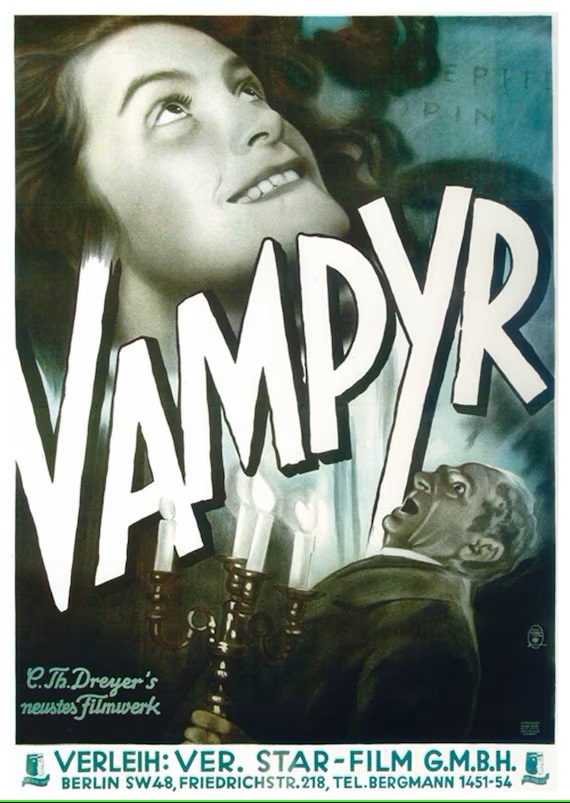
It feels like some sort of bizarre joke. What did Carl Theodore Dreyer direct after The Passion of Joan of Arc? A vampire movie of course! Vampyr for decades was seen as a curious footnote on Dreyer’s CV, so out-of-step with the rest of his filmography that cinematic experts have suggested it was nothing more than a naked attempt to turn a few coins at the box office (something which, like almost all of Dreyer’s work, is spectacularly failed to do). But this is the work of a master visualist film-maker: Vampyr is a vampire movie almost unlike any other, something so dark, surreal and unsettling that will haunt your nightmares.

Inspired by the work of Sheridan Le Fanu, Vampyr (subtitled The Strange Adventures of Allan Gray) follows the arrival of Allan Gray (Julian West) in a strange, secluded village where almost everyone seems to be in a trance, and a series of strange, unexplained events occurs. In the grand house of the lord of the manor (Maurice Schitz), his daughter Léone (Sybille Schmitz) lies dying and her sister Gisèle (Rena Mandel) can’t work out why. When the lord of the manor dies suddenly, West stumbles across what might be the truth: the terrible power of the undead, a mysterious creature that rises from its coffin every night to consume the living and send their souls to damnation.

Vampyr unfolds like something between a dream or a trance. It has lashings of the surreal in almost every scene, and it scrupulously avoids clear or even rational explanations. Events frequently happen for seemingly no rhyme or reason, dreams come to life, shadows gain mysterious powers and everything is designed to unsettle, confuse or mystify us. Camera movements seem designed to disorientate and confuse us about the geography of the locations in the film. It’s shot in a hazy slight blur (a deliberate effect by Dreyer and photographer Rudolph Maté) which adds to the sense that we are halfway between sleep and awake. It adds up to something unsettling, unpredictable but also hauntingly off-kilter.

Vampyr was Dreyer presenting a film the antithesis in almost every way to The Passion of Joan of Arc. He set up his own production company to make it – gaining funding from a Baron Nicolas de Grunsberg (who required that he play the lead role, under the pseudonym Julian West). Joan of Arc was filmed on huge sets, in stark close-up and a static camera, that would bore into every emotion of its characters. Vampyr would be shot on location with a constantly moving camera, performed by actors encouraged to perform as if hypnotised. Where one was about realism, the other would be about occultish fantasy, one about truth the other about concealment.

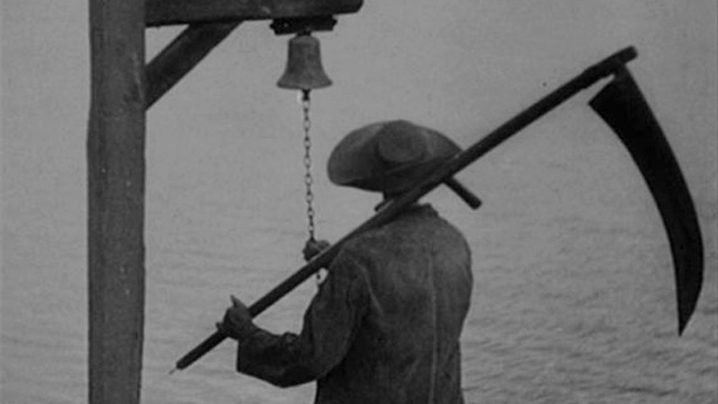
It ends with Dreyer creating a strikingly originally, deeply surreal and fascinating film, a vampire film in its way as influential as Nosferatu. While Murnau’s film would be unsettling in its painterly composition and the twisted, jittery movements of its lead,Dreyer’s would have the quality of a nightmare. From the start, images to unsettle and disturb the viewer are marshalled brilliantly. Gray’s arrival at his accommodation – with an unsettling, disturbingly long wait for a door to open – is intercut with shots of a mysterious man carrying a huge scythe waiting for a ferry to take him across the river. From such details, Dreyer imposes a sense of twisted unpredictability.

When Gray enters the house he will stay in, the camera seems to whip around the building, making sharp but smooth turns, constantly leaving us slightly disoriented as to where we are. It only gets worse for us as Dreyer throws in the first of a series of sequences where it is almost impossible to tell if what we are watching is real, a dream or something in between. Gray explores a nearby mill, the camera tracking smoothly away from him past a white wall, where we see shadows of a bizarre waltz play out to music, stopped only by the cry of a distant old woman for ‘Quiet!’. In the mill, Gray discovers an array of coffins, strange objects and the sounds of children and dogs – sounds which no one else can seem to hear.

Dreyer continues this unpredictable mise-en-scene throughout the film. The camera constantly focuses on the strange movements of shadows on floors and walls – scenes constantly play out only in shadow. The actors – nearly all of them amateur (and, to be fair, nearly all of them not great) – walk about as if in a daze, robotically delivering lines and as hazy and transmutable as the shadows. Gray even has a literal out-of-body experience, his ghostly double projection reflection separating from his body, to witness a dream (or premonition) of his own funeral.

This sequence is another chilling display of horror, as the ghost Gray opens a coffin to find himself inside – rigid and unable to move – before he finds himself in the coffin, witnessing the lid being screwed in (something we also witness from his POV), but able to see outside through a window in the lid. From this prone, trapped position he witnesses the coffin carried to the church and buried before he awakes. It’s but one nightmareish entombment we see in the film, another character facing the horrific fate of being buried alive under a mountain of freshly sieved flour, his hands grasping hopelessly for freedom above him.

Through it all we see nothing graphic – there is only one brief drop of blood – but everything remains unexplained and terrifying. Doors open seemingly unaided. Discordant sounds are heard (the film’s primitive, intermittent sound actually becoming a benefit for its unsettling effect) and its as if the whole world is collapsing in on itself into a small, nightmareish stumble around a house or garden in unpredictable, hard-to-interpret haze where nothing is as it seems and where everyone seems to be acting under a dark influence.

Dreyer’s Vampyr is horror in its most unexplained, unsettling and ungraphic style. It’s the fear of being trapped in a bad dream you can’t wake from, unfolding in a nightmareish atmosphere of unpredictability and terror where nothing is ever what it seems. Imagery and mood is crucial and Dreyer’s precise but ever-moving camera seems to float unnaturally through all the action. With its touches of the surreal and unpredictable it’s deeply unsettling, haunting and surprisingly effective. Far from a footnote, it shows the depth and ambition of Dreyer’s skill and cinematic vision.

Rocco and His Brothers (1960)

Rocco and His Brothers (1960)

Visconti’s realistic family epic simmers with the dangers of split loyalties, but is mixed on gender politics

Director: Luchino Visconti

Cast: Alain Delon (Rocco Parondi), Annie Girardot (Nadia), Renato Salvatori (Simone Parondi), Katina Paxinou (Rosaria Parondi), Roger Hanin (Duilio Morini), Spiros Focas (Vincenzo Parondi), Claudia Cardinale (Ginetta), Paolo Stoppa (Tonino Cerri), Max Cartier (Ciro Parondi), Rocco Vidolazzi (Luca Parondi, Alessandro Panaro (Franca), Suzy Delair (Luisa), Claudia Mori (Raddaella)

Visconti was born into a noble Milanese family: perhaps this left him with a foot in two camps. He could understand the progress and achievement of northern Italy in the post-war years, those booming industry towns which placed a premium on hard work, opportunity and social improvement. But he also felt great affinity with more traditional Italian bonds: loyalty to family, the self-sacrificing interdependency of those links, and the idea that any outsider is always a secondary consideration, no matter what. It’s those split loyalties that power Rocco and His Brothers.

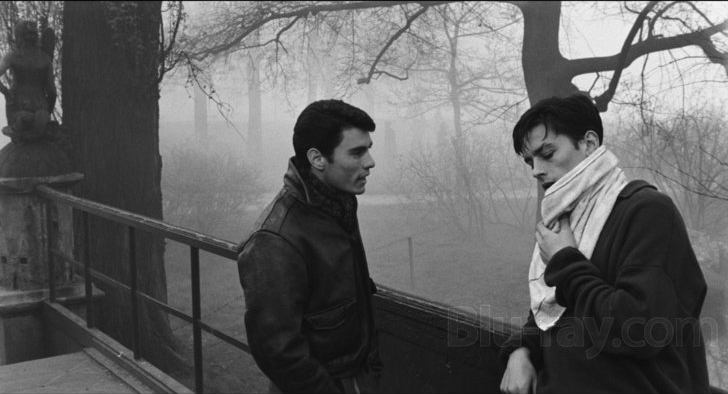
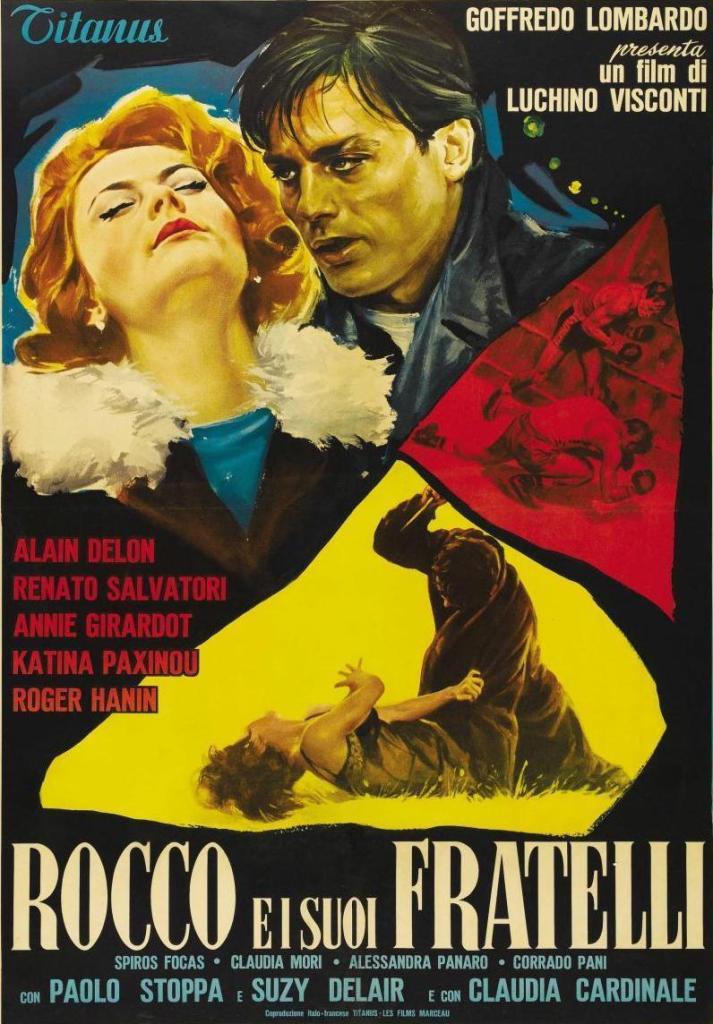
Rocco (Alain Delon) is one of five brothers, arriving in Milan from the foot of Italy looking for work with his mother Rosaria (Katina Paxinou). The hope of the family is second brother Simone (Renato Salvatori), a sparky pugilist destined for a career as a boxing great. But Simone can’t settle in Milan, too tempted by the opportunities he finds for larceny and alcohol. He falls in love with a prostitute, Nadia (Annie Girardot), until she rejects him and then he drifts ever downwards. Rocco, always putting family first, inherits his place first as a boxer than as Nadia’s lover. Problem is, Simone is not happy at being replaced, and the three head into a clash that will see Nadia become a victim in the twisted, oppressive, family-dominated loyalty between the two brothers.

Rocco and His Brothers is a further extension of Visconti’s love of realism – but mixed with the sort of classical themes and literary influences that dominated his later period pieces, themselves in their stunning detail a continuation of his obsession with in-camera realism. Filmed in the streets of Milan, where you can feel the dirt and grit of the roads as much as the sweat and testosterone in the gym, it’s set in a series of run-down, overcrowded apartment blocks and dreary boxing gyms that you could in no way call romantic.

This ties in nicely with Visconti’s theme. Rocco and His Brothers is about the grinding momentum of historical change – and how it leaves people behind. In this case, it’s left Rocco and Simone as men-out-of-time. Both are used to a hierarchical family life, where your own needs are sacrificed to the good of the family and every woman is always second best to Momma. While their brother Ciro knuckles down and gains a diploma so he can get a good job in a factory, Simone drifts and Rocco bends over backwards to clean up the mess his brother leaves behind. Naturally, Simone and Rocco are the flawless apples of their mother’s eye, Ciro an overlooked nobody.

The film focuses heavily on the drama of these two. And if Visconti seems split on how he feels about the terrible, destructive mistakes they make, there is no doubting the relish of the drama he sees in how it plays out. Rocco, by making every effort to make right each of the mistakes his brother makes, essentially facilitates Simone’s collapse into alcoholism, criminality and prostitution. Simone flunks a boxing contract? Rocco will strap on the gloves and fulfil the debt. Simone steals from a shop? Rocco will leave his personal guarantee. Simone steals from a John? Rocco will pay for the damage.

Caught in the middle is Nadia, a woman who starts the film drawn to the masculine Simone but falls for the romantic, calm, soulful Rocco. Wonderfully embodied by Annie Girardot, for me Nadia is the real tragic figure at the heart of this story. Whether that is the case for Visconti I am not sure – I suspect Visconti feels a certain sympathy (maybe too much) for the lost soul of Simone. But Nadia is a good-time girl who wants more from life. Settling down to a decent job with Rocco would be perfect and he talks to her and treats her like no man her before. Attentive, caring, polite. He might be everything she’s dreaming off, after the rough, sexually demanding Simone.

Problem is Nadia is only ever going to be an after-thought for Rocco, if his brother is in trouble. Alain Delon’s Rocco is intense, decent, romantic – and wrong about almost everything. He has the soul of a poet, but the self-sacrificing zeal of a martyr. He clings, in a way that increasingly feels a desperate, terrible mistake, to a code of conduct and honour that died years ago – and certainly never travelled north with them to the Big City. When Simone lashes out at Nadia with an appalling cruelty and violence, making Rocco watch as he assaults her with his thuggish friends, Rocco’s conclusion is simple: Simone is so hurt he must need Nadia more than Rocco does. And it doesn’t matter what Nadia wants: bros literally trump hoes.

Rocco does what he has done all his life. He wants to live in the south, but the family needs him in the north. He wants to be a poet, but his brother needs him to be a boxer. He loves Nadia but convinces himself she will stabilise his brother (resentful but trapped, she won’t even try, with tragic consequences). All of Rocco’s efforts to keep his brother on the straight-and-narrow fail with devastating results. Naturally, his mother blames all Simone’s failures on Nadia, the woman forced into trying to build a home with this self-destructive bully. Rocco’s loyalty – he sends every penny of his earnings on military service home to his mother – is in some ways admirable, but in so many others destructive, out-dated indulgence.

And it does nothing for Simone. Superbly played by Renato Salvatori, he’s a hulk of flesh, surly, bitter but also vulnerable and self-loathing, perfectly charming when he wants to be – but increasingly doesn’t want to. His behaviour gets worse as he knows his brother is there as a safety net. It culminates in an act of violence that breaks the family apart: not least because Simone crosses a line that Ciro (the actual decent son, who Visconti gives precious little interest to) for one cannot cross and reports him to the police.

That final crime is filmed with a shocking, chilling naturalism by Visconti, horrific in its simplicity and intensity. But I find it troubling that Visconti’s core loyalties still seem to be with the out-of-place man who perpetrates this crime and his brother who protects him, rather than female victim. Rocco and His Brothers could do and say more to point up the appalling treatment of Nadia, or at least make clearer the morally unforgiveable treatment she receives from both brothers (she’d have done better disappearing from Milan after Simone’s attack and never coming back, not playing along with Rocco’s offensive belief that Simone’s assault was a sort of twisted act of love).

Saying that, this is a film of its time – perhaps too much so, as it sometimes feels dated, so bubbling over is it with a semi-Marxist view of history as a destructive force. But it’s shot with huge vigour – the boxing scenes are marvellous and their influence can be felt in Raging Bull – and it ends on a note of optimism. The film may have disregarded Ciro, but there he is at the end – happy in his choices, settled, making a success of his life. Rocco and Visconti may see the drama as being exclusively with the old-fashioned brothers, making their counterpoint a paper tiger, but it ends with him – and (I hope) a reflection that Ciro’s path may be duller and safer, but also nobler and right.

Cat Ballou (1965)

Cat Ballou (1965)

Zany western comedy, a little dated, but with almost enough good jokes

Director: Eliot Silverstein

Cast: Jane Fonda (Cat Ballou), Lee Marvin (Kid Shelleen/Tim Strawn), Michael Callan (Clay Boone), Dwayne Hickman (Uncle Jed), Nat King Cole (Sunrise Kid), Stubby Kate (Sam the Shade), Tom Nardini (Jackson Two-Bears), John Marley (Frankie Ballou), Reginald Denny (Sir Harry Percival)

In a town out West in Wyoming, Cat Ballou (Jane Fonda) is to be hanged as a notorious outlaw. How did she end up here? Let Nat King Cole and Stubby Kaye tell you as they recount ‘The Ballad of Cat Ballou’. This young, would-be school-teacher ended up on the gallows after a feud over her father’s (John Marley) land with Sir Harry Percival (Reginald Denny). Percival has a brutal hired gun, Tim Shrawn (Lee Marvin). So, Cat hired her own gunman, the legendary Kid Shelleen (Marvin again) who has become an equally legendary drunk. After the death of her father, Cat, Kid and her friends and love interests form a gang to bring Percival’s corporation down.

Cat Ballou stems from an era when audiences were not quite ready for the violent, nihilistic Western revisionism that would spawn the likes of McCabe and Mrs Miller and The Wild Bunch, but could no longer take the Ford/Wayne style Western seriously. Instead, it takes its inspiration from Swinging Sixties comedy, playing like Tom Jones or a Dick Lester Beatles movie. It’s zany, tongue-in-cheek, daubed in primary colours and nothing in it is meant to be taken particularly seriously, not even the bullets. It’s a fast-paced entertainment and if it looks rather dated today, at least it has its moments.

It’s most notable as the film that won Marvin the Oscar for his double performance as the drunk, shambling Kid Shelleen and the Marvinesque heavy Tim Strawn (with missing nose). Marvin revelled a chance to showcase his comic skills – and even have his stereotypical role as a bruising, violent killer as a contrast. Kid Shelleen doesn’t turn-up until almost a third of the way in, but all the film’s most memorable moments involve him. Slurring, scruffy, stumbling and only able to shoot straight when a little bit pissed (in an early shooting test he literally can’t hit a barn door), Marvin offers not only a red-eyed piece of comedy acting just this side of hammy, but also a neat jokey commentary on the truth behind an army of Western heavies (Cat is hugely disappointed to find the stories she’s read of Kid’s exploits, in no ways matches the mess she sees before her).

Marvin, rather graciously, always claimed of his Oscar “that half of this belongs to a horse somewhere out in San Fernando Valley”. It’s a touchingly modest reference to the film’s closing sequence – the inevitable rescue attempt on Cat – where Kid turns up pissed, riding a horse that seems as drunk as him (a neat shot, that took much careful animal wrangling, shows both Kid and his horse leaning lopsidedly against a wall, the horse with its legs drunkenly crossed). But Marvin’s performance works because it nails the tone of the film in a way no-one else really does.

That’s arguably true of Jane Fonda, who seems either slightly bemused or mildly contemptuous of the role she’s ended up in. When the film throws in moments close to tragedy, she reacts with more emotional realism than a zany comedy can support. She’s not willing to surrender herself to the moments of farce or flirtation, not helped by the dull or forgettable performances of her love interests. Callan lacks charisma or flair as outlaw Clay Boone, Dwayne Hickman overeggs as Boone’s comedic partner-in-crime Uncle Jed while Tom Nardini tries hard but lacks grace as Jackson Two-Bears. Fonda is also stuck in the only role where she can’t corpse at the drunken antics of Marvin.

The film bounces along, from its animated opening, via a series of comedic twists on Western tropes (a dance, a fight, a train robbery etc). Personally, I’ve never really been a fan of zany comedies, and my mind wasn’t changed here. Mixed with its very 60s view of the West, all colour splashed checked shirts, the try-hard craziness of Cat Ballou can start to wear cynical modern viewers like me down.

Which isn’t to say there isn’t a good joke here or there, or that Marvin isn’t worth the price of admission. Silverstein directs with a professional smoothness that leaves the actors to get on with it (perhaps a little too much). The darker moments of the film don’t always marry up successfully with the tone – Cat’s reaction to the death of her father is from a different movie altogether – but generally it glides along, helped with some catchy tunes well sung by Cole and Kaye as a ballad-touting Greek Chorus.

Cat Ballou might actually be best enjoyed by taking a leaf out of Kid Shelleen’s books: get a couple of whiskies inside you and you’ll find the accuracy of your laughter jumping up several notches.

Seven Chances (1925)

Seven Chances (1925)

Sub-par Keaton comedy, remembered only for its chase scene, but otherwise best forgotten

Director: Buster Keaton

Cast: Buster Keaton (James Shannon), T Roy Barnes (Billy Meekin), Snitz Edwards (Lawyer), Ruth Dwyer (Mary Jones), Frances Raymond (Mrs Jones), Erwin Connelly (Clergyman), Jules Cowles (Hired Hand), Jean Arthur (Receptionist)

It’s the film Keaton didn’t care for – so much so he told a film restorer working on his films to essentially not bother with it. It was a play purchased for him by producer Joseph Schenck, rather than chosen by the physical-comedy gag-meister, who called it a “sappy farce”. Still, he did his best with it – and then some, since it became one of his biggest hits – and, if it’s far from a stand-out on his CV, that’s not Keaton’s fault. In fact, the only parts of the film anyone remembers are all due to Keaton alone.

The plot follows businessman James Shannon (Buster Keaton). He finds out from a lawyer (Snitz Edwards) that he is to inherit $7million – but only if he is married by 7pm on his 27th birthday. And naturally, today is his 27th birthday! Bungling his proposal to the girl he loves (but was always too shy to ask) Mary (Ruth Dwyer), he and his business partner (T Roy Barnes) head to a country club and ask every girl he can see to marry him. They all say no (guess how many he asks) until an advert in the paper revealing the fortune awaiting a willing bride, produces an army of ladies who will chase Shannon to the ends of the earth for marriage. Can he get back to Mary, reconcile and marry by 7pm?

You can see why Seven Chances is an awkward fit for Keaton. He was more comfortable in a role where the world was awash with obstacles. From natural elements to modern machinery, Keaton was the impassive little guy struggling against the odds. He was much less suited to the faintly unsympathetic Shannon, where coincidence, shyness and poor explanations were his problem. Keaton reworked the character to make him more sympathetic – it’s shyness rather than unwillingness that delays his proposal (in an opening technicolour sequence showing the passing of the seasons around Shannon’s ever-delayed proposal), but its still a role he lacks affinity for.

The film’s opening is too dialogue driven – it throws up more title cards than almost any Keaton film you can think of – and Keaton looks restrained by the role. It’s telling that the “Keaton” part for the first ten minutes goes to Snitz Edwards (very funny with his eternally put-upon face) who struggles to get anyone to listen to his news about a possible inheritance. The film rushes through much of the plays plot in its opening 40 minutes, recognising that it’s essentially the same gag – Keaton asks a woman to marry him, she says no – repeated over and over again.

Those seven chances whizz by in the country club, as a progression of women (including an unbilled, pre-fame Jean Arthur) turn him down with a mix of laughter, anger and contempt. To be honest its diminishing returns, even with some Keaton directorial flair (one proposal takes place walking up the stairs, without breaking step after rejection Keaton walks down the stairs with a second unwilling woman). There is nothing for Keaton to get his teeth stuck into.

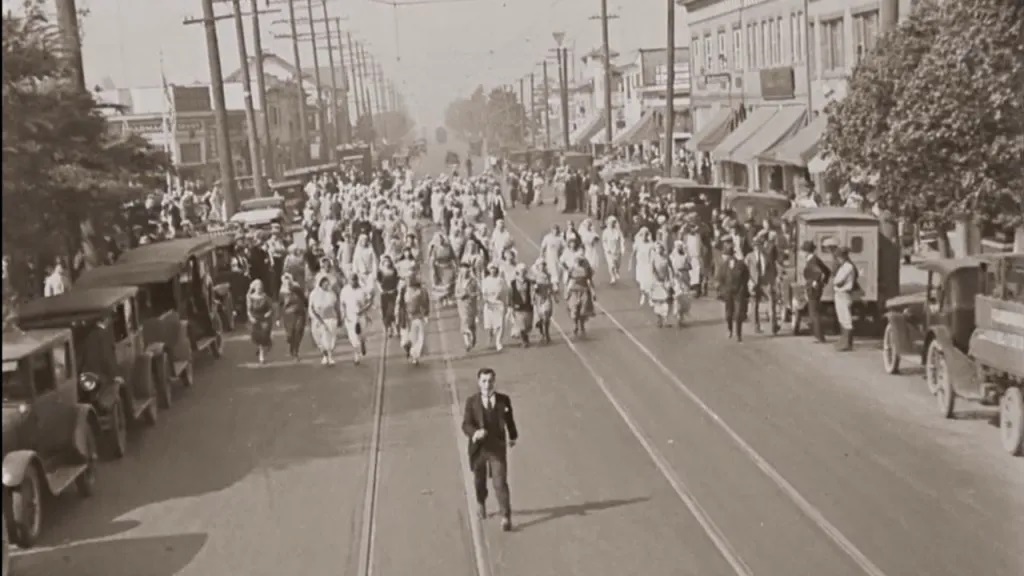
It’s only in the second half, the play forgotten, that Keaton finds sure ground – and the films memorable moments. The advert produces an army of women – in some shots, it looks like hundreds if not more. As Keaton sleeps in a church pew, it slowly fills up around him. Eventually a clever cross fade (similar to an early cross fade that moves a cars location without it moving in frame from one house to the other – Keaton understood editing like few others) sees the church filled with women. Keaton awakes, is ambushed under a scrum of would-be brides and makes his escape.

What follows is a madcap chase through the streets – including several inspired tracking and crane shots stressing the speed and the size of the pursuing crowd. The chase passes through a police march, a football game (where the players are all crushed by the mob), an industrial plant and then into the countryside, Keaton running for all he is worth.

At one point Keaton intended to end the film like this. It wasn’t until a test audience failed to laugh that he realised it needed to change – and he cottoned onto the unexpectedly loud laugh from when he had thrown himself down a hill (a suicidal looking jump on screen) and dislodged some rocks, causing a small avalanche. Back out to location they went, accompanied by dozens of papier-mâché rocks of various sizes, and scaled up the gag to huge levels, Keaton running, leaping and climbing up trees to escape this onslaught of boulders. It also created a reason for the women to be blocked off – and allow Keaton to escape to propose to his girl and create the just-in-time happy ending.

It’s that chase people remember – and gives Seven Chances a fonder public image than it deserves. But its ten minutes of great material in over an hour of sub-par Keaton. It doesn’t help that this film, more than any other Keaton, has a parade of black-face gags (Jules Cowles in a head-in-hands performance today) revolving around Mary’s servant, who is (of course) stupid, slow and lazy. It’s compounded by a gag where Keaton rejects (in horror) the idea of proposing to a Black woman.

Seven Chances is fondly remembered for its chase – but if you want to watch a Keaton chase, there are many better options than this, a film meaner and less good-natured than his best work.

The Grapes of Wrath (1940)

The Grapes of Wrath (1940)

Steinbeck’s masterpiece is transformed into a richly humanitarian and heartfelt film

Director: John Ford

Cast: Henry Fonda (Tom Joad), Jane Darwell (Ma Joad), John Carradine (Jim Casy), Charley Grapewin (Grandpa Joad), Dorris Bowdon (“Rosasharn” Joad), Russell Simpson (Pa Joad), OZ Whitehead (Al Joad), John Qualen (Muley Graves), Eddie Quillan (Connie Rivers), Zeffie Tilbury (Grandma Joad), Frank Sully (Noah Joad), Frank Darien (Uncle John), Darryl Hickman (Winfield Joad)

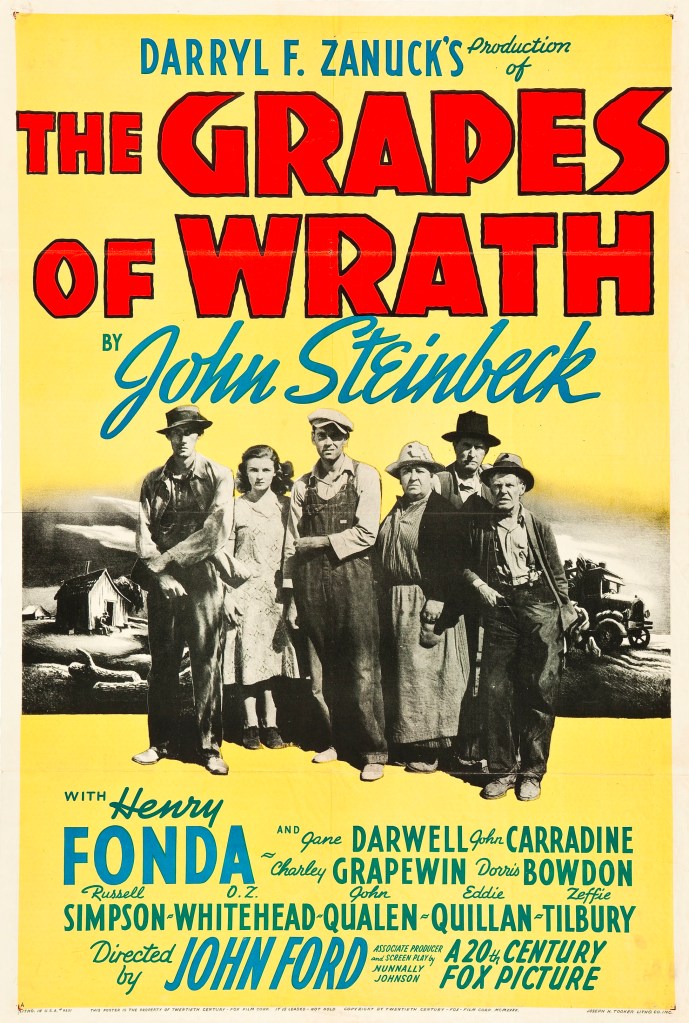
If you can be certain of one thing, it’s that times of economic hardship rise and fall like waves on the shore. John Steinbeck’s novel The Grapes of Wrath was a searing, powerful exploration of the impact of the Dust Bowl, the Great Depression and new farming technologies on Oklahoma tenant farmers. It was almost immediately cemented as a Great American Novel. Just as Ford’s moody, heartfelt, humanitarian film of it was immediately hailed as a Great American Film.

In Oklahoma, Tom Joad (Henry Fonda) is released from prison (after killing a man in a bar fight) to find his farming community has been devastated. The Depression has shattered the market and the landowners now farm their land with tractors rather than people. Tom and his family have no choice but to load up a beaten-up van and migrate to California where they have hopes of work picking fruit for meagre wages. What they find on the way, among small acts of kindness, is exploitation, brutal policing determined to crush any protest from migrants and migrant camps in terrible conditions. Misery, death and the endless grind of fading hopes seems to be all they have to look forward to.

The Grapes of Wrath moved to the screen faster than almost any other novel in history. Published in April 1939, in months Nunnally Johnson had completed a script and shooting began in October for release in 1940. The unprecedented speed spoke to the book’s enormous impact, which has remained eternally relevant in its depiction of the hostility faced by migrants. Producer Darryl F Zanuck, despite his passion for the novel, worried it would be seen as pro-Communist propaganda – thankfully basic research showed Steinbeck had, if anything, played down the labour conditions. Zanuck was convinced he could defend any accusation of anti-Americanism – perhaps, as well, he decided recruiting the film poet of romantic Americana, John Ford, as director would lay any change The Grapes of Wrath could be seen as an attack on the US to rest.

Ford was in fact a near perfect choice as director. A man who held his Irish migrant roots close to his heart, he felt a powerful bond with these victims of changed circumstances. As a man with a romantic view of America’s Golden Age, he was equally critical of sharp technology changes (he shoots the tractors who plough through the Oklahoma farmland as monstrous tanks, crushing hope below their ominous caterpillar tracks). Working closely with cinematographer Gregg Toland, he shot a film with one foot in realism, the other in low-lit, moody impressionistic shadow, a rich visual treat that marries both methods to enforce the appalling economic situation it depicts.

From its opening shot, which frames Tom Joad walking across Oklahoma desert land framed with telegraph poles, the idea of ordinary people left behind by technological change rings out. Tom’s farmstead Tom is derelict with one tenant recounting his eviction in a cramped room lit by a single candle. The Joad’s leave for California in a truck so beat up, it only just starts and appears to be partially made of wood. The California shanty town they are herded into is contrasted with the sleek automobile of the landowner offering work for a pittance. In the government run camp, we see running taps and modern bathrooms that seem space-age compared to the squalor we’ve seen.

The Grapes of Wrath doesn’t shirk in its anger at the ill-treatment of these sons of the soil. In California, the bosses are cruel, uncaring and greedy. The flyers the Joad family clutch hoping for work, is one of thousands recruiting for only hundreds of jobs. Salaries are constantly undercut – at their second camp, the Joads work exhaustingly for just about enough to feed them for the day. The sheriffs are little more than heavies for the bosses, breaking up protests at pay, arresting and beating ‘trouble makers’ and turning a blind eye to any threats or danger to the migrants.

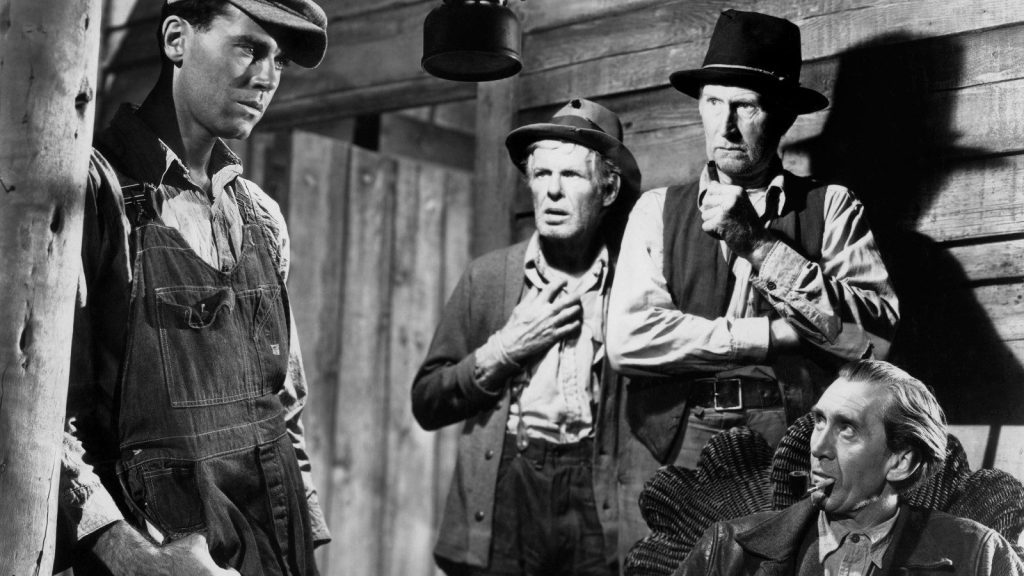
The injustice of it is captured in a superb speech by John Carradine’s Jim Casy, a former preacher whose faith has been replaced by a burning passion to protect the rights of the little guy. Shot by Toland in a shadow-drenched, candle-lit tent, Carradine delivers with impassioned brilliance an inarticulate but moving speech on the need for the workers to stick together to combat exploitation. He follows in the footsteps of an earlier ‘rabble rouser’, whose denunciation of a fat-cat businessman is met with gunfire from a sheriff (a woman being near-fatally shot in the aimless fire).

It’s feelings that will inspire Henry Fonda’s Tom Joad. Fonda is marvellous as this plain-speaking man with a streak of self-destruction, who learns to focus his anger aware from his own needs to fighting for others. With his father – well-played by Russell Simpson – increasingly ineffective, Tom transforms himself slowly into a leader. His lolloping stance doesn’t detract from his everyman nobility. Fonda even manages to make some heavy-handed, speechifying really work as a profound statement of human rights.

He’s joined in this with the film’s third stand-out, the Oscar-winning Jane Darwell as the indefatigable “Ma”. Darwell becomes the family lodestone and an epitome of resilient spirit, her pained but patient face returned to again and again. Darwell as at the heart of many of the most moving moments, perhaps the most one of its simplest: Ma quietly, with sad smiles, burning old mementoes and holding up a pair of earrings to study her reflection in the flickering candlelight. Ma holds the family together, from cradling the dying Grandma on the floor of the truck to desperately hiding Tom from the vindictiveness of the police. Ford closes the film with a powerful speech of hope and resilience from Ma, again wonderfully delivered by Darwell in simple, unflashy close-up.

Despite that delivery though, the end film’s final act doesn’t ring true with what has gone before. The film reshuffles the novel’s plot. That culminated in a bleak miscarriage in a windswept hut. The well-built government-run migrant town is a stopping off point, a moment of hope, in a grim journey towards desolation. Here it is the final destination – and the community dances, organised by benevolent caretakers, feels like a cheat of reality. Perhaps Zanuck felt a relatively hopeful ending was needed to balance those fears of Anti-Americanism. Either way, it never feels like a ‘real’ ending: this economic catastrophe didn’t end like this for many, so it shouldn’t for our everymen.

It is perhaps, though, the only major flaw in Ford’s superb film. It’s a film sprinkled with as many small moments of peace and hope as it is injustice. The Joads enjoying a swim in the lake, or the kindly garage staff who let Pa buy bread and sweets for the kids at a price far below their value warms the heart. The shanty towns are given a real sense of community by Ford. It makes the stark cruelty of those in charge stand-out all the more.

The film doesn’t shirk on the grim surroundings. The detail of the squalor is magnificently delivered, while the foreboding, shadow filled lighting of Toland’s photography is exceptional. With a host of excellent performances, Grapes of Wrath is the finest statement of Ford’s overlooked humanitarianism. He was a director with a warm regard for the common man, who believed in their righteousness and right to just treatment. This streak runs strong throughout The Grapes of Wrath and makes a film that is never sentimental, but arouses huge sentiment in anyone who watches it.

Indiana Jones and the Dial of Destiny (2023)

Indiana Jones and the Dial of Destiny (2023)

Is there a place for Indy in the 2020s? The nostalgia-tinged would-be epic doesn’t provide an easy answer

Director: James Mangold

Cast: Harrison Ford (Indiana Jones), Phoebe Waller-Bridge (Helena Shaw), Mads Mikkelsen (Jurgen Voller), Antonio Banderas (Renaldo), John Rhys-Davies (Sallah), Toby Jones (Basil Shaw), Boyd Holbrook (Klaber), Ethann Isidore (Teddy Kumar), Karen Allen (Marion Ravenwood), Shaunette Renée Wilson (Mason), Thomas Kretschmann (Oberst Weber), Olivier Richters (Hauke)

Okay let’s get the elephant out of the room: It’s better than The Kingdom of the Crystal Skull. Yes folks, we have a new fourth-best Indiana Jones film. Is that something to celebrate? Indiana Jones and the Dial of Destiny makes some of the same errors as the previous valedictory effort, but at least it learned a few things and it’s been made by people who clearly love Indy. But they loved it too much, creating an often overblown, hellishly overlong, everything-but-the-kitchen-sink film which never just jump when it can flip, spring, bounce then explode at the end of it.

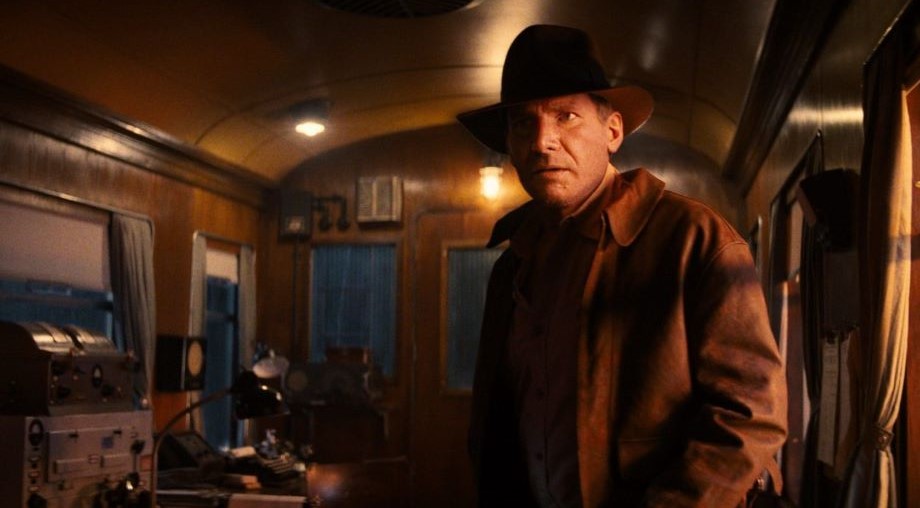
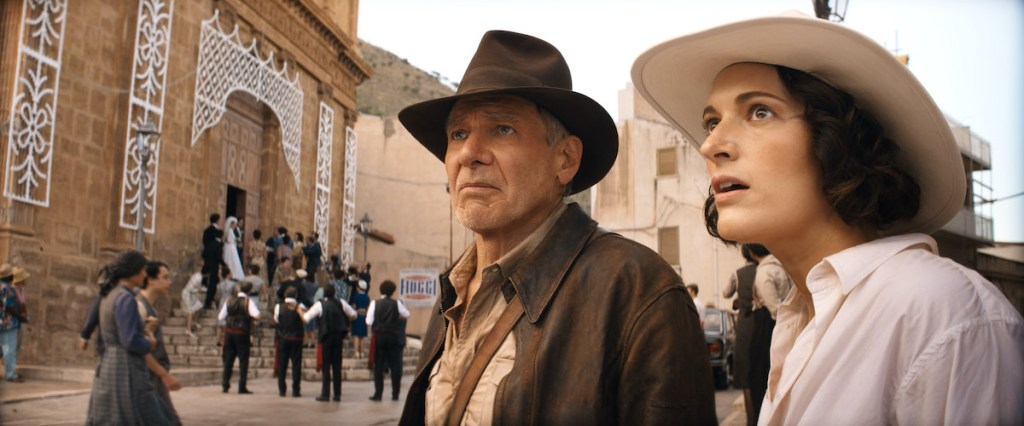
It opens with a (younger) Indy (Harrison Ford) battling Nazis in the dying days of the Second World War, trying to save a train full of precious artefacts. After defeating them, we flash forward to 1969 with Indy now a retiring archaeology professor to disinterested students in New York’s Public University, out of a place in an era where man has stepped on the moon. Grouchy, separated and fed-up, Indy’s life gets disrupted one more time when his god-daughter Helena Shaw (Phoebe Waller-Bridge) turns up on the hunt for Archimedes’ Dial. Indy knows about this dial as it was also the obsession of Nazi physicist Jurgen Voller (Mads Mikkelsen), last seen on that train in 1945 and now the brains behind the NASA moon landings. Indy and the unscrupulous Helena end up in a duel with Voller to find the dial – the prize being what Voller believes is a chance to change history.

Back in the day, Raiders of the Lost Ark was largely made so Spielberg and Lucas could show they could make an action-packed, crowd-pleaser quick and cheap. Today The Dial of Destiny is one of the most expensive films ever made (lagging only behind assorted Avengers films, the recent Star Wars trilogy and various other franchise entries). So much mony to make something less than half as good.

What this has allowed is Mangold and co to act like kids given the keys to their parents’ car. The Dial of Destiny is an explosion of Indy ideas, all rammed into the film willy-nilly. It’s made by people who feel this is their only chance to make an Indy film and don’t want to miss the opportunity to include every idea they’ve ever had.

We end up with a film that feels both far too long and yet strangely rushed. The Dial of Destiny would be immeasurably improved if about twenty minutes (at least) had been cut from its run-time and its poorly sketched thematic ideas condensed down. Its narrative structure has one too many quests, with Indy and Helena forever searching for a thing that leads to a thing that leads to yet another thing. An entire sequence, involving a pointless cameo from Banderas as a one-legged diver, would have been better slashed to ribbons or cut altogether. Every single one of the mega-budget chase sequences go on at least 2-3 minutes too long, straining the interest.

At the same time, the film manages to feel rushed. Ideas are presented and then taken nowhere at all. We see Indy tipping most of a bottle of whisky into his coffee in the morning – this suggested alcoholism never rears its head again. Voller is working in partnership (it seems) with the CIA, but their motives for this are never explained and Voller calmly ditches them part way through the film. Indy is framed for murder, but this plot thread is judicially abandoned by the time we get to the end. John Rhys-Davies literally pops up to drive Indy to an airport and make a trailer-friendly speech.

Most strikingly, all the films blaring action and endless bangijg stuff buries the most interesting plot thread of a tired, depressed Indy who no longer knows his place is in the world. The film solves Shia LaBeouf’s toxic unpopularity by having Mutt die in Vietnam, giving Indy a burden of guilt and grief. This is an Indy who has fallen from his Princeton heights, as ancient to his students as the artefacts he lectures about. It’s a thread though that the film only intermittently remembers, so crowded out is it by overlong chases, so that when the film’s conclusion returns to it as a major motivator for Indy it feels forced.

In any case, the film’s action set-pieces peak with the 1945 opening section with a digitally de-aged Ford and Mikkelsen facing off on a speeding train. I think the de-aging effect is very well done (though Indy speaks with Ford’s current 80-year-old voice), and this sequence has a sort of nostalgic charm to it and at least it feels of a piece with the originals. Not that its perfect: it’s overlong and overblown of course – a castle explodes, Indy runs over the top of a speeding train – and looks like something created with blue-screens and digital effects rather than in reality. (It’s also clear a digitally de-aged Ford head has been placed on a stunt double at key points.)

But it’s a bright-spot. There are others: Harrison Ford, again, is perfect for the role – crusty, resigned but still with the glamour of excitement in his eyes. He and the film don’t back away from his advanced age – Indy looks more vulnerable than ever – and Ford sells the moments he’s allowed in the film’s breakneck speed to reveal Indy’s emotional turmoil. He also has a great chemistry with Phoebe Waller-Bridge, who effectively channels Han Solo as an immoral adventurer who learns about decency. Mikkelsen’s mastery makes him an impressive villain.

I’ve been really hard on this film. It is fun I promise. I laughed and at times I was thrilled. But it is too much. Even the settings of the chases offer a sensory and time overload: a chase around a ticker-tape parade in New York onto a subway (with Indy on a horse) has an overload of visual details. A chase through the streets of Marrakesh goes on forever – and is over-built with our heroes chasing Voller while also being chased by Helena’s gangster-former-fiancee. film culminates in a final sequence which is just about not as silly as aliens – but by any other score is incredibly silly.

Essentially The Dial of Destiny is undermined by fan love. Mangold is a good director but doesn’t know where to stop. The film leans into nostalgia too hard but, above all, it offers far too much bang for your buck. The film is frequently at its most effective in its quieter, character-driven moments. Like Crystal Skull, it mistakes bigger for better. It’s still a more entertaining and a better film than Crystal Skull – but, somehow, its excessive overindulgence makes you feel strangely disappointed.

Rocky II (1979)

Rocky II (1979)

Rocky Balboa rides again, in Stallone’s enjoyable virtual remake of the first film

Director: Sylvester Stallone

Cast: Sylvester Stallone (Rocky Balboa), Talia Shire (Adrian Balboa), Burt Young (Paulie Pennino), Carl Weathers (Apollo Creed), Burgess Meredith (Mickey Goldmill), Tony Burton (‘Duke’ Evers), Sylvia Meals (Mary Anne Creed), Joe Spinell (Tony Gazzo)

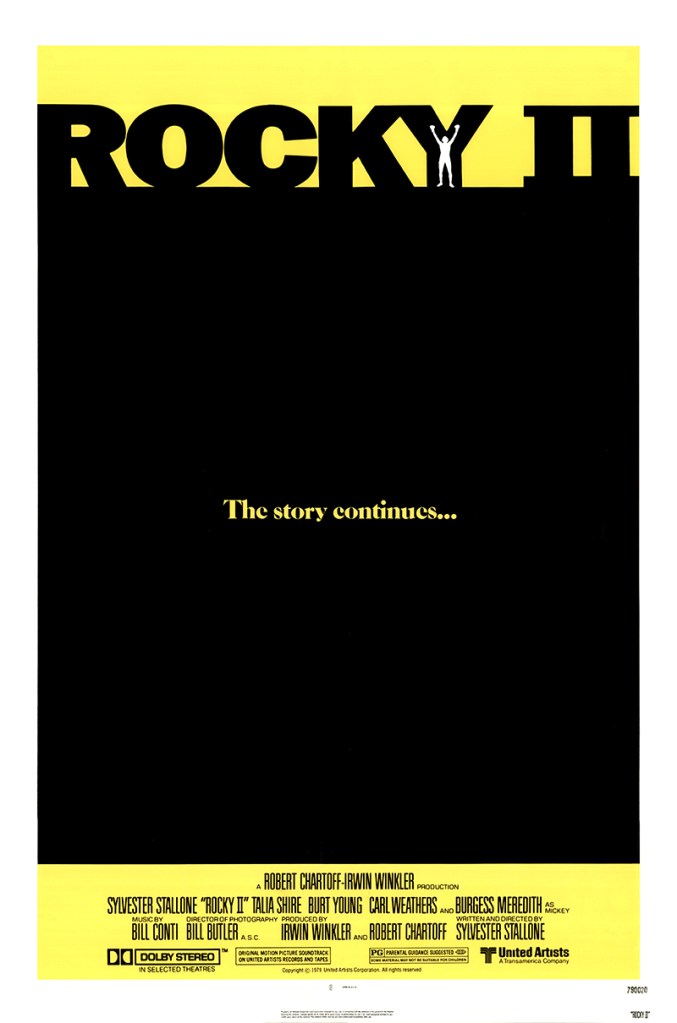
It’s minutes after the end of that shock title fight won (just) by Apollo Creed (Carl Weathers – very good here as a curled ball of frustration), but already the champ is smarting since the moral victory was won by plucky challenger Rocky Balboa (Sylvester Stallone). Now Apollo wants a rematch. It’s the last thing Rocky – or his soon-to-be-wife Adrian (Talia Shire) want: Rocky’s eyesight is shot and he wants to retire to a well-earned career of cashing in on his fame. But when his money dries up, Rocky has no choice but to saddle up once again – only this time he and trainer Mickey (Burgess Meredith) are “gonna eat lightnin’ and crap thunder” till Rocky wins the bout outright.

I like to think of Rocky II as being, just like Rocky semi-autobiographical. If the first Rocky was about plucky small-timer Sylvester Stallone getting a shot at the big-time, Rocky II is about the hero returning to the scene of his success, but only on his own terms. Stallone had followed up Rocky with a film he wrote and starred in about union politics (F*I*S*T) and a would-be epic on an Italian-American family Paradise Alley which he wrote, directed and starred in that flopped. I’m guessing part of him didn’t want to be (at that time) just the guy who did Rocky. He wanted more.

That’s the vibe I get in a film where Rocky spends the first hour telling anyone who’ll listen he doesn’t want to fight no more. If he can’t make a career in advertising – and Rocky’s stumbling inarticulacy and border-line illiteracy quickly show that a filming career ain’t a goer – he wants a job in an office. Like Stallone pushing higher-brow passion projects, Rocky wants a new chapter. And, just like (I assume) Stallone was met by executives saying “just make another Rocky” so Rocky meets a (admittedly sympathetic) office manager who basically politely asks him “why don’t you just go back to fighting”

Just as Rocky fights Creed on his own terms, because it’s his decision, Stallone made Rocky II on his own terms: he would direct. The film we end up with is decent, but honestly little more than a retread. This is designed for people who saw and loved the first film – and at that time might not even have seen it since the cinema. It’s a nostalgia vehicle after only three years!

The basic structure is the same. Rocky shuffles around, bashful and quiet. He tries to be something he’s not and does his best to fit in (buying a home, car and posh new coat) but he never loses track of his fundamental decency. He still has a sweet relationship with Adrian – their ice rink date is basically restaged here with a zoo-set proposal (a neat joke since Rocky said in the previous film he couldn’t imagine a date to a zoo). Just as they had a brief will-they-won’t-they, so the couple have a crisis as Adrian struggles to support Rocky’s decision to go back into the ring and falls into a brief coma after a painful delivery of their son.

The training is all pretty much the same – as it would be in almost every film to come – including a call back to Rocky’s epic run up those steps, this time as the culmination of a run around seemingly the whole of Philadelphia, with half the cities kids running behind him cheering. Then he takes to the ring for another 15-round, mano-a-mano face-off with Apollo, sweat, blood and fists flying, Rocky switching to right-hand from southpaw.

Rocky II is entertaining – but it’s a diet coke rehash of Rocky, with all the same tricks but an ever-so-slightly diminished reward. Probably because nothing about it surprises you one little bit. It’s a film that’s looking to recapture that warm glow from 1976 and doesn’t aspire to anything more. It even ends with our hero bellowing “Adrian!” at the end. You’d have a decent quiz if you cut the two films up and threw random scenes at people and asked them to guess which Rocky film they were from.

Saying that, the franchise pretty much exhausted its kitchen-sink roots here. By the time we get too Rocky III there was no way the film was going to remember that Rocky’s eyesight was going or that he was a plucky underdog fighter. From here, Rocky would turn into a chiselled slab of marble and Rocky would fight Hulk Hogan, hire a robot butler and bring down communism. Compared to the nonsense that would follow in films 3 and 4, Rocky II really does look like the last time we had a Rocky film that might just have been directed by Ken Loach.

Jagged Edge (1985)

Jagged Edge (1985)

Exploitation and barmy courtroom and steamy romantic couplings abound in this silly but fun mystery

Director: Richard Marquand

Cast: Glenn Close (Teddy Barnes), Jeff Bridges (Jack Forrester), Peter Coyote (DA Thomas Krasny), Robert Loggia (Sam Ransom), John Dehner (Judge Carrigan), Karen Austin (Julie Jenson), Guy Byd (Matthew Barnes), Marshall Colt (Bobby Slade), Louis Giambalvo (Fabrizi), Lance Henricksen (Frank Martin), Leigh Taylor Young (Virginia Howell)

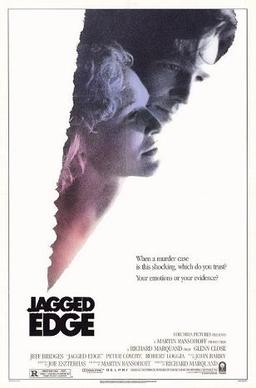
Teddy Barnes (Glenn Close) is done with criminal law after her time at the DA’s office, working under ambitious, unscrupulous Thomas Krasny (Peter Coyote). But she’s dragged back in to defend handsome newspaper editor Jack Forrester (Jeff Bridges), accused of brutally murdering his wife and her maid (for the money naturally). Teddy takes the case and soon crosses that line marked “personally involved” as she and Jack swiftly move from riding horses to riding each other. But what if Jack is really guilty after all?

Jagged Edge is a big, silly courtroom drama, a sort of erotic thriller B-movie that got some serious notice because two critically-acclaimed, three-time Oscar nominated actors fleshed out the cast. Written by Joe Eszterhase (for whom this was the springboard for a career of sex-filled, murder-and-legal dramas that would culminate, via Basic Instinct, with Striptease), Jagged Edge is full of pulpy, super-tough dialogue that its cast loves to chew around their mouths and spit out. It’s got the sort of courtroom dynamics that would see a case thrown out in minutes and would make its lead character unemployable in seconds. It’s daft, dodgy and strangely good fun for all that.

What it is not, really, is either any good or in any way surprising. One look at rugged, casually handsome Jeff Bridges and sharp-suited, charming-but-whipper-smart Glenn Close and you just know its only a matter of time before they end up in bed together. This leads to all sorts of unprofessional sex-capades and legal decisions, not to mention the sort of pathetically readable poker-faces in courtrooms that I would definitely not want from my lawyer.

Jagged Edge makes no secret of its hard-boiled, pulp roots. It opens with a POV home invasion as the killer breaks into his victim’s house that is only barely the right side of exploitative. Marquand doesn’t shirk any opportunities to chuck crime scene photos up on the wall. Peter Coyote’s uber-macho DA loves to say lines like “he has a rap sheet longer than my dick”. Best-in-show Robert Loggia (Oscar-nominated) is the sort of grimy flatfoot investigator who has a fridge full of booze and can’t go more than five words without cussing (when asked if his mother ever washed his mouth out with soap he simply responds “Yeah. Didn’t do no fuckin’ good”).

It’s similarly open about its sexy energy. Close and Bridges have a blue-filtered, late-night roll in the sheets, made even more exciting (perhaps) by the fact she spends half the film suspecting he did the deed. That’s the question the film challenges us with. On the one hand, Bridges seems far too boyish and aw-shucks to have slaughtered two women with a jagged knife. He sure looks upset when he visits the crime scene. Problem is there doesn’t seem to be any other possible suspect, and all that circumstantial evidence just keeps stacking up around him.

Close plays all this with a great deal of force and emotional intelligence, far more than the part (or the film) really deserves. She’s amicably separated from her husband (a very decent guy) and the film even finds a little ahead-of-its time space to make clear that Kransky’s animosity for her (and her loathing of him) is based on his sexual harassment of her as much as his flexibility with courtoom rules. Close balances the whole B-movie set-up with a real dedication – it’s effectively a warm-up (in a way) for the nonsense she’d play in Fatal Attraction.

Bridges is also pretty good, always keeping you guessing from scene-by-scene. How bothered is he when he spreads his wife’s ashes off his yacht? But then how affronted and hurt he looks when he is accused of the crime? It’s a tricky part, but he does a great job of constantly shifting the audience viewpoint and his relationship with Close’s Teddy is just smooth enough to have you guessing how genuine it is.

Wisely – perhaps – he doesn’t hit the stand during the trial. It would probably lead to drama meltdown. The courtroom is full of unbelievable curveballs, witnesses crumbling in a way they never do in real life. Every single disaster for each case is signposted by the fixed horror on the faces of the lawyers. Revelations fly-in and a new suspect effectively incriminates himself mid-trial to the delight of all (this suspect even enforces his caddishness by threatening Teddy in a car park in another moment where the film tries too hard).

The film culminates in the inevitably silly reveal, with plot twists abounding, where we are asked to believe that a killer who has ingeniously considered every single angle of his crime casually leaves incriminating evidence hanging around waiting to be discovered. Its final scene, where the killer is revealed, is either tense or unbearably, ridiculously stupid, depending on your viewpoint (everyone behaves ludicrously out-of-character and takes stupid, unnecessary risks). But for the bulk of its runtime, Jagged Edge is dirty, cheap fun.

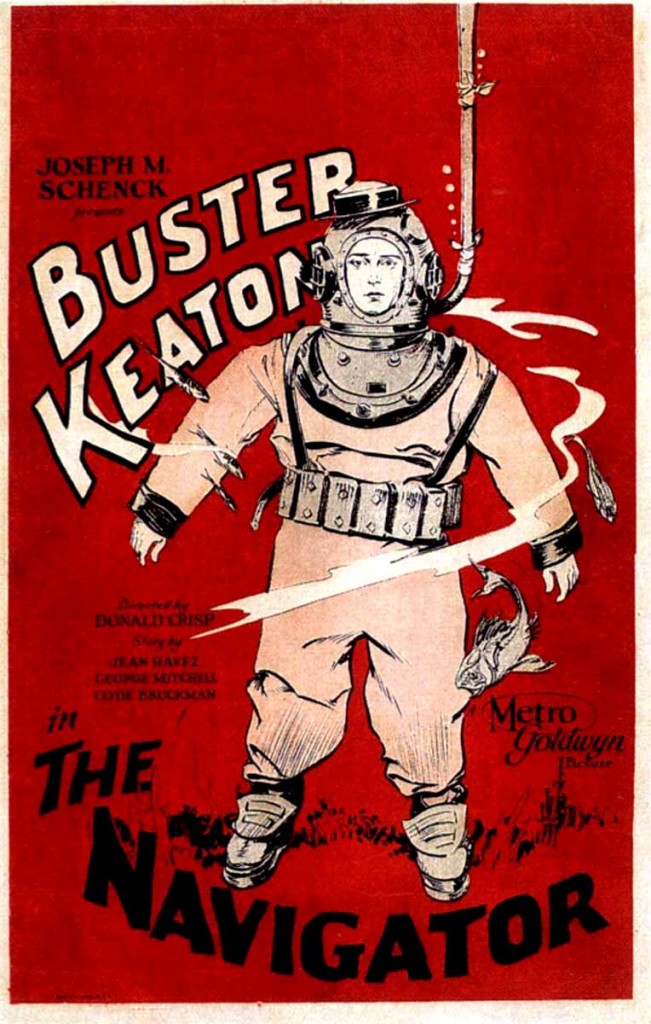
The Navigator (1924)

The Navigator (1924)

Keaton is cast adrift in a film that is all gags and no story or stakes and not the better for it

Director: Buster Keaton (& Donald Crisp)

Cast: Buster Keaton (Rollo Treadaway), Kathryn McGuire (Betsy O’Brien), Frederick Vroom (John O’Brien), Noble Johnson (Chief), Clarence Burton (Spy)

Buster Keaton claimed The Navigator was his best film. With all due respect he’s wrong. The Navigator was born out of the ahead-of-its-time failure of Sherlock Jr. When that marvel of cinematic invention didn’t land with audiences, Keaton played safe. He put a lid on the tricks and focused on the gags. In fact, he cast himself away in a boat with only Kathryn McGuire for company and they told jokes for 45 minutes. That’s the basics of The Navigator and, for me, the lack of plot, stakes or character ends up in a much weaker film.

Buster is Rollo Treadaway, a rich sap, who one day decides to get married and books the honeymoon before he’s asked his planned intended Betsy (Kathryn McGuire). When she says no, Rollo goes on honeymoon anyway but in a confusion at the docks ends up on the wrong ship, The Navigator. It’s owned by Betsy’s father – but spies for a foreign power plan to set it adrift. In further confusion, Betsy also ends up on board and she and Rollo wake-up drifting at sea. How will two pampered rich people work out how to look after themselves on a deserted ship?

The Navigator keeps things simple, cranking up the jokes in a film much closer in spirit to his shorts, all designed to be easy to digest and just tickly the funny bone. You feel they genuinely did just cast the ship out to sea and waited for Keaton to work out as many gags as he could until the camera ran out of film. Donald Crisp was hired to direct the dramatic stuff, but Keaton quickly realised he didn’t need him and didn’t like Crisp’s vague prologue about wicked spies (he was right, it’s totally forgettable unlike the equivalent opening of Our Hospitality) so set off to sea without him. (Crisp makes a visual cameo as the painting of the ship’s captain that swings in front of a porthole).

There are, for me, three key gags that work in The Navigator. Rollo’s spontaneous decision to get married (based on seeing a happy couple outside of the window), after which he distractedly bathes fully clothed then gets his chauffeur to drive him to Betsy’s house – on the opposite side of the street (the car does a big circular loop across the street). After the rejected proposal he informs the chauffeur, he needs a walk home to clear his mind.

This is, in many ways, the funniest, most inventive moment in The Navigator. It’s a great little showpiece as well for the (passionately not-getting-married) Kathryn McGuire and the finest example of Keaton’s capacity for easily led saps, overwhelmingly influenced by things they see around them. It’s the part of the film I enjoyed the most and its over after ten minutes.

The Navigator starts to drift as soon as it heads to sea. There is some neat camera work that suggests the haunting emptiness of the ship (it’s so vast we get an amusing series of visual jokes as Keaton and McGuire consistently miss bumping into each other while walking around it), but where other Keaton films would have explored more the ghostly darkness of this technological marvel (or the oppressive nature of it emptiness) The Navigator largely shies away from this.

The best sequence on the ship follows McGuire and Keaton’s attempts to cook a meal in a massive galley, hampered by the fact that (a) everything on the ship is set-up to cook for hundreds not two and (b) the two pampered souls have no idea how to open a tin can or boil a kettle, let alone cook a meal. Three potatoes are thrown into an enormous vat. Keaton goes through a series of trial error involving drills and carving knives to get into tins. McGuire can’t work out that sea water isn’t drinkable or how much coffee is needed for a cup. They are both befuddled by fish (which they basically eat raw) and can’t find cutlery so make do with kitchen utensils. It’s a sharply observed, well-constructed scene.

But other than this, the film struggles with a series of gags that rather disappoint. There is a painfully overlong underwater sequence where Keaton wrestles with a fake swordfish. There is a lack of Keaton’s trademark physical stunts (aside from a bit of business with a deckchair). An encounter with an island tribe – a bit uncomfortable today to watch these Black-skinned savages – is overlong and heads into a siege that is never particularly funny (other than a gag of Keaton accidentally dragging around a miniature cannon that no matter where he turns is always aimed at him – a gag later lifted for Jar-Jar Binks in The Phantom Menace).

The main problem I have about The Navigator is that this bag of gags never engages me because the film isn’t about anything. Neither of these people feel like real people (and, lord knows, Keaton characters were often lightly-sketched comic roles, but this is ridiculous), the film has no stakes and has no plot momentum, drifting like the boat they are stuck on. I need more for a comedy, to feel invested. Without that investment, it’s just stuff happening. A Keaton’s I won’t revisit. It was, however, his biggest hit. What do I know?

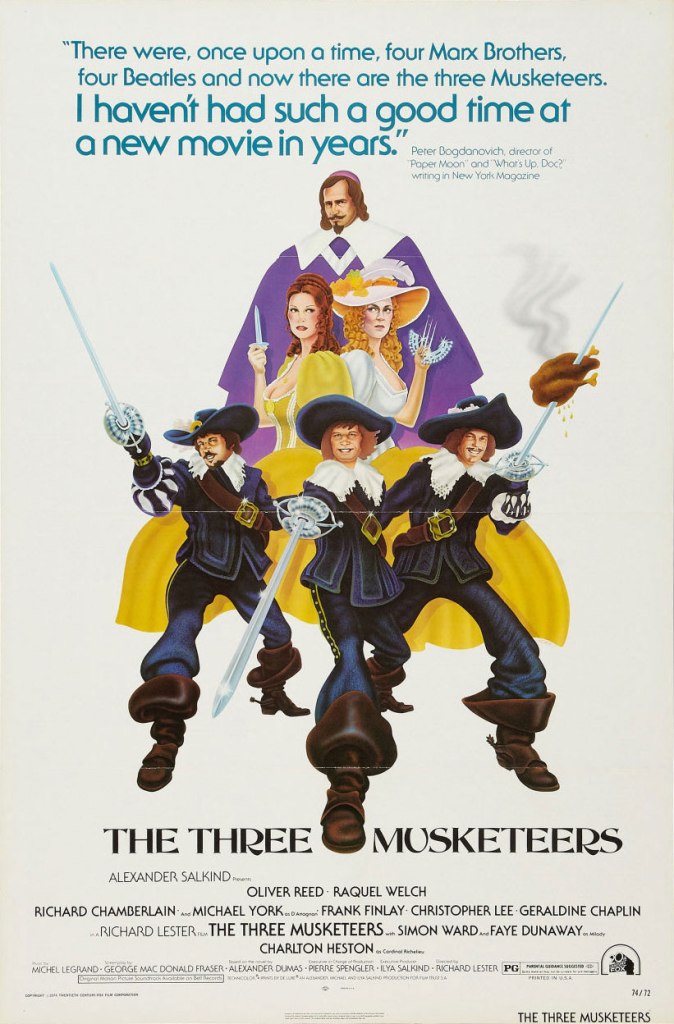
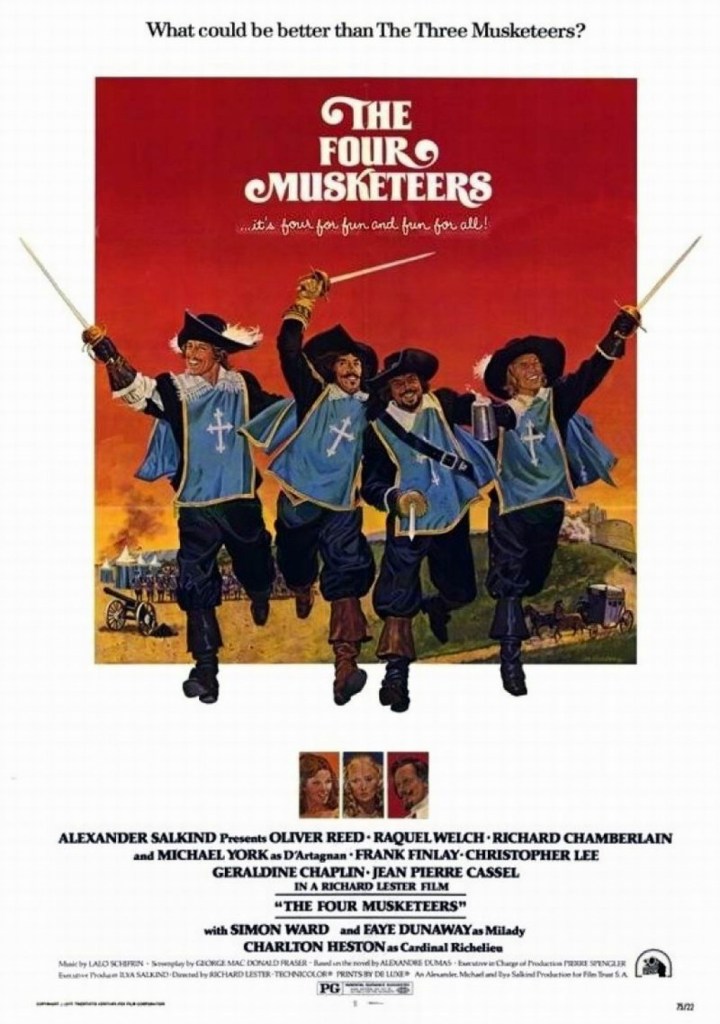
The Three Musketeers (1973) / The Four Musketeers (1974)

The Three Musketeers (1973) / The Four Musketeers (1974)

A film of two halves, in more ways than one: the swashbuckling original and its dark sequel

Director: Richard Lester

Cast: Michael York (d’Artagnan), Oliver Reed (Athos), Frank Finlay (Porthos/O’Reilly), Richard Chamberlain (Aramis), Raquel Welch (Constance Bonacieux), Jean-Pierre Cassel (Louis XIII), Geraldine Chaplin (Anne of Austria), Charlton Heston (Cardinal Richelieu), Faye Dunaway (Milady de Winter), Christopher Lee (Count de Rochefort), Simon Ward (Duke of Buckingham), Spike Milligan (Bonacieux), Roy Kinnear (Planchet), Georges Wilson (Captain de Treville)

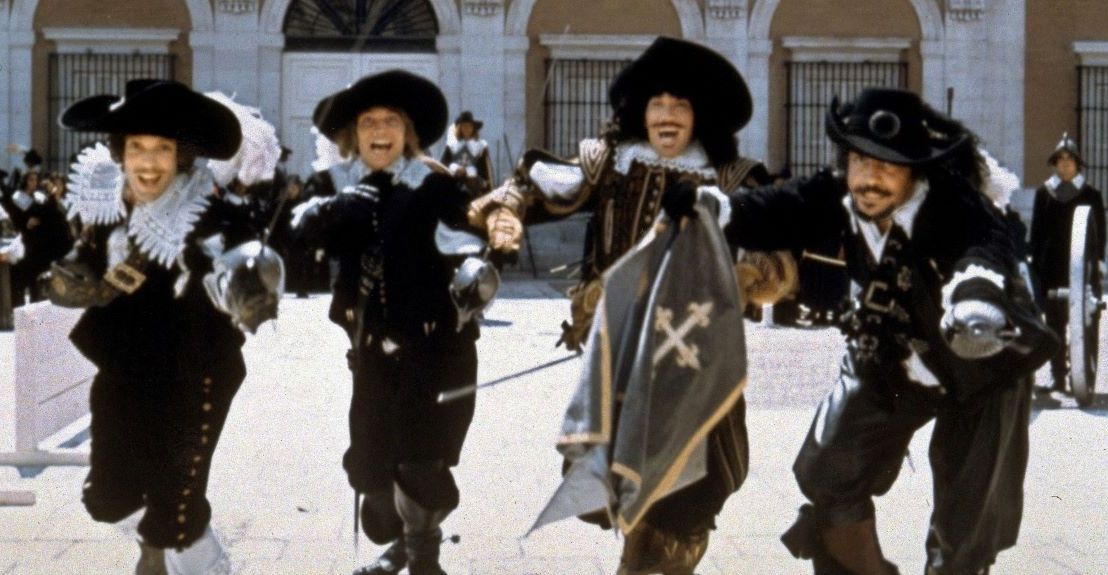
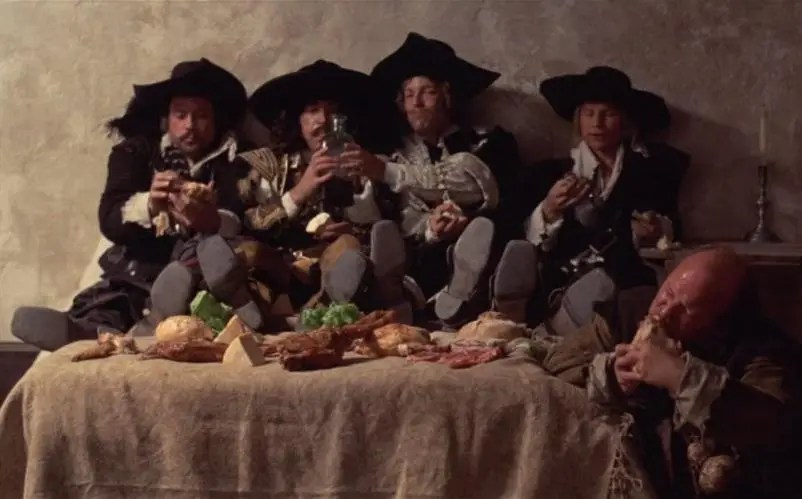
All for one and one for all! The Three Musketeers is probably the greatest adaptation of Dumas’ rollicking classic, a wonderful mix of swashbuckler, romance and Hellzapoppin comedy, that never takes itself particularly seriously and is crammed with actors having a whale of a time. It’s not quite a send-up, but it’s also not quite a straight re-telling either. Instead, it’s gunning all-out for entertainment – and it succeeds most of the time.

d’Artagnan (Michael York) arrives in Paris in 1625 desperate to join the musketeers. After various adventures along the way – including a rivalry with suavely villainious Rochefort (Christopher Lee) – the impulsive young man forms a friendship (after bumps in the road) with the famed musketeers Athos (Oliver Reed), Porthos (Frank Finlay) and Aramis (Richard Chamberlain). Falling in love with the unhappily married Constance (Raquel Welch), maid to Queen Anne (Geraldine Chaplin), d’Artagnan and his friends are dragged into foiling a plot by the ambitious Cardinal Richelieu (Charlton Heston) to use the ingenious Milady de Winter (Faye Dunaway) to expose the Queen’s infidelity with the Duke of Buckingham (Simon Ward). Will our heroes manage to foil the scheme in time?

The Three Musketeers adapts the first third or so – the most famous and by far the most enjoyable part – of Dumas’ novel. With an irreverent script by Flashman author George MacDonald Fraser, its framed as a rollicking romp with a tongue-in-cheek humour. Richard Lester, famed for his cheeky Beatles comedies (and the film was originally envisaged as a vehicle for the Fab Four), added his trademark scruffy, opportunistic comedy.

The film is awash with muttered asides – many of them well delivered by Roy Kinnear’s exasperated servant Planchet – that are only just picked up by the sound mix. My favourite? d’Artagnan bursting into a room full of guards, yanking a rug with a yell in an attempt to upend them, succeeding only in tearing the corner off it, then immediately jumping out of a window, leaving the bemused guards one of whom plaintively mutters “He’s torn our carpet” – I find this funny on multiple levels, from York’s all-in energy to the stillness of the shot, to the underplayed sadness of the punchline.

Lester’s film is full of long-shot gags – passengers in litters being dropped in a lake, d’Artagnan swinging on a rope to knock someone off a horse, missing and falling in the mud or his jump from a third storey window only to immediately reappear having landed on a (anachronistic) window cleaner cart. While the film does have its moments of drama, danger and intensity, it doesn’t ease up on visual humour, or gags (“This ticket is for one man” “I am one man. This is a servant”). It’s all part of Lester’s plan to make a fast-paced, pantomimic entertainment in which nothing is intended to ever be too serious.

It’s all played with maximum commitment by the cast, all of whom buy into the films’ tone. Michael York leaves very little in the locker-room with a performance full of youthful bravado, lusty hurrahs and naïve, winning eagerness. It’s a very hard balance to get right but he is never overbearing, but provides a relatable, likeable lead. He’s physical commitment to a series of Buster Keaton style gags is also commendable. He sparks a rather sweet romance with Raquel Welch, who is not the world’s strongest actress, but gamely delivers a series of pratfalls as the eternally clumsy Constance.

Around these two, a series of experienced actors delight in larger-than-life roles. Reed brings a surly intensity to Athos, a reminder of how great a career this charisma laden actor could have had. Finlay gives a Falstaffian joie de vivre to Porthos. Chamberlain (with little to do) strikes a gamely romantic figure as Aramis. As the baddies, Heston clearly enjoys subverting his grandiosity as the scheming Cardinal, Dunaway has a kittenish sensuality as Milady and Christopher Lee is so perfect as the debonair Rochefort that his eye patch (unmentioned in Dumas) has become de rigour for every Rochefort performance afterwards.

The Three Musketeers is crammed with swashes being buckled. The sword fights come thick and fast and are all shot in a series of impressive locations (the camera work of David Watkin, design of Brian Eatwell and costumes of Yvonne Blake do a wonderful job creating a sumptuous period setting). At times they do look a little ragged today – producers the Salkinds ran a tight budget, and there are multiple reports of the slightly-under-rehearsed fights leading to near-serious injury (this slapdash preparation would lead to tragic consequences when Roy Kinnear was killed on the belated second sequel 15 years later). But the actors enter into them with a firey commitment (a little too much so in Reed’s case according to the terrified stuntmen) and rumbunctious energy that really sells these as gripping action. They are also give a certain air of peril that gives just enough weight to the film.

The Three Musketeers has moments of dated clumsiness – the bizarely arty slow-mo opening with blurred motion feels totally out-of-keeping with the rest of the film – and not all the jokes land (Spike Milligan in particular is completely over-indulged in the film’s least successful comic moments). Not every performance works – Chaplain in particular is weak as Anne of Austria – and not all the jokes pay off. The musical score by Michael Legrand, catchy as it is, sometimes overeggs the “isn’t this all such fast-paced fun” angle. But the stuff that lands, really does well and there is more than enough fun, action, adventure and rollicking good humour to keep you entertained on a weekend afternoon.

And then there were two (or rather four)

There is always a twist in the tale. At some point while making The Three Musketeers the Salkinds realised they would never get it ready for the Paris premiere. But they could get half the film ready. So, they released that and cheerily announced at the end a sequel was already in the can. Problem was no one had mentioned it to the cast, who discovered they had shot an entire movie for free. A court case exploded, which the Salkinds lost, settling with actors and leading to a new clause being inserted into all contracts for actors preventing such a dodge happening again.

The Four Musketeers covers the second, less famous, much less fun part of Dumas’ novel. Rather like novel, it’s a rambling affair that lacks the compelling narrative thrust (We’ve got to get those diamonds and save the Queen!) which made The Three Musketeers so entertaining. It doesn’t help that its also considerably darker, serious and bleaker as bodies pile up and things get serious.

This makes the sequel a very different beast to the first. Energetic heroism prevented villainy in the first film, but here it often fails . Milady (Faye Dunaway) has sworn revenge and is ordered by Cardinal Richelieu (Charlton Heston) to assassinate Buckingham (Simon Ward). Along the way she kidnaps Constance (Raquel Welch) and seduces d’Artagnan (Michael York) seduced. The Musketeers rescue Constance, fight at La Rochelle and do their best to defend Buckingham – but nothing goes to plan, especially after Athos (Oliver Reed) realises Milady and his criminal ex-wife (thought dead) are one-and-the-same.

The Four Musketeers keeps up the humour, but it is frequently at odds with the darker film it sits in. Gone is the high-paced musical score of Michel Legrand, replaced with a lyrical series of melodies by Lalo Schifrin. It’s telling that Welch – whose comic clumsiness was a large part of the first movie – appears only briefly here. Similarly, Cassell’s shallow monarch (dubbed by Richard Briers) pops up just once, Roy Kinnear’s Planchet isn’t in the first hour and Spike Milligan’s free-wheeling improvisation is missing completely (in that case, no bad thing).

The film feels tonally at odds with the first film and even, at times, with itself. The Three Musketeers was full of sword fights but no deaths – here sword strokes are lethal. As the Musketeers comically bounce around at La Rochelle sight gags abound – but it feels at odds with a film where the death is very real. The more realistic feel means some set pieces – such as Rochefort and d’Artagnan fighting on an inexplicably frozen lake in the height of Summer – become harder to swallow.

Some performers do flourish. Oliver Reed comes into his own as an increasingly dark and vengeful Athos, giving into temptations of shocking revenge. Faye Dunaway laces her role with cold, murderous fury. They have most of the film’s most compelling scenes – but the incredibly dark ending (which involves our heroes actively perpetrating judicial murder with a terrified victim) while loyal to the book, feels far too heavy for a pair of films that started with Buster Keatonish comedy.

The loyalty to the book and the commitment to follow it is partly to blame. There is a reason why most adaptations chuck away this section of the book. It lacks a clear narrative line for emotional connection and is highly episodic. d’Artagnan, in the book, does indeed sleep around after Constance disappears – but when the film requires their relationship to be the emotional heartbeat, is it a good idea to have him jump into bed with two women within days of her disappearance?

Lester announces the more sombre parts by filming them in a very framed, artful way inspired by the old masters, with a static camera and medium shot, reliant on Schifrin’s maudlin music. He’s far more at home with the comic business delivered by Finlay (very good) and Chamberlain (still with nothing to do). At other points he surrenders initiative to legends like Heston (suavely menacing), Lee (whose Rochefort steps up a level in lip-curling contempt) and Dunaway.

The finest thing on display are the sets and the sword fights, which are even more desperate, ragged and violently dramatic than last time (when Rochefort and d’Artagnan stop in one to take a breath, you are not remotely surprised given the total commitment we’ve seen). The action set pieces all look really impressive and staged with confidence and brio. It’s just a shame that much of the rest of the story feels like its being told by a natural comic trying hard to be King Lear, but not able to resist throwing a few gags in. It makes for an entertaining, but tonally messy film that feels it has come from a totally different place than its flawed but fun predecessor.