Author: Alistair Nunn

The Quiet Girl (2022)

The Quiet Girl (2022)

Stunning, low-key deeply-moving drama as a child flourishes with love in this Irish drama

Director: Colm Bairéad

Cast: Catherine Clinch (Cáit), Carrie Crowley (Eibhlín Kinsella), Andrew Bennett (Seán Kinsella), Michael Patric (Da), Kate Nic Chonaonaigh (Mam)

Childhood can be difficult. Even more so when the child knows they are an unwanted daughter, in an overlarge family overseen by an uncaring father (Michael Patric) more interested in the horses and the bottle than those his family. Cáit (Catherine Clinch) is a quiet child in early 1980s Ireland who has learned quietness because she knows no one cares what she has to say. When her Ma (Kate Nic Chonaonaigh) is expecting another child, Cáit is sent to stay with her Ma’s middle-aged cousin Eibhlín (Carrie Crowley) and husband Seán (Andrew Bennett) on their farm. There she finds a warmth, care and love she never knew at her home. But, though this is a house with warmth and “no secrets”, it is also a home where a painful loss is never spoken of.

Adapted from one of the finest short stories from Claire Keegan, one of Ireland’s leading novelists, The Quiet Girl became the most successful Irish film of all time and the first nominated for an Oscar. It’s no wonder: this is a beautifully made, carefully crafted and immensely moving film, overflowing with humanity and empathy that left me dapping my eyes.

Perfectly scripted and directed with a quiet controlled restraint by Bairéad, The Quiet Girl is a film that throbs with emotion, a collection of small events and everyday moments of kindness that bloom into moments of great resonance by the skilful empathy built up for this child. Throughout the film, shot in a Academy ratio 4:3, Cáit is frequently positioned in the centre of the frame. At first, in her home and school, this superbly stresses her isolation. Events bustle around her, family members casting shadows over her. She stares down and away from us and feels like the single fixed point in a world of motion. She sits unnoticed in the backseats of cars and watching her father drink in pubs. She is at the centre of our perception, but adrift in a sea of activity around her.

Bairéad superbly uses this device throughout to slowly bring characters and interactions to curve inwards and focus on Cáit much as we do. When she arrives at her aunt’s farm, for the first time the attention of others in the frame settles on her. Their eyes are on her, they speak to her, move to connect with her. The Quiet Girl is intensely moving as it shows the difference a change of scene can make, the warmth and love can make to a child who has known nothing like it.

This is in many ways a simple story, but the low-key tenderness which Bairéad tells it gives it immense power. Cáit – played with quiet gentleness by Catherine Clinch – is a sensitive, intelligent and caring girl who has never been allowed to flourish. It’s striking after the film’s first fifteen minutes showcasing the indifference she faces, how much your heart glows as Eibhlín talks to her, makes her feel comfortable, washes her and tucks her up in bed. It’s a world away from the neglect we’ve seen Cáit suffer.

This is a film where small acts of kindness bring tears to the viewers eyes. When Cáit wets the bed on her first night – too scared to use the toilet – Eibhlín immediately notes her fear (she expected punishment) and apologises for giving her “a mattress that weeps”. Eibhlín separates her from her uncomfortable clothes, teaches her basic household tasks, brushes her hair, encourages her to feel a part of their home. For the first time Cáit is treated not as a burden – or worse – but as a human being. This is brilliantly conveyed by Carrie Crowley as Eibhlín, who delivers a performance of immense emotional depth, both tender and kind but with a deeper layer of sadness underneath, the cause of which is slowly revealed.

Bairéad is sensitive about the home environment Cáit has emerged from. There are dark hints: her Da is, at best, a potentially violent drunk with a temper and Cáit is introduced first hiding in a field, then under her bed. Arriving at her foster home she has a fear of “secrets”. Eibhlín is quick to pick up on this, reassuing her there are no secrets here.

No secrets perhaps, but a pain never spoken of. Cáit’s room is decorated in train wallpaper and she sleeps in a child’s bed. She is dressed in boy’s clothes (“our old things”) only a few sizes too big for her. Seán finds her hard to look at, at first – but when, under her care, she wanders off he becomes panicked and distressed. The loss this sad couple suffered is clear to us and The Quiet Girl becomes a film of mutual healing. There is pain on both sides: a child with parents and parents without a child.

Seán’s growing bond with Cáit is wonderfully paced and deeply affecting. Gruff but kindly, Andrew Bennett’s performance melts the heart. From a biscuit placed without comment on a table to a run to the post-box that turns into a repeated game, their slowly flourishing love is simply beautiful. As he buttons her coat or the two of them race to sweep clean the cow shed, you’ll find it impossible not to be moved. Seán is slower to bond with the child than Eibhlín, but both of them find the pain in their heart slowly eased by allowing theirs to open to this quiet, caring child.

Of course, it is only a holiday that must end. Bairéad’s film ends with Keegan’s own, tinged with a slight ambiguity. But it’s a beautiful one for all that, a heart-rending tribute to emotional connection between people. Bairéad’s film has this empathy running through it like a pulse. Shot with an immense visual beauty that turns everyday objects into items of intense beauty – from tables to drains – The Quiet Girl is a deeply moving quiet masterpiece, which carries a low-key emotional impact that is hard to beat and impossible to forget.

The Lavender Hill Mob (1951)

The Lavender Hill Mob (1951)

Delightful but surprisingly subversive Ealing comedy, one of my all-time personal favourites

Director: Charles Crichton

Cast: Alec Guinness (Henry “Dutch” Holland), Stanley Holloway (Alfred Pendlebury), Sid James (Lackery Wood), Alfie Bass (Shorty Fisher), Marjorie Fielding (Mrs Chalk), Edie Martin (Miss Evesham), John Salew (Parkin), Ronald Adam (Turner), Arthur Hambling (Wallis), John Gregson (Inspector Farrow), Clive Morton (Station Sergeant), Sydney Talfer (Clayton)

It’s my personal favourite of all the Ealing comedies. It’s always surprised me it has been so warmly endorsed by the Vatican. Sure, it ends with a cursory “crime doesn’t pay” message – and it’s got a great deal of lightness, affection and wit. You want our seemingly mousey underdog to successfully take on the big banks. But this is a surprisingly dark and subversive film under its cuddly exterior. Much like its lead character, appearances can be deceptive and The Lavender Hill Mob lulls you into a false sense of security to hide its surprisingly darker heart.

Set in post-War London, Henry Holland (Alec Guinness) is a timid bank clerk, paid pocket money to monitor the delivery of hundreds of thousands in gold bullion to his bank. And he’s had enough. Holland plans a heist – he’ll steal the money, escape unsuspected and live the life of Reilly he feels he deserves on the proceeds. The inspiration for how to smuggle the money out presents itself when he befriends artist turned tacky gift manufacturer Alfred Pendlebury (Stanley Holloway) – they’ll melt down the gold and smuggle it as Eiffel Tower models. What could go wrong?

The Lavender Hill Mob fits very neatly into the classic Ealing set-up. The plucky underdog takes on the establishment, in this case the heartless bank run by public-school poshos and the police with their new-fangled technologies. It plays these cards extremely well, poking fun at the set order and building a great deal of empathy with Holland and Pendelbury, the two most unlikely criminal masterminds you can imagine. Middle-aged, middle-class professionals who have led lives of quiet, dutiful anonymity, its huge fun to see them cut loose and embrace the chance to be bad-boys. Who hasn’t wanted to say “to hell with it” and grab the opportunities you want in life?

But TEB Clarke’s superb script, matched with Charles Crichton’s dynamic direction, has a darker heart under the surface charm. Set in a bombed-out post-war London, the film’s design never lets us forget this is an upturned Britain, reeling from years of unimaginable upheaval. A country going through social and political change leaving old, deferential ideas in the past and old principles of morality might not apply. After all, when death was a nightly visitor to the capital, why should you continue to play by the rules? Holland is actually a man who has simmered with quiet, unspoken resentment for decades, who crafts the perfect heist and sees it through with obsessive, almost cold-hearted fanaticism.

Sure, he seems sweet and, yes, he doesn’t half get swept-up in childish excitement in the glamour of crime – who can forget his bashful desire to take on the criminal nom de plume Dutch. But the genius of Guinness’ performance is that he never lets us overlook the ambition, greed and willingness to go to any lengths under Holland’s meek exterior. Watch how Guinness stares with unblinking acquisitiveness at the gold as it melts down. The authoritative command he takes over Pendlebury when a small batch of gold Eiffel towers are accidentally purchased by a group of school children. The demanding perfection he insists on in every step of the heist.

This is Guinness at his absolute best and perhaps only he could combine such a criminal heart with light-comedy. Holland is an immensely endearing character because his success remains so unlikely. His scheme is low-tech and clever so it’s impossible not to end up rooting for it – especially when the resources and technology of the police and the bank are so well sign-posted. Guinness is giddy with excitement at the scheme – but also look at how quickly and coldly he lies, how smug and satisfied he can be in success and how ruthless when the situation calls for it. But yet we love him. This is dramatic and light comic acting distilled in one. He’s superb.

If anyone is a corrupted innocent, it’s Alfred Pendelbury. Played wonderfully by Stanley Holloway as a poetry-quoting dreamer, Pendlebury is the real unlikely criminal here. Holloway and Guinness have a wonderful chemistry, both enjoying the naughtiness of theft, but with Holloway’s star-struck eyes, Pendlebury is the follower, in awe of Holland’s cleverness and determination. Poor Pendlebury almost blows the heist by absent-mindedly wandering away from a newspaper stand still clutching an (unpaid for) newspaper, blithely suggests they let lost Eiffel towers go and bundles around the crime with an optimistic amateurism.

Clarke’s script has a lot of fun with questions of class. The pompous bank managers are exactly the sort of arrogant posh-boys who look down on everyone else with paternal disregard. They are blank, unthinking automatons. Class works both ways. Holland is unsuspected of the crime as he’s the sort of middle-class person who wouldn’t do this sort of thing. Holland and Pendlebury are quietly resentful of those above them – but they assume the same authority over the criminal classes they recruit for the scheme. Sid James (cementing his persona as a cheeky spiv) and Alfie Bass are natural cap-doffers who quickly accept their place in the gang’s hierarchy and even (rather sweetly) trust Holland and Pendelbury to deliver their share from Paris (naturally, as working-class lads, they are suspicious of travelling to France anyway to collect the loot).

The Lavender Hill Mob exposes the assumptions and traps of the class system in this country, and does so with a gentle, sly, subversive wit. Holland is basically the forerunner of the sort of bitter middle and lower middle class ambitious types who would drive change in Britain in the next few decades.

The film also gets a lot of comic mileage out of the smug ineffectiveness of most of the official forces. The police have a raft of technologies – radios, cars, scientific techniques – all of which do very little to help. In a late car chase through London, the radios actively work against them – Holland easily uses the radio in their stolen police car to spread disinformation, the central radio director guides several cars into a collision and eventually scrambled signals lead to “Old MacDonald” being played on all receivers. Optimistic but hopelessly inaccurate bulletins are constantly posted on their progress and only personal inspiration of the lead detective (a colourless John Gregson) and chance leads to the crime being unmasked. As well as looking at the dark bitterness of its lead character, The Lavender Hill Mob is strikingly cynical about officialdom.

Crichton’s direction is visually inventive and at times almost Hitchcockian – Holland and Pendlebury’s dizzying stairway descent from the Eiffel Tower arguably inspired Vertigo. And the film is supremely funny. The heist is planned with perfect comic timing, chase scenes are brilliantly done and there is a superb farcical set-piece as Holland and Pendlebury hurriedly try to negotiate French customs in a rush to catch a boat. Every scene has a funny line or inspired piece of comic business and Clarke’s script perfectly balances this with gentle but intelligent social commentary.

The Lavender Hill Mob is a triumph. From start to finish a delight, insightful and funny, it has superb performances from a faultlessly brilliant Guinness and a bombastically huggable Holloway. It wraps up comedy, social commentary and a surprising cynicism into a complete package. It’s a tour-de-force of charm, shrewdness and grace. It remains my best loved Ealing comedy, and possibly one of my favourite comedies ever made.

Back to the Future Part III (1990)

Back to the Future Part III (1990)

The franchise closes on a high with a fun, romantic and exciting finale, tonnes better than Part II

Director: Robert Zemeckis

Cast: Michael J. Fox (Marty McFly/Seamus McFly), Christopher Lloyd (Emmett “Doc” Brown), Mary Steenburgen (Clara Clayton), Thomas F. Wilson (Biff Tannen/Buford “Mad Dog” Tannen), Lea Thompson (Lorraine McFly/Maggie McFly), James Tolkan (Marshal James Strickland), Elizabeth Shue (Jennifer), Matt Clark (Chester), Richard Dysart (Salesman), Flea (Needles)

And we’re back. After the frankly awful Back to the Future Part II – an onslaught of bad gags, terrible performances, clumsy call-backs and a lot of sound and fury – the trilogy ended on a high with Back to the Future Part III which, by going back to the past, managed to find more heart and originality than Part II ever had. Strangely, by looking backwards in time, the series managed to look forward to new ideas. Part III is, by many degrees, a huge improvement.

We left Part II with Doc Brown (Christopher Lloyd) stranded in 1885 and Marty McFly (Michael J Fox) equally stranded in1855. How are they going to get back to 1985? Well Doc is happy where he is, and has left the Delorean buried in 1885 for Marty to dig it up in 1955 and get back to the future with the help of the 1955 Doc. But, digging the Delorean up, Marty discovers Doc’s 1885 grave: turns out he will be murdered by gunslinger Buford “Mad Dog” Tannen (Thomas F Wilson). So, Marty travels back to 1885 to save him. But with the Delorean damaged on the way, how will they get back to 1985? Will Doc or Marty be killed in a fatal gunfight with Tannen? And what about the Doc and schoolteacher Clara Clayton (Mary Steenburgen) falling in love?

Back to the Future Part III juggles all these plot themes with real expertise, all based in a hugely affectionate portrait of the Old West that drips with Zemeckis and Gale’s childhood love for the genre. I’m going to guess that Part III is inexplicably not held in the same regard as Part II because my generation and onward simply has far less of a connection to the Western than they do crudely cheesy views of an 80s tinged future.

But the sense of fun here is on point. Galloping horses, street fights, open air dances, trains, cameos from old-school Western supporting actors, the majestic score… it’s all an on-point reconstruction of the tone and style of Ford. (In particular, the entire film feels like a fun recreation of many elements of My Darling Clementine). The film also has fun with later perceptions. Marty is dressed up for his journey back to 1885 in the sort of brightly coloured, skin-tight costumes 1950s TV and B-movie western stars wore. He adopts the alias “Clint Eastwood” (and doesn’t the film have fun with that). He even (eventually) dresses not dissimilarly from the Man with No Name himself.

It doesn’t stop with the Western re-build. Back to the Future Part III has the inevitable call-back gags to events we have seen throughout the last two movies. But here they are delivered with a far more freshness. Not least because Doc and Marty largely reverse roles here (leaning into this, they even swop their catchphrases at one point). While in the previous films Marty was the impulsive one, flying by the seat of his pants with instant decisions and being assisted by the eccentric Doc, here they settle into new roles.

Because Doc here is the one being rescued and the one tempted by an impulsive decision. Namely, staying in the past because he has fallen in love. Christopher Lloyd, a much better actor than he gets credit for, is allowed to broaden out and enrich his eccentric performance as Doc with a real emotional depth in a very sweetly drawn romance. Mary Steenburgen is equally good as the kindred spirit he falls in love with. Both actors play the romance dead straight and it allows Lloyd to show an emotional depth and shade his performance has lacked elsewhere. Steenburgen’s casting is also a nice tip-of-the-hat to Time After Time (where she also played a woman who inadvertently falls in love with a time traveller). Clara is also a neatly written character, integrated far more into the plot than poor Jennifer in Part II and another welcome shake-up the buddy formula.

As Doc takes on the romantic and paradox creating role, Marty becomes the driver, urging Doc to stop getting mixed up in influencing past events and focus instead on fixing the Delorean and getting back home. Fox embraces playing (largely) the secondary role in the film. He still gets moments of fun as an actor (not least playing Marty’s Irish great-grandfather – a performance immeasurably better than all his latex covered efforts in Part II) but he’s largely the voice of sense here.

Except of course concerning his fatal character flaw: don’t call him chicken. There is nowhere more dangerous to allow someone to pick a fight with you than the Wild West. And Marty swiftly inherits the clash with Tannen (played with gruff comic gusto and impenetrably density by Thomas F Wilson). This culminates – but of course – in a face-off in a dustbowl street, with a solution to the gunfight inspired by the real Eastwood and nicely signposted in Part II.

That leads into a genuinely edge-of-the-seat exciting race to hijack a train to push the Delorean up to the desired 88 miles an hour. Zemeckis shoots and cuts this sequence to perfection – and Alan Silvestri’s score does a lot of build and sustain the tension and excitement – and it seems appropriate that the only real opponent Marty, Doc and Clara have to deal with in this sequence is time itself. Crammed with sight gags, orchestrated to perfection and perfectly paced it’s a great way to cap the series.

Much as the film itself is a perfect ending to the franchise. Its imaginative and playful, riffing on the previous events without slavishly imitating them, approaching both its characters from new angles that helps us discover new things about them and crammed with great jokes, exciting set-pieces and genuine emotion. It’s easily the second-best film in the franchise. If you want to revisit a sequel for Back to the Future do yourself a favour and pick the one in the past.

The Lost King (2022)

The Lost King (2022)

Bizarre, grudge-settling comedy-drama that celebrates amateurism and hates experts

Director: Stephen Frears

Cast: Sally Hawkins (Philippa Langley), Steve Coogan (John Langley), Harry Lloyd (Richard III), Mark Addy (Richard Buckley), Lee Ingleby (Richard Taylor), James Fleet (John Ashdown-Hill), Bruce Fummey (Hamish), Amanda Abbington (Shelia Lock)

In 2012 the world’s media descended on Leicester after the body of King Richard III was discovered in priory turned car park. Richard III had long had passionate supporters – Ricardians – who rejected the idea that the man Shakespeare turned into Britain’s most hated monarch was anything of the sort. It was one of those fans, Philippa Langley (Sally Hawkins), who researched for 20 years to find evidence for where he was buried and became the public face of the search through ratings-winning television documentaries and writing a best-selling book.

All of this is rejigged in a silly, sentimental, bizarre film that repositions Langley as an inspired amateur butting heads with the self-promoting professionals of Leicester University. I suppose there is something ironic in a film which insists someone had their reputation sullied in the name of drama, itself sullies peoples names in the name of drama. (Richard Taylor, the deputy registrar of Leicester, here portrayed as a sexist, elitest self-promoter who mocks the disabled, has openly declared his intention to sue). The Lost King wants to be an affectionate Ealingesque comedy of the triumph of the little guy. It’s actually got an uncomfortable feeling of grudges being settled and a stench of Brexity anti-intellectualism.

Fascinatingly the anti-intellectualism even extends to Langley herself. Remember that 20 years of research? All deleted in this film. Here Langley is a working mum, suffering from ME (the film draws vague parallels between this and Richard’s scoliosis) who one day stumbles into a performance of Richard III and basically falls in love with the dead king. She pops down to a second-hand bookshop, buys eight books on Richard and in a few months is digging up the car park. It’s as if the idea she spent time in archives, triple checking sources, studying maps etc. would somehow have been “cheating” – that we could only root for her if she was an amateur, “one of us” who makes her (always correct) decisions purely on gut instinct.

But it fits with a film that portrays Leicester University as a sort of scheming club of middle-managers and moustachio-curling villains. No one from the university can so much as draw breath without disparaging “that woman” as an obsessive weirdo. They batter everyone with their expertise, arrogantly dismiss any ideas they don’t have themselves and stand around growling so Langley can puncture their pretention with her common-sense wisdom. Case in point: she suggests they overlay a modern map of Leicester over a medieval map to check locations. First they object, then look at her like she’s split the atom. Of course, they are right to object: medieval maps are hand-drawn approximations often more based on aesthetics than accuracy. But that doesn’t matter to the film, which of course immediately shows the two maps lining up in microscopic detail. If only 500 years’ worth of scholars could have thought of that, eh?

Embodied by Lee Ingleby’s Richard Taylor as a number-crunching obstructive bureaucrat who does everything he can to steal the credit (honestly, if you are going to take this kind of pop at a regular person at least change his name), Leicester University are unilaterally baddies. All this score-settling seems to have come from Langley’s resentment at not being invited to speak at a couple of press conferences. No matter that TV documentaries and books made her name synonymous with Richard III to anyone who really cares (even the film can’t pretend it’s telling “an untold true story”). This is a film with an axe to grind – so much so that the eventual discovery of Richard becomes secondary to this mud-slinging as Langley rebukes Taylor publicly (inevitably shaming him into silence) for equating disability with wickedness and cutting her out of meetings.

What’s particularly odd about The Lost King is that the film ends up painting Langley as exactly the kind of un-credible crank its villains (villainously) see her as. Having removed all her rigorous research, it replaces it with Having A Feeling. This is communicated visually with Langley communing regularly with a vision of Richard III, personified by the actor from the play she saw. Langley chats to this vision with the breathless excitement of a giddy teenager, and he helps her discover reams of facts, not least a bizarre moment of ecstasy when she spots an “R” in the car park and just knows Richard is under there.

Harry Lloyd is all adrift in this bizarre part and its main impact is to raise unfortunate giggles and make Langley look exactly like the sort of person you wouldn’t invest tens of thousands of pounds in. Mind you, Langley here is way more competent than any other Ricardian society member, all of whom are portrayed as cranks and pub bores, talking as if they only discovered famous primary sources this week, and utterly unable to even tie their own shoelaces until Langley sails in and discovers the king’s body in about ten minutes.

Hawkins plays a part firmly in her wheel-house, as an eccentric but determined woman in love with a ghost, while co-scriptwriter Steve Coogan generously writes himself a “stop reading Holinshed and look after the kids” role as her supportive ex-husband. Langley, like other characters, bends and changes according to the needs of the scene but is always the hero. When the script needs her to be a determined leader, she won’t take no for an answer. When it needs her to be oppressed by those nasty Leicester professionals, she won’t say boo to a goose. (Similarly, Mark Addy’s archaeologist yo-yos between dismissive of Langley to affectionately supportive almost scene-to-scene.)

The Lost King wants to be a triumphal little-guy film, but actually it has an unpleasant air to it. It feels like a massive grudge being publicly settled. It belittles and ignores expertise, patience and research in favour of gut instinct and amateurism. It bizarrely paints its lead character as a mixture of oddball weirdo, genius and saintly crusader. It’s also neither dramatic nor funny (except accidentally). It’s a bad film.

Through a Glass Darkly (1961)

Through a Glass Darkly (1961)

Faith, family and femininity are put to the test in Bergman’s bleak meditation on religion and love

Director: Ingmar Bergman

Cast: Harriet Andersson (Karin), Gunnar Björnstrand (David), Max von Sydow (Martin), Lars Passgård (Minus)

Bergman’s Through a Glass Darkly marks a new era in the Master’s filmography. It was the first of three thematically connected films about faith and religion (although you could argue The Virgin Spring really makes this a quartet). It saw Bergman make a firm commitment to seemingly theatrical chamber pieces, with small, focused casts of trusted collaborators handling complex (joke-free) and searching themes. It was also first of his films set on Fårö, a place that would become so associated with him it would effectively be rechristened Bergman Island.

Through a Glass Darkly (Bergman’s second consecutive Oscar winner for Best Foreign Language Picture) is a brooding, intense chamber piece set entirely in a house and beachside jetty on Fårö. It’s a family reunion. Author David (Gunnar Björnstrand) returns to Sweden from Switzerland to see his children. They are 17-year old son and aspiring writer Minus (Lars Passgård) and Karin (Harriet Andersson), now married to respected older doctor Martin (Max von Sydow). The real purpose of the gathering is to monitor the recovery of Karin, a schizophrenic whose condition has (without her knowledge) been declared inoperable. Karin is drawn to obey the commands of voices only she hears which she believes emanate from an abandoned bedroom, covered in cracked wallpaper. There she believes God calls for her to join him on the other side of the wall.

There is much to admire about Through a Glass Darkly, not least the striking, haunting, cinematography of Sven Nykvist. In a film that takes place on an almost silent island – there is no music, other than a few bars of Bach on the soundtrack, and barely any natural sound, so much so that a late arrival of a helicopter seems (deliberately) like an almost demonic visitor – light becomes the main force. It beats down from the sun, wraps across rooms, seems to transform spaces in front of an eye (there is a beautiful stationary shot of it flooding an abandoned boat where Minus and Karin sit in shocked horror). It picks out every feature of the scarred wallpaper in Karin’s room and casts searching shadows and stark, interrogative beams across the character’s faces.

It greatly expands both the intensity and claustrophobia of a challenging chamber piece, exquisitely directed by Bergman. The acting of the four leads – three trusted collaborators and a newcomer – is faultless. Andersson, in particular, tackles an almost impossibly difficult character who we first meet as a carefree young woman and leave as a huddled, shattered figure hiding from the light behind sunglasses. Andersson’s raw and searching performance avoids all overblown histrionics, becoming a detailed and compassionate study of a woman losing control over her actions. Bergman holds the camera on her for long takes, while Andersson lets a multitude of emotions play across her face.

Björnstrand is equally impressive as a (disparaging) Bergman stand-in, an artist neglecting his children in a quest for perfection, coldly distant to others, guilty at his selfishness (at one point he excuses himself to privately weep at his inadequacy as a father, then returns unchanged) but quite happy to take what he can from his family to use in novels. von Sydow takes a quietly restrained role as a sombre, somewhat dour man, hopelessly in love with his wife but clearly little more to her (and he accepts this) than a surrogate father. Passgård more than matches them as a depressed teenager, yearning for approval and frustrated at learning how difficult life is.

Bergman’s family follows this complex and challenging family, which becomes a filter for understanding if love is where God is in our world. The family is distant and uncommunicative with each other – the opening scene sees them laughingly return from a swim, but the second any of them split into pairs for conversations, resentments about the others come bubbling out. Is any love here real or performative? And if it’s performative, where is love and therefore where is God?

In this world, has Karin’s schizophrenia may have emerged as an attempt to insert an acceptable love that is otherwise missing from her life. Her father is a cold-fish, who immediately announces at their reunion dinner he will soon leave for Yugoslavia, then produces a series of gifts “from Switzerland” all too obviously purchased at an airport and unsuitable for the recipient (such as gloves that don’t fit Karin). Her husband overflows with desire for her, but she can hardly raise a flicker of interest in him sexually and behaves him with more like an affectionate daughter.

The most affection filled relationship she has is also the most inappropriate. She and Minus have a relationship of physical intimacy, and she kisses and strokes him with an affection that from the start feels uncomfortably close. They confide in each other emotionally in a way they never would do with others, and Minus is the first witness of one of her schizophrenic breaks, invited by her to view the room she believes is a passageway to God. This unhealthy intensity builds, through confidences and whispered confessions into a terrible encounter in a ruined boat, where Karin is commanded by her voices to seduce Minus into crossing a terrible line.

Perhaps this is a search for love and meaning “to see but through a glass darkly” as St Paul wrote. Karin is searching endlessly for love – and therefore God – but her search seems fruitless. Her family only slowly adjust, she shatters her closest relationship and eventually even her visions in her wallpapered room tip into nightmares. Bergman never lets us see the visions Karin witnesses or hear the voices she does (this places more pressure on Andersson whose controlled and measured performance is more than capable of delivering on) but we see all the traumatic impact on her as they prove as incapable of delivering confirmation of love in her world as anything else.

It’s surprising, for a film which starts as a family drama and becomes a quietly nihilistic drama, that Bergman ends on a moment of hope as David and Minus share a moment of closeness. Bergman later said he regretted this, and the moment does feel forced at the end of a downbeat drama. It may be a reflection of the fact that Through a Glass Darkly, intriguing as it is, is perhaps a little too serious and leans a little too heavily into artistic intensity. It lacks the touches of warmth, hope and humanity that makes Wild Strawberries a masterpiece and at times hits its notes of intense brooding a little too hard (its more or less from here that the Gloomy Swede label stuck).

It’s frequently an artistic triumph, but in some ways I find it less complete than other Bergmans. It’s exploration of its themes of faith and love don’t always coalesce quite as sharply as I would wish. It strains a little too much for profound importance at the cost of some of its humanity and the characters – brilliantly performed as they are – feel a little too much like puppets in the hands of God-like Bergman, going as and when according to his needs. But then, a Bergman film that doesn’t quite make it, would be the crowning achievement of other directors – and Through a Glass Darkly haunts the mind, turning over and over again in your thoughts, for days after you’ve seen it.

The Seven-Per-Cent Solution (1976)

The Seven-Per-Cent Solution (1976)

Affectionate and faithful Holmes pastiche that shines an interesting light on the Great Detective’s character

Director: Herbert Ross

Cast: Nicol Williamson (Sherlock Holmes), Robert Duvall (Dr John Watson), Alan Arkin (Dr Sigmund Freud), Laurence Olivier (Professor Moriarty), Vanessa Redgrave (Lola Devereaux), Joel Grey (Lowenstein), Jeremy Kemp (Baron Karl von Leinsdorf), Charles Gray (Mycroft Holmes), Samantha Egger (Mary Watson), Jill Townsend (Mrs Holmes), John Bird (Berger), Anna Quayle (Freda)

The magic of Sherlock Holmes is he is immortal. Doyle’s detective has been reshaped so many times since the publication of the canonical stories, that we’re now used to seeing him presented in myriad ways. It was more unsettling to critics – particularly British ones – in 1976, who didn’t know what to make of an original, inventive Holmes story that treats the characters seriously but is playful with the canon. Was this a parody or a new story? (Why can’t it be both!) Today though, The Seven-Per-Cent Solution stands out as a Holmesian treat, a faithful slice of gap-filling fan fiction.

Based on a best-selling novel by Nicholas Meyer (who also adapted it), The Seven-Per-Cent Solution expertly reworks Doyle’s The Final Problem. Professor Moriarty (Laurence Olivier) is not the Napoleon of Crime, but a mousey maths tutor, the subject of Holmes’ (Nicol Williamson) cocaine-addled idée fixe. Worried about his friends dissent into addiction, Dr Watson (Robert Duvall) tricks Holmes into journeying to Vienna to receive treatment from an up-and-coming specialist in nervous disease and addiction, Dr Sigmund Freud (Alan Arkin). The treatment is a slow success – and the three men are drawn into investigating the mysterious threat to drug addicted glamourous stage performer Lola Devereaux (Vanessa Redgrave) that may or may not be linked to her fierce lover, the arrogant Baron Karl von Leinsdorf (Jeremy Kemp).

As all we Holmes buffs know, seven per-cent refers to Holmes’ preferred mix of cocaine, taken to stimulate his brain between cases and see off boredom. But what if that persistent cocaine use wasn’t a harmless foible – as Holmes tells the disapproving Watson – but something much worse? Kicking off what would become a decades long obsession with Holmes the addict – Brett and Cumberbatch would have their moments playing the detective high as a kite and a host of pastiches would explore the same ground – Meyer created a version of Holmes who was definitely the same man but losing control of himself to the power of the drug.

This short-circuited some critics who didn’t remember such things from school-boy readings of Doyle and hazier memories of Rathbone (those films, by the way, were basically pastiches in the style of Seven-Per-Cent Solution as well). But it’s a stroke of genius from Meyer, shifting and representing a familiar character in an intriguing way that expands our understanding and sympathy for him. Holmes may obsessively play with his hands and have a greater wild-eyed energy to him. He may sit like a coiled spring of tension and lose his footing. But he can still dissect Freud’s entire life-story from a few visual cues in a smooth and fluid monologue and his passion for logic, justice – as well as his bond with the faithful Watson (here bought closer to Doyle’s concept of a decent, if uninspired, man) – remain undimmed.

It helps that the film features a fantastic performance from Nicol Williamson. Few actors were as prickly and difficult – so could there have been a better choice to play the challenging genius? Williamson’s Holmes is fierce in all things. Introduced as a wild-eyed junkie, raving in his rooms and haring after leads, his behaviour oscillates between drug-fuelled exuberance to petulant paranoia. But there are plenty of beats of sadness and shame: Holmes is always smart enough to know when he no longer masters himself. When the mystery plot begins (almost an hour into the film), Williamson’s does a masterful job of slowly reassembling many of the elements of the investigative Holmes we are familiar with – the focus, the energy, the self-rebuke at mistakes and the excitement and wit of a man who loves to show he’s smarter than anyone else.

The film is strongest as a character study, in particular of Holmes. Its most engaging sections take Holmes from a perfectly reconstructed Victorian London (including a loving, details-packed recreation of 221B from production designer Ken Adam) to waking from a cold turkey slumber full of apologies for his cruel words to Watson. Seeing Watson’s quiet distress at Holmes state, and the great efforts he takes to help him, are a moving tribute to the friendship at the book’s heart. The clever way Meyer scripts Holmes’ ‘investigation’ into Moriarty (an amusing cameo from Laurence Oliver, his mouth like a drooping basset hound) sees him apply all his methods (disguise, methodical reasoning, unrelenting work) in a way completely consistent with Doyle but clearly utterly unhinged.

That first half serves as a superb deconstruction of the arrogance of literature’s most famous detective, who won’t admit the slightest flaw in himself. It’s still painful to see a frantic Holmes, desperate for a hit, causing a disturbance in Freud’s home and denounce Watson as “an insufferable cripple” (a remark met with a swift KO and later forgiven). Holmes’ cold turkey sequence is a fascinating sequence of nightmareish hallucinations, as he is plagued by visions of cases past (The Engineer’s Thumb, Speckled Band and Hound of the Baskervilles among them) and the eventual awakening of Holmes as a contrite, humbled figure very affecting.

Bouncing off Williamson we have the traditional “Watson” role split between that character and Freud. Robert Duvall is a very unconventional choice as Watson – and his almost unbelievably plummy accent takes some getting used to – but he gives the character authority without (generously) giving him inspiration. Limping from a war wound (another touch of the novels often missed until now), he’s dependable, loyal and goes to huge lengths to protect his friends.

But most of the traditional role is actually given to Freud, played with quiet charm and authority by Alan Arkin. Intriguingly the film places Freud as a combination of both men’s characters. He has the analytical mind of Holmes, investigating the subconscious. But he also chases after errands for Holmes, “sees but does not observe” during the case in the manner of Watson and eventually becomes an active partner in confronting the villains.

The actual mystery (taking up less than 40 minutes of the film’s runtime) can’t quite maintain the momentum, being a rather trivial affair (greatly simplified from the book) revolving around a cameo from Vanessa Redgrave as a fellow drug addict Holmes feels a touching sympathy for. Jeremy Kemp makes a fine swaggering bully, but his greatest moment is actually his pre-mystery anti-Semitic confrontation with Freud at a sports club, culminating in a Flemingesque game of real tennis between the two. If the film has any moment that tips into outright comedy, it’s a closing train chase that involves Holmes, Watson and Freud dismantling the train carriage to burn the wood as fuel.

But the real heart of the film is Holmes. Throughout the film we are treated to brief visions of the boyhood Holmes slowly climbing a staircase. What he saw at the top of that staircase is buried deep in his subconscious, with the final act of the film revealing all under hypnosis. It’s an intriguing motivator for all Holmes has become, just as it is surprisingly shocking. As Watson comments, the bravest act is sometimes confronting ourselves: The Seven-Per-Cent Solution treats the detective with huge respect, while pushing him into psychological waters Doyle would never have dreamed of. It’s why the film (and Meyer’s book) is a fascinating must-see for Holmes fans: it takes the material deeper, but never once forgets its loyalty to the source material.

A Matter of Life and Death (1946)

A Matter of Life and Death (1946)

A pilot is stranded between Earth and…somewhere else in this brilliant romantic fantasy

Director: Michael Powell, Emeric Pressburger

Cast: David Niven (Peter David Carter), Roger Livesey (Dr Frank Reeves), Raymond Massey (Abraham Farlan), Kim Hunter (June), Marius Goring (Conductor 71), Robert Coote (Bob Trubshaw), Kathleen Byron (Officer Angel), Joan Maude (Chief Recorder), Abraham Sofaer (Judge/Surgeon), Richard Attenborough (Pilot)

In the final days of World War II, a plane glides across the Channel in flames. The crew has bailed out, leaving only their skipper behind. Unknown to them, he’s not got a parachute – and is facing a choice between jumping or crashing to certain death. With only moments left to live, when is there a better time to fall in love? Quoting poetry and embracing what life he can in his final moments, Peter Carter (David Niven) falls in love with American radio operator June (Kim Hunter), the last person he expects to talk to. It’s stirring, sweeping, hugely romantic – and then Peter jumps at 50,000 feet.

So that’s it, right? Wrong. Peter washes up on the shores of Britain, not dead and practically on June’s doorstep. Happy ending? Perhaps not: at the end of a huge escalator linking our world to another (maybe the next?) Peter was expected. His “conductor” (Marius Goring), a French fop executed during the Revolution, whose job it was to take his soul “up” lost him in the fog. Now a man who isn’t supposed to be alive is walking around on Earth falling in love. Can it be allowed? Or will Peter need to head up that staircase? Or is all of this in fact in Peter’s head, a product of a head injury diagnosed by Dr Frank Reeves (Roger Livesey)? Either way, Peter faces two trials: life-saving surgery on Earth and a tribunal in that other place to decide whether he stays on Earth or not.

When released in America, AMOLAD was renamed Stairway to Heaven – a title rightly hated by Michael Powell. Part of the magic – and there is a lot of magic realism here in the most beloved of all British filmic fables – is the film’s carefully measured ambiguity. The film superbly doesn’t give any answers. The two worlds are clearly, visually distinguished and when Goring’s Conductor and others descend to Earth to freeze time and converse with Peter, their appearance is always foreshadowed with the same symptoms (smells and headaches) Frank diagnoses as part of Peter’s condition.

The beauty of AMOLAD is how wonderfully gently it explores the struggle of two nations – here represented by Peter and June – to emerge from the trauma of war and return to everyday life. From a world where death lies around every corner – where your plane can plummet to fiery doom in moments – they must readjust to one of romantic picnics, amateur theatricals and games of table tennis. Peter’s struggle to survive his surgery is a beautiful metaphor for returning to a life full of hope, possibility and looking forward rather than backward.

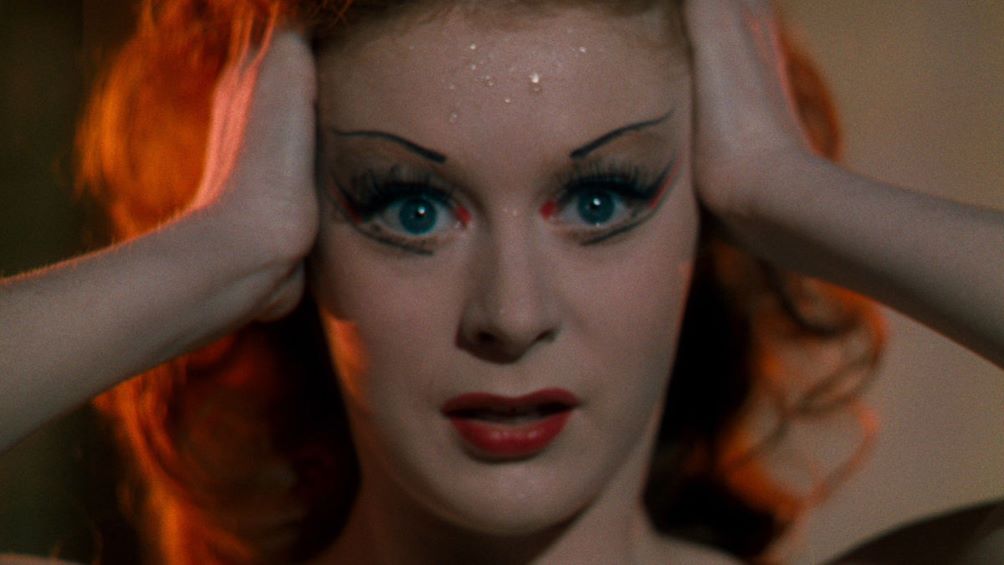
It’s why the visual impact of the film is so important. “Heaven” is shot in crisp black-and-white. As the Conductor says when travelling down to Earth, “one is starved of Technicolor up there”. This Heaven is a place of peace, but also of bureaucratic efficiency. Arrival lounges are staffed with decent but practical Angels (Kathleen Bryon is marvellous as the first of these we meet – and there is a fabulous shot from Powell that frames her in front of a clock, making the edges of its face appear like a halo around her head). There are rules and paperwork – in fact a whole city of clerks and arrival lounges. What it doesn’t have is the warmth and passion – the colour – of Earth. Down here, everything is in luscious, gorgeous Technicolor. Up there life is restful, but monochrome.

Jack Cardiff’s photography of AMOLAD – combined with Powell’s astute visual eye – crafts one of the most ravishing films you’ll ever see. Blues, oranges and reds practically pour off the screen into your eyes. Filters add a golden hue to much of what we see. The ramshackle details of locations – Frank’s cluttered library with its piles of books, June’s country-house-base – see every single detail captured in painterly beauty, colours popping out. Only Peter’s surgery room feels like a bridge between ”Heaven” and Earth, cooler filters stressing their blues and cool icey whites.

This is what Peter is fighting to stay in. A world of colour, of joy and poetry. Perhaps “Heaven” is just his imagination of what the afterlife could be like. It resembles the military operations he has spent the last few years emersed in. It’s filled with the historical generations he taught at university. Familiar faces up there fight his corner and represent him at the great trial to decide his fate. His surgeon on Earth shares the face of his judge in “Heaven”. Powell and Pressburger don’t lean too far either way – it’s all gloriously left open to our imagination.

And who, in 1946, wouldn’t want to believe in a heaven as reassuringly welcoming as this. (On a side note it’s refreshing to see a film from the 40s that depicts such a racially diverse after life). One where all are equal and questions of colour and creed are left aside. “Heaven” is packed with soldiers from all across the world – and the sheer volume of uniforms up there reminds us of the trauma down here.

AMOLAD is all about the world we might decide to live in after the trauma of war. It’s also about forging lasting bonds between two nations bought together to fight. No one feels more English than David Niven: and AMOLAD is, arguably, his finest performance. He makes Peter a man of casual wit and lightly worn intelligence, but with hints of the burdens he has carried across years of war. He’s the best of us Brits – and now he has fallen in love with the best of America. June, wonderfully played by Kim Hunter, is practical, brave and grounded. Their love (and the life they could spend together) becomes the battleground at the heavenly trial.

On the one side: a prejudiced revolutionary American (played with gusto by Raymond Massey) – on the other the perfect embodiment of English decency. There could have been no better choice of actor for this than the glorious Roger Livesey. Livesey’s Frank Reeves becomes a mix of English eccentric, master surgeon and Prospero-like magus. It’s no coincidence that among his hobbies is a large camera obscura with which he observes events on his village streets with a protective, grandfatherly care. His study is lined with books, his knowledge is infinite and he is always open to Peter’s tales of heavenly staircases and visitations from mysterious conductors. Then as his advocate in “Heaven” it is he who has the clear sight and judgement to focus the jury not on what divides us, but what unites us – what makes us all human, not what drives us apart.

AMOLAD is about what brings us together. It’s open about the flaws of Britain – the first trial jury is awash with Boers, Indians and other victims of Empire – but also a celebration of its virtues. It celebrates the melting pot of America – the second trial jury is made-up of an incredibly diverse selection of American citizens – and is a hymn to personal freedoms. Farlan picks up on what divides Britain and America – cricket vs American dynamism – but what unites us is our desire for life. So what does it matter if Brits can be austere or Americans so brash they raid a coke dispenser on arrival in “Heaven”. We’re still cousins.

All this helps capture the film as a universal fable, of love being discovered in the magical boundaries between worlds (its no coincidence we see Midsummer Night’s Dream being rehearsed by an American cast under a British vicar). This is a quiet, decent struggle about emerging from the horrors of war into the chance of a new world of love. It’s a struggle for Peter and June that is both very personal and hugely universal.  Powell and Pressburger’s film captures this perfectly in a film that’s sublimely directed and never-endingly rich in dialogue and visuals. It perfectly offers up a universal fable that speaks to the heart. It’s perhaps why this is their most beloved – and finest – hour.

Dance with a Stranger (1985)

Dance with a Stranger (1985)

Hell is other people in this Satresque version of the life of Ruth Ellis

Director: Mike Newell

Cast: Miranda Richardson (Ruth Ellis), Rupert Everett (David Blakely), Ian Holm (Desmond Cussen), Stratford Johns (Morrie Conley), Joanne Whalley (Christine), Tom Chadbon (Antony Findlater), Jane Bertish (Carole Findlater), David Troughton (Cliff Davis)

Hell is other people. Dance with a Stranger is the tragic story of how Ruth Ellis (Miranda Richardson in an electrifying screen debut) became the last woman hung for murder in Britain. But it’s also a terrible Satre-like tale of three people stuck a destructive cycle, loathing each other but unable to imagine their lives apart. Ellis is fanatically, obsessively in love with feckless David Blakely (Rupert Everett) who blows hot and cold on her and is nowhere near consistent in his feelings as middle-aged Desmond Cussen (Ian Holm), so besotted with Ruth (who treats him like a benevolent uncle) that he drives her to her assignations and pays rent on the apartment where she sleeps with Blakely.

All three cause each other immeasurable harm in Newell’s cool, bleak, well-made true-crime story that is far less interested in the moments of violence and retribution, than the sad and sorry cycle that leads to them. Tellingly, we never see a single moment of the trial or punishment of Ruth and the film effectively concludes in long-shot as we watch the fatal shooting of Blakely from afar. But who needs the close-up of this inevitable ending, when we’ve had front row seats to the catastrophic relationships that led up to it.

Like many British films, it’s at least partly about class. In 1950s London, we’re still on the cusp of the sort of cultural levelling out of the 1960s. This is a post-war, Agatha-Christie-like London. Blakely and his friends are Waughish Bright Young Things, living on Trust Funds and driving racing cars for fun. Their evenings are spent in drinking clubs aiming for glamour, staffed by those yearning to jump up a notch on the ladder like Ruth Ellis. Such women are of course for dalliances (and casual screws) not for marrying. Ruth’s back-up lover Desmond is an RAF-veteran who misses the war, an overgrown besotted schoolboy and middle-aged bachelor who accepts he is only worth other men’s cast offs.

Blakely’s friends encourage him to mess Ruth around because she’s a working-class strumpet. Ruth is at least partly willing to forgive him because marriage could lift her once and for all out of the working classes. Desmond is of less-interest, because a loveless middle-class marriage of sexual duty simply isn’t as attractive. Neither does Ruth love – or lust after – him the way she does the dynamic, sexy, little-boy-lost Blakely. A man she finds herself so uncontrollably drawn to that, no matter what he does – not turn up, mock her in front of his friends, push her down the stairs or punch her in the face in public – she comes crawling back. Often with Desmond in helpless tow, ignoring his adoration while demanding he drive her to another confrontation with the selfish Blakely.

Dance with a Stranger finds intense sympathy, to various degrees, with all three of its leads. But most strongly it turns Ruth Ellis, who could be a historical statistic, into a figure of real tragedy. Richardson is superb as a woman who is confident, assertive – even arrogantly dismissive – in so many areas of her life except one: her compulsive, obsessive and destructive love for Blakely. Dance with a Stranger charts effectively her mental collapse: from a woman who flirts confidently in a bar, to a quivering, weeping mess standing in the streets staring up at her lover’s window, screaming abuse, smashing up cars and babbling incoherently and inconsolably.

The film charts the same deadly cycle, showing Blakely’s ill-treatment and selfishness having ever more deadly impact on Ruth’s mental well-being. In it all, Blakely isn’t always malicious, more immature and easily led. Everett’s performance is perfect at capturing this playboy uneasiness under a fundamentally weak personality, a man who has been handed everything on a plate and is unable to respond in any adult way to Ruth’s love for him. Nevertheless, his stroppy behaviour gets her fired from her job and his behaviour fluctuates from gifts of framed pictures and promises of devotion, alternated with angry outbursts and emotional and physical violence.

And Desmond Cussen picks up the pieces time and again. Ian Holm is wonderful as this hen-pecked sadomasochist, impotent and all-too willing to debase himself, hurt time and again by seeing Ruth returning time and again to the dismissive Blakely. Holm makes Cussen small, weak, moody and frequently pathetic. He limply follows where she leads and suffers with weary, besotted patience every one of her preoccupied complaints against Blakely. This is man who almost sado-masochistically puts himself in painful situations, can’t be angry with Ruth for more than a few minutes and gets into impotent scuffles with Blakely outside pubs.

But it’s also Cussen who has the gun – and the film at least suggests the possibility that his openness about its location might well have been a factor in Ruth’s later decision to use it. The killing is, deliberately, the least interesting part of the film. What matters is the mental state that led Ruth to this killing. The self-delusion and desperation to believe that she could form a relationship with Blakely, the same obsessive blind-spot that leads to her closing the film writing a condolence letter to Blakely’s mother. Ruth is a victim here as much as him (perhaps more?) a mis-used woman who cannot give Cussen what he wants and can never get what she needs from Blakely.

Newell’s direction is sharp and sensitive and while the film’s cycle of destructive behaviour – Blakely and Ruth row, break-up, Cussen picks up some pieces, rince and repeat – can become overwhelming, it is partly the intention. And it cements the feeling for the audience of being as much trapped in this hell as everyone else. Holm is superb, Everett perfectly cast but Richardson is mesmeric as Ruth, vivid, vibrant, vivacious, vulnerable and victimised in a film that goes a long way to humanise the suffering behind what seem open-and-shut cases.

The Quiet Man (1952)

The Quiet Man (1952)

Ford’s sweet and funny Irish fable is possibly his most purely enjoyable film

Director: John Ford

Cast: John Wayne (Sean Thornton), Maureen O’Hara (Mary Kate Danaher), Barry Fitzgerald (Michaleen Oge Flyyn), Ward Bond (Father Peter Lonergan), Victor McLaglen (Squire Will Danaher), Mildred Natwick (The Widow Sarah Tillane), Francis Ford (Dan Tobin), Eileen Crowe (Mrs Elizabeth Playfair), Arthur Shields (Reverend Cyril Playfair), Charles B Fitzsimmons (Hugh Forbes), James O’Hara (Father Paul), Jack MacGowran (Ignatius Feeney), Sean McClory (Owen Glynn)

John Ford wasn’t born in Ireland, but he loved the place in the way only the child of ex-pats could. The Quiet Man is a loving, romantic, almost fairy-tale view of Ireland, an affectionate feelgood fantasy that transcends any possibility of patronising its subject through its warmth and charm. It’s an unashamedly feel-good film, a delightful fable full of luscious scenery and tenderly sketched characters that plays out like a warm end-of-term treat where we are all invited to the party. It’s possibly Ford’s most purely enjoyable and heart-warming film.

Set in 1920s Ireland, Sean Thornton (John Wayne) returns to his childhood home of Inisfree after growing up and becoming a boxer in Pittsburgh. Sean loves his home country, but with his American upbringing is out-of-step with the customs and traditions of Ireland – something that becomes very clear when he falls in love with Mary Kate (Maureen O’Hara), sister of local squire Will Danaher (Victor McLaglen). Their rules-bound courtship – overseen by matchmaker Michaleen Oge Flynn (Barry Fitzgerald) – eventually leads to marriage, but via tricking Will, who withholds Mary Kate’s dowry, the sign of her independence. Mary Kate wants Sean to fight for it – but the former boxer is haunted by the accidental killing of an opponent in the ring and wants to live-and-let-live. Problem is everyone, from Mary Kate down, sees that as cowardice.

Ford was desperate to make The Quiet Man, the rights for which he had paid $10 for in 1933 when the short story was published by Maurice Walsh (Ford ensured Walsh received another $5k when the film was finally made). B-movie studio Republic Pictures was the only one willing to take a punt on it. But, alarmed by Ford’s insistence to shoot in colour and (even more expensively!) on location, they were convinced they had a box office bomb on their hands. They insisted Ford and his cast made a western first – the literally for-the-money Rio Grande – to cover the expected losses. They even demanded Ford couldn’t make it longer than 2 hours. Ford screened the final 2 hours and 9 minutes cut to them, stopping the film on exactly the two hour mark and asking them what they’d cut. They released the film unchanged. The film was an Oscar-nominated smash-hit.

It’s not a surprise why, because the film is a whimsical delight. Ford isn’t often remembered for his sense of fun, but The Quiet Man is unarguably funny. It’s crammed with sight gags – from sly double takes (there is a delightful one from the railway station workers, who watch first a determined Sean then a horse walk straight past them), to Sean and Will grimacing in pain but smiling as they exchange a brutal handshake, to Mary Kate jumping over obstacles as Sean drags her back to the village to have it out with her brother. It famously ends with an extended comic set-piece as Sean and Will launch a mano-a-mano “Queensbury Rules” fistfight that takes most of a day, moves across the whole village, and is interrupted only by a break for a pint.

All of this takes place in an Ireland that, while it never feels entirely real, is drawn with such loving affection and cast with such careful exactitude that it hardly matters. Ford’s insistence on shooting all the exteriors on location paid off in spades. The country has never looked more ravishing than through Winton C Hoch’s technicolour lens. Rolling vistas, gentle brooks, quaint villages, perfect beaches. You totally understand why Sean, on arrival, simply stands on a stone bridge and stares across the valley of Inisfree, lost in memories and his emotions.

Sure, it’s a romantic vision. And 1920s Ireland wasn’t the sort of haven depicted here, where Catholic and Protestant lived in perfect harmony, politics never reared its head and the local IRA man is a jolly joker in the pub. If The Quiet Man had not been so well-meaning, you can imagine people taking offence at a picture of the country full of roguish charm, horse-drawn carriages, drinking and fighting. (You could say The Quiet Man shaped many Americans’ perceptions of what the country is like.) But Ford never makes any of this a subject of humour. In fact, it’s a subject of love. The joke is never on the Irish. Inisfree is in fact a haven of community spirit, a supportive village where its people are wise, caring and decent, tradition is respected and what people say and do matters.

It’s why so many are shocked by Sean’s seeming cowardice at not raising his fists earlier. That’s not what “men” do. John Wayne is very effective as the easy-going Sean, a guy who just wants to settle down to marriage. It’s a decent playing-against-type by Wayne, that balances his quiet sense of dignity with the sort of manly determination we know will eventually come through. It’s easy to see why he and Mary Kate fall in love. Also, why she is both swept up in his masculinity and also enraged that he doesn’t behave enough like a man, by refusing to take a stand to defend her honour and secure that dowry that will make her a true wife.

O’Hara is marvellous in a challenging role as Mary Kate. This is a feisty and determined woman, who knows what she wants but denies to herself what that is. She and Wayne share a striking, windswept early kiss – her mood in it going form surprise, to fascination, to irritation, to surrendering to her own desires. While you could suggest the film’s comic set-piece of Sean dragging her (sometimes literally) back to the village so she can watch him fight her brother the way she’s demanded from the start feels uncomfortable today, but it’s also Sean not only delivering what she has wanted him to do from the start, but also strangely the thing that finally bonds them together.

A bond is what they have, both of them straining against the confines of the courtship rules of Ireland. Together they flee the chaperoned carriage ride Michaeleen (a delighful Barry Fitzgerald) takes them on to ride a tandem through the streets. Mary Kate constantly, bashfully, tries to go after what she wants – and a large part of that is the lurking “bad boy” tendency that she detects under the surface of the quiet Sean. Something her less-bright brother Will can’t see.

Victor McLaglen (Oscar-nominated) swaggers, slurs and puffs himself up as this rough-and-tough, punch-first-think-later bruiser, who constantly thinks he’s being cheated. He and Wayne throw themselves into the long dust-up that ends the film with the same comic energy and enthusiasm they did exchanging handshakes. Part of The Quiet Man’s success comes from the comfort and familiarity the cast felt for each other. The trip to Ireland was like a friends-and-family holiday: old mates like Ward Bond, Ford’s brother, O’Hara’s brother, Wayne’s children – they all round out the cast. It helps build even more the family and community feeling that makes the film a delight.

Above all, The Quiet Man leaves you with a smile on your face. With expertly filmed set-pieces – a horse race, Sean and Mary Kate’s long walk back to Inisfree and the epic punch-up – combined with luscious shooting (also done with wit – a sexually frustrated Sean pounds through the countryside, tossing heavily puffed cigarettes aside, after Mary Kate withdraws favours) – it’s also fast-paced, witty and warm. The cast even effectively take bows as Ward Bond’s (his finest hour) priest delivers a final voiceover. Full of affection and charm, it’s a delight and is perhaps the only foreign “Irish” film that has been embraced by the Irish.

Salvador (1986)

Salvador (1986)

Oliver Stone’s passionate denunciation of American policy, highly politicised but electrically made

Director: Oliver Stone

Cast: James Woods (Richard Boyle), Jim Belushi (Doctor Rock), Michael Murphy (Ambassador Thomas Kelly), John Savage (John Cassady), Elpida Carrillo (Maria), Cindy Gibb (Cathy Moore), Tony Plana (Major Maximiliano Casanova), José Carlos Ruiz (Archbishop Oscar Romero)

To many countries the Cold War was very hot. The USA and USSR may not have crossed swords personally, but they were happy to funnel money and arms to governments and resistance groups in other countries to fight for them. The Salvadoran Civil War became another proxy battleground for East vs West – or rather Capitalism vs Communism. The US backed the military dictatorship, the USSR the left-wing revolutionaries. Caught in the middle? The people of El Salvador and their shattered human rights.

It’s not surprising this attracted the attention of Oliver Stone. Released in the same year as Platoon, Salvador is the second half of a one-two punch against the failures of American intervention. It was considerably less palatable to the masses though: Salvador is a furious, spittle-mouthed denunciation of American policy. Unlike Platoon where the victim is basically the innocence of a whole generation of Americans (an American tragedy), here you can’t fail to notice America is one of the bad guys. To Stone, El Salvador (as Richard Boyle points out in the film) was America’s chance to fight Vietnam again, only this time “right”: win it while sacrificing the lives of another country instead. It’s a considerably less easy to digest message.

Salvador is based on a fictionalised version of gonzo-journalist Richard Boyle (played with mesmeric intensity by an Oscar-nominated James Woods) who escapes from the mess of his life in San Francisco to cover the war first hand in El Salvador. There he finds himself growing increasingly sympathetic to the left-wing rebels, as the US-backed government forces commit atrocity after atrocity: mountains of corpses, assassinations and out-of-control death squads. And no-one in the embassy wants to admit to it, not when they are more concerned about keeping El Salvador from going Red. To stop that, any price is worth paying.

It makes for a passionate, angry but not subtle film. But then is Oliver Stone known for anything else? It hectors, it bellows, it hammers its points home. Stone’s writing is often a touch simplistic. There are traces of the unpleasant racism of Stone’s scripted Midnight Express in the scruffy, lecherous vileness of many of the government troops while death squad leader Major Max (Tony Plana) struts around like a mix of Tony Montana and Henry II, all but saying “who will rid me of this turbulent priest?” as he plots the murder of leading protestor Archbishop Oscar Romero.

It’s a film that lands punches that would have been better pulled. I could have done without the all-too-detailed recreation of the rape and murder of four American missionaries by a government death squad. Changing the names, doesn’t change the fact that these are fundamentally real people whose final moments are staged with a little too much queasy detail (or close-ups of their mistreated, bullet ridden bodies). But then, Stone is equally unafraid – and perhaps rightly so – to show us mountains of dead Salvadoran bodies, including children, so maybe it’s hypocritical of me to argue restraint for American victims.

Stone shoots the film with a real urgency and immediacy. Boyle frequently makes his way to the heat of the action and the camera follows him right in there. It ducks and sways among panicked mobs of people. It sees charges of horse-backed revolutionaries head towards it. It follows Boyle through devastated streets and scenes of despicable human carnage. It doesn’t flinch from executions and murders and when Boyle is thrown to the ground by explosions and gunfire, it goes down with him. Stone allows bombastic excess into the film, twinned with a score that adds a little too much classical self-importance, but at least his reasoning behind making this an overwhelming film makes sense. The whole ghastly civil war is overwhelming.

And so is America’s part in it. Aside from the ambassador – a Carter-ish hangover, played with ineffectual decency by Michael Murphy – the figures we see from government are heartless, cold warriors, interested only in the ends and caring nothing for the means. They pour money into death squads, provide air support and tanks for rebels to be strafed on the ground and are totally indifferent to morality. The media largely backs them all the way, parroting the government line and painting the revolutionaries as terrorists. They even suggest those dead missionaries were either foolish or mixed up with the rebels – either way fundamentally responsible for their deaths.

The government contrasts with the “ordinary” Americans we see. Missionaries down here to do good. And, of course, the cryptic figure of Richard Boyle. Boyle is, in many ways, a deeply unsympathetic character. Woods makes him selfish, sleazy and self-interested, constantly letting people down and taking what he can get from friendships and situations. But the things he sees in El Salvador reawakens his sense of right and wrong. He’s vile but he’s kind of brave. He will call out what he sees as wrong. He will protect others, instinctively covering those he loves when bullets fly.

And, finally, he tries to do something right, smuggling his girlfriend Maria (sweetly played by Elpidia Carrillo) and her young son back to America (needless to say, the authorities do not react well). Part of Salvador’s success is in seeing Woods perfectly craft a character arc that takes a man interested only in himself through to putting himself at risk for innocents. It’s a long road from the gonzo washout who drives down to the country stoned with drinking buddy Dr Rock (Jim Belushi, rather good as grungy stoner, sweeter than he appears, who grows to love the country and its people).

He’s a complex hero though, superbly bought to life by Woods in a performance that’s like a raw wound in a complex film. While Platoon could be seen, for all its loss of innocence, as a film where America was the victim, Salvador casts the country as the villain sharing morally responsibility for the piles of corpses Boyle picks his way through. Stone acknowledges the crimes of the revolutionaries – Boyle furiously denounces them for their shooting of unarmed soldiers pleading for the lives – but his real anger in this passionate, vibrant polemic is America itself. It’s delivered with verve, commitment and drama and helps make Salvador one of his best and most overlooked films.