Author: Alistair Nunn

Wild Strawberries (1957)

Wild Strawberries (1957)

An aged doctor reflects on his past regrets and failures, in Bergman’s strangely optimistic masterpiece

Director: Ingmar Bergman

Cast: Victor Sjöström (Professor Isak Borg), Bibi Andersson (Sara/Sara Borg), Ingrid Thulin (Marianne Borg), Gunnar Björnstrand (Evald Borg), Jullan Kindahl (Mrs Agda), Folke Sundquist (Anders), Björn Bjelfvenstam (Viktor), Naima Wifstrand (Isak’s Mother), Gunnel Broström (Berit Alman), Gunnar Sjöberg (Sten Alman/Examiner), Max von Sydow (Henrik Åkerman), Ann-Marie Wiman (Eva Åkerman), Gertrud Fridh (Karin Borg), Åke Fridell (Karin’s lover), Per Sjöstrand (Sigfrid Borg)
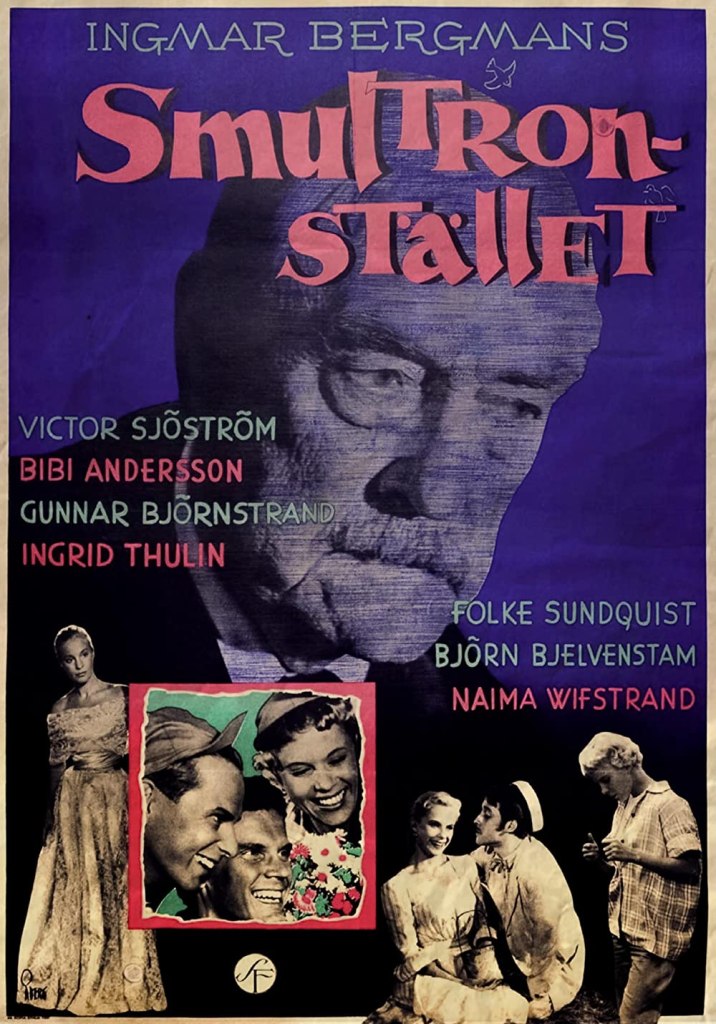
Is anything in life more painful than regret? When we look back at our past mistakes, the things we wish had played out differently, the roads not taken, it’s difficult to accept there is nothing we can do about it. It’s the theme of Bergman’s beautiful, strangely optimistic Wild Strawberries (his third consecutive masterpiece, cementing him as one of the most distinctive, visionary directors in the world). Wild Strawberries is filmed with a virtuoso assurance, that still finds a genuine sense of optimism, despite the pain of the past.

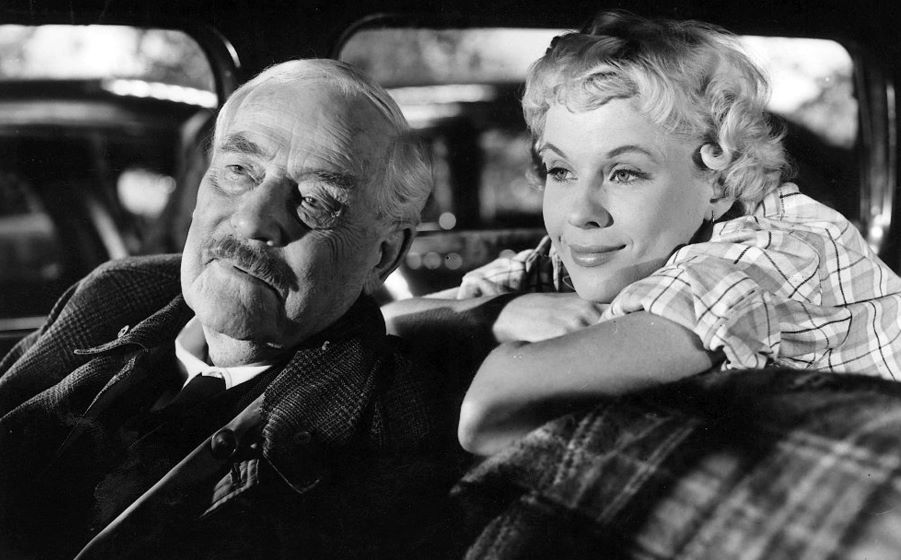
It’s about a long, single-day, road trip taken by famed, retired, medic Professor Isak Borg (Victor Sjöström, Sweden’s legendary father of cinema and Bergman’s idol) and his daughter-in-law Marianne (Ingrid Thulin). Isak is receiving an honorary doctorate in Lund but, after a bad dream, spontaneously decides to drive there. They drop by places with huge personal significance: the country chalet where he loved and lost his cousin Sara (Bibi Andersson) and the home of his mother (Naima Wifstand), who perhaps never really wanted him. Along they way they pick up a trio of young hitchhikers, one of whom, Sara (Bibi Andersson again), reminds him of his lost love. Will Isak come to terms with his regrets and failures?

The Wild Strawberries were collected by Sara on the birthday of her and Isak’s uncle. They are touch points in Isak’s memories, a reminder of the summer when Sara broke off her engagement with him to marry his more fun brother Sigfrid (Per Sjöstrand). Did that moment set Isak on the path of distant, judgmental coolness that defined his whole life? Or was he always bound to become who was, especially since his mother matches him for chilly distance? Is the cycle destined to continue, as Isak’s son Evald (Gunnar Björnstrand, full of cold nihilism) is just as austere as his father?

Bergman‘s radiant memory piece, explores all this without casting judgment. Wild Strawberries profoundly studies the regrets that come with facing your mortality. Isak becomes so lost in his memories, he literally becomes a silent witness in them. Sjöström’s beautifully expressive face lights up with a mixture of powerless pleasure, sadness and longing as he sees Sara once more – its implied the only woman (or indeed person) he has allowed himself to purely love.

What’s striking though, is that Isak’s memory of her – flirting with Sigfrid and then tearfully telling another cousin that Isak is so nice but… – is not a memory he can possibly have. He was never there: it can only be his supposition. It’s the same with the birthday party of his uncle (Bergman fills this with some great comedy, not least two gossipy pre-teens who talk simultaneously), an event he was not present at. Isak clings to these as memories, but they are imaginings. It’s not a card the film plays heavily: but Isak is, essentially, an unreliable narrator showing us his version of the past. It makes you wonder: are we all unreliable narrators of our own memories?

Is Wild Strawberries actually a dream piece? These recollections are daydreams, helping Isak accept his choices, and begin to find peace. The film opens with a striking surreal – and chillingly horror tinged – dream sequence that inspired hundreds of imitators: Isak walks an abandoned street, clocks lack hands, a faceless man collapses into water, a hearse overturns and when Isak investigates his own hand emerges to pull him in. (The unsettling artifice of this sequence is so masterful, it makes you realise Bergman could have become the king of terror if he’s wanted to).

A series of sequences take place halfway between dream and memory. In one he’s challenged by a cold and formal Examiner (a mirror of Isak himself?) with unanswerable questions, diagnosed with guilt and loneliness and then taken to witness his most vivid memory – watching his wife in the throws of passion with another man. The memory changes from reality to dream as Isak’s wife (an unsettling Gertrud Fridh) – who loathes him – sits up and dispassionately recounts their conversation later when she confessed/rubbed-his-face-in her infidelity. These aren’t straight memories.
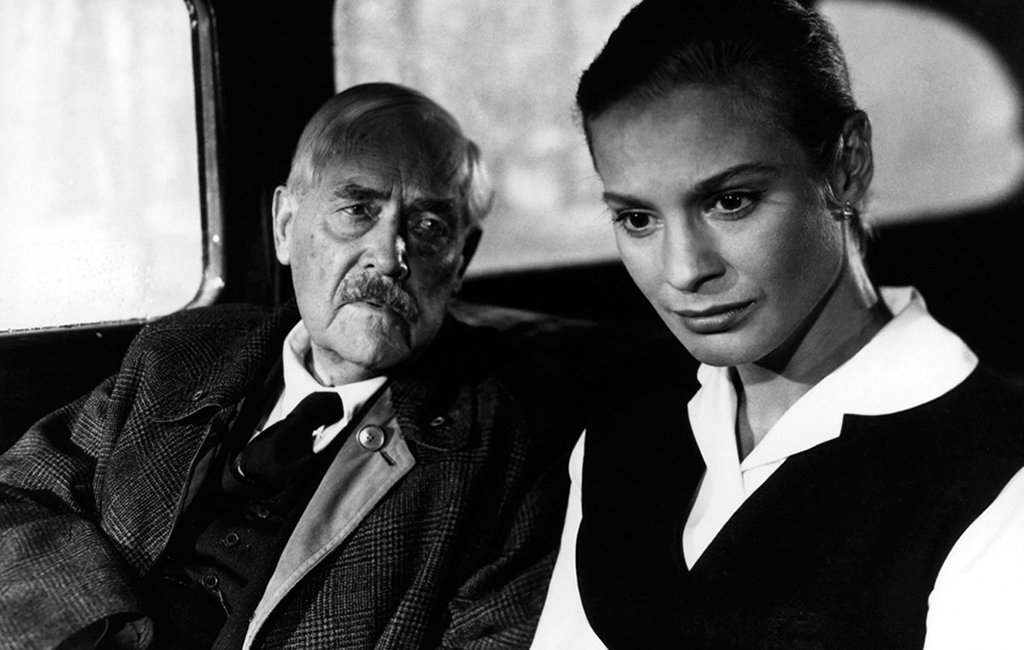
Isak’s reminiscences creep up on him. It’s started by his daughter-in-law Marianne flatly telling him she can’t stand his aloofness and self-satisfied smugness. He seems unmoved: but does it prompt him to take her to the chalet of his childhood, to try and prove her wrong? Surely it can’t be a complete coincidence he awakes from a dream of Sara, by another Sara (Bibi Andersson brilliantly distinguishes between these two very different women, who both speak to repressed romantic yearnings in Isak) or asks for a lift? My private theory: I think Bergman is implying only Isak sees these two people as identical in appearance, like he plops past-Sara’s face on hitch-hiker-Sara’s body. It’s another walking semi-memory-dream.

Sara is one of several people prompting Isak’s reflection and changing our perceptions. Why did he become a man so detached he barely bats an eyelid when his daughter-in-law rubbishes him? A feuding couple the group pick up after a road accident – whose abuse of each other gets so personal and cruel, Marianne throws them out of the car – could almost be past versions of Isak and his wife. How miserable must his marriage have been? When Isak is feted as a doctor at a small village (a neat Max von Sydow cameo), how much does his sad observation that perhaps he should never have left further trigger his softening character?  As hiker-Sara talks about romance and opportunity, how much does this make Isak think about the staid, loveless respectability of his own life?

Our understanding of Isak is also partly filtered through Marianne’s perception of him. Ingrid Thulin is glorious as a woman whose marriage (to a knock-off prototype of his father) is on the rocks due to her husband’s callous loathing of the world. When she meets Isak’s mother, Thulin’s face radiates understanding of how this woman shaped Isak, who in turn shaped his son. As Isak begins to talk about his past and his fears, it prompts her own willingness to confide in him – something she would never have considered at the film’s start. As Marianne changes her perceptions, so do we.

Wild Strawberries benefits most of all from the wonderfully valedictory performance of Victor Sjöström. Bergman begged his mentor to take the role on, and it produces a cinematic wonder. Sjöström is in every scene and his face fills with such powerful emotion – from distraught regret to wistfulness to confusion to a peaceful radiance – that Bergman allows it to dominate the frame at key points. Its an unforced, gentle and underplayed performance with real emotional force.

Not least because, at heart, this is an optimistic film that tells us its never too late. Sure, we can regret mistakes and lost opportunities: but it shouldn’t close our hearts. Isak learns he has been wrong in closing his heart: there is life, warmth and happiness out there for the taking. It comes together in a final dream/memory, as Isak rediscovers a happy memory of his parents (all the more powerful for how few and far these must be) and Bergman’s camera (shot with majesty by Gunnar Fischer) trains one final time on Sjöström’s face and we understand that he has, at last, come to terms with his life. For a director famed as the master of misery, Wild Strawberries shows he could also frame a story of optimism, growth and understanding, making Wild Strawberries one of his most affecting movies.
Avatar (2009)

Avatar (2009)

Cameron’s monster-hit is an exciting slide of traditional story-telling, that had less cultural impact than you might expect

Director: James Cameron

Cast: Sam Worthington (Jake Sully), Zoë Saldana (Neytiri), Stephen Lang (Colonel Miles Quaritch), Sigourney Weaver (Dr Grace Augustine), Michelle Rodriguez (Trudy Chacón), Giovanni Ribisi (Parker Selfridge), Joel David Moore (Dr Norm Spellman), CCH Pounder (Mo’at), Wes Studi (Eytukan), Laz Alonzo (Tsu-tey), Dileep Rao (Dr Max Patel)

Why is Avatar so easy to mock? It’s the second biggest box office hit ever (Cameron holds slots two and three with this and Titanic:only Avengers: Endgame grossed more). But its cultural impact feels wide but not deep. As FOUR more Avatar films start to arrive from 2022, the question remains: why has no-one really talked about Avatar since 2009?

Perhaps it’s because there isn’t really much new or unique in Avatar, beyond the magic of its visuals and the magnificent showmanship of Cameron. For all the striking blue design of the aliens, their story was too reminiscent of too many other things. The script lacked punch, distinctive lines and unique characters. There was little to quote and few truly original pivotal moments that could be embraced by our cultural memory. Narratively and structurally, it’s all a little too safe, predictable and conventional.

 Avatar partly became a “must see” cinematic event, because it was the film that finally nailed 3D. Maybe it is the best 3D film ever made. I don’t know, I’ve only ever seen it in 2D. To be very fair, Cameron doesn’t fill the film with crappy shots of things pointing at the camera. Instead, concentrating on telling a cracking (if predictable) story and filling the screen with beautiful, imaginative imagery that works in any dimension.

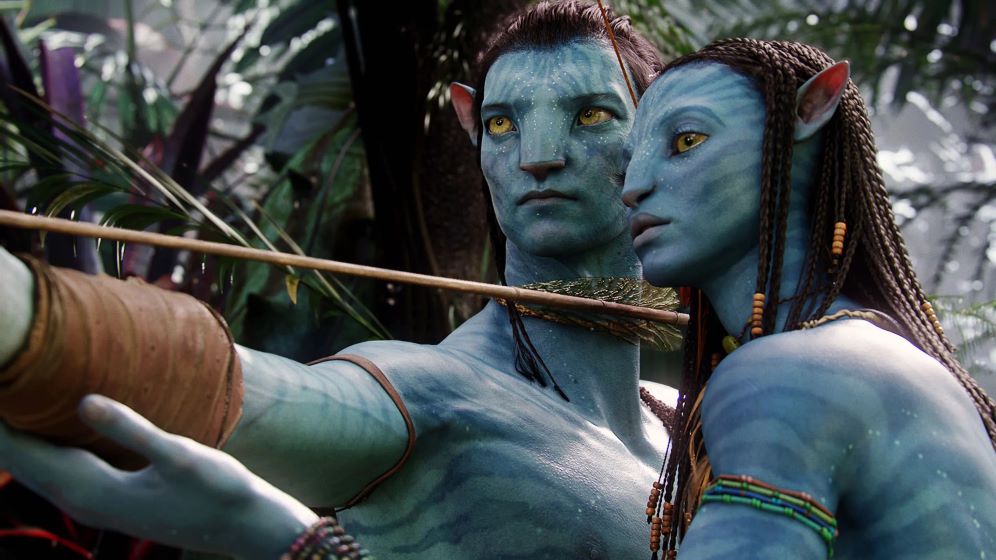
Avatar’s imagery is so striking because it’s set on the magical alien world of Pandora. In 2154, with Earth’s resources depleted, mankind has struck out into the stars – and Pandora is a rich seam of an insanely valuable mineral called unobtanium (chuckles presumably intended). Pandora is a carefully balanced biosphere, peopled by exotic animals and 10-foot, blue-skinned natives called the Na’vi. Pandora’s atmosphere is poisonous to humans, so scientists – led by Dr Grace Augustine (Sigourney Weaver) – use Na’vi “avatars”, operated by genetically matched humans, to explore. The mission is carefully balanced between science and financial exploitation by a sinister corporation, backed by mercenary army, led by the fanatical Colonel Quaritch (Stephen Lang).

Into this magical set-up drops paraplegic ex-marine Jake Sully (Sam Worthington), taking the place of his dead scientist brother because he is a genetic match for a freshly grown Na’vi avatar. With this warrior background, Jake is welcomed by the Na’vi, becoming an ambassador to the people. But Jake’s loyalties split as he finds a purpose in Na’vi life he has long since lost on Earth – and as he falls in love with Na’vi warrior Neytiri (Zoë Saldana). When the company decide to destroy the Na’vi’s home to gain access to the rich unobtanium deposits beneath, which side will Jake back?

It’s not hard to guess. At heart, Avatar fits very neatly into a series of Dances with Wolves-esque films, in which a wounded and lost (white) soldier finds a spiritual peace and solace with a native people, eventually rising up to fight for their rights against his own people. Avatar also finds roots in The Mission, with the scientists as the missionaries fighting alongside the natives (although with much better results), the conclusion of Return of the Jedi and Cruise’s The Last Samurai. Not to mention more than a few stylistic and plot echoes from Cameron’s own Aliens (you can even hear them at several points in Horner’s score), from technology (those stomping war suits) and cocky marines lost in a world they don’t understand (except this time, we love to see them killed off).

Avatar doesn’t challenge you, presenting its humble message of environmentalism and peaceful co-existence within a familiar framework where military forces and corporations are very bad and enlightened missionaries and Indigenous people are good. It entertains because it’s told with such skill. Cameron, while never the greatest screenwriter in the world, knows how to marshal his clichés and standard narrative tricks into something exciting and involving.

It also helps that the stock characters he creates a played with such forceful engagement by the actors. Stephen Lang is a growlingly hateable racist, delighting in the prospect of genocide, while Giovanni Ribisi’s corporate boss is a snivelling opportunist who couldn’t care less about the impacts of his actions. Opposite them, Sigourney Weaver gives huge weight to a fairly standard irritated-boss-turned-mentor role as the head scientist, Sully’s bridge to learning the Na’vi way. As Sully, Sam Worthington is not the most charismatic performer but he has an earnest intensity and emotional honesty that helps us invest in his pre-Pandora misery and his growing love of his adopted home.

Cameron’s greatest achievement though is the vision he creates for the Na’vi. All are played by actors using cutting-edge (and still impressive now) motion capture. Cameron builds a whole world for these people: a language, belief system, culture and bond with the environment. Sure, it’s heavily inspired by Indigenous American culture, but it feels real. Its bought to the screen with grace and tenderness and gains a huge amount from Zoë Saldana’s committed and emotionally open performance as Neytiri. Cameron so successfully builds a bond between audience and the Na’vi that you feel your heart wrench to see mankind tear their beautiful world apart.

It’s that emotional connection Cameron successfully builds that helps make the film work. After all we’ve all seen effects stuffed films before, but they don’t all become monster hits. And if the film was a dog, all the 3D magic in the world wouldn’t have helped. Few directors have as much skill with threading emotional bonds within the epic as Cameron. He shoots Avatar with a stunning majesty, carefully placed shots and graceful, almost traditional, editing help to build a sense of magic and wonder around the awe-inspiring alien vista. Avatar has a lot of action, but it never feels like just an action film: it’s a relationship drama, inspired by the beauty of its setting, with action in it.

More people have mocked Avatar with comparisons to the visually and thematically similar Fern Gully: The Last Rainforest than have actually seen Fern Gully. Narratively it does little new or unique and offers very little surprises. But its visuals are stunning and Cameron’s superb direction knows how to engage you. Clichés last because they carry a sort of truth: Avatar uses these truths to help you invest in a gripping, if conventional, story. But it’s also why its impact over time has been so slight – there aren’t any new ideas for viewers to tie themselves to and almost nothing that stands out as a unique cultural reference point – even if the conventional plot helped make it a short-term monster hit. But it’s also why it still makes for enjoyable rewatching.

The Ten Commandments (1956)

The Ten Commandments (1956)

DeMille’s massive, camp epic sets the table for what we expect from Biblical epics

Director: Cecil B. DeMille

Cast: Charlton Heston (Moses), Yul Brynner (Rameses II), Anne Baxter (Nefretiri), Edward G. Robinson (Dathan), Yvonne De Carlo (Sephora), Debra Paget (Lilia), John Derek (Joshua), Cedric Hardwicke (Seti I), Nina Foch (Bithiah), Martha Scott (Yochabel), Judith Anderson (Memnet), Vincent Price (Baka), John Carradine (Aaron), Olive Deering (Miriam), Douglass Dumbrille (Jannes)

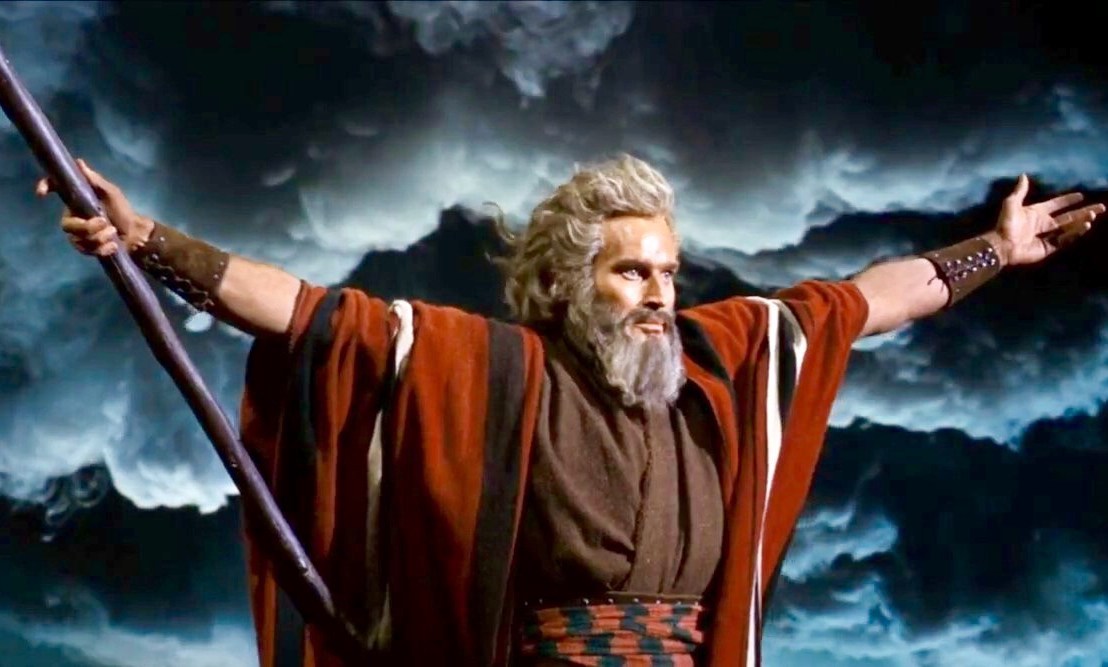
“Let my people go!” Close your eyes and think of Moses. Chances are you’ll see an image of Charlton Heston, arms spread wide, parting the waves to lead his people to freedom. Heston had been partly chosen for his resemblance to Michelangelo’s sculpture of the famous law-giver. It’s also a tribute to how Cecil B DeMille’s slightly ponderous, very-very-serious Biblical epic pretty much defined what we expect from Bible stories.

The Ten Commandments would be DeMille’s final movie (and for all its many flaws, it’s way more deserving of the Best Picture Oscar than the valedictory pat-on-the-back his penultimate film got). It’s basically a triumphal capturing of his self-important style, with sonorously devout voiceover and a faultless hero chiselled from marble an excuse to fill the screen with action, campy scheming and lots of sexiness. The Ten Commandments became a massive hit because it’s a rollicking pile of nonsense and something you could persuade yourself was “good for you” because it’s about the Exodus.

It’s a BIG film. DeMille delivers an opening direct-to-camera address, dripping with pompous self-satisfaction, where he piously tells us about the level of historical and Biblical research he’s carried out. The credits list a stack of professors, historians, religious experts and, last of all, the Holy Gospels as sources (presumably the Gospels’ writers got no cut of the vast profits). DeMille, as per his style, marshals thousands of extras and some huge (and distinctly sound-stage looking) sets to play out a series of tableaux, many of them rooted in classic silent-movie framing and techniques. Special effects abound to create plagues (disappointingly the film skips seven of them) and parting of the Red Sea. DeMille narrates with the grandiose aloofness of a Sunday School teacher.

It’s almost enough grandeur to make you overlook this pageantry covers a rather camp, frequently silly piece of entertainment. The film is ripe with buff actors striking poses: Heston does a lot of this during the first half, matched by Brynner (who worked out at length so as not to be shown-up). Opposite them, gorgeous Israelite and Egyptian babes fawn and flirt. The film is at least as interested in the love/hate relationship between Moses and Nefretiri as it is in the Word of God, not least because DeMille knows that this soapy stuff really sells.

Perhaps that’s why Anne Baxter plays Nefretiri with a level of campy purring that would be almost laughable, if you weren’t sure that she’s in on the joke. Relishing the chance to play a sex bomb – in costumes designed to stress her assets – Baxter simpers, flirts, drapes herself across Heston’s ram-rod (in every way but one of course – he’s righteous man of God) Moses and gets to utter lines like “Oh Moses, Moses, you stubborn, splendid adorable fool”. She mocks and cajoles Rameses into rejecting Moses’ demands, partly because she can’t stand Moses is immune to her charms, partly because she can’t bear the idea of Moses leaving Egypt (and her) behind forever.

Ten Commandments elevated Heston to the rank of the immortals. Few actors could carry the weight of films like this as well as he. His performance is in two acts. The first is the visionary, egalitarian adopted son of the Pharoah: the guy who builds the best cities, turns rival kingdoms into allies, gives the stuffy priests’ grain to the slaves (even before he finds out he’s one of them) and whom Seti (a haughtily British Cedric Hardwicke) would rather took over the kingdom than Rameses. Discovering his roots, he morphs over a (long) time into the white-haired, broad-shouldered prophet, speaking most of his lines in sonorous block capitals (“BEHOLD. THE POWER. OF GOD” that sort of thing). Very easy to mock, but only Heston could have played such woodenly written silliness with such skilful conviction.

He generously said he believed Brynner gave the better performance. Brynner does have the more interesting material. A playboy monarch who is true to his word and seems (at first) torn with how he feels about this adopted brother who overshadows him at every turn, Brynner adds a lot of light and shade to a character written as a pretty much straight villain. Moses is presented as such an imperious stick-in-the-mud, it’s a little tricky not to feel a bit sorry for the put-upon, inadequate Rameses, for all he’s a tyrant.

Heston was the only actor who went on location for a few key shots (the others all perform on sound stages or in front of green screens). Keeping things sound stage based allowed DeMille to have complete visual control over the set-ups. This suited his conservative camera movements and editing – most of the scenes take place in a few carefully extended mid-shots, that allow us to soak up the pretty costumes and the theatrical acting. The Ten Commandments is partly a flick-book of devotional pictures – so much so that a tracking shot into Seti’s face when he banishes Moses stands out for the amount of camera movement.

That doesn’t stop DeMille throwing in plenty to look at in frame. With Heston spending half the movie as (in some cases literally) the voice of God, John Derek’s Joshua carries the action torch: chiselled of chest, he’s introduced zip wiring to save Moses’ mother from being crushed by a mighty stone. Like most of the “good” characters he gets very little to actually work with: the decent Jews are either excessively pure or aged men of physical weakness who commentate on the wonders around us. Still, it’s better than the hilariously cheesy dialogue of the regular Israelites (“We’re going to the land of milk and honey – anyone know the way?”) that contrasts laughably with the Biblical pastiche Moses and the other principals speak in.

DeMille has plenty of fun with the doubters and naughty among the Israelites. Edward G Robinson goes gloriously over-the-top as quisling Dathan, blackmailing Joshua’s girl Lilia (a timid Debra Paget) into years of servitude and taking every single opportunity to undermine Moses’ leadership. It works as well: no wonder Moses gets so peeved – the slightest set-back and the Israelites seem ready to stone him. Dathan leads the final act Golden Calf orgy (DeMille’s voiceover tuts constantly, while letting us see as much of the action as the censor would allow) while Moses is up the mountain picking up the Word of God.

Robinson has the tone right though: the cast is stuffed full of OTT actors. Vincent Price plays a perverted Egyptian architect with lip-smacking glee. Judith Anderson jumps over the top as Nefretiri’s nursemaid. Nina Foch (one year younger than Heston!) plays Moses’ adopted mother with grandiose gentleness. They know this is a big, silly, pose-striking pantomime passing itself off as a piece of devotional work.

But that’s why its popular. DeMille knows that people don’t want to see a devotional lecture – or even really have to think that much about the rights and wrongs of an Old Testament story that sees the Lord strike down a load of kids with a murderous cloud (even Moses is torn by this for a minute). The Ten Commandments is huge in every sense, full of campy nonsense, pose-striking acting and a mix of stuff it’s taking very-very-seriously and campy ahistorical nonsense. It’s a winning cocktail that doesn’t make for a great film (or even, possibly, a good one) but cemented it as a landmark everyone recognises even if they haven’t seen it. In a way, making it one of Hollywood’s most magic epics.

Black Hawk Down (2001)

Black Hawk Down (2001)

Ridley Scott’s immersive combat film is politically simple but one of the great combat films

Director: Ridley Scott

Cast: Josh Hartnett (SSG Matt Eversmann), Ewan McGregor (SPC John Grimes), Eric Bana (SFC Norm ‘Hoot’ Gibson), Tom Sizemore (LTC Danny McKnight), Sam Shepard (General William F Garrison), Ron Eldard (CWO4 Michael Durant), William Fichtner (SFC Jeff Sanderson), Jeremy Piven (SW4 Clifton Wolcott), Ewen Bremner (SPC Shawn Nelson), Gabriel Casseus (SPC Mike Kurth), Hugh Dancy (SFC KURT Schmid), Jason Isaacs (CPT Mike Steele), Tom Hardy (SPC Lance Twombly), Orlando Bloom (PFC Todd Blackburn), Nikolaj Coster-Waldau (MSG Gary Gordon), Johnny Strong (SFC Randy Shughart)

On 4 October 1993, the US won a pyrrhic victory supporting UN efforts to prevent genocide in the Somalian Civil War. A mission in Mogadishu to capture the lieutenants of rebel leader Mohamed Farrah Aidid collapsed into a desperate overnight street battle as Aidid’s forces rose up en masse (up to 4,000 of them) in an attempt to cut off and wipe out the c. 160 US troops.

Although the majority escaped, it was one of the most costly American operations since Vietnam, with the loss of 18 dead and 73 wounded and two Black Hawk helicopters shot down. As many as 2,000 Somalians were also killed. Pictures of the bodies of American soldiers dragged through the streets by Somalian rebels led to a major realignment of US foreign policy, with a reluctance to join future peace keeping operations (most notably the Rwandan genocide).

This is bought to the screen in a virtuoso directorial achievement by Ridley Scott, one of the most immersive and gripping war films ever made. Black Hawk Down doesn’t shirk on an inch of the war experience. Combat is loud, sudden, all-consuming and a barrage on the senses. It’s scary, confusing and always unforgiving. Mud, blood and dirt are flung into a camera that runs through streets alongside the soldiers, embedded with them under siege. The slightest lack of focus or mistake is punished by horrific injury or death. The battle is a nightmare of confusion and desperate improvisation in which neither side (especially the Americans) really knows what’s going on.

It’s not surprising they don’t. The film expertly demonstrates how a multi-approach plan (helicopters delivering ground forces, an armed convoy to collect prisoners) was effectively a rashly planned house of cards, which collapsed when the hornet’s nest of an uncontrolled city, crammed with thousands of potential hostiles, roadblocks and a prepared and dedicated enemy (willing to suffer a level of loss the Americans were not) was unleashed. Ground forces are stranded, helicopters shot down, the exposed convoy becomes a slow-moving hospital, all under constant fire in a dusty, urban centre where every single civilian could be a enemy combatant.

Scott shoots and edits this with pulse-pounding intensity, aided by the dizzying camera work of Sławomir Idziak and the high-octane cutting of Pietro Scalia, whose work grips you by the throat and never lets go. It’s a “grunt’s-eye” view of the war, that puts the viewer very much in the trenches with the soldiers. We pretty much join them running through gauntlets of bullets, ducking into foxholes and desperately trying to stay alive. Scott’s work is outstanding here, a brilliant depiction of the chaos of battle in which events are both intimidatingly out of control but also crystal clear to the audience, assembled with a never-lets-up energy leaving the viewer tense and breathless.

As Eric Bana’s fiercely professional Hoot says “it’s about the man next to you”. That’s very much what Black Hawk Down is about. There’s very little context about the American operation in Somalia, the Somalian people, the impact on long-term American politics…  The film believes the whys and wherefores are less important than protecting the lives of your colleagues.

Argument has raged about whether Black Hawk Down is pro-war or not. I’m not convinced it is. Can a film which shows soldiers maimed, disfigured and literally torn in two, really be a celebration of war? But, what it clearly is, is pro-the American fighting man. The training and expertise of these soldiers – trained to make every shot count and keep their cool in terrifying situations – is crucial to their survival. (The scattergun indiscipline of the Somalian rebels is noticeable by comparison – and it’s fair to note that Black Hawk Down gives very little focus to the Somalians at all, other than as a faceless hostile mass).

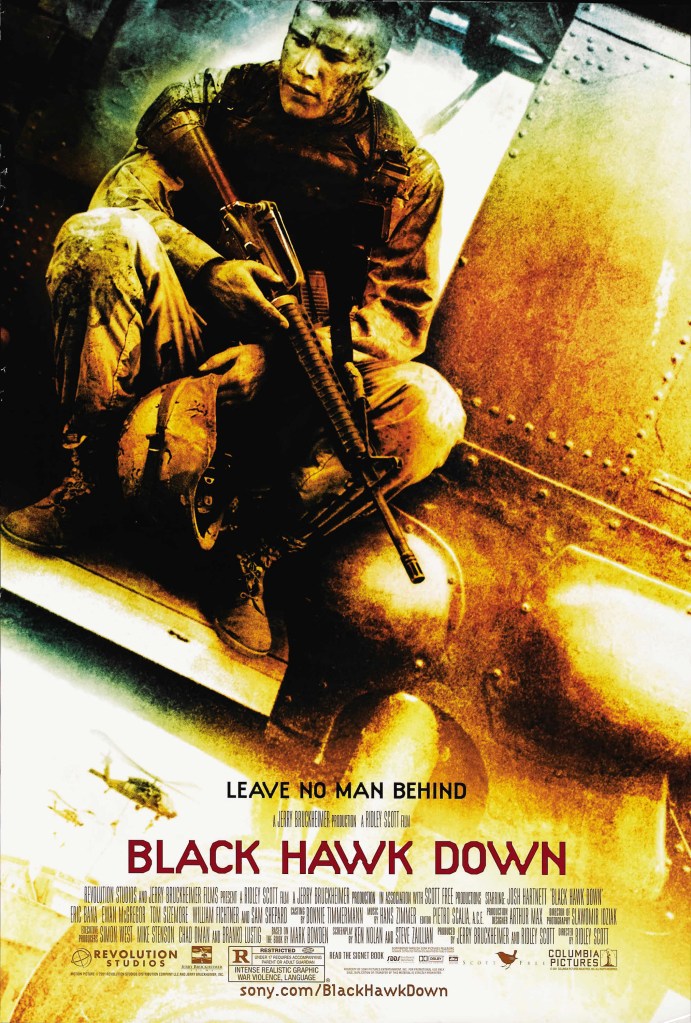
The film is in awe of the soldiers’ willingness to sacrifice themselves for each other: the dramatization of Gary Gordon and Randy Shughart’s request to be dropped in to provide some sort of cover to one of the downed Black Hawk pilots (a request they know is a suicide mission) exemplifies “leave no man behind” bravery. Black Hawk Down is a tribute to soldiers.

Interestingly though, that also means it’s a film where characters are more important for what they do rather than who they are. We learn very little personal information about any of them. Hartnett’s newly-promoted SSG has sympathy for the Somali people and is nervous about his first command mission. McGregor’s admin officer is unsettled by his first field operation. Sizemore and Isaacs are professional officers, executing orders to the best of their ability; Fichtner and Bana experienced Rangers, samurai trained to adapt and improvise. But their personalities are only hooks to hang their deeds on. Each melts into the large cast as needed. Black Hawk Down is the triumph of the unit – be that fighting together or some member volunteering to die to help protect others.

It is fair to argue the film should have done more to contextualise events. Black Hawk Down focuses so much on celebrating the bravery of soldiers, it skips any political impact: it’s not made clear in the end captions that the US effectively withdrew from its peace-keeping responsibilities for years afterwards (only shocked back into it by 9/11). It never mentions the UN were slow to respond as they had been caught in an almost identical disaster a few weeks before (a lesson the US didn’t bother to learn from). It never mentions the cost of non-intervention in places like Rwanda. It never explores how these events – and American complacency, not least in the committed-but-unengaged soldiers – were a step toward a terrorist world that would culminate in 9/11.

Scott was aiming to make an immersive film. Perhaps his work on films like Body of Lies (and even Kingdom of Heaven) later was about adding more shading and depth to his presentation of world affairs (and critique of American policy). But, in its intent, Black Hawk Down is a triumph, one of the most unrelenting and compelling combat films ever made. You can argue it turns the Somalis into bogey men fighters – but it’s trying (rightly or wrongly) to be a representation of a single military action, from a single side’s perspective. And there is no doubt this is one of Scott’s finest achievements – and one of the great war films.

La Grande Illusion (1937)

La Grande Illusion (1937)

Friendship, class, warfare and change are explored superbly in Jean Renoir’s masterful war film

Director: Jean Renoir

Cast: Jean Gabin (Lt Maréchal), Marcel Dalio (Lt Rosenthal), Pierre Fresnay (Captain de Boëldieu), Erich von Stroheim (Major von Rauffenstein), Dita Parlo (Elsa), Julie Carette (Cartier), Gaston Modot (Engineer), Georges Péclet (Officer), Werner Florian (Sgt Arthur), Jean Dasté (Teacher)

“Cinematic Public Enemy Number 1”. That’s what Joseph Goebbels called Renoir’s La Grande Illusion on its release in 1937. It’s easy to think it’s because of its pacifist stance – the idea that war itself is the Grande Illusion – but perhaps it’s because Renoir’s masterpiece isn’t easy to dismiss as polemic. It’s intelligent enough to present soldiers who believe in fighting a war on different levels, but don’t see that as a reason to hate the enemy. La Grande Illusion is as much about the passing of an era and the important links that bring us closer together rather than tear us apart. And that of course was anathema to a Nazi regime, intent on crushing freedom of any sort in Europe.

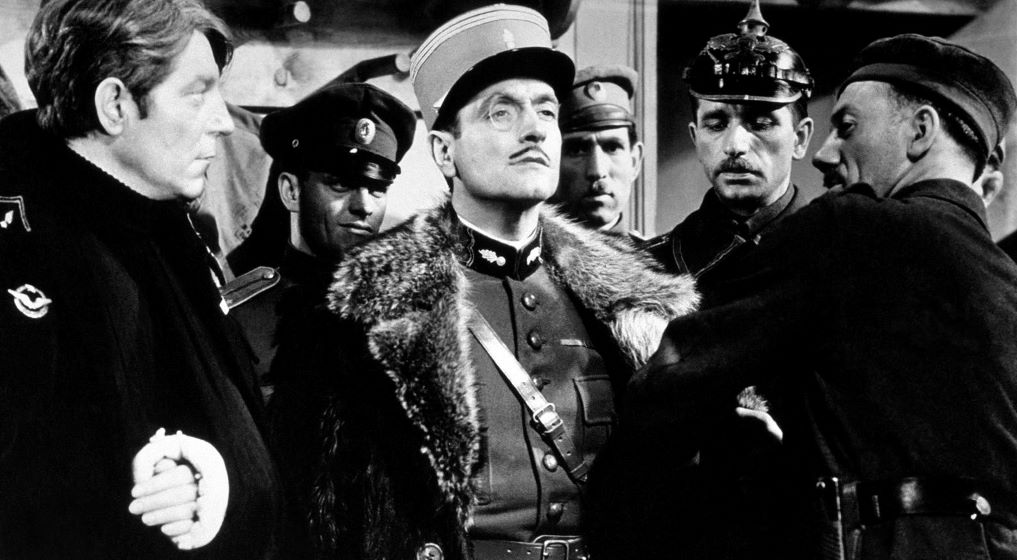
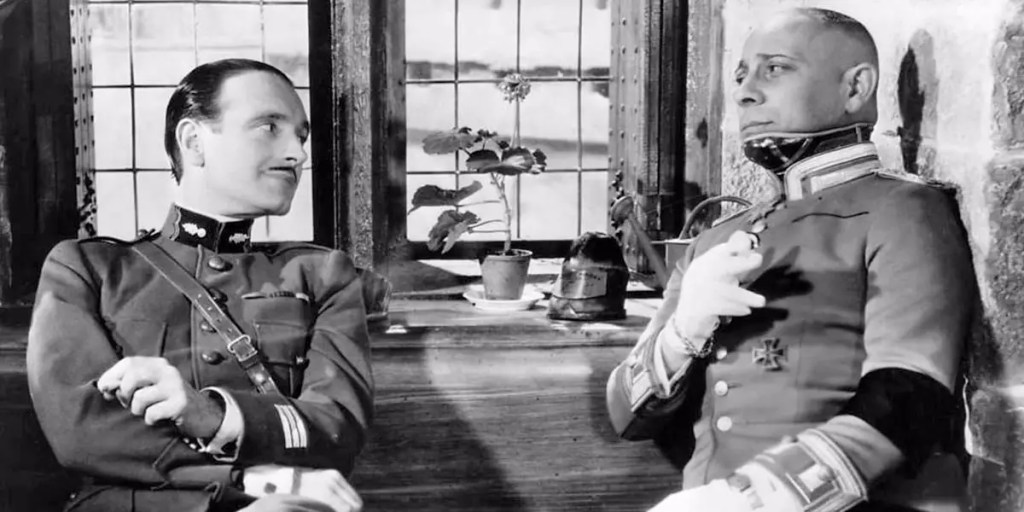
Renoir’s film is one of the foundational war films, the first great POW drama. Two French officers are shot down while flying a reconnaissance mission over enemy lines. One is working class pilot Lt Maréchal (Jean Gabin), the other aristocratic Captain de Boëldieu (Pierre Fresnay). Moving from camp to camp, the two finally find themselves in a camp run by the German officer who shot them down, aristocratic Major von Rauffenstein (Erich von Stroheim). Von Rauffenstein and de Boëldieu have more in common with each other than the soldiers on their own side – though von Rauffenstein’s Victorian, romantic view of the world differs from de Boëldieu pragmatic awareness of the advance of change. When Maréchal and fellow prisoner, Jewish officer Rosenthal (Marcel Dalio) plan an escape, will de Boëldieu help them?

La Grande Illusion is a beautifully thought-provoking and gorgeous piece of film-making, a wonderful and hugely influential film. (It inspired, among others, The Great Escape with its tunnel digging escape exploits and Casablanca’s famous La Marseillaise scene). It’s a pacifist film, masquerading as a war film – but one where we never see any fighting. A polemic would have shown us the horrors and slaughter of the trenches. La Grande Illusion shows us men proud to be soldiers, praises their bravery, centres the cavalry-style dignity of the air-force and features just one death. What makes it more pacifist is the lack of anger or rage of its characters, their lack of rancid nationalism.

This is partly because the film explores a war at the cusp of societal change. The nineteenth century era of ‘gentleman’s war’ is passing away, as are the old societal hierarchies. Maréchal and de Boëldieu are on the same side, but when they are shot down it’s striking that they have more in common with their supposed enemies. Invited to a commiseration dinner by the victorious German pilots, the aristocratic de Boëldieu bonds with flying ace von Rauffenstein (they speak in English together, something that immediately separates them from the others, about horse racing) while Maréchal is delighted to find a German working-class pilot was, just like him, a car mechanic in Marseilles. There is no hatred here, just mutual respect.

On arrival in the camp these class differences are magnified. Maréchal (the magnificently charismatic Jean Gabin) fits in far easier with the other French prisoners, all of them either professionals (engineers, teachers and the like) or outsiders, like Jewish officer Rosenthal (a heartfelt Marcel Dalio). Maréchal is inducted, enthusiastically, into their escape attempts (including the tunnel digging) as well as the social events, like the cabaret shows. de Boëldieu is a different case: there is a faint air of distrust (one prisoner even questions whether he should be told about the tunnel), and he gently refuses to take part in any cabaret and indulges the escape attempt through a sense of fair play.

But de Boëldieu is aware his world is moving on. Superbly played by Pierre Fresnay, with a wry, breezy upper-class distance that masks an acute insight, de Boëldieu knows the future belongs to commoners like Maréchal. His world – and his counterpart von Rauffenstein – is one of horse-racing, society dinners and grand houses, where a gentleman never lets a person’s nation affect his perception of them. He takes part in the war as a final grand gentleman’s sport, but also knowing that a glorious death is “a way out” of the difficult social changes that will follow.

It’s an understanding not shared by von Rauffenstein, played by an iconic preciseness by Erich von Stroheim. Von Rauffenstein respects the word of a gentleman (during a search, he tears apart the beds of every prisoner but de Boëldieu, taking his word for it that he has no contraband), sees war as a glorious expression of masculinity but never something that should come between friends. Locked within a neck brace, his posture stiff and his hands forever in trapped in tight white gloves, there is more than a hint of the closet to von Rauffenstein – and his faintly homoerotic attraction to de Boëldieu, who he sees as a natural brother-in-arms is both sad and slightly touching.

Where do de Boëldieu’s loyalties lie though? To his social equal and contemporary with whom he shares a lifetime of upperclass pursuits, or his fellow countrymen with whom he shares nothing? It’s the core of the second act of the film, as Maréchal and Rosenthal plan their escape and ask for de Boëldieu’s help. Goebbels was no doubt also unhappy with the presentation of Rosenthal. Sure, he fits many of the Jewish stereotypes: he’s a rich foreigner whose family has bought up French land. But he’s also decent, kind, shares his food and sheds a tear when Maréchal is released from solitary confinement. Maréchal and the others aren’t above befriending him despite his Jewishness, but here Rosenthal is a hero.

He’s also part of the melting pot of characters who, though they have moments of prejudice, are fundamentally all in it together. A black French prisoner goes more or less uncommented on. In solitary confinement, a distraught Maréchal is bought a harmonica by a friendly German guard, which he then delightedly plays. The French officers join in a mutually teasing relationship with an officious German guard. The various nationalities in the prison camp all muck in on their cabaret show (and escapes – a blackly comic language barrier prevents a departing Maréchal from informing a newly arrived British officer there is an escape tunnel finished and ready to go in the camp). Despite the world is tearing itself apart, but that’s not a reason for people to hate each other.

Indeed, on the run from the prison camp, Rosenthal and Maréchal find refuge on the farm of a German mother, Elsa, and her daughter, her husband having been killed in the war. (War victories get remarkably little airtime in La Grande Illusion – the famous singing of Les Marseillaise after Maréchal announces a French victory is followed in the next scene by the Germans winning it back. In the camp the soldiers grow increasingly cynical about the shortage of promised easy victories). Maréchal and this woman form a romantic bond – with Rosenthal as translator – that again transcends national boundaries. Can you imagine Goebbels being thrilled at that paragon of Aryan maidenhood, falling in love with a lunking Frenchman whose fellows killed her husband?

Neither would he be thrilled by von Rauffenstein’s desperation to save the life of de Boëldieu, the man abetting an escape. Dancing through the POW castle, pipe in hand, literally leading the guards a merry dance, de Boëldieu stage-manages his own death to leave a legacy and avoid facing the future he knows he has no place in. There is a fatalism about de Boëldieu not present in any other character: and certainly not von Rauffenstein who can’t imagine his world is ending.

But life will go on for others. Every character has a longing for life outside of the demands of war. During the cabaret, a French officer dresses (convincingly) in drag: there is something touching about the stunned, longing silence that falls across these men as they stare upon the closest thing to a woman any of them have seen in years. Maréchal plans for a future with Elsa, Rosenthal one of acceptance in his French home. War is an encumbrance, but one people understand is a burden on all regular people.

The film is beautifully made by Renoir, who uses a series of striking long-takes and intricate camera moves to create a feeling of time and place that is completely convincing, but also hugely engaging and immersive. Characters constantly stare out of windows, stressing their isolation, or are framed seemingly encased by their surroundings. Leaving aside the technical achievements and artistry, La Grande Illusion is a heartfelt, complex and moving film that challenges and questions as much as it feels regret for a time being left behind. By avoiding polemic, and stressing simple humanity and the madness of hate, it’s one of the most powerful anti-war films ever made.

Transformers: Dark of the Moon (2011)

Transformers: Dark of the Moon (2011)

Sexist, violent, crude and deeply disgusting. Transformers continues to make you weep for your childhood memories

Director: Michael Bay

Cast: Shia LaBeouf (Sam Witwicky), Josh Duhamel (Colonel William Lennox), John Turturro (Seymour Simmons), Tyrese Gibson (Robert Epps), Rosie Huntington-Whiteley (Carly Spencer), Patrick Dempsey (Dylan Gould), John Malkovich (Bruce Brazos), Frances McDormand (Charlotte Mearing), Kevin Dunn (Ron Witwicky), Julie White (Judy Witwicky), Alan Tudyk (Dutch Gerhardt)

I’m ashamed to say when I saw it in the cinema I sort of enjoyed it. Goes to show how the excitement of a trip out can make the most ghastly, horrible, vile piece of work feel like fun. Even at the time, I recognised enjoying Transformers: Dark of the Moon was like becoming engaged with the story-telling in a porno. Doesn’t change the fact it’s a crude exercise, pandering to your baser instincts.

The plot? Autobots. Decepticons. Blah, blah, blah. Don’t worry if you’ve not seen the previous films: this merrily contradicts them. In the 60s an Autobot ship crashes on the moon, the moon landings were all about exploring the wreckage. In the present day our “hero” Sam (a never more annoying, unlikable Shia LaBeouf) can’t land a job and the Decepticons hatch a plan to destroy the planet by bringing their homeworld Cybertron here. Former Autobot Boss Sentinal Prime betrays everyone. Optimus Prime doubles down on being a psychopath. It’s very loud and makes no sense.

Transformers: Dark of the Moon exposes Michael Bay’s aesthetics as those of a porn director. Everything is crude, huge, brash, obvious, tries to do as much work for you as possible and panders to your worst instincts. Dark of the Moon is shocking in almost every possible sense: from its crude sexism and leering camera, its revoltingly heavy-handed, end-of-the-pier, terminally unfunny comic relief, its overlong, explosive battle sequences (shot with the slavering longing of a pornographic gang-bang). Dark of the Moon is a revolting film, a disgusting perversion of what was a kids cartoon.

Can you imagine letting a child watch this? Let’s deal with its disgusting sexism first. Megan Kelly had been sacked between this and Revenge of the Fallen for denouncing Michael Bay’s working basis (I’ll admit calling him Hitler went too far). Every chance in the film to disparage her character is taken (two appallingly unpleasant tiny Autobots all but call her a bitch). She’s replaced by Rosie Huntington-Whiteley, introduced walking up-stairs, the camera starting at her feet and trailing up, lingering on her bottom (she’s wearing just a slightly-too short shirt). Later two characters will discuss “the perfect curves” of a car – while the camera pans up her body. Those are only the most egregious of the deeply uncomfortable sexual objectification of this poor woman.

How about its crude humour? Several actors enter a private competition to give the loudest, least funny comic cameo. Malkovich gurns and rants as Sam’s pointless, kung-fu obsessed boss. John Turturro does whatever he wants as a Transformers obsessed former-agent. Kevin Dunn and Julie White are eat-your-fist levels of unfunny as Sam’s parents. Worst of all is Ken Jeung as a Deep Throat style informer whose every scene is crammed with homophobic jokes about anal and oral sex. Remember, once upon a time this was for kids. All this alleged humour does is add to the already bloated run-time. You’ll suffer through every single word, because you certainly won’t miss it due to laughing. Bay’s idea of funny is if the joke is delivered LOUD by a wild-eyed actor, preferably accompanied by a whip-pan. He’d probably love Roy Chubby Brown.

The film has two of the least likable heroes perhaps ever placed on film. Shia LaBeouf must have genuinely hated himself by the time he made this. Perhaps that’s why he makes no effort to make Sam even one per cent likeable. Sam is a whining, petulant man-child, alternating between bitching about his job to bragging about his trophy girlfriend (whom he spends half the film whiningly chasing). In the first of these films, LaBeouf had a goofy charm. Now the character is just a deeply arrogant little prick, with major entitlement issues. LaBeouf shouts and screams throughout, but mostly just looks really angry at himself for even being there.

Then we come to the pièce de resistance: Optimus Prime. When I was a kid, this noble warrior was like the perfect Dad. Traumatised kids wept when he died in the animated movie. Revenge of the Fallen started turning him into a violent killer. This completes the journey. Bay probably thinks Prime is a bad-ass taking names. He’s actually a violent, psychopathic killer who arrives at a battle with the inspiring words “We will kill them all”. Prime allows the whole of Chicago to be destroyed (at the cost of millions of lives) to prove a point to the stupid humans. At the film’s end he reacts to Megatron’s offer of a truce by ripping out his spine and then executes Sentinel Prime by shooting him point blank in the head while Sentinel pleads for his life. Ladies and gentlemen: our hero.

It’s customary to say the special effects are good, so: the special effects are good. The violence is pornographic, shot often in slow-mo, with explosions, fast editing and huge noise filling the screen. Transformer bodies are mauled, beheaded, eviscerated. There are several rather chilling executions. Prime rips out the equivalent of heart, lungs, eyes and brains. Bay adds a reddish oil to the transformers, which looks like blood spraying up. Just like the humour, the action goes on FOREVER. The final Chicago battle takes up fifty minutes of buildings falling, brutal slaughter and triumphalist flag-waving. After repeated viewings it’s not just boring, it starts getting offensive.

Dark of the Moon is, quite simply, only just (only, only, only just) better than Revenge of the Fallen – and it says it all that it’s because it’s not as racist. In every other sense it’s simply revolting: violent, crude, sexist and homophobic. This is a horrible, horrible film made by a soulless director. It genuinely is like a beautifully shot pornographic film that wants you to respect the craft that’s gone into it while you finish yourself off. For a brief few seconds you might get sucked in – but you’ll certainly not be boasting about it afterwards.

Doctor Strange in the Multiverse of Madness (2022)

Doctor Strange in the Multiverse of Madness (2022)

Marvel opens up its infinite universes as it lays the groundwork for bringing back old characters with new faces in this corporate outing

Director: Sam Raimi

Cast: Benedict Cumberbatch (Dr Stephen Strange), Elizabeth Olsen (Wanda Maximoff/Scarlet Witch), Rachel McAdams (Dr Christine Palmer), Chiwetel Ejiofor (Karl Mordo), Benedict Wong (Wong), Xochitl Gomez (America Chavez), Michael Stuhlbarg (Dr Nicodemus West)

Spoilers: The main spoiler would be looking at the cast list. I won’t name the cameos are but I do mention a main plot development revealed within 15 minutes.

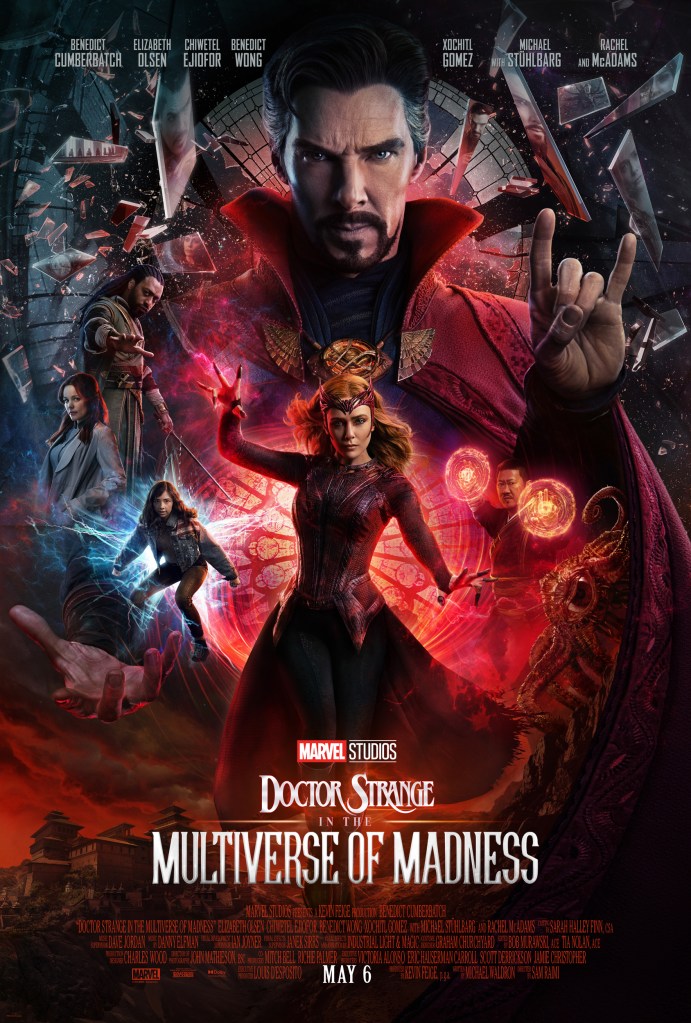
Parallel universes have infinite possibilities. These are largely not found in this lumpen, fan-service obsessed and (whisper it) slightly dull film that fails to follow-up on either the promise of the first film (to which it makes awkward call-backs) or its main concept. It allows Raimi scope to indulge his Evil Dead style visuals, but all within the confines of producing another entry in the series that feels like a bridge between chapters rather than an interesting story in its own right.

Dr Strange (Benedict Cumberbatch) attends the wedding of former girlfriend Christine Palmer (Rachel McAdams), when he’s torn away to fight a squid monster chasing a teenager, America Chavez (Xochitl Gomez). America has the power to travel between parallel universes – and is dragging behind her the dead body of a parallel Strange who failed to protect her from a mysterious foe trying to steal her power. Strange, Wong (Benedict Wong – the most engaging performance in the film from this under-rated actor) and the Sorcerers protect America – but Strange’s attempt to recruit Wanda Maximoff (Elizabeth Olsen) goes awry when it turns out its she hunting America, using dark magic in an attempt to find her parallel versions of her lost children.

DSITMOM has been called the MCU’s horror film: which by no means makes it The Exorcist. It’s a sort of very, very gentle entrée to the genre – like Cronenberg’s Videodrome was turned into a kid’s TV series or a comic-book version of Raimi’s The Evil Dead. It has a few flourishes, but none of this is allowed to get in the way of the corporate enterprise. It’s more interested in giving people what it feels they want and fitting itself into the timeline of a series.

In fact it sometimes feels like an attempt to mirror the success of Spider-Man: No Way Home (I wonder how many of the cameos were added after that film’s release?). It takes the elements of guest stars and parallel universes and presents them in ways that provide little insight or long-term reward. In No Way Home alternate versions of characters are used to explore how different events could have shaped our heroes. The returning stars aren’t just thrown in, they have arcs and emotional journeys. The whole is both fun and an engaging story but also nostalgic. Compare, as well, the TV series Loki (by the same writer) that brilliantly used parallel versions of its lead to deconstruct and develop his character.

DSITMOM does none of this. There are rich opportunities to see how Strange may have developed in different universes: after all this is the closest thing to an “ends justify the means” character in the MCU. Would different versions of him go more or less further – and how might it make our Strange reflect on his occasionally ruthless ‘big picture’ thinking (this is after all, as the film mentions, the guy who allowed half of all life to blink out of existence as part of a masterplan only he knew). We don’t get nearly enough of that. In fact, we get virtually none of it.

These opportunities are ignored in the two parallel universes we spend the most time in, where Strange is either a dead war hero or an insane hermit corrupted by dark magic. Neither of these characters is really contrasted effectively or interestingly with our version. A faint plotline of Strange learning trust from the mistakes of others is threaded through, but only lightly. Instead, the film focuses more attention on Strange’s lost love for Christine Palmer, an oddly unsatisfying focus since Strange has appeared in at least four films since his first solo effort six years ago, and the franchise has failed to mention this motivating loss once (not even a throwaway line in No Way Home to build it up).

Mind you it’s better than the development Wanda Maximoff gets. DSITMOM is pretty much impenetrable unless you’ve watched WandaVision. Even if you have, as I have, you’ll probably be a little annoyed at the ‘development’ she gets here. At the end of that series, Wanda had accepted the damaging consequences of her grief and started moving on. Here though, she’s a sociopathic monster defined solely by her motherly grief and her ruthless determination to tear universes apart to heal it. It feels retrograde to, essentially, be saying “women who suffer loss go axe-crazy” or to double down on her willingness to harm others to cling to a ‘normal life’ fantasy (as well as contrary to the hopeful tone the series ended on).

That’s not to mention the clumsy fan service peppering the film. The main outing to a parallel universe is basically an excuse for fan-pleasing cameos. These amount to nothing more than a series of actors popping up say “Hello I’m Y” and promptly suffering terrible fates (because it’s a parallel universe and your plot armour means nothing there). Like Yoda fighting Christopher Lee, it’s cool when you first see it but risks becoming less and less rewarding overtime because it’s utterly insubstantial.

DSITMOM is basically insubstantial. It drags on – it’s a chase film that largely lacks momentum – it has a series of slightly bored looking actors (Ejiofor wins, with a Mordo who seems to have become Strange’s nemesis in the interim between this and the first film despite never being mentioned in any other film since), gets absorbed in a MacGuffin filled plot (there are no less than two Magic Books of Wham-a-bam that are being hunted or fought over) and flattens down most of Raimi’s style into a corporate product with little heart (compare this to his Spider-Man films which look like Citizen Kane or Vertigo next to this).

There are about two moments of invention: a sequence when Strange plummets through a series of bizarre parallel universes (including one where he’s made of paint) and a battle between two Stranges that utilises musical notes as weapons. Everything else feels production flattened, as do the actors, and ends teeing you up for a third film with another “whoop” cameo. Flat, lumpen and failing to capitalise on its possibilities, this is a big disappointment, an empty lightshow with brief but shallow pleasures.

Murder by Decree (1979)

Murder by Decree (1979)

Sherlock Holmes investigates Jack the Ripper in this overlong but enjoyable Doyle pastiche

Director: Bob Clark

Cast: Christopher Plummer (Sherlock Holmes), James Mason (Dr John Watson), David Hemmings (Inspector Foxborough), Susan Clark (Mark Kelly), Frank Finlay (Inspector Lestrade), Anthony Quayle (Sir Charles Warren), Donald Sutherland (Robert Lees), Geneviève Bujold (Annie Crook), John Gielgud (Lord Salisbury)

In the world of Sherlock Holmes pastiches, it’s a popular sub-genre: Sherlock Holmes vs Jack the Ripper. How would Holmes have taken on the murderer who has baffled generations since those brutal Whitechapel killings in 1889? Murder by Decree explores the idea, mixing Conan Doyle with a deep dive into (at the time) the most popular theory in Ripperology, the Royal Killings (Murder by Decree indeed!).

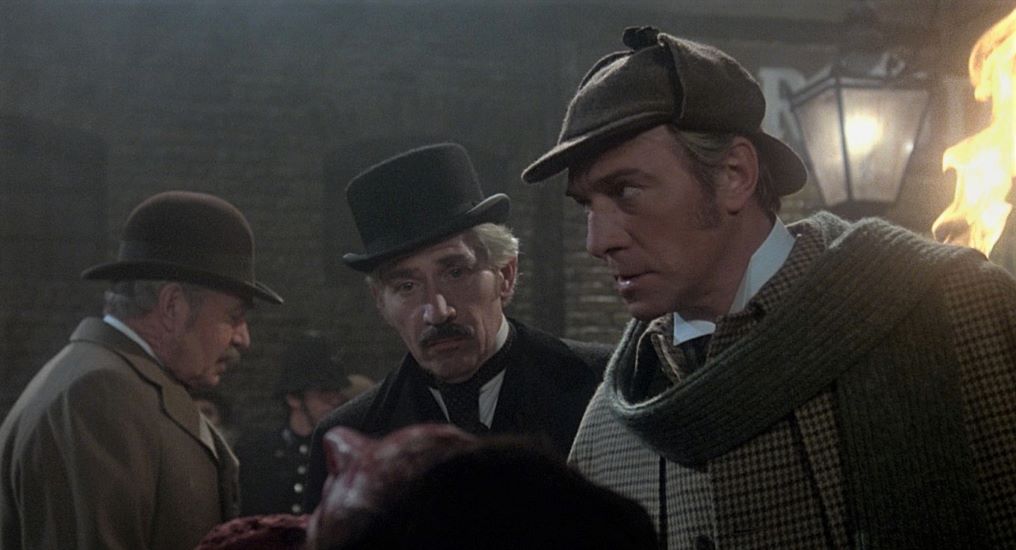
It’s all pulled together into a decent, if over-long, film, shot with sepia-toned stolid earnestness by Bob Clark. With its fog-ridden Whitechapel sets (carefully built but always strangely empty), heavy-duty actors sporting large sideburns, wavy-screen flashbacks and carefully unimaginative framing, there is something very old-fashioned about Murder by Decree. That also extends to its Ripper theory, steeped in a very 70s class-conscious conspiracy. The film pads out its two-hour run time with many a POV shot of the Ripper prowling the streets, which bring to mind Jaws and slasher horror films of the time.

Where Murder by Decree does stand out is in its imaginative characterisation of Holmes and Watson. They are presented as affectionate friends – Mason’s older Watson has a sweet indulgent elder-brother feeling to him, giving Plummer’s sparkly Holmes plenty to tease and bounce off. They split the casework between them – Watson is an equal partner, even if Holmes does the brainwork – and use their strengths to complement each other (notably, Watson frequently distracts people so Holmes can interrogate a witness more closely). They genuinely feel like long-term friends (there is a delightful sequence where Holmes is so distracted by Watson’s attempt to fork a pea, that he squashes it onto the fork – to be met with a forlorn “you’ve squashed my pea” from Watson, who likes the peas intact so they “pop in my mouth”).

They are dropped into the middle of a very much of-its-time Ripper theory. Murder by Decree centres on the theory that the murders were ordered (the film reluctantly suggests tacitly) by the establishment to cover up the secret marriage of Prince Edward, Duke of Clarence to a Whitechapel woman, Annie Crook. This alleged marriage produced a baby, and a royal doctor, sheltered by a Masonic conspiracy, sets about eliminating everyone who knows the truth. Of course, it’s almost certainly bollocks – but with its mix of secret societies, Royals, a lost heir and the rest, it’s an attractive story.

It gains a lot from the performances of the two actors. James Mason flew in the face of then popular perception by presenting a quick-witted, assured Watson, more than capable of looking after himself (he bests a blackmailing pimp in a street fight and is very comfortable with guns – far more than the reticent Holmes). He’s still the classic gentlemen, who loves King and Country, but also shrewd, brave, loyal, able to win people’s trust and look at a situation with clear eyes.

With Christopher Plummer, Murder by Decree has one of the all-time great Sherlock Holmes. Plummer’s Holmes is refreshingly un-sombre, twinkly with a ready wit, who loves teasing Watson (cleaning his pipe with Watson’s hypodermic needles) and delights in his own cleverness. But Plummer takes Holmes to places no other film Holmes goes. The case as a devastating effect on him: he weeps at the fate of Annie Crook (consigned by conspirators to a slow death in an asylum) and furiously attacks her doctor. When the conspiracy is unmasked, he emotionally confronts the Prime Minister and berates himself for his failures. There is a depth and humanity to Plummer’s Holmes unseen in other versions, a living, breathing and surprisingly well-adjusted man, unafraid of emotion.

Sadly, the film takes a little too long to spool its conspiracy out. Rather too much time is given to an extended cameo by Donald Sutherland as a pale-faced psychic who may or may not have stumbled upon the killer. There are a lot of unfocused shots of that killer, all swollen black eyes and panting perversion. It relies a little too much on a Poirot-like speech from Holmes at the end explaining everything we’ve seen. But there are strong moments, best of all Geneviève Bujold’s emotional cameo as the near-catatonic Annie Crook, cradling in her arms a memory of her stolen child.

There are many decent touches. The film is open in its depiction of the filth and squalor of life in Whitechapel – a pub is an absolute dive, and the women pretty much all look haggard and strung out. It has a refreshingly sympathetic eye to the victims, with Holmes denouncing the attitudes of both Government and radicals (looking to make political hay from the killings) who see them as lives without intrinsic worth. Holmes places no blame or judgment on them, or the choices life has forced on them, which in a way puts him (and the film) quite in line with modern scholarship (even if there is the odd slasher-style shot of mangled corpses).

The main issue is the film never quite manages to come to life. It’s a little too uninspired, a bit too careful and solid where it could have been daring and challenging. There are good supporting roles: Finlay is a fine low-key Lestrade (at one point persistently raising his hand to ask his superior permission to speak) while Gielgud sells the imperious Lord Salisbury. There is enough here for you to wish the film just had a bit more of spark to lift it above its B-movie roots. But in Plummer and Mason it has a Holmes and Watson to treasure – and for that alone it’s worth your time.

Vertigo (1958)

Vertigo (1958)

Obsession and grief come dangerously into play in one of the greatest films ever made

Director: Alfred Hitchcock

Cast: James Stewart (John “Scottie” Ferguson), Kim Novak (Madeline Elster/Judy Barton), Barbara Bel Geddes (Midge Wood), Tom Helmore (Gavin Elster), Henry John (Coroner), Raymond Bailey (Doctor), Ellen Corby (Hotel manager), Konstantin Shayne (Pop Leibel), Lee Patrick (Car owner)

Spoilers: Vertigo was controversial at the time for revealing its twist, three quarters of the way through the film. I might well do the same in the review – although this is possibly a richer film if you know the twist going in

In 2012 Vertigo dislodged Citizen Kane at the top of Sight and Sound’s decadal “Greatest Film” poll, after 50 uninterrupted years for Welles’ classic. It’s an astonishing turn-around for a film which was a box-office disappointment and first met with reviews that called it “long and slow” and complained that Hitchcock had “indulged in such farfetched nonsense”. (Welles also hated the film – bet he’s even more pissed off at it now.) This is partly because Vertigo is a fiercely, almost defiantly, complex and cold film that defies easy characterisation and flies in the face of the fast-paced watchability of most of Hitchcock’s popular films. But it’s still a haunting and fascinating masterpiece, which has its greatest impact when you reflect on it days after it has finished.

Its plot is both complex and slight. John “Scottie” Ferguson (James Stewart) is an ex-police detective, his career ended by crippling acrophobia bought on by powerlessly watching a fellow officer fall to his death. He’s hired by old college friend Gavin Elster (Tom Helmore) to follow Elster’s wife Madeline (Kim Novak). Madeline is in the grip of an idée fix that she is an incarnation of Carlotta Valdes, a woman who committed suicide in 1857. Scottie follows her – and develops an idée fix of his own for the beautiful Madeline. When his acrophobia prevents Scottie from saving Madeline from jumping to her death from a bell tower, he suffers a near-breakdown. Then he catches sight of Judy Barton (Kim Novak again) who has a chilling resemblance to Madeline. And Scottie tries to turn her into just that.

Vertigo is a dizzying film of monomania and obsession, something you are immediately plugged into with its beautiful Saul Bass opening (swirling spirals, reflecting the circular nature of the obsessive) and its hauntingly mesmeric and off-beat romantic theme from Bernard Herrmann (possibly his greatest work – and he also scored Kane!). More than any other Hitchcock film, Vertigo places us firmly into the POV of its lead character, who is in all but three scenes and whose perceptions and observations we not only share but which totally guide our understanding of everything we see in the film (until that twist, when suddenly we shift to knowing more than he does).

Hitchcock’s technique is truly masterful here. There isn’t the flash of something like North by Northwest, but the sort of chilling control that builds tension and unease that also marks out films like The Birds or, to a degree, Psycho (although that’s much more of a black joke, where Vertigo is terrifyingly serious). Hitchcock uses a huge number of POV shots, alternating with shots of Stewart’s reactions (at times these are disturbing in their fixed intensity) building a subtle momentum that reflects the character’s obsession and further filters everything we experience from his perspective.

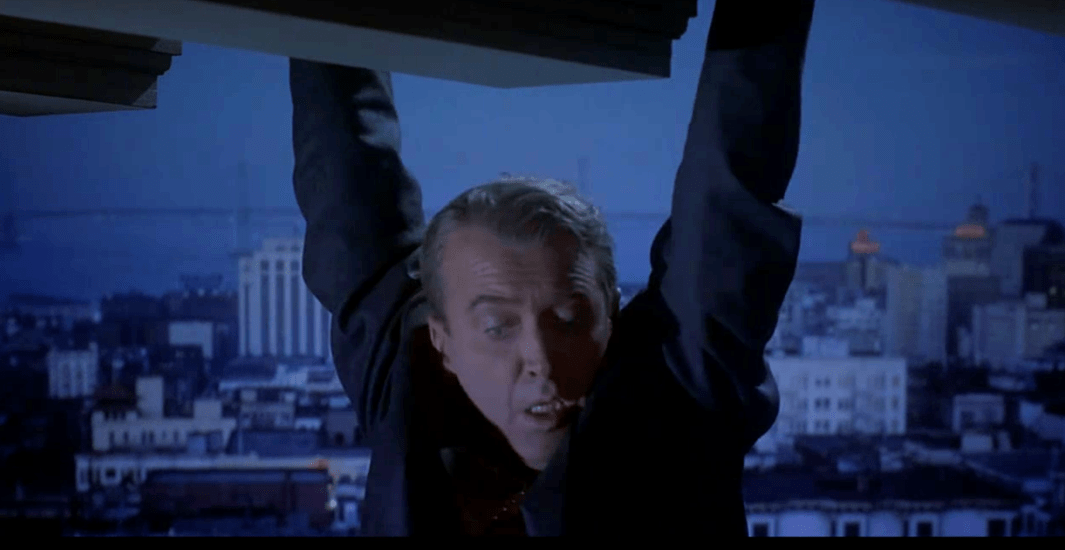
That would be the perspective of an ever-more obsessed man tipping steadily into stalkerish territory. Few films have so clearly drawn the link between the private eye and the voyeur. As Scottie silently prowls the streets of San Francisco, observing every inch of Madeline’s actions – and Vertigo has long, worldless stretches of what Hitchcock called “pure cinema” – the disturbing pleasure and control that following brings you becomes more and more clear. It’s certainly giving a sense of masculinity back to Scottie, introduced to us hanging helplessly from a ledge and then so hamstrung by his condition he can’t even climb a step ladder without collapsing.

Judged from this perspective, Scottie is one of the most darkly disturbing characters in film. Rescuing Madeline from the Golden Gate (where she has jumped in) he takes her home, undresses her and puts her in his bed – hardly normal behaviour. It’s not long from there before he surrenders to his romantic obsession (feelings Madeline perhaps returns), that eventually leads him again to be a powerless witness as Madeline plunges to her death right in front of him.

Catatonia and mental collapse follow – but really it’s perhaps just a continuation of the same obsession in another form. Because after a stay in a sanatorium, Scottie is back on the streets again, prowling for something – anything – that could make him feel closer to Madeline again. Which is how he spots Judy, the woman who reminds him of the woman he’s lost. Scottie doesn’t so much woo Judy as seemingly browbeat her into a bizarre (joyless and sexless) relationship and undertake a terrifyingly grotesque remodelling exercise, designed to make her into a carbon copy of Madeline.

This sequence is probably partly at the heart of the film’s fascination for critics and film historians – even more so since we’ve learned about Hitchcock’s manipulative, controlling relationship with his blonde female stars. Here we have Scottie instructing his love interest how to dress, walk and cut her hair – all while telling her it’s for her own good and she’ll like it – his voice with the breathless longing of a closeted pervert (that is when Scottie manages any sexual yearning to Judy, who he treats more like a treasured exhibit). This is Hitchcock dramatizing his own hang-ups, presenting them as creepy and dangerous, making Vertigo partly as well a fascinating psychological study of its director. Did Hitchcock know that his controlling relationship with women was wrong? And, in real life, could he not help himself or did he not care?

Vertigo is a perfect exploration of obsession. But it also pulls the rug out from us – and rewards constant reviewing as a result – because the film reveals there was a whole other level going on. Scottie may seem the Hitchcock substitute, but the in-film Hitch figure is actually the amiable Gavin Elster. Because the entire action of the film is carefully stage-managed by Elster to manipulate Scottie (and us!): Judy and Madeline (as Scottie has met her) are in fact the same woman, a doppelgänger for Elster’s wife. The real Madeline – who Scottie never sees or meets – is murdered by Elster at the top of that tower, and Judy/Madeline was helping build a backstory to have this murder written off as suicide, with Scottie’s acrophobia perfect to make him a powerless witness.

Here comes that pleasure for rewatching: because now when Scottie rescues “Madeline” from the river, then spends the next day with her, we thought at first he knew more than she. Now however, we understand he’s always been a patsy who knew less than anyone else. We’ve been manipulated by Elster, the master director, pulling the strings and building horrors for us. That’s Hitchcock.

The film reveals this in one of the few scenes told from Judy/Madeline’s perspective – and means we then watch Scottie actually craft a woman who actually is the woman he’s obsessed with into his memory of that very same woman. (Get your head around that!) And she allows it, because she seems as desperate as he to recapture the passion of those brief days together – but cannot tell him the thing that would help to do that. It all leads, of course, to Scottie’s destructive obsession leaving him once again to being a helpless witness as another victim plummets to their death.

Vertigo is effectively a two-hander, and most of the focus usually lands on Stewart. He is chillingly dead-eyed in this, his crazed hunting after something he doesn’t even understand capturing the controlling horror behind some romance. In many ways though, Kim Novak has the more complex part. She doesn’t speak for almost 45 minutes – she spends it mostly in long shot performing Elster’s play for Scottie (and us) of the mentally disturbed wife. But when Novak does take centre stage, this is a complex multi-layered performance, carefully modulated throughout to communicate (in advance) Judy’s vulnerability and love for Scottie, without ever letting us realise she is anything but the death-fixated “Madeline”. Novak marries two contradictory characters into one with a simple and convincing aplomb. Equally good is Barbara bel Geddes, in almost the only other named role, as Scottie’s one-time fiancée now best friend, all too aware that her feelings are not returned.

Vertigo will never match the likes of Casablanca or North By Northwest – on a list of films truly popular with audiences. It’s been described as the ultimate critic’s film: a cool, chilling, brilliantly filmed, psychological thriller that quietly exposes the mechanics of film, the manipulation of story-telling and the dark psyche of its director. In many ways initial reviews were right: on first impression, the film is cold and slow, with characters it’s hard to relate to. But it has a truly haunting quality few others can match. And it constantly presents us with a clear image, while never allowing us to guess we are seeing only part of the overall picture. It can leave us as dizzy as Scottie is, hanging from that ledge and staring down at doom, the camera zooming inside his head and showing us his terrifying POV. You need to work at it, but this is a film to value.

Clear and Present Danger (1994)

Clear and Present Danger (1994)

Tom Clancy’s door-stop thriller is turned into an involving conspiracy thriller that makes masterful use of Harrison Ford

Director: Philip Noyce

Cast: Harrison Ford (Jack Ryan), Willem Dafoe (John Clark), Anne Archer (Dr Cathy Ryan), Joaquim de Almeida (Colonel Felix Cortez), Miguel Sandoval (Ernesto Escobedo), Henry Czerny (Bob Ritter), Harris Yulin (James Cutter), Donald Moffat (President Bennett), Benjamin Bratt (Captain Ramirez), Raymond Cruz (Domingo Chavez), James Earl Jones (Jim Greer), Tim Grimm (Dan Murray), Hope Lange (Senator Mayo)

Tom Clancy’s Jack Ryan has always been the All-American hero (his slimy, besuited CIA rival even frustratedly snarls “you are such a Boy Scout”). Ryan is almost too-good-to-be-true: pure as the driven snow, incorruptible, a success at everything he does and a devoted family man. What chance does someone like that have in Washington? In Clear and Present Danger, Ryan is dragged into the War on Drugs, unwittingly becoming the front man for an illegal military assault team against the Columbian cartels, ordered by a US President on a vendetta for the death of a friend. When the truth comes out, you’ve got one guess who takes it on himself to save the soldiers who are hung out to dry by the suits in Washington.

We know he’ll do the right thing as well, because he’s played by Harrison Ford. Ryan is basically a blank slate as a character, so Ford’s straight-as-an-arrow everyman decency does most of the heavy lifting to establish who he is. As an action hero, Ford has the chops but his real strength is his ability to look frazzled, scared and muddling through – rather like the rest of us would. Ryan gets in some real scrapes here, from dodging missiles in an attack on a diplomatic convoy to desperately fighting for his life in a timber factory. Ford’s strength as an actor is to be both authoritative and also vulnerable – his willingness to look scared but determined works wonders.

Clear and Present Danger also gives plenty of scope for Ford to employ his other major empathetic weapon: the clenched jaw and pointed figure of moral outrage. He does a lot of both here, a central scene seeing Ryan confronting besuited rival Ritter (played by a weaselly, bespectacled Henry Czerny, the polar opposite of Ford’s clean-cut everyman-ness) earnestly telling him he broke the law and is heading to jail (laughed off). There can’t be an actor more skilled at getting you to invest in someone, to both simultaneously worry about him while being confident he will do the right thing. It’s a rare gift, and Clear and Present Danger exploits it to the max.

Ford is the centrepiece – and main strength – of a competent, well-made conspiracy thriller, directed with a professional assurance by Philip Noyce. It makes a good fist of translating Clancy’s doorstop novel – with its huge complexities – to the screen (although you might need a couple of viewings to work out the twisty-turny, backstabby plot, where wicked schemers turn on their own schemes). Noyce has a special gift for keeping dense technical and exposition scenes lively. At one point he cross-cuts a parallel investigation into a fake car bombing between Ryan (who flicks doggedly through textbooks) and his Cartel rival who employs gadgetry and computers. Plot heavy scenes like this are well-shot, pacey and capturing plenty of reaction shots, even if they only feature characters messaging each other on clunky 90s computers or walking-and-talking in shadowy metaphors.

Clear and Present Danger also successful juggles its Washington shenanigans, with parallel intrigue in its Columbia setting. There ruthlessly charming Cortes (played with a wonderful cocksure suaveness by Joaquim de Almeida) is scheming to takeover his boss’ (a blustering Miguel Sandoval) operation. These plot unfold both together and in parallel, allowing for a little bit of neat commentary contrasting the cartels and Washington. The film manages a bit of critique of America’s thoughtlessly muscular intrusion into the affairs of other countries, with a President turning a blind eye after passing on implicit instructions (but still with a boy scout hero who will sort it all out).

Noyce also pulls out the stops for a couple of brilliantly executed scenes. Great editing, sound design and committed acting makes a scene where Luddite Ryan races to print off incriminating evidence from a shared drive while technically assured Ritter deletes the files, edge-of-the seat stuff. Never before has racing to fill a printer with paper seemed more exciting.

That pales into significance with the film’s centre piece, a genuinely thrilling Cartel ambush on a US diplomatic convoy, with Ryan stuck in the middle. With perfect build-up – from James Horner’s tense score to the skilful editing – the attack (with Oscar nominated sound design) is hugely tense, leaves our heroes terrifyingly powerless and is flawlessly executed by Noyce and his crew. It makes the whole film a must watch all on its own.

It’s surrounded by several other well-handled action set pieces, featuring the Marines sent on a covert mission (and then hung out to dry). As the operation leader, Willem Dafoe plays very successfully against type as a (ruthless) good guy, as Clancy’s other regular character, uber-fixer John Clark. Dafoe also has the chops to go toe-to-toe with Ford, and like de Almedia’s charmingly wicked Cartel-fixer also serves as another neat contrast to Ryan’s decency-with-a-fist.

The film is rounded out by a troop of reliable actors. Anne Archer has little to do as Ryan’s supportive wife, but Donald Moffat is good value as the shifty President (communicating both intimidating authority and Nixonian survival instinct), Harris Yulin perfectly cast as a President-pleasing apparatchik and Raymond Cruz as an ace but naïve marine sharp-shooter. Clear and Present Danger has few pretensions to be anything other than an involving thriller – but that also helps make it a very enjoyable one.