Category: Action film

Jason Bourne (2016)

Matt Damon swings back into action in after-thought Jason Bourne

Director: Paul Greengrass

Cast: Matt Damon (Jason Bourne), Tommy Lee Jones (Director Robert Dewey), Alicia Vikander (Heather Lee), Vincent Cassel (The Asset), Julia Stiles (Nicky Parsons), Riz Ahmed (Aaron Kalloor), Ato Essandoh (Craig Jeffers), Scott Shepherd (Edwin Russell), Bill Camp (Malcolm Smith), Vinzenz Kiefer (Christian Dassault), Gregg Henry (Richard Webb)

They say you should never go back. Producers had been begging Paul Greengrass and Matt Damon to get back together again and make another Bourne film. After all, there was hardly anyone asking for a sequel to that Jeremy Renner one was there? But Jason Bourne seems like a film that’s been made after Greengrass and Damon ran out of reasons for saying no. I can’t decide if we can blame them for that or not. But their making the film at all suggests they aren’t really losing any sleep about whether people feel this half-hearted effort has an impact on the legacy of the others.

Anyway it’s ten years later. The world is an increasingly technical place, with people living in an era of increasing social unrest and anti-government fury. Jason Bourne (Matt Damon), recovered from his amnesia, now lives off-the-grid – until of course he’s unearthed by his old colleague Nicky Parsons (Julia Stiles). Parsons is now working with a hacker commune in Iceland, and has unearthed more evidence about the shady CIA programme, Treadstone, that Bourne used to be a part of, and about Bourne’s own recruitment into it. Meeting in Athens in the middle of an anti-government riot, Parsons is killed and Bourne is set on a collision course with the CIA as well as finding out more about the mysterious death of his father 20 years before. 

Jason Bourne is basically going through the motions. There is an attempt to add another layer of mystery around Bourne’s background, but it barely seems to add much to the hinterland of Bourne we’ve already learned about in the last couple of films. Furthermore, I’m uncomfortable with a Bourne here who goes increasingly on a rampage of revenge. Part of the charm – or rather what makes Bourne different – in the previous films was that he was a man who lived in a world of violence, but didn’t care for it himself. He used brutal force only when it was absolutely necessary, and several times chose not to take a personal revenge. Here however, he dispatches at least three people, which doesn’t seem to square with the character as we’ve previously seen him.

Furthermore, the film seems to be struggling to reclaim Bourne as one of the formal good guys, a patriot and American hero. Again part of what made him different in the original trilogy was that he stood outside the government and nations, that (as Greengrass once said) “he’s on our side”. Here he’s clearly less than sympathetic to anti-government forces, and strongly opposed to exposing CIA secrets. In fact he ends up feeling rather conservative here to be honest, and more like the faceless killer that he started as rather than a renegade. 

It’s not helped by the fact that the plot is pretty meh, a remix of different elements from previous films, carefully ticked off to make sure we get everything we could expect. So we get a reworking of various car chases, fights, tense meetings in public locations etc. etc. The film-making is very well done – Greengrass rewrote the book on how to make films like this, and he carries that on here, brilliantly mixing twitchy editing, handheld camera work, immersive film-making and gloomy silences to create a really wonderfully done viewing experience. It’s just more of the same from the originals. The film just ends up living in the shadow of the originals, rather than really forging something out on its own.

Greengrass tries to tap into contemporary ideas. We get the sense of anti-establishment clashes and Internet data scams – but it never really feels like it goes anywhere or coalesces into any real point at the end of it. What is the actual message of this film? There are hints that Tommy Lee Jones’ gravelly CIA Director and Riz Ahmed’s Mark Zuckerberg-lite tech expert are planning some sort of mass intrusion on people’s privacy – but the film never explains this or explores it. It never even makes Bourne aware of it – and since Bourne is our “window” into this world, that means we never understand it either.

I mean, the film is fine other than that, but that’s all it really is. Matt Damon still hasn’t lost it as Bourne – and blimey he should have some inverted award for how little he speaks in this film – and he has not only the physicality but also the worn-down, haunted look of a man who has seen way, way too much. There are professional performances from the rest, but nothing that stretches any of the actors here, with Alicia Vikander particularly under-used as an unreadable CIA agent. 

But that sums up the whole film. Despite all the attempts to build in a modern “torn from the headlines” angle to the story, it feels more like Greengrass and Damon are quite happily (and with some enthusiasm at least) going through the motions in order to pick up a cheque. And I guess that’s fine. It just means we are probably not going to rush to see this again.

The Spy Who Loved Me (1977)

Bond finds himself in another pretty pickle in The Spy Who Loved Me

Director: Lewis Gilbert

Cast: Roger Moore (James Bond), Barbara Bach (Anya Amasova), Curd Jürgens (Karl Stromberg), Richard Kiel (Jaws), Caroline Munro (Naomi), Walter Gotell (General Gogol), Bernard Lee (M), Desmond Llewelyn (Q), Lois Maxwell (Miss Moneypenny), Geoffrey Keen (Frederick Gray), Robert Brown (Vice-Admiral Hargreaves), George Baker (Captain Benson), Michael Billington (Sergei Barsov), Vernon Dobtcheff (Max Kalba), Nadim Sawalha (Fekkesh)

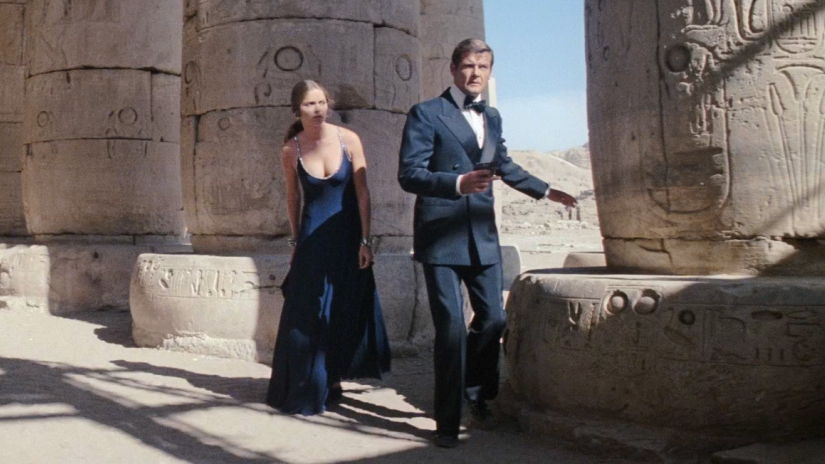
Roger Moore had made two Bond films before he made The Spy Who Loved Me – but this is the one when he finally hit upon the formula that works for him. It’s also probably the moment where the Bond films became – once for all – comedy adventure capers. It was but a few more degrees from here until Bond was telling a tiger to “sit” or racing past a double-taking pigeon in the middle of St Mark’s Square. And the public loved it. For better or worse, Moore’s Bond here helped define the franchise for a whole generation.

Anyway, the story. It’s eerily familiar in many ways to Thunderball and You Only Live Twice: a power-crazed lunatic (Karl Stromberg) running a secret organisation wants to destroy the world. His plan? To capture one American and one Soviet submarine and use them to fire nuclear missiles at the nation’s two capitals, to kickstart a nuclear war, leaving only his underwater kingdom intact. Just as well then that an over-keen Stromberg (Curd Jürgens) first captures a British sub, meaning James Bond (Roger Moore) is called in to investigate. Bond will work with the USSR’s finest agent – Anya Amasova, Triple X (Barbara Bach) – to find out what’s going on and why.

TSWLM is a lot of fun, possibly the ultimate expression of what a lot of people think Bond is. It’s hugely silly, rather exciting and has almost no connection with reality whatsoever. Moore goes through the whole thing with his eyebrow forever arched, tipping the wink at the audience – “You do know, dear boy, this is all dreadfully silly stuff”. Sometimes in Bond this humour gets a bit much – but here it’s pretty much pitched perfectly. And Moore looks like he is having the time of his life.

The film is crammed with action set pieces in striking locations: the Alps! The pyramids! A converted oil tanker base! Nothing is left to the imagination, and everything is thrown at the screen. It gets the sense of excitement right from the pre-credits sequence, with Bond’s high-speed ski chase across the alps from Russian would-be hitmen. Fools – what chance did they have? I don’t know what I like most about this scene: is it the wild ski stunts? The way music and camera action combine so well? The fact that it’s crystal clear Moore probably spent precisely zero days on location for this sequence? What am I talking about, it’s got to be that insane parachute jump at the end – with the camera leaving it just long enough for you to start to think “is Bond going to get out of this one?”. (Spoilers he does.)

That’s almost nothing compared to the famous Lotus-turned-submarine car chase, which pretty much set the standard for all the car-based action (not to mention gadget filled cars) that would follow in the franchise. The idea of a car that turns into a submarine: it’s both brilliant and so overwhelmingly silly that, like Bond at its vibrant best, it seems to transcend class and logic into a higher plane of excitement.

And all this with a plot that is almost staggeringly stupid. Jurgens has a lot of arch, naughty fun as scheming monomaniac (with subtle webbed hands) Stromberg, a pompous arsehole and a great villain. Of course he wasn’t a physical threat – hence the invention of Jaws, surely the most popular henchman ever invented for Bond. Jaws is a lunking, vicious but strangely endearing brute – it’s hard to put your finger on why he’s strangely likeable, maybe it’s just the totally absurd idea of a hitman whose killer tools are metal teeth. Maybe it’s because Richard Kiel has such a dorky sense of humour – and is as good at the glance at the camera as Moore himself is.

Of course it is a dated film – and it’s always the women that show it. If this set a lot of good Bond archetypes, then it also helped to cement a few bad ones. Anya Amasova is (allegedly) the greatest agent Russia has. Not that you would know it, as she stumbles in this film from moments of staggering incompetence and stupidity to victimhood and damsel-in-distress. There is a hint of character development – Bond offs her boyfriend in that alpine chase literally without a backward glance – but that’s soon forgotten by the end under Bond’s charms. The poor woman can’t even drive stick (“That’s reverse, let’s try again shall we” says Bond with smackable smugness) and by the end of the film she’s bikini-clad and being rescued by Bond. It says a lot when the strongest thing about her character is that her name isn’t an innuendo.

But you can let it go, because the rest of the film is such good fun. Everything is nonsense of course, and you could steer a submarine through the plot holes. If Stromberg only needs two submarines to start his evil plan, why on earth does he grab a third one at the start of the final act? (Just as well he does, of course, as otherwise Bond would never get on board his base.) Stromberg is ruthless enough to eliminate three underlings and to set up a nuclear war to wipe out the world – but those captured submarine crews he keeps alive, imprisoned, with a small guard, next to the armoury on his base. Ooops. His plan is almost effortlessly undone with a radio message from Bond. But never mind. It doesn’t matter.

The point is that this is all great fun and basically set the tone for the next ten years of Bond films – until Dalton shifted gears. Moore is really good in it, as a sort of ringmaster of silliness – and he’s clearly enjoying it wildly. The Spy Who Loved Me is his best film – and for all its dumbness, its leaning into cheap humour, its ludicrous plot and sexist attitudes, it’s still up there at the top of the franchise. Because for a lot of people, all those negatives are exactly what they now expect from Bond.

The Untouchables (1987)

The Untouchables (1987)

Super stylish cops and robbers thriller, as Costner and Connery take on Capone

Director: Brian de Palma

Cast: Kevin Costner (Eliot Ness), Sean Connery (Jimmy Malone), Andy Garcia (George Stone), Robert De Niro (Al Capone), Charles Martin Smith (Oscar Wallace), Patricia Clarkson (Catherine Ness), Billy Drago (Frank Nitti), Richard Bradford (Chief Mike Dorsett), Jack Kehoe (Walter Payne)

“What are you prepared to do!”

It’s the motto of this electric law-enforcement film, one of those all-time classics that provides endlessly quotable lines and moments you can’t forget. It’s crammed with iconic moments, from its brilliantly quotable dialogue from David Mamet, via its wonderful music score, to its artful film literacy and iconic performances. If there is an untouchable film, this one is pretty close. I love it.

It’s 1930, prohibition is in full force and Chicago is ruled by gangland kingpin Al Capone (Robert De Niro). Young Federal Officer Elliot Ness (Kevin Costner) is thrown into Chicago to end Capone’s reign and stamp out the illegal liquor business. Not surprisingly, it’s hard to know who to trust in a town as stinking as this one, until a chance meeting with disillusioned beat cop Jimmy Malone (Sean Connery) helps him find a group of people he can trust – “Untouchables” who aren’t going to go on Capone’s payroll. But to bring Capone down he’s going to have to embrace the “Chicago way” and start to bend his strict moral code. 

Listening to Brian de Palma talk about the making of the movie, you can’t help but suspect he felt he was doing one for the suits rather than one from the heart. Well perhaps he should do that more often, because The Untouchables is a lean, mean, hugely entertaining action-adventure, that plays with genuine ideas and but also nails every single moment. Every scene is shot with a confident, compelling swagger – the sort of thing that reminds you what a conneseur of high-class pulp de Palma can be. The Untouchables plays out like a super-brainy graphic novel adaptation, and every scene sings. There is barely a duff moment in there.

A lot of this comes straight from David Mamet’s brilliant script. Really, with lines like this, moments as well-crafted as this, characters as clearly, brilliantly defined as the ones on show here, you can’t go wrong. Quotable lines fall from the actors’ lips like the gifts they are: “He brings a knife, you bring a gun. He sends one of yours to the hospital, you send one of his to the morgue. That’s the Chicago Way!” It’s dialogue like this that just has ageless appeal, the sort of stuff you find yourself trying to work into day-to-day conversation.

But Mamet’s script is also sharply clever. It swiftly lays out at the start Ness’ moral compass, his code – and then, as the film progresses, it cleverly shows the whys and wherefores for Ness compromising these. Needless to say, the man at the end of the film is totally different from the bright-eyed naïve agent we met at the start. Mamet also brilliantly works shades of grey into all our heroes, while scripting some compelling moments of grandstanding bastardy that an actor as marvellous as De Niro is just waiting to send to the back of the net.

De Niro was of course the inevitable choice as Capone. Bob Hoskins was contracted just in case De Niro said no (when told De Niro would be taking the job but he would get a $20k pay-out for his time, Hoskins told de Palma he’d be thrilled to hear about any other movies de Palma didn’t want him to be in), but it had to be Bobby. The film drops Capone in at key moments: the film opens with the swaggering bully delighted at holding court with English newspapers while being shaved (de Palma’s camera draws down from an overhead shot, like a spider descending from the ceiling, to reveal him in the barber’s chair) – a flash of danger emerges when the barber slips and cuts Capone’s face (de Niro’s flash of fury, followed by his decision to pardon – combined with the barber’s terror – is perfect). Later Capone rages at Ness, hosts a very messy dinner party with a baseball bat, and weeps at the theatre while a key character bleeds to death at his home (a brilliant example of de Palma’s mastery of B-movie cost cutting). He’s the perfect dark heart.

And opposite him you need a white knight – even if it a white knight who is set to be sullied. I’m not sure Kevin Costner ever topped his performance here, in the film that made him a superstar overnight. Looking like the perfect boy scout – his fresh faced earnestness is one of his finest qualities – Costner also has a WASPish hardness under the surface. The burning determination he has to destroy Capone, his disgust at the murder and chaos Capone deals in, is never in doubt – just as his initial naïveté about how to end Capone is all too clear. Costner masterfully shows how each event pushes Ness a step or two further in bending his rules, to fight Capone’s ruthlessness with ruthlessness of his own. “What are you prepared to do!” Malone asks him, and the film is about Ness working out how far his moral compass can stretch. I can’t think of many films that so completely and successfully have the lead character change as much as Costner does here without it feeling rushed or forced. It’s a wonderful performance.

But the film is stolen – and it’s no surprise, as he has the showiest part, most of the best lines, and of course the movie-star cool – by Connery. It’s easy to mock Connery’s blatantly Scottish Irish cop – he gives the accent a go for his first scene, but promptly drops it. What Connery’s performance is really all about is an old dog who never got a chance to do the right thing, finally being given the licence, the support and the inspiration from the younger man to clean up this filthy city. And Connery rages in the film, a force of nature, the perfect mentor, the cop who against all initial expectations is prepared to go through any and all risks to get Capone. He’s the samurai beat cop, and Connery (Oscar-winning) growls through Mamet’s dialogue with all the love of the seasoned pro letting rip. It’s an iconic performance – and led to a five year purple patch of great films and roles for Connery.

But the film works partly because of these great performances and the script, but also because of de Palma’s direction. The pacing is absolutely spot-on, the camera full of moments of flash and invention. Every action sequence has its own distinct tone, from the horse riding hi-jinks of a Canadian border interception of a booze truck, to the dark slaughter late at night of one of the film’s main characters (a masterful, Hitchcockian piece of genius by the way that uses the POV shot to exceptional effect). A late roof chase sizzles with a ruthless energy.

But the real highpoint of the action is of course that famous train-station shoot out. Allegedly the original plans on the day had to be ditched due to budgetary reasons – so cinephile de Palma pulled a sublime Battleship Potemkin homage out of his locker. Shot in near silence, save for gunshots, the bounce of a pram falling down the station stairs (baby on board) and a spare score from Morricone, the sequence is true bravura cinema, both hugely exciting and strangely endearing for all those who know anything about the history of cinema. 

De Palma and Mamet keep the story focused, clear and every scene has a clear purpose and goal. There isn’t a single superfluous character or moment. Everything is perfectly assembled to serve the overall impact of the film. It’s gripping, entertaining and compelling: the sort of film where if you catch it at the right age it has you for life. Ennio Morricone’s operatic score is perfect for the film, underlining and emphasising every moment and effectively sweeping you up. Costner and Connery are superb, De Niro is perfect, the film is a gift that has something new to give every time you see it.

Star Trek VI: The Undiscovered Country (1991)

Kirk has to overcome a lifelong prejudice against Klingons in the marvellous, best-in-series film Star Trek VI: The Undiscovered Country

Director: Nicholas Meyer

Cast: William Shatner (Captain James T Kirk), Leonard Nimoy (Captain Spock), DeForest Kelley (Dr Leonard ‘Bones’ McCoy), James Doohan (Scotty), Walter Koenig (Commander Pavel Chekov), Nichelle Nichols (Commander Uhuru), George Takei (Captain Hikaru Sulu), Christopher Plummer (General Chang), Mark Lenard (Ambassador Sarek), David Warner (Chancellor Gorkon), Kim Cattrell (Lt Valeris), Rosana DeSoto (Azetbur), Kurtwood Smith (Federation President), Brock Peters (Admiral Cartwright), Michael Dorn (Colonel Worf), John Shuck (Klingon Ambassador), Iman (Martia)

This will sound ridiculous, but there are few films that have had such an impact on me as Star Trek VI: The Undiscovered Country. How bizarre is that? But not only can I trace my love of all things Trek to this film, but it was also my basic introduction to Shakespeare, whose plays in various shapes and forms have been a big part of my life ever since. Throw into the mix that it sparked an interest in the Cold War and you’ve got quite a coup for this sixth film in (I’ll be honest!) a hit-and-miss franchise.

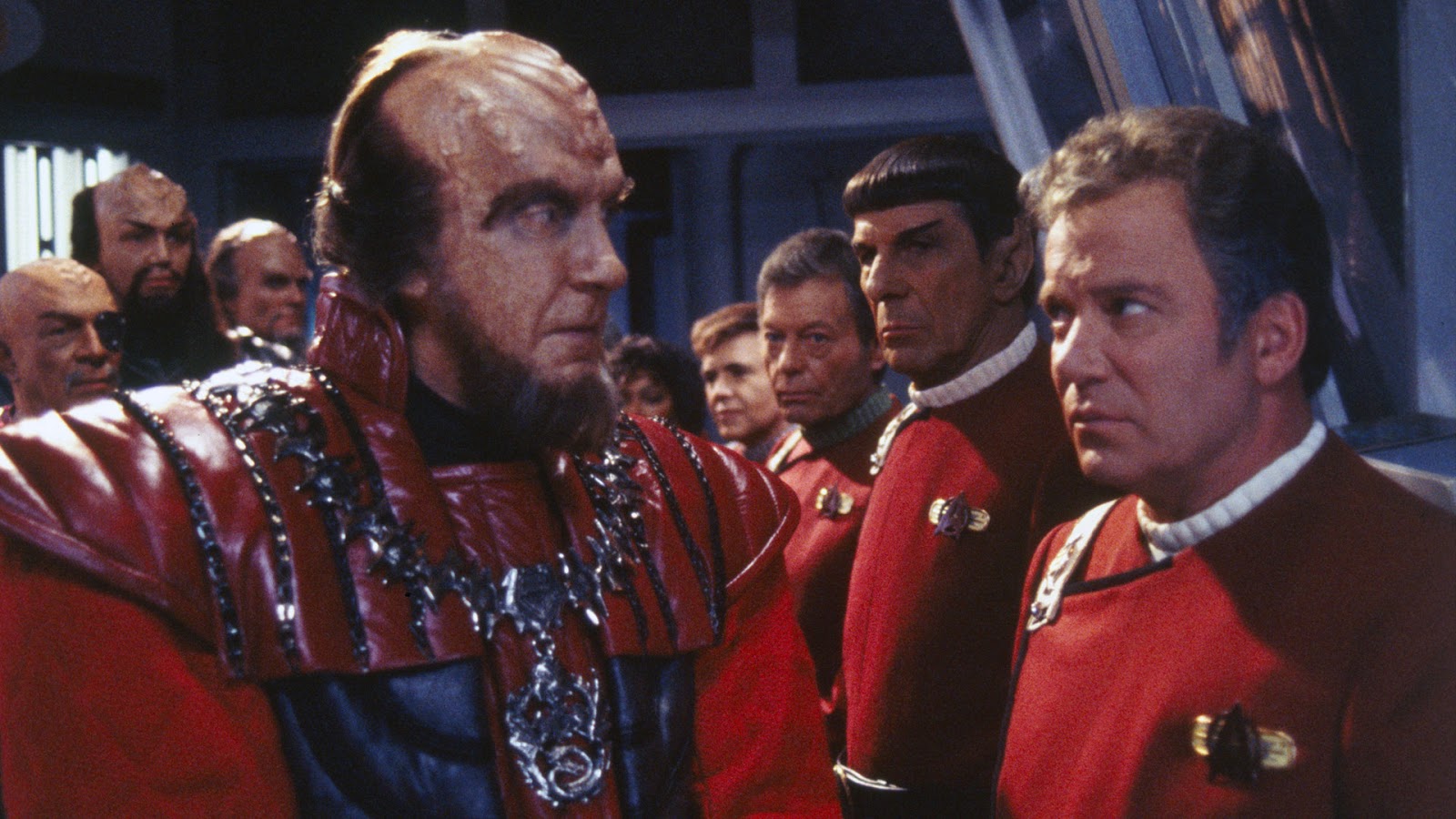
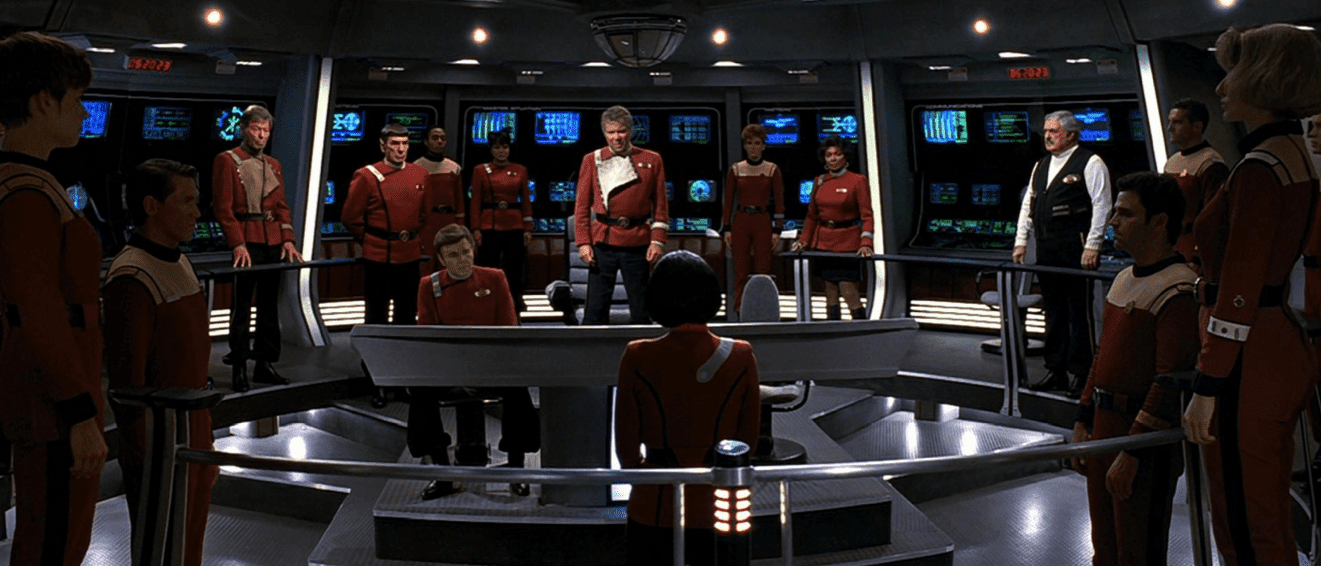
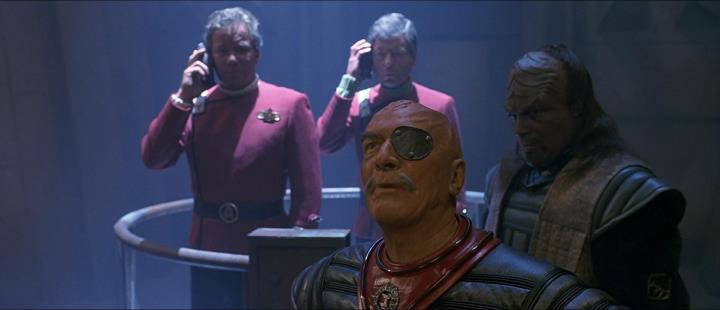
This film follows the final mission of Kirk (William Shatner) and company. There has been a disaster on the Klingon moon Praxis, which has devastated the Klingon economy and left them with no choice but to enter peace negotiation with the Federation, to try and end the Cold War that has existed for generations between the two powers. Sound familiar? While Spock (Leonard Nimoy) has been one of the leading negotiators with Klingon Chancellor Gorkon (David Warner), Kirk is reluctantly roped in to provide an escort for the Klingons to a peace conference. Kirk, and many of his crew, are weighed down with decades of prejudice and suspicion of Klingons (attitudes that erupt in a tense dinner between the Enterprisecrew and many of the equally suspicious Klingons). Kirk and McCoy (DeForest Kelley) however find themselves in trouble when Gorkon is assassinated and the two men are arrested and put on trial by the Klingons. Will Spock save them? Can they save the peace talks? Time for one last adventure.

Star Trek VI very nearly didn’t happen. The previous film, written and directed by Shatner, was a disaster, a messy, strange, flat-footed, cheap-looking adventure that was a huge flop, won several Razzies and nearly killed the series off. So it’s great that the cast got a chance to have one final swan-song in their parts – and that this basically turned into the most intelligent film they had made since Star Trek II. No surprise that Nicholas Meyer, an articulate, literate and intelligent novelist turned film-maker, was the common link between them. Not weighed down by Star Trek lore, nor the breezy “I’m above this” contempt that other directors in the series have had, Meyer understands what makes good Trek – a strong story, compelling character arcs, intelligent writing and a good balance between adventure and themes that resound with contemporary depth.

Star Trek VI was written as the Berlin Wall fell, and it’s a neat commentary on the sort of attitudes you would have seen in America and Russia at the time. Gorkon’s name even echoed Gorbachev (and Lincoln as well). But this isn’t just a historical parallel with the modern world. Instead Meyer also uses this to explore the attitudes of his characters. Like Star Trek II, this works into a neat deconstruction of Kirk’s persona. Kirk has to confront not age here (as in that film) but instead his own out-of-step anger, prejudices and refusal to change. At the same time, the film also explores Kirk as a man who can overcome his instinctive hostility, to make himself a better man. It’s such rich complexity that it’s no wonder I got sucked into a life-long love for Star Trek.

All this makes a fabulous framework for the strongest, most high-stakes entry in the franchise. Meyer’s direction is spot on: simmering with tension in the first half, investing every scene with a creeping intensity and rumbling sense of disagreement. He also works brilliantly with the regular cast, who turn in some of their best performances in this film: Shatner in particular reins in (mostly) the ham for a thoughtful and intelligence performance, while Kelley mixes deadpan snarks with a world-weary resignation. Nimoy also goes further than he has for a long time with Spock, who struggles under the surface with a host of emotions, from hope, pride, guilt and fury all bubbling away under that cool Vulcan façade. The rest of the cast also get moments to shine. 

This is a film that barely puts a foot wrong in its entire first act. From the opening explosion of Praxis – with a hugely exciting sense of danger as Sulu’s Excelsior starship gets caught up in the shockwave – through to the trial of Kirk and Bones, this film is tonally spot on. We understand completely the hostility and distrust Kirk feels towards the Klingons, just as we appreciate on a deeper level his desire to make the peace talks work. The awkward encounters with the Klingons simmer with an unspoken racism from the Federation characters (many of the cast reported being uncomfortable with the imperialist and superior tone their characters had to take), and a hostile resentment from the Klingons. The eventual assassination attempt has a grim inevitability about it, but is expertly shot and edited (a zero-gravity assault by two assassins on Gorkon’s disabled ship). The show-trial itself is like a nightmare of injustice. It’s scintillating and compelling stuff.

While the pace does slacken slightly when Kirk and McCoy find themselves in a Klingon prison camp – we are, by the way, introduced to the prison camp via a speech from the commandant eerily reminiscent of the greetings handed out in Bridge on the River Kwai – it never loses the audience’s attention. And it powers back up for a brilliant all-action, at first totally one-sided, fight between the Enterprise and a Klingon ship en route to the peace conference. A large measure of the film’s atmospheric success should also be given to the extraordinary score by Cliff Eidelman, a brilliant combination of familiar themes and fast-paced orchestral work, one of my favourite film scores.

And Shakespeare? Where does he come into it? Largely through Christopher Plummer, playing General Chang, the man who emerges as principal antagonist. Plummer’s exuberant performance is perfect for this larger-than-life warrior – a man who loves nothing more than reading Shakespeare “in the original Klingon” (one of many examples of the film’s wit). Plummer lets rip throughout the film, quoting endlessly from virtually every Shakespeare play you could imagine, just this side of ham. Plummer is also, for my money, the best villain this series had. But how could you not love a film where the villain rotates round in his command chair shrieking gleefully “Cry havoc and let loose the dogs of war!” Or says farewell to Kirk early on with a cheeky “we have heard the chimes at midnight…”. It’s possibly the best introduction to how great Shakespeare is that you can have.

But then that’s just part of Meyer’s witty, literate script, which throws in quotes from Conan Doyle and JM Barrie to Adlai Stevenson and Neville Chamberlain, and has Spock tells Kirk he’s the perfect choice for a mission to the Klingons as “there is an old Vulcan saying: only Nixon can go to China”. With stuff like that how can you not enjoy the film? It also understands the warmth between the main cast, their sense of character. The whole film combines an elegiac tone with a triumphant final mission, the passing of an era – with the final moments of the film capturing this, from its Peter Pan quote (“First star to the left and straight on until morning”), to the signatures of the cast appearing on the screen, literally signing off on their Star Trek careers.

The whole film is perfectly pitched like this. Every moment works from the off, and the action and adventure is balanced by some wonderful comic moments and beats of high tension and drama. The film’s use of the Cold War in Space as a backdrop works really well, and sheds a new light on attitudes in the franchise that have never really been touched before. It’s well acted, directed with flair and skill (the final space battle is brilliantly assembled), and the score is fantastic. There is a reason why I inflicted this film on my best man and ushers the morning before my wedding: it’s got a special place in my heart and it always will.

X-Men Apocalypse (2016)

Oscar Isaac destroys something else (again) in misfire X-Men Apocalypse

Director: Bryan Singer

Cast: James McAvoy (Charles Xavier/Professor X), Michael Fassbender (Erik Lehnsherr/Magneto), Jennifer Lawrence (Raven/Mystique), Oscar Isaac (Apocalypse), Nicholas Hoult (Hank McCoy/Beast), Rose Byrne (Moira MacTaggert), Evan Peters (Peter Maximoff/Quicksilver), Tye Sheridan (Scott Summers/Cyclops), Sophie Turner (Jean Grey), Olivia Munn (Psylocke), Kodi Smit-McPhee (Kurt Wagner/Nightcrawler), Alexander Shipp (Ororo Monroe/Storm), Lucas Till (Alex Summers/Havoc), Josh Helman (Colonel William Stryker), Ben Hardy (Angel)

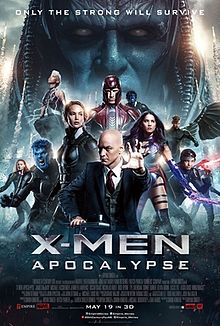
Where do you go with a franchise when you are on at least your second timeline (maybe more, who knows?) and earth-shattering destruction has been done so many times before? At one point in this movie, our young heroes head to the cinema to watch Return of the Jedi – with a genre savvy conversation following on whether the third film in a franchise is always the worst. You’d like to think if you were going to pop such a hostage to fortune in the third film of your franchise, then you’d be busting guts to make this film as stand-out as possible. Doesn’t happen.

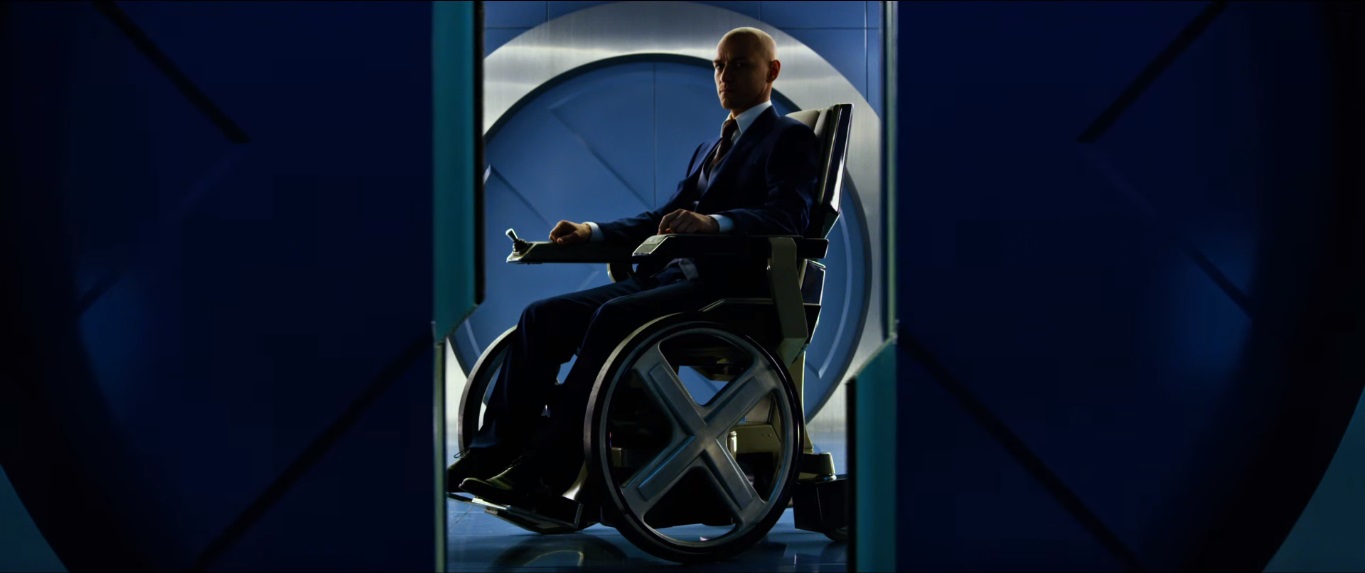
It’s 1983. Charles (James McAvoy) is still running his school with Hank (Nicholas Hoult). Raven/Mystique (Jennifer Lawrence – looking for every single second as if she is only there by contractual obligation) is saving mutants left, right and centre on the underground. Magneto (Michael Fassbender) is living incognito in Germany with a wife and daughter. All that is about to be thrown into chaos when Apocalypse (Oscar Isaac, trying his very best to make an impression under piles of make-up), the very first mutant, rises from imprisonment after thousands of years. The most powerful mutant in history, he decides the world is ripe and ready for the taking.

In X-Men: Apocalypse, not only is more not more, but the film churns out emotional character and relationship beats, covered to exhaustion in other movies. One glance at Magneto’s family and anyone who has ever seen a movie is going to know they are not long for this world. Raven and Charles no sooner appear in the same frame than you know the two of them are going to struggle to reconcile their past with their different viewpoints. We’ve seen it all before – and you feel, in the slightly disengaged performances, that the cast have had enough as well. Even Apocalypse, for all his world-altering power, basically has the same agenda as every mutant villain this franchise has ever had before: Mutant Superiority. 

Around these familiar plot beats, we get action that also feels culled from before. The film culminates in such earth-shattering destruction you really feel it should be more exciting, but instead it feels tediously familiar. How many times have we seen cities devastated like this? It’s such a cliché that the millions of people who must have died in the planet-wide obliteration that consumes the final third of the film don’t even merit a mention. It’s like the world treats this global destruction with the same meh that you feel a number of the film’s viewers do. 

But then the whole film has a weary sense of inevitability about it, of going through the motions. The plot makes little or no sense. Apocalypse is awoken by a cult we never hear from again, the whole film takes place in a few days, barely enough time to build up any sense of peril – but also somehow too short a time for the vast number of comings-together of different characters to feel natural. Characters from past films are thrown in willy-nilly, often for no real reason. So from the first scene we have Moira MacTaggert and Havoc back from the first film, then Quicksilver is back to repeat his bullet-time action from Days of Future Past (saying that, this sequence, as Quicksilver rushes to save people from an exploding mansion to the tune of Sweet Dreams, is the most vibrantly enjoyable moment in the film). We even get Stryker back, a character who becomes more and more of a cartoony villainous idiot each time he appears.

In between these points, the film frequently misses its beats. Apocalypse’s assembled group of mutant followers are assembled with such casual indifference (Apocalypse basically seems to pick up the first four mutants he meets) that their characters and motivations barely register. Obviously we know Storm is destined to be a goodie, so we get a few seconds of establishment that she is basically a goodie. Magneto gets his painfully predictable backstory (Michael Fassbender is by the way totally wasted in this movie, forced to repeat the same notes over and over again from the last two films). The other two barely make an impression – other than perhaps Olivia Munn’s unbelievably fanservice costume.

But it also makes more serious errors. A hideously distasteful moment sees Magneto destroy the whole of Auschwitz in a rage. There is, quite frankly, something more than a little stomach turning about the site of a real atrocity – where millions died – being blown away on screen like any other major landmark. Even more disgusting to have it serve as a shallow, over-exploited “he feels pain because he was in the Holocaust” moment. Other times in this series this link has worked – here it manifestly doesn’t.

About the only thing that really works here is the darker interpretation of Charles – McAvoy making it clear that events have made Xavier far more willing to go to dangerous ends to protect his family – and there is a neat replay of the first conversation between Xavier and Magneto from the very first film in the franchise, with the stresses all changed to show that their positions have developed in a far different way in this new timeline. But that’s the only real moment that feels new.

But I’ve still got a certain affection for these X-Men movies, and this isn’t the worst one they’ve ever made (that’s always going to be X-Men Origins: Wolverine), but it’s up there. It somehow doesn’t feel special, more like a film that had to be made for legal and financial reasons, rather than because there seemed like a decent story to be told, or something unique to be said. The rushed plot and lack of engaging characters make more sense when you think about it like that. It’s nothing special at all, and seems to pass in front of your eyes and then just as quickly out of your memory.

King Arthur: Legend of the Sword (2017)

Charlie Hunnam is a “Proper LEGEND” in disasterous geezy gangster King Arthur: Legend of the Sword

Director: Guy Ritchie

Cast: Charlie Hunnam (King Arthur), Jude Law (King Vortigern), Àstrid Bergès-Frisbey (The Mage), Djimon Hounsou (Sir Bedivere), Aidan Gillen (Goosefat Bill Wilson), Eric Bana (King Uther Pendragon), Kingsley Ben-Adir (Tristan), Craig McGinlay (Percival), Tom Wu (George), Neil Maskell (Back Lack), Annabelle Wallis (Maggie), Katie McGrath (Elsa), Freddie Fox (Rubio), Mikael Persbrandt (Greybeard), Michael McElhatton (Jack’s Eye), Geoff Bell (Mischief Jack)

Okay we’ve all seen bad movies. And we’ve all seen movies that don’t make a lot of sense. But it’s a pretty special film that is both at the same time. King Arthur: Legend of the Sword is one of those. It is jaw-droppingly terrible and also insanely, ludicrously, incoherent. It’s completely impossible to follow what the hell is going on. Considering the studio planned this as the first of at least ten movies in an Arthur-verse, it’s practically a textbook on how not to start a movie franchise.

Anyway the plot, such as I can work out, is something like this: back in ye olde England times, magic and Mages have been nearly wiped out after (I think) an attempt by Mage Warlord Mordred to seize the throne. Then former Mage pupil and jealous brother of King Uther Pendragon (Eric Bana), Vortigern (Jude Law) kills his wife to get powers to seize the throne. Only young Arthur survives – and an unspecified period of time later (he ages, no one else does), Arthur (Charlie Hunnam) is a cocky geezer running a brothel in Londinium in the shadow of the Coliseum (yes really). Then one day Uther’s sword Excalibur turns up buried in a stone and Vortigern gets everyone to try and pull the sword out of the stone, so he can find the true heir (Arthur) and then when he finds him he puts on a show trial and it looks like he’s going to execute him because Arthur has become a legend in five minutes. Then Arthur is rescued by rebels who want Arthur to lead them, because the sword has special powers which Arthur can control if he can only get over his doubt and when it works… Oh God I can’t believe I’ve just tried to puzzle it out.

Scenes in King Arthur: Legend of the Sword follow each other with barely any structural link from one to the other. The film is convinced that the best way to pique our interest in a mystery is to throw us into the deep end and then info-dump flashbacks and voiceover throughout the film. The effect is rather like an ove- excited child trying to tell you a story (“And then a MASSIVE OLIPHANT SMASHED THE BRIDGE, and Uther fought it with a sword and it went boom and there was a big funeral and then Vortigern killed his wife and he was sad and he shouted and then a BIG DEMON killed Uther because the sword couldn’t go boom and then Arthur grew up”) who keeps leaving out the key details so has to throw them in later (“oh and Vortigen killed his wife because he needed to become a BIG DEMON and could only do it if he killed someone he loved and he had to become a BIG DEMON because it was the only way to stop Uther from making the sword go boom and he needed to get the sword – umm – well I’m not sure why but he needed it to build his tower. Did I mention his Tower? I think it was why he wanted to become King so he could build the tower. I think the tower made him a powerful magician. But of course he already was a magician he just wanted to be a betterer one. Did I mention that Arthur got the sword and made it go boom?”).

Instead the film showcases absolutely all the worst instincts of Guy Ritchie. All of them. Everything happens really fast and incredibly loudly. There are huge senseless battles and enormous CGI beasts who attack for no reason whatsoever. Arthur and his cronies are all transformed into cockney wide-boys, with Vortigern’s enforcers basically gangsters, all speaking with the Lock Stock rat-a-tat vibe that was fresh in 1998 but feels impossibly dated and tiresome now. This mixes with the ridiculously loud and fast pace of the film that makes it almost literally impossible to work out what is going on – and certainly makes it impossible to give a shit about anyone or anything in the film as events, characters, action and dialogue fly past with nothing dwelling to make any impact.

Everything has been thrown at this. Monsters! Gangsters! Chinese Martial Artists! Knights as Nazis (Jude Law’s Vortigen hosts a full blown Nuremberg Rally)! None of it really ties together. Nothing makes sense. Everything is filmed dull and murkily.

Probably because the producers worked out what they’d put together was an impossible turkey, the film has been cut to ribbons. To try and make a virtue of this, frequently characters explain events that are going to happen, while the events themselves play out on screen. Ritchie pumps this up to the next level by having the dialogue delivered with manic speed, which clearly passes in his mind for cool. This is when it explains things at all. More often events speed by so swiftly that we just have to assume massive time jumps have happened. This sword must be important (its name is in the title) but when it pops up out of nowhere, we get no sense that Vortigern has spent any time looking for it. Not only that, his system of forcible sword tests is both a well-oiled machine and something Arthur (who lives literally in the shadow of Vortigern’s castle) has never heard of. In less than two minutes of screen-time after he pulls the sword, Arthur is spoken of as a legendary figure who must be killed publicly to kill his legend. What? How much time is passing here?

The film has both way too much plot going on, and not enough interesting plot going on. It’s so determined to set up future movies that we get lots of incoherent information about Mages, magic and powerful swords dumped on us really quickly. Anything that could be seen as a “special effect” has been left in, while it feels like anything dialogue-related has been cut. So we have a way, way, way too long sequence of Arthur in some place called the Darklands battling monsters for reasons never explained by the plot (its stated purpose, to get him to master the sword, doesn’t even work – making it a complete cul-de-sac). We get a battle at the start where we literally don’t know who is fighting whom or why. At one point, the Mage commands a giant snake which pops up to save Arthur and is never used again. On the counterside, we are never clear what Vortigern is trying to do or why he seized the throne, why he is building a huge tower or why he needs the sword – or indeed why the sword is important other than it makes things go BOOM.

The actors stumble about the wreckage of this film, like shell-shocked survivors of some kind of apocalypse. Perhaps this is at last the end of Charlie Hunnam as a star of big budget movies – he is, to put it bluntly, awful: a complete non-presence. Jude Law swans through the film as if just turning up was repaying a favour to Ritchie – although god knows Vortigern is a character that makes no sense at all. The rest of the actors make no impact – Aidan Gillen looks a little ashamed to be there – with the one exception of Neil Maskell who gets some very small emotional force out a father-son relationship. But to be honest, this is one where you want to be forgotten.

A film that wants to start a franchise but gives us no reason to care about anyone in it, is on a hiding to nothing. What on earth in this movie would make you want to come back and see the future adventures of Arthur and Pals? I can’t think of anything. If you can work out what is going on you are welcome to it. Lord knows no one else wants it.

Mission: Impossible – Fallout (2018)

Tom Cruise gets the gang back together for high octane excitement in Mission: Impossible Fallout

Director: Christopher McQuarrie

Cast: Tom Cruise (Ethan Hunt), Henry Cavill (August Walker), Ving Rhames (Luther Stickell), Simon Pegg (Benji Dunn), Rebecca Ferguson (Ilsa Faust), Sean Harris (Solomon Lane), Angela Bassett (Erica Sloane), Michelle Monaghan (Julia Meade), Alec Baldwin (Alan Hunley), Vanessa Kirby (Alanna Mitsopolis/White Widow), Frederick Schmidt (Zola Mitsopolis), Wes Bentley (Patrick)

It’s probably not something many people would expect watching a Hollywood blockbuster, but part way through Mission: Impossible Fallout, as Tom Cruise motorbikes into a stream of traffic round the Champs-Élysées, I was reminded of Michael Crawford in Some Mother’s Do ‘Ave ‘Em. If there’s one thing these two have in common, it’s having a star willing to constantly go above and beyond to perform their own stunts. Which mainly makes you think as well that Crawford and Cruise are probably both a bit nuts.

Mission Impossible: Fallout picks up almost exactly where Rogue Nation left off. The villain of that film, Solomon Lane (Sean Harris), may be in custody, but the remnants of his organisation have reformed as The Apostles, chosen a new leader (known only by the pseudonym John Lark), and are trying to seize three nuclear warheads. Ethan Hunt (Tom Cruise) is deployed to stop them. During the mission, Hunt chooses to save the lives of his team rather than complete the mission – leaving the IMF force with a race against time to regain the warheads, and leading to clashes and alliances with enemies and friends old and new, including Lane and Hunt’s female counterpart Ilsa Faust (Rebecca Ferguson).

Mission: Impossible Fallout is big. By golly gosh it’s big. They aimed to make this the biggest and most stunt-filled, action-packed entry in the series – and they probably succeeded. More than any other film in the series, this one feels like a series of action sequences joined together by scenes of story and dialogue. Never has the overall aim of the villains, or their scheme, been so swiftly outlined – or essentially so inconsequential to the events we are watching. Do we need to know why the Apostles (an organisation we never even encounter in the flesh!) or Lane or any combination of the film’s baddies want to blow up three nuclear bombs in Kashmir? The film gambles that we won’t really care, that all we really care about is watching Hunt and co prevent them on a 15-minute deadline. It’s a gamble that the film more or less gets right.

The film also skims quickly, depending on you having seen the three preceding films so that it can spend time less on character re-establishment and more on those action scenes. It plays off emotions we have developed for the characters over previous episodes – and relies on us carrying across our knowledge of their past relationships. Alongside this, the film is crammed with callbacks to pretty much every film in the series – most prominently of all to Hunt’s marriage in the third film. This is a plot development, you feel, largely introduced to allow the characters to move on: it’s clear Hunt and Faust are the series intended romantic leads going forward (though Faust is never anything less than Hunt’s equal in all areas), so we need to know that Hunt isn’t cheating on a wife somewhere along the line, and that they have mutually decided to go their separate ways. The film accomplishes this – and also allows a few beats to suggest that, under the surface, all this Impossible Missioning has given Hunt the odd small emotional problem.

But not too many, as establishing Hunt’s decency is pretty central to the film. One of its themes is Hunt’s unwillingness to sacrifice any innocents or indeed anyone who doesn’t deserve it. This theme runs throughout the film, and is used to suggest that part of the reason Hunt so often instigates such insanely grandiose schemes is that he is completely unwilling to let the needs of the many outweigh the needs of the few: give him the choice of sacrificing one man to get nuclear warheads easily, or jumping through the sorts of insane loops, schemes and dangers this film throws him into, and Hunt will choose the hard option every time. (Of course I could also be mean and say that Cruise has developed a character whose only real flaw is that he cares too much.)

At least this makes him really easy to root for. Which is just as well, as Fallout throws Hunt front and centre. Perhaps more so than any film since the second one, the team feels like a one-man army. Hunt does everything difficult or dangerous – which means Cruise is dragging himself to take on a number of insane stunts, from HALO jumps, to driving against the Parisian traffic, to hanging off the bottom of a flying helicopter. Of course, we also get no fewer than six speeches praising Hunt to the heavens – but when Cruise is willing to go such insane lengths (one stunt famously left him with a broken ankle and shut down filming for eight weeks) you can’t hold it against him that much.

And like all the rest of the series, this is a very fun film. It takes a while for the sense of fun to really kick in – much of the first half-hour feels deathly serious – but eventually that sense of fun, of enjoying the lunacy, settles in and you start to run with it. A madcap chase over the roofs and office blocks of London that ends at the Tate Gallery is a perfect example of a sequence that mixes hi-jinks, death-defying stunts and tongue in cheek humour. 

And that’s really the secret of this franchise. It’s a mix of absurdly OTT action, incredible dangers, and death-defying stunts that its star throws himself into with an insane abandon all played with a certain lightness of touch. The series, for all its world-endangering excitement and merciless villains, also has a family feeling behind it. Hunt’s team is his family and it’s that warmth which underpins all the drama. Fallout is huge fun – in fact, if it has any real flaws it is that it is too big by the end, with an action sequence that never seems to end – and a great rollercoaster to climb on board.

John Wick 2 (2017)

Keanu tools up for my running, jumping and shooting in genial, but perfunctory, sequel John Wick 2

Director: Chad Stahelski

Cast: Keanu Reeves (John Wick), Riccardo Scamarcio (Santino D’Antonio), Ian McShane (Winston), Ruby Rose (Ares), Common (Cassian), Claudia Gerini (Gianna D’Antonio), Lance Reddick (Charon), Laurence Fishburne (The Bowery King), Franco Nero (Julius), Peter Stormare (Abram Tarasov)

It’s that age-old story: every time you think you’re out, they drag you back in. Well that’s what we get with John Wick (Keanu Reeves). Picking up where the last film stopped, Wick is approached by mafioso head Santino D’Antonio (Riccardo Scamarcio) who wants Wick to assassinate his sister, who has been promoted to head of the business over him. Eventually (after much pressure) Wick agrees – and quickly finds himself betrayed and on the run.

The first John Wick has a real charm about it, the sort of film you can really enjoy because tonally it gets itself absolutely spot on. It’s a lot of action fun, it manages not to take itself too seriously and it sets its hero up as someone very sympathetic who only goes on a rampage of violence under extreme provocation. The sequel attempts to double down on all of this and give us more of the same – but not always to the same impact.

Part of the issue is that there just isn’t the same engaging story at the heart of it. I totally understand John Wick in the first film, and completely got what it was that he was doing in the film – that essentially avenging his dog was about getting revenge on those who had taken the only thing he had left from his relationship with his wife. Here the lines are a lot more blurred – John basically saddles up under extreme provocation and blackmail and then basically spends the film killing people left, right and centre – first for someone else, then to get revenge for being betrayed back into this life (or something like that), and then finally because he’s just really pissed.

So that emotional grounding behind all the killing – and the thing that makes John Wick pretty likeable in the first film – gets lost. Instead he’s just a ruthlessly efficient killing machine – and while that is fun to watch, it’s not as immediately engaging as the first film. In fact, the second film (aiming to go bigger and better) is basically just three orgies of gunplay and violence, linked together by a few tongue-in-cheek dialogue scenes.

It’s another of those films made for YouTube clips. The action scenes can pretty much be watched and enjoyed without the burden of trawling through the nonsense plot, so you might as well hunt those down online and watch them alone. They’re really well done, extremely well shot and pretty exciting (if covered in claret). The rest of the film you can take or leave to be honest.

That’s despite all the best efforts of those involved. Keanu Reeves still brings a slacker charm to the role, even if it’s one that doesn’t stretch even his limited acting range. Ian McShane has a decent, fun turn as an influential member of a shadowy criminal organisation. We even get a rather dry Matrix reunion between Reeves and Fishburne. It’s very well directed and there are occasional good jokes.

However, it lacks a decent villain (Scamarcio as a Mafia baddie is singularly uninspiring), it goes on too long and, most of all, it’s just not quite as good as the first film. There the “world building” around the edges of the film was a fun aside from the action. Here it’s the focus – with strange councils and mystical rules all over the place – and that just doesn’t quite work as well.

John Wick 2 is fun, don’t get me wrong. But somehow it feels less charming and more bloated, something that is starting to feel itself a little too important and, in throwing more and more at the screen, means you lose the heart of some of the original.

The Man From UNCLE (2015)

Armie Hammer and Henry Cavill try, and fail, to get some zing out of The Man From UNCLE

Director: Guy Richie

Cast: Henry Cavill (Napoleon Solo), Armie Hammer (Ilya Kuryakin), Alicia Vikander (Gaby Teller), Elizabeth Debicki (Victoria Vinciguerra), Jared Harris (Adrian Sanders), Hugh Grant (Alexander Waverly), Luca Calvani (Alexander Vinciguerra), Sylvester Groth (Uncle Rudi), Christian Berkel (Udo Teller), Misha Kuznetsov (Oleg)

The Man From U.N.C.L.E.was a 1960s TV spy caper series, which I confess I’ve never seen an episode of but I’m reliably told (by my wife who has) that it’s all larks and fun. This Guy Ritchie remake, on the other hand, is a tonal mess that has no idea what the hell it is. Only Hugh Grant gets anywhere near to appearing in a caper movie – probably because he’s virtually the only member of the cast who might have grown up watching the original series.

Anyway, in the early 1960s Napoleon Solo (Henry Cavill) is an international master-thief turned CIA agent (this suggests his character is a whole lot more fun than he actually is). Ilya Kuryakin (Armie Hammer) is a KGB super-agent, dealing with issues of psychosis (yup more fun to be had there). This odd couple are ordered to team up and work with car mechanic (no seriously) Gaby Teller (Alicia Vikander), whose father is working with renegade Italian fascists, led by femme fatale Victoria Viniciguerra (Elizabeth Debicki), to build a new nuclear mastery over the world. Or something.

It should be a ridiculous, overblown, mix of Bond and high 60s camp. Instead it’s dreary, chemistry-free, largely uninvolving sub-Mission: Impossible high jinks that I’m not ashamed to say I dozed off during at one point. Would that I had slept through more of it. It’s quite damning when the most enjoyable thing about it is thinking about the accent Olympics going on (we have a Brit playing an American, an American playing a Russian, a Swede playing a German, an Australian playing an Italian, an Irishman playing an American…).

No matter which way the three leads are arranged, Cavill, Vikander and Hammer have no chemistry at all in any combination. There is precisely zero bromance between the two leads. Vikander and Hammer have a will-they-won’t-they romance that comes from absolutely nowhere and leads nowhere (set up for sequels that will never come). Cavill looks the part, but completely lacks the cheeky, self-confident, “I’m-enjoying-all-this” charm that the part requires – instead he’s flat and boring. Hammer has more of the winking-at-the-camera cool, but he’s saddled with a part that frequently requires him to burst out in hotel-room-trashing outbursts of anger. Vikander just looks a bit bored with the whole thing.

These rather joyless characters go through a series of action set pieces, none of which got my pulse racing, and all of which felt like off cuts from a lousy Mission: Impossible sequel. Car chases, fisticuffs, gun fights, explosions, boat chases – they all tick by with no wit or pleasure involved anywhere. In these sort of things, you need to feel the characters are such adrenaline junkies that they sorta enjoy the crazy antics they get thrown into – you don’t get any of that from these three.

Much as I like Elizabeth Debicki, she can do little with her underwritten part – I mean I get that the plot isn’t the main thing in a film like this, but they could have at least given our villain a character. Instead she is as cardboard cut-out as the rest of the storyline. The acting from the bulk of the cast is also really odd – some seem aware they are in a tongue-in-cheek spy film, others seem to think they are in an espionage thriller. It’s a mess. There are scenes of pratfall comedy followed by grim scenes of torture and violence. In one juddering moment of this spy romp, the flipping Holocaust is dragged in as a shorthand for identifying a character as an “ultimate villain” – which given he had our hero strapped to a chair and was about to torture him, I think we could all have worked out without exploiting genocide. Anyone else think pulling this appalling real world event (with photos!) into a stupid caper movie is really tasteless? Did no one watch this thing while it was being edited?

I will say the design is pretty good and it’s well shot. But compare this to the fun and games of Guy Ritchie’s Sherlock Holmes films (which this is obviously trying to emulate) and the total lack of chemistry at its heart becomes immediately clear. Hugh Grant is a complete relief when he turns up as he’s the only actor who actually looks like he is enjoying his part and wants to be there. It was a big box office bomb and it’s no surprise. No one is having fun, the spirit of the original series seems to have been completely lost, and the lead actors totally fail to bring the leading-man pizzazz the film needs. Perfect if you want a nap.

Robin Hood (2010)

Russell Crowe takes aim as Robin Hood

Director: Ridley Scott

Cast: Russell Crowe (Robin Longstride), Cate Blanchett (Marian Locksley), William Hurt (William Marshal), Mark Strong (Sir Godfrey), Mark Addy (Friar Tuck), Oscar Isaac (Prince John), Danny Huston (King Richard), Eileen Atkins (Eleanor of Aquitaine), Max von Sydow (Sir Walter Locksley), Kevin Durand (Little John), Scott Grimes (Will Scarlet), Alan Doyle (Allan A’Dale), Matthew Macfadyen (Sheriff of Nottingham), Lea Seydoux (Isabella), Douglas Hodge (Sir Robert Locksley)

When this film was developed, it was a CSI style medieval romp called Nottingham. Russell Crowe was cast as the film’s hero – an ahead-of-his-time Sheriff of Nottingham, busting crimes in Olde England and dealing with rogue thief (with good press) Robin Hood. Yes that really was the original idea. Mind you, it would at least have been more original than what we ended up with after Scott and Crowe had a bit of a rethink.

So here we are: Robin Hood: Origins (as it might as well have been called). Russell Crowe is Robin Longstride, on his way back from the crusades as an archer in the army of King Richard (Danny Huston) army. When Richard is killed at a siege in France (it was one last siege before home – what are the odds!), the messengers carrying the news back to France are ambushed and killed by wicked Sir Godfrey (Mark Strong). Robin finds the bodies and assumes the identity of Sir Robert Locksley, travelling to England to tell Prince John (Oscar Isaac) the news of his succession – then returning to Nottingham with his friends, where Robert’s father Sir Walter (Max von Sydow) asks him to continue pretending to be Robin for dull tax reasons – and soon feelings develop between Robin and Sir Robert’s widow Marian (Cate Blanchett). But John is intent on farming the land for taxes, and Sir Godfrey is in cahoots with the French to conquer England.

Robin Hood is a semi-decent, watchable enough retread of a story so totally and utterly familiar that even the things it rejigs end up feeling familiar. In fact, to be honest you sit watching it and wondering why on earth anyone really wanted to make it. Scott brings nothing original and different to it, and the film looks like a less visually interesting retread of Kingdom of Heaven. Plot wise it’s empty. What’s the point of it all? It slowly shows us all the pieces of the Robin Hood myth coming together, so best guess is that it was intended to be the first of a series (there seems to have been no interest or demand for a sequel of any sort). 

And then we’ve got Russell Crowe. Leaving aside everything else, Crowe looks about 10 years too old for the part. He delivers some sort of regional accent that meanders from Ireland to Yorkshire in its broadness, a laughable stumble around the country. Crowe does his slightly intense, sub-Gladiator mumbles and stares at the camera and attempts to suggest a deep rooted nobility, but actually comes across a bit more like a snoozing actor awaiting a pay-cheque.

Cate Blanchett does her best, lending her prestige to the whole thing in an attempt to make it land with some dignity (she of course does the opening and closing narration, which struggles to add some sort of grandeur to the whole flimsy thing). She’s saddled with a Maid Marian who is granted various “action” moments, but still has to be saved by Robin and face possible rape from a leering Frenchman (at least she saves herself from that one). 

It also doesn’t help either actor that their romance plays out in the dull middle third of the film, where the plot grinds to a halt as we deal with Sir Walter (Max von Sydow almost literally acting blindfolded) using Robin as some sort of tax dodge scheme. The film is overloaded with characters, all of whom are separated at this point and struggling manfully to make their disconnected plotlines interesting: so we get John dealing with the pressures of office, Sir Godfrey scheming and looting, William Marshal trying to find a middle ground, Robin and Marian falling in love – it’s a mess. On top of this a get a ludicrous reworking of the Magna Carta as some Medieval version of the Communist Manifesto (it’s written by Robin’s executed dad no less, giving him a bizarre “painful backstory” to overcome). None of these plots really come together, and so little time is spent with each of them that they all end up getting quite boring.

The film culminates in a totally ridiculous battle scene on a beach, as Sir Godfrey’s French allies arrive on the shores of medieval England in some sort Saving Private Ryan landing craft. The tactics of this landing and the battle that ensues are complete nonsense. Every single character rocks up at this battle, which should feel like all the plot threads coming together but instead feels like poor script-writing. When Marian turns up, disguised as a man (how very Eowyn), leading a group of warrior children (I’m not joking) who feel yanked from the pages of Lord of the Flies, it’s just the crowning turd on this nonsense.

And all this fuss to defeat Sir Godfrey? Why cast Mark Strong and give him such a nothing part? Sir Godfrey is a deeply unintimidating villain. Everything he does goes wrong. He is bested in combat no less than three times in the film (once by a flipping blind man!). His motivations are never even slightly touched upon. He has less than one scene with John, the man who he is supposed to be manipulating. He runs away at the drop of a hat and Robin gets the drop on him twice on the film. He’s neither interesting, scary or feels like a challenging adversary or worthy opponent.

But then nothing in this film is particularly interesting. The set-up of the merry men around Robin (they seem more like an ageing band of mates on tour by the way than folk looking to rob from the rich and give to the poor) is painfully similar to dozens of other film, particularly in the Little-John-and-Robin-fight-then-become-brothers routine. Crikey even Prince of Thieves shook up the formula by making Will Scarlet Robin’s brother. Scott is going through the motions, like it was one he was committed to so needed to see through to the end despite having long-since lost interest. It’s not a terrible movie really, just a really, really, really average one with a completely miscast lead and nothing you haven’t seen before.