Category: Action film

The Terminator (1984)

The Terminator (1984)

Schwarzenegger becomes an icon in Cameron’s masterpiece, a darkly gripping sci-fi chase-thriller

Director: James Cameron

Cast: Arnold Schwarzenegger (The Terminator), Michael Biehn (Kyle Reese), Linda Hamilton (Sarah Connor), Paul Winfield (Ed Traxler), Lance Henriksen (Hal Vukovich), Bess Motta (Ginger), Rick Rossovich (Matt), Eal Boen (Dr Peter Silberman), Bill Paxton (Punk)

“It can’t be bargained with. It can’t be reasoned with. It doesn’t feel pity, or remorse, or fear. And it absolutely will not stop… ever, until you are dead!”

If that description doesn’t grab your attention, I don’t know what will. James Cameron cemented his place in cult-film history with The Terminator, such a pure shot-to-the-heart of filmic adrenalin, its hard to think it’s been bettered since. Cameron takes a fairly simple story – essentially a long, relentless chase – and fills it with energy, black humour and a genuine sense of unstoppable menace, in a film that barely draws breath until it’s over an hour in and then promptly throws you straight into a final action set-piece. It uses its low budget effectively to create a world of mystery and dark suggestion and leaves you gagging for more. So much so, they’ve tried to recapture the thrill ride six times since (and only Cameron did it right, with Terminator 2).

It’s 1984 and two naked people arrive in Los Angeles in a ball of light. They’re both from 2029, time-travellers looking for the same woman. One of them nicks a tramp’s piss-stained trousers and runs from the police. The other is a stoic, impassive mountain of muscle who offs a few violent punks after they refuse his blunt instruction to hand over their clothes. Which one do you wish you were eh? Unfortunately, the second one is a Terminator (Arnold Schwarzenegger), a machine in the skin of a man sent to eliminate Sarah Connor (Linda Hamilton), mother of the future leader of the post-apocalyptic human resistance to the machines. The first is Kyle Reese (Michael Biehn), the man sent to save her. Tough gig, since the Terminator is relentless, almost invulnerable and holds all the cards.

The Terminator is pulpy, dirty, punchy film-making – and its huge success became James Cameron’s calling card for a lifetime of success. Set in a neon-lit, dingy Los Angeles (it never seems to be daytime in The Terminator), it taps into the core of a million nightmares, the fear of being chased and nothing you do ever sees to get you further away. It’s a really elemental fear which The Terminator brilliantly exploits, as impassive and impossible to negotiate with as your deepest, darkest dreads. Throw into that Cameron’s gift for tension and you’ve got the almost perfect thrill-ride.

It’s also a film that gives us the perfect level of information we need. Unlike the cops (and Sarah Connor) who can’t believe this story Reese is peddling them that they are up against an unstoppable metal killing machine, we know from the start the whole story. It’s enough for us to feel a cheeky frustration as they bend over backwards to fit logical explanations to the things they’ve seen and for us to feel the sneaking dread that storing Sarah away in a police precinct crammed full of heavily armed cops isn’t going to make a jot of difference. He won’t let anything stop him.

Is it any wonder quite a few people came out of the film sympathising with Sarah and Kyle – but feeling a sort of guilty admiration for the Terminator? This is the foundation stone of the Schwarzenegger cult, his role as the monosyllabic machine sending him into the upper echelons of Hollywood stardom. Cameron’s original idea was the Terminator should be a perfect infiltration unit, the sort of guy who wouldn’t stand out in a crowd (the original choice was Lance Henriksen, relegated instead to the second-banana cop behind Paul Winfield’s folksily doomed decent guy, fundamentally out of his depth). That went out of the window when Schwarzenegger came on board: say what you like about the Austrian Oak, but he stands out in a crowd.

Why is the Terminator darkly cool? (After all literally no one ever pretended to be Kyle Reese, but everyone has put on a pair of shades and said “I’ll be BACH”.) Because he embodies all the qualities we’ve been taught by films to respect. He’s strong and silent, calm and confident, never complains, doesn’t need help and never gives up. He’s exactly the sort of guy Hollywood has cast admiring eyes at since film spooled through a camera. We can’t help ourselves.

The film becomes about Schwarzenegger (even if he’s not in the last set piece, replaced by a budget-busting CGI android). Cameron knew how to get the best out him, his tiny number of lines (17 in total) delivered in his emotionless, euro-accent make him seem mysterious, different and cool, frequently responding with either deadpan seriousness or sudden violence. His under-statement lines are funny because we anticipate already the bloodbath that will follow. And, unlike despicable villains, he’s not motivated by greed, jealousy or wickedness: he’s almost the quintessential American hero, taking care of business – it just so happens his business is killing people.

Reese should be someone we admire more: he’s a plucky, resourceful underdog. But, unlike the actions-rather-than-words Terminator, he’s got to speak all the time – while the Terminator is a killing machine, Reese is the exposition machine. Biehn does a terrific job with a difficult role, a decoy protagonist who spends much of the movie alternating between gunplay and spitting out reams and reams of exposition explaining to anyone and everyone the future and terminators. On top of that, while his opponent gets on with, Reese’s constant refrain of how scared he is and everyone else should be (who wants to hear a hero say how terrified he is eh?) and his frustrated whining at no-one listening to his fantastic story marks him as weak. Charismatic heroes persuade their audiences: no one believes Reese until they are literally watching Arnie shrug off a whole clip of ammo.

Reese is, in any case, a decoy protagonist of sorts. His romantic longing for Sarah (having fallen in love with her photo in the future) and nurturing personality actually mark him out as the more conventional ‘female lead’. In the first of several films where Cameron would show-case heroic female characters, the actual ideal rival for the machine is Sarah. One of the most interesting things about The Terminator is watching Linda Hamilton skilfully develop this character from ordinary young woman into the sort of archetypal Western hero the film ends with her as (she even gets the sort of badass kiss-off line “You’re terminated FUCKER” you can’t imagine the less imaginative Reese saying).

On top of this The Terminator is a triumph of atmosphere. With its synth-score, it has an unsettling quality from the off helping to build the sense of grim inevitability that is its stock-in-trade. Just like the Terminator’s never-ending pursuit, the whole film is a well-judged, inevitable, time-loop. Sending people back in time turns out to be the very thing that guarantees that future will happen. Throughout, Cameron’s little titbits about the future (partly constrained by budget) are perfect in giving us just enough information to understand the stakes but leave enough mystery for us to be so desperate to know more, we fill in the gaps from our imagination.

But the reason The Terminator works best is that it’s an undeniably tense thrill ride, an extended chase sequence that rarely eases off and never loses its sense of menace. You never feel relaxed or safe while watching The Terminator and never for a moment that its heroes are on a level playing field with their opponent. Atmospheric, tense and terrifying, it walks a brilliantly fine line (so much so, the Terminator methodically massacring a precinct full of cops is both unnerving and the most popular scene in the film) and never once let’s go of your gut. It’s not only possibly the best, most perfect, Terminator film made also still one of Cameron’s finest hours.

Deadpool & Wolverine (2024)

Deadpool & Wolverine (2024)

Smug, tiresome gags underpin a shallow piece of fan-pandering that mocks fan-pandering

Director: Shawn Levy

Cast: Ryan Reynolds (Deadpool), Hugh Jackman (Wolverine), Emma Corrin (Cassandra Nova), Matthew Macfadyen (Mr Paradox), Morena Baccarin (Vanessa Carlysle), Rob Delaney (Peter Wisdom), Leslie Uggams (Blind Al), Aaron Stanford (Pyro), Dafne Keen (Laura), Jon Favreau (Happy Hogan)

Deadpool is Marvel Jesus. It’s a joke in the film, but it’s also kinda true. The MCU has struggled in the past few years and it’s hoping the raw-and-ready sociopathic, fourth-wall-breaking merc-with-the-mouth can give its fortunes a jolt. In terms of money take, Deadpool & Wolverine is, I guess, going to do that. In terms of creativity and imagination, we’re still circling the toilet bowl, but hey at least Feige and co are doing it while clutching a wadge of greenbacks.

You say Deadpool’s constant fourth-wall leaning jokes ain’t really funny and that all they do is point out (and neutralising criticism in advance) weaknesses in plot and writing: but that toilet bowl gag was a bit of a turd right?

Wade Wilson aka Deadpool (Ryan Reynolds) has been rejected by the Avengers on Earth-616 “The Sacred Timeline” (otherwise known as the one the MCU happens in) and returns to his friends on Earth-10005 (otherwise known as the 20th Century Fox X-Men Franchise timeline) to retire and work as a used-car salesman. Until he is grabbed by the Time Variance Authority and informed by Mr Paradox (Matthew MacFadyen) his universe is being erased, due to the death of its Anchor Being Wolverine (Hugh Jackman) in Logan. Deadpool’s only chance to save his universe is to find a new Wolverine, eventually pulling in “the worst Wolverine” who failed to save his world. Both are banished to “The Void”, a resting place for “erased” heroes from earlier timelines (aka cancelled movie franchises) run by Cassandra Nova (Emma Corrin), the insane sister of Charles Xavier.

You made that tough to follow on purpose, you absolute bell-end. Ain’t you funny!

Flipping heck. If you think that sounds like a lot going on, don’t worry: it hardly matters. For Deadpool & Wolverine the story is just a very loose framework for a series of slightly smug in-jokes about nineties and noughties nostalgia, and gags about corporate mergers. (In case you missed it, Disney bought 20th Century Fox and swallowed its comic book franchises like a money-Moloch). This matters an awful lot to some. Many others won’t care less. Deadpool & Wolverine very much tailors to the first group. If telling gags about Disney’s caution about jokes on drugs and anal sex, or riffing on the X-Men movies being less-and-less good over many years, sounds like your idea of comedy gold then this is for you.

Moloch and anal sex in the same paragraph – well-read show-off who wants to look cool ain’t ya?

Deadpool & Wolverine prunes a lot of comic mileage (or tries to) from mocking the “special sock” longings of geeks and fanboys, those who wile away hours debating who’s costume looked best or who could beat who in a fight. But this is a film mocking shallow, fanservice wank while itself being a massively shallow, fanservice piece of wank. If the only thing you felt was missing from Hugh Jackman’s previous Wolverine career was that he never wore the yellow-and-blue uniform, then this is the movie for you.

You were so pleased with that fanservice comment I saw you use it several times in Whatsapp hot takes. Twat.

Deadpool & Wolverine mocks fans for their shallow love for the obvious easy hit of seeing Deadpool and Wolverine fight, or a cameo from a well-known actor from an old movie or a celebrity playing a different version of a familiar character, then fills the film with almost literally nothing but this. Am I really meant to get excited seeing an actor revive a comic book role from a noughties superhero film we’ve forgotten and everyone at the time thought was rubbish? For all Deadpool & Wolverine wants to feel like something cheeky and dirty, it’s the safest slab of product out there. Every single thing in it feels like it has been cribbed from a fan’s wishlist on a Reddit thread. It feigns cocking a snook at Disney, but Deadpool is just an in-house jester: tweaking his master’s nose while taking a pay cheque and avoiding anything really pointed in his barbs. After a while you just get tired of it and the film’s embrace of cliché and retreads isn’t justified by Deadpool turning to the camera and pointing it out.

Getting up a head of righteous steam there ain’t you? Still paid to see it didn’t you! Sucker!

Still at least it’s better than when the film tries to have a heart. I’d respect it more if it was willing to make Deadpool a flat-out psychopath with no real sense of morals. Instead, he’s really all (very tiresome) talk, because Deadpool & Wolverine is desperate to turn him into someone the masses can find sympathetic by mixing his mook slaughter with emotive mooning over a group polaroid of the friends he’s trying to save from erasure from existence. Much like Ryan Reynolds’ performance, it often feels like filmmakers enjoying the shock quality of shrieking “FUCK” in a park, before running home to an early bedtime with their families.

Chickened out of writing the C-word there? Guess you don’t want to get blocked.

Deadpool & Wolverine opens with assurance it won’t ‘desecrate’ the legacy of Logan (an actual, good film with a proper story and emotional arc) – before, in one of the film’s better jokes, it has Deadpool dig up the skeleton of the dead Wolverine and use the bones to bloodily slaughter an army of TVA mooks. But then it desecrates it in a different, deliberate, even worse, way by ripping Logan off with shameless abandon. It gives Wolverine pretty much exactly the same plotline, including restaging almost identical emotional conversations, in almost identical locations. In fact, my overwhelming emotion watching Hugh Jackman snooze through this film with a growl was sadness that he came back after his perfect sign-off. But then I guess he get over a dozen million reasons to come back and prostitute himself here for one last runaround.

Like Deadpool doesn’t make that joke himself in the film – if you’re going to knock it, don’t rip it off!

Maybe he thought it was funny. It does feel like a home movie put together by a series of actors in their forties or fifties desperate to show their kids they can do something cool. Is there anything good in Deadpool & Wolverine? There are some good fights, even if Shawn Levy isn’t the best at staging them, but it does spray claret marvellously all over the place to well-chosen Madonna tunes. Matthew MacFadyen, essaying a cartoonish version of Succession’s Tom Wambsgans, is good fun, Emma Corrin makes an effective if under-used villain. There are some good jokes.

Because you gotta give some sugar right?

But the overwhelming air is smugness. None of the fourth-wall, franchise-teasing, corporate digs are that funny and very few of the asides carry any bite (several are about how handsome or muscular its stars are – the only remotely sharp comment is on Hugh Jackman’s divorce). Aside from that it offers nothing new or familiar, its setting is reminiscent of several other films, and it rips off plot galore from Logan and TV’s Loki show. Perhaps worst of all, in a year where an actually original and daring film Mad Max: Fury Road has fatally tanked at the box office, this openly rips off its location and style for The Void and it’s going to make millions.

It’s not as if you were even wild about Furiosa, but like the sanctimonious prick you are, you’ll give a pass to a film from an auteur but then knock a Marvel film. What makes you such a smug, humourless prick eh? Go with the fun!

Look for the last time, it’s not big, clever or funny to just milk some cheap gags out of anticipating the criticism. That’s enough. Fuck off now.

Touchy!

No seriously. Fuck off.

Hunger Games: The Ballad of Songbirds and Snakes (2023)

Hunger Games: The Ballad of Songbirds and Snakes (2023)

Terminally dull prequel, full of backstory you won’t care about at all

Director: Francis Lawrence

Cast: Tom Blyth (Coriolanus Snow), Rachel Zegler (Lucy Gray Baird), Josh Andrés Rivera (Sejanus Plinth), Viola Davis (Dr Volumnia Gaul), Peter Dinklage (Casca Highbottom), Jason Schwatzman (“Lucky” Flickerman), Hunter Schafer (Tigris Snow), Fionnula Flanagan (Grandma’am), Burn Gorman (Commander Hoff), Ashley Liao (Clemensia Dovecote)

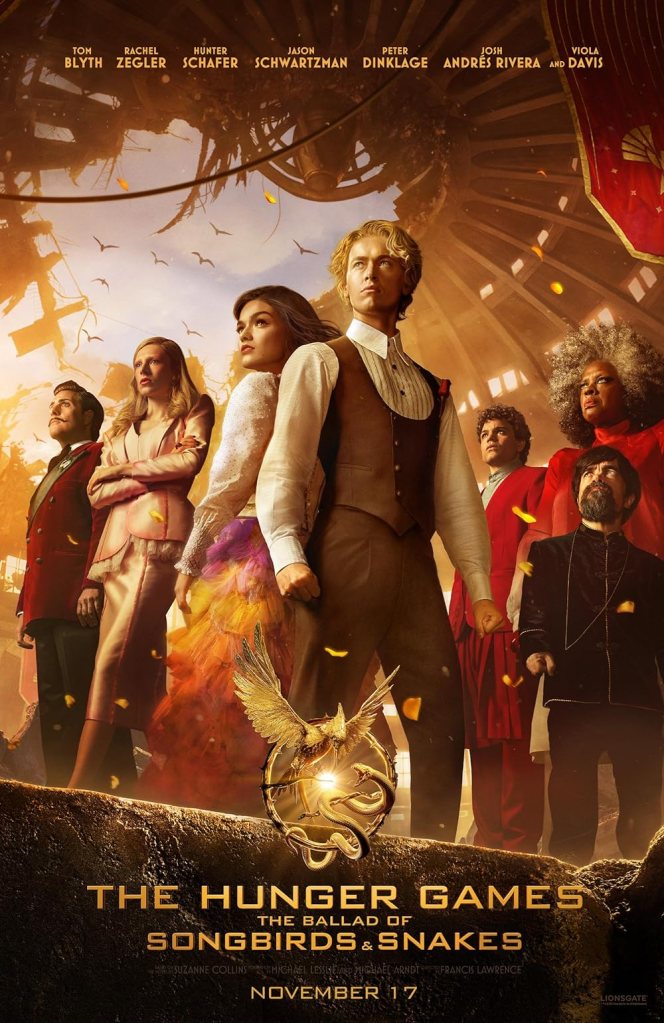
Did you watch Hunger Games and wonder – ‘this is great and all but where did that guy Coriolanus Snow come from, eh’? Not sure I did. And I’m not sure I really needed to know, now that I’ve sat through all interminable 158 minutes of Hunger Games: Ballad of Songbirds and Snakes or Hitler: The Early Days. Imagine, if you will, the original Hunger Games movie – but if it was much longer, had an utterly uninteresting lead character and took itself so seriously you’d think it was offering a solution to third world debt and climate change all at once. Ballad of Songbirds and Snakes worst crime isn’t that it goes on forever, that it retreads old ground with no new ideas or that it feels like a pointlessly over-extended footnote. It’s that it is overwhelmingly, crushingly, dull.

People didn’t care about the back story: they cared about Katniss Everdean, a perfectly crafted character, hugely engaging and relatable on every viewing. I cared about her struggle to protect the people she loved not the backdrop of Panem politics. Did anyone? If I was interested in anything in Panem politics it was the way the Games both terrified the huddle masses of the districts and gave them hope. Unfortunately, this film either didn’t understand that, didn’t care or assumed we’d happily invest in the original’s villain if he was buff and had a dreamy girlfriend.

Young Coriolanus Snow (Tom Blyth, doing his best to sound like Donald Sutherland) is one of the leading students in Panem, selected to mentor a tribute through the 10th Hunger Games. Young Snow’s loins heat-up when his tribute is manic pixie dream-girl Lucy Gray (Rachel Zegler) from District Twelve. But what excites him more: a tumble with a girl from the sticks, or persuading outlandishly loopy games master Dr Volumnia Gaul (Viola Davis, the only person having fun) he knows how to turn this gladiatorial deathmatch into ratings gold? You got one guess what he picks.

Though it takes him a very, very, very long time to pick it. We watch this Proto-Hitler embrace his inner sociopath, through a weary trudge in Hunger Games lore with the origins of virtually every prop in the original movies lovingly laid out for us. Ever wondered why Snow wears that buttonhole? This is the film for you and then some. Almost every single thing in Ballad of Songbirds and Snakes is linked to something in the original movies. It’s the sort of unimaginative, world-shrinking yawn-fest where nearly every character shares a surname of a character from the original films – but of course Caesar Flickerman’s dad has exactly the same job, personae and style as he does!

You could let this go if Ballad of Songbirds and Snakes had an interesting story of its own. But it’s tedious, self-important plot makes Attack of the Clones look like Tolstoy. It chucks in a little bit of arena slaughter, but inexplicably makes it unclear how many of Coriolanus’ suggestions for improving the show are actually changing things. When the tributes perform for ‘favour’ is that something they always did (as most people behave like it is) or because Coriolanus scrawled memo suggested it (as the film implies)? The wider impact is also lost: are people bonding with Lucy Gray or having their child-killing-urges ticked in brand new ways by Coriolanus? Who knows.

It doesn’t help that Ballad seems shy about making Coriolanus himself a villain. It gives Tom Blyth a difficult act to pull off and he’s left playing his cards so close to his (inevitably) buff – his future sadism doesn’t stand in the way of a good topless scene in this film – chest that rather than wondering what will top him into sociopathy, he instead becomes a flat, boring character, with even his lust for Lucy fizzling rather than sizzling.

Rachel Zegler gets a bit more fun as this irritating mix of idealist and realist (she is pretty much whatever the plot needs from scene-to-scene – one minute angrily slapping away offerings of food, the next cowering in shocked fear when danger comes calling), with Ballad at least a good vehicle for Zegler’s vocal talents. But Lucy Gray remains too enigmatic – and, to be honest, just as dull in her unknowability – to ever become someone you care about. And never, for one minute, in her flower-crafted dress and perfect make-up do you believe she is a child of the ghetto in the way you did with Jennifer Lawrence.

Honestly the film misses a hero as complex and multi-layered as Katniss and splitting facets of her into two other characters just creates to incomplete characters. Throw in a plot that lacks any energy – it’s lackadaisical second half, with Coriolanus chucked into the wilderness as a Stormtrooper in District 12, goes on forever – and which gets bogged down in an utterly unengaging and confusing rebellion plotline with is resolved with a nonsensical narrative flourish – and it’s a recipe for disaster. It never, ever get the pulse racing as it stumbles, yawningly, to its end.

The stuff that actually is interesting gets shunted to the sidelines. A bored Peter Dinklage gets a late monologue on the creation of the Hunger Games that you desperately want to hear more about it, but don’t. Viola Davis, barrelling over-the-top under a mountain of demented hair, weird contact lenses and bizarre costumes, keeps talking about ‘the purpose of the Hunger Games’ in a portentous way that sounds like its leading somewhere but never does (so much so, I wondered if the filmmakers even understood the bread-and-circuses-as-control metaphor going on here).

Francis Lawrence directs as if this background-filling pamphlet from Suzanne Collins was a newly discovered Testament. The film is slow, stately and gives even the smallest, most inconsequential moments an unbearable level of self-important significance. It lacks pace and interest – so much so that even the slaughter of eleven scruffy, malnourished children and teenagers feels tired and ‘seen it all before’. There is no mystery, no sense of roads-not-taken, not even any peril . Just small elements of a more interesting later story being slotted dutifully in place, you realise you never wondered where Coriolanus Snow came from because it never mattered in the first place.

The Fall Guy (2024)

The Fall Guy (2024)

Very enjoyable action caper and also a rather sweet tribute to the unsung heroes of filmmaking

Director: David Leitch

Cast: Ryan Gosling (Colt Seavers), Emily Blunt (Judy Moreno), Aaron Taylor-Johnson (Tom Ryder), Hannah Waddingham (Gail Meyer), Teresa Palmer (Iggy Starr), Stephanie Hsu (Alma Milan), Winston Duke (Dan Tucker), Ben Knight (Dressler)

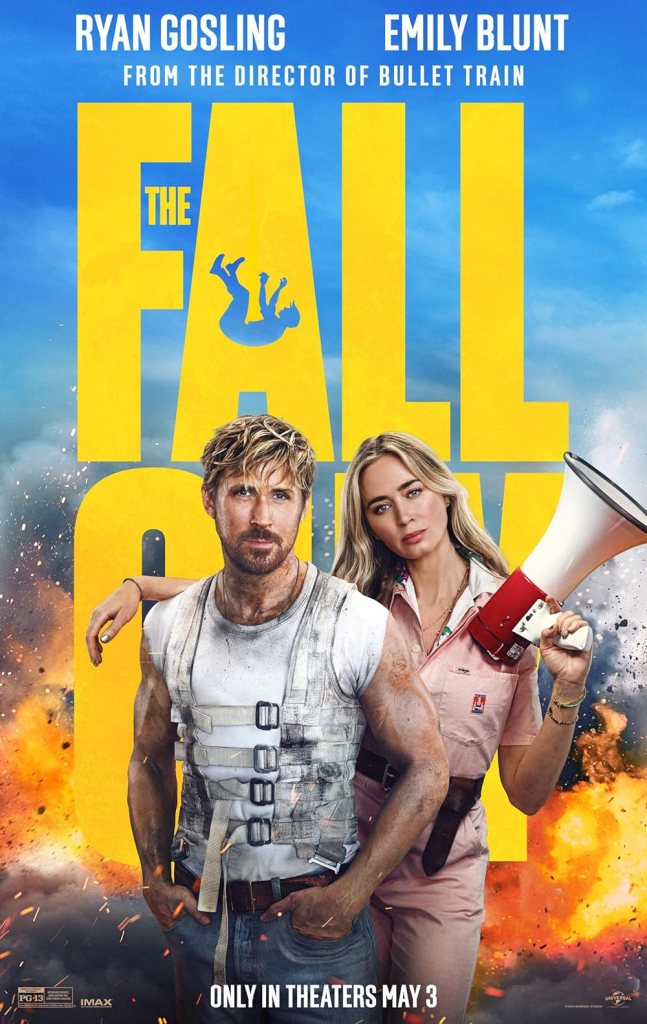
I’ve seen every single Hollywood Superstar I’ve ever heard of perform miraculous acts of derring-do in front of my very eyes. That all happened right? The camera doesn’t lie! Alas what we saw wasn’t the Legendary Star but instead a well-trained guy, dressed in the same costume, putting life and limb on the line for the big shot. And they don’t even get Oscars for it! The Fall Guy is a witty, exciting and rather sweet tribute to the unsung hero of the movies, the stunt guy, all wrapped up in a pulsating, tongue-in-cheek action-adventure that showcases two likeable stars and, of course, their similarly costumed fall guys.

Our hero is Colt Seavers (Ryan Gosling), stuntman of choice for superstar Tom Ryder (Aaron Taylor-Johnson), a spoilt man-child who brags he does his own stunts but can’t cross a road without a double. Colt is riding high, in a promising relationship with cinematographer Jody Moreno (Emily Blunt), until a stunt goes wrong leaving him badly injured. Colt disappears, breaking-up with Jody and wallowing in depression for eighteen months. However, he comes storming back when summoned to Australia by producer Gail Meyer (Hannah Waddingham) who claims Jody personally asked him to double for Tom on her directorial debut, Mad-Max-meets-Independence-Day sci-fi epic Metalstorm. Only turns out she didn’t ask: Colt is in fact tasked by Gail to find the missing Ryder or she’ll be forced to cancel the film and end Judy’s career. Colt soon gets bogged down in drug lords, dead bodies, hitmen who don’t quit and imaginary unicorns. Can he find Ryder and make amends with Judy?

The Fall Guy is fast-paced, loose and funny with a script of punchy Drew Pearce jokes, focused overwhelmingly on giving the viewer a cracking night out at the movies. It leaves very little in the locker room which is fitting for a film is all about celebrating the joy of doing things for real. The Fall Guy pushes the envelope for stunts, be it stupendously high falls, multiple barrel roll cars, furious fisticuffs that use everything going and car chases that leave burnt rubber skid marks on every surface. Basically, it’s a celebration of the art of stunt work, no more than you would expect from Leitch, a former stunt co-ordinator and champion of doing it for real.

It very successfully mixes giddy action thrills with a engaging romantic comedy that uses its two stars to great success. Gosling is relaxed, witty and above all extremely cool, his obvious enjoyment of the material very infectious. Blunt’s comic timing is immaculate. Together their chemistry not only creates plenty of laughs, but makes us invest in wanting them to be together. But The Fall Guy doesn’t just settle for rom-com conventions. A focus of the film is watching Colt get in touch with his feelings (how many other action films feature their stars quietly crying in a car, listening to Taylor Swift?) and accepting his stuntman bravado (it’s the profession where you stick your thumb up at the end of the stunt, regardless what happens) led him to drive Judy away out of twisted shame.

Of course, on the way to getting in touch with his findings, Colt doesn’t half stumble through more than his fair share of brawls. You couldn’t make a film about a stuntman without packing in more death-defying thrills than you can shake a stick at. The Fall Guy delivers two types of stunt thrills. One is the behind-the-scenes on-set stunts Colt executes – death-defying falls, flipping and rolling cars, people being thrown across a field into a rock – where we get to see a few tricks of the trade behind the magic. And then we also get genuine ‘real world’ stunts of epic, popcorn-munching excitement as Colt goes about his search. This is some of the most impressive stuff you’ll see (and its expertly deconstructed in the behind-the-scenes clips that festoon the end-credits), from Colt being hurled and smashed through every inch of Ryder’s apartment to a stunning car-chase that turns into a bare-knuckle dumper-truck fight that’s the film’s mid-act calling card.

The action is somehow even more enjoyable because of the world-weary comedy Ryan Gosling plays it with. After all, being thrown into situations like this is bread-and-butter for Colt, so whether its spending a fight protecting an elusive jet-lag-defeating espresso or working out exactly when he to jump into the road to collide with a car, everything is met with a semi-resigned shrug. He also gets some excellent partners-in-crime, trading stunt-movie facts with colleague Dan (a very funny Winston Duke, shouting the name of the Hollywood stars whose signature moves he’s replicating during fights) and, perhaps best-of-all, a French speaking stunt dog called Jean-Claude who Colt treats like a friend (a dog that bites people in the groin shouldn’t be as funny as this, but I must have been in the right mood). The final battle also sees Colt call on an army of fellow stunt-people.

It makes sense in a film that celebrates this brotherhood. When Colt and the team are working on set, The Fall Guy centralises their creativity and commitment. The shooting of a Metalstorm battle scene is hugely improved by Colt and the team pushing the envelope with suggestions and improvements to the rudimentary script and the whole crew is scrupulously dedicated, professional and committed.

The real threats in The Fall Guy are the things that work against this. Special effects and deep fakes (whch plays into the film’s neat double-meaning title) are the tools of the villains and, in a wider sense, kill the flesh-and-blood of film-making. Hollywood stars and bottom-line Hollywood suits with no respect for the craft are the baddies. Aaron Taylor-Johnson has a lot of fun in a role that parodies almost every star you can think of (Tom Cruise is twice specifically named in the film, as if to stress for the laywers Tom Ryder is not him) while Hannah Waddingham is a smilingly heartless producer, never seen without clutching an oversized diet coke.

The Fall Guy is, above all, a film designed to cheer you up no-end. Crammed with sharp one-liners, expert sight gags and thrilling stunts with a cast having an absolute ball in their roles, it’s the sort of treat that will be remembered long after its slightly disappointing box-office haul has been forgotten.

The Running Man (1988)

The Running Man (1988)

Gloriously stupid Arnie vehicle, sort of satire but really a chance for violence and wise-cracks

Director: Paul Michael Glaser

Cast: Arnold Schwarzenegger (Ben Richards), María Conchita Alonso (Amber Mendez), Richard Dawson (Damon Killian), Yaphet Kotto (William Laughlin), Jesse Ventura (Captain Freedom), Jim Brown (Fireball), Erland Van Lidth (Dynamo), Marvin J. McIntyre (Harold Weiss), Gus Rethwisch (Buzzsaw), Professor Toru Tanaka (Professor Subzero), Mick Fleetwood (Mick)

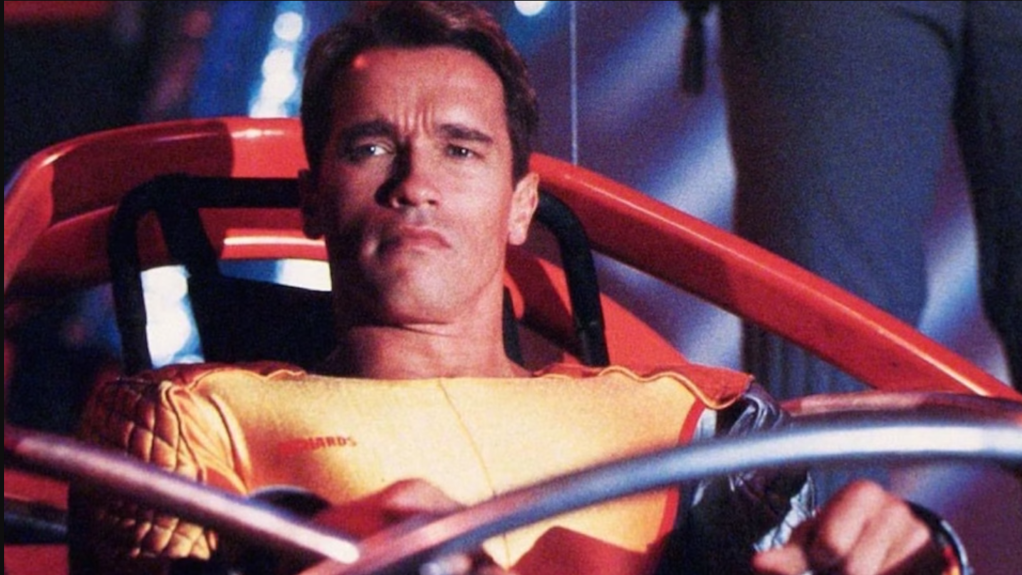
It’s 2017 and the USA has fallen apart (they were more right than they thought…) with a dictatorial government keeping the population in their place and distracting them from their lost freedoms with the violent TV show The Running Man, where criminals fight to the death in gladiatorial contests. The latest contestant? Ben Richards (Arnold Schwarzenegger), a former cop who everyone believes massacred civilians from his helicopter gunship but who we know is actually the hero who tried to stop it. Running Man host Dawson (Damon Killian) thinks Richards is the guy for a ratings slamdunk. But guess what? Arnie is as tough as he looks and might just bring down the system in prime time.

The Running Man makes an interesting contrast with Rollerball. In fact, it’s really just a souped-up 80s version of the same idea, of corporations using violent entertainment to keep the masses in line. The main difference being Rollerball is a sort-of lingering existentialist character study which mixes ambiguity with high-octane sports action, played out with Kubrick-inspired classical music and lingering slow-mo. The Running Man is a loud, brash, hyper-violent film that allows Arnie to flex both his muscles and his wise-cracking wit. Leaving its roots as a Stephen King adaptation far behind, it’s both a lot more stupid and a whole lot more fun than Rollerball.

The Running Man is a bizarre mix of Cronenbergish media satire and ludicrous camp comedy. It’s in-universe TV show has a parade of killers on it, laughable in their cartoonish violent silliness, with methods of killing so elaborate that they would put Bond villains to shame. Subzero is an ice-skating wrestler with a razor-sharp hockey stick! Buzzsaw dispatches opponents using (you guessed it) a chainsaw that can cut through anything! Dynamo dresses up in an electric suit, sings opera and electrocutes people! Fireball burns everything with his gas-filled flame-thrower!

You think that sounds silly? Well don’t worry because Arnie will (surprise, surprise) send them all to their maker with a karmic death (you have one guess as to how they all die) and an apt pun (“He had to split!” he grins slicing Buzzsaw in half with his own chainsaw). This is Arnie at his eighties height, expanding his brand and transforming The Running Man into his very own star vehicle. (He even squeezes in his “I’ll be back!” catchphrase). Ben is the perfect Arnie character: he’s noble but cool, muscular but witty, makes bad-ass threats and delivers on them, smokes stogies like they’re going out of fashion and waltzes off with the girl at the end after saving the world.

Arnie is sort of working alongside a resistance movement, but they don’t get in the way of his manly independence. The principle function of his resistance movement buddies Laughlin (Yaphet Kotto) and Weiss (Michael J McIntyre) is to symbolically lay down their lives to give Arnie even more moral high-ground – The Running Man makes very clear he doesn’t enter this sadistic blood-sport to protect himself (oddly in this totalitarian dictatorship, criminals still have enough rights to choose not to sacrificed on national television) but to save the lives of his Red Shirt pals. Their deaths also serve to justify the ruthless violence Arnie hands out (though of course he refuses to kill an unarmed, injured opponent just so we know all the other bodies he dropped must have deserved it).

It’s all set in a charmingly quaint 80s view of the future: power-suits for the rich and jump-suits for the convicts, with clunky TVs and worn-out urban environments. The Running Man throws in its odd surreal, camp and bizarre touch, not least the sight of Mick Fleetwood (buried under prosthetics) playing himself as the resistance leader. Its pumped-up TV show is packaged like a hyper-violent 80s mega-smash, hosted by real-life actor-turned-quiz-show-host Richard Dawson, gleefully embracing self-parody as a venal, heartless bully full of two-faced smarm with the audience while treating his staff like dirt.

Dawson, in all his larger-than-life awfulness, actually makes a pretty good foil for the muscle-bound Arnie, not least because he understands exactly what the Austrian Oak wanted from this film. Because Arnie knew people didn’t really want social commentary or satire – they wanted a black-and-white world where the ex-Terminator could smack, punch and shoot things with gleeful abandon while testing out a host of potentially quotable catch-phrases. Essentially The Running Man is a sort of Tom-and-Jerry cartoon with a sheen of social commentary, that panders shamelessly for our love of watching outré villains suffer grim and painful ironic deaths.

And you know what? Arnie was right. Because, however stupid (and its very, very stupid) The Running Man is, no matter how cookie-cutter, uninspired and predictable every single second of it is – it’s perfect, brain-dead, beer-in-hand, Friday night fun. And while the progression of Rollerball to this is a perfect example of how lobotomized Hollywood had become, at least this is fun.

Furiosa: A Mad Max Saga (2024)

Furiosa: A Mad Max Saga (2024)

Deliriously overblown and full of demented imagination even if it never quite feels necessary

Director: George Miller

Cast: Anya Taylor-Joy (Furiosa), Chris Hemsworth (Dementus), Tom Burke (Praetorian Jack), Lachy Hulme (Immortan Joe), Alyla Browne (Young Furiosa), George Shevtsov (History Man), John Howard (People Eater), Angus Sampson (The Organic Mechanic), Nathan Jones (Rictus Erectus), Josh Helman (Scotus), Charlee Fraser (Mary Jabassa), Elsa Pataky (Mr Norton)

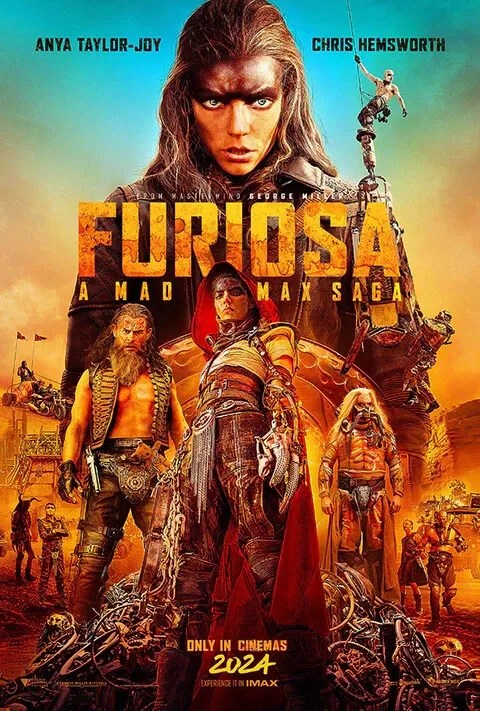
Is there a more demented mainstream film series than Mad Max? Furiosa follows the balls-to-the-wall excess of Mad Max: Fury Road with more of the same and a mythic atmosphere of Godfather Part II-backstory deepening. What you end up with might feel slightly odd or self-important – over two and a half hours of direct build-up for a pay-off we saw almost ten years ago (perhaps that’s why Furiosa ends with a cut-down play-back of the major events of Fury Road spliced into the credits, so we can all be reassured the villains left alive here got their comeuppance later). Furiosa is frequently overlong, a little too full of its love of expansive world-building and never quite convinces you that we actually need it – but then it’s also so bizarre, Grand Guignal and totally nuts perhaps we should just be happy that, in a world of focus-grouped content, it even exists.

We’re back on the desert wasteland of post-apocalyptic Australia as motorbike riding goons kidnap young Furiosa (Alyla Browne) from the Green Place hoping to use her to persuade crazed war lord Dementus (Chris Hemsworth) to lead his forces there. Despite the heroic efforts of her mother (Charlee Fraser), Furiosa remains a captive with only a secret tattoo on her arm (guess what’s going to happen to that…) to guide her home. Dementus provokes a resources war with cult-leader Immortan Joe (Lachy Hulme), with Furiosa traded, then escaping a hideous fate as one of Joe’s wives, instead growing up secretly-disguised as a boy (becoming Anya Taylor-Joy) as part of Praetorian Jack’s (Tom Burke) War Rig crew. Then the war between Immortan Joe and Dementus explodes again, foiling Furiosa and Jack’s plan to escape and giving Furiosa a change at revenge against Dementus.

That sprawling plot outline hopefully gives an idea of the ambitious bite George Miller is taking out of his world. While Fury Road took place over, at most, a few days, Furiosa stretches well over twenty, so gargantuan in scale and newly invented locations (as well as the mountainous citadel, we get the oil-rig nightmare of Gas Town and the Mordor-like Bullet Town) that it squeezes most of the entire Act Five war between Dementus and Immortan Joe into a brief, tracking-shot, montage. Furiosa is actually rather like a fever-dream Freud might have had after reading an airplane thriller, split into on-screen chapter titles – each with portentous (and sometimes pretentious) names like ‘The Pole of Inaccessibility’ – and a self-important narration dialling up mythic importance. If Fury Road was like someone stabbing an adrenalin-filled syringe straight into your heart, Furiosa is a like being told a detour-crammed story by someone a bit the worse-the-wear after a long night.

Not that Furiosa shirks on the banging madness of Fury Road’s slap-in-the-face action. It features a mid-film War Rig vs motor-bike raiders pitched-driving battle that is so extreme you wonder no one got crushed under wheel while making it, perfectly capturing the addled madness of Fury Road. A Chapter 4 pitched battle at one of Furiosa’s Dystopian-on-speed locations sees destruction, devastation and disaster on an even grander scale than anything else Miller has done before in this series, with an entire mining crater turned into a whirligig of firey destruction. That’s not forgetting three desperate desert chases – the finest of which is the film’s opening sequence, which see Furiosa’s mother track down and ruthlessly dispatch Furiosa’s kidnappers with a velociraptor-like ruthlessness and efficiency. No wonder Miller can put a whole war into a single shot – and why he feels comfortable ending Furiosa with a surprisingly personal and small-scale confrontation.

The main confrontation is between Furiosa and her self-proclaimed warlord – and would-be surrogate Dad – Dementus. Furiosa gives Chris Hemsworth the opportunity he’s been waiting for, allowing to flex his comic muscles, chew hilarious lumps out of the scenery and still show his menace. He makes Dementus an overgrown child, brilliant at stealing but with no idea about how to use them, obsessed with self-improvement (his dialogue is full of verbose, overwritten phrases, like a psychotic thesaurus) and only really happy when he’s smashing something. Introduced framing himself like a zen-like messiah, it doesn’t take long until he’s charging around on a chariot drawn by motorbikes, tasting other people’s tears and giving self-aggrandizing speeches while torturing Furiosa’s nearest-and-dearest. It’s a gift of a part, funny, scary, loathsome but strangely likeable even when he does awful things.

Opposite him, Anya Taylor-Joy actually has less to work with as Furiosa (she only takes over the part almost an hour into the film). Although this is meant to be a Furiosa film, it rarely feels like its telling us much more than we already know, especially since much the skills that ‘makes’ Furiosa what she is in Fury Road takes place in montage and her desire for freedom and to protect others are swiftly established so that any new-comers can unhesitatingly root for her. If Dementus is all talk, Taylor-Joy’s Furiosa is silent and simmering, her humanity either shrinking or quietly growing from moment-to-moment. She has a quiet romance with Tom Burke’s world-weary Praetorian Jack, but this really about converting her into a mythic figure of vengeance rather than making her a personality.

A vengeance we’ve already seen pan-out in Fury Road. I’ll be honest, for all the grand scale of Furiosa, I don’t really feel I learned anything about its central character here I hadn’t already picked up from Theron’s brilliantly expressive performance in the first film. For all the impressiveness of the scale, a lot of Furiosa boils down to physically showing us things that were implied in the first (second?) film – from locations, to the reasons why Furiosa lost her arm to giving us clear reasons for her motivations. But all this is already there – and with brilliant economy – in Fury Road. Telling us all again feels like Miller giving us the footnotes (Furiosa Silmarillon perhaps?) rather than anything truly new and the Homeric backdrop Miller is going for never really clicks into place.

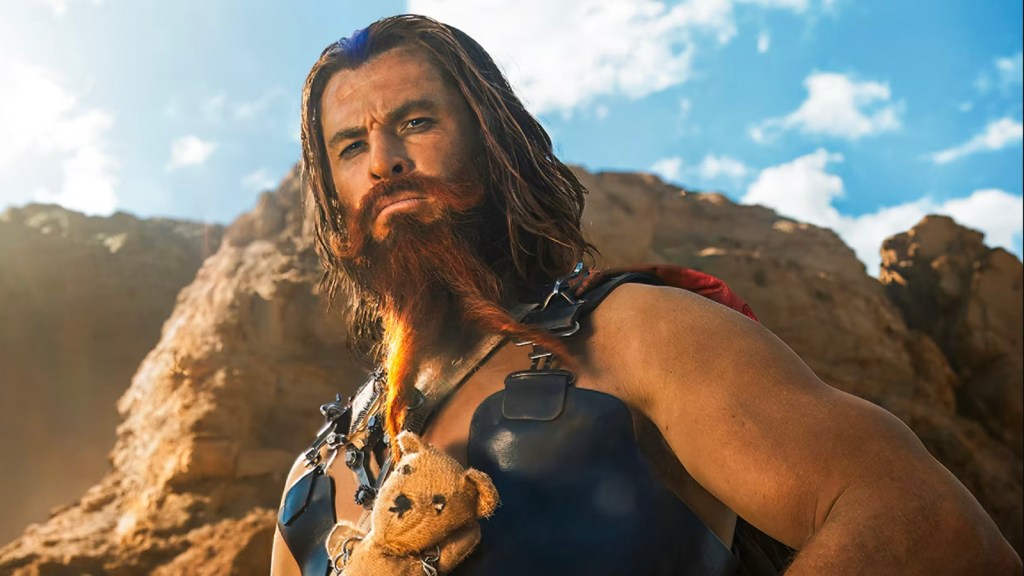
So the most successful swings are not narrative but visual. Furiosa reminds you what an absolutely insane extreme world Mad Max is. Death cults of radiation-deformed albinos? Villains who bottle milk straight from the nipple (not a cow’s), while another obsessively fondles his exposed, pierced ones? A villain who straps a battered old Teddy bear to himself? Action set-pieces that throw in everything – flying bikes, lava lakes and arms stoically lopped off? Even time-jumps are done imaginatively, like a wig, caught in a branch, decaying in front of our eyes. Every single design decision in this – and the gorgeously sun-kissed photography – is dialled up to eleven for George Miller’s very personal vision of pulpy, dystopian chaos.

You can wonder at times – as I did – whether we really needed a two-and-a-half hour film that’s expands the thematic depth of a chase movie which already outlined its characters motivations and personalities with impressive economy. But then, there are moments in Furiosa that just feel like they’ve been pulled out of someone’s crazy dreams. It’s put together with such a good mix of pulp poetry and head-banging craziness by George Miller that after a while you just go with it. And it sticks with you in a way focus-grouped Marvel films never seem to.

Kingdom of the Planet of the Apes (2024)

Kingdom of the Planet of the Apes (2024)

Intelligent and engaging entry in a continuously rewarding sci-fi series

Director: Wes Ball

Cast: Owen Teague (Noa), Freya Allan (Nova), Kevin Durand (Proximus Caesar), Peter Macon (Raka), William H Macy (Trevathan), Lydia Peckham (Soona), Travis Jeffery (Anaya), Sara Wiseman (Dar), Neil Sandilands (Koro), Eka Darville (Sylva)

Apes Together Strong! Their battle cry never works out that way does it? Because apes are more like humans than they would like to think – just as humans can be as dangerous as they fear. Kingdom of the Planet of the Apes picks up the franchise hundreds of years after the death of ape-leader Caesar. The human’s world is lost under a vast forest and apes live in separate clans, barely able to remember the teachings of their one-time leader. 

One clan – living in the forest-covered remains of Los Angeles – live peacefully, rearing and bonding with eagles. All that is shattered when the clan is captured by the soldiers of would-be ape emperor, the self-styled Proximus (Kevin Durand). The only one to escape is young Noa (Owen Teague) who sets out on a pilgrimage to free his people, encountering along the way Raka (Peter Macon), an orangutan who is the last of the Cult of Caesar and mysterious human Nova (Freya Allan) who is being hunted by Proximus’s soldiers. At the heart of Proximus’ kingdom Noa discovers many are willing to go to extreme lengths to gain access to a mysterious structure they believe is the key to dominating the planet.

Kingdom of the Planet of the Apes is sharply directed by Wes Ball and follows the trend of putting the apes front-and-centre of their own story (it’s nearly an hour into the film before we see a human). It almost goes without saying now, but the special effects and motion-capture work is extraordinary: the apes feel utterly real and the human performers behind these evolved simians are flawless in their physicality. All of this is set in a superbly designed post-apocalyptic world, where locations slowly become recognisable as overgrown skyscrapers, observatories, airports and oil tankers.

Ball’s film takes it’s time – perhaps, at times, a little too much – to build our connection with the eagle clan. Peaceful and with a rich, humanitarian (apeitarian?) community, they live in harmony with their surroundings, carefully obeying set rules to avoid over-exploiting their environment. Noa and his friends Soona and Anaya are carefully established as a contrasting group each with their own flaws and strengths. Noa, in particular, displays early quiet leadership skills and an intuitive understanding of machinery: from manipulating the ruins around him as unexpected climbing tools, to working out how to repair damaged equipment.

It makes it even more affecting when this community is torn apart by brutal violence – especially since the main threat of Proximus’s forces is a terrifyingly, psychotic gorilla who murders without a second thought. It’s particularly unsettling as this destruction and violence is constantly done “in the name of Caesar”. How could the hero – the funeral of whom the film opens with – who was so full of respect for others have become the byword for such hate.

It’s because this is a world where the apes’ ability to build communities has outstripped their ability to create records of their history. None of the apes have any knowledge of the past – the eagle clan have never heard of Caesar and has no idea that humans (or echoes as they call them, implying some past knowledge has been lost) used to talk and rule the planet. Even Raka’s Cult of Caesar learning equates to fractionally less than a casual viewer of this franchise would remember and guards a series of books he has no idea how to read. Noa stares in wonder at these symbols on the page, understanding that this ability to record and recall the past can be used to bring power to the future.

It’s certainly understood by Proximus, the only ape who seems to have any understanding of their past, but has used this knowledge to twist himself into the demagogue figurehead of his own cult of personality, building an empire he models after the Romans. Proximus has an extremist ideology, taking the Apes Together Strong as a mantra for forging his own empire, terrified that humans could rise again and take back the world they once owned and also yearning (like a violent King Louis) to learn the secrets of their skills and technology.

And perhaps he’s right. As Kingdom of the Planet of the Apes develops, its narrative takes unexpected twists and turns as Noa and the eagle clan become the peaceful eye of a storm of extremist megalomania. Perhaps Noa suspects this from the start – his instincts on whether to trust or not are shown to be consistently strong – but Ball takes the film into unexpected directions that forces us to ask whose side we are on, especially as the ending tees us up for a sequel where we could potentially find our loyalties fiercely divided. It’s telling that the closing moments of Ball’s film, using the framing and style of a traditional triumphant ending, are invested by him with a great deal of dread and menace.

It’s fitting that an intelligent film like this, mixing action with subtle commentary on human (and ape) nature, draws out some fine performances. Owen Teague makes for highly engaging and relatable lead as Noa, a young buck who becomes a leader. Kevin Durand is wonderfully bombastic as Proximus and Peter Macon warm, charming and witty as Raka. Freya Allan brings a great deal of light, share and ambiguity to a challenging part while William H Macy is a similarly ambiguous delight, as someone both right and wrong, in a great cameo.

Above all, Kingdom of the Planet of the Apes suggests there is plenty of life left in this franchise yet, which still sits near the top of the list of intelligent, engaging and exciting sci-fi series. Continuing a rich run of form, this entry in the franchise leaves you fascinated as to where the film will turn next.

Skyfall (2012)

Skyfall (2012)

Bold, beautiful and brilliant Skyfall is probably my favourite Bond film ever – sorry folks!

Director: Sam Mendes

Cast: Daniel Craig (James Bond), Judi Dench (M), Javier Bardem (Raoul Silva), Ralph Fiennes (Gareth Mallory), Naomie Harris (Eve), Bérénice Marlohe (Sévérine), Albert Finney (Kincade), Ben Whishaw (Q), Rory Kinnear (Bill Tanner), Ola Rapace (Patrice), Helen McCrory (Clair Dowar MP)

As I watched Skyfall for the umpteenth time it suddenly occurred to me. I know I should say Goldfinger but I think this might just be both my favourite and the best James Bond film ever made. Released to coincide with the fifth anniversary of Doctor No, Skyfall manages to be an anniversary treat the celebrates Bond not with an ocean of call-backs but by telling a gripping story which plays to the star’s strengths and riffs imaginatively in both a literal and a metaphorical sense with our understanding of the legacy of the world’s best-known secret agent.

After a mission gone wrong leaves a list of undercover agents out in the open and Bond (Daniel Craig) presumed dead, MI6 comes under fire from a secret assailant seemingly determined to destroy the reputation of M (Judi Dench). With M already hanging on by a thread after that disastrous mission – Chairman of the JIC Gareth Mallory (Ralph Fiennes) is threatening her with removal – she has no choice but to lure Bond out of hiding and back into the spy game. But is the slightly out-of-shape, wounded spy ready for the challenge? The trial to find their mysterious enemy leads to Shanghai, Macau and the secretive island home of Raoul Silva (Javier Bardem), a Bond-like former British agent with a vendetta against M. Cure a battle of wits and wills between ‘these two last rats standing’.

Skyfall pretty much does everything right. Directed with verve, energy, intelligence and wit by Sam Mendes at the top of his game (Skyfall restored him to the front rank of British film directors), it mixes sensational action with well-acted, equally exciting character beats. It gets the balance exactly right – in the way that Quantum of Solace failed – between giving you the thrills but also really investing you in the drama. And it builds towards a final face-off that is, almost uniquely in the series, small-scale, intimate and personal (admittedly via a conflagration that consumes an ancestral Scottish castle and most of the Highlands). There is so much to enjoy here that you’d have to have a heart of stone not to be entertained. No wonder it’s the franchises biggest hit.

Mendes was brought on board at the suggestion (and persuasion) of Craig, eager to work with directors who would be recognise character was at least as important as fast cars and explosions, but also had the skill to deliver both. Skyfall is perfectly constructed to play to Craig’s strengths. His Bond reaches its zenith, a world-weary cynic with a strong vein of sarcasm, covering up deeply repressed unreconciled trauma. Craig is wonderful at conveying this under a naughty-boy grin.

Skyfall dials down the romance, Craig’s weakest string – it’s the only film in the franchise with no Bond girl (after QoS where, for the first time, Bond didn’t sleep with the Bond girl). Aside from a brief fling (with a character who is, perhaps a little tastelessly, all to dispensable – the fate of Sévérine being fudged with an uncomfortable flippancy) it’s Judi Dench who is the really ‘Bond Girl’ here. Judi Dench is fabulous in her swan-song, from taking the tough calls, voicing small regrets and quoting Tennyson. Skyfall acknowledges the surrogate parent relationship between M and Bond, something that was there from the day of Connery – every M has always inspired a filial loyalty from their 007. It’s a loyalty Skyfall reveals M ruthlessly exploits, extracting personal dedication from a host of agents, including both Bond and Silva – a man who (only half-jokingly) repeatedly calls her “Mummy” and has redefined his life around taking revenge on her.

It makes a gift of a part for Javier Bardem, channelling his eccentricity into a character who often yings when he should yang. When he’s angry he laughs, when he’s overjoyed he gets quieter. Softly-spoken, almost effeminate, he’s also a ruthless killer – his studied manner of unpredictability a superb reflection of Bond’s own tightly constructed personality. Even their first meeting together is unusual and different – far from threatening Bond, Silva seems intent on seducing him, batting his eyes, stroking his bare chest with a finger and all but inviting him for a quickie (Bond’s classic response – “What makes you think this is my first time?” surely launched a thousand slash fictions).

There is a fabulously, just-below-the-line meta slice of fun going on in Skyfall. It brings Bond back from the dead (after its pulsating opening scene ends with him falling lifelessly to a watery grave), but burdens him with a host of scars. In a series of MI6 tests he completely misses a target, collapses to the floor after a workout, blows a psychological test and is repeatedly told he’s a borderline alcoholic. (In case we miss the point, Q meets him in front of Turner’s Fighting Temeraire and pointedly comments on the over-the-hill wreck being dragged back to port). Back in the field, his gunshot wounded shoulder gives out while holding onto the underside of a rising lift and Silva asks the question we’ve all asked at time or another: Mr Bond hasn’t it all gone on long enough?

While it can seem odd that two films ago Craig was introduced as a fresh-faced youngster and now embodies all fifty years of franchise ‘mileage’, it doesn’t really matter since he so triumphantly (of course!) reasserts his relevance. It’s a lovely, not too heavy-handed, piece of meta-commentary I think is both funny and human. It also means most of the call-backs to the gloried past of the franchise are metaphorical rather than literal – making a huge change from the Easter Egg stuffed nonsense you get from other franchises. It also means the one major piece of fanservice – the return of the Goldfinger car (the film is hilariously vague on whether this means Craig’s Bond and Connery’s Bond are one-and-the-same, a thing that really annoys some people who should really get a life) – really lands with a punch-the-air delight.

Skyfall is similarly astute with its characters. When Ralph Fiennes’ Gareth Mallory is introduced, we take him for an obstructive bureaucrat, flying his desk. Each scene in Fiennes’ perfectly pitched performance peels away layers to reveal a hardened professional (a decorated Army Colonel no less) and ally. It’s hard not to cheer when he takes up arms during Silva’s attack on a Parliamentary committee (with a gunshot wound no less) just as it’s hilarious to see Bond teasingly wink at Mallory before shooting out a fire extinguisher right next to him. Q returns, embodied by a perfectly cast Ben Whishaw, as a computer genius (in another gag at the franchise he’s scornful of ‘exploding pens’ and such like gadgets). Naomi Harris is very good as (it’s probably not a surprise any more to say) a Miss Moneypenny who’s a field agent in her own right. Skyfall even cheekily serves as a sort of back-door ‘origins’ story, leaving us with a very Fleming-Universal-Exports set-up.

It throws this all together with some sensational action scenes. The opening sequence is one of the best in the series, a manic chase through Istanbul that starts on foot in a darkened room (a nice reminder of M’s ruthlessness that she orders Bond to abandon to his certain death an injured agent) cars, bikes on rooftops, trains, diggers on trains and train rooftops (via a witty cufflink adjustment). There is a gorgeously shot fight-scene in a Shanghai rooftop (Roger Deakins pretty much makes Skyfall the most beautiful looking Bond film there has ever been) and a pulsating (and very witty) chase through the London Underground before that gripping Parliamentary committee gunfight. Mendes mixes excitement with plenty of neat jokes throughout and it works a treat – and the film plummets along at such speed you can forgive the little nits you can pick (like how does Silva know where to plant a bomb on the underground eh? And why did that train have no passengers?).

It culminates in a Home Alone inspired booby-trap rigged house in Scotland (wisely a Sean Connery cameo idea was nixed, with the legendary Albert Finney cast instead) and an Oedipal confrontation in a tiny Highlands church. At the end, it gave us thrills while bringing Bond home (in every sense) and was brave enough to focus on excellent actors play in a human story of regret, loss and betrayal. It’s a film which positively delighted me in the cinema and hasn’t stopped thrilling me the innumerable times I’ve seen it since then. And I can’t imagine it won’t continue to do so!

Dune: Part 2 (2024)

Dune: Part 2 (2024)

Villeneuve’s triumphant sequel continues to raise the bar for science fiction films

Director: Denis Villeneuve

Cast: Timothée Chalamet (Paul ‘Muad-Dib’ Atreides), Zendaya (Chani), Rebecca Ferguson (Lady Jessica), Javier Bardem (Stilgar), Josh Brolin (Gurney Halleck), Austin Butler (Feyd-Rautha Harkonnen), Florence Pugh (Princess Irulan), Dave Bautista (Rabban Harkonnen), Christopher Walken (Emperor Shaddam IV), Léa Seydoux (Lady Margot Fenring), Souheila Yacoub (Shishakli), Stellan Skarsgård (Baron Vladimir Harkonnen), Charlotte Rampling (Gaius Helen Mohaim)

Denis Villeneuve had already taken on the near-impossible in adapting the unfilmable Dune into a smash-hit admired by both book-fans and initiates. In doing so he set himself an even greater task: how do you follow that? Dune Part 2 (and this is very much Part 2, picking up minutes after the previous film ended) deepens some of the universe building, but also veers the story off into complex, challenging directions that fly in the face of those expecting the sort of “hero will rise” narrative the first Dune seemed to promise. Dune Part 2 becomes an unsettling exploration of faith, colonialism and cultural manipulation, all wrapped up in its epic design.

Paul (Timothée Chalamet) and his mother Jessica (Rebecca Ferguson) have escaped the clutches of their rivals House Harkonnen and it’s corrupt, sadistic leader Baron Vladimir (Stellan Skarsgård). Escaping into the deserts of Arrakis, they take shelter with the Fremen, vouched for by tribal leader Stilgar (Javier Bardem). It transpires Paul fits many of the conditions of the prophecy of the Mahdi or Lisan al Gaib, the promised messiah of the Fremen. Paul is uncomfortable with this – and the growing devotion of the likes of Stilgar – but also recognises the potential this has for marshalling the Fremen for his own revenge on the Harkonnen’s. Its further complicated by his knowledge the prophecy was embedded into their culture by the mysterious Bene Gesseri, the religious order that quietly controls much of the Empire, not to mention the hostility of Chani (Zendaya) the woman he loves, as she believes the Fremen should save themselves not rely on an outsider.

These complex ideas eventually shape a film that avoids simple good-vs-evil narratives and subtly undermines the very concept of the saviour narrative. Dune’s roots in a mix of Lord of the Rings and Lawrence of Arabia have rarely been clearer. Not least in the perfect casting of the slightly androgenous and fey Timothée Chalamet as Paul (with more than a hint of Peter O’Toole), barely knowing who he is, drawn towards and standing outside an indigenous community based on strong tribal loyalty, tradition and the grim reality of life in a hostile environment. 

A large part of Dune 2 deconstructs Paul’s heroism and his (and Jessica’s) motives. When Jessica – who takes on a religious figurehead role with the Fremen – starts stage-managing events to exactly match the words of the prophecy, does that count as a fulfilment? Paul is deeply uncomfortable with positioning himself as messianic figure for an entire race, effectively weaponising their belief for his own cause. But he’s also nervous because he is also an exceptionally gifted person with powers of persuasion and prophetic insight that mark him out as special. As Paul allows himself to more-and-more accept the role he has been groomed for, how much does it corrupt him? After all, he gains absolute power over the Fremen – and we all know what that does to someone…

Paul’s messianic possibility is also spread on very fertile ground. Javier Bardem’s Stilgar represents a large portion of the Fremen population, who belief in this prophecy with a fanatical certainty. The dangers of this is subtly teased out by Villeneuve throughout the film. At first there is a Life of Brian comedy about Stilgar’s wide-eyed joy as every single event can be twisted and filtered through his naïve messiah check-list (“As is written!”) – even Paul’s denial he is the messiah is met with the response that only a messiah would be so humble! This comedy however fades as the film progresses and the militaristic demands Paul makes sees this same belief channelled into ferocious, fanatic fury that will leave a whole universe burning in its wake.

Much of Paul’s hesitancy is based on his visions of a blood-soaked jihad that will follow if he indeed “heads south” and accepts the leadership of the Fremen’s fanatical majority. The question is, of course, whether the desire for revenge – and, it becomes increasingly clear, a lust for power and control – will overcome such scruples. Part of the skill of Chalamet’s performance is that it is never easy to say precisely when your sympathy for him begins to tip into horror at how far he is willing to go (Villeneuve bookends the film with different victorious armies incinerating mountains of corpses of fallen foes), but in carefully calculated increments the Paul we end up at the end of the film is a world away from the one we encountered at the start.

Villeneuve further comments on this by the skilful re-imagining of Chadi, strongly played by Zendaya as an intelligent, determined freedom-fighter appalled at the Fremen exchanging one dogma for another. In the novel a more passive, devoted warrior-lover of Paul, in Dune Part 2 she becomes effectively his Fremen conscious, a living representation of the manipulation Paul is carrying out on these people. In her continued rejection of worship – even while she remains personally drawn to Paul – she provides a human counterpoint to Paul’s temptation to follow his father’s instructions and master “desert power” to control the worlds around them.

Deplorable and evil as the Harkonnen’s are, do Paul’s ends justify his means? And where does it stop? Dune Part 2 sees the Harkonnen’s subtly reduced in status. Dave Batista’s brooding Raban proves an incompetent manager of Arrakis. Stellan Skarsgård’s Baron is crippled by an assassination attempt and increasingly buffeted by events rather than controlling them. The film’s clearest antagonist becomes Austin Butler’s chillingly psychopathic junior Baron Feyd-Rautha, a muscle-packed bald albino, obsessed with honour and utterly ruthless towards his own subordinates. (Introduced in a stunningly shot, black-and-white gladiatorial combat scene that showcases his insane recklessness and twisted sense of honour.) But increasingly they feel like minor pawns in a game of international politics around them.

Villeneuve allows Dune’s world to expand, delving further into the cultural manipulations of the Bene Gesserit. This ancient order not only controls the Emperor – a broodingly impotent Christopher Walken – but also manipulates the bloodlines of great houses for their own twisted breeding programme, as well as inject cultures like the Fremen with perverted, controlling beliefs. While Villeneuve still carefully parses out the world-building of Dune – you could be forgiven for not understanding why the Spice on Arrakis is so damn important – it’s a film that skilfully outlines in broad strokes a whole universe of backstairs manipulation.

Among all this of course, Dune remains a design triumph. Grieg Fraser’s cinematography ensures the desert hasn’t looked this beautiful since Lawrence. The production and costume design are a triumph, as is Hans Zimmer’s imposing score. Above all, the film is brilliantly paced (wonderfully edited by Greg Walker) and superbly balanced into a mix of complex political theory and enough action and giant worm-riding to keep you more than entertained.

Dune Part 2 is a rich and worthy sequel, broadening and deepening the original, as well as challenging hero narratives. It turns Paul into an increasingly dark and manipulative figure, whose righteous anger is only a few degrees away from just anger (he’s no Luke Skywalker), who starts to see people as tools and moves swiftly from asserting Fremen rights to asserting his own rights (overloaded with different names, its striking when Paul chooses to use which names). In a film that provokes thoughts and thrills, Villeneuve’s Dune continues to do for fantasy-sci-fi what Lord of the Rings did for fantasy, creating a cinematic adaptation unlikely to be rivalled for decades.

Dungeons and Dragons: Honour Among Thieves (2023)

Dungeons and Dragons: Honour Among Thieves (2023)

Delightful fantasy action-adventure, well-made fun that leaves you with a warm glow inside

Director: Jonathan Goldstein, John Francis Daley

Cast: Chris Pine (Edgin Darvis), Michelle Rodriguez (Holga Kilgore), Regé-Jean Page (Xenk Yendar), Justice Smith (Simon Aumar), Sophia Lillis (Doric), Hugh Grant (Forge Fitzwilliam), Chloe Coleman (Kira Davis), Daisy Head (Sofina), Jason Wong (Dralas), Bradley Cooper (Marlamin)

I can’t be the only person who had low expectations heading into Dungeons and Dragons: Honour Among Thieves. A swords-and-spells epic based on a game that is a by-word for geeky sadness? No wonder quite a few people said “count me out”. Well, they were wrong. D&D: HAT is a left-field treat, a bouncy adventure that is both loads of fun and also true to the spirit of the original game, full of content for fans while welcoming newcomers with open arms. This is the sort of treat that years from now people will remember as one of the best adventure films of its era.

Set in the world of Dungeons and Dragons – and don’t worry about the overwhelming backstory and cultures of this sprawling role play game, they only intrude when essential to the plot – our heroes are crooks-with-hearts-of-gold: former-Harper (a sort of heroic knight) turned thief Edgin Darvis (Chris Pine) and his best friend, barbarian warrior Holga (Michelle Rodriguez). They’ve been banged up in an arctic prison after a job-gone-wrong, escaping only to discover they were betrayed by oily conman Forge (Hugh Grant), who has used their incarceration to turn Darvis’ daughter Kira (Chloe Coleman) against them. To win her back – and find an amulet that could bring Edgin’s late wife back from the dead – they assemble a team for a dangerous quest. One that could become even more dangerous, since Forge is in league with evil red witch Sofina (Daisy Head).

Perhaps the best thing about D&D: HAT is that it never takes itself too seriously, but also never laughs at or looks down on its source material. It sounds easier than it is: pulling off this sort of trick is extremely hard. Lean too far one way, and the jokes can suggest the cast and crew feel contemptuous about what they doing; go too serious, and the po-faced treatment of a parade of silly names and gobbledegook backstories practically invites the viewer to laugh at it. D&D: HAT though is bouncy entertainment that knows exactly when to ease off the gags for moments of drama, danger and emotion to really land. If you’d told me I’d get a bit choked up watching the end of a role-play game adaptation, I’d have said you were mad.

Pretty much every scene provides a little piece of comic business that delights, almost all of them perfectly executed by a director and cast whose affection for the original material shines out. Watching D&D: HAT you get the impression it must have been fun to make – and to successfully make that sense of fun be shared by the viewing audience is a real challenge to pull-off (take a look at the horrific Thor: Love and Thunder). But there is a real charm here that means emotional plots about loss of a partner, father-daughter divides, broken marriages, traumatised children and persecuted victims carry real impact because we invest in the characters.

That’s in large part due to some knock-out performances of comedy vigour. Chris Pine is the perfect lead for material like this: charming and fun to be around, witty without ever trying too hard (he’s the master here of the throwaway pun) but skilled enough to make us see the heart and yearning below the surface of a fast-talking trickster with a line for everything. He sparks wonderfully off the gruff Michelle Rodriguez, whose surliness hides depths. Fellow gang members Justice Smith and Sophia Lillis (both Americans juggling, it has to be said, very good accents) match them perfectly, turning potentially one-note characters into heartfelt heroes.

D&D: HAT also manages to be true to the spirit of playing games like this. Goldstein and Daley wisely avoided the obvious idea for a film of D&D (“people playing the game in the real world are sucked inside it!”) to instead create the wild, improvisational tone of the game where your decisions guide the narrative. Like gamers, our heroes are a disparate collection of people and species, all with different skills that complement and conflict, given a loosely-defined mission and responding to unexpected curveballs thrown at them by the invisible game runner (the scriptwriters and directors) that keeps them on their toes.

It also captures the way best laid plans in the game can go awry (a portal in a picture, foiled by a picture falling face down onto a stone floor) or how a sudden unlucky movement (or random dice roll) can lead to disaster – a moment perfectly captured where a laboriously detailed series of instructions about crossing a bridge are rendered moot when a character absent-mindedly places a rogue foot on the first stone and instantly collapses it. The characters have a constant feeling of flying by the seat of the pants, much like D&D players often do, and D&D: HAT wonderfully captures this improvisational wildness on screen.

It’s also a very entertaining spells-and-swords romp. There are some great set-pieces, not least a sequence in a sort of lava-filled mine (with the inevitable dragon – both dungeons and dragons make several appearances throughout) and a wild and crazy chase through a death-filled maze arena. The film throws in some inventive Ocean’s Eleven style trickery to get out of difficult situations. In all these moments the cast’s energy, likeability and blend of wit and heart makes each development sing and ensures even routine plots (Can wizard Simon overcome his self-doubt? Can persecuted animagus Doric learn to trust?  Can Holga learn to be honest to the people she loves? Can Edgrin learn to put other people’s needs first?) become tender and engrossing plotlines.

It bounces along perfectly, all hugely entertainingly and with a real winning charm. It spices things up just right with some brilliantly engaging comic turns: no one does slimy insincerity better than Hugh Grant (hysterical), while Regé-Jean Page is a revelation as a hilariously earnest super-powered knight, the only character who really speaks like you sort-of-expect a po-faced D&D character to. Above all, it’s huge fun with a lot of heart. I’ve seen it twice and it knocks spots off almost every other blockbuster for the last couple of years, being purely enjoyable, clever, funny and sweet.