Category: Actor biography

Funny Girl (1968)

Funny Girl (1968)

A star-turn is the main interest in this grand-scale but so-so musical

Director: William Wyler

Cast: Barbra Streisand (Fanny Brice), Omar Sharif (Nicky Arnstein), Kay Medford (Rose Brice), Anne Francis (Georgia James), Walter Pidgeon (Florenz Ziegfeld), Lee Allen (Eddie Ryan), Mae Questel (Mrs Strakosh), Gerald Mohr (Branca), Frank Faylen (Keeney)

Fanny Brice was the major pre-war star of Broadway, the leading lights of the Ziegfeld Follies, the sort of all-singing, all-dancing spectaculars they just don’t make any more. A fictionalised version of her life became a Broadway smash, produced by her son-in-law Ray Stark. Hollywood came knocking, leading to this film version. Shepherded to the screen by William Wyler (his first ever musical, a genre he’s avoided due to being deaf in one ear) it would tell of Brice’s early success, her relationship with Ziegfeld (Walter Pidgeon) and her marriage to dodgy gambler Nicky Arnstein (Omar Sharif). And to play Brice? It could only be the woman who created the role, a young sensation called Barbra Streisand.

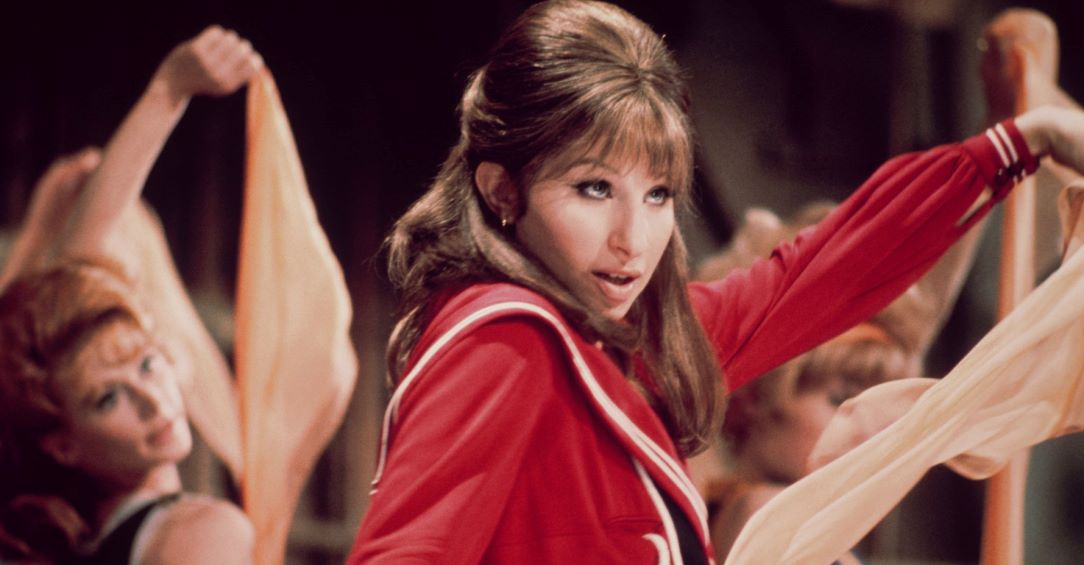
Funny Girl begins, ends and is exclusively about Barbra Streisand. Making her film debut, Streisand is, not to put too fine a point on it, absolutely sensational. This is charismatic, star-making stuff from an actress who knew exactly how to tailor the part (already basically written for her) to her strengths. Streisand is funny, kooky, witty but also vulnerable, shy, preoccupied with her low-opinion on her looks. She totally convinces as a charismatic figure who can dominate the room with cheek, won’t think twice at bluffing she can roller-skate to land a role or pigeon-hole Zeigfeld and argue against being asked to do something in performance. But she equally easily embodies a vulnerable woman, worried she is an unlovable ugly duckling, so certain she is destined to be alone she zeroes in on the first man who shows interest in her.

That’s not even mentioning the magnetism of Streisand. A truly confident, unique performer you couldn’t imagine anyone else so brilliantly mixing power-ballad notes with this sort of quirky character comedy. She can belt out Don’t Rain on My Parade or I’m the Greatest Stars with an awe-inspiring voice. She can add layers of pathos and tragedy to songs like People and Funny Girl. But few other performers could be both a diva and a pratfall artist on roller-stakes or mix arch-wit with low-comedy by stuffing a pillow up her dress in performance to turn her bride character pregnant in His Love Makes Me Beautiful, the Ziegfeld number she desperately doesn’t want to perform (because she can’t see herself as a beautiful bride).

Streisand is so central to Funny Girl’s success that I’m not sure that so much as three minutes go by without her appearing. It’s not a surprise as, subtract her from the mix, and Funny Girl is a fairly bland, unoriginal and at times slightly flat musical that struggles to do or say anything interesting. It’s had millions poured into its elaborate sets, it’s grandiose costumes and its vintage, sepia-tinged photography. But it’s an overlong, overblown, poorly paced film blessed with a star turn.

Wyler’s main strength as a director on mega-budget spectaculars like this was his professionalism and control, the gifts a producer likes. Visually though, Funny Girl frequently looks lost in widescreen, sets shot in a way that magnifies their emptiness and lacking the sort of affinity for timing and musicality that something like Minnelli, Donen and Kelly made look so natural (Most of the larger musical numbers were worked on by Herbert Ross). There is the odd strong shot – a showy helicopter shot pans down to Fanny on a tug steaming past the Statue of Liberty during Don’t Rain on my Parade or a sunset that pops up between the faces of Sharif and Streisand during a dockside embrace. But too many shots favour getting the money on the screen or struggle to frame two people interestingly in widescreen.

Mind you the story is a bit of a struggle. Fanny’s ascent to success is fast-paced and untroubled by conflict. Every gamble she takes pays-off, every cheeky trick goes unpunished. She can’t roller-skate when hired to do so? She sabotages the closing number of Ziegfeld’s show with her pregnancy flourish? Doesn’t matter – everyone loves it. She teeters for a few minutes on being fired, then jumps to promotion and glory. Ziegfeld – the sort of elite, New England aristocratic role perfect for Walter Pidgeon – just sighs and acknowledges talent gonna talent.

There are a few more clashes in her personal life. Her marriage to Nicky is the core emotional plotline of the film, but Nicky’s rough edges (in real life he was a conman and a swindler) are shaved off. Instead, he is played as a charming rogue, a professional gambler who bamboozles Fanny’s manager into giving her a stonking payrise and plays with honour and grace at the card table. When his business dealings go south, it’s never really his fault and he’s so noble he works to save Fanny’s honour by taking the rap for a collapsed business and arguing she should divorce him forthwith.

It doesn’t help that Nicky is played by Omar Sharif. Sharif, while a striking screen presence, had an acting range pretty much restricted to playing Sherif Ali. He’s unable to give the role any depth or interest, he can’t sing (thankfully he only tries once) and he’s overly reliant on his expressive eyes. He’s no match for Streisand, with whom he has less chemistry than rumour suggests was the case.

Streisand though was one-in-a-million here. Rumours abound she was a difficult and demanding presence, who fought tooth-and-nail with Wyler. She requested endless retakes to get her performance just right and “contributed” to script cuts (Anne Francis, playing a blousy Ziegfeld singer, was furious that her role effectively ended on the cutting room floor). Her perfectionism made her a controversial figure in Hollywood – but it’s also the brilliant fine-tuning of her own skill that won her the Oscar she shared with Katherine Hepburn. On a side note, Streisand had been controversially invited to join the Academy before she made a film, meaning the vote I assume she cast for herself was the one that guaranteed her the Oscar.

Funny Girl is large, overlong, largely visually and narratively uninteresting film that has a bright, shining, tour-de-force superstar in the lead who is in absolute, total control of her talent. Without Streisand it would be a tedious turkey – with her, it’s a strange landmark.

Judy (2019)

Judy (2019)

A star turn is the only thing of note in this empty, uninsightful biopic

Director: Rupert Goold

Cast: Renée Zellweger (Judy Garland), Jessie Buckley (Rosalyn Wilder), Finn Wittrock (Mickey Deans), Rufus Sewell (Sid Luft), Michael Gambon (Bernard Delfont), Richard Cordery (Louis B Mayer), Darci Shaw (Young Judy Garland), Bella Ramsey (Lorna Luft), Royce Pierreson (Burt Rhodes), Andy Nyman (Dan), Daniel Cerqueira (Stan), Gemma-Leah Devereux (Liza Minnelli)

By 1969 Judy Garland (Renée Zellweger) was homeless, broke and stuck in a pill-and-alcohol fuelled depression. Desperate to provide a home for her children, she flew to London for a five-week booking at the Talk of the Town nightclub. Judy sees her, pushed beyond her physical and emotional limits, as she struggles to complete the run – or even get on stage – marrying the feckless young Mickey Deans (Finn Wittrock) and flashbacks to her memories as a Hollywood child star (Darci Shaw), under the punishing “mentorship” of studio head Louis B Mayer (Richard Cordery).

All this gets mixed together in Goold’s uninspired, sentimental and rather empty biopic that never really gets to grips with Garland’s personality, so desperate is it to shoe-horn her into a bog-standard narrative of redemption mixed with personal tragedy. Garland, I’m sure, would have hated it: she always pushed back against the idea that her life had been tragic (which this film whole-heartedly embraces) and the portrayal of her as a constantly misunderstood victim, generously one-sided as it is, boils her down into someone with no agency or control at all in her life.

As such, the most effective parts of this film are the flashbacks to her childhood, filming Wizard of Oz, living off diet pills so she can’t put on weight and working 18-hour days. All under the direction of a monstrously calm Louis B Mayer – a terrific performance of amiable, grandfatherly menace from Richard Cordery – who pleasantly tells her she is a dumpy child who must work like a dog to get ahead and owes everything to him. If the film gets anywhere to understanding Garland’s psychology, it’s in these scenes – I’d rather they’d made it about this than her swan song in England.

In the 1969 sections, the film continues to try and communicate that a life of constant work and pressure left Garland an emotional, physical (and possibly mental) wreck. It puts us on her side, stressing her vulnerability and desperation which she covers with brittle, demanding behaviour. But it’s too squeamish to show too much of her popping pills and downing more than the odd glass of vodka – despite the fact she’s clearly intoxicated for large parts of the film. It only briefly looks at how crippling anxiety affected her unwillingness to rehearse and implies her time in London was a lengthy period of unending servitude rather than a five-week booking singing her greatest hits (the film is hugely vague about timelines to increase the feeling of Garland’s powerlessness).

The film isn’t even smart enough to give us moments where other characters get a glimpse of the fragility under Garland’s prima donnai-sh petulance. Despite her treating both of them as a mix of underlings and informers, Jessie Buckley’s minder and Royce Pierreson’s pianist inexplicably become friends to the star part-way through the film. There is no scene to transition this, no moment of fragile tenderness they witness that makes them understand there is more to this demanding person than they initially thought. Instead, it feels like the narrative requires them to like her just as the audience is supposed to, so whoosh they like her.

The one affecting sequence sees a lonely Garland bumping into two gay fans (Andy Nyman and Daniel Cerqueira) and rather sweetly asking if they would have dinner with her (they are of course thrilled). Back at their apartment, they cook a disgusting looking omelette, play the piano and she listens as they are tearfully talk about their life of persecution in homophobic Britain. It’s gentle, sweet and the only time we (or she) get a real sense of what Garland means to people – these fans idolise her as a symbol of hope. Even this scene is undermined by (a) it not having any lasting impact on Garland as soon as it finishes and (b) these characters being shoe-horned into a blatantly emotionally manipulative ending almost unwatchable in its cloying feel-good-ish-ness.

The one thing the film has going for it is a committed, pitch-perfect performance by Renée Zellweger who captures the vocal and physical mannerisms perfectly. She won every award going including the Oscar. It’s an impressive study and she plays the moments of pain as committedly and rawly as the gentle, tender moments. She does everything the film asks of her, and it’s not her fault that it asks so little of her. There is no dive into Garland’s personality, no questioning that any of her ills were self-inflicted, no criticism for her not turning up for gigs where customers have paid a fortune to see her, no attempt to explore other perspectives on the impact of her actions or how she has become the woman she is.

Instead, Judy meanders towards its semi-feelgood ending without ever really letting us feel we’ve understood much about either this woman or her difficult life, other than framing her as a victim from a life of exhausting show-biz exploitation. Told within a story that is low on drama, pathos or humour, you end up wondering what point it was trying to make in the first place.

Blonde (2022)

Blonde (2022)

Exploitative biopic of Marilyn Monroe that doubles down on misery, discomfort and leaves you feeling rather like a Peeping Tom

Director: Andrew Dominik

Cast: Ana de Armas (Norma Jeane Mortenson/Marilyn Monroe), Adrien Brody (The Playwright), Bobby Cannavale (Ex-Athlete), Xavier Samuel (Cass Chaplin), Julianne Nicholson (Gladys Pearl Baker), Evan Williams (Edward G Robinson Jnr), Toby Huss (Whitey), David Warshofsky (Mr Z), Caspar Phillipson (Mr President), Dan Butler (IE Shinn), Sara Paxton (Miss Flynn)

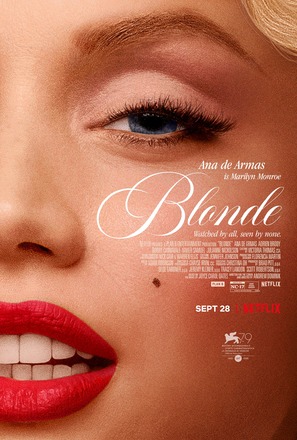
Few icons had such cultural impact in the 20th century as Marilyn Monroe. Maybe Elvis – coincidentally also the subject of a 2022 biopic. Even people who have never seen a Monroe film can impersonate her or knows about that dress being blown up around her. It’s also pretty widely know she had a difficult life, troubled family and some disastrous marriages culminating in her tragically early death from an overdose. Blonde, based on a novel by Joyce Carol Oates, dives into a heavily fictionalised account of Monroe’s life, focusing overwhelmingly on anything that could be seen as miserable, shocking and traumatic to the exclusion of almost everything else.

In doing so it’s hard not to think that, for all its attempts to shine a light on the difficulties of Monroe’s life, it’s not also partly exploiting her as well, turning her into a sort of misery porn entertainment. Over the course of nearly three hours, we see her raped at least three times, beaten, fall victim to elaborate revenge plots, forced through two blood-soaked abortions, pumped full of drugs to get her through film shoots and constantly at the centre of slavering piles of male filmgoers who scream for her attention and call her a whore the second she walks past. To say Blonde is a miserable film that’s tough to watch is putting it lightly.

Why does Marilyn put herself through it? The film offers no real answers, beyond the simplest, crudest flashes of pop-psychology possible: Daddy issues. Growing up not knowing who her father is, Marilyn’s life is a quest to find either her father or an acceptable substitute. That could be the audience, the husbands she calls “Daddy” or the hope that the person claiming to be her father who sends her a letters, might one day meet her. This is about as far as the insight goes. How issues influenced her choices and decisions is left frustratingly untold.

The film skims over the creative control she gained over her movies, the production company she set up and her skill as comic actor (it focuses much more on her dramatic Actor’s Studio work). It never once tries to understand why she continues in a career she hates so much – she had plenty of chances, even in this film, to back out – or what lured her to the silver screen and a quest for superstardom in the first place. It’s as if acknowledging Monroe worked hard to get her career would undermine the victimhood the film is determined to define her with.

The film suggests “Marilyn Monroe” is a persona put on by Norma Jean. This is another crude piece of psychology. We completely skip the years Norma Jean must have spent creating this persona and we never learn what influences it or get an understanding of “who” this Marilyn is. I suppose it’s “Marilyn” who smiles at film premieres or appears on screen: but we get little sense of how Norma Jean might have used this alternative persona to get her through the day. For all the time we spend with her, we never understand her beyond someone desperate for love with severe Daddy issues.

The film is so clumsily mishandled, its makers were reduced to stating it was not intended as an anti-abortion movie. This despite both abortions being horrifying experiences (one with a drugged Marilyn begging that she’s changed her mind, the other a late blood-soaked possible-fantasy where Marilyn is kidnapped has an implied Kennedy baby removed). Worse than this, the film Marilyn hammers home Marilyn’s sense of guilt. During her first abortion she imagines herself in a house burning down around her and later imagines a conversation with a giant foetus, which asks “Mummy why did you kill me?” and begs her not to do the same for her future babies. Not exactly the sort of messaging you expect from a #metoo film.

On top of this, Blonde is a film almost unbearably pleased with itself. This is Art with a capital A, R and T. Dominik shifts from colour to black-and-white, changes film stock and constantly shifts and changes the aspect ratio from shot-to-shot. In almost three hours, only once could I see any logic in this: as Marilyn agrees to marry Joe DiMaggio, the frame closes in on her from 2.35:1 to 4:3, a neat visual metaphor for the constricting marriage she has signed up for. Other than that, there is no rhyme or reason for any of these visual changes in the film. It doesn’t comment on the action, reflect emotional beats, delineate between reality or fantasy… it just smacks of an overindulged director using all the flashy tools for the sake of it. It becomes intensely irritating.

There is a committed lead performance from Ana de Armas (even if her Cuban accent does sneak through), who captures beautifully Monroe’s physical and vocal traits and sells what emotional titbits she is given in the salacious, muck-raking framing of the film. Her traumatic relationship with her disturbed mother, a sex-filled thruple with Hollywood princes Cass Chaplin and Eddy Robinson Jnr, raped by Darryl F Zanuck and a surprisingly-vile John Kennedy (while a TV in the background shows missiles rising – boom boom), knocked about by a jealous Joe DiMaggio (in real life he remined close to her and organised her funeral, but hey ho)… it’s all meant to be shocking but it’s all dialled up with glee of a two-bit muck-rag, flogging the hot goss.

That’s standard for the whole film, a flashy, pleased-with-itself epic that focuses on misery and pain for its subject at the cost of everything else and ends up telling us very little about her or her inner life, instead leaving us feel slightly like peeping toms for watching.

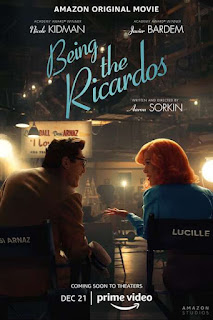
Being the Ricardos (2021)

Being the Ricardos (2021)

I Love Lucy is bought to life in this behind-the-scenes drama that bites off more than it can chew

Director: Aaron Sorkin

Cast: Nicole Kidman (Lucille Ball), Javier Bardem (Desi Arnaz), JK Simmons (William Frawley), Nina Arianda (Vivian Vance), Tony Hale (Jess Oppenheimer), Alia Shawkat (Madelyn Pugh), Jake Lacy (Bob Carroll), Clark Gregg (Howard Wenke), John Rubenstein (Older Jess Oppenheimer), Linda Lavin (Older Madelyn Pugh), Ronny Cox (Older Bob Carroll)

A film about I Love Lucy is always going to lack cultural cache outside of the US: it would be the same if a British film about Dad’s Army or Hancock’s Half Hour played there. Without a legacy of growing up on endless re-runs, I think a lot of British audiences (like me) will be left playing catch-up working out who the stars are and what the show is about.

Sorkin’s Being the Ricardos follows one week in the making of I Love Lucy in 1952. It’s a big week. There are rumours of infidelity (from him) in the lives of the married co-stars Lucille Ball (Nicole Kidman) and Desi Arnaz (Javier Bardem). On top of that, the media is running stories that Ball is a card-carrying communist (not completely true). And finally, she’s pregnant, something the network can’t imagine would be acceptable to include in a family show. All these problems come to a head as that week’s show is finalised, rehearsed and shot.

Sorkin’s film is by far and away at its best when dealing with the backstage mechanics behind bringing a TV show to the screen. Which perhaps isn’t a surprise, as that is obviously material he’s very familiar with. The film is fascinating at showing the technical side of things like rehearsals, and it’s very illuminating on the dedicated perfectionism Ball bought to making the comedy work. We see every single gag being worked on over and over to mine the maximum number of laughs from it. There are long back and forth conversations on timing, positioning and nuances of line delivery.

There are similarly fascinating ideas during scenes in the writers’ room. A huge board maps out the details of future episodes. The writers – a neatly squabbling but fundamentally loyal Alia Shawkat and Jake Lacy, headed up by executive producer Tony Hale – are constantly pushed to fine-tune their ideas, while passionately defending many of their own jokes to the sceptical stars.

A sequence essentially showing Ball and the writers spit-balling ideas that will develop into future set-pieces is particularly well done. Sorkin also comes up with a neat visual concept showing how Ball considers the impact of the gags: events from the show play out in black-and-white then switch to colour as the action pauses and Ball considers what to do next to get the most laughs. It’s all part of the film’s primary strength: a fascinating look at the energy and passion required to produce a half-hour sitcom, be it arguing over camera placement to a sleepless and worried Ball calling her co-stars to the studio in the wee small hours to fine-tune a pratfall.

Where the film is less certain is all the other stuff it tries to cover. Being the Ricardos is almost the dictionary definition of a film biting off more than it can chew. It tries to cover: the making of a TV show, McCarthyism, a biography of the marriage of the two stars, the sexism of network TV, racial unease at the Cuban Arnaz playing Ball’s husband, the sexual prudishness of the 1950s, and expectations around gender roles. On top of which, Sorkin’s film trumpets continuously that this was the “most difficult week ever”. It’s an onslaught of stakes the film finds hard to deliver on.

For starters, most of the action focuses on the mechanics of making the show – mechanics that surely would be the same every week. The communist plotline is introduced then largely dropped for most of the film until the final rousing hurrah. McCarthyism is barely tackled, other than a new perspective from Arnaz, who remembers being forcibly driven from Cuba by Communists. Awkward flashbacks fill in some of the backstory around Lucille and Desi’s meeting but end up feeling like superfluous additional information that adds nothing to anything other than the runtime.

Tensions in their marriage bubble away before finally coming to a head, as if Sorkin didn’t want to spoil the rat-a-tat dialogue with some deeper content. The film is very good at showing what a great team they made: Ball’s creativity and comic genius matched with Arnaz’s business-sense and ability to plan every aspect of the show’s technical and financial set-up. But again, more could have been made of this – too often it’s an idea crowded in amongst others, with a tone that can’t decide how it feels about Arnaz’s possible betrayal or Ball’s fixation on it.

More could have been made about the prudish and sexist struggles Ball and Arnaz went through to get her pregnancy integrated in the show. It’s a fascinating realisation that the implication that a happily married couple must have had sex to produce a baby was anathema to TV networks in the 50s. A film that focused on the battle to get this integrated into the show – and the impact that doing so had on America and television – would not only have been more focused, it would also have played into the film’s real strengths: the mechanics of actually making television. As it is, this sense of the struggle Ball had to get due recognition in a male-dominated industry is lost.

As the two stars Nicole Kidman (under layers of latex to transform her facial features into Ball’s) and Bardem are very good, Kidman in particular brilliantly conveying Ball’s comedic genius as well as her self-doubt and insecurity, expressing itself in worries about her marriage to making sure her female co-star looks less attractive than her on the screen. Kidman pounces on Sorkin’s fast-paced dialogue and provides much of the film’s drive and focus. There are also neat supporting turns by JK Simmons and especially Nina Arianda as their co-stars.

In the end though, yet again, it feels like Sorkin the writer is ill-served by Sorkin the director. While the film is more sharply directed than his others, it lacks focus, discipline and drive, like Sorkin can’t bear the idea of cutting some of his own words and ideas so tries to include them all. It ends up meaning nearly all of them lack the impact they should have.

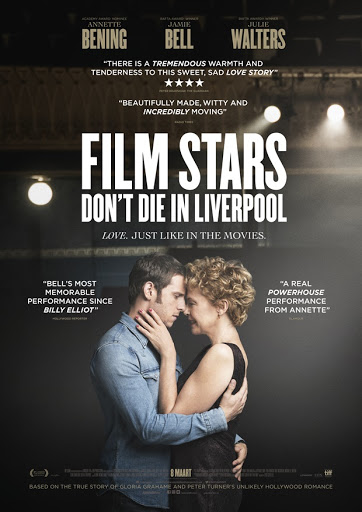
Film Stars Don't Die in Liverpool (2017)

film stars dont die in liverpool
Annette Bening and Jamie Bell as an unconventional couple in Film Stars Don’t Die in Liverpool

Director: Paul McGuigan

Cast: Annette Bening (Gloria Grahame), Jamie Bell (Peter Turner), Julie Walters (Bella Turner), Kenneth Cranham (Joe Turner), Stephen Graham (Joe Turner Jnr), Vanessa Redgrave (Jeanne McDougall), Frances Barber (Joy Hallward), Leanne Best (Eileen)

In 1981, Oscar-winning actress Gloria Grahame (Annette Bening) is performing The Glass Menagerie in Lancaster as part of a UK tour. When she collapses backstage seriously ill, she asks her former lover, young Liverpudlian actor Peter Turner (Jamie Bell), to come to her aid. Peter takes her back to his parents (Julie Walters, Kenneth Cranham) in Liverpool. The two had met a couple of years ago – Grahame the fading star, Turner the would-be actor – and age hadn’t prevented their relationship flourishing into a passionate romance. The film cuts between what pulled them apart in the past, and the present day, where Turner discovers Grahame has been diagnosed with terminal cancer and has at best a few months to live.

Film Stars Don’t Die in Liverpool is based on Turner’s book and is directed with just the right stylistic flourish by Paul McGuigan. Fundamentally a straight-forward (even rather conventional) narrative, McGuigan doesn’t crowd out the action and emotion, but skilfully intercuts past and present together (for instance, characters walk through doors in 1981 and emerge in their memories of 1979). This is pretty subtly done throughout (although the glorious, sun-kissed past and the rain drenched Liverpool present isn’t particularly subtle!) and allows the film to focus on its main strengths – the acting.

The success of the film rests on the chemistry – and skill – of the two leads who both give wonderful performances. Annette Bening excels in nearly a career-best role, as a star clinging to the remnants of her career. Outwardly displaying glamour and confidence – complete with a soft-toned movie star voice – it’s a brilliant study of inner fragility and uncertainty. She carefully reveals a Gloria Grahame who is deeply insecure and fragile.

Bening brings a lot of empathy to the role of a slightly lonely woman who has spent years avoiding questions around her own health, terrified that it could make her unemployable. It’s a fear that has a tendency to make her brittle and defensive. And of course, that’s only added to by her knowing that she is ageing in a young person’s profession. Even jokes about age expose her self-doubt and fear. (Peter drops an early clanger when she tells him after their first date she dreams of playing Juliet with the RSC: “You mean the Nurse?” he says without thinking. She throws him out.)

It’s one of the nice things about the film that the only person who really has a concern about age – or ever seems to mention it as an issue – is the older woman. Nobody else in the film questions the relationship between these two on age grounds (all the doubts raised are based on background and, above all, Grahame’s track record with marriage – four and counting). It’s purely an obsession of Grahame’s – because she doesn’t want to be reminded of her own mortality and, unconsciously, the far younger Turner is a constant reminder of this. And Grahame isn’t really that old anyway: certainly not at heart, her vibrancy being one of the first things that attracts Peter to her.

Peter’s feelings though are heart-breakingly genuine, shown in Bell’s wonderfully compassionate performance. McGuigan frequently allows long reaction shots to study the emotional impact of events on the characters, and no-one benefits from this more than Bell whose face is frequently a picture of conflicted, tortured emotion, of grief that he’s only just managing to hold in. Bell is terrific.

The film charts a romance that starts with a blissful freedom, but ends with a very true and heartfelt declaration of love. The past – saturated with cleanliness and colour as it is – is full of fun, romance and semi-surreal early encounters stuffed with expressive dancing (a great reminder that Bell can really move!) and watching Alien. The time the two spend in New York is similarly golden tinged. What draws it to a close is illness – and Grahame’s fears of how it will affect Turner as well as not wanting to live her last few months being nursed by her lover like an invalid.

It’s an involving romance and relationship piece, and it also gives time to how important families can be. Turner’s parents (lovely work from Walters and Cranham) are supportive and caring of Grahame – and his brother (edgy work from Graham) is only frustrated that they put her before their own interests. It makes quite a contrast with Grahame’s family, a mother who seems more interested in herself (Redgrave at her grand damest, showily quoting Shakespeare) and bitchy, jealous sister (a prickly Frances Barber).

But it’s mainly a film about the two leads and while it doesn’t reinvent anything about biopics or romances (or tragic stories of loss), it tells its story neatly and cleanly and allows scope for the acting to do a lot of the work. Bening and Bell more than rise to the challenge.

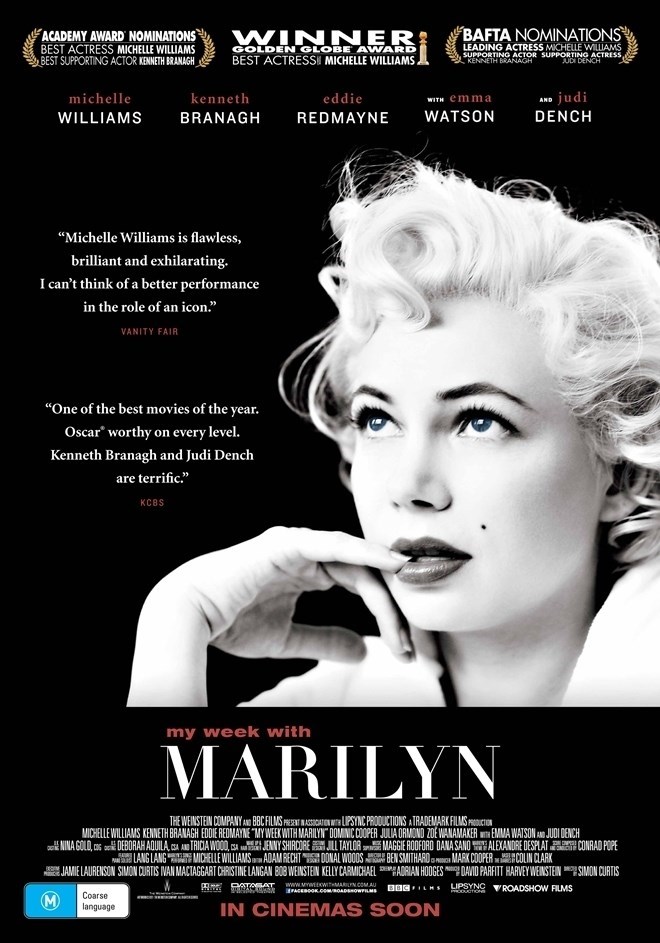
My Week with Marilyn (2011)


Michelle Williams navigates the world of fame as Marilyn Monroe, escorted by Eddie Redmayne

Director: Simon Curtis

Cast: Michelle Williams (Marilyn Monroe), Eddie Redmayne (Colin Clark), Kenneth Branagh (Laurence Olivier), Judi Dench (Sybil Thorndike), Emma Watson (Lucy), Dominic Cooper (Milton H. Greene), Derek Jacobi (Owen Morshead), Dougray Scott (Arthur Miller), Toby Jones (Arthur P Jacobs), Julia Ormond (Vivien Leigh), Zoë Wanamaker (Paula Strasberg), Michael Kitchen (Hugh Perceval), Philip Jackson (Roger Smith), Simon Russell Beale (Cotes-Preedy), Robert Portal (David Orton), Jim Carter (Barry), Richard Clifford (Richard Wattis), Gerard Horan (Trevor)

In 1956 Laurence Olivier was the greatest actor in the world; Marilyn Monroe was the biggest star (and sex-symbol) in the world. Surely when they came together to make a movie, it would be cinema gold. It wasn’t. Olivier directed and starred with Monroe in The Prince and the Showgirl, an almost impossibly slight puff piece, partly assembled (so rumour goes) so Olivier could sleep with Monroe. But it turned out Monroe’s fragile psyche and Stanislavkian approach to acting was incompatible with Olivier’s well-honed craft. The two did not get on.

Simon Curtis’ gentle, at times charming, but basically very lightweight film follows the making of the film through the eyes of Colin Clark. Clark, son of the famous art critic Kenneth Clark, was a naïve, romantic young man keen for a career in the movies through his father’s contacts. Hired by Olivier’s production company, Clark is tasked to take care of Monroe throughout the film. He becomes increasingly fascinated and infatuated with her as they spend more and more time together.

The film is based on Clark’s diaries, and he is played by Eddie Redmayne at his most fresh-faced. The problem with Clark is that, to be honest, rather than a young man on a journey of self-discovery, he comes across a little like a social-climbing creep and borderline stalker. Clark recounts a short-lived friendship that obviously had huge importance to him – but the film doesn’t want to deal with the fact it probably meant virtually nothing to Monroe, beyond some company during a lonely time. 

It’s not helped by the fact Clark comes across slightly like a pushy groupie, the self-proclaimed guardian of Monroe’s needs – qualifications barely justified by his actions. The film wants us to think he got closer to the magic of celebrity than anyone, but he feels like a stranger with his nose a little closer to the portcullis. Quite frankly, Colin is the least interesting character in his own story, and Redmayne fails to really give him much depth for us to engage with. Instead he remains a slightly unsettling inverted snob, manipulated by Monroe. The film, you feel, just doesn’t get this. At the end someone tells Colin he is “standing taller” than when he first met him (the implication being the relationship has made a man of him – as if spending a bit of downtime with a celebrity was the only route to emotional maturity). But rather than being part of a sweet star-crossed romance, Colin feels like someone creepily attaching himself to someone vulnerable. 

However, Michelle Williams is very good as Marilyn, capturing a real sense of her emptiness and insecurity. She perfectly captures Monroe’s physicality and vocal mannerisms. She is very good at capturing Monroe’s sense of permanent performance, of her glamour, kindness and innocence, mixed with her maddening vulnerability and (inadvertent?) selfishness. It’s a fine performance – better than the film deserves. 

Because the film is afraid of remotely criticising Monroe at all – or really engaging with the deep psychological reasons for her depression, or addressing the possibility that part of her appeal was her slight blankness that any desires could be projected onto. Instead, the film suggests, she’s sad because men just use her. Apart from Colin of course. His kissing, skinny-dipping and sharing a bed with her are entirely unmotivated by any lustful yearnings.

The film is in love with Monroe, presenting her just as Colin saw her – perfection. In fact, just as Dougray Scott’s put-upon Arthur Miller says, she was probably exhausting and all-consuming. She certainly sucks the naïve Colin into her orbit, in a way he (or the film) hardly notices or understands. It wants us to think of this as a romance – in fact, Monroe’s fragility created a neediness that meant she didn’t feel she needed to consider other people, so overwhelmingly concerned was she with her own brittleness. The film essentially believes she was a star, so is basically allowed to do what she wants. The fact that she did so with an air of gentle vulnerability means the film gives everything she does a pass.

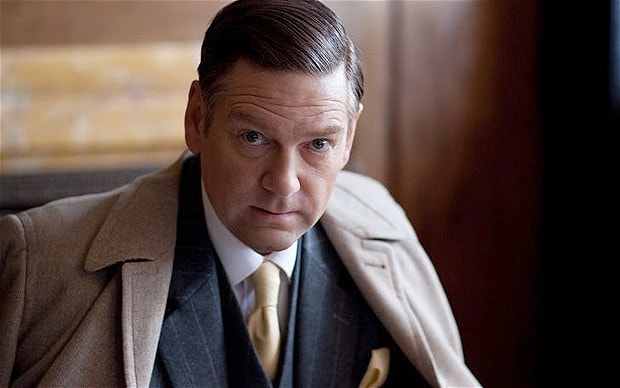
So it’s rather hard not to sympathise with Olivier’s growing frustration with Monroe’s unreliability. Kenneth Branagh triumphs as Olivier, surely the role he was born to play: very funny, but also with a patrician charm and all-consuming arrogance. Branagh taps into Olivier’s vulnerability, his sense that he may not be able to communicate his acting strength into movie stardom, that he is yesterday’s man. For all her difficulty, Monroe had that “star quality” that makes her the centre of your attention. I’d argue Olivier almost certainly had the same – but the film is so in love with Monroe, it needs to slightly bring Olivier down. Branagh, however, is so good that he constantly punctures the film’s attempt to force Olivier into a less sympathetic role than the one it indulges Monroe with.

My Week with Marilynis far from terrible – it’s just a rather empty film. It has a terrific cast with these British star actors all offering fine pen portraits of assorted actors, producers and agents. The film however is slight, and so in love with its fairy-tale elements, it doesn’t notice that Clark’s story is slightly more creepy and certainly a lot more emotionally empty than the film wants it to be. It wants to take us behind the curtain of a 20th-century icon – instead it accidentally shows how impenetrable their screens are, and how easy it is for ordinary people to persuade themselves that the most fleeting of contacts was something special.