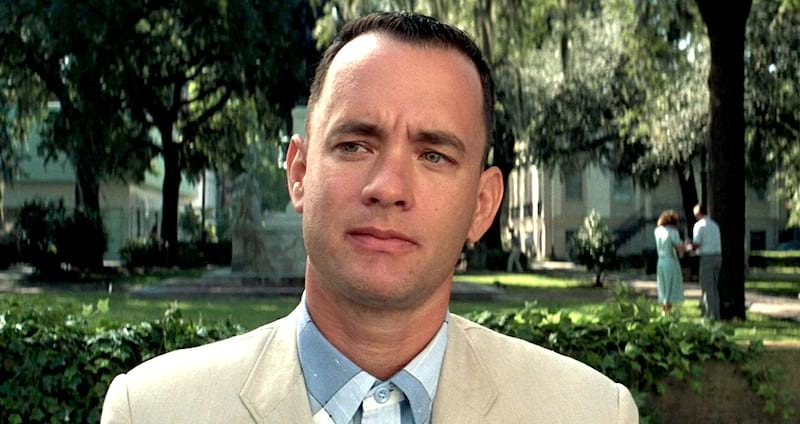
Category: Best Picture winner

Forrest Gump (1994)

Tom Hanks unleashes some cloying charm in Forrest Gump

Director: Robert Zemeckis

Cast: Tom Hanks (Forrest Gump), Robin Wright (Jenny Curran), Gary Sinise (Lt Dan Taylor), Mykelti Williamson (“Bubba” Blue), Sally Field (Mrs Gump), Haley Joel Osmont (Forrest Gump Jnr)

Oh dear God. It’s worse than I remembered. I hadn’t watched Forrest Gump since maybe 1995. I hadn’t liked it much then. But that might just have been my contrariness: sure I was going to find faults in the film that became a cultural phenomenon. Rewatching it today: actually no, I had good taste. This must be one of the worst films to ever win the Best Picture Oscar – and certainly one of the most unsettlingly twee, sentimental, conservative-minded pieces of feel-goodery to ever come out of Hollywood.

You surely know the plot. Forrest Gump (Tom Hanks, who to do him credit plays this one note character with real charm) is a good-hearted man with developmental difficulties (IQ below the 75 mark) who lives through some of the most turbulent times in American history. From racial violence in the 1950s, to Vietnam, the Cold War, the political turmoil of the 1970s, Forrest lives through it all. And largely lets it wash over him, never letting it intrude on his simple, folksy, homespun gentleness. Although that might mostly be because he also doesn’t really understand most of the things happening around him. He’s quite a contrast with the girl he’s loved since their childhood, Jenny (Robin Wright) who embraces everything the modern world brings (protest, politics, drugs) but of course finds her life much less rewarding and happy than Forrest’s “go-with-the-flow” acceptance.

Just writing it down I can feel my stomach turning again. At the time the filmmakers were very keen to promote the film as stridently apolitical. Yeah sure the film never praises, say Kennedy or Nixon, just as it goes out of its way not to state an opinion on either George Wallace or the Black Panthers. But the film is, at its heart, a large, beating, reassuring lump of rank conservatism.

It looks back at America’s past with rose-tinted glasses, portraying a world which would have all better if they had taken a leaf out of Forrest’s book. If we had all been just as uninvolved, decent, kind and stayed at home where we were happy rather than getting engaged in major social and political issues, everything would have been better. Forrest is a celebration of all-American virtues of honesty, bravery and loyalty – but the film is also an implicit criticism of other all-American virtues like curiosity, scepticism and challenging the status quo. Basically, the film celebrates the cosy attitudes conservatives adore and has nothing good to say about more liberal values. Sure, it doesn’t roll out a banner for Nixon – but you can also see this playing well at a Trump rally, with people saying we would be a happier country if we could all be a bit like Forrest.

That’s really tough on the film – and I imagine Zemeckis and co would be rightly horrified about that very idea – but it’s a film that doesn’t once challenge the audience at all. I was reminded throughout of Being There which took a similar concept: a man with low IQ finds himself at the centre of major events. But while that film was a satire – where the characters invest Chance’s gnomic utterings with profound wisdom – this film is a serious drama which encourages the audience to see a “deeper wisdom” in Forrest, to effectively treat him as a sort of prophet. There is a reason bland nonsense like “life is like a box of chocolates” caught on.

The original book was far more of a satire on the shallowness of modern culture. This instead plays like a sort of holy fool pilgrimage, with Forrest’s interaction with historical figures played for laughs. From showing Elvis how to dance, to (in the film’s most cringing moment) inspiring John Lennon with the lyrics of Imagine (another reason to hate Forrest), the film is crammed with gags like this. While the insertion of Tom Hanks into newsreel footage with Kennedy, Johnson and Nixon is impressive (although it has not aged quite so well), it’s not made with any point. This is because Forrest has no real appreciation of what’s happening around him. He’s merely moving from one event from the next – but this lack of engagement and understanding is held up as a virtue. And the very fact that it is, speaks to the film’s underlying conservatism and love for simple, small-town American ideals that shouldn’t be sacrificed to all that uncomfortable social and political change.

The film is particularly harsh on Jenny, decently played by Robin Wright, who is portrayed as someone succumbing to every trend and popular movement of the era. And whom the film consistently punishes for this by showing her emptiness, shallowness and unhappiness, until it finally consigns her to death from AIDS. Just in case we’ve missed the point, Forrest repeatedly urges her to come home – to stop engaging with the wider world and the problems in it and bury her head back into the sands of home, where everything is simple, safe and nothing changes.

The world of Forrest Gump is one where corruption and war mongering don’t matter because it happened a long time ago. A world where racial politics are too distasteful to mention (although since Forrest’s Granddaddy was a leading member of the KKK – a flashback played for laughs – that clearly wasn’t the case). Where the only black people Forrest encounters are the outsider soldier Bubba (who of course dies in ‘Nam – even in serious films, the Black Guy dies first) and his servile family whose names don’t even merit a mention, but who become the grateful beneficiaries of Forrest’s oblivious generosity. But there is no sense here of the dangers and violence of America (bar some nasty jocks at Forrest’s college) – which considering the film has a cameo from George Wallace of all people is really striking.

But then the problems of the world I guess don’t seem that bad if you just don’t think about them and instead go through life with a smile on your face, blissfully unaware of what’s happening around you. The closest the film gets to giving Forrest an opinion on something is when he is asked to speak at a rally against Vietnam – and even then the sound cuts out meaning we can’t hear him (though it seems to have been profound). A wittier film, like Being There, would have made this a moment for satire. Here it seems more like the magic of Forrest’s simplicity mustn’t be shattered for the audience by daring to suggest he actually has a view on something.

The film is a warm and comforting hug, that tells people the past wasn’t that bad and would have been better still if we’d just been nice to each other. That wanting to change the world is dangerous and greater rewards can come from going with the flow. For all Forrest is bereft by Jenny’s death, the film still rewards him with family, home and friends. It’s sentimental, empty, depressing crap. Well made, but simply dreadful. You may not know what’s in a box of chocolates, but you sure as shit will remember after you’ve vomited them all back up after watching this.

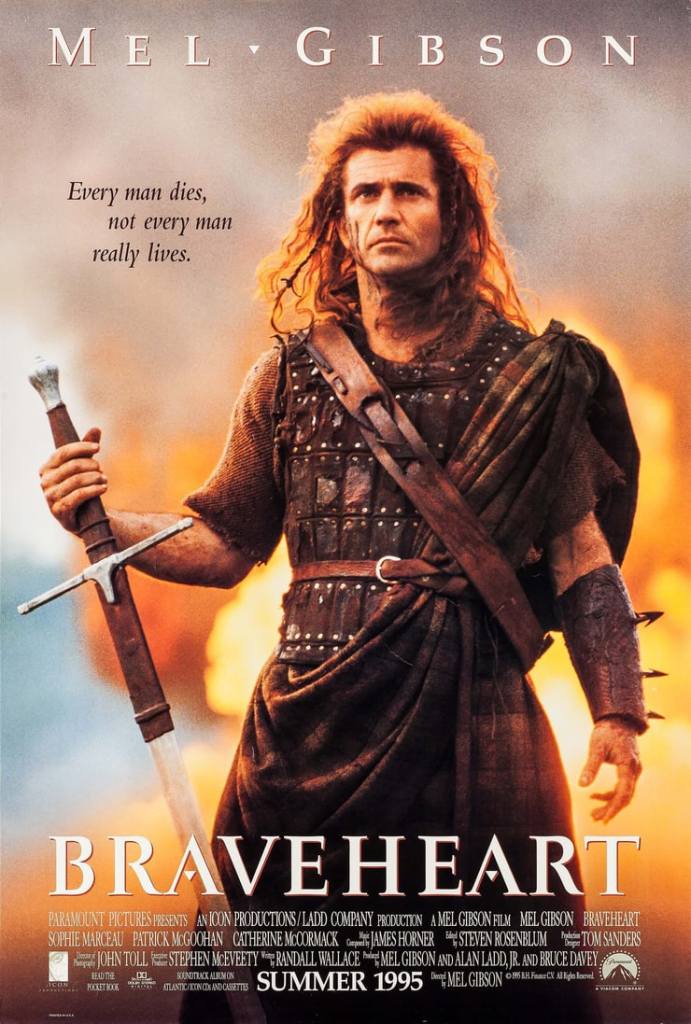
Braveheart (1995)

Braveheart (1995)

Gibson’s Oscar-winning epic mixes great action and bad everything else – how did it win?

Director: Mel Gibson

Cast: Mel Gibson (William Wallace), Sophie Marceau (Princess Isabelle), Patrick McGoohan (Edward I), Angus MacFadyen (Robert the Bruce), Brendan Gleeson (Hamish), David O’Hara (Stephen), James Cosmo (Campbell), Peter Hanly (Prince Edward), Catherine McCormack (Murron MacClannough), Ian Bannen (Bruce’s Father), Sean McGinley (MacClannough), Brian Cox (Argyle Wallace)

Think back to 1994 and a time when no one really knew who William Wallace was and Mel Gibson was the world’s favourite sexy bad-boy. Because by 1995, William Wallace had become the international symbol of Scottish “Freedom!” and Mel Gibson was an Oscar-winning auteur. Can you believe a film like Braveheart won no fewer than five Oscars, including the Big One? History has not always been kind to it – but then the film was hardly kind to history, so swings and roundabouts.

It’s the late 13th century and Scotland has been conquered by the cruel Edward I (Patrick McGoohan) – a pagan apparently, which just makes you think that Gibson and screenwriter Randall Wallace simply don’t know what that word means. William Wallace (Mel Gibson) saw his whole family killed, but now he’s grown and married to his sweetheart Murron (Catherine McCormack). In secret, as the wicked king has introduced Prima Nocte to Scotland, giving English landlords the right to do as they please with brides on the wedding night. When Murron is killed after a fight to avoid her rape, Wallace’s desire for revenge transforms into a crusade to win Scotland its freedom. A brilliant tactician and leader of men, battles can be won – but can Wallace win the support of the ever-shifting lords, such as the conflicted Robert the Bruce (Angus MacFadyen)? Will this end in freedom or death?

Even in 1995, Braveheart was a very old-fashioned piece of film-making. You can easily imagine exactly the same film being made (with less sex and violence) in the 1950s, with Chuck Heston in a kilt and a “Hoots Mon!” accent. In fact, watching it again, I was struck that narratively the film follows almost exactly the same tone and narrative arc as Robin Hood: Prince of Thieves – with the only difference being if that film had concluded after the Sheriff’s attack on Sherwood Forest with Robin Hood gutted alive in the streets of Nottingham.

This is a big, silly cartoon of a movie, that serves up plenty of moments of crowd-pleasing violence, low comedy, heroes we can cheer and villains we can hiss. Mel Gibson, truth be told, sticks out like a sore thumb with his chiselled Hollywood looks and defiantly modern mannerisms. The film takes a ridiculously simplistic view of the world that categorises everything and everyone into goodies (Wallace and his supporters) and the baddies (almost everyone else).

It’s also far longer than you remember it being. It takes the best part of 50 minutes to build up to Wallace going full berserker after the death of his wife. A later section of the film spends 30 minutes spinning plates between Wallace being betrayed at the Battle of Falkirk and then being betrayed again into captivity (you could have combined both events into one and lost nothing from the film). There is some lovely footage of the Scottish (largely actually Irish) countryside, lusciously shot by John Toll and an effectively Celtic-influenced romantic score by James Horner. In fact, Toll and Horner contribute almost as much to the success of the film as Gibson.

Gibson is by no means a bad director. In fact, very few directors can shoot action and energy as effectively as the controversial Australian. The best bits of Braveheart reflect this. When he’s shooting battles, or fights, or brutal executions he knows what he’s doing. Even if I’d argue that Kenneth Branagh managed to make much less than this look more impressive in Henry V. The battles have an “ain’t it cool” cheek to them, that invites the audience to delight in watching limbs hacked off, horses cut down and screaming Woad-covered warriors ripping through stuffy English soldiers. It’s probably not an accident that the film channels more than a little bit of sport-fan culture into its Scottish warriors.

Where Gibson’s film is more mundane is in almost everything else. The rest of the film is shot with a functional mundanity, mixed with the odd sweeping helicopter shot over the highlands. Its similarities to Robin Hood: Prince of Thieves are actually really strong, from the matey bonhomie of the gang at its heart, its pantomime villain, the moral certainty of its crusades and the fact that Mel Gibson is no more convincing as a 13th-century Scot than Kevin Costner was as Robin Hood. But at least Prince of Thieves knew it was a silly bit of fun. Braveheart thinks it’s got an important message about the immortality of Freedom.

Alongside that, it’s a film that focuses on giving you what you it thinks you want. Gladiator – in many ways a similar film – is a richer and more emotional film, not least because it has the courage to stick to being a film where the hero is faithful to his dead wife and whose triumph is joining her in death. In this film, there are callbacks throughout to the dead Murron – but it doesn’t stop Wallace banging Princess Isabelle, or the film using the same sweeping romantic score to backdrop this as it did for the marriage of Murron and Wallace. What on earth is it trying to say here?

It goes without saying that the real Wallace did not have sex with Princess Isabelle and father Edward III – not least because the real Isabelle was about ten when Wallace died and I’m not sure putting thatin the film would have had us rooting for Wallace. Almost nothing in the film is historically accurate. Wallace is presented as a peasant champion, when he in fact was a minor lord (the film even bizarrely keeps in Wallace travelling Europe and learning French and Latin – a big reach for a penniless medieval Scots peasant). Even the name Braveheart is taken from Robert the Bruce and given to Wallace. The Bruce himself – a decent performance by Angus MacFadyen – is turned into a weak vacillator, under the thumb of his leprous Dad (a lip-smacking Ian Bannen).

The historical messing about doesn’t stop there. Even Wallace’s finest hour, the Battle of Stirling Bridge, is transformed. The film-makers apparently felt the vital eponymous bridge “got in the way” – a sentiment shared by the English, who in reality were drawn into its bottleneck and promptly massacred. Instead we get a tactics free scrap in a field – fun as it is to watch the Scots lift their kilts, it hardly makes sense. The Scots culture in this film is a curious remix of about five hundred years of influences all thrown into one. Prima Nocte never happened. The real Edward II was a martial superstar – but here is a fey, limp-wristed sissy (the film’s attitude towards him stinks of homophobia). Almost nothing in the film actually happened.

But the romance of the film made it popular. It’s a big, crowd-pleasing, cheesy slice of Hollywood silliness. The sort of film where Wallace sneaks into someone’s room at the top of a castle riding a freaking horse and no-one notices. It tells a simple story in simple terms, using narrative tricks and rules familiar from countless adventure films since The Adventures of Robin Hood. It looks and sounds great, enough to disguise the fact that it isn’t really any good. Because it has a sad ending, scored with sad music, it tricked enough people to think it had depth and style. In fact is a very mediocre film, hellishly overlong, that turns history into a cheap comic book. It remains in the top 100 most popular films of all time on IMDB. It’s about as likely an Oscar winner as 300.

A Beautiful Mind (2001)

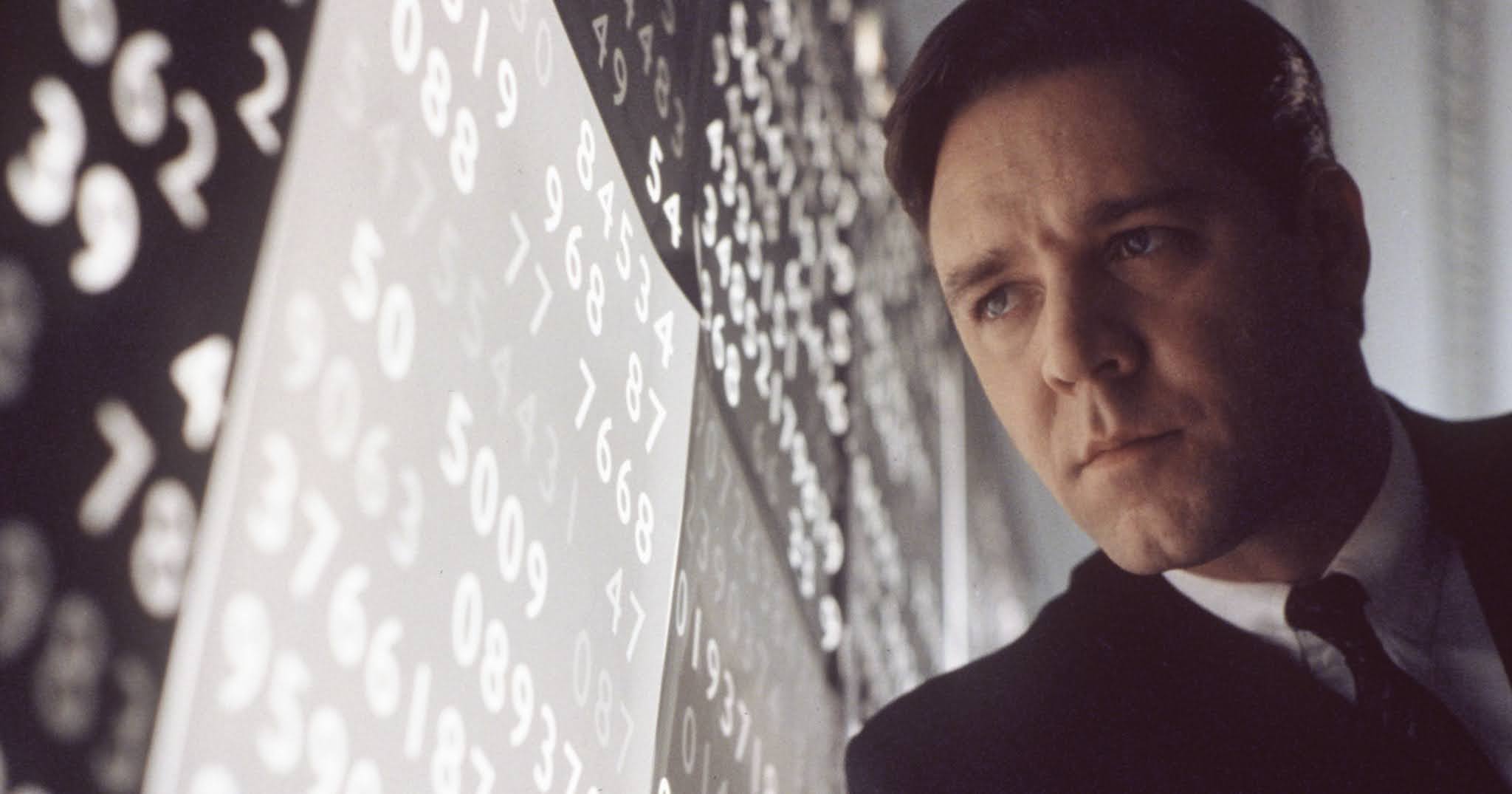
Russell Crowe struggles with reality as Math’s genius John Nash in A Beautiful Mind

Director: Ron Howard

Cast: Russell Crowe (John Nash), Ed Harris (William Parcher), Jennifer Connelly (Alicia Nash), Christopher Plummer (Dr Rosen), Paul Bettany (Charles Herman), Adam Goldberg (Richard Sol), Josh Lucas (Martin Hansen), Anthony Rapp (Bender), Judd Hirsch (Professor Helinger)

There is nothing Hollywood likes more than a man overcoming adversity. Make him a troubled genius and that’s even better. Throw in a supportive wife who bends over backwards to help him and you’ve got the dream Hollywood scenario. You can bet Oscars will follow – and they certainly did for Ron Howard’s A Beautiful Mind, which hoovered up Best Picture, Best Director, Best Adapted Screenplay and Best Supporting Actress (it probably would have also nabbed Best Actor if Russell Crowe’s personal behaviour hadn’t turned him from idol to Hollywood’s most unpopular actor).

The film is a romantically repackaged biography of John Nash (Russell Crowe), a pioneering mathematician whose life was turned upside down by his diagnosis with schizophrenia in the 1960s. Even before then, Nash had become increasingly preoccupied by delusions and fantasies, many of them revolving around “secret government code-breaking work” for a bullying CIA Agent (Ed Harris). Slowly coming to terms with his diagnosis, with the help of his loving wife Alicia (Jennifer Connelly), Nash must learn to put aside the things he knows he are not real, while trying to rebuild his life.

Ron Howard’s film is assembled with his usual assured professionalism. It is never anything less than effective, what it never quite manages to be is inspired. Perhaps because it’s a very standard Hollywood biopic. It effectively presents the life of its troubled genius as something very easily digestible, hitting all the beats of suffering, determination and eventual triumph you could expect when the film starts.

This makes for exactly the sort of middle-brow filmmaking made with absolute professionalism that, if you turn your head and squint a bit, can be made to look like Oscar-winning art. That seems incredibly harsh on the film: but there is really nothing particularly “new” about anything here: in many ways, it could have been made almost exactly the same in the 1940s (and it would probably have won an Oscar then as well).

That’s not to say it’s a bad film. Howard’s direction is sharp and exact, and he stages the film very well, drawing very good performances out of the cast. The film is good at immersing us in Nash’s delusions, particularly in the first hour of the film (it’s not until the hour mark that anyone overtly states there is anything wrong with Nash beyond eccentricity and social awkwardness). Howard shoots the fantasies totally straight: in fact if you had managed to avoid knowing what the film is about, you can totally imagine being tricked into thinking it’s a genuine spy thriller.

With that though, the film gives you just enough hints. Take a beat and look at Nash’s CIA actions and they don’t make much sense. A secret code that involves him tearing pages out of thousands of magazines and pinning them up around his office connected with bits of string (standard filmic language for the obsessive nutter)? The CIA injecting a number implant into his arm? A dead drop at a posh house which requires letters to be sealed with wax? The film gives us the hints that Nash is more troubled than just awkward around people, but doesn’t lay it on too thick. And at least one plot reveal that something we have seen was in fact a Nash-delusion the whole time is so skilfully presented that it surprised me (and I know surprised several other people).

The film is also strong on schizophrenia and delusion. Reworking Nash’s real-life auditory hallucinations into visual fantasies (including imagined buildings and people) works really effectively for film. It also really opens up for us the horror of how difficult living with something like this might be. How would you feel if you could never trust the world you saw around you? What if you discovered things that were central to your life turned out to be fantasies? That people you had built relationships with were not real? That’s a traumatic emotional burden, and the film is very strong at building your empathy with Nash.

It’s also helped by Crowe’s very effective performance in the lead. Shy, buttoned-up, physically awkward, his eyes always cast down, body slouched and voice an embarrassed mumble, Crowe brilliantly embodies a nervous outsider whose problems fitting in only magnify his growing dependence on fantasies that place him at the centre of the world. There is a touching vulnerability about Crowe here that so rarely gets seen. A big part of the film’s success is due to his performance.

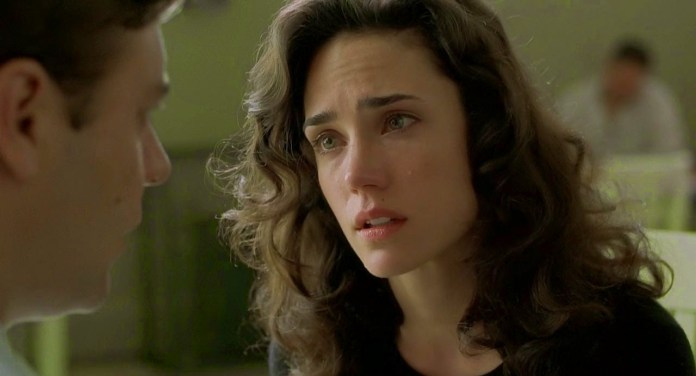
Jennifer Connelly also makes a great deal of her very traditional role as the supportive wife, bringing just the right level of assurance, spark and warmth to the role. Connelly carefully shifts the character from flirtatious confidence to heartbroken but supportive wife. But she doesn’t lose track of Alicia’s own frustrations at living with a medicated, unresponsive husband – even if, of course, any regrets she may have about the way her life turned out are overcome swiftly.

Which of course is completely different from real life where, for all her support, the couple divorced. Nash also had a baby (which he didn’t acknowledge) with a nurse he had an affair with. But these are real life complexities that have no place in a crowd-pleasing biopic like this. Similarly gone are Nash’s possible flirtations with bisexuality, his experiments with drugs or his flashes of violence. Added in are an entirely invented “pen gifting” Princeton ceremony and Nash’s Nobel prize acceptance speech where he gives thanks to his loving wife (in real life no such speech happened and the couple were separated). But that’s not the story this film wants to tell, so truth can go hang.

Perhaps these, post-diagnosis, difficulties are why the final third of the story – which sees Nash casting aside the invasive treatments to overcome the power his delusions have over him through willpower alone – is the least involving part. After all, they had to drop most of the actual real-life events that happened (see above). But there simply isn’t as much drama in watching someone quietly adjust to rebuilding a career in maths as there is in seeing them struggle.

Perhaps as well, because maths is a pretty difficult to bring to the screen. The film falls back into many accepted visual tropes – you’ll see a lot of writing on windows – and explains Nash’s theory of co-operative dynamics with a bar-and-booze based conversation around pulling girls in bars. That’s about as far as engagement with maths and understanding his theories goes – but we take it as read that Nash is a genius because he acts like one, people tells he is and he writes lots of big equations on boards.

A Beautiful Mind offers few real surprises (except for one) and presents a story that Hollywood has basically been making for decades. Things from real-life that don’t fit the story have been cut out, to make this as conventional a film as possible: the troubled genius and the loving wife behind him. It’s very well played (as well as Crowe and Connelly, Paul Bettany is brilliantly charismatic as Nash’s eccentric college roommate) and directed with a professional skill. But it’s also a very safe and even conservative film that has skill but not inspiration.

Around the World in Eighty Days (1956)

Around the world header
David Niven and Cantinflas head Around the World in Eight Days in this Oscar-winning epic

Director: Michael Anderson

Cast: David Niven (Phileas Fogg), Cantinflas (Passepartout), Shirley MacLaine (Princess Aouda), Robert Newton (Inspector Fix), Charles Boyer (Monsieur Gasse), Joe E. Brown (Stationmaster), John Carradine (Colonel Proctor), Charles Coburn (Steamship clerk), Ronald Colman (Railway official), Melville Cooper (Mr Talley), Noel Coward (Roland Hesketh-Baggott), Finlay Currie (Andrew Stuart), Marlene Dietrich (Hostess), Fernandel (Paris coachman), Hermione Gingold (Sporting lady #1), Cedric Hardwicke (Sir Francis Cromarty), John Gielgud (Foster), Trevor Howard (Denis Fallentin), Glynis Johns (Sporting lady #2), Evelyn Keyes (Paris flirt), Buster Keaton (Train conductor), Beatrice Lille (Revivalist), Peter Lorre (Steward), Victor McLaglen (SS Henrietta helmsman), John Mills (London coachman), Robert Morley (Gauthier Ralph), Jack Oakie (SS Henrietta captain), George Raft (Bouncer), Frank Sinatra (Piano player), Red Skelton (Drunk), Harcourt Williams (Hinshaw)

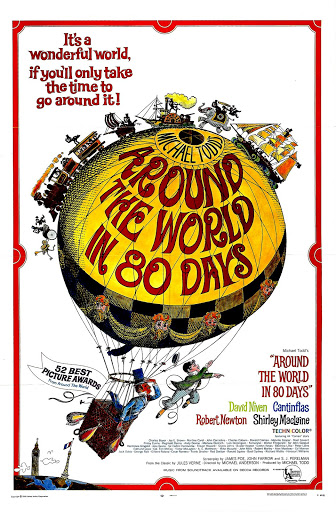
In the 1950s, cinema struggled to encourage people to come out of their homes and leave that picture box in the corner behind. Big technicolour panoramas and famous faces was what the movies could offer that TV couldn’t. This led to a trend in filmmaking that perhaps culminated in 1956 with Around the World in Eighty Days triumphing among one of the weakest Best Picture slates ever seen at the Oscars. Around the World had everything cinema knew it could do well: big, screen-filling shots of exotic locations filmed in gorgeous colour; and in almost every frame some sort of famous name the audience could have fun spotting. It’s perhaps more of a coffee table book mixed with a red carpet rather than a narrative film: entertaining, but overlong.

Faithfully following Jules Verne’s original novel (with added balloon trips), Phileas Fogg (David Niven) is a punctilious and precise Englishman of the old school, whose life is run like clockwork and whose only passion is whist. Nevertheless he accepts a challenge from his fellow members of the Reform Club (among them Trevor Howard, Robert Morley and Finlay Currie) to circumnavigate the globe in 80 days or less. Setting off with his manservant – the recently hired, accident prone Passeportout (Cantinflas) – Fogg races around the world, from Paris to Cairo to India to Hong Kong to Japan to San Francisco. Along the way he rescues Princess Aouda (Shirley Maclaine) from death by human sacrifice in India and has to confront the suspicions of Inspector Fix (Robert Newton) who is convinced that Fogg is responsible for a huge theft at the Bank of England. Can Fogg make it back to the Reform Club hall on time to win his bet?

Around the World was the brain-child of its producer Michael Todd. A noted Broadway producer, Todd had been looking to make a similar splash in the movies. Perhaps it’s no surprise that he decided the finest way to do this (after the mixed success of a movie version of Oklahoma) was to produce something that‘s pretty much akin to a massive Broadway variety show. Around the World – as you would expect – is an incredibly episodic film, seemingly designed to be broken down into a number of small sequences either to showcase the scene’s guest star or to provide comic opportunities for Cantinflas to display his Chaplinesque physical comedy.

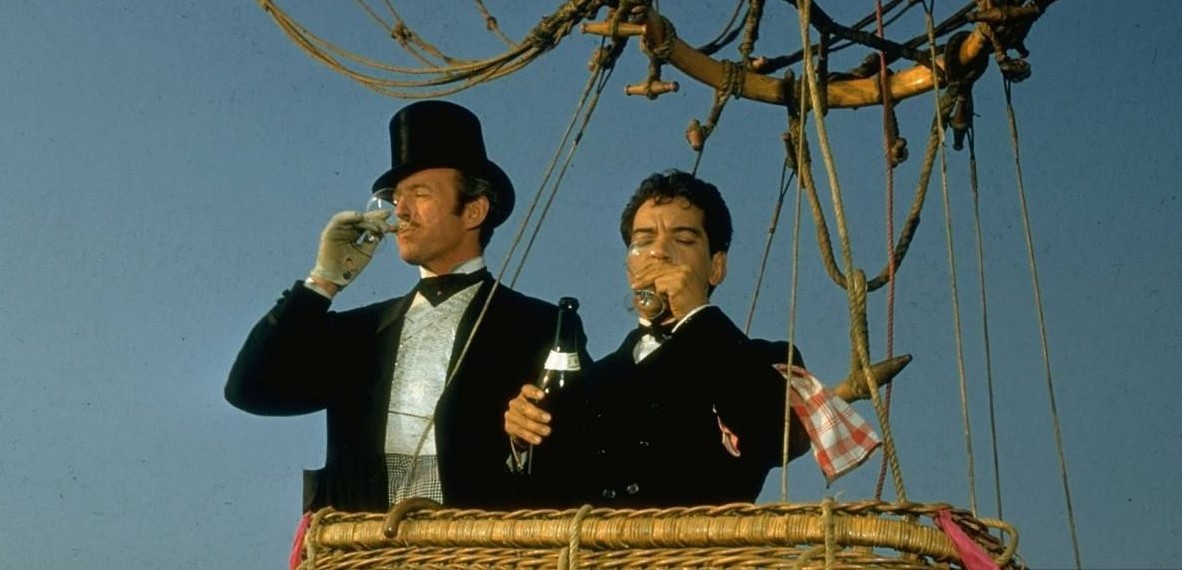
That and lots of opportunities for some lovely scenic photography. Nearly every major sequence is bridged with luscious photography capturing some exotic part of the world – from the coast of Asia to the Great American Plains. It’s pretty clear this is a major attraction of the film: come to the movies and see those parts of the world you’ve always dreamed of, just for the price of a movie ticket! Surely introduction of a hot air balloon to allow Fogg and Cantinflas to travel from Paris to Spain was purely to allow lovely aerial shots of the French countryside and chateaux. It’s the sort of film that proudly trumpeted in its publicity the number of locations (112 in 13 countries!), the vast number of extras (68,894!) and even the number of animals (15 elephants! 17 fighting bulls! 3,800 sheep!). It’s all about the scale.

That scale also carries across to the guest cameos. Between enjoying the scenic photography, viewers can have fun spotting cameos. Can that really be Noel Coward running that employment agency! The chap who owns the balloon, I’d swear that’s Charles Boyer! Wait that steward: that’s Peter Lorre! Good lord that’s Charles Coburn selling Fogg tickets for the steamer! Oh my, Buster Keaton is helping them to their seats on the train! Marlene Dietrich is running that saloon – and good grief that’s Frank Sinatra playing the piano! Most of the stars enter into the spirit of the thing, even if they frequently start their shots with backs to the camera, before turning to reveal their star-studded magnificence. Sadly time has faded some of the face recognition here, not helped by David Niven (perfectly cast as the urbane and profoundly English Fogg, so precise that his idea of romantic talk is to recount past games of whist) probably today being one of the most famous people in it.

Todd marshals all this with consummate showman skill. It’s handsome, very well mounted and generally entertaining – even if it is painfully long (it’s not quite told in real time, but can feel like it at points). The film is nominally directed by Michael Anderson. However, I think it’s pretty clear his job was effectively to point the camera at the things Michael Todd had lined up (be they location or stars) – Todd had already dismissed the original director, John Farrow, after a day’s shooting for not being sufficiently ”co-operative”. To be honest it’s fine as this is an entertainment bereft of personality, instead focused on being “more is more”.

Part of its extended runtime is due to the long comedic sequences given to Cantinflas. A charming performer – and possibly the most famous comedian in Latin-America at the time – Cantinflas can be seen doing everything from bicycle riding, to bull fighting (for a prolonged time), to gymnastics to horseback riding. (Far different from the unflappable and spotless English gentleman Niven is playing.) Your enjoyment of this may depend on how far your patience lasts. I’m not sure mine quite managed to last the course. Sadly one of Cantinflas’ greatest comedic weapons, his Spanish wordplay, was completely lost in translation.

There are some decent sections. The iconic balloon flight is well mounted and gives the most impressive images (the famously vertigo-suffering Niven was replaced by a double for much of this). Others, like the bullfight or an interminable parade in San Francisco go on forever. The casting of Shirley MacLaine as an Indian princess is an uncomfortable misstep (even at the time MacLaine felt she was painfully miscast), made worse by an offensive “human sacrifice” storyline – that got cut when the film was screened in India. Robert Newton though is very good value as the misguided but officious Inspector Fix.

Around the World in Eighty Days is grand, handsomely mounted entertainment. But to consider it as a Best Picture winner feels very strange. It’s not a lot more than an entertaining variety show, its plot impossibly slight (made to feel even more so by its vastly over-extended run time). While you can enjoy it in pieces, it finally goes on too long for its own good. Entertainingly slight as it is, it’s still one of the weakest Best Picture winners ever.

Spotlight (2015)

SPotlight header
Ruffalo, McAdams, Keaton and James head up the investigation into the church in Spotlight

Director: Tom McCarthy

Cast: Michael Keaton (Walter “Robby” Robinson), Mark Ruffalo (Michael Rezendes), Rachel McAdams (Sacha Pfeiffer), Brian d’Arcy James (Matt Carroll), Liev Schreiber (Marty Baron), John Slattery (Ben Bradlee Jnr), Stanley Tucci (Mitchell Garabedian), Billy Crudup (Eric MacLeish), Jamey Sheridan (Jim Sullivan), Paul Guilfoyle (Peter Conley), Len Cariou (Cardinal Bernard Law), Neal Huff (Phil Saviano)

True villains are hard to spot: those clothed in good deeds are particularly well hidden. Few clothe themselves in good deeds more effectively than priests – and the small minority who use their positions of trust and power to abuse vulnerable children. It’s an unforgiveable, abominable betrayal that has ruined the lives of thousands of victims around the world. This century, the Catholic Church was rocked by a scandal: many in the church hierarchy were all too aware of these appalling acts, but protected priests from exposure rather than submitting them to well-deserved punishment. It took the work of crusading journalists to lift this veil and force the Church to begin to change its policy from protecting priests to protecting children.

The story was bought to wider attention by the dedicated work of the Boston Globe’s Spotlight team – the US’s finest investigative journalist team, a small team of reporters who work for months at one story. Boston is a firmly Catholic city, where the Church still holds a huge influence over the lives of its population. For years, faint suspicions of misconduct from any of the nearly 1,500 priests in the city was hushed up. It takes the arrival of an outsider at the Boston Globe – the paper’s unassuming new Jewish, Floridian editor Marty Baron (Liev Schreiber) – to push the Spotlight team to delve deeper into this story. He finds plenty of support from the team – respected editor “Robby” Robinson (Michael Keaton), the passionate Michael Rezendes (Mark Ruffalo), dedicated and empathetic Sacha Pfeiffer (Rachel McAdams) and increasingly disgusted Matt Caroll (Brian d’Arcy James). Using tried-and-trusted journalistic methods, passionate investigation, archival work and winning the confidence of survivors, the team piece together a systematic cover-up by the Catholic Church that extends all the way to the Vatican.

Spotlight scooped the Oscar for Best Picture (along with an Oscar for its brilliantly researched screenplay). It feels like a late Oscar partly awarded in memory of All the President’s Men, the film that Spotlight bears the most relation to. But, even more so than Pakula’s film, this is a low-key, reserved but strikingly effective and engrossing film that takes an almost documentary approach to the patient work required to uncover a story (no Deep Throat here) and the grinding shoe leather needed to get there. Fittingly, given the tragic story the team were reporting on, Spotlight is almost totally devoid of histrionics (there is at best one scene where a member of the team gets angry – only to be met with a quiet “are you done?”), instead being a tribute to the professionalism and integrity of journalists powered, but never overwhelmed by, their anger.

McCarthy’s film is refreshingly free of flourish or over-emphasis. It’s brave enough to let the story speak for itself, and trusts the viewer to understand both the emotional weight of abuse and the feelings of those involved without resorting to dramatic speeches or tearful dialogue. The details dominate – searching through archives for old newspaper clippings, waiting for access to court papers, days spent reading over a decade of parish records. Nothing is earned cheaply: every revelation the result of patient leg-work and following where the story leads without agenda or bias.

Agenda is something these journalists are deeply aware of. All of the team were raised in the faith to one degree or another, with strong roots in a community. The team’s leader, Robby, is an esteemed alumnus of a Catholic school one of the guilty priests worked at when he was a child – a revelation that quietly leads him to question both his implicit turning of a blind eye, but also how only a single man’s choices prevented him from becoming a victim. There is discomfort throughout the Boston Globe at the story – assistant Editor Ben Bradlee Jnr (a fine performance from John Slattery), while supportive of the team, is prickly at revelations that the Globe had previously not followed up reports of abuse and is deeply unhappy at the thought of accusing the Church itself.

The power of the Church in communities like this is subtly, but brilliantly, depicted. The film opens in the 70s with a paedophile priest having his actions being quietly hushed up by the police after the intervention of an ADA. Virtually every important person in the city is a Catholic and, like Robby, has been bought up and schooled in the Church. In exterior shots, McCarthy’s camera constantly frames churches on the edges of shot, their spires visible over residential blocks. The scale of the power of this institution – its reach and influence – is constantly demonstrated. It’s a big challenge for the team to take on – and one which they are not even sure their readers are ready to read about.

But McCarthy’s film isn’t crude. It’s made clear that these priests are a minority – 6% – and the anger is not with faith itself, but with the flawed and wrong decisions taken by men (the psychologist the team consults, an ex-priest, makes clear his faith is not shaken by his discoveries, only his trust in the institution). Equal care is given to the victims themselves. Their stories are reported by two characters in the film, each time with a careful lack of over-emphasis and a quiet, yet emotional, honesty. No attempt is made to sensationalise any of this.

And the film also makes clear that everyone is in some way complicit in this. The Globe has failed to report it. The police and government have covered it up. People might whisper about it – or say a particular priest is “dodgy” – but no one has made an effort to rock the boat and find out about it. Instead, victims are paid off, priests are moved to new parishes and everyone tries to carry on as normal. It’s a grimy and quiet conspiracy – miles away from the Grisham-esque danger the film’s trailer suggested – rather a collective failure of moral responsibility.

The film’s low-key approach, professionalism and absorption in how people do their jobs is deeply engrossing. Few things, after all, are as involving as watching highly professional people execute their jobs flawlessly. The performances are superb. Michael Keaton gives possibly the finest performance of his career – surely connected to it being his most restrained – as the team’s leader, whose sense of personal guilt and regret quietly build along with determination. Ruffalo (Oscar-nominated) is fantastic as his passionate, committed colleague (he gets the one shouting scene). McAdams delivers quiet empathy and powerful intelligence. Schreiber confounds expectations as the numbers man who emerges as a dedicated searcher for the truth.

The truth is exposed – but it’s just a tip of the iceberg. The story might be out there, but as the film shows in its coda, the struggle goes on. Crusading maverick lawyer Mitchell Garabedian (Stanley Tucci, very good) can’t celebrate the story’s publication – he’s got two child victims he needs to talk to. Cardinal Law (a fine performance of assured, misguided, certainty from Len Cariou) is promoted to the Vatican. Similar scandals emerge across the world. But the problem doesn’t go away. Just as the story needs time and work, the same qualities are needed to reform the Church.

Spotlight is quiet, engrossing and finely moving and triumphant film-making. It focuses brilliantly on professionalism and dedication producing results and shows that hyperbole and embellishment are not needed for outstanding drama. Told with documentary realism, acted with reserved grace and skill, McCarthy’s film is a call-back to 1970s film-making in the best possible way. A deserved winner and a small triumph.

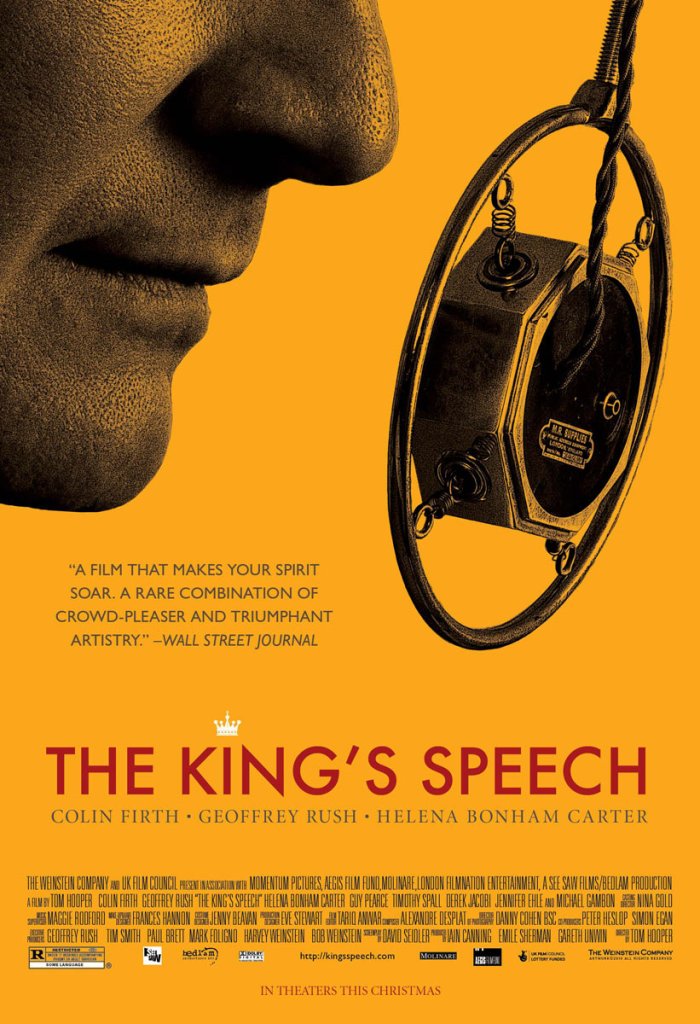
The King's Speech (2010)

The King's Speech (2010)

A King struggles to speak in this Oscar-winning heart-warmer that really works

Director: Tom Hooper

Cast: Colin Firth (King George VI), Geoffrey Rush (Lionel Logue), Helena Bonham Carter (Queen Elizabeth), Guy Pearce (King Edward VIII), Timothy Spall (Winston Churchill), Derek Jacobi (Archbishop Cosmo Lang), Jennifer Ehle (Myrtle Logue), Michael Gambon (King George V), Freya Wilson (Princess Elizabeth), Ramona Marquez (Princess Margaret), Anthony Andrews (Stanley Baldwin), Eve Best (Wallis Simpson)

It can be very hard to imagine the fear and pressure of not being able to trust your own voice. In a world where communication is valued so highly, what terror can it bring if you can’t easily express the thoughts in your own head? It’s a fear perfectly captured in the Oscar-winning The King’s Speech. Because in a constitutional monarchy, what purpose does the King have, but to be a voice for his people? And if the King can’t speak, how can he hope to fulfil his duty? The King’s Speech uses its empathy for those struggling with a condition many find easy to mock and belittle, to create an emotionally compelling and deeply moving story that is a triumph not of overcoming an affliction, but learning how it can be managed and lived with.

In the 1930’s Prince Albert, Duke of York (Colin Firth) is second-in-line for the throne. But unlike his charismatic brother David (Guy Pearce), he’s a tense man uncomfortable in the spotlight, whose life has been blighted by his stammer. As pressure grows from his father George V (Michael Gambon) to take on a more public role, he and his wife Elizabeth (Helena Bonham Carter) begin the process of consulting doctors for “a cure”. But the answer might lie with a former actor turned speech therapist Lionel Logue (Geoffrey Rush), whose techniques are as much psychological as they are practical. As he and the future George VI begin to work together, a tentative friendship forms as the taciturn king begins to open up about his feelings and find real friendship for the first time in his life.

The King’s Speech delivers a well-paced, beautifully written (an Oscar winning script from David Seidler) moving story of two unlikely outsiders who find themselves as unlikely kindred spirits. While it’s easy to see its Oscar win for Best Picture as a triumph of the academy’s conservatism (and there is a case to make, with the film’s heritage style and rather conventional structure and story-telling), but that would be to overlook the emotional impact it carries. I’ve seen the film several times now, and each time I find a lump forming in my throat as it sensitively and intelligently tackles themes of depression, isolation and fear and builds towards the heart-warming achievement of a man who learns his afflictions don’t have to define him.

Hooper (who scooped the Oscar for Best Director) draws superb performances from his actors, as well as bringing his own distinctive style to the film. He had already shown with his TV miniseries John Adams that he could shoot period material with all the immediacy and energy of more modern subjects, and it’s what he does here. His unique framing – with the actor’s often at the edges of the frame, in front of strikingly character-filled surfaces – not only grounds the drama in reality, but also captures a sense of the characters own personal isolation, helped by the frequent intimately-close shots. It helps the film avoid throughout from falling into the “heritage” trap, and instead feel (for all its royal family trappings) like a personal, intimate and real story.

And the intimacy is what makes it work so well – especially since so many of the scenes are made up of two characters sitting and talking, gently but with a slowly peeling honesty, about their own thoughts and feelings. The film is hugely successful in building up our empathy for the often over-looked struggles those who stammer go through. The terror that everyday events can bring. The burden of not mastering your own voice. The anger not being able to express yourself can bring. The resentment of how others can perceive your condition as anything from an irritation to a joke to something that with just a bit of help and effort you could brush aside like a sore toe.

The film has drawn praise for its depiction of stammering – although I am reliably told by an friend with an expertise in such things that the film’s connection of stammering with psychological trauma is old-fashioned and far from proven. But it realistically shows the burdens both it, and a troubled childhood, can bring and draws attention and sympathy to the condition in the best possible way.

A lot of this is helped by Colin Firth’s outstanding, Oscar-winning, performance in the lead role. From first seeing him, his George VI is a buttoned-up man with tension pouring out of every pore, who has chosen taciturn aggression as a defensive alternative to actually having to speak. Firth’s observance of mechanics of stammering is spot on (I wonder if he consulted Jacobi, who has had more than his own experience acting a stammer!), but above all he captures the deep pain, frustration and fear it can bring to a person. Firth’s King is a man who has lived a life feeling coldly shunned by most of his family – an upbringing he is clearly working hard to correct with his sweetly loving relationship with his own children. He’s bitter and angry – not only struggling to understand and express these emotions, but allowing them to crowd out his natural warmth, kindness and generosity which emerge as he opens up to Logue, and experiences genuine friendship for the first time.

Firth sparks beautifully with Geoffrey Rush who is at his playful and eccentric best as Logue. A warm, witty and caring man with a sharp antipodean wit and playful lack of regard for authority (the film mines a lot of fun from Logue’s playful teasing of the stuffed shirt nature of monarchy and the British class system), Rush’s performance is excellent. Just as the King has been dismissed by others for his stammer, so Logue has been dismissed as an actor for his Aussie accent and is scorned by his colleagues for his unconventional methods and lack of qualifications. But, by simply listening to a man who has been lectured to his whole life, who is frightened of himself and his situations, he helps him find a voice (in, of course more ways than one). Rush’s performance is essential to the success of the film, both as the audience surrogate and also a character with his own burdens to overcome.

Backing these two is a superbly judged performance of emotional honesty, matched with that take-no-prisoners bluntness we grew to know in the Queen Mother, from Helena Bonham Carter. The rest of the cast is equally strong. Pearce offers a neat cameo as a bullyingly selfish Edward VIII. Jacobi is overbearingly pompous as the face of the establishment. Jennifer Ehle is wonderfully playful as Logue’s put-upon wife. Andrews contributes a neat little turn as Stanley Baldwin.

Historically the film telescopes events for dramatic purposes. In fact, the future King’s therapy had started almost a decade earlier. Timothy Spall’s Winston Churchill – a rather cliched performance – is converted here into an early supporter of George VI during the abdication crisis (in fact Churchill’s outspoken support for Edward VIII nearly destroyed his career). Baldwin has been partly combined with Chamberlain. Other events are simplified. But it doesn’t really matter too much. Because the emotional heart of the story is true – and the relationship between these two men, and the positive impact they had on each other’s life is what make the film so moving.

Culminating in a near real-time reconstruction of the King’s speech announcing the outbreak of the Second World War – a brilliantly handled, marvellously edited and shot sequence with masterful performances from Firth and Rush – the film is an emotional triumph. Sure, it hardly re-events the wheel, with its struggle to overcome adversity story line and tale of royalty bonding with commoner – but it hardly matters when the rewards are as rich as this. With superb performances all round, in particular from Firth, Rush and Carter and sharp direction of a very good script, this is a treat.

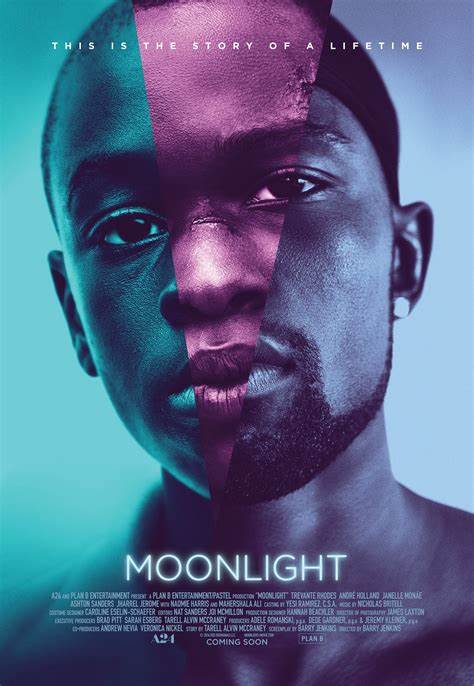
Moonlight (2016)

Mahershala Ali is a mentor with mixed impact in Barry Jenkins tender Moonlight

Director: Barry Jenkins

Cast: Trevante Rhodes (Adult Chiron/”Black”), Ashton Saunders (Teenage Chiron), Alex Hibbert (Young Chiron/”Little”), André Holland (Adult Kevin), Jharrel Jerome (Teenage Kevin), Jaden Piner (Young Kevin), Naomie Harris (Paula), Mahershala Ali (Juan), Janelle Monáe (Teresa), Patrick Decile (Terrel)

What makes us the people we are? So many things in our environment, personalities and influences can shape the people we are. Imagine, though, how much we might end up twisting and manipulating ourselves, if some of the core parts of what made us who we are, ran against the expectations of our community. It’s the fascinating, poetic heart of Moonlight, Barry Jenkins’ astonishingly tender Oscar-winner, which shows a side of the Black American experience that so rarely makes it to the screen.

In three acts, we see the life of Chiron, from a young child, to a confused teenager to a muscular, adult drug dealer. Played by a different actor at each age, each self-contained half-an-hour-or-so act sees him struggle with understanding who he is, and deal with the impact that different people have on shaping the man he is, from his mother Paula (Naomi Harris), a woman embracing a destructive drug addiction, to his mentor as a young boy, the thoughtful drug dealer Juan (Mahershala Ali) and his caring girlfriend Teresa (Janelle Monáe). Perhaps the core influence however is childhood friend Kevin, the love of Chiron’s life. Because Chiron is struggling with the fact he is gay, in a community where macho masculinity is all important.

Jenkins’ thoughtful and beautifully made film is a wonderful coming-of-age story, that explores deeply emotional territory with sensitivity and care. Jenkins invests the entire story with a beautiful sense of poetry and an echoing, longing sense of sadness. The entire film is constructed of paths not taken, of lost opportunities and painful misunderstandings. It asks profound questions around the people who inspire us, the impact our parents can have, the damaging impact of trying to conform with the world, and the struggle we can take to understand ourselves.

Because the main theme that runs through each act is Chiron’s struggle to come to terms with his homosexuality. As a young boy it’s something he’s beginning to be aware of – and the distance it brings, knowing he’s different from his fellow kids. It’s there in the cruel treatment he receives from his mother. As a young boy, there is the potential that his life could go another way – something that his mentor figure, drug dealer Juan, detects (perhaps, the film subtly implies, because it echoes lost opportunities and ignored feelings in Juan’s own life).

The middle act shows how these chances can be truly lost, how our teenage experiences can shake us. Because Chiron is different in a way that will never gain true acceptance in such a macho environment, where Chiron has it enforced to him time and time again that his sexuality is a weakness, something that dirties him and makes him less than others. Jenkins’ film offers a beautiful view of how a teenager can be made to feel ashamed of themselves and the person they are – to the extent that his reaction after his first sexual experience with his childhood friend Kevin is to apologise. Chiron hasn’t been given the emotional confidence or language to be comfortable with who he is – Juan is the only person who has ever told him that there is nothing wrong with being gay. Chiron instead has to cope with isolation, guilt and shame – emotions that Jenkins’ beautifully structured middle-chapters show, push him more and more towards anger and rage.

It’s perhaps not surprising that Chiron as a young adult has turned himself as much as possible into what his community believes “a man should be”. It’s striking how similar he looks to Juan – from his dress and jewelry, to his muscular manner and his profession. The skinny boy of the first two chapters has become a muscle-bound, intimidating young man. What hasn’t changed is his emotional distance, his isolation. In fact, what has been magnified is his desire to be loved, to feel a connection. A connection that he arguably hasn’t felt for over a decade.

The film can speak to anyone who has had problems fitting in, who feels different from others. Jenkins fits it beautifully into a community he was familiar with, a Black community (there isn’t a single white person anywhere in the film) that values qualities of masculinity and aggression that run counter to Chiron’s own personality, but which he is forced to conform with. This is such a compromised community that the person who understands Chiron most – the drug dealer Juan – is also a big part of the problem, supplying the drugs that are affecting his mother’s life and a leading part of the violent, macho world Chiron lives in.

This mentor relationship is the beating heart of the much of the film – helped by Mahershala Ali’s wonderfully judged (Oscar-winning) performance as Juan. Juan is a man of contrasts, thoughtful and tender, understanding of the internal struggles of a young man (has he dealt with them himself), but also moving in a violent and destructive world, a leading part of the criminal community that dominates Chiron’s world. He offers enough of a lost opportunity for Chiron to have reshaped his life – while also propping up the world that will crush him.

Juan is certainly a big part of destroying Chiron’s mother Paula. Naomi Harris is superbly damaged, raw and uncontrolled as an addict we see disintegrate over the first two chapters until she settles into the fragile older woman plagued with guilt in the final act. This is a mother who offers no love and support to her son, who denigrates him for his differences and builds a world around him that has no love or understanding in it. Her collapse is as much a criticism of the horrors and compromises of this community as it is a terrible warning story.

Jenkins’ film looks phenomenal, with a style that marries poetry and realism. It can feature young boys playing in the park with aggressive naturalness, underscored with Mozart. There is a beautiful running theme of water, cropping up at key moments of Chiron’s life: from the swimming lesson Juan gives him, to the cold water he cleans his face in after a teenage beating, to the adult Chiron largely drinking only water (perhaps to make sure he never slips and reveals too much of himself). It’s a gentle touch – reflected as well in the cool blues that frequently cover the screen, like the wash of water.

The actors portraying Chiron and Kevin are wonderful. The final act revolves around a beautifully played scene between Trevante Rhodes and André Holland as their adult versions, a low-key, but deeply emotional, conversation that sees them carefully skirt round a host of emotions that can never be expressed, partly as neither character as the emotional hinterland to use them.

Jenkin’s film won a deserved Oscar as Best Picture. It deserves it for showing us two worlds we see so little in film: both the working-class Black community, but also the life of a young gay man in modern America. It’s wonderfully judged, low-key, personal and with a slight story carries great emotional force. It gives you far more to think about and consider than you might at first expect, and makes for an eye-opening and deeply involving film.

Gladiator (2000)

Russell Crowe dominates in Ridley Scott’s Oscar-winning Gladiator

Director: Ridley Scott

Cast: Russell Crowe (Maximus Decimus Meridius), Joaquin Phoenix (Emperor Commodus), Connie Nielsen (Lucilla), Richard Harris (Emperor Marcus Aurelius), Oliver Reed (Proximo), Derek Jacobi (Senator Gracchus), Djimon Hounsou (Juba), Tomas Arana (General Quintus), Spencer Treat Clark (Lucius Verus), David Schofield (Senator Falco), John Shrapnel (Senator Gaius), Rolf Moller (Hagen), Tommy Flanagan (Cicero), David Hemmings (Cassius)

When Gladiator hit the big-screen the swords-and-sandals epic genre was dead. A relic of the early days of technicolour Hollywood, where the widest possible screens were designed to tempt audiences away from the television and into the movie theatre, Roman epics were often seen as stodgy things, usually carrying heavy-handed Christian themes while gleefully throwing as much of the decadence of the empire on the screen as possible. Gladiator changed all that, bringing an emotional and psychological complexity to the genre, as well as a rollicking good story and some brilliant film-making. An Oscar for Best Picture confirmed the genre was back.

In 180 AD General Maximus Decimus Meridius (Russell Crowe) commands the final battle of the Roman forces to conquer the German tribes and bring them under the control of the Emperor Marcus Aurelius (Richard Harris). The humble, dutiful and principled Maximus is a natural leader and the son Marcus Aurelius wishes he had, rather than the son he has the insecure and ambitious Commodus (Joaquin Phoenix). When the Emperor decides that Maximus not Commodus will succeed him – with the brief to restore the Roman republic – Commodus murders the Emperor. When Maximus refuses to give Commodus his loyalty, the new Emperor sentences him and his family to death. Maximus escapes, although he is badly injured, but arrives too late at his home to save his wife and son from death. Collapsing, the General is taken by slavers, healed by fellow slave Juba (Djimon Hounsou) and sold to the North African Gladiator school of Proximo (Oliver Reed). Maximus will play the Gladiator game – because he longs to have his revenge on Commodus.

Gladiator is superbly directed by Ridley Scott, who perfectly mixes the epic scale of the drama with the intimate, human story at its heart. The film looks absolutely fantastic from start to finish, with the superb visuals backed by a breathtakingly beautiful score by Hans Zimmer and Lisa Gerrard that skilfully uses refrains and themes to instantly identify the core emotions in the audiences mind. These themes are associated with emotional beats that immediately plug us into the interior thoughts and emotions of the characters. 

It works because of the emotional truth at its heart. Basically it’s a love story between a man and his dead wife, and isn’t afraid to explore the depths of love that we feel for those closest to us and our pain of their loss. Maximus’ wife and child are represented in silent flashbacks and by two small icons Maximus carries with him on campaign. When, late in the film, he is reunited with these items his raw, tearfully quiet joy carry as much force as any real reunion would do. What drives the film is less a drive for revenge – although there is no doubt this is a motivator for Maximus – but of a continued sense that he must fulfil all his duties (in this case restore the Republic as his surrogate father wished) before he can return to his wife and son (i.e. die).

It’s that which makes the film so easy to invest in emotionally, and which makes Maximus (a hardened killer) so easy to relate to. If he was just a raging man out for revenge, the film would carry a leaner harsher look. But he is instead a man motivated by love, who yearns to be with his family again. Mortality hangs over the entire film – the first shot of the film, famously of the hands in the wheat, have buried themselves in the consciousness because we can all relate to a man who longs to lay down his labours and be with the people he loves. Christianity doesn’t appear too much in Gladiator (unlike older Hollywood Roman epics) but faith is there in spades. And Maximus will do nothing that will jeopardise a reunion with his family in heaven.

This deeply involving story of a man who remains faithful to the memory of his wife – and Scott wisely removed any love plot with Lucilla, which would have felt like cheatingso strongly does the film build Maximus’ love for his wife – that audiences are happy to go with the film through all the violence that follows. Gladiator hit the sweetspot of having something for everyone, from emotion to action. And the action is brilliant. The opening battles is hugely impressive, from its scale to the imaginative interpretation of Roman tactics. It’s trumped by the more raw and ragged action that comes in the Gladiatorial ring, as Maximus transfers his brutal efficiency at war into the ring for the amusement of the crowd.

Like all Gladiator films and series the film successfully has its cake and eats it – so we get a sense of the horror of people fighting to the death for our entertainment, while also heartily enjoying watching our heroes kick ass. The sequence that uses this most effectively, as Proximo’s outmatched Gladiators follow Maximus’ strategic experience and military training to defeat a group of deadly chariot fighters, would-be a stand out in any movie.

The film further works due to the assured brilliance of the Oscar-winning Russell Crowe in the lead role. Crowe exudes natural authority as a general – he genuinely feels like the sort of man that first his soldiers and then his fellow Gladiators will follow to the bitter end. Crowe also dives deep into the soulful sadness at the heart of Maximus, the romantic longing and the searing pain of the betrayal and murder of his family. It’s a performance of immense, small-scale intimacy that also never once gets over-shadowed by the huge spectacle around him. I’m not sure many other actors could have pulled it off.

But the whole cast is extremely strong, Scott encouraging great work across the board. Joaquin Phoenix in particular takes the villain role to a bravely unusual place. His Commodus, far from a sneering Caligula, is in fact a weak, anxious, jealous even strangely pitiable man, so insecure and riven with envy for others that he becomes twisted by it. But we never lose a sense of the humanity at his heart, the sense of a little boy lost, scared by the world around him. It makes sense the Connie Nielsen’s Lucilla – walking a difficult line as a character who has to play both sides – could both fear and hate him but still love the fragile little brother she still senses in him.

Scott’s trusting of experienced pros – many you feel hungry for an opportunity like this – is clear throughout the whole cast. Richard Harris was pulled out of a career slump and reinvented here as an elder statesman, with a wry, playful and eventually moving performance as Marcus Aurelius. Scott’s biggest risk was pulling Oliver Reed from a life better known for drinking bouts to play Proximo. Playing his best role for almost thirty years, Reed reminded us all for one last time that as well as a chat-show joke he was also a powerful and dominant performer, his Proximo a snarling scene stealer. Reed’s death – his final scenes completed with special effects – made this a better tribute than he could have ever imagined.

There are few feet placed wrong in Gladiator. As an action spectacular it’s faultless, but this works because of the truth and love at its heart. It creates an epic that is emotionally involving as it is exciting to watch. The reconstruction of Rome is hugely impressive and Scott paces the film perfectly, letting its force grow along. You never once feel thrown by its scope, and so completely does it wrap you up that, as it becomes more operatic in the final act, the film is never at risk of losing you. It deserves to be remembered with the best of the Hollywood epics.

Amadeus (1984)

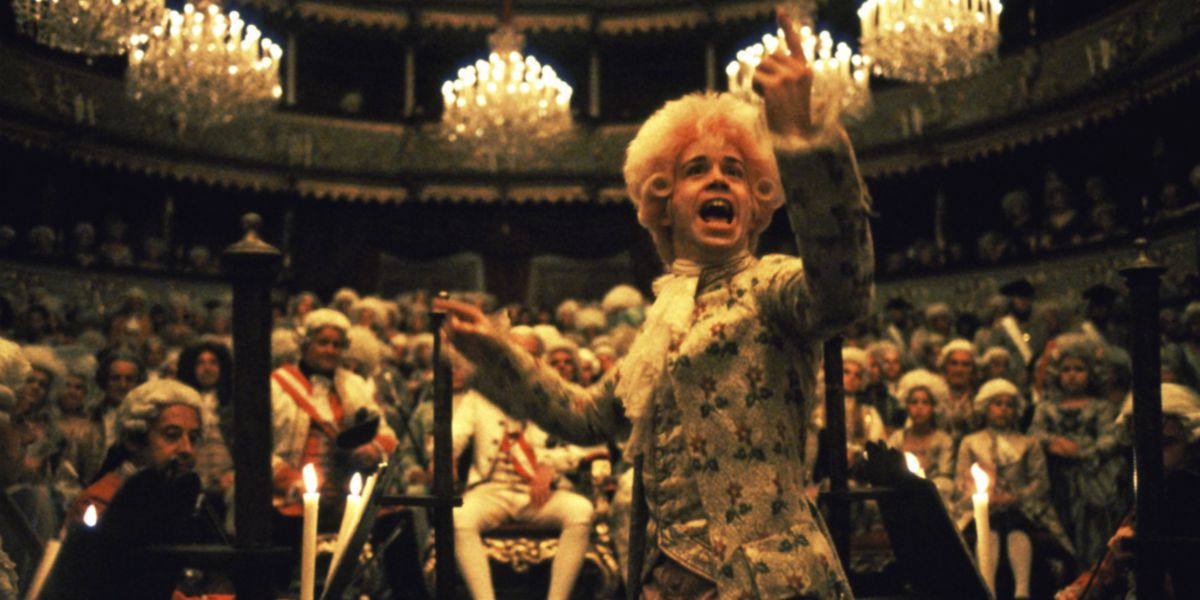
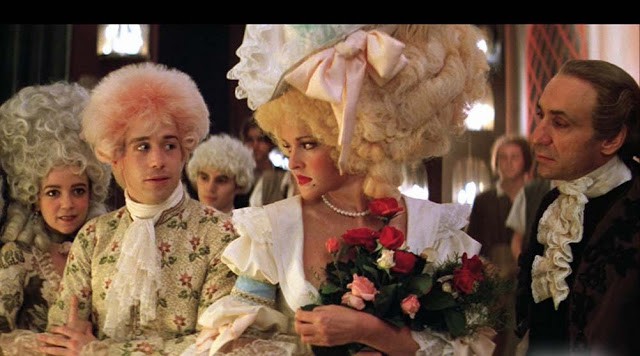
Tom Hulce is the childlike genius in Amadeus

Director: Milos Forman

Cast: F. Murray Abraham (Antonio Salieri), Tom Hulce (Wolfgang Amadeus Mozart), Elizabeth Berridge (Constanze Mozart), Roy Dotrice (Leopold Mozart), Simon Callow (Emanuel Schikaneder), Christine Ebersole (Caterina Cavalieri), Jeffrey Jones (Emperor Joseph II), Charles Kay (Count Orsini-Rosenberg), Kenneth McMillan (Michael Schlumberg), Richard Frank (Father Vogler), Cynthia Nixon (Lorl), Patrick Hines (Kapellmeister Giuseppe Bonno), Jonathan Moore (Baron von Swieten)

Peter Shaffer’s Amadeus was a smash hit play, both at the National Theatre and on Broadway. With such a delicious plot line – captured so beautifully in its tag line “The Man, the Music, the Madness, the Murder!” – is it any wonder that this fable about the life of Mozart, framed around the envy of his contemporary Antonio Salieri who, as an old man, claims to have murdered the great genius, was swiftly bought to the screen? Radically reworked and restructured by Peter Shaffer for the screen, Amadeus may stand as one of the few times where the script for the film is superior to the script for the stage. And the film itself is so carved out of radiance, that every single production of the play will forever live in its shadow.

As an old man Antonio Salieri (F. Murray Abraham) confesses to the murder of Wolfgang Amadeus Mozart (Tom Hulce). After a suicide attempt, he tells his tale to a young priest (Richard Frank). As a younger man, Salieri was the court composer to Emperor Joseph II (Jeffrey Jones). He has everything he dreamed of as a young man – fame, riches and a life of music – all of which fortune he sees as a sign from God. His world view is shaken with the arrival in Vienna of the young genius Mozart. A brilliant artist and composer, with a God-given gift for composition, Mozart is also everything the reserved Salieri is not – brash, rude, impulsive and a man of once-in-a-generation talent. How, Salieri wonders, could a man like him be given all the gifts, while Salieri’s music is merely competent? Salieri believes this is a cruel joke played on him by God – made worse by the realisation that alone in Vienna society, Salieri seems able to recognise the genius. Salieri decides to destroy this chosen child of God once and for all.

Shot on location in Prague – and Czech defector Milos Forman was treated as a returning hero when he bought the film there – Amadeus is perhaps one of the most strikingly beautiful films ever made. The cinematography is luscious, the production design – utilising every inch of the almost untouched-since-the-18th-century Prague settings (Thank God for Communist inefficiency Forman joked) – sinks you into the era completely while the costume design is striking, imaginative and excellent. The film is an opulent feast. But it is a million miles from being a staid period piece – instead this is something fresh, bold and modern.

Amadeus is perhaps one of my favourite films of all time. I just think it gets everything more or less right. Not least, capturing the idea of the passions and struggle of creativity. It’s clear why this story spoke so clearly to Hollywood, because no film captures as well as this one, the horrible plight of the competent journeymen, working every hour, while watching an effortless genius create masterpieces as easy as breathing. That’s the real tension here – and what makes us all empathise with Salieri, at least on some level. All of us have looked at the things we create – be it putting up a shelf to writing a play – and frustratingly seen our grasp exceed our reach, while seeing others do what we have so failed to achieve with frustrating ease.

Matched in with this, it’s a film that understands perhaps better than any other the burdensome process of creation. It’s easy for viewers to just remember the childish excess of Mozart – but Forman and Shaffer also show a dedicated and passionate worker. Hulce’s Mozart crouches over a billiard table, oblivious to the world around him while he composes (the soundtrack, as it often does, is flooded with the score he is composing, while his wife tries to get his attention – snapping to silence as soon as she succeeds). His dedication to his music is absolute – in his first scene, only hearing the orchestra starting to play his music before his arrival snaps him out of his raucously rude flirtatious banter with Constanze. Scenes of him conducting and directing rehearsals pinpoint his exactitude and perfection. Salieri as well is seen frequently labouring carefully and precisely over his work, while lacking the inspiration of Mozart.

It’s pinpointed with a beautiful late scene, where a bed-ridden Mozart dictates his Requiem score to Salieri. Mozart is electric, precise, his thinking fast-paced, complete, his passion for the score all-consuming – with poor Salieri desperately trying to keep up (“You go to fast” he frequently whines). It’s a scene that captures completely the intensity of mining creation. (Hulce apparently deliberately skipped lines during the scene, to add to Abraham’s confusion in the scene – with Abraham’s later agreement!). Its part of what the film beautifully captures, how being able to bring your ideas, perfectly formed, into the world is the most enchanting drug of all.

So you can see why Salieri grows too loath this blessed talent. In a wonderful moment – again perfectly utilising Forman’s decision to use the music as almost a character in the piece – he flicks through a portfolio of Mozart compositions, all of them first drafts devoid of any correction, the music playing in his head (and on the soundtrack) as he reads. It’s the sort of skill his diligent and slavish composition could never achieve.

It’s pinpointed even more in their first scene together, where Mozart arrives at Joseph’s court. The emperor plays a small welcoming march, composed by Salieri, which is fine. Mozart not only memorises the tune on first hearing it (“The rest is just the same?”) but then beautifully starts to play with it before suddenly turning it into an aria from The Marriage of Figaro, composing this beautiful piece on the spot. Nothing could be more devastating but to see your hack work improved in front of others into something genius – and the genius in question to be so oblivious of the impact, that he behaves like he’s done you a favour. No scene in the movies, I believe, has ever captured so completely this world of difference between the journeyman and the artist.

The film is crammed full of moments like this, all perfectly delivered by a perfectly chosen cast. The film was controversial at the time for using American actors – with their natural accents – rather than Brits (the “American accents jar the ear” whined Brit critic Leslie Halliwell). In fact it’s an inspired idea, that adds an air of modernity to the piece, but also principally opens the door to making the whole genre less stuffy (as if 18th century Venetians would speak with received pronunciation). The only characters who speak with English accents are the most upper-class, Italian-fixated, Opera purists. Everyone else – with even Simon Callow (the original stage Mozart, here in his film debut) adopting an accent – speaks with a Yank twang.

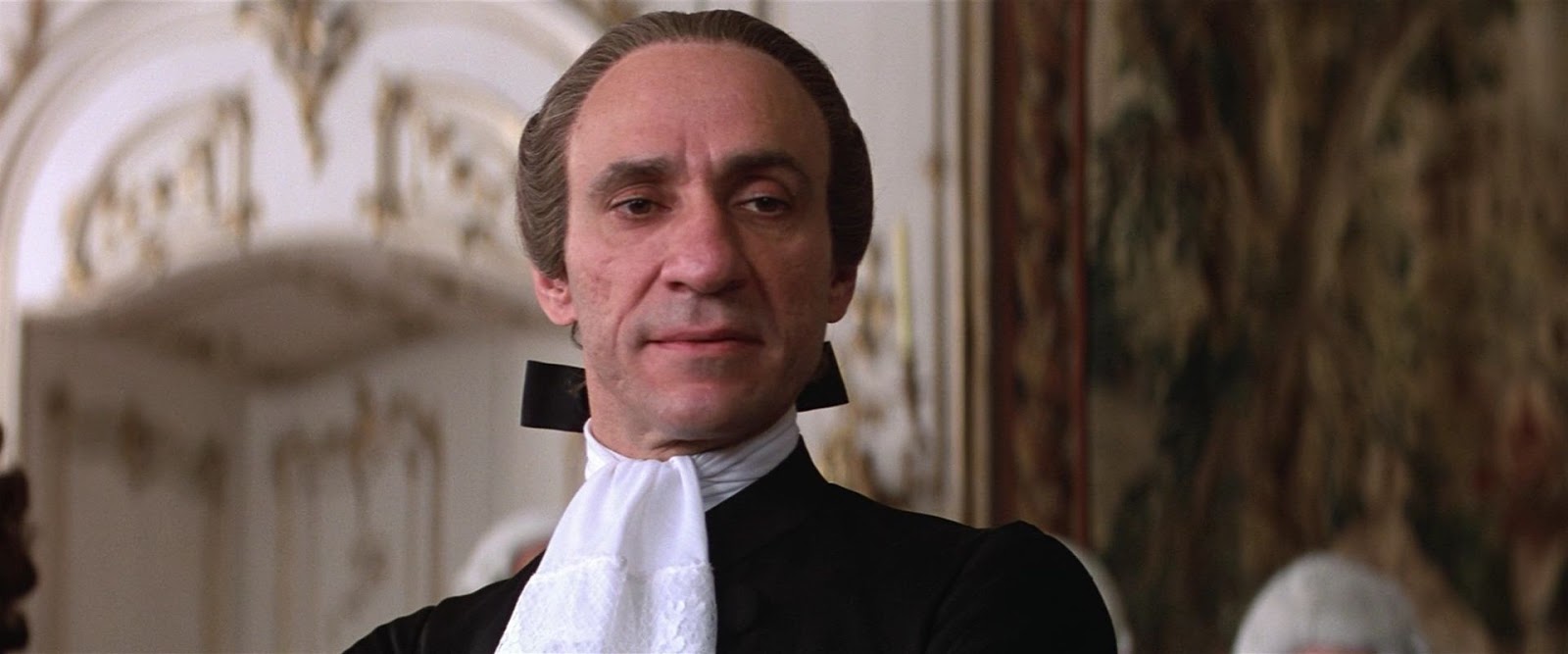
F. Murray Abraham beat out seemingly the whole Western acting world to land the leading role of Salieri. (In a backhanded compliment if ever I heard it, Forman suggested on meeting Abraham that he simply was Salieri). Abraham’s precise, detailed and beautifully judged performance – which allows gallons of resentment and self-pity to bubble under the surface of a tight self-control. He also has a wonderful spry lightness as his elder self, who has come to terms with his failures. It’s a brilliant role – and one Abraham struggled to match for decades to come.

Tom Hulce is equally superb as Mozart. I’ve talked a lot about how wonderfully the film – and Hulce – captures inspiration. But Hulce perfectly mixes this with a childlike vulnerability, an impulsive foolishness and sense of absurdity. His Mozart is frequently rude, obnoxious and interested only in a good time – frequently losing nights to drink, sleeping around with a crude sense of humour. But he’s also sweetly childlike, who needs to be looked after – Elizabeth Berridge (very good, a late replacement for Meg Tilly during shooting) as Constanze frequently has to mother him and manage his life and career. The rest of the cast are equally strong, from Jeffrey Jones’ studied normality as the Emperor, to Roy Dotrice’s firmness as Mozart’s disapproving father.

Amadeus brings this all together superbly – Forman’s direction is faultless – and mixes it together with Mozart’s music. Not a single piece of music is used twice in the film, and each quote from the music has been perfectly chosen to reflect the scene, from the film’s opening with Symphony #25 to its close with the Requiem. Sections from opera performances are shown – with the actors conducting (both learnt). The music soaks through the whole film – Shaffer and Forman believed it was the “third lead”. And it perfectly captures the tone and emotion every time, deepening and enriching the film itself.

Winning eight Oscars (including Picture, Director, Actor for Abraham and Screenplay), Amadeus is not only the best film ever made about classical music, it’s also one of the most fascinating and profoundly engaging films ever made about creativity. Does it matter that historically it’s all bunk? Not really at all, as a fictionalised exploration of how the average can be tormented by the extraordinary it’s perfect.

Gandhi (1982)

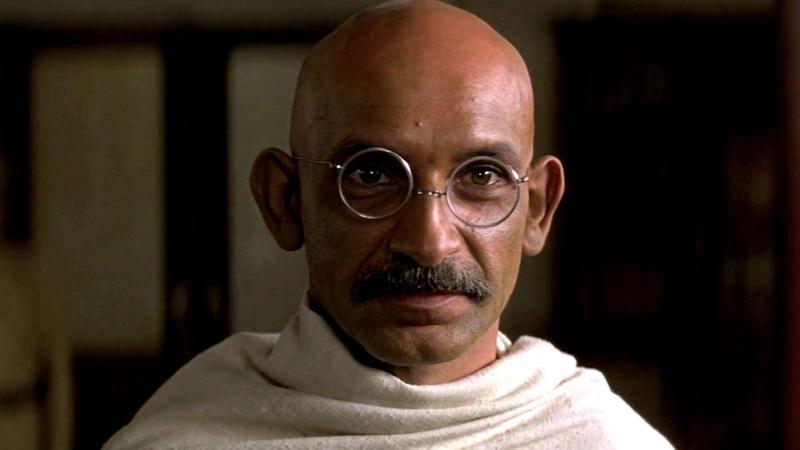
Ben Kingsley excels as Gandhi in Richard Attenborough’s Oscar winning epic

Director: Richard Attenborough

Cast: Ben Kingsley (Mahatma Gandhi), Rohini Hattaggadi (Kasturba Gandhi), Roshan Seth (Jawaharlal Nehru), Pradeep Kumar (VK Krishna Menon), Saeed Jaffrey (Vallabhbhai Patel), Alyque Padamsee (Muhammad Ali Jinnah), Virendra Razdan (Maulana Azad), Candice Bergen (Margaret Bourke-White), Edward Fox (Brigadier General Reginald Dyer), John Gielgud (Lord Irwin), Trevor Howard (Judge Broomfield), John Mills (Lord Chelmsford), Martin Sheen (Vince Walker), Ian Charleson (Reverend Charles Andrews), Arthul Fugard (General Jan Smuts), Geraldine James (Mirabehn), Amrish Puri (Khan), Ian Bannan (Senior Officer Fields), Richard Griffiths (Collins), Nigel Hawthorne (Kinnoch), Michael Hordern (Sir George Hodge), Om Puri (Nahari)

In 1962, Richard Attenborough was approached by Motilal Kothari, an Indian civil servant, who believed Attenborough was the man to bring the life of Mahatma Gandhi to film. All this despite Attenborough having never directed a film. But the life of one of history’s greatest men, and passionate advocate of peace and non-violence, spoke deeply to the socially-engaged Attenborough who dedicated 20 years of his life to bringing the film to the screen, immersing himself in Indian culture along the way and winning the support of Nehru (until his death delayed the project again) and Gandhi’s family. The eventual film was a huge success, cementing the public perception of Gandhi and beautifully capturing both the importance of the story, and its emotional heart.

Opening with Gandhi’s assassination in 1948, the film covers in flashback his life from combatting anti-Indian prejudice in South Africa as a young, British-trained, lawyer to his return to India and long involvement in the campaign to win India its independence from the British Empire, stressing non-co-operation, his eventual success but also his failure to hold the Hindu and Muslim parts of the country together and his attempt as “father of the nation” to put an end to religious violence, a failure that will eventually lead to his assassination. 

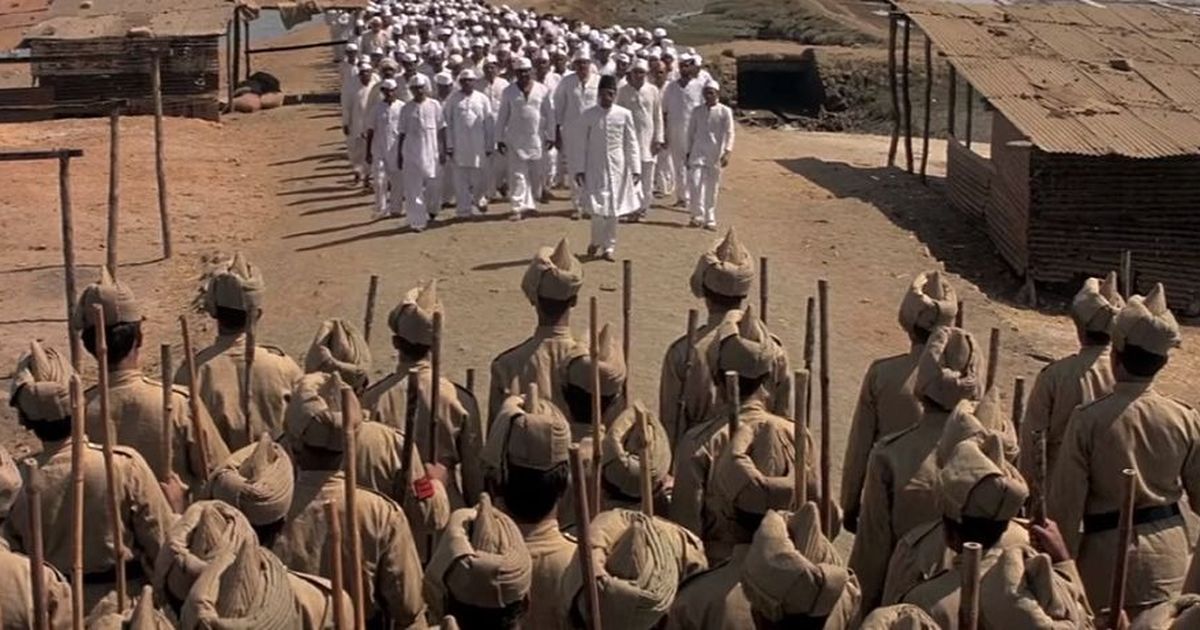
Attenborough’s grand, epic film marshals thousands of extras to bring to life pages of history. At times events fly by with speed, but Attenborough never loses sight of the emotional heart of the story – both Gandhi and the status of Indians as not being masters in their own home. Attenborough directs scenes of real power, most strikingly a heart-rending peaceful march on a salt works (the tax on salt use being a major burden on many poor Indians) that culminates in line after line of peaceful Indian protestors walking calmly forward to be beaten down by soldiers. Despite being the grandest and largest of films, it allows questions of pure morality and decency to lie at its heart and, supported by a parade of British acting greats, keeps the Indians at the heart of their own story and the masters of their own destinies.

The film’s impact though may be directly connected to the gloriously transcendent performance of Ben Kingsley in the title role. For years it was believed the film could only work with a British actor in the title role – imagine how it would be received today if Gandhi had been played by (as it nearly was) a browned-up Anthony Hopkins or John Hurt (who famously told Attenborough he looked absurd). Instead half-Indian unknown RSC actor Ben Kingsley took the role. Kingsley so completely and utterly immersed himself in Gandhi – everything, the physicality, the morality, the voice, the intellectualism – that not only has he become so completely associated with the role but it’s hard to imagine anyone else playing it.

Ageing almost 50 years over the course of the film, Kingsley’s Gandhi is above-all moral, softly-spoken, observant and considerate – the very spirit of the original man seems to be up on the screen. Far from the sort of histrionics you might expect from a subject of an epic movie, Kingsley is not afraid to be quiet, gentle even underplayed. He completely understands that the charisma and power in Gandhi laid in his moral authority, not his speech-making, but his careful example-setting of even-handedness, patience and desire for peace. 

But Kingsley is also willing to show Gandhi as shrewd and stubborn, even while mixing it with both a deep pain at the loss of life. Kingsley is superbly good at the smaller quieter moments – he wrings heart-rending force from the loss of his wife (a similarly impressive and quietly authoritative performance from Rohini Hattaggadi), which partly works because the film quietly centres the truth and faith in their marriage. This is extraordinary work from Ben Kingsley, that seems to carry not just the entire film but the sense of a nation.

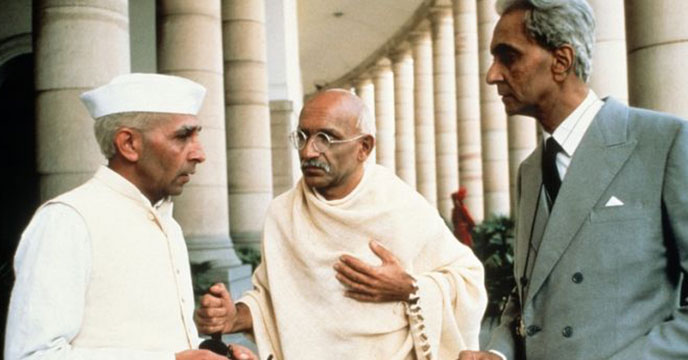
Attenborough though was a director who was at his best when working with actors, and his ability to coax truthful and heartfelt moments from quiet scenes are what gives the other sequences the emotional force to make them work. Attenborough seemingly called in every favour to assemble the supporting cast that backs up Kingsley, many of them juggling only a few scenes. Among the stand-outs we have a martially certain Edward Fox as General Dyer, an archly arrogant John Gielgud and a frustrated John Mills as viceroys, Trevor Howard representing decent British rule as an honest Judge and Martin Sheen as a reformist minded journalist. That’s to overlook dozens of others in small roles, all of them clearly committed to the intention of the project.

The film though allows the Indians themselves to take centre stage, even if it is easy to criticise some of the simplifications of many of the issues that would eventually culminate in partition. The film has a clear hostility towards the idea of religion, seeing it as the root of much of the violence that erupted in India in the last years of Gandhi’s life. While Roshan Seth is excellent as Nehru, the character is portrayed more as the faithful follower of Gandhi than the shrewd politician in his own right (it’s a role most of the other leading members of congress are also placed in). Alyque Padamsee carries a high level of charisma as Jinnah, founder of Pakistan – but the film can’t quite resist painting him into the corner as a semi-villain, ignoring Gandhi’s desperation to get Jinnah to invest in a united India.

It’s part of what has been seen since as the film’s more hagiographic stance towards Gandhi. Certainly later historiography has outlined a few shades of grey in Gandhi – although I would argue that seeing him as a man and not a saint only heightens (similar to Mandela) the awe at what he went on to achieve. The film’s whistle stop tour of Indian history – taking in every major event and personality, some in a matter of moments – looks particularly old-fashioned now with our current trend being biographical films that focus only on crucial moments, not the whole life. It adds a slight air of schoolboy history to the project, an unfortunate side-effect of the passionate earnestness with which the story is told.

But then even in 1982 – when it lifted 8 Oscars including Best Picture, Director and Actor and most of the technicals – it was seen as slightly old-fashioned. Attenborough has generously repeatedly said that he believed Steven Spielberg was more deserving of Best Director for ET. And it’s true that Attenborough was in many ways a producer at heart with these epics than an inspired director like Lean. His marshalling of crowds, finances and simply forcing the will together to make the picture – and to allow it to focus on Indians rather than Westerners – is a tribute to his organisational skills. His strengths as a director were more in performances, and as with many of his epic films the most memorable moments are smaller, intimate ones. The larger moments are shot with an assured professionalism rather than inspiration, but Attenborough understands how to wring emotion from moments and how to let character drive action.

Gandhi works above all because even today you can see it is a passionate labour of love, that everyone involved in clearly believed in passionately. It may well be that at times it is workmanlike or simplistic – and covers the sweep of history with an earnest completeness, even while it is unafraid to be critical certainly of the British – but it still invests it crucial moments with humanity, life and deep emotion. You can’t help but be moved by it – and you are instantly stunned by the sheer brilliance of Kingsley as Gandhi, one of those performances like George C Scott as Patton which seems more like the man than the real thing. Gandhi may be old fashioned, but that’s not a crime when the quality is still there.