Category: British Films

The Long Good Friday (1980)

Bob Hoskins rules London – but for how long? – in classic Brit gangster masterpiece The Long Good Friday

Director: John Mackenzie

Cast: Bob Hoskins (Harold Shand), Helen Mirren (Victoria), Derek Thompson (Jeff), Bryan Marshall (Harris), PH Moriarty (Razors), Dave King (Parky), Eddie Constantine (Charlie), Paul Freeman (Colin), Stephen Davies (Tony), Paul Barber (Errol), Pierce Brosnan (Irishman)

The Long Good Friday nearly turned into a one-hour TV special starring a dubbed Bob Hoskins. The fact that it didn’t – and that today it can stand as one of the greatest British films ever made – is thanks to George Harrison’s Handmade Films, which bought the rights and saved the film. Thank God they did, as this is brilliant: thrilling, dangerous, intense but witty, strangely tender, satirical and smart. Fantastically made and wonderfully acted, it’s not just a great gangster film, it’s a great film.

Harold Shand (Bob Hoskins) is the undisputed gangland boss of London, desperate to turn legitimate. He has a plan for development of London’s dockside into a paradise of office blocks and apartments. All he needs is a big investor to support his “corporation” to make the final push. On an Easter weekend he prepares to greet an American investor from a similar “company” to his own. But as Shand prepares for this life-changing weekend, his business is hit by a wave of killings and bombings that seem targeted at shattering his organisation. What’s behind this? Who is “having a go”? And how does this link with a mysterious money shipment we witnessed at the start of the film? Shand’s going to find out – and has to do so without his investors getting cold feet.

The Long Good Friday is a well-written, brilliantly structured mystery mixed with some brutal gangland violence. Mackenzie’s film is lean and mean but laced with dry, biting humour. Everything in the film works perfectly, and it really understands the veneer of culture, class and decency that gangsters like Shand like to put over their crime dealings.

Not that Shand isn’t a decent bloke of course. Bob Hoskins is simply superb as Shand, a likeable, strangely decent guy at first, who seems to somehow shrink and twist as the film progresses and he is less and less able to control the anger he keeps bottled up. Shand clearly cares deeply for those around him, but he’s also clearly stubborn and convinced of his own superiority. Hoskins brings the part a humane gravitas, a force of nature fury that burns through the film. And when confronted with opponents he can’t understand, he still tries to use the rules of gangland to take them on.

Of course these rules are completely unsuited for his IRA opponents. Despite the advice of his pet policeman Parky, Shand is confident that he can deal with these bomb-toting fanatics. Even worse, he thinks that they are basically playing by the same rules that powered his own rise to the top of the gangster tree. Part of the tragedy of the part is seeing someone who essentially appears relatively likeable at the start of the film fall back on the violence and rage that powered his assent to the very top. Needless to say the IRA aren’t intimidated by cockney thugs, and have no intention of letting Shand get away with his attempts to strike back. 

Here is a film brave enough to not only show the IRA at its centre, but to make them as effective and ruthless as this. Not even our geezer gangsters can take them on, and the poor plods seem petrified as soon as they rear their head. Could there be a more cutting criticism of Britain’s policy in Ireland? Terrorism has hardly gone away since – you imagine Shand being equally outmatched by Al-Qaida.
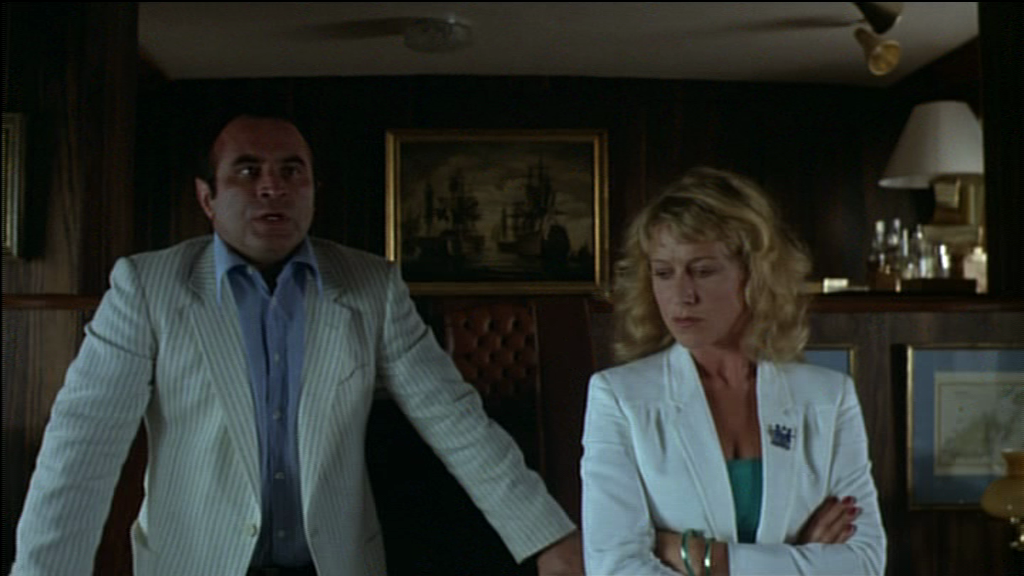
As well as a gripping gangster film, The Long Good Friday is a prescient and intelligent criticism of Thatcherism. Shand is actually pretty much spot-on with his vision of London being redeveloped into a political and economic power-house, one of the major cities of Europe. Many of the locations the film uses would be unrecognisible today, as they are all sites of offices and apartments. Shand has a 1980s swagger to him, a barrow-boy made good who likes to think of himself as a visionary businessman. He’s desperate to grab for himself a bit of the new money he senses could be washing around Thatcher’s Britain. So the film makes a nice satire of the “loadsamoney” generation, as well as of the gangster world of the East End. Shand’s yacht and flat are the quintessential yuppie pads, and Shand’s motivation is raking the cash in.

British hubris actually seems to lie at the heart of the whole film. Shand’s swagger and super-confident, “Britain reborn” attitudes are all based in his firm belief that Britain has its own special destiny. Of course, as events begin to hit home, this sense of British pride (represented by Shand’s determination to reshape London into a city of glass and office complexes) begins to shrivel under the weight of events. Shand is reduced to angrily denouncing everyone from the Irish to his potential American partners to the other nations of Europe.

(In fact it’s interesting watching the film in the light of Brexit – Shand would on the surface seem to be the poster boy for a certain type of UKIPer, but he’s actually passionately excited about the opportunities the Union presents, and the centrality of London to that world. He’d almost certainly loath Farage.)

All this thematic content – and this is a hugely British film, instantly recognisable to anyone who has grown up here – gets swept up in this brilliant gangster flick. The acting is sublime. Helen Mirren is a stand-out as a woman who is a very equal partner in Shand’s business empire, just as smart and just as ruthless. Derek Thompson (him off Casualty!) is good as a slightly sleazy major-domo, as is PH Moriarty as a gangland heavy (he certainly looks the part!). Future stars like Kevin McNally, Paul Freeman, Dexter Fletcher (as a kid) and most notably Pierce Brosnan (in his first acting job as a handsome IRA hitman) fill out the cast.

Brilliantly acted, tightly directed and full of great cultural and political depth, with terrific pace, scintillating action, engrossing tension, a deceptively simple story and a great script: The Long Good Friday surely stands as a landmark British film. And it has one of the finest final sequences you’ll see, which considering it revolves solely around Hoskins sitting in a car is saying something.

If… (1968)

Malcolm McDowell as contemptuous bitter student Mick Travis in counter-culture classic If…

Director: Lindsay Anderson

Cast: Malcolm McDowell (Mick Travis), Richard Warwick (Wallace), David Wood (Johnny), Christine Noonan (The Girl), Robert Swann (Rowntree), Peter Jeffrey (Headmaster), Arthur Lowe (Mr Kemp), Mona Washbourne (Matron), Ben Aris (John Thomas), Robin Askwith (Keating), Robin Davis (Machin), Rupert Webster (Bobby Phillips), Geoffrey Chater (Chaplain), Anthony Nicholls (General Denson), Graham Crowden (History Master)

Lindsay Anderson’s If…emerged in the late 1960s, at a time of furious counter-culture reaction to the establishment. Only a few months before its release, Paris had been torn by student riots against everything from the government to class discrimination, which had sparked over a month of protests and strikes that consumed every part of society. If… was released in the midst of the aftermath to this event – and managed to capture the mood of Europe with an astonishing prescience.

In an unnamed English public school, “College House” is run by the senior prefects (“Whips”) who impose a harsh discipline upon the rest of the students. The head of house (Arthur Lowe) is an easily manipulated weakling, the school headmaster (Peter Jeffrey) is a well-meaning but distant figure, most of the staff are either bizarre, creepy, disinterested or all three. Mick Travis (Malcolm McDowell) and his friends Wallace (Richard Warwick) and Johnny (David Wood) are three persecuted lower sixth formers, who (particularly Mick) have a burning resentment for the structures and traditions for the school: a resentment that slowly builds towards outright rebellion.

Lindsay Anderson’s background was Cheltenham College followed by Oxford. Only someone so thoroughly grounded in the background of private education as that could surely have produced a public school film as furious as this one. The entire film is like a kick in the teeth. Anderson understands the cruel traditions and oppressive rules of public schools completely, and the entire film is awash with moments like this that govern school life. There is not a single, solitary moment where there appear to be any positives at all in the life at the school, or any educational benefits (the school is proudly focused on turning out “gentlemen”). 

Anderson shoots all this with a careful eye for the surreal and flights of fancy. Much has been made about the black and white sequences that pepper the film. The natural light in the chapel caused the colour stock to be over-exposed, forcing Anderson to shoot the scenes there in black and white. However, Anderson loved the effect, and filled the film with scenes shot in monochrome to unsettle the audience and make them question the nature of what they are seeing. And that’s something you need to do with If…, as the film walks a fine tightrope between what is real and what is imagination.

While the film starts off grounded in a reality of cruelty and traditions, as it progresses it develops into something unusual and perverse. An extended sequence where Travis and Johnny skip school and head into town, steal a motorbike, drive to a country café and Travis seduces a Girl (Christine Noonan) becomes ever-more hyper real. Is the Girl even real? The speed of her seduction certainly seems to owe more to the boys’ adolescent fantasies of attractive women than any reality. In fact, the use of Noonan’s character (as sex object) is both a dated moment and an expression of the boys’ immaturity and fantastical longings.

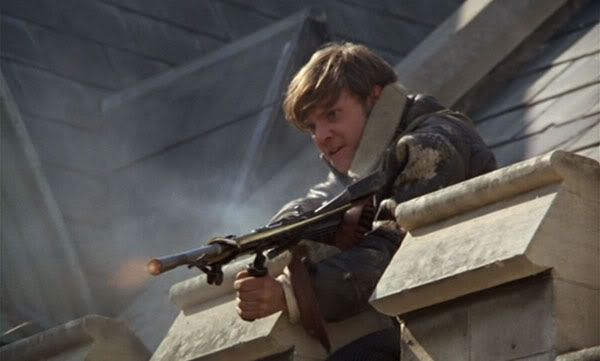
The film is building of course towards the final act of rebellion: a firearms-laden shoot-out after the rebel boys discover a secret cache of automatic weapons on campus (this is in itself unlikely) and then proceed to machine gun visiting dignitaries and their oppressors from the roof of the school, who in turn return fire with their own machine guns. How much of this is real and how much is a flight of fancy from the students and from the film makers? It’s unclear – there is no consistency in the filming of this sequence. When does reality in the film start to cross over to fantasy? There are plenty of moments where this could be happening.

It comes down to the title of the film. If – is this Kiplingesque title suggesting the possibility of such things happening, or such things coming to pass in certain situations, rather than an actual reality? Anderson’s fury at the ghastliness of the class system in this country, and the institutions that promote it (the army, politicians and the church get the same short shrift) suggest a fantasy of bringing the whole system down in a violent outburst. It’s a fantasy, initially grounded in reality, that suggests a poetic realism with lashings of the surreal (most famously the reveal of the schools bullying and vile chaplain as living in a large drawer of a desk in the Headmaster’s office).

The film’s fury and counter-culture joy has the perfect lead actor in Malcolm McDowell, whose simmering, edgy anger as an actor, and chippy rage with a sneering sense of defiance, are perfect for Travis. I’m not sure if McDowell ever topped this first performance, one where he burns through every frame and brilliantly seems to embody every single cog in the system that wanted to thumb its nose at the boss (to mix some metaphors). Anderson and McDowell are clearly working in perfect sync in this film (they collaborated three more times on spiritual sequels). It’s a beautiful performance of simmering resentment and fury at the hypocrisy around him.

The film’s exploration of the injustice of the school doesn’t feel outdated at all. The brutality of fagging and caning plays is like a darkly twisted version of Tom Brown’s Schooldays. Robert Swann is particularly good as leading Whip Rowntree, a hypocritical patrician, and memorable sequences capture the eccentric inadequacy of the teaching, the drilling of school rules into new students (brainwashing them into continuing the pattern in the future) and the arbitrary cruelty of the Whips. Peter Jeffrey’s liberal but distant and ineffective Headmaster is a perfect Thomas Arnold parody, a man with grand ideas but no knowledge of the actual school he is running, who claims to understand the boys but knows nothing about them.

However, interestingly, it’s the rebellion itself that seems rather dated today. In the 1960s, it was easier to whole-heartedly invest our sympathies in the counter-culture rebellion of Mick and his friends – but it’s harder today, with our climate of school shootings in America (there was one the day before I watched this film), to root for our heroes carrying out an indiscriminate shooting, for all the vileness of the institutions Travis is taking on. Of course this sequence is shot with a surreal eye (and I’m not sure any of it is meant to be an expression of something that is literally true, just spiritually true), but it’s a little uncomfortable today.

But at the time, this gut punch of a picture by Anderson wouldn’t have been troubled by these doubts. It’s a brilliantly directed film, that burns with a genuine fury against the institutions it is addressing. There is virtually nothing sentimental or kind about the film – it’s entirely about kicking against the tracks. Nothing in the school is redeemable or decent, everything is corrupt and twisted. It’s a sneering, burning, angry shout of a movie that manages to avoid preaching to the audience and instead presents its hellish vision of class in this country with a witty grace. If… is a film that perfectly captures the mood of the time and understands the “small world” culture of public schools like few others: it’s an essential classic.

The Go-Between (1971)

Julie Christie enlists young Dominic Guard to pass notes in classic adaptation The Go Between

Director: Joseph Losey

Cast: Julie Christie (Marian Maudsley), Alan Bates (Ted Burgess), Dominic Guard (Leo Colston), Margaret Leighton (Mrs Maudsley), Michael Redgrave (Older Leo Colston), Edward Fox (Hugh, Viscount Trimingham), Michael Gough (Mr Maudsley), Richard Gibson (Marcus Maudsley), Roger Lloyd-Pack (Charles)

“The past is a foreign country. They do things differently there.”

It’s a classic line from JP Hartley’s masterpiece novel of youthful disillusionment and trauma, The Go-Between. This film version perfectly captures the novel’s wistful reflections on a past that seems bright and glowing to the young boy caught up in the centre, while carefully and subtly suggesting the darker currents and temptations that lie under the surface. 

In 1900, 12-year-old Leo Colston (Dominic Guard), a middle class boy, spends the summer at the country house of his wealthy school friend. There he finds himself increasingly drawn to the glamour and kindness of the family, who do their best to make Leo feel at home – particularly Marian (Julie Christie), the daughter of the house. Leo also befriends local farmer Ted Burgess (Alan Bates) and finds himself recruited to carry letters between Marian and Ted, little understanding what the messages and arrangements between the two may mean, and what it might mean for her engagement with the decent Viscount Trimingham (Edward Fox). 

The Go-Between is a perfect Chekovian tragedy, which brilliantly captures the hypocrisy and dangers of the final days of the Victorian era. Of course it bubbles down to sex – and there is tonnes of it beneath the surface in the quietly built passion between Marian and Ted. But it’s also class as well – the primary reason why Marian’s affair with Ted remains so illicit is because the farmer (as the younger family members make abundantly clear) is socially unacceptable.

Class weaves itself into every part of the film. The Maudsley family work over time to make Leo feel as comfortable as possible in the house as they are all aware of the social gap between them. The Maudsley family treat Leo as almost a sort of social obligation, quietly buying him new clothes (as he ‘must have forgotten to pack’ the correct clothing for the scorching summer heat) and making much of him at the local cricket game. But Leo can never really forget that he falls somewhere in the middle between the Maudsleys and Tony, and finds himself out of place with both. This awkwardness is perfectly captured in Dominic Guard’s bashful performance.

Class is also lies under Marian’s affair with Burgess – and she seems to know it can never last. Indeed, she has every intention it seems of marrying Trimingham. Trimingam and her father, it’s implied, are even aware of the affair and expect it to burn out. It’s Mrs Maudsley who seems most threatened by the social possibilities of the affair – while the men expect the normal order to reassert itself, Mrs Maudsley (Margaret Leighton, who brilliantly simmers at the edge of the whole film before dominating its closing scenes) seems far more aware of the dangers that love and attraction have.

But it’s a story where the real victims turn out to be those outside the family. Ted Burgess (expertly played by Alan Bates, who made a living of playing son of the soil types like this) winds up feeling like an innocent, a bashful teenager who barely seems to know where to look when Marian accompanies him on the piano while he sings at the celebration after the village cricket match (Mrs Maudsley is appalled at this point). And Ted (constantly described as a lady-killer by Maudsley and Trimingham, despite all evidence to the contrary in his manner – further signposting their awareness of the affair) constantly feels like the weaker partner in the relationship, besotted with the lady of the manor.

As that lady, Julie Christie gives an intriguing performance (even if she is slightly too old for the part). Christie’s Marian is strangely distant, despite her many acts of kindness towards Leo. To what extent is she merely using the boy, winning him over with affection to manipulate him later to deliver her messages? How much does she care for the boy? She understands her relationship with Ted can never be – and is more than prepared to marry Trimingham – but how much is that a defence mechanism against her true feelings? We get only a half suggestion, as Leo does, of how she may really feel. It’s subtly left open for most of the film. 

The film uses a neat device of intercutting moments of the story with the far older Leo (Michael Redgrave, whose voice is perfect for the moments of narration) revisiting the locations of the story again. Everything is in contrast to the bright, luxurious summer of 1900 as the older Leo heads around windswept and rainy locations. Unlike the past, the present day finds the soundtrack drained out by sound effects and ambient noise. It’s a quiet reminder of the foreboding doom that lies over the story – and the film makes good business from the suggestion of trauma that has affected Leo resulting from the events of 1900, and how it has shattered and reshaped his life.

Losey’s direction is a perfect capturing of the languid heat of that 1900 summer, and he perfectly frames events and action for maximum impact. It’s a film made of small looks, quiet asides and suggestions to the audience played from the perspective of a child, where we need to interpret the things we see to get a full understanding of what’s really happening and its implications. Harold Pinter’s script is equally strong, perfectly capturing the mood and feel of Hartley’s novel.

The Go-Between is an excellent film, stuffed with good performances (in addition to those mentioned, Edward Fox and Michael Gough are both excellent), and beautifully shot and filmed. It’s an intelligent and very faithful adaptation of the book that still manages to make the book more cinematic, with the intercutting between past and present giving us a sense of Greek tragedy, and the interrelations between the characters staged with subtly and intrigue. A wonderful adaptation of a great novel.

Women in Love (1969)

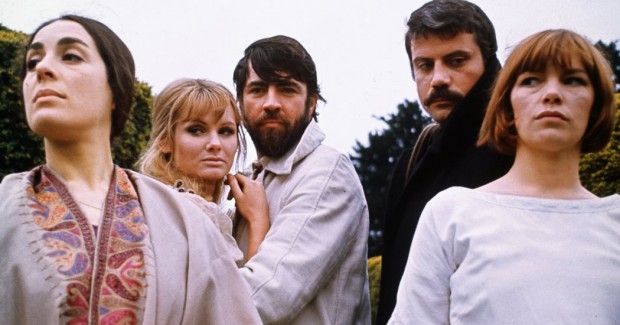
The stars of Women in Love: this publicity still gives only a hint of the simmering (and slightly strange) heightened passions you find therein

Director: Ken Russell

Cast: Alan Bates (Rupert Birkin), Oliver Reed (Gerald Crich), Glenda Jackson (Gudrun Brangwen), Jennie Linden (Ursula Brangwen), Eleanor Bron (Hermione Roddice), Alan Webb (Thomas Crich), Vladek Sheybal (Loerke), Catherine Wilmer (Christina Crich), Phoebe Nicholls (Winifred Crich), Sharon Gurney (Laura Crich), Christopher Gable (Tibby), Michael Gough (Tom Brangwen), Norma Shebbeare (Mrs Brangwen)

DH Lawrence is an acquired taste. While his writing is undoubtedly brilliant, reading his novels today it’s hard to shake off their sometimes histrionic melodrama – their revelling in all that (at the time) shockingly frank discussion of sex and all that Freudian analysis of fractured personalities against an alien industrial world. So perhaps there is a reason why one of the best interpreters of his work for the screen has been someone as melodramatic and envelope-pushing as Ken Russell.

Women in Love is Russell and Lawrence to the max. In a 1920s mining town, two sisters, Gudrun (an Oscar-winning Glenda Jackson) and Ursula (Jennie Linden) want to make their own way in the world. Local school inspector Robert Birkin (Alan Bates) wants to find perfect love and fulfilment. Alpha-male son-of-the-local-mine-owner Gerald Crich (Oliver Reed) isn’t quite sure what he wants, other than to reinvigorate his father’s business. Naturally all four of these characters come together in romantic, intellectual and sexual tangles that lead to a lot more misery than happiness.

Wow this is a difficult picture to write about. How so? Because it is about two-thirds masterpiece to one-third pretentious, hyperbolical nonsense. That’s quite some tight-rope. Russell walks it pretty well, but his problem has always been he loves being a sort of enfant terrible of British cinema too much. Too often he succumbs to temptation and pushes things a little further, to go for the demented camera or editing trick, or to push the sexual content a little bit further. The whole film has a hint of a cocky teenager, jumping up and down to look cool and catch your attention. 

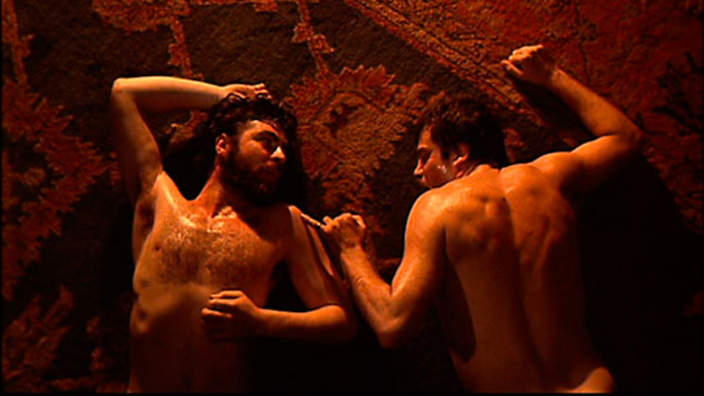
But then on the flipside, sometimes this excess really works (or if you like, sometimes more really is more). Nowhere is this clearer than in the famous naked wrestling scene between Oliver Reed and Alan Bates. It’s a high-blown, tightly edited, single-camera, increasingly artistic sequence that leaves little to the imagination as we wonder how far this nude, willy-waggling, sweaty wrestling turned intimate clinch will go (the final shot sees the characters roll off each other and lie exhausted on a carpet, breathless, in front of a roaring fire). But it works so well because the amped up shooting and content really tells us something about these two characters, their relationship, feelings, viewpoints on life, sexuality – everything. It’s a great scene and it’s a sign of how good this film can be.

And then you get other moments where you sigh and roll your eyes and almost want to say “yeah Ken we get it…”.  As Robert and Ursula roll off each other after an intense sexual encounter in the woods, we cut immediately to two bodies found drowned in a lake, their bodies locked together in exactly the same position. Yup sex ‘n’ death. Gerald and Gudrun have sex, intercut with shots of Gerald’s mother. Other moments ape up stuff that was already pretty ridiculous in the book to the max: Birkin, after a bash on the head, runs naked into the countryside and smears himself with grass and mud and rolls in the dirt. For about three minutes.

But then this is the sort of film where Glenda Jackson tames some bulls by performing a bizarre dance. Why does she do this? Who knows (certainly not the characters). But then the film is full of moments like this. But what kind of makes it work, even when it is so ridiculously over-the-top and dated in its filming, is that there is a smartness in it. It is a film that does, underneath it all, have some profound thoughts about love and relationships.

It manages to bring together the themes that intrigued Lawrence with a bit of coherence. What do we want from life? It focuses overwhelmingly on the men of the story, and in particular Alan Bates (excellent) as Birkin. Made up to look like Lawrence, Birkin also carries a lot of the prose of the novel debating what makes us happy, whether we need equally strong bonds in our life with men and women, and what constitutes our completeness as human beings. 

The film does this to a certain extent with the female characters as well – although we see them almost completely from the perspective of the men (which is interesting – maybe they were worried about making a film called Men in Love…). That’s possibly why Gudrun’s confused desires for Gerald never quite come into focus. Marvellous as Glenda Jackson is – surely an actress born to play this sort of part, marvellously passionate but strangely unknowable, vulnerable but harsh and even a little cruel – it’s hard to understand how Gudrun’s feelings change for Gerald. Maybe she doesn’t know herself. 

Gerald and Gudrun seem to be characters who don’t understand what they want (Gerald even expressly says it). That’s part of the point of the film (and Lawrence’s book) – a yearning, like both these characters have, for freedom and something different from previous generations, but unable to really put their finger on what this is. Gudrun wants a strong, dynamic man – but she also wants freedom and artistic fulfilment, and can’t find this with Gerald.

The film juggles these themes, of people struggling to reach an expression of (or to understand) their desires. Russell understands this – and for all the highblown eccentricity of some of the shooting, he sticks with a brilliant understanding of these personalities and themes. It remains a very caring movie that understands and relates to its characters. It has a lot of heart under the madness of Russell’s shooting.

And it’s superbly acted. Bates and Jackson are both marvellous, as is Jennie Linden in a (to be honest) rather thankless part as the second sister. But it’s a revelation of what a fine actor Oliver Reed could have been, if he had not decided to become a professional drunk. Reed drips charisma and intensity and he gives Gerald a real frustrated, sensual depth – a confused sexual fear mixed with a determined machismo. It’s a brilliant performance. The rest of the cast are also good, even if Eleanor Bron is (partly deliberately) overdone as Birkin’s first lover.

Women in Love is very dated in its style, but still a fascinating and intelligent piece of filmmaking that engages with and juggles with ideas. Despite all its overblown Russell excess, I actually really liked it, it stuck with me and I’ve been thinking about it since it finished. I’d actually like to see it again and see if it unlocks even more for me – and blimey it even makes me want to read Lawrence again, which after The Rainbow I never thought I’d say…

In Bruges (2008)

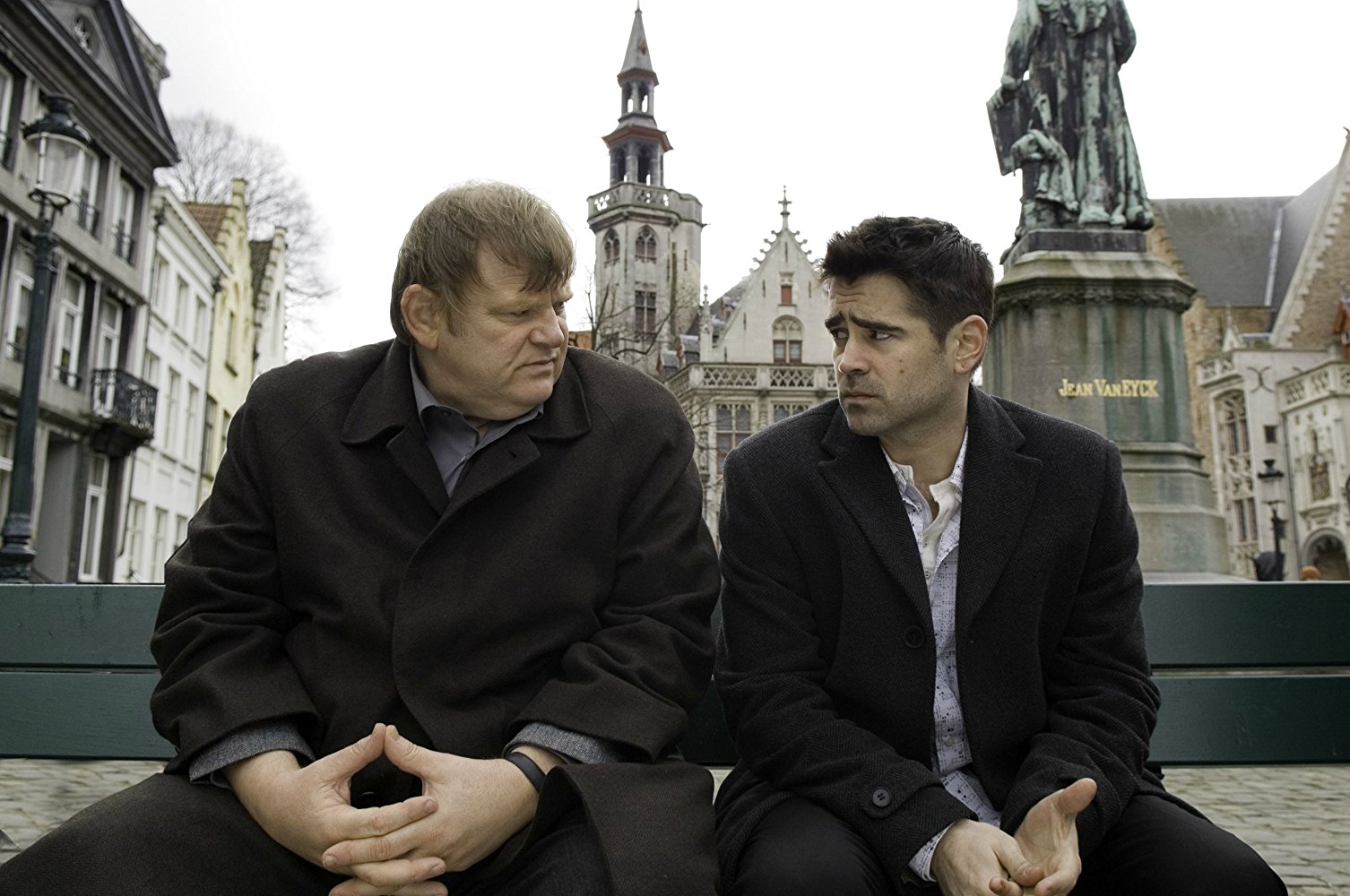
Brendan Gleeson and Colin Farell excel in hitman comedy In Bruges

Director: Martin McDonagh

Cast: Colin Farrell (Ray), Brendan Gleeson (Ken Daley), Ralph Fiennes (Harry Waters), Clémence Poésy (Chloë Villette), Jordan Prentice (Jimmy), Thekla Reuten (Marie), Jérémie Renier (Elrik), Anna Madeley (Denise), Elizabeth Berrington (Natalie Walters), Eric Godon (Yuri), Željiko Ivanek (Canadian)

Who hasn’t been dragged somewhere for sightseeing and culture, and longed to be somewhere else (anywhere else?). Most of us right? So how many of us are hitmen hiding out after a job gone wrong? Probably not that many (I hope!). It’s this mixture of the everyday and the bizarre that Martin McDonagh nails so well in his debut film, a sharp as nails, laugh-out-loud but also moving piece of work, possibly one of the sharpest written, well-made debut films you’ll find.

Ray (Colin Farrell) and Ken (Brendan Gleeson) have been sent to Bruges to hide out for a few weeks after a job gone horribly wrong in Dublin. Ken is fascinated by the city, its culture and buildings and enthusiastically buys a guide book. Ray responds like a surly, miserable kid and is desperately unimpressed with everything he sees. Their long weekend in the city becomes increasingly unusual and dangerous as they encounter angry tourists, a racist dwarf (Jordan Prentice) and a drug-dealing film assistant (Clémence Poésy), and dodge the rage of their boss Harry Waters (Ralph Fiennes).

In Bruges is a hilarious piece of film-making, with every scene featuring some moment of black humour, wry observation or un-PC laugh-out-loud comedy. It’s foul-mouthed, sometimes violent, very rude – but also deals with profound feelings of guilt and regret with a real humanity. McDonagh’s work expertly combines jet black comedy, with a warmth for its deeply flawed characters. It’s got a compelling, masterful story that packs character development, incident and intricate plot threads together with assured expertise.

McDonagh’s gift is to make you relate for all of these characters, all of whom are made to feel very real and human. It skilfully leads you to overlook their many flaws and embrace them as people. It says a lot that the most sympathetic, likeable person in the film is a multiple murderer with an (implied) cocaine habit. Everything we learn or see about the characters is designed to make us understand and relate to them more.

Ray initially seems little more than a foul-mouthed thug. But as the film progress – and thanks to Colin Farrell’s masterful performance of brashness covering deep insecurity and vulnerability – we learn he is a rather sweet, even loving man who has stumbled into a career he is deeply unsuited to. Farrell gets these switches perfectly – and his childishness is hugely endearing. From stropping around like a sulky teenager to bouncing up to a film shoot with a childish, excited shriek of joy, he defies expectations. McDonagh throws in a perfect note of tragedy once we find out the mistake Ray made – and suddenly Farrell’s performance overflows with guilt, self-loathing and an unbearable regret that makes you re-evaluate everything you’ve seen him do.

But then that is the whole film right there: it makes you laugh uproariously, then chucks you a curveball and before you know it you are hugely emotionally invested, with a huge sense of empathy for their slowly revealed depths. That goes for every character – even the nominal villains have a sadness, or a firm set of principles, or a certain dignity to them that makes you care. It’s a brilliant piece of writing and directing – and masterfully acted.

Brendan Gleeson plays the other lead in Ken: and few other actors could surely have managed to turn Ken into such a warm avuncular figure, a gentle giant who feels he has come to terms with his choice of career but experiences a subtle shift over the course of the film. Gleeson’s performance is sublime, warm and witty with a careful thread of sadness underneath it – it’s some of his best work. 

But then the whole cast is great. Prentice’s bitterness as the angry Jimmy is brilliant – and he is very funny – while Poésy’s gentle bad-girl is a terrific, radiant performance. The film also has third act dynamite with Ralph Fiennes’ Harry Waters, a foul-mouthed, furiously angry, tour-de-force character who shakes up the whole film – but who has a strange sense of nobility about him, even while he is (hilariously) effing and blinding left, right and centre.

And the film has a brilliantly anti-PC vein of humour. Jokes about drug-taking and dwarves. Foul-mouthed gags about every subject under the sun. Brilliant encounters with “large” American tourists (brilliantly paid off later in the film), jobsworth ticket sellers, angry tourists in restaurants – the film is crammed with hilarious moments. All of it is brilliantly funny because it comes naturally out of characters who feel real.

It’s also so thematically rich. As the characters stand in front of Hieronymus Bosch’s The Last Judgement, you realise that the entire film is a metaphor for purgatory, with Bruges’ medieval beauty carefully chosen to reflect this. Our heroes, laden down with sins, wait in Bruges for an unspecified length of time to discover where they will head next. Amends have to be paid, sins have to be reconciled – and all these threads come together brilliantly in a final, dream-like sequence that you suddenly realise the whole film has been carefully building towards from the start.

So the film, after a scabrous, brilliantly hilarious, darkly foul-mouthed start, slowly becomes something which (while still hilarious) is also a discussion of morality, principles and guilt. We see characters do things we might never have imagined them doing at the start, some are redeemed, others make principled decisions. And it’s really funny. I’m not sure Colin Farrell or Brendan Gleeson will ever be better than they are here. It’s a brilliant play script turned into a wonderful film. A classic.

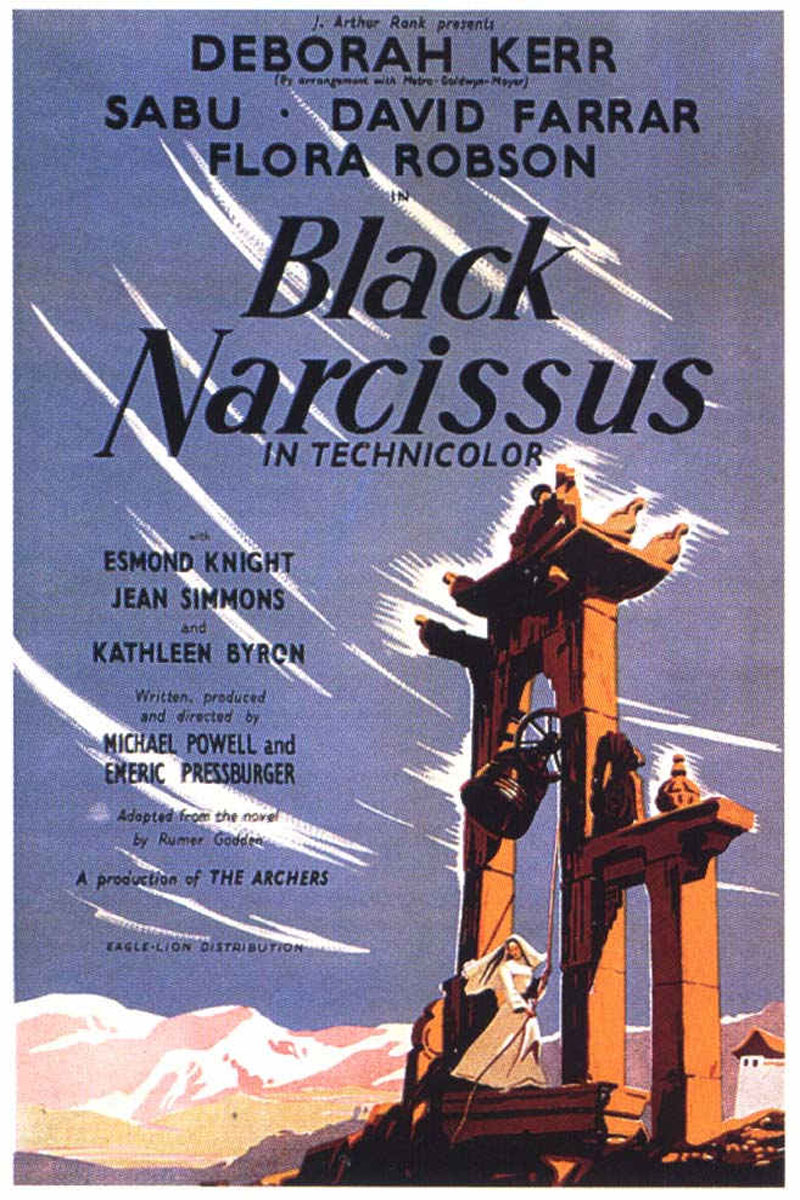
Black Narcissus (1947)

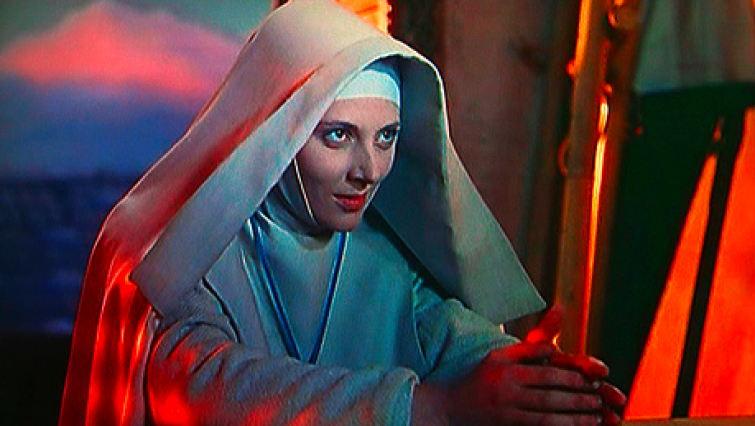
Deborah Kerr leads a community of nuns struggling with temptations in the classic Black Narcissus

Director: Michael Powell, Emeric Pressburger

Cast: Deborah Kerr (Sister Clodagh), Sabu (Young General), David Farrar (Mr Dean), Kathleen Byron (Sister Ruth), Flora Robson (Sister Philippa), Jenny Laird (Sister Honey), Judith Furse (Sister Briony), Esmond Knight (Old General), Jean Simmons (Kanchi), May Hallatt (Angu Ayah)

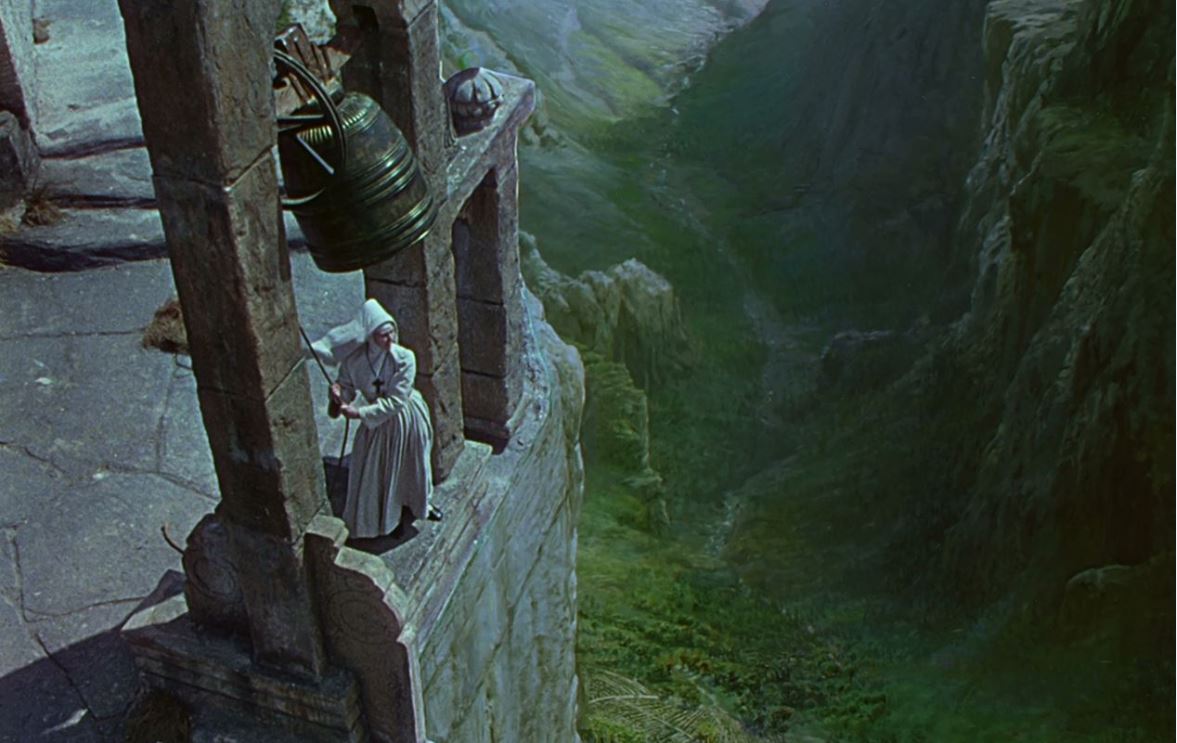
In 1947, people hadn’t seen anything like Black Narcissus. Its triumphant technicolour was like nothing that had been made before – and watching it now on a brand new, shiny restoration, it’s still overwhelmingly impressive. Alongside this beautifully shot action, we have a storyline surprisingly modern in its acute psychology and questioning of the strengths and weaknesses of human nature.

Sister Clodagh (Deborah Kerr) is given leadership of a group of nuns in a remote Himalayan harem building converted into a nunnery. But the isolation of the mountains and the strange atmosphere of the harem bring out weaknesses in the characters of the nuns, leading to profound challenges to their spiritual and mental well-being – not least Sister Ruth (Kathleen Byron), who becomes increasingly pre-occupied with local land captain Mr Dean (David Farrar).

Powell and Pressburger’s film is a brilliant, slightly hard to interpret, psychological gothic drama, a du Maurier-style sexually charged drama set in an exotic Indian location which the nuns struggle to understand. It’s a curious melange of scenes, often moving swiftly, sometimes only with narrow bridge scenes, meaning you soon get as lost in how much time has passed as the nuns themselves. Several key events take place off screen, and the native Indians are curious, unknowable and strangely intimidating in their distance and coolness.

All this is to help build the audience into feeling as unsettled as the characters themselves. It’s a film about the struggles between expression and repression. The two principal nuns – Sisters Clodagh and Ruth – both show elements of this. Both are drawn towards the earthy, manly but still patrician Dean, but both handle these emotions in very different ways – one by denying those feelings, another by trying to embrace them. All of this takes place in a distancing and intoxicating environment, where the convention rules of life seem suspended.

For Sister Clodagh, Dean serves as a bridge back to her own frustrated romantic feelings for an old flame – whose failure to propose guided her towards taking the veil – and elements of her warmer persona (witnessed by us in flashback). But Clodagh resolves never to make herself a slave to these feelings, and these moments of remembrance seem to make her cling all the more to her order – even while the film suggests that it is a strange mixture of pride, insecurity and fear as well as faith that motivates her.

By contrast, Sister Ruth – already acknowledged by the Mother Superior as not an obvious choice for the sisterhood – increasingly loses her grip first on her faith, then sanity, as she struggles with the feelings she clearly has for Dean. This quiet obsession has built up in her mind into representing all the desires for freedom and independence she feels while in the order. Where Clodagh resolves to cling closer to the repression of her feelings, Ruth rejects this very idea and determines to express herself – even as it costs her everything. 

This heated growing madness is powers the film – and Kathleen Byron provides most of the drama with a stunningly unhinged performance, which builds so quietly (almost in the background of the film) that it never becomes wearing and also surprises with the extent of her unhinged delusion. One particular night-time encounter with Clodagh sizzles with rival agendas – one woman using a lipstick, the other using a Bible. 

Powell (and it was Powell who largely directed these Archers pictures) uses a variety of techniques to develop this unease. Several shots are direct POV shots, with the audience becoming one of the characters, giving us the slightly unsettling feeling of being addressed by the actors. Quick tableaux editing gives us economic storytelling and a sense of events building swiftly towards a head (several sequences use a series of quick cuts of characters reacting to events). The camera uses a series of close-ups of sweaty foreheads or dizzying, vertigo inducing shots of the Himalayas to increase the unease. A later shot shows Sister Ruth moving through a shimmeringly filmed jungle, bringing a sense of confused eroticism to the picture.

Sexuality is a major theme of the film – and the characters have a series of acknowledged or unacknowledged sexual interests in each other. The music and camera work develop a sense of heated intensity on the mountain that suggests a simmering heat that unnerves the mind and throws open the temptations of physicality. Old wall paintings from the harem of bare-breasted women seem to be a constant presence – no wonder feelings are running high.

Jack Cardiff’s photography is simply extraordinary – it’s hard to believe none of this was filmed on location and most of it was shot in a studio – and this is still a film today that is hugely beautiful. The production by Alfred Junge is hugely impressive, with the nunnery a triumph of mismatched themes.

It’s not perfect. It’s a bit awkward to see actors blacking up. Some of the acting is quite OTT or stagy – in particular May Hallatt at points – and the film’s occasional delight in its visual appeal means its themes don’t always get the exploration that they deserve. One of the disadvantages of its deliberately vague timeline is that sometimes events happen too soon – or we don’t get enough sense of why they are happening. But these are blemishes.

This is a masterfully made picture, still beautiful to look at with impressive performances from Kerr, Byron, Farrar and many of the rest of the cast. It’s a surprisingly gothic melodrama by the end, with reds splashed across the screen with an imposing sense of threat. Still one that needs to be seen: and the end is so melodramatically gothic considering where the film started that the fact it doesn’t seem hugely jarring is an enormous tribute to the talents of those involved.

Plenty (1985)

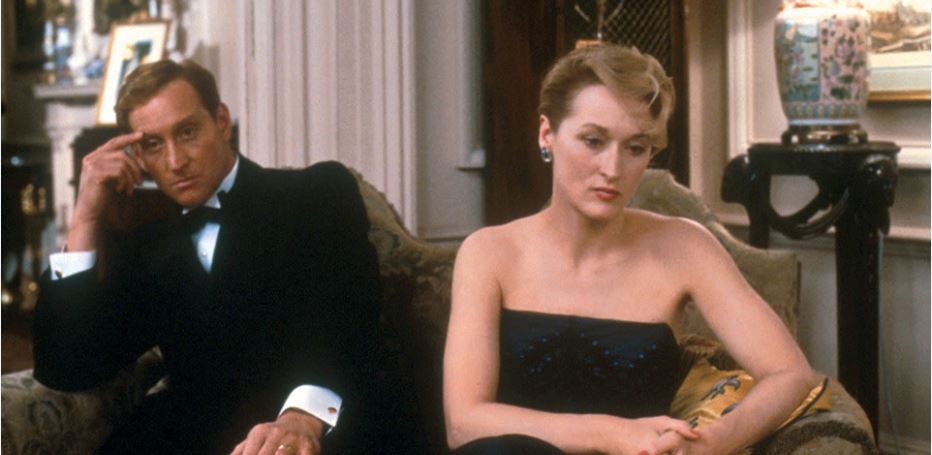
Charles Dance and Meryl Streep endure marital misery in the bleak, oblique and uninvolving David Hare drama Plenty

Director: Fred Schepisi

Cast: Meryl Streep (Susan Traherne), Charles Dance (Raymond Brock), Tracey Ullman (Alice Park), John Gielgud (Sir Leonard Darwin), Sting (Mick), Ian McKellen (Sir Andrew Charleson), Sam Neill (Lazar)

David Hare’s 1970s play Plenty looked at the impact of peace on the war generation. A “state of the nation” story on the growth of prosperity in the post-war era, and the return of many to the humdrum reality of life with Britain’s importance as a world power in rapid decline, led to isolation, anger and depression. It’s a shame that much of that really doesn’t come across in this buttoned-up, murky and unclear social drama, with a hard-to-follow plot and a hard-to-like central character.

Susan Traherne (Meryl Streep) is an SOE courier in France during the Second World War, who has a one-night stand with fellow SOE operative Lazar (Sam Neill) which has a profound effect on her. After the war, she marries Foreign Office civil servant Raymond Brock (Charles Dance), but is unable to find a purpose and contentment in regular civilian life. As the years tick by, and their surroundings grow ever more plentiful, Susan becomes more and more unhappy, difficult and demanding.

The central issue with Plenty (I can’t comment on the play, having never seen it) is that Meryl Streep creates possibly one of the least likeable leading performance you are going to see. Perhaps mistaking Britishness for cut-glass chill – or perhaps it’s the character – Streep’s Susan is brittle, bitter, angry, annoying and infuriating. She complains about everything around her, she lashes out at people, she sulks and whines with no self-insight, she constantly makes life difficult for those around her (most of whom are unbelievably patient) and she is almost impossible to work out. 

While the film perhaps intends her to be as sort-of PTSD sufferer, with undiagnosed personality disorders, who cannot reconcile the shallowness of her life with the excitement of war service, I’m not sure this comes across. All we really see is her deeply irritating self. We don’t get a sense of her war service – we see her breakdown early in the film in France – and her relationship with Lazar remains so ill-defined we are unclear what impact it had on her, other than part of a halcyon memory. The film’s final scene is a flashback to the end of the war: Susan watching a sunrise on a French hill dreaming of her life being full of days like this. That scene would have been helpful earlier – it’s the only time we see her optimistic or likeable in the film, and it gets lost by placing it at the end. With it in order we could have warmed to her more.

Instead she remains a shrill presence, in a hard to relate to film that never really makes clear whether we are meant to empathise with Susan, or find her as frustrating as some of the characters do. The film also fails to make this enigma part of its viewing design – I don’t feel like having the lines blurred made the film a richer experience, just one it was harder to engage in. Schepisi’s directing style is very cold and distant – from the slow camera moves, to the tight close ups on Susan at key moments, to the deliberate lack of clear time line (each scene moves on weeks, months or years from the previous one with only a few design and dialogue hints to suggest the change).

Combined with Hare’s indefinable script – crammed with elliptical conversations, unclear emotional and dramatic points, and political points delivered with a querying shrug – it makes for a film that is very hard work to engage with – and doesn’t offer much to reward the viewer if they do. 

What pleasures there are come from the performers. Charles Dance is good as Susan’s long-suffering husband – far from a domineering patriarch, his only real crime seems to be that he is a bit boring. Ian McKellen makes a great cameo as a senior civil servant, coolly and calmly telling Susan the errors of her thinking. Sting is an odd choice (I suspect his presence helped the film get backing) and Tracey Ullman does tend to go too far as Susan’s bohemian but more emotionally restrained friend.

John Gielgud steals the show. He is simply superb as Brock’s boss, an old-school diplomat who is, at first, a figure of fun with his Edwardian values but whom events (in particular Suez) reveal to have firm principles. Gielgud also gets most of the film’s best lines, while his quiet air of polite dignity is both endearing and admirable. His delivery of the following line to a tedious bore of a party guest basically is the high point of the movie: “But perhaps before I go, I may nevertheless set you right on a point of fact. Ingmar Bergman is not a bloody Norwegian, he is a bloody Swede.”

But there aren’t enough pleasures like this in this overbearing, rather trying film that never really decides what point it’s trying to make. I think it’s something about wealth and discontent and the more selfish and scrambling build of the post-war generation towards Thatcherism. But I’m really not sure. And to be honest I’m not sure I care.

Mary, Queen of Scots (1971)

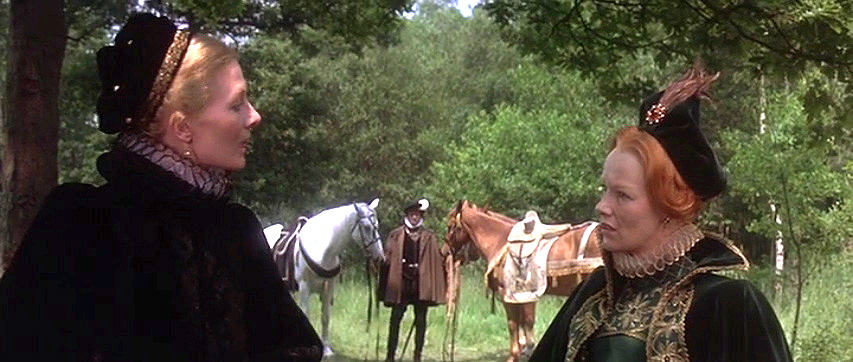
Vanessa Redgrave and Glenda Jackson are the feuding queens in Mary, Queen of Scots

Director: Charles Jarrott

Cast: Vanessa Redgrave (Mary, Queen of Scots), Glenda Jackson (Elizabeth I), Patrick McGoohan (James Stuart, Earl of Moray), Timothy Dalton (Lord Henry Darnley), Nigel Davenport (Earl of Bothwell), Trevor Howard (Sir William Cecil), Daniel Massey (Robert Dudley, Earl of Leicester), Ian Holm (David Rizzio), Andrew Keir (Ruthven), Robert James (John Knox), Katherine Kath (Catherine d’Medici), Frances White (Mary Fleming), Vernon Dobtcheff (Duke of Guise)

So here we are, back in the Tudor history craze of late 1960s Hollywood. Charles Jarrott directed, following up his efforts in Anne of the Thousand Days with this professionally mounted, handsome and rather personality-free film adaptation. It occasionally falls a bit too much in love with its luscious romanticism – and it falls hard for Mary herself, surely one of the worst queens ever – but despite all that, it has an entertaining quality that never lets you down.

The film picks up with the recently widowed Mary (Vanessa Redgrave) essentially being chucked out of France after the death of her husband the King, and swiftly being sent back to Scotland to take up the throne there. Problem is: the very Catholic Mary isn’t exactly the choice of the lords of Scotland – led by her bastard brother James Stuart (Patrick McGoohan). Mary’s Catholicism also threatens to destabilise the relationship with Protestant England – particularly because she is the nearest successor to Elizabeth I (Glenda Jackson). But Mary lacks Elizabeth’s tactical understanding of ruling and is guided by her heart – leading her into a disastrous marriage with feckless alcoholic Henry Darnley (Timothy Dalton).

Mary Queen of Scots is a stately picture, which uses its location shots, costumes and production design to tell its familiar story with a sweep and relish that effectively hides the lack of inspiration in its film-making. Just as in Anne of the Thousand Days, Charles Jarrott shows he’s a fine producer of middle-brow entertainment, safe costume dramas that aren’t going to challenge anyone’s perceptions or give you any real wow moments of filming. He’s happy to set the camera up and let the actors do their thing, with the script ticking off the great events.

That’s what you get here. It’s a film that could have been a lot more of an exploration of the rivalries and different life philosophies of its feuding queens. But it doesn’t quite connect with that. This is partly because it can’t quite bring itself to engage with the reality of Mary herself, preferring the popular romantic image. The film doesn’t want to admit that many of Mary’s decisions were, to put it bluntly, completely misguided bordering on wrong. It is in love with her romantic image – and not as enamoured with Elizabeth’s wiser, more pragmatic, manipulative rule. It’s this rule by heart rather than head the film finally holds up for praise.

It doesn’t help that Vanessa Redgrave feels miscast in the lead role. Redgrave is too sharp an actor to convince as someone as easily led and foolish as Mary. She looks too shrewd, she feels too smart. Redgrave compensates by speaking softly and giving a lot of love-struck eyes to various male actors (principally Nigel Davenport’s bluff, masculine Bothwell), but it doesn’t quite work. It’s like she’s struggling to find the character – and to find the balance in a film that doesn’t want her to be seen as too stupid, while the viewer is left slapping their foreheads at every action she carries out.

This feeling stands out all the more with Glenda Jackson’s casting as Elizabeth. Having just finished playing the same role in a landmark six-part TV series, Elizabeth R(which covered a lot of the same ground), Jackson here confirms that she was the definitive Elizabeth. As smart and shrewd an actress as Redgrave, Jackson’s natural firmness marries up very well with these qualities to make the perfect Virgin Queen. There have been so many others who have taken on the role, but Jackson is simply perfect in this role – she becomes Elizabeth. Her Elizabeth is clever, manipulative, cunning but also quick tempered, capable of great wisdom but prone to moments of passionate lashing out.

The rest of the cast is a familiar parade of character actors – British actors of this generation made a living from films like this! Timothy Dalton stands out as a foppish, clearly useless Darnley (here reimagined as a syphilitic bisexual with anger management issues), as does Ian Holm as a cool-headed, would-be power behind the throne David Riccio, who meets a tragic end. Daniel Massey does a decent job as Leicester (though I can’t shake memories of Robert Hardy in the same role in Elizabeth R – was he busy at the time?), Trevor Howard gets saddled with a lot of plot as Burghley. Up in Scotland, Patrick McGoohan has a lot of fun as a scheming Earl of Moray.

All of these actors fit comfortably into the slightly browned, grainy photography style of films of this type, and the screenwriters hammer together plenty of incident alongside dramatic invention. The focus on the soap opera of Mary’s three marriages (she’s widowed in the opening moments of the film) leaves plenty of scope for invention, from Darnley and Riccio’s affair to the inevitable non-historical meeting between Mary and Elizabeth – it seems like every drama going from Schiller onwards has invented a meeting between these two as a dramatic highpoint.

This final scene captures the lack of thematic depth to the film. In a film that had focused more on really comparing the differences between the two, this could have been the culmination of a debate running through the film (can you rule with a brain but not a heart?). Instead it misses the trick, and becomes a final game of one-up-man-ship, which the film allows Mary to win because she is the more romantic figure. 

It’s well mounted and assembled like many other films like this – but it’s not the best of its genre, and you do sometimes wish for something that had a little more meat on its bones.

Greystoke: The Legend of Tarzan, Lord of the Apes (1984)

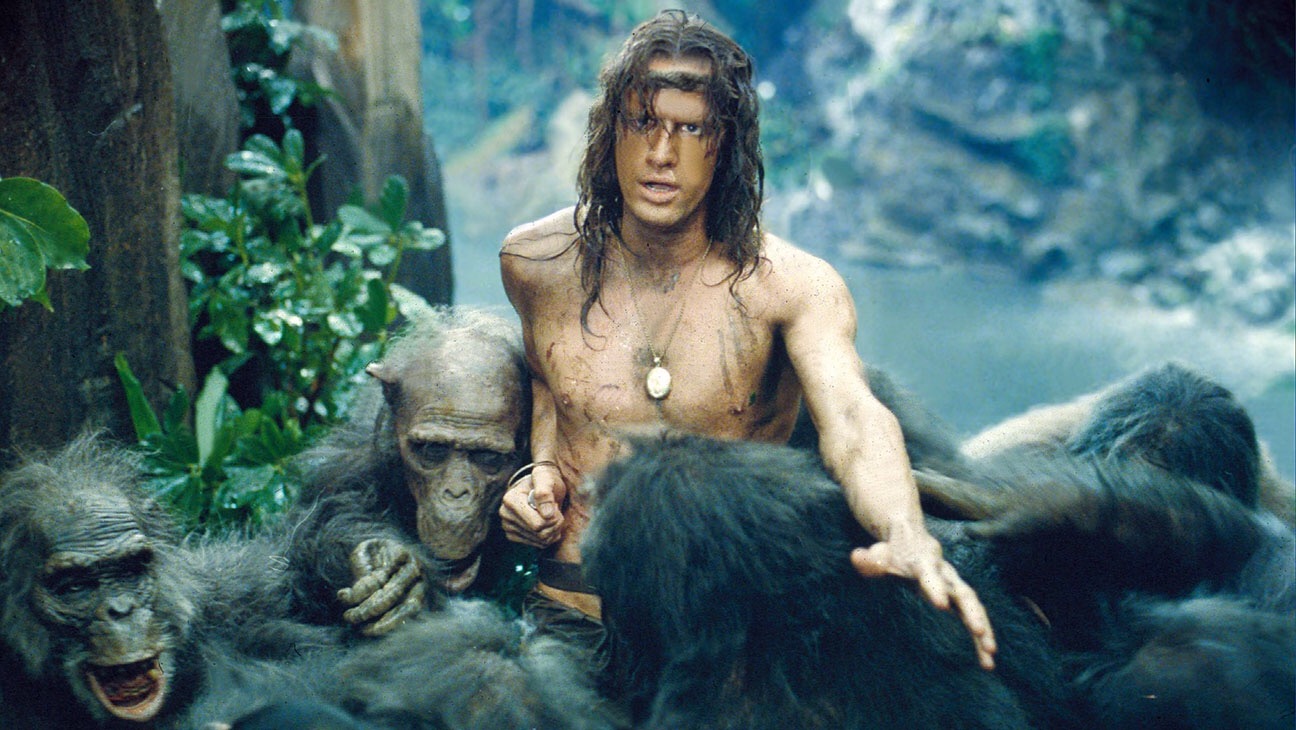
Christopher Lambert is the lord of the apes in dull Tarzan epic Greystoke

Director: Hugh Hudson

Cast: Christopher Lambert (John Clayton), Ralph Richardson (Earl of Greystroke), Ian Holm (Capitaine Fyllieppe d’Arnot), James Fox (Lord Charles Esker), Andie MacDowell (Jane Porter), Cheryl Campbell (Lady Clayton), Ian Charleson (Jeffson Brown), Nigel Davenport (Major Jack Downing), Nicholas Farrell (Sir Hugh Belcher), Paul Geoffrey (John Clayton Snr), Richard Griffiths (Captain Billings), Hilton McRae (Willy), David Suchet (Buller), John Wells (Sir Evelyn Blount)

For his follow-up to Chariots of Fire, Hugh Hudson settled on this curious mess: part heavy-handed exploration of class and the brutality of man, part picturesque jungle picture with people in ape costumes. If anyone remembers Greystroke today, it’s for an interesting bit of trivia: original director and writer Robert Towne was so annoyed at being removed from the project, he used his dog’s name as his screenwriting credit. When the Oscar nominations were announced, this pooch became the first four-legged Oscar nominee. Strangely fitting for a film about the nobility of animals.

The film is a “real life” version of the Tarzan story. What this basically means is that it is dry and boring with a ponderous self-important message about how the real animal is in man (or something like that). It also of course means that the word “Tarzan” isn’t used except in the title (presumably so that audiences could be lured into the cinema). Anyway, after his parents are shipwrecked off the jungle coast, and die after young John Clayton’s (Christopher Lambert) birth, he is raised by gorillas and becomes one of the leaders of the pack. When a troupe of gung-ho explorers are slaughtered by natives, the only survivor is Belgian Fyllieppe d’Arnot (Ian Holm). Rescued by John, d’Arnot teaches him language and takes him home to the estate of his grandfather the Earl of Greystoke (Ralph Richardson), who is desperate for an heir. But can John adjust to the jungle of the modern world?

So Greystoke is well filmed, looks good and has a couple of decent performances in it. But it’s a dull mess as a film. Watching it you suspect a lot of the runtime ended up on the cutting room floor. There are sudden time jumps. Characters appear and disappear, many serving no real purpose. The film drifts towards a conclusion that neither seems enlightening nor serves any real cathartic summation of what the film might be about. There are many, many lovely shots of the jungle and Scottish countryside, but we never really end up caring about any of the characters within it.

The film is thematically a mess from start to finish. It seems to be making a point about John being totally unsuited, by his upbringing, to adjusting to the world of man. But it never really gives a proper voice to John himself. Of course he’s only just learning language, but even without that you never really feel like you begin to understand him, or get a sense of half-remembered human traits emerging from his ape upbringing. Basically you don’t get a sense of conflict within him as to whether he should stay or go. Without that conflict, there isn’t really much interest in watching him work out the answer.

This is despite the fact the Christopher Lambert is actually pretty good as John Clayton. The role plays to his strengths: it’s highly physical (not just in the acts of athleticism but also in its half-man, half-ape physicality). Lambert also has this rather fine other-worldly quality that constantly leaves him looking a bit lost and vulnerable. The part may be underwritten but he is certainly doing his very best here, and he really does a brilliant job of playing an ape trapped in man’s body.

It’s a shame that the film takes so long to get going that he doesn’t really appear for the first half an hour or so. Instead we get a lot of ape-based action in the forest – and probably too much of his parents. Later in the film, the camera makes a point of returning two or three times to a large painting of Cheryl Campbell as John’s mother – but the film never suggests any link at all between these two characters. A lot of time is wasted setting up the parents’ voyage, while at the same time no time is spent on establishing any emotional link between the Claytons and their son.

Far more time is spent on the apes – which I suppose is the point of a film that wants to celebrate the purity of the world of animals over the corruption of man. Rick Baker’s ape make-up is pretty impressive for the time – and works really well in longshot – but in close-up is all too obviously a series of performers in masks. There is a sense of their natures, but not of them as dangerous or wild animals. In fact the film goes overboard in humanising them – even to the extent of giving them their own language of grunts and groans.

The ape stuff goes on too long – and then means the return to civilisation seems rushed and unclear. Ian Holm is excellent as d’Arnot, the bridge between the two worlds, and his fatherly love for John works extremely well. But the film makes no attempt to tackle the questions it raises of John dealing with his split animal-human relationship. Instead the film loads the decks by making almost every human character – epitomised by James Fox’s flat performance as Jane’s toff fiancée – a heartless uncaring moron.

Ah yes Jane. Played with an openness by Andie MacDowell, she’s dubbed in a painfully obvious way by an uncredited Glenn Close. This is another underwhelming relationship that seems skimmed over – one moment they have just met, the next they seem on the verge of a great love. It’s as rushed and slapdash as the introduction of a mentally handicapped servant – of course, with his childish outlook, he is closer to John than anyone could be – who literally appears out of nowhere.

The film was also Ralph Richardson’s final role – he died shortly after completing it – and his barmy Earl of Greystroke (part lonely old man, part semi-senile eccentric) does lift the film with a certain energy (he was posthumously Oscar nominated). But it’s an easy role for Richardson – and in fact his eccentric, hard-to-define energy kind of sums up the whole messy film pretty well. His character’s death is the final nail in its interest, his eccentric energy sorely missed.

The most damaging thing about Greystoke is it is dull and obvious. Pretty scenery and decent performances can only cover so much when the plot is empty and predictable. The film feels cut down absurdly – half the cast of Chariots appear in roles so tiny you wonder why they bothered – and by the time the film drifts towards its conclusion you’ll probably have stopped caring about what it was all about in the first place. It tries to ask questions about man’s nature, but it doesn’t even seem to notice it never answers them. A poor film.

Chariots of Fire (1981)


Celebrations abound in triumphant running flick Chariots of Fire

Director: Hugh Hudson

Cast: Ben Cross (Harold Abrahams), Ian Charleson (Eric Liddell), Nicholas Farrell (Aubrey Montague), Nigel Havers (Lord Andrew Linsley), Ian Holm (Sam Mussabini), John Gielgud (Master of Trinity), Lindsay Anderson (Master of Caius), Cheryl Campbell (Jennie Liddell), Alice Krige (Sybil Gordon), Struan Rodger (Sandy McGrath), Nigel Davenpot (Lord Birkenhead), Patrick Magee (Lord Carogan), David Yelland (Prince of Wales), Peter Egan (Duke of Sutherland), Daniel Gerroll (Henry Stallard), Dennis Christopher (Charley Paddock), Brad Davis (Jackson Scholz)

Dun-da-da-da da-da dun-da-da-Da-Da DA. Hum that theme tune and you know straight away what film it is: you can’t resist the temptation to mime out running (in slow motion of course), arms swinging gracefully from side-to-side. There aren’t many more movies with more iconic, instantly recognisable themes than Chariots of Fire

If there is one thing everyone remembers, it’s the young athletes running along the beaches of St. Andrews, spray flying up from their bare feet. Nicholas Farrell sprinting with upper-class determination. Nigel Havers wiping spray from his face with glee. Ian Charleson full of serene joy. Ben Cross with fixed, rigid focus. The opening of Chariots is a master-class in quickly established character, tone, mood and era. The cross-fade from the funeral oration from an ageing Nigel Havers into this slow-motion, halcyon-days reflection tells you we are in the land of memory – and sets right up for the feel-good triumph the film becomes.

The film follows the key athletes of the British 1924 Olympics team. Harold Abrahams (Ben Cross) is a second-generation Jewish grammar-school boy who runs to prove he belongs and can excel. Eric Liddell (Ian Charleson) is a Presbyterian Scot, who runs to celebrate God and whose religion prevents him running in a vital Sunday qualifying heat. Both characters are, in their own ways, outsiders – and their underdog status makes them perfect to root for in this extremely well-made crowd pleaser.

Chariots is often seen as a slightly undeserving Oscar-winner. But that’s to overlook the panache it’s made with and how emotionally uplifting and engaging it is. Hugh Hudson had never directed a film before this one. His background was in commercials and he brings many of the strengths of that background to Chariots. The film is wonderfully assembled, a perfect combination of montage, cross-cutting, longer tracking shots and cross-fading. 

That opening scene tells you a lot with its swift economy. But he handles others just as well: Abrahams’ 100m winning race is played first in real time, then again, cross-cut with Abrahams’ reaction to victory. The first moment is one of triumph, but the immediate repeat allows an opportunity for the viewer to understand the mixed feelings that achieving everything you aimed for can bring. Abrahams’ slightly shocked, underpowered reaction gives the slow-motion repeat of the race a hazy, post-match analysis feel – as if Abrahams is still running the race in his mind. As if he knows that his whole life was building to that one moment, and now he needs to find a new focus.

Hudson’s mastery of moments like this is impressive. Sequences are fabulously assembled. The famous “one minute” dash around the Trinity court (actually Eton) is brilliant, and a great example of how the film sells tent-pole moments. It also masters quieter character moments. One of its stand-out moments simply allows Abrahams’ coach Mussabini (a scene-stealing Ian Holm) to react to Abrahams win (a victory he has not seen due to being banned from the stadium) by quietly rising to attention, then sitting on his bed, gleefully punching through his hat and quietly whispering “my son”. Other scenes – such as those where Abrahams confronts quiet anti-Semitism from Cambridge scholars (nice bitchy cameos from John Gielgud and famed director Lindsay Anderson), or Liddell is quietly pressured into running on Sunday – simmer with good acting and restrained direction.

It’s these scenes that really make the film work. Ben Cross is superb as a chippy, frustrated Abrahams who feels he must justify his place in England’s oppressive class system. He’s constantly glowering, tense and uncertain – but Cross mixes this with a boyish charm, a gentleness (most notably in his shy romance with an unrecognisable Alice Krige) – and a warmth and genuineness that he shows with friends. Nicholas Farrell’s boyish Aubrey Montague (a love-struck best friend if ever I saw one!) helps a lot here – if someone as obviously nice as him likes Abrahams, then gosh darn it we should as well.

Ian Charleson is equally impressive as the devout, charming but coolly determined Eric Liddell who has decided his course in life and nothing is going to shake him from it. The film has a refreshingly considerate view of Liddell’s Christianity – and, furthermore, praises him for sticking to his devout principles. Charleson wrote many of his speeches himself, and he brings a charming honesty to his character. How can you not love this guy? He’s the perfect ambassador for the Church.

The film tackles plenty of clashes for Liddell which sizzle in a quiet way. Cheryl Campbell is very good as his partly proud, partly concerned sister, worried that his missionary work is being sacrificed for his running. His confrontation with the Olympic committee over his crucial decision not to run – is there any other film where not working on a Sunday is the dramatic centre piece? – is nicely underplayed. It’s clear that they (including a very good Nigel Davenport as an understanding Chair) want him to run, and it’s equally clear Liddell is determined he won’t.

It’s the moments like this that make the film so triumphantly feel-good. Both Abrahams and Liddell are at heart immensely likeable, the upper classes and elites who frown at them in their way rather boo-able. The running scenes are great (despite the sweetly dated lack of grace!), the film really capturing the exhilarating energy of pushing yourself to the limit. Watching Abrahams training under the expert eyes of Mussabini (worth repeating again that Holm is the heart of this film, as the fatherly, wise trainer struggling against prejudice against both Italians and professionalism), or Liddell winning from behind after being pushed over in a race are simply hugely uplifting.

Strangely the one thing that does seem a little odd today is the Vangelis score. Yes the Chariots march is outstanding – but the 80s electronic beat to the rest of the score now sounds very dated. Yes it is interesting to overlay (then) modern music over a period piece – but nothing dates quicker than music (except perhaps haircuts) and that is the case here. It sounds odd and jarring with the action at times – but then that main theme is so brilliant (but also the most classical of Vangelis’ compositions) that it still sort of works.

The sad thing is that Chariots didn’t lead to great new things for most involved. When he won the Oscar for best original screenplay, Colin Welland famously cried “the British are coming!”. Sadly he wasn’t really right. Within four years two flop films had all but ended Hudson’s career. Producer David Puttnam took over Columbia Pictures, only to be dismissed within a year after disastrous results. Many of the stars of the film never got the breaks this film promised (Charleson died tragically young – the first major star in England to openly acknowledge his cause of death as AIDS). Even the star Americans introduced to play the yank athletes (Brad Davis and Dennis Christopher) never had a hit film again. As David Thomson put it, within ten years of all the major players only Ian Holm “had any professional credibility left”.

But Chariots is still a bit of lightening caught in a bottle. A strange idea to spin an entire film out of an event lasting less than 10 seconds, but which married up so well with universal themes of class and struggle. It knows exactly what it is, and exactly what it is doing. It really worked then and it really works now. It’s not pretending to be high art, or to really make profound statements – just to entertain. And it really does. Fetch your running shoes and start that Vangelis theme!