Category: British Films

The Wooden Horse (1950)

The Wooden Horse (1950)

One of the first POW films, setting a template for stiff-upper-lip derring-do

Director: Jack Lee

Cast: Leo Genn (Peter Howard), David Tomlinson (Philip Rowe), Anthony Steel (John Clinton), David Greene (Bennett), Peter Burton (Nigel), Patrick Waddington (Senior British Officer), Michael Goodliffe (Robbie), Anthony Dawson (Pomfret), Bryan Forbes (Paul), Dan Cunningham (David)

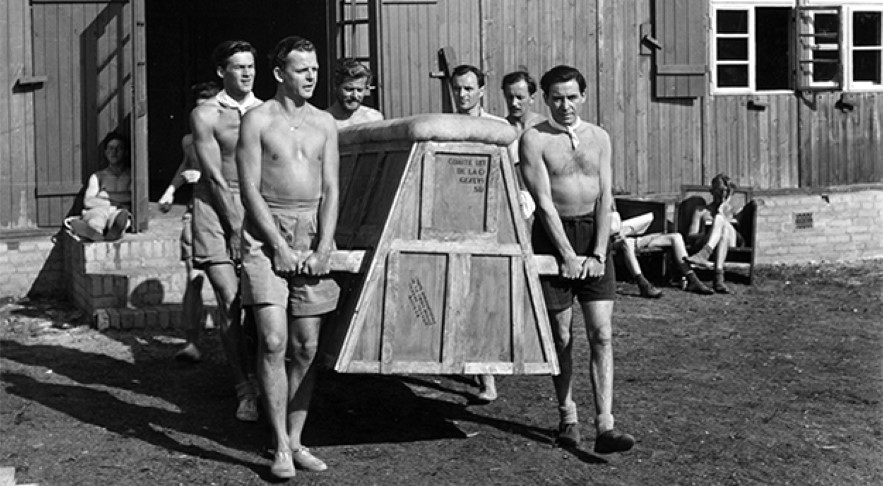
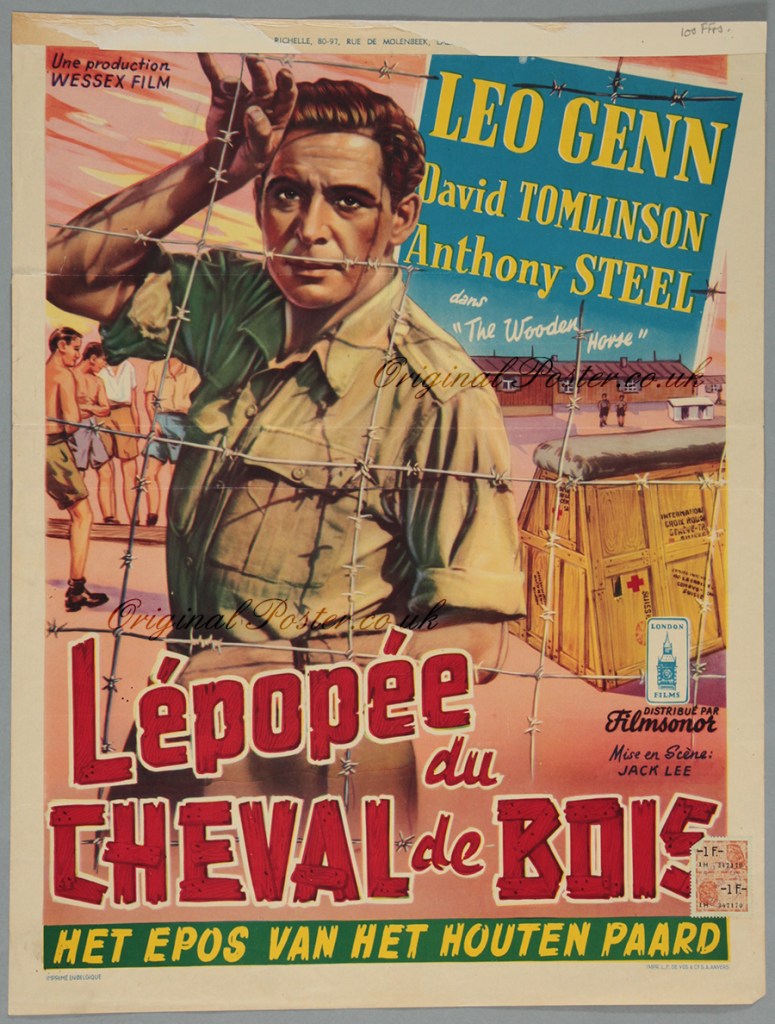
One of the most popular of WW2 movies sub-genres is the POW escape movie. The Wooden Horse was one of the first of these, showcasing the sort of barmy, off-the-wall scheme that British POWs spent their tedious years dreaming up. Based on an autobiographical novel by former POW Eric Williams – here fictionalised as Peter Howard (Leo Genn) – inmates of Stalag Luft III built a pommel horse to aid their escape. The scheme? Hide a man underneath the horse to dig a tunnel, while the guards are distracted by a never-ending stream of men jumping over it for hours and hours on end.

The Wooden Horse dramatizes this with a stiff-upper-lip ‘well done Old Chap’ Britishness, shot with a low-key documentary realism (the film blew a huge portion of its budget on location shooting). It’s almost defiantly low-key, about a world away from Steve McQueen jumping over a fence on a motorbike or the sort of emotive struggles with war pressure in The Cruel Sea. Even the escape itself is a grinding, repetitive task taking place over months moving an infinitesimal distance every day as the parade ground tunnel edges closer and closer to the fence. This low-key attitude extends to the cast, led by Leo Genn, who eschew dynamics for calm, quiet unflappability. (Ironically, despite its documentary realism, Peter Butterworth – one of the original members of the escape attempt – was told on auditioning he wasn’t believable as a POW.)

The film is split neatly into two halves. The first covers the escape plan itself and lays out a structure that became familiar from countless POW films that followed: the plan is carefully detailed, senior officers humph and finally flick the thumbs up, a parade of fellow inmates chip in expertise (from forgery to ingenious distractions), a staged accident of flipping the horse over tricks the Germans into thinking nothing is going on, the tunnel caves in, a man is left stranded in the tunnel longer than is safe… It’s all in here, while our heroes bluffly and bravely work out the logistics of smuggling soil away and mastering various French identities to make their escape.

The second half follows two of our heroes – Leo Genn’s stoic Howard and Anthony Steele’s matinee idol Clinton – as they shred their nerves moving through Europe aiming for the port of Lübeck and a ship to Norway. This is the marginally less interesting part of the film, although it conversely does feature the film’s most interesting moment as a visibly sickened Clinton is forced to kill an ordinary German guard, very different from the usual boys-own adventure attitudes you expect.

However, most of the rest of the second half is just a little too dry and documentary, despite the best efforts to play up the paranoia and tension of a life on the run in occupied territory. Lee directs with a methodical, unflashy style, while ongoing clashes with producers on the budget, which eventually saw the film completed months later by the producer and a hurriedly put-together rather abrupt (and incongruous) ending in a Swedish restaurant, which seems to lean into the beginnings of an anti-Soviet Cold-War era consensus. Some of the dramatic tension drains out of a film which actually might have benefited from a little more melodrama, among the muttered, patient conversations in alleyways and the almost-agitated debates about which resistance groups to trust.

The camp-escape half works best, probably because the ingenuity of seeing the prisoners work out the logistics of converting their pommel horse into the perfect escape weapon and overcoming the minutia of camp life remains very entertaining. There is even a certain amount of wit in the bonhomie and cheek of the escape, which the film doesn’t shy away from, from the plan depending on the willingness of hungry POWs hurling themselves over a wooden horse for hours at a time to the boarding school air of bored over-familiarity that permeates the sleeping quarters. Lee also mines some tension out of a late-night inspection of the sleeping quarters, which only just misses discovering the mountains of soil that has been hidden precariously in the ceiling.

The Germans themselves are presented fairly sportingly – The Wooden Horse doesn’t give us an obvious villain and, as noted, presents its only slain German as a tragic figure. The Germans are even fairly sporting, solemnly carrying away the offending horse with a hurt dignity after the escape – presumably the poor War Horse is to be confined to solitary – while the POWs give this hero a rousing cheer. The Wooden Horse avoids the set-up of many similar films, which often presents both a token ‘Worthy Opponent’ and a token ‘Unrepentant Nazi’ among the Germans. Instead, they are exclusively presented as straight-forward professionals – again perhaps with an eye on the emerging 1950s anti-Soviet consensus that was starting to form in Europe.

The mood of sporting endeavour around the whole film – as well as the stiff-upper-lip pluck of the imprisoned Brits – helped guide the POW film towards its natural development as a Boy’s-Own adventure story with a sense escape as the ultimate sporting adventure (though even The Great Escape throws in more than enough tragedy). The Wooden Horse sometimes lacks in drama, so swept up is it in a sort of documentary realism (it’s hard not to argue with the producers that the put-upon forbearance of John Mills might have been a better choice for the lead than the rather too smooth Leo Genn), but as an early example of a much-loved genre it offers more than enough entertainment.

Sexy Beast (2001)

Sexy Beast (2001)

Superb acting motors a gangster film that’s also a nightmare house-guest comedy

Director: Jonathan Glazer

Cast: Ray Winstone (Gal Dove), Ben Kingsley (Don Logan), Ian McShane (Teddy Bass), Amanda Redman (DeeDee Gove), James Fox (Harry), Cavan Kendall (Aitch), Julianne White (Jackie), Álvaro Monje (Enrique)

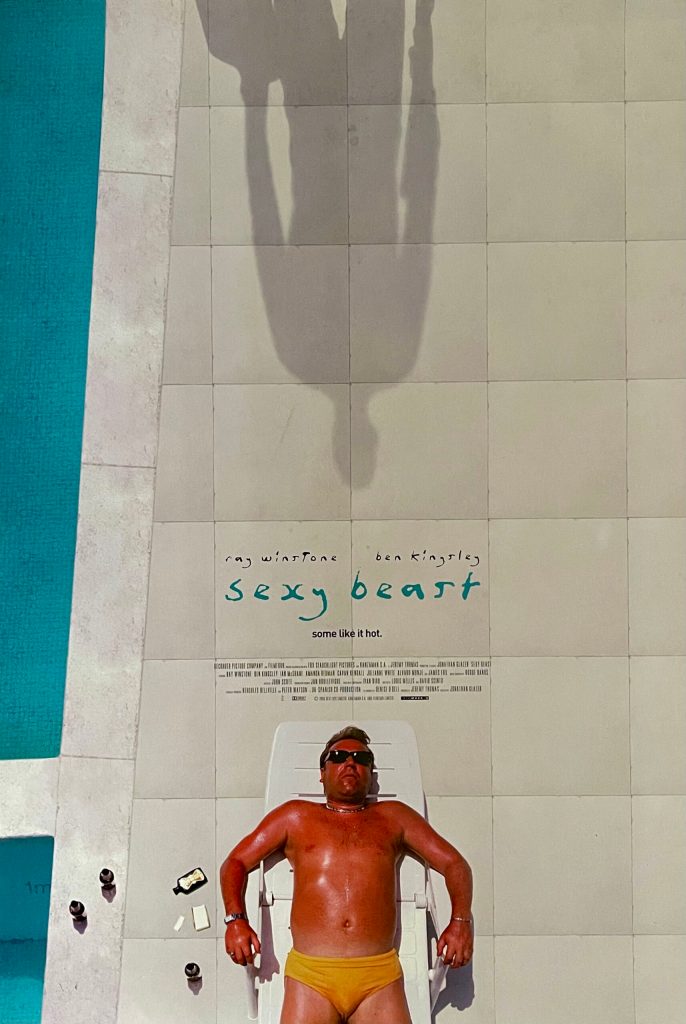
Gal Dove (Ray Winstone) has got it made. He’s baked bronze by the pool in his home on the Costa del Sol, earned after a life as a top safe cracker in London, alongside wife DeeDee (Amanda Redman), best friend (and fellow ex-crook) Aitch (Cavan Kendall) and glamourous Jackie (Julianne White). All that changes when an unexpected visitor turns up: Don Logan (Ben Kingsley). A tightly-wound, terrifyingly unpredictable sociopath, Logan has a job offer to which the only acceptable answer is yes: joining a team to break into a top London bank for crime king-pin Teddy Bass (Ian McShane). How’s Gal going to get himself out of this one?

Sexy Beast seems at points it might settle for being a standard British gangster drama. But Glazer’s becomes a hugely enjoyable mix of that and bizarre black comedy. A houseguest from hell comedy, like a psychotically foul-mouthed The Man Who Came to Dinner, with the added sprinkle of playful psychological theory and touches of darkly sexual content (James Fox brings back memories of The Servant and Performance). There is even an element of Greek drama: Gal really should be paying attention to the parade of ill-events preceding Don’s arrival, not least the boulder that tumbles down a mountain into his swimming pool nearly squashing Gal en route.

That boulder is, it turns out, far less of a danger than Don. If there is one thing that dominates perceptions of Sexy Beast, it’s the intimidating, witty danger of Ben Kingsley. For an actor best known at the time as Gandhi, to say this was a change of pace was an understatement. Kingsley arguably changed his whole career here with this stunningly intense, hilarious, performance. Shirt tucked in, head shaved, Logan might look physically unassuming but the pulsing vein in his head is a sign of him being a tightly wound ball of unprocessed anger and fury. Kingsley makes him superbly unpredictable – snapping on a sixpence from quiet to rabid fury with a terrifying capacity for sudden violence.

Glazer throws him into Gal’s Spanish heaven like a ticking timebomb. There is a great deal of wit in how Glazer shoots Logan, often sitting or standing in a domineering position in rooms while the other characters awkwardly shuffle, uncertain of where to look, hugging the margins. This comedy carries across into Logan’s utter disregard for social rules or niceties – all captured in his blackly hilarious calm refusal to extinguish his cigarette on a plane, followed by his ranting ejection (“I hope this crashes!”) – which sparks shocked laughs. It’s not funny for those around him as Logan sprays matter-of-fact slurs about his hosts, deliberately urinates on their bathroom floor and calmly discusses the time he had sex with Jackie in front of her husband.

There is a strange immaturity about Don, like a maladjusted child who has never grown up, superbly contrasted with Gal’s calm, contented mellowness. Don lacks any emotional maturity and sounds like a sulky teenager. He’s the sort of playschool bully who psyches himself up in the mirror and parrots word-for-word the instructions he’s received about the planned heist from the ‘bigger boys’. He seems to have no friends and a teenage romantic obsession with Jackie (who I would bet money was his only ever sexual experience). This is all captured superbly by Kingsley’s surprisingly complex performance full of terrifying childish unpredictability alongside its dark humour.

The dominance of Kingsley makes it easy to overlook Winstone’s equally fine performance. Any doubts about the power of Kingsley to intimidate is squashed by Winstone’s subtle terror at the former Gandhi. Winstone plays up his more loveable aspects, as an honest man (despite his profession), keen to make the lives of those around him better. He’s completely unsuited now for the life of violence and crime he has left behind. Mumbling, downward looking, Winstone gives Gal some nice hints of the submissive surrender of a life-long victim to his bully.

Glazer skilfully presents these characters as two sides of the same psychological coin. While Don is certainly real, viewers can have fun tying themselves into knots on theories where he is Gal’s terrifying id, an embodiment of the hardened, dangerous criminal he possibly used to be. This makes Don’s intimidating take-over of Gal’s home a visual representation of the repressed violence in Gal. It’s a feeling added to by Gal’s dreams of a satanic satyr figure (who sort of resembles Don). Sexy Beast uses this vibe to subtly suggest the real danger might be Gal’s deeply suppressed criminal psychology. It makes for a neat suggestive undertone, which Glazer carefully never overplays.

Sexy Beast makes an impressive calling card for Glazer’s skill. It’s smartly edited – a Logan monologue explaining the heist’s background is skilfully intercut both with Logan being told of the scheme and Teddy formulating the plan. Glazer mixes interesting camera angles – there are some neat shots where cameras appear to be attached to doors in particular a revolving bank door – and impressive simplicity, not least a quietly staged scene that uses a single shot to track Logan going from calm to berserk in Gal’s kitchen. It’s a sign of the flair and imagination of a consummate visual stylist.

He also stages the heist – masterminded by a dead-eyed and chillingly calm Ian McShane – with an impressive confidence. While Kingsley’s character so dominates the film that it’s hard to get as interested in the crime itself, it offers visual panache and – in the blundering of several of the criminals in a flooded bank vault and their clumsy celebrations afterwards – further sly commentary of the immature dumbness of criminals. The sexually fluid upper class orgy where the crime is born is also staged with a refreshing lack of salaciousness and the bursts of violence, when they come, carry a matter-of-fact brutality that’s much worse than all-out gore.

If Sexy Beast has a major fault, it is that the power and fascination of Kingsley’s character unbalances the film in his favour. Its final act feels like an anti-climax – probably the only time gun-laden, underwater antics have been less exciting than a classically-trained actor spraying f-bombs and the c-word like there’s no tomorrow – but that’s also a tribute to its early power. The first two acts speak to us because, beneath all the gangster shenanigans, we’ve all had to deal with the nightmare of an uninvited house guest from your past and we can all sort of relate to the dark humour of egg-shell tip-toeing the rest of the characters do around the simmering Kingsley-volcano.

It’s why Sexy Beast works best as a black-comedy confined play (a theatrical adaptation, not a TV prequel series, is what it really needs). When it focuses on the superb interplay of Winstone and Kingsley, the film flies. It’s also proof that Glazer, even at the start of his career, could turn familiar tropes into something strikingly different, original and unique in tone. A gangster film like few others.

Scoop (2024)

Scoop (2024)

Interview dramatisation which mostly fails to turn news into drama, making empty points

Director: Philip Martin

Cast: Gillian Anderson (Emily Maitlis), Keeley Hawes (Amanda Thirsk), Billie Piper (Sam McAlister), Rufus Sewell (Prince Andrew), Romola Garai (Esme Wren), Richard Goulding (Stewart MacLean), Amanda Redman (Netta McAlister), Connor Swindells (Jae Donnelly), Lia Williams (Fran Unsworth), Charity Wakefield (Princess Beatrice)

It was one of those interviews that shook the world – largely because it was such car-crash TV. Prince Andrew (played, under layers of effective make-up, by Rufus Sewell) desperately wanted to distance himself from the Jeffrey Epstein scandal and BBC’s Newsnight was seen as the most appropriate outlet for a reputation-restoring chat with a proper journalist, Emily Maitlis (Gillian Anderson). The interview was booked by producer Sam McAlister (Billie Piper) – whose book Scoops inspired this – and advocated for by Andrew’s senior advisor Amanda Thirsk (Keeley Hawes). The revelation of Andrew’s priceless mix of out-of-touch privilege and shallow dimness, combined with his inability to understand the impact on anyone but himself, consigned him to royal oblivion.

Scoop tries its best to turn the behind-the-scenes story into drama – but, to be honest, it comes across as a hugely underwhelming Frost/Nixon-lite. It’s hard not to feel an episode of Netflix’s The Crown would have dealt with this with more depth and interest than this manages. Scoop commits the cardinal sin of any “plucked-from-the-TV-headlines” biopic: all its most interesting parts are pitch-perfect recreations of an interview you can watch at your leisure on YouTube. Once you’ve got over how well Anderson and Sewell have captured their subjects, that’s basically it.

That’s Scoop all over. It’s a film that’s all flash and no substance. Martin and screenwriter Peter Moffat work overtime to suggest that this interview was a seismic piece of journalism, a sort of David-v-Goliath reveal. It ends with the Newsnight team giving themselves a self-congratulatory round-of-applause for “having given a voice to the victims” – a bit rich considering neither the interview or this film gives them much more than a second or two. Maitlis and co are shown to be trembling with nerves before interviewing this Royal Spare who no-one ever took particularly seriously (as McAlister bluntly tells him at one point), something which feels a bit odd since we are repeatedly told Maitlis has quizzed Bill Clinton among a score of other names.

There is a Spotlight-ish attempt to show the Newsnight team verifying some facts before the interview takes place – Scoop is one of the few films you’ll see where a paparazzi photographer, played as a cheeky wideboy by Connor Swindells, presented as a noble crusader for the truth – but it never rings true. No real facts about the Andrew-Epstein case were either unknown, in dispute or revealed during the interview. Andrew wasn’t even undone because of “gotcha” questions: it was because he performed so catastrophically badly, painting himself as the “real victim” and revealing he existed in a reality no ordinary person could begin to recognise.

There is very little drama in Scoop. Based on McAlister’s book, Scoop is duty-bound to place her as centrally as possible. Problem is the slogging hard-work of building trust over time to land big interviews is quite undramatic. Instead, the film boils McAlister’s work down into a chance email, a pub chat and a bit of Hollywoodish-straight-talking from McAlister during a meeting with the prince. This sells her skills short. In fact, unlike Frost/Nixon which got chunks of drama out of the will-they-won’t-they dance to set-up the interview, Scoop gives the impression everyone wanted it to happen. In fact, it makes it look so straight-forward, you end up thinking McAllister’s bitter colleague might be right – how highly skilled is her job?

The desire to centralise McAllister creates further problems: their nominal lead’s key involvement ends before the stuff the film is really interested in (the interview) even begins prepping. Scoop falls back on plucky outsider to keep her involved, retrofitting McAllister (a producer with nine year’s experience with world leaders) into a working-class outsider, who needs to force herself into “the room where it happens”. Problem is as soon as she’s in the room, McAlister has nothing to say or do (one suspects the whispered legal battles connected with a rival mini-series on the same subject stopped the writing of any McAllister-ish insight here, for fear it would be promptly denied by the Maitlis-backed rival production).

McAlister becomes a side-bar, a largely silent background character in her own story. Not quite the message that the film wants to promote on female empowerment (even if her bosses are all women). There are similar odd notes in here. Amanda Thisk’s colleague, an aggressive male we are clearly not meant to sympathise with, resigns when the interview is agreed saying it’s a terrible idea. Scoop paints him as a chauvinist bully, furious at being over-ruled by a woman – problem is he’s right. The most effective moment on this subject is arguably more about privilege in general, as Andrew demeans a female cleaner for incorrectly sorting his teddy bear collection. As mentioned the actual victims remain voiceless and nameless on the margins, barely meriting even a post-credits mention.

Perhaps the real problem with Scoop is it wants to be an All the President’s Men style journalism film but the interview was really a soapish showbiz story. There is not investigation, no wrongs bought to light. There is no gladiatorial duel (compare to Frost/Nixon). Andrew essentially commits reputational suicide in front of his stunned opponents, when confronted with fairly routine, fact-based questions. It’s not like toppling someone really important – and the film is so careful about legal implications it avoids putting any stance on what Andrew may or may not have done, knowingly or otherwise.

What the film doesn’t want to say is that Newsnight landed a big hit by giving us exactly the sort of easy-to-digest, car-crash, celeb news it’s staff start the film scorning. Now a film embracing that would be interesting! In the film McAlister says they need to rejuvenate the programme, to stop talking in an echo-chamber to the Metropolitan elite on subjects like Brexit but focus on the things people really care about and challenge its viewers with positions that differ from their own. Was this story about Prince Andrew in any way at all an answer to that challenge? No. Did it change the world? No. Did it really deserve a film – and that rival three-part series? Scoop never suggests it does.

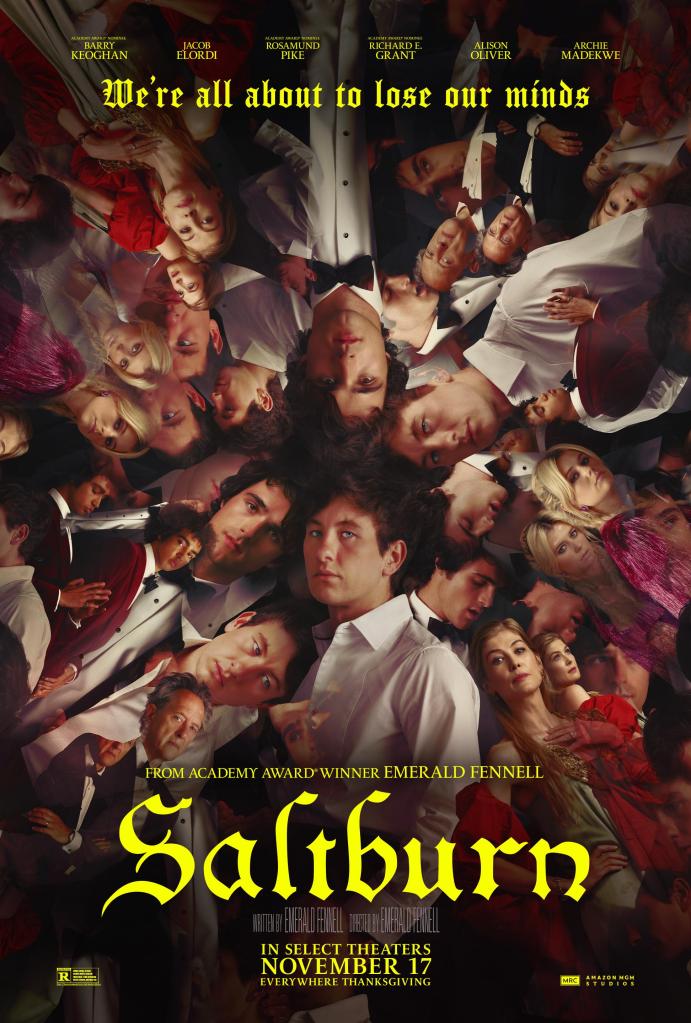
Saltburn (2023)

Saltburn (2023)

Dreadfully pleased with itself and full of shallow insights and stunt clickbait moments

Director: Emerald Fennell

Cast: Barry Keoghan (Oliver Quick), Jacob Elordi (Felix Catton), Rosamund Pike (Lady Elspeth Catton), Richard E Grant (Sir James Catton), Alison Oliver (Venetia Catton), Archie Madekwe (Farleigh Stuart), Carey Mulligan (“Poor Dear” Pamela), Paul Rhys (Duncan), Ewan Mitchell (Michael Gavey), Sadie Soverell (Annabel), Reece Shearsmith (Professor Ware), Dorothy Atkinson (Paula Quick)

Promising Young Woman was a thought-provoking, very accomplished debut. It’s odd that Emerald Fennell’s sophomore effort plays more like a first film: try-hard, style-over-substance, very pleased with itself and its punky attempts to shock. Crammed full of moments designed to be snipped out and talked about – in a “you will not fuckin’ believe what just happened” way – Saltburn is a fairly trivial remix of ideas much, much better explored elsewhere, predictable from its opening minutes.

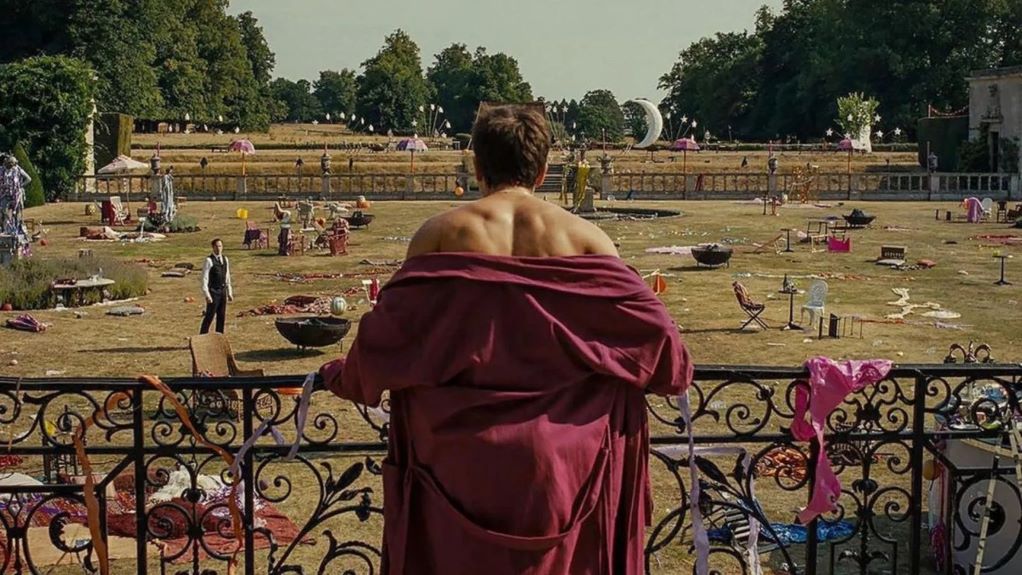
It’s 2006 and Oliver Quick (Barry Keoghan) is a scholarship student at Oxford University, socially awkward and very conscious of his Liverpudlian roots, struggling to fit in among the wealthy set that dominates his college. At the centre is Felix Catton (Jacob Elordi), fundamentally decent but blithely unaware of his privilege, who takes a shine to Oliver with his shyness, troubled working-class background and grief at the recent death of his alcoholic father. Felix invites Oliver to spend the summer at Saltburn, his luxurious family seat. There Oliver is welcomed – or does he inveigle his way? – into the lives of the Cattons, from seducing Felix’s sister Venetia (Alison Oliver) to charming his parents Sir James (Richard E Grant) and Lady Elspeth (Rosamund Pike). But is Oliver all he appears to be?

The answer, of course, is no. Which shouldn’t surprise anyone who has ever really encountered any form of unreliable narrator before. Fennell opens the film with a clearly older, well-dressed Oliver recounting the film’s story to an unseen person. It’s not much of a deduction from this alone, that Oliver is at best not to be trusted, is definitely potentially dangerous and is probably a lot worse. All that, inevitably plays out, in a film that so nakedly rips off Brideshead Revisited (or Recycled) and The Talented Mr Ripley that Oliver might as well be called Ripley Ryder.

“Ryder” would at least have been a witty name for a character who spends most of the film putting his (apparently) well developed manhood to effective use in manipulating and controlling people. Saltburn assembles a series of “shocking” moments of sexual weirdness from stalker-like sociopath Oliver – so much so, that the moments he merely wanders (or dances) around in the buff feel almost normal. Surely there was more than half an eye on hashtags when the film presents scenes like Oliver drinking spunky bathwater, performing oral sex on a woman during her period or dry humping then wanking over a grave. It’s not big and it’s not clever.

“Not clever” also sums up the film’s inane social commentary. Set in 2006, it seems to take place in a version of Oxford that probably hasn’t existed since 1956. Having been in a state-school kid at Oxbridge at this time, its vision of a university 98% populated by poshos jeering at working-class kids with the wrong sort of tux just isn’t true (in fact there were more state school students than private school kids at Oxford that year). In this fantasy, all the students are either from Old Etonians or maladjusted weirdos from state schools. It’s hard not to think this is Emerald Fennell (a woman so posh, her 18th birthday party was featured in Tatler) guiltily looking back at how her “set” at Oxford might have behaved to the less privileged students.

It boils down to a view of Oxford as an elitist social club laughing openly at anyone who can’t trace their descendants back to the House of Lords, where tutors are entranced by the idea that a place like “Liverpool” exists and snort at the working class student for being a clumsy try-hard by actually reading the books on the reading list with student life flying by in a series of hedonistic raves, hosted by the rich and famous. Maybe I was just in the wrong circles back in the day.

This portrait of Oxford as a play pen for the super elite is as damaging (it’s exactly the sort of false image that stops deserving people from wanting to go) as it is lazy, tired and false. But then, Saltburn compounds its boringly seen-it-all-before social commentary by trudging off down other, all-too-familiar paths as it turns its fire on those with their nose pressed up against the window of privilege. The film’s vilest member of the elite, Farleigh, is himself an interloper, turned aggressive gate-keeper. And, as is not a surprise, Oliver’s roots turn out to be far more comfortable than he is letting on. Oliver is a Charles Ryder who yearns for Brideshead so much, he starts destroying the Marchmain family to get it. Because, in his eyes, as an aspirant middle-class type he appreciates it more.

On top of this is layered a clumsy, Ripley-esque madness to Oliver, who can’t decide himself whether he is infatuated with the charming Felix (very well, and sympathetically, played by Jacob Elordi) or just wants to suck his soul dry. Barry Keoghan plays this Highsmith-styled sociopath with just enough flash and sexual confusion – and he does manage to successfully turn on a sixpence from wide-eyed wonder, to vicious anger. But the character again feels like a remix of something done better elsewhere, trading emotional depth for cartoonish bombast and clumsy on-the-nose point scoring.

The on-the-nose-ness runs through the whole film. It’s a film screaming to be taken seriously, from its 4:3 framing, to its jarringly satirical music choices, arty Gothic fonts, visual quotes from Kubrick and look-at-me love of tricksy camera shots (some of these, I will admit, are gorgeously done, even if the film frequently lingers on them so we can “see the work”). But it makes very little sense. How does Oliver manage to exert an influence, so profound and complete, over Felix’s parents? Why does the wool fall from everyone’s eyes one-at-a-time in quick succession? Does Saltburn feel sorry for the generous but emotionally dysfunctional Cattons or does it feel they deserve their fate?

Because so many of these ideas are so half-heartedly explored, it becomes a collection of scenes designed to shock, tricksy directorial decisions, some flashy performances (Rosamund Pike can certainly wittily deliver a slew of lines dripping with blithely unaware privilege) and twists that will only surprise those who have never seen a story about an outsider before. Jacob Elordi emerges best, creating a character of surprisingly revealed emotional depth, but most of the rest of Saltburn settles for flash and instant gratification. To use its own terms of reference, it’s as satisfying as premature ejaculation: fun for an all-too-brief second, then a crushing, shameful disappointment.

The Old Oak (2023)

The Old Oak (2023)

Loach’s swansong is a passionate, if slightly out-of-time, call for peace and understanding

Director: Ken Loach

Cast: Dave Turner (TJ Ballantyne), Ebla Mari (Yara), Claire Rodgerson (Laura), Trevor Fox (Charlie), Chris McGlade (Vic), Col Tait (Eddy), Jordan Louis (Garry), Chrissie Robinson (Erica), Chris Gotts (Jaffa Cake)

The OId Oak is likely the swansong for 87-year-old Ken Loach, Britain’s leading independent film-maker and high-priest of left-wing political cinema. It’s an engaging valedictory effort, crammed with fine Loach touches. But it’s a film that feels slightly politically out-of-time, which works better not when making tub-thumbing points but as a simple plea for a love and understanding. There are worse things Loach (who I’ve sometimes found rather trying for all his brilliance) can sign off with.

In a small town near Durham, TJ Ballantyne (Dave Turner) is a former miner and passionate union man now struggling to keep his pub, The Old Oak, alive in the face of mounting costs. World-weary, he is roped into helping Syrian refugees settle in their new homes in the town. Many locals, bitterly feeling the town has been left behind by government, can barely hide their fury at these refugees. But TJ finds they re-ignite in him a desire to make the world a better place, particularly as he forms a fatherly friendship with Yara (Ebla Mari), a passionate young photographer, who doesn’t know if her own father is alive or dead and wants to build links between the refugees and the local community.

The bond between TJ and Yara is at the heart of this gentle film, with Loach drawing beautifully natural performances from Dave Turner (a former fireman union boss) and Ebla Mari. One of Loach’s greatest strengths has always been his ability to poetically draw out hugely endearing relationships. TJ and Yara are a perfect example, two people who recognise loss and isolation in each other. TJ’s purpose in life has gone, never finding anything to replace his union campaigns of the 80s, estranged from his family and going through the motions to keep his pub alive. Yara has lost her home and everything she has known, the only memento of her father being her treasured camera, facing hostility from all around her.

The Old Oak centres this relationship in a passionate cry for empathy between different communities. The refugees arrive lost, isolated, confused and scared, fleeing conditions far harsher than many of the people in the town could understand. Far from having an easy-ride (as many accuse them of, seeing them get free homes and furniture) they desire nothing else but to go home, but are forced to make the best of it here. It’s a perspective that never occurs to many of the townspeople, seeing them only as interlopers not victims with whom their community – that has never really recovered from pit closures – has more in common with than they suspect.

TJ and Yara both recognise this – and want to build bridges not burn them. Much of The Old Oak revolves around TJ’s efforts to convert his disused back room – a shrine to union action when the room was the heart of the mining community – into a food bank to support both refugees and local alike. Loach’s humanitarianism comes to the fore here in the brief stories we hear about the users of this food bank: the small boy who can’t believe the food is free, the sulky teenager who finds care she rarely encounters elsewhere, the proud boy promised his ‘secret’ thathe needs the food bank will be kept. These are real people, with real problems, which Loach excels at bringing to life.

Loach is equally skilled at subtly staging personal pain. The director of Kes hasn’t lost his touch with the staging of deaths of beloved pets. The emotional pull TJ’s dog Mara has over him – much of his life’s meaning coming from tending for this small dog – and the impact of her loss is beautifully played with a raw grief by Dave Turner and staged with maximum emotional impact by Loach without a stroke of sentimental manipulation. Just as the smashing of Yara’s camera in the film’s opening moments by an unpleasant yob, berating the arrival of these interlopers, carries real impact from the gentle desolation on her face. The building of relationships, instigated by mutual pain and a hope for a better future, is The Old Oak’s strongest material.

It’s the political content that never quite pulls itself into focus. Loach’s sympathy for the working-class community is clear. He demonstrates forcefully these communities have been left with almost nothing, lacking hope or purpose and facing lives of underfunded lack of opportunity. No wonder kids bristle when they see refugee children given old bikes and toys for free. Or that locals bristle at seeing houses assigned for free after they have had to scrimp and save to buy theirs. But I wonder if Loach finds himself slightly confused with some of the prejudices and lack of socialistic international brotherly love in some of the working class today.

Loach has always clinged to the idea of the workers of the world uniting. But throughout The Old Oak he tacks away from really facing the racially-based anger and prejudice in some working class circles and avoids tackling where some of this racism and xenophobia comes from. Or facing the fact that it’s more widely shared, on some level, by more people than he might care to think. (He seems more relaxed linking it to old battles – inevitably one of the most hostile is the son of a scab from the mining days.)

The film shows the angry grousing of the many of the regulars, but avoids getting under the skin of why they are angry about this invasion of their space, eventually writing them off as simply lacking true working-class solidarity. While sympathising with the struggles faced by many of the working class, as a consequence of decades of under investment and alienation from the status quo, Loach feels uncomfortable with acknowledging how some of this has fed into prejudice – or how the working-class dreams of Scargill have been corrupted into “us and them” ill-informed ranting.

Instead, Loach wants to fast-track to a picture he’s more comfortable with, showing many of the local community perform sudden 360 turns towards acceptance and brotherly love, with remaining racists written off as bad apples. The creation of an atmosphere where the younger generation are encouraged to feel xenophobic racial hatred – kids beat Yara’s brother outside of the school, filming it to post on YouTube, where it is watched with glee by some of the regulars – is unaddressed. It’s telling Loach seems certain getting everyone together for an old-fashioned socialist sing-along will help solve problems. It feels like a naïve, if touching, idea that doesn’t really ring true.

The Old Oak sometimes feels like a film from a man slightly out-of-step with the times (the many clumsy shots of phones playing YouTube videos adds to this). It’s a film made up of effective scenes – including a heartfelt sequence in Durham cathedral – but not quite drawn together into a satisfying whole, with so many plot developments kept off screen that it starts to feel it hinges on contrivance. It works best as a simple, human plea for love and understanding – but a more accurate understanding, or a willingness by Loach to really turn a harsh eye on the negative side of the working-class communities he has dedicated his life to, seems to have evaded it.

Distant Voices, Still Lives (1988)

Distant Voices, Still Lives (1988)

Davies beautiful memory piece is quite unlike any other film in its poetic virtuosity

Director: Terence Davies

Cast: Pete Postlethwaite (Father), Freda Dowie (Mother), Lorraine Ashbourne (Maisie Davies), Angela Walsh (Eileen Davies), Dean Williams (Tony Davies), Jean Both (Aunty Nell), Michael Starke (Les), Debi Jons (Micky), Chris Darwin (Red), Pauline Quirke (Doreen)

When we study the past and our memories, we see an assortment of recollections of events and motionless snapshots of moments in time. The past can feel both distant and still, a long-ago series of happenings that our mind constantly shuffles and reinterprets depending on circumstance and situation. That vibe lies at the heart of Terence Davies’ poetic dive into that foreign land of memories, where events, people and snatched moments combine, shift and contrast in a visual attempt to reproduce our own sifting of our past lives.

Distant Voices, Still Lives follows the post-war lives of a working-class Liverpudlian family. Father (Pete Postlethwaite) is a depressive tyrant, who oscillates between moments of tenderness and acts of extreme violence. Mother (Freda Dowie) is a saint-like victim, who tries her best for her children. Maisie (Lorraine Ashbourne), Eileen (Angela Walsh) and Dean (Tony Davies) grow up, marry and forge their own lives in the community, sometimes repeating the mistakes of their parents, all in largely warm and welcoming working-class community.

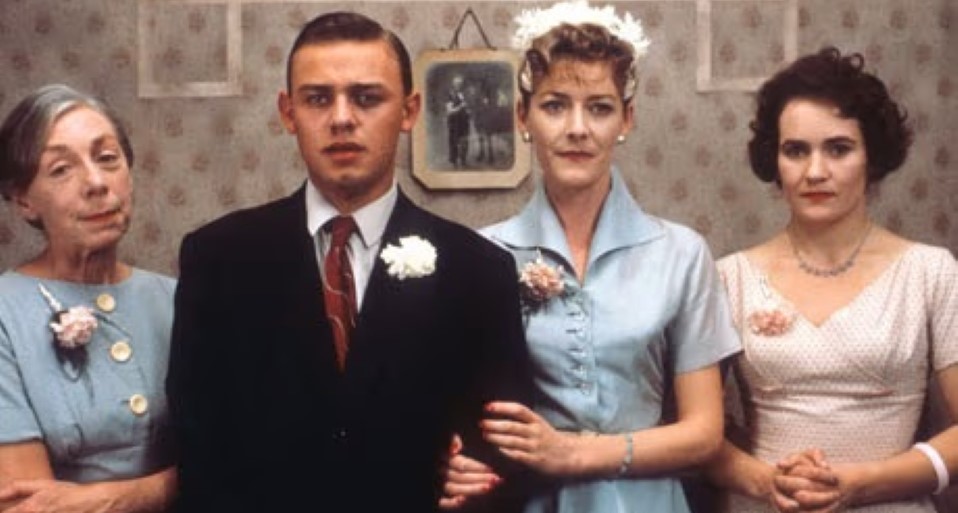
Terence Davies based much of Distant Voices, Still Lives on his own upbringing and memories of his family (a framed photo on the wall is of Davies’ own father). Shot with a rich, slightly sepia-toned classicism, the entire film replicates both the random workings of memory and watching a carefully constructed slide show. Events frequently are only tangentially connected to those preceding and following them: a memory of a marriage in the family, activates memories of the now-absent father at both his best and worst, a Christmas when he was affection itself, another when he overturned the dining room table in a sudden fury and demanded it cleaned up. It continues throughout the film, the narrative sliding from pre- to post-war, dictated more by tone and mood than by narrative.

It requires that you pay close attention to Davies’ film, to sift yourself through its moods and subtle shifts in tone. It opens with a carefully managed tracking shot that takes us inside the family house at an unspecified time, then fixes on a still shot on the staircase, while we hear conversation all around us. Is this happening at the same time? Or are we merely hearing the echoes of conversations past? In this film the past is both all around us and tantalisingly out of reach. Distant Voices, Still Lives is made up of frequent stationary, carefully assembled shots that resemble Mitchell and Kenyon photos that suddenly spring into movement (the image of the family preparing the wedding looks so like a photo, it’s a shock when all four actors suddenly walk out of frame). It’s a reminder that, to many of us, the past is a series of still lives, frozen in time.

Around everything, in a Dennis Potterish touch, is wrapped a musical backdrop of songs from the 40s and 50s. These tunes bring people together, knit together memories and (perhaps) even cover over and confuse events. Music is crucial in unity, the family and their friends frequently breaking into extended sing-alongs to popular tunes in the pub. It provides moments of warmth, closeness and intimacy – moments of mutual joy – which perhaps covers and balances the complex relations and struggles at home. It also makes the film often feel like an odd musical, like a sort of living slide show of images scored by the classics of yesteryear.

Distant Voices, Still Lives can be seen as a sort of poetic art installation, with its balance of still images bought to life and its poetic rhyming of events and persons. But it manages to involve the viewer, because it’s a very human film. There is real warmth and compassion in these memories and reflections. The love of a family, pulling together to survive trauma at home. Those moments of release in singing. The joy and delight – and tears – of coming together to watch a film at the cinema, swept up in the big screen emotion and imagination. Davies also finds a simple, pure beauty in the everyday: watching mother carefully tend and clean the house takes on a strange, natural beauty and power in the care and tenderness that lies behind it.

That’s particularly striking, considering the unflinching horror at home. Pete Postlethwaite is extraordinarily terrifying as a deeply unhappy and depressed man, who can process his complex feelings (and even, bizarre as it seems, his love for his family) only through anger and violence. He viciously beats his children and (in one terrible scene) his wife. He is charming and sweet with their friends. He oscillates between affection and fury. His children – particularly his son – are torn between despising the old man and wanting something – anything – from him in the way of affection. (Eileen will later bemoan his absence – due to death – at her wedding, to the disbelief and anger of her brother who often bore the brunt of his beatings). Davies’ film carries real power in its opening half, dominated by Postlethwaite’s tragic dark-heart, the ruler and gate-keeper of his home until his health collapses and he reverts to vulnerability.

The terrible impact on mother – beautifully played by Freda Dowie, in an extraordinary performance that feels like it’s been pulled direct from Davies’ memory of his own mother – dominates the emotional thread of the film. It also adds a dread to the possibility that Eileen’s own husband shows traces of jealousy and violence. But then the world is one of danger: the war could have ended the lives of the whole family (there is a striking sequence where they run trying to find their parents during an air raid warning, before finally finding the shelter and being greeted with relief and inevitable anger by their father). An accident nearly cripples Dean and Maisie’s husband – it’s echoes recurring throughout the film. Echoes touch nearly every moment of Davies film, flashes of memories activated by memories pulling together the film into an engrossing and heartfelt tapestry.

But the film’s real impact comes from the humanity that grounds it. It perfectly captures a moment of time, the bonds and interdependence of a working-class community in a film extraordinarily textured into something like a fictional documentary. The film is crammed with small moments of joyful intimacy, among the trouble and strife: friends laughing together, joy in music and film, laughing faces at shared jokes. All of this is shot with an exactitude that never manages to squash the tenderness at its heart. It’s a uniquely artistic, inventive and warm exploration of memory and time, with very few films even remotely like it – and rewatching it is a reminder of what a loss to cinema Terence Davies, a truly unique film-maker, is.

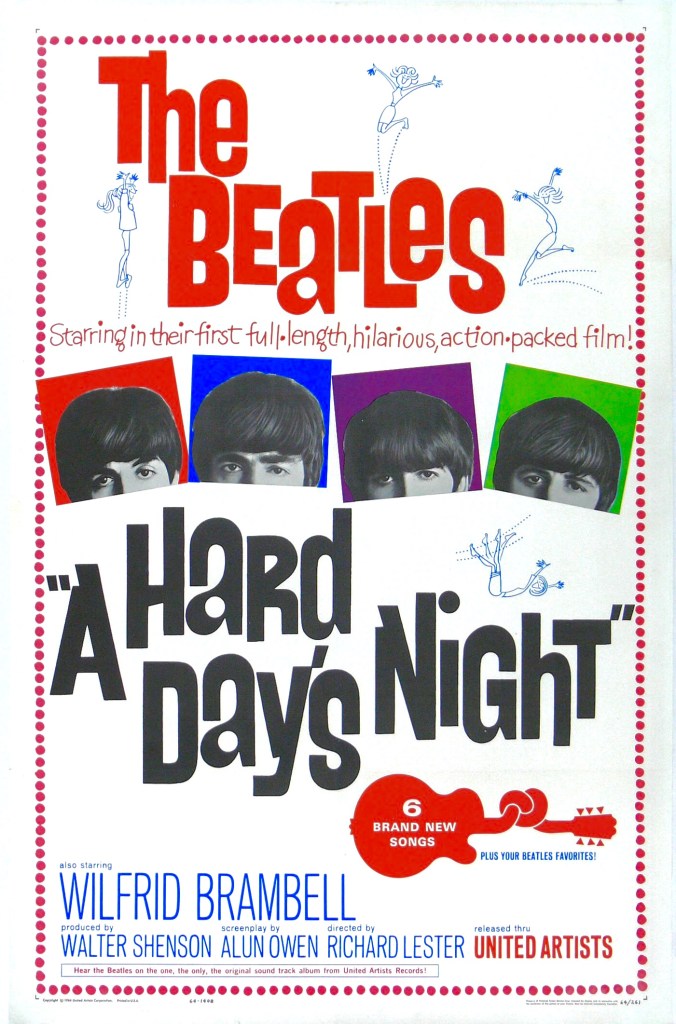
A Hard Day’s Night (1964)

A Hard Day’s Night (1964)

The Fab Four conquer the movies in this fast-paced and funny road movie

Director: Richard Lester

Cast: The Beatles, Wilfrid Brambell (John McCartney), Norman Rossington (Norm), John Junkin (Shake), Victor Spinetti (TV Director), Anna Quayle (Millie), Richard Vernon (Man on Train), Kenneth Haigh (Simon Marshall)

In 1964 they weren’t just the most popular music act: they basically were music. Everywhere they went they were met by crowds of screaming fans. They’d conquered America. They were no longer four lads from Liverpool: they were The Beatles. They were numbers 1-5 in the States, their last 11 songs had gone to number one, they were the most popular people on the planet. Of course, it was time for them to conquer the movies.

What’s striking is that A Hard Day’s Night could have been like any number of god-awful Elvis Presley films, with the King awkwardly playing a series of characters shoe-horned into plots based on songs. Richard Lester would do something different – and along the way he’d arguably invent the music video (when told he was the father of MTV, Lester famously asked for “a paternity test”) and the mockumentary all in one go. Lester placed the fab four into a day-in-the-life road movie, mixed with silent-comedy inspired capers and Marx Brothers style word play, in which they would play versions of their various personas in what basically amounted to a series of fly-on-the-wall sketches.

The film follows the gang in Paul’s (fictional) grandfather John (“Dirty old man” Steptoe’s Wilfrid Brimbell) complains move from “a train and a room and a car and a room and a room and a room”. (In a running gag lost on those not au fait with 60s British sitcoms, he is repeatedly called “clean”). In other words, we see the Fab Four shuttle to London, answer questions at a press conference, skive-off to prat about in a park then go through a series of rehearsals (with interruptions) before performing on TV and choppering off to their next appointment. It’s non-stop (even their night-off is filled with answering fan-mail – and pulling Grandad out of casino) work, work, work and any time outside is spent running from a mob of screaming fans. A Hard Day’s Night indeed.

Lester shoots this with an improvisational energy that feels like its run novelle vague through a kitchen-sink drama. He’s not averse to Keystone Kops style chases, sight gags and letting the camera bounce and jerk around with the actors. If things go wrong – ten seconds into the film George and Ringo fall over during a chase scene, get up and start running again while John laughs his head off – Lester just ran with it and kept it in. Everything feels like it has the casual, cool energy of just sticking the camera down and watching four relaxed, cool guys shoot the breeze.

It helps that he moulds four decent performances from a band that, let’s be honest, was never going to trouble the Oscars for their acting. Screenwriter Alun Owen – whose Oscar-nominated script is awash with pithy one-liners and gags – spent a couple of weeks with the boys and from that essentially scripted them four personas best matching their real-life attitudes. John becomes a cocksure smart-arse, with a quip for every corner. Paul an earnest, decent guy with a taste for wacky gags. George a shier, poetic type. Ringo the closest the band gets to a sad-sack loser, but also the most down-to-earth. Essentially, with these scripted “selves” the band were encouraged to relax and go where the mood takes them.

It works. Of course, it helps that the Beatles are (a) really cool and (b) totally relaxed with themselves, with Lester encouraging an atmosphere where the four feel less like they are acting and more like they are just being. There is an impressive naturalness about this film – really striking since it’s full of silly stuff, from the four hiding in a work tent to a car thief being roped in by the police to drive them through a chase – that means it catches you off guard. After a while you kick back and relax along with the people in it. That’s the sort of casual cool that’s impossibly hard work to pull off.

The musical sequences also feel spontaneous. When the Beatles bust out their kit and do a number on the train among the baggage it makes as much sense as them performing their stuff in the studio. It all stems from confidence – the sort of confidence that makes the group seem cheeky rather than cocky. There is a vein in A Hard Day’s Night of thumbing your noise at the posh, privileged world that was being gate-crashed by four working-class Scousers. It’s hard not to side with the Beatles when they tease Richard Vernon’s snobby city gent on the train (“I fought a war for you lot” he sniffs “Bet you wish you’d lost now” John snarks) or smirk at the deferential police eye these working class lads with suspicion.

What A Hard Day’s Night does best of all is make the Fab Four look like Four Normal Guys. They always look slightly dumbfounded by the pace of their life and the riotous reception from fans. They always seem like they’d be happier joking around or, as Ringo does when he bunks off for some time alone, wandering along chatting with people and dreamily watching the world go. They treat the media attention (and stupid questions) with straight-faced but ridiculous answers (“What do you call this haircut?” “Arthur”) and never feel or look like fame has corrupted them. Their manager Norm (a fine Norman Rossington) essentially treats them like four naughty schoolboys.

A Hard Day’s Night flies by in less than 90 minutes. It’s charm, wit and Lester’s sparkling imagery (the boys pratting around in the park did indeed inspire about a million MTV videos) and ability to shoot musical gigs in imaginative exciting ways makes it almost certainly the finest music-star film ever made – and inspired generations of comedies to comes. No wonder it made the Beatles number one at the Box Office and the Charts.

The Lesson (2023)

The Lesson (2023)

Sinister family mystery, full of good moments that don’t come together into something that really works

Director: Alice Troughton

Cast: Daryl McCormack (Liam Sommers), Richard E. Grant (JM Sinclair), Julie Delpy (Hélène Sinclair), Stephen McMillan (Bertie Sinclair), Crispin Letts (Ellis)

Liam Sommers (Daryl McCormack) strides onstage for an interview about his literary debut, that has set the world alight. How did he get the inspiration to write about a domineering patriarch in a rich country house? Flashback to Liam’s summer spent as an English tutor to Bertie (Stephen McMillan), who is trying to get into Oxford to impress his domineering father JM Sinclair (Richard E Grant), Britain’s leading literary novelist. The Sinclair household bubbles with suppressed grief over the accidental drowning of JM and Hélène’s (Julie Delpy) older son Archie in their private lake. As Sinclair puts the finishing touches to his new novel – and ropes in Liam to help him as “final lap amanuensis”, what secrets will Liam uncover about this family?

The Lesson revolves heavily around its oft-repeated pithy mantra from JM Sinclair – “Great writers steal”. So often is this repeated, that it drains much of what little surprise there might be about the true origins of JM Sinclair’s latest tome. It’s a fitting mantra from the film that feels like a mood piece, assembled from little touches of other filmmakers (Kubrick for starters), reassembled into something just a little too pleased with its reveals and secrets-within-secrets structure, but is well enough made that you are willing to cut it some slack.

Effectively all filmed in a single location, the Sinclair’s luscious house (a mix of the modern and the classical) set amongst rich private grounds, it’s well directed by Alice Troughton, who makes effective use of angles and transitions (particularly its cuts back and forth between the working practices of Sinclair and would-be novelist Liam, which subtly stress both their similarities and differences) to enhance mood and an air of unknowable menace. The camera drifts with a chilling intimacy across the fateful lake, giving it a sense of ominous power and mystery.

The film is at its strongest in its opening sections (like Sinclair’s novel, it is divided into three parts with short prologues and epilogues). Within a self-contained theatrical space, tensions and resentments between the family are carefully but not pointedly outlined. The father who switches between indifference, annoyance and gregarious enthusiasm. The mother who feels like both a dutiful supporter and a resentful slave. The prickly, difficult son scared of affection, who attempts (unsuccessfully) to ape his father’s authoritarianism, but is crying out to be hugged. Troughton skilfully cuts between these characters, frequently positioning them at opposing sides of the frame, setting them at visual odds with each other.

In the middle of this, Liam becomes an out-of-place, equally unreadable presence. Very well played by Daryl McCormack, full bluntness mixed with inscrutability, Liam is impossible to categorise and totally outside the upper-class formality of the Sinclair home (with its servants, home fine-dining accompanied with classical music and casually displayed artwork). He’s Irish, working-class, Black and sexually ambiguous. But he’s also hard for us to read: is his admiration for Sinclair something that could tip into resentful violence? Does he really like Bertie, or does he see him as a tedious, brattish child? As the prologue sets up, is he an innocent or a destructive, vampiric presence?

These beats are neatly set up in The Lesson’s opening parts, added to by the presence of a Pinteresque butler (a fiercely polite Crispin Letts) whose status and loyalties prove equally hard to read. Liam’s slowly becomes an intimate figure in the house, moving from a servant occasionally allowed to dine with the family, to Sinclair’s IT consultant, proof-reader and one-sided sounding-board for conversations about his novel, becoming an object of sexual fascination for Bertie and Hélène and given the late Archie’s clothes to wear (adding an Oedipal frisson to his flirtation with Hélène).

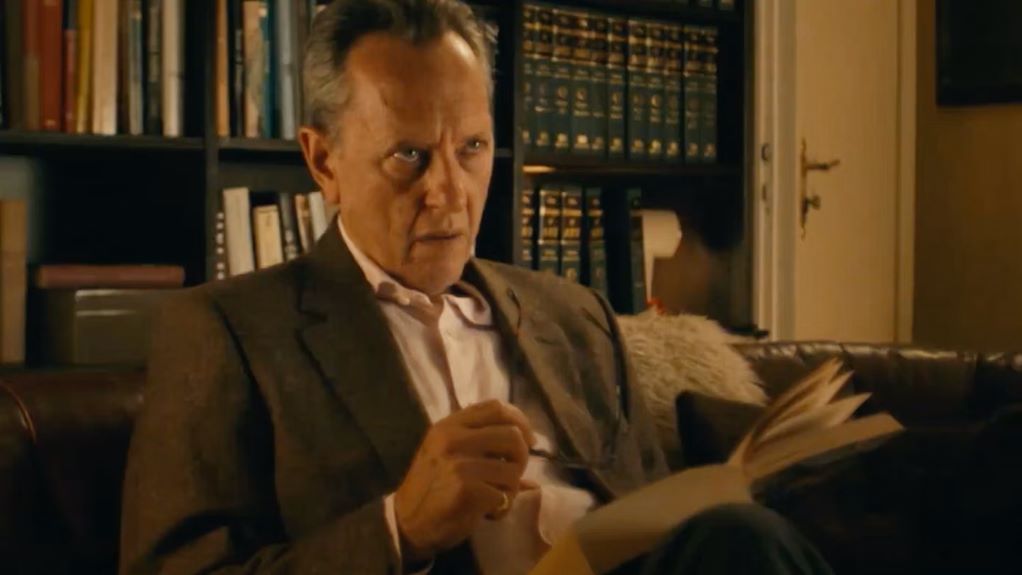
Ambiguity however slowly gives way as The Lesson continues, as it fails to weave its initial jarring mood into a reveal that feels truly satisfying, logical or surprising. This effect is magnified by the fact the more time we spend with Sinclair, the more it’s made clear he is less complex than we think, but simply an egotistical monster. Richard E Grant has huge fun with this larger-than-life braggart, a man so competitive that he feels compelled to aggressively slap down Liam’s draft novel as “airport trash” and smilingly telling him he has “done him a favour” by encouraging him not to write. But Sinclair’s monstrous, bullying self-importance sign-posts a little too clearly where the plot is heading.

The final reveal that we have been witnessing a secret plot unfold in front of us feels like a flawed attempt to add a narrative coherence to a series of events that would be impossible to pre-plan. This also relies on chance events and skills (events hinge on Liam’s near-photographic memory). The final ‘answer’ is also too clearly sign-posted from the opening, leaving you expecting a rug-pull that never comes.

The Lesson has a good sense of atmosphere in its opening half and some strong performances – Julie Delpy is very effectively unreadable as the enigmatic Hélène – but for all its sharp direction, its plot is too weak to be truly rewarding on a first viewing or give you a reason to want to return for a second lesson. Despite some good scenes, a bravura Grant and a subtle McCormack, the resolution of its quiet atmosphere of tension and inscrutability doesn’t quite ring true.

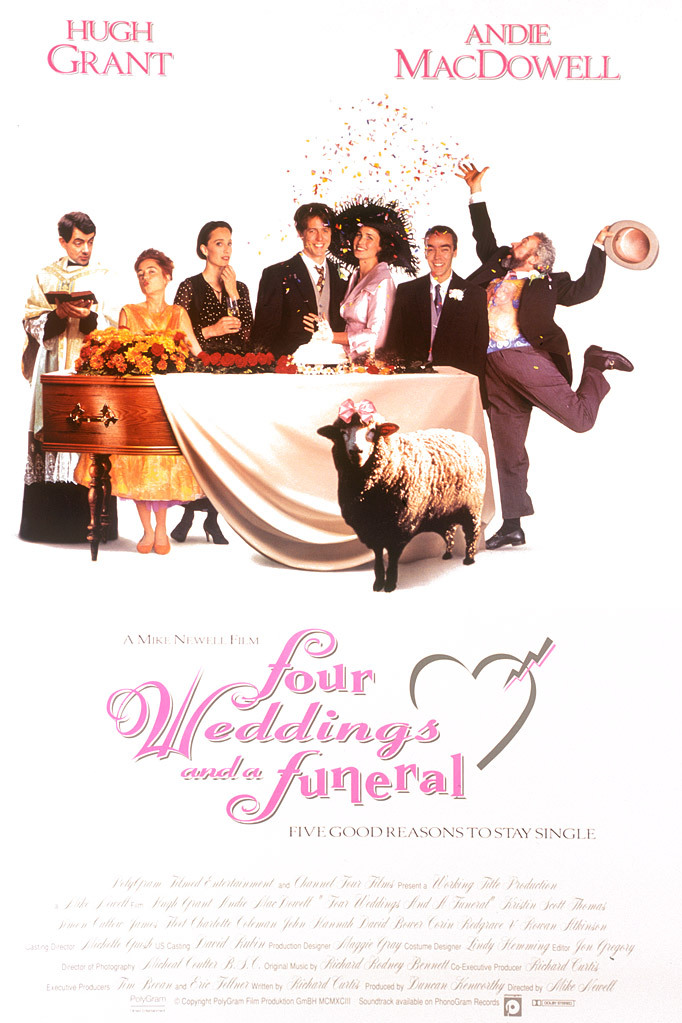
Four Weddings and a Funeral (1994)

Four Weddings and a Funeral (1994)

The phenomenon of the 90s, this charming comedy still (rightly) lies in many people’s soft spot

Director: Mike Newell

Cast: Hugh Grant (Charles), Andie MacDowell (Carrie), Simon Callow (Gareth), Anna Chancellor (Henrietta), Charlotte Coleman (Scarlett), James Fleet (Tom), John Hannah (Matthew), Kristin Scott-Thomas (Fiona), David Bower (David), Rowan Atkinson (Father Gerald), David Haig (Bernard), Sophie Thompson (Lydia), Corin Redgrave (Hamish Banks), Simon Kunz (John), Rupert Vansittart (George)

It’s 1994 and love really is all around. It certainly felt like it in the UK, as Four Weddings and a Funeral went from small Brit rom-com to national phenomenon. It was number one at the box office for ten weeks and Wet Wet Wet’s Love is All Around felt like it was number one for the whole year. The film was a huge international hit, the sort of once-in-a-lifetime movie for everyone involved, culminating in an Oscar nomination for Best Picture. For anyone who went to the movies in the 90s, it feels like an old, familiar friend. And, leaving aside the inevitable backlash, it’s still witty, charming and fun today.

Based on writer Richard Curtis’ experience of attending a never-ending parade of weddings one year (we’ve all been there), we follow Charles (Hugh Grant) through a series of disastrously different weddings (and, of course, one moving funeral) while he tries to deal with the fact he’s fallen in love with American Carrie (Andie MacDowell) – and one of the weddings he attends is hers. Around him float a phalanx of loyal friends: gregarious Gareth (Simon Callow) and his loyal, utterly reliable partner Matthew (John Hannah), dimly posh Tom (James Fleet) and his arch sister Fiona (Kristin Scott-Thomas) and zany Scarlett (Charlotte Coleman). But, when the time comes for Charles to head down the aisle, who will he find waiting for him at the end?

Four Weddings works because it’s blessed with a series of talents at the peak of their powers. Richard Curtis has never written a film script that balances so perfectly excellent one-liners, sharply sketched, engaging characters and a perfect mix of pathos and belly-laughs. Mike Newell balances the comedy with just the right touch of drama, never allowing events to tip into sitcom territory. The cast are all pretty much selected perfectly. And above all, it turned out Hugh Grant was placed on earth to play the lead roles in Curtis comedies.

Before Four Weddings, Hugh Grant was almost completely unknown: a Merchant Ivory supporting player at best. After it, he would be almost indistinguishable in the public’s eye from Charles (he’d effectively play the same role three times again for Curtis). What Grant does in this film is simply phenomenal. Curtis’ dialogue and rhythm fits his style like a glove: not since Rowan Atkinson (who delivers a Peter Sellars like performance as a nervous and shy vicar at the other end of the comic spectrum from Grant’s mix of comedy and pained earnestness) had an actor clicked so much with Curtis. There is, perhaps, no skill harder than light comedy, but Grant is a master at it.

He turns socially awkward comedy into a thing of beauty (trapped at a table with a series of ex-girlfriends, he lets the smallest inflections telegraph his desire for the earth to swallow him). He has the subtlety to not overplay pratfalls or physical gags (look at the minimalist simplicity which he plays being trapped, hiding, in a cupboard while a recently married couple have noisy sex in the same room, his face a mix of pained embarrassment and longing for escape). Grant captures better than almost any actor alive a peculiar, self-deprecating British sense of humour, the quiet rabbit-in-the-headlight horror of saying the wrong thing. He even makes you love Charles (who, in many ways, is a self-obsessed git) because Grant is so effortlessly likeable, emitting rays of little-boy lost charm.

It also works because the film crams into it a hinterland of friendship and warmth. The chemistry between the company is pretty much spot-on – you never for one moment doubt these people are lifelong friends, despite the fact we learn nearly nothing about any of them over the course of the film (even Charles – what other film would not even tell us his job?). Each of the actors seizes their role with relish. Simon Callow got to explode with red-faced bonhomie and shaggy-faced camp in a way you suspect he had been dying to do his whole career. Kristin Scott-Thomas’ arch dryness and icy posture was leavened with just the right touch of romantic yearning and wit.

In fact, the whole cast were so perfectly cast they almost became destined to spend their whole lives struggling to break out of the moulds Four Weddings placed them in. James Fleet was so skilled at nice-but-dim sweeties like Tom, he had to grow a huge beard to get serious roles. John Hannah (extremely good, with the films much touching WH Auden inspired moment) took on playing a posh twit in The Mummy. Anna Chancellor was so born to play the strangely needy ‘Duckface’, Charles’ ex-girlfriend she jokes the first line of her obituary will be “Duckface dies”. Callow and Scott-Thomas would play versions of these roles several times over – and even being arrested for picking up a sex worker wouldn’t break the public perception of Grant being Charles.

Which is all a round-about way of saying everything works here, the magic alchemy of everyone being in the right place at the right time, and every single risk paying off. You can be slightly churlish and say Andie MacDowell lacks some of the charisma and comic skill the role of Carrie needs (it’s a Meg Ryan role), but her innocent Southern exterior is needed to make the scene of her recounting her serial shagging to Charles over a restaurant table land with as much comic force as it does.

That’s one of many comic set-pieces that just plain work. From the “fuck!”-filled opening montage, which sees Charles hare, late, to a wedding where he is the best man, via the film’s many social faux pas (“She is now my wife” has never been funnier), Atkinson’s malapropism-stuffed wedding service to the film’s final comic denouement at Charles’ wedding, it’s packed with laugh-out-loud moments. But, because the characters are so well-drawn, with just the right amount of reality, we also care as well. The funeral carries real emotional impact – not least due to Hannah’s beautiful delivery of the eulogy (and let’s not forget, few other mainstream movies were as open to homosexuality at the time as this one). And every character has moments of depth: even dim Tom has flashes of real emotional insight.

You can mock it in retrospect for moments like “is it raining, I hadn’t noticed” – but films like this don’t stumble into becoming cultural phenomena. They get there because, for one glorious moment, everything comes together the way it was meant to be. A great script got just the right approach, from a series of actors perfectly cast and marshalled by a director towards warm, genuine comedy. That’s why people continue to watch – and quote it – thirty years later and it still feels like love is all around it.

Nil by Mouth (1997)

Nil by Mouth (1997)

Gary Oldman’s passion project is a punishingly raw, unforgettably tough drama of marital abuse

Director: Gary Oldman

Cast: Ray Winstone (Raymond), Kathy Burke (Valerie), Charlie Creed-Miles (Billy), Laila Morse (Janet), Edna Dore (Kath), Chrissie Cotterill (Paula), Jon Morrison (Angus), Jamie Foreman (Mark)

Gary Oldman called it his Lamborghini. Where other stars poured money into fast cars, Oldman pumped millions into this passion project. Writing and directing, Oldman’s film was not autobiographical, but an exploration of working-class themes that had surrounded him during his life. Nil By Mouth is a punishing look at the self-destructive cycles of some working-class lives, trapped in ruts with little opportunities or aspirations, tinged with humour but smothered in an aggressive and toxic masculinity where women so often become the victims.

Raymond (Ray Winstone) is married to Valerie (Kathy Burke). They live in a council estate in London, along with Valerie’s junkie brother Billy (Charlie Creed-Miles). Raymond makes a living in casual crime and carries a seething, barely controlled temper that explodes at the slightest provocation. Often that comes from his own family and his shocking and brutal capacity for extreme, vindictive rage will leave physical and mental scars on all around him.

Oldman’s Nil By Mouth doesn’t really have a plot as such. It’s more a ‘slice of life’ film – or a kitchen-sink drama, but one where the sink is ripped from the wall and used to smash someone in the face. Nil By Mouth is visceral, difficult to watch and relentlessly, almost overwhelmingly, powerful in its grimness. Oldman doesn’t allow a shred of romance about working class life. There is no nobility inherent in poverty, and for every piece of human decency there are those stuck in self-destructive cycles. Often this means men barrelling around causing pain, while women pick up the pieces.

Oldman shoots the film with an alarming immersiveness. Handheld cameras, awkward turns and a deliberate shunning of the careful and conservative distancing of two-shot set-ups, makes the viewer feel uncomfortable close to the characters in all their exceptionally flawed whole. The film is designed to make us feel as much in the room as possible, an increasingly helpless witness to the aggression and violence that bubbles under the surface of every moment. Just like Valerie’s young daughter, who watches everything with a mute silence, we are helpless witnesses.

Working-class London is an overwhelmingly male – and toxic – environment. No one can go more than a few words without effing and blinding. All the male characters guard their personal space like pit bulls. The slightest accidental touch can be met with nose-to-nose spittle fuelled fury. While there is a homespun humour to some of the conversations, the content is pitch-black. Anything that could even be vaguely interpreted as weakness is aggressively shunned.

It’s clear that all the man are emotionally stunted, frightened little boys behaving with the aggression of angry teenagers and the muscles of fully-grown men. Oldman’s gift with the film is to look at some of the most appalling people, with an understanding that never tips into sympathy. None more so than wife-beater Raymond. Raymond is a monster. A bleeding fist of anger, who sheds self-pitying tears in the aftermath of the latest atrocity he has inflicted upon his wife (“I do it because I love you”). Raymond sees himself as “the Daddy” but is actually a weak-willed bully, drowning in self-loathing and crippled by misdirected anger and grief at his own bullying father.

None of this excuses the appalling, terrifying behaviour he dishes out to Billy and Valerie. He nearly bites Billy’s nose off in an incandescent fury when Billy steals his drugs. That’s nothing to the jealous beating he meets out to Valerie when he witnesses her playing pool with a man. This shockingly violent outburst of kicks, punches and stamps to the prone and weeping Valerie is impossible to watch (mercifully Oldman keeps it mostly off camera). It’s felt inevitable: Raymond looks on the edge of handing out a beating every time we see him.

But then, Oldman is making the point, it’s inevitable to the characters as well. None of Valerie’s family are surprised by it – even if there is a vague attempt by her mother Janet (played excellently by Oldman’s real-life sister Laila Morse) to accept Valerie’s detailed story of a hit-and-run leading to her disfiguring injuries. Raymond is translating the pain handed out him onto his own family, dishing out treatment he received from his father but a hundred-fold worse. Just as his mother accepted treatment like this from his father, so Valerie will accept it from him. Her daughter will see this behaviour, and likely accept the same from her husband in the future.

Why do women accept it? Because what choice do they have? There is so few opportunities. Aspiration hardly comes into it – even if it clearly doesn’t exist for many – because quite simply the idea of there being another way of living your life than this just seems impossible. Women are there to pick-up the pieces. Janet has been doing it for years, nursing her son through a drug-habit with cash when he needs it (all of which goes into his arm). They need to keep the family, dysfunctional as it is, strangely functional. To let the dust settle, to welcome the abuser back in when he promises to change, give the junkie who has robbed them one more chance.

Nil By Mouth is at its strongest when it implies this terrible cycle. This can’t be the first time Raymond has struck Valerie (there is mention of an earlier estranged marriage, which presumably ended for the same reason). The film comes full circle to the family back together again – but no problems have been solved, no changes made, no revelations made. People have simply come together because, at the end of the day, what other choices are there?

Nil By Mouth isn’t perfect. Its grim power is sometimes overstretched at its two-hour plus run time. Much of the first half hour focuses on Billy, with Oldman’s camera a little too in love with the observational tragedy of this slightly shallow character (Creed-Miles does a good job, but the character is never quite interesting enough to sustain his screen-time). This is particularly obvious once the focus returns to the raw, unwatchable power of Raymond and Valerie.

Here Oldman also shows his strengths as a director of actors. Winstone – who a year before was making episodes of One Foot in the Grave and Murder Most Horrid – saw his whole career change with a performance of such stunning intensity, commitment and sheer visceral horror matched with self-pitying weakness, that he makes Raymond one of the most pathetic monsters of cinema. Kathy Burke is astoundingly good as Valerie, suffering, patient but unable to conceive of a change to her life. Both have never been better, turning a domestic tragedy into something of elemental force.

Oldman’s film is hard, grim, difficult viewing – but also essential. It marks him, after Laughton, as one of the greatest sole-directing credit actors (so far!) ever. Nil By Mouth, once seen, is impossible to forget.