Category: British Films

Judy (2019)

Judy (2019)

A star turn is the only thing of note in this empty, uninsightful biopic

Director: Rupert Goold

Cast: Renée Zellweger (Judy Garland), Jessie Buckley (Rosalyn Wilder), Finn Wittrock (Mickey Deans), Rufus Sewell (Sid Luft), Michael Gambon (Bernard Delfont), Richard Cordery (Louis B Mayer), Darci Shaw (Young Judy Garland), Bella Ramsey (Lorna Luft), Royce Pierreson (Burt Rhodes), Andy Nyman (Dan), Daniel Cerqueira (Stan), Gemma-Leah Devereux (Liza Minnelli)

By 1969 Judy Garland (Renée Zellweger) was homeless, broke and stuck in a pill-and-alcohol fuelled depression. Desperate to provide a home for her children, she flew to London for a five-week booking at the Talk of the Town nightclub. Judy sees her, pushed beyond her physical and emotional limits, as she struggles to complete the run – or even get on stage – marrying the feckless young Mickey Deans (Finn Wittrock) and flashbacks to her memories as a Hollywood child star (Darci Shaw), under the punishing “mentorship” of studio head Louis B Mayer (Richard Cordery).

All this gets mixed together in Goold’s uninspired, sentimental and rather empty biopic that never really gets to grips with Garland’s personality, so desperate is it to shoe-horn her into a bog-standard narrative of redemption mixed with personal tragedy. Garland, I’m sure, would have hated it: she always pushed back against the idea that her life had been tragic (which this film whole-heartedly embraces) and the portrayal of her as a constantly misunderstood victim, generously one-sided as it is, boils her down into someone with no agency or control at all in her life.

As such, the most effective parts of this film are the flashbacks to her childhood, filming Wizard of Oz, living off diet pills so she can’t put on weight and working 18-hour days. All under the direction of a monstrously calm Louis B Mayer – a terrific performance of amiable, grandfatherly menace from Richard Cordery – who pleasantly tells her she is a dumpy child who must work like a dog to get ahead and owes everything to him. If the film gets anywhere to understanding Garland’s psychology, it’s in these scenes – I’d rather they’d made it about this than her swan song in England.

In the 1969 sections, the film continues to try and communicate that a life of constant work and pressure left Garland an emotional, physical (and possibly mental) wreck. It puts us on her side, stressing her vulnerability and desperation which she covers with brittle, demanding behaviour. But it’s too squeamish to show too much of her popping pills and downing more than the odd glass of vodka – despite the fact she’s clearly intoxicated for large parts of the film. It only briefly looks at how crippling anxiety affected her unwillingness to rehearse and implies her time in London was a lengthy period of unending servitude rather than a five-week booking singing her greatest hits (the film is hugely vague about timelines to increase the feeling of Garland’s powerlessness).

The film isn’t even smart enough to give us moments where other characters get a glimpse of the fragility under Garland’s prima donnai-sh petulance. Despite her treating both of them as a mix of underlings and informers, Jessie Buckley’s minder and Royce Pierreson’s pianist inexplicably become friends to the star part-way through the film. There is no scene to transition this, no moment of fragile tenderness they witness that makes them understand there is more to this demanding person than they initially thought. Instead, it feels like the narrative requires them to like her just as the audience is supposed to, so whoosh they like her.

The one affecting sequence sees a lonely Garland bumping into two gay fans (Andy Nyman and Daniel Cerqueira) and rather sweetly asking if they would have dinner with her (they are of course thrilled). Back at their apartment, they cook a disgusting looking omelette, play the piano and she listens as they are tearfully talk about their life of persecution in homophobic Britain. It’s gentle, sweet and the only time we (or she) get a real sense of what Garland means to people – these fans idolise her as a symbol of hope. Even this scene is undermined by (a) it not having any lasting impact on Garland as soon as it finishes and (b) these characters being shoe-horned into a blatantly emotionally manipulative ending almost unwatchable in its cloying feel-good-ish-ness.

The one thing the film has going for it is a committed, pitch-perfect performance by Renée Zellweger who captures the vocal and physical mannerisms perfectly. She won every award going including the Oscar. It’s an impressive study and she plays the moments of pain as committedly and rawly as the gentle, tender moments. She does everything the film asks of her, and it’s not her fault that it asks so little of her. There is no dive into Garland’s personality, no questioning that any of her ills were self-inflicted, no criticism for her not turning up for gigs where customers have paid a fortune to see her, no attempt to explore other perspectives on the impact of her actions or how she has become the woman she is.

Instead, Judy meanders towards its semi-feelgood ending without ever really letting us feel we’ve understood much about either this woman or her difficult life, other than framing her as a victim from a life of exhausting show-biz exploitation. Told within a story that is low on drama, pathos or humour, you end up wondering what point it was trying to make in the first place.

Empire of Light (2022)

Empire of Light (2022)

Mendes passion project is strangely free of passion in a film that misses the targets it aims for

Director: Sam Mendes

Cast: Olivia Colman (Hilary Small), Micheal Ward (Stephen Murray), Tom Brooke (Neil), Toby Jones (Norman), Colin Firth (Donald Ellis), Tanya Moodie (Delia), Hannah Onslow (Janine), Crystal Clarke (Ruby), Monica Dolan (Rosemary Bates), Sara Stewart (Brenda Ellis)

In 1981, Hilary Small (Oliva Colman) is the duty manager of grand, old-fashioned, Margate sea-front cinema The Empire. A quiet, lonely spinster who’s never seen any of the cinema’s movies, she carefully performs her duties at work which include servicing the sexual needs of owner Mr Ellis (Colin Firth). However, her life changes when young Black man Stephen Murray (Micheal Ward) starts as an usher. The two strike up a friendship that becomes a relationship – but runs into conflict as Stephen struggles with growing racism and Hilary suffers a relapse into schizophrenia.

Empire of Light has been described as personal passion project by Sam Mendes. Bizarrely it feels like a film which all passion has been strained out of. It’s a functional and safe film, scripted with little inspiration and given life largely by the charisma of its two leads.

Empire of Light partially frames itself as a love-letter to cinema-going and film. Strangely it hardly engages with either of these. In fact, it could (with minor script changes) be set just as easily in a department store, petrol station or bingo hall. This is a film where no-one talks about cinema, watches a film or even seems interested. Toby Jones’ projectionist explains the mechanics of his trade in what feels like a carefully scripted explanation of the workings of a machine the writer knows nothing about. For all the beauty of Roger Deakins’ photography, there is no moment of magic that you might expect from a director who claims to be enamoured with the medium.

Hilary finally decides to watch a film for the first time: “pick any one you like” she tells Jones. He tees up Being There – a film I’m wondering if Mendes has seen. For starters, would I show a film about mental health featuring a racist cartoon in the middle to a woman struggling with her own mental health who has just watched a close friend being beaten up by the National Front? You’re left feeling Norman simply teed up whatever film was in the machine. But then, as he says, he doesn’t really watch the films anyway. Afterwards Hilary and Stephen chat about Peter Sellers – but never once mention he has only just died.

Empire of Light fails at most other things it attempts to do. Its heart is in the coming-of-age, second-chance-at-life romance at its centre. There is fine chemistry between Colman and Ward, and their bashful coming together works as a meeting of two spiritually similar people who feel life is passing them by. Their unspoken courtship early on – rescuing a wounded pigeon together in the abandoned upper-storey of the Empire or watching the New Years fireworks on the roof – has a pleasant innocence. But fundamentally, these characters feel ill-defined and go through personal crises that feel pat and under-developed.

Colman gives her all as Hilary – although this sort of dumpy, frumpy, tragic, timid woman is becoming a little too much of a calling card – but this is a thin character. We slowly realise Hilary is a woman struggling with mental health – making her sexual exploitation by Firth’s smug, sleazy, manager even more unpleasant. She carefully goes about her work, stares down at the ground and wouldn’t even dream of intruding on the cinema-goer by actually watching the film. Colman masters the little touches of glee she gets at the presence of Stephen, Hilary’s simultaneous enjoyment and bashfulness about what she assumes is a hopeless crush.

Where the film fails though is in finding any depth in Hilary’s struggles with schizophrenia. Colman’s character is inspired, in many ways, by Mendes’ own mother. The film aims for a sympathetic presentation of mental health, which it manages but without providing any insight. While many aspects of mental health were not discussed at the time, a film made today really should have more to say than Empire of Light musters.  Instead, Hilary’s condition feels like a dramatic shorthand. For a passion project that’s not good enough – the film even falls back on the age-old “stops taking her meds” plotline. For all the gusto and commitment Colman brings to Hilary’s mental collapse – a furious destruction of a sandcastle, or ranting, drunk, in an apartment where the walls are strewn with self-penned graffiti – it never feels insightful enough.

It’s sadly the same with Micheal Ward’s Stephen. For all Ward is hugely charming as this saintly young man – and for all he expertly suggests Stephen’s anger at the growing tide of racism in Britain – the issues he deals with feel like window-dressing. The most interesting moment is his confrontation with an angry, racist customer who is appeased by Hilary rather than challenged – much to Stephen’s justified fury. But name-checking Brixton and New Cross and saying “it’s getting worse” doesn’t really feel like getting to grips with the dilemmas he, and young men like him, were facing. Particularly when Stephen responds to a deadly beating with something approaching a shrug of the shoulders. You can’t argue with Mendes’ genuine feelings, but there is never enough depth.

Instead, these major social issues are benched by the film’s end, making them feel like discussion points to make Hilary feel better about her life and for Stephen to resolve to move on with his. It has less to say about these issues than an episode of Call the Midwife. Just as it has nothing to say about the magic of cinema going, turning it into a retro back-drop of posters and old sweeties. Far from making a case for cinema, it makes the building as irrelevant as some worry it is becoming today.

Tinker, Tailor, Solider, Spy (2011)

Tinker, Tailor, Solider, Spy (2011)

We’re going on a Mole Hunt: Le Carré’s finest book is boiled down into an atmospheric and masterful spy thriller

Director: Tomas Alfredson

Cast: Gary Oldman (George Smiley), Colin Firth (Bill Haydon), Tom Hardy (Ricki Tarr), Mark Strong (Jim Prideaux), Ciaran Hinds (Roy Bland), Benedict Cumberbatch (Peter Guillam), David Dencik (Toby Esterhase), Toby Jones (Percy Alleline), John Hurt (Control), Kathy Burke (Connie Sachs), Roger Lloyd-Pack (Mendel), Svetlana Khodchenkove (Irina), Konstantin Khabensky (Polyakov)

Anyone taking on this, Le Carré’s finest novel faced a tough challenge. After all, arguably the definitive version already exists: the masterful, slow-burn, 1979 TV adaptation (one of my favourite films ever) starring an Alec Guinness so perfect as the rotund, inscrutable spy-master George Smiley that Le Carré stated he could no longer write the character without thinking of him. I’ve long been nuts for Tinker, Tailor: I rushed to the cinema to see this with an equally keen-friend about five days before my wedding (on my wife-to-be’s birthday!) because I was looking forward to it so much. (Despite this the wedding went ahead). It can’t match that Guinness version – but it runs it close.

It’s the height of the Cold War, and the respected head of the British Intelligence Services (‘the Circus’) Control (John Hurt) is forced out, along with his deputy George Smiley (Gary Oldman) after a rogue mission in Hungary goes disastrously wrong. Over a year later, Smiley is secretly recalled to lead a mole hunt. Someone at the top of the service is a Russian agent – but who? New head Percy Alleline (Toby Jones)? Or one of the deputies – Bill Haydon (Colin Firth), Roy Bland (Ciaran Hinds) or Toby Esterhase (David Dencik)?

The first inspiration here is the screenplay. When I heard the film was two hours long I was stunned: the TV series unfolded over nearly seven hours! But the script, by Peter Straughan and the late Bridget O’Connor (who tragically died of cancer during it’s making) is a masterpiece. It brilliantly and skilfully compresses and restructures the novel, boiling down scenes to their core. But yet, it never feels rushed. The script creates composite scenes – most brilliantly a flashback to a Circus Christmas party – which allows a vast range of sub-plots and characters to simultaneously unfold.

Alongside this, the film is superbly, atmospherically directed by Tomas Alfredson. Alfredson brings a sharp, outsider’s view to this public-school nightmare turned espionage hub. These are posh boys, running an exclusive club, which plays by punishing rules. Everyone constantly spies one everyone else and there is no moment of privacy. Alfredsen brilliantly explores the social and emotional impact of spying, trapped within a grim and oppressive 70s mileu of dirt, beige, fear and loneliness.

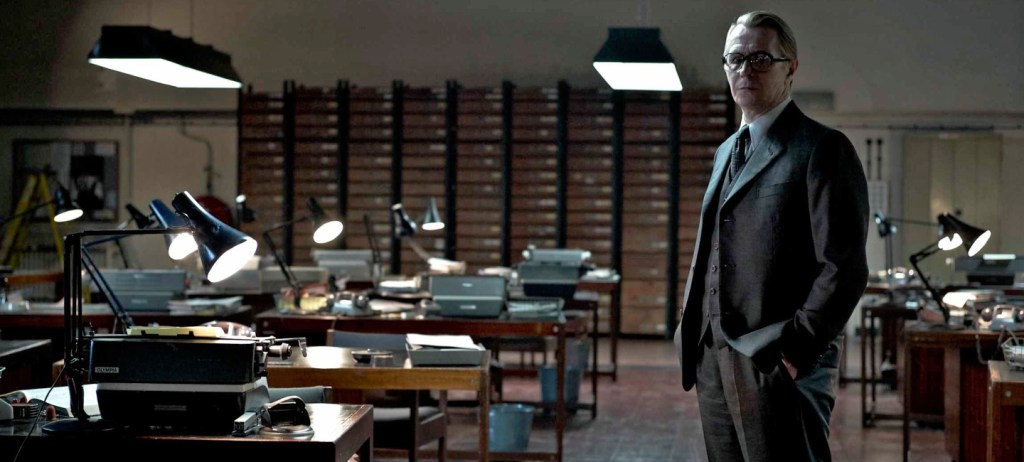
The film is brilliantly designed, capturing a vast array of 70s designs and shades. The Circus is an industrial office – with its centre piece an orange lined, sound-proof room. Streets are lined with political graffiti – at one point we see “The Future is Female” a nifty comment on the all-male institution we are watching. Communist Hungary is a post-industrial slum, hotel rooms crowded with papers, cigarette smoke and overflowing ash trays.

At the centre is Gary Oldman, simply brilliant as Smiley. Controlled, measured and deploying only as much energy is needed, Smiley adds a hint of Guinness to his voice and always seems in control. But this lugubrious Smiley bubbles with tension, driven by twin demons. The first is Karla, the Russian spy-master Smiley let slip through his fingers years ago, the subject of a maudlin late-night recollection to his assistant Guillam. Even more important is his wife Ann, the betrayer Smiley still loves to distraction, a half-sight of her enough to make him stumble and lose breath. We never see either of these clearly in the film, reflecting their status as the only characters Smiley never understands and can’t make cool, calm, passion-free decisions about.

Cold-eyed reason guides everything else he does. Oldman’s Smiley may be grandfatherly, softly-spoken and controlled, but he’s as ruthless (if not more so) than everyone else. Smiley is precise and patient. There is a beautiful character establishing moment: Smiley, Mendel and Guillam are in a car bothered by a wasp. Guillam and Mendel flap with futile energy: Smiley waits and then lowers the window slightly at the perfect moment to let the wasp fly out. It captures in microcosm Smiley’s investigation. But he’s not afraid to use force: quietly threatening Dencik’s trembling Esterhase with deportation (not even flinching as a plane lands behind him), ruthlessly mining witnesses for evidence and verbally lashing out bitterly at the mole.

Alfredson’s film zeroes in on much of the emotional impact on spying. Smiley is a man slightly lost in the world outside of spying: retired, he seems adrift walking the streets, swims alone, sits at home in his suit. He’s so deactivated he doesn’t even speak for the first 18 minutes of the film, when he is recalled to life. Smiley has suppressed his emotions so completely only the shadow of his wife can move him. His home is a strange shrine, so much so he even keeps the gifts her lover gives her.

Each of the characters suffers under their burdens, and the demands on them for secrecy and isolation. Mark Strong’s Jim Prideaux buries himself in guilt in a caravan and forms a friendship with a young boy he later realises he is crafting into the same secretive man he is. Guillam is quietly ordered by Smiley to end his relationship with his boyfriend and acquiesces in private tears. Connie Sachs lives in retirement like a mad woman in an attic, cradling her memories. Control dies alone in a hospital bed. Later the Mole clings to having “made his mark” to supress his guilt, while a man whose career is ruined walks into oblivion blank faced not even noticing the rain around him.

Tinker, Tailor, Soldier, Spy is full of moments like this, the high-price of dogged, dedicated work like spying. Alfredson’s coolly, beautifully shot film (by Hoyte van Hoytema) with its lyrical score by Alfredo Iglesias is a masterpiece of tone. This is a dark, dangerous world and we are constantly reminded of it, in between the muttered meetings in board rooms and dark corriders. Tom Hardy’s (wonderful) Ricki Tarr and Mark Strong’s deeply emotional Prideaux are spies-on-the-ground, face-to-face with dangers. Theirs is a world of brutal throat-cuts, eviscerations in a bath and sudden executions. The decisions played out in rooms like that orange-lined sound-proof office with its methodical, intricate ship’s clock, lead to death and violence.

The film is stuffed with beautifully composed shots and brilliantly edited (Dino Jonsäter’s cuts frequently carry us over brilliantly over transitions and segues that streamline the narrative perfectly). Despite cutting back and forth over multiple timelines, it’s always clear when we are (an ingenious device sees Smiley change his glasses in retirement, instantly grounding us in the timeline based on the pair he is wearing). The Christmas party scene – exactly the sort of bizarre public-school irreverent piss-up (where spies who fight night and day to destroy the USSR raucously sing communist songs with a Lenin-dressed Santa) is a superb distillation of character and plot beats and becomes, in many ways the emotional pivot of the movie. It’s a very inventive addition.

The film assembles a superb cast. Oldman, of course, leads from the front but there is not a weak turn in the cast. Hardy is gritty, bitter and jumped-up, Cumberbatch holding his tension down under professionalism, Strong drips quiet grief, Firth swaggers with superb, assured insouciance, Hurt is the book’s arch-spy-master come to life, Jones is full of preening pride, Burke lost in memories. If I’d like the film to be longer for any reason, it would be to see more of these actors.

Full of moody, seventies beauty and creeping paranoia, it’s also crammed with beautifully judged lines and incidental moments from the book. Alfredson’s atmospheric film has a profound emotional understanding of the cost of this life of isolation and paranoia. It took a couple of viewings, but this emerges from the shadow of my favourite TV series.

Croupier (1999)

Croupier (1999)

Slow-burn delight in this low-key but compelling British crime and gambling drama

Director: Mike Hodges

Cast: Clive Owen (Jack Manfred), Alex Kingston (Jani de Villiers), Gina McKee (Marion Neil), Kate Hardie (Bella), Nicholas Ball (Jack Manfred Snr), Nick Reding (Giles Cremorne), Paul Reynolds (Matt)

The last thing would-be writer Jack (Clive Owen) wants is to be sucked back into the grimy underbelly of the casinos where his father (Nicholas Ball) made his living. Jack fears his addiction to the places. But his buzz is not the gambling or the chance of raking in cash himself. Nah, his particular hit is the cold voyeuristic delight of watching others lose. The greedy, the arrogant, the clueless, the desperate: he gets the same buzz from sweeping their chips away from the table in front of them. Jack knows you play, you only guarantee you will lose: but will glamourous South African Jani (Alex Kingston) persuade him to join her in another game against the casino?

Mike Hodges’ fascinating crime drama struck out of the blue to restore Hodges from yesterday’s man – the forgotten master of Get Carter – as a vibrant voice in British cinema. Typically, of course, this was only after the film had been all but ignored in Britain but became a hit in America. An Oscar campaign was planned but cancelled when it emerged a single screening on Dutch TV before its release in LA made it ineligible. Nevertheless, the film’s cold, arch mix of distance, cool and menace was a keen reminder of what a great director of mood and intention Hodges could be.

Hodges also has the perfect actor in its lead role. Clive Owen’s precision, quiet exactitude and mastery of the micro-expression is perfect for a man as distant, observant and (at times) uncaring as Jack. Only someone as effortlessly cool and striking as Owen could have made us like Jack as much as we do, a particular challenge as he is a cocky shit with an almost sociopathic coldness, viewing the creep of the voyeur who loves control. Owen captures all this perfectly, his voice rarely rising, his life lived to a sort of bizarre samurai code where he the only person he needs to impress with his superiority is himself.

Hodges film is one of mood and sensation rather than plot. Events unfurl with an increasingly dream-like logic, dictated by Jack’s noir-like voiceover as he slowly turns his life and experiences in the casino more-and-more into fiction. Sections of the film are divided into chapters in voiceover and Jack’s arch commentary exposes his views of those around him (communicated only by the most micro expressions on Owen’s face). Jack dreams of publishing a novel that will worm its way inside people: it’s the yearning not of the artist but the control freak, as excited by the sensation of knowing his words can guide people’s reactions and feelings just as a flick of his wrist at the card table or the roulette wheel can enrich them or drive them to destitution.

Jack’s control makes him a perverse stickler for rules. Jack’s professional croupier life – slicing money with a thunk down a pipe to the cashier or sweeping lost chips into a count-up oblivion (Hodges’ eye for the brutality and violence in the mechanisms of gambling is matched by his brilliance in demonstrating the businesses cold-eyed indifference to short-tern winning and losing) – is one of masterly control. His personal something else. The drama comes from wondering how far he will stick to that when offered the temptation, not of wealth but of proving he’s smarter than anyone else. There he allows himself the risks that he would never take when working.

Three women rotate around Jack. Gina McKee has the most thankless role of the three, a cop turned store detective who seems to be propping up the initially bohemian (a blonde, porkpie hatted Owen) Jack but offers the sort of dull, parental support lacking in his life. Two other women appeal to different parts of him. Kate Hardie’s Bella – a fellow croupier as chillingly professional as the DJ-suited Jack – is a sort of half-mirror image, bubbling with temptation (and very appealing to an egotist like Jack, who would like nothing better than to sleep with himself). Most striking of all is Alex Kingston’s erotic punter Jani, a mysterious South African who attempts to both seduce and bring out the protective side in Jack. Jack may never gamble his money, but risk in her personal life seems a harder dodge. He sleeps with women, gets in fights – which he engages in with a terrifying capacity for violence – and casually seems to invite dangers to drop into his path.

Spontaneously taking Jani to a weekend at the country-house of a would-be publisher, Jack mixes his buzz of voyeuristic control with the temptation of doing something wild and dangerous. He agrees to join a late-night card-game as dealer only – and promptly uses his card shark skills to deal out a series of progressively brilliant hands to the players in the final game. He then goes to bed with Jani, doesn’t touch her but quietly listens to her offer of ten grand in return for his aid in stealing from the casino. This is not the behaviour of a normal man.

If the film has a flaw, it’s the almost indifference with which Hodges wraps up most of these plots. There is a shock death, but the impact of it is almost deliberately passing and the heist of the casino is as laughable in its amateurishness as it is sudden in its resolution. Is it because we have moved from the real world to Jack’s noirish I, Croupier novel without realising it? You could imagine, as the film grows more dreamlike, that at some point we shifted from Jack’s reality to the constructed one he has formed for his novel. What better thrill for a control freak than to become ‘God’ of the narrative. After all Jack dreamed of his novel climbing inside people’s brain and infesting their thoughts.

Jack ends the film the smartest, most well-adjusted addict you could ever imagine, The short-term job at the casino is something he cannot let-go and Hodges’ shooting of this den of addiction, this theatre of destitution turns it into a mirror-lined sess-pit of human frailty, reflecting vice back into itself, presided over by a man who delights in weakness. More money is swept, triumphantly, from the table by Jack and its clear being there for him is the real triumph. Atmosphere, style and vicarious thrills. It’s these chilling things Croupier finds so thrilling, enticing and fascinating.

Paddington (2014)

Paddington (2014)

Michael Bond’s lovable bear makes an almost perfect screen-transition in this heart-warming tale

Director: Paul King

Cast: Ben Whishaw (Paddington Bear), Hugh Bonneville (Henry Brown), Sally Hawkins (Mary Brown), Madeleine Harris (Judy Brown), Samuel Joslin (Jonathan Brown), Julie Walters (Mrs Bird), Nicole Kidman (Millicent Clyde), Peter Capaldi (Mr Curry), Jim Broadbent (Samuel Gruber), Imelda Staunton (Aunt Lucy), Michael Gambon (Uncle Pastuzo), Tim Downie (Montgomery Clyde)

If there is one thing we need in troubled times, it’s kindness. Few characters are as overflowing with warmth and decency as Michael Bond’s Paddington Bear. First introduced in 1958, the lovable marmalade-consuming little bear all the way from darkest Peru is never anything less than kind and decent – even as the well-meaning bear gets himself into a string of catastrophes.

Paddington is one of the most universally beloved figures from post-War British culture – surely no surprise he was the perfect tea-party guest for that other beloved icon of the same period, the Queen. The pressure was on for a Paddington film – could it match the tone of the books? The answer was an over-whelming yes. Paddington is an endlessly heart-warming triumph, which it is impossible to watch without a warm glow building inside you, and a goofy smile on your face.

Explorer (Tim Downie) discovers a species of intelligent, marmalade-loving bears in darkest Peru. Forty years later, after a terrible earthquake, a young bear travels to find a new home in London. He meets the Brown family – overly cautious father Henry (Hugh Bonneville), caring Mary (Sally Hawkins) and their children Judy (Madeline Harris) and Jonathan (Samuel Joslin) – who take him into their home and name him Paddington after the train station where they found him (his bear name being unpronounceable). Paddington (Ben Whishaw) works hard to settle in with his new hosts – but danger looms from an ambitious Natural History Museum taxidermist (Nicole Kidman) who longs to make Paddington the centrepiece of her collection.

Directed with a great deal of unobtrusive flair by Paul King, Paddington is a truly endearing film about the triumph of opening your heart to strangers. The Brown family don’t realise it, but they are in need of a burst of kindness in their lives to help bring them together. They get it in spades with Paddington. The film captures perfectly the little bear’s personality. This is Paddington exactly as you remember him: polite, decent, kind and hilariously accident-prone. King’s film also gets the tone exactly right – there are no pop-culture references or rude gags (although there are a few subtle double-entendres of a sort) and the film is set in a timeless mix of 1950s London and today.

The film’s CGI Paddington is gorgeously designed – a wonderful rendering of the bear’s appearance tailored with more realistic fur, but still the same as the book– and perfectly voiced by Ben Whishaw. Whishaw was a late replacement – Colin Firth voluntarily withdrew, as he felt his voice was ill-matched to this naïve, gentle young bear – but his light and gentle tones convey all the warmth you need. It’s a superb performance, humane, kind and deeply funny, and so well suited you suddenly realise in your head Paddington always sounded like this.

King creates a series of gorgeously handled set-pieces to showcase Paddington’s possibilities for well-intentioned mayhem. On his first night in the Brown household, he duels with toothbrushes, mouthwash, toilet flushes and showers, culminating in flooding their bathroom with a swimming pool’s worth of water. He gets mummified in sellotape, slips up in the kitchen and causes several marmalade-sandwich involved disasters (most hilariously a marmalade baguette-pneumatic tube mix-up). But he always means well: a caper-filled set-piece through the London streets sees Paddington finally collide with a man he’s trying to return a dropped wallet too – allowing someone we’ve known all along to be a pickpocket to be apprehended by the police.

The Brown family’s home – already a beautifully designed dolls-house made real, with a tree blossom mural that changes to reflect the mood of the scene – comes to life with Paddington in it. (Watch how the colours of their clothing change depending on how much Paddington is part of the family or not). Mary (a wonderfully warm Sally Hawkins) is already eager for him to stay. Judy and Jonathan (superbly sparky performances from Madeline Harris and Samuel Joslin) are quickly won over by him. It’s only Mr Brown – a performance of perfectly judged fussy, pinickity, rule-bound caution and stuffiness by Hugh Bonneville which flourishes into something warmer – who is unsure. But then this is a man so obsessed with his risk analysis job, he prevents his children from doing anything (34% of all childhood accidents happen on the stairs!) and has forgotten how to have fun.

Watching Mr Brown slowly warm to Paddington is a huge part of the film’s charm and warmth. Who could imagine the man who tries to leave him at the train station (and urge his family not to catch the bear’s eye, muttering “stranger danger”) would later be dressing up as a Scottish cleaning woman to help him infiltrate the Geographer’s Guild building? (This sequence is a little comic physical and verbal tour-de-force Bonneville.) It’s a larger part of the film’s wider – and most rewarding – message: the importance of treating migrants to this country with respect and care.

The pro-migration message is throughout the film – and the film is a fabulous reminder to many of what we have gained from those who have come to this land from across the seas, from NHS staff to political leaders to entertainers. Paddington’s journey to London – in a small boat, then sneaking past customs – is all-too-familiar.  Next door neighbour Mr Curry (a comically ingratiating Peter Capaldi) voices many of the “concerns” of anti-immigrant communities (let one bear in and who knows how many will follow?). Even Mr Brown voices worries about bears telling you sob stories to win your trust. The important message here is the value migrants bring us. A recurring calypso band reminds us of parallels with the Windrush generation. It’s not spoken but Jim Broadbent’s antique shop owner’s accent and memories of arriving on a train in London as a child clearly mark him as a Kindertransport child. Paddington has a subtle and truly important message for people: when we open our arms to people, we gain as much as they from the exchange.

Paddington throws in a few moments of darkness: the shock death of Uncle Patuszo is surprisingly affecting and Nicole Kidman’s taxidermist is possibly the scariest villain you’ll see in a kid’s film this side of the child catcher. But in some ways this enhances the warmth even further. By the film’s end you’ll feel your own life has been enriched by the small bear’s presence as much as the Brown’s has. We need him in times like this.

The Draughtsman’s Contract (1982)

The Draughtsman’s Contract (1982)

Cryptic puzzles abound in Greenaway’s debut, a striking, oblique country house murder mystery (with bodily fluids)

Director: Peter Greenaway

Cast: Anthony Higgins (Robert Neville), Janet Suzman (Virginia Herbert), Anne-Louise Lambert (Sarah Talmann), Hugh Fraser (Mr Talmann), Neil Cunningham (Thomas Noyes), Dave Hill (Mr Herbert), Michael Feast (Living statue), David Meyer & Tony Meyer (Poulenc brothers), Nicholas Amer (Parkes), Susan Crowley (Mrs Pierpont), Lynda La Plante (Mrs Clement)

Peter Greenaway’s work often feels more like complex, intellectual art projects than films. They are dizzying, mystifying morasses of symbolism, veiled hints, numerical games, puzzles and oblique references, all wrapped up in a stunning visual originality that speaks volumes for Greenaway’s instincts as an artist. All of which means to say, don’t come to a Greenaway film expecting such comforting things as plot or characters. The Draughtsman’s Contract was his first ‘narrative’ feature film and is still (perhaps) the finest example of his complex, challenging (and often, let’s be honest, frustrating) style. Constantly keeping you in your toes, there are few films like it out there.

Its 1694 and famed draughtsman Mr Neville (Anthony Higgins) is approached by country lady Mrs Hebert (Janet Suzman) to create twelve drawings of her husband’s expansive house and gardens, while her husband is away in London. Neville is less than interested in the commission – until Mrs Herbert agrees to his unusual terms that he will have complete control over the house and access to her person at any time that he wishes to “take his pleasure”. Neville sets about his drawings with the detailed fanaticism of a man determined to capture reality exactly as it is: but strange items and objects keep appearing in his panoramas, dutifully reproduced in his drawings. Mrs Herbert’s daughter Mrs Talmann (Anne-Louise Lambert) inveigles Neville into her own ‘contract’ for ‘taking her pleasure’. Is there is something going on in this house that Neville is unaware of?

Greenaway described the film as, in part, an Agatha Christie style murder mystery, with the unloved, bullying husband Mr Herbert as the victim. But then, in true Greenaway style, he also stated any explanation of the identity of the killers, their motives or indeed anything that could explain the crime was unnecessary because the clues were all there and any half-way intelligent viewer could figure them out. In many ways it’s a huge pleasure to have a director who treats his audience with such respect. It’s also an indication, perhaps, that plot was also the thing he was least interested in.

The Draughtsman’s Contract is a fascinating, immersive, coldly intellectual but endlessly puzzling film. Visually it’s like an art-history banquet. Images inspired by a host of the greats (and some lesser knowns) abound. From the film’s opening with its Caravaggio candle-lit interiors to its Hogathian interior shots, it comments throughout on the differences in art between representation and imagination. Neville believes art to be defined by its ability to capture reality: the idea of creation and invention is almost anathema to him, his art a careful preserving of events. It’s why he controls the conditions he paints in so absolutely and why he powerlessly includes the random pieces of clothing (among other things) that appear in his tableaus.

What is happening here? It’s clear something is going on. What slowly becomes clear to us as well is, that for all his slightly repellent arrogant and confidence, Neville has no idea what it is, or even perhaps that anything is happening at all. For all his bragging of his magnificent eye and ability to immediately perceive the smallest change he pretty much misses everything of consequence in the film. He detects no real ulterior mystery here because he seems to lack the imagination to grasp one, so preoccupied is he with his arrogant enjoyment of his commission’s benefits.

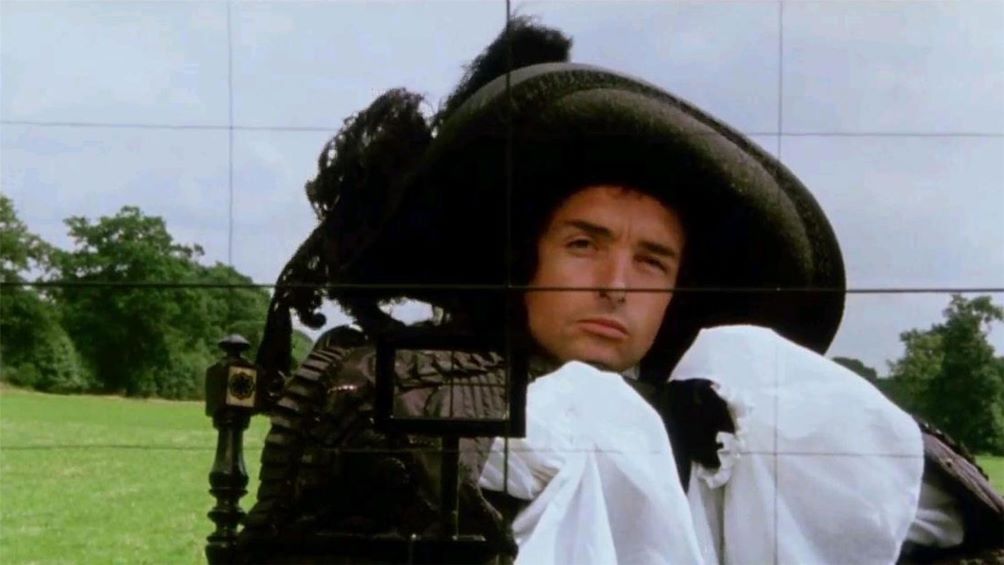
Greenaway presents Neville as the sort of pedestrian, camera-obsessed film-maker I imagine he scorns. Neville sets up his easels and perspective device (which even has a viewfinder) like a movie camera, obsessively fiddling with its set-up with never a thought for the deeper truth behind his striking images. Is this a comment on the lack of imagination in film-makers? Is Greenaway saying they are as bluntly obsessed with the beautiful cross-hatching of details stops them from creating something truly visually striking, or discovering the “spiritual truth” behind the details?

It’s that failure to pick up the spiritual truth that is Neville’s downfall. Slowly we realise the house’s owner is unlikely to return alive. The curiously artificial behaviour of everyone in the house, their sterile, detailed lives and obsessions with form, becomes overwhelming sinister. Neville however, charges about, aggressively pushing Mrs Herbert through sexual encounters (she even vomits after their first one – no Greenaway film is complete without every excretion the human body can produce), provoking her impotent son-in-law Mr Talmann (a vilely aristocratic Hugh Fraser) and endearing himself to no-one. It never occurs to him he might be being used.

Very few answers are spoken in the film. It’s left to us to figure out who might have committed the murder, and largely to surmise why two childless women allow Neville to take such liberties with them at a time of strict inheritance laws that denies rights to childless women. An elaborate trick is being played on Neville, dependent on his arrogant assumption that he is in charge. In fact, in his black clothes, loud voice and lack of over-elaborate hair and make-up, he is an out-of-his-depth outsider, even as he behaves with the rumbunctious confidence of a man at the top of the hierarchy.

Greenaway’s film is full of small curiosities that largely go unnoticed. Small details in the house are clearly out of period. A small boy sketches what looks like spaceships. Above all, the house’s grounds are populated by a nude living statue (played in a performance of physical dexterity by Michael Feast), painted grey, who seems to see and hear everything but is invisible to all. As to what this means, who can really say (Greenaway ain’t telling), although in true Greenaway style we get to watch him piss. Is it perhaps a comment on the increasingly obvious things Neville is missing? Or a sort of holy fool or Puck-figure, observing the mayhem with fascination?

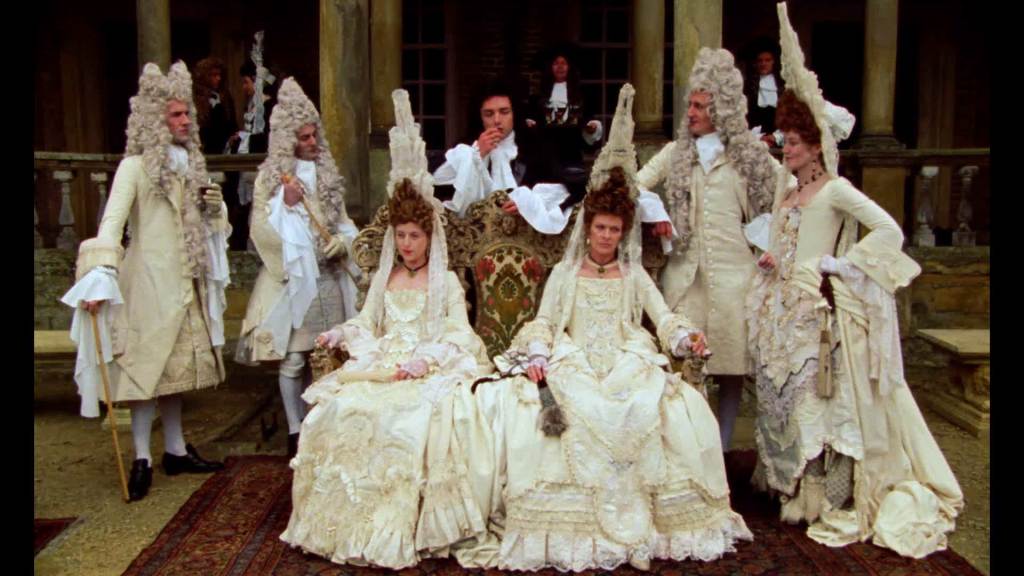
This is a film that can get frustrating as its oblique conversations work overtime to obscure their meaning and intent. But it’s so marvellously, and intricately, assembled it just about gives you enough to fascinate to balance. The painterly shooting style – often with a static camera – is visually striking, as is the overblown grandeur of costume and design. Michael Nyman’s score – a remix of Purcell – is astoundingly good, subtle themes accompanying each action. The film descends into a bleakly terrible ending, that could sit comfortably in the worst kind of folk horror, as Neville discovers just how little he really saw while he was looking.

But it’s really an experience more than a film. Like a slice of recorded life carrying a deep allegorical message of mankind’s darkness in a way Greenaway, bless him, has the confidence we will get. There is a magnetic performance from Anthony Higgins, whose bombast and pride still somehow makes him just-about-sympathetic. An oblique commentary on art and life, The Draughtsman’s Contract offers no easy answers (or any answers at all really) but is full of images, moments and concept that will fascinate, appal and certainly stick with you long after it’s blackly nihilistic ending.

Aftersun (2022)

Aftersun (2022)

Memory fails to give the information needed in this striking, thought-provoking debut

Director: Charlotte Wells

Cast: Paul Mescal (Calum), Frankie Corio (Sophie), Celia Rowlson-Hall (Adult Sophie), Brooklyn Toulson (Michael), Sally Messham (Belinda), Spike Fearn (Olly), Harry Perdios (Toby)

Memories resemble half-remembered dreams more than we like to think. No matter how hard we try, we are always constrained in what recollect: if we didn’t notice or understand it at the time, trying to remember every detail of an event can be like trying to assemble a jigsaw using the final picture and many blank pieces. It’s a core theme from Charlotte Well’s fascinating, thought-provoking, debut picture, a fictional memory piece unlike anything else.

In the late 90s, 31-year-old Calum (Paul Mescal) and his 11-year-old daughter Sophie (Frankie Corio), go on a package holiday to Turkey. For Sophie, this was an exciting holiday of a lifetime. But, looking back on the holiday decades later, the now 31-year Sophie (Celia Rowlson-Hall) knows something was wrong. Her father was a far more fragile, delicate man than her 11-year-old self could hope to realise. But her attempt to understand this will be forever restricted by her memories and the few camcorder films she has of the holiday.

Well’s film is both a challenging, intriguing musing on the nature and unknowability of memories, and a superb presentation of a loving father-and-daughter relationship. What it doesn’t give you at any points are easy or obvious answers. There are no revelations, no breakthroughs, no sudden dramatic recollections that reposition everything. There isn’t even a confirmation of what exactly happened to the father after 11-year-old Sophie flew back home to her mother. There is a sense of unease throughout, which plays against the childhood joy in many of the scenes. We know something is amiss. But this isn’t about adult Sophie trying to solve a puzzle: it’s clear she never will. She can assemble the jigsaw, using the final picture, but the blank pieces will always remain blank.

To film this, Wells (with great confidence and skill for a first-time director) uses a number of unshowy but intelligent camera angles and film stocks. The film opens with home recordings, before images rewind and granulate before our eyes. Reflecting how memories are never quite what we need them to be, but are reliant on what we were focusing our attention on at the time, the film frequently concentrates visually on the wrong things while important events happen just out of shot.

That opening camcorder scene sees Calum, with weary firmness, asking Sophie to turn off the camera rather than answer questions about where he wanted his life to be now when he was 11. When we reach this moment again in the film’s flashback structure (which we now realise is crucial to understanding Calum’s depression and feelings of inadequacy), the film is constrained by what Sophie was focusing on at the time. So, we focus rigidly on the small television in the hotel room Sophie was playing her recording on, meaning we only see events in the room on hazy TV-screen reflections and the small part of the mirror visible on screen.

This recurs throughout. We focus on character’s legs or the skydivers floating down the Turkish sky (the activity Sophie wanted to do that Calum ruled out because she was too young). A polaroid picture slowly developing on the table during their meal together on the final night. Other scenes that had a strong impact on a child play out full screen: her encounters with a group of older children who play pool with her. Her first flirtation with a boy her own age, that ends with a kiss (though she ‘remembers’ more clearly other children hammering on the roof above them).

Above all, she has many clear memories of her father. Aftersun is a beautiful depiction of a loving relationship between father and daughter. Sophie remembers clearly the shared jokes (mocking a tour guide, mucking around in a pool). She remembers the insistence her father tried to teach her self-defence moves, the way he carefully applied her sun cream, the night they threw bread rolls and ran away from a tour guide concert, teaching her his tai chi moves while she playfully imitated him. It’s a warm, intimate, extremely genuine relationship superbly bought to life.

But she also remembers harsher moments. The times her father would go quiet. The way he wouldn’t tell her how he broke his arm (he wears a cast for the first few days of their holiday). The moment he adamantly refuses to sing karaoke with her on stage – and her stubborn insistence to perform REM alone – before he passes out in their hotel room, leaving her locked out. Flashes of silence or ennui which he tried to hide from her, but she can just about understand now.

And it’s clearer to us, not least from the brilliance of Paul Mescal’s performance. Few actors can convey such deep, gut-wrenching pain and emotional turbulence under a confident exterior. Mescal looks like a happy-go-lucky guy, but every movement is tinged with an unknowable sadness. At times he seems crushed. It’s clear he’s working overtime to (largely successfully) hide this from his daughter. But still he’ll talk briefly about his own unhappy childhood, marvel that reaching 30 was “hard enough” when someone asks what he will do at 40, talks about future plans he doesn’t seem to quite believe in and uses tai chi and meditation to suppress some deep emotional trauma.

Adult Sophie – and the film – can only imagine what he might be going through, or what caused this spiritual crisis. Wells throws in scenes of Calum alone, which clearly can’t be memories (Sophie isn’t there) – are these Sophie’s imaginations and interpolations? Her attempts to fill in the gaps? Is she imagining her father walking alone through the streets at night, or weeping uncontrollably in his hotel room after she leaves? Is this her attempt to fill the gaps, just as a conversation where Calum assures Sophie she can always talk to him about anything is played in long shot, like Sophie remembers it but didn’t realise its importance at the time.

There is a recurring visual intercut of the adult Sophie watching what looks like an unaged Calum dancing in a club, strobe lighting only intermittently lighting his face. The film’s emotional closing moments, cut to Bowie and Queen’s Under Pressure, finally help us to understand what we might be seeing here, the closest thing to a reveal (unveiled during a virtuoso rotating transition shot which takes us through multiple locations and timelines in a single fluid movement) the film has.

At the centre of much of this is an extraordinary performance from Frankie Corio as Sophie, a precociously talented child who gets a perfect balance between understanding and ignorance, and brilliantly communicates that age when children are starting to form independent character and interests away from their parents.

Aftersun is a thought-provoking, dynamic and challenging piece of cinema, that lingered with me for days after seeing it. Sad but also strangely joyous at times, acted with perfection, it marks Wells as a talent to watch.

Secrets and Lies (1996)

Secrets and Lies (1996)

Hard truths and deep emotion combine with Mike Leigh’s warmth and humanism in this powerful, spectacular film

Director: Mike Leigh

Cast: Timothy Spall (Maurice), Phyllis Logan (Monica), Brenda Blethyn (Cynthia), Claire Rushbrook (Roxanne), Marianne Jean-Baptiste (Hortense), Elizabeth Berrington (Jane), Michele Austin (Dionne), Lee Ross (Paul), Lesley Manville (Social worker), Ron Cook (Stuart), Emma Amos (Scarred girl)

“Secrets and lies. We’re all in pain! Why can’t we share our pain?”. These words come from family photographer Maurice (Timothy Spall), fighting a losing battle against his own pain while doing his best to hold his family together. It’s the mission statement for one of Mike Leigh’s most powerful films, a heart-rending drama that left me tearful. This is as gut-wrenching as Leigh can get, with actors delivering performances that feel ripped from their souls. Despite this, it gets me because this is a hopeful film about the power of love, whose anguish builds from watching what could (and should) be a loving family, failing (almost until the end) to share pain long suppressed due to shame.

That family are the Purley’s. Maurice is a successful photographer with a charming house in suburbia, dotingly maintained by his perfectionist wife Monica (Phyllis Logan). Sister Cynthia, who effectively raised Maurice, remains a working-class single-Mum to 21-year-old Roxanne (Claire Rushbrook). This class difference fuels resentments between Cynthia and Monica.

Unspoken secrets abound. But our first introduction is middle-class black optometrist played by Marianne Jean-Baptiste, Hortense Cumberbatch. (A running joke in the film is everyone’s unfamiliarity with this surname – how times change!). Hortense was adopted and now, with both her parents dead, wants to make contact with her birth mother. That birth mother – to her shock – is Cynthia, who gave birth to Hortense at 15. The relationship between Hortense and Cynthia becomes a catalyst for searing revelations, and shattering of emotional barriers, in the Purley family.

Leigh’s film is a triumph of his quiet, observational, unobtrusive directorial style, grounded on a deep and profound understanding of people and their strengths and foibles. As with his earlier films, the characters were developed after an intensive rehearsal process, with the actors given information only when their characters were. Secrets and Lies takes his approach to everyday life to its zenith, finding levels of tragedy (and warmth) in the simple pain of carrying on that other dramas can only dream of.

It is about how hopes can be both sustaining and damaging. A refrain heard in the movie is “You can’t miss what you’ve never had”. Au contrarie. The film is stuffed with people deep in grief about, or desperate to find, things they’ve never had. Hortense wants to discover where she came from. Cynthia’s life is one of lonely disappointment, resenting the domestic contentment of Maurice and Monica. Maurice and Monica are anguished by their childless marriage, Monica resenting Cynthia for having had the child she longs for. Roxanne wants a stable family, resenting her mother’s clumsy confirmation seemingly everyday that her birth was an accident (even if not a regretted one).

But, in typical British style, no one can talk about any of this. Instead, the Purleys cling to impressions of what the other family members are like. Monica sees Cynthia as a hopeless deadbeat, who can’t care for her children. Cynthia sees Monica as a snob, who stopped Maurice having a child. Roxanne sees Cynthia as constantly disappointed in her, Cynthia sees her as difficult, rebellious young woman unable to look after herself. And Maurice attempts to hold all this together, positioning himself as a jovial head-of-the-family, and whacking down any pain of his own.

Hortense, by comparison, is a model of well-adjusted upbringing. Leigh’s film doesn’t let us see much of her family – we witness her (non-adopted) siblings feuding over an inheritance – but the film constantly enforces the love she got from her parents, from the film’s beautifully staged opening at her mother’s funeral to her smiling reminiscences of parents (flaws and all) who did their best, were honest with her and taught her she was loved. Seen in conversation with her best friend Dionne (a neat single scene cameo by Michele Austin), she’s humane, warm and self-aware enough about her hopes and failings.

But she also has the fixated determination of the middle-classes – the sort of go-getting attitude completely alien to Cynthia, to whom events always happen rather than being something she starts. She disregards the advice of a social worker (a wonderful cameo of rushed professionalism, tinged with just enough genuine care by Lesley Manville) to make contact through social services and instead takes the plunge to contact Cynthia herself.

One of Secrets and Lies many strengths is its open-eyed honesty about the joy and pain of adoption. Hortense, as noted, found a loving family through adoption. But still she wants to know, why did her mother not even hold her when she was born? The answer isn’t simple, as Cynthia’s devastated reaction to the question shows: because if she held her, she would never have let go. This is the emotional centre-piece of an emotionally devastating but deeply uplifting scene at the centre of the movie as Hortense and Cynthia meet for the first time.

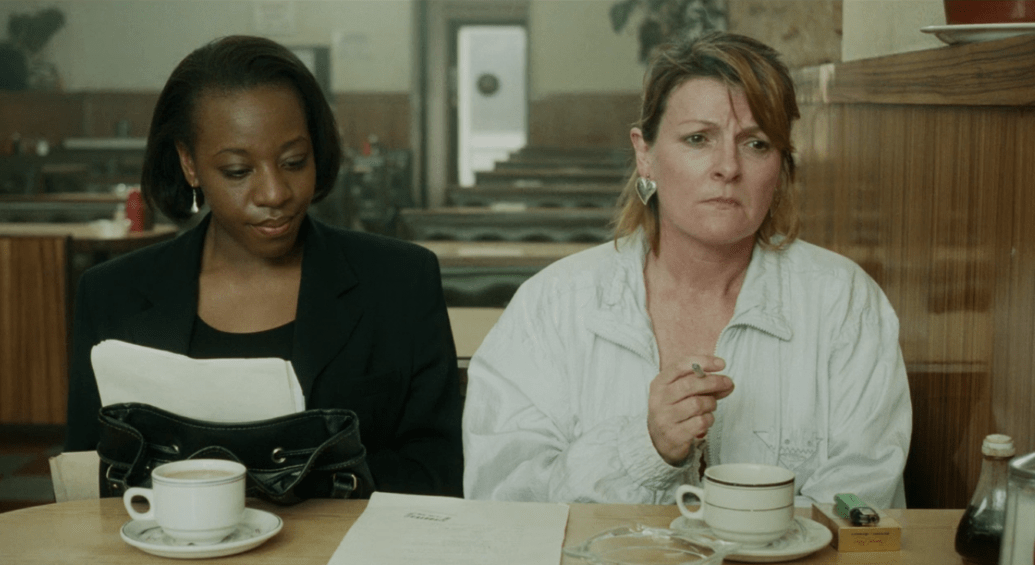
Shot in a café in a single near-seven-minute uninterrupted take with a stationary camera (a stylistic choice Leigh repeats at a family BBQ later in the film, as we wait for inevitable secrets to flood out), this is an acting masterpiece. Blethyn and Jean-Baptiste (both Oscar-nominated) give extraordinary performances throughout, but achieve the sublime here. Blethyn delivers nearly every line as if it was being pulled out of her soul by pliers, at points convulsed with teary shame unable to look Hortense in the eye: Jean-Baptiste, so assured throughout, is quiet, almost abashed but clinging to a professionalism to help resolve facing emotion head-on (right down to sitting next to Cynthia rather than opposite her).

Emotionally truthful performances run throughout. Spall is superb as a man who is no pushover – he quietly but determinedly shrugs off a drunken former mentor (a neat cameo from Ron Cook) asking to be given a chance – but who will bend over backwards to accommodate those he loves. Logan battens down hysterical guilt and grief under a house-proud fussiness. Rushbrook is a cauldron of resentments under a surly exterior. The relationship between Cynthia and Hortense – beautifully played by both actresses – quickly becomes one of genuine affection, for all their vast differences.

The film builds towards a celebratory BBQ for Roxanne’s birthday – which Cynthia brings Hortense to, claiming her as work friend. Leigh uses a long take as the family eats (we, the audience, constantly awaiting the emotional walls to break) before a devastating sequence as one after another family secrets come tumbling out, shattering emotional reserves, characters clinging to each other for comfort in floods of repressed tears, stunned onlookers open-mouthed.

It’s a scene of huge emotional impact – I cried – as regrets, loss and resentments built from years of understanding tumble out. But it’s hopeful, uplifting almost, because this is not the end. It’s a start. It’s very clear that, having finally said what they are really feeling, the extended family can move in a way that was impossible at the start. That they are closer now than ever. Hortense is the agent of positivity, and Leigh’s film closes with a quiet scene with Roxanne that suggests they have every chance of forming a warm, genuine, relationship.

Secrets and Lies is a superb film, a masterclass observation and domestic near-tragedy, powered by extraordinary performances of lived-in reality from the actors, that carries emotional strength but also has a rich vein of hope running through it. It is one of Leigh’s masterpieces.

Get Carter (1971)

Get Carter (1971)

Brutal, dark and nihilistic British gangster film removes any chance that you might fancy trying a life of crime

Director: Mike Hodges

Cast: Michael Caine (Jack Carter), Ian Hendry (Eric), John Osborne (Kinnear), Britt Ekland (Anna), Brian Mosley (Cliff Brumby), George Sewell (Con McCarty), Tony Beckley (Peter the Dutchman), Glynn Edwards (Albert Swift), Alun Armstrong (Keith), Bernard Hepton (Thorpe), Petra Markham (Doreen), Geraldine Moffat (Glenda), Dorothy White (Margaret)

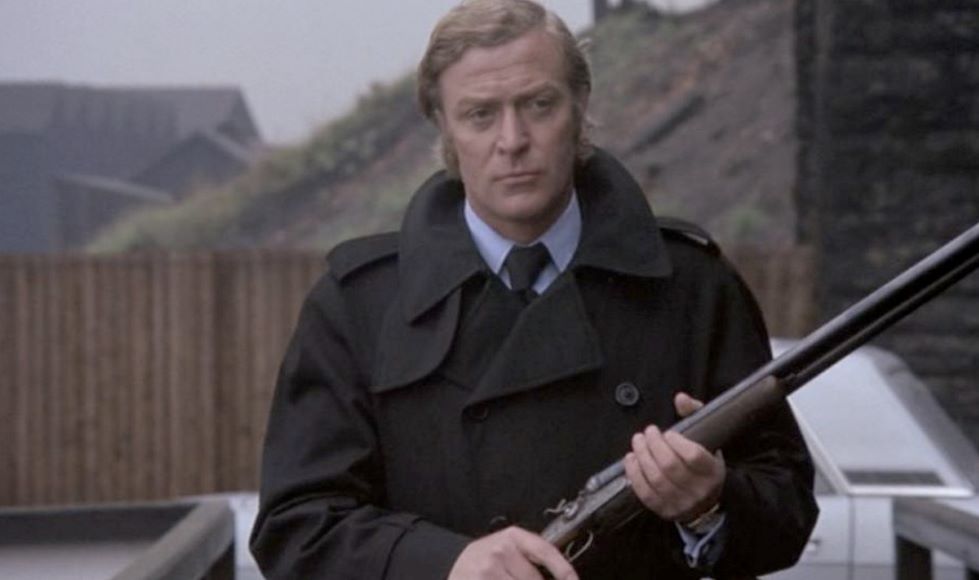
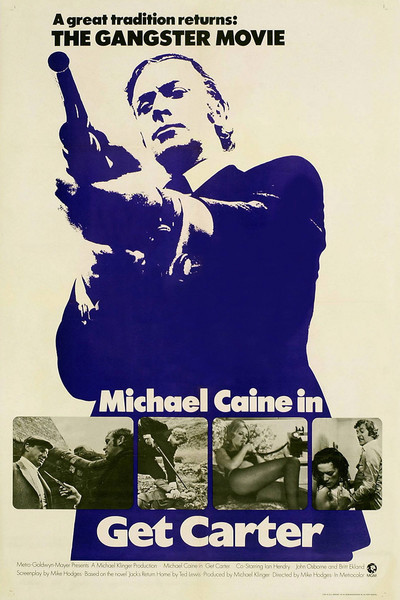
It’s probably the finest British gangster film ever made. Get Carter is a cold, dark, grimy film – a punch to the solar plexus, which completely rejects any sense of charm in its gangster characters. Michael Caine called Jack Carter a shadow Caine, the man he could have become if his life had broken out slightly differently. It’s set in an unremittingly bleak Newcastle, but it feels like it might be happening in an anti-chamber of hell, with its thoroughly amoral lead barely aware he’s spiralling towards destruction. It’s a sociopathic, Jacobean revenge tragedy set among the dirt filled suburbs of Newcastle.

Jack Carter (Michael Caine) is a professional fixer for London gangster brothers. He returns to his childhood home of Newcastle after the sudden death of his brother. But he’s not satisfied with the official explanation. Instead, he dives into an investigation, in which he cares not a jot about the collateral damage he causes or the likely reaction of the underworld powers that be as he rocks the boat to destruction, trashing the lives of everyone he meets, good and bad.

Powered by an extraordinary performance of blank nihilism and cold, unexpressed fury by Caine, nominally Jack is a man motivated by the harm done to his family. However, Hodges film is so cold-eyed and realistic about the mentality of gangsters, we know it’s just an excuse. Carter is never heart-broken, he’s annoyed. His brother may have been punished and his niece (it transpires) misused, but fundamentally what motivates Carter is the affront. By taking a pop at his family, he feels they really think they can take a pop at him. How dare they: he’s Jack Carter.

Any charm Carter has, solely comes from residual affection for Caine. By any measure, Carter is an awful man (even if he has a good turn of phrase). He is a sociopath with no concern for anyone. When friendly Keith (a young Alun Armstrong) is beaten black and blue for helping Carter, how does our hero respond? Tosses a few bank notes on his bed and tells him “buy some karate lessons”. Carter sees the world solely as made up of debts, which can be discharged by money, never mind the situation. His niece throws beer over a friend? He’ll pay for the dry-clean. Keith gets bashed up: take a roll of twenties, what’s your problem?

Carter directly kills four people (and is responsible for several other deaths), all with a blank-eyed lack of reaction. There isn’t any sadism to what he does – the deaths are mostly efficient and to his mind, justified, because by taking actions against his family they disrespected him. When he locks a woman in the boot of his car, and a pair of heavies push the car into the Tyne he doesn’t bat an eyelid at her inevitable death (never mind he slept with her hours before). People who find themselves close to Jack, or drawn into his circle, suffer terribly and he literally couldn’t care less.

Get Carter is the bleakest of all gangster films, shot with an imaginative kitchen-sink beauty by Mike Hodges, which actually carries a lot more visual glory than you might expect. Drained out colours abound – there are virtually no bright primary colours in this, with the whole of Newcastle a mix of muddy browns, soot-stained greys and filthy charcoals. Hodges’ film is also dynamic and fast-paced: he throws in striking aerial and crane shots (there is a beautiful shot that follows a car chase from a bird’s eye view), but also gets down and dirty in this grainy world.

It’s an urgent, lean and mean film constantly kicking you in the shins, but told with skill and artistry. Hodges pieces together a marvellous early scene, where Carter visits local heavy Kinnear (a suave, chillingly well-spoken John Osborne): simultaneously, in one single location, two scenes (both with vital information) play out at the same time – Carter chats to Kinnear’s moll Glenda (Geraldine Moffat), picking up vital information while on the same sofa Kinnear beats his guests at cards. Everything though is perfectly clear: masterful stuff. It’s also a film crammed with small details that reward careful viewing: Carter’s bed has a cross-stitch of “What would Jesus say?” above it (I dread to think) and on his train journey, look out for a fellow passenger with a distinctive ring.

So confidently is this put together, it’s amazing to think Hodges was a first-time director. This is a film dripping with menace, but also a horrifyingly immersive camera. We are frequently thrown into the midst of the action. Carter frequently looms over the camera or is filmed in violent motion moving towards his next goal. There is not a jot of romanticism around the film: neither about the gangsters or the bleak world they operate in. Newcastle is pre-Thatcherite hellhole, with precious little glamour. Even the gangster locales – the clubs and pubs – are bashed-up and unpleasant.

Across the board, the gangsters are exposed as cruel, heartless and vile. Touches of class are ruined by everyone’s fundamental lack of class. Cliff Brumby’s (Brian Mosley) planned classy restaurant sits atop a concrete multi-story car-park. Kinnear’s (John Osborne) fancy country house is the setting of the grimmest, most depressing orgy you’re likely to see. Carter is trying his best to dress classily, but his cruelty always punctures the illusion. He’s introduced watching a porn film with his bosses in London and the film revolves around the seamy underworld of homemade porn.

The women in the film are primarily used by the gangster as props for these films, and Get Carter doesn’t shy away from the exploitative fate for women in this world. However, you can’t disagree that it takes in a bit of exploitation itself. Britt Ekland has high billing for her single scene, where she lies mostly naked on a bed pantily having phone sex with Carter (who goes about this, as all things, with a functional efficiency, at least as interested in the excited reaction of his middle-aged landlady who is sitting in the room with him while he chats on the phone). It’s undeniably a moment for us to gawp but it still feels less cold and cruel than those awful porn films.

Carter discovers his niece has found her way into these. He even sheds a tear over this: but he doesn’t care because of what has happened to her. Again it’s all about him: Carter couldn’t care less about the morals and is perfectly happy for porn to soak up other women. He’s not really that interested in his niece: it’s all about the damage to him, that a “made man” like him should have a member of his family getting boffed like a slag for others entertainment. How bloody dare they?

Get Carter understands this is a dark and soulless world, and is a film bereft of hope. Its hero is a revenge obsessed sociopath, who only smiles in the film after he has burnt everything around him down. Gangsters destroy everything they touch and care about nothing other than themselves. All debts can be settled with money, all women are toys to be used and thrown away. Death means nothing and the world is a drained-out hell of shabby houses and dirty clubs. It’s the grimmest and finest British gangster film out there. Who would want to be gangster after seeing this?

After Love (2021)

After Love (2021)

Loss, grief and family combine in Aleem Khan’s poetic, heartfelt debut

Director: Aleem Khan

Cast: Joanna Scanlan (Mary Hussain), Nathalie Richard (Genevieve), Talid Ariss (Solomon), Nasser Memarzia (Ahmed), Sudha Bhuchar (Farzanna), Nisha Chadha (Mina)

Mary Hussain (Joanna Scanlan) is a white English woman who converted to Islam decades ago to marry Ahmed (Nasser Memarzia). Ahmed works as a captain of a ferry ship, travelling between their home in Dover and Calais. When he suddenly passes away, Mary is distraught. But that’s nothing compared to how she feels when she discovers Ahmed had a second family in Calais: Genevieve (Nathalie Richard) and their son Solomon (Talid Ariss) – whose very existence is a painful memory of the child Mary and Ahmed lost decades ago. Mary travels to Calais to do she’s-not-sure-what but, due to a misunderstanding, ends up working as a cleaner in Genevieve’s house as she packs for a move, totally unaware Ahmed is not just ignoring her calls.

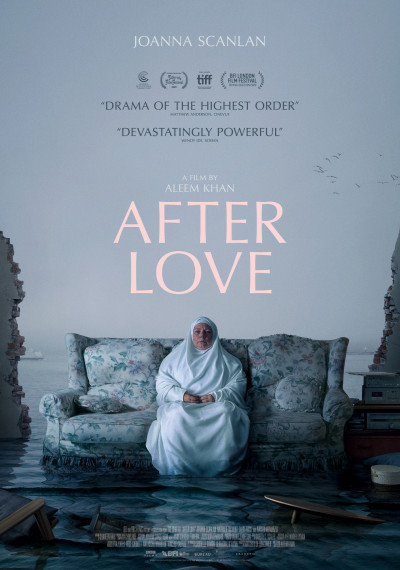
The debut film from Aleem Khan – whose mother was similarly a white English convert, living in Kent, who immersed herself in her adopted culture – After Love is part fascinating moral dilemma, part profound exploration of the burden of grief. Mary’s life has been shattered by the loss, not only of her husband, but the even greater loss of her understanding of what her life was. Khan captures this with a beautifully shot visual metaphor: Mary hallucinates the world literally collapsing around her, from dust dancing in the sunlight, to cracks appearing in the ceiling above her to a vivid hallucination of the white cliffs of Dover collapsing behind her as she sails to Calais.

Khan’s film is at its strongest when it centres Mary’s emotions and faith. It’s a wonderful endorsement of the power of faith. Faith is central to Mary’s life: she immersed herself in her adopted culture – from prayer to dress to food, which she cooks with love-infused skill. Part of the film’s purpose is to challenge any underlying assumptions we may have about this culture. Mary’s faith is not something forced upon her or which provides barriers to her. It has, instead, given her peace, purpose and contentment. In a world where images of Islam are not always so positive, it’s refreshing to see religion as such a positive force in a person’s life.

But the film also knows seeing a woman in a hijab carries certain assumptions. Its perhaps the biggest reason why, when Mary arrives at her door, Genevieve assumes she is a cleaner. Later she will question why Mary wears it, as if it was a set of chains rather than a personal choice that is an expression of her faith. For Genevieve, the hijab not only makes it easier to push her into a servile position, it also defines her, in the eyes some, as being on the lower rungs of society (which she isn’t). You can be confident if Mary had turned up wearing a black dress and a hat, the film would have played out very differently.

We see Mary carefully prep what she might say to this other woman, before she arrives. It all goes out of the window in tongue-tied fear and shock when she arrives. Instead, she ends up working as a cleaner. Mary accepts the misunderstanding for reasons she almost can’t understand herself. Is it meekness? Awkwardness? Curiosity? Shock that this woman is far more glamourous than she is? Does she want revenge? She hardly knows herself, using her position in the house, effectively as a servant, to learn more about this woman and the family she built with her husband.

If there is a weakness in After Love it’s the slightly contrived nature of this plot. In a film grounded in the realism of the pain of loss – Mary’s devastation, confusion and sense of being adrift is explored with a profound sensitivity – it revolves around the sort of plot device that wouldn’t seem out of place in a soap opera. It takes a bit of investment – which the film just about manages to earn – to go with this storyline, which relies slightly on contrivance to sustain itself.

But it does allow us to have our perceptions about Genevieve challenged as well. While we assume, at first, she will be little better than a hussy, we discover she is a sensitive, realistic woman, well aware that she is (and more than a little guilty about being) “the other woman”. She is struggling with her teenage son Solomon, who can’t understand why his life is so unusual and of course blames his mother more than his absent (and therefore idealised) father.

In fact, the longer Mary stays in this house, not telling the truth, becoming a confidant to mother and son, the more you start to feel your loyalty shift. From our first perception of Mary being the wronged woman, the more you start to feel she is taking terrible advantage of Genevieve and her son. That not telling them Ahmed is dead, as they long to hear from him, is wrong. That her attempt to comfort Solomon (whom she starts to feel a motherly love for) by texting him from Ahmed’s phone is inadvertently deeply cruel. You start to feel unease about this interloper, lying to this family at what is already a difficult time.

The fact you stick with her is due to the extraordinary performance by Joanna Scanlon. Quiet, polite, over-flowing with faith and a desire to help, Scanlon also lets us see that the loss of Ahmed (and the loss of her memories of a happy marriage) has torn her apart. Scanlon’s performance drips with grief and pain, an anguish she can barely form into words. It’s a gentle powerhouse of humanity (and rightly BAFTA winning). Richard and Ariss also give fabulously raw performances as two people only just holding their own relationship together, never mind processing the loss of a husband and father.

After Love is strongest when exploring the profound and lasting effect of grief. Khan’s film is shot with a poetic beauty, and he draws deep and moving performances from his lead actors. It revolves around a massive contrivance but carries enough impact that you’ll feel the same note of hope, of the debris settled and life going on, as the film ends on.