Category: British Films

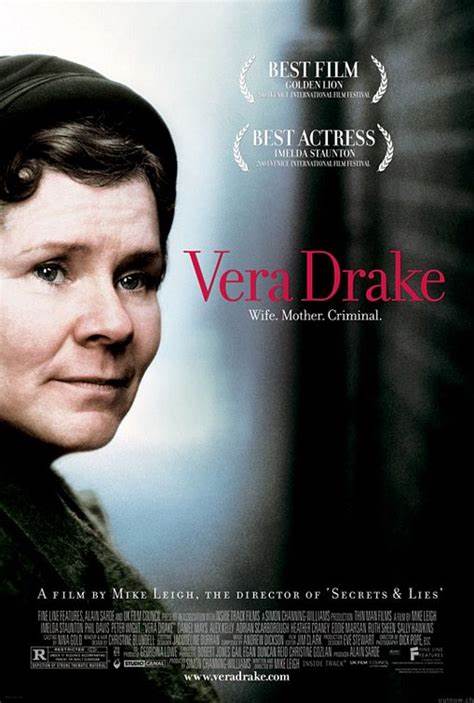
Vera Drake (2004)

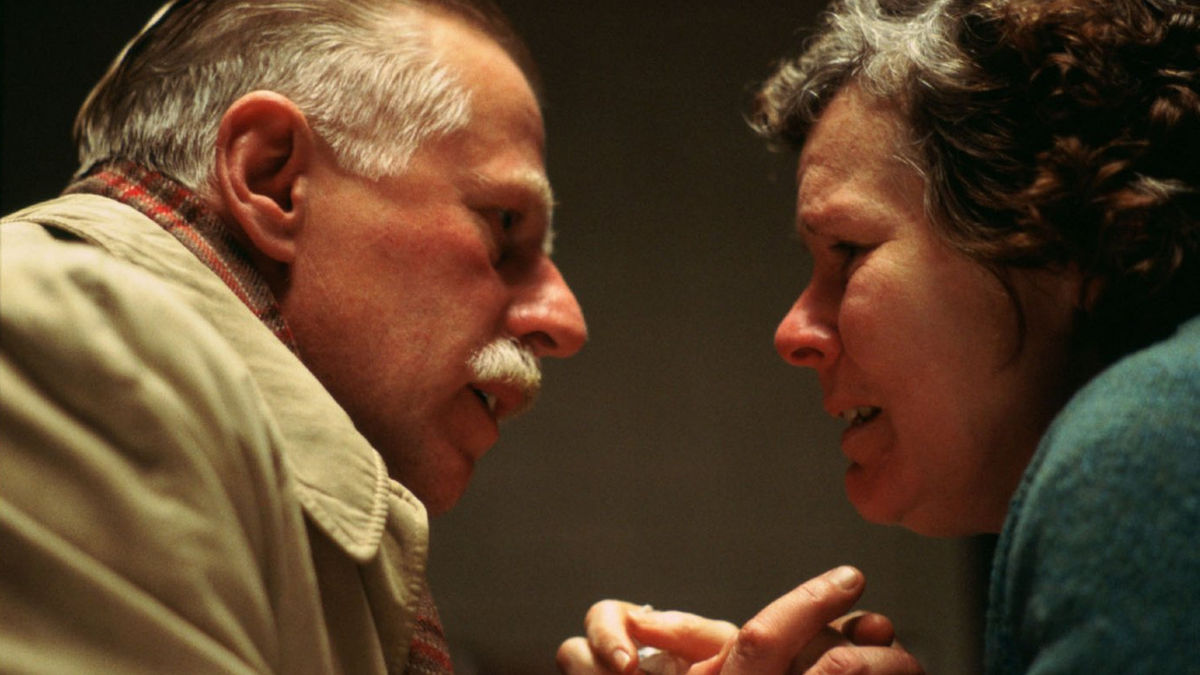
Phil Davis and Imelda Staunton are superb in Mike Leigh’s masterpiece Vera Drake

Director: Mike Leigh

Cast: Imelda Staunton (Vera Drake), Phil Davis (Stan Drake), Peter Wight (Inspector Webster), Daniel Mays (Sid Drake), Alex Kelly (Ethel Drake), Eddie Marsan (Reg), Adrian Scarborough (Frank Drake), Heather Craney (Joyce Drake), Sally Hawkins (Susan Wells), Ruth Sheen (Lily), Lesley Sharp (Jessie Barnes), Liz White (Pamela Barnes), Martin Savage (Sergeant Vickers), Helen Coker (WPC Best), Vincent Franklin (Mr Lloyd), Lesley Manville (Mrs Wells), Jim Broadbent (Judge)
If you passed her on the street, you’d be sure to say hello and she’d be sure to ask after your family – and really mean it. She has a kind word for everyone and never thinks about herself. And, as far as the law is concerned, she’s a multiple murderer. Vera Drake mixes warmth and goodness with anger at social injustice and is stuffed with perfectly observed detail and marvellous acting. It might just be Mike Leigh’s masterpiece. Certainly, few other of his films carry such an emotional wallop.

In London in 1950, Vera Drake (Imelda Staunton) spends her life helping those around her and is a devoted wife and mother. But what her husband Stan (Phil Davis) and children Sid (Daniel Mays) and Ethel (Alex Kelly) don’t know is that for decades she has been “helping young girls out” who find themselves unwillingly in the family way. All Vera wants to do is help – but with abortion illegal, her actions are a ticking timebomb, which explodes when Vera is arrested.

Vera Drake is a film about “the family way” – in every sense. Leigh’s unique film-making technique is familiar now: long weeks of research and intensive, improvisational rehearsals help the actors to create fully-fleshed characters who they know so well, they can predict their reactions in any circumstances. During rehearsals, none of the actors in the family knew Staunton was playing an abortionist until the actors playing the police knocked on the door mid-rehearsal – and even Staunton was completely unaware she was to be arrested. The genuine shock the actors felt feeds this intensely powerful scene – and every moment that follows.

In perhaps no other film has Leigh’s technique been more successful: every single character feels completely and utterly real. You could look in any direction and find a character with such a rich hinterland you want to know their stories. Just as intriguing films could be formed around the lives of the young women Vera helps out – Sinead Matthews ‘very young woman’ (and the boyfriend who waits outside), Tilly Vosburgh as a mother of seven with a sick husband, Rosie Cavaliero as a nervous married woman or Vinette Robinson’s scared Jamaican girl – as has been about Vera.

These women have fallen through the cracks – unable to support a family, but deprived any chance of making choices about themselves and bodies. There is a clear social gap – Sally Hawkins gives a sensitive, gentle performance as an upper-class woman, raped by her boyfriend, who obtains an abortion through psychiatric loopholes available only to the rich. No fault of hers – you can imagine she’d be horrified at how others suffer – but for the poor, their only option is Vera. It’s a huge flaw in the system – and removing Vera won’t solve the ‘problem’. It only means women will turn with more desperation to the sort of uncaring sleazy abortionists Denholm Elliott played in Alfie.

The film works because of its tenderness and the raw emotion of the performances. Leigh’s camera is a largely stationary and observatory, but that immerses us in the domestic charm of the first half as much as it does the horrifying coldness of the legal system in the second half. The Drake family home is small and cramped, reflecting their poverty, but also because it feels stuffed with love. Their children – the extremely shy Ethel and her outgoing son Sid – both reflect their intensely loving home, and her husband Stan is full of kindness, generosity and decency.

Leigh carefully demonstrates the warmth of this family. There’s a tear-inducingly sweet romance between Eddie Marsan’s Reg (a beacon of human decency) and the shy Ethel. Stan’s brother Frank (Adrian Scarborough, marvellous) and middle-class wife Joyce (Heather Craney, wonderfully torn in her feelings) struggle to conceive a child. The family laugh and joke together, every day ending in smiles and expressions of love. It’s beautifully immersing and deeply moving – and makes the wait for this world to shatter even more dreadful.

As Vera, Imelda Staunton gives an astonishing performance. A quiet, polite, open-hearted lady whose greatest pleasure is other people’s happiness. Leigh’s film follows her acts of caring around the community – cleaning neighbours houses, looking after her ill mother, inviting lonely newcomer Reg to dinner – showing she applies the same heart-felt but unshowy care to those, as she does to her abortions. It’s twenty minutes before we see one of these, and what’s striking is the well-practised calmness Vera goes about this work, carefully repeating the same reassuring instructions. She never asks for anything (the posh doctor treating Sally Hawkins’ character takes £100). Lily, who puts her in touch with those in need, has no qualms charging £2 without Vera’s knowledge.

Then the arrest comes. This sequence – and the rest that follows – is frankly extraordinary. Staunton’s face when she sees police is a heart-breaking thing of wonder – a horrified realisation that what she has dreaded for decades has finally happened and the realisation that the world as she knew it is over. Throughout she is astoundingly fragile. Barely able to speak, mute with shock – and horrified to hear one of her girls nearly died (it’s never revealed what went wrong). Her first thought is the girls health and how this will ruin her family’s celebration of Ethel’s engagement. So warm and joyful has the first half of the film been, we feel the shocking coldness as the law goes about – albeit with a regret, beautifully underplayed by Peter Wight’s sympathetic detective and Helen Coker’s gentle WPC – the black-and-white business of cataloguing wrongs.

Staunton is extraordinary: she shrinks and diminish, terrified and mortified. The reactions of her family – confused then stunned and in some cases appalled – feel immensely true: some jump forward in support, others in anger. Phil Davis’ deeply moving performance sees Stan suppress his anger under love. Mays’ Sid rages, Heather Craney’s Joyce is resentful, Scarborough’s Frank is a pillar of support, Alex Kelly’s Ethel quietly holds her mother and will not her go. The emotion of this is so affecting as it feels so real: when Reg quietly shows his support and later gently says the disastrous post-arrest Christmas is the finest he has ever had, you’ll feel tears spring to your eyes.

The relentless march of the law is chronicled perfectly by Leigh. This is a director at the top of his game, creating a low-key film that switches on a sixpence from warmth and familial love to shattering emotional impact. Staunton’s performance is breathtakingly brilliant, avoiding all histrionics and will break your heart. The entire cast is astounding. The research and filming is exquisite. The film will quietly devastate you, but also remind you that nothing is more reassuring than the fundamental goodness of people. A beautiful, moving, masterpiece of a film.
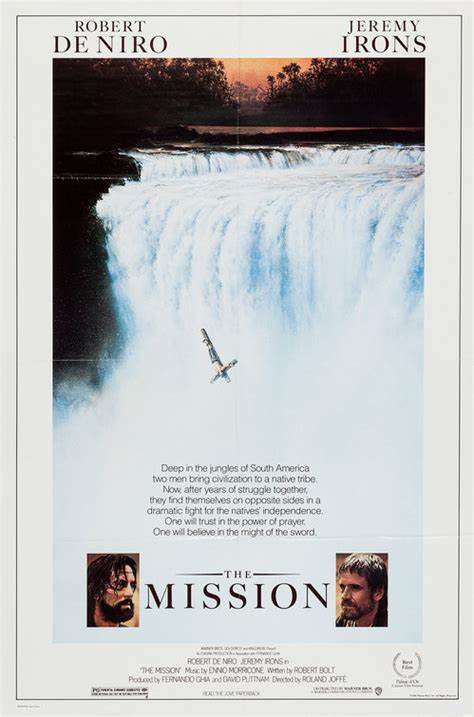
The Mission (1986)

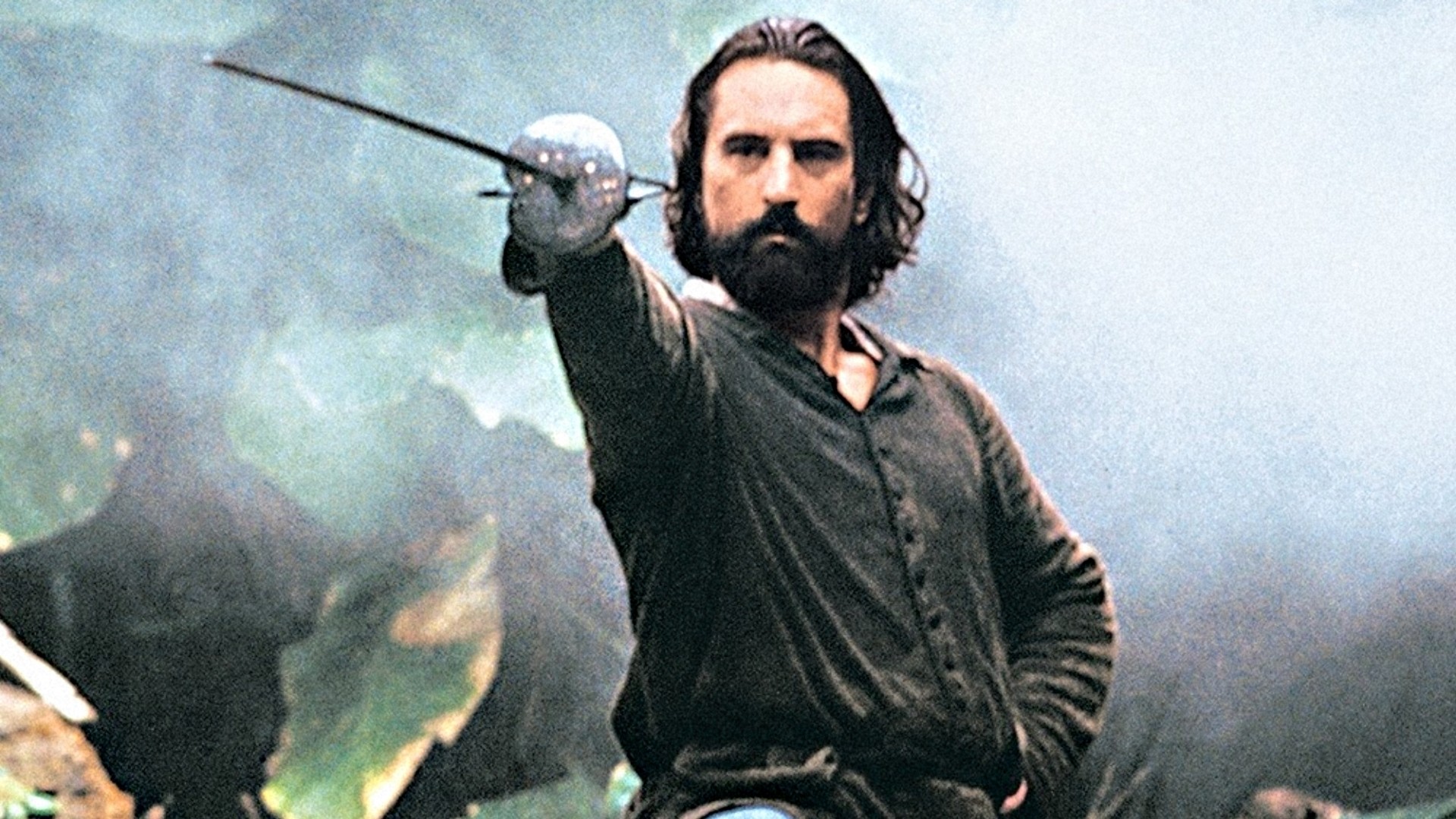
Robert de Niro turns aside from the Jesuit rule to fight for right in The Mission

Director: Roland Joffé

Cast: Robert de Niro (Rodrigo Mendoza), Jeremy Irons (Father Gabriel), Ray McAnally (Cardinal Altamirano), Aidan Quinn (Felipe Mendoza), Cherie Lunghi (Carlotta), Ronald Pickup (Hontar), Chuck Low (Don Cabeza), Liam Neeson (Father John Fielding)

Spoilers: The incredibly grim and depressing ending of The Mission is discussed in detail.

When the world is run by men, how much of a voice does God have? Roland Joffé’s film explores colonial politics and religious duty in Spanish and Portuguese controlled South America. Needless to say, God doesn’t get that much of a vote when questions of land ownership, slavery and money are in play – and no noble stand from Jesuit priests is going to make a jot of difference. Joffé’s beautifully made and moving epic might be slightly self-important, but it won the Palme d’Or. With powerful imagery and sequences but some under-explored themes and characters, its one of those films that probably would have benefited from being at least an hour longer.

In the Paraguayan jungle in the 1750s, Jesuit priest Father Gabriel (Jeremy Irons) successfully converts a Guarani community at his mission. Problem is to the Spanish and Portuguese empires the Guarani are fit only for exploitation and slavery. Mercenary slaver Rodrigo Mendoza (Robert de Niro) is one of them – but his world collapses after he murders his brother (Aidan Quinn) in a dispute over the woman (Cherie Lunghi) they both love. Mendoza makes his penance with the Jesuits, and the forgiveness he receives from the Guarani changes his life, leading to his conversion. But when a treaty – with the reluctant agreement of papal legate Cardinal Altamirano (Ray McAnally) – calls for an end to the mission, Gabriel and Mendoza resolve to fight: one with prayers the other with the weapons he has sworn off. Can they help the Guarani defend themselves from colonialism?

I don’t think its too much of a spoiler to say, no they can’t. The Mission may occasionally muddle itself by trying to say a lot in a short run-time, but on one thing it’s clear: the world is what men have made it, and they’ve made it a pretty dreadful place. The final quarter of the film is entirely given over to the spirited fight to protect the mission, as Mendoza and the other priests take up arms to help these people defend their homes. Joffé doesn’t gloss over the hideous cost of this, with a staggeringly high body count. The Europeans don’t differentiate between combatants and non-combatants, and the killed (and everyone is killed) fall with a sickening finality.

Watching the senseless destruction of this entire community for no purpose other than stripping the Guarani people of anything of value and shipping it back to Europe, you can only agree with Cardinal Altamirano that perhaps it would have been better for all concerned if ships had never crossed the Atlantic. When the dreams of bringing Christian civilisation end with Father Gabriel leading a march of peaceful converts into a hail of bullets, something has gone badly amiss in the world. Hammering home how helpless decency is, Mendoza is fatally wounded (and the village finally doomed) when he is distracted from destroying the bridge into the village, by running to safe a wounded child. No good deed goes unpunished in The Mission.

All of this is, by the way, immensely moving. It’s a tribute to Joffé’s quiet, coldly realistic eye for violence among the natural world that the final half hour is a hard watch. The European invaders may be faceless, scruffy monsters, but even they are briefly halted by the sound of prayer from the village (before they burn it down and kill everyone). The Mission is a profoundly beautiful film, which strains hard for spiritual meaning, and this final sequence is almost impossibly tragic to watch. Just as he had done in The Killing Fields, Joffé’s ability to report without sensationalism on real life tragedy, amongst scenery of great beauty, makes for powerful viewing.

There is so much right about The Mission, it feels harsh criticising it. The film was shot entirely on location (at times the cast show clear signs of the jungle-tummy that spread like wildfire through the cast and crew) and Chris Menges’ (Oscar-winning) cinematography captures the exotic beauty of the jungle, with a powerful visual sense of the spiritual and the sublime. It’s an effect built on immeasurably by Ennio Morricone’s extraordinary score (one of the greatest ever recorded), every single note perfectly chosen to communicate the holy serenity of the Jesuits and the dark flaws of mankind.

Its in exploring those flaws that the film feels a tad rushed. I dearly wish this was an hour longer, if for no other reason that it could bring greater focus to the balance between faith and realpolitik in greater depth. Although the Cardinal gets a few moments to reflect on this, and explicitly question the self-appointed right the Europeans have given themselves as masters of the world, the film never quite manages to dive into these. (McAnally however is excellent as this tortured and ashamed man). Too often these ideas are boiled down into “worldly men bad, priests good”.

The role of the Missionaries themselves also goes unquestioned – these are, after all, people who have crossed the seas with the same sort of imperialist missions as anyone else, finding the indigenous tribes and aiming to make them (no matter how decent their motives) as much like the Europeans as they can. Instead there are presented as purely good and holy. Just think what another hour could have done for expanding the insight into the role of the Church here.

There is a few too many blunt statements of intentions and plot information, rather then real insight. You come out of it still with only a most basic idea of why Gabriel and Mendoza make the decisions they do – or what they hope the outcomes might be. More of a dive into the characters could have given more context to their holy intentions.

In the end the film’s main aim is pushing a message of peace. It’s the message Mendoza must learn. The film’s other most successful sequence covers his extraordinary penance, dragging a huge bundle of armour and weapons up a mountain to the mission. De Niro sells the anguish as beautifully as he does Mendoza’s shamed gratitude when he is greeted warmly by the very people he had enslaved. Its moments like this where The Mission achieves its aim of grappling with something close to how spirituality can move and change us – which often gets bogged down elsewhere in ticking off plot.

The message of peace is embodied by Irons’ profound and generous performance as Gabriel, a man who believes the world should be simpler than it is. I just wish the film had given itself more room to delve into its themes. In trying to cover imperialism, religion, spirituality and native rights, all in two hours (the Guarani draw a short story, with not one of them really being given a character) its too much. A richer, more textured film would make for a richer overall experience. It’s a film of great beauty in score and photography, often moving, but doesn’t make its message much more than give peace a chance.

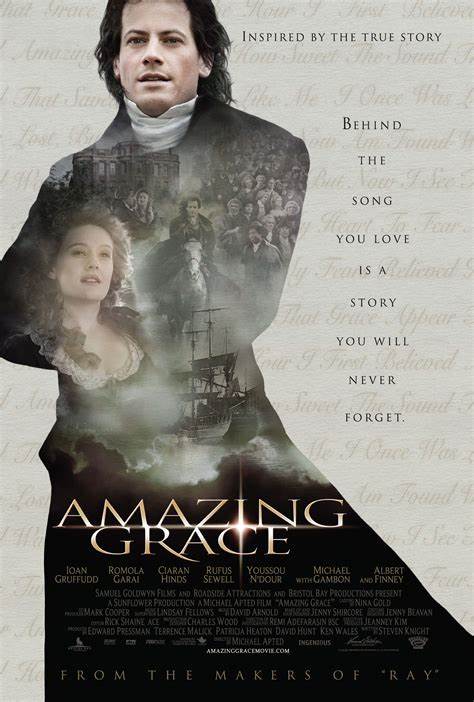
Amazing Grace (2006)

Ioan Gruffudd in full flight in the conventional but charming Amazing Grace

Director: Michael Apted

Cast: Ioan Gruffudd (William Wilberforce), Romola Garai (Barbara Spooner), Benedict Cumberbatch (William Pitt the Younger), Ciaran Hinds (Banastre Tarleton), Albert Finney (John Newton), Michael Gambon (Charles James Fox), Rufus Sewell (Thomas Clarkson), Youssou N’Dour (Olaudah Equiano), Toby Jones (Duke of Clarence), Nicholas Farrell (Henry Thornton), Sylvestra Le Touzel (Marianne Thornton), Stephen Campbell Moore (James Stephen), Bill Paterson (Heny Dundas), Jeremy Swift (Richard)

From 1782 to 1807 William Wilberforce (Ioan Gruffudd) fought a long – sometimes lonely – campaign to end the slave trade (and eventually slavery – the film confuses the two, with slavery continuing in much of the Empire for over twenty more years) in the British Empire. During that time, he competed with vested interests, parliamentary rivals and accusations of being a radical at a time when Britain was at war with Revolutionary France.

Michael Apted’s old-fashioned film covers this, hitting every beat you would expect for a biographical drama. It uses a traditional framing device of starting in the middle of the story: Wilberforce in 1797, depressed, hooked on laudanum and out of hope, revitalised by meeting Barbara Spooner (Romola Garai) who will become his wife. This makes for a perfect narrative tool as it means she can ask him questions like “tell me what happened” which serves as a neat entrée into a whole host of flashbacks sketching out in the swiftest means possible the history of abolitionism.

Amazing Grace could have been made in the 1930s, so closely does it hue to the classic rules of biopics. It’s practically a structural brother to The Life of Emile Zola, a hagiographical portrait of an (admittedly outstanding) man which shows the expected arc of moral awakening, early success, tricky mid-point, the sad years, getting the band back together for one final big push ending in friends and foes alike coming together to hail his accomplishments. It’s all threaded together with a script that carefully moves through every event, simplifies history down and sometimes wears its research rather heavily.

You can’t argue that it isn’t well-meaning and heartfelt, but its simplicity (and the careful traditionalism of its shooting) makes it look more like a well-made TV special than an actual movie. But if you are a sucker for such things, as I am, it has more than enough to engage you. It also makes a compelling case about the horrors of the slavery and allows a few moments of spotlight to fall on former slave turned abolitionist Olaudah Equiano (well played by Youssou N’Dour). It certainly has its heart in the right place, its passionate liberalism and sense of moral outrage very clear.

Gruffudd – his skill for playing reluctant moral authority and duty honed from playing Hornblower – is good as Wilberforce, his obvious investment in the subject matter clear. Garai doesn’t have much to do other than tee up flashbacks, but does it with charm. Many of the rest veer on the side of fruity: Hinds and Jones scowl effectively as slave-owning senior lords (for some reason they sit in the House of Commons; Jones is even playing a Duke for goodness sake!). Gambon twinkles as only he can as Charles James Fox. Finney hams up lustily as the blind John Newton. Best of all though are Sewell as an eccentric Thomas Clarkson and Benedict Cumberbatch in an early sign of star-quality as the morally divided, reserved but decent Pitt the Younger.

It all comes together into something that seems tailor-made for Sunday afternoons. Nothing wrong with that – and not every film needs to reinvent the wheel – and since it wears its heart so openly on its sleeve, you can’t help feeling warmth towards it. It’s a Spark notes look at history – and glosses over the fact that slavery itself continued for decades – but as hagiography it’s endearing and as a feel-good biopic it succeeds at what it sets out to do.

Séance on a Wet Afternoon (1964)

Kim Stanley and Richard Attenborough are superb in unsettling drama Seance on a Wet Afternoon

Director: Bryan Forbes

Cast: Kim Stanley (Myra Savage), Richard Attenborough (Billy Savage), Nanette Newman (Mrs Clayton), Mark Eden (Charles Clayton), Patrick Magee (Superintendent Walsh), Gerald Sim (Sergeant Beedle), Judith Donner (Amanda Clayton), Ronald Hines (Constable)

Myra (Kim Stanley) and Billy (Richard Attenborough) Savage are a middle-aged couple held together by shared grief for a lost child. Myra works as a medium with the spirit of their son, Arthur, as a spirit guide. But grief has had a damaging impact on them both – and Myra believes her work can bring some life back to their lost son. Keen to gain more recognition – and therefore for their son – she urges Billy to kidnap the daughter of a rich couple, so that she can “discover” the child through her spirit guide. However, events soon spiral increasingly out of control.

Bryan Forbes writes and directs (and produces, with Attenborough) this unsettling and often tense film, which shares DNA with ghost stories (but contains no terrors) and psychological dramas. It’s also a superbly acted chamber-piece, an acute psychological study of two deeply traumatised individuals who have responded very differently to personal tragedy and found themselves locked into cycles of behaviour that are becoming increasingly destructive.

Forbes shoots the film with a fly-on-the-wall intensity, giving the exterior scenes a cinéma verité style, concealed cameras capturing unwitting crowds walking blithely through a kidnap drama. There is a kitchen-sink realism here, and elements of psychological hammer horror, with the viewer never quite sure how far this couple will be willing to go. The eerie score by John Barry, mixes in with hauntingly dominant sound designs (especially of dripping water in the film’s opening moments) to create an oppressive, claustrophobic atmosphere that leaves you not in the least surprised that the psyche of its two lead characters have been so badly damaged.

That sense of disturbance fits perfectly with the lack of planning around the couple’s entire operation. Despite sparks of ingenuity (many of them dependent on Billy’s bland forget-ability and bank-managerish blending into the crowd), once the child has been kidnapped, they have no idea of the next step or how (or even, it seems, if they want to) exploit the situation. It becomes increasingly clear that the plan is not a grand design, but a final desperate attempt to find meaning in their own lives and (certainly in Myra’s case) to provide some sort of connection to their lost son.

That lost son hangs over the whole film, his pointedly not-real ghostly presence having contributed hugely to Myra’s mental disintegration – and also having crushed the life out of Billy. Myra has clearly never recovered from the shock and grief – more facts of which are revealed as the film plays out, culminating in a scintillating scene of emotional confrontation between the two – and Billy, in a desperate attempt to comfort his wife, has instead become the chief enabler of her fantasies.

It makes for an elegant two-hander of stirring emotion – and requires two actors at the peak of their game. As Myra, the little-known Kim Stanley is a sensation. A Broadway star (the “female Brando”) but with only one film credit prior to this (and only three more after this), Stanley brings a brilliant method technique but also a freshness and theatricality matching perfectly the film’s theatrical roots and heightened sense of reality. Stanley delivers an immersive performance that walks a fine tight-rope between calculation, delusion and psychological collapse. It’s a show-piece role, but Stanley largely avoids overplaying, instead exploring the deep emotional scars in the character with a sensitivity that makes Myra someone to pity as recoil from.

Opposite her, Attenborough delivers one of his finest performances as the complex, conflicted Billy. Seeming at first just a brow-beaten husband, it becomes clear Billy has in fact taken on a great emotional responsibility for protecting and comforting Myra, a dedication that has (step-by-step) led to him catering to her every misguided demand. It’s a generous, very subtle performance, of a fundamentally good man who performs misdeeds because he believes it is for the greater good, confusing love for his wife with refusing to make her confront reality.

These two excellent performers perform a complex dance where our perception of the power dynamics in the relationship constantly shift. At first Myra appears to hold all the aces, brow-beating the meek Billy and lecturing him on everything from the spirit world to classical music. However, it slowly becomes clear – as does Myra’s lack of grasp of reality – that Billy is the quieter but stronger character, whose dedication and strength has kept the couple going.

Séance on a Wet Afternoon is at its best when exploring the relationship between these two and provides two fine actors magnificent opportunities which their seize with relish. Its pace flags a bit over the two hours – a tighter 90 minute run time would probably have helped it – and while it’s lack of drive in the plot does reflect the confused ambling scheme at its heart, it does mean the film can drift. But this is a fine psychological study, well-made and superbly performed.

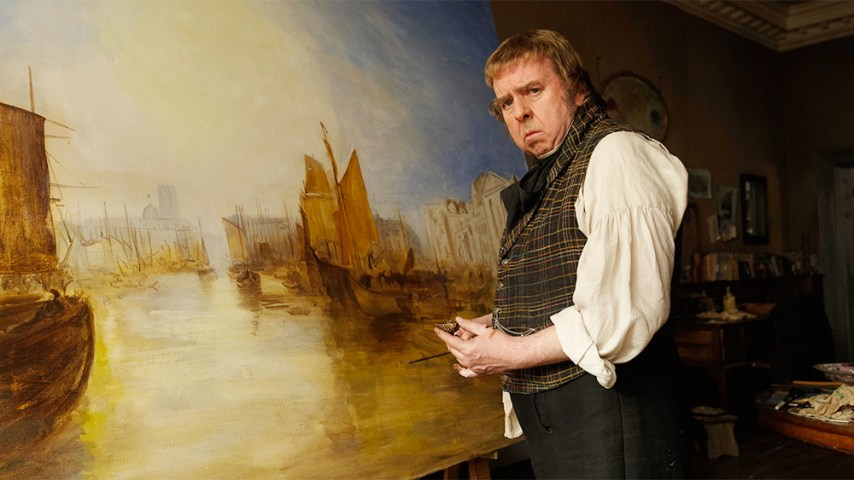
Mr Turner (2014)

Mr Turner header2
Timothy Spall is superb in Mike Leigh’s outstanding portrait of Mr Turner

Director: Mike Leigh

Cast: Timothy Spall (JMW Turner), Dorothy Atkinson (Hannah Danby), Marion Bailey (Sophia Booth), Paul Jesson (William Turner Snr), Lesley Manville (Mary Somerville), Martin Savage (Benjamin Robert Haydon), Ruth Sheen (Sarah Danby), David Horovitch (Dr Price), Karl Johnson (Mr Booth), Joshua McGuire (John Ruskin), Mark Stanley (Clarkson Stanfield), Patrick Godfrey (Lord Egremont), Niall Buggy (John Carew), James Fleet (John Constable)

“This guy was a revolutionary…he was also timeless”. That’s Mike Leigh’s perspective on JMW Turner – and looking at his late work, as this film does, how can you argue? Turner’s striking use of colour, his work increasingly reflecting moods rather than cold photographic reality, was a forerunner of Impressionism. Often scorned at the time, they now stand as a body of work almost unequalled among British masters. Leigh’s film is a pictorially beautiful, but also sensitive (if meandering) coverage of Turner’s last 25 years, which (like his Topsy-Turvy) is a fascinating celebration of creativity.

To play the artist, Leigh turned to one of his most trusted regulars, Timothy Spall. Spall spent two years learning to paint – a Day-Lewis like effort that reaps dividends as the camera catches his natural, skilfully mastery of both brush and pencil. In a career-best performance, Spall captures Turner in all his scruffy energy. Spall’s Turner is an ambling, gruff eccentric who communicates frequently through grunts (Spall finds multiple variations on a series of guttural cries, from emotional collapse to satisfaction), creating a portrait of an artist who is as deeply intellectually curious as a he is curiously reserved amongst people (for all his frequent gruff bonhomie).

It’s easy to see the grunting Turner as a curmudgeon. But he is in fact far from it. This is a man of deep personal feeling – his uncontrolled sobbing on the death of his father speaks to that – who has warm and personable feelings with his fellow artists. He engages naturally – and with genuine interest – with all he speaks to here, from lords to workers. Like all great artists, he is observing, curious and wants to discover all he can about people and their world.

Again, much like Topsy-Turvy, Mr Turner is a celebration of the power of creativity. With its beautiful imagery and lingering on the environment around Turner, we get a powerful sense of the inspiration he drew from nature. It also shows painting perhaps as it never has been shown before on screen. Turner paints with an aggression that suggests the ideas are tearing themselves out of him. The canvasses are struck, pounded and wrestled into shape. Paint and spit are mixed together, rags and brushes thrown aside. The painting is fast, messy and all-consuming, hands dripping with watery paint. It’s a sense of the artist captured by the muse.

It’s made clear that we are seeing a man who never lets a moment of inspiration pass. Who wants to capture, in his canvasses, the glory and wonder he sees in light dancing across the sky. None of this is clumsily presented or cliched: instead Leigh communicates an intimate understanding of the curiosity and ambition of the artist. The film also doesn’t back away from how revolutionary art like this is – from Queen Victoria to Music Hall comics, Turner is increasingly reviled as a half-blind, mad artist who can now longer paint. Leigh also pokes playful fun at the pretension of critics – principally John Ruskin, here presented as a pompous pillock explaining painting to painters.

It also has a brilliant eye for the performance of art. Turner is clearly a showman – and it’s hard not to think that Leigh appreciates his theatricality. The film brilliantly reconstructs a famous moment at the Royal Academy where Turner recognised his own painting (Helvoetsluys) paled in its colours next to Constable’s The Opening of Waterloo Bridge. Applying a seemingly random splash of red to his painting and then walking away – while onlookers stare aghast at the ruined painting – Turner then returns and crafts (with a rag and his nail) the blob of paint into a small, eye-catching buoy. Its details like that which make the artist. That’s inspiration, and the film is crammed with moments like this.

Taking as its effective starting point the death of Turner’s beloved father (a sparkling Paul Jesson), Leigh’s film takes an observatory, non-judgemental, episodic approach to following Turner’s life. His relationship with fellow artists – from bonhomie with pals like John Carew and Clarkson Stanfield, to guarded distance with his rival Constable, the only man he feels can match him – are contrasted with Turner’s complicated private life.

In private, Leigh presents Turner as a man partly selfish, partly unwilling to confront responsibility – a damaged relationship with his mother having left him retreating from intimacy. A man who, still in his 50s, relies on his father (who he introduces to everyone as “Daddy”) to look after him (from planning his meals to mixing his paint). Turner has disowned his teenage daughters by his mistress Sarah Danby (a furiously good Ruth Sheen).

Turner’s relationship with two women become the pivot of the film. Dorothy Atkinson gives an extraordinary performance, part shuffling curiosity, part portrait of quiet long-suffering devotion. The film supposes an occasional sexual affair between this faithful housekeeper and Turner, which for Turner is clearly little more than an opportunity for release. For Hannah Danby, it’s something considerably more – and Leigh gives the final shot of the movie to her grief and loneliness after Turner’s death.

Turner finds some peace in an unofficial marriage he forms with landlady Sophia Booth (a wonderfully humane performance from Marian Bailey), a relationship he kept completely secret, setting up a home in Chelsea. It’s a relationship set-up and run on Turner’s own terms, but for a man who was a public figure (in every sense), the film suggests that this taste of the ordinary gave him a sense of safety he hadn’t felt since the loss of his father.

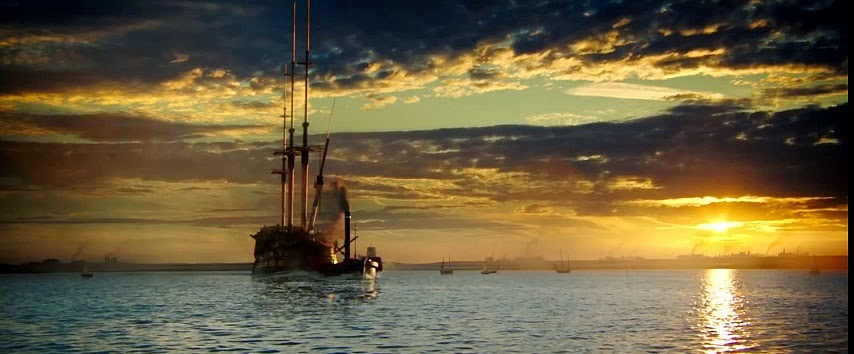
Any film about Turner almost has a moral obligation to be shot beautifully. From the opening minutes you’ll know you are in safe hands with Leigh’s regular camera-man Dick Pope. This is an astonishingly beautiful film, which takes Turner’s mastery of light as its inspiration for a series of strikingly gorgeous images. There is a reconstruction of the inspiration for The Fighting Temeraire which wouldn’t look amiss on your wall. The inspiration of Rain, Steam and Speed is extraordinary. At every moment the use of light and vibrant yellows echoes Turner’s dying words “The Sun is God”. One transition to Turner sketching in the Lake District captures a rocky outcrop so wonderfully that for a second I thought I was looking at a painting.

Mr Turner can be criticised as a collection of scenes – or sketches – that come together to form a film. There is no real plot, thematic or otherwise, in the film. Instead, it is designed to give us an impression of the artist, and follows the same sort of episodic, sometimes random, pattern than life itself follows. But in its intimate understanding of both creativity and the complexity of humanity, it becomes a wonderfully involving and inspiring film, beautifully shot and wonderfully directed by Leigh with a towering performance by Spall.

Heat and Dust (1983)

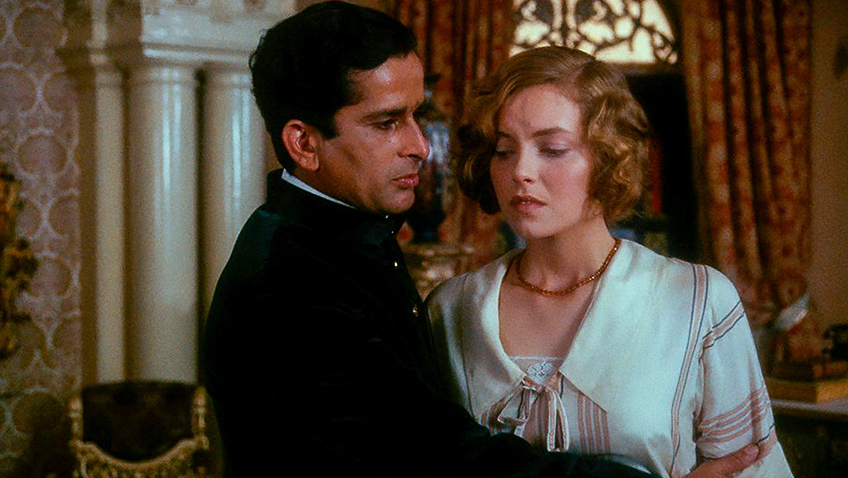
Shashi Kapoor and Greta Scacchi in a love across the divide in Heat and Dust

Director: James Ivory

Cast: Julie Christie (Anne), Greta Scacchi (Olivia Rivers), Shashi Kapoor (The Nawab), Christopher Cazenove (Douglas Rivers), Nickolas Grace (Harry Hamilton-Paul), Zakir Hussain (Inder Lal), Julian Glover (Crawford), Susan Fleetwood (Mrs Crawford), Patrick Godfrey (Dr Saunders), Jennifer Kendal (Mrs Saunders), Charles McCaughan (Chid), Madhur Jaffrey (Begum Mussarat Jahan), Barry Foster (Major Minnies)

Adapted by Ruth Prawer Jhabvala from her Booker-prize winning novel, Ivory-Merchant’s production of Heat and Dust is much like the source: precise, admirable and both faintly enigmatic and intriguingly slight. In 1982 Anne (Julie Christie) travels to India to discover more about the life of her great-aunt Olivia (Greta Scacchi). In 1923, Olivia lived in Satipur as wife to local official Douglas Rivers (Christopher Cazenove). The Nawab (Shashi Kapoor) is the local Indian prince, a charismatic man who may or may not be in league with local bandits. Enthralled by India, bored by British India but deeply in love with Douglas, Olivia still finds herself drawn to the Nawab. Scandal is round the corner.

Heat and Dust is a delicate, well-mounted adaptation, but it never quite engages as much as it should. Perhaps this is because its central plot – a white woman is fascinated by India – is a familiar trope in both novels and films of the Raj. It does take a different approach by intercutting between the present and the 1920s. This presents intriguing opportunities to show ways India has changed physically (the homes of the British Raj have become offices) but also ways it has remained the same culturally.

This carries across in the contrasting stories of two women, both of whom become intrigued by their surroundings and romantically entangled with Indian men. While Olivia is (eventually) disgraced and ostracised by her community, Anne has the freedom to make her own choices. Both women find themselves drifting into life-changes through male seduction. Perhaps this is one of the points of the film in the end – that women, no matter the timeline, are people that things (or men) happen to, rather than being the true owners of their own lives?

It seems the case with Olivia, who never feels in full control her own life, but instead moves inexorably towards a destiny she can’t really influence. Charmingly played, with a sparkle and playful innocence by Greta Scacchi in her film debut, Olivia’s motivations are almost deliberately obscured. Although Ivory uses a device at first of Olivia’s letters being dramatised by Scacchi addressing the camera, this device is swiftly dropped. The letters remain a presence, but we never hear from them. Instead most of Olivia’s actions are narrated by her friend Harry (Nickolas Grace), now an old man. It places a distance between the viewer and Olivia, making her actions harder to understand.

But then that is part of the enigma. India is a land of heat and dust, where normal rules don’t apply and people (particularly those from the West) find themselves reformed by. Olivia has no time for the stuffy, racist British population (especially the frightful woman). But she’s drawn to the Nawab partly because he’s a fusion of East and West, an Indian exotic with the charm of an English gentleman. For his part the Nawab, very well played by Shashi Kapoor, plans a seduction but his motives are as hard to read as Olivia. Is it attraction or revenge on the British for their contempt?

Perhaps it’s a film where we look for deep meaning and motivations, but it is in fact about how we don’t necessarily make grand decisions about our lives, but make a series of in-the-moment decisions. Both Anne and Olivia never seem to proactively make decisions, but instead events largely occur to them. Although this can make for a film sometimes lacking in energy, it does avoid making things obvious for the audience. Even if that can be frustrating when characters remain almost deliberately oblique.

What’s also oddly frustrating about the film is its more modern section. The commentary comparing the present and the past promises much but actually adds little. Anne is a curiously uninvolving character, played with a sweet tenderness by Julie Christie. Anne is hardly proactive and there is very little narrative drive behind her exploration of the past. Strangely the issues the more modern section deals with – including digs at Western cultural tourists – end up feeling less relevant than the issues of race and empire in the 1920s.

And its unfortunate that the 1920s plot line, although well staged and managed, seems extremely familiar – with echoes of A Passage to India and The Jewel in the Crown for starters. While it’s well acted (as well as those mentioned, Christopher Cazenove is very good) and creates an enigmatic atmosphere, you often feel you’re seeing something done better elsewhere. It starts as an investigation into the past, but becomes something more freeform, as if in the heat and dust of India, plans come to nothing. But its air of enigma and portrayal of characters buffeted by small events doesn’t come together into a compelling story or a rich insight into India.

Topsy-Turvy (1999)

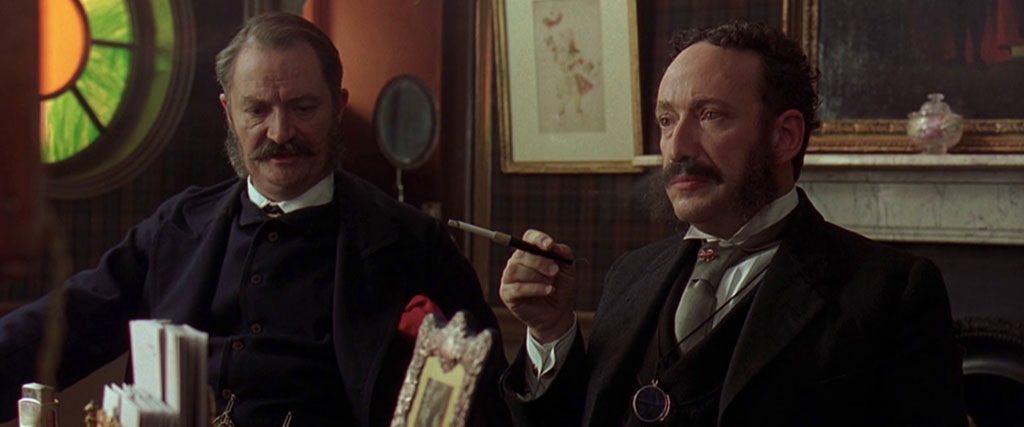
Allan Corduner and Jim Broadbent excel as the Gilbert and Sullivan’s in Mike Leigh’s superb Topsy-Turvy

Director: Mike Leigh

Cast: Jim Broadbent (WS Gilbert), Allan Corduner (Sir Arthur Sullivan), Lesley Manville (Lucy “Kitty” Gilbert), Ron Cook (Richard D’Oyly Carte), Eleanor David (Fanny Ronalds), Wendy Nottingham (Helen Lenoir), Timothy Spall (Richard Temple), Vincent Franklin (Rutland Barrington), Martin Savage (George Grossmith), Dorothy Atkinson (Jessie Bond), Shirley Henderson (Leonara Braham), Kevin McKidd (Durward Lely), Louise Gold (Rosina Brandham), Andy Serkis (John D’Auborn), Dexter Fletcher (Louis), Sam Kelly (Richard Barker)

It seems an odd-fit: Mike Leigh, auteur of working class drama, prestige period films and the music of the middle-class in Gilbert and Sullivan. But that’s to forget Gilbert and Sullivan were among the masters of theatre – and Leigh himself is a theatrical great. Topsy-Turvy, from seeing the most uncharacteristic of the director’s works, in fact perhaps an examination of the creative process Leigh has made his life. It’s a wonderfully made, superbly executed tribute to the struggles and rewards of artistic creation. A celebration of how disparate personalities come together to create something bigger than themselves. Affectionate, heartfelt, at times quietly moving, Topsy-Turvy is both one of Leigh’s most enjoyable films and one of his most tender.

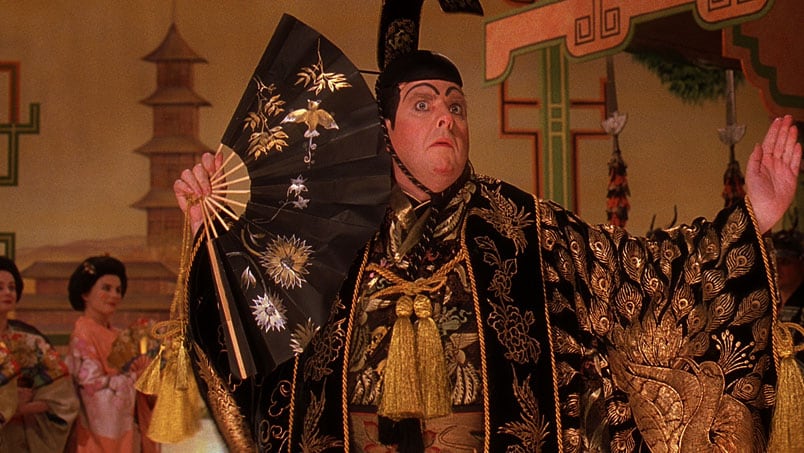
It’s 1884 and the creative partnership between WS Gilbert (Jim Broadbent) and Arthur Sullivan (Allan Corduner) is at a turning point. With their latest, Princess Ida, hardly setting the box-office alight. Sullivan feels the partnership has gone stale – and also feels under pressure to turn his attention towards more ‘serious’ composing. Gilbert refuses to change his next libretto, which Sullivan feels is effectively more of the same. Things change though when Gilbert is intrigued by an exhibition of Japanese arts and crafts, quickly creating a new libretto: The Mikado. The two geniuses, finally in unison, work together to bring the production to the stage.

Topsy-Turvy is probably Leigh’s most purely entertaining film. For anyone who has ever been involved in theatre or the arts, you’ll certainly recognise more than a few moments in this film, which is practically Leigh’s love letter to the arts. Leigh’s aim was to pay tribute to the difficulties of creativity and the demand of having to constantly refresh and reinvent your work to stay relevant and fulfilled. He succeeded: few films have so beautifully captured the struggle, pain, satisfaction and joy of creation or the strange anti-climax artistic success can bring.

Most of the second half of the film is a fascinating look at every step required to bring a production to life. From casting and contract negotiations, to costume fittings, staging and work in the rehearsal room. We get a fascinating insight into the complex backstage politics and squabbles in this small world. From actors bitching about the management (always incompetent, regardless of the situation) to the delight and playfulness of rehearsals as different opportunities are explored, it’s a wonderfully true insight into the theatre. Matched with the intricate and extraordinary detail of the reconstruction of the original production – and you have an enthralling insight into theatre. It also very appropriate for Leigh, whose organic methods of creating a film through copious rehearsal and improvisation remains very similar to theatre.

Alongside this though, the film has plenty of sympathy for the cost of creative exertion. Many of the actors lead sad and even lonely lives. Shirley Henderson’s Leonara Braham struggles with drink, Martin Savage’s George Grossmith is a drug addict (the company is too polite to mention it, but he’s clearly struggling with withdrawal at the dress rehearsal), Dorothy Atkinson’s Jessie Bond has constant pains from an unhealed ulcer. WS Gilbert and his wife lead a chaste life, he as terrified of intimacy and connection as he is of watching first nights. Sullivan juggles health problems and a long-running, regular-abortion marked, affair with Fanny Ronalds with a lingering sense of shame at not having exploited his talents more fully. These are lives that come to life when doused with creation, for all the off-stage world reveals trouble and strife.

Much of the first half is a wonderfully judged contrast between the extraverted Sullivan, keen to stretch himself but lacking the application and drive, and the repressed Gilbert, doggedly ploughing on with his (stale-sounding) original idea and unable to comprehend Sullivan’s reluctance. Leigh’s film could easily have manifested itself as a clash between two mis-matched partners. However, while the film expertly draws the parallels between the two, it also shows how much their energy comes from mutual respect. Sullivan is, after all, right that Gilbert’s first idea is a limp retread. But Gilbert’s Mikado idea is so good we don’t need a scene showing Sullivan change his mind – the simple contrast of Sullivan’s chuckles and animated striding while Gilbert reads him The Mikado’s libretto with his boredom and constant questions to the abandoned libretto speaks volumes.

Jim Broadbent is outstanding as Gilbert. He has the repressed distance, the grumpy-old-man bluntness but he mixes it with small flashes of excitement and rapture that speak volumes. His fascinated glances at the Japanese exhibition – soaking up inspiration – are beautifully judged, while his later excited larking around with a samurai sword (the very next scene sees him with a first draft) is perfect. Broadbent is both supremely funny, with several perfectly judged mon-bots, and also heartbreakingly, unknowingly lonely in his distance and fear of emotional contact. Allan Corduner makes a perfect contrast as the brash Sullivan, enjoying fame in a way Gilbert never can, but sharing with him a tortured sense of his need to fulfil his artistic potential.

The rest of the cast – a delightful mix of Leigh regulars and familiar faces – are also fabulous. Lesley Manville is wonderful as Gilbert’s wife, a gentle, eager-to-please woman who we discover has carefully buried deep regret about her emotionally repressed marriage and lack of children (Gilbert’s own difficult relationships with his parents have had a long reach on his life). Timothy Spall is wonderfully entertaining as bitchy leading actor who reacts with quiet despair when his big number is cut. Shirley Henderson’s fragility is perfect for a woman whose stage presence masks her emotional vulnerability and drink dependence. Dorothy Atkinson and Martin Savage are marvellous as two actors whose willingness to carry on under all conditions is skilfully contrasted.

Leigh’s film is also a brilliant reconstruction of time and era (rarely can a researcher be so highly billed on a film’s credits). There is a delight taken in showing how the characters react to new inventions, from Gilbert’s bellowing phone calls (“I am hanging up the phone now!”) to Sullivan’s wonder at a fountain pen (“What will they think of next?”). The design from Eve Stewart, the glorious photography of Dick Pope and the Oscar-winning costumes Lindy Hemming all are perfectly judged. The film though never becomes buried in “prestige costume drama” trappings: it’s eye for history is to acute. From alcoholism to drug addiction, broken families to the seamier streets of London, this is a film that never succumbs to easy nostalgia.

What it remains is a loving tribute to the strange families the build up around theatre. When Temple’s song is cut from the play, the chorus come together humbly but selflessly to beg for the song to be retained, because of their affection and regard for Temple. There may be disagreements, but everyone pulls together to stage the show when the time comes. Leigh’s film is full of wit, affection and a deep, loving regard for those who have chosen a life of creativity. While the film can show the cost of such a life – and the contrasting emptiness and regret away from the stage, in a life which can doesn’t always provide satisfaction – it also celebrates art in a way few other films can. One of the greatest films about the theatre ever made.

Disobedience (2017)

Rachel Weisz and Rachel McAdams deal with love and faith in Disobedience

Director: Sebastian Lelio

Cast: Rachel Weisz (Ronit Krushka), Rachel McAdams (Esti Kuperman), Alessandro Nivola (Dovid Kuperman), Allan Corduner (Moshe Hartog), Bernice Stegers (Fruma Hartog), Anton Lesser (Rav Krushka), Nicholas Woodeson (Rabbi Goldfarb), Liza Sadoby (Rebbetzin Goldfarb)

After the death of her father, a highly respected member of a Jewish Orthodox community in London, photographer Ronit (Rachel Weisz) returns from New York for his funeral. Estranged from her father, due to her rejection of Orthodoxy, Ronit has been quietly forgotten by her community. She stays with old childhood friends, now married, Dovid (Alessandro Nivola) and Esti (Rachel McAdams) Kuperman. Dovid, her father’s chosen disciple, has been offered his place in the synagogue. Esti is a teacher at the local primary school. However, Ronit and Esti are more than just friends – their love for each other being the unspoken reason for Ronit’s departure.

Disobedience is a tender, thought-provoking exploration of the struggles between faith and love – or rather the longing to be a part of a community, that rejects a big part of who you are. While Ronit is our entry point into this world, the real tragedy here is Esti. Both a believer in Jewish Orthodoxy and a lesbian, Esti has struggled her whole life to find a balance between these two. While Ronit has, to a certain extent, chosen – deciding to leave her family life behind to allow some personal freedom for her bisexuality – Esti has remained and tried to reconcile the contradictions in her life.

What works really well about Disobedience is that it avoids moral judgements. The Orthodox community is never condemned or hold up backward or wicked. Those who live in it may be traditional, but they are not cruel. Ronit felt she had to leave, and there is an awkwardness around her return (and she is not mentioned in her father’s obituary), but apart from a few individuals, the community acknowledges her. This proves especially effectively as it allows the film to focus on a very tenderly drawn love-and-relationship triangle between the three leads, rather than scoring easier political or religious points.

It becomes a beautifully acted depiction of a three close childhood friends who are torn between affection, bitterness and longing for each other. In particular, the love between Ronit and Esti is immediately apparent, but also the tensions of confusion, missed opportunities and confused messages. These are two women deeply in love, but held apart by pressures of their community and conflicts in themselves. Between them falls Dovid, the loyal scholar of Orthodoxy, desperate to make his marriage to Esti work but also feeling a genuine affection to his adopted sister Ronit.

There is no easy answers to this mess – and the film looks carefully at questions of freedom, choice and free will. How can you reconcile your faith and the pressures of your community with the things you want in your heart? How do you compress the guilt when you feel you are forcing choices onto someone you love? How willing are we to sacrifice everything we have grown up with to make our own choices? You’d expect the answers to come down on the obvious sides, but instead Disobedience frequently operates in shades of grey and complex, messy realities. Its endings are open, its conclusions emotionally strong but not clear-cut. It reflects the ambiguity of life in its refusal to supply simple, reassuring endings.

The film is directed, in a muted palette, with great sensitivity and restraint by Sebastian Leilo. The camera has a wonderful eye for passing moments, for suppressed looks of affection. He uses long takes to allow his actors to relax into their performances, helping them create characters who feel extremely natural. The moment when Esti and Ronit finally surrender to their feelings to each other is shot with an urgency and intimacy – which then makes the restraint of much of the rest of the film all the more striking, as reality returns.

He also constantly surprises us, skilfully shifting perceptions from character to character. At first we feel that this is the story of the rebellious Ronit, but as the story progresses Esti emerges as a truly tragic figure, while Dovid is a man holding back huge waves of doubt and uncertainty about the rules that have defined his life.

The three lead actors are wonderful. Weisz is edgy, cagey and unapologetic about the air of rebelliousness she outwardly displays – but its clear that underneath she is full of regret, grief and a powerful sense of loss about the family and love she left behind. McAdams grows in statue from scene to scene as a woman who seems naïve but actually is all-too-aware of the compromises life demands – and has struggled all her life with sexual feelings alien to her culture. Nivola superbly turns a character who could have been an obstructive bore into a man who knows suffering deep down with the knowledge that his functional marriage based on duty will never bring him (or Esti) the happiness he desires.

Disobedience balances these three characters wonderfully. At times it luxuriates too much in its languid pace and stolen, lingering glances – a sense of urgency is often missing. But intelligent, sensitive, respectful and with a respect for faith that many other films would have avoided, it’s brilliantly played and sensitively directed.

Great Expectations (1946)

Great Expectations (1946)

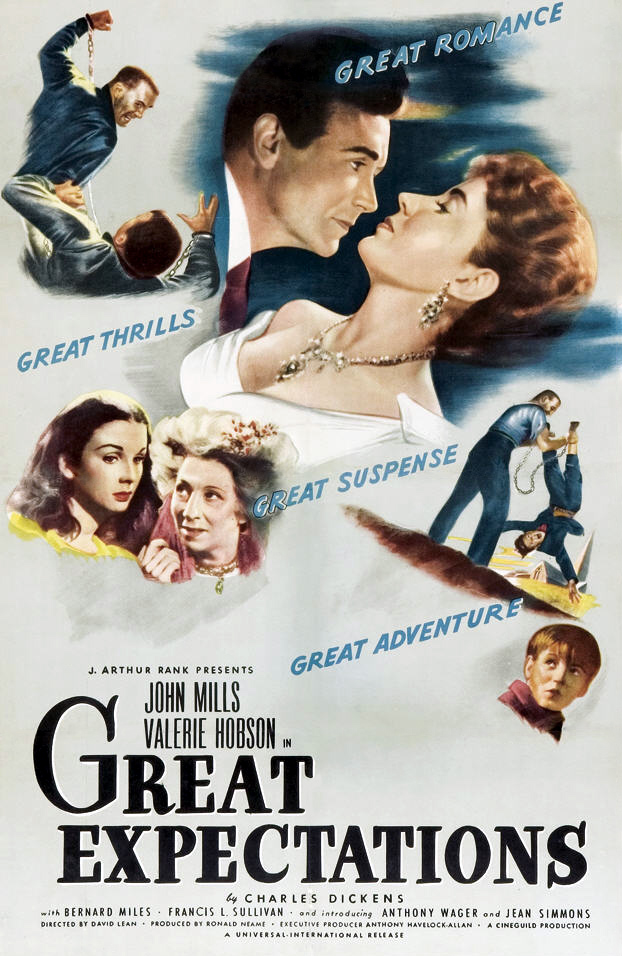
Lean’s masterful adaptation is still one of the finest examples of Dickens on screen

Director: David Lean

Cast: John Mills (Pip), Valerie Hobson (Estella), Bernard Miles (Joe Gargery), Francis L Sullivan (Jaggers), Finlay Currie (Abel Magwich), Martita Hunt (Miss Havisham), Alec Guinness (Herbert Pocket), Jean Simmons (Young Estella), Anthony Wagner (Young Pip), Ivor Barnard (Wemmick), Freda Jackson (Mrs Joe Gargery), Eileen Erskine (Biddy), Torin Thatcher (Bentley Drummle)

Of all Dicken’s books there is perhaps none so popular as Great Expectations – and no Dickens adaptations are more highly regarded than David Lean’s 1946 film. Of course, just under two hours is only time to tell a simplified version of Dicken’s original. But no-one’s taking the book away. What Lean’s film did triumphantly was turn Dicken’s prose into a clear cinematic language and style, without losing the uniqueness of the author’s voice. Lean’s visual mastery is perfectly matched with his experience as an editor of telling a story to produce an endlessly entertaining film.

As a young boy Pip (Anthony Wagner) encounters an escaped convict (Finlay Currie) in a graveyard. Intimidated, Pip brings the convict food and tools to escape his chains – acts which the convict clears him of when he is caught later that day. Weeks later, Pip is invited to the home of rich spinster Miss Havisham (Martita Hunt) to provide her and her adopted daughter Estella (Jean Simmons) with company. The visits continue until Pip’s apprenticeship as a blacksmith to his brother-in-law Joe (Bernard Miles) begins. Imagine Pip’s (now John Mills) surprise six years later when he is informed by lawyer Jaggers (Francis L. Sullivan) that he has come into money – that he has become a gentlemen of “great expectations”. Assuming it is the work of Miss Havisham – and that he is destined to marry Estella (now Valerie Hobson) – he is horrified to discover his life is more complex than he believed.

The film repackages Great Expectations a bit more into a romance. While the relationship between Pip and Estella, and the bond between them, is clear in the novel – and a large part of its plot – its but one thread masterfully woven together into the final storyline. Here this thread is given prominence, at the cost of several others. It’s not a complaint as such, but it makes Great Expectations into a more traditional story: a feeling added to by the film’s more conventional “feel-good” ending (very different from the much more uncertain ending of the novel, that Dicken’s edited back and forth in different editions to increase or decrease its hopefulness). However, it works for creating a film story, even if it loses some of the depth of the novel.

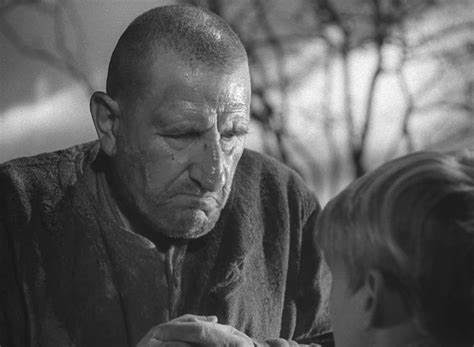
Its also more than balanced by how much the film gets right. Lean brilliantly captures the novel’s atmosphere, its gothic sense of impending dread, the burden of the past and the paranoia of persecution. For decades the opening scenes of the film, with its masterfully shot and edited mist covered graveyard (simultaneously a place of peace and a place of unsettling unknowability ) bursting into life through the grasping hands of Magwich, were practically used as a textbook example of cinematic language. Lean’s work is intensely cinematic. The mis en scene of Expectations is masterful – everything from casting, to camera angles to score comes together to bring Dickens world to life. This is exactly his London as he wrote it. It’s a wonderful expression of a particular author’s style, told using a mastery of cinematic language – from camera angles to editing cuts.

The characters have that perfect sense of eccentricity laced with menace that Dickens invests them with. Francis L Sullivan’s Jaggers is an unknowable legal machine who is part man of business, part fearsome fixer. Alec Guinness (in his film debut) is good-natured kindness to a T as Pip’s faithful friend Herbert (in one lovely scene he politely and gently corrects Pip’s primitive table manners). Finlay Currie’s Magwich captures the sense of danger and threat in the book’s opening that will become a fatherly meekness in the story’s later acts.

Largest of all, Martita Hunt’s gothic Miss Havisham sits like a giant spider at the centre of a decaying web. The design of Satis House – with its rotting wedding cake, sprawling cobwebbed dinner service, the heavy curtains and lack of light – is just one of the many perfect touches in the film. Hunt herself is superb as this outwardly eccentric aunt, who in fact has been nursing a core of bile and hatred that ends up only hurting those closest to her. There is something hugely dreamlike about Miss Havisham’s home – you suspect Lean may have watched some Cocteau – with its strangely angled table and mix of intimate framing and wide-angle crane shots.

Perhaps because we only see, not read, Pip’s actions in this film it’s impossible not notice what an arrogant snob he becomes. John Mills does decent work in the part, but (much as in the book) Pip ends up feeling like a slightly colourless figure. The film doesn’t always explore in detail the negative sides of his character meaning moments like his patronising dismissal of the kindly Joe (a perfectly judged Bernard Miles), don’t do the character much favours. Mills does however make a larger impression than Valerie Hobson, left slightly adrift as Estella. She’s not helped by how outstanding Jean Simmons is as the young and preciously flirtatious Estella, the perfect picture of the little cruelties teenagers inflict on each other. (A braver film might have had her play the role throughout – but then Mills would look even older than he does!)

The film is very strong on the pain caused to these two characters – and that they cause for each other. More than any other version, we get a sense here of how Miss Havisham’s misguided aim to use Estella as a weapon of revenge on all men only manages to hurt Estella herself and Pip (her one true love as presented here). Just as a Pip’s snobbish dismissal of Joe stings. And Lean’s brilliant sense of pace and rhythm means that this plays hand-in-hand with Pip’s ever more desperate attempts in the second half to save Magwich from doom.

Many of the complexities of the plot (from Estella’s parents to Herbert’s marriage to several key characters) are cut out, but it’s striking how the film still manages to feel so faithful to the book. Lean’s understanding of Dickens mix of eccentricity and darkness is communicated in every frame. The major moments and characters from the book are beautifully bought to life, from that opening scene to Satis House. But also because small moments, like Wemmick’s “Aged P” remain in the film. Sure, the canvas has been reduced – and refocused into a love story of sorts – but the picture that emerges is still very much in the style of Dickens.

That’s what makes it one of the greatest adaptations of all time: it’s both an interpretation of the original and a beautifully judged capturing of its spirit and tone. An adaptation twice the length may have caught more plot, but would not have been such a fine movie. Because so much of this film’s imagery and drama sticks in the mind long after it is finished. Lean’s masterstroke here was to understand completely the heart of the book, and to focus the film on that. Brilliantly assembled, designed, shot and acted, it’s still one of the best literary adaptations ever made.

Vita and Virginia (2018)

Gemma Arterton and Elizabeth Debicki struggle to bring a love story to life in Vita and Virginia

Director: Chanya Button

Cast: Gemma Arterton (Vita Sackville-West), Elizabeth Debicki (Virginia Woolf), Isabella Rossellini (Lady Sackville), Rupert Penry-Jones (Harold Nicholson), Peter Ferdinando (Leonard Woolf), Gethin Anthony (Clive Bell), Emerald Fennell (Vanessa Bell), Adam Gillen (Duncan Grant), Karla Crome (Dorothy Wellesley)

The love affair between Bloomsbury group writers Vita Sackville-West (Gemma Arterton) and Virginia Woolf (Elizabeth Debicki) inspired a successful epistolatory play by Eileen Atkins. It’s got all the elements you need for a love story: sadly none of those make their way into this limp, lethargic, languid film which drains any trace of passion from its material.

Where did it all go so wrong? The film expands the plays concept (two actors performing the various letters between the two lovers) into a series of conversations and throws in as characters the other members of the Bloomsbury circle. Sadly, what it fails to do is convey a sense of joi d’vive to any of this. The Bloomsbury crowd not only come across as pompous bores, but they never even really seem to be enjoying themselves. They certainly find it hard to get passionately worked up about any of these marvellous artistic ideas we keep being told they are having. The only thing we really see them talk about is sex, probably because it’s easier to put that on screen than writing.

The failure of the film is increased by the sadly misjudged performances by the two actors at its heart. It’s already a struggle to get any sense of chemistry between these two – I can’t put my finger on why this is, but there isn’t the undefinable ‘spark’ between them. Perhaps it’s partly because they both choose such wildly diverse acting styles, that their scenes never quite click together.

Debicki goes for a stately fragility, mixed with an emo waviness and seems to be playing every scene as if she subconsciously stating “my character committed suicide you know”. Arterton seems to try and compensate for Debicki’s overstated lip wobbling, by going for a jolly hockey-sticks brashness. Neither performance compliments the other and the effect is feeling like two very good actresses feeling constrained in different ways by the material.

It’s not helped by the flatness of much of the filming. I’ve seen Chanya Button’s work elsewhere (notably on television with some great work on WW2 drama World on Fire), but here she seems uncertain how to bring visual interest to this story. Too many scenes are shot with a murky lack of visual interest. Moments of letter reading are presented as the actors addressing the camera. Stylistic flourishes – such as Virginia’s visions of swiftly growing vines at moments of emotion – seem to come out of nowhere and jar with much of the rest of the traditionalism of the rest of the filming.

So instead, two fascinating intellectuals end up coming across as slightly self-absorbed bores in a relationship that never catches fire. Most of the rest of the cast fail to make an impact: Rupert Penry-Jones gets closest as Vita’s husband who oscillates between embracing their open marriage and demanding a wife who will fulfil a more traditional role. But for the rest, it’s hard to get any sense of their personalities with some performances – especially Adam Gillen – tipping too far into gurning comedy.

The general lifelessness of the film is made somehow even worse by the bizarrely left-field score. It’s a strikingly anachronistic slow-paced drum-and-base inspired sound that wouldn’t seem out of place in the late hours of a nightclub. Here it not only feels horrendously out of place – not least because it’s the only anachronistic touch either in the film-making of the performances, which are otherwise scrupulously correct – but it’s incessant throbbing beat actually helps make the film even slower, as if you were watching it in a slightly intoxicated haze.

Vita and Virginia should really have crackled with the vibrancy of the real-life characters and the passion of their love for each other and their shared ideas. Instead it’s a tedious bore that never sparks into life.