
Tag: Michael Apted

Coal Miner’s Daughter (1980)

Coal Miner’s Daughter (1980)

Biography of Loretta Lynn, faithful to the official line but sometimes lacking in dramatic interest

Director: Michael Apted

Cast: Sissy Spacey (Loretta Lynn), Tommy Lee Jones (Doolittle Lynn), Beverly D’Angelo (Patsy Cline), Levon Helm (Ted Webb), William Sanderson (Lee Dollarhide), Phyllis Boyens (Clara Ramey Webb), Bob Hannah (Charlie Dick)
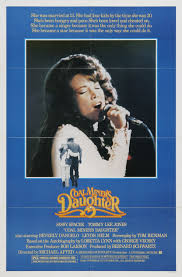
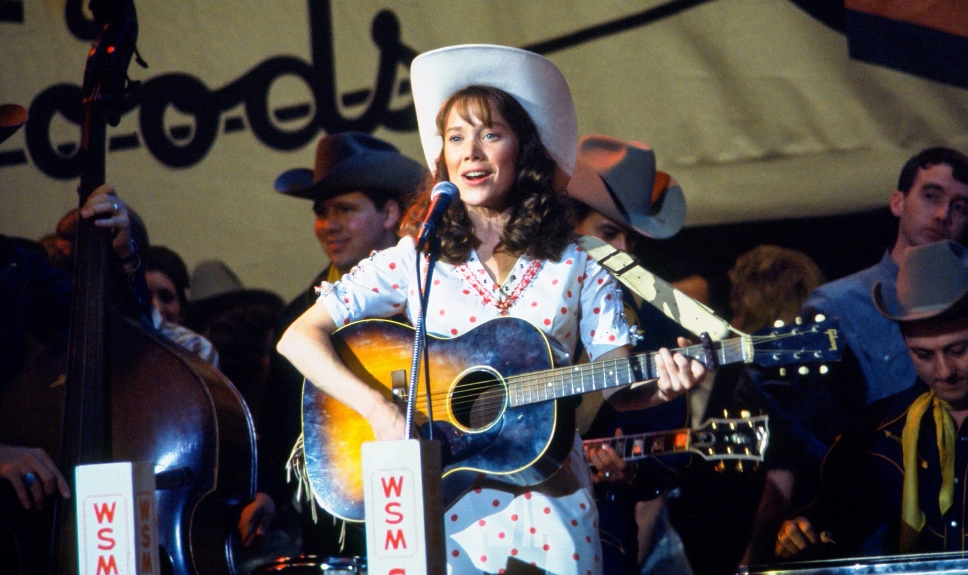
Born in poverty, in a Kentucky coal mining community, Loretta Lynn became one of the biggest Country and Western stars in America. Based on her hugely successful biography, Loretta and husband Doolittle were closely involved in this faithful translation of her life story (or at least the official version of it) to the big screen, Lynn handpicking Sissy Spacek to portray her from age 13 to 35. Coal Miner’s Daughter traces her life from teenage marriage to Doolittle (Tommy Lee Jones), to leaving her family home, Doolittle pushing her into performing with her musical talents, through to success with their loving but sometimes tumultuous marriage as a backdrop.

Coal Miner’s Daughter really splits into two halves. The first is an extremely well-observed and respectful portrait of Lynn’s working-class routes among a coal mining community which, while far from perfect, is a community full of honesty and decency despite the odd bad apple. It’s in this half that it feels the heart – and much of the drama – lies. Strangely, once Lynn starts singing (nearly an hour into the film), its second half feels a lot less dramatic, much more of a ticking off of various landmarks in what feels like a mostly uninterrupted march to success (this is despite the odd marital feud, the death of Lynn’s mentor Patsy Cline and a nervous breakdown).

Perhaps that’s because the film hues so closely to the Lynn “official line” that the film ends up feeling very curiously structured. A lot of this is in the portrayal of Lynn and Doolittle’s marriage. I don’t doubt the undoubted strength of this marriage – or the devotion of these two for each other – but, with an outsider’s eye, it’s hard not to feel its presentation here is a little odd. Apted’s film frequently presents it as borderline abusive and toxic relationship, while simultaneously celebrating it as a romance for the ages. The mismatch in tones can be hard to process when watching it, the film setting up narrative zigs before offering up layer and layer of zags.

Loretta Lynn was devoted to her husband, while cryptically saying it was a relationship she fought for. Perhaps today one of the strangest things about it is that Lynn aged herself down by two years (a fiction the film repeats), meaning that here she marries the 22-year-old Doolittle at 13. It’s harder to see this as charming today, instead seeing Doolittle as a borderline groomer. Especially as he caps the wedding night by playfully raping Loretta, who has been wildly unprepared for married life (she seems to not fully understand what has happened to her here, so is pleasantly untraumatized feeling instead guilt at not being good enough at sex for Doolittle’s high standards). Before the marriage of their first child, Doolittle will have: thrown her out of the house as a punishment for her domestic failings; cheated on her; raised his hands against her in an argument (breaking a cardinal promise he made to her dad).

He also merrily breaks the other without a second thought by carrying her hundreds of miles away to start a new life. Under the influence of booze and drink, Doolittle can have a slightly childish, sulky temper – although Lynn herself will give as good as she gets (at one point she breaks his finger by walloping him with her handbag). The two of them frequently seem never quite on the same page at the same time. Alongside this, Doolittle drives his timid wife into performing at bars and honky tonks at least partly to show her off, as much as enjoying hearing her sing.

What’s unusual – and in some ways anticlimactic – in Coal Miner’s Daughter is that these marital negatives remain un-resolved and unengaged with. Perhaps it’s because, not that far down, Doolittle really is proud of his wife and does love her music. He dedicates himself to furthering her career – at least in part so he can share in the rewards – and as she grows in fame, the power subtly swings in the relationship. Now she drags him out of the backseat of a car from a floozy, harshly deals with his bouts of drunkenness, and rejecting his attempts to try and control her image (including repeated demands that she should never wear make-up, because he doesn’t like it).

It’s never quite clear to me what the film wants us to make of all this. Is this Lynn turning the marriage into one of equals? Doolittle being put into his box? A subtle commentary on a relationship that perhaps didn’t always bring out the best. What you end up with – and I’m aware this is way more likely to be an issue today than in 1980 – is a relationship presented with several obvious negatives, continuously celebrated as a force of good. And I get that the Lynn’s themselves saw the marriage that way – but I wonder if a film they were less involved in the making of might have raised a bit more of a critical eye.

You can’t doubt the chemistry between the two actors though. Sissy Spacey won an Oscar for a near-note-perfect capturing of Lynn, and her quirky oddness fits very well for a timid country girl struggling to find her place, even as her spikey self-confidence grows. It’s a very well observed and interesting performance, Spacek also very effectively transitioning from child to adult without jarring. Tommy Lee Jones is also excellent as Doolittle: charming, relaxed, capable of real anger but also of a deep and lasting affection, loyal in his own way even when he’s disloyal. It’s a relaxed, impressive performance that makes a slightly unclear character work.

But the finest parts of the film are in the perfectly observed Kentucky mining community of Lynn’s childhood – far more dramatically interesting that watching her tick off local stations on her way to the Grand Ole Opry. Apted’s documentary experience perfectly captures the casual poverty – bedrooms lined with newspaper, a radio that needs to be turned off because there is no money for batteries, the permanent dirt of the coal dust everywhere, the moonshine. It’s all wonderfully pulled together, and Lynn’s childhood home is one of love and gentleness, helped by very impressive performances from Levon Helm and Phyllis Boyens as her devoted parents (who just about come to terms with her young marriage to a slightly wild man).

It’s a shame that backend of the drama doesn’t capture either the same depth or carry the same dramatic energy, largely because the sort of resolution (or even addressing) of the complexities the film has been displaying never comes. Despite strong performances, Coal Miner’s Daughter eventually feels like it offers little real challenge or exploration of its subject’s self-image.

Amazing Grace (2006)

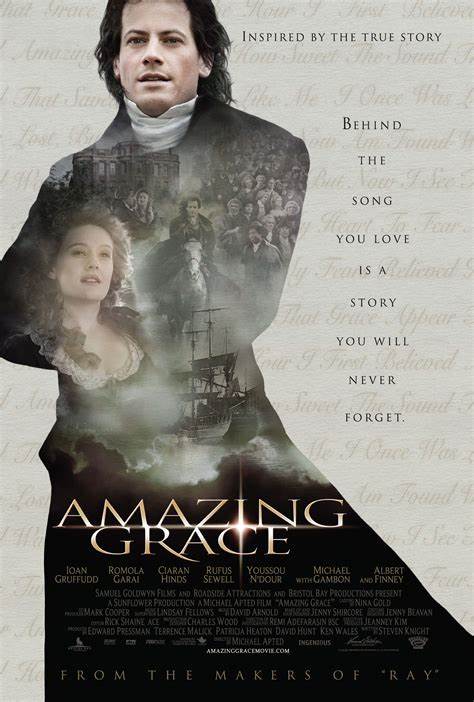
Ioan Gruffudd in full flight in the conventional but charming Amazing Grace

Director: Michael Apted

Cast: Ioan Gruffudd (William Wilberforce), Romola Garai (Barbara Spooner), Benedict Cumberbatch (William Pitt the Younger), Ciaran Hinds (Banastre Tarleton), Albert Finney (John Newton), Michael Gambon (Charles James Fox), Rufus Sewell (Thomas Clarkson), Youssou N’Dour (Olaudah Equiano), Toby Jones (Duke of Clarence), Nicholas Farrell (Henry Thornton), Sylvestra Le Touzel (Marianne Thornton), Stephen Campbell Moore (James Stephen), Bill Paterson (Heny Dundas), Jeremy Swift (Richard)

From 1782 to 1807 William Wilberforce (Ioan Gruffudd) fought a long – sometimes lonely – campaign to end the slave trade (and eventually slavery – the film confuses the two, with slavery continuing in much of the Empire for over twenty more years) in the British Empire. During that time, he competed with vested interests, parliamentary rivals and accusations of being a radical at a time when Britain was at war with Revolutionary France.

Michael Apted’s old-fashioned film covers this, hitting every beat you would expect for a biographical drama. It uses a traditional framing device of starting in the middle of the story: Wilberforce in 1797, depressed, hooked on laudanum and out of hope, revitalised by meeting Barbara Spooner (Romola Garai) who will become his wife. This makes for a perfect narrative tool as it means she can ask him questions like “tell me what happened” which serves as a neat entrée into a whole host of flashbacks sketching out in the swiftest means possible the history of abolitionism.

Amazing Grace could have been made in the 1930s, so closely does it hue to the classic rules of biopics. It’s practically a structural brother to The Life of Emile Zola, a hagiographical portrait of an (admittedly outstanding) man which shows the expected arc of moral awakening, early success, tricky mid-point, the sad years, getting the band back together for one final big push ending in friends and foes alike coming together to hail his accomplishments. It’s all threaded together with a script that carefully moves through every event, simplifies history down and sometimes wears its research rather heavily.

You can’t argue that it isn’t well-meaning and heartfelt, but its simplicity (and the careful traditionalism of its shooting) makes it look more like a well-made TV special than an actual movie. But if you are a sucker for such things, as I am, it has more than enough to engage you. It also makes a compelling case about the horrors of the slavery and allows a few moments of spotlight to fall on former slave turned abolitionist Olaudah Equiano (well played by Youssou N’Dour). It certainly has its heart in the right place, its passionate liberalism and sense of moral outrage very clear.

Gruffudd – his skill for playing reluctant moral authority and duty honed from playing Hornblower – is good as Wilberforce, his obvious investment in the subject matter clear. Garai doesn’t have much to do other than tee up flashbacks, but does it with charm. Many of the rest veer on the side of fruity: Hinds and Jones scowl effectively as slave-owning senior lords (for some reason they sit in the House of Commons; Jones is even playing a Duke for goodness sake!). Gambon twinkles as only he can as Charles James Fox. Finney hams up lustily as the blind John Newton. Best of all though are Sewell as an eccentric Thomas Clarkson and Benedict Cumberbatch in an early sign of star-quality as the morally divided, reserved but decent Pitt the Younger.

It all comes together into something that seems tailor-made for Sunday afternoons. Nothing wrong with that – and not every film needs to reinvent the wheel – and since it wears its heart so openly on its sleeve, you can’t help feeling warmth towards it. It’s a Spark notes look at history – and glosses over the fact that slavery itself continued for decades – but as hagiography it’s endearing and as a feel-good biopic it succeeds at what it sets out to do.

Gorky Park (1983)

William Hurt investigates murder in Soviet Russia in ace adaptation Gorky Park

Director: Michael Apted

Cast: William Hurt (Arkady Renko), Lee Marvin (Jack Osborne), Brian Dennehy (William Kirwill), Ian Bannen (Prosecutor Iamskoy), Joanna Pacula (Irina Asanova), Michael Elphick (Pasha), Richard Griffiths (Anton), Rikki Fulton (Major Pabluda), Alexander Knox (The General), Alexei Sayle (Golodkin), Ian McDiarmid (Professor Andreev), Niall O’Brien (KGB Agent Rurik)

Martin Cruz Smith’s novel Gorky Park was a bestseller in the early 1980s. It looked at grim goings-on behind the Iron Curtain, a trio of grisly murders in Moscow’s Gorky Park (the bodies are faceless, toothless and fingerless to avoid identification). The murders are investigated by Arkady Renko (wonderfully played in this film by William Hurt), a chief investigator for the Moscow militia who feels out of place in the corruption of Soviet Russia, but is equally scornful of the consumerism of the West. The investigation delves into a complex web of Soviet relationships with American business and the dissident community, not least an American millionaire fur trader Jack Osborne (Lee Marvin), and a would-be defector and possible friend of the victims, Irina Asabova (Joanna Pacula).

What I loved about this film is the novel is a rather overwhelming 500+ pages, but this film is a brisk and pacey two hours – and I literally couldn’t think of a single thing missing. But then that’s what you get when you have a master writer adapting your screenplay. Gorky Park has Dennis Potter, perhaps the greatest British TV writer of all time – and this is a sublime script, which keeps the pace up, covers all the tense greedy wrangling of the villains, and also makes subtle and telling points about the Soviet system, all in a punchier and clearer way than the books. The dialogue is also absolutely cracking, ringing with a brusque, icy poetry, with a brilliant ear for a turn of phrase.

Filmed on location around Helsinki and Glasgow among other places, what the film misses in actual Russian locations (needless to say the Soviets were not keen to host the production of a film that showcased murder and corruption at the heart of their capital city), it makes up for with Apted’s taut direction and eye for the general crappiness of Soviet life. Everything is run down, everything is dirty, everything looks cold and unappealing, even the houses and luxury bathhouses of the party leaders look a bit middle-class and uninspiring. By the time (late in the film) that you find yourself in one of Osborne’s houses you are immediately struck by the quality of the furnishings – it’s literally a different world.

This atmosphere not only creates something a bit more unique, it also allows us to relax and enjoy the quality of Smith’s story. I found it overstretched in the book, but the film gives it an urgency and a sinister creepiness that grips your attention. Apted has a brilliant eye for the little tricks to survive living in a police state, from watching what you say, to carefully placing a pencil in a dialled telephone wheel to prevent bugs from activting. Every moment is well paced and nothing outstays its welcome. Characters are introduced with skillful brushstrokes, and the relationships feel real and lived in. With such strong dialogue, it’s also great they got such good actors to do it.

William Hurt takes on the lead, and he is perfect, affecting a rather clipped English accent (all the Russians speak with various regional or RP accents). With his unconventional looks (part boyish, part stone-like), he looks the part and he totally captures the yearning unconventionality of a character who deep down probably would be a true believer in a good society, but can’t believe in the corruption around him. Far from the stereotypical would-be dissident, Hurt makes him a man who loves his homeland, but not always the people running it. He’s exactly as you would picture Renko in the book – a guy who will go for justice with the bit between his teeth, a semi-romantic hero, no superman (he frequently is bested in combat), who is looking for something to love and believe in.

The rest of the cast are equally fine. Lee Marvin is cast against type as a suave, hyper-intelligent, manipulatively greedy businessman – although his reputation for playing heavies comes in handy when the gloves come off. Joanna Pacula mixes sultry Euro-siren with an urgent yearning for freedom. Ian Bannen is wonderfully avuncular as Renko’s supportive boss (extra points for Tinker Tailor fans that Bannen is reunited here with Alexander Knox, in a dark reflection of their Control-Prideaux working relationship from that series). Michael Elphick seizes on the part of the down-to-earth Pasha, Renko’s friend and comrade, a role greatly improved from the book (largely to give Renko someone to bounce ideas off).

Apted’s film has a great sense of tension and a wonderful feeling for Soviet Moscow’s dark underbelly. The mystery is increasingly gripping and involving as the film goes on – and, in a nice rug-pull, turns out to be about something totally different than what you might expect. Even the final shootout is assembled and shot with an unexpected vibe. It avoids any Cold War pandering – the main villain is a sadistic American allied with Russians, our hero a noble Russian who partners up with a salt-of-the-earth but decent American cop (Brian Dennehy, also very good). For a late night mystery thriller, with a touch of everything thrown in, you can do a lot worse than this. I enjoyed it far more than I expected. I’d almost call it an overlooked B-movie gem.