
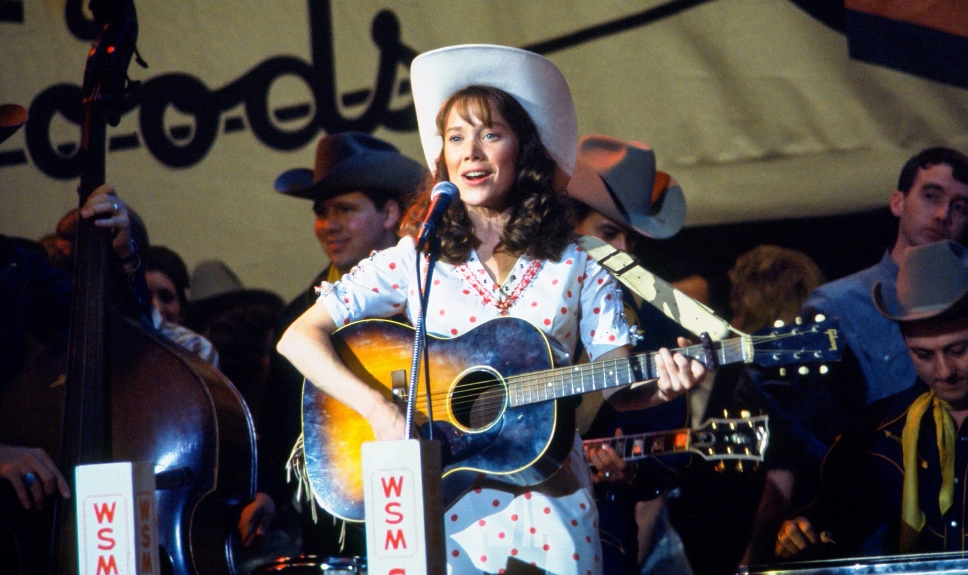
Biography of Loretta Lynn, faithful to the official line but sometimes lacking in dramatic interest
Director: Michael Apted
Cast: Sissy Spacey (Loretta Lynn), Tommy Lee Jones (Doolittle Lynn), Beverly D’Angelo (Patsy Cline), Levon Helm (Ted Webb), William Sanderson (Lee Dollarhide), Phyllis Boyens (Clara Ramey Webb), Bob Hannah (Charlie Dick)
Born in poverty, in a Kentucky coal mining community, Loretta Lynn became one of the biggest Country and Western stars in America. Based on her hugely successful biography, Loretta and husband Doolittle were closely involved in this faithful translation of her life story (or at least the official version of it) to the big screen, Lynn handpicking Sissy Spacek to portray her from age 13 to 35. Coal Miner’s Daughter traces her life from teenage marriage to Doolittle (Tommy Lee Jones), to leaving her family home, Doolittle pushing her into performing with her musical talents, through to success with their loving but sometimes tumultuous marriage as a backdrop.
Coal Miner’s Daughter really splits into two halves. The first is an extremely well-observed and respectful portrait of Lynn’s working-class routes among a coal mining community which, while far from perfect, is a community full of honesty and decency despite the odd bad apple. It’s in this half that it feels the heart – and much of the drama – lies. Strangely, once Lynn starts singing (nearly an hour into the film), its second half feels a lot less dramatic, much more of a ticking off of various landmarks in what feels like a mostly uninterrupted march to success (this is despite the odd marital feud, the death of Lynn’s mentor Patsy Cline and a nervous breakdown).
Perhaps that’s because the film hues so closely to the Lynn “official line” that the film ends up feeling very curiously structured. A lot of this is in the portrayal of Lynn and Doolittle’s marriage. I don’t doubt the undoubted strength of this marriage – or the devotion of these two for each other – but, with an outsider’s eye, it’s hard not to feel its presentation here is a little odd. Apted’s film frequently presents it as borderline abusive and toxic relationship, while simultaneously celebrating it as a romance for the ages. The mismatch in tones can be hard to process when watching it, the film setting up narrative zigs before offering up layer and layer of zags.
Loretta Lynn was devoted to her husband, while cryptically saying it was a relationship she fought for. Perhaps today one of the strangest things about it is that Lynn aged herself down by two years (a fiction the film repeats), meaning that here she marries the 22-year-old Doolittle at 13. It’s harder to see this as charming today, instead seeing Doolittle as a borderline groomer. Especially as he caps the wedding night by playfully raping Loretta, who has been wildly unprepared for married life (she seems to not fully understand what has happened to her here, so is pleasantly untraumatized feeling instead guilt at not being good enough at sex for Doolittle’s high standards). Before the marriage of their first child, Doolittle will have: thrown her out of the house as a punishment for her domestic failings; cheated on her; raised his hands against her in an argument (breaking a cardinal promise he made to her dad).
He also merrily breaks the other without a second thought by carrying her hundreds of miles away to start a new life. Under the influence of booze and drink, Doolittle can have a slightly childish, sulky temper – although Lynn herself will give as good as she gets (at one point she breaks his finger by walloping him with her handbag). The two of them frequently seem never quite on the same page at the same time. Alongside this, Doolittle drives his timid wife into performing at bars and honky tonks at least partly to show her off, as much as enjoying hearing her sing.
What’s unusual – and in some ways anticlimactic – in Coal Miner’s Daughter is that these marital negatives remain un-resolved and unengaged with. Perhaps it’s because, not that far down, Doolittle really is proud of his wife and does love her music. He dedicates himself to furthering her career – at least in part so he can share in the rewards – and as she grows in fame, the power subtly swings in the relationship. Now she drags him out of the backseat of a car from a floozy, harshly deals with his bouts of drunkenness, and rejecting his attempts to try and control her image (including repeated demands that she should never wear make-up, because he doesn’t like it).
It’s never quite clear to me what the film wants us to make of all this. Is this Lynn turning the marriage into one of equals? Doolittle being put into his box? A subtle commentary on a relationship that perhaps didn’t always bring out the best. What you end up with – and I’m aware this is way more likely to be an issue today than in 1980 – is a relationship presented with several obvious negatives, continuously celebrated as a force of good. And I get that the Lynn’s themselves saw the marriage that way – but I wonder if a film they were less involved in the making of might have raised a bit more of a critical eye.
You can’t doubt the chemistry between the two actors though. Sissy Spacey won an Oscar for a near-note-perfect capturing of Lynn, and her quirky oddness fits very well for a timid country girl struggling to find her place, even as her spikey self-confidence grows. It’s a very well observed and interesting performance, Spacek also very effectively transitioning from child to adult without jarring. Tommy Lee Jones is also excellent as Doolittle: charming, relaxed, capable of real anger but also of a deep and lasting affection, loyal in his own way even when he’s disloyal. It’s a relaxed, impressive performance that makes a slightly unclear character work.
But the finest parts of the film are in the perfectly observed Kentucky mining community of Lynn’s childhood – far more dramatically interesting that watching her tick off local stations on her way to the Grand Ole Opry. Apted’s documentary experience perfectly captures the casual poverty – bedrooms lined with newspaper, a radio that needs to be turned off because there is no money for batteries, the permanent dirt of the coal dust everywhere, the moonshine. It’s all wonderfully pulled together, and Lynn’s childhood home is one of love and gentleness, helped by very impressive performances from Levon Helm and Phyllis Boyens as her devoted parents (who just about come to terms with her young marriage to a slightly wild man).
It’s a shame that backend of the drama doesn’t capture either the same depth or carry the same dramatic energy, largely because the sort of resolution (or even addressing) of the complexities the film has been displaying never comes. Despite strong performances, Coal Miner’s Daughter eventually feels like it offers little real challenge or exploration of its subject’s self-image.

