Category: British politics

Disraeli (1929)

Disraeli (1929)

Early talkie gives a melodramatic insight into a Victorian stateman, with an Oscar-winning star turn

Director: Alfred E. Green

Cast: George Arliss (Benjamin Disraeli), Doris Lloyd (Mrs Travers), David Torrance (Lord Probert), Joan Bennett (Lady Clarissa Pevensey), Florence Arliss (Lady Beaconsfield), Anthony Bushell (Lord Charles Deeford), Michael Simeon Viscoff (Count Borsinov)

Based on an Edwardian melodrama, Disraeli was the sound debut of George Arliss, a highly acclaimed British actor with a successful silent career. Unlike other silent actors, Arliss’ theatre training made him ready made to have his voice be heard around the world and his Oscar for Best Actor saw him ride the crest of the sound wave. Today, the film looks inevitably quite primitive, so careful to get the sound recorded that its camera barely moves from its fixed position in the ceiling-free sets. But Disraeli, for all this, is rather entertaining if you settle down to it despite its stodgy set-up still deeply rooted in its Edwardian melodrama roots.

It’s odd to read some reviewers describing Disraeli as a dry history lesson: there is almost nothing historical about the plot of Disraeli. While Disraeli did arrange the purchase of a controlling share in the Suez Canal, I can assure you he did not do it while dodging Russian spies in his own home, balancing a series of daring financial moves, laying cunning traps for scheming Russian agents or playing match-maker for his young protégé. Far from a history lesson, Disraeli is really a sort of Sherlock Holmesish thriller, with Disraeli recast as a twinkly wise-cracker constantly several steps ahead of everyone else. It’s a playfully silly set-up rather disconnected from history – and certainly far more fun than the actual dry history of financial and diplomatic negotiations.

Disraeli is a surprisingly well-scripted (as far as these things go) play, which mixes some decent jokes and creative set-ups with a liberal use of phrases from the eminently quotable Disraeli himself. You can’t argue with the wit of Disraeli (the man famously had dozens of entries in the Oxford Dictionary of Quotations) and the film bounces several bon mots around (‘That’s good. Perhaps I’ll use it with Gladstone’ Disraeli even comments on one of his own lines). There is wit in other moments, not least Lord Charles’s (Anthony Bushell) proposal to Lady Clarissa (Joan Bennett) which dwells so much on his charitable good works rather than any affections that Lady Clarissa is moved to comment she expected a proposal “not an essay on political economy”.

You can see its melodramatic roots all the way through. Secret talks about the canal are held in Disraeli’s house, in open earshot of a Russian spy Lady Travers (Doris Llloyd), who we later discover Disraeli is carefully leading on. Like a cunning Edwardian detective, Disraeli role-plays illness at one point to delay Lady Travers and resolves a last minute disastrous collapse in his payment scheme for the Suez shares with a swaggering bluff that he delightedly tells his amazed allies about the moment the duped Governor of the Bank of England (forced against his will to back the scheme) leaves the room. All this in a largely single-room setting: this is pure Edwardian theatrical melodrama bought to screen, not history.

It’s similar in its picture of history, here re-worked to position Disraeli as the sort of maverick hero we can immediately recognise from films. Disraeli is established as an outsider who no one in the establishment trusts (never mind he was the leader of the firmly establishment Conservative party, or that his rival Gladstone was seen by the crusty banker types in this film not as their saviour but as a dangerous radical). Despite being referred to as Lord Beaconsfield several times, he sits in the commons to face down Gladstone (an uninspired cameo by an unbilled actor). He is displayed as the sort of negotiating and diplomatic genius whose insights can only be responded to in wonder by Lord Charles, his dim Watson.

Like Sherlock Holmes, he lavishes Charles with backhanded compliments (specifically that his rigid honesty makes him the perfect agency for a secret mission because no one could believe he was up to lying). Like many Edwardian theatrical leads, he’s also an intense romantic. Not only deeply in love with his wife (played by Arliss’ wife Florence) but also at least as interested in making sure Charles and Clarissa end up happily married. Arguably none of that relates to the real Disraeli, a largely scruple and principle free opportunist with more than a few similarities to Boris Johnson (but with a sense of personal honesty and decency, Boris can only dream of).

The main point of interest today is George Arliss’ performance. For all its clearly a version of his stage performance, it’s still very engaging and charismatic. Arliss may deliver some of his lines like they are theatrical asides, and his mugging to a non-existent audience in Disraeli’s fake fitness is (while funny) clearly something that worked much better on stage. But he is twinkly, captures the shrewd intelligence of Disraeli and utterly convinces as a man who could run circles around everyone else. Arliss invests both the speeches and the dialogue with a genuine playful wit and a heartfelt honesty which works very well.

It’s entertaining and he looks very comfortable in front of the camera and he’s head and shoulders above the rest of the cast in terms of the light-and-shade he gives the dialogue. While the rest of the cast deliver their lines with the sort of forced formality that focuses on making sure the mic picks up every word, Arliss performs his lines. He’s got a sharp sense of comic timing, wheedles and boasts with real energy and isn’t afraid to chuck the odd line away. It’s a sound performance probably years ahead of its time.

The rest of the film is very much of its era. Green’s direction is incredibly uninspired. The camera set ups are very basic. The problems of sound can be seen throughout: from the awkward positions and formality of the camerawork to the occasional line flub that creeps into the soundtrack. Disraeli can look a lot like a filmed play, largely because it’s been set-up with such little focus on visuals. It’s reliance on title cards between scenes shows how fixed it still is on the clumsier parts of silent film-making. You could say, without Arliss, there would be very little to actually recommend it, for all there is the odd good line. But with him, it manages to be a little bit more than just a historical curiosity.
Saltburn (2023)

Saltburn (2023)

Dreadfully pleased with itself and full of shallow insights and stunt clickbait moments

Director: Emerald Fennell

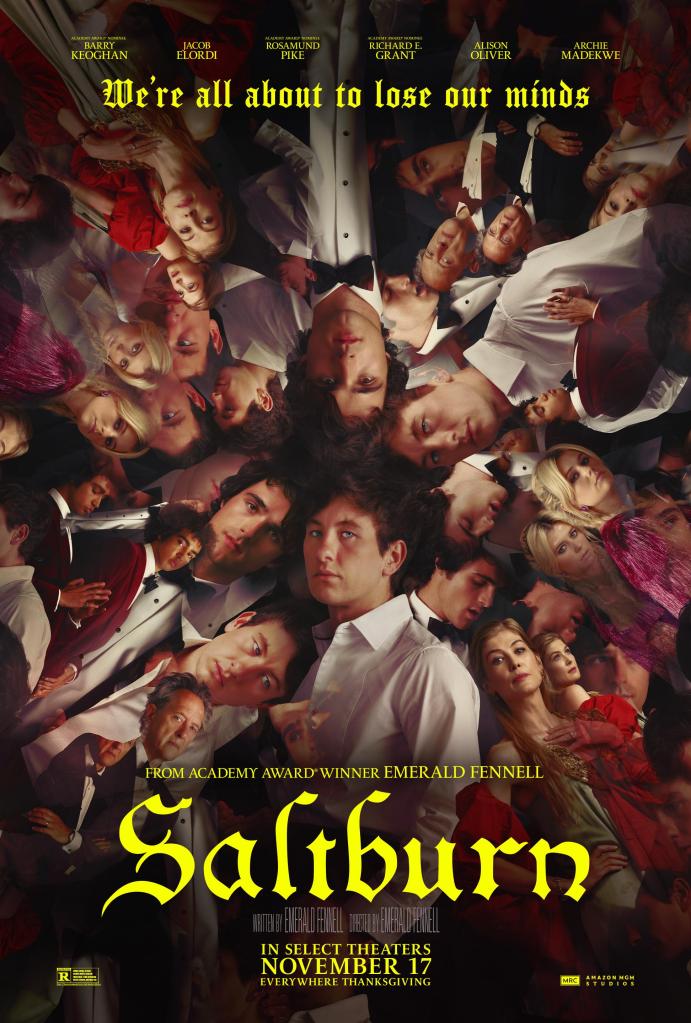
Cast: Barry Keoghan (Oliver Quick), Jacob Elordi (Felix Catton), Rosamund Pike (Lady Elspeth Catton), Richard E Grant (Sir James Catton), Alison Oliver (Venetia Catton), Archie Madekwe (Farleigh Stuart), Carey Mulligan (“Poor Dear” Pamela), Paul Rhys (Duncan), Ewan Mitchell (Michael Gavey), Sadie Soverell (Annabel), Reece Shearsmith (Professor Ware), Dorothy Atkinson (Paula Quick)

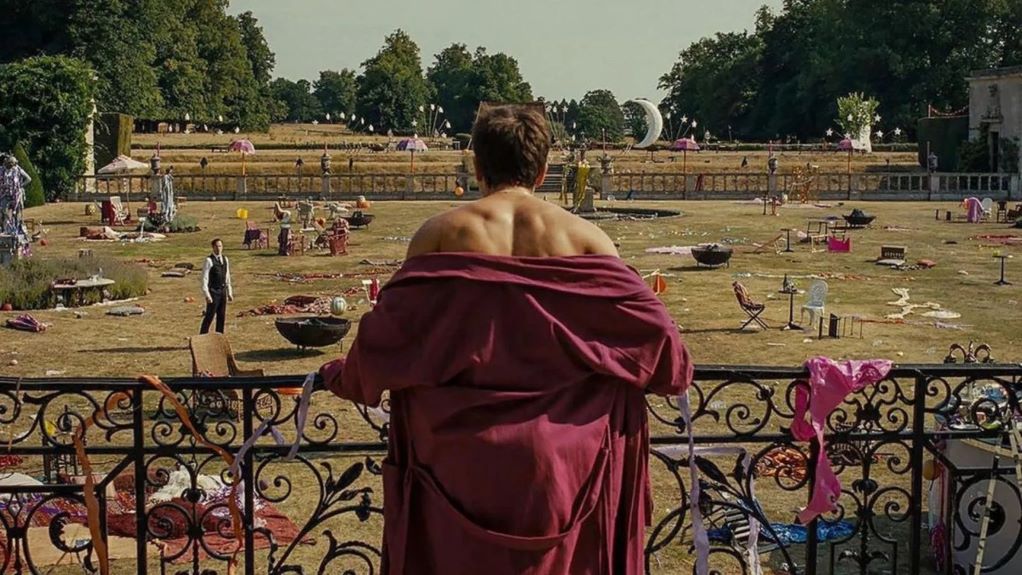
Promising Young Woman was a thought-provoking, very accomplished debut. It’s odd that Emerald Fennell’s sophomore effort plays more like a first film: try-hard, style-over-substance, very pleased with itself and its punky attempts to shock. Crammed full of moments designed to be snipped out and talked about – in a “you will not fuckin’ believe what just happened” way – Saltburn is a fairly trivial remix of ideas much, much better explored elsewhere, predictable from its opening minutes.

It’s 2006 and Oliver Quick (Barry Keoghan) is a scholarship student at Oxford University, socially awkward and very conscious of his Liverpudlian roots, struggling to fit in among the wealthy set that dominates his college. At the centre is Felix Catton (Jacob Elordi), fundamentally decent but blithely unaware of his privilege, who takes a shine to Oliver with his shyness, troubled working-class background and grief at the recent death of his alcoholic father. Felix invites Oliver to spend the summer at Saltburn, his luxurious family seat. There Oliver is welcomed – or does he inveigle his way? – into the lives of the Cattons, from seducing Felix’s sister Venetia (Alison Oliver) to charming his parents Sir James (Richard E Grant) and Lady Elspeth (Rosamund Pike). But is Oliver all he appears to be?

The answer, of course, is no. Which shouldn’t surprise anyone who has ever really encountered any form of unreliable narrator before. Fennell opens the film with a clearly older, well-dressed Oliver recounting the film’s story to an unseen person. It’s not much of a deduction from this alone, that Oliver is at best not to be trusted, is definitely potentially dangerous and is probably a lot worse. All that, inevitably plays out, in a film that so nakedly rips off Brideshead Revisited (or Recycled) and The Talented Mr Ripley that Oliver might as well be called Ripley Ryder.

“Ryder” would at least have been a witty name for a character who spends most of the film putting his (apparently) well developed manhood to effective use in manipulating and controlling people. Saltburn assembles a series of “shocking” moments of sexual weirdness from stalker-like sociopath Oliver – so much so, that the moments he merely wanders (or dances) around in the buff feel almost normal. Surely there was more than half an eye on hashtags when the film presents scenes like Oliver drinking spunky bathwater, performing oral sex on a woman during her period or dry humping then wanking over a grave. It’s not big and it’s not clever.

“Not clever” also sums up the film’s inane social commentary. Set in 2006, it seems to take place in a version of Oxford that probably hasn’t existed since 1956. Having been in a state-school kid at Oxbridge at this time, its vision of a university 98% populated by poshos jeering at working-class kids with the wrong sort of tux just isn’t true (in fact there were more state school students than private school kids at Oxford that year). In this fantasy, all the students are either from Old Etonians or maladjusted weirdos from state schools. It’s hard not to think this is Emerald Fennell (a woman so posh, her 18th birthday party was featured in Tatler) guiltily looking back at how her “set” at Oxford might have behaved to the less privileged students.

It boils down to a view of Oxford as an elitist social club laughing openly at anyone who can’t trace their descendants back to the House of Lords, where tutors are entranced by the idea that a place like “Liverpool” exists and snort at the working class student for being a clumsy try-hard by actually reading the books on the reading list with student life flying by in a series of hedonistic raves, hosted by the rich and famous. Maybe I was just in the wrong circles back in the day.

This portrait of Oxford as a play pen for the super elite is as damaging (it’s exactly the sort of false image that stops deserving people from wanting to go) as it is lazy, tired and false. But then, Saltburn compounds its boringly seen-it-all-before social commentary by trudging off down other, all-too-familiar paths as it turns its fire on those with their nose pressed up against the window of privilege. The film’s vilest member of the elite, Farleigh, is himself an interloper, turned aggressive gate-keeper. And, as is not a surprise, Oliver’s roots turn out to be far more comfortable than he is letting on. Oliver is a Charles Ryder who yearns for Brideshead so much, he starts destroying the Marchmain family to get it. Because, in his eyes, as an aspirant middle-class type he appreciates it more.

On top of this is layered a clumsy, Ripley-esque madness to Oliver, who can’t decide himself whether he is infatuated with the charming Felix (very well, and sympathetically, played by Jacob Elordi) or just wants to suck his soul dry. Barry Keoghan plays this Highsmith-styled sociopath with just enough flash and sexual confusion – and he does manage to successfully turn on a sixpence from wide-eyed wonder, to vicious anger. But the character again feels like a remix of something done better elsewhere, trading emotional depth for cartoonish bombast and clumsy on-the-nose point scoring.

The on-the-nose-ness runs through the whole film. It’s a film screaming to be taken seriously, from its 4:3 framing, to its jarringly satirical music choices, arty Gothic fonts, visual quotes from Kubrick and look-at-me love of tricksy camera shots (some of these, I will admit, are gorgeously done, even if the film frequently lingers on them so we can “see the work”). But it makes very little sense. How does Oliver manage to exert an influence, so profound and complete, over Felix’s parents? Why does the wool fall from everyone’s eyes one-at-a-time in quick succession? Does Saltburn feel sorry for the generous but emotionally dysfunctional Cattons or does it feel they deserve their fate?

Because so many of these ideas are so half-heartedly explored, it becomes a collection of scenes designed to shock, tricksy directorial decisions, some flashy performances (Rosamund Pike can certainly wittily deliver a slew of lines dripping with blithely unaware privilege) and twists that will only surprise those who have never seen a story about an outsider before. Jacob Elordi emerges best, creating a character of surprisingly revealed emotional depth, but most of the rest of Saltburn settles for flash and instant gratification. To use its own terms of reference, it’s as satisfying as premature ejaculation: fun for an all-too-brief second, then a crushing, shameful disappointment.

The Ghost Writer (2010)

The Ghost Writer (2010)

Conspiracies, lies and dirty politics surround a politician who definitely isn’t Blair in Polanski’s superb thriller

Director: Roman Polanski

Cast: Ewan McGregor (The Ghost), Pierce Brosnan (Adam Lang), Kim Cattrall (Amelia Bly), Olivia Williams (Ruth Lang), Tom Wilkinson (Professor Paul Emmett), Timothy Hutton (Sidney Kroll), Jon Bernthal (Rick Ricardelli), Tim Preece (Roy), Robert Pugh (Richard Rycart), David Rintoul (Stranger), Eli Wallach (Old Man), James Belushi (John Maddox)

An American publishing company is in dire straits. They’ve paid a fortune for the autobiography of former British Prime Minister Adam Lang (Pierce Brosnan), once seen as a visionary liberal idol but now blamed for a deeply controversial war in Iraq (sound familiar?). Problem is his trusted aide Mike McCara – who is actually writing the book – has been found drowned on Martha’s Vineyard where Lang, his wife Ruth (Olivia Williams) and staff are staying. The book needs to be finished in a month – but it’s in an unpublishable mess. Who ya gonna call? A Ghost writer (Ewan McGregor) of celebrity memoirs to finish the job of course. But will the Ghost resist trying to investigate whatever McCara uncovered in Lang’s life that may have led to his suspicious death?

Adapted from a novel by Robert Harris – who turned from a strong supporter of Blair, to terminally disenchanted – The Ghost Writer comes to the screen as a superbly controlled, perfectly placed piece of tight-wound tension from Roman Polanski, that mixes wonderful elements of Hitchcockian menace and Seventies conspiracy thriller, not to mention lashings of his own Chinatownbut here switched to the doom-laden drizzle of New York, rather than the sunkissed glory of California.

Set on a grim, grey and foreboding Martha’s Vineyard (although, for obvious legal reasons, actually filmed in Potsdam), Polanski lets every scene grow in unsettling tension. Very little explicit is every said, but danger from unknown, unseen forces is a constant presence. Accompanied by a Herrmann-esque score from Alexandre Desplat (also with a hint of a twist on Jerry Goldsmith’s work on Chinatown), this is film made with such calm, patient authority that its exudes engrossing tension. Polanski employs some beautiful touches, worthy of Hitchcock: from the Ghost, uncertain if he is being followed when boarding a car ferry, making a desperate run for freedom; to a wonderful tracking shot at a book launch that follows a note containing a vital reveal, passed from hand to hand through a crowd to the guilty speaker.

The Ghost Writer also has neat moments of dark comedy which also feels reminiscent of Hitchcock’s ability to mix dark chuckles with oppressive tension. The Ghost’s recruitment as a writer – and his hilariously frank suggestion that political memoirs are boring beyond belief – is a lovely lightly comic entrée that completely fails to prepare us for the conspiracy thriller that follows in all the right ways. Stuck in Lang’s house on Martha’s Vineyard, the Ghost tries to secretly download a copy of the memoir he is only allowed to read under supervision: his attempt coincides, to his terror, with what turns out to be a test of the alarm system. In the background of a shot during a monologue from Lang, a worker struggles with wearied patience to clean the wind-filled grounds of leaves, constantly, dutifully, collecting them back up as they blow away.

These moments of lightness make the dark even blacker. We are constantly left guessing as to who knows what. Was McCara murdered? What mysteries lie in Lang’s university past that McCara considered so important? Lang and his wife oscillate from welcoming to coldly distant. Particularly so with Ruth Lang, a superb performance from Olivia Williams. Ruth has, quite possibly, been the power behind the Lang throne, but now seems less sure of where she stands. She’s tense, without making clear why and at times painfully blunt. Suffering no fools, brittle, sharply intelligent, coldly determined, her surprisingly vulnerability draws the Ghost in, despite him knowing its “a bad idea”.

But then The Ghost makes more than a few bad ones. Perhaps because he gets fed up with people thinking he’s stupid and is too keen to prove them wrong. Ewan McGregor is wonderful as a man who spends most of his time wearily ignoring digs at the fact he’s best known for ghosting the autobiography of a celebrity chef. The Ghost – as in Harris’ book he remains un-named, suitable for a man whose job is to pretend to be his client – seems to be a disconnected observer, but emerges as a dogged detective – even if he is painfully out of his depth and acting way beyond his expertise. He becomes increasingly panicked at the terrifying world of international politics and espionage, like a beginner swimmer dropped in the deep end, while unable to stop himself digging further, like picking at a scab.

The film picks at its own scab with the legacy of Blair. Brosnan’s confident, charismatic performance captures an impression of Blair while never trying to be an impersonation. He perfectly conveys the easy charm and casual but shallow warmth of the professional politician, but the slightest scratch of the surface reveals a man who feels hard-done-by and undervalued and sick of being judged for making the tough calls. Polanski allows him moments of sympathy: it’s hard not to see his point when he makes the case for what many would call intrusive security and the self-righteousness of his persecutor, former foreign secretary Ryecart (Robert Pugh, channelling Robin Cook) hardly warms the viewer (or the Ghost) to him.

The Ghost Writer manages to make its political parallels – especially about Iraq – pointed but not too heavy handed. (There is a lovely performance from David Rintoul as a calmly spoken former-army type who turns out to be a rabid anti-war protester). It imaginatively fictionalises a version of history, humanising characters who could otherwise be crude caricatures. The cast are wonderful and this is an intelligent, gripping, classic conspiracy thriller. Mastered by Polanski, who assembles the film with such control that it takes a cold grasp of your heart without ever seeming to overwork itself. As the credits roll, Polanski having left us with a poetically tragic image of pages blowing emptily in the wind on a London street, you’ll realise how the quiet doom so expertly built could only have led to one thing. The Ghost shoulda forgot about it: its Chinatown.

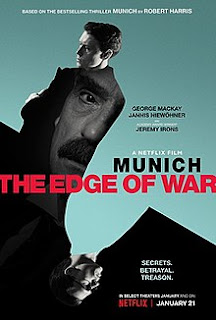
Munich: The Edge of War (2021)

Munich: The Edge of War (2021)

The backstory of history’s most famous empty promise is explored in this solid historical drama

Director: Christian Schwochow

Cast: George MacKay (Hugh Legat), Jannis Niewöhner (Paul von Hartmann), Jeremy Irons (Neville Chamberlain), August Diehl (Franz Sauer), Liv Lisa Fries (Lena), Sandra Hüller (Helen Winter), Alex Jennings (Sir Horace Wilson), Ulrich Mathes (Adolf Hitler), Anjli Mohindra (Joan), Jessica Brown Findley (Pamela Legat), Mark Lewis Jones (Sir Osmond Cleverly)

It’s 1938 and Hitler (Ulrich Matthes) wants the Sudetenland in Czechoslovakia. Will the British and French say no? The danger is, if they do, it will lead to a war only Germany is ready for. War is feared by Prime Minister Neville Chamberlain (Jeremy Irons), who remembers the horrors of the trenches. So, he flies to Munich to make a deal with Hitler. While there, a member of the British legation Hugh Legat (George MacKay) is contacted by an old friend, Paul von Hartmann (Jannis Niewöhner), a German diplomat now extremely disillusioned by the brutal Hitler regime.

Schwochow’s film is a handsomely mounted film version of Robert Harris’ best-selling thriller. Lots of critics called it a “What if” history film, which pretty much suggests people don’t understand what that term means. The film presents a pretty much a faithful (if compressed) version of the Munich talks, rather than some sort of alternative history. What makes it different is the revised angle it takes on Chamberlain – spiced up with a fictional plot about young diplomats trying to bring down Hitler.

Played with an avuncular, praetorian charm by a perfectly-cast Jeremy Irons, Harris book (and this film) presents Chamberlain not as a naïve idiot, duped by Hitler, but a man very much aware of the nature of his opponent, but who felt duty bound to do everything he could to safeguard peace. Chamberlain speaks with real emotion of the loss of a whole generation in the trenches and his fear that Britain is not ready for another war. Sure, Irons’ Chamberlain can also be arrogant and blinkered, convinced of his own cunning shrewdness, but he’s willing to risk his reputation for peace.

What he’s willing to sacrifice of course are the Czechs – and the film doesn’t give a lot of time (if any) to this screwed nation, that saw huge parts of its country split off and handed over to an aggressive power. The film would have been richer with more content around the debates and discussions at the conference and giving more time – as the novel does – to understanding Chamberlain’s strategic thinking. The film implies Chamberlain’s infamous bit of paper was his effort to clarify where blame for eventual war would lie – but it doesn’t allow us to understand more about what Chamberlain initially intended to gain from the conference or when he decided that he was unlikely to win any concessions from Hitler. We never see a moment of the negotiations, which seems a waste for a film that was designed to re-evaluate Chamberlain.

That’s partly because the film, like the book, gives a lot of time to its fictional plot. And like there, never seems to make this seem as vital or interesting as the historical storyline. Perhaps because, while the Munich storyline presents us with something we’ve not seen before, the fictional storyline feels familiar and derivative. George MacKay and Jannis Niewöhner do good work as slightly naïve young men who feel they can change the world, if they find a way to apply pressure at the right moment. But they feel like narrative devices to spice up the history, to throw in a bit of light espionage and peril to stop it being a film about a conference.

But everything feels familiar: clandestine meetings in crowded bars and pubs (surely anyone watching would hear everything?), meetings in parks, document handovers, pacey walks with people looking over their shoulder… It’s all handsomely done but it doesn’t feel fresh. And somehow, since we know (as this isn’t a What if… movie!) that it all end in failure (our heroes spend ages trying to get a copy of the Hossbach memorandum to Chamberlain who basically ignores it immediately) it doesn’t feel urgent enough.

And more interesting personal stories get short-changed. There is more than a hint of sexual chemistry between Hugh and Paul, that the film does more than hint at in performance, but doesn’t explore. Liv Lisa Fries as a young woman both men fall in love with, ends up shifted into a very stereotyped martyr role. There are some interesting ideas touched upon with the growth of a resistance movement to Hitler, but it never quite tells us enough to understand this. And the film shies away from being too bleak in its ending – even though the fates of both our lead characters must surely be a terminal one as they head into the war (given their chosen paths of anti-Nazi resistance cell and the RAF).

I wish the film – just as I felt when reading the book – had dropped most of its standard espionage sub-plot and instead had focused solely on Chamberlain. Especially with an actor as well-suited to the role as Irons. It would have allowed to focus exclusively on re-evaluating and exploring the motivations of those at the conference and the political and military difficulties they faced. Unfortunately, this gets diluted too much, which means we never quite get our perceptions challenged as much as they should. It’s a well-made film, but settles too often for being traditional rather than daring.

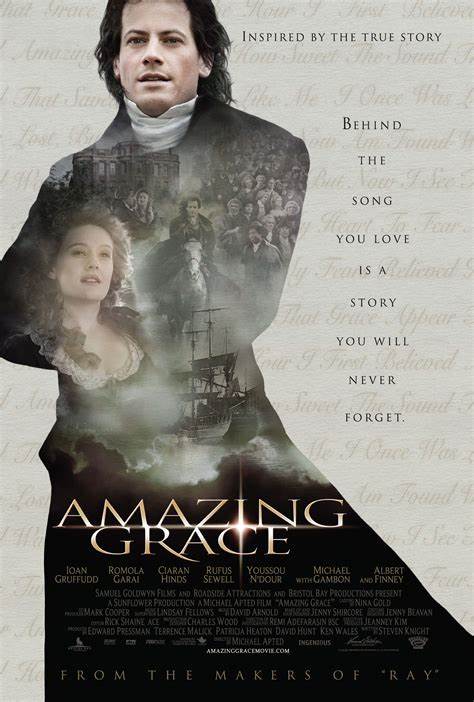
Amazing Grace (2006)

Ioan Gruffudd in full flight in the conventional but charming Amazing Grace

Director: Michael Apted

Cast: Ioan Gruffudd (William Wilberforce), Romola Garai (Barbara Spooner), Benedict Cumberbatch (William Pitt the Younger), Ciaran Hinds (Banastre Tarleton), Albert Finney (John Newton), Michael Gambon (Charles James Fox), Rufus Sewell (Thomas Clarkson), Youssou N’Dour (Olaudah Equiano), Toby Jones (Duke of Clarence), Nicholas Farrell (Henry Thornton), Sylvestra Le Touzel (Marianne Thornton), Stephen Campbell Moore (James Stephen), Bill Paterson (Heny Dundas), Jeremy Swift (Richard)

From 1782 to 1807 William Wilberforce (Ioan Gruffudd) fought a long – sometimes lonely – campaign to end the slave trade (and eventually slavery – the film confuses the two, with slavery continuing in much of the Empire for over twenty more years) in the British Empire. During that time, he competed with vested interests, parliamentary rivals and accusations of being a radical at a time when Britain was at war with Revolutionary France.

Michael Apted’s old-fashioned film covers this, hitting every beat you would expect for a biographical drama. It uses a traditional framing device of starting in the middle of the story: Wilberforce in 1797, depressed, hooked on laudanum and out of hope, revitalised by meeting Barbara Spooner (Romola Garai) who will become his wife. This makes for a perfect narrative tool as it means she can ask him questions like “tell me what happened” which serves as a neat entrée into a whole host of flashbacks sketching out in the swiftest means possible the history of abolitionism.

Amazing Grace could have been made in the 1930s, so closely does it hue to the classic rules of biopics. It’s practically a structural brother to The Life of Emile Zola, a hagiographical portrait of an (admittedly outstanding) man which shows the expected arc of moral awakening, early success, tricky mid-point, the sad years, getting the band back together for one final big push ending in friends and foes alike coming together to hail his accomplishments. It’s all threaded together with a script that carefully moves through every event, simplifies history down and sometimes wears its research rather heavily.

You can’t argue that it isn’t well-meaning and heartfelt, but its simplicity (and the careful traditionalism of its shooting) makes it look more like a well-made TV special than an actual movie. But if you are a sucker for such things, as I am, it has more than enough to engage you. It also makes a compelling case about the horrors of the slavery and allows a few moments of spotlight to fall on former slave turned abolitionist Olaudah Equiano (well played by Youssou N’Dour). It certainly has its heart in the right place, its passionate liberalism and sense of moral outrage very clear.

Gruffudd – his skill for playing reluctant moral authority and duty honed from playing Hornblower – is good as Wilberforce, his obvious investment in the subject matter clear. Garai doesn’t have much to do other than tee up flashbacks, but does it with charm. Many of the rest veer on the side of fruity: Hinds and Jones scowl effectively as slave-owning senior lords (for some reason they sit in the House of Commons; Jones is even playing a Duke for goodness sake!). Gambon twinkles as only he can as Charles James Fox. Finney hams up lustily as the blind John Newton. Best of all though are Sewell as an eccentric Thomas Clarkson and Benedict Cumberbatch in an early sign of star-quality as the morally divided, reserved but decent Pitt the Younger.

It all comes together into something that seems tailor-made for Sunday afternoons. Nothing wrong with that – and not every film needs to reinvent the wheel – and since it wears its heart so openly on its sleeve, you can’t help feeling warmth towards it. It’s a Spark notes look at history – and glosses over the fact that slavery itself continued for decades – but as hagiography it’s endearing and as a feel-good biopic it succeeds at what it sets out to do.

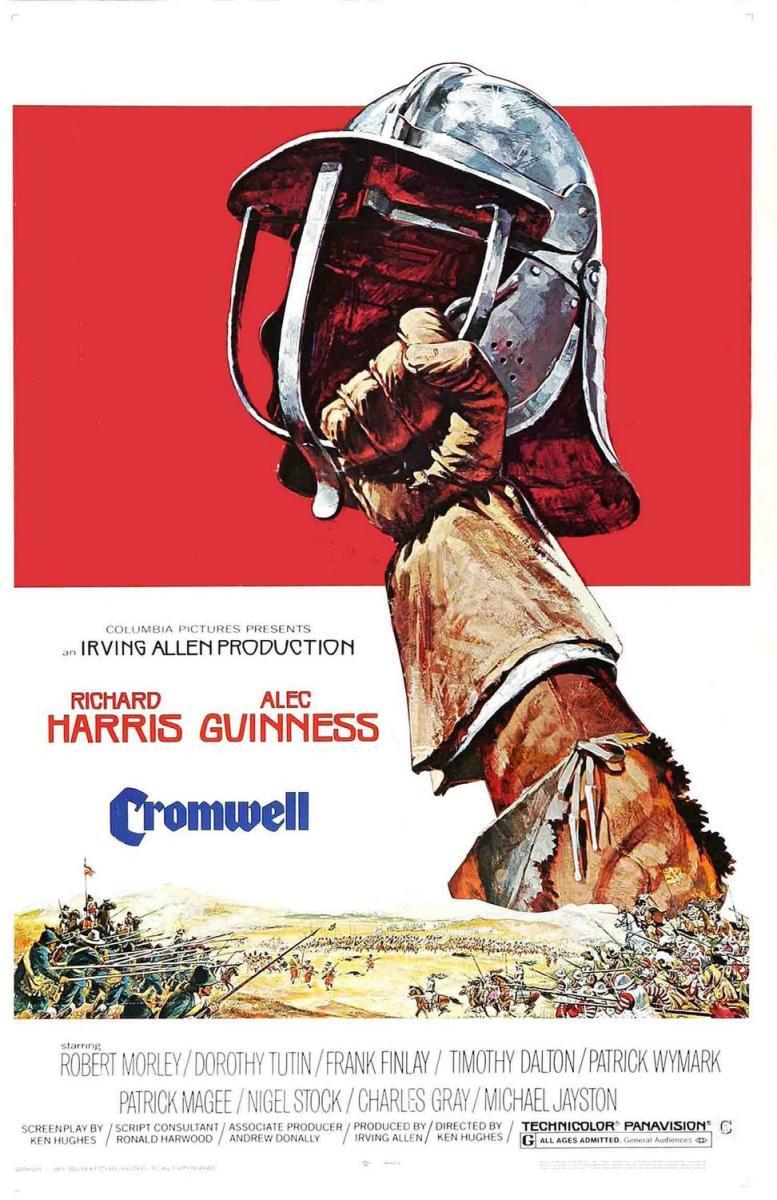
Cromwell (1970)

Cromwell image
Richard Harris let loose the revolution in Cromwell

Director: Ken Hughes

Cast: Richard Harris (Oliver Cromwell), Alec Guinness (King Charles I), Robert Morley (Earl of Manchester), Dorothy Tutin (Queen Henrietta Maria), Frank Finlay (John Carter), Timothy Dalton (Prince Rupert), Patrick Wymark (Earl of Strafford), Patrick Magee (Hugh Peters), Nigel Stock (Sir Edward Hyde), Charles Gray (Earl of Essex), Michael Jayston (Henry Ireton), Douglas Wilmer (Sir Thomas Fairfax), Geoffrey Keen (John Pym), Stratford Johns (President Bradshaw)

How much does history actually matter when you watch a historical film? We all know we aren’t watching a documentary don’t we? It’s worth bearing in mind when watching Cromwell a film which would probably be in the running for “least historically accurate film of all time”. But despite that, it’s entertaining and gets quite close to some of the spirit of the times – even if it changes most of the facts. It probably as well deserves notice for being one of the very few films to offer a sympathetic portrait of Oliver Cromwell – not a guy it’s easy to like.

It’s the 1640s, and England is a mess. Charles I (Alec Guinness) has been ruling the country directly, without involving Parliament, for over ten years. But now the money is gone and he needs Parliament to raise some more cash. Problem is, Parliament is more interested in pushing a defence of its own prerogatives rather than simply putting more money into the King’s pocket. Among the leaders of the Parliamentary campaign is Oliver Cromwell (Richard Harris), and he is not the man to take any false promises from the king. Before we know it, the country has tipped into civil war – and now it’s up to Cromwell to create a Parliamentarian army that is capable of defeating the King and bring democracy to the nation.

Ken Hughes film offers some plenty of scope and drama, even if is old-fashioned (even a little Victorian) in its Wrong-but-Wromantic Cavaliers and Right-but-Repulsive Roundheads (to mis-quote 1066 And All That). It’s a strange topic for a historical epic (it took years to get the funding) – but it looks fabulous and has a wonderful score that really embraces the religious music of the time.

What it gets right is the passion and the fire that people felt at the time for questions of politics and religion. The film frequently features heated debates (even if the dialogue is often more ticking boxes than inspired) that the actors invest with real force. Its view of events is of course truncated and at times simple (it is, after all, trying to cover around ten of the most tumultuous years in British history in about two hours), but it focuses on trying to get the spirit of things right.

A large part of this is Richard Harris’ firey performance in the lead role. There is, it has to be said, a cosmic irony in Cromwell, the least popular British leader in Irish history, winds up being played so sympathetically by one of the most famous Irish actors of all time. Sure, the real Cromwell would have hated being played by an Irishman and a Catholic (Cromwell was surprisingly inclusive at the time, but had no truck with either group). But then Cromwell would also have loved being portrayed as a mixture of George Washington and Cincinnatus (the Roman general who left his plough to assume supreme command when the nation needed him, only to retire again to obscurity). This Cromwell is bullheaded, but determined to do what’s best for the nation, with personal ambition not even a consideration. He’s the one true, selfless man in a revolution of violence.

In fact, Cromwell was sorely tempted by the eventual offer to be King (something he laughs off here). He also undoubtedly was touched heavily by ambition, while his attempt to turn the Protectorate into a hereditary office was a disaster that doomed the Republic (surely George Washington learned a few lessons from him). But, deep down, Cromwell was sincere – a guy who largely said, and did, what he meant. It’s that sense of morality that Harris gets very well here. And, while its easy to poke fun at those hoarse tirades Harris is frequently called on to deliver, this sort of intemperate ranting (laced with Biblical language and a strong sense of moral superiority) were pretty much central to Cromwell’s personality.

It makes for a very different hero, even if the film is determined to turn Cromwell into the only decent man in the Kingdom. Cromwell, in real life, never retreated from politics to return to his farm as he does in the latter part of the film (he actually spent this time on brutal campaign in Ireland, something the film mentions only vaguely in passing). But there is no doubt Cromwell would have believed he was the guy selected by providence to save the nation – and that idea the film channels very well. In fact, Cromwell gives you a pretty decent idea of what Cromwell might have been like – and a pretty accurate picture of who Cromwell wanted to be – even if the things it shows you only have a passing resemblance to what happened.

It’s a key directive throughout Ken Hughes’ film, which feels free to distort historical events willy-nilly (see more below). But there is a sort of truth in spirit, if not in fact – from the heated debate in Parliament, to the mixture of frantic panic and regimented order in the battles (one particularly good shot positions the camera under a charging horse, which makes a cavalry charge suddenly feel horrifyingly visceral). Sure it’s arranged into a much more simple black-and-white story, but it works.

A similar trick also works for its portrayal of Charles I. This is probably one of Guinness’ most over-looked performances. His Charles is a weak, indecisive man who confuses stubbornness and pride for moral strength. Softly spoken when calm, he collapses into heavily Scots accented rage when riled and his politeness is a only a shield for bitterness and vexation. He routinely shirks responsibility for his actions and spreads the blame around everyone but himself. Again, it might not all be accurate, but you can’t imagine this is far off from the actual King.

Historically though, so much of the film is wildly inaccurate. Many of these changes are done to increase the importance of Oliver Cromwell early in the Parliamentarian campaign. To scratch the surface: Cromwell – a minor figure until quite late into the war – was not one of the five members Charles marched to Parliament to arrest (neither was Henry Ireton). He certainly didn’t – and neither did anyone else – remain sitting when the troops arrived and set a motion in place protecting MPs. He never met the King before the war. Cromwell is later made C-in-C of the Parliamentarian army – an office actually given to Fairfax. The film’s depiction of the Battle of Naseby flips the numerical advantage exactly to favour Charles rather than Cromwell. Far from providing the key damning evidence at Charles’ trial, Hyde fled the country with Prince Charles.

But this is a fiction, rather than drama. Even if the facts it presents are largely nonsense, it gets a lovely sense of the divided loyalties and tensions that existed during this period. The performances are often quite broad – Robert Morley simpers and sneers as an opportunistic Manchester, Patrick Wymark growls and splutters as Strafford while Timothy Dalton goes way over the top as a foppish Prince Rupert – but some, such as Michael Jayston’s firebrand Ireton or Nigel Stock’s tortured Hyde (historical nonsense as his storyline is) are rather good.

And it’s hard not to like a film where the lead actor is going at it such great guns that you can actually hear his voice disappearing into a rasp. Cromwell doesn’t have much relation to the facts, but deep down it does seem to understand the man Cromwell wanted to be. And, on that level, it feels truthful and heartfelt – and that’s partly why it remains entertaining and why I remain rather fond of it.

The Queen (2006)

Helen Mirren reigns supreme as her Majesty in The Queen

Director: Stephen Frears

Cast: Helen Mirren (Queen Elizabeth II), Michael Sheen (Tony Blair), James Cromwell (Prince Philip), Helen McCrory (Cherie Blair), Alex Jennings (Prince Charles), Roger Allam (Robin Janvin), Sylvia Syms (Queen Elizabeth, the Queen Mother), Tim McMullan (Stephen Lamport), Mark Bazeley (Alistair Campbell), Julian Firth (Jonathan Powell)

It’s easy to assume The Queen is a cozy piece of film-making, not least because writer Peter Morgan’s exploration of the Royal Family has become every one’s favourite costume drama viewing thanks to his series The Crown on Netflix. But that’s to forget the acute sense of the personal and the public Morgan has, and his ability to write himself into the minds of his participants. And he’s perfectly matched here with the wry eye of Stephen Frears. Together they create a film that uses a single moment of history to explore the nature of our institutions and the particular characters of the people that fill them.

The film follows the death and aftermath of Princess Diana, and especially the dramatic public reaction to the death that expressed itself both in unparalleled scenes of national public mourning and hostility to the Royal family. Both are things a lifetime of duty and service have failed to prepare Queen Elizabeth II (Helen Mirren) for – but are also things intrinsically understood by her new Prime Minister Tony Blair (Michael Sheen). As the public clamour for the Royals to join the public in an exhibition of public grief rises, it’s mixed with a furious demand for a royal ‘mea culpa’ for ruining the life of the “People’s Princess”. Could the Royal Family be finished?

Well of course it wasn’t, and perhaps it’s hard to understand for those who didn’t live through those crazy days of 1997. But there was never anything like it before – people wept in the streets as if they had lost a family member of their own. Princess Diana – a tireless campaigner for charities, who did a great deal to change public perceptions on AIDS among many other issues – was also a brilliant master of public opinion, far more attuned to the countries drift away from stiff-upper-lip reticence towards celebrity-worship sentimentality than the family she married into. As skilful a manipulator of the press, as she was a victim of their hounding, she’d made herself into someone larger than life. It’s the sort of modern cult of celebrity, that few others mastered – and certainly not in the Royal Family.

Diana hangs over the family in the film like a ghost, an embodiment of their sense that the country is drifting away from them. It’s a film where pace and speed are vital, Frears and Morgan brilliantly contrasting the rushing onslaught of events from the car crash to distraught, increasingly angry, crowds gathering outside Buckingham Palace with the relatively sedate official response, which was effectively a private retreat to Scotland and say and do very little. The film has a brilliant sense of the momentum of those crazy days, and of the clash between an institution straitjacketed by tradition and a world where the public exhibition of emotion is de rigour.

What the film finds however is the value in both, and in doing so perhaps becomes one of the greatest adverts for the monarchy – or at the very least for Elizabeth II – you will ever see. A lot of this comes from Helen Mirren superb performance as the Queen. It’s a role Mirren performs with a combination of Sphinx-like genius and a genuine fragility under a veneer of exactitude. Mirren’s Elizabeth is a woman whose sense of duty has led to a lifetime of living as a symbol, a profession that has demanded the avoidance of any sort of personal opinion what-so-ever (something Morgan leans on with his Alan Bennettish early scene, where the Queen chats with a maid about the recent General Election and regrets she never had the chance to tick a box for something). She’s a woman certain that she has performed her duty in the finest tradition of her family.

Her tragedy in the film is the bewildered sense of suddenly finding the country she thought she knew being completely different. Put simply, the destructive Diana, a difficult person privately but loved publically, is a woman she can’t understand – and a country that embraces her is one she struggles to understand as well. Mirren’s Queen has a sharply defined sense of her place and person, but finds herself questioning all that. While sharply refusing to be treated as fool, she has a distressed sense of suddenly being adrift in the world.

Morgan captures all this in a series of engaging “behind the scenes” moments, but his real trick is his sure touch with symbology. A magnificent stag on the grounds, being hunted by all and sundry, could easily have been a clumsy parallel with the Queen, but it’s delivered with real grace and serves as a true emotional catalyst for the Queen (twice!) as she finally begins to understand both her own situation, and the necessity for her to bend her own firm principles and tradition to meet the requirements of this new age.

It’s the main theme of the film, this conflict between tradition and modernism, but the film sees merit in both. Many of the formalities of court life are humoursly spoofed in their intricate pomposity, but the overblown sentimentalism and knee-jerk judgamentalism of the modern world are hardly much better. As Blair himself, the arch modernist, observes there will always be a place for a head of state who gives us a symbol to aspire to. Not least, because the burden of standing for things and being driven to play to the masses will eventually lead to the destruction of most political careers (the film mines a fair bit of material between the implicit comparison of Blair’s saint-like popularity in 1997 to the wreckage of his “Bliar” reputation in 2006).

Frear’s film is a gentle critique but also a sharp defence of the institution of the monarchy, as practiced by the Queen. It may pain her, but she will get on with it. Morgan’s script also suggests her quiet wisdom – the film’s coda has her suggesting that Diana, like all things popular today, will pass. 

The film is less sure footed elsewhere. It’s portrayal of New Labour at times leans a bit too heavily into public perception – Campbell (played by a bullying Mark Bazaely) as a brash blow-hard, Labour as being obsessed with spin and image, Cherie Blair as a judgemental Shrew. Other members of the Royal family sometimes bend into parody – by the time of the Crown, Peter Morgan was to find Prince Philip as a far more fascinating and richer character than he is here. But the performances are strong across the board, as if following their head of state in Mirren. Sheen’s re-creation of Blair is pitch perfect, and he also aptly understands the difficult balance in Blair between genuine decency and ambition. Roger Allam also provides a wonderfully dry cameo as the Queen’s old fashioned secretary, while Alex Jennings does a neat impersonation of a Charles desperate to be seen to be doing the right thing.

The Queen’s main interest though is showing that tradition and modernism can sit side-by-side – and that a leaning too far in either direction is harmful for all involved. It sprinkles in intriguing levels of criticism for Diana, but matches that with a respect for the Queen, that makes her real while keeping her a symbol. Helen Mirren’s performance deserved every price going, and the film itself rewards with each new viewing.

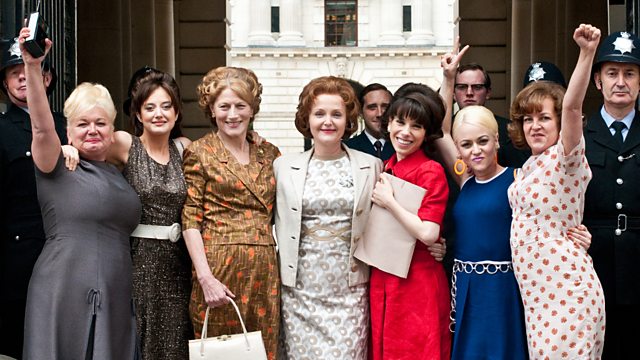
Made in Dagenham (2010)

Up the Women! British comedy wallows in nostalgia but tells a still relevant tale of sexual equality

Director: Nigel Cole

Cast: Sally Hawkins (Rita O’Grady), Bob Hoskins (Albert), Miranda Richardson (Barbara Castle), Geraldine James (Connie), Rosamund Pike (Lisa Hopkins), Andrea Riseborough (Brenda), Jamie Winstone (Sandra), Daniel Mays (Eddie O’Grady), Richard Schiff (Robert Tooley), Rupert Graves (Peter Hopkins), Kenneth Cranham (Monty Taylor), Nicola Duffett (Eileen), Lorraine Stanley (Monica), Roger Lloyd-Pack (George), Andrew Lincoln (Mr Clarke)

You’d like to think a film made ten years ago about a strike for equal pay in the 1960s would be more of a history piece than something that still carries real relevance today. But this is still a world where women are often paid less than a man, and where their work is often devalued or held as less “important” than their male counterparts. Made in Dagenham looks at all these issues with a rose-tinted, feel-good stance that aims to entertain first and make you think second. Nothing wrong with that, but it means the film is largely just a crowd-pleaser, when you feel it could be more.

At the Ford factory in Dagenham, the female sewing machinists are not paid as skilled workers, and are forced to accept less work. Frustrated at the patronising attitude from their all-male union reps, and encouraged by foreman Albert (Bob Hoskins, lovely in one of his cuddliest performances), the women decide to go on strike for equal play, led by Rita O’Grady (Sally Hawkins). As public attention builds, the Ford owners in America mobilise for a battle and the strike attracts the interest of Secretary for Employment Barbara Castle (Miranda Richardson), someone who knows the struggles a woman faces in a man’s world.

It’s no great surprise based on the fluffy, charming tone of this film that Nigel Cole’s previous credit was Calendar Girls. (Also no surprise that, like that film, this has been turned into a crowd-pleasing stage musical.) William Ivory’s script deftly sketches out some familiar movie-dynamics for its characters, establishes clear heroes and villains, gives us a good sprinkling of information and “things to think about”, mixes in at least one tragic sub-plot and provides a steady stream of high points, heart-string tugging moments and punch the air moments. As a piece of writing playing to the masses, it’s pretty flawless.

It’s in love with the 1960s details, with nostalgia dialled up to 11, with a love of the look, feel and styles of the era and plenty of sound cues mixed in that will have you tapping your toes. It’s all designed for you to have fun, and if that means some of the deeper questions get a bit lost at points, that doesn’t really matter. 

And there is more than enough enjoyable material to be seen in setting up a series of bigoted or patronising men (gamely played principally by Kenneth Cranham and Rupert Graves) and seeing them knocked down. You could argue that a slightly braver film would touch at the implications of what Richard Schiff’s corporate big-hitter says about equal pay: make it more expensive to make cars here and we will make our cars somewhere else. (In fact it was pretty hard to forget that, watching the film today, as Brexit has already caused at least three major car factory closures in the UK. In fact the film is very happy to talk all about equal pay for women in the Western World but never even raises the question of how we are quite content to have people in the third world slave away in conditions far worse than this for a few pennies an hour.) But that’s not the film’s point, and instead it’s all about those male-female relationships. 

Sally Hawkins does a good job as a woman slowly growing a social and political awareness and then turning that new-found enlightenment on her own domestic life with well-meaning but of-his-time husband Eddie (a sweet but cluelessly sexist Daniel Mays). It’s all conventional stuff, but Hawkins and Mays play it very well.

The real meat actually comes from plotlines elsewhere. Rosamund Pike is excellent as a woman with a first in history from Oxford, reduced to wheeling out nibbles for her patronising husband and keeping her ideas to herself. Geraldine James and Roger Lloyd-Pack get the tragic plotline of a couple struggling with his post-war undiagnosed PTSD, which gets most of the heart-string tugging. 

Eventually all is made well by Miranda Richardson’s Barbara Castle, floating into the picture to wave a magic wand and save the women’s bacon. Richardson thoroughly enjoys herself in a rather cardboard role, at least two scenes of which are solid exposition, in which Castle’s lecturing of two uppity civil servants is used to introduce the political context. By the end you won’t be surprised that good triumphs. But it’s a film which largely only looks to put a smile on your face, and doesn’t really look at the wider implications or injustices of unequal pay. To the film’s credit it has a final montage of the real Ford women talking about their lives and the battles they had to be respected, which gives it a bit of extra depth. A truly brave film would have found a few minutes – and that’s all it really needs – to look at the wider issues (then and today) economically and socially, and to make us think a little. As it is this just entertains, which is what you want, but it could be more.

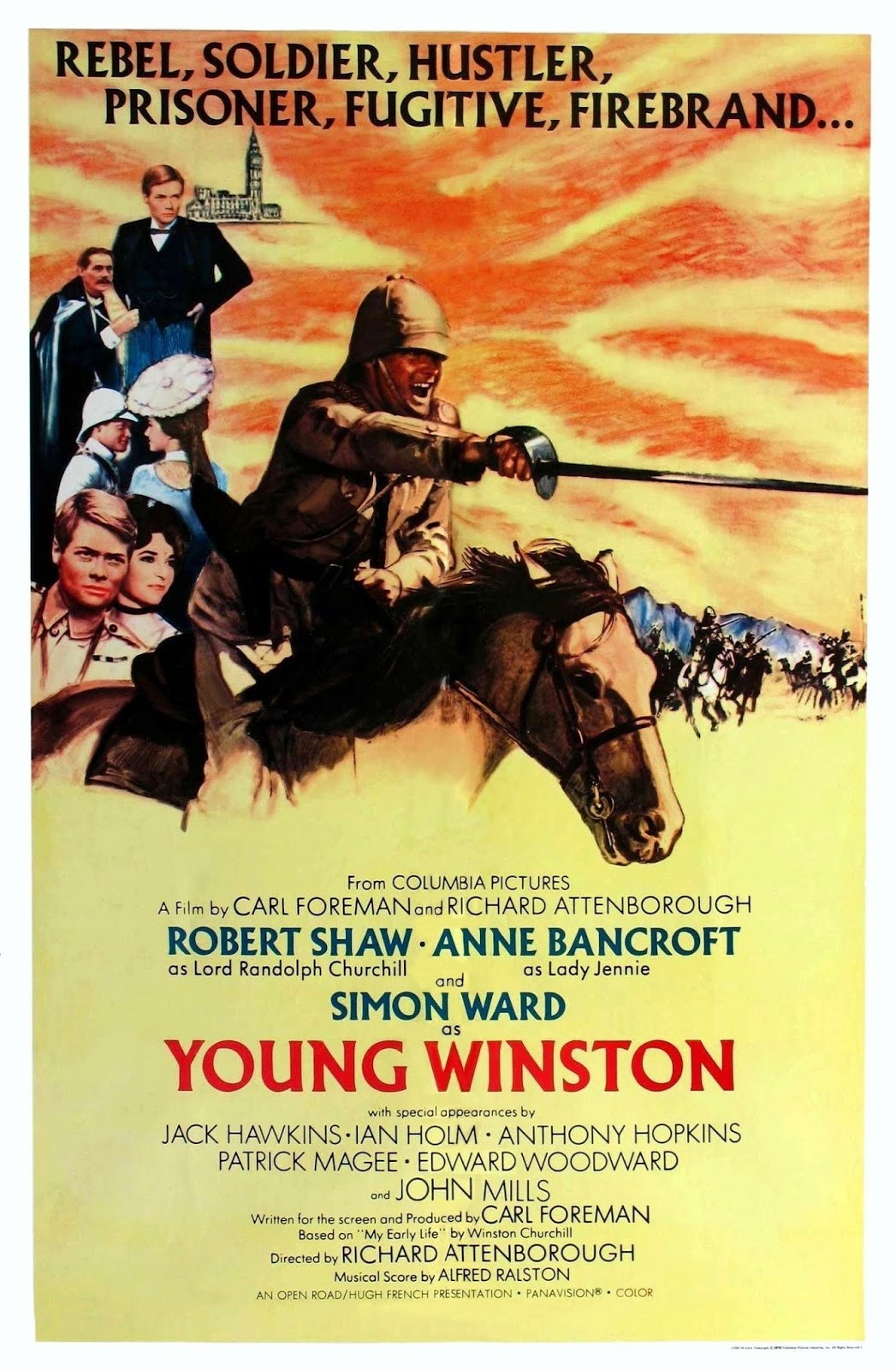
Young Winston (1972)

Simon Ward as the Young Winston: episodic but fun look at the early life of the Greatest Briton

Director: Richard Attenborough

Cast: Simon Ward (Winston Churchill), Robert Shaw (Lord Randolph Churchill), Anne Bancroft (Lady Jennie Churchill), John Mills (Lord Kitchener), Jack Hawkins (James Welldon), Ian Holm (George Earle Buckle), Anthony Hopkins (David Lloyd George), Patrick Magee (General Sir Bindon Blood), Edward Woodward (Captain Aylmer Haldane), Pat Heywood (Elizabeth Ann Everest), Laurence Naismith (Lord Salisbury), Basil Dignam (Joseph Chamberlain), Robert Hardy (Headmaster)

Any poll of the Greatest Briton is bound to throw up, near the top, Winston Spencer Churchill. So famous is he, that his surname isn’t even required for Attenborough’s biography of the Great Man – just that name Winston gives you a pretty good idea of what you’re going to get. And you’d be right, because this film gives you a pretty straightforward rundown of Winston Churchill’s early years, in an episodic breakdown that gives us some small insight into what shaped the chap who went on to implore us to “fight them on the beaches”.

Simon Ward is the Young Winston, with Robert Shaw and Anne Bancroft as his parents Lord and Lady Churchill. Lord Randolph is the high-flying MP who throws away his career, catches syphilis, loses his mind and dies aged 37 – all the time disappointed with the son desperate for his approval. Lady Jennie is his loving, supportive but slightly distant mother. Winston himself? A bright lad, but a hopeless academic, struggles at school, needs umpteen attempts to scrap into Sandhurst for a career as a cavalry officer (a dunce’s career in the opinion of Randolph), serves in the Sudan under Kitchener (John Mills) and starts writing books and newspaper articles – because hopeless academic he might be, he’s still gifted with words. A career in Parliament is his dream – helped no end by his escaping captivity during the Boer War, making him a popular hero. 

You can probably tell from that plot summary that this is a somewhat episodic film. Although initially throwing us into a clash in North-West India between the 35th Sikhs regiment and Pashtun rebels – an action during which embedded journalist Churchill wins a mention in dispatches – the film quickly settles into a straight narrative run down of Churchill’s early life, filtered through the great man’s own writings. This makes for an episodic, at times rather dry, box ticking exercise of key moments in his life although it gets enlivened with some decent scenes and some good performances.

The one fact that comes out most strongly from the film is the wretchedly unhappy childhood of Winston himself. A borderline dunce, Churchill is a hopeless student from an early age. His school days are miserable, dispatched to some ghastly boarding school where thrashings from the headmaster (ironically played by later regular – and definitive – Churchill performer Robert Hardy) are handed out as regularly as dollops of gruel. There is a certain emotional impact throughout these scenes, with extensive quotations from the pre-teen Churchill’s letters barely concealing pleas for his parents to visit him (save him) under protestations of his happiness at school.

But this emotional connection doesn’t really last once we get into the adventures of the younger Churchill. This is despite an excellent performance from Simon Ward, who perfectly captures the mood and manner of the more famous older man while splicing in plenty of youthful exuberance and naivete. Ward does a terrific job of holding the film together – so well in fact you are left feeling slightly sorry that he never got a part as good as this ever again. His final speech is a perfect capturing of the speech-making prowess of the young statesman.

The film takes a mixed attitude to Churchill’s parents. It’s very open about the syphilis that afflicted Lord Randolph, and even before that makes clear his career is one governed by rashness and poor judgement. Robert Shaw is excellent as Churchill’s father – a stern taskmaster, constantly disappointed in his dullard, lazy son, but spicing it with enough small moments of affection to make you understand why Churchill worshipped this man whom he surpassed by every measurable factor. Shaw also makes a pre-illness Churchill, sharp, witty and strikingly intelligent: making his later descent into illness and unpredictability all the more affecting. Randolph’s final speech in the House – raddled by syphilis he looks awful and can barely remember his train of thought for longer than a few seconds – is remarkably moving.

The film takes far more of a conventional view of Lady Sarah, presenting her far more as the idealised mother figure she must have been for Churchill. Anne Bancroft is saddled with a rather dull part that never really comes to life, as the more interesting aspects of her colourful life are largely left on the cutting room floor.

Attenborough’s film does try to drill down into the personalities of these three people with a curious device where each character has a scene speaking (direct to the camera) to an unseen journalist asking them questions about themselves and the events around them. This interrogational style looks like a rather dated 1970s innovation today – look how we put the spotlight on these people! – but it does give a chance to see them from another perspective, and give the all-seeing author of the screenplay (Carl Foreman) a chance to ask questions viewers are probably asking. It’s on the nose, but still kind of works, even if the revelations we get barely seem to give us any shocks.

It’s about the only slight moment of invention anyway in a film that is another example of Attenborough’s excellence at marshalling a huge number of actors and locations into something very reassuringly safe and professional that is going to have a long lifespan on Sunday afternoon TV schedules. Young Winston is a decent, enjoyable mini-epic, but it’s not the film for those really wanting to either understand the times or understand the personalities involved.

The Favourite (2018)

Olivia Colman is at the centre of a complex rivalry in The Favourite

Director: Yorgos Lanthimos

Cast: Olivia Colman (Queen Anne), Emma Stone (Abigail Hill), Rachel Weisz (Sarah Churchill, Duchess of Marlborough), Nicholas Hoult (Lord Robert Harley), Joe Alwyn (Colonel Lord Masham), Mark Gatiss (Lord Marlborough), James Smith (Lord Godolphin)

Looking around the cinema, I couldn’t help but wonder how many of the audience were expecting The Favourite to be a Sunday night-style costume drama about Queen Anne. Goodness only knows what they made of this skittishly filmed, acidic, sharp-tongued, very rude drama about squabbles in the court of Queen Anne. The Crown it ain’t.

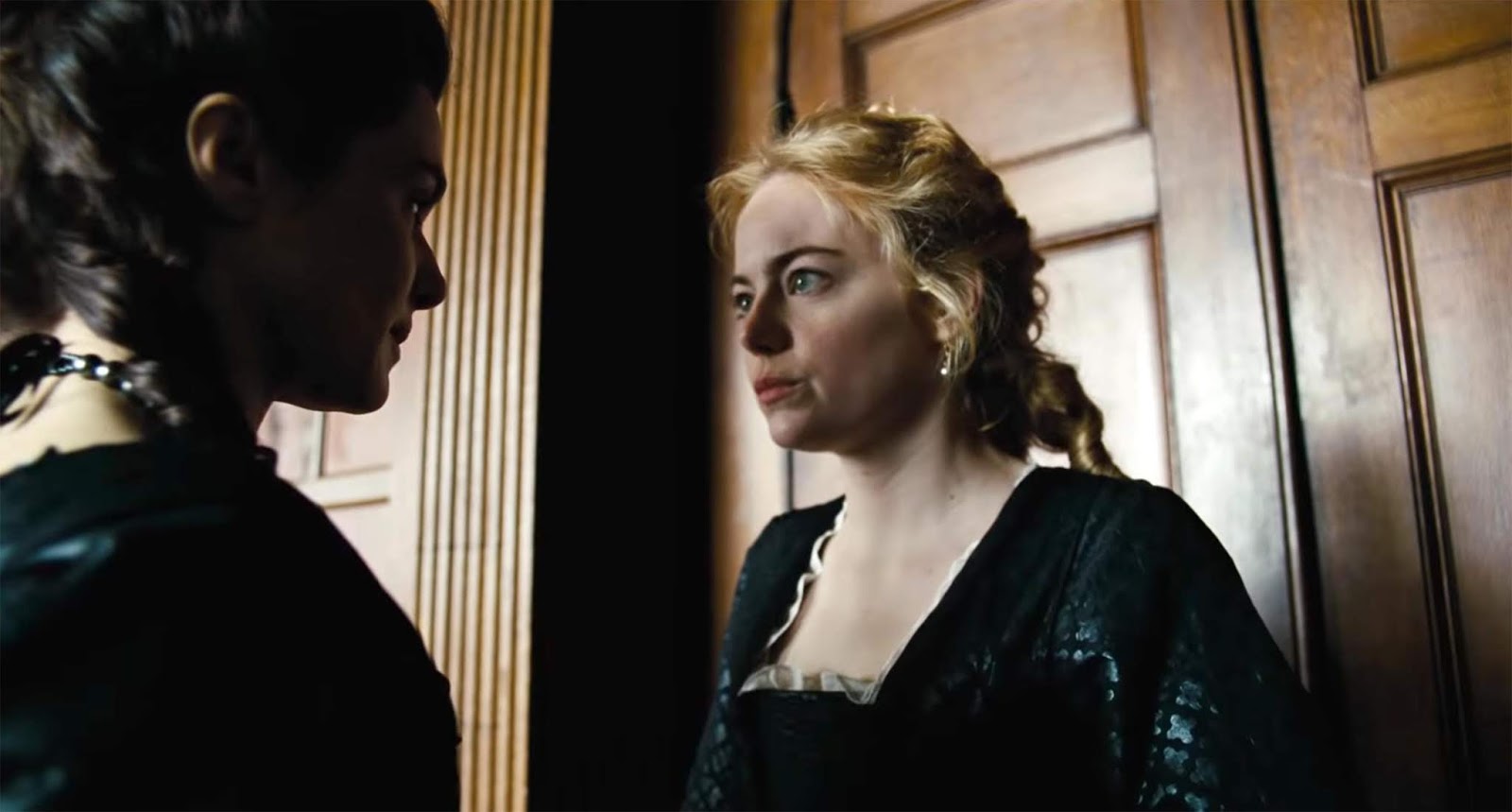
In 1708, the court of Queen Anne (Olivia Colman) is dominated completely by her head of household, chief advisor, secret lover and domineering best friend Sarah Churchill, Duchess of Marlborough (Rachel Weisz). But Sarah’s control over Queen Anne is set to be challenged by the arrival in court of seemingly charming, but in fact ruthlessly ambitious, cousin Abigail Hill (Emma Stone), a former aristocrat who has fallen on hard times. Soon Sarah and Abigail find themselves in the middle of a bitter, ruthless clash for control over Anne – who, seemingly weak-willed and disinterested in government, in fact takes an eager pleasure from the rivalry of the two women.

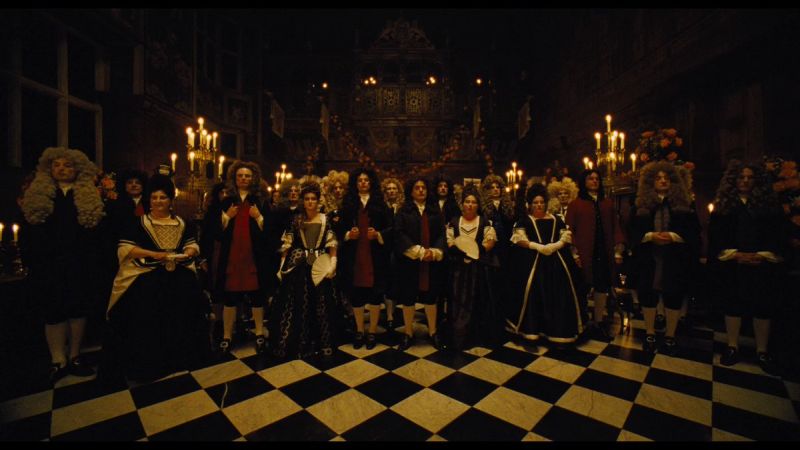
The Favourite is a brilliant, acerbic, very dark comedy that treats its period setting with a hilarious lack of reverence. It’s a frequently laugh-out loud comedy, with its often foul-mouthed dialogue just on the edge of being anachronistic (a trait that also comes into the hilarious non-period dancing). It takes a moment to tune up, but leans just enough on the fourth wall to work. Lanthimos’ film doubles down on the insane pressure bowl of Anne’s courts, turning the court of the 1700s into a bizarre, semi-surreal state where you have no idea what insanity you might see around the corner – from racing ducks, to rabbits roaming free, to a naked man being pelted with oranges. 

But then this is the sort of bizarreness that stems from the top, and Olivia Colman’s Queen Anne is a domineering eccentric. In a film-career-making performance from Colman, her Queen Anne is part infantalised puppet, part needy insecure lover, part bitter control freak. Anne will change from scene to scene from a furious, knee-jerk rage to a weeping vulnerability. Her interest in actually ruling the kingdom has been largely beaten out of her, but she still needs to feel that she holds the power. With her body raddled with gout, Anne alternates between demanding independence and being wheeled from place to place. Colman’s performance bravely skits between temper tantrums and a desperate, panicked loneliness and sadness – it’s a terrific performance.

A woman as uncertain and unhappy in herself as Anne is basically pretty ripe for control and manipulation. History has not been kind to Sarah Churchill, who is often seen as a ruthless, power-hungry manipulator only out for what she can get, obsessed with the power her role brings her. This film takes a different, more interesting slant, thanks in part to Rachel Weisz’s superb performance. Weisz plays Churchill as a strong-minded, hard to like woman, who has a genuine bond with Anne, but honestly believes she is better suited to execute the powers of royalty than her lover. But that doesn’t stop her having feelings for her – or priding herself on refusing to lie to Anne about anything (from her appearance to her behaviour). But this doesn’t stop Sarah from ruthlessly bullying Anne or threatening her – though she’s equally happy to climb into bed with her when required.

But Sarah Churchill here is doing the things she is doing because she honestly believes that it is what is best for the kingdom and (by extension) Anne, and the moments of shared remembrance between Anne and Sarah have a genuine warmth and feeling to them. Which makes her totally different from the ruthless Abigail, played with a stunning brilliance by Emma Stone. Abigail doesn’t give a damn about anything or anyone but herself: something the rest of the servants in the household seem to recognise instinctively as soon as she arrives, but a danger Sarah doesn’t detect until too late. Abigail’s every action is to promote her own wealth and prestige, and she’ll do whatever it takes to do that, from crawling through the mud for herbs to crawling between the sheets to pleasure Anne at night. Stone’s Abigail is ruthless, self-obsessed, uncaring and on the make in another terrific performance.

The film focuses in large part on the see-sawing fortunes of these two rivals for the role of favourite – with Anne as the fulcrum in the middle. The film is split into eight chapters, each of which is opened by a quirky quote from the chapter itself. It neatly structures the film, and also gives it a slight off-the-wall quality. The film is packed with electric scenes, as the women wear the trousers in the court (often literally, in Sarah Churchill’s case), riding and shooting in their spare time and slapping down the assorted politicians and lords desperately trying to promote their interests on the edge of the court. This battle of wits and wills is a fabulous, increasingly no-holds barred, rivalry that motors the film brilliantly.

Lanthimos loves every moment of scheming and double crossing the film supplies. He shoots the film with a selection of low-angle and fisheye lenses, which make the palace settings seem as imposing, large and domineering as possible – and also distorts the world just as the feud between the two women is doing. The film looks fabulous, with its intricate design and it’s candle lit lighting. Lanthimos’ court always looks gloomy and secretive, with only a few spots of orange warmth.

Lanthimos also understands that there is very little room for sentiment or feeling here, and the flashes of it we get are never allowed time to really grow. That’s not a negative of course, as this sharp comic drama is also an arch commentary on some of the selfishness and distortion of events that lies under politics (sound familiar?), with the interests of the ordinary people of the realm raising very little interest from any side on the political divide. And Anne is such a bizarre character, so pulled between pillar and post, so desperately unhappy so much of the time, so utterly spoilt the rest, that you understand how she has become such a chew toy for court faction, and why she is happy to tacitly encourage this world where her every whim is played to for advantage.

I laughed out loud several times during The Favourite. It’s obvious to say that it feels like a film for the #metoo era – but it certainly has three fabulous, brilliant, hilarious and strangely heartfelt performances from its three female leads, three of the best actresses in the business. Wonderfully directed, beautifully written and fabulously designed, this is properly fantastic cinema.