Category: Comedy

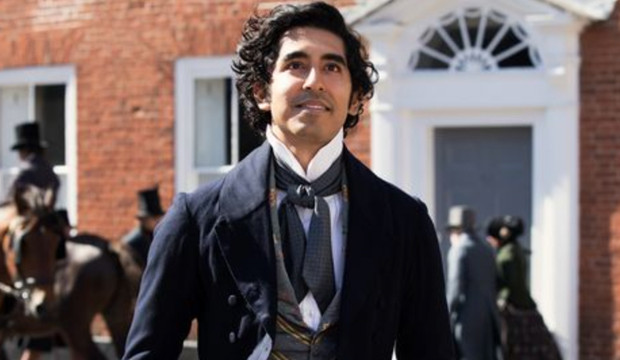
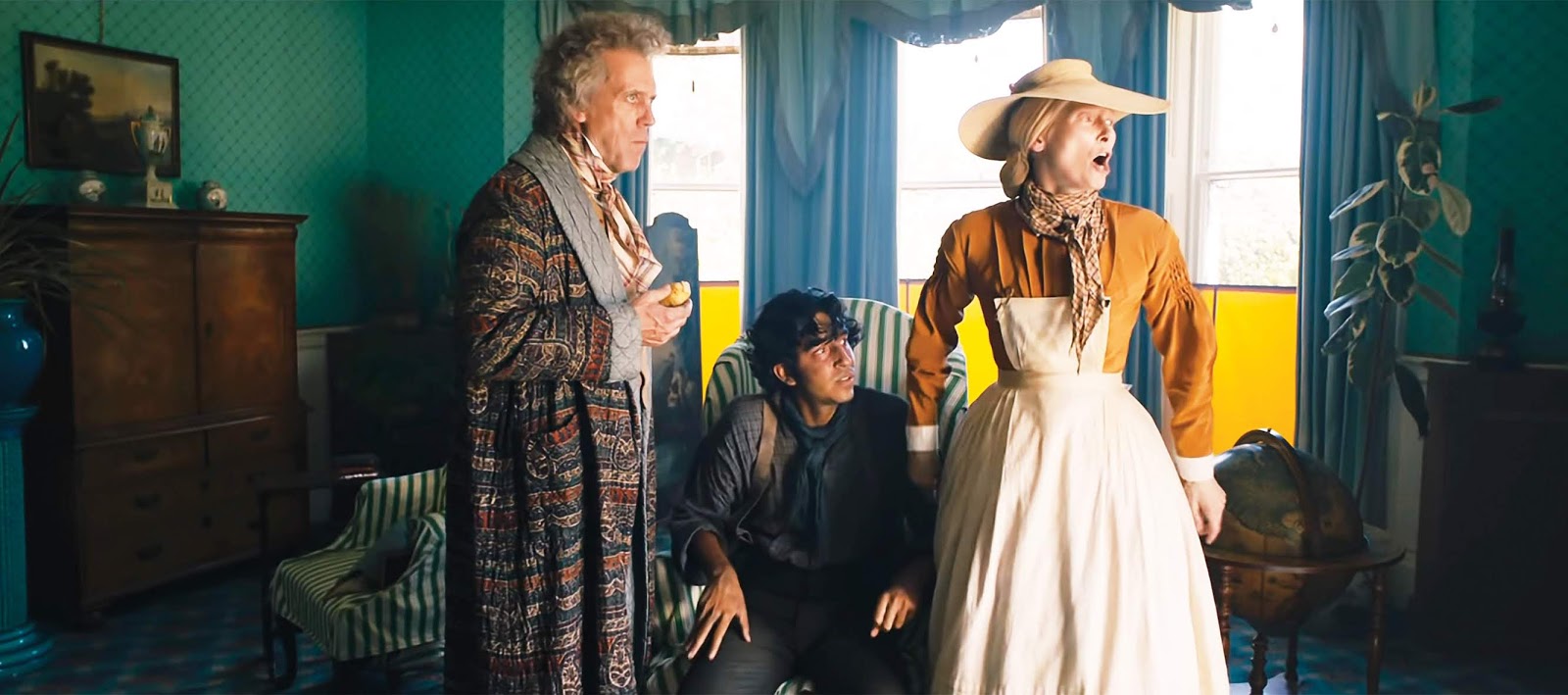
The Personal History of David Copperfield (2019)

Dev Patel makes a charming lead in this Dickens adaptation that finds the comedy but misses the heart

Dir: Armando Iannucci

Cast: Dev Patel (David Copperfield), Tilda Swinton (Betsey Trotwood), Hugh Laurie (Mr Dick), Peter Capaldi (Mr Micawber), Ben Whishaw (Uriah Heep), Paul Whitehouse (Mr Peggotty), Aneurin Barnard (James Steerforth), Daisy May Cooper (Peggotty), Morfydd Clark (Dora Spenlow/Clara Copperfield), Benedict Wong (Mr Wickfield), Darren Boyd (Mr Murdstone), Gwendoline Christie (Jane Murdstone), Anthony Welsh (Ham Peggotty), Rosalind Eleazar (Agnes Wickfield), Nikki Amuka-Bird (Mrs Steerforth), Anna Maxwell Martin (Mrs Strong)

If Charles Dickens ever had a favourite child, it was probably David Copperfield. His novel – heavily inspired by events in his own life and upbringing – is an epic masterpiece, part coming-of-age story, part heart-warming family saga, part social satire. It’s quite a challenge to boil down its hundreds and hundreds of pages – and multiple plot points and characters – into less than two hours, but that’s the task Armando Iannucci takes on here. Does it work?

Well, to be honest, not quite. There is a lot to admire here, I’ll say that straightaway. And maybe I’m hard on it as I’ve read (or listened to) the novel at least three times. But for me this version drains out the heart of the novel. It zeroes in on the comedy – and there are several scenes and characters that are inarguably funny – but in doing so it removes or peels away anything bittersweet or with even a hint of sadness. It’s funny, but also a strangely empty and unengaging version of the story that it’s hard to get invested in and finally seems to drag.

Iannucci uses a terrific framing device, inspired by Dickens’ own public readings of his work. The film opens with Copperfield (a wonderfully jovial and engaging Dev Patel) publically introducing his novel to a theatre full of people which, with a flourish, disappears as he walks into the scenery and into his own past. Iannucci sprinkles his film with little flourishes like this to remind us of the semi-created nature of what we are watching, from Mr Murdstone’s hand looming into the Peggottys’ boat to pluck Copperfield into the next scene, through to the use of projected imagery at key points to fill in visually backstories the characters in the scene are relating.

The book has been well pruned and structured – and this is in some ways a triumph of compression, since it ticks off nearly all the main storylines of the plot (with some changes) and includes all the main characters. The real purist will decry such things as the loss of Barkis and Mr Micawber’s famous lines, or the translation of Mr Creakle into a factory owner or Rosa Dartworth into Steerforth’s mother. But these are necessities of adaptation and much of the storyline remains the same (if abbreviated). The script punches up the comedy a great deal – Iannucci has been vocal in his feeling that Dickens does not get the appreciation he deserves as a comic writer.

The script also digs up a few gems in the novel – Copperfield’s nervousness in reading, his inability to read to Murdstone’s gaze, is imaginatively reinterpreted as dyslexia. The semi-Freudian longing he feels for the warmth and innocence of his lost childhood is neatly captured by casting Morfydd Clark (very endearing and charmingly ditsy) as both his mother and his first love Dora. There are several laugh-out loud moments and a charmingly freewheeling love for absurdity.

But what doesn’t work is that the heart and soul of the novel has been stripped out. There is, to put it frankly, no pain or difficulty here. The tears in Dev Patel’s eyes at the end of the film as he closes his recital with the audience and reflects on the triumphs and losses of his life feel unearned. Put frankly nothing seems that hard, for all poverty rears its head at time. Even the Murdstones are less fearsome and cruel than they need to be. Worst of all, anything of any real emotional depth or tragedy from the book is removed. The two key tragic deaths of the book are actively reversed here, with both Dora and Ham surviving at the end. The complexities of Copperfield’s feelings for Dora and Agnes are resolved with immense ease for a traditional happy ending in a garden of the heroes surrounded by friends and families (exactly the sort of happy ending that Greta Gerwig gently poked fun at in Little Women). 

It’s all boiled down and told for jokes and the emotional engagement just isn’t there. Dev Patel enters the film too early – Copperfield is a young adult before he even heads to his aunt’s house – meaning the lost, vulnerable sense of sad childhood turning into a happy one is completely lost, and Copperfield’s fragility is too quickly brushed aside. Mr Micawber (a funny turn from Capaldi, but far too wheedling) is played so much for laughs that his essential decency and kindness is lost in favour of a man who spends his life borrowing cash. Too often humour is the first and only port of call, and finally it crushes the heart out of the story.

There are triumphs in the film’s cast. Hugh Laurie is simply outstanding as Mr Dick – warm, funny, wise, surreal, eccentric, half a philosopher, half an engaging and excited child – it’s Laurie’s finest performance ever on film. Benedict Wong is very funny as the alcoholic Mr Wicklfield. Tilda Swinton has great fun as a battleaxe but wise Miss Trotwood. Nikki Annuka-Bird could cut glass as Mrs Steerforth. Aneurin Barnard makes for a charmingly dissolute Steerforth. Ben Whishaw is terrific as the unctuous and ambitious Uriah Heep. The colour-blind casting works a treat to bring a range of wonderful actors in.

It’s just a shame the story doesn’t translate as well. There is a theme somewhere in here of Copperfield trying to work out his identity (much prominence is given to his multiple names and nicknames) but it never really takes flight, serving as a fig leaf of an arc rather than an actual arc. It’s a film full of jokes and fine moments – but with no heart, and no real engagement with the audience, it ends up feeling far longer than reading the book.

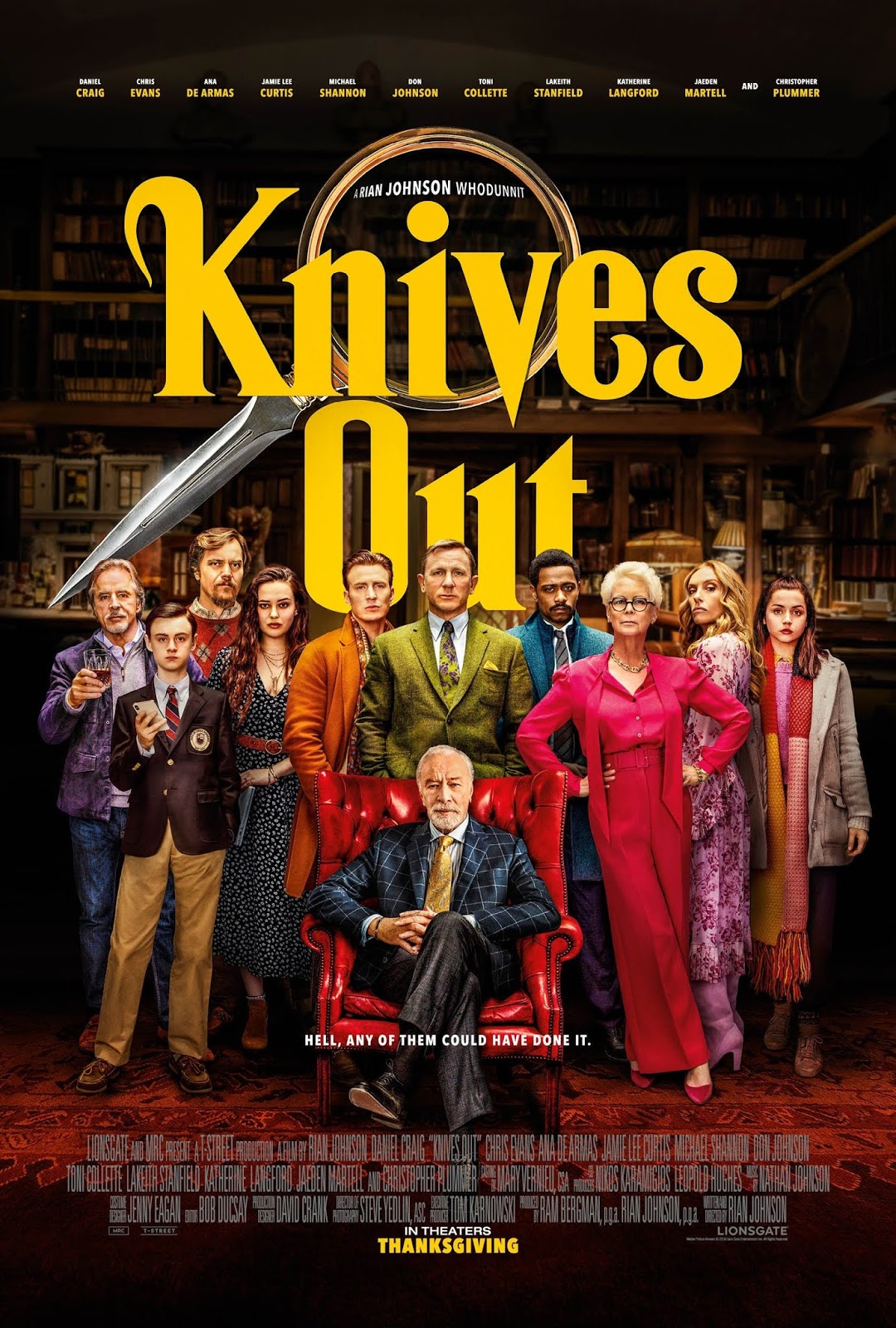
Knives Out (2019)

Daniel Craig investigates in Rian Johnson’s amusing Christie-pastiche Knives Out

Director: Rian Johnson

Cast: Daniel Craig (Benoit Blanc), Chris Evans (Random Drysdale), Ana de Armas (Marta Cabrera), Jamie Lee Curtis (Linda Drysdale), Michael Shannon (Walt Thrombey), Don Johnson (Richard Drysdale), Toni Collette (Joni Thrombrey), Lakeith Stanfield (Lt. Elliot), Katherine Langford (Meg Thrombey), Jaeden Martell (Jacob Thrombey), Christopher Plummer (Harlan Thrombey), Noah Segan (Trooper Wagner), Frank Oz (Alan Stevens)

Rian Johnson’s film CV is full of interesting (and affectionate) twists on assorted genre films. While many will be most familiar with his controversial and iconoclastic Star Wars film The Last Jedi, Knives Outfits more neatly in with his imaginative twist on time-travel Looper and, most tellingly, his film-noir high-school thriller Brick. Knives Out plays into Johnson’s love of old-school, all-star, Agatha Christie style murder-mysteries. Johnson even pops up before screenings of the film to beg viewers – like Alfred Hitchcock in his prime – to not give away the twist endings. So I won’t do it here. Rian Johnson’s way too sweet to disappoint.

The murder that leads to the mystery is Harlan Thrombey’s (Christopher Plummer), the film opening a week after his apparent suicide (or was it!?). If everything is so straight forward, then who has anonymously hired “last of the gentlemen sleuths” Benoit Blanc (Daniel Craig) to investigate the death? There seems to be no shortage of motives either: in his last day, Thrombey threatened to expose his son-in-law Richard’s (Don Johnson) affair, cut-off his daughter-in-law Joni’s (Ton Collette) allowance due to theft, fired his youngest son Walt (Michael Shannon) as head of his publishing company and cut Richard and his daughter Linda’s (Jamie Lee Curtis) playboy son Random (Chris Evans) out of his will. On top of that, his live-in-nurse Marta (Ana de Armas) may have secrets of her own. Will Blanc be able to unpick this web?

Going too far into detail around Knives Out would be to spoil the general sense of fun that Johnson’s film manages to create. The film is not a spoof or parody in any way, but a very intelligent reworking of genre tropes and Agatha Christie style plot twists (a distant house, a mysterious killing, a host of suspects, a barrage of motivations, a house crammed with bolt holes, blackmail, muddy footprints, medicine and acting all get a look in), all governed by an eccentric detective bubbling with his own unique methods for solving a case. It’s all told with a brilliant affection, a wonderful twinkle and a great deal of invention and intelligence from Johnson. 

It’s also a film with a brilliantly assembled plot – and a neat reminder of what a strong writer Johnson is, as well as an inspired stylist. The film creates a host of superb characters for the audience to enjoy and puzzle over – each of them of course attracting a wonderful company of actors, a perfect mix of the skilled and wildcard choices, all of whom pay off. It’s also a structurally daring film: it reveals what it leads many to think is its full hand very early in the film, before subtly revealing that there are multiple mysteries wrapped up within the main mystery (“a doughnut within a doughnut” as Blanc puts it in his own unique way).

And interestingly the film more and more revolves around Marta, its seeming Captain Hastings-figure (or Watson as the film prefers to quote). Played with a charming guilelessness and honesty by Ana de Armas (in more ways than one, since all lies cause Marta to vomit, a joke that sounds crass but is executed perfectly throughout), Marta is the eyes we follow the film’s plot through, meaning we discover events as she does. Marta’s decency and honesty also work as a wonderful device to flag up the increasing hypocrisy and mean-spiritedness of Thrombey’s family. 

The Thrombey clan are an extraordinary group of self-obsessed, greedy and selfishly entitled so-and-sos, who seem to be lacking all expected principles. From Jamie Lee Curtis’ domineering elder daughter, who believes she is a self-made-woman but quickly resorts to bullying when she wants something, to Michael Shannon’s softly spoken but bitterly two-faced Walt, to Toni Collette’s seemingly liberal lady of the people Joni, who is actually as lazy and entitled as all the rest. It’s a host of delightful performances, not forgetting Don Johnson who is a revelation as Curtis’ conniving husband and Chris Evans (having a whale of a time) as the waspishly intelligent, smirking playboy.

Each of the family is as convinced of their own virtue as they are indifferent to those around them. Is it any wonder Thrombey wants to be shot of all of them? Even with the good-natured Marta, none of the family seem to have a clue of anything about her (much as they protest she is part of the family), each of them seemingly naming at random some South American country she hails from and each member in turn telling her confidingly that they would have loved to have had her at the funeral, but they were outvoted by the rest. It makes for a perfect collection of suspects for our detective.

Benoit Blanc himself is a fascinating collection of mannerisms and little touches. The name brings to mind the idea of Hercule Poirot, and Blanc has touches of the man’s arrogance and humanity. Craig has a whale of a time with the part, lacing it with a Southern charm and an eccentric swagger. It’s a part though that actually is a bit of a homage to Columbo, with Blanc also encouraging people to underestimate him and not take him seriously, only to suddenly reveal his insight (including in a last act revelation that is so pure Christie that super-fan Trooper Wagner can barely contain his glee). Blanc is in any case a brilliantly deployed near decoy protagonist, one who Johnson is encouraging us to underestimate as much as most of the characters do.

Thrombey’s murder – and Thrombey has a slight air of Agatha Christie to him, not least the fact that he has written the same number of best-selling books as Christie – is the key to it, and hinges on the overcomplex mind of the great murder writer himself. Johnson’s script is superbly playful, brilliantly written and a delight for murder mystery fans, full of wit and invention and also a very genuinely constructed and intelligent murder mystery. A terrific, playful and witty little treat.

Being John Malkovich (1999)

A portal into the head of a famous actor? What better way to find out what it’s like Being John Malkovich

Director: Spike Jonze

Cast: John Cusack (Craig Schwartz), Cameron Diaz (Lotte Schwartz), Catherine Keener (Maxine Lund), John Malkovich (John Horatio Malkovich), Orson Bean (Dr Lester), Mary Kay Place (Floris), Charlie Sheen (Himself), W Earl Brown (JM Inc Customer)

Is there a more consciously eccentric film ever made than Being John Malkovich? Can you imagine the pitch to the Hollywood suits? 

Our hero, Craig Schwartz (John Cusack) is a weedy, bitter puppeteer (as well as creep and potential stalker), whose wife Lotte (Cameron Diaz) fills their house with rescue animals, from talkative parrots to a chimp with PTSD. Needing to make ends meet, Schwartz takes a filing job at a company based on floor 7½ of an office block (it’s a low ceilinged floor built between the other two floors – it’s cheaper on the rent obviously) where he becomes obsessed with his sexy co-worker Maxine Lund (Catherine Keener), who is resolutely not interested. But all this changes one day when Schwartz finds a fleshy, dark tunnel behind a filming cabinet that takes someone into the mind of actor John Malkovich (John Malkovich) – for 15 minutes, before expelling you onto the New Jersey turnpike. Sounds like a business interest for Schwartz and Maxine (spend 15 minutes in someone else’s body!), but the experience of being in someone’s body slowly begins to change Schwartz, Lotte and Maxine – and having his brain invaded has a terrible impact on Malkovich himself.

If that’s not the oddest plot you’ve ever heard, then I don’t know what films you’ve been watching. The film was the brainchild of Charlie Kaufman, who developed from this into one of the most distinctively gifted screenwriters in Hollywood, a master of the quirky and weird, the off-the-wall and the science fiction tinged everyday fantasy, blessed with the ability to mix in genuine human emotion amongst the oddness. 

Being John Malkovich is an inspired idea and Kaufman’s script is ingenious in its structure and progression. Never once does the film settle for the expected narrative development or the conventional structure. It’s a livewire of a film that constantly leaves you guessing, switching tone and throwing logical but unexpected plot twists at every turn. There are plenty of moments where you could expect events to take a conventional turn, but the film never settles for the obvious.

Kaufman’s inspired script was lucky enough to find a quirky visual stylist who was willing to embrace it as much as Spike Jonze did. Jonze’s direction is a masterclass in small detail, slight twists and little touches of invention that never draw excessive attention to themselves but combine to make a thrillingly off-the-wall final picture. 

Jonze knows that the jokes and surrealism of Kaufman’s script are so effective that they don’t need a firm directorial hand to lean the humour on – they work absolutely fine presented almost as written, and make for terrific entertainment. He shoots the low ceiling of floor 7½ with such straightforward confidence that each scene becomes hilarious for its stooped actors and crammed rooms. Jonze can therefore concentrate the flourishes on core moments, from the puppetry that Schwartz and later a Schwartz-controlled Malkovich make their life’s work, to assorted training and educational videos that pepper the film at key moments.

Like Kaufman as well, Jonze’s storytelling works because he inherently understands human emotion and isn’t afraid to throw it into the film alongside the humour. Plenty of directors would have been happy to have all the principals settle into being comic stereotypes, or overplayed pantomime figures. Jonze encouraged the actors to find the depth – and sometimes the darkness – in their characters, to ground the film effectively with touches of real life tragedy and human flaws that give weight to the surreal sci-fi elements – so much so that they start to feel as real as the rest.

John Cusack’s Schwartz is a bitter, increasingly twisted fantasist and dreamer – the sort of guy who believes that his lack of willingness to compromise his art in any way is a strength (his puppetry shows are highly complex, sexualised, high-blown, poetry-inspired hilarious puffs of pretension). Schwartz could have become a joke or a guy with a big dream – but the film increasingly shows him to be a dark, obsessive, cruel even dangerous outsider, who has no problem with harming other people to get what he wants, his moral compass is driven by his self-assessment of himself as a man treated badly by others, so doing what he wants is somehow deserved. It’s an increasingly dark portrait of a man who has more than hint of danger to him.

Keener, as the focus of his obsession, also does extraordinary work as a woman the film is not afraid to present as unpleasant in her selfishness, casual cruelty and greed – but a woman who slowly allows herself to open up and reveal an emotional openness and romanticism someone watching the start of the film would never expect. Similarly Diaz’s downtrodden, sad wife at home flourishes and grows as a person, as she finds in herself a new comfort and ease with who she is, from inhabiting the mind of another person. Both are excellent.

The film explores fascinating ideas of identity – Lotte and Maxine find a freedom and an exciting otherness in being a passenger in another person’s body, and use it as voyages of self discovery for themselves. Schwartz on the other hand sees this body – just as he sees all human beings – as just another puppet for him to control, another way of adjusting the world to match his requirements, rather than change anything about himself. While some lose themselves in Malkovich’s body and find the experience rewarding, Schwartz can only find happiness when bending the body to his own will.

And what of Malkovich himself?  Well has there ever been a braver performance in film? Malkovich is superb as an arch portrait of himself as a rather self-important actor, with an unknowable coolness about him, an intellectualism that makes him a man easy to respect but strangely hard to relate to, a face that is distinctive but a strangely unrelatable style that makes him hard to remember (it’s really an extraordinarily funny and brave performance). As Malkovich realises what is happening to him, the film plays with real beats of tragedy and even horror – what would it be like to be forced into being a passenger in your own head? This is nothing compared to the horror Malkovich encounters when he enters the tunnel himself – to find himself in a world where everyone looks like Malkovich and can only speak using the word “Malkovich”.

Being John Malkovich uses its surreal ideas to explore profound – and even chilling – ideas of control, destiny, personality and identity. With several superb performances, a brilliant script and controlled and intelligent direction, it’s a film unlike any other – and continues to delight and surprise twenty years on from its release.

The Descendants (2011)

George Clooney is a family man dealing with difficulty from The Descendants

Director: Alexander Payne

Cast: George Clooney (Matt King), Shailene Woodley (Alex King), Amara Miller (Scottie King), Nick Krause (Sid), Beau Bridges (Hugh), Judy Greer (Julie Speer), Matthew Lillard (Brian Speer), Robert Forster (Scott), Patricia Hastie (Elizabeth King)

Anyone expecting a straight comedy hasn’t been familiar enough with Alexander Payne’s career. Payne’s movies are triumphant, slightly quirky, explorations of crisis in the lives and emotions of middle-aged, middle-class men. Few directors do it as well, bringing both a lightness of touch and a profound understanding of the tragedy that can underpin ordinary lives. He has an astute understanding of the pain of opportunities lost. And The Descendants is full of these, just as it is full of the hope you can gain from seizing new opportunities in the future.

Matt King (George Clooney) is a Honolulu attorney who is the last trustee representative in his vast family for a site of 25,000 pristine acres on Kauai. With the trust due to end, Matt is under pressure from his family to sell the land for hundreds of millions and gain them all their financial security. In the middle of this, his wife suffers a boat accident that leaves her in an unrecoverable coma. Matt has to rebuild the relationship with his two daughters Alex (Shailene Woodley) and Scottie (Amara Miller) as well as deal with the reveal this his wife was planning to leave him for her lover, a married estate agent Brian Speer (Matthew Lillard).

Payne’s film is heartfelt, low-key and a marvellous showcase for George Clooney who has probably never been better as the grieving and shocked Matt, struggling to come to terms with revelations about his own life that come completely out of the blue. In particular, his own realisation that he has left far too much of his family life to his wife, and his wife has in any case a less than perfect relationship with their two troubled children. Alex (Shailene Woodley) has a history of substance abuse and hell-raising while her sister Scottie (Amara Miller) is using bullying as a way of acting out. King, its clear, has let his connection with his family drift away with his consumption in his work, a character flaw that leaves him with a serious of painful revelations about his own failures.

These revelations are expertly acted by Clooney, who gives the part a rawness and edge beneath his natural charm that becomes deeply involving. He makes Matt both desperate, bewildered and confused as well as kind, decent and forgiving. Payne’s films never present easy solutions to problems, and frequently hold up their leading characters as being the root of their own troubles. It’s the case here as well, as King must learn to realise that many of the problems he is discovering in his family life come out from his own mistakes and lack of focus. How should he respond to his discovery of his wife’s infidelity? How should he decide to react when he discovers his wife’s lover had his own family? 

It’s never the easy choice, and it’s never a clean and easy solution that wraps everything up neatly. The problems we encounter will eventually require us to make intelligent, emotional decisions and accept there are no clean answers. When we meet Brian Speer, he’s not a bad guy just a bit weak. It’s the same throughout. Every character has depth and hinterland. Robert Forster as Matt’s father-in-law may seem foreboding and harsh – but then he is perhaps right to blame Matt for his daughter’s unhappiness, even while he never holds it too harshly against him. Alex’s spaced out boyfriend Sid (Nick Krause) suddenly surprises Matt with his emotional insight into family dynamics.

And of course, his daughters who seem tearaways are in fact far more mature and supportive than might have been expected. Shailene Woodley is excellent as Alex, a young woman who doesn’t blame but demands to be part of solutions, and supports her father to make the tough calls. And the moral problems keep coming, mixed with surrealist comic touches. It’s the sort of film where Matt can make a shocking realisation about his wife, and then return to his table in his restaurant to be assailed by a garish traditional music band.

Despite all this Payne’s film captures a sense of affection and warmth without succumbing to sentimentality or easy solutions. The sort of satisfying outbursts of pain and cathartic anger are largely avoided for far more mature and realistic feelings of joint responsibility for problems and an acceptance that what our lives become are what we make of them as well as other people. It’s a sort of complex avoidance of black-and-white solutions that help to make the film feel truly real and grounded. While not many of us need to worry about the pressures of making decisions that will make us millionaires, all of us have had to deal with our own mistakes leading to others making mistakes and the emotional fallout that this can bring. 

In the centre of Payne’s emotionally intelligent film are these excellent performances, with George Clooney hugely unlucky to miss out on an Oscar for his emotionally intelligent and rich performance here. Payne’s film takes the male mid-life and family crisis and subtly analyses from a host of positions and angles, not just the man itself. We can feel sorry for a bloke who has suffered blows but also see his own decisions have contributed to his position. It makes for a delightful and heartfelt film, which is beautifully made by Payne and superb showcase for intelligent, grown up film making.

The Missionary (1982)

Michael Palin sets up a failed mission for change in The Missionary

Director: Richard Loncraine

Cast: Michael Palin (Reverend Charles Fortescue), Maggie Smith (Lady Isabel Ames), Trevor Howard (Lord Henry Ames), Denholm Elliott (Bishop of London), Michael Hordern (Slatterthwaite/Narrator), Graham Crowden (Reverend Fitzbanks), David Suchet (Corbett), Phoebe Nicholls (Deborah Fitzbanks), Roland Culver (Lord Fermleigh), Rosamund Greenwood (Lady Fermleigh), Timothy Spall (Parswell)

In the 1970s Michael Palin co-wrote (with Trevor Jones) a series called Ripping Yarns, affectionate half-hour spoofs of “Boys Own Adventures”, all starring Palin, told with a winning mix of affection, surreal gags and gentle humour. The Missionary is Palin expanding the concept into a full film, written by and starring the future Globe-Trotting Python. Palin plays the Reverend Charles Fortescue, who in 1902 returns from a mission in Africa (teaching the natives the date of composition of Magna Carta) to England and is asked by the Bishop of London to set up a mission in London to “save” prostitutes. Needless to say, things do not according to plan.

Palin’s script is full of some fabulous gags and a gentle, sometimes cheeky, sense of humour that gives you something truly entertaining every moment. If The Missionary does at times feel a collection of sketches and great comedic ideas and characters, rather than a fully formed filmic narrative, that matters slightly less when the jokes are as good as these. Sure, even Palin and Loncraine have said the final act of the film doesn’t completely work and largely fails to add actual narrative conclusion (it feels rather like the film required an ending, so this section was added to give it one), but it doesn’t really matter as much when the sense of fun is as strong as it is here.

Watching this on the recent re-mastered blu-ray from Indicator, this is also a beautifully made film, very well shot and framed by Loncraine with a cracking sense of pace. Visually the jokes work very well, and the push through from comic set-piece to comic set-piece that runs through the opening hour of the film is perfect. 

Palin also is perfect in the leading role, his sense of earnestness and decency, his slight air of a very-British innocence and bashfulness works in hilarious contrast to when (inexplicably to him) finds himself sexually irresistible to a host of ladies. Which sounds, when you write it, like a vanity project if ever I heard it, but never plays like it for a moment as there is a superb, slightly embarrassed, befuddled awkwardness about Palin (which I don’t think any other actor could have done as well) that makes the entire concept work an absolute treat.

It’s part of the extremely British atmosphere of the film, where sex is something deeply embarrassing and slightly shameful, something we are all far too polite to talk about or even acknowledge. Rather than the atmosphere of an end-of-the-pier show the film could have had, instead it has a very dry, rather touching attitude towards sex as something completely natural and everyday, that the repression of the English has elevated to something hugely awkward.

The only person who seems to be in touch with her true feelings and sexuality is Maggie Smith’s sexually liberal Lady Ames, a woman who knows what she wants and is determined to get it come what may. Smith is superbly funny in the role, a part she keeps just the right side of parody, making it very funny but also ring very true. This makes her a complete contrast to Fortescue’s intended (played expertly by Phoebe Nicholls) so repressed she cannot bear to be touched and obsessed with a complex filing system for storing and cross-referencing her fiancée’s letters.

All this happens within a series of sketches that are worth the price of admission themselves. Denholm Elliott has a few excellent scenes as a bullish Bishop, obsessed with sport who seems unable to speak in anything but sporting metaphors. Roland Culver plays a Lord who dies in the middle of an impassioned Fortescue’s pitch for funding, to the intense social embarrassment of his wife (Rosamund Greenwood, very funny). Best of all on the cameo front is Michael Hordern, who practically steals the entire movie as a butler utterly unable to successfully navigate around the gigantic house he works in.

Through this all rides Fortescue, a man with a barely acknowledged sexual drive, who bumbles from escapade to sexcapade with a bright-eyed innocence and determination to do the right thing, but constantly landing himself in trouble. It’s a charming, playful and very British movie and Loncraine and Palin get the tone just right. It’s perhaps a little too close to Ripping Yarns, a fabulous parody of a particular era (and type) of Britishness and British attitudes, and you feel it would be comfortable as a single 45 minute episode. But when the jokes are as cracking as they can be here – and Hordern apologetically leading Fortescue from room to room unable to work out where he is or how he can get to where they want to go, is a pleasure I could watch again and again – then you’ll cut it a lot of slack.

M*A*S*H (1970)

Elliott Gould, Tom Skerritt and Donald Sutherland are three madcap surgeons in Robert Altman’s M*A*S*H  a film that looks less screwball and more misogynist every day

Director: Robert Altman

Cast: Donald Sutherland (Captain “Hawkeye” Pierce), Elliott Gould (Captain “Trapper” John McIntyre), Tom Skerritt (Captain “Duke” Bedford), Sally Kellerman (Major Margaret Hoolihan), Robert Duvall (Major Frank Burns), Roger Bowen (Lt Col Henry Blake), Rene Auberjonois (Father Mulcahy), David Arkin (SSgt Wade Vollmer), Jo Ann Pflug (Lt Maria “Dish” Schneider), Jon Schuck (Captain “The Painless Pole” Waldowski), Carl Gottlieb (Captain “Ugly John” Black)

Robert Altman’s counter-culture M*A*S*H was his first (and probably only) unreserved smash hit, the film where Altman cemented his style as a director. Although set in the Korean War, the film was clearly more about attitudes towards Vietnam. Today M*A*S*H is probably more well known as the filmic spring board for the extremely long-running TV show starring Alan Alda (which, at 11 years, lasted seven years longer than the war it was set in). 

M*A*S*H (like the series) covers the mad-cap antics of the doctors at the 4077thmedicine outpost near the frontlines of the Korean war, a casualty clearing station where young men are patched up and either sent back to the front line or sent home. While the base is a military operation, most of the doctors serving there are drafted civilian doctors rankled by rigid military discipline. The leaders of this prickly bunch are “Hawkeye” Pierce (Donald Sutherland), “Trapper” John (Elliot Gould) and “Duke” Bedford (Tom Skerritt), with their targets ranging from generals to the stiff-backed military figures on the base, specifically the officious but less-competent surgeon Frank Burns (Robert Duvall) and Head Nurse Major Hollihan (Sally Kellerman).

M*A*S*H is the first expression of what became Robert Altman’s signature style as a director. The film has a grimy immediacy that throws the audience into the middle of the action, and is cut with an edgy lack of artifice that at the time was seen as barely competent film-making. That didn’t outrage people as much as Altman’s willingness to allow a lack of conventional discipline in dialogue delivery, with actors overlapping wildly, some dialogue drifting out of earshot or not being captured on screen, no real story being developed through it. It’s a deliberately scrappy, scratchy, almost clumsy film shot with a great deal of artistic discipline (including a spot on The Last Supper parody) but cut and sound-edited with a casual precision that makes it feel extraordinarily experimental.

It infuriated its screenwriter Ring Lardner Jnr (no doubt the Oscar that he received soothed his pain), and Altman’s loose, improvisational style and unwillingness to go for conventional framing and style also alienated his leading actors. Altman and Sutherland (with Gould’s support) each pushed for the other to be dismissed from the film (Sutherland has claimed to have never seen the film, and ton have never understood its success; Gould later apologised by letter to Altman and worked with him several times again) and the whole film’s final style – its influential fly-on-the-wall vibe and nose-thumbing lack of formal discipline – can be attributed completely to Altman’s vision and artistic independence.

The film is important as a key landmark in film-making style and in Altman’s development as a director – but there is no other way of saying it, it has dated extraordinarily badly. For those more familiar with the TV show, its tone is going to come as quite a shock. The TV show is a lighter, sillier, more socially conscious creation (increasingly so in its later years) where the tone was more japery and deadpan silliness. The film is cruel, and its lead characters are swaggering, alpha jocks and bullies, whose meanness and astonishing levels of misogyny are constantly celebrated and rewarded. For those who remember Alan Alda as Hawkeye, Donald Sutherland’s viciousness is coming to come as quite a shock!

Hawkeye and Trapper John’s vileness at frequent intervals is pretty hard to stomach (the less said about the racist, unpleasant Duke the better). The film is really keen to show that all this rampant cruel practical jokery is a survival mechanism against the horrors of war, and the difficulty of dealing with patching young soldiers up to send them back out to die. But the film never really gives us a sense of the war, and the surgery scenes (while effective in their bloodiness and counterpointing the frat house atmosphere of the rest of the film) fail to create that ominous sense of senseless never-ending conflict that the film needs to balance out the vileness of the humour. Further, while Hawkeye and Trapper John are both shown to be dedicated and gifted professionals, they also remain two-dimensional figures, never really shown to have an emotional hinterland that expands their work. They are instead more like Wall Street stockbrokers: excellent at their job, but still a pair of arseholes.

Their attitude to women – and the film’s attitude – is beyond troubling today, it’s flat out offensive. The nurses on station are treated as no more than snacks for the men to enjoy, that they are entitled to pick up as often as they like, and who are barely given any character at all. Sex is as much an entitlement as rations. On his promotion to Chief Surgeon, Trapper John demands (half-jokingly) sex, while Hawkeye “volunteers” a woman to help “cure” another character who fears he has turned homosexual and is considering suicide. Counter culture against the war is celebrated throughout – but it shown in this film to be overwhelmingly a masculine campaign, in which women have no place and no equality. Men can feel the war is terrible, and men can rebel against authority, but women exist only to service their needs.

All of this boils down into a real bad taste in the film’s treatment of ultra-professional Major Hoolihan. Reviled by Hawkeye, Trapper John and Duke for the twin crimes of taking her military career seriously and not being interested in sex with Hawkeye, Hoolihan is systematically degraded and humiliated throughout the film. From having her sex with humourless prig and fellow disciplinarian Frank Burns broadcast around the camp (giving her the nickname “Hot Lips” from her pillowtalk, a title she never escapes) to having the shower tent collapsed around her in front of the whole camp to settle a bet about whether she is a “real blonde” or not – her reaction to which we are misogynistically encouraged to view as hysteria, as dismissed by her commanding officer – it’s tough to watch. The one compliment she gets in the film on being a good nurse is accompanied by her insulting nickname, and by the end of the film she has been reduced to being depicted as an air-headed cheerleader at a football game. Even her credits picture shows her ultimate moment of humiliation. She’s seen as a Blue Stocking, unnatural because she is attractive but not willing to be sexually available to men. This is the sort of treatment that could drive a person to suicide, here treated for laughs. It’s impossible to watch with a smile today.

And it’s the dated part of the film as Hawkeye and Trapper are never questioned for this behaviour – indeed they are celebrated and encouraged throughout as fun, cool guys – when in fact they are the worst sort of jock bullies and their antics the sort of tedious frathouse rubbish that blights too many all-male clubs. They are working class Bullingdon boys, who value nothing, with the film giving them passes because they are great surgeons. Sutherland in particular isn’t charming, he’s creepy and unsettlingly cruel, while Gould at least has a madcap goofiness with touches of humanity. 

Two hours with these arseholes is a long time, and the film just plain isn’t funny enough for what it is trying to do – neither does it convey the horrors of war enough, or the men’s understanding of it. More time shown on the surgeons at least acknowledging the horrors might have helped wonders – but the film assumes that we know what they are feeling and just rolls with it. You could generously say they are cruel in a cruel world. But the film never acknowledges the essential meanness of the humour here, and tries to involve us all in it with no sense of conflict or concern. It’s a troubling film to watch today, its rampant sexist cruelty is offensive and its lack of charm purely unintentional. Time will continue to be cruel to it.

Pygmalion (1938)

Pygmalion (1938)

The leads excel in this vibrant, well-made adaptation of Shaw that set the framework for My Fair Lady

Director: Anthony Asquith, Leslie Howard

Cast: Leslie Howard (Professor Henry Higgins), Wendy Hiller (Eliza Doolittle), Wilfrid Lawson (Alfred Doolittle), Marie Lohr (Mrs Higgins), Scott Sunderland (Colonel George Pickering), Jean Cadell (Mrs Pearce), David Tree (Freddy Eynsford-Hill), Everley Gregg (Mrs Eynsford-Hill)

“It’s an insult for them to offer me an honour, as if they have ever heard of me – and it’s very likely they never have. They might as well send some honour to George [VI] for being King of England.” That was George Bernard Shaw’s reaction when he heard that he had won Best Adapted Screenplay at the Oscars. Now that’s a reaction that would have burned Twitter up today. Mind you Shaw wasn’t adverse to taking the film world’s money for bringing Pygmalion to the screen – and also means he is one half of a nifty pub quiz question (who is the only other person to win BOTH an Oscar and the Nobel Prize for literature?).

Pygmalion, always Shaw’s most popular play, seemed a logical choice to begin for producer Gabriel Pascal’s dream of bringing a cannon of the playwright’s complete work to the cinema screens. Shaw agreed – so long as he had was on board as the screenwriter and with a personal supervision of the adaptation. He missed a trick by not insisting on creative control. Shaw re-wrote and restructured much of the play for the screen – and it’s this screenplay that forms the basis of My Fair Lady. So closely so, that it’s the most familiar version of the play – and so close does the dialogue cut that you end up wondering where the songs are.

Anthony Asquith was bought on board as the director, and Shaw oversaw the assembly of the cast. Leslie Howard was cast over Shaw’s original choice, Charles Laughton, and also given a co-director credit (although there are some disagreements about what this meant, with some claiming it was basically some on-set notes to actors). Asquith was a director with a gift for opening out literary adaptations onto the big screen, and he succeeds here in capturing much of the atmosphere and mood of Shaw’s comedy of manners. There was also a young whippersnapper called David Lean on hand to direct the montage sequences that showed Eliza’s training.

Leslie Howard was a major matinee idol, but also an accomplished stage actor – and both qualities come to the fore here in what is surely the best Higgins captured on screen (with apologies to Rex Harrison). His Higgins is a rough-edged, somewhat scruffy, eccentric who speaks before he thinks, treats everything with an absent-minded, off-the-cuff bluntness and is almost professionally rude. He’s never straight-forwardly charming, indeed sometimes he’s outright cruel and bullying, but there is a professorial lack of harm to him that makes him reassuringly British and decent. And he gives the final act a real sense of vulnerability and emotional repression that is vital.

If Leslie Howard makes a very good Higgins, I do think there is very little doubt that Wendy Hiller is the definitive Eliza Doolittle. Handpicked by Shaw, she is superb here. Her Eliza has all the fragility, worry and working-class chippiness you expect, but Hiller laces it with such a real streak of humanity that you end up deeply investing in her. Her flourishing sense of personality, of her growing strength of personality and feelings of independence dominate much of the final act of the play, and Hiller mixes it with notes of genuine hurt and sadness about the dismissive treatment she is receiving from Higgins. It’s a performance overflowing with nuance and pain – and the moment when a pained Eliza responds with a pained dignity when Higgins suggests she marry someone else that “we sold flowers….we did not sell ourselves” is a truly wonderful moment.

But this is also a very well made, cinematic movie with some really outstandingly funny sequences. The scene where Eliza – newly trained to talk “proper”, but with no idea about what makes for decent polite conversation – regales a dinner party in earnestly, perfectly accented English about her belief that “they done [that] old woman in” at great length is hilariously funny, as is Howard’s wryily amused response. There is also equal comic mileage to be got from Wilfrid Lawson’s very funny performance as Eliza’s selfish, street-smart father, the dustbinman with the mind of philosopher. 

Asquith’s film is very well shot and assembled, helped a great deal by this inventively made and very structured montage sequences contributed by Lean (who also edited the film). It’s done with real snap, and Asquith’s camera movements and invention of framing dwarves the far more staid and flat production of My Fair Lady that would win many Oscars 25 years later. He knows when to go for low, static shots – particularly in those moments when Eliza realises she is just a toy for Higgins – and also close-ups and one-two shots that give even greater energy and dynamism to Shaw’s wonderful dialogue (again the final argument sequence benefits hugely from this).

Shaw didn’t go for creative control, so he failed to prevent the happy ending that was added to his play, as Eliza returns to Higgins (after seeming to leave to marry Freddy), and the Professor continues his pretence of indifference – which thanks to Howard’s excellent performance earlier we know is just that. To be honest, even with the performances of the leads, Eliza’s devotion to Higgins still seems to come from left-field (just as it does in the musical) and there isn’t much in the way of romantic chemistry between them. But it works for many people, even if it never works for me (or Shaw).

Pygmalion is a fine film, far superior to My Fair Lady (better made, better acted, better written, funnier, smarter, more moving and more heartwarming). It deserves to live a life outside of its shadow.

And that other Nobel and Oscar winner? Why Bob Dylan of course.

Silver Linings Playbook (2012)

Bradley Cooper and Jennifer Lawrence in an unusual love story Silver Linings Playbook

Director: David O. Russell

Cast: Bradley Cooper (Pat Solitano Jnr), Jennifer Lawrence (Tiffany Maxwell), Robert De Niro (Pat Solitano Snr), Jacki Weaver (Dolores Solitano), Anupam Kher (Dr Cliff Patel), Chris Tucker (Danny McDaniels), Julia Stiles (Veronica), Shea Whigham (Jake Solitano), John Ortiz (Ronnie)

David O. Russell is a director it’s easier to admire than fall in love with. I can see why actors come back to work with him time and again – he’s clearly an actors’ director who crafts stories that give them chances to shine. But his films often have an archness about them, while I find too many of them settle for a sort of middle-of-the-road quirky cool. I’ve never really, truly, loved any of them – even if I have enjoyed them while watching them. The closest I think I’ve got is Silver Linings Playbook.

Pat Solitano (Bradley Cooper) is released from psychiatric hospital, after being confined for assaulting his ex-wife’s lover, into the care of his parents Pat Snr (Robert De Niro), unemployed now making a living as an underground bookmaker, and Dolores (Jacki Weaver). Suffering from a host of compulsions connected to his bipolar disorder, Pat is fixated on winning back his wife. To do so, he enlists the help of Tiffany (Jennifer Lawrence), the widow of a policeman who died in a road traffic accident, who has her own borderline personality disorder and has been dealing with her grief through a parade of casual sexual encounters. Together they enter a dance competition – Tiffany because she always wanted to, Pat because Tiffany has offered to take Pat’s letters to his wife if he says yes and because Pat wants to prove to his wife that he has changed. But is there more than mutual convenience between the two?

Silver Linings Playbook is an unusual romance, that also explores themes of mental health and compulsions and how thin the lines can be between what we consider healthy and not healthy. When does obsession tip over into something that should be treated? Pat is the sort of guy who wakes his parents up to furiously denounce the Hemingway book he has just finished reading in one sitting (a scene played exuberantly for laughs – including Pat smashing a window by throwing the book out of it) but it quickly tips into danger when in a similar mania he awakens the entire neighbourhood at 3am tearing the house apart for his wedding video, accidentally hits his mother, and ends in a tear filled scuffle with his dad. Similarly, Tiffany’s tendencies towards aggression and self-destruction frequently put her in situations both funny and dreadfully damaging.

But just as close to this, we have Pat Snr’s addiction not only to gambling, but also to a raft of superstitions designed to better his chances of winning (and which dominate large parts of his life). Dolores seems obsessed with maintaining peace and order in the family. Pat’s brother has an almost savant tendency to speak his mind, causing more harm than good. Every character in this seems to have their own psychological hang-ups, with resulting problems.

But the film marries this up with an actually quite sweet romantic story between two damaged souls, both very well played by Cooper and Lawrence. This was the film where Cooper repositioned himself as a major actor of note. His performance here is a perfect mixture of charm, pain, confusion, frustration, insight and self-destructive monomania. He’s both funny and deeply moving, sweet and also slappable, gentle but with a capacity for unpredictability. He’s a terrific performance, deeply affecting. It also helps he has fabulous chemistry with an Oscar-winning Jennifer Lawrence. Lawrence’s Tiffany is a vulnerable soul, desperate to appear as tough and impossible to harm as possible and not caring about any of the collateral damage. She’s as brittle as she seems rigid, and as desperate for affection as she pretends to be uncaring about it.

The film throws these two together with an obvious spark from the start, and brilliantly uses their preparation for a dancing contest to show them growing closer together physically and emotionally, as well as adding a purpose to their lives and giving them a common goal to work towards. There is a rather nice gentleness, amongst all the chaos of this film, that something as simple as taking up a new hobby can help to ground two people.

The film builds the romance gently, carefully showing it developing organically and leaving us to guess at what point the bond between these two enrichens and deepens from an instant connection to something more profound. It’s sure got a lot to overcome, with Pat’s obsessive focus on his wife and Tiffany’s compulsion for meaningless sex and her own desire to destroy promising relationships (she almost immediately alienates the surprisingly gentlemanly Pat with an offer of casual sex on their first meeting). With a gentle slow-burn, the film builds towards something that ends up being rather moving.

Russell’s adaptation of the original novel is well-structured and entertaining and his unfussy, stylish direction brilliantly creates an enjoyable mode. De Niro (in what many people called a joyous return to form) and Weaver are both very good as the parents (both were Oscar nominated – this is one of the few films to be nominated in each acting category) and there is hardly a weak beat in the cast. After several quirky, indie-cool, rather distant films, this is possibly the most fun and the most heart-warming Russell has ever been. It’s a career high. Heck even Chris Tucker is really good. And I’d never thought I’d say that.

Made in Dagenham (2010)

Up the Women! British comedy wallows in nostalgia but tells a still relevant tale of sexual equality

Director: Nigel Cole

Cast: Sally Hawkins (Rita O’Grady), Bob Hoskins (Albert), Miranda Richardson (Barbara Castle), Geraldine James (Connie), Rosamund Pike (Lisa Hopkins), Andrea Riseborough (Brenda), Jamie Winstone (Sandra), Daniel Mays (Eddie O’Grady), Richard Schiff (Robert Tooley), Rupert Graves (Peter Hopkins), Kenneth Cranham (Monty Taylor), Nicola Duffett (Eileen), Lorraine Stanley (Monica), Roger Lloyd-Pack (George), Andrew Lincoln (Mr Clarke)

You’d like to think a film made ten years ago about a strike for equal pay in the 1960s would be more of a history piece than something that still carries real relevance today. But this is still a world where women are often paid less than a man, and where their work is often devalued or held as less “important” than their male counterparts. Made in Dagenham looks at all these issues with a rose-tinted, feel-good stance that aims to entertain first and make you think second. Nothing wrong with that, but it means the film is largely just a crowd-pleaser, when you feel it could be more.

At the Ford factory in Dagenham, the female sewing machinists are not paid as skilled workers, and are forced to accept less work. Frustrated at the patronising attitude from their all-male union reps, and encouraged by foreman Albert (Bob Hoskins, lovely in one of his cuddliest performances), the women decide to go on strike for equal play, led by Rita O’Grady (Sally Hawkins). As public attention builds, the Ford owners in America mobilise for a battle and the strike attracts the interest of Secretary for Employment Barbara Castle (Miranda Richardson), someone who knows the struggles a woman faces in a man’s world.

It’s no great surprise based on the fluffy, charming tone of this film that Nigel Cole’s previous credit was Calendar Girls. (Also no surprise that, like that film, this has been turned into a crowd-pleasing stage musical.) William Ivory’s script deftly sketches out some familiar movie-dynamics for its characters, establishes clear heroes and villains, gives us a good sprinkling of information and “things to think about”, mixes in at least one tragic sub-plot and provides a steady stream of high points, heart-string tugging moments and punch the air moments. As a piece of writing playing to the masses, it’s pretty flawless.

It’s in love with the 1960s details, with nostalgia dialled up to 11, with a love of the look, feel and styles of the era and plenty of sound cues mixed in that will have you tapping your toes. It’s all designed for you to have fun, and if that means some of the deeper questions get a bit lost at points, that doesn’t really matter. 

And there is more than enough enjoyable material to be seen in setting up a series of bigoted or patronising men (gamely played principally by Kenneth Cranham and Rupert Graves) and seeing them knocked down. You could argue that a slightly braver film would touch at the implications of what Richard Schiff’s corporate big-hitter says about equal pay: make it more expensive to make cars here and we will make our cars somewhere else. (In fact it was pretty hard to forget that, watching the film today, as Brexit has already caused at least three major car factory closures in the UK. In fact the film is very happy to talk all about equal pay for women in the Western World but never even raises the question of how we are quite content to have people in the third world slave away in conditions far worse than this for a few pennies an hour.) But that’s not the film’s point, and instead it’s all about those male-female relationships. 

Sally Hawkins does a good job as a woman slowly growing a social and political awareness and then turning that new-found enlightenment on her own domestic life with well-meaning but of-his-time husband Eddie (a sweet but cluelessly sexist Daniel Mays). It’s all conventional stuff, but Hawkins and Mays play it very well.

The real meat actually comes from plotlines elsewhere. Rosamund Pike is excellent as a woman with a first in history from Oxford, reduced to wheeling out nibbles for her patronising husband and keeping her ideas to herself. Geraldine James and Roger Lloyd-Pack get the tragic plotline of a couple struggling with his post-war undiagnosed PTSD, which gets most of the heart-string tugging. 

Eventually all is made well by Miranda Richardson’s Barbara Castle, floating into the picture to wave a magic wand and save the women’s bacon. Richardson thoroughly enjoys herself in a rather cardboard role, at least two scenes of which are solid exposition, in which Castle’s lecturing of two uppity civil servants is used to introduce the political context. By the end you won’t be surprised that good triumphs. But it’s a film which largely only looks to put a smile on your face, and doesn’t really look at the wider implications or injustices of unequal pay. To the film’s credit it has a final montage of the real Ford women talking about their lives and the battles they had to be respected, which gives it a bit of extra depth. A truly brave film would have found a few minutes – and that’s all it really needs – to look at the wider issues (then and today) economically and socially, and to make us think a little. As it is this just entertains, which is what you want, but it could be more.

Now You See Me (2013)

A gang of magicians get up to all sorts of antics in light and empty caper Now You See Me

Director: Louis Leterrier

Cast: Jesse Eisenberg (J Daniel Atlas), Woody Harrelson (Merritt McKinney), Isla Fisher (Henley Reeves), Dave Franco (Jack Wilder), Mark Ruffalo (Agent Dylan Rhodes), Mélanie Laurent (Agent Alma Dray), Morgan Freeman (Thaddeus Bradley), Michael Caine (Arthur Tressler), Michael Kelly (Agent Fuller), Common (Agent Evans)

Sometimes the simplest tricks are the best. Remember David Blaine? All his huge illusions and stunts weren’t worth thruppence compared to the simple awe of watching him perform card tricks in front of stunned regular folks in the streets. This film is pretty much the same, a dazzlingly shot con-trick of a film that wants to reveal a stream of tricks that it was holding up its sleeves over its runtime, each twist being less and less impactful. The most magic thing in this is the sleight of hand card trick Jesse Eisenberg performs at the start of the film – after that it’s like watching your soul drain away over two hours under an onslaught of wham-bam twists.

Anyway, J Daniel Atlas (Jesse Eisenberg), Merritt McKinney (Woody Harrelson), Henley Reeves (Isla Fisher) and Jack Wilder (Dave Franco) are a ragtag bunch of professional magicians, hypnotists, stunt performers and conmen who are recruited by a shadowy magical organisation known only as The Eye for reasons unknown. One year later they are performing huge stadium gigs, with the support of millionaire insurance man Arthur Tressler (Michael Caine), as The Four Horseman. During their first show they magic millions of Euros out of a bank in Paris while performing in Las Vegas – a stunt that attracts the attention of the FBI and Interpol who send agents Dylan Rhodes (Mark Ruffalo) and Alma Dray (Mélanie Laurent) to investigate. Meanwhile, the Horsemen are on the run from the law, and still working towards ends unknown, while dodging magic debunker Thaddeus Bradley (Morgan Freeman). But is anything as it seems?

The answer of course is no. But then what do you expect from a film that proudly announces (frequently) “the closer you look, the less you will see”. It’s a pretty good message for the film – but not in a good way – as Now You See Me is as insubstantial as air, a puff of showmanship so pleased with its twists and tricks that it completely fails to have a heart. By the time we get to the end of the film and realise almost everything we saw over its runtime wasn’t real you’ll feel disconnected rather than engaged.

In fact, as a heist/con movie, this isn’t that good. The formula depends on you thinking you’ve got it worked out and then BOOM you realise you didn’t. It also by and large depends on charming, playful leads (think Newman and Redford in The Sting) and on a sort of consistent logic where you get the satisfaction of pieces you didn’t even notice falling into place as vital clues. Now You See Me does none of this.

In fact, it’s so pleased to tell you that it pulled the wool over your eyes that it rushes several of its reveals with an indecent haste. It largely fails to sprinkle clues throughout the film and basically plays unfair with the whole audience. There are things you can never hope to work out as they are based on not being shown vital clues early on. Characters and the film carefully never reveal any hints of true allegiances or motivations until the last possible minute.

In fact it’s one of those films where most of the characters are, for large chunks of time, really pretending to be someone else. This can work, but it doesn’t here as most of the Horsemen are basically rather unlikeable arrogant arseholes. The four actors mostly coast through basic set-ups, and you’ll be pleased when they fade into the background in the second half of the move (all four of them are basically decoy protagonists, and the film shelves them when it can no longer think of a way of hiding their true motivations in plain sight any more). The real lead is actually Mark Ruffalo’s FBI agent, and Ruffalo is a charming, likeable, schleppy presence that you can root for, even if the plot takes us on a character journey with him that makes no real sense (the clue for this is the film’s references to a magician who buried a card in a tree years earlier for one trick). 

It’s flashy in its film making, and Leterrier has a workmanlike touch with making things look cooland putting the camera in interesting places. He has no real idea of character or pacing – the film is frequently quick, quick, slow – and he creates a film here that has nowhere near the brains it thinks it has. It’s all flash and no substance. Look too closely and you’ll see nothing there.