Category: Comedy

Anora (2024)

Anora (2024)

Superb mix of tragedy, farce and social commentary laugh-out-loud-funny then suddenly deeply moving

Director: Sean Baker

Cast: Mikey Madison (Anora “Ani” Mikheeva), Mark Eydelshteyn (Ivan “Vanya” Zakharov), Yura Borisov (Igor), Karren Karagulian (Toros), Vache Tovmasyan (Garnick), Aleksei Serebryakov (Nikolai Zakharov), Darya Ekamasova (Galina Zakharova), Lindsey Normington (Diamond), Ivy Wolk (Crystal)
Who doesn’t love a Cinderella story? A plucky young woman comes from nothing to find a life of love and riches she never dreamed of is at the heart of dozens of fairy tales. And films for that matter: it’s impossible to not think about Pretty Woman when watching Anora. In fact, you could argue the at-times surprisingly charming, laugh-out-loud funny but cold-eyed realism of Anora is a Pretty Woman corrective, as if Richard Gere woke up a few days later, introduced Julia Roberts to his friends and family and immediately wondered what the hell he had done.

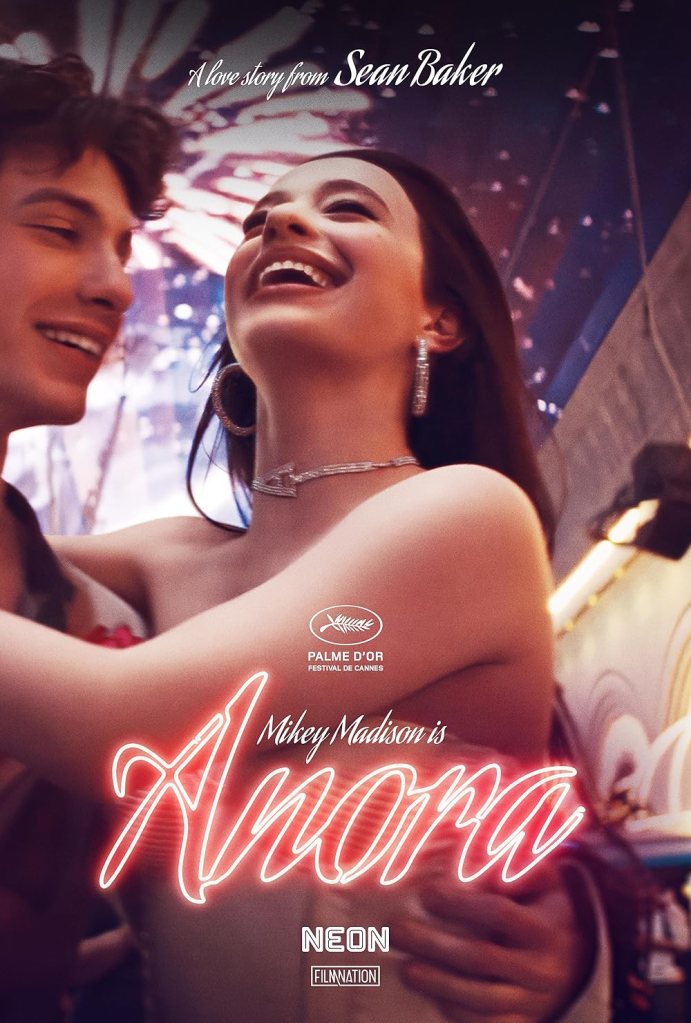
Not just that but Mikey Madison’s beautifully performed force-of-life Ani (real name Anora, but she doesn’t like it) feels far more like a high-end-stripper-and-occasional-sex-worker than Julia Roberts. She’s 24-years-old, living in Brighton Beach and working in a glossy Manhattan strip club. One night the manager asks her to entertain Ivan (Mark Eydelshteyn), the dissolute, immature son of an extraordinarily wealthy Russian oligarch, because she can speak Russian. Ivan is taken with Ani, paying her $15,000 for a week as his girlfriend that peaks (after a hedonistic stay in Las Vegas) in a marriage proposal. Eloping, Ani returns home believing her life has changed forever. That illusion is shattered when Ani’s godfather Toros (Karren Karagulian), and heavies Garnik (Vache Tovmasyan) and hired muscle Igor (Yura Borisov) turn up at their home (really, of course, Ivan’s parent’s home) under strict instructions that the marriage must come to end. Over a long 24 hours of exasperation, farce and slow realisations our Cinderella story collapses.

Anora is a brilliant film, superbly directed by Sean Baker. You’d expect a film of cold-eyed social realism – and there are elements of this in Anora – but it’s also a hugely loveable, charming, surprisingly hilarious and deeply felt film, perfectly paced as its story develops across a series of events that beautifully lead into each other. A lot of its success comes from Mikey Madison’s extraordinary performance, one of those star-making force-of-nature roles where you start off liking her and end up loving her. Madison is warm but prickly and spikey, vulnerable but determined, worldly but naïve, someone who fights her corner to the end but can’t see any change at forming her own future. Madison embodies all this perfectly, switching from wide-eyed naïve delight at her luck, to spitting, incandescent fury when defending her rights, to an increasingly desperate disillusionment mingled with self-disgust as her dreams collapse around her.

Similar to his previous films, Baker presents the world of sex work with understanding and compassion. There is nothing leering about the lens of Anora, even as it opens with a pan (sound tracked to a disco remix of Take That’s Greatest Day) along a row of dancer. Baker understands the professional drudgery of exotic dancing, the hard work and effort needed to give each client the best experience. Ani is a master of ‘put the client first’ patter, her sing-song Brooklyn accent filled with awe at their dull lives, helping her clients believe they are special. What’s striking about Anora is this a world Ani needs to be ‘saved’ from as such – she’s comfortable with her profession, is good at it and understands it’s limits – but it one where she has subconsciously learned her value as a person is directly related to her body and what she is willing to do with it, complex feelings that return at the film’s conclusion with shattering impact.

What she doesn’t truly understand perhaps is people in the long-term. So swept up and impressed with Ivan’s ostentatious wealth, she misses all the clues to his true character. Anyone who still moves around his apartment by letting his feet slide across the floor, who doesn’t know where the water in the house is kept, plays video games obsessively and hurls himself into sex with the rabbit-like intensity of a horny teenager is about a million miles away from the app developer she first imagines he is. Ivan – very well played by Mark Eydelshteyn – might be sweet, excitable and full of joie de vivre, but he’s also staggeringly immature, extremely selfish and barely thinks about anyone other than himself. Or maybe Ani does notice, but she’s so used to being part of a perverse service industry, she assumes this is normal. Ivan may profess to love Ani, but he is the grasping, self-obsession of a spoilt teenager who no-one has ever said no to.

Baker’s care and regard for his characters is beautifully done – in fact what’s striking about Anora is how characters who at first feel peripheral and marginal are organically grow, emerging over time as crucial figures. In fact, what’s striking about it is that it becomes very much a film about class: about the have and have-nots and how all of us – from put-upon fixer to stripper – have more in common with each other than with the super-rich, to whom everyone else are nothing but staff, there to meet their needs. There is only a small degree of difference between the cleaner Ivan teases while she cleans his floors and Ani who he teases while she allows him to get his end away in bed.

This become clear when the film enters it’s hilarious second act, as Ivan’s godfather Toros (a side-splitting performance by Karren Karagulian as man on the verge of a nervous breakdown) can barely hide his resentment at being Ivan’s dogsbody – while still terrified at how his super-powerful parents could ruin Toros’ life in seconds (and clearly wouldn’t think twice about it). Such is their power, Toros leaves his own child’s christening to clean up Ivan’s mess – and its clear he’s been doing this his whole life (his first appearance is easy to miss, ordering Ivan’s drunken friends to get off the sofa at the debauched New Year’s party he throws). Equally good is Vache Tovmasyan as the increasingly bemused Garvik, medicine addled and slowly losing his composure over one never-ending night.

What these characters have in common – along with Yuro Borisov’s Igor, hired muscle like Ani valued only for his physicality – is that to their employers they are less people and more items of furniture or household utensils. Ivan is no different from his tyrannical parents, who may deplore their son’s selfish wastefulness but have never done anything to stop it. Anora’s tragedy (among the comedy) is watching (and Mikey Madison does this beautiful in a series of micro reactions) Ani release only the thinnest slither of affection makes her any different from Ivan’s cleaner. To Ivan, she’s a status symbol – an attractive woman, great in bed who his hangers-on can be impressed by, a tool for rebellion, marrying her the ideal fuck an immature teenager can imagine for the parents he fears and resents.

Baker’s film unfolds all this with astonishing skill, but also an overwhelming energy and joy – and I have to stress again, that Anora’s middle section is hilariously funny, much more so than many conventional comedies – but also an empathy that eventually lands with a devastating and surprising force. Mikey Madison’s extraordinary performance deeply invests in Ani, understanding how her spiky exterior hides a vulnerable interior she rarely exposes. Every performance is outstanding – kudos also to Yuri Borisov who so subtly draws Igor’s quiet decency under his thuggish exterior, that his growing prominence in the film feels completely natural.

Anora is a film that deconstructs the reality of Cinderella stories. But it’s also a film that feels very much about the world today, where all of us have our lives directed and influenced by the super-wealthy in ways we have become so used to, we don’t even notice it anymore. It’s more obvious with strippers, cleaners, fixers and hired muscle. But if Ivan’s parents sank a business, how many families would be drowned in the waves? Under the heartfelt characters, the superbly paced drama, the farce and the emotional moments, Anora captures a universal truth about our modern age that all of us, like Ani, have tried to close our eyes against.

Deadpool & Wolverine (2024)

Deadpool & Wolverine (2024)

Smug, tiresome gags underpin a shallow piece of fan-pandering that mocks fan-pandering

Director: Shawn Levy

Cast: Ryan Reynolds (Deadpool), Hugh Jackman (Wolverine), Emma Corrin (Cassandra Nova), Matthew Macfadyen (Mr Paradox), Morena Baccarin (Vanessa Carlysle), Rob Delaney (Peter Wisdom), Leslie Uggams (Blind Al), Aaron Stanford (Pyro), Dafne Keen (Laura), Jon Favreau (Happy Hogan)

Deadpool is Marvel Jesus. It’s a joke in the film, but it’s also kinda true. The MCU has struggled in the past few years and it’s hoping the raw-and-ready sociopathic, fourth-wall-breaking merc-with-the-mouth can give its fortunes a jolt. In terms of money take, Deadpool & Wolverine is, I guess, going to do that. In terms of creativity and imagination, we’re still circling the toilet bowl, but hey at least Feige and co are doing it while clutching a wadge of greenbacks.

You say Deadpool’s constant fourth-wall leaning jokes ain’t really funny and that all they do is point out (and neutralising criticism in advance) weaknesses in plot and writing: but that toilet bowl gag was a bit of a turd right?

Wade Wilson aka Deadpool (Ryan Reynolds) has been rejected by the Avengers on Earth-616 “The Sacred Timeline” (otherwise known as the one the MCU happens in) and returns to his friends on Earth-10005 (otherwise known as the 20th Century Fox X-Men Franchise timeline) to retire and work as a used-car salesman. Until he is grabbed by the Time Variance Authority and informed by Mr Paradox (Matthew MacFadyen) his universe is being erased, due to the death of its Anchor Being Wolverine (Hugh Jackman) in Logan. Deadpool’s only chance to save his universe is to find a new Wolverine, eventually pulling in “the worst Wolverine” who failed to save his world. Both are banished to “The Void”, a resting place for “erased” heroes from earlier timelines (aka cancelled movie franchises) run by Cassandra Nova (Emma Corrin), the insane sister of Charles Xavier.

You made that tough to follow on purpose, you absolute bell-end. Ain’t you funny!

Flipping heck. If you think that sounds like a lot going on, don’t worry: it hardly matters. For Deadpool & Wolverine the story is just a very loose framework for a series of slightly smug in-jokes about nineties and noughties nostalgia, and gags about corporate mergers. (In case you missed it, Disney bought 20th Century Fox and swallowed its comic book franchises like a money-Moloch). This matters an awful lot to some. Many others won’t care less. Deadpool & Wolverine very much tailors to the first group. If telling gags about Disney’s caution about jokes on drugs and anal sex, or riffing on the X-Men movies being less-and-less good over many years, sounds like your idea of comedy gold then this is for you.

Moloch and anal sex in the same paragraph – well-read show-off who wants to look cool ain’t ya?

Deadpool & Wolverine prunes a lot of comic mileage (or tries to) from mocking the “special sock” longings of geeks and fanboys, those who wile away hours debating who’s costume looked best or who could beat who in a fight. But this is a film mocking shallow, fanservice wank while itself being a massively shallow, fanservice piece of wank. If the only thing you felt was missing from Hugh Jackman’s previous Wolverine career was that he never wore the yellow-and-blue uniform, then this is the movie for you.

You were so pleased with that fanservice comment I saw you use it several times in Whatsapp hot takes. Twat.

Deadpool & Wolverine mocks fans for their shallow love for the obvious easy hit of seeing Deadpool and Wolverine fight, or a cameo from a well-known actor from an old movie or a celebrity playing a different version of a familiar character, then fills the film with almost literally nothing but this. Am I really meant to get excited seeing an actor revive a comic book role from a noughties superhero film we’ve forgotten and everyone at the time thought was rubbish? For all Deadpool & Wolverine wants to feel like something cheeky and dirty, it’s the safest slab of product out there. Every single thing in it feels like it has been cribbed from a fan’s wishlist on a Reddit thread. It feigns cocking a snook at Disney, but Deadpool is just an in-house jester: tweaking his master’s nose while taking a pay cheque and avoiding anything really pointed in his barbs. After a while you just get tired of it and the film’s embrace of cliché and retreads isn’t justified by Deadpool turning to the camera and pointing it out.

Getting up a head of righteous steam there ain’t you? Still paid to see it didn’t you! Sucker!

Still at least it’s better than when the film tries to have a heart. I’d respect it more if it was willing to make Deadpool a flat-out psychopath with no real sense of morals. Instead, he’s really all (very tiresome) talk, because Deadpool & Wolverine is desperate to turn him into someone the masses can find sympathetic by mixing his mook slaughter with emotive mooning over a group polaroid of the friends he’s trying to save from erasure from existence. Much like Ryan Reynolds’ performance, it often feels like filmmakers enjoying the shock quality of shrieking “FUCK” in a park, before running home to an early bedtime with their families.

Chickened out of writing the C-word there? Guess you don’t want to get blocked.

Deadpool & Wolverine opens with assurance it won’t ‘desecrate’ the legacy of Logan (an actual, good film with a proper story and emotional arc) – before, in one of the film’s better jokes, it has Deadpool dig up the skeleton of the dead Wolverine and use the bones to bloodily slaughter an army of TVA mooks. But then it desecrates it in a different, deliberate, even worse, way by ripping Logan off with shameless abandon. It gives Wolverine pretty much exactly the same plotline, including restaging almost identical emotional conversations, in almost identical locations. In fact, my overwhelming emotion watching Hugh Jackman snooze through this film with a growl was sadness that he came back after his perfect sign-off. But then I guess he get over a dozen million reasons to come back and prostitute himself here for one last runaround.

Like Deadpool doesn’t make that joke himself in the film – if you’re going to knock it, don’t rip it off!

Maybe he thought it was funny. It does feel like a home movie put together by a series of actors in their forties or fifties desperate to show their kids they can do something cool. Is there anything good in Deadpool & Wolverine? There are some good fights, even if Shawn Levy isn’t the best at staging them, but it does spray claret marvellously all over the place to well-chosen Madonna tunes. Matthew MacFadyen, essaying a cartoonish version of Succession’s Tom Wambsgans, is good fun, Emma Corrin makes an effective if under-used villain. There are some good jokes.

Because you gotta give some sugar right?

But the overwhelming air is smugness. None of the fourth-wall, franchise-teasing, corporate digs are that funny and very few of the asides carry any bite (several are about how handsome or muscular its stars are – the only remotely sharp comment is on Hugh Jackman’s divorce). Aside from that it offers nothing new or familiar, its setting is reminiscent of several other films, and it rips off plot galore from Logan and TV’s Loki show. Perhaps worst of all, in a year where an actually original and daring film Mad Max: Fury Road has fatally tanked at the box office, this openly rips off its location and style for The Void and it’s going to make millions.

It’s not as if you were even wild about Furiosa, but like the sanctimonious prick you are, you’ll give a pass to a film from an auteur but then knock a Marvel film. What makes you such a smug, humourless prick eh? Go with the fun!

Look for the last time, it’s not big, clever or funny to just milk some cheap gags out of anticipating the criticism. That’s enough. Fuck off now.

Touchy!

No seriously. Fuck off.

Hit Man (2024)

Hit Man (2024)

Inventive, playful, funny, sexy and dark this fabulous dark comedy changes gears with confident ease

Director: Richard Linklater

Cast: Glen Powell (Gary Johnson), Adria Arjona (Madison Figueroa Masters), Austin Amelio (Jasper), Retta (Claudette), Sanjay Rao (Phil), Molly Bernard (Alicia), Evan Holtzman (Ray Masters)

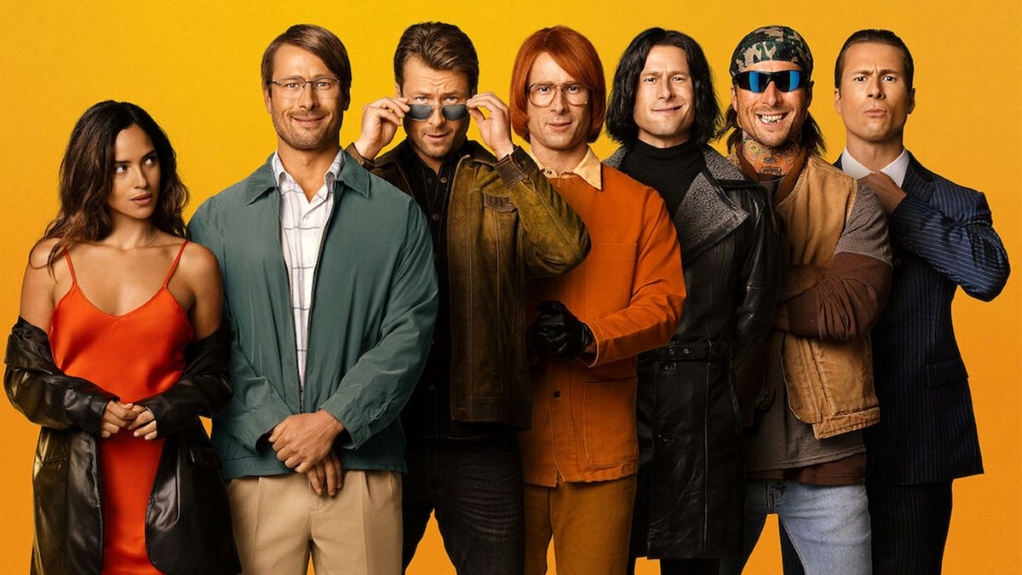
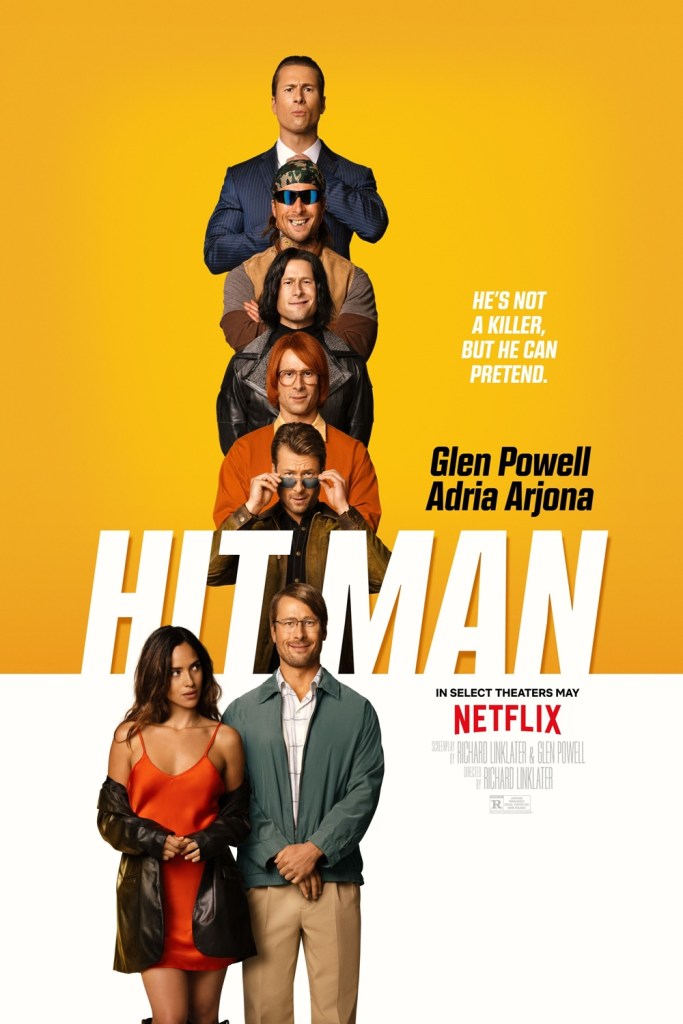
You might not want to hear it, but despite what the movies say there is no such thing as a hit man. In New Orleans, if you are talking to a mysteriously charismatic man who offers to take care of your ‘personal problems’ for a wedge of cash, you are probably confessing your desire to conspire to murder to a police agent. That agent would be mild-mannered psychology professor Gary Johnson (Glen Powell), a bland forgettable person who discovers a hidden talent for charismatic role-play, using his psychological skills to create a persona specific to his target. On a job, Gary becomes attracted to Madison (Adria Arjona), first dissuading her from ‘hiring him’ to kill her husband and then starting a relationship with her ‘in character’ as ‘Ron’. But relationships prove to be as risky for fake hit men as they would be for real ones.

To say where Hit Man, Linklater’s darkly twisted rom-com, heads would be to spoil it (let’s just say I didn’t see where it’s going) and the journey is a fabulous ride. Linklater and Powell collaborated on a (heavily) fictionalised version of this true story and pull together a smart, sexy, witty and at times surprisingly dark film, which make some shrewd points about the extent to which we choose and shape our own identities. Hit Man sees Linklater so confidently shift tone and mood within scenes, that you almost don’t notice how smoothly the film travels from farce to psychological insight to Postman Always Ring Twice sexiness to screwball wit to morally shady action. It’s a terrific ride.

It’s also a superb showcase for Glen Powell, who co-wrote the screenplay with Linklater. This should be a star-making role for Powell, in which he deftly plays mild-mannered and timid and darkly charismatic, often in the same scene. What’s so superb about Powell’s performance is how fluid it is, his two personalities (mild Gary and confident Ron) overlapping and merging into each other from moment-to-moment, or switching in response to sudden changes of situation. Powell and Linklater carry this out with real subtlety from moment to moment but watch the first scene and the last and you immediately notice the difference in our lead from the man we met at first.

Powell is both extremely funny – sequences showing the dizzying array of characters (from red necks to prissy Snape-ish goths) he becomes to lure in his targets are hilariously done – but also wonderfully engaging. Beneath the surface, it’s clear Gary is thrilled by how differently he is perceived when he becomes ‘Ron’, grinning as he overhears his police colleagues confess how exciting and sexy ‘Ron’ is compared to boring bird-watcher Gary. He finds he takes on a whole new confidence – and accompanying sexual prowess – as he throws himself into a dizzyingly sexual fling with Madison, who is also far more excited about the prospect of illicit sex with a killer than she probably would be with sweet rumpy-pumpy with a tenured psychology professor. Powell captures this all wonderfully, throwing himself into a tangled web of deceit with gleeful gusto.

Adria Arjona is similarly excellent as Madison, a woman who becomes harder and harder to read as the film continues. Its early stages really feels like a traditional rom-com – except the ‘meet cute’ features one person trying to hire another for murder, before they charm each other with cat puns – but the relationship shifts as much as the film itself does. Madison seems to come to life, filled with sexually excited recklessness, as she spends time with Ron. But Arjona is able to imply half a dozen things under the surface: is Madison a downtrodden girl enjoying a brush with danger, or is she some sort of manipulative femme fatale?

Linklater uses this to maintain a real high-wire tension in the film, which increasingly becomes impossible to predict. Both Gary and Madison are playing with fire here. If Gary’s dalliance with a former ‘client’ is discovered by his superiors – or if a chance encounter unmasks him to Madison – hell knows what might happen next. And can he keep the pretence that he is capable of ruthless, skilled violence, something much harder to do when your date takes you to a firing range and asks you to teach her? And what is Madison’s game, as it emerges that her break with her boyfriend isn’t as clean as she suggests it is – does she have something in mind that Gary isn’t prepared for?

Hit Man balances this brilliantly with the comedy, in one of Linklater’s most delightfully off-beat films, expertly played by Powell and Arjona. It’s underpinned with a deftly layered thematic message. Throughout we are reminded, by Gary’s psychology lectures to his increasingly engaged students, that people balance their own ids and egos and eventually ‘choose’ where they land. In doing so they create their own personality. It’s what we realise we are watching in this film. Both Gary and Madison decide they like more than a few of the elements of the people they are pretending to be – so why not mix them into their own personality? Suddenly they find themselves effortlessly capable of things they never thought possible – yet still embracing passions their playful alter-egos would find dull beyond belief.

It leads to a surprisingly ending that comes from left-field, but we realise we have been prepared for by Linklater and Powell almost from the film’s opening moments. It makes for a supremely entertaining and rewarding film, brilliantly played by its two leads (and it bears repeating that Powell is sensational here), with excellent support from Austin Amelio as a sleazy cop and Retta and Sanjay Rao as Gary’s more playful police colleagues. Hit Man is a dynamic, funny, sexy and surprising treat.

The Producers (1968)

The Producers (1968)

A funny gag sits at the heart of a film that’s more cheeky than really funny or clever

Director: Mel Brooks

Cast: Zero Mostel (Max Bialystock), Gene Wilder (Leo Bloom), Dick Shawn (Lorenzo St. DuBois (L.S.D.), Estelle Winwood (“Hold Me! Touch Me!”), Christopher Hewett (Roger De Bris), Kenneth Mars (Franz Liebkind), Lee Meredith (Ulla), Renée Taylor (Eva Braun), Andreas Voutsinas (Carmen Ghia)

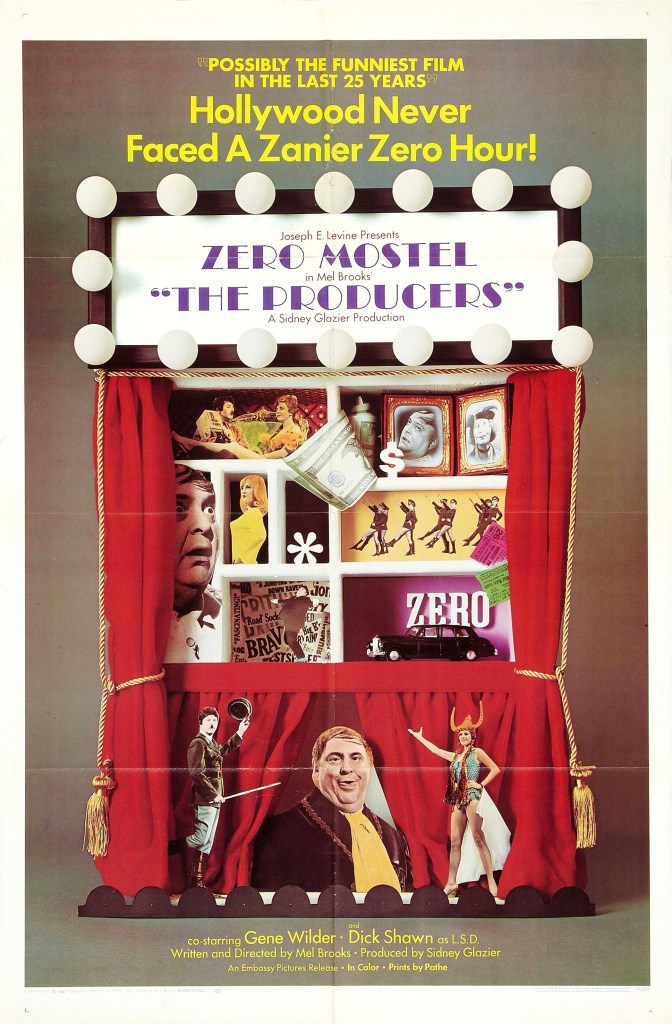
“Don’t be silly, be a smartie/Come and join the Nazi Party!” The cheek of a knockabout musical Hitler musical is the sort of stroke of genius only Mel Brooks might have come up with (and got away with). It’s the saving grace of The Producers, an otherwise rather pleased with itself, slight film whose cheeky gags look like they are taking a pop at sacred shibboleths but actually conform rather neatly with common (at the time) perceptions of women, homosexuals and randy old people. So much so, the film looks more braver and cheekier today when its relatively innocent sexism and homophobia comes across as cheeky tasteless fun rather than pretty much being par-for-the-course.

Max Bialystock (Zero Mostel) is the least successful producer on Broadway. But perhaps he can turn that to his advantage when neurotic accountant Leo Bloom (Gene Wilder) points out that overselling shares of a guaranteed flop can make way more money than a hit. They just need a play that will definitely bomb: what better choice than Springtime For Hitler, a ludicrous musical tribute to Hitler written by dim Nazi Franz Liebkind (Kenneth Mars). Just to make sure they get the bomb they need, the duo hire talentless camp director Roger de Bris (Christopher Hewett) and stoned hippie lead (Dick Shawn). What could possibly go wrong? Or, rather, right?

There is a wild comic zaniness to The Producers epitomised by Zero Mostel’s manic energy as Max, a sleazy, sweaty mass of greed and self-obsessed vanity, totally devoid of any sense of shame. The Producers gets away with a lot because, like Max, its utterly shameless and frankly doesn’t give a damn what you think. Whether you find it hilarious or not depends on how much you are taken by provocative humour and scattergun cheekiness. There is an end-of-the-pier quality at the heart of The Producers (in the UK it would have been Carry On Up Broadway). Brooks doesn’t miss an opportunity for smutty postcard humour. It’s all so naughty he gets away with the ridiculousness of a Hitler musical.

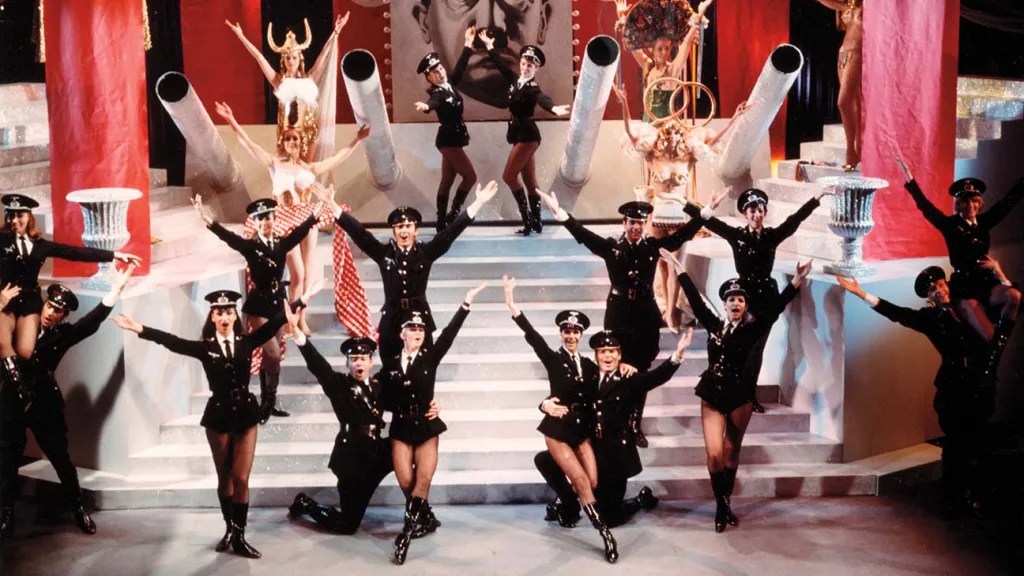
A Hitler musical that wisely satirises the Nazi’s Riefenstahl showmanship via ludicrous Broadway choreography (including tap dancing stormtroopers forming themselves into dancing swastikas). Of course, Brooks is clever enough to keep the actual content of the musical purely on a surface level (no talk about what the Nazis actually did beyond aggressive militarism) – combined with Hitler portrayed as a bumbling Hippie full of the streetwise slang of pony-tailed sixties counter-culture. At heart, Springtime For Hitler doesn’t really do anything really more shocking or provocative than put blackshirts into 42nd Street. It also carefully distances itself from the antisemitic elephant-in-the-room by having Bialystock and Bloom rip off the swastika armbands they agreed to wear while wooing Liebkind, throwing them in a bin and spitting on them. It’s a neat balance that allows the film to get away with as much as it does, while never touching the nightmareish darkness of the regime.

Of course, it helps that Brooks is one of Hollywood’s most famous Jews – and that Mostel and Wilder delight in leaning into a very Jewish comedy about a couple of shmucks enjoying being rogues. Wilder in particular is fantastic. While Mostel is at times be a bit much, Wilder’s hilarious snivelling childish timidity (he’s obsessed with a comfort blanket, the loss of which turns him into a mass of bleating despair) ‘blooms’ into the delight of an eternal good-boy finally allowed to be naughty. Wilder gets the balance just right between something larger-than-life and something real and when he talks about Bialystock being his first and only friend, it’s strangely moving.

Wilder, alongside the scenes taken from Springtime For Hitler, provides most of the humour. I’ll be brutally honest – I’ve never found much of the rest of The Producers funny. Nearly every other joke in the film relies on smut and cheek. Bialystock makes what money he does from pimping himself to randy octogenarians (never men obviously, that would be too risqué), and The Producers buys heavily into the idea that the sex lives of anyone over the age 60 is hilarious. It’s a cheap and rather repetitive joke, made over-and-over that Zero Mostel just about manages to sell because he embraces Bialystock’s utter lack of restraint. But it’s a one-note joke that outstays its welcome.

The Producers similarly makes rather obvious, one-note, jokes about all its female and gay characters. (Again, at the time much of this would not have been out-of-the-ordinary, so it actually looks more bizarrely more boundary pushing today). Ulla, Bialystock’s Swedish secretary, is a blonde sex-bomb whose recurring joke is her oblivious sexiness and willingness to burst into erotic dancing at the drop of a hat. She’s explicitly hired by Bialystock as a glamourous piece of eye candy ‘toy’ as a reward for his self-pimping and it’s not particularly funny. Also not particularly funny is the play’s director, a cross-dressing, mincing figure of camp satire played by Christopher Hewett, the main joke being he is a ridiculously overblown queer who wears a dress. Kenneth Mars’ Franz Liebkind – a ridiculous relic of the Reich, incompetent at pretty much everything he attempts – is slightly more amusing, if only because he’s utterly oblivious to his complete uselessness.

Brooks’ film is, you suddenly realise, rather slight. At around 80 minutes, it’s heavily reliant on its show-stopping glimpses of the Nazi musical (and even in that Dick Shawn’s Hipster swagger isn’t as funny as the Broadway parody) and aside from that relies on predictable farce, cheek and smut. Only Gene Wilder really transcends the material with a perfectly timed, strangely touching performance. Other than that, it feels like a film trying very, very hard to be a little bit-naughty, like an over-extended student revue sketch. But “Don’t be silly be a smartie/Come and join the Nazi party”? That is funny.

Monty Python and the Holy Grail (1975)

Monty Python and the Holy Grail (1975)

The Python’s finest hour is a hit-a-minute medieval comedy that I never fail to laugh at

Director: Terry Gilliam, Terry Jones

Cast: Graham Chapman (King Arthur), John Cleese (Sir Lancelot/The Black Knight/French Taunter/Tim the Enchanter), Terry Gilliam (Patsy/ Soothsaying Bridgekeeper/The Green Knight/Sir Bors), Eric Idle (Sir Robin the-not-quite-so-brave-as-Sir-Lancelot/Concorde, Dead collector/Roger the Shrubber/Brother Maynard), Terry Jones (Sir Bedevere the Wise/Prince Herbert/Dennis’ mother), Michael Palin (Sir Galahad the Pure/Leader of the Knights Who Say Ni/Lord of Swamp Castle/Dennis), Connie Booth (Miss Islington), Carol Cleveland (Zoot/Dingo)

I’ve sometimes found the surreal, satirical and sometimes plain silly humour of the Monty Python troupe hit-and-miss. But when it lands, it really lands and Monty Python and the Holy Grail may well just be their finest hour. Essentially a series of sketches loosely worked together into a sort-of-plot, but never taking itself too seriously, it’s an often-inspired collection of highly influential gags delivered by a troupe of performers at the top-of-their-game (it’s hard to believe that they have all said shooting the film was a tough, punishing and exhausting process).

What Python got right here is how easy – and hilarious – it is to poke fun at something so very po-faced and serious as medievalism had a tendency to take itself back then. In fact, it’s perhaps a lasting tribute to the film that no-one has ever been able to take it quite as seriously since. Monty Python and the Holy Grail also lines up shots at the arthouse high-brow seriousness of films like Andrei Rublev and, most famously, The Seventh Seal (those hilarious, moose-obsessed, opening credits are a flawless take-down of Bergman’s portentous opening) but also a dismantling of the likes of Bresson’s Lancelot du Lac (no-one can watch that film’s opening now without picturing the Black Knight protesting ‘It’s a only a flesh wound!’ as crimson spray flows freely).

I love Holy Grail. It’s practically designed for undergraduates to sit around and watch, while getting slowly pissed and then spend ages quoting at each other. Many of its jokes lean into bizarre surrealism and funny sounding words – “shrubbery!” just sounds funny, even more so when it’s squeaked out by a giant Michael Palin in a ridiculous helmet affecting a rhotacism. And the Pythons knew how to turn problems into genre-defining gags: thank God they couldn’t afford horses, so instead came up with the frankly genius idea to just mime the knights riding horses to the sound of two coconut halves being visibly tapped together by their squires.

And then to have the comic presence of mind to riff on enforced ideas like this so much (just how did coconuts turn up in medieval Britain?) that for generations, fans will ram their tongues earnestly into their cheeks debating the migratory habits and air speeds of laden and unladen swallows. It’s all part of a superbly written script, which get just the right balance between Thomas Mallory-esque medieval rhythms laced with nonsese ( “The swallow may fly south with the sun or the house martin or the plover may seek warmer climes in winter, yet these are not strangers to our land”) and a mix of anachronistic casualism and simmering middle-class frustration. All the time in Monty Python and the Holy Grail there are traces of the sort of serious, played-dead-straight, medieval film this could be, making the constant punctuation of surreal, fourth-wall leaning, silliness all the more hilarious.

A lot of this also comes down the highly skilled comic playing of the troupe. Graham Chapman, in particular, has the seemingly dull job of playing the straight-man. But his ability to play, even the most ridiculous encounters, with complete earnestness is crucial to the film’s success. Arthur is, really, a ludicrous figure, but Chapman knows he can never acknowledge this for the joke to work. Hilariously, the legendary king here becomes a sort of put-upon middle-manager, constantly frustrated while going about his day job, dumb enough to be unaware of how absurd he is, but smart enough to get frustrated at the increasingly dim antics of his followers.

It also allows the rest of the troupe to let rip with broader comic performances, all of whom have a whale of a time. John Cleese’s pompous bossiness and control-freak mania is perfect for the psychotic Sir Lancelot while his latent comic cruelty, combined with a passion for silly accents and walking, is perfect for the famed French taunter (the funniest Frenchman on screen). Palin’s goodie-two-shoes decency is great for the tempted Sir Galahad while his brilliant capacity for deluded self-importance nails the Lord of Swamp Castle – and who else could have taken such an impish delight in the Trotskyist mantras of the socialist peasant Dennis? For the rest of the troupe, Eric Idle’s mix of cheek, dressed-up poshness and wimpy weakness is expertly used while Terry Jones mocks academia as Sir Bedevere and whines brilliantly as Herbert. And no-one does dirty better than Terry Gilliam.

Gilliam and Jones also directed, allegedly not always harmoniously neither quite agreeing if this was a film or whether it was a comic show. But the presence of Gilliam behind the camera probably accounts for why this is the most visually striking Monty Python film, with mists rolling over the hills and the Scottish locations given a mythic power which makes the silly jokes that happen all around them even funnier – while Jones’ medievalist background surely helped define the film’s surprisingly authentic (and therefore even funnier) feel. Holy Grail also very successfully disguises that it was effectively all shot in one or two locations (Doune Castle is shot from so many angles it becomes about a dozen different locations).

But what really makes Holy Grail work is the quality of the jokes. And it opens with a run of gags of such consistent quality they are perhaps unparalleled in Python’s work. The Swallow debate. Bring Out Your Dead. Peasants nailing the ‘self-perpetuating autocracy’. The flesh wounds of the Black Knight. The witch trial. The French Taunter (“Your mother was a hamster and your father smelled of elderberries!”). The Trojan Rabbit. Camelot being a silly place. The opening half of the film is one piece of solid comic gold and if the second half doesn’t have quite the same hit rate, it’s still more than funny enough.

And funny is what it is all about. You can say ‘it doesn’t have as good a plot as Life of Brian’. You can say it just ends, as if the troupe ran out of ideas. You can say it loses a steam. But it doesn’t matter when you laugh and laugh time and time again at its best bits. And you really do. And people who encounter it at the right age, will go on laughing at it for the rest of their lives., for decades to come.

The Big Chill (1983)

The Big Chill (1983)

Heart-warming, engaging and moving ensemble drama, low-key and all the better for it

Director: Lawrence Kasdan

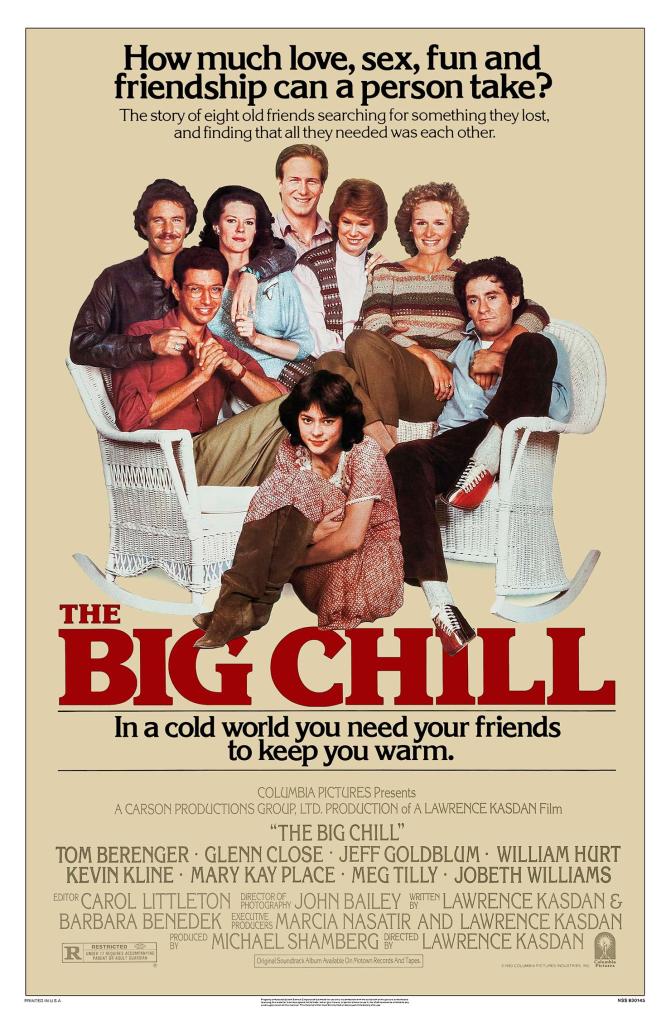
Cast: Tom Berenger (Sam Weber), Glenn Close (Sarah Cooper), Jeff Goldblum (Michael Gould), William Hurt (Nick Carlton), Kevin Kline (Harold Cooper), Mary Kay Place (Meg Jones), Meg Tilly (Chloe), JoBeth Williams (Karen Bowens), Don Galloway (Richard Bowens)

Growing up is hard, isn’t it? The older you get, the harder it is to cling on to the idealism of your younger days. The past can wind up feeling both very familiar and a very different country indeed. It’s something a group of thirtysomething college friends start thinking about when they gather for the funeral of their friend Alex (the famously cut-from-the-film Kevin Costner, seen only via close-ups of his hands and chest while being prepped by an undertaker). Spending a weekend together they reminisce, argue and remind each of why (and if they are still are) friends.

Kasdan’s sharp script, full of sparkling dialogue and rich (if at times familiar) character arcs attracted a smorgasbord of the cream of 80s American film acting, all of whom give fabulously relaxed, extremely genuine performances, largely devoid of grandstanding. The disparate range of career and life-choices the friends have made influenced an armada of ‘college-reunion’ stories, but it’s a trope that works because Kasdan knew it offered such a rich potential for drama.

The Big Chill is the definitive ensemble piece, delightful because it’s structured not around heavy-handed, overtly dramatic clashes, but everyday conversations full of observational humour and low-key emotional truths. There isn’t really a plot as such in The Big Chill: the pleasure comes from Kasdan pulling off the near-impossible trick of making us feel we have been invited to share the fun rather than watching, with our noses pressed up against the window, a film where the actors are having more fun than us. The Big Chill feels truthful, universal and eventually moving because it is so down-to-earth. We’ve all had social groups where we feel absolute loyalty and love for its members, while still being capable of finding them earth-shatteringly infuriating.

Most of them have traded their youthful idealism to change the world for a Reaganite cash-grasping. Sam (Tom Berenger) stars in a hit Magnum PI style TV drama. His former partner in left-wing politics Harold (Kevin Kline) owns a successful running shoes business (named Running Dog in a subtle pop at his own selling out) while his wife Sarah (Glenn Close) is a successful doctor. Michael (Jeff Goldblum) writes shallow celebrity pieces for glossy magazines, Meg (Mary Kay Place) has traded being a public defender for real-estate law. Karen (JoBeth Williams) wanted to be a writer, but instead married an ad executive Richard (Don Galloway).

All of them feel their late friend Alex represents the path they could have taken: a genius scientist who turned down all academic promotions to focus on social work and his old principles. Not that this seems to have made Alex happy. The most like Alex’s seems to be Nick (William Hurt). A former radio-psychiatrist, left impotent after Vietnam, who jacked in his career and is now a drifting drug addict. It’s never quite said, but you can feel the concern of the rest of the group that Nick feels destined to be the next funeral they gathering for.

Much of the tension comes from Nick – largely because he feels more willing to touch nerves the rest are happy to leave unprodded. This is a group that works hard to maintain harmony – after all, Sarah’s affair with Alex hasn’t dented Harold’s genuine grief or his love for his wife, and no one else wants to address it. But there are clear tensions and resentments under the surface: small grudges or irritations many perhaps coming from that uncomfortable feeling of the group seeing their own self-recriminations reflected back at them in their friends faces.

Nick is the only one who raises the scary spectre that decade-old events hold this group together, not their lives today. If they all met for the first time now, would they even be friends? Nick is also willing to take pot-shots at their tendency to self-pitying regret and to provoke the romantic and sexual tensions the others are happy to keep unremarked or compromise on. (Even Jeff Goldblum’s seemingly provocative Michael, avoids trouble by scrupulously taking nothing seriously.)

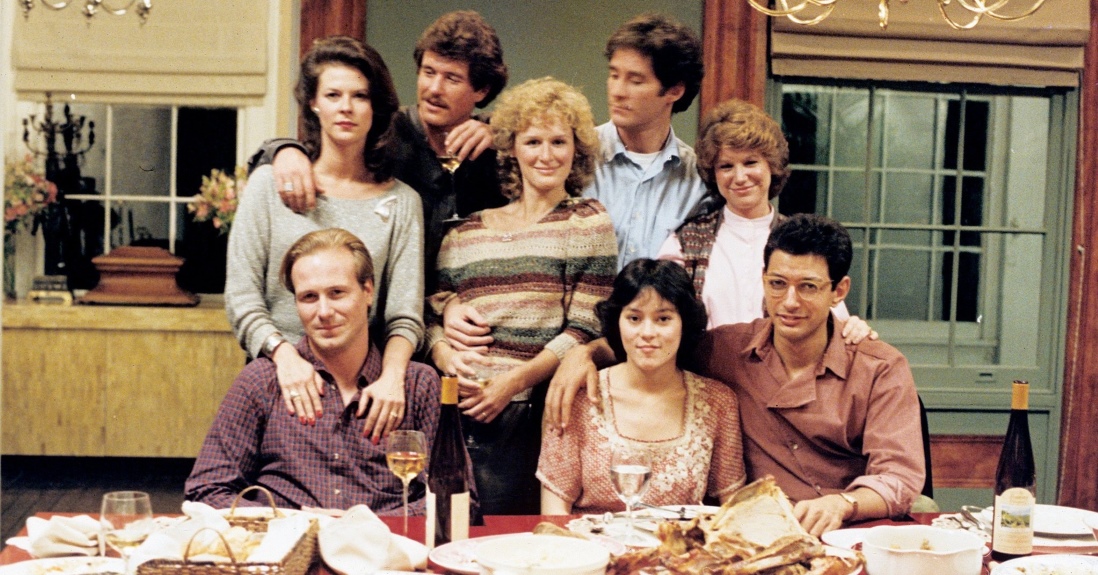
What makes The Big Chill such a lovable film, despite this, is this doesn’t fracture the group but are islands of tension within a sea of genuine friendship and warmth. Kasdan’s insistence that the company spend a longer time than usual in rehearsal – famously the cast cemented their chemistry via an almost five-hour, Mike Leigh-style, in-character improvisation, involving cooking and eating a dinner together – paid off in spades. They genuinely feel like life-long friends, sharing in-jokes, teasing each other, looking out for each other and making generous offers of help.

There is a lot to laugh at because it feels so universal. We’ve all mucked around with friends while cooking and cleaning. When the group gather to teasingly cheer along with the opening credits of Sam’s cheesy TV show (to his good-natured embarrassment) it makes us laugh because we recognise the affection. The hilarious absurdity of Harold, Nick and Sam chasing a bat out of the attic feels real. Just as the emotions hammer home – Harold’s grief in his eulogy for Alex, Sarah’s tears at a meal, Nick’s tragic middle-distance gloom or Karen’s private ennui among her friends.

It’s all helped by superb performances. JoBeth Williams is excellent in, arguably, the film’s most challenging role, deeply unhappy with where her life has gone, wanting to pretend she can seize the day but not having the conviction to see it through. Goldblum is drily witty but distant as the group’s closest thing to an outsider, Berenger affectingly modest at his sell-out success, Place quietly desperate as a woman whose body clock is ticking down. Kline is very funny and sweet as a man desperate to help those around him, while Close in the flashier (and Oscar-nominated) part as the group’s nominal ‘mother figure’, far more deeply affected by Alex’s death than she is willing to let on.

Perhaps best of all is Hurt, vulnerable, gentle and quietly lost as Nick, his pain manifesting itself in occasional bear-prodding outbursts, but who will quietly apologise the next morning with a gentle, unremarked hug. He also forms a warm and genuine bond with Alex’s younger girlfriend Chloe, played with a sparky energy by Meg Tilly, who (not surprisingly) sees a lot of Alex in him.

Kasdan’s film gently explores the tensions of a group of adults unsure about where their life has taken them, but it does so in a warm and charming structure that makes us really care for the characters all of whom are expertly and humanly drawn. It’s lack of explosive melodrama is a large part of its success, helping ground the film as something relatable that we can feel a real bond with.

Challengers (2024)

Challengers (2024)

Dynamic, mature, hilarious and moving relationship drama, an absolute delight

Director: Luca Guadagnino

Cast: Zendaya (Tashi Duncan), Josh O’Connor (Patrick Zweig), Mike Faist (Art Donaldson), Darnell Appling (New Rochelle Final Umpire), AJ Lister (Lily Donaldson), Nada Despotovich (Tashi’s mother), Naheem Garcia (Tashi’s father), Hailey Gates (Helen)

Tennis superstar Art Donaldson (Mike Faist) is on the slide after six majors – he’s lost his click and can’t even struggle past up-and-comers from the lower rungs of the tour. His coach, manager and wife Tashi (Zendaya) has an idea for how to get his groove back: he’ll enter a lowest-rung Challenger tournament, chalk up an easy win and return to confidence. Problem is, Art’s estranged former friend and doubles partner Patrick Zweig (Josh O’Connor) is also in the tournament and the two of them now line up for a grudge match in the final. But there is more going on than meets the eye, as Guadagnino’s film unfolds in a non-linear style to reveal the complex, confused and frequently ambiguous sexual, emotional and sporting tensions that have beset the three over 13 years.

Challengers feels like it might be a ripe piece of teen click-bait fluff – but reveals itself to be a whipper-sharp, funny, involving and cleverly open-ended film stuffed full of excellent dialogue by Justin Kuritzkes that frequently catches you off-guard with its plot developments. Challengers is a thrillingly mature, adult and very truthful exploration of the underlying attractions and tensions between three people, all of whom seem confused about their exact feelings and motivations.

What is clear – as made explicitly clear by an intensely erotic late-night encounter in a hotel room between the three of them thirteen years earlier – is the rich, unspoken attraction they all share. Art and Patrick are strongly attracted to Tashi, she seems equally interested in different aspects of each of them, while Art and Patrick’s homoerotic bond (clued in before this by their affectionate, casual physical intimacy as well as their intense celebrations on winning the Junior US Open) is immediately clear to the savvy Tashi and briefly embraced by the two men.

Sport – particularly mano-a-mano games like tennis – has an undercurrent of sexual energy to it. Adrenalin-filled men pounding away at each other from across the net, bodies glistening with sweat? Teammates grasping each other in victory with an intensity often beyond anything they would show to a romantic partner? Challengers explores how close a dance sport and sex is, the remarkably similar effects both have on our bodies. It’s what Tashi – a former tennis sensation whose career was ended in tragic circumstances – is getting at when she says the best tennis matches aren’t about tennis. They are semi-romantic couplings, the perfect rally being two bodies in perfect harmony.

This all develops thrillingly in the inter-relationships between the three leads, each excellent. Zendaya is superb as a woman forced to live her tennis dreams vicariously through her husband, who values the loyalty of Art while being quietly troubled by his neediness, infuriated by Patrick’s arrogant performative selfishness while being deeply attracted to his don’t-give-a-damn independence. She has a tight knot of tension throughout that is compelling, a constant sense we are watching a woman struggling to find some sort of resolution from a lifetime of competing resentments and desires.

Equally superb – revelatory in fact – is Josh O’Connor, who makes Patrick a cocksure, confident, selfish but immensely charming guy. Patrick scraps a career from natural skill that he never bothered to hone (witness his bizarre crooked-arm serve), embraces his sexual confidence, bounces around with a breezy bro-confidence and does everything he can to hide the lonely, lost boy he really is. This is breathtaking work from O’Connor, from hilariously funny when shamelessly pimping himself on tour for a roof over his head, and tragically vulnerable in bashful confessions with Tashi.

Mike Faist has the least flashy role but is equally wonderful. Art is – if you will – the most closeted of the three, the least confident, most dutiful, who dedicates himself to things and doesn’t stop to think deeply about his true feelings. You suspect the unspoken intense romantic bond between Art and Patrick remains unspoken in their youth because Art himself is uncertain (scared?) about what he feels. Just as he buttons up and represses his own resentments and anger towards Tashi.

Challengers switches and re-aligns these characters beautifully and constantly leaves us guessing. When Tashi (and by extension Art) refuses to see Patrick after her injury, is this because she genuinely blames him for unsettling her before the match or because she just needs something other than random chance to blame? Does she drive Art into becoming a Grand Slam winning machine out of love, a vicarious desire for success or anger (as she shapes into something he isn’t) because she blames him as well? Does Art know or care? Does he realise how much his depression comes from severing connections with his alter-ego Patrick and does Patrick slog it out on the circuit because it’s the only way he can still feel in-any-way close to the only two people he loves (but won’t admit?).

Watching all this unfold, seeing each scene reveal a new piece of information that refocuses what we thought about each character, is compelling – helped a great deal by the vibrant, emotional and intensely sympathetic performances from the three leads. Challengers is also a superbly assembled film, sharply and snappily edited and with an electric, emotionally well-judged score by Trent Reznor and Atticus Ross that skilfully uses refrains to link back to key emotions and sensations. It’s also a film that shoots tennis more electrically than any other. With sweeping crane shots, hand-held camera and every trick in the book, we see matches from the perspective of everything: the players, the ground, even the ball itself. It’s stunningly visually inventive.

It culminates in a truly wonderful, open-ended, emotionally satisfying ending that I actively adored. It’s a film about love, about three people who feud over petty things for years but need each other to be complete, who find there are elements of each other’s personalities that serve to complete themselves. Who are fiercely sexually attracted to each other, but also have a deep, intense emotional bond they need more than they realise. Challengers is an absolutely gorgeous, delightful, superb film – another emotional, mature triumph from Guadagnino, with three brilliant actors working wonders with a sharp script. It’s a film to love and treasure.

The Bells of St Mary’s (1945)

The Bells of St Mary’s (1945)

Schmaltzy but also rather charming, a superior sequel to Going My Way

Director: Leo McCarey

Cast: Bing Crosby (Father Chuck O’Malley), Ingrid Bergman (Sister Mary Benedict), Henry Travers (Horace P Bogardus), William Gargan (Joe Gallagher), Ruth Donnelly (Sister Michael), Joan Carroll (Patsy Gallagher), Martha Sleeper (Mary Gallagher), Rhys Williams (Dr McKay), Dickie Tyler (Eddie Breen), Una O’Connor (Mrs Breen)

When Bing Crosby asked America if they were Going My Way in 1944, the answer was a massive yes. It was inevitable we got a sequel –the first sequel to be nominated for Best Picture – The Bells of St Mary’s. In a stunning display of it ain’t broke so don’t fix it, The Bells of St Mary’s drops Father Bing (aka Chuck O’Malley) into another urban-parish-with-problems, this time turning round a rundown convent school, run by straight-laced Sister Ingrid Bergman (aka Mary Benedict). Can Father Bing and Sister Ingrid set aside their incredibly-good-natured rivalry to: (a) convince heartless local businessman Horace Bogardus (Henry Travers) to donate a new school building, (b) save sensitive young Eddie from easy-going bullying and (c) re-build the marriage of easy-going-bad-girl Patsy’s parents? If you have any doubt Father Bing can solve these problems without breaking his easy-going-sweat, you ain’t spent long enough going his way.

The Bells of St Mary’s score over its Oscar-winning forbear by being significantly less gag-inducing in its snowstorm of saccharine schmaltz. This is despite the fact it shares almost all the flaws of the original. It goes on forever, very little really happens, every single problem is solved with a little flash of Father Bing’s gentle insight, and it’s painfully predictable. But The Bells of St Mary’s manages to not outstay its welcome because it’s told with genuine wit and, in Ingrid Bergman, has a consummate performer who is actually charming and lovable rather than someone we are just told is charming and lovable.

It’s also somehow more down-to-earth, the resolution to its problems being a bit more relatable than Going My Way’s MET-opera finale for the tough kids. Father Bing is marginally less saintly smug and has an underhand cunning – having worked out his wise words ain’t melting the heart of Bogardus (how strange it is to see George Bailey’s Clarence as a child-hating arsehole), he quickly switches to a little conspiracy of suggestion to make Bogardus fret about being set on a highway to hell. Despite this of course, O’Malley remains blissfully perfect, a liberal churchman and bathed in perfection.

The Bells of St Mary has complete faith in the fundamental goodness of the church. The only questions are ones of approach: O’Malley favours a manly Christianity where decent men fight bullies, while Mary Benedict’s instinct is to turn the other cheek and take the moral high ground. O’Malley feels the kids will be served best if they relax, Mary Benedict sees virtue in hard work and self-improvement. Naturally, lessons are learned on both sides: O’Malley discovers sending the boys on holiday isn’t a ticket for good behaviour, Mary Benedict teaches bullied Eddie to box and prove himself to his bully.

Sister Ingrid might be a bit more serious because, unlike Father O’Malley, she’s lived a bit in her time. The tomboy-turned-nun can swing a baseball bat with the best of them and when she tells young Patsy you “have to know what you are giving up” when you become a nun, there is more than a hint Sister Mary might have snuck behind a few bike-sheds back in the day. Perhaps this contributes to The Bells of St Mary’s cheekily suggesting a little bit of sexual tension between the eunuch-like O’Malley and Mary Benedict. (Crosby and Bergman played up to this to tease their on-set Catholic advisors, at one point ending a take with an improvised passionate kiss – a gag that’s probably a little funnier than some of those in the film.)

Ingrid Bergman is actually rather marvellous here. It’s a reminder she had fine light comic chops, making Mary charming, warm and rather endearing – for all Sister Mary switches from hard-headed academic realism to a flighty faith that God Will Provide so long as they pray hard enough (very different from O’Malley’s God Helps Those Who Help Themselves angle). Bergman hilariously dances and prances, like Sugar Ray, while teaching Eddie to box but is also touchingly gentle when comforting a distressed Patsy. Bergman is such a good actress she pretty much lifts the entire film another level from its original.

She even lifts the game of Bing Crosby. Though he still largely coasts through on his own charm and persona, but he pushes himself into some more fertile dramatic territory. Even the film’s  contrived plot developments like Sister Ingrid’s TB diagnosis – something which for reasons she can’t be told about (don’t ask) – end up carrying a touch of realistic drama. Not that Bing forgets what the people want to see: of course Patsy’s father is a piano player, so of course within seconds of him turning up at her mother’s flat he and Bing dive straight into a musical number.

Despite all the treacle that The Bells of St Mary’s wades through, there is enough genuine charm here (among all its sentimental, signposted silliness) for you to cut the film some slack. Leo McCarey directs mostly with an unfussy professionalism – although he does sprinkle in the odd good bit of comic business, noticeably a cat stuck crawling around under O’Malley’s signature straw hat, on the mantlepiece behind him during his first meeting with the nuns. And it might largely be due to Bergman’s skilful presence, but there is genuinely more substance here than Going My Way. It might still feel like gorging on candy, but at least this time you don’t feel your stomach groaning in pain after you’ve finished.

Saltburn (2023)

Saltburn (2023)

Dreadfully pleased with itself and full of shallow insights and stunt clickbait moments

Director: Emerald Fennell

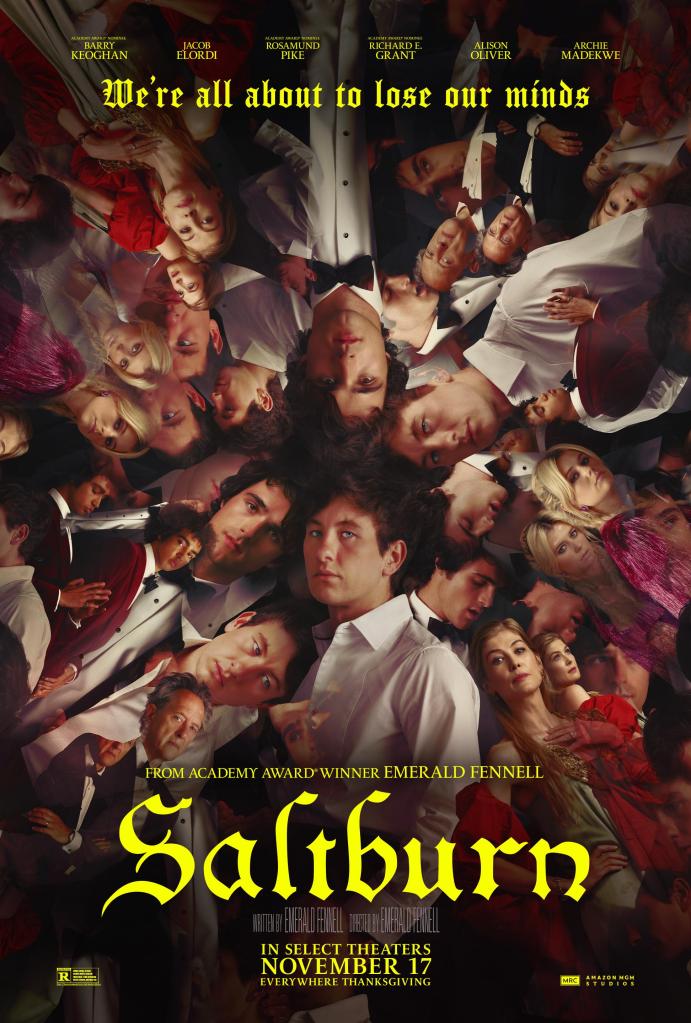
Cast: Barry Keoghan (Oliver Quick), Jacob Elordi (Felix Catton), Rosamund Pike (Lady Elspeth Catton), Richard E Grant (Sir James Catton), Alison Oliver (Venetia Catton), Archie Madekwe (Farleigh Stuart), Carey Mulligan (“Poor Dear” Pamela), Paul Rhys (Duncan), Ewan Mitchell (Michael Gavey), Sadie Soverell (Annabel), Reece Shearsmith (Professor Ware), Dorothy Atkinson (Paula Quick)

Promising Young Woman was a thought-provoking, very accomplished debut. It’s odd that Emerald Fennell’s sophomore effort plays more like a first film: try-hard, style-over-substance, very pleased with itself and its punky attempts to shock. Crammed full of moments designed to be snipped out and talked about – in a “you will not fuckin’ believe what just happened” way – Saltburn is a fairly trivial remix of ideas much, much better explored elsewhere, predictable from its opening minutes.

It’s 2006 and Oliver Quick (Barry Keoghan) is a scholarship student at Oxford University, socially awkward and very conscious of his Liverpudlian roots, struggling to fit in among the wealthy set that dominates his college. At the centre is Felix Catton (Jacob Elordi), fundamentally decent but blithely unaware of his privilege, who takes a shine to Oliver with his shyness, troubled working-class background and grief at the recent death of his alcoholic father. Felix invites Oliver to spend the summer at Saltburn, his luxurious family seat. There Oliver is welcomed – or does he inveigle his way? – into the lives of the Cattons, from seducing Felix’s sister Venetia (Alison Oliver) to charming his parents Sir James (Richard E Grant) and Lady Elspeth (Rosamund Pike). But is Oliver all he appears to be?

The answer, of course, is no. Which shouldn’t surprise anyone who has ever really encountered any form of unreliable narrator before. Fennell opens the film with a clearly older, well-dressed Oliver recounting the film’s story to an unseen person. It’s not much of a deduction from this alone, that Oliver is at best not to be trusted, is definitely potentially dangerous and is probably a lot worse. All that, inevitably plays out, in a film that so nakedly rips off Brideshead Revisited (or Recycled) and The Talented Mr Ripley that Oliver might as well be called Ripley Ryder.

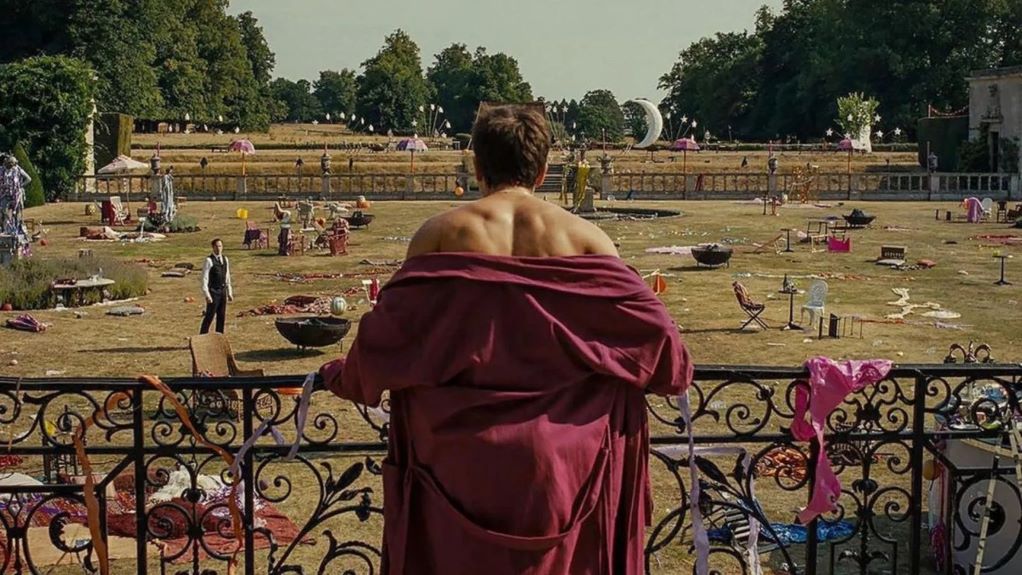
“Ryder” would at least have been a witty name for a character who spends most of the film putting his (apparently) well developed manhood to effective use in manipulating and controlling people. Saltburn assembles a series of “shocking” moments of sexual weirdness from stalker-like sociopath Oliver – so much so, that the moments he merely wanders (or dances) around in the buff feel almost normal. Surely there was more than half an eye on hashtags when the film presents scenes like Oliver drinking spunky bathwater, performing oral sex on a woman during her period or dry humping then wanking over a grave. It’s not big and it’s not clever.

“Not clever” also sums up the film’s inane social commentary. Set in 2006, it seems to take place in a version of Oxford that probably hasn’t existed since 1956. Having been in a state-school kid at Oxbridge at this time, its vision of a university 98% populated by poshos jeering at working-class kids with the wrong sort of tux just isn’t true (in fact there were more state school students than private school kids at Oxford that year). In this fantasy, all the students are either from Old Etonians or maladjusted weirdos from state schools. It’s hard not to think this is Emerald Fennell (a woman so posh, her 18th birthday party was featured in Tatler) guiltily looking back at how her “set” at Oxford might have behaved to the less privileged students.

It boils down to a view of Oxford as an elitist social club laughing openly at anyone who can’t trace their descendants back to the House of Lords, where tutors are entranced by the idea that a place like “Liverpool” exists and snort at the working class student for being a clumsy try-hard by actually reading the books on the reading list with student life flying by in a series of hedonistic raves, hosted by the rich and famous. Maybe I was just in the wrong circles back in the day.

This portrait of Oxford as a play pen for the super elite is as damaging (it’s exactly the sort of false image that stops deserving people from wanting to go) as it is lazy, tired and false. But then, Saltburn compounds its boringly seen-it-all-before social commentary by trudging off down other, all-too-familiar paths as it turns its fire on those with their nose pressed up against the window of privilege. The film’s vilest member of the elite, Farleigh, is himself an interloper, turned aggressive gate-keeper. And, as is not a surprise, Oliver’s roots turn out to be far more comfortable than he is letting on. Oliver is a Charles Ryder who yearns for Brideshead so much, he starts destroying the Marchmain family to get it. Because, in his eyes, as an aspirant middle-class type he appreciates it more.

On top of this is layered a clumsy, Ripley-esque madness to Oliver, who can’t decide himself whether he is infatuated with the charming Felix (very well, and sympathetically, played by Jacob Elordi) or just wants to suck his soul dry. Barry Keoghan plays this Highsmith-styled sociopath with just enough flash and sexual confusion – and he does manage to successfully turn on a sixpence from wide-eyed wonder, to vicious anger. But the character again feels like a remix of something done better elsewhere, trading emotional depth for cartoonish bombast and clumsy on-the-nose point scoring.

The on-the-nose-ness runs through the whole film. It’s a film screaming to be taken seriously, from its 4:3 framing, to its jarringly satirical music choices, arty Gothic fonts, visual quotes from Kubrick and look-at-me love of tricksy camera shots (some of these, I will admit, are gorgeously done, even if the film frequently lingers on them so we can “see the work”). But it makes very little sense. How does Oliver manage to exert an influence, so profound and complete, over Felix’s parents? Why does the wool fall from everyone’s eyes one-at-a-time in quick succession? Does Saltburn feel sorry for the generous but emotionally dysfunctional Cattons or does it feel they deserve their fate?

Because so many of these ideas are so half-heartedly explored, it becomes a collection of scenes designed to shock, tricksy directorial decisions, some flashy performances (Rosamund Pike can certainly wittily deliver a slew of lines dripping with blithely unaware privilege) and twists that will only surprise those who have never seen a story about an outsider before. Jacob Elordi emerges best, creating a character of surprisingly revealed emotional depth, but most of the rest of Saltburn settles for flash and instant gratification. To use its own terms of reference, it’s as satisfying as premature ejaculation: fun for an all-too-brief second, then a crushing, shameful disappointment.

The Holdovers (2023)

The Holdovers (2023)

Alexander Payne’s hilarious Christmas-themed prep school drama is a heart-warming delight

Director: Alexander Payne

Cast: Paul Giamatti (Paul Hunham), Dominic Sessa (Angus Tully), Da’Vine Joy Randolph (Mary Lamb), Carrie Preston (Lydia Crane), Brady Hepner (Teddy Kountze), Ian Dolley (Alex Ollerman), Jim Kaplan (Ye-Joon Park), Michael Provost (Jason Smith), Andrew Garman (Dr Hardy Woodrup)

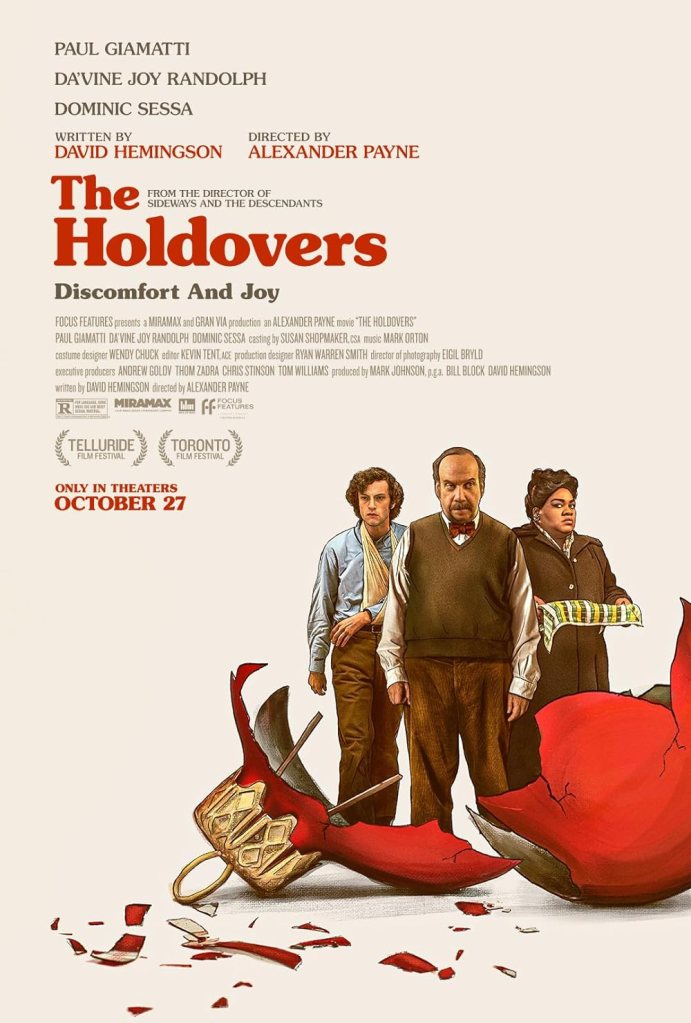
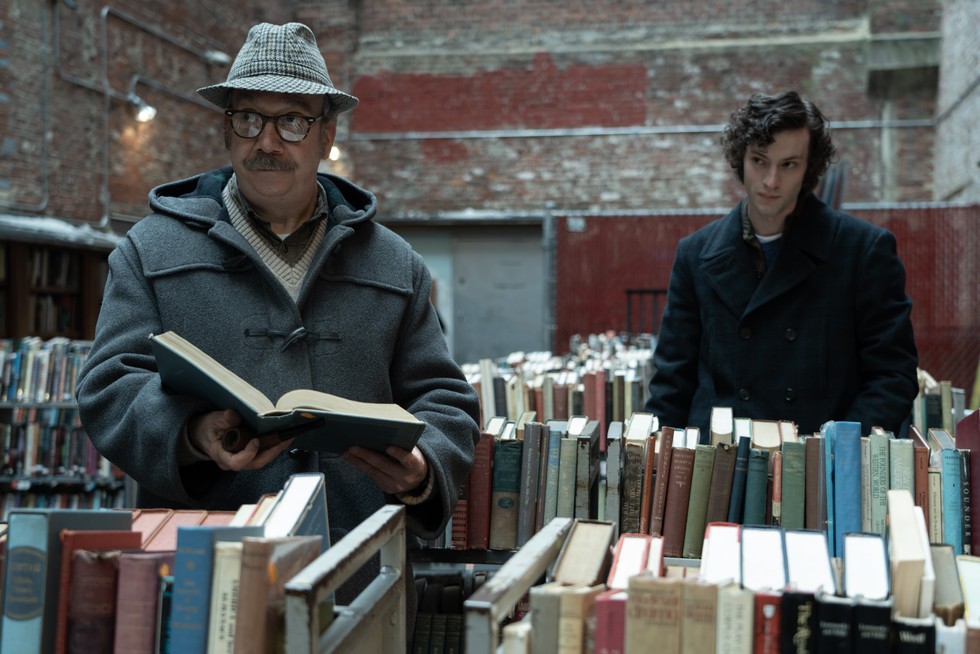
Christmas is a time when people come together – not always by choice. In 1971, Paul Hunham (Paul Giamatti) is a curmudgeonly classics teacher at Barton Academy, a New England boarding school for the wealthy which he once attended himself on a scholarship. He’s despised by teachers and students alike for his waspish wit, brutal marking and abrasive personality. As a punishment for refusing to give a donor’s son the grade needed for Princeton, Hunham must spend Christmas with “the Holdovers”, the students whose families cannot take them for Christmas. Principal among these is Angus Tully (Dominic Sessa), while Mary (Da’Vine Joy Randolph) the campus cook whose son (a former scholarship student at the school) was killed in Vietnam also remains on site. These three difficult, damaged people surprise themselves and each other as time together thaws each of them.

I found this film an absolute delight, funny, heartwarming and rather moving, a treat for any time of the year. Shot and edited with a deceptive simplicity, it’s only when you think back that you realise every scene was perfectly formed, every beat wonderfully timed and not a frame was wasted. This is serene film-making that never draws attention to itself. Payne textures the film like a missing 70s auteur piece – like other parts of his work there are strong elements of Hal Ashby, not least The Last Detail – and his measured, patient staging makes the moments of waspish or foul-mouthed humour land with as much impact as quiet moments of raw pain.

What’s really striking about The Holdovers is the warmth and regard it has for its three characters. Lesser films would set them up as standard tropes: people whose edges would be worn off due to the magic of reaching out to others. What The Holdovers does really well is establish from the start that, depressed and damaged as they are, they are all at heart kind, decent people. Paul’s hostility to his students stems from disgust at their entitlement – we’re completely with him when he hits the roof at the contemptuous “get over it” attitude one student shows to the grieving Mary. Mary’s motherly instincts express themselves in myriad ways. And Angus’ sardonic, smart-aleck waspishness doesn’t stop him comforting a vulnerable younger student.

To make this work as well it does, the acting is key and in its principals The Holdovers is blessed. Paul Giamatti is superb as the prickly Paul, who at first even we can find challenging. Like a bullying Mr Chips, Paul sets tests for Christmas, orders the holdovers to exercise and study during vacation and delights in insulting his students. But Giamatti slowly shows this is a shield for a man disappointed with life, who feels its injustice and imbalance very keenly and decides it’s best to attack life head on.

Paul is a man who really, really cares – so much so, that it’s easier to never allow himself to get close to anyone. Giamatti balances this heartfelt humanity with perfectly pitched comedy. Paul’s acidic put-downs, layered with dense classical references, are frequently hilarious but it’s also rather touching to see him trying to use the same references to try and spark small-talk with strangers (unfortunately the etymological origins of Santa Claus in Ancient Greece leave his audience baffled.). You believe him when he talks about finding the world a bitter and complicated place just as you can understand why he feels he has to respond in kind.

You can also understand why he starts to see the same traits in Angus Tully. Played with a wonderful naturalness by Dominic Sessa (in his film debut), Angus also uses humour and intelligence as a shield. Both he and Paul are sharply intelligent (Paul even grades Angus a B!), disgusted by the casual superiority of Angus’ classmates (in particular the awful – and surely not accidentally named – Kountze) and turn out to be all-but orphans struggling with the same depression. What’s delightful about Sessa’s performance though is he manages to show Angus is still just a kid – he can be vulnerable, moody but also innocent: he’s breathlessly excited when flirting with a girl at a party and bounds off to pack his bags with a whoop when Paul agrees to take him on a “field trip” to Boston.

Angus and Paul are surprising kindred spirits. They both stretch the “Barton men do not lie” mantra to the limit in a series of minor crises, from a hospital visit to a prevented barroom brawl to a meeting with Paul’s puffed up former Princeton schoolmate. The Holdovers also, refreshingly, avoids creating cheap melodrama between them. Promises that certain facts will remain entre nous are loyally kept, making the film’s close (with developments we could have an anticipated at the start) feel true.

The bridge these two meet across is Da’Vine Joy Randolph’s wonderfully warm yet brittle performance as a loving woman lost in grief. Mary had clearly focused every hour on her son since his birth, his death leaving her bereft. Around her house, his possessions are stored like mini-shrines. Mary keeps up her professionalism while screaming in agony on the inside, but she’s still determined to see the best in people. All three actors are astonishingly good.

The Holdovers sparks these actors off each other in a series of scenes that are, in turn, hilarious, surprising and then, from nowhere, deeply moving. It’s a lovingly optimistic film at heart. Except for Kountze and the headmaster, every character is deep-down decent (the holdover who spontaneously – and excitedly – invites his fellow holdovers to a skiing holiday is adorable). It’s a film that finds this good in people without being cloying, possibly because the characters puncture any sentimentality with a well-timed, foul-mouthed quip. It also swerves away from predictable tropes (despite Payne cheekily teasing more than a few) to create a sense of a story that feels true.

The Holdovers is also rare in American films for taking class as a strong theme. Barton is a sort of finishing school for the rich, where the size of the library a benefactor buys is more important than the academic skill of his son. Paul is, rightly, appalled by the casual assumption of superiority of many of the students, and their smug obliviousness to their privilege. Mary’s son, due to not being able to afford college, was condemned to enlistment in Vietnam in the hope of a GI bill education. Paul’s past misfortunes are steeped in class injustice and Payne frequently stresses the plush comfort of the school compared to the working-class town it sits inside. There is something quite British about this sharp-eyed look at a “classless society”.

The Holdovers is an intelligent but also magnificently heart-warming film with just the right touch of lemony bittersweetness. With three gorgeous performances, Payne’s film superbly shows how the defences we use to protect ourselves can hurt us as much as those around us. Avoiding sentimentality, it concentrates on making us care deeply for its three damaged souls as they stumble towards understanding. It does this with sensitivity, empathy and (perhaps most importantly) a lot of humour. The Holdovers is a small-scale triumph, the sort of film I can imagine watching again and again and always bringing a small tear to the eye.