Category: Conmen films

Suspicion (1941)

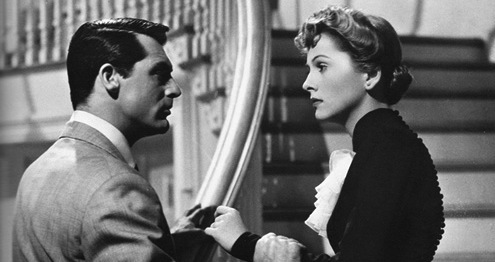
Is Cary Grant plotting to murder Joan Fontaine? Oh the Suspicion.

Director: Alfred Hitchcock

Cast: Cary Grant (Johnnie Aysgarth), Joan Fontaine (Lina Aysgarth), Nigel Bruce (Gordon Cochrane ‘Beaky’ Thwaite), Cedric Hardwicke (General McLaidlow), May Whitty (Martha McLaidlow), Isabel Jeans (Helen Newsham), Heather Angel (Ethel), Auriol Lee (Isabel Sedbusk), Leo G Carroll (Captain George Malbeck)

What do you do when you suddenly start to believe you might be living in a murder mystery? When you begin to think that the person you are married to might just be planning to dispatch you as well? That’s the big suspicion that haunts the mind of Lina Aysgarth (Joan Fontaine), a shy and meek heiress who has been charmed into marrying waster Johnnie Aysgarth (Cary Grant), a lazy spendthrift and playboy. After they elope together, she quickly finds out that Johnnie has no work ethic or talent at all other than spending money. As real estate deals fall through, and Johnnie steals money from his employer to cover his debts, Lina starts to worry that her life insurance is looking more and more tempting to Johnnie.

Suspicion is a decent, middle-of-the-road Hitchcock thriller, which deals with familiar themes of doubt, dread and (of course) suspicion, but with Hitchcock very much in second gear. He’s not helped by the neutering of the source material. The original novel is very much a story of a woman who works out that her husband is definitely trying to kill her. The producers here, however, couldn’t abide the idea that CARY GRANT could be plotting to kill his wife. So the story is rejigged at the end to turn Lina into a silly, paranoid woman and Johnnie into, well yes a playboy, but also one who has been treated badly because of the suspicion thrown at him. This may have flown in 1941, but it’s impossibly sexist today. Plus it means the whole film basically builds towards – well – nothing.

Hitchcock throws in the odd decent flourish – most famously the carefully lit glass of milk that Johnnie carries up the stairs near the film’s end, which may or may not be poisoned. But far too often the story seems to be taking place in a fairytale England, of horses riding to hounds, country villages, Agatha Christie style authors dispensing accidental poisoning advice, and careful class structures. For all the odd moments of danger, the film is safe, contained and as unthreatening as it can get. But the rest is Hitch on autopilot, which feels at time as a remix of the director’s earlier Oscar winning film Rebecca.

That mood carries across to Joan Fontaine as well in the lead role. Fresh off working with Hitchcock on Rebecca, Fontaine essentially recreates the same role again here as the timid, shy, would-be dutiful wife who wants to see the best in a husband who in fact seems dangerous and unknowable. Fontaine won the Oscar for this film – but it feels as much like a compensation award for her previous defeat for Rebecca as it does for Suspicion. Really she does very little here that lifts the film, or stretches her as a performer from her previous role. It’s a retread, and while it’s a trick she does well, it’s a trick she has done before.

A far more challenging performance comes from Cary Grant, who uses the role as a clever meta-commentary on his own persona. Johnnie has all the charm and engaging bonhomie of Grant himself, but all subtly twisted with a selfish superficiality and wastrel greed. Grant walks a very fine line of a man who could be plotting to murder his wife or could just be a greedy chancer – and walks it very well indeed. You always see that Johnnie is bad news, while also understanding why Lina finds him so engaging. It’s a terrifically skilled performance, a lovely riff on Grant’s own screen persona, that shows he’s a far better actor than people often give him credit for – and you feel he is only too willing to embrace the chance to play a weak-willed, opportunistic murderer with little conscience (except of course it turns out he isn’t a murderer). 

It’s a shame that nothing else in the film really rises to the occasion in the same way (although Nigel Bruce gives a very good performance as the gentle, ageing playboy Beaky). The film itself never really seems to be heading anywhere – it even takes a good two-thirds of its runtime before Lina begins to wake up to the fact that Johnnie is far from being the sort of husband women should dream of. It’s a bit slow, a bit too safe, and it largely lacks the element of danger. For the final few scenes, logic seems to evacuate the film as all the clues and hints we’ve had building towards us are shown to be – nothing more than red herrings and the inferences of a silly woman. Because, after all, CARY GRANT can’t be a murderer can he? No matter what he wants.
McCabe and Mrs Miller (1971)

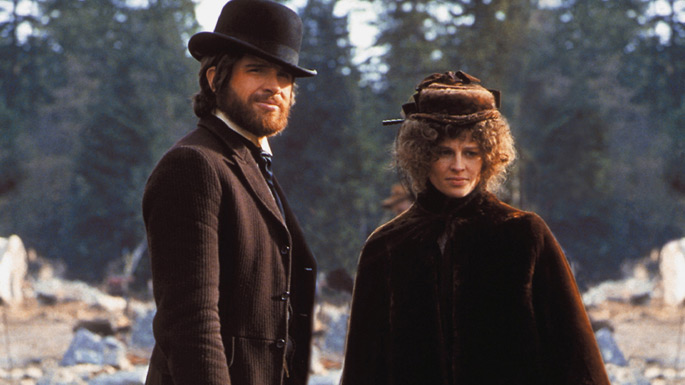
Warren Beatty and Julie Christie fail to conquer the Wild West in Altman’s revisionist Western McCabe and Mrs Miller

Director: Robert Altman

Cast: Warren Beatty (John McCabe), Julie Christie (Constance Miller), RenéAuberjonois (Sheehan), Michael Murphy (Eugen Sears), Antony Holland (Ernest Hollander), Bert Ramsen (Bart Coyle), Shelley Duvall (Ida Coyle), Keith Carradine (Cowboy), Hugh Millais (Butler), Corey Fischer (Reverend Elliot), William Devane (Clement Samuels), John Schuck (Smalley)

The Western is such a familiar genre of Hollywood film-making that you can be pretty familiar with nearly all the concepts that  it contains – from the stranger in town through to the final shoot-out. All these familiar tropes were just challenges though for a film-maker like Robert Altman: how do we make a Western that features all these, but then completely twists and subverts it all into something that also feels like a product of the 1970s rather than the 1870s? Well Altman runs with all this in McCabe and Mrs Miller, his successful anti-Western.

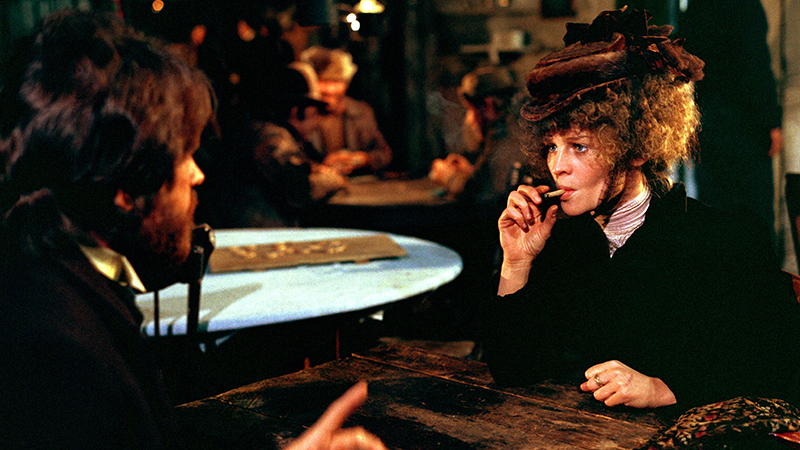
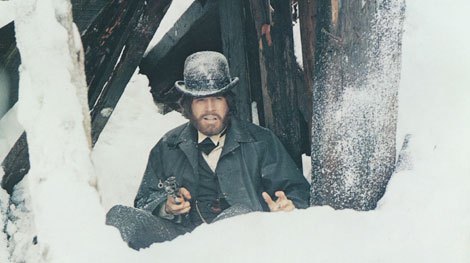
In Washington State in 1902, John McCabe (Warren Beatty), a conman and card sharp, rides into Presbyterian Church, a town so small it’s named after its only prominent building. McCabe’s skills at cards quickly make him rich, and as the town’s mining fortunes grow so do his. He sets up a gaming and cat house in the town. Constance Miller (Julie Christie) is a cockney opium addict with experience of running whorehouses and she quickly partners with McCabe, promising that she can raise his profits tenfold. All goes swimmingly – until big business heads into town and makes an offer to buy out McCabe’s holdings (and the whole town) for redevelopment. When McCabe says no he quickly finds himself in over his head.

Altman’s film combines all the techniques that he had been experimenting with throughout his career into a perfect storm of Altmanesque technique. He and Vilmos Zsigmond, his skilled cinematographer, deliberately “flashed” the film to slightly over-expose it, giving the picture a slight sepia hue like a series of old photos. The camera leisurely roves around like curious spectator to the film, letting itself catch moments of interest here and there – sometimes refusing to focus on events that feel, by rights, that they should be centre of the film. It gives the film a real lived in feeling, while also making it look slightly like a historical record of true events. Either way, as the cold hits Washington State, it looks beautiful – candle-lit interiors mixed with coldly blue exteriors of snow and ice-covered surroundings.

But those visuals are as nothing compared to Altman’s experiment with sound. Sticking rigidly to the script was hardly ever Altman’s way and it’s certainly not here. In rehearsals, the actors felt free to experiment with and rework a script that had already been through the hands of several writers. Altman kept this loose, free-flowing, improvisational tone in the final film. As the camera roves round, so does the microphone, picking up snatches of conversation here and there – sometimes giving us a mixture of conversations from which we need to pick out what to listen to. In addition to that, most of the actors deliberately mumble their lines – or happily deliver them from mouths clutching cigars or chewing food. Anarchic is almost the right word for it – Altman doesn’t want to tell you what to listen to, and is more interested in getting across the atmosphere of the scene rather than the facts and figures. It takes some time to get used to – and at points is highly frustrating – but it creates its own mood. 

And this mood is very different from what you might expect from a Western. There is a distinct lack of glamour here. This world of Presbyterian Church is dirty, grimy and lacking in any moral fibre or real sense of right and wrong. The church itself is respected but largely ignored by the citizens, who are far more interested in drinking, screwing and gambling. When violence occurs it is ignored as much as possible or – as in the final shoot-out that ends the film – it happens around people so wrapped up in their own concerns (from domestics, to a large fire) that they barely notice it happening. Needless to say, for those in the fire fight, there are no rules to be played by at all. People are shot in the back, shoot down innocent bystanders, and play by no rules whatsoever, stalking and shooting opportunistically.

McCabe is a perfect hero for this very different kind of Western. As played by Beatty, he is a cocksure coward nowhere near as clever, confident or controlled as he thinks he is. Arriving in the town, he seems like the height of glamour in his bearskin coat, and he swiftly masters the simple townsfolk with his tall tales and charisma. However, the more people who intrude on this world, the more quickly it emerges that McCabe has very little clue about what is going on, is easily cowed and has only the barest understanding of how the world works. Meeting with a lawyer, one scene later he is parroting a (completely misunderstood) version of the law that he has heard from there. Meeting with the “muscle” from the corporation, he deflates like a balloon, desperately making offers hand over foot. Beatty is very good as this puffed up coward, confused and constantly living a front but out of his depth in the world.

Julie Christie’s Mrs Miller is far more worldly than him, immediately able to recognise the dangers and understanding exactly the sort of men McCabe is dealing with. Mrs Miller’s opium habit is a quietly understated obsession, one the other characters seem unaware of, but which the viewer alone seems to know about. It raises questions of course – is this meant to imply perhaps some of what we see is a drug induced fantasy? But it doesn’t impact otherwise the relationship she develops with McCabe, part meeting of partners, part a protective relationship with Miller guiding McCabe.

The rest of the cast is stuffed with a series of Altman regulars, all of whom deliver fine performances. The stand-out is Hugh Millais, an English writer making his acting debut, who is simply sublime as the articulate and ruthless chief heavy sent by the company to intimidate McCabe.

For the film itself, your enjoyment of it is largely going to be affected by how easily you plug into its style of storytelling. There is very little story for much of the first half of the film, instead events continue in a loose and undisciplined style, but the second half delivers a more focused story of ambition pushed too far, and culminates in an impressively filmed ruthless shoot out. It is perhaps more of a film that is about the atmosphere and the style than the story, but as a redeveloped Western that carries across the style of the grimy 1970s it works extremely well. At first I thought I would never get into it, but by the end I found myself wrapped up in the story it was telling. Visually and performance-wise it’s superb. Altman is an acquired taste, but acquire it and you will be richly rewarded. 

Coda: Much like The Long Goodbye I watched this film about a week ago at time of posting and I find myself thinking over several sequences in it again and again with ever more admiration. When watching it I felt it had been over promoted by critics. Now I increasingly think it might be something very special indeed.

The Man Who Would Be King (1975)

Caine and Connery together at last heading out to the sort of land perfect for The Man Who Would Be King

Director: John Huston

Cast: Sean Connery (Daniel Dravot), Michael Caine (Peachy Carnehan), Christopher Plummer (Rudyard Kipling), Saeed Jaffrey (Billy Fish), Shakira Caine (Roxanne), Doghmi Larbi (Oootah), Jack May (District Commissioner)

A glorious rip-roaring adventure, The Man Who Would Be King is exactly the sort of deeply enjoyable Sunday afternoon viewing you could expect to see playing out on a Bank Holiday weekend on the BBC. Which is enough to make you often overlook that this is quite a dark, even subversive film in amongst all the fun.

Adapted from Rudyard Kipling’s short story, the story follows Daniel Dravot (Sean Connery) and “Peachy” Carnahan (Michael Caine): cashiered NCOs from the British Empire, bumming their way round the Raj in the 1880s, picking pockets and scamming everyone from local rajahs to British commissioners. But their dream is to travel to the distant land of Kafiristan, a country almost unknown in the West, where they hope to help a ruler conquer the land, overthrow him, clean the country out and head back to the West. Arriving after a difficult journey, their plan goes well – but is put out of joint when Dravot is mistaken for a god…

Strange to think that John Huston had this project in development for so long that his original intended stars were Clark Gable and Humphrey Bogart. After the project faltered for so long that those two stars sadly died, Huston shopped it around to most actorly double bills around Hollywood. Finally he settled on his ideal choices for these very British scoundrels: Paul Newman and Robert Redford. Fortunately, Newman took one read of the script and essentially said “John they’ve got to be British”. Connery and Caine were suggested – the rest is history.

And just as well they were suggested, as the film’s principal delight is the gorgeous interplay between the two star actors, happily embracing the film as if they knew they’d never get to bounce off each other together on screen again. This is one of the warmest, most genuine feeling friendships between two characters captured on film, Dravot and Peachy are so clearly heterosexual life partners that they are willing (after much bickering) to forgive each other virtually anything. On top of which, the two actors play around with each other like old-school stage comedians, matching each subtle raise of an eyebrow with a wry half smile. 

Connery is of course perfect as the man succumbing to hubris, his Scots burr spot on for Dravot’s slightly pompous “front man”, while Caine excels as the more sly, fast-talking Peachy. The finest moments of the film feature these two interacting, from performing long cons, to hysterical laughter when death feels near on a snowswept mountain, to the final (emotionally stirring) moments of sacrifice and support.

Because yes, with the film opening with a decrepit Peachy recounting his story to Kipling (an engagingly plummy performance from Plummer – no pun intended) you just know this little boys’-own adventure in the East isn’t going to end well for our heroes. Huston, however, still manages to make the whole thing feel like an excellent jaunt, even though the devastation is clearly signposted from the start. 

Huston’s film is shot with a sweeping, low-key excellence – Huston was a master at putting the camera in place and then basically not getting in the way of the story. He totally identifies from the start that it’s the relationship between the two leads that is the real emotional and dramatic force of the film and never allows anything to obstruct that. He’s smart enough to also get a bit of social commentary in there, around imperialism and the entitlement that means these lower-class Brits feel that they should have their share of other people’s counties. But these themes never unbalance the picture. Instead they counterbalance it – however much we enjoy the leads cheek and charm, we can’t forget that in many ways they are immoral conmen, who represent some of the worst riches stealing excesses of the British Empire.

The slow spiralling of Dravot into the sort of man who wants to stay behind and build a dynasty in Kafiristan works extraordinarily well. Connery perfectly suggests the ego and love of attention that motivates many of the actions of this natural showman. From the first battle, when an arrow fails to kill him, we see him slowly realise and enjoy the implications of this fame. His rather touchingly childlike pleasure in dispensing justice (even if Peachy has to quietly correct his maths in the middle of one case) and spinning fantasies about sitting on equal terms of Queen Victoria don’t turn him into a monster or an egotist, but more of a kid who is running before he can walk. 

It’s the sense of fun that keeps you watching – and also what gives the final few moments their emotional force and power. It works because it never harps on the darker social commentary it contains, about the corruption of British rule, and the greed of these buccaneering adventurers. Superbly acted – as well as the leads, Saeed Jaffrey is very good as a Gurkha soldier who acts as translator for our two con-men – and extremely well filmed, with the sweep and grandeur of India coming across strongly in Huston’s careful camerawork, this is a hugely enjoyable film about friendship that has all the fun and vibrance of a con film wrapped in an epic adventure.

Catch Me if You Can (2002)


Leonardo DiCaprio lives out his fantasies in Catch Me if You Can

Director: Steven Spielberg

Cast: Leonardo DiCaprio (Frank Abagnale Jnr), Tom Hanks (Agent Carl Hanratty), Christopher Walken (Frank Abagnale), Nathalie Baye (Paula Abagnale), Amy Adams (Brenda Strong), Martin Sheen (Roger Strong), James Brolin (Jack Barnes), Nancy Lenehan (Carol Strong)

Conmen. You wouldn’t want to meet one but they don’t half make for great stories: largely because tell a great one. Watching cons has the same tension as watching a high-wire artist: will they slip? We all like to think we could fool people if we wanted to – and the movies give us a chance to watch someone else live those fantasies for us.

Frank Abagnale Jnr (Leonardo DiCaprio) was a teenager who was a natural at the arts of the short and long con, as well as an accomplished forger. The film tells the story of his late teens and early twenties when, as well as impersonating a senior paediatrician and a junior district attorney, Abagnale stole almost $3 million from Pan Am by impersonating a pilot and forging checks between 1963 and 1969. Hanks plays Carl Hanratty, the dedicated FBI investigator on the case.

What’s great about this film is that, by and large, it isn’t trying to be a lot more than an entertainment. In fact, Spielberg deliberately shoots the film in a low key, unflashy style that puts the focus on the story and acting. And there is something hugely entertaining about the chutzpah of conmen, particularly those who are only fleecing huge businesses, which this film really understands and taps into. It’s probably Spielberg’s funniest “comedy”.

It’s witty throughout with a sly sense of humour. In his roles as both doctor and lawyer, Abagnale is shown carrying out research by watching TV shows and reading pulp novels – and then repeating their clichés, to the bemusement of those around him (but he delivers it with such confidence it still works). I also enjoyed the fact that his chosen careers (air pilot, doctor, lawyer) are all approached with the same naive understanding a kid would have for what the job involves (and DiCaprio’s look of childish terror slipping past his adult facade watching a plane take off from the cockpit and when asked for his opinion on the treatment of an injured child at a hospital are endearingly genuine). The film is told with a great deal of bounce and lightness, taking on the structure of a Wil-E Coyote/Roadrunner chase cartoon, with Hanratty defeated several times by Abagnale’s confident sleight of hand.

The script does have depth to it, rooting Abagnale’s actions in his trauma from a broken family and witnessing his father’s humiliating fall into poverty after charges of tax evasion. The film suggests this to be the main motive for Abagnale’s actions – a misguided attempt to redeem his father and take back what was taken from him. This theme of a son trying to win his father’s respect gives the film a heft that balances the fluff – especially as it’s clear the son has taken many of the wrong lessons from his father’s life on the edges of legality. It’s helped in this respect by a wonderful performance of twinkly charm and fatherly pride by Christopher Walken, combined with a sly sense of roguishness.

Leonardo DiCaprio is the motor that really makes this film work. His boyish good looks are perfect for this and he has both the confidence to convince as a trickster and the vulnerability to be the young boy underneath. As such he has the lightness of touch that the story needs and the acting chops to convey the inner pain Abagnale is working so hard to soothe. He’s also effortlessly charming and endearing here, surely the perfect traits of a con man.

For the rest of the cast, Tom Hanks very generously plays second banana as the investigator and gives the role a strong sense of the surrogate father. Amy Adams in one of her first roles is wonderfully sweet as Abagnale’s fiancée, totally unaware that he is a 17 year old kid. Martin Sheen and Natalie Baye also give good performances.

The film is a light and frothy confection that shades in just the right amount of nuance and depth to make us care for its lead character. With John Williams’ zippy score and its luscious recreation of the late 1960s, it’s also a film in love with the vibrancy of the era. A terrific unpretentious entertainment, it’s not one of its director’s great works, but it might be one of his most joyful.