Category: Crime drama

The Night of the Hunter (1955)

The Night of the Hunter (1955)

Laughton’s only masterpiece is a fairy-tale, stuffed with beautiful images and dreamlike logic

Director: Charles Laughton

Cast: Robert Mitchum (Harry Powell), Shelley Winters (Willa Harper), Lillian Gish (Miss Rachel Cooper), James Gleason (Uncle Birdie), Evelyn Varden (Icey Spoon), Don Beddoe (Walt Spoon), Billy Chapin (John Harper), Sally Jane Bruce (Pearl Harper), Gloria Castilo (Ruby), Peter Graves (Ben Harper)

Few films have had their critical reputation change quite as much as The Night of the Hunter. When released, its reception from film critics and audiences was so negative that the crushing disappointment saw director Charles Laughton decide his debut would also be his last film. Flash forward seventy years and it’s now hailed as one of the great American films, a pictorial masterpiece. The Night of the Hunter sits alongside Citizen Kane as the classic film unappreciated in its day.

Adapted from Davis Grubb’s best-selling novel, it follows the nightmareish experiences of young John Harper (Billy Chapin) and his sister Pearl (Sally Jane Bruce). These kids witness their father Ben (Peter Graves) dragged away by the cops to imprisonment and execution – but not before he’s hidden $10,000 in Pearl’s doll and sworn them both to secrecy. Word about the money gets out: it’s why sinister ‘Preacher’ Harry Powell (Robert Mitchum) arrives and starts a-courting their mother Willa (Shelley Winters). After swiftly disposing of Willa, Powell turns his attentions to the kids – who flee down river, eventually coming under the protective wing of kindly widower Rachel Cooper (Lilian Gish) and her brood of young waifs and strays. Is it far enough though to escape Powell’s clutches?

The Night of the Hunter plays out like a fairy tale. Its images are full of the magic of the countryside and mysticism of nature. It frequently, deliberately, uses artificial sets and locations to create a dream-like state. It’s got a classic monster its heart, with Powell a demonic force-of-nature. It follows a pair of children on a journey reminiscent of Hansel and Gretel. There is a kindly old woman and a moral message of the importance of love, family, faith and loyalty. Everything in it feels, to various degrees, heightened. This is Southern drama via Hans Christian Anderson.

I wonder if that’s what threw people off on release. I’d agree that the film’s opening – Lilian Gish’s face superimposed over a starry night sky (followed by a cut of five kids heads superimposed over the same sky raptly listening) – might tee us up for the film’s mood, but looks and feels kitsch. The moments where Laughton deliberately aims at heightened, almost cartoonish, reality push the envelope of what you can accept – why does Powell, at one point, chase the kids up a flight of stairs, hands stretched out before him like he’s in a live action Tom & Jerry cartoon? Stumble onto The Night of the Hunter unwarned about its fantastical grounding and melodrama and it must look and feel odd, bizarre and even a bit laughable.

But it’s these same qualities that have made the film last. Laughton created a film of magical force and power, crammed with striking, imaginative images and beautiful sequences that tip between dream and reality. Its real heart lies in the children’s escape down the river, a remarkable sequence as the camera follows the boat drifting down an obviously artificial river, the children asleep as it glides past spider’s webs, frogs and other wildlife. From a film that opens with the aggressive arrest of the Harper’s dad, this burst of Where the Wild Things Are mysticism intentionally feels like we are crossing into a completely different world, let alone movie. But it’s also part of the film’s striking originality and quirky memorability. Few things look conventionally ‘real’ – in fact, like the farmhouse the kids stop at overnight in their long drift down river it feels even intentionally artificial – but it also gives the film a timeless, poetic feeling.

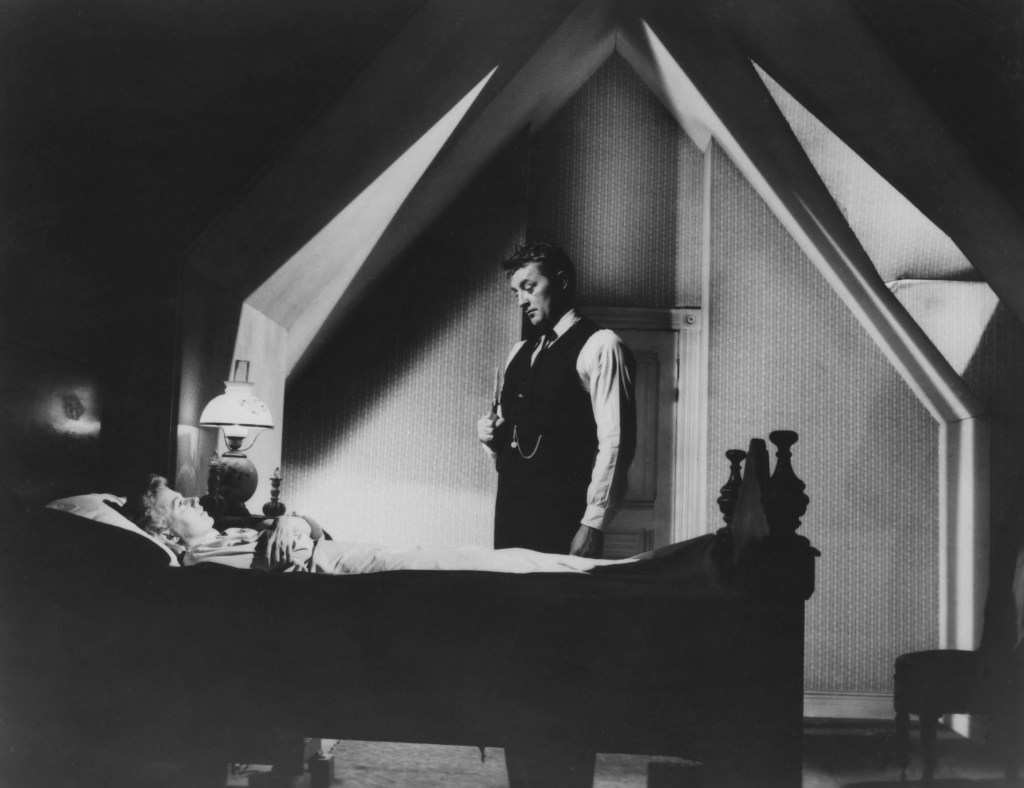
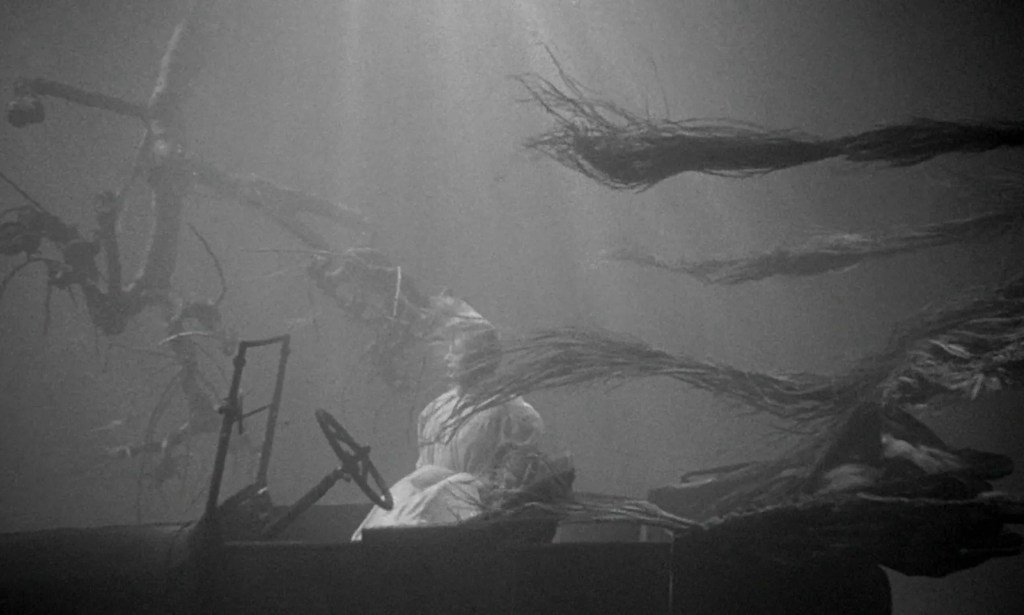
It’s a beautiful sequence in a film stuffed with them. Laughton worked closely with cinematographer Stanley Cortez and several sequences are awash with poetic visual flourishes inspired by some of the great German silent cinema of the 1920s. Who can forget the visually stunning shot of Willa’s body in a car at the bottom of the river, her hair flowing in matching waves with the weeds around her (possibly the most beautiful image of death in the movies)?  From the countryside shots that bring back memories of Murnau’s Sunrise to striking sets that seem to have emerged from The Cabinet of Dr Caligari. Most striking is the high-ceiling, Church-like set that is Powell and Willa’s bedroom, a shadow-laden expressionist nightmare. The scene is played with the same carefully choreographed expressionist force, from Mitchum’s vivid gestures to Winter’s corpse-like resting.

Death comes from Mitchum’s Preacher, one of the great monsters in cinema. With those famous ‘Love’ and ‘Hate’ tattoos, Mitchum makes the role truly terrifying. Mitchum kept up a studied public contempt for acting, but he immerses himself in Preacher in a way he did with few other roles. He makes him horrifyingly charming (he wins adult confidences easily) and his smooth gravel-voice and masculine bearing are both imposing and intimidating. But Mitchum also embraced the weirdness, the psychopathy of a man who murders without a second thought while keeping up a private conversation with the Lord. Preacher is an animalistic demon wrapped up in human skin – he lets out the most bizarre, piercing screams when foiled or injured – twisting his body into unsettling shapes before his misdeeds or letting his eyes boil with anger and disgust (most particularly at sex, something he seems to find repulsive and fascinating).

It’s an extraordinary, terrifying, monstrous performance unlike almost everything else in Mitchum’s career in its willingness to go to such twisted, eccentric, unnatural extremes. Mitchum credited Laughton as his finest director – and Laughton’s skill with actors is clear from all the performances. Shelley Winters’ has rarely been better in a role she skilfully downplays, as an unhappy woman, desperate for redemption, forced to feel ashamed of her desires. The two children are very good, in particular Chapin’s frequently raw panic and trauma and determination. The rest of the cast is stuffed with striking, Dickensian pen portraits, performances of striking eccentricity.

These performances fit within the magical realism of the film in a film that is as stylised as this. Again, I can’t imagine that audiences at the time – used to blockbusters, shot on gloriously realistic locations – were ready for something that aped so strongly the artistic flourishes of silent cinema. But it works spectacularly for a film about a children’s semi-magical quest into the wilderness. It’s hard to think of another film that leans so completely into such an aesthetic unreality as this one – even the town the kids eventually escape to feels like it’s a movie set rather than a real place.

The film’s final act in the home of Miss Rose Cooper is not as strong as those before. There is something rather po-faced and self-satisfied about the slightly clumsy moral message of finding faith and goodness which feels rather twee and disappointing considering the gothic film we’ve just watched. The film’s final sequence, on a peaceful Christmas day, belongs in a more conventional film (even though you could argue it’s also a conventional fairy tale ending). Much as I enjoy several moments of Lillian Gish’s performance as a tough old woman – like a shot-gun wielding Whistler’s Mother – the shift of focus away from Preacher’s demonic schemes feels like a loss.

The Night of the Hunter, for me, isn’t the complete masterpiece it’s sometimes hailed as – there are clumsy moments (I would agree the Tom & Jerry Preacher chase feels tonally out of place, and neither the opening or closing is strong), but it’s also filled with moments of pure cinematic magic – and has a performance from Mitchum that is one for the ages. Its imagery is beautiful, it’s tone mostly perfect and its imagination limitless. The greatest sadness about watching it is that Laughton never directed again – based on this, imagine how good his next film might have been?

The Taking of Pelham 123 (1974)

The Taking of Pelham 123 (1974)

Effective thrills on a well made heist drama with some interesting social points to make

Director: Joseph Sargent

Cast: Walter Matthau (Lt. Zachary Garber), Robert Shaw (Mr. Blue), Martin Balsam (Mr. Green), Héctor Elizondo (Mr. Grey), Earl Hindman (Mr. Brown), James Broderick (Denny Doyle), Dick O’Neill (Correll), Lee Wallace (Mayor), Tony Roberts (Warren LaSalle), Jerry Stiller (Lt. Rico Patrone), Rudy Bond (Police Commissioner), Julius Harris (Inspector Daniels)

Colour coded crooks carry out a crime? Tarantino was clearly a fan of The Taking of Pelham 123. And who can blame him? This is exactly the sort of well-constructed, entertaining thriller Hollywood used to churn out so well. It even manages to mix its cunning crooks with more than a bit of cynical social commentary on the contemporary mess that was New York. It’s grimy, surprisingly hard-edged but with a lean slice of black humour: you can see why it’s a bit of a cult classic.

On the New York City subway, a gang of determined, efficient criminals take control of the front car of downtown train ‘Pelham 1-2-3’ (a train name now banned in New York due to copycat fears!). They are led by polite but utterly ruthless Mr Blue (Robert Shaw) and include nervous train-expert Mr Green (Martin Balsam), loyal Mr Brown (Earl Hindman) and trigger-happy Mr Grey (Hector Elizondo). Their demands are simple: $1million dollars (such humble ambitions these days!) in one hour, or they execute one of their 18 hostages every minute. And no negotiation, no matter how much City Transit Police cop Zachary Garber (Walter Matthau) might try over the radio. With the crooks seemingly having thought of everything, can Garber stop playing catch-up and work out their plan?

You only need to look at the popularity of Die Hard to see what guilty pleasure there is in fanatically prepared criminals trying to get away with it. The Taking of Pelham 123 has all of this. Blue’s team is professional, prepared and have anticipated everything. From calmly telling the passengers how futile any escape attempt would be, to anticipating every single action of the authorities, to delivering (with fatal results) on every one of their promises, these guys have the sort of competence we always sneakly admire in film. Match that with Mr Blue’s strangely samurai-like sense of honour (he’ll keep every deal he makes, despises anger and sadism and respects worthy opponents – even while he emotionlessly executes a hostage) and a bit of you will root for the criminals to get away with it. Right up to, of course, when they start to deliver on their fatal promises.

Of course, it helps that The Taking of Pelham 123 takes some intriguingly sharp pops at the forces ranged against the criminals. The mayor’s ineffectiveness is underlined by having him spend virtually the entire film in bed with a stinking cold. His decision about what to do hinges on how many votes he might get. He resents going to the scene, complaining he’ll get booed (guess what happens!) and is frequently brow-beaten by his more accomplished deputy. When he whines about where they are going to raise the money from (stop to remember for a second what a bankrupt, crime-ridden, mess New York was at the time) it’s even suggested (half-jokingly) he considers cleaning out one of his Swiss bank accounts. Around them many members of the police are heavy-handed, trigger-happy and frequently flustered by the relentless deadlines while the main representative of the train network sees the risk of 18 deaths as an irritating obstacle to an efficient transport system.

This has all been factored into the criminal’s plans. Ask for a big amount, but not so big that the authorities find it politically impossible to deliver. Give a deadline that is achievable but too short to allow anyone the time to make a plan. Count on the general disorganisation of the system being your best ally. Yup The Taking of Pelham 123 is a very 70s crime thriller, when cynical expectations about the efficiency and honesty of the authorities is crucial to the scheme!

Naturally, in a world like this, an awkward looking, scruffy maverick is our hero. Walter Matthau is the man you call for – particularly when the villain is Robert Shaw at his most smooth, clipped and articulate. Matthau’s homespun wisdom and gut instincts are, of course, the only thing the villains haven’t anticipated. It’s Garber’s focus on the people – as opposed to the obsession everyone else has about saving face and passing the buck – that marks him out: that and his authority-shirking cynicism and complete lack of interest in work-place turf battles.

The Taking of Pelham 123 barrels along from there with surprising efficiency and a little dark humour. Some of this humour is even – rather bravely – at the characters own lazy assumptions. One of Garber’s most knuckle-dragging colleagues is seemingly unable to comprehend the idea of a female police-officer. Garber himself isn’t immune: his increasingly rude handling of a group of Japanese transport officials rebounds on him with acute embarrassment when they reveal on departure that they speak perfect English (so understood all his derogatory slurs) and, on meeting his police liaison (Julius Harris) Garber awkwardly fails to hide his astonishment at discovering the authoritative, intelligent man he’s been talking to on the radio is Black (a surprise all too clearly noted by Harris).

Whimsical humour rebounds – not least the impact of the recurring cold of an excellently world-weary and avaricious Martin Balsam’s Mr Green and Garber’s instinctive, polite Gesundheit – among the surprisingly hard-edged violence and no bullets-pulled shootings. But the main thing that ends up compelling you is trying to work out, like Garber, exactly what the criminals are planning and how they intend to get away with it. In that sense, Sargent’s film keeps itself lean, mean and focused and zeroed in on the plot details. A stripped down, always exciting entertainment.

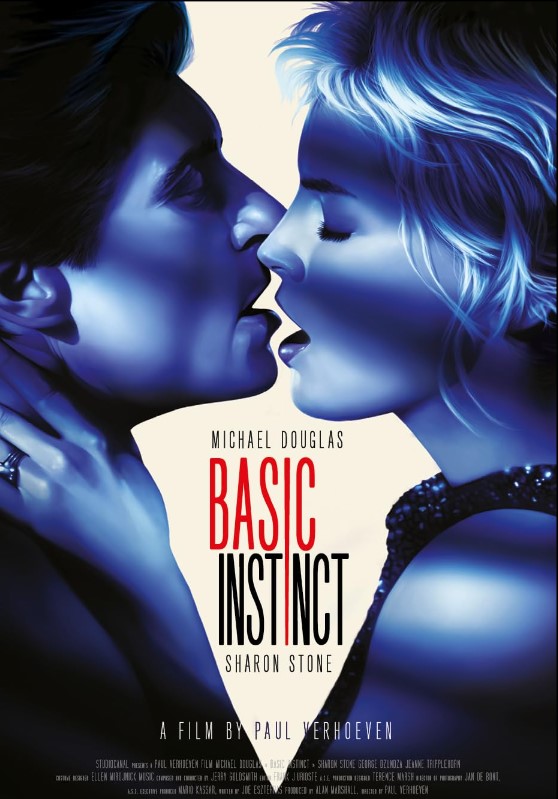
Basic Instinct (1992)

Basic Instinct (1992)

A sensationalist hit, this Trashy Hitchcock-pastiches looks very pleased with its own naughtiness today

Director: Paul Verhoeven

Cast: Michael Douglas (Detective Nick Curran), Sharon Stone (Catherine Tramell), George Dzundza (Detective Gus Moran), Jeanne Tripplehorn (Dr Beth Garner), Dorothy Malone (Hazel Dobkins), Denis Arndt (Lt Philip Walker), Leilani Sarelle (Roxy Hardy), Bruce A Young (Detective Sam Andrews), Chelcie Ross (Captain Talcott), Wayne Knight (Assistant DA John Correli), Stephen Tobolowsky (Dr Lamott)

If there is one thing Basic Instinct proves for sure, it’s that Paul Verhoeven is a very naughty boy. A sensational smash hit in 1992, largely because of the instant iconic status of that scene (you know which one), Basic Instinct remixes Hitchcock (especially Vertigo and Psycho) with lashings of explicit sex and violence, a touch of The Silence of the Lambs and a dollop of Fatal Attraction. It’s a deeply silly, dirty film that was a sort of Fifty Shades of its day: vanilla porn for those who feel too self-conscious to actually go and watch a real one.

Catherine Trammell (Sharon Stone) is number one suspect for the murder of her boyfriend (or rather as she describes him “the guy I was fucking”) for two reasons: one she published a novel a few weeks earlier where she explicitly described the crime in detail and two she’s an obvious Hannibal Lector-ish genius psychopath. Doesn’t stop weak-willed detective Nick Curran (Michael Douglas) from becoming obsessed with her, sucked into a wild sexual affair. But is Catherine a misunderstood unlucky victim, or the genius manipulator her old college rival Dr Beth Garner (Jeanne Tripplehorn) – also Nick’s on-and-off girlfriend and psychiatrist – says she is?

Basic Instinct was the most expensive script ever sold, earning Joe Eszterhas $3million for what he claimed was fourteen days’ work. And you can see why – it’s got everything audiences could need for an addictive, trashy bit of fun. A femme fatale who is also a genius psychopath! A handsome macho cop! Brutal murders! A puzzle interesting enough to keep ticking over but obvious enough that you don’t need to think about it too much! And of course, lots and lots and lots of sex! And then even more sex! No wonder people saw dollar bills – at the very worst they had a chance at a so-bad-its-good box office smash.

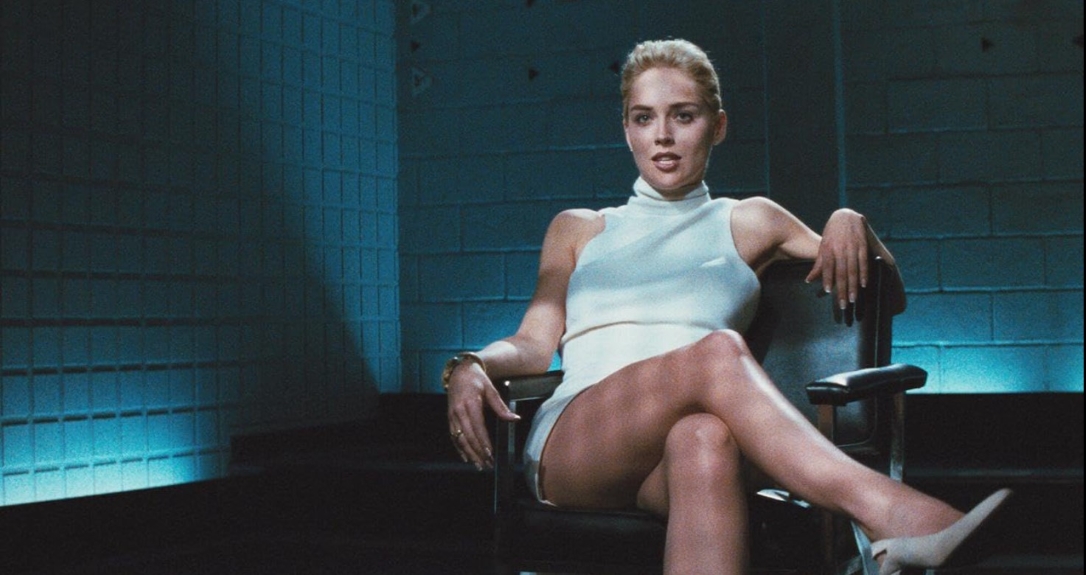
But the good stuff. Basic Instinct’s comic-book Hitchcock pastiche actually works rather well, helped enormously by a marvellous Oscar-nominated score by Jerry Goldsmith, which brilliantly channels Bernard Herrmann’s luscious Vertigo strings. It’s no exaggeration to say Goldsmith’s score dramatically improves the film, from adding tension to a drawn-out elevator trip to adding a film noir lyricism to Catherine and Nick’s rather forced sexualised banter. Verhoeven also really knows his business: the film’s famous interrogation scene works as well as it does through his skilful editing between wide angles, close-ups and POV shots, aided by the striking uplighting from cinematographer Jan de Bont.

That scene – and the film – also works because of Sharon Stone. Taking on a role turned down by almost every single woman in Hollywood, Stone seizes hold of a part she knew was a once in a lifetime opportunity. Nick may be the lead – and Douglas, in the middle of his run of weak modern American men bewitched by strong women, may have been the high-paid star ($14 million to Stone’s $550k) – but both knew this was Catherine’s movie. Stone plays the role with a playful, sensual confidence and arrogant defiance, knowing full well she can seduce anyone. Despite the clunky dialogue, she makes Catherine sexy, smart and just about vulnerable enough to make some viewers doubt whether she’s the killer or not. (I mean she blatantly is, the film doesn’t really try and pretend otherwise. Most of the fun is seeing how shamelessly she can parade it and still get away with it.)

Away from that though, Basic Instinct is a terribly silly film, a well-made pandering to our lowest desires. Opening with an extremely graphic post-coitus stabbing frenzy (with blood spray everywhere and a nose skewered by an ice pick) – it then teases us three times that it will repeat this again after nearly every explosive session of rumpy-pumpy. Ah yes, the rumpy-pumpy. Basic Instinct slows at the half-way mark for an almost five-minute extended multi-angled, orgasm packed bit of horizontal jogging that Nick then rather pathetically spends most of the rest film bragging about being “the fuck of the century”.

But then Nick is a pathetic figure. Somehow keeping hold of his badge, despite gunning down two tourists while high on cocaine, he’s got such an addictive personality he makes Lloyd Bridges’ (“I picked the wrong week to quit sniffing glue!”) air traffic controller in Airplane look like a model of restraint. After internal affairs-mandated therapy (how’s that for a slap on the wrist) – hilariously compromised by Jeanne Tripplehorn’s Dr Garner crossing all ethical lines by repeatedly shagging him – Nick has proudly quit drugs, drink, smoking, and shooting before asking questions. Needless to say, under Catherine’s influence, he embraces all of these again, all while still managing to be the sort of middle-aged loser who wears a pullover to nightclub.

Eszterhas’ script mixes awful “tough” dialogue (“Looks like he got off before he got offed” Nick’s partner jokes over a victim) with clumsy psychological insight (my favourite is Tobolowsky’s consultant who confidently states two options: Trammel either did or didn’t do it – inevitably this childishly empty insight is met with the manly ‘tecs muttering “In English Doc!”) and blunt statements of the obvious (“She’s brilliant! And Evil!” screams poor Tripplehorn). The flirty banter is largely sold by Sharon Stone’s confidence, since the lines (“I’m not wearing underwear”) are hardly Double Indemnity. The film’s mystery is so irrelevant to its appeal (and, in many ways, plot), it merrily gets bogged down in several off-screen murders of characters we’ve never met.

Today Basic Instinct feels like a bizarre museum piece. George Dzundza’s sidekick cop is intended as comic-relief but comes across like a little ball of toxic masculinity. An early sex scene between Nick and Beth is pretty much impossible to watch today without thinking “yeah that’s rape”. The film uses bisexuality (though we only, of course, get girl-on-girl – Douglas made it clear he ain’t gonna kiss no man) as raw titillation, an entre for the soft porn of Douglas and Stone noisily going at it for about 10% of the film’s run time. Even the famous scene is uncomfortable to watch, since Stone has since made it clear she didn’t consent to that shot.

Basic Instinct is a deeply silly piece of trash. But then that was its appeal back then – no one felt they were actually watching Hitchcock when they sat down to this rip-off of the master (in fact Basic Instinct makes you feel it’s probably a relief the production code meant Hitchcock couldn’t give into his Verhoevenish instincts). Today most like to think of it as a sort of well played card trick. However, it’s hard not to feel a bit for Sharon Stone to whom it became a millstone (which she eventually exploited for a terrible belated sequel for which she pocketed $13.5million), despite being the person possibly most responsible for its success. So maybe Nick won in the end after all.

The Critic (2023)

The Critic (2023)

McKellen’s familiar star turn is the only life in an otherwise unremarkable film

Director: Anand Tucker

Cast: Ian McKellen (Jimmy Erskine), Gemma Arterton (Nina Land), Mark Strong (David Brooke), Lesley Manville (Annabel Lord), Romola Garai (Cora Wyler), Ben Barnes (Stephen Wyley), Alfred Enoch (Tom Tunner), Nikesh Patel (Ferdy Harwood), Claire Skinner (Mary Brooke), Ron Cook (Hugh Morris)

The murky streets of 1930s West End London are the kingdom of Daily Chronicle theatre critic Jimmy Erskine (Ian McKellen), famous for his poison-inked, vitriolic reviews of the many shows that fall beneath his high standards. But the times they are-a-changing, not least at the Chronicle where the former owner (a Rothermere-like bully who loved Jimmy’s take-no-prisoners prose bullying) is replaced by his son David Brooke (Mark Strong), a softly-spoken liberal who wants to take the paper in a new direction. With the arrogant Erskine on a knife-edge (not helped by his risk-taking penchant for rough-trade sex encounters with gentlemen in the park), Brooke is about to unknowingly discover how far the famed critic will go to cling onto his job and reputation – and how easily he will embroil an ambitious young actress, Nina Land (Gemma Arterton), in his schemes.

The Critic starts far more interestingly when it ends. It’s easy criticism, but you can well imagine it falling foul of Erskine’s fury if he had seen it unfold before him in a West End theatre on a Tuesday night. Despite the best efforts of all involved, it all too quickly becomes the sort of routine revenge-murder-conspiracy potboiler that relies a little too much on contrivance and coincidence, the stench of familiarity all over it. Atmospheric as it is – set in a dimly-lit, fog-bound London and in the plush retiring rooms of the rich and famous – and well-selected as its selection of faux theatrical memorabilia that litters Erskine’s home is, the actual story becomes all too predictable.

The main thing it has going for it is a fine performance by Ian McKellen, even if the part plays so neatly to his strengths you feel he could play it standing on his head. McKellen has long mastered mixing the twinkle of the bon vivant with the vicious, cold-eyed cruelty of the sociopath, even having recently done the same thing in The Good Liar. Erskine is selfish, demanding, cruel with a self-destructive streak (both financially – living a ruinous life well beyond his means – and his frequent drunken pride and stubbornness). He bitterly believes himself to deserve acclaim and standing (denied to his failed acting career) and treats almost everyone around him with contempt hidden behind a raised eyebrow or pursed lip. His primary motivation, to the very end, is that his theatrical writing should become a collected volume in every home cementing him as a sort of Wildean wit.

The Critic toys with a more interesting view of Erskine as not entirely unsympathetic. His homosexuality – and the abuse and persecution it has bought him – shows him fall foul of encounters with the police and sees him challenging preening National Front blackshirts. He’s disgusted by Fascism and despises racism, promoting his young Black lover, secretary and amanuensis Tom Tunner (a fine performance of mixed loyalty and Stockholm-syndrome-like support from Alfred Enoch). He’s genuinely touched when Nina Lane – who has lambasted for years in print – tells him his writing made her want to act. But these shades of grey get largely ditched for as the film focuses on darkening his shadow as the plot descends into conspiracy, blackmail and murder.

McKellen does provide the film’s best entertainment. He knows how to deliver a line, how a splutter can communicate outrage, how an intake of breath can communicate fury, how the eyes can turn any smile insincere. He’s long since mastered Iagos and if The Critic doesn’t ask him to do anything he hasn’t done before, he can still do it like an absolute pro. There are other decent performances. Mark Strong plays against type as a man as (surprisingly) decent and kind as he seems. Gemma Arterton expertly plays both “bad” and “good” acting as would-be theatrical giant Nina Lane, while mixing desperation and self-loathing in her off-stage persona. On the other hand, the film wastes Romola Garai as Brooke’s Nazi-sympathising daughter and Lesley Manville as Nina’s chatterbox mother.

The Critic builds up a contrived (and inadvertently creepy) plotline that links both Brooke and Nina – most convenient for Erskine’s improvised blackmail scheme – and that melodrama eventually suppresses The Critic’s more interesting moments. A film that looked at Erskine’s character having been formed in a world where his sexuality was a persecuted crime might have made for a more intriguing storyline. Or which explored how Erskine settled for being court jester to powerful, clubbing homophobes – so much so he actively resents the more liberal Brooke. Or looked at the creeping onset of fascist sympathy in the upper classes. Or one which took a more expanded look at Tom’s struggles in a defiantly non-diverse 30s London (instead the significance of Tom’s skin colour fluctuates according to plot requirements and its awkward uniqueness is undermined by the fact the theatre director is played by Nikesh Patel). It avoids all this for all too familiar tropes.

In most ways The Critic has its moments but fundamentally fails to deliver. And, perhaps worst of all, it does so in a way that doesn’t even really raise the critical heckles. Instead, you’re overwhelming feeling when this sub-Christie drama comes to its close is that it was okay. The sort of film Jimmy Erskine would have dismissed in a few short sentences.

Training Day (2001)

Training Day (2001)

Pulsating corrupt-cop drama, highly entertaining with a full-throttle Denzel Washington

Director: Antoine Fuqua

Cast: Denzel Washington (Detective Alonzo Harris), Ethan Hawke (Officer Jake Hoyt), Scott Glenn (Roger), Tom Berenger (Stan Gursky LAPD), Harris Yulin (Doug Rosselli LAPD), Raymond J Barry (Lou Jacobs LAPD), Cliff Curtis (Smiley), Dr Dre (Officer Paul), Snoop Dogg (Blue), Macy Gray (Sandman’s wife), Charlotte Ayanna (Lisa), Eva Mendes (Sara)

“King Kong ain’t got nothing on me!” That’s the mantra of larger-than-life legendary cop Alonzo Harris (Denzel Washington), who has immersed himself so much in the dirty neighbourhood gangland of LA that it’s hard to see where cop ends and crook begins. Alonso claims to believe to keep the town clean, you gotta break a few rules. But then he also believes in filling his own pockets with stolen money. It’s all going to come to a head in one day: first day on the job for ambitious boy-scout officer Jake Hoyt (Ethan Hawke) who thinks he’s auditioning to join an elite squad only to find he’s the victim of a series of elaborate mind-games and dodgy moves by Alonzo, testing to see whether he is potential asset or sacrificial pawn. It’s going to be a long day.

Training Day is basically a massive dance with the devil, offering his little Faustus all the wonders of the world in return for his soul. It’s all there for Hoyt’s taking: respect, glory, standing – and of course oodles of plastic-wrapped dollar bills. All he has to do is sacrifice every inch of his integrity and personal morality to Alonzo Harris, a grandstanding Mephistopheles. This first day is all about Harris pushing Hoyt to see how far he will go. Will he smoke a little dope so he could pass as an undercover druggie? Will he search a house under a false warrant? Will he rough up a suspect? Will he murder a drugdealer and steal his cash?

Throughout all this, Denzel Washington barnstorms to fantastic Oscar-winning effect. This is a delightfully Devilish performance, Washington leaving it all out on the pitch. Alonzo Harris has inhabited the persona of the gangsters he follows for so long he’s basically become one. Harris is scarily charismatic, the unshakeable confident cool he uses to cow and terrify criminals and punks on the street, also making him a hugely attractive figure. This is despite his complete amorality, his ruthless capacity for violence and his shocking willingness to abuse and use almost everyone around him. He does all this by convincing Hoyt for long stretches that his poor treatment, abuse and deception of him is all in Hoyt’s own interest: to toughen up this naïve puppy into a killer.

Hoyt spends half the time if this is some elaborate show-and-test. Who can blame him? Washington’s exuberance plays masterfully on the edges of someone putting on a massive performance. There are neat moment where we see how fragile some of Harris’ control is, once he is outside of his comfort zone: he’s in hoc for millions to Russian gangsters and as events of the day pile up his thermonuclear self-confidence tips into moments of impotent fury. Washington is fantastic as this street monster, whose seductive lines on modern policing (do a little bad to do a greater good) start off sounding like common sense before you realise they tip quickly into justifying open criminality. It’s a performance of perfect physical swagger matched with his limitless charisma, inverting the qualities that made him a perfect Steve Biko or Malcolm X into a Lectorish monster.

Ethan Hawke is also extremely good as his polar opposite, the eager to please rookie who realises there is a lot more going on here than he thought. Training Day suggests there may well be a middle ground between Hoyt’s straight-as-an-arrow idea of policing and Harris’ corruption – and it’s part of Harris’ appeal that his perverted mentoring ends up making Hoyt a tougher, more unrelenting (better?) cop than he was before. But also, Hawke is great at showing that Hoyt (under his sheen of moral uprightness) is also a tough, hardened professional. In classic story-telling style, Harris is a dark reflection of Hoyt: they share a stubbornness, a conviction that they are right, a refusal to be intimidated (Hoyt may nervously try to please Harris at first, but once he realises the score he refuses to be forced into doing anything he doesn’t want to do) and a capacity for throwing themselves into decisive action. There is a reason why this rookie can get the drop on Harris – much to his wicked mentor’s delight and admiration – in a way no one else can.

That alone shows the dark magnetism of people like Harris: like Hoyt we end up wanting their approval even when we hate or fear them. Even as he holds a shotgun to his head, there is a part of Hoyt you suspect is proud that Harris’ gut reaction is to shout an impressed “My man!”. Of course Harris knows his validation is important to people. Monsters like this know the weaker-willed crave their respect. But then Harris also knows no one else in his team – all of them weak-willed bullies, desperately trying to imitate them – have even a quarter of the independence of mind Hoyt has.

What Harris under-estimates is Hoyt’s survival instinct. The final third of the film, the clash that has been building inevitably between these two, again demonstrates both their similarities and their fundamental differences. The main difference between them being Hoyt cares for, and protects others, and Harris cares only about himself. Hoyt’s humanitarianism will save him from dangerous situations and even Harris’ girlfriend (a tough-but-cowed performance from Eva Mendes) recognises Hoyt has shown more concern for her son in a few minutes than his father, Harris, ever has in his whole life.

The final act of Training Day hinges a little too much on one whopper of a coincidence: the sort of narrative contrivance so colossal that, in a less magnetic film, you’d be throwing stuff at the TV shouting “oh come on!” It’s final, inevitable, confrontation between Harris and Hoyt feels rather too much like many, many other films before it in every single beat, while the ending has a whiff of Hays Code morality (all wrongs righted!) about it that rather undermines the edgy, unpredictable film it precedes.

But when Training Day focuses on the sound and the fury of Washington and the Faustian dance on the deep grey lines of street policing, this is a sensational, energetic and highly watchable cop thriller, pulsatingly directed by Antonie Fuqua. With Washington superb and Hawke easy to overlook as his straight-laced partner, it’s a character study that constantly shifts our expectations and leaves us genuinely worried about the fate of its hero. The sort of slick entertainment Hollywood does at its best.

Seven (1995)

Seven (1995)

Darkly, unrelentingly unsettling, Fincher’s true-debut is an outstanding psychological thriller

Director: David Fincher

Cast: Brad Pitt (Detective David Mills), Morgan Freeman (Detective William Somerset), Gwyneth Paltrow (Tracy Mills), Richard Roundtree (DA Talbot), R. Lee Ermey (Police captain), John C McGinley (‘California’), Julie Araskog (Mrs Gould), Mark Boone Jnr (FBI man), John Cassini (Officer Davis), Reginald E. Cathey (Dr Santiago), Richard Schiff (Mark Swarr), Kevin Spacey (John Doe)

Set in a city where decency and humanity goes to die, daylight is a stranger and everything is covered with constant rainfall, Seven covers the most chilling week-in-the-life of two detectives. One, disillusioned William Somerset (Morgan Freeman), is counting down to his early retirement. The other, his cocksure replacement David Mills (Brad Pitt) thinks he’s unbeatable and indestructible. But they are going up against someone who will shake them to their core, a calculating serial killer dispatching victims he judges guilty of the seven deadly scenes, framing their bodies in grotesque rituals. Can they track him down before he completes his terrible work?

Seven is one of the finest, and most influential, of all serial killer films. Dark, haunting and relentless, it’s a perfect package of grim foreboding and nihilistic terror, expertly directed by David Fincher. Seven is very careful about what it shows you, trusting far more in the horror of suggestion and witnessing the reactions of the characters – you come out of it convinced you have seen more than you have. It never lets you relax for a moment, always dreading the worst – yet so many people never saw coming its infamous final act with its unexpected, horrifying, reveals and darkly, hope-free conclusion. Seven offers almost no comfort and never pets you at ease only a despairing look at how terrible the world can be and how desperate the struggle for goodness can be.

In a visual design that’s reminiscent of Blade Runner, the world of Seven is almost permanently dark, dingy and rain-soaked, the crime scenes filthy, terrifying haunted houses of grimness. The chaotic sounds of the city, mechanical and uncaring, are everywhere: Somerset even sleeps with a metronome ticking in an attempt to impose sone order on his world. The score uses base beats and near-industrial sound, the editing mixes smooth classic cuts and sudden shocks, the camera work is awash with tones from the green of greed to the blood red of lust. Not there there is any comfort in daylight, since the brightest, most open sequence of this claustrophobic film (even the Mills’ apartment violently shakes from passing trains, a subtle hint no where is safe) takes place in a pylon-stuffed field and it’s the most horrific, nihilistic of the lot.

Seven though is also darkly seductive: it plays on our fascination with the dark ‘genius’ of Hollywood killers, their love of patterns and the twisted purity of their quest for perfection. The film’s opening sequence, showing the killer’s preparations in a series of jagged, disorienting cuts, even places us in his perspective. When he is revealed, he mixes prissy politeness with dark, obsessive love for his work. Seven understands out fascination with the pattern killer – just as we were obsessed with Hannibal Lector and the Terminator, the guy in control is intriguing. It punishes us for this by stressing the horrific impact of his crimes and the traumatic impact on the survivors, is nihilistic ending even more effective for all the dark enjoyment the viewer has taken out of Seven’s grim momentum.

It’s also benefits hugely from its play on the conventions of the odd-couple detective pairing. Somerset and Mills are chalk-and-cheese: Somerset is calm, methodical and professionally distant, Mills is volcanic, lacks focus and becomes terribly personally invested. One of the films few touches of humanity and hope is the growing friendship between these two – slow-burning to say the least – that sees them go from butting heads to sharing jokes and supporting each other’s calls.

The performances are excellent. Brad Pitt (whose clout helped ensure producers couldn’t neuter the film’s shocking ending) is full of jittery energy masking his insecurity, doubt and fear; so worried about looking weak he resorts constantly to anger. Lacking patience (hilariously he can’t bring himself to read Dante and Chaucer, as Somerset recommends, instead resorting to hiding Cliff Notes books in his desk) he investigates the crimes with gusto, focused on the exterior not the interior. He can’t only see the killer as a lunatic, an under-estimation that makes him easy to manipulate.

The moral centre is Morgan Freeman’s Somerset, a superb performance. Somerset is completely disillusioned, convinced any trace of goodness in the world has disappeared. Despite this, events prove him wise (but not above terrible errors) and determined with a strong moral centre. He’s empathetic about crime in ways Mills isn’t (at an early crime scene, one of his first questions is if the victim’s kid has seen the body, a question dismissed as irrelevant by his colleagues) and investigates from inside the killer’s psyche, seeking to understand his motives. Perhaps no other film than Seven has given Freeman so perfect a vehicle, his expressive eyes full of sorrow and regret, his careful decency a mask of detachment that he slowly lets slip to Mills and his wife.

As that wife, Gwyneth Paltrow gives a striking, endearing and perfectly judged performance in a small but crucial role. Tracy Mills is the one unquestionably decent person in this crap-sack world, perhaps why she and Somerset are drawn together. Seven has a wonderfully quiet, humane moment in all this horror, when the two meet to discuss parenthood, a beautifully played exploration of doubt and fear from Paltrow and quiet semi-regret from Freeman. It’s a role pivotal for the film, Paltrow leaving a deeply tender impression on the viewer.

It’s vital for the film’s final act pay-off. Seven is perfectly constructed, both in its pacing of the murders and in not dragging out the mystery of the motive too long (it knows, of course, that everyone watching the film is ahead of the detectives on that score). It’s crammed with stand-out sequences: a SWAT team house storming promises drama but turns into a dark twist on the wrong-door routine; a chase sequence after a chance encounter with the unseen killer gives a perfect shot of adrenalin. It’s all unbalancing us for a shockingly unexpected move by the killer (the actor’s identity carefully kept a secret in advance, meaning his reveal is a genuine shock for the uninitiated) leading to its horrifically nihilistic ending that I defy anyone to anticipate (except its now probably as famous as the identity of Rosebud or Keyser Soze).

Seven is astonishingly brave in all its pulsating thrills and perfectly judged tension for offering very little hope. This is a film where good is essentially powerless against evil: Somerset is too detached to beat evil, Mills so invested in his own black-and-white world he’s easy prey for the coldly manipulative. The film’s conclusion is a punch to the gut, but logical in a film where we’ve seen ordinary people indifferent to the worst of humanity and evil being so devilishly determined and ingenious in its actions no one stands a chance to beat it. You can criticise Seven for its small beats of misogyny: while Tracy is pure, like a fairy-tale princess, the two female victims are a shallow, preening model while the lust victim is not the man who uses prostitutes but the prostitute herself – an attitude we shouldn’t be surprised the killer has, but is unquestioned by any of the (all-male) investigators. (I was uncomfortable with this when I first saw it in the nineties, and time hasn’t changed my mind).

But aside from that, Seven is a darkly compelling masterpiece, a brilliantly unsettling film from David Fincher, at last allowed to deliver a film that exactly matched his vision (in a way Alien 3 did not). The battle to keep its nihilistic dark and shocking ending was a battle well-won, and it makes for a film that is a chilling exploration of evil in the world as well as a compelling, darkly-bloody film noir set in a world of unrelenting hopelessness. One of the greatest serial killer films ever made.

Mississippi Burning (1988)

Mississippi Burning (1988)

Earnest drama about racism, whose narrative perhaps focuses on less important issues and people

Director: Alan Parker

Cast: Gene Hackman (Agent Rupert Anderson), Willem Dafoe (Special Agent Alan Ward), Frances McDormand (Mrs Pell), Brad Dourif (Deputy Sheriff Clinton Pell), R. Lee Ermey (Mayor Tilman), Gailard Sartain (Sheriff Ray Stuckey), Stephen Tobolowsky (Clayton Townley), Michael Rooker (Frank Bailey), Pruitt Taylor Vince (Lester Cowans), Kevin Dunn (Agent Bird), Badja Djola (Agent Monk)

In June 1964 three civil rights workers – two white New Yorkers Andrew Goorman and Michael Schwerner and a black Mississippian James Chaney – were arrested, released and then murdered by Neshoba County law officials working alongside KKK white supremacists. An FBI investigation (codenamed Mississippi Burning) revealed the crime, arrested the criminals and managed to convict several (but not all) of them on the federal charge of violating civil rights (convinced the state charge of murder would lead to acquittal from racist juries). Mississippi Burning fictionalises this true-life atrocity into a hard-hitting thriller, mixed with the conventions of crime drama.

It’s directed by Alan Parker in the style of Midnight Express, pulling no punches in chucking the vileness of the KKK up on screen. During the course of Mississippi Burning we see Black people chased, beaten, flung out of moving cars onto the street, lynched and a praying child kicked in the face by a KKK thug. Rightly, the murderers are a vile parade of bullies, cowards and knuckle-dragging monsters portrayed by a group of actors (Dourif, Rooker, Sartain and Vince among them) used to going all-in on portraits of the scum of humanity. It’s a tightly directed, intense film – with a repetitively pounding score by Terry Jones – with Oscar-winning photography by Peter Biziou capturing the flame-lit night-time atrocities these repulsive people execute on innocents.

Mississippi Burning is undoubtedly well-made, with a very earnest message behind it. It’s impossible to fault its rightful disgust at the appalling injustice and racism, but you can’t help but feel it’s focusing its heroic lens on the wrong part of the story. It drew fire at the time for its fictionalisation of almost every element – wisely so in its portrayal of the initial crime, where their names and exact nature of their murder are altered – and the way this pushed the FBI (an organisation that had in many cases actively worked against civil rights) into a traditional heroic role, while reducing the Black people to passive recipients of beatings or kind words from whites. It’s hard not to feel today that, for all the skill of the film, the impact of those decisions have magnified the film’s flaws over time.

At heart, Mississippi Burning uses the conventions of a mis-matched buddy-cop investigative drama to add narrative drive to a social issues film. The two FBI agents are played so well by Gene Hackman and Willem Dafoe, you barely notice both are stock roles straight out of central casting. Hackman gives such energy and life (with a lovely touch of shame that his own past conduct, as a Southern sheriff was presumably only a degree better than the people he’s investigating) to his role as no-nonsense, veteran maverick who understands the streets, that he transforms this cliché into a real person. Similarly, Dafoe plays the by-the-book, stuffy superior who has too learn rules-bending sometimes break the case, with such commitment you forget how role familiar it is.

The personal narrative of the film revolves around whether these chalk-and-cheese investigators will overcome their initial iciness – they address each other formally throughout the film and butt-heads frequently on the conduct of the investigation – to become a team which feels odd for a film where the other stakes (violent institutional racism) are so large. In many ways an alternative cliché – two disconnected investigators investing more in a case based on the injustice they see and the witnesses they talk to – might well have served it better and also reflected contemporary complaints that the FBI was more interested in the letter than the spirit of the law. Mississippi Burning does, at times, address this by having characters explicitly ask if the FBI would even lift a finger if two of the victims weren’t white. But seeing as the film generally considers raising the question the same as engaging with it, it doesn’t go anywhere.

The film requires the agents to undertake mis-steps in order to educate the audience (would Dafoe’s character really be as ignorant about the nuances of segregation as he frequently is here?) and blunder about for much of the early acts, most notably Dafoe’s public conversation with a Black man in a diner, that inevitably leads to the poor man kidnapped and beaten by the KKK. But on the whole, the FBI are presented as noble straight-shooters, aghast at the state of affairs in the South, rather than a body run by the morally-ambiguous J Edgar Hoover.

It also means Mississippi Burning relegates its Black characters to passengers and passive victims, reliant on white people for protection and vindication. While it would be false to claim the system in the South didn’t leave Black people largely powerless, the film’s failure to introduce a single memorable character giving voice to the Black perspective of a series of crimes that happened to them feels more and more uncomfortable as the film ages (particularly as the film’s hopeful ending very much places racism as a problem in the past, not a dilemma America continues to face).

The film’s real conscience (and the victim given most development) is instead Frances McDormand as the wife of Dourif’s vile racist sheriff. Parker’s film subtly indicating her lack of racism early (she consoling touches the arm of a Black man), and McDormand (who is excellent) brings real force to her pained, frightened longing to do the right thing. She contrasts neatly with the committed vile cowardice of Dourif, Rooker’s swaggering bullying and Stephen Tobolowsky’s Hiterlian racism as a KKK Grand Wizard. Parker successfully makes these guys so repulsive, that when Hackman’s Anderson gets free reign to intimidate, rough-up and bully them back it carries real satisfaction. But the film making the most developed victim of the film’s KKK a white, gentile feels more like filmmaker concerns that otherwise the bulk of the likely audience may otherwise have trouble relating to the bulk of the victims.

Mississippi Burning tries to be hopeful. This extends to some slightly forced moralising – the suicide of one character is attributed to guilt at the crime, rather than the more likely guilt at having ‘betrayed’ his fellow KKK – and a general sense that Mississippi is on the road to peace, feels a bit of a stretch for a region that had decades of continued unrest ahead. Saying that, in its sometimes clumsy way, you can’t doubt its power and its righteous disgust at racism. It’s well directed and has some excellent performances – Hackman and McDormand were both Oscar nominated – but it feels like a film that only focuses on part of an overall picture and not always the right part.

Hit Man (2024)

Hit Man (2024)

Inventive, playful, funny, sexy and dark this fabulous dark comedy changes gears with confident ease

Director: Richard Linklater

Cast: Glen Powell (Gary Johnson), Adria Arjona (Madison Figueroa Masters), Austin Amelio (Jasper), Retta (Claudette), Sanjay Rao (Phil), Molly Bernard (Alicia), Evan Holtzman (Ray Masters)

You might not want to hear it, but despite what the movies say there is no such thing as a hit man. In New Orleans, if you are talking to a mysteriously charismatic man who offers to take care of your ‘personal problems’ for a wedge of cash, you are probably confessing your desire to conspire to murder to a police agent. That agent would be mild-mannered psychology professor Gary Johnson (Glen Powell), a bland forgettable person who discovers a hidden talent for charismatic role-play, using his psychological skills to create a persona specific to his target. On a job, Gary becomes attracted to Madison (Adria Arjona), first dissuading her from ‘hiring him’ to kill her husband and then starting a relationship with her ‘in character’ as ‘Ron’. But relationships prove to be as risky for fake hit men as they would be for real ones.

To say where Hit Man, Linklater’s darkly twisted rom-com, heads would be to spoil it (let’s just say I didn’t see where it’s going) and the journey is a fabulous ride. Linklater and Powell collaborated on a (heavily) fictionalised version of this true story and pull together a smart, sexy, witty and at times surprisingly dark film, which make some shrewd points about the extent to which we choose and shape our own identities. Hit Man sees Linklater so confidently shift tone and mood within scenes, that you almost don’t notice how smoothly the film travels from farce to psychological insight to Postman Always Ring Twice sexiness to screwball wit to morally shady action. It’s a terrific ride.

It’s also a superb showcase for Glen Powell, who co-wrote the screenplay with Linklater. This should be a star-making role for Powell, in which he deftly plays mild-mannered and timid and darkly charismatic, often in the same scene. What’s so superb about Powell’s performance is how fluid it is, his two personalities (mild Gary and confident Ron) overlapping and merging into each other from moment-to-moment, or switching in response to sudden changes of situation. Powell and Linklater carry this out with real subtlety from moment to moment but watch the first scene and the last and you immediately notice the difference in our lead from the man we met at first.

Powell is both extremely funny – sequences showing the dizzying array of characters (from red necks to prissy Snape-ish goths) he becomes to lure in his targets are hilariously done – but also wonderfully engaging. Beneath the surface, it’s clear Gary is thrilled by how differently he is perceived when he becomes ‘Ron’, grinning as he overhears his police colleagues confess how exciting and sexy ‘Ron’ is compared to boring bird-watcher Gary. He finds he takes on a whole new confidence – and accompanying sexual prowess – as he throws himself into a dizzyingly sexual fling with Madison, who is also far more excited about the prospect of illicit sex with a killer than she probably would be with sweet rumpy-pumpy with a tenured psychology professor. Powell captures this all wonderfully, throwing himself into a tangled web of deceit with gleeful gusto.

Adria Arjona is similarly excellent as Madison, a woman who becomes harder and harder to read as the film continues. Its early stages really feels like a traditional rom-com – except the ‘meet cute’ features one person trying to hire another for murder, before they charm each other with cat puns – but the relationship shifts as much as the film itself does. Madison seems to come to life, filled with sexually excited recklessness, as she spends time with Ron. But Arjona is able to imply half a dozen things under the surface: is Madison a downtrodden girl enjoying a brush with danger, or is she some sort of manipulative femme fatale?

Linklater uses this to maintain a real high-wire tension in the film, which increasingly becomes impossible to predict. Both Gary and Madison are playing with fire here. If Gary’s dalliance with a former ‘client’ is discovered by his superiors – or if a chance encounter unmasks him to Madison – hell knows what might happen next. And can he keep the pretence that he is capable of ruthless, skilled violence, something much harder to do when your date takes you to a firing range and asks you to teach her? And what is Madison’s game, as it emerges that her break with her boyfriend isn’t as clean as she suggests it is – does she have something in mind that Gary isn’t prepared for?

Hit Man balances this brilliantly with the comedy, in one of Linklater’s most delightfully off-beat films, expertly played by Powell and Arjona. It’s underpinned with a deftly layered thematic message. Throughout we are reminded, by Gary’s psychology lectures to his increasingly engaged students, that people balance their own ids and egos and eventually ‘choose’ where they land. In doing so they create their own personality. It’s what we realise we are watching in this film. Both Gary and Madison decide they like more than a few of the elements of the people they are pretending to be – so why not mix them into their own personality? Suddenly they find themselves effortlessly capable of things they never thought possible – yet still embracing passions their playful alter-egos would find dull beyond belief.

It leads to a surprisingly ending that comes from left-field, but we realise we have been prepared for by Linklater and Powell almost from the film’s opening moments. It makes for a supremely entertaining and rewarding film, brilliantly played by its two leads (and it bears repeating that Powell is sensational here), with excellent support from Austin Amelio as a sleazy cop and Retta and Sanjay Rao as Gary’s more playful police colleagues. Hit Man is a dynamic, funny, sexy and surprising treat.

Sexy Beast (2001)

Sexy Beast (2001)

Superb acting motors a gangster film that’s also a nightmare house-guest comedy

Director: Jonathan Glazer

Cast: Ray Winstone (Gal Dove), Ben Kingsley (Don Logan), Ian McShane (Teddy Bass), Amanda Redman (DeeDee Gove), James Fox (Harry), Cavan Kendall (Aitch), Julianne White (Jackie), Álvaro Monje (Enrique)

Gal Dove (Ray Winstone) has got it made. He’s baked bronze by the pool in his home on the Costa del Sol, earned after a life as a top safe cracker in London, alongside wife DeeDee (Amanda Redman), best friend (and fellow ex-crook) Aitch (Cavan Kendall) and glamourous Jackie (Julianne White). All that changes when an unexpected visitor turns up: Don Logan (Ben Kingsley). A tightly-wound, terrifyingly unpredictable sociopath, Logan has a job offer to which the only acceptable answer is yes: joining a team to break into a top London bank for crime king-pin Teddy Bass (Ian McShane). How’s Gal going to get himself out of this one?

Sexy Beast seems at points it might settle for being a standard British gangster drama. But Glazer’s becomes a hugely enjoyable mix of that and bizarre black comedy. A houseguest from hell comedy, like a psychotically foul-mouthed The Man Who Came to Dinner, with the added sprinkle of playful psychological theory and touches of darkly sexual content (James Fox brings back memories of The Servant and Performance). There is even an element of Greek drama: Gal really should be paying attention to the parade of ill-events preceding Don’s arrival, not least the boulder that tumbles down a mountain into his swimming pool nearly squashing Gal en route.

That boulder is, it turns out, far less of a danger than Don. If there is one thing that dominates perceptions of Sexy Beast, it’s the intimidating, witty danger of Ben Kingsley. For an actor best known at the time as Gandhi, to say this was a change of pace was an understatement. Kingsley arguably changed his whole career here with this stunningly intense, hilarious, performance. Shirt tucked in, head shaved, Logan might look physically unassuming but the pulsing vein in his head is a sign of him being a tightly wound ball of unprocessed anger and fury. Kingsley makes him superbly unpredictable – snapping on a sixpence from quiet to rabid fury with a terrifying capacity for sudden violence.

Glazer throws him into Gal’s Spanish heaven like a ticking timebomb. There is a great deal of wit in how Glazer shoots Logan, often sitting or standing in a domineering position in rooms while the other characters awkwardly shuffle, uncertain of where to look, hugging the margins. This comedy carries across into Logan’s utter disregard for social rules or niceties – all captured in his blackly hilarious calm refusal to extinguish his cigarette on a plane, followed by his ranting ejection (“I hope this crashes!”) – which sparks shocked laughs. It’s not funny for those around him as Logan sprays matter-of-fact slurs about his hosts, deliberately urinates on their bathroom floor and calmly discusses the time he had sex with Jackie in front of her husband.

There is a strange immaturity about Don, like a maladjusted child who has never grown up, superbly contrasted with Gal’s calm, contented mellowness. Don lacks any emotional maturity and sounds like a sulky teenager. He’s the sort of playschool bully who psyches himself up in the mirror and parrots word-for-word the instructions he’s received about the planned heist from the ‘bigger boys’. He seems to have no friends and a teenage romantic obsession with Jackie (who I would bet money was his only ever sexual experience). This is all captured superbly by Kingsley’s surprisingly complex performance full of terrifying childish unpredictability alongside its dark humour.

The dominance of Kingsley makes it easy to overlook Winstone’s equally fine performance. Any doubts about the power of Kingsley to intimidate is squashed by Winstone’s subtle terror at the former Gandhi. Winstone plays up his more loveable aspects, as an honest man (despite his profession), keen to make the lives of those around him better. He’s completely unsuited now for the life of violence and crime he has left behind. Mumbling, downward looking, Winstone gives Gal some nice hints of the submissive surrender of a life-long victim to his bully.

Glazer skilfully presents these characters as two sides of the same psychological coin. While Don is certainly real, viewers can have fun tying themselves into knots on theories where he is Gal’s terrifying id, an embodiment of the hardened, dangerous criminal he possibly used to be. This makes Don’s intimidating take-over of Gal’s home a visual representation of the repressed violence in Gal. It’s a feeling added to by Gal’s dreams of a satanic satyr figure (who sort of resembles Don). Sexy Beast uses this vibe to subtly suggest the real danger might be Gal’s deeply suppressed criminal psychology. It makes for a neat suggestive undertone, which Glazer carefully never overplays.

Sexy Beast makes an impressive calling card for Glazer’s skill. It’s smartly edited – a Logan monologue explaining the heist’s background is skilfully intercut both with Logan being told of the scheme and Teddy formulating the plan. Glazer mixes interesting camera angles – there are some neat shots where cameras appear to be attached to doors in particular a revolving bank door – and impressive simplicity, not least a quietly staged scene that uses a single shot to track Logan going from calm to berserk in Gal’s kitchen. It’s a sign of the flair and imagination of a consummate visual stylist.

He also stages the heist – masterminded by a dead-eyed and chillingly calm Ian McShane – with an impressive confidence. While Kingsley’s character so dominates the film that it’s hard to get as interested in the crime itself, it offers visual panache and – in the blundering of several of the criminals in a flooded bank vault and their clumsy celebrations afterwards – further sly commentary of the immature dumbness of criminals. The sexually fluid upper class orgy where the crime is born is also staged with a refreshing lack of salaciousness and the bursts of violence, when they come, carry a matter-of-fact brutality that’s much worse than all-out gore.

If Sexy Beast has a major fault, it is that the power and fascination of Kingsley’s character unbalances the film in his favour. Its final act feels like an anti-climax – probably the only time gun-laden, underwater antics have been less exciting than a classically-trained actor spraying f-bombs and the c-word like there’s no tomorrow – but that’s also a tribute to its early power. The first two acts speak to us because, beneath all the gangster shenanigans, we’ve all had to deal with the nightmare of an uninvited house guest from your past and we can all sort of relate to the dark humour of egg-shell tip-toeing the rest of the characters do around the simmering Kingsley-volcano.

It’s why Sexy Beast works best as a black-comedy confined play (a theatrical adaptation, not a TV prequel series, is what it really needs). When it focuses on the superb interplay of Winstone and Kingsley, the film flies. It’s also proof that Glazer, even at the start of his career, could turn familiar tropes into something strikingly different, original and unique in tone. A gangster film like few others.

The Outfit (2022)

The Outfit (2022)

Theatrical, twisty-and-turn filled thriller, with a very fine leading performance

Director: Graham Moore

Cast: Mark Rylance (Leonard Burling), Johnny Flynn (Francis), Zoey Deutch (Mable Shaun), Dylan O’Brien (Richie Boyle), Simon Russell Beale (Roy Boyle), Nikki Amuka-Bird (Violet LaFontaine), Alan Meddizadeh (Monk)

In the 1950s “English” Leonard Burling (Mark Rylance) has fled haunting loss at home to Chicago. A veteran of Savile Row, Leonard is a “cutter” (definitely not a tailor – that’s any fool with a needle and thread) who crafts tailor-made suits for the wealthy. But in Chicago, the wealthiest clients are also the most dangerous: the Boyle family, an Irish mob run by Roy (Simon Russell Beale) whose impulsive son Richie (Dylan O’Brien) hopes to succeed him – as does Roy’s enforcer Francis (Johnny Flynn). The Roys use Leonard’s tailor shop as a dead drop – Leonard scrupulously doesn’t want to know – and Richie is secretly dating Leonard’s shop assistant Mable (Zoey Deutch), who Leonard sees as a surrogate daughter. But, when the Roys discover they have a rat in their turf war with the LaFontaine gang, Leonard’s shop becomes the setting for one long night of cross and counter-cross, where Leonard will need to all his wits to survive.

The Outfit’s title has a double meaning – referring both to the obvious and the Capone-founded crime syndicate the Roy’s dream of joining – and that dual nature is a pointer to the film as a chamber piece where almost nothing or anyone is exactly as it seems. With all its action taking place within the confines of Leonard’s shop it means The Outfit best resembles a decent play. Certainly, it has a theatrical love for its tricksy structure of move and counter-move (perhaps a little too much) and gives rich, chewy dialogue relished by its cast of experienced theatre performers.

At its heart is a very fine performance of Mark Rylance. Few actors can more skilfully suggest deeper depths, below a softly spoken, quiet exterior. Leonard appears to be a mild-mannered, obsessive crafter of suits, slightly lonely who wouldn’t say boo to a goose or take even a moment to involve himself in anything beyond his shears (and you bet those are going to come into play at some point). He’s fastidious and exact – reflecting a craft where every cut must be made to perfection. Rylance perfectly captures the fastidious timidity of a humble, unquestioning man, cowed by his interaction with blow-hard, trigger-happy gangsters.

But he also subtly implies at every moment there is more to Leonard than first appears. With his gentleness and genuine concern for the well-being of Mable – excellently portrayed by Zoey Deutch as a head-strong, kind young woman making impulsive, reckless decisions while dreaming of an exciting future – it’s a surprise that when guns start appearing he’s fairly calm. Despite protests, when asked to sew up a gunshot wound he doesn’t even flinch. When bodies start to pile-up, he’s able to suggest courses of action without any trace of doubt.

Slowly we realise Leonard is thinking fast on his feet to get him – and Mable – out of a lethal situation. That he is a far more shrewd, resourceful survivor than we first thought. While fearing the dangers of the gangsters he interacts with, they don’t terrify him into inaction. We start to notice he can lie with ease, string out a yarn and think on his feet. That years of judging what clothes will fit a man have made a swift and accurate observer of details and human nature.

Rylance is able to convey all this with an assured skill. In many ways the most compelling thing about The Outfit is watching this consummate actor slowly reveal various cards in his hand, brilliantly balancing the quiet, shy persona with shrewd cunning. It’s also a brilliant camouflage for people to underestimate him – which of course they do – but Rylance also manages to lull the audience into constantly underestimating him as well.

It’s the gangsters who end up looking slightly out-of-the-depth. Ritchie Boyle – who Leonard timidly calls “Master Ritchie” throughout, like he was the scion of a lord of the manor – is a young-man desperate to prove his worth, but hopelessly incompetent and over-confident in his skill as a rough-and-tough man of the street. The real threat emerges as enforcer Francis (played with a sullen sharpness by Johnny Flynn), a born survivor with a ruthless streak a mile wide. Simon Russell Beale is slightly odd casting as a tough Irish gangster (I never quite buy it), but he and Rylance spark off each other brilliantly and Beale gets a great sense of sociopathic lèse-majesté about this crime boss who likes to see himself as a benevolent community improver but is in-fact a ruthless killer.

The Outfit offers an array of twists and turns – and more than a few shocks – and Graham Moore’s direction of his own script keeps up the tense atmosphere in its tight theatrical setting. There is more than enough mystery in exactly how events will turn out and there is enough doubt in the viewer about who is coming out of this alive. It’s final act, however, tips events a little too far – and certainly offers one reveal too many, that comes a little too much of the blue and gilds the lily too much as well as (for me) slightly undermining some of the character work the film works hard to do, as if Moore was trying a little too hard to top what’s come before. But before then this is an engaging theatrical plot-boiler, powered by an excellent Mark Rylance performance.