Category: Crime drama

Jagged Edge (1985)

Jagged Edge (1985)

Exploitation and barmy courtroom and steamy romantic couplings abound in this silly but fun mystery

Director: Richard Marquand

Cast: Glenn Close (Teddy Barnes), Jeff Bridges (Jack Forrester), Peter Coyote (DA Thomas Krasny), Robert Loggia (Sam Ransom), John Dehner (Judge Carrigan), Karen Austin (Julie Jenson), Guy Byd (Matthew Barnes), Marshall Colt (Bobby Slade), Louis Giambalvo (Fabrizi), Lance Henricksen (Frank Martin), Leigh Taylor Young (Virginia Howell)

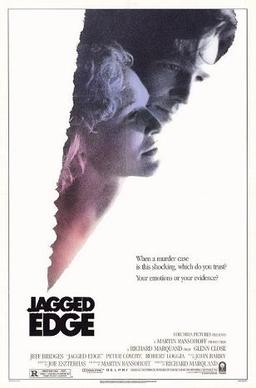
Teddy Barnes (Glenn Close) is done with criminal law after her time at the DA’s office, working under ambitious, unscrupulous Thomas Krasny (Peter Coyote). But she’s dragged back in to defend handsome newspaper editor Jack Forrester (Jeff Bridges), accused of brutally murdering his wife and her maid (for the money naturally). Teddy takes the case and soon crosses that line marked “personally involved” as she and Jack swiftly move from riding horses to riding each other. But what if Jack is really guilty after all?

Jagged Edge is a big, silly courtroom drama, a sort of erotic thriller B-movie that got some serious notice because two critically-acclaimed, three-time Oscar nominated actors fleshed out the cast. Written by Joe Eszterhase (for whom this was the springboard for a career of sex-filled, murder-and-legal dramas that would culminate, via Basic Instinct, with Striptease), Jagged Edge is full of pulpy, super-tough dialogue that its cast loves to chew around their mouths and spit out. It’s got the sort of courtroom dynamics that would see a case thrown out in minutes and would make its lead character unemployable in seconds. It’s daft, dodgy and strangely good fun for all that.

What it is not, really, is either any good or in any way surprising. One look at rugged, casually handsome Jeff Bridges and sharp-suited, charming-but-whipper-smart Glenn Close and you just know its only a matter of time before they end up in bed together. This leads to all sorts of unprofessional sex-capades and legal decisions, not to mention the sort of pathetically readable poker-faces in courtrooms that I would definitely not want from my lawyer.

Jagged Edge makes no secret of its hard-boiled, pulp roots. It opens with a POV home invasion as the killer breaks into his victim’s house that is only barely the right side of exploitative. Marquand doesn’t shirk any opportunities to chuck crime scene photos up on the wall. Peter Coyote’s uber-macho DA loves to say lines like “he has a rap sheet longer than my dick”. Best-in-show Robert Loggia (Oscar-nominated) is the sort of grimy flatfoot investigator who has a fridge full of booze and can’t go more than five words without cussing (when asked if his mother ever washed his mouth out with soap he simply responds “Yeah. Didn’t do no fuckin’ good”).

It’s similarly open about its sexy energy. Close and Bridges have a blue-filtered, late-night roll in the sheets, made even more exciting (perhaps) by the fact she spends half the film suspecting he did the deed. That’s the question the film challenges us with. On the one hand, Bridges seems far too boyish and aw-shucks to have slaughtered two women with a jagged knife. He sure looks upset when he visits the crime scene. Problem is there doesn’t seem to be any other possible suspect, and all that circumstantial evidence just keeps stacking up around him.

Close plays all this with a great deal of force and emotional intelligence, far more than the part (or the film) really deserves. She’s amicably separated from her husband (a very decent guy) and the film even finds a little ahead-of-its time space to make clear that Kransky’s animosity for her (and her loathing of him) is based on his sexual harassment of her as much as his flexibility with courtoom rules. Close balances the whole B-movie set-up with a real dedication – it’s effectively a warm-up (in a way) for the nonsense she’d play in Fatal Attraction.

Bridges is also pretty good, always keeping you guessing from scene-by-scene. How bothered is he when he spreads his wife’s ashes off his yacht? But then how affronted and hurt he looks when he is accused of the crime? It’s a tricky part, but he does a great job of constantly shifting the audience viewpoint and his relationship with Close’s Teddy is just smooth enough to have you guessing how genuine it is.

Wisely – perhaps – he doesn’t hit the stand during the trial. It would probably lead to drama meltdown. The courtroom is full of unbelievable curveballs, witnesses crumbling in a way they never do in real life. Every single disaster for each case is signposted by the fixed horror on the faces of the lawyers. Revelations fly-in and a new suspect effectively incriminates himself mid-trial to the delight of all (this suspect even enforces his caddishness by threatening Teddy in a car park in another moment where the film tries too hard).

The film culminates in the inevitably silly reveal, with plot twists abounding, where we are asked to believe that a killer who has ingeniously considered every single angle of his crime casually leaves incriminating evidence hanging around waiting to be discovered. Its final scene, where the killer is revealed, is either tense or unbearably, ridiculously stupid, depending on your viewpoint (everyone behaves ludicrously out-of-character and takes stupid, unnecessary risks). But for the bulk of its runtime, Jagged Edge is dirty, cheap fun.

John Wick: Chapter 4 (2024)

John Wick: Chapter 4 (2024)

It’s got almost no plot but what it does have is mesmeric, balletic fighting – for three hours

Director: Chad Stahelski

Cast: Keanu Reeves (John Wick), Ian McShane (Winston Scott), Donnie Yen (Caine), Bill Skarsgard (Marquis Vincent Bisset de Gramont), Laurence Fishburne (The Bowery King), Clancy Brown (The Harbinger), Hiroyuki Sanada (Shimazu Koji), Shamier Anderson (Mr Nobody), Lance Reddick (Charon), Rina Sawayama (Shimazu Akira), Marko Zaror (Chidi), Scott Adkins (Killa Harkan), Natalie Tena (Katia)

John Wick (Keanu Reeves) wants revenge against The High Table, the shadowy criminal organisation that (for various reasons) wants to punish him for various transgressions. The High Table are raising the stakes, giving the psychotic Marquis (Bill Skarsgard) carte blanche to destroy John, including levelling the Continental hotel of John’s ally Winston (Ian McShane). With destruction all around him, hunted by two deadly assassins the blind (and old friend) Caine (Donnie Yen) and the relentless dog-loving Nobody (Shamier Anderson), John’s only chance of survival is an arcane ritual duel between him and the Maquis.

John Wick: Chapter 4 is, in many ways, less a film and more an experience. Over stretched at nearly three-hours, its effectively three mammoth fights scenes (in Osaka, Berlin and Paris) loosely stitched together with a plot that doubles down on the arcane ritual of the franchise’s criminal underbelly. It was also a massive hit, the franchise’s biggest yet. Why? Because John Wick: Chapter 4 speaks a little bit to all of us who are bored with endless big-budget, special effects filled action films where nothing is real.

In John Wick: Chapter 4 you watch real people – stunt men and actors who have clearly trained for eons – set about a series of awe-inspiring action set-pieces with stunning realism. There is the same visceral thrill of watching Reeves dish out beatings as there was watching Gene Kelly dance steps: in both cases we are watching a master at work, turning his expertise into cinematic realism in front of our eyes.

So, in some ways, it doesn’t matter there is no real plot in John Wick 4 or that the characters are lightly sketched. Because we are here for elaborate, stunt filled fight scenes in the Osaka Continental. To see Donnie Yen move with the fluidic grace of a ballet dancer. To be gripped by Reeves punching his way through a brutal brawl with a fat-suit clad Scott Adkins (a martial arts superstar himself) in a neon lit Berlin nightclub. To watch Reeves fight his way up the Rue Foyatier steps, fall back down them, then fight back up again. Why these things are happening doesn’t really matter. It’s about the beautiful realism of watching actors actually do them.

That’s what powered this film to a record-breaking haul. Its why Reeves spent time in development, Steve McQueen like, ripping lines out of the script (he says little more than 500 words in the whole three hours). Who wants to see a monologue when a Reeves weary half-shrug on having to fight his way back up those stairs speaks volumes? When we need a break from the action, the script throws in some tense verbal show-pieces that Skarsgard chews up as a politely psychotic bully or McShane and Fishburne riff on with cod-Shakespearean grandeur.

It’s all thrown together with a great deal of style by Chad Stahelski, who has grown in cinematic confidence the more of these films he has directed. It takes some balls to effectively open the film with a homage to one of the most famous edits of all time from one of the greatest films ever made, as Fishburne blows out a match to cut to the desert sun rising. But then, I’m here for a film that wears its love for Laurence of Arabia on its sleeve (and even shoots a sequence on the actual location of Lean’s classic). Alongside this, Stahelski continues to find new ways to shoot this mayhem: from tracking shots, Steadicam immediacy to a sprawling birds-eye view (inspired by computer games) that tracks Wick taking out a building full of baddies.

There are a few thematic links in the film that brings the series full circuit. Wick’s two frenemies are reflections of himself. Donnie Yen – very cool – reflects Wick’s love for family, with his “doing the bare minimum” actioning to protect his daughter, while Shamier Anderson’s softly-spoken Nobody reflects Wick’s famous dog love. John Wick: Chapter 4 also hints at the existential crisis of its hero – when you are literally taking on the entire criminal world, leaving hundreds of bodies in your wake, what chance is there that this will ever end?

It’s these little grace notes that keep the film grounded enough for us to care about Wick while he slices his way through another army of thugs. But it’s not why you are there. John Wick 4 can easily – perhaps best – be watched in chunks. Soak in one action scene, have a breather, and then throw yourself into another. Because these are some of the best, coolest, most relentless action scenes you will ever see, executed with a stunning skill. And that is what differentiates John Wick at a time when everything else feels sterile. There might be far too much of it, but at least it is life.

Dirty Harry (1971)

Dirty Harry (1971)

Eastwood enters into cinematic legend in this grippingly entertaining pulpy cop thriller

Director: Don Siegel

Cast: Clint Eastwood (Inspector Harry Callahan), Harry Guardino (Lt Al Bressler), Reni Santoni (Inspector Chich Gonzalez), John Vernon (Mayor), Andy Robinson (Scorpio), John Larch (Police Chief Paul Dacanelli), John Mitchum (Inspector Frank DiGiorgio), Mae Mercer (Mrs Russell)

“Do you feel lucky? Well do ya? Punk” With these words, .44 Magnum in one hand and remains of a hot dog in the other (yes, Harry Callahan was so cool he didn’t even stop having lunch to take on a bunch of armed robbers), Clint Eastwood made a permanent mark on cinematic history. In 1971 Dirty Harry was condemned by some as fascist or reactionary, but really it’s just energetic, punchy, impossibly entertaining pulp. In a year where tough, rule-bending cops were de rigour, Dirty Harry may have more of a B-movie vibe than Friedkin’s Oscar-winning The French Connection but there is no doubt which one is the most viscerally entertaining.

“Dirty” Harry Callahan (Clint Eastwood) – so called because he gets all the jobs no-one else wants – is a tough-as-nails Inspector who values the Rule of Law over the Rules of the Law. Taciturn, not-suffering fools and always on the hunt for criminals (as the prototype gruff cop maverick, of course he works best alone), he prowls the streets of San Francisco and stops at nothing to take down bad guys and protect the innocent. He’s the guy you want on the case when the ruthless Scorpio killer (Andy Robinson) holds the city to ransom, shooting innocent people at random, seizing hostages and sending notes demanding payment to prevent more outrages.

Dirty Harry is lean, mean and a simply perfect piece of pulpy action. Directed with a tautness by Don Siegel, that never let’s go, it riffs on real life events – Scorpio is an obvious stand-in for the Zodiac Killer – and basically shifts a shoot-first-ask-questions-later cowboy into the heart of a modern city. Harry, embodied with sublime suitability by Eastwood (cementing his image) has a waspish sense-of-humour, speaks as he finds, never-ever-stops, has the ruthless determination we all wish we had and carries inside himself (buried deep) a maudlin sadness at his fundamental loneliness.

Dirty Harry doesn’t shirk in showing how a cop who bends the rules to deliver real justice can be an attractive figure. Harry doesn’t quite shoot first – he gives a cursory warning every time – but he always responds with lethal force when people are threatened. He’ll carry out illegal search operations of despicable offenders, he’ll follow a psychopath because he knows he’ll offend again (he’s right, but still) and when Scorpio won’t tell him where a hostage has been hidden, he doesn’t think twice about effectively torturing the guy to get him to talk.

Siegel’s film knows that this makes Harry the sort of guy we liberals tut about but, when push-comes-to-shove we need. Harry clones run through film and television history – what is 24’s Jack Bauer, but Dirty Harry fighting nuclear terrorists? – and it’s rooted in the fact that, although we know we should respect the rights of criminals, secretly we don’t want to. Surely, it’s not an accident that the film was set in San Francisco, the nirvana of liberalism in 1970s America. What makes that possible – cops like Harry.

The film stacks the deck slightly by making most of the besuited bosses Harry rubs up against punch-clock rules followers who place the letter of the law above its spirit. Of course, the DA will release Scorpio back onto the street because the damning evidence Harry has collected needs to be thrown out. Of course, he’ll order Harry to leave the clearly-mad-as-a-bag-of-bats Scorpio in peace. Of course, almost every other law official we see can’t hold a candle to Harry’s ruthless skill. Eastwood is so cool, we need to take a beat to remind ourselves that Harry is a widower who lives in an empty apartment, has no friends and he looks on with a quiet envy when his wounded partner is comforted by his wife.

But Harry is made for other things. Siegel’s character-defining set-piece early on, irrelevant to the plot, introduces everything we need to know about Harry. He effortlessly surmises a robbery is taking place at a bank across the street, calls for back-up and when he realises it will arrive too late, grabs that .44 Magnum and hot dog and strolls across the street into a shoot-up. At the same time, it’s a miracle no one is caught in the crossfire or crashing cars. He then bluffs another robber to stand down with a hard-as-nails bad ass speech, despite his chamber being empty of bullets.

To take on a guy like that, you need a truly inspired villain. Andy Robinson, his performance a master-class of twitch with a high-pitched giggle that acts like nails on a blackboard, provides it. He makes Scorpio a deeply unhinged, unpredictable predator who compensates for his slightness and youth (opposite Eastwood’s chiselled masculinity) by simply being an utterly unpredictable lunatic, with no sense of moral compass. Robinson pitches the performance just right, avoiding obvious histrionics to present a character larger than life but terrifyingly plausible.

The duel between them is shot by Siegel like an extended, grimly tense mix of chase and spy thriller. Opening the film with Scorpio searching the horizon for a new victim through a rifle’s telescopic lens, it throws us into a dark nightmare of San Francisco, with parks and baseball grounds places of unimaginable danger and a closing tense game of cat-and-mouse at an industrial plant. Through it all, Eastwood brings his softly spoken charisma to a man who knows full well there is little too him but the chase, but who puts the rights of the guilty a very, very distant second to the victims.

Dirty Harry plays like a punch to the guts, a superbly (and seductively) entertaining film that gives just enough hints at the dangers of Harry’s methods, while making their effectiveness abundantly clear. Siegel’s direction is pitch-perfect – this is one of the greatest cop thrillers ever made – and Eastwood’s performance is iconic. The French Connection maybe a more complex film – but Dirty Harry is more entertaining and the one you’d choose to put on with some popcorn.

Manhunter (1986)

Manhunter (1986)

Mann’s visually striking thriller doesn’t have quite the dark subversiveness it needs but is an unsettling thriller

Director: Michael Mann

Cast: William Petersen (Will Graham), Kim Griest (Molly Graham), Dennis Farina (Jack Crawford), Brian Cox (Dr Hannival Lecktor), Joan Allen (Reba McClane), Tom Noonan (Francis Dollarhyde), Stephen Lang (Freddy Lounds)

Before The Silence of the Lambs, there was an earlier attempt to bring the twisted world of Thomas Harris’ gothic thrillers to the screen. Michael Mann’s Manhunter has grown in reputation since its release, along with an increased regard for the visually stylised and cold modernism of Mann’s work. Truthfully, Manhunter lacks the Hitchcockian dark wit, and is far less effective at exploring the dark links between investigator and psychopath, than Silence of the Lambs. But it remains an intriguing – and often disturbing – curiosity.

FBI profiler Will Graham (William Petersen) is called out from extended leave by Agent Jack Crawford (Dennis Farina) to investigate chilling serial killer, the Tooth Fairy. The killer breaks into family homes and brutally murders the occupants, leaving bite marks and broken mirrors behind. Graham has an empathetic gift for understanding the mindset of killers, something he used to capture cannibalistic serial killer Hannibal Lecktor (Brian Cox), now imprisoned in a mental institute. Graham’s quest to catch the Tooth Fairy leads to him becoming ever more obsessive, including reconnecting with Lecktor to help profile the killer. Meanwhile the Tooth Fairy, Francis Dollarhyde (Tom Noonan), a lonely photo developer obsessed with William Blake’s Red Dragon and desperate to ‘become’ something greater begins his first meaningful relationship with blind colleague, Reba (Joan Allen).

Manhunter is set in a crisp, modernist world of clean, soulless buildings, glass fronted houses and offices and precise, featureless rooms. Mann and cinematographer Dante Spinnotti film everything with a series of tinges – strong, cool blues, drained out and striking whites, murky greens. All is designed to give the film a deliberately forensic feeling, like we watching something play out in a crime lab. It fits with a film that is fascinated with the procedures of investigating and profiling and delights in the intuitive, deductive leaps Graham makes.

Mann’s film attempts to draw parallels between Graham and Dollarhyde, both men uncomfortably in touch with their darkest, twisted impulses. As Hannibal Lecktor observes, Graham can so completely inhabit the interior world of killers, because he secretly longs for the buzz of killing himself. That’s easy to see in William Petersen’s focused, intense performance. Reluctantly dragged back in, Graham is noticeably unphased by the horrific crime scenes he witnesses (however much he is furious at the loss of life) and becomes ever more fixed and lean as the hunt continues, increasingly more-and-more like the obsessive prey-hunting psychopath he is investigating.

In doing so he sidelines his family – even putting them in danger – and increasingly cuts off human connections to feed his laser-focused quest. This contrasts him with Dollarhyde, a damaged, isolated and self-loathing man who flirts with the last vestiges of humanity. A man who sees nothing in himself that anyone could love, Dollarhyde becomes as giddy as a schoolboy when Reba sees him as a kind, attractive and decent man. Behind his eyes, Tom Noonan shows a quiet struggle between the obsessive monster, driven to destroy, and a man considering changing his path. This intriguing contrast between the family-man who leaves tem to hunt killers and the killer who flirts with settling down is a thread you wish the film had more patience to explore among its neon-lit, filtered style.

But Mann doesn’t quite have the patience to draw these threads together. Perhaps not helped by, skilled and intelligent as Noonan’s performance is, always presented Dollarhyde as an imposing, Frankenstein-monster style heavy rather than someone we invited to feel the sort of twisted empathy for that the film needs. We should be feeling something of what Graham says when he talks about feeling pity for the abused child and disgust for the twisted killer that child grew up to be. We never truly do.

Perhaps that’s partly because Dollarhyde is a character the film can never build up the same interest in, as it does with the looming shadow of Hannibal Lecktor (the spelling was unique to this film). Appearing only in three scenes, Lecktor dominates the film. Basing his performance on Scottish serial killer Peter Manuel, Cox brings the part a chillingly studied delight at his own intelligence with an air of quiet politeness which only vaguely masks his malice and cruelty. A ghost of a smile is behind every cruel, hurtful word and action he carries out and his every action is motivated only by a desire to harm. It’s a mesmerically terrifying, low-key performance that overwhelms the film.

It contributes to the film’s second half never really matching the first. As Lecktor recedes and Graham focuses on the Tooth Fairy, the lack of personal connection between hunter and hunted (and the film’s unease to draw too distinctive a comparison between them) makes the final hunt less compelling ironically than when the Tooth Fairy was an unknown, unseen adversary. Noonan’s most effective scene is his terrifyingly soft-spoken interrogation of smart-aleck reporter Freddy Lounds (a braggart Stephen Lang), but the film isn’t brave enough to give him enough potential humanity to make the character really interesting – or the Satanic charisma that Lecktor has.

Manhunter culminates in a disappointingly run-of-the-mill shootout (edited with a curiously ham-fisted jaggedness) and an unsatisfactory Graham family reunion that feels like it hasn’t got the energy or desire to explore any of the lasting impact the darkness we’ve discovered in our lead character would surely have. Manhunter not only changes the title of Harris’ book (there was fear that Red Dragon was too easy to mistake as a martial arts film), but it also benches the emotional and psychological obsession of Dollarhyde (even the character’s famous tattoos don’t appear in the film). It becomes a strikingly shot, intriguingly fast-paced thriller which doesn’t manage to make the psychological complexities its striving for either as fascinating or unsettling as it should. It has plenty to haunt you – its creepy POV home-invasion opening is nightmare-inducing – but Harris was better served by Lambs mix of playful dark-horror and focus on acute psychological insight.

Atlantic City (1981)

Atlantic City (1981)

A never-was romances a dreamer in Malle’s low-key film, full of neat observations

Director: Louis Malle

Cast: Burt Lancaster (Lou), Susan Sarandon (Sally), Kate Reid (Grace), Michel Piccoli (Joseph), Hollis McLaren (Chrissie), Robert Joy (Dave), Al Waxman (Alfie), Moses Znaimer (Felix)

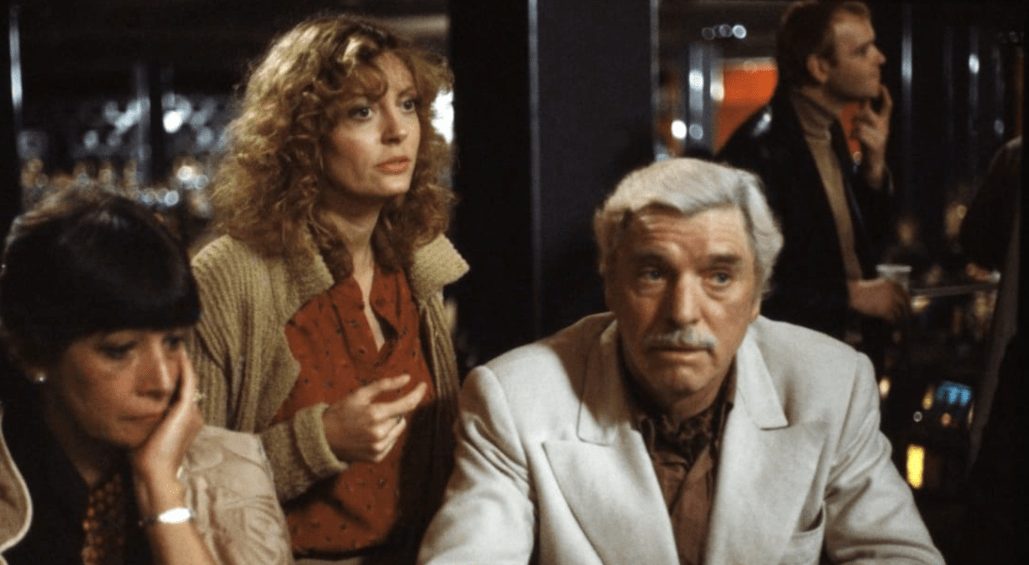
Lou trundles around Atlantic City taking a few cents for bets and wanting anyone who listens to know that back in the glory days of the Boardwalk Empire he was a big shot. Bugsy Siegel roomed with him in the slammer. Meyer Lansky asked his opinions on the latest scores. When he killed someone, he dove into the sea to wash the exhilaration from his body. Not his fault the glory days are gone, and his life has crumbled as much as the worn out city around him. He’s still a player.

Only of course he’s not. Played in a fine autumnal performance by Burt Lancaster, Lou has the front of an ageing star, but is a dyed-in-the-wool loser. He trades on a past that never happened, full of tall stories that only the dimmest and most impressionable would consider believing. He’s essentially a kept servant of Grace (Kate Reid), a former local beauty queen (third place) and spends his nights spying on his neighbour Sally (Susan Sarandon), while she washes away the stench of the hotel fish counter she works in.

When the chance comes to spin a fantasy that means Lou could actually impress and seduce this women, he jumps at it. That chance is Dave (Robert Joy), Sally’s pathetic dweeb of an ex-husband who believes Lou is the perfect to peddle his stolen cocaine around town. Dave winds up dead, Lou pockets the money, impresses the naïve but determined Sally (training to be a croupier) and very firmly considers letting her take the rap when the cocaine’s owners turn up looking for the money.

Both Lou and Sally are dreamers – or fantasists – at the opposite end of life’s scale. Lou dreams big about a past that never was. Sally is dreaming of an impossible future – one of French class, Monaco high-rollers and earning a future as a flash croupier. Really, we know both of their dreams are fantasies. After all it should be clear only losers wind up in Atlantic City. The casinos are dumps and even the criminals are pathetic, easily out-matched by Philadelphia hoods. Louis Malle’s film captures this perfectly in a crumpling city that looks like mouldy leftovers.

Malle’s film is a marvellously structured, low-key but highly effective character study, very well acted and shot with an intelligent, detailed eye. It’s a showcase for Malle’s subtle but intelligent camera work and composition. As Lou serves Grace early in the film, he is kept constantly in the centre of the frame, the camera jerking up and down to match his movements as he fetches and carries for the bed-bound Grace. Dave is frequently shot from above, looking even more pathetic and irrelevant with every shot. This is framing that speaks volume for status and character. The camera fluidly shifts across large spaces – the boardwalk, a casino – to show different interactions in different plains, characters either unaware of each other or using events elsewhere to escape notice.

Grimy and fabulously capturing the collapsing grandeur of a city fallen on very hard times, the setting is the perfect metaphor for the disaster of the character’s lives. None more so than Lou. You can argue Malle’s film may be too sympathetic to Lou – and, indeed, contemporary reviews discussed Lancaster’s inherent dignity mistaking it for the character. Lancaster however is smarter. Lou is a pathetic, sad figure. Look how he delights in puffing himself up as a big shot for the feeble Dave. Watch the childish excitement he takes in the notoriety he collects late in the film. Lancaster perfectly understands the desperate need to dress the part, longing to be something you are not: the grand, well-dressed sugar daddy who solves problems for his moll by unwrapping the elastic band from a roll of dollar bills.

Lancaster never allows this fantasy to be mistaken for reality. When danger comes, Lou almost always freezes or looks to keep himself safe. When he spins his stories of daring or classy confidence, Lancaster shows us a Lou who is replicating behaviours he has seen elsewhere. After completing his first cocaine deal, he has to wash his face in fear in a bathroom – then instantly condescends to an old friend who has been reduced to toilet attendant.

Sally is fooled for a while. But then we know she has a weakness for glamour. After all we’ve seen her indulge the pervy whims of casino trainer Joseph, a lecherous Michel Piccoli. In a clever performance by Sarandon, Sally is naïve enough to be sucked in but guileful enough to just about keep afloat. She tends to trust anyone who oozes confidence. She’s a little star-struck by the idea of Lou perving at her across the window (as if happy that she’s sexy enough to win the attentions of this seemingly classy old guy). But, turned, Sarandon makes clear she’s righteously furious when cheated and far more adept at confidence-tricksterism than the increasingly hapless Lou.

Because when crime comes Lou is out of his depth. But what would you expect from a man who is a live-in cook, dog-walker and sometime-stud for Grace, entombed in her kitsch-nightmare room. Kate Reid is very good as this clear-eyed bully who needs but also despises Lou, who knows all about what an unreliable and cowardly fellow he is deep-down but jealously guards his attentions.

Malle’s film plays out like a sort of noir short story, an adept study of its characters more focused on their damage and flaws than on the crimes at its nominal heart. This is about fantasy and the lies we tell ourselves. Just like Atlantic City kids itself it’s still a gambling mecca, so Lou and Sally believe they still have chances in life. It makes for an intriguing, engrossing film as they lie to themselves and each other, denying the truth until it hits them squarely and unavoidably in their face.

Atlantic City muses on familiar themes, but does so with freshness and intelligence. Perhaps Malle is a little too sympathetic to its characters (Lou in particular), but he is very clear-eyed about the Dennis Potterish fantasy world they are clinging onto and the shabby decline and disrepair that clutters their existence. It makes for a very fine, well-made and fascinating little film, full of sharp observations and wonderfully played beats.

The Lavender Hill Mob (1951)

The Lavender Hill Mob (1951)

Delightful but surprisingly subversive Ealing comedy, one of my all-time personal favourites

Director: Charles Crichton

Cast: Alec Guinness (Henry “Dutch” Holland), Stanley Holloway (Alfred Pendlebury), Sid James (Lackery Wood), Alfie Bass (Shorty Fisher), Marjorie Fielding (Mrs Chalk), Edie Martin (Miss Evesham), John Salew (Parkin), Ronald Adam (Turner), Arthur Hambling (Wallis), John Gregson (Inspector Farrow), Clive Morton (Station Sergeant), Sydney Talfer (Clayton)

It’s my personal favourite of all the Ealing comedies. It’s always surprised me it has been so warmly endorsed by the Vatican. Sure, it ends with a cursory “crime doesn’t pay” message – and it’s got a great deal of lightness, affection and wit. You want our seemingly mousey underdog to successfully take on the big banks. But this is a surprisingly dark and subversive film under its cuddly exterior. Much like its lead character, appearances can be deceptive and The Lavender Hill Mob lulls you into a false sense of security to hide its surprisingly darker heart.

Set in post-War London, Henry Holland (Alec Guinness) is a timid bank clerk, paid pocket money to monitor the delivery of hundreds of thousands in gold bullion to his bank. And he’s had enough. Holland plans a heist – he’ll steal the money, escape unsuspected and live the life of Reilly he feels he deserves on the proceeds. The inspiration for how to smuggle the money out presents itself when he befriends artist turned tacky gift manufacturer Alfred Pendlebury (Stanley Holloway) – they’ll melt down the gold and smuggle it as Eiffel Tower models. What could go wrong?

The Lavender Hill Mob fits very neatly into the classic Ealing set-up. The plucky underdog takes on the establishment, in this case the heartless bank run by public-school poshos and the police with their new-fangled technologies. It plays these cards extremely well, poking fun at the set order and building a great deal of empathy with Holland and Pendelbury, the two most unlikely criminal masterminds you can imagine. Middle-aged, middle-class professionals who have led lives of quiet, dutiful anonymity, its huge fun to see them cut loose and embrace the chance to be bad-boys. Who hasn’t wanted to say “to hell with it” and grab the opportunities you want in life?

But TEB Clarke’s superb script, matched with Charles Crichton’s dynamic direction, has a darker heart under the surface charm. Set in a bombed-out post-war London, the film’s design never lets us forget this is an upturned Britain, reeling from years of unimaginable upheaval. A country going through social and political change leaving old, deferential ideas in the past and old principles of morality might not apply. After all, when death was a nightly visitor to the capital, why should you continue to play by the rules? Holland is actually a man who has simmered with quiet, unspoken resentment for decades, who crafts the perfect heist and sees it through with obsessive, almost cold-hearted fanaticism.

Sure, he seems sweet and, yes, he doesn’t half get swept-up in childish excitement in the glamour of crime – who can forget his bashful desire to take on the criminal nom de plume Dutch. But the genius of Guinness’ performance is that he never lets us overlook the ambition, greed and willingness to go to any lengths under Holland’s meek exterior. Watch how Guinness stares with unblinking acquisitiveness at the gold as it melts down. The authoritative command he takes over Pendlebury when a small batch of gold Eiffel towers are accidentally purchased by a group of school children. The demanding perfection he insists on in every step of the heist.

This is Guinness at his absolute best and perhaps only he could combine such a criminal heart with light-comedy. Holland is an immensely endearing character because his success remains so unlikely. His scheme is low-tech and clever so it’s impossible not to end up rooting for it – especially when the resources and technology of the police and the bank are so well sign-posted. Guinness is giddy with excitement at the scheme – but also look at how quickly and coldly he lies, how smug and satisfied he can be in success and how ruthless when the situation calls for it. But yet we love him. This is dramatic and light comic acting distilled in one. He’s superb.

If anyone is a corrupted innocent, it’s Alfred Pendelbury. Played wonderfully by Stanley Holloway as a poetry-quoting dreamer, Pendlebury is the real unlikely criminal here. Holloway and Guinness have a wonderful chemistry, both enjoying the naughtiness of theft, but with Holloway’s star-struck eyes, Pendlebury is the follower, in awe of Holland’s cleverness and determination. Poor Pendlebury almost blows the heist by absent-mindedly wandering away from a newspaper stand still clutching an (unpaid for) newspaper, blithely suggests they let lost Eiffel towers go and bundles around the crime with an optimistic amateurism.

Clarke’s script has a lot of fun with questions of class. The pompous bank managers are exactly the sort of arrogant posh-boys who look down on everyone else with paternal disregard. They are blank, unthinking automatons. Class works both ways. Holland is unsuspected of the crime as he’s the sort of middle-class person who wouldn’t do this sort of thing. Holland and Pendlebury are quietly resentful of those above them – but they assume the same authority over the criminal classes they recruit for the scheme. Sid James (cementing his persona as a cheeky spiv) and Alfie Bass are natural cap-doffers who quickly accept their place in the gang’s hierarchy and even (rather sweetly) trust Holland and Pendelbury to deliver their share from Paris (naturally, as working-class lads, they are suspicious of travelling to France anyway to collect the loot).

The Lavender Hill Mob exposes the assumptions and traps of the class system in this country, and does so with a gentle, sly, subversive wit. Holland is basically the forerunner of the sort of bitter middle and lower middle class ambitious types who would drive change in Britain in the next few decades.

The film also gets a lot of comic mileage out of the smug ineffectiveness of most of the official forces. The police have a raft of technologies – radios, cars, scientific techniques – all of which do very little to help. In a late car chase through London, the radios actively work against them – Holland easily uses the radio in their stolen police car to spread disinformation, the central radio director guides several cars into a collision and eventually scrambled signals lead to “Old MacDonald” being played on all receivers. Optimistic but hopelessly inaccurate bulletins are constantly posted on their progress and only personal inspiration of the lead detective (a colourless John Gregson) and chance leads to the crime being unmasked. As well as looking at the dark bitterness of its lead character, The Lavender Hill Mob is strikingly cynical about officialdom.

Crichton’s direction is visually inventive and at times almost Hitchcockian – Holland and Pendlebury’s dizzying stairway descent from the Eiffel Tower arguably inspired Vertigo. And the film is supremely funny. The heist is planned with perfect comic timing, chase scenes are brilliantly done and there is a superb farcical set-piece as Holland and Pendlebury hurriedly try to negotiate French customs in a rush to catch a boat. Every scene has a funny line or inspired piece of comic business and Clarke’s script perfectly balances this with gentle but intelligent social commentary.

The Lavender Hill Mob is a triumph. From start to finish a delight, insightful and funny, it has superb performances from a faultlessly brilliant Guinness and a bombastically huggable Holloway. It wraps up comedy, social commentary and a surprising cynicism into a complete package. It’s a tour-de-force of charm, shrewdness and grace. It remains my best loved Ealing comedy, and possibly one of my favourite comedies ever made.

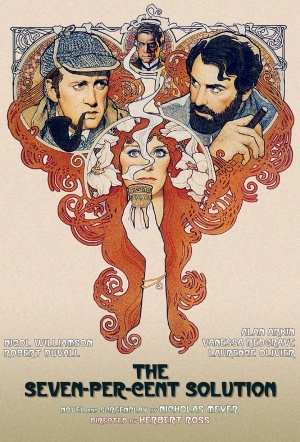
The Seven-Per-Cent Solution (1976)

The Seven-Per-Cent Solution (1976)

Affectionate and faithful Holmes pastiche that shines an interesting light on the Great Detective’s character

Director: Herbert Ross

Cast: Nicol Williamson (Sherlock Holmes), Robert Duvall (Dr John Watson), Alan Arkin (Dr Sigmund Freud), Laurence Olivier (Professor Moriarty), Vanessa Redgrave (Lola Devereaux), Joel Grey (Lowenstein), Jeremy Kemp (Baron Karl von Leinsdorf), Charles Gray (Mycroft Holmes), Samantha Egger (Mary Watson), Jill Townsend (Mrs Holmes), John Bird (Berger), Anna Quayle (Freda)

The magic of Sherlock Holmes is he is immortal. Doyle’s detective has been reshaped so many times since the publication of the canonical stories, that we’re now used to seeing him presented in myriad ways. It was more unsettling to critics – particularly British ones – in 1976, who didn’t know what to make of an original, inventive Holmes story that treats the characters seriously but is playful with the canon. Was this a parody or a new story? (Why can’t it be both!) Today though, The Seven-Per-Cent Solution stands out as a Holmesian treat, a faithful slice of gap-filling fan fiction.

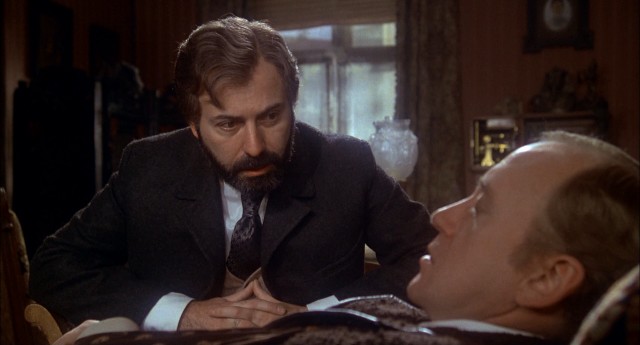
Based on a best-selling novel by Nicholas Meyer (who also adapted it), The Seven-Per-Cent Solution expertly reworks Doyle’s The Final Problem. Professor Moriarty (Laurence Olivier) is not the Napoleon of Crime, but a mousey maths tutor, the subject of Holmes’ (Nicol Williamson) cocaine-addled idée fixe. Worried about his friends dissent into addiction, Dr Watson (Robert Duvall) tricks Holmes into journeying to Vienna to receive treatment from an up-and-coming specialist in nervous disease and addiction, Dr Sigmund Freud (Alan Arkin). The treatment is a slow success – and the three men are drawn into investigating the mysterious threat to drug addicted glamourous stage performer Lola Devereaux (Vanessa Redgrave) that may or may not be linked to her fierce lover, the arrogant Baron Karl von Leinsdorf (Jeremy Kemp).

As all we Holmes buffs know, seven per-cent refers to Holmes’ preferred mix of cocaine, taken to stimulate his brain between cases and see off boredom. But what if that persistent cocaine use wasn’t a harmless foible – as Holmes tells the disapproving Watson – but something much worse? Kicking off what would become a decades long obsession with Holmes the addict – Brett and Cumberbatch would have their moments playing the detective high as a kite and a host of pastiches would explore the same ground – Meyer created a version of Holmes who was definitely the same man but losing control of himself to the power of the drug.

This short-circuited some critics who didn’t remember such things from school-boy readings of Doyle and hazier memories of Rathbone (those films, by the way, were basically pastiches in the style of Seven-Per-Cent Solution as well). But it’s a stroke of genius from Meyer, shifting and representing a familiar character in an intriguing way that expands our understanding and sympathy for him. Holmes may obsessively play with his hands and have a greater wild-eyed energy to him. He may sit like a coiled spring of tension and lose his footing. But he can still dissect Freud’s entire life-story from a few visual cues in a smooth and fluid monologue and his passion for logic, justice – as well as his bond with the faithful Watson (here bought closer to Doyle’s concept of a decent, if uninspired, man) – remain undimmed.

It helps that the film features a fantastic performance from Nicol Williamson. Few actors were as prickly and difficult – so could there have been a better choice to play the challenging genius? Williamson’s Holmes is fierce in all things. Introduced as a wild-eyed junkie, raving in his rooms and haring after leads, his behaviour oscillates between drug-fuelled exuberance to petulant paranoia. But there are plenty of beats of sadness and shame: Holmes is always smart enough to know when he no longer masters himself. When the mystery plot begins (almost an hour into the film), Williamson’s does a masterful job of slowly reassembling many of the elements of the investigative Holmes we are familiar with – the focus, the energy, the self-rebuke at mistakes and the excitement and wit of a man who loves to show he’s smarter than anyone else.

The film is strongest as a character study, in particular of Holmes. Its most engaging sections take Holmes from a perfectly reconstructed Victorian London (including a loving, details-packed recreation of 221B from production designer Ken Adam) to waking from a cold turkey slumber full of apologies for his cruel words to Watson. Seeing Watson’s quiet distress at Holmes state, and the great efforts he takes to help him, are a moving tribute to the friendship at the book’s heart. The clever way Meyer scripts Holmes’ ‘investigation’ into Moriarty (an amusing cameo from Laurence Oliver, his mouth like a drooping basset hound) sees him apply all his methods (disguise, methodical reasoning, unrelenting work) in a way completely consistent with Doyle but clearly utterly unhinged.

That first half serves as a superb deconstruction of the arrogance of literature’s most famous detective, who won’t admit the slightest flaw in himself. It’s still painful to see a frantic Holmes, desperate for a hit, causing a disturbance in Freud’s home and denounce Watson as “an insufferable cripple” (a remark met with a swift KO and later forgiven). Holmes’ cold turkey sequence is a fascinating sequence of nightmareish hallucinations, as he is plagued by visions of cases past (The Engineer’s Thumb, Speckled Band and Hound of the Baskervilles among them) and the eventual awakening of Holmes as a contrite, humbled figure very affecting.

Bouncing off Williamson we have the traditional “Watson” role split between that character and Freud. Robert Duvall is a very unconventional choice as Watson – and his almost unbelievably plummy accent takes some getting used to – but he gives the character authority without (generously) giving him inspiration. Limping from a war wound (another touch of the novels often missed until now), he’s dependable, loyal and goes to huge lengths to protect his friends.

But most of the traditional role is actually given to Freud, played with quiet charm and authority by Alan Arkin. Intriguingly the film places Freud as a combination of both men’s characters. He has the analytical mind of Holmes, investigating the subconscious. But he also chases after errands for Holmes, “sees but does not observe” during the case in the manner of Watson and eventually becomes an active partner in confronting the villains.

The actual mystery (taking up less than 40 minutes of the film’s runtime) can’t quite maintain the momentum, being a rather trivial affair (greatly simplified from the book) revolving around a cameo from Vanessa Redgrave as a fellow drug addict Holmes feels a touching sympathy for. Jeremy Kemp makes a fine swaggering bully, but his greatest moment is actually his pre-mystery anti-Semitic confrontation with Freud at a sports club, culminating in a Flemingesque game of real tennis between the two. If the film has any moment that tips into outright comedy, it’s a closing train chase that involves Holmes, Watson and Freud dismantling the train carriage to burn the wood as fuel.

But the real heart of the film is Holmes. Throughout the film we are treated to brief visions of the boyhood Holmes slowly climbing a staircase. What he saw at the top of that staircase is buried deep in his subconscious, with the final act of the film revealing all under hypnosis. It’s an intriguing motivator for all Holmes has become, just as it is surprisingly shocking. As Watson comments, the bravest act is sometimes confronting ourselves: The Seven-Per-Cent Solution treats the detective with huge respect, while pushing him into psychological waters Doyle would never have dreamed of. It’s why the film (and Meyer’s book) is a fascinating must-see for Holmes fans: it takes the material deeper, but never once forgets its loyalty to the source material.

Dance with a Stranger (1985)

Dance with a Stranger (1985)

Hell is other people in this Satresque version of the life of Ruth Ellis

Director: Mike Newell

Cast: Miranda Richardson (Ruth Ellis), Rupert Everett (David Blakely), Ian Holm (Desmond Cussen), Stratford Johns (Morrie Conley), Joanne Whalley (Christine), Tom Chadbon (Antony Findlater), Jane Bertish (Carole Findlater), David Troughton (Cliff Davis)

Hell is other people. Dance with a Stranger is the tragic story of how Ruth Ellis (Miranda Richardson in an electrifying screen debut) became the last woman hung for murder in Britain. But it’s also a terrible Satre-like tale of three people stuck a destructive cycle, loathing each other but unable to imagine their lives apart. Ellis is fanatically, obsessively in love with feckless David Blakely (Rupert Everett) who blows hot and cold on her and is nowhere near consistent in his feelings as middle-aged Desmond Cussen (Ian Holm), so besotted with Ruth (who treats him like a benevolent uncle) that he drives her to her assignations and pays rent on the apartment where she sleeps with Blakely.

All three cause each other immeasurable harm in Newell’s cool, bleak, well-made true-crime story that is far less interested in the moments of violence and retribution, than the sad and sorry cycle that leads to them. Tellingly, we never see a single moment of the trial or punishment of Ruth and the film effectively concludes in long-shot as we watch the fatal shooting of Blakely from afar. But who needs the close-up of this inevitable ending, when we’ve had front row seats to the catastrophic relationships that led up to it.

Like many British films, it’s at least partly about class. In 1950s London, we’re still on the cusp of the sort of cultural levelling out of the 1960s. This is a post-war, Agatha-Christie-like London. Blakely and his friends are Waughish Bright Young Things, living on Trust Funds and driving racing cars for fun. Their evenings are spent in drinking clubs aiming for glamour, staffed by those yearning to jump up a notch on the ladder like Ruth Ellis. Such women are of course for dalliances (and casual screws) not for marrying. Ruth’s back-up lover Desmond is an RAF-veteran who misses the war, an overgrown besotted schoolboy and middle-aged bachelor who accepts he is only worth other men’s cast offs.

Blakely’s friends encourage him to mess Ruth around because she’s a working-class strumpet. Ruth is at least partly willing to forgive him because marriage could lift her once and for all out of the working classes. Desmond is of less-interest, because a loveless middle-class marriage of sexual duty simply isn’t as attractive. Neither does Ruth love – or lust after – him the way she does the dynamic, sexy, little-boy-lost Blakely. A man she finds herself so uncontrollably drawn to that, no matter what he does – not turn up, mock her in front of his friends, push her down the stairs or punch her in the face in public – she comes crawling back. Often with Desmond in helpless tow, ignoring his adoration while demanding he drive her to another confrontation with the selfish Blakely.

Dance with a Stranger finds intense sympathy, to various degrees, with all three of its leads. But most strongly it turns Ruth Ellis, who could be a historical statistic, into a figure of real tragedy. Richardson is superb as a woman who is confident, assertive – even arrogantly dismissive – in so many areas of her life except one: her compulsive, obsessive and destructive love for Blakely. Dance with a Stranger charts effectively her mental collapse: from a woman who flirts confidently in a bar, to a quivering, weeping mess standing in the streets staring up at her lover’s window, screaming abuse, smashing up cars and babbling incoherently and inconsolably.

The film charts the same deadly cycle, showing Blakely’s ill-treatment and selfishness having ever more deadly impact on Ruth’s mental well-being. In it all, Blakely isn’t always malicious, more immature and easily led. Everett’s performance is perfect at capturing this playboy uneasiness under a fundamentally weak personality, a man who has been handed everything on a plate and is unable to respond in any adult way to Ruth’s love for him. Nevertheless, his stroppy behaviour gets her fired from her job and his behaviour fluctuates from gifts of framed pictures and promises of devotion, alternated with angry outbursts and emotional and physical violence.

And Desmond Cussen picks up the pieces time and again. Ian Holm is wonderful as this hen-pecked sadomasochist, impotent and all-too willing to debase himself, hurt time and again by seeing Ruth returning time and again to the dismissive Blakely. Holm makes Cussen small, weak, moody and frequently pathetic. He limply follows where she leads and suffers with weary, besotted patience every one of her preoccupied complaints against Blakely. This is man who almost sado-masochistically puts himself in painful situations, can’t be angry with Ruth for more than a few minutes and gets into impotent scuffles with Blakely outside pubs.

But it’s also Cussen who has the gun – and the film at least suggests the possibility that his openness about its location might well have been a factor in Ruth’s later decision to use it. The killing is, deliberately, the least interesting part of the film. What matters is the mental state that led Ruth to this killing. The self-delusion and desperation to believe that she could form a relationship with Blakely, the same obsessive blind-spot that leads to her closing the film writing a condolence letter to Blakely’s mother. Ruth is a victim here as much as him (perhaps more?) a mis-used woman who cannot give Cussen what he wants and can never get what she needs from Blakely.

Newell’s direction is sharp and sensitive and while the film’s cycle of destructive behaviour – Blakely and Ruth row, break-up, Cussen picks up some pieces, rince and repeat – can become overwhelming, it is partly the intention. And it cements the feeling for the audience of being as much trapped in this hell as everyone else. Holm is superb, Everett perfectly cast but Richardson is mesmeric as Ruth, vivid, vibrant, vivacious, vulnerable and victimised in a film that goes a long way to humanise the suffering behind what seem open-and-shut cases.

Decision to Leave (2022)

Decision to Leave (2022)

Obsession, murder and romance combine in this stunningly made inventive romantic film noir

Director: Park Chan-wook

Cast: Tang Wei (Song Seo-rae), Park Hae-il (Detective Jang Hae-jun), Lee Jung-hyun (Jung-an), Go Kyung-pyo (Soo-wan), Park Yong-woo (Im Ho-shin), Kim Shin-young (Yeon-su), Jung Yi-seo (Yoo Mi-ji), Jung Young-Sook (Granny Hae Dong), Yoo Seung-mok (Ki Do-soo), Park Jeong-min (San-oh), Seo Hyun-woo (Sa Cheol-seong “Slappy”)

Death from dizzying heights, a mysterious femme fatale and a detective who tips into unhealthy, romantic obsession. Sound familiar? Park Chan-wook’s Decision to Leave is an enticing spin on Vertigo, but also a beautifully made marriage of Park’s visually dynamic style with classic Hollywood film noir. Decision to Leave is soaked in the sort of atmosphere you’d find in Laura or Double Indemnity and is a breath-taking marriage of half-a-dozen genres, from noir to romance to tragedy. It rotates continuously, no matter how much we observe and watch people, on how little we understand them – and how little we understand ourselves. It’s a stunning piece of film-making.

Jang Hae-jun (Park Hae-il) is a high-flying Busan murder detective, the youngest senior investigator on the force. He’s also a reserved man, crippled with insomnia and weighed down with guilt over cases he failed to solve, conducting a long-distance marriage with Jung-an (Lee Jung-hyun) a scientist at the nuclear plant in distant Ipo. He’s called into investigate the death of a civil servant and keen climbing enthusiast, who fell to his death from his favourite climbing spot. His much younger Chinese wife Song Seo-rae (Tang Wei) is strangely unmoved by his death and becomes the investigation’s focus. She also becomes the focus of Hae-jun’s sleep-deprived obsession as he stakes out her home. Gradually Seo-rae and Hae-jun form an intimate but unromantic relationship as they discover a deep bond between them. But does that mean that Seo-rae isn’t a murderer?

Questions of motivation and the reasoning behind decisions is central to Park’s film. At its heart is Seo-rae, a woman constantly unreadable, as hard to distinguish as her turquoise-tinged clothes are between blue or green (depending on who you talk to). A Chinese woman in South Korea, her Korean is formal and perfectly phrased but she relies on Google Translate to render more emotive sentences into Korean. She nurses ageing women in their homes, showing them care and attention. She might also be a murderer several times over, for motives that are impossibly unreadable.

It must be particularly unreadable for a detective whose mind is clouded by lack of sleep. Hae-jun’s eyes in his lined, weary face are frequently blurred by eye drops (the same eye drops covering POV camera shots). As a detective he’s prepared for everything. He wears trainers, constantly prepared for sudden sprints after criminals (one of these sees him pounding up the side of Busan’s mountain – both he and the suspect collapsing, wheezing for breath, at the top), he has specially tailored coats filled with any object he might need, from tissues to aspirin to a knife glove for hand-to-hand combat. He is calm, unruffled and ready for anything. He’s also a man who struggles with knowing who or what he wants and has placed such pressure on himself that insomnia feels like his body telling him sleeping is irresponsible in a world where there is so much to fix.

Decision to Leave revolves around the fascinating dance between these two characters, a Sherlock Holmes and Irene Adler, who recognise on some-level they are kindred spirits. Both are quiet, dedicated observers of people. Both have the ability to zero in on details – its telling that Seo-rae is the only one who can help Hae-jun begin to crack his old cases and that Hae-jun is the only one who delights in every detail of Seo-rae’s careful, formal Korean. Neither are exhibitionists, both quest obsessively because they feel they must for others: Hae-jun for the victims of crimes, Seo-rae to reclaim the Korean land her grandfather had been forced to leave behind when he fled to China.

But yet… these are also people seemingly determined to manipulate and entrap each other. Sae-jae’s growing closeness with Hae-jun is also a way to get closer to the case, to follow Hae-jun’s progress and to nudge (or outright shove) it in certain directions. Her motives and decisions remain unclear. When they go on a tenderly chaste date to a Buddhist temple, is their connection and intimacy genuine for her, or is she ruthlessly playing a lonely man for advantage?

Because Hae-jun defines himself as a detective – after all, he will chase cases to the end long-after his bosses have demanded he file it. Decision to Leave explores how far this will affect Hae-jun: how far will he go to protect someone he suspects might be a killer? If he helps Seo-rae, how much would he grow to hate himself for doing it? Or to put it another way – is there a greater expression of love that a Holmes is capable of, than to help his Irene Adler get away with it?

These dizzying themes interweave with fascinatingly oblique motivations in this endlessly rewarding puzzle-box of a movie. It’s also clear to see the Vertigo parallels, as manipulators fall in love and stalkers try to shape people and events to meet their desires. It’s second act, set in Ipo, as the characters come back together after a time-jump is a brilliantly engaging dance between two people who might be deeply in love and might be doing their very best to manipulate each other. Here acts of love include reading seized phone call transcripts or draining a swimming pool of bloody water.

It’s extraordinarily shot by Park chan-wook – this is the sort of film that makes you want to run out and see everything else he’s ever made straight away. Decision to Leave is more classical and reserved than his other ‘cinema of cruelty’ films. But that isn’t to say it’s not crammed with endless inventive flair. Camera angles plumb every depth of imagination – from vertigo-inducing heights to shots that seem to place the camera inside phones, their graphics superimposed across the screen.

As Hae-jun imagines Seo-rae’s actions or stakes out her home, he is visually inserted into her memories or placed in the scene as a witness as he deduces how she may have killed her husband. As this dedicated, obsessive watcher – who can’t leave his fascination with the case alone – watches her home, Park suddenly places Hae-jun inside Seo-rae’s home, sitting alongside her on a sofa. Scenes replay from multiple angles to show us new perspectives, and the characters blur and switch roles as Seo-rae stakes out Hae-jun in Ipo, noticing how his smart shoes (not suitable for running) are in fact a sign of his collapse in confidence.

Decision to Leave gains hugely from Tang Wei and Park Hae-il’s superb performances. Tang Wei is utterly unreadable, her motives and emotions discernible moment-by-moment only in micro-clues – but by the film’s conclusion you feel you finally have an understanding of her tortured, confused emotions. Park Hae-il drips crumpled loneliness and sadness under a professional demeanour, his emotional vulnerability becoming more and more apparent, his job a fig leaf to give his life definition. The chastely, strangely innocent, intimacy between the two of them has profound emotional impact – this is a classic romance, about two people far closer than sex could make them.

Park’s direction of all this is perfectly paced – for a slight plot and an extended run-time, this feels like a film where not a moment is wasted. Like Vertigo every moment fits together into a complete whole which might only be understandable when you step back and look at. Visually, it’s a treat – inventive but not flashy, unique but not overbearing. And it builds a carefully modulated and deeply moving spiritual romance at its heart. It’s a beautiful slice of film noir, rung through with poetry. It’s a marvellous film.

The Virgin Spring (1960)

The Virgin Spring (1960)

Revenge, violence but also a touch of hope abound in Bergman’s haunting Oscar winning classic

Director: Ingmar Bergman

Cast: Max von Sydow (Töre), Birgitta Valberg (Märeta), Gunnel Lindblom (Ingeri), Birgitta Pettersson (Karin), Axel Düberg (Thin Herdsman), Tor Isedal (Mute Herdsman), Axel Slangus (Bridge-keeper), Allan Edwall (Beggar), Ove Porath (Boy)

Spoilers: If you can spoil a Bergman classic, the full content of the film is discussed below

If a film cemented Bergman as the master of misery, it was his Oscar-winning The Virgin Spring. On the surface, a grim fable of rape revenge shot in wintery horror, it’s hard to imagine most people nerving themselves to watch it based on a synopsis. But they would be missing out. The Virgin Spring is, for all its hard-hitting violence and cruelty, a surprisingly hopeful film. Like the best of Bergman, it’s profoundly challenging, searching and operates on multiple levels – but rewards the viewer with splashes of strange optimism that feel a world away when it opens. It’s one of his truly great films.

Set in medieval Sweden, Töre (Max von Sydow, magnificently, chillingly grief-stricken) is a prosperous and devotional Christian farmer, in a cooling marriage to Märeta (Birgitta Valberg). The light of his life is his daughter, the beautiful Karin (Birgitta Pettersson). One day, Töre tasks Karin to travel to the Church (half a day’s ride) to deliver some candles. She travels with Ingeri (Gunnel Lindblom – bitter, damaged and brilliant), a pagan servant girl, heavily pregnant and resentful. Along the way they two are separated and Karin meets with three peasant brothers in the forest, who share her meal with her before the two adult brothers (Axel Düberg, Tor Isedal) rape and murder her. The brothers walk on and take shelter that night in Töre’s hall. When he discovers their deed, he murders them all (even the innocent youngest brother, a boy) then, horrified, pleads to God for forgiveness. At which point a spring, bursts forth where Karin was killed.

Not exactly a bundle of laughs. But this is powerful, compelling film-making from Bergman. His influence on horror has been overlooked, but The Virgin Spring show how much he inspired everything from shlock to The Exorcist. This is a tense, unbearably so, film which twice draws out the long build-up to shocking violence in a way that would make Sergio Leone proud. Played out in a beautifully moody, bleakly cold and wintery visual style from Sven Nykvist (his first collaboration with Bergman) and often in an atmospheric mix of silence and natural sound, you can feel your stomach knot as the inevitable transgressive act looms ever closer.

The film pulls no punches, while never being exploitative. The rape and murder of Karin (excellently played with just the right mix of innocence and spoilt certainty by Birgitta Pettersson) unfolds with a cold matter-of-factness, as she slowly realises these men are far more dangerous than she imagined. The event is hard-to-watch for its simplicity rather than its graphicness, and for the cold indifference of its perpetrators who act on a whim. It takes place almost in silence and the killing (mercifully off-camera) is more because they don’t know what to do next. Mix that in with the terrified stares of Ingeri from afar, and the shell-shock of the younger brother (who vainly tries to bury Karin with dirt before running away), makes a scene devoid of sensationalism but terrible to watch.

It’s reflected in the film’s later act of violence. The brothers having tried to pass off Karin’s blood-stained dress as their (imaginary) sister’s, sell it to Märeta (who instantly recognises a garment she stitched herself, even as she’s asked to admire the handiwork), are locked in the hall while they sleep. Töre’s slaying of them, however, never feels triumphant. Instead, the Christian Töre abandons his faith to embrace pagan revenge. Like a priest before a blood sacrifice he dresses himself in butchery gear, discards a sword for a smaller knife, carefully prepares the room for the brothers to wake and then sits, idol-like, in his chair waiting. This is a damning ritualistic insight into how our faith – the faith Töre was so proud of – can drop away to reveal our vengeful simplicity below.

The fight that ensues feels like something from the nether-regions of hell. One brother is skewered, arms wide, to Töre’s chair. Another is stabbed under Töre’s body weight – shot in a way reminiscent of Karin’s rape, with the flames of the fire dancing between them and the camera – his body left to burn in the fire. Their brother – a child – runs to Märeta for protection, yet Töre hurls him against the wall breaking his neck. There is no triumph. Töre speaks not a word – the brothers die having no idea who he is. Töre is left starring at his trembling hands in shock, as if waking from a dream not recognising the man he has become who turned his back on every article of faith he held dear.

It’s a film that shows the impact of grief and trauma. From the terrified face of the youngest brother – shovelling dirt on a dead body with tear-stained eyes – to Töre’s shell-shocked realisation his daughter is dead. Deep down, people blames themselves. Märeta believes she is being punished for envying Karin’s closeness to her father. Ingeri believes she has cursed Karin to suffer the same shame as her. Töre, perhaps, feels guilt at his own semi-incestuous closeness with his daughter. Why else does he struggle to bring down with his bare hands a new-planted birch tree (in beautifully haunting medium shot), cutting branches from it to flay himself in a sauna before he takes his revenge? It’s both punishment for past and future sins.

This is also a film that challenges us to decide whether brutal revenge is justified. The build-up to the murder of the brothers is very similar to the murder of Karin. A long meal, shared, even with similar food – so similar that the innocent younger brother vomits at the memories it brings back. This young boy is the death of innocence in this world. Betrayed into crime by his vile elders then forced to pay a terrible price for a deed he was powerless to stop and left him deeply distressed. How can we really triumph in Töre’s killing, when we see it performed so violently at such a price?

Bergman tests throughout how far faith goes, and questions what power God has. The film opens with two pleas, to two very different Gods. Ingeri pleads to Odin to punish the virtuous Karin, who in Ingeri’s eyes is a working rebuke for her wedlock-free pregnancy. Töre prays to a Dürer style carved cross for God to keep their household safe. Only one deity delivers: and rightly Töre will plead at the film’s end “You see it God, you see it…you allowed it. I don’t understand you.” Töre has even mirrored the rapists, in murdering an innocent. He repents later, but is a heathen in the moment.

Paganism is strong in The Virgin Spring. But it is not good. Ingeri separates from Karin when she meets a half-blind bridge-keeper, in a house full of ravens, in the wood. The man ticks every box for representing Odin and conveys dark promises of powers beyond mankind. But he is a vile, Devilish figure who takes an impish delight in cruelty and mischief. Ingeri’s departure from him coincides with Karin’s encounter with her killers – as if these demonic sprites had been conjured up by Odin to punish Ingeri by providing her with exactly what she asked for.

Why then is a film so grim, so cold, so difficult and challenging also feel strangely hopeful? Odin has won and Töre has turned his back on Christian faith to embrace cold, merciless, pagan violence. But as Töre pleads for forgiveness a spring bursts forth from below the point where Karin’s head lay. Suddenly, water pours out of the ground. Light bathes the clearing from above. Ingeri washes her face and hands, cleaning symbolically the parts of her that made those pagan pleas. Suddenly, from nowhere, the film presents an intense moment of spiritual hope that I found surprisingly moving. Rarely has something so grim, felt so cleansing at its close. Perhaps viewers need the simple, honest refreshing splash of water to help themselves after. That’s what helps makes The Virgin Spring difficult, uncomfortable but essential.