Category: Cult films

The Taking of Pelham 123 (1974)

The Taking of Pelham 123 (1974)

Effective thrills on a well made heist drama with some interesting social points to make

Director: Joseph Sargent

Cast: Walter Matthau (Lt. Zachary Garber), Robert Shaw (Mr. Blue), Martin Balsam (Mr. Green), Héctor Elizondo (Mr. Grey), Earl Hindman (Mr. Brown), James Broderick (Denny Doyle), Dick O’Neill (Correll), Lee Wallace (Mayor), Tony Roberts (Warren LaSalle), Jerry Stiller (Lt. Rico Patrone), Rudy Bond (Police Commissioner), Julius Harris (Inspector Daniels)

Colour coded crooks carry out a crime? Tarantino was clearly a fan of The Taking of Pelham 123. And who can blame him? This is exactly the sort of well-constructed, entertaining thriller Hollywood used to churn out so well. It even manages to mix its cunning crooks with more than a bit of cynical social commentary on the contemporary mess that was New York. It’s grimy, surprisingly hard-edged but with a lean slice of black humour: you can see why it’s a bit of a cult classic.

On the New York City subway, a gang of determined, efficient criminals take control of the front car of downtown train ‘Pelham 1-2-3’ (a train name now banned in New York due to copycat fears!). They are led by polite but utterly ruthless Mr Blue (Robert Shaw) and include nervous train-expert Mr Green (Martin Balsam), loyal Mr Brown (Earl Hindman) and trigger-happy Mr Grey (Hector Elizondo). Their demands are simple: $1million dollars (such humble ambitions these days!) in one hour, or they execute one of their 18 hostages every minute. And no negotiation, no matter how much City Transit Police cop Zachary Garber (Walter Matthau) might try over the radio. With the crooks seemingly having thought of everything, can Garber stop playing catch-up and work out their plan?

You only need to look at the popularity of Die Hard to see what guilty pleasure there is in fanatically prepared criminals trying to get away with it. The Taking of Pelham 123 has all of this. Blue’s team is professional, prepared and have anticipated everything. From calmly telling the passengers how futile any escape attempt would be, to anticipating every single action of the authorities, to delivering (with fatal results) on every one of their promises, these guys have the sort of competence we always sneakly admire in film. Match that with Mr Blue’s strangely samurai-like sense of honour (he’ll keep every deal he makes, despises anger and sadism and respects worthy opponents – even while he emotionlessly executes a hostage) and a bit of you will root for the criminals to get away with it. Right up to, of course, when they start to deliver on their fatal promises.

Of course, it helps that The Taking of Pelham 123 takes some intriguingly sharp pops at the forces ranged against the criminals. The mayor’s ineffectiveness is underlined by having him spend virtually the entire film in bed with a stinking cold. His decision about what to do hinges on how many votes he might get. He resents going to the scene, complaining he’ll get booed (guess what happens!) and is frequently brow-beaten by his more accomplished deputy. When he whines about where they are going to raise the money from (stop to remember for a second what a bankrupt, crime-ridden, mess New York was at the time) it’s even suggested (half-jokingly) he considers cleaning out one of his Swiss bank accounts. Around them many members of the police are heavy-handed, trigger-happy and frequently flustered by the relentless deadlines while the main representative of the train network sees the risk of 18 deaths as an irritating obstacle to an efficient transport system.

This has all been factored into the criminal’s plans. Ask for a big amount, but not so big that the authorities find it politically impossible to deliver. Give a deadline that is achievable but too short to allow anyone the time to make a plan. Count on the general disorganisation of the system being your best ally. Yup The Taking of Pelham 123 is a very 70s crime thriller, when cynical expectations about the efficiency and honesty of the authorities is crucial to the scheme!

Naturally, in a world like this, an awkward looking, scruffy maverick is our hero. Walter Matthau is the man you call for – particularly when the villain is Robert Shaw at his most smooth, clipped and articulate. Matthau’s homespun wisdom and gut instincts are, of course, the only thing the villains haven’t anticipated. It’s Garber’s focus on the people – as opposed to the obsession everyone else has about saving face and passing the buck – that marks him out: that and his authority-shirking cynicism and complete lack of interest in work-place turf battles.

The Taking of Pelham 123 barrels along from there with surprising efficiency and a little dark humour. Some of this humour is even – rather bravely – at the characters own lazy assumptions. One of Garber’s most knuckle-dragging colleagues is seemingly unable to comprehend the idea of a female police-officer. Garber himself isn’t immune: his increasingly rude handling of a group of Japanese transport officials rebounds on him with acute embarrassment when they reveal on departure that they speak perfect English (so understood all his derogatory slurs) and, on meeting his police liaison (Julius Harris) Garber awkwardly fails to hide his astonishment at discovering the authoritative, intelligent man he’s been talking to on the radio is Black (a surprise all too clearly noted by Harris).

Whimsical humour rebounds – not least the impact of the recurring cold of an excellently world-weary and avaricious Martin Balsam’s Mr Green and Garber’s instinctive, polite Gesundheit – among the surprisingly hard-edged violence and no bullets-pulled shootings. But the main thing that ends up compelling you is trying to work out, like Garber, exactly what the criminals are planning and how they intend to get away with it. In that sense, Sargent’s film keeps itself lean, mean and focused and zeroed in on the plot details. A stripped down, always exciting entertainment.

Escape from New York (1981)

Escape from New York (1981)

B-movie thrills and an epic piece of world building in this very fun cult actioner

Director: John Carpenter

Cast: Kurt Russell (Snake Plissken), Lee Van Cleef (Commissioner Bob Hauk), Ernest Borgnine (Cabbie), Donald Pleasance (The President), Isaac Hayes (The Duke), Harry Dean Stanton (Brain), Adrienne Barbeau (Maggie), Tom Atkins (Captain Rehme), Season Hubley (Girl in ChockFull o’ Nuts)

In the 1980s New York was pretty much America’s crime capital, so it wasn’t too much of a stretch to imagine an insanely dystopian America of 1997 where Manhattan is turned into a massive jail surrounded by a wall with its population entirely made up of murderous gangs and criminals (sadly without the severed head of the Lady Liberty lying in the middle of the streets). That’s what we get in Escape From New York (great title!). Problem is, it also makes it incredibly hard to get into New York – a real issue when a hijacked Air Force One crashlands there and the President (Donald Pleasence) needs rescuing.

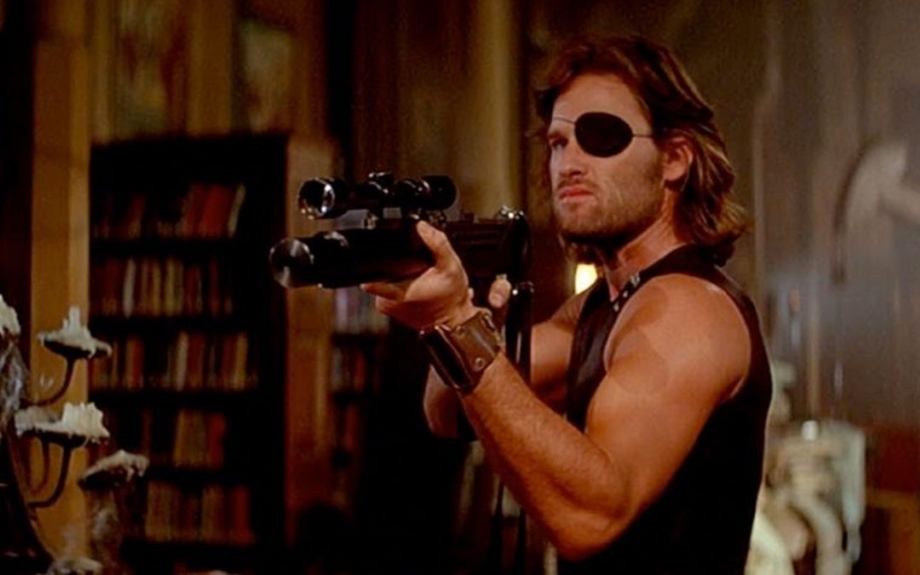
Who ya gonna call? None other than grizzled, scowling, no-nonsense ex-Special Forces legend turned criminal Snake Plissken (Kurt Russell). Plucked from a line of convicts by Commissioner Hauk (Lee Van Cleef), Snake is given a simple offer: fly a glider into Manhattan, find the President and bring him back in 22 hours so he can speak at vital peace conference and in exchange get a pardon. And just to make sure he doesn’t back out? Inject him with explosives that will go off in exactly 22 hours unless Hauk switches them off. Into New York Snake goes, a Mad Max hell under the thumb of kingpin The Duke (Isaac Hayes), with his only allies an eccentric ex-cabbie (Ernest Borgnine) and married couple Maggie (Adrienne Barbeau) and an old (untrustworthy) partner-in-crime Brain (Harry Dean Stanton).

From all this pulp, Carpenter serves up a very entertaining slice of B-movie fun and games, that frequently makes very little narrative sense (by the end relying on hilariously convenient plot developments and off-screen meetings), where the 22-hour countdown seems to alter with as little consistent logic as the shifts between night and day (judging by the sky, at one point it takes Snake well over an hour to take a lift up the World Trade Centre which even in a dystopian hell seems like a long time) and where characters switch allegiances as easily as you and I change socks.

But that hardly matters when Carpenter was so focused on making B-movie fun and use every penny of his tiny budget to maximum effect. Escape From New York is above all a triumph of creative world-building. In broad strokes – the sort of well-built skeleton that leaves the audience wanting to fill in the muscles and skin themselves – it presents a compelling view of an America that has so comprehensively gone-to-shit that a city is now a prison, a forever-war is taking place with both the USSR and China, the President is a corporate stooge (with British accent!) and the whole country is run by a proto-fascist police force. It’s full of neat little touches – not least the computer voice at the Manhattan prisoner processing centre that offers prisoners the chance of voluntarily immediate cremation rather than be chucked into the city – that suggest a panoply of dystopian mess behind it.

The world of Escape From New York is so intriguing, it carries the fairly bog-standard urban warfare against lunatic gangs plot that Carpenter had already mastered with Assault on Precinct 13. Once Snake lands his glider atop the World Trade Centre (for extra un-intentional retrospective impact, hijackers also fly Air Force One into a couple of Manhattan skyscrapers), truthfully there isn’t much in terms of the action that we haven’t seen before. Shoot-outs on streets lined with trashed cars and graffiti, fisticuffs in abandoned train stations and boxing ring match-ups between Snake and a giant bruiser armed with a baseball bat full of nails. Most of the film is basically a hide-and-seek cat-and-mouse chase. Eccentrically presented stuff, but all fairly run-on-the-mill.

What makes it work is that post-apocalyptic mystique and Carpenter’s determination to make every shot count. Not least because the budget only stretched to about a day’s filming in New York (probably why both sequences atop the World Trade Centre illogically take place at nighttime). The rest was shot in a burnt-out district of St Louis. There is a great deal of demented imagination that has gone into the design of the film, not least the cyber-punk barminess of the gang costumes, from the Duke’s Napoleonesque shoulder braids to the punk-rocker scuzziness of his number two Romero (an eye-catching performance of bizarre oddness from Frank Doubleday).

It helps when you have some committed performances, not least from Kurt Russell as ultimate man’s-man maverick Snake Plissken. Strange to think now that Russell, best known for Disney work, was seen as an odd choice for the bitter, shoulder-chipped, ruthless Snake. But it’s a role he embraces whole-heartedly, making Snake both a selfish guy who literally barely cares about anything other than himself and the sort of ideal tough-as-nails maverick who gets things done that we all kind of want to be. He’s also – from his eyepatch to his grizzled monosyllabic dialogue to his unveiled contempt for all the double-dealers and bullies he meets – effortlessly cool.

Russell sets a lot of the tone for the movie, his low-key scowl allowing a lot of the rest of the cast to cut loose in eccentric roles. Ernest Borgnine overflows with cheery New York patter, which doesn’t even slow down when he lights a Molotov cocktail to ward off marauding gang-members. Harry Dean Stanton weasels as a constantly side-shifting guy we are assured is a genius (despite all evidence to the contrary). Donald Pleasance has a whale of a time as an uncharismatic functionary who, it becomes clear, doesn’t care about anyone other than himself. Best of all, Lee Van Cleef (perhaps flattered that Russell seem to be homaging his Spaghetti Western roles) smirks, gloats and scowls as a relentlessly ends-rather-than-means boss.

Escape From New York barrels along to a blackly comic ending (in which our pissed off maverick hero potentially scuppers a major peace conference out of a fit of resentful pique). It’s intriguing world-building riffs wonderfully on Mad Max (in fact, you could argue that later Mad Max films basically riff of Escape From New York) and while its action is fairly routine, it’s acted and directed with huge verve and fun. The sort of thing you call a guilty pleasure.

The Terminator (1984)

The Terminator (1984)

Schwarzenegger becomes an icon in Cameron’s masterpiece, a darkly gripping sci-fi chase-thriller

Director: James Cameron

Cast: Arnold Schwarzenegger (The Terminator), Michael Biehn (Kyle Reese), Linda Hamilton (Sarah Connor), Paul Winfield (Ed Traxler), Lance Henriksen (Hal Vukovich), Bess Motta (Ginger), Rick Rossovich (Matt), Eal Boen (Dr Peter Silberman), Bill Paxton (Punk)

“It can’t be bargained with. It can’t be reasoned with. It doesn’t feel pity, or remorse, or fear. And it absolutely will not stop… ever, until you are dead!”

If that description doesn’t grab your attention, I don’t know what will. James Cameron cemented his place in cult-film history with The Terminator, such a pure shot-to-the-heart of filmic adrenalin, its hard to think it’s been bettered since. Cameron takes a fairly simple story – essentially a long, relentless chase – and fills it with energy, black humour and a genuine sense of unstoppable menace, in a film that barely draws breath until it’s over an hour in and then promptly throws you straight into a final action set-piece. It uses its low budget effectively to create a world of mystery and dark suggestion and leaves you gagging for more. So much so, they’ve tried to recapture the thrill ride six times since (and only Cameron did it right, with Terminator 2).

It’s 1984 and two naked people arrive in Los Angeles in a ball of light. They’re both from 2029, time-travellers looking for the same woman. One of them nicks a tramp’s piss-stained trousers and runs from the police. The other is a stoic, impassive mountain of muscle who offs a few violent punks after they refuse his blunt instruction to hand over their clothes. Which one do you wish you were eh? Unfortunately, the second one is a Terminator (Arnold Schwarzenegger), a machine in the skin of a man sent to eliminate Sarah Connor (Linda Hamilton), mother of the future leader of the post-apocalyptic human resistance to the machines. The first is Kyle Reese (Michael Biehn), the man sent to save her. Tough gig, since the Terminator is relentless, almost invulnerable and holds all the cards.

The Terminator is pulpy, dirty, punchy film-making – and its huge success became James Cameron’s calling card for a lifetime of success. Set in a neon-lit, dingy Los Angeles (it never seems to be daytime in The Terminator), it taps into the core of a million nightmares, the fear of being chased and nothing you do ever sees to get you further away. It’s a really elemental fear which The Terminator brilliantly exploits, as impassive and impossible to negotiate with as your deepest, darkest dreads. Throw into that Cameron’s gift for tension and you’ve got the almost perfect thrill-ride.

It’s also a film that gives us the perfect level of information we need. Unlike the cops (and Sarah Connor) who can’t believe this story Reese is peddling them that they are up against an unstoppable metal killing machine, we know from the start the whole story. It’s enough for us to feel a cheeky frustration as they bend over backwards to fit logical explanations to the things they’ve seen and for us to feel the sneaking dread that storing Sarah away in a police precinct crammed full of heavily armed cops isn’t going to make a jot of difference. He won’t let anything stop him.

Is it any wonder quite a few people came out of the film sympathising with Sarah and Kyle – but feeling a sort of guilty admiration for the Terminator? This is the foundation stone of the Schwarzenegger cult, his role as the monosyllabic machine sending him into the upper echelons of Hollywood stardom. Cameron’s original idea was the Terminator should be a perfect infiltration unit, the sort of guy who wouldn’t stand out in a crowd (the original choice was Lance Henriksen, relegated instead to the second-banana cop behind Paul Winfield’s folksily doomed decent guy, fundamentally out of his depth). That went out of the window when Schwarzenegger came on board: say what you like about the Austrian Oak, but he stands out in a crowd.

Why is the Terminator darkly cool? (After all literally no one ever pretended to be Kyle Reese, but everyone has put on a pair of shades and said “I’ll be BACH”.) Because he embodies all the qualities we’ve been taught by films to respect. He’s strong and silent, calm and confident, never complains, doesn’t need help and never gives up. He’s exactly the sort of guy Hollywood has cast admiring eyes at since film spooled through a camera. We can’t help ourselves.

The film becomes about Schwarzenegger (even if he’s not in the last set piece, replaced by a budget-busting CGI android). Cameron knew how to get the best out him, his tiny number of lines (17 in total) delivered in his emotionless, euro-accent make him seem mysterious, different and cool, frequently responding with either deadpan seriousness or sudden violence. His under-statement lines are funny because we anticipate already the bloodbath that will follow. And, unlike despicable villains, he’s not motivated by greed, jealousy or wickedness: he’s almost the quintessential American hero, taking care of business – it just so happens his business is killing people.

Reese should be someone we admire more: he’s a plucky, resourceful underdog. But, unlike the actions-rather-than-words Terminator, he’s got to speak all the time – while the Terminator is a killing machine, Reese is the exposition machine. Biehn does a terrific job with a difficult role, a decoy protagonist who spends much of the movie alternating between gunplay and spitting out reams and reams of exposition explaining to anyone and everyone the future and terminators. On top of that, while his opponent gets on with, Reese’s constant refrain of how scared he is and everyone else should be (who wants to hear a hero say how terrified he is eh?) and his frustrated whining at no-one listening to his fantastic story marks him as weak. Charismatic heroes persuade their audiences: no one believes Reese until they are literally watching Arnie shrug off a whole clip of ammo.

Reese is, in any case, a decoy protagonist of sorts. His romantic longing for Sarah (having fallen in love with her photo in the future) and nurturing personality actually mark him out as the more conventional ‘female lead’. In the first of several films where Cameron would show-case heroic female characters, the actual ideal rival for the machine is Sarah. One of the most interesting things about The Terminator is watching Linda Hamilton skilfully develop this character from ordinary young woman into the sort of archetypal Western hero the film ends with her as (she even gets the sort of badass kiss-off line “You’re terminated FUCKER” you can’t imagine the less imaginative Reese saying).

On top of this The Terminator is a triumph of atmosphere. With its synth-score, it has an unsettling quality from the off helping to build the sense of grim inevitability that is its stock-in-trade. Just like the Terminator’s never-ending pursuit, the whole film is a well-judged, inevitable, time-loop. Sending people back in time turns out to be the very thing that guarantees that future will happen. Throughout, Cameron’s little titbits about the future (partly constrained by budget) are perfect in giving us just enough information to understand the stakes but leave enough mystery for us to be so desperate to know more, we fill in the gaps from our imagination.

But the reason The Terminator works best is that it’s an undeniably tense thrill ride, an extended chase sequence that rarely eases off and never loses its sense of menace. You never feel relaxed or safe while watching The Terminator and never for a moment that its heroes are on a level playing field with their opponent. Atmospheric, tense and terrifying, it walks a brilliantly fine line (so much so, the Terminator methodically massacring a precinct full of cops is both unnerving and the most popular scene in the film) and never once let’s go of your gut. It’s not only possibly the best, most perfect, Terminator film made also still one of Cameron’s finest hours.

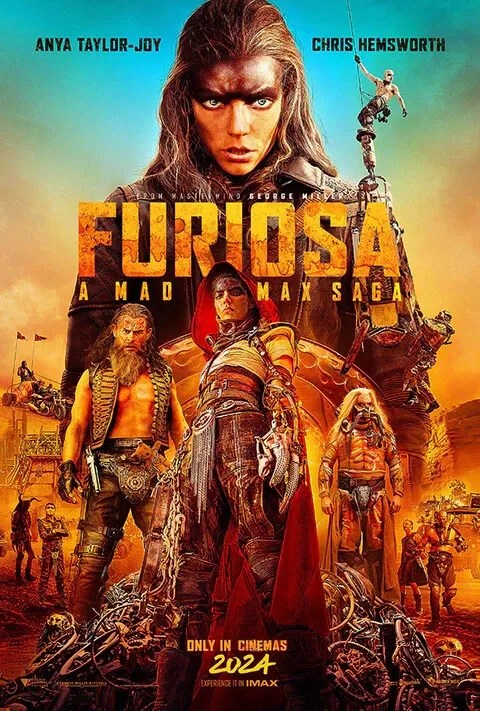
Furiosa: A Mad Max Saga (2024)

Furiosa: A Mad Max Saga (2024)

Deliriously overblown and full of demented imagination even if it never quite feels necessary

Director: George Miller

Cast: Anya Taylor-Joy (Furiosa), Chris Hemsworth (Dementus), Tom Burke (Praetorian Jack), Lachy Hulme (Immortan Joe), Alyla Browne (Young Furiosa), George Shevtsov (History Man), John Howard (People Eater), Angus Sampson (The Organic Mechanic), Nathan Jones (Rictus Erectus), Josh Helman (Scotus), Charlee Fraser (Mary Jabassa), Elsa Pataky (Mr Norton)

Is there a more demented mainstream film series than Mad Max? Furiosa follows the balls-to-the-wall excess of Mad Max: Fury Road with more of the same and a mythic atmosphere of Godfather Part II-backstory deepening. What you end up with might feel slightly odd or self-important – over two and a half hours of direct build-up for a pay-off we saw almost ten years ago (perhaps that’s why Furiosa ends with a cut-down play-back of the major events of Fury Road spliced into the credits, so we can all be reassured the villains left alive here got their comeuppance later). Furiosa is frequently overlong, a little too full of its love of expansive world-building and never quite convinces you that we actually need it – but then it’s also so bizarre, Grand Guignal and totally nuts perhaps we should just be happy that, in a world of focus-grouped content, it even exists.

We’re back on the desert wasteland of post-apocalyptic Australia as motorbike riding goons kidnap young Furiosa (Alyla Browne) from the Green Place hoping to use her to persuade crazed war lord Dementus (Chris Hemsworth) to lead his forces there. Despite the heroic efforts of her mother (Charlee Fraser), Furiosa remains a captive with only a secret tattoo on her arm (guess what’s going to happen to that…) to guide her home. Dementus provokes a resources war with cult-leader Immortan Joe (Lachy Hulme), with Furiosa traded, then escaping a hideous fate as one of Joe’s wives, instead growing up secretly-disguised as a boy (becoming Anya Taylor-Joy) as part of Praetorian Jack’s (Tom Burke) War Rig crew. Then the war between Immortan Joe and Dementus explodes again, foiling Furiosa and Jack’s plan to escape and giving Furiosa a change at revenge against Dementus.

That sprawling plot outline hopefully gives an idea of the ambitious bite George Miller is taking out of his world. While Fury Road took place over, at most, a few days, Furiosa stretches well over twenty, so gargantuan in scale and newly invented locations (as well as the mountainous citadel, we get the oil-rig nightmare of Gas Town and the Mordor-like Bullet Town) that it squeezes most of the entire Act Five war between Dementus and Immortan Joe into a brief, tracking-shot, montage. Furiosa is actually rather like a fever-dream Freud might have had after reading an airplane thriller, split into on-screen chapter titles – each with portentous (and sometimes pretentious) names like ‘The Pole of Inaccessibility’ – and a self-important narration dialling up mythic importance. If Fury Road was like someone stabbing an adrenalin-filled syringe straight into your heart, Furiosa is a like being told a detour-crammed story by someone a bit the worse-the-wear after a long night.

Not that Furiosa shirks on the banging madness of Fury Road’s slap-in-the-face action. It features a mid-film War Rig vs motor-bike raiders pitched-driving battle that is so extreme you wonder no one got crushed under wheel while making it, perfectly capturing the addled madness of Fury Road. A Chapter 4 pitched battle at one of Furiosa’s Dystopian-on-speed locations sees destruction, devastation and disaster on an even grander scale than anything else Miller has done before in this series, with an entire mining crater turned into a whirligig of firey destruction. That’s not forgetting three desperate desert chases – the finest of which is the film’s opening sequence, which see Furiosa’s mother track down and ruthlessly dispatch Furiosa’s kidnappers with a velociraptor-like ruthlessness and efficiency. No wonder Miller can put a whole war into a single shot – and why he feels comfortable ending Furiosa with a surprisingly personal and small-scale confrontation.

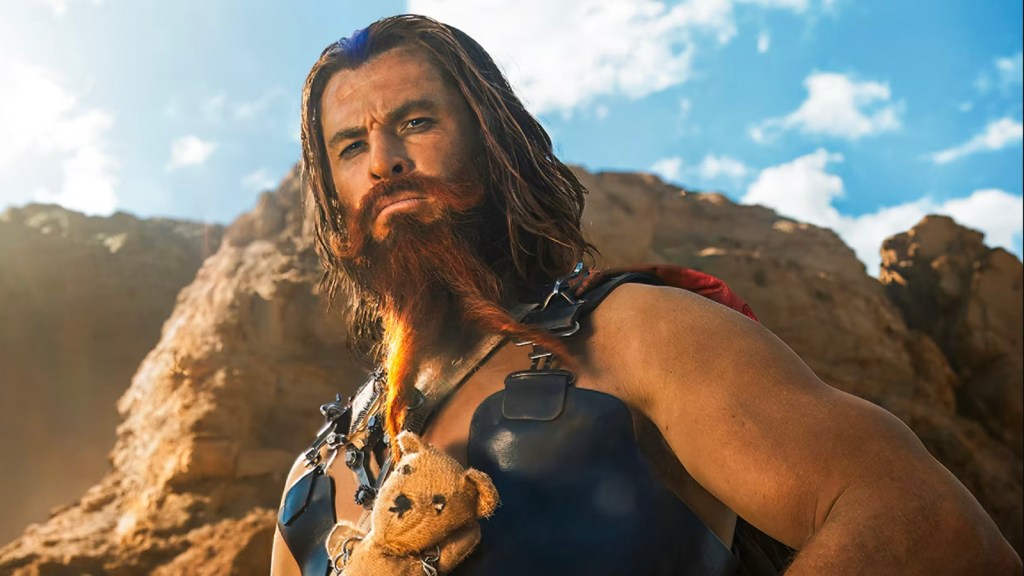
The main confrontation is between Furiosa and her self-proclaimed warlord – and would-be surrogate Dad – Dementus. Furiosa gives Chris Hemsworth the opportunity he’s been waiting for, allowing to flex his comic muscles, chew hilarious lumps out of the scenery and still show his menace. He makes Dementus an overgrown child, brilliant at stealing but with no idea about how to use them, obsessed with self-improvement (his dialogue is full of verbose, overwritten phrases, like a psychotic thesaurus) and only really happy when he’s smashing something. Introduced framing himself like a zen-like messiah, it doesn’t take long until he’s charging around on a chariot drawn by motorbikes, tasting other people’s tears and giving self-aggrandizing speeches while torturing Furiosa’s nearest-and-dearest. It’s a gift of a part, funny, scary, loathsome but strangely likeable even when he does awful things.

Opposite him, Anya Taylor-Joy actually has less to work with as Furiosa (she only takes over the part almost an hour into the film). Although this is meant to be a Furiosa film, it rarely feels like its telling us much more than we already know, especially since much the skills that ‘makes’ Furiosa what she is in Fury Road takes place in montage and her desire for freedom and to protect others are swiftly established so that any new-comers can unhesitatingly root for her. If Dementus is all talk, Taylor-Joy’s Furiosa is silent and simmering, her humanity either shrinking or quietly growing from moment-to-moment. She has a quiet romance with Tom Burke’s world-weary Praetorian Jack, but this really about converting her into a mythic figure of vengeance rather than making her a personality.

A vengeance we’ve already seen pan-out in Fury Road. I’ll be honest, for all the grand scale of Furiosa, I don’t really feel I learned anything about its central character here I hadn’t already picked up from Theron’s brilliantly expressive performance in the first film. For all the impressiveness of the scale, a lot of Furiosa boils down to physically showing us things that were implied in the first (second?) film – from locations, to the reasons why Furiosa lost her arm to giving us clear reasons for her motivations. But all this is already there – and with brilliant economy – in Fury Road. Telling us all again feels like Miller giving us the footnotes (Furiosa Silmarillon perhaps?) rather than anything truly new and the Homeric backdrop Miller is going for never really clicks into place.

So the most successful swings are not narrative but visual. Furiosa reminds you what an absolutely insane extreme world Mad Max is. Death cults of radiation-deformed albinos? Villains who bottle milk straight from the nipple (not a cow’s), while another obsessively fondles his exposed, pierced ones? A villain who straps a battered old Teddy bear to himself? Action set-pieces that throw in everything – flying bikes, lava lakes and arms stoically lopped off? Even time-jumps are done imaginatively, like a wig, caught in a branch, decaying in front of our eyes. Every single design decision in this – and the gorgeously sun-kissed photography – is dialled up to eleven for George Miller’s very personal vision of pulpy, dystopian chaos.

You can wonder at times – as I did – whether we really needed a two-and-a-half hour film that’s expands the thematic depth of a chase movie which already outlined its characters motivations and personalities with impressive economy. But then, there are moments in Furiosa that just feel like they’ve been pulled out of someone’s crazy dreams. It’s put together with such a good mix of pulp poetry and head-banging craziness by George Miller that after a while you just go with it. And it sticks with you in a way focus-grouped Marvel films never seem to.

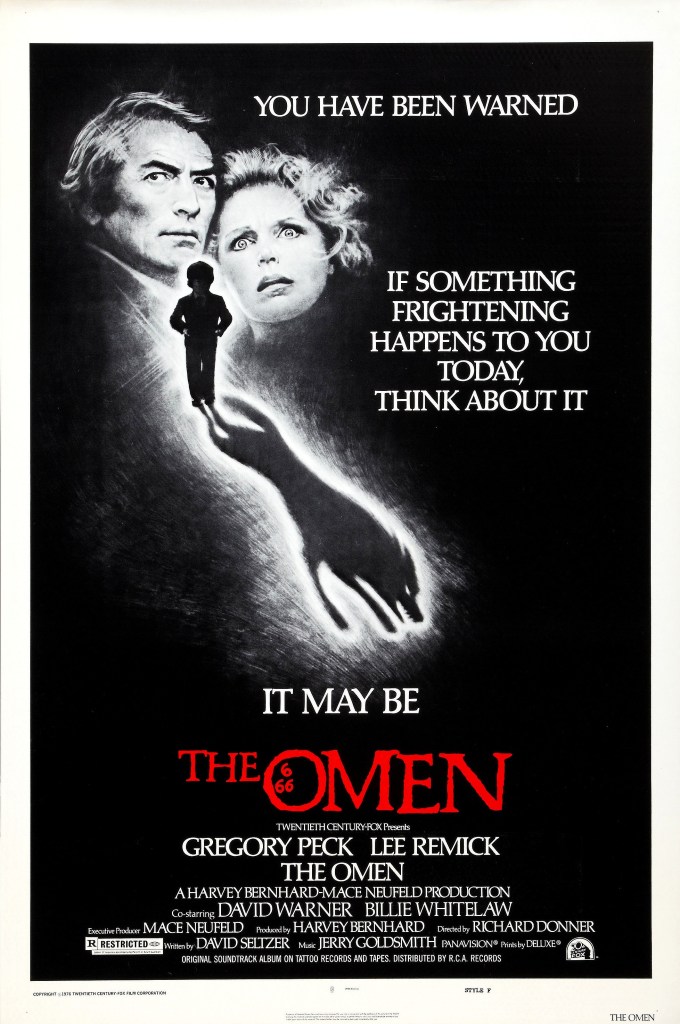
The Omen (1976)

The Omen (1976)

Extremely silly horror with a great score, more interested in inventive deaths and genuine fear or dread

Director: Richard Donner

Cast: Gregory Peck (Robert Thorn), Lee Remick (Katherine Thorn), David Warner (Keith Jennings), Billie Whitelaw (Mrs Baylock), Patrick Troughton (Father Brennan), Leo McKern (Carl Bugenhagen), Harvey Stephens (Damien Thorn), Martin Benson (Father Spiletto), Robert Rietty (Monk), John Stride (Psychiatrist), Anthony Nicholls (Dr Becker), Holly Palance (Nanny)

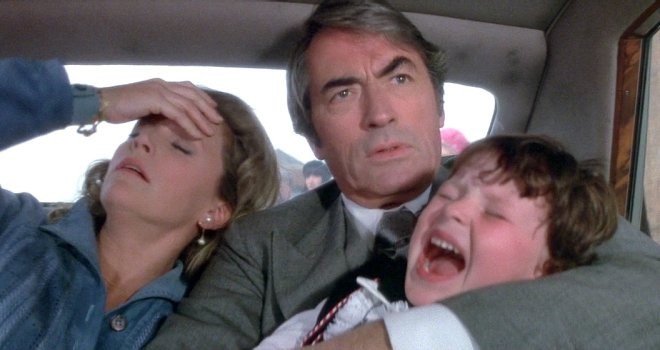
“Let him that hath understanding count the number of the beast; for it is the number of a man; and his number is 666.” One of the sweetest things about The Omen is that the number of the Beast was considered such an unknown concept to original viewers, that its painstakingly explained to us. In some ways The Omen is quite sweet, a big, silly Halloween pantomime which everyone involved takes very seriously. If The Exorcist was about tapping into primal fears, The Omen is a gory slasher (with a cracking score) that’s about making you go “Did you fucking see that!” as actors are dispatched in inventively gory ways. It’s brash, overblown and (if we’re honest) not very good.

Robert Thorn (Gregory Peck, selling every inch of his innate dignity for cold, hard lucre) is an American diplomat told one night in Rome that his pregnant wife Katherine (Lee Remick) has given birth to a stillborn child. “Not a problem” he’s told by an absurdly creepy Priest (Martin Benson) – just so happens there’s another motherless new-born child in the hospital tonight so he can have that one, no questions asked, and his wife need never know. Flash forward five years: Thorn is Ambassador to the Court of St James and young Damien (Harvey Stephens) is a creepy kid, with few words and piercing stare. In a series of tragic accidents people start dying around him. Could those people warning Thorn that his son is in fact the literal anti-Christ himself, be correct?

Want to see how powerful music can be? Check out how The Omen owes nearly all the menace it has to it imposing, Oscar-winning score from Jerry Goldsmith (wonderfullyGothic full of Latin-chanting and percussive beats). It certainly owes very little to anything else. The Omen is an exploitative, overblown mess of a film, delighting in crash-zooms, jump-cuts and extreme, multi-cut build-ups to gore. Richard Donner never misses an opportunity to signpost an approaching grisly death, by cutting between the horrified face of the victim, the object of their demise and then often back again. For the best stunts – including a famous demise at the hands of a sheet of glass – Donner delights in showing us the death multiple times from multiple angles.

This slasher delight in knocking off actors – people are hanged, impaled, crushed and decapitated in increasingly inventive manners – is what’s really at the heart of The Omen. None of this is particularly scary in itself (with the possible exception of the hypnotised madness in the eyes of Holly Palance’s nurse before her shocking suicide at Damien’s birthday party) just plugging into the sort of delight we take in watching blood and guts that would be taken in further in series like Halloween (which owed a huge debt to the nonsense here). Donner isn’t even really that good at shooting this stuff, with his afore-mentioned crude intercutting and even-at-the-time old-fashioned crash zooms.

With Goldsmith’s score providing the fear, The Omen similarly relies on its actors to make all this nonsense feel ultra serious and important. They couldn’t have picked a better actor than Gregory Peck to shoulder the burden of playing step-dad to the Devil’s spawn. Peck has such natural authority – and such an absence of anything approaching fourth-wall leaning playfulness – that he invests this silliness with a strange dignity. Of course, Atticus Finch is going to spend a fair bit of time weighing up the moral right-and-wrongs of crucifying with heavenly knives the son of Satan! Peck wades through The Omen with a gravelly bombast, managing to not betray his “for the pay cheque” motivations, and investing it with his own seriousness of purpose.

Peck’s status also probably helps lift the games of the rest of the cast. Lee Remick may have a part that requires her to do little more than scream (and fall from a great height twice) but she does manage to convey a neat sense of dread as a mother realising her son is not quite right. David Warner gives a nice degree of pluck to a sceptical photojournalist (while also bagging the best death scene). Troughton and McKern ham it up gloriously as a drunken former devil-worshipping priest and an exorcist archaeologist respectively. Best in show is Billie Whitelaw who filters her Beckettian experience into a series of chillingly dead-eyed stares as Damien’s demonic nanny.

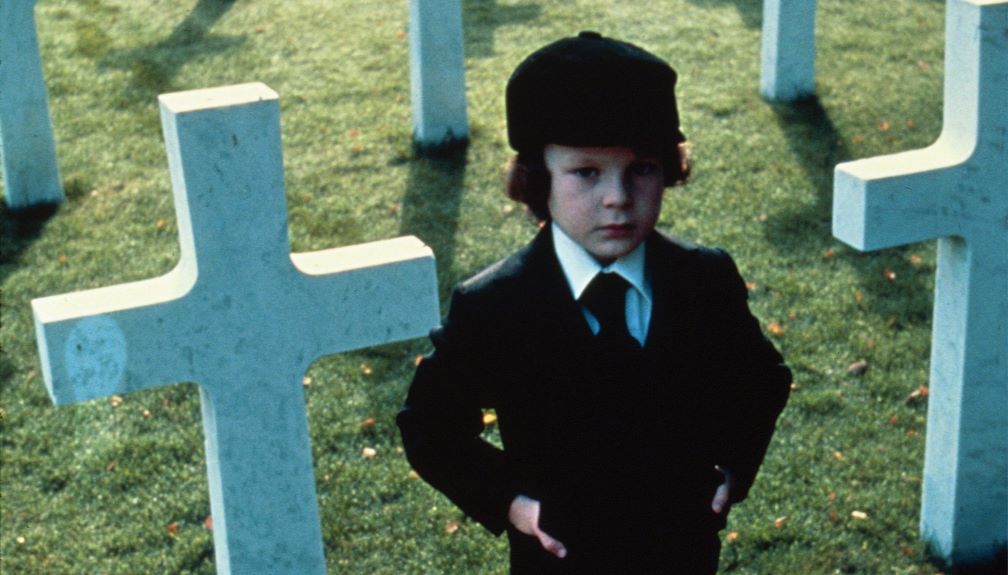
The Omen does make some good hay of its neat paedophobia. Harvey Stephens with his shaggy hair, impish smile and pale skin (not to mention darkly sombre wardrobe) looks like your worst nightmare – he’s creepy enough that the film doesn’t need to gift him a vicious rottweiler as well. Donner’s decision to never have Damien show a touch of any real emotion for most of the film also pays off, meaning even something as silly as Damien inflicting slaughter from behind the pedals of a child’s tricycle seems scary.

Of course, if Damien was savvy enough to present himself as a bright and sunny child perhaps Troughton, Warner, McKern and co would have struggled to convince Peck he was the Devil’s seed. In that sense he takes after his dad: Satan loves an over-elaborate death, and from a storm herding one victim to a fatal impalement under a tumbling church spire to popping the handbrake of a glass-bearing van for another, no trouble is too much for Satan when bumping off those who cross him. (The Omen could be trying to suggest that maybe everything is a freak accident and Thorn goes wild and crazy with grief – but that Goldsmith score discounts any possibility other than Damien is exactly what we’re repeatedly told he is.)

The Omen trundles along until its downbeat, sequel-teasing ending, via a gun-totting British policeman who sticks out like a sore thumb in a country where the cops carry truncheons not pistols. Donner balances the dialled up, tricksy, overblown scares with scenes of po-faced actors talking about prophecies and the apocalypse, all shot with placid straight-forwardness. There is a really scary film to be made here about finding out your beloved son is literally a monster, or how a depressed father could misinterpret a series of accidents as a diabolical scheme. But it ain’t The Omen – this is a bump-ride of the macabre. The Devil may have the best tunes – but he needs to talk to his Hollywood agent.

Battleship Potemkin (1925)

Battleship Potemkin (1925)

Revolutionary in more ways than one, this masterpiece still carries a real punch today

Director: Sergei Eisenstein

Cast: Aleksandr Antonov (Grigory Vakulinchuk), Vladimir Barsky (Commander Golikov), Grigori Aleksandrov (Chief Officer Giliarovsky), I. Bobrov (Young sleeping sailor), Mikhail Gomorov (Militant sailor), Aleksandr Levshin (Petty Officer), N. Poltavseva (Pince-nez woman), Lyrkean Makeon (Masked Man), Konstantin Feldman (Student agitator), Beatrice Vitoldi (Woman with baby)

If you have any doubt whether you have ever seen a film influenced by Battleship Potemkin I’d direct your attention to just one sequence. No, not the Odessa Steps. Instead: we’re on the deck of the Potemkin. The tyrannical captain has reacted to a complaint about the mouldy meat by demanding everyone refusing to eat it is shot. In a series of swift edits, mixing shots of the soon-to-be-victims, the marines who will do the shooting, different angles of the ship, we keep cutting back to Sailor Vakulinchuk’s face. What will he do? Will he protest? If you have ever seen a film build a violent crescendo with repeated cuts to a hero torn on taking action, you’ve seen something inspired by Battleship Potemkin.

It was made to celebrate the 20th anniversary of Russia’s first go-round for revolution, the series of uprisings that nearly overthrew the Tsar in 1905 (and led to him caving and allowing a degree of political representation anathema to him). Sergei Eisenstein, with the highly praised film Strike under his belt, was selected to direct. Eisenstein was offered a script full of events, but just one really spoke to him. That revolt of the sailors of the Potemkin, off the coast of Odessa. This was something he thought he could make a movie about! Eisenstein ditched nearly the whole of the script to focus on the class struggle between the sailors and workers and the faceless Tsarist system.

Battleship Potemkin would be a showcase for Eisenstein to expand the possibilities of editing images, cross-cutting to suggest inferences between events and characters. It’s no accident we cut so swiftly, and so often, from the maggot-filled meat the sailors are given and the stubbly, smug faces of the officers who insist the meat is edible. It’s pretty clear those maggots aren’t the only parasites aboard ship. The guns of the Potemkin are returned to time and again, dominating and dividing the frame or serving constantly as a reminder, first of the oppressive Tsarist regime, then of the heroic defiance of the sailors when faced with the Tsarist fleet sailing towards them.

Eisenstein’s mise-en-scene would become unimaginably influential. Not least because Battleship Potemkin is the most effective propaganda film ever made. It is impossible not to feel complete kindred with the sailors – all humble, honest, stoic Russian types, roused only to action by repeated provocation – and to despise the officer class, puffed up, dripping in elaborate uniforms, sneering at everyone, twirling moustaches over stubbly faces.

The film is shot time and again to present the sailors and the crowds in Odessa as a single, unified force. It’s rare where one of them appears alone – only reaction shots which capture their individual resolve (and, later, horror) – and they are mostly presented as united in purpose. In particular, Eisenstein shoots the citizens of Odessa as a near never-ending flow: they pour down the streets and steps (in a disciplined, respectful, mass) and fill the pier leading to Vakulinchuk’s makeshift grave. They work together and collaborate on tasks. On the other hand, the officers are frequently shot alone, either in close-up to stress their monstrous features or to capture their spittle-filled rants.

The sole exception is that meat-grinder of sabres and bullets that chews through the crowds at the Odessa Steps sequence. Here these soldiers – the brothers who don’t rise up but carry out the cruel, sadistic orders of their superiors – are barely human at all. There is no trace of personality or individuality in them. The features Eisenstein cuts to most are their marching feet, striding inexorably forward over bodies like a machine, and the bayonet tip of the rifles that relentlessly pour bullets into the crowd. If Bolshevism is a mass of individuals working as a coherent whole, then Tsarism is a brutality where the only faces are scornful and cruel officers.

The eventual coup of the sailors is masterfully cut together, fast-paced and overwhelmingly modern. It’s another indicator of the huge influence Battleship Potemkin has had on the grammar of modern filmmaking. As we watch Vakulinchuk and his fellows fight the officers, chasing them across the deck, scrabbling for weapons and the final duel between Vakulinchuk and Commander Golikov, its only the silence and black-and-white imagery that really distinguishes it from a similar end sequence in Avatar: The Way of Water. Battleship Potemkin can lay claim to being the most influential action film ever made, it’s use of fast-cutting to build tension, empathy and the imposing terror of seemingly insurmountable odds in a hostile environment second to none.

Editing and montage was central of Eisenstein’s technique – and you can argue that camerawork, character and (sometimes) narrative were secondary. Battleship Potemkin works as well as it does because it is an experience film. Its characters are ciphers, all of them Marxist tools towards an end effect. Eisenstein’s film is one of cuts designed to bring pace and rhythm, to project and create a visceral emotive reaction. He is very different from other silent directors who used the camera as a viewing tool, mobile and flowing. His movement comes from fast edits and quick cuts. Battleship Potemkin is modern in the sense that its finest sequences are a dizzying array of cuts and quick shots, that continue to influence action films today.

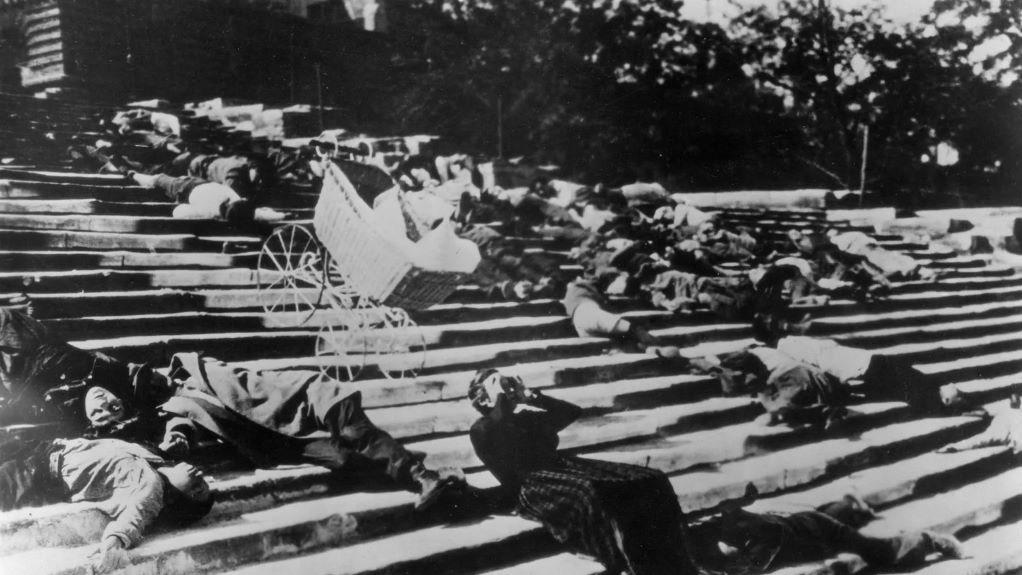
Which brings us, of course, to the Odessa Steps. Does it matter that this never happened in real life? Eisenstein essentially takes the 1905 Bloody Sunday massacre at the gates of the Imperial Palace in St Petersburg and transposes it to Odessa. It captures the mood of the time. Edits build in intensity – and swiftness – to highlight the growing tension and then explosive terror when the guns start firing. People flee in terror – one of the few tracking shots in the film follows the descent first of people, that that famous pram – down the steps. Reaction shots show a horrified mother, an older woman pleading for peace and a furious student radical.

And the furious intensity of the montage helps communicate the rampage. Careful cutting highlights the horror of a boy shot, trampled and then carried up to the soldiers by his distraught mother only to be gunned down. This is montage at its finest, and it even transforms time. People are shot and start to fall, we cut to reactions, soldiers marching, the stairs and then back to that person still falling. Is it reality? No. Is it drama? Yes. It’s a magisterial triumph of Eisenstein’s style, everything servant to the editing machine.

Battleship Potemkin is in the end all about editing. Eisenstein loves the impressions it can build. From maggots to officers. The sadistic priest’s face which constantly cuts back to his crucifix which thuds into his hand like a mace. The three lion statues – one lying down, one sitting, one standing up – cut swiftly together in sequence to give the impression the statue is reacting to events. Where Potemkin avoids camera inventiveness it more than makes up for it with the power of its montage.

And Eisenstein would argue that’s what cinema (ultimately) is and what differs it from theatre. It certainly works to make Battleship Potemkin thrillingly impactful. It’s no wonder that almost every country in the world – including the USSR – seems to have banned it at some point. It carries such visceral impact, it’s practically a weapon in the class war. Eisenstein’s influence continues to felt today, and while other pioneering directors would introduce more effective camerawork and story-telling techniques, none would harness the potential of the editing suite as effectively as Eisenstein.

Not seen it? Watch it now

Escape to Victory (1981)

Escape to Victory (1981)

The sort of odd movie pitch that could only have been made in the 80’s: it’s a POW film – but with footballers! And Stallone in goal! Cult nonsense, but fun.

Director: John Huston

Cast: Sylvester Stallone (Captain Robert Hatch), Michael Caine (Captain John Colby), Pelé (Cpl Luis Fernandez), Max von Sydow (Major Karl von Steiner), Bobby Moore (Terry Brady), Osvaldo Ardilles (Carlos Rey), Paul von Himst (Michel Fileu), Kazimier Deyna (Paul Wolchek), Hallvar Thoresen (Gunnar Hilsson), Mike Summerbee (Sid Harmor), Russell Osman (Doug Cluire), John Wark (Arthur Hayes), Daniel Massey (Colonel Waldron), Tim Pigott-Smith (Major Rose), Carole Laure (Renee)

It’s possibly the most bizarre idea in movies. An old-school, boy’s-own-adventure about POWs starring a Panini sticker album’s worth of footballers, led by Michael Caine and Sylvester Stallone playing the Germans (actually represented by a team of ringers from the New York Cosmos) in a ‘friendly’ football match in Paris. Oh, and it’s directed by John Huston. Who thought this one up?

Needless to say Escape to Victory is a cult hit. Caine plays professional footballer John Colby, his career interrupted by internment in a POW camp, challenged to an exhibition match by football-mad Major von Steiner (Max von Sydow). When von Steiner’s bosses turns the game into a propaganda vehicle, Colby is under intense pressure to pull out. When he refuses – not wanting to put his players lives at risk, some of whom (the Eastern European ones) have been rescued from labour camps – instead he is asked to accommodate a daring escape plan, led by American Robert Hatch (Sylvester Stallone) who joins as ‘trainer’ and back-up goalie. With the match scheduled, a plan is formed: the team will escape at half time. But will the players abandon the game, or will sporting pride kick in?

Well, what do you think? The whole film is a build up to the game. Are they really going to leave it at 4-1 to the Germans? The pedestrian opening two thirds of the film can pass you by. You certainly feel it passed John Huston by (if you ever want to see a great director do a pay cheque movie, watch this). The film settles into familiar rhythms of both genres (sports and POW movies) mashed together. For the latter; forgers, escape committees, roll-calls, daring escape attempts over and under wire, muttered attempts to board trains with fake papers are all dutifully ticked-off. Nothing unusual: the interest is all in the sports film.

And if you are going to make a sports film – crammed with training montages – who else would you hire than a dream list of footballers to perform them. And no footballer was more of a God-like figure than Pelé. Welcome to the only film the Greatest Player Ever made (as soon as he opens his mouth, you’ll see why). Alongside him England’s legendary World Cup winner Bobby Moore, charming Argentinian Ossie Ardilles (not trusted with a line), several other internationals from across Europe and (filling out the numbers) half a dozen players from Ipswich Town (though, to be fair, John Wark might just be the best actor). Most of the best parts involve watching these stars go through their paces.

Michael Caine – who only took the film so he could say he had genuinely played with Pelé – anchors all this reasonably well (even though, at 47, he looks noticeably out-of-shape considering he’s playing an international footballer at the peak of his career). The role of Colby is no stetch for him, but Caine conveys carrying responsibility rather well, and there is some decent material as he butts heads against the unhappy upper-class officers who want him to tell the Germans to shove it.

The officers – decent performances from Daniel Massey and Tim Pigott-Smith among others – point out the Germans won’t give them a sporting chance. But, this is the sort of film where boy’s own pride kicks in, and we get a classic ‘let’s show em’ attitude. This culminates, of course, in the half-time planned escape attempt being aborted as the players protest “We can win this!” and the side head back out for the second half (and, of course, glory).

It’s a big shout as our heroes take a heck of a drubbing in the first half. (This despite Caine’s ahead-of-his-time coaching advice to make the ball do the running, which sounds like tika-taka seventy years early – was Escape to Victory required viewing in Spanish football academies?). To the disappointment of von Steiner – our token ‘Good German’ played with his customary professionalism of von Sydow – who gave his word it would be a fair game, his superiors hire “a very good referee” who will “make no mistakes”. German tackles fly in un-punished, a dubious penalty is awarded and Pelé’s ribs are broken in a filthy foul forcing the team to play with ten men. Those dirty, cheating Germans! Thank goodness Bobby Moore scores to give them a chance.

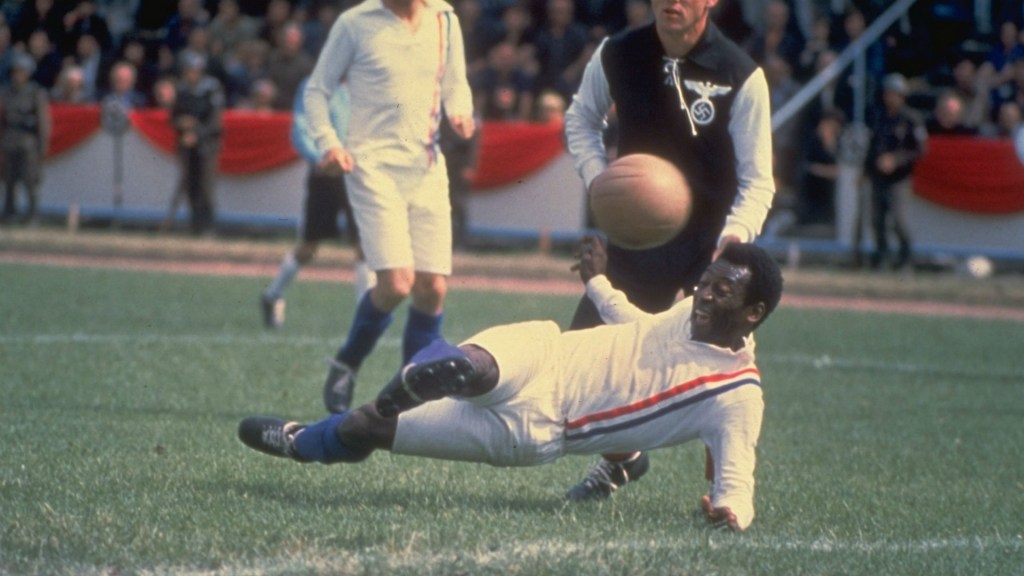
Every star player gets their moment in the spotlight, most of all Pelé who scores with a trademark bicycle kick. (I wonder if Pelé counted this one in his career goals record?) It’s a breath-taking piece of skill – von Steiner even proves his “Decent German” credentials by rising to applaud (to the fury of his fellow officers). Our heroes pull it back to 4-4 before having a goal disallowed for a false off-side (mind you it feels less inexplicable in an age where VAR chalks off goals for offside elbows). Then of course the Germans are awarded a penalty as the last kick of the game after a fair tackle by Ardiles.

And so, we come to Stallone. Perhaps the most inexplicable thing in this, the Italian Stallion at least convinces as a man who knows nothing about football. Looking trim, Stallone handles most of the POW and escape stuff (and a token romance subplot with a French resistance fighter) but of course space had to be made for him in the game. So, he plays as keeper (the team’s first choice keeper volunteers for Caine to break his arm so Stallone can be released from lock-up to play in the film’s most difficult to watch moment). Stallone wanted to score the winning goal, but was told that was unlikely for a keeper, so instead he saves the penalty to preserve the moral victory. Stallone mumbles his way through the film, feeling bizarrely out of place, but he was the big star.

Escape to Victory is a truly bizarre thing. But it’s got a fun football game in it and as sort of exhibition match it’s a bit of a treat. And watching it shortly after the passing of Pelé, it feels almost like a rather lovely tribute.

Drive (2011)

Drive (2011)

Neon, darkness and shades of grey fills the screen in a film that’s practically the definition of cult

Director: Nicholas Winding Refn

Cast Ryan Gosling (Driver), Carey Mulligan (Irene Gabriel), Bryan Cranston (Shannon), Albert Brooks (Bernie Rose), Oscar Isaac (Standard Gabriel), Christina Hendricks (Blanche), Ron Perlman (Nino Paolozzi), Kaden Leos (Benicio Gabriel)

Impassive and supernaturally calm, the Driver (Ryan Gosling) sits with the car engine purring. In this five-minute window he is the get-away driver who will go to any length. Outside of that, criminals are on their own. Its one of the simple rules he lives by. He never compromises. Until, of course, he finds something worth compromising for. That would be his neighbour Irene (Carey Mulligan) and her young son Benicio (Kaden Leos), trying to make ends meet while her husband Standard (Oscar Isaac) is in prison. The Driver helps them – and feels compelled to go on helping them when newly released Standard (trying to go straight) does one more job to get out from under the thumb of his criminal friends. That last job is always the worst one isn’t it? Particularly when crime lords as ruthless as Bernie (Albert Brooks) and Nino (Ron Perlman) are involved.

Drive won Refn the best director award at Cannes (after a huge standing ovation). It’s not hard to see why. This film is so overflowing with style, uncompromising cool and unreadable enigma it was practically a cult classic before it was even released. Layered in a mix of 70s and 80s chic – with its electric pink titles, John Carpenter-ish Los Angeles visuals and counter-culture smarts – it echoes cutting-edge crime drama from the punk years of Hollywood (it’s practically a remake of The Driver for starters!), by way of touches of Melville crime drama and Spaghetti Western anti-hero. Scored to a mix of ambient beats and electronic rock, it’s the dictionary definition of style.

It keeps you on your toes from the start. Its opening not only explores the Driver’s incredible skills (speed, manoeuvring, ingenious evasions and knowing when to go slow, he can do it all) it also sets us up for the whole film. Shot largely alongside the Driver in the car, we zip through streets and understand the determination (and hints of danger) under his impassive surface. That prologue is the whole movie in capsule – a careful wait, a sense of a fuse being list, touches of humour to distract us (the Driver’s precision with his gloves) and brilliant misdirection when his focused  attention to listening to a football game on the radio pays off in spades when we see his plans revealed.

Much of the first 40 minutes carefully develops the Driver’s surprisingly contented life: his happy acquiescence in the racing dreams of his fixer and mechanic boss Shannon (an ingratiating Bryan Cranston), who the Driver likes so much he doesn’t care that Shannon regularly swindles him; a soft, unspoken half-romance with Irene (Carey Mulligan, truthful and with a strength beneath the vulnerability); and a big-brother bond with her son Benecio. In another world this could have been a film where a loner learns to make a connection and finds love.

But it ain’t that film. The troubles start with Standard’s release from prison. Skilfully played by Oscar Isaac as well-meaning but essentially hopeless, Standard’s problems become Irene and Benecio’s problems. That one last job goes south – as they always do – in an orgy of cross, double cross and increasingly graphic violence. And the burning propulsive energy that lies under Drive, just like that purring engine in the films opening, is let rip.

What we get in the second half is dark, nihilistic and violent. Oh, good Lord, is it violent. Bone crunchingly, skull shatteringly, blood spurtingly violent. Because when gangsters get pissed off, they play for real. And it turns out, when the Driver finds something to care about, he plays for real as well. Refn’s eye for violence is extremely well-judged. We see just enough for it to be horrifying, but the worst is done via sound and editing (the Driver’s almost unwatchable assault on a goon in a lift puts almost nothing on screen, but the squelches and crunches on the soundtrack leave nothing to the imagination).

Refn’s trick is to combine lashings of indie cool and ultra-violence with a deceptively simple story that allows plenty of scope for interpretation. Drive has a sort of mythic, Arthurian quest to it, with the Driver as a sort of knight errant, defending a damsel in distress. But it’s also a grim crime drama, with a man at its centre who brutally kills without a second thought. This all depends on the enigmatic Driver at its heart. No other actor alive can do unreadable impassivity like Ryan Gosling – this could almost be his signature role. He’s ice-cool and professional, but also rather child-like and gentle.

Is he a guy dragged down by his own worst impulses? His jacket has a large scorpion on its back, echoing the old fable of the frog and the scorpion. Rather than one or the other, the Driver feels like both in one. A frog who wants to carry everyone over the river, but whose poor instincts and capacity for violence acts as the scorpion that destroys him. Where does he come from? What is his past? The film ends with a series of enigmatic shots that, to my eyes, suggest a supernatural quality to him. I sometimes toy with the idea he’s a sort of fallen angel, constantly protecting the wrong people like he has a scorpion curse on him. Refn’s gift is to craft pulp with psychological intrigue.

Drive is a very cool film – and Carey Mulligan and Ryan Gosling’s careful playing gives it a lot of heart, just as Albert Brooks’ marvellously dangerous gangster gives it a sharp, unpredictable edge. It rips its eye through the screen, with pace, speed and iconic imagery, all splashed with a pop art cool. But it’s not just a celebration of style: it’s also a dark romance, a tragedy and an exploration of a character who may be his own devil or may not even be human at all. Either way, its intriguing and exciting. Can’t ask for much more than that.

The Scarlet Empress (1934)

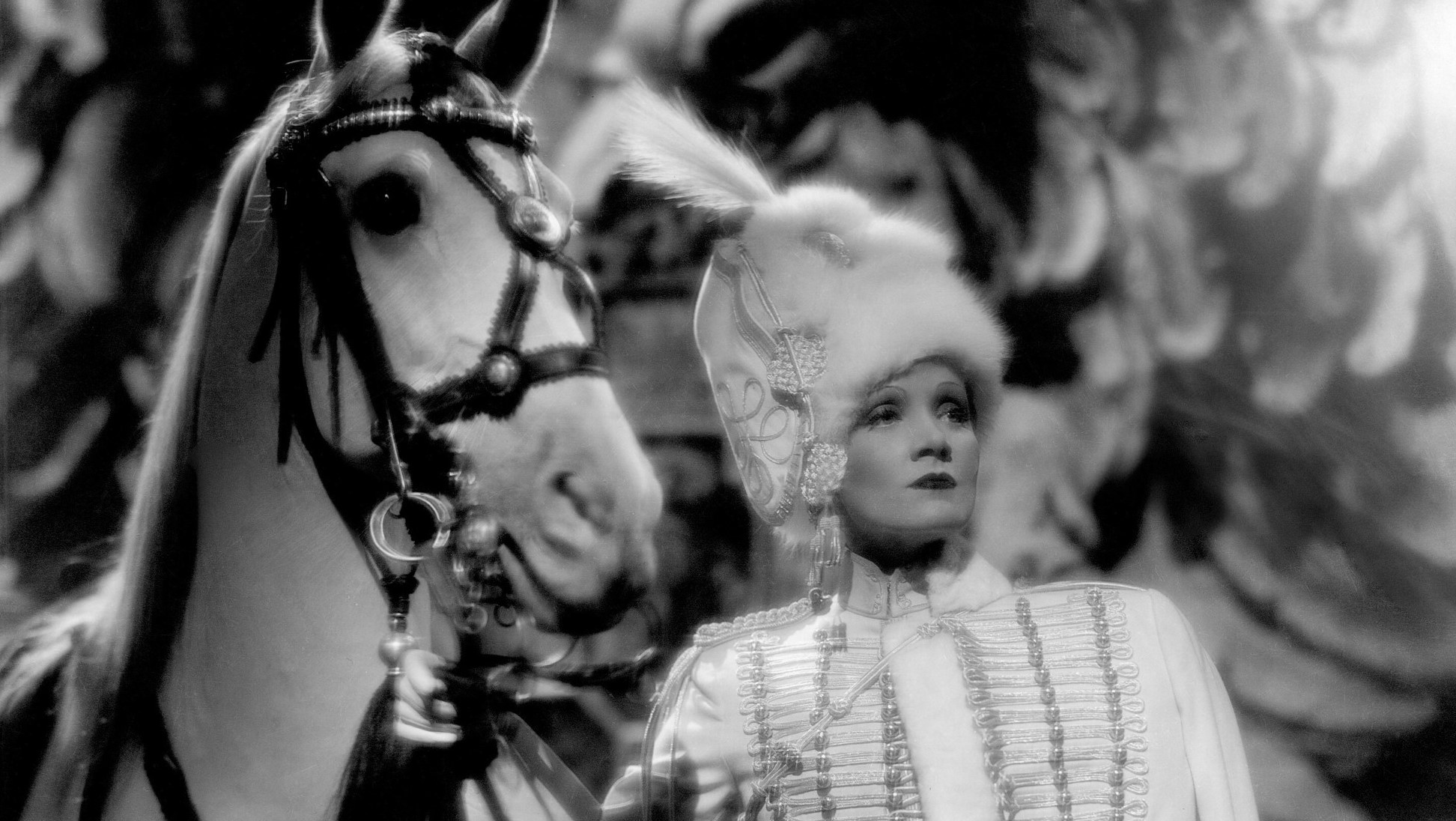
Marlene Dietrich with a beloved friend (and the film has fun with that rumour) in The Scarlet Empress

Director: Josef von Sternberg

Cast: Marlene Dietrich (Empress Catherine), John Lodge (Count Alexey Razumovsky), Sam Jaffe (Emperor Peter III), Louise Dresser (Empress Elizaveta Petrovna), C. Aubrey Smith (Prince Christian August), Gavin Gordon (Captain Orlov), Olive Tell (Joanna Elizabeth), Ruthelma Stevens (Countess Elizaveta), Davison Calrk (Arch Episcopope), Erville Anderson (Chancellor Bestuzhev-Ryumin)

Did von Sternberg have a bet on when he made this film? “Hey Josef, what’s the maddest film you think you could make and get away with?” Either that, or perhaps he didn’t care anymore and decided his own obsessions with visuals, sexuality and Dietrich were more important than anything else. Regardless, he made The Scarlet Empress, perhaps one of the most bizarre major releases from a 1930s Studio, a sort of camp masterpiece that contains things you just won’t see any in other film, but at the same time is a disjointed, barely plotted ramble through a fable-tinged version of Russian history. Either way, it’s a truly unique film – and how many films can you say that about?

The plot loosely follows the rise of Catherine the Great (Marlene Dietrich) to power, but any resemblance to real people (living or dead) seems to be purely coincidental. Catherine arrives in Russia to power the heir to the throne, Grand Duke Peter (Sam Jaffe), a gurning simpleton more interested in his soldiers (both toys and real ones) and his mistress Elizaveta (Ruthelma Stevens) than Catherine. Russia is ruled by his mother Empress Elizaveta (Louise Dresser), a domineering matriarch. The (initially) innocent Catherine is admired by the rakeish Count Alexey (John Lodge), but must learn to master the skills of the court – and the sensuality of her own body – to take power.

The Scarlet Empress is pretty crazy. If you are coming here for a history lesson on Catherine the Great, keep on walking. Josef von Sternberg called it “a relentless excursion into style” and that’s a pretty good description. It’s a parade of his fascinations (and obsessions), set in a Russia that never really existed but I suspect Sternberg would argue ‘shouldhave done’. This is Russia as a medieval backwater, built entirely from Cossacks, icons and gargoyles, with the Russian court a ramshackle wooden palace with a throne that wouldn’t look out of place in Game of Thrones. Much of the sense of time and place is buried under this and huge chunks of the film may as well be silent cinema, so little does dialogue matter and so skilfully are emotions and events communicated visually.

However, grab this in the right mood and this is a film it’s impossible not to admire and even fall in love with a little bit. There really is nothing like this, and like much of Sternberg’s work there is a visual sweep and drama here that few other filmmakers can match. There are some truly striking images, from Cossacks riding through the palace, to Sam Jaffe’s gargoyle like face as Grand Duke Peter, to a giant drill bit punching through the eye of a wooden icon. The jaw dropping production design – sets that dwarf the actors – is mixed with misty lighting for romantic assignations and deep shadows for (literally) backstairs court intrigue.

In all this, the story counts for very little, with the primary focus being Sternberg’s obsessions. Many of those seem to be sexual. The Scarlet Empress was released right on the cusp of the Production Code being enforced in Hollywood – and it’s hard to imagine it could ever have been passed once the code was fully enforced. The film lays it’s hand out early with an S&M tinged Russian torture montage (with naked women in iron maidens, whippings, beheadings and a giant bell with the clapper replaced by a human being) and hardly stops from there. Later montages feature explosions of Peter’s soldiers, looting, shooting and orgying across Russia.

The primary lesson Catherine needs to learn in Russia is to use the power of her own sexuality. The idea of politics is even openly rejected by Catherine in favour of mastering her seductive powers. Initially a blushing, mousy innocent, she becomes increasingly coquettish and seductive as the film unfolds. In an early scene she nervously fingers a riding crop – by later in the film she’s bending it in her hands with all the confidence of a Dominatrix. Lovers come and go, as she wins supporters over to her side (she “added the army to her list of conquests” a caption deadpans at one point). Trysts grow in confidence, as Dietrich’s performance progresses from innocence to dominant knowingness.

Dietrich is as close as she’s been to a prop here, striking a series of poses in a performance that’s largely campily two dimensional. For the first 70 minutes she’s given almost nothing to do other than strike a bemused face: for the remaining 40 minutes she’s like Sternberg’s wet dream of a sexually aggressive domineering woman. Basic notes are what most of the cast are kept to, fitting the impression that they are just props in a silent film. John Lodge scowls and poses as Count Alexey and is as wooden as most of the set. Sam Jaffe is one of the gargoyles made flesh. Louise Dresser is an older version of the sexual kingpin Catherine becomes.

But that’s because it’s all about the mood and the style. The Scarlet Empress has that in absolute spades. It’s as close as you can get in the 1930s to a director of a major Hollywood studio film, pouring money into something that maybe only he will like. It’s silent film roots can be seen not only in its vast impressionistic sets, but also in the steady parade of title cards that dance across the screen to communicate what passes for the story. Acting and story are very much secondary to the mood of sexual exuberance and craziness that dominates nearly every frame of the action. The film was a massive bomb on release – perhaps because no one else could quite work out what it was – and it’s taken decades for its overblown mad genius to be recognised. But it’s a film unlike any other and for that alone you should see it.

The Dam Busters (1955)

Richard Todd leads the most famous bombing raid ever in The Dam Busters

Director: Michael Anderson

Cast: Richard Todd (Wing Commander Guy Gibson), Michael Redgrave (Barnes Wallis), Ursula Jeans (Mrs Molly Wallis), Basil Sydney (Air Chief Marshal Sir Arthur Harris), Patrick Barr (Captain Joseph “Mutt” Summers), Ernest Clark (Air Vice-Marshal Ralph Cochrane), Derek Farr (Group Captain John Whitworth)

It’s famous for its stirring theme. Those bouncing bombs. The fact that George Lucas, while still completing the special effects, spliced in the final bombing runs into his first cut of Star Wars. But where does The Dam Busters sit today as a film? 

In 1942, aeronautical engineer Barnes Wallis (Michael Redgrave) is working on a plan to take out the German dams on the Ruhr, a strike that could cripple German heavy industry. Conventional bombs can never cause enough damage, and the dams are protected from torpedo attack. So Wallis has a crazy idea – to build a bouncing bomb that will skim the top of the water, hitting the dam, with its top spin taking it down to the base of the dam for detonation. It’s a crazy idea – but it finally wins favour, with Wing Commander Guy Gibson (played by real-life World War II paratroop veteran Richard Todd) given command over an operation that promises to be risky and dangerous beyond belief.

The Dam Busters doesn’t really have much in the way of plot, being instead a rather straight-forward, even dry in places, run through of the mechanics involved in planning the operation and overcoming the engineering difficulties that stood in the way of the operation. Throw into that our heroes overcoming the various barriers and administrative hiccups put in the way by the authorities and you have a pretty standard story of British pluck and ingenuity coming up with a left-field solution that saves the day. (Though Barnes Wallis denied he faced any bureaucratic opposition like the type his fictional counterpart struggled with for most of the first forty minutes).

Of course, the film is also yet another advert for the “special nature” of the British under fire, a national sense of inherent destiny and ingenuity that has frequently done as much harm as good. Made in co-operation with the RAF, it’s also a striking tribute to the stiff-upper-lipped bravery of the RAF during the war, and the sense of sacrifice involved in flying these deadly missions.  

In fact it’s striking that the film’s final few notes are not of triumph after the completion of the operation, and the destruction of the two dams, but instead the grim burden of surviving. After 56 men have been killed on the mission, Barnes Wallis regrets even coming up with the idea. The final action we see Gibson performing is walking quietly back to his office to write letters to the families. Anderson’s camera pans over the empty breakfast table, set for pilots who have not returned, and then over the abandoned belongings of the dead still left exactly where they last placed them. It’s sombre, sad and reflective – and probably the most adult moment of the film.

Because other than that, it’s a jolly charge around solving problems with a combination of Blue Peter invention, mixed with a sort of Top Gear can-do spirit. Michael Redgrave is very good as the calm, professorial, dedicated Barnes Wallis, constantly returning to the drawing board with a reserved, eccentric resignation to fix yet another prototype. The sequences showing the engineering problems being met and overcome are interesting and told with a quirky charm that makes them perhaps one of the best examples of such things made in film. 

The material covering the building of the flight team is far duller by comparison, despite a vast array of soon-to-be-more-famous actors (George Baker, Nigel Stock, Robert Shaw etc.) doing their very best “the few” performances. Basically, generally watching a series of pilots working out the altitude they need to fly at in training situations is just not as interesting as watching the boffins figure out how to make the impossible possible.

The flight parts of the film really come into their own in the final act that covers the operation itself. An impressive display of special effects at the time (even if they look a bit dated now), the attack is dramatic, stirring and also costly (the film allows beats of tragedy as assorted crews are killed over the course of the mission). The attack is brilliantly constructed and shot by Michael Anderson, and very accurate to the process of the actual operation, in a way that fits in with the air of tribute that hangs around the whole film.

All this reverence to those carrying means that we overlook completely the lasting impact of the mission. “Bomber” Harris (here played with a solid gruffness by Basil Sydney) later considered the entire operation a waste of time, money and resources. Barnes Wallis begged for a follow-up to hammer home the advantage, but it never happened. The Germans soon restored their economic capability in the Ruhr. Similarly, today it’s more acknowledged the attack killed over 600 civilians and over 1000 Russian POWs working as slave labour in the Ruhr. Such things are of course ignored – the film even throws in a moment of watching German workers flee to safety from a flooding factory floor, to avoid showing any deaths on the ground.

And of course, the film is also (unluckily) infamous for the name of Gibson’s dog. I won’t mention the name, but when I say the dog is black and ask you to think of the worst possible word to use as its name and you’ve got it. It does mean the word gets bandied about a fair bit, not least when it is used as a code-word for a successful strike against the dam. Try and tune it out.

The Dam Busters is a solid and impressive piece of film-making, even if it is low on plot and more high on documentary ticking-off of facts. But it’s also reverential, a little dry and dated and avoids looking at anything involved in the mission with anything approaching a critical eye. With its unquestioning praise for “the British way”, it’s also a film that reassures those watching it that there is no need for real analysis and insight into the state of our nation, but instead that we should buckle down and trust in the divine guiding hand that always pulls Britain’s irons out of the fire.