
Category: DC Comics

Joker (2019)

Joaquin Phoenix goes all out as Joker

Director: Todd Phillips

Cast: Joaquin Phoenix (Arthur Fleck), Robert DeNiro (Murray Franklin), Zazie Beetz (Sophie Dumond), Frances Conroy (Penny Fleck), Brett Cullen (Thomas Wayne), Glenn Fleshler (Randall), Leigh Gill (Gary), Bill Camp (Detective Garrity), Shea Whigham (Detective Burke), Douglas Hodge (Alfred Pennyworth), Marc Maron (Gene Uffland)

The mystic of Batman’s nemesis the Joker is his unpredictability, his other-worldly insanity laced with malicious viciousness and an anarchic sense of fun. There is a reason such an electric character has been the go-to for so many Batman related films – and why people are drawn time and time again to re-exploring him. With the DC Universe struggling, it makes sense that a stand-alone film around the most-popular, most-famous comic book villain of all time would be attractive. It’s been a massive success, but is it truly a good movie? I’m not so sure.

Arthur Fleck (Joaquin Phoenix) is a struggling professional clown in 1981 Gotham City, living with his invalid mother Penny Fleck (Frances Conroy). A run-down, dirty and no-good town with astronomical divides between the haves and the have nots, Fleck is a guy who can’t make the world work for him. Dreaming of a being a professional stand up and appearing on the popular nightly talk show hosted by Murray Franklin (Robert DeNiro), Fleck is actually a maladjusted, bitter outsider and fantasist who struggles to adjust to the real world. Will the idea of taking brutal vengeance on those around him, be eventually to tempting to resist? Hey: why so serious world?

Joker is a grim, trying and rather uninvolving film that even contained within a fairly tight two hours still feels like it drags on way too long. It perhaps feels like this because it signposts all its major narrative developments far too far in advance, meaning very little if anything surprises you. Fleck is essentially a time bomb waiting to go off, and everyone knows by the film’s final act he will do. The long wait to get there doesn’t really give us anything fresh or interesting to think about, other than presenting a comic book world mixed with the grimy atmosphere of classic Scorsese films. It’s a film made by people who love classic urban Hollywood films – but who seem unable to bring anything really fresh to a series of ideas better film makers have already had.

Instead it’s a film that relies heavily – in fact is completely dependent on – its inspirations, torn from comic books, other films and news bulletins. Your understanding of Fleck’s character arc is dependent on having some sort of visual image in your head for the Joker. Your appreciation of the film’s style and tone relies on you having seen Taxi Driver and King of Comedy. Your reaction to the sudden growth of flash-mob violence in Gotham depends on you knowing about these attitudes in the real world. The film largely fails to develop any of these ideas organically within itself or its own narrative, but instead throws them to the screen knowing that we will do the work of making them stick on our own with our past associations.

As the film doesn’t really try and build its own ideas, or really try to take ideas from anywhere else to really original places (apart from a few Joker developments which I’ll talk about later), for people who are familiar with its themes and inspirations, it just manages to make for a rather dull watch. The Joker character has been done better elsewhere, King of Comedy and Taxi Driver are films so full of depth and interest around maladjusted losers, stalkers and fantasists yearning for recognition, that this film’s showy coverage of the same ground come across as deep as puddle. Its political positions are so simple, basic and unchallenging that they might as well have come from a school essay. 

Both the film’s greatest strength, and its greatest weakness, is Phoenix’s lead performance. There is no question that this is a powerhouse performance, fully committed physically and emotionally. Phoenix has explored every inch of the psychological make-up of a misfit who believes the world owes him something and whose vulnerability eventually becomes twisted into a psychotic rage. As a portrait of the making of a school shooter (say) it’s a fascinatingly successful performance. But it’s also overwhelming. It’s so quirky, so twitchy, so detailed, so mannered it finally becomes too much. 

Finally, and this is perhaps intentional, it doesn’t feel like the Joker. When I think of that character, I think of one defined by joy. A twisted sense of joy, a psychotic killer’s joy, but joy nevertheless. Joy is something that never enters Phoenix’s interpretation for a second. This makes sense for the first three quarters of the film, but when the final push of the narrative takes us towards Joker territory, Phoenix’s character is still by-and-large the same tearful, desperate, tragic figure he was before. That doubling down on villainy, that “just let the world burn” anarchism is something completely missing from the performance. It makes the part something that is all impact but no real depth, no real development. It’s a showy performance of tricks and manners, impressive in its commitment but in the end empty and unaffecting.

It also means the film focuses almost completely on Fleck, meaning it has not time to develop its themes of urban clashes and rich vs poor narrative. Instead it just throws these ideas straight in to the film with no real introduction or context and trusts that we will do the work ourselves. It does the same with Fleck’s fantasies and obsessions. It’s no great surprise that all these dreams fail to pan out, and it’s no great surprise that killing ensues. All the victims of Fleck’s rage are completely predictable from the first few minutes, but Phillips film feels like it takes a very long time to get there. 

Joker does at least try to do something different, but Phillips film is more a scrap book of ideas and themes explored better elsewhere. Phoenix tries too hard and the film itself ends up telling a not very compelling story. In the end the character of the Joker is fascinating because the character is unknowable, unpredictable, a rootless force of nature. Giving him a back story weakens the character and makes him (and the film) less and less successful. And the general get-out-of-jail card the film holds (and plays) that all or some of this might just be happening in Fleck’s fractured mind isn’t clever, it’s just irritating.
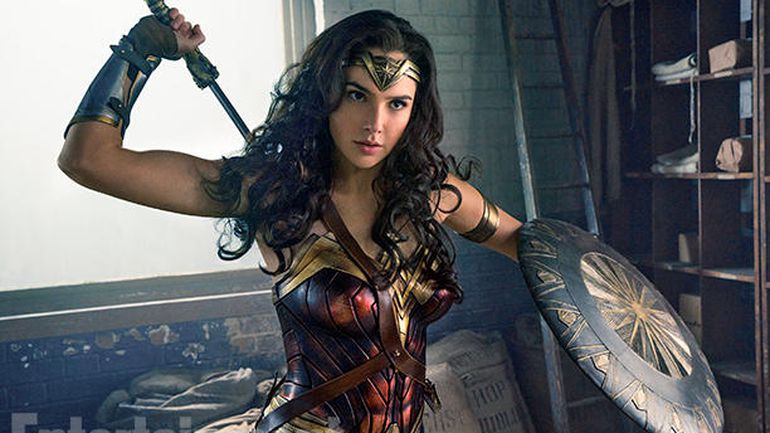
Wonder Woman (2017)


Gal Gadot prepares to save the world as Wonder Woman

Director: Patty Jenkins

Cast: Gal Gadot (Diana), Chris Pine (Steve Trevor), Robin Wright (Antiope), Danny Huston (General Erich Ludendorff), David Thewlis (Sir Patrick Morgan), Connie Nielsen (Hippolyta), Elena Anaya (Isabel Maru), Lucy Davis (Etta Candy), Saïd Taghmaouri (Sameer), Ewen Bremner (Charlie), Eugene Brave Rock (Chief Napi)

The DC universe has largely been a feeble attempt to parrot the success of Marvel, but without the latter’s charm or sense of fun. Each film has been a crushingly, overwhelmingly, teenage-boy focused series of grim super-bashing. So it’s a refreshing change that for their fourth film we get something different: lighter, funnier, warmer and focused on women rather than men.

On a hidden island, the Amazons live in hiding, waiting for the day they will return to save humanity from the villainous fallen god Ares. Diana (Gal Gadot) is the daughter of Hippolyta (Connie Nielson) queen of the Amazons, trained by Antiope (Robin Wright) into becoming their greatest warrior. Their timeless world is shattered in 1918, when American pilot Steve Trevor (Chris Pine) crashlands his plane on the island – and explains the world is torn apart by war. Convinced this is Ares’ influence, Diana leaves the island with Steve – and finds herself thrown into a world she scarcely understands, with only her faith in the goodness of mankind to sustain her.

Wonder Woman is a change of pace from previous DC filmes – largely because it is pretty good. For the first time in this struggling universe, we have a bit of lightness and humour, and some engaging central characters. Which, considering the dark grimness of the previous entries is saying something. It’s bright, feels like a comic book (in a good way), has a decent story arc and, most importantly, you care. Is it the best comic book movie ever made? Of course not, but it’s a damn solid effort.

A lot of this is due to Gal Gadot being such an endearing lead. She gives Diana a perfect blend of serene, super-powered action goddess and naïve, charming lost-out-of-time sweetness. So one minute she can cooing over the first baby she’s ever seen, the next she can be laying out baddies in a scuffle. Her unquestioning faith in the fundamental goodness of people makes her innocence very winning. In fact, her secret weapon is empathy, a quality the film really embraces. Gadot’s skill is in keeping such unremitting goodness and positivity hugely loveable. She is terrific.

The film deals with her head-turning beauty with a witty affection (“You put specs on her and she’s suddenly not the most beautiful woman you’ve ever seen?” Etta comments on one particularly feeble disguise option Steve suggests). In fact, the romance between Diana and Steve (Chris Pine similarly engaging as an “above average” man head over heels in love) is really well drawn – he clearly adores her, while she has a shy, almost teenage crush which blossoms over time into a genuine affection. It’s a very innocent and heart-warming romance, that plays out extremely well.

Needless to say as well, the film makes a fine counter-balance to the leering cameras you see in other films. Diana’s unmatchable competence is immediately recognised by Steve: while Steve understands the world, Diana is very much the hero, for all her fish-out-of-water naïveté. The film holds off a reveal of the costume for a long time – but when it is, it’s not a sexualised moment, but one of awe. The opening section of the movie, with its Amazonian islanders, also allows plenty of ass-kicking to be given to the women (Robin Wright is especially terrific as an Amazonian general – she should get her own Taken style action series).

Wonder Woman is not perfect. Structurally it’s pretty similar to other origin stories. Much of the backstory makes little sense, while the powers (or not) of the Amazonians in comparison with Diana are poorly explained. Away from the charm of the lead characters, nothing feels particularly new – none of the action sequences feel unique, and are shot with competence rather than inspiration. The final battle briefly looks like it might do something different, before it becomes an all too familiar CGI bashing.

I’m also not sure about setting the film in the First World War. Seeing Diana lead a successful charge through the trenches where real people died in their thousands, somehow doesn’t sit quite right. It’s uncomfortable to watch a cartoon hero walking across no man’s land into gunfire, just as thousands of real people had to, but without super-powers to make it a moment of awesome cool. They just died; it wasn’t the setting for an action sequence, oh a moment of “wow she’s cool”.

I’m not sure about the film’s use of the grim trenches of the First World War for kick-ass action

Unlike the Second World War (where at least we know the SS were completely despicable) its portrayal of German soldiers as mostly faceless villains feels unjust – these were largely just ordinary people in a horrendous situation. Making Luddendorf a psychotic, lunatic also feels uncomfortable – he was real. Would it have been so difficult to make up a General von Baddie? (It doesn’t help that Danny Huston gives a truly abysmal performance of over-the-top hamminess). This is an area where Captain America handled its setting much better – the film may have been set in a real war, but the villains are specifically Hydra soldiers, a made-up army of made-up people who had consciously sworn allegiance to Evil. The First World War was a complex tragedy in shades of grey – presenting it as a good vs evil, with the Germans eager to embrace a horrifying nerve gas, just doesn’t feel right.

The strengths of the film are away from the action, and I think that’s why it has formed a bond with people. You genuinely care and root for Diana and Steve. It’s got wit and humour and it doesn’t take itself too seriously. When the action really kicks off the film isn’t anything special, but before then it has its moments: a charming sequence where Diana tries on (and breaks with various fighting moves) female costumes of the 1910s; a beautiful Renaissance-painting style flashback to the backstory of how the gods fell; the early fumbling scenes of romantic interest between Diana and Steve. It’s where the heart of the film is.

In fact that’s what the film is really about (and what really makes it work) – the heart at the centre. It gets a little bit lost in all the booms and bombast of the second half, but there is more than enough of it in the first half to carry it through. When the film is tightly focused you can really feel it coming to life. The more of that the better. It’s also a breath of fresh air for presenting such a strong female lead, whom the men are defined by their relationship to (rather than vice versa). It’s fun and it’s heart-warming. Its old ideas presented from a fresh perspective