Category: Detective film

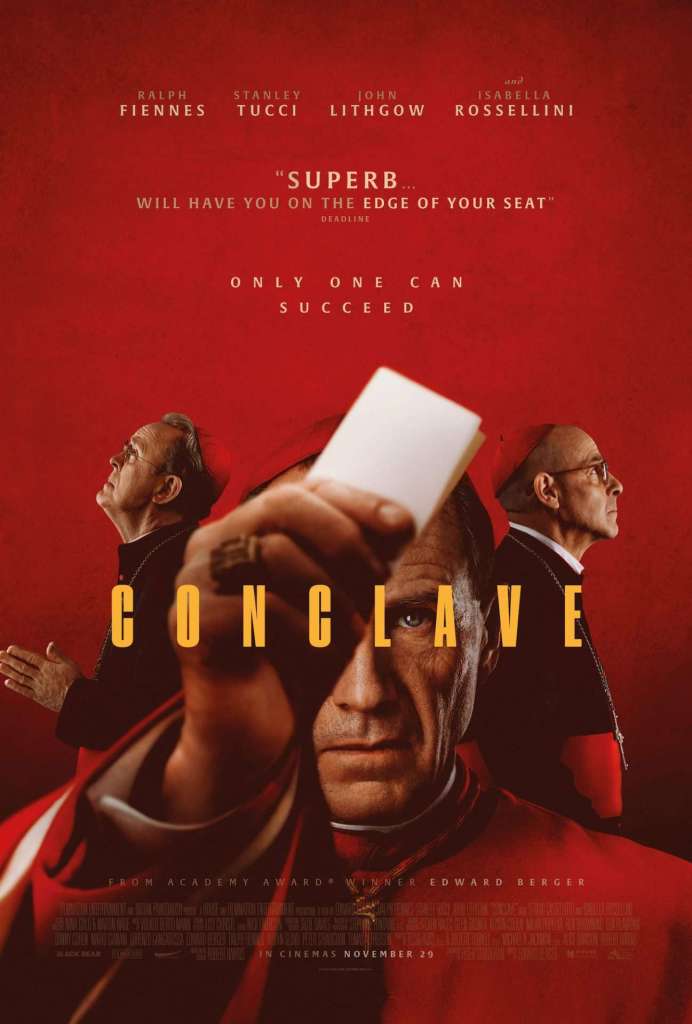
Conclave (2024)

Conclave (2024)

Papal boardroom politics combine with detective mystery in this engaging mix of high- and low-brow

Director: Edward Berger

Cast: Ralph Fiennes (Cardinal Thomas Lawrence), Stanley Tucci (Cardinal Aldo Bellini), John Lithgow (Cardinal Joseph Tremblay), Sergio Castellitto (Cardinal Goffredo Tedesco), Isabella Rossellini (Sister Agnes), Lucian Msamati (Cardinal Joshua Adeyemi), Carlos Diehz (Cardinal Vincent Benitez), Brian F. O’Byrne (Monsignor Raymond O’Malley), Jacek Koman (Archbishop Janusz Wozniak)
Few things have changed as little over 500 years than the election of a pope. Sure, they didn’t need to take away the phones of the Borgias and Medicis, but the idea of locking away the Princes of the Church in the Sistine Chapel until the Holy Spirit guides them towards choosing the next Heir to the Throne of St Peter hasn’t changed. But then neither (probably) has the ruthless politicking and barely concealed ambition of the cardinals (after all some were Borgias and Medicis!), many having dreamt their whole lives of moulding the Church into the shape they believe He wants it to be.

Politicking and spiritual and moral struggles with the temptations of ambition are at the heart of this excellent adaptation of Robert Harris’ novel. After the pope dies, Cardinal Thomas Lawrence (Ralph Fiennes), Dean of the College of Cardinals, is responsible for organising the new Papal Conclave. Lawrence, struggling with doubts whose request to resign was recently rejected by the Pope, is part of the moderate wing and a supporter of Cardinal Aldo Bellini (Stanley Tucci). The other major candidates are conservative Canadian Cardinal Tremblay (John Lithgow) and ultra-traditionalists Italian Cardinal Tedesco (Sergio Castellitto) and Nigerian Cardinal Adeyemi (Lucian Msamati). Lawrence slowly discovers severe reasons to doubt the suitability of all these candidates – while the number of cardinals suggesting he himself might be a suitable candidate grows.

Conclave is a very enjoyable dive into the mysterious world of papal politics. Part of its appeal is seeing that, under the mystery of centuries-old practices, elaborate robes and beautiful artworks, the struggle to elect a pope is a highly political business. Things ain’t changed that much since the Borgias, as various sexual, financial and other scandals crop up to scupper the chances of one candidate after another. As per 15th-century papal tradition, take away those flowing robes and lapses into Latin, and this is a cut-throat boardroom succession struggle that leaves more than a few reputations in ruins (and it ain’t going to be easy – even the late pope’s signet ring only comes off his finger after a rough-handed struggle).

In fact, Conclave works as well as it does because it’s a sort of Succession meets Father Brown, a brilliantly paced and staged merging of high-brow settings with pulpy page-turner thrills. At its heart is a superb performance by Ralph Fiennes as Cardinal Lawrence. Softly-spoken, Lawrence is dutiful, decent and diligent – and plagued with doubts about everything from his faith to his ambition, with permanently sad eyes, full of world-weary resignation. At one point Lawrence stares up at The Last Judgement, his eyes catching a man twisting in torment: he knows how he’s feeling. Unlike all the other cardinals, dripping with certainty, he’d rather be anywhere but there.

Lawrence becomes Father Brown, the quiet, level-headed priest going the extra mile to sniff out wrong-doing. As his concerns about many of his fellow cardinals emerge, he goes to rule-bending lengths to confirm these suspicions – and part of the delight of Conclave is how entertainingly it plays out murder mystery conventions alongside its papal shenanigans. Lawrence carries out his dogged investigation with an earnest sense of duty but what’s great about Fiennes’ performance is that he also manages to suggest the possibly of guilty ambition underneath. After all, Lawrence is a cardinal too, right? Why can’t he have a crack at being the Holy Father?

Lawrence has moments of temptation when the Holy See is dangled before him. Part of Conclave’s argument is that power is best suited to those most reluctant to carry it. Lawrence is one of the most reluctant among the papal players – but even he isn’t immune to guilty temptation. When he opens the concave with an off-the-cuff speech on moral conduct, is it subconsciously to establish his leadership? When he very publicly exposes one candidate’s misdeeds, is a side benefit demonstrating his own virtue? Conclave tracks Lawrence’s vote every time – and when he is tempted to vote for himself, an act of seemingly divine intervention takes place to almost tick him off.

It’s said at one point all cardinals have thought about their papal name. Lawrence shrugs this off, but later unhesitatingly gives an answer. Perhaps the only cardinal who hasn’t really thought about it is Cardinal Benitez (Carlos Diehz, wonderfully serene), secretly appointed Cardinal of Kabul by the late pope, a man almost alone in thinking this is a quest to find the holiest. The rest? They could probably tell their regnal names without thinking. And unlike Lawrence, they are certain about everything: from their own suitability to how pleased God will be when they land it.

Peter Straughan’s sharp and intelligent script gives an array of opportunities for excellent character actors (Conclave would make a good play). Sergio Castellitto’s scene-stealingly bombastic Tedesco, forever vaping when not growling about how chucking the Latin Mass was the end-of-days, can’t imagine he won’t win. It’s a trait he shares with Lucien Msamati’s Adeyemi, although Msamati finds a vulnerable humility that makes Adeyemi’s eventual downfall surprisingly affecting. Lithgow’s imperious Tremblay drips with arrogance (his eventual comeuppance sees Lithgow brilliantly deflate like a pricked balloon). Stanley Tucci is brilliant as the charming, morally upright Bellini who then surprises even himself with how fiercely ambitious he is.

Berger sets all this in a brilliantly oppressive setting, for all the beauty on the walls around them. Berger superbly conveys the isolation of the conclave, lit almost entirely artificially in heartless hotel rooms (that feel like monastic jails) and a fluorescent-lit canteen. The sound design is a massive part of this, the rooms devoid of ambient sound, just a crushingly deadened stillness. Frequently Lawrence’s breathing fills the soundtrack, giving the film a confessional feeling. It all means the late on surprise sound of a gust of wind carries the same impact for us as it does the cardinals.

Male voices dominate in the Vatican, so it’s telling Conclave deliberately undercuts this by giving one of its standout moments to Isabella Rossellini’s primly professional Sister Agnes. Like the other nuns staffing the conclave, she barely speaks – meaning when she does, it seizes the viewer’s attention as much as she does the crowd of cardinals. The flaws of this world return in the film’s final (slightly forced) twist, which helps question how much the alpha-male clashes between these papal academics may have shaped the atmosphere of the Church, and not for the better.

Conclave is tightly directed film, and a great adaptation of a page-turning novel with a faultless cast brilliantly led by Ralph Fiennes. It mixes pomp and ceremony with a fascinatingly tense struggle for power, made all the more gripping that in the parade of languages we hear (and all the cardinals can switch easily from English to Latin to Italian to Spanish) the language of power and ambition is constant but unspoken – and when it is explicitly stated, it has a devastating impact on those who use it. It’s a great touch in an entertaining and engaging film.
Training Day (2001)

Training Day (2001)

Pulsating corrupt-cop drama, highly entertaining with a full-throttle Denzel Washington

Director: Antoine Fuqua

Cast: Denzel Washington (Detective Alonzo Harris), Ethan Hawke (Officer Jake Hoyt), Scott Glenn (Roger), Tom Berenger (Stan Gursky LAPD), Harris Yulin (Doug Rosselli LAPD), Raymond J Barry (Lou Jacobs LAPD), Cliff Curtis (Smiley), Dr Dre (Officer Paul), Snoop Dogg (Blue), Macy Gray (Sandman’s wife), Charlotte Ayanna (Lisa), Eva Mendes (Sara)

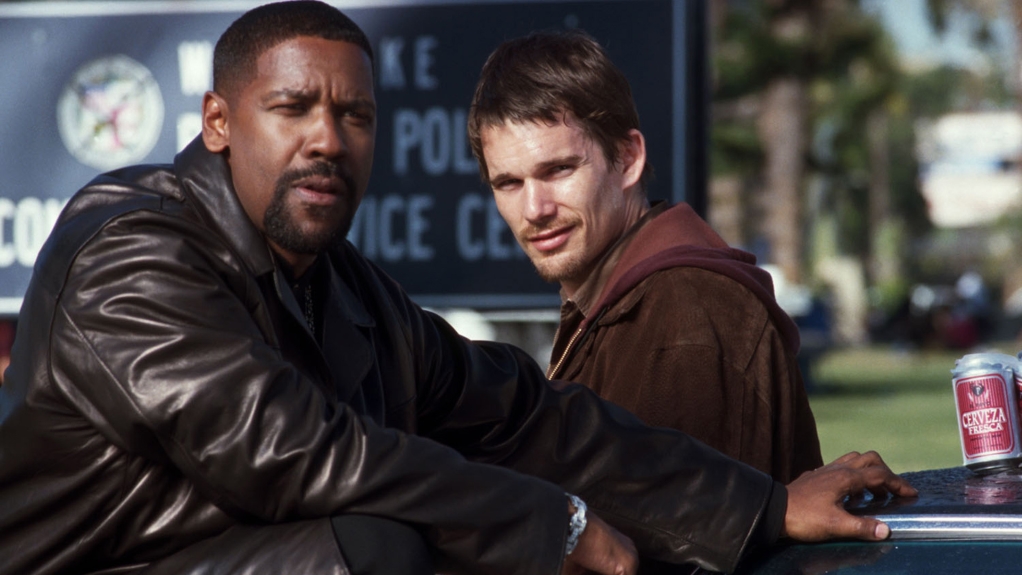
“King Kong ain’t got nothing on me!” That’s the mantra of larger-than-life legendary cop Alonzo Harris (Denzel Washington), who has immersed himself so much in the dirty neighbourhood gangland of LA that it’s hard to see where cop ends and crook begins. Alonso claims to believe to keep the town clean, you gotta break a few rules. But then he also believes in filling his own pockets with stolen money. It’s all going to come to a head in one day: first day on the job for ambitious boy-scout officer Jake Hoyt (Ethan Hawke) who thinks he’s auditioning to join an elite squad only to find he’s the victim of a series of elaborate mind-games and dodgy moves by Alonzo, testing to see whether he is potential asset or sacrificial pawn. It’s going to be a long day.

Training Day is basically a massive dance with the devil, offering his little Faustus all the wonders of the world in return for his soul. It’s all there for Hoyt’s taking: respect, glory, standing – and of course oodles of plastic-wrapped dollar bills. All he has to do is sacrifice every inch of his integrity and personal morality to Alonzo Harris, a grandstanding Mephistopheles. This first day is all about Harris pushing Hoyt to see how far he will go. Will he smoke a little dope so he could pass as an undercover druggie? Will he search a house under a false warrant? Will he rough up a suspect? Will he murder a drugdealer and steal his cash?

Throughout all this, Denzel Washington barnstorms to fantastic Oscar-winning effect. This is a delightfully Devilish performance, Washington leaving it all out on the pitch. Alonzo Harris has inhabited the persona of the gangsters he follows for so long he’s basically become one. Harris is scarily charismatic, the unshakeable confident cool he uses to cow and terrify criminals and punks on the street, also making him a hugely attractive figure. This is despite his complete amorality, his ruthless capacity for violence and his shocking willingness to abuse and use almost everyone around him. He does all this by convincing Hoyt for long stretches that his poor treatment, abuse and deception of him is all in Hoyt’s own interest: to toughen up this naïve puppy into a killer.

Hoyt spends half the time if this is some elaborate show-and-test. Who can blame him? Washington’s exuberance plays masterfully on the edges of someone putting on a massive performance. There are neat moment where we see how fragile some of Harris’ control is, once he is outside of his comfort zone: he’s in hoc for millions to Russian gangsters and as events of the day pile up his thermonuclear self-confidence tips into moments of impotent fury. Washington is fantastic as this street monster, whose seductive lines on modern policing (do a little bad to do a greater good) start off sounding like common sense before you realise they tip quickly into justifying open criminality. It’s a performance of perfect physical swagger matched with his limitless charisma, inverting the qualities that made him a perfect Steve Biko or Malcolm X into a Lectorish monster.

Ethan Hawke is also extremely good as his polar opposite, the eager to please rookie who realises there is a lot more going on here than he thought. Training Day suggests there may well be a middle ground between Hoyt’s straight-as-an-arrow idea of policing and Harris’ corruption – and it’s part of Harris’ appeal that his perverted mentoring ends up making Hoyt a tougher, more unrelenting (better?) cop than he was before. But also, Hawke is great at showing that Hoyt (under his sheen of moral uprightness) is also a tough, hardened professional. In classic story-telling style, Harris is a dark reflection of Hoyt: they share a stubbornness, a conviction that they are right, a refusal to be intimidated (Hoyt may nervously try to please Harris at first, but once he realises the score he refuses to be forced into doing anything he doesn’t want to do) and a capacity for throwing themselves into decisive action. There is a reason why this rookie can get the drop on Harris – much to his wicked mentor’s delight and admiration – in a way no one else can.

That alone shows the dark magnetism of people like Harris: like Hoyt we end up wanting their approval even when we hate or fear them. Even as he holds a shotgun to his head, there is a part of Hoyt you suspect is proud that Harris’ gut reaction is to shout an impressed “My man!”. Of course Harris knows his validation is important to people. Monsters like this know the weaker-willed crave their respect. But then Harris also knows no one else in his team – all of them weak-willed bullies, desperately trying to imitate them – have even a quarter of the independence of mind Hoyt has.

What Harris under-estimates is Hoyt’s survival instinct. The final third of the film, the clash that has been building inevitably between these two, again demonstrates both their similarities and their fundamental differences. The main difference between them being Hoyt cares for, and protects others, and Harris cares only about himself. Hoyt’s humanitarianism will save him from dangerous situations and even Harris’ girlfriend (a tough-but-cowed performance from Eva Mendes) recognises Hoyt has shown more concern for her son in a few minutes than his father, Harris, ever has in his whole life.

The final act of Training Day hinges a little too much on one whopper of a coincidence: the sort of narrative contrivance so colossal that, in a less magnetic film, you’d be throwing stuff at the TV shouting “oh come on!” It’s final, inevitable, confrontation between Harris and Hoyt feels rather too much like many, many other films before it in every single beat, while the ending has a whiff of Hays Code morality (all wrongs righted!) about it that rather undermines the edgy, unpredictable film it precedes.

But when Training Day focuses on the sound and the fury of Washington and the Faustian dance on the deep grey lines of street policing, this is a sensational, energetic and highly watchable cop thriller, pulsatingly directed by Antonie Fuqua. With Washington superb and Hawke easy to overlook as his straight-laced partner, it’s a character study that constantly shifts our expectations and leaves us genuinely worried about the fate of its hero. The sort of slick entertainment Hollywood does at its best.

Dirty Harry (1971)

Dirty Harry (1971)

Eastwood enters into cinematic legend in this grippingly entertaining pulpy cop thriller

Director: Don Siegel

Cast: Clint Eastwood (Inspector Harry Callahan), Harry Guardino (Lt Al Bressler), Reni Santoni (Inspector Chich Gonzalez), John Vernon (Mayor), Andy Robinson (Scorpio), John Larch (Police Chief Paul Dacanelli), John Mitchum (Inspector Frank DiGiorgio), Mae Mercer (Mrs Russell)

“Do you feel lucky? Well do ya? Punk” With these words, .44 Magnum in one hand and remains of a hot dog in the other (yes, Harry Callahan was so cool he didn’t even stop having lunch to take on a bunch of armed robbers), Clint Eastwood made a permanent mark on cinematic history. In 1971 Dirty Harry was condemned by some as fascist or reactionary, but really it’s just energetic, punchy, impossibly entertaining pulp. In a year where tough, rule-bending cops were de rigour, Dirty Harry may have more of a B-movie vibe than Friedkin’s Oscar-winning The French Connection but there is no doubt which one is the most viscerally entertaining.

“Dirty” Harry Callahan (Clint Eastwood) – so called because he gets all the jobs no-one else wants – is a tough-as-nails Inspector who values the Rule of Law over the Rules of the Law. Taciturn, not-suffering fools and always on the hunt for criminals (as the prototype gruff cop maverick, of course he works best alone), he prowls the streets of San Francisco and stops at nothing to take down bad guys and protect the innocent. He’s the guy you want on the case when the ruthless Scorpio killer (Andy Robinson) holds the city to ransom, shooting innocent people at random, seizing hostages and sending notes demanding payment to prevent more outrages.

Dirty Harry is lean, mean and a simply perfect piece of pulpy action. Directed with a tautness by Don Siegel, that never let’s go, it riffs on real life events – Scorpio is an obvious stand-in for the Zodiac Killer – and basically shifts a shoot-first-ask-questions-later cowboy into the heart of a modern city. Harry, embodied with sublime suitability by Eastwood (cementing his image) has a waspish sense-of-humour, speaks as he finds, never-ever-stops, has the ruthless determination we all wish we had and carries inside himself (buried deep) a maudlin sadness at his fundamental loneliness.

Dirty Harry doesn’t shirk in showing how a cop who bends the rules to deliver real justice can be an attractive figure. Harry doesn’t quite shoot first – he gives a cursory warning every time – but he always responds with lethal force when people are threatened. He’ll carry out illegal search operations of despicable offenders, he’ll follow a psychopath because he knows he’ll offend again (he’s right, but still) and when Scorpio won’t tell him where a hostage has been hidden, he doesn’t think twice about effectively torturing the guy to get him to talk.

Siegel’s film knows that this makes Harry the sort of guy we liberals tut about but, when push-comes-to-shove we need. Harry clones run through film and television history – what is 24’s Jack Bauer, but Dirty Harry fighting nuclear terrorists? – and it’s rooted in the fact that, although we know we should respect the rights of criminals, secretly we don’t want to. Surely, it’s not an accident that the film was set in San Francisco, the nirvana of liberalism in 1970s America. What makes that possible – cops like Harry.

The film stacks the deck slightly by making most of the besuited bosses Harry rubs up against punch-clock rules followers who place the letter of the law above its spirit. Of course, the DA will release Scorpio back onto the street because the damning evidence Harry has collected needs to be thrown out. Of course, he’ll order Harry to leave the clearly-mad-as-a-bag-of-bats Scorpio in peace. Of course, almost every other law official we see can’t hold a candle to Harry’s ruthless skill. Eastwood is so cool, we need to take a beat to remind ourselves that Harry is a widower who lives in an empty apartment, has no friends and he looks on with a quiet envy when his wounded partner is comforted by his wife.

But Harry is made for other things. Siegel’s character-defining set-piece early on, irrelevant to the plot, introduces everything we need to know about Harry. He effortlessly surmises a robbery is taking place at a bank across the street, calls for back-up and when he realises it will arrive too late, grabs that .44 Magnum and hot dog and strolls across the street into a shoot-up. At the same time, it’s a miracle no one is caught in the crossfire or crashing cars. He then bluffs another robber to stand down with a hard-as-nails bad ass speech, despite his chamber being empty of bullets.

To take on a guy like that, you need a truly inspired villain. Andy Robinson, his performance a master-class of twitch with a high-pitched giggle that acts like nails on a blackboard, provides it. He makes Scorpio a deeply unhinged, unpredictable predator who compensates for his slightness and youth (opposite Eastwood’s chiselled masculinity) by simply being an utterly unpredictable lunatic, with no sense of moral compass. Robinson pitches the performance just right, avoiding obvious histrionics to present a character larger than life but terrifyingly plausible.

The duel between them is shot by Siegel like an extended, grimly tense mix of chase and spy thriller. Opening the film with Scorpio searching the horizon for a new victim through a rifle’s telescopic lens, it throws us into a dark nightmare of San Francisco, with parks and baseball grounds places of unimaginable danger and a closing tense game of cat-and-mouse at an industrial plant. Through it all, Eastwood brings his softly spoken charisma to a man who knows full well there is little too him but the chase, but who puts the rights of the guilty a very, very distant second to the victims.

Dirty Harry plays like a punch to the guts, a superbly (and seductively) entertaining film that gives just enough hints at the dangers of Harry’s methods, while making their effectiveness abundantly clear. Siegel’s direction is pitch-perfect – this is one of the greatest cop thrillers ever made – and Eastwood’s performance is iconic. The French Connection maybe a more complex film – but Dirty Harry is more entertaining and the one you’d choose to put on with some popcorn.

The Batman (2022)

The Batman (2022)

Robert Pattinson presents a noirish Bat in Matt Reeves’ dark, moody vision

Director: Matt Reeves

Cast: Robert Pattinson (Bruce Wayne/Batman), Zoë Kravitz (Selina Kyle/Catwoman), Paul Dano (The Riddler), Jeffrey Wright (Lt James Gordon), John Turturro (Carmine Falcone), Peter Sarsgaard (DA Gil Colson), Andy Serkis (Alfred Pennyworth), Colin Farrell (Oswald Cobblepot/Penguin), Jayme Lawson Bella Réal) Rupert Penry-Jones (Mayor Don Mitchell Jnr), Barry Keoghan (Arkham Prisoner)

The rain pounds down on Gotham. In the shadows a masked man strikes terror into the hearts of wrong-doers. It could only be the start of a new Batman trilogy. At least that’s the intention, as DC Comics mines its strongest asset, in a dark, noirish version that positions Batman as a gumshoe pulp detective with fisticuffs. If Reeves film at times has more ambition than it knows what to do with, at least it is ambitious.

For two years Bruce Wayne (Robert Pattinson) has been crusading on the streets of Gotham as Batman, trying to fix the city’s problems one criminal at a time. He’s formed an uneasy alliance with police Lt James Gordon (Jeffrey Wright) and is just about tolerated by the official force. That starts to change when unhinged serial killer The Riddler (Paul Dano) begins a campaign of terror targeting Gotham’s elites, who he accuses of corruption. How far will the Riddler go? How do crime boss Carmine Falcone (John Turturro) and mysterious cat burglar Selina Kyle (Zoë Kravitz) fit in?

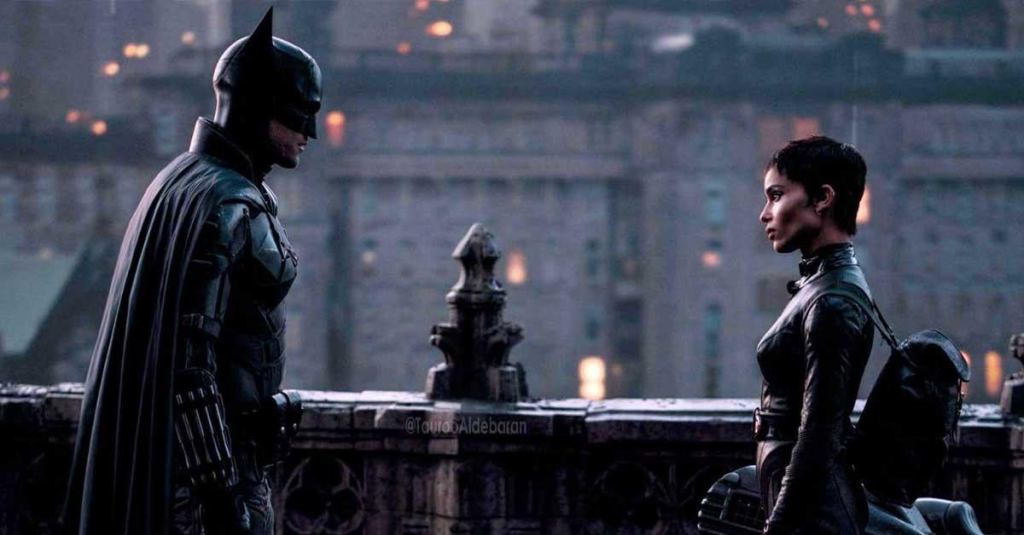
Reeves’ film is a grimy film-noir Batman. Pretty much the entire film is set at night-time, in seedy bars and filthy streets with barely a frame unaccompanied by the pounding of rain on the soundtrack. Atmospherically shot by Grieg Fraser, the film has a rain-sodden canvas with deep blacks and splashes of red. It’s sound design – and Michael Giacchino’s music – uses deep bases and reverbative sounds that give the film an intimidating rumble.

Reeves’ takes Fincher’s Seven and Zodiac as key inspirations, mixed with the shadowy darkness of Pakula and other 1970s filmmakers. Gotham is the hellish noir of Seven, where light is a stranger. The Riddler is radically re-interpreted as an ingenious psychopath, covering his crimes with cryptic clues, cultivating an online audience with videos where he conceals his face behind a sort of gimp mask and prominent spectacles – in methods and style he’s very similar to the Zodiac killer.

Batman is a tech-assisted private eye, working alongside the official forces, doing things they can’t do. Few other Batman films have zeroed in on the detective element of the character as much, but it’s possibly his main skill here: searching for clues, deftly cracking the Riddler’s cryptic clues, chasing down leads, utilising top-of-the-line surveillance equipment (a set of contact lenses that records everything he sees) and making connections from crime to crime. He’s a sort of miserable Sam Spade who punches lots of people.

Setting the film very early in Batman’s crusade allows for a rough and raw quality to Batman’s gear and approach, helped by Pattinson’s age. The suit has a homespun practicality to it, a hulking suit of armour that bullets bounce of, with various useful attachments. The batmobile is essentially a normal car with a massively souped-up engine. Batman often travels on a normal but powerful motorbike, and stakes out witnesses with his armour disguised under a hoodie. At times Bruce misjudges things: a fall from a building that almost goes horribly wrong, the odd fight where he bites of more than he can chew.

With an eemo look inspired by Kurt Cobain, Bruce Wayne is a surly recluse with serious emotional difficulties. He has a tense relationship with surrogate father Alfred (an effective Andy Serkis), who disapproves of how Bruce spends his evenings. The Batman has far less Bruce Wayne in it than almost any other Batman movie. This Bruce only feels comfortable behind the mask and has worked hard to crush all fear and emotion to find security in anonymity. He has cut himself off not only from the city, but from humanity, idealising his lost parents – and is a stern, humourless judge who describes his mission as one of vengeance.

There is a lot of vengeance needed in Reeve’s corrupt Gotham. The film bites off a huge chunk of content around corruption, class conflict and injustice. The Riddler’s crimes are all connected to corruption, people whose hands are actually filthy with drug money. His fury extends to the Wayne family – Gotham’s venerated philanthropists – and the film is at its best with this character when he functions as a sort of avenging angel of class war.

But it doesn’t quite manage to nail down exploring the morality of a serial killer, eliminating pernicious public figures. There is no discussion of the misguided merit in the twisted motives of the killer. He’s always presented as wicked and insane, with no scope given to understand or acknowledge the legitimate social points he makes. A late act reveal of his deeper plot comes from nowhere and (with its indiscriminate destruction) feels inconsistent with any point the film was trying to make earlier. It seems instead to exist to give us a big action set-piece. The film strains towards a coherent message about institutional, systemic corruption, but doesn’t quite give it the depth and shade it needs.

It’s all part of a film that isn’t quite smart enough, or a script that isn’t deft enough. Take a look at those riddles. Darkly fascinating as they are, their never quite strong or enigmatic enough. The film offers no ‘light-bulb moment’ when a hidden message is suddenly made clear. Batman cracks them all quickly, apart from one. Most audience members will quickly suss out that one and you suspect the only reason Batman doesn’t is that if he did the film would end quickly.

Ending quickly is something The Batman isn’t concerned about. At nearly three hours, it is far too long – particularly as it never quite works out what it is trying to say. There are too many sub-plots: an unrecognisable Colin Farrell is good value as The Penguin, but his entire presence is to set up future movies. The film drags out its ending with a sudden twists, which don’t feel like a wider plan playing out behind the scenes rather than slightly jarring extensions.

The Batman covers a lot, but none of it in enough depth. Very good as Robert Pattinson is, I don’t feel we learn a lot about Wayne. The Batman adds a romance with Selina Kyle (a dynamic Zoë Kravitz) and gives her a sub-plot of her own which largely just crowds the film. None of these plots are complex in themselves, but they all play out at the same time, reducing the focus on each of them. It’s all too much for you get to a handle on what the film is trying to be about.

Essentially, you feel Reeves had hundreds of ideas about what he wanted his Batman film to be – and didn’t have the heart to leave any of them out. But, even when over-ambitious, he’s an impressive and exciting film-maker. The Batman is crammed with great scenes (from action to disturbing splashes of horror). When the sequel comes, a clearer overall theme will help a great deal. But, with this dark but beautifully made film – and an impressive Batman from Robert Pattinson – I’ll be excited to see what Reeves does next.

French Connection II (1975)

French Connection II (1975)

Change of setting isn’t really enough to justify the existence of this half-hearted sequel

Director: John Frankenheimer

Cast: Gene Hackman (Detective Jimmy “Popeye” Doyle), Fernando Rey (Alain Charnier), Bernard Fresson (Inspector Henri Barthélémy), Philippe Léotard (Jacques), Ed Lauter (General Brian), Charles Millot (Miletto), Jean-Pierre Castali (Raoul Diron), Cathleen Nesbitt (Old Lady)

Did The French Connection really need a sequel? Friedkin’s original was a self-contained gem, based on a true story, that even ends with a series of “what happened next” captions. But there was enough of a foot in the door for a completely fictionalised resolution to fates left hanging. French Connection II has some similarities with the original, but it’s also a slight film caught even more obviously than the first between documentary realism and trigger-happy actioner.

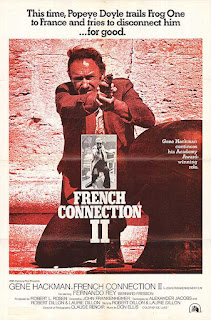
The whole film feels like it has been assembled in a rush. The plot is incredibly slight. “Popeye” Doyle (Gene Hackman) arrives in Marseilles to help the police track drug kingpin Alain Charnier (Fernando Rey). Doyle doesn’t speak a word of French and charges around pissing everyone off and generally making a nuisance of himself. He’s grabbed off the streets by Charnier’s men. To get him to talk they spend weeks force-feeding him heroin until he’s hooked then cut off his supply. They then return him to the Marseilles police who lock him in a cell and help him go cold turkey. When he comes out if Popeye wasn’t mad before, he certainly is now.

That (long) sequence of heroin addiction and painful cold turkey is one of two things that really makes Frankenheimer’s sequel stand out. I think it must be what attracted Hackman to the film. Not only did the liberal Hackman (troubled by Doyle’s slight neo-fascism in the first film) probably enjoy the idea of seeing this guy hit rock bottom, it’s also an opportunity for an acting tour-de-force. Hackman is probably given more challenging material in this largely forgotten sequel than in his actual Oscar-winning role.

Weaned onto the drugs, Hackman’s body language shifts from defiant resistance to despondent, dope-strewn lethargy until he can’t be bothered to record the passing of days any more in his tally chart. He goes from being cuffed and dragged around, to blankly following his captors and rolling up his sleeve to accept another shot. But that’s nothing compared to the cold turkey scenes.

Locked up in a dingy cell under the police station (the French police worried about taking the blame and also feeling a brotherhood with this fellow cop), Doyle goes through withdrawal mourning – anger, bargaining and eventual grief – in a series of calmly shot, claustrophobic scenes that allows Hackman let rip. And he certainly does, deconstructing this proud man’s self-image until he’s a weeping mess, kicking doors, throwing food around and so full of self-loathing, he can barely face himself in the mirror. It’s hard to watch, and something truly unique – a twisted punishment for a drugs cop and a man who defines himself by his lack of reliance for anyone or anything else.

This long sequence takes up the centre of the film – and includes an equally difficult scene to watch, as Frankenheimer stages in (a single take) forensic detail the French police’s pumping of Doyle’s stomach to get a final (deadly) overdose out of his system. It’s quite unlike anything else I’ve seen before in a cops and robbers shoot-em-up (which is what most of the rest of the film, at heart, is) and you can guarantee it’s the one thing people will remember.

The other element that stands out is Frankenheimer’s – a long time Francophile – ability to shoot Marseilles not as a tourist destination, but a strikingly real urban environment. On top of this anti-picture-postcard environment, he stresses Doyle’s isolation. None of the French dialogue in the film is translated, leaving us as stranded as Doyle is in trying to understand what is going on and what people are saying. Doyle clumsily pantomimes for everything he wants, be that information from a suspect (he tries his toe-picking line to no effect what-so-ever) to a drink in a bar (a long exchange until he finally reaches an understanding with the barman on “whiskey”). Doyle, of course, has made no effort to learn any French and blunders about in a city he doesn’t understand, ruining operations and getting himself and others in trouble.

Aside from these moments though – and despite the film being well shot by Frankenheimer, with a nice continuation of the original’s drained out neo-realism – this is otherwise a conventional and unimaginative film that ticks a number of expected boxes. It has an action set-piece at a dry dock that feels unreal (and also copies the central idea of the car smuggling operation from the first film) and concludes in a chase and shoot-out that’s almost a copy of the original’s ending – with an ending even more sudden. For all Frankenheimer’s love of France, the film still has a suspicion for Europeans – be they smooth criminals or obstructive cops.

French Connection II tries a couple of different things, but never really makes a case for itself as a truly stand-alone film. It’s main rivalry between the hero and villain is dependent on having seen the first film and its slender plot veers into the sort of shoot-outs and set-pieces that don’t feel remotely like they are occurring in a ‘real’ world. It deserves credit for the bravery and honesty of its cold turkey sequence, but it’s a sequence caught in a film that otherwise offers little that’s truly unique.

The French Connection (1971)

The French Connection (1971)

A ruthless, obsessed (of course!) cop chases down a drug kingpin in this Best Picture winning crime drama

Director: William Friedkin

Cast: Gene Hackman (Detective Jimmy “Popeye” Doyle), Fernando Rey (Alain Charnier – “Frog One”), Roy Scheider (Detective Buddy “Cloudy” Russo), Tony Lo Bianco (Salvatore Boca), Marcel Bozzuffi (Pierre Nicoli – “Frog Two”), Frédéric de Pasquale (Henri Devereaux), Bill Hickman (FBI Agent Bill Mulderig), Ann Rebbot (Marie Charnier), Harold Gray (Joel Weinstock), Arlene Faber (Angie Boca), Eddie Egan (Captain Walt Simonson), Sonny Grosso (FBI Agent Clyde Klein)

Cops and criminals: do they have more in common than we’d like to think? In Friedkin’s Oscar-winning The French Connection, the lead cop and criminal are both obsessive, single-mindedly ruthless and locked into a cycle of actions that isn’t going to be change with one big bust. Look at them in isolation and its hard to tell at times which is which: the French drug dealer is a suave cosmopolitan type, unfailingly cultured and polite, but remorseless; the cop is a border-line racist and narcissist who doesn’t give two hoots about collateral damage, kills without remorse and whose life is one of tunnel-visioned obsession.

Based on a true-story – the model for Doyle, Eddie Egan, has a cameo playing his own boss – the film covers the arrival in New York of French heroin dealers, led by Alan Charnier (Fernando Rey) looking to make a killing with their prime product. Opposite them is narcotics officer Jimmy “Popeye” Doyle (Gene Hackman), who’s practically the dictionary definition of anti-hero. Doyle and Charnier engage in a battle of wits and force across New York during one blisteringly cold few days in Winter, and never mind who gets in the way.

The French Connection is about masculinity, and that no matter what many men don’t like to lose. Getting beat is certainly the main concern for Doyle, who I’m not sure has ever really thought twice about the impact of drugs (he’d be just as passionate chasing down coca-cola or stamps if you banned those). Neither has Charnier, with his reassured cool of old Colonial Europe, which just knows better than the nouveau Americans. (there is an underlying subversive fear of America being undermined by this suspiciously metropolitan Frenchman, the country’s best defence being a loud-mouthed, son of the streets).

Played superbly by Gene Hackman, Doyle is presented as a man we are invited to make up our own mind about. He’s obviously an effective detective and he doesn’t just go the extra mile: the job is a night-and-day obsession. He’ll spend hours pounding the streets, staking out a hotel on a rainy street, walk miles tailing a subject and barely spend a minute off-duty. He’ll also drive cars wildly though crowded streets, shoot a man in the back, rough-up suspects and treat others with an abrupt anger, xenophobia or both. As a model for the society he’s sworn to protect, he’s a disgrace – but is he the effective agent of crime-fighting we need?

Friedkin’s film largely aims to present Doyle as he is, within its documentary realism – although I’d argue the film repeatedly looks at his commitment and never-say-quit-energy with barely veiled admiration. The film is assembled with an on-the-streets immediacy reminiscent of The Battle of Algiers – added to by the casting of many non-actors in key roles. It’s shot with a drained-out series of muted colours (even more drained-out in Friedkin’s egotistical blu-ray remastering). All shot on location, it captures the slummy flavour of the rougher ends of New York. Right from the off, we see Doyle and Russo roughing up an informer in something between a slum and building site (including the famous “do you pick your toes in Poughkeepsie” exchange, a classic bit of psychological messing with criminals – incidentally check out Scheider trying not to corpse as Hackman roars through this.)

The investigation proceeds with a muted sense of grounded realism. There is a lot of time-consuming following, watching and taking notes. Word is picked up by informers. Careful surveillance work fills out the gang and its members. Doyle is constantly frustrated by bureaucratic demands, not to mention turf-war squabbles with the FBI (who, in addition, think he might be next door to a dirty cop which is pretty fair). Similarly, the criminals go through careful negotiations around timing, testing the purity of the goods and working out the best way of dodging the cops.

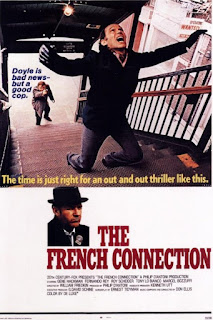
Friedkin’s film is so wrapped up in a perfect “slice of life” documentary realism shell, that it gets away with much of the second half being a piece of pure filmic flair. First and foremost is its famous car-chase. Narrowly surviving an assassination attempt from “Frog Two”, Doyle requisitions a car and hares through New York at 100mph trying to beat the elevated train “Frog Two” is escaping on, to the next station. In this superbly cut sequence, Friedkin pioneers the sort of low-angled front bumper shots that would be a staple of car chases for years to come. It’s pounding, gripping and brilliantly assembled, a raw slice of action that uses the film’s documentary style to trick you into thinking it’s something akin to the realism elsewhere.

But it’s a bit of filmic fantasy – and wouldn’t be out of place in Dirty Harry, the other 1971 film about a morally-complex cop. Doyle is certainly a less attractive person than Callahan – with no real moral feelings just a love of winning. Winning is what motivates him in this car chase: he has little interest in questioning the shooter (who has, to be fair, taken out several civilians, including a mother of a young baby) or preserving public safety and way more about getting revenge. He tears through the streets, sending civilians flying, scares Frog Two into killing two more people and finally caps it by shooting his unarmed would-be-killer in the back after a cursory warning. (Not the first time he’ll pull the trigger after only the most slender of warnings).

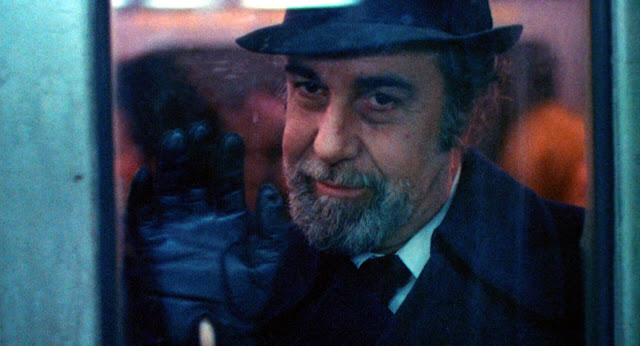
Winning is all that matters though. Charnier is just as bad. He ruthlessly exploits a patsy and has no concerns about bodies piling up. Fernando Rey’s impish smile and campily cool little wave to Doyle through the subway doors, after he has managed to shake him off in a marvellous sequence in a subway station, is all about enjoying a smug triumph. No wonder Doyle repeats the same gesture to him late in the film when the tables are turned.

It’s the way Friedkin’s film mostly doesn’t ask us to blindly root for Doyle that really makes it stand out. In many ways the film is less exciting – or even less intriguing a character study – than Dirty Harry. It uses its documentary realism heavily at times, to justify showing the sort of shocking, exploitative material (at one point, the camera lingers on the incidental victims at a car crash scene at distasteful length) that you would expect to find in Dirty Harry or Shaft. What Friedkin’s euro-inspired style – and Hackman’s committed playing – managed to do was make itself feel like it was making a higher artistic statement than those films, which played a much more conventional hand.

That and the sense that nothing has really changed. Early in the film Doyle and Russo charge into a bar – a bar by the way with an entirely black clientele, who Doyle delights in abusing – to seize whatever drugs people seem to have on them. It’s a basic clean-up and shakedown – but hours later you can be sure it will be look nothing happened there. Similarly, the film’s end credits reveal all involved basically dodged charges (except for the patsy for the smuggling of course), while the cops got transferred. We’ve got one small win at the cost of at least five lives.

I seem to change my mind on The French Connection every time I see it. Sometimes I think it’s not that different from a host of other police actioners released at the same time (add Bullit to that list). At others, I get gripped by its edgy mise-en-scene and Friedkin’s challenges to conventional morality. And I guess, a film that can make you switch your mind constantly, should be seen as some sort of classic.

Witness (1985)

Harrison Ford and Kelly McGillis have a cautious romance across the divide in Peter Weir’s gripping thriller Witness

Director: Peter Weir

Cast: Harrison Ford (Detective John Book), Kelly McGillis (Rachel Lapp), Lukas Haas (Samuel Lapp), Jan Rubes (Eli Lapp), Josef Summer (Chief Paul Schaeffer), Alexander Gudunov (Daniel Hochleitner), Danny Glover (Lt James McFee), Brent Jennings (Sgt Elton Carter), Patti LuPone (Elaine), Angus MacInnes (Dgt Leon Ferguson), Viggo Mortensen (Moses Hochleitner)

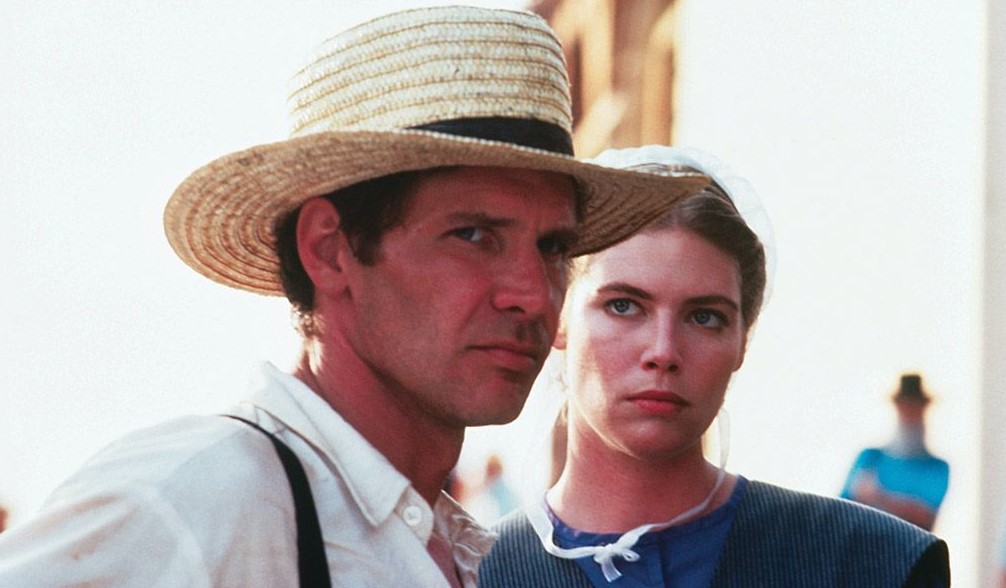
The old world meets the new, when a mother and son from an Amish community find themselves travelling through Philadelphia and the son is the only witness to a murder at the train station. The mother, Rachel (Kelly McGillis) wants to help, but is worried about her son Samuel’s (Lukas Haas) safety and is desperate to return home – after all these ‘English’ problems aren’t theirs. However, Detective John Book’s (Harrison Ford) investigation reveals the murder to be the work of dirty cops in his own department – and, after an attempt on his life, he has no choice but to flee back to Amish community with Rachel and son, hiding until he can find a way to set things right.

Directed by Peter Weir with a real professional smoothness, Witness is a triumph of atmosphere and mood, with an intriguing thriller at the heart of it. Weir brings a real understanding and respect for different ways of life, embracing the differences in the Amish way of life but also making some striking parallels between it and our modern world. It’s that emotional maturity and sensitivity that makes the film work: and the most impactful factor is the heartfelt, largely unspoken romance between Book and Rachel. Weir keeps this subtle, gentle and built on suppressed feelings and wordless moments that trusts the audience to understand their bond and their knowledge that their different worlds mean they can probably never be together.

Weir directs these moments with a real romantic simplicity, drawing possibly the most heartfelt, almost boyish, performance he’s ever given from Harrison Ford. Oscar-nominated (his only nomination), Witness is a reminder of how well Ford does both moral outrage and pained suffering. His fury at his corrupt colleagues betraying their badge is as visceral as his sense of fear when he’s chased (first in a car park, then later around an Amish farm) by Danny Glover’s heavy – we always feel worried about Ford’s safety, while also sure he can look after himself. He also works wonderfully with Lukas Haas, Weir focusing on his under-valued fatherly qualities as an actor.

Ford brilliantly combines his decency and world-weary sadness (few actors manage to look more outraged but also resigned when confronted with betrayal and villainy – and is there a more decent, homespun name than John Book?) but Witness taps into his vulnerability more than almost any other film. That’s not just physical vulnerability – he spends a large portion of the film recovering from a gunshot and looks genuinely in fear of his life in the final confrontation – but also emotionally vulnerable.

In a luscious scene he and Rachel (an equally superb performance from Kelly McGillis) dance in a barn to What a Wonderful World by Sam Cooke. As the two shyly and slightly hesitantly exchange looks, both actors allow their characters to hang on the edge of making a clear romantic gesture, but always backing away with laughs and grins. Ford has never seemed more playful, joyfully singing along while McGillis’ emotional frankness and honesty leads makes the scene beautifully romantic, with two people nervous about admitting their growing feelings for each other.

This is just one of several romantic touches that really carry impact. From the moment they arrive in the Amish village, they find themselves drawn to each other. Maybe it’s the charmingly awkward way Book wears the Amish clothes that don’t fit him. Perhaps is the delighted smile and the realisation of her own loneliness in Rachel . But the feelings are unspoken but clear. Both of them are tentative about romance. Book is passionate about justice but surprisingly shy personally (as is all too clear from his bashful talk with his sister earlier). Rachel is committed to her religion, but also yearns for something emotionally beyond what that community can give her (certainly she’s unthrilled by the expectation that she will marry Alexander Gudunov’s Amish farmer, who courts her with a pleasant but romance free dutifulness). Interestingly she is the one more forward in what she wants than Book. For all the film is a gripping thriller, this romantic story is its heart and what gives the film its impact.

The film also works because Weir treats the Amish life so matter-of-factly. The opening moments of the scene, in its simple rural setting and accompanying choral-inspired score could be set hundreds of years ago. It’s actually quite jarring when we find ourselves in busy Philadelphia: but Weir never suggests either way of life is superior to the other. Both are communities with their own rules, virtues and flaws. The Amish are peaceful, but just as capable of prejudice as anyone else. But they are free of the cruelty and violence of the modern world.

A large chunk of the film follows Book’s fish-out-of-water experiences with the Amish, and his growing regard for them reflects the film’s own feelings. He finds there’s a strange peace in the community – and we can see why after we’ve seen the hard-bitten streets Book works. Ford’s real-life carpentry skills have never been used better on film, as Book helps raise a barn (a lovely moment of communal accomplishment). But while the peace is refreshing, he can only change so much. Confronting abusive townspeople (“It’s not our way”/”It’s my way”), Book strikes back. The film’s stance on Book’s smacking down of these abusive street kids is an insight into its maturity: it’s a brief moment of triumph, but is soured instantly by the horror of his hosts – and leads directly into blowing Book’s cover.

But it works because it reflects how we are feeling. Having been led to invest so heavily in a way of life it’s easy to joke about, we feel the same as Book does: those bullies need taking down a peg or two. It fits with Book’s character as well – the idea of corrupt, bullying cops is as repugnant to him as drunken oaths mocking those who choose not to defend themselves.

Weir’s film also successfully creates plenty of thriller beats. Little Samuel’s witnessing of a murder in a train station toilet has a seedy immediacy and sense of danger that really makes you fear for the kid’s safety (and admire his life-saving ingenuity). There’s also rather nicely a simplicity to the film – it’s no whodunnit, we more or less have every question answered in the first half hour. Instead, the suspense comes from if Book can live long enough to hand out justice and how he can possibly manage that from an Amish village.

But Witness’s heart is the relationship between Book and Rachael, wonderfully bought to life by Ford and McGillis. Few thrillers would dare to be as soft and sensitive as this film – or have such restraint. It’s tinged throughout by the careful creation of two worlds that mutually co-exist, but never together. It’s open about the virtues and flaws of Amish life, but offers no judgement on either them or their religion, only acceptance of difference. Witness is a thriller with a heart, combining excitement with moments of heart-rending romance. Professional Hollywood working at its best.

A Soldier's Story (1984)

Howard E Rollins Jnr investigates a racially motivated murder with a difference in A Soldier’s Story

Director: Norman Jewison

Cast: Howard E Rollins Jnr (Captain Davenport), Adolph Caesar (Sergeant Waters), Art Evans (Pvt Wilkie), David Alan Grier (Cpl Cobb), David Harris (Pvt Smalls), Dennis Lipscomb (Captain Taylor), Larry Riley (CJ Memphis), Robert Townsend (Cpl Ellis), Denzel Washington (Pfc Peterson), William Allen Young (Pvt Henson)

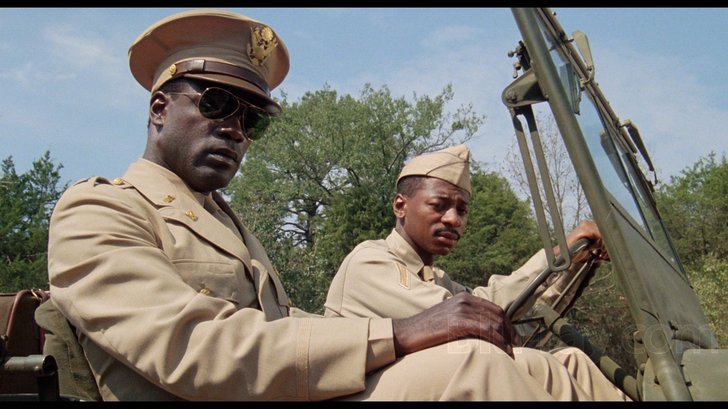
A Louisiana military base, 1944. A company of black soldiers prep for Europe to fight for Uncle Sam. All that is put on hold when hard taskmaster Vernon Waters (Adolph Caesar), their sergeant, is shot outside the base. Black JAG officer Captain Richard Davenport (Howard E Rollins Jnr) arrives to investigate the murder – to the hostility of his fellow officers, who are unused to saluting a black man as the common soldiers are. But is Waters murder the result of racism from the town? Or is it due to the tensions within the platoon?

Jewison’s adaptation of a notable stage success by Charles Fuller is a professionally mounted, sharp film – nominated for Best Picture in 1984, but largely forgotten since – that while never quite inspired, does provide plenty of insightful racial commentary on America. It never quite manages to come together as a film – and at times its pace is still better suited to the theatre than the movies –but it counterbalances this with its strength of good acting and an underplayed anger at divisions in America.

Racism is at the heart of the film. Many types of it. Jewison’s opening sequence – depicting Davenport’s arrival on the bus – provides us plenty of sightings of America’s apartheid, segregation being clearly visible in shops, benches and the bus itself. Davenport is addressed as “boy” and instinctive racial unease and disgust is in the eyes of every townsperson we meet. The officers range from paternalistic to patronisingly contemptuous of their men. Every element of the base is designed to remind the soldiers of their second-class status. Davenport is only with great reluctance allowed the trappings of his fellow officers. The film ends with a march of the soldiers towards war – a war they are volunteering to fight in, to protect a country that sees them as less-than-human.

But at its heart this is a film about the real insidious horror of racism. How it can turn someone against themselves. Because the real racial villain, it becomes clear, was actually Sergeant Walters himself. Played with a tightly-wound, self-loathing resentfulness by Adolph Caesar (repeating his stage role and Oscar nominated), Walters loathes the black men under his charge. He sees them as embodying the elements of black culture that (he believes) has led to them being treated so poorly by the whites. He hates their choices in music, in food, the way their talk. Most of all he hates the late Private CJ Memphis (Larry Riley), a good-natured, music-playing, sweet soldier who he believes embodies all the casualness and simplicity that he believes his people need to put them behind them to gain respect.

It’s Fuller’s brilliant insight that the most insidious thing about racism is that it is about creating barriers and hatreds – and it can lead to a black man loathing himself and his own people for not being white. Bad enough that the rest of society is against black people: worse that it is also secretly encouraging them to turn on each other. The tensions in the company all stem from Walters barely concealed unease at his colour, and his fury that his men don’t feel the same way.

Unwrapping in a series of flashbacks as Davenport investigates, the film reveals a fascinating series of tableau that demonstrates the confusion in Walters’ psyche and the impact it has on others. In a society where everything is all against them – as Jewison’s film is at pains to show – these are people who should be sticking together. Instead Walters crusade is to turn them against themselves and each other – to deny who they are in an attempt to become their oppressors. The quest for an acceptance that Walters eventually realises will never happen.

Because, as he bitterly states, no matter how much blood a black man sheds for America, no matter what sacrifices he makes – to many he will still be an “other”. Someone who the people of Louisiana are happy to have fight for them, but wouldn’t share a park bench with. These destructive attitudes are there as well in Davenport’s attempts to investigate, butting up against resentment from junior officers who can’t stomach being spoken to like this by a black man. Howard E Rollins Jnr plays the role with a terrific cool underneath which lies a tightly-controlled fury (he rather effectively channels Poitier in In the Heat of the Night).

A Soldier’s Story is crammed with some wonderful and challenging insights into race. It has a wonderful cast – Art Evans and a young Denzel Washington also stand-out – and a real sense of moral outrage at the evil of racism. What it sometimes lacks is the energy and dynamism the story needs to carry more immediate impact. Too often the film feels a little too safe, a little too conventional to really grip. It wraps up things with a rather conventional feel-good position (with Davenport and Dennis Lipscomb’s Captain Taylor coming to a soapy ‘mutual respect’ position). With the pace slightly off, it can drag at times. However, it’s insight can’t be doubted: it will certainly make you consider that the impact of racism can be even deeper and more damaging than the obvious, initial signs.

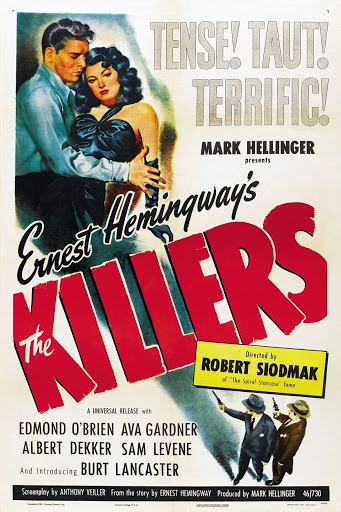
The Killers (1946)

THe Killers
Ava Gardner draws Burt Lancaster into a world of crime in The Killers

Director: Robert Siodmark

Cast: Burt Lancaster (Pete Lund/”Swede” Anderson), Ava Gardner (Kitty Collins), Edmond O’Brien (Jim Rearden), Albert Dekker (“Big Jim” Colfax), Sam Levene (Lt Sam Lubinsky), Vince Barnett (Charleston), Virginia Christine (Lily Harmon Lubinsky), Charles D Brown (Packy Robinson), Jack Lambert (“Dum-Dum” Clarke), Donald MacBride (RS Kenyon), Charles McGraw (Al), William Conrad (Max)

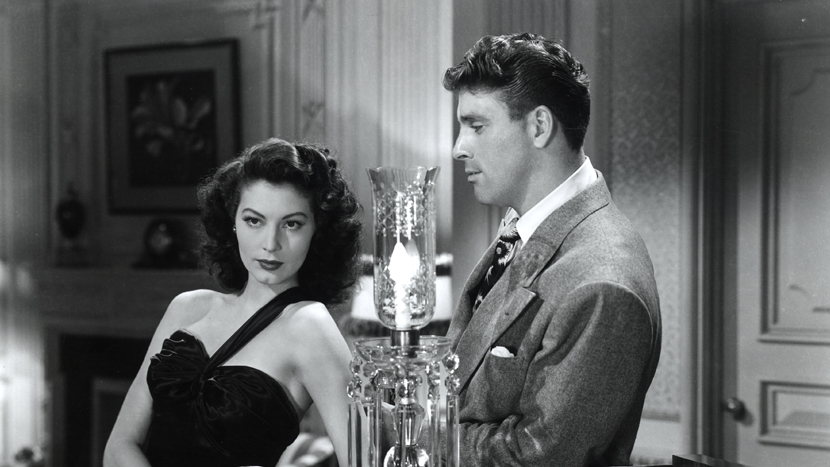
Ernest Hemingway’s short story “The Killers” is 3,000 words of tension and atmosphere, as a pair of hitmen turn up at a diner looking for a former Swedish boxer. They leave and a fellow diner runs to warn the Swede. He meets the news of his impending demise with a stoic acceptance that nothing can be done. That’s basically it. Siodmark’s film consumes the entire content of the source material in the first fifteen minutes. So the film basically expands and explores this set-up. The gripping opening is just our entrée into the film, that will explain to us why the killers are here, who the Swede was and why he needs to die. It makes for a tight, atmospheric and very well-done film noir.

Because there is no doubt that this is a classic film noir. The Swede’s backstory ticks all the boxes you would expect of the genre. Of course, all his troubles are rooted in a Femme Fatale (needless to say his former girlfriend is a saint). There’s a heist gone wrong, double crossing gangsters, a dedicated investigator and a range of locations from seedy nightclubs to rundown hotel rooms. The Swede (Burt Lancaster) is an easily-led handsome man, duped by a beautiful woman. Of course, it all finally leads to a series of shoot-outs, where the wicked are punished for their crimes. In many ways, the script (by Anthony Veillor, heavily polished by John Huston) simply turns the short-story into a familiar piece of genre work. What makes it work is the freshness with which it’s told.

Siodmark is not the biggest name director out there. But he’s a skilled professional and he elevates the material into something with deeper meaning. Perhaps it’s the Hemingway in its DNA, but this story plays like a Greek Tragedy. Fate intervenes at frequent moments, with chance and minor decisions circling back to reveal all. The Swede is a sympathetic heavy, out-of-his-depth, with the fateful flaw of being too trusting. Even the villains are vulnerable figures, while the femme fatale is only doing what she must to try and survive. It’s a neat structure.

And Siodmark shoots it with a beautiful, unobtrusive and pacey smoothness. Nothing in the film draws overt attention to itself, but every moment beautifully combines with those around it to create an absorbing whole. The pace works perfectly, and the film’s structure works very well. Throwing us essentially into the middle of the story increases the mystery – and also means that as we hear the story of each person who knew The Swede, we are constantly invited to rethink and reappraise events and characters we have already met.

It’s a film about the lasting impact of disappointment and disillusionment. Why doesn’t the Swede run a mile when he hears there are killers after him? Because its clear he died inside years ago – the bullet is just a formality. There is a rather touching romanticism to this. This strangely gentle boxer turned thug, who is so smitten by Kitty Collins that he can’t take his eyes off her during their first meeting. Who willing serves jail time for the stolen necklace she’s wearing. Who trashes his hotel and nearly flings himself out of a window when she leaves him. This is a shell of a man. And its not just him. Most of the crooks live out lives of disappointment and fear, while even our investigator seems to have very little in his life beyond chasing down insurance claims. If there is a message in this film, it’s that life is tough.

A lot of that impact comes from the sad-sack vulnerability in Burt Lancaster’s eyes. In his film debut here, Lancaster is at times a little raw. But what he conveys fantastically is the sense of a little boy lost. The Swede always looks out of his depth, dragged from pillar to post by other people, constantly unable to control the situations he finds himself in.

No wonder he’s so easily suckered by Ava Gardner’s gloriously savvy and fiercely determined Kitty – the character with the most drive and determination in the film. She’s smart enough to fool all the characters at least once – and ruthless enough to not give a damn about any of them. Gardner’s performance is spot-on here, with Kitty emerging as possible the most ruthless femme fatale this side of Double Indemnity – with Lancaster as much her gullible patsy as Fred MacMurray was. Gardner’s icy cool is so well done, that it adds even more weight to her performance of a last act switch to desperation, as events finally spiral out of her control.

Carrying most of the narrative is Edmond O’Brien in the slightly thankless role of the investigator piecing it all together. O’Brien however plays the role with a real savvy and drive, as well as with a growing sense of moral outrage – making his role much more than what it could have been (a feed for other characters). The rest of the cast is also very strong.

The Killers isn’t overtly flashy or eye-catching in the way of other films. But it carries with it a large degree of intrigue and more than a dash of hopeless tragedy. With sharp, efficient direction and some fine performances, it’s possibly one of the finest film noirs ever made.

American Gangster (2007)

Denzel Washington leads his brothers in a life of crime in American Gangster

Director: Ridley Scott

Cast: Denzel Washington (Frank Lucas), Russell Crowe (Richie Roberts), Chiwetel Ejiofor (Huey Lucas), Josh Brolin (Detective Trupo), Lymari Nadal (Eva), Ted Levine (Captain Lou Toback), Robert Guenveur Smith (Nate), John Hawkes (Freddie Spearman), RZA (Moses Jones), Yul Vazquez (Alfonsa Abruzzo), Malcolm Goodwin (Jimmy Zee), Ruby Dee (Mama Lucas), Ruben Santiago-Hudson (Doc), Carla Gugino (Laura Roberts), John Ortiz (Javier J Rivera), Cuba Gooding Jnr (Nicky Barnes), Armand Assante (Dominic Cattaneo), Joe Morton (Charlie Williams), Idris Elba (Tango), Common (Turner Lucas), Jon Polito (Russo), Ric Young (Chinese General), Clarence Williams III (Bumpy Johnson)

In 1970s New York there was only one organisation that ran crime: the mafia. The idea that anyone else could get a look in was unthinkable: to the cops, the government and the criminals themselves. Frank Lucas (Denzel Washington) was the guy who was going to shake that up: a resident of Harlem and former right-hand man of crime boss “Bumpy” Johnson (Clarence Williams III), Lucas saw an opening to bring in cheap, high-quality drugs from Vietnam (hidden in the temporary coffins of deceased servicemen). With this product he could take over crime in New York – and run it as he thinks it should be run, with the mentality of a FTSE 500 company and a gun. Frank is helped by the fact no one knows who he is. But that is all about to change as honest cop Richie Roberts (Russell Crowe) sets up a task force dedicated to finding, and arresting, the drug kingpins in New York. He’s as surprised as anyone to find the trail leads to Harlem.

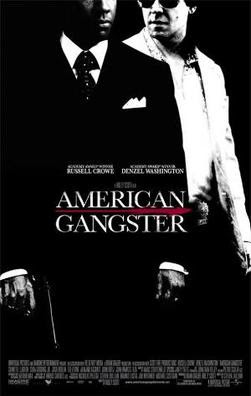
Based on a true story, Scott’s American Gangster is assembled with Scott’s usual professionalism and assured touch, using top actors in well-assembled, well-shot scenes. It’s glossy, entertaining and enjoyable. But it’s not quite inspired or stand-out. Despite everything, it doesn’t really show us anything new and lacks either the fire of inspiration or the sort of poetry and energy the likes of Spike Lee, Quentin Tarantino or Steve McQueen could have bought to it. It tells an interesting story, but manages to be pretty much by the numbers – albeit those numbers are flashed up with as much pizzazz, drama and entertainment as you could wish.

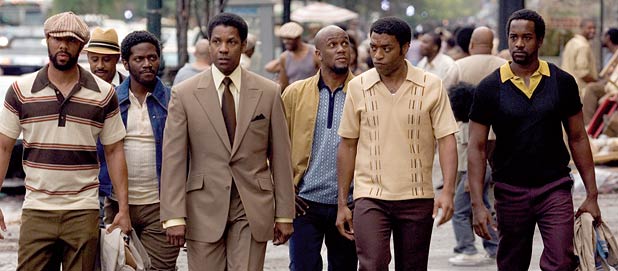
The most interesting themes are questions of class and racial politics. The film’s version of Frank Lucas is successful because he runs his crime empire not like a gang but like a company. He dresses plainly and simply, so as not to draw attention (unlike the flamboyant criminals played by Idris Elba and Cuba Gooding Jnr). He talks in terms of supply and demand, brand loyalty and being a chairman. In one particularly well managed scene, he pontificates to his brothers on his ideology of business, excuses himself to walk across the street and shoot a rival in the head, then returns to calmly finish his breakfast. It’s the ideas of Wall Street applied to gangster crime. Lucas is all about bringing a smooth, modern, professional thinking to crime – but with the gun still up his sleeve.

But another reason why Frank Lucas needs to be as professional as he is, is because he’s loathed by all other parts of the criminal system. It’s a system that is racist from top-to-bottom, where black men are unwelcome as anything other than foot-soldiers. The elite criminals – most of them tracing many generations back to Sicily – smile at Frank for his money, but never see him as an equal. Even the government can’t begin to imagine a black man could be running such a huge empire – Robert’s AG boss spews out a racist diatribe, rubbishing any idea that a black man could achieve something the Mafia has failed to do. Frank though is just as wary of the flashy ostentatiousness of most black criminals in New York, telling his brother that the quietest man in the room is the most powerful.

It’s those brothers who Frank relies on – only family can be trusted. They’ll also be his Achilles heel. Because even his most competent brother (played by a sharp Chiwetel Ejiofor) is as much a liability as he is a good lieutenant. His brothers are innocents turned by their brother into tools for his crime empire. Frank hands out beatings to cousins who are unreliable. He’s bitterly disappointed when his nephew chucks in a baseball career because crime looks more fun. As his mother – an impassioned performance from an Oscar-nominated Ruby Dee – tells him, the rest of the family looks to him and follows his lead. There is a clear tension between this family – whose benefactor is also its corrupter – but it doesn’t quite come into focus.

This is partly because the film is covering a lot, and partly because it finds itself falling a bit in love with Frank Lucas. Not surprising when the part is played by Denzel Washington at his most magnetic – if strangely not quite as energised as you might expect. Washington gives Frank a dignity and cool that the real Frank – by all accounts a much cruder, ruder, less able man – never had. The film doesn’t really want to explore the darker side of Frank. Instead it invites us to sympathise with him, as an outsider made good. To feel sorry for him when he makes a fatal error (wearing an ostentatious fur coat to the Ali/Frasier “Fight of the Century” – an act that blows his carefully preserved anonymity). The film doesn’t want us to feel the damage of the drugs Frank is pouring into New York, since it might damage our respect for his triumph against the odds.

The barriers that Frank has to overcome – from arrogant Mafia kingpins, to local crime lords and corrupt cops (Josh Brolin has fun as a prowling bullying detective) – are in the end more interesting than the procedural struggles of Russell Crowe’s Richie Roberts (on solid form). Roberts is also given a rather cliched (and fictional) custody battle that hardly justifies its screentime. The cops definitely get the short end of the stick – and a stronger film might have focused just on Frank Lucas and really explored the struggles of a black man in white crime world, dealing with racism and trying to apply Wall Street ideals to street violence.

American Gangster doesn’t quite succeed with its dark commentary on the American dream – but it’s as entertaining as you could hope and while it lacks in inspiration, it’s also hard to find too much fault with. One of Scott’s most solid works, with a charismatic Washington doing decent work.