

Psychological complexities abound in a gripping revenge Western full of intriguing characters
Director: Anthony Mann
Cast: James Stewart (Will Lockhart), Arthur Kennedy (Vic Hansbro), Donald Crisp (Alec Waggoman), Cathy O’Donnell (Barbara Waggoman), Alex Nichol (Dave Waggoman), Alice MacMahon (Kate Canady), Wallace Ford (Charley O’Leary), Jack Elam (Chris Boldt), John War Eagle (Frank Darrah), James Millican (Tom Quigby)

It’s the classic Western set-up. A mysterious man rides into town, shaking up the local rivalries while secretly searching for something himself. The final collaboration between James Stewart and Anthony Mann, The Man From Laramie proves to be one of their most complex and, in the end, uncomfortably unreassuring of them all. It seems to promise a fiendish scheme only James Stewart can blow apart. What we actually get is something far more haphazard, put together by a panicked villain, where our hero is only a few shades less compromised than the villain.
Will Lockhart (James Stewart) is nominally in Coronado to deliver goods to Barbara Waggoman (Cathy O’Donnell). But he’s really a cavalry officer searching for a mysterious person selling repeating rifles to the Apache; rifles that led to the ambush and slaughter of a cavalry troop. Lockhart soon finds himself butting heads with the impulsively angry Dave Waggoman (Alex Nichol), son of local rancher Alec (Donald Crisp) who runs the town with his trusted lieutenant Vic Hansbro (Arthur Kennedy) as mediator. Lockhart is more and more determined to uncover the truth.
No one in The Man From Laramie is quite what they seem – or who others see them as. Lockhart seems like the mild-mannered James Stewart, a humble trader looking to make money and move on. But he has obsession in his eyes, a capacity of sudden, compulsive violence and is hiding a complex past that leaves the town reeling. The Waggomans aren’t quite who they seem either. The Lear-like Alec feels like a domineering dictator, but he’s strong-willed but fair. His son Dave seems like a villain, but he’s more a spoilt, impulsive child and the reasonable Vic is more compromised than he appears, a nominal second-son to an Alec but painfully away he comes a distant second to flesh-and-blood. Even Jack Elam’s eccentric is also a dangerous man.
Donald Crisp’s stoic, gruff, hardened rancher is raging against the dying light, covering up his incipient blindness (he can barely read accounts or see the dials on his safe, let alone accurately count out money). He’s facing a conundrum: his actual son, Dave, is a foolish weakling who will be eaten for breakfast by Alec’s crushed rivals – and Vic isn’t his son. Not to mention pressures reveal Vic as liable to stupid, ill-thought out and panicked decisions himself. There is an obvious Shakespeare beats playing out in the wilds of the West.
This combines with a mission of personal revenge for Lockhart. Stewart excels again as an obsessively single-minded man who won’t let anything get in the way: even a gunshot to the hand doesn’t shake his determination. Slapped down early on by Dave –accusing Will of stealing salt and rustling cattle, Dave shoots his mules and burns his carts – he responds with slaps of his own, roughing up Dave in the street and with quiet determination sets about pointedly not doing what the Waggomans want, allying with their rival, sharp-tongued Kate Canady (a wonderfully arch Alice MacMahon) who likes a challenge as much as he does.
But the film avoids a Shane-like clash between little guys and ranchers that we expect. Alec, who clearly learned a lot getting where he is, makes a very generous financial offer to Will as an apology and has no delusions about the (lack of) qualities in his son. There are hints of a past relationship between Alec and Kate, making him less of a bully than you think. And when Alex objects that he never interferes once he appoints a sheriff, you feel inclined to believe him. Alec has risen to power through merit, hard work, investing wisely and reaping the rewards; in fact he’s almost an American business hero. And Lockhart isn’t interested in settling rights and wrongs in the town (he’s not the dangerous stranger Alec keeps dreaming about) however sympathetic he might be.
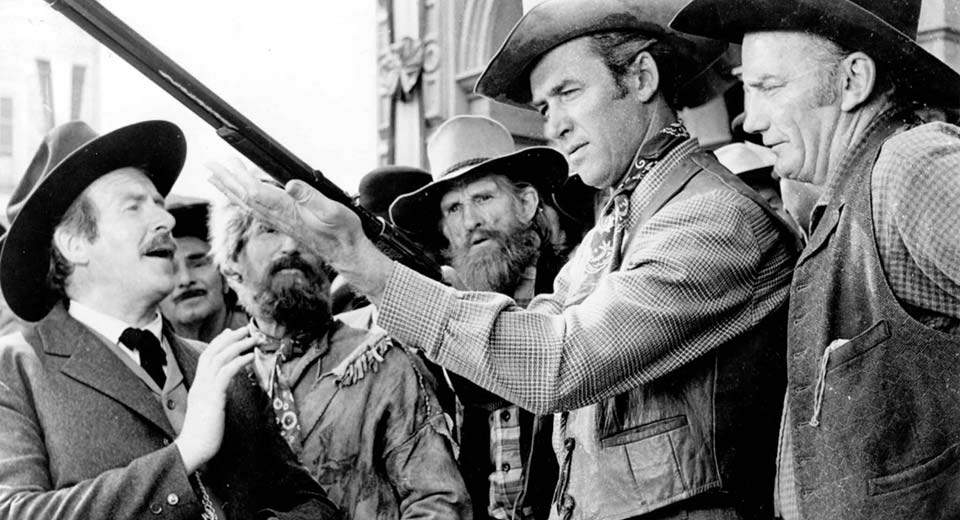
The Man From Laramie constantly unspools unexpectedly, all it filmed in gorgeous cinemascope that captures the vastness of the West. Mann is also confident with more intimate settings, captureing some truly striking images, not least a Stewart-focused dolly shot that sees the furious Lockhart march through a crowd for retribution against Dave. Mann also shows the terrible power of violence. Opening with the discovery of the smoked-out ruins of a cavalry patrol, it presents violence as the tool of bullies and a blunt instrument. Hand-to-hand battles are desperate, messy struggles in the dirt with no nobility at all. A shoot-out between rocks feels tight and scary and when bullets land the camera captures intense pain in the victim’s faces. The Man From Laramie’s most famous scene focuses violence as a tool, a humiliated Dave ordering Lockhart held down while he shoots him point blank in the hand (a reaction Stewart sells perfectly).
It leaves Lockhart visibility compromised for a large chunk of the film, his hand wrapped in bandages, barely able to aim and fire his rifle. It contributes to another great mini shoot-out where the near blind Alec attempts retribution on a one-handed Stewart, a great scene that deglamorises and builds empathy at the same time. And always we circle back round to Arthur Kennedy’s Vic, an expert portrait of a man who feels like he is constantly paddling violently under the surface to float serenely at the top.
It’s one of several excellent performances, lead brilliantly by Stewart, that round out a very well-shot and psychologically engaging Western that cleverly inverts and realigns expectations and presents a resolution that is deliberately unsatisfying (for us and for Stewart) and a comment itself on the strangers who ride into town to shake it up and then disappear. It’s a fine swan song for a great collaboration between star and director.




 Movie Musings