Category: Directors

Metropolis (1927)

Metropolis (1927)

Lang’s sometimes flawed science fiction epic is one of the most influential films ever made

Director: Fritz Lang

Cast: Brigitte Helm (Maria/The Machine), Alfred Abel (Joh Frederson), Gustav Frölich (Freder), Rudolf Klein-Rogge (Rotwang), Fritz Rasp (The Thin Man), Theodor Loos (Josaphat), Heinrich George (Grot), Erwin Biswanger (11811/Geogry)

It’s 1927 and for too long Hollywood had held sway over the movies. But there were plans in Germany to change that. The booming Weimar film community, arguably the artistic hub of World Cinema, felt they had a shot at claiming the sort of global success Hollywood had made its own. No expense would be spared to bring Fritz Lang’s science-fiction spectacular, Metropolis to the screen. It was met with such a muted reaction, that the original epic cut was sliced to ribbons, parts of the film lost for all time, and for decades it lived only in a mutilated form. But it was visionary and extraordinary enough to inspire virtually every single science fiction film that followed it.

Metropolis is a sprawling future city state, run by Joh Frederson (Alfred Abel). In it the rich live a gilded life in mighty skyscrapers, with private gardens, luxurious apartments and raucous parties. Beneath them – literally so – are the workers, living a Morlock-like life of drudgery in the factories and power stations that keep the lights burning. But all that could change: below ground Maria (Brigitte Helm) preaches hope for change, above ground Frederson’s son Freder (Gustav Frölich) falls in love with Maria and rejects his father’s way for the life of a prole. Frederson has a scheme of his own: to use a robot (Helm again) built by old friend (and one time rival for the affection of his late wife) the one-handed scientist Rotwang (Rudolf Klein-Rogge) to replace Maria and sow discord among a potential worker’s rebellion. But does Rotwang and his creation have a game of their own?

Lang had a brief to create a film that would be a box-office hit in America. No stone was left unturned in creating his epic. Metropolis took a staggering 17 months to film, running almost three times over its initial budget. It’s extended shooting schedule was a godsend for many of its extras, struggling to make ends meet while the Weimar Republic thrashed through the after-effects of hyperinflation. It’s a magnificent monument to Lang’s superb visual styling, marrying shadow filled expressionism with sweeping epic magnificence.

Metropolis’ strengths all lie in its stunning, inventive and breath-taking design work. That has been so inspiring, it has permeated vast swathes of our culture. Filmic visions of imposing, neon-lit, skyscraper packed modern Babels (Frederer’s headquarters is an art-deco reimagining of Brueghel’s Tower of Babel) all find their roots here: from Burton’s Batman to Scott’s Blade Runner. Any robot in the movies can chase its lineage back to Rotwang’s man-machine, as any mad scientist ancestor is  Rotwang (from Dr Strangelove to Back to the Future’s Doc Brown). It’s the film that invented steam-punk, with its piston-filled machines, staffed by boiler-suited workers (it’s inspiration for a zillion music videos is not surprising). Everywhere you look in Metropolis it might feel like you are seeing something familiar, when in fact you are witnessing its original generation.

Metropolis is a cat’s cradle of differing moods and designs, woven masterfully into a whole. Frederson controls the city from a penthouse suite, while his immediate staff and family live in swish, very 1920s apartments. This contrasts sharply with the industrial-punk of the factories, cathedrals of technological movement, full of gears, levers and men performing tasks with a robotic, convey-belt repetition under a series of clocks. There are real cathedrals, legacies of an old world, where God has been left behind by the new Gods of work and efficiency. Under the ground, the workers live in personality free tenement blocks and chiselled out caves, which echo churches. Rotwang works in a laboratory part Frankenstein’s layer, part bizarre lecture theatre, all seemingly housed in a ramshackle house that wouldn’t look out of place in a Hans Christian Anderson fairy tale.

A fairy tale is perhaps what Metropolis is, underneath all the astonishing technical sheen and directorial mastery. We follow a hero who exiles himself to live among the poor, eventually becoming their champion, with a damsel-in-distress he must rescue from a crazed wizard. The wizard even produces a magic imposter, who threatens to bring disaster. Metropolis’ plot often proceeds with the illogical progression of a fairy tale, with characters frequently making veering changes in allegiance or unveiling dastardly schemes that appear from nowhere or make little sense.

It’s similar in Metropolis biggest weakness: it’s simplistic plot, wrapped up in a casually naïve politically theory that attempts to find a balance between left and right, but essentially boils down to “why can’t we all just get along”. It’s loud proclamation that “The Mediator Between the Head and the Hands Must Be the Heart” is so vague that it allowed the film to be embraced by the left as a proto-socialist film supporting worker’s rights and the right as a film that revealed the workers as a mob and the fate of the world best left in the hands of elites who know what they are doing.

It’s part of the simplistic view the film largely takes of character and story, which frequently feels like an after-thought behind the film’s sumptuous production values and Lang’s expressive camera work. It’s also not helped by some of the acting which, particularly in the case of Gustav Frölich’s hand-claspingly camp performance, mines the depths of silent-movie ostentatiousness. Saying that Brigitte Helm is chillingly, wickedly artificial and physically disjointed as the fake Maria (a far cry from her more simpering ‘good’ self) and Abel underplays effectively as Frederson. Klein-Rogge’s insane glare and conflicting lusts also make a strong impression.

But none so strong as Lang’s mastery of visual symbolism. Freder’s terrified vision of the ‘heart machine’ that sits at the centre of the city’s power, transformed into a terrible Moloch with workers literally fed into its gaping, firey maw. Those same workers from the film’s opening with Lang’s brilliant visual conceit of shuffling, shoulder-drooping figures lurching into a gigantic elevator that lowers them into the ground. Rotwang’s birth of the fake Maria is a masterclass in light and cross-cutting, as is the simmering eroticism of the fake Maria’s dance at an orgiastic night-club, the screen filling with the slathering faces of the man she has enchanted.

It mixes with the Gothic power Lang brings the film in its closing sequence, seemingly inspired by mystery plays with their deep-rooted sins bubbling to the surface to condemn those alive today. There are echoes back to this in Freder’s dreams of Metropolis as a modern Babylon (hammered home, once, by the lost scene of a monk preaching in the cathedral) and in Maria’s Joan of Arc like status among the working classes – a mantle taken to its logical conclusion by her metallic replacement who leads a doomed insurrection. Again, all these concepts and influences are effortlessly held together into one magnificent whole by Lang’s fluidic, beautifully paced direction.

Metropolis lives today as a monument to creative science fiction film-making – it is the most ambitious and most influential science-fiction film ever, except perhaps 2001 and (in a very different way) Star Wars. It may be politically simple and its story may veer in unplanned directions and strange cul-de-sacs, but as a piece of visionary cinema it is nearly unparalleled. Even its existence today as a reconstructed, corrupted version of itself (after hours of footage were considered lost for decades) doesn’t not dim or diminish its mastery.

Aparajito (1956)

Aparajito (1956)

Generational clashes lie at the heart of Ray’s heartbreaking second entry in his Apu trilogy

Director: Satyajit Ray

Cast: Kanu Banerjee (Harihar), Karuna Banerjee (Sarbajaya), Smaran Ghosal (Adolescent Apu), Pinaki Sengupta (Young Apu), Ramani Sengupta (Uncle Bhabataran), Charuprakash Ghosh (Nanda-babu), Subodh Ganguli (Headmaster), Moni Srimani (School inspector), Ajay Mitra (Shibnath), Kalicharan Roy (Akhil)

Satyajit Ray initially saw Pather Panchali as a one-off, a story from the works of Bibhutibhushan Bandyopadhyay, not the start of a multi-film fable on the life of its young protagonist. But, such was the impact of Ray’s debut, it almost demanded a continuation of the story. Ray then adapted parts of two Bandyopadhyay novels, re-shaping them into a tale of Apu’s late childhood and adolescence, that difficult crossing point between childhood and adulthood. In doing so, he created a film full of life but also profoundly moving and quietly devastating. Rich, confident and powerful, Aparajito may just be even more affecting than its forbear.

Beginning a few years after the conclusion of Pather Panchali Apu (played as child by Pinaki Sengupta and later as an adolescent by Smaran Ghosal) lives in the holy city of Varanasi with his dreaming father Harihar (Kanu Banerjee) and tireless mother Sarbajaya (Karuna Banerjee). Apu is still the same inquisitive, observant, fascinated child he ever was and when his father’s death leads to mother and son returning to the country, he excels at the local school. Winning a scholarship to college at Calcutta, Apu he finds Sarbajaya’s love for him smothering, just as she is heart-broken by his growing distance and reluctance to write or return to visit her.

This universal story of children struggling to outgrow their parents and their parents longing to help them grow but desire to keep them close, a situation causing pain on both sides, that gives Aparajito it’s huge emotional force. We can totally understand why Apu, swept up in the excitement of Calcutta and forging of his own life (one that has the promise of being so much more dynamic than his parents), begins to feel the ties of duty to his mother (almost alone in the world without him) constraining. At the same time, having witnessed the never-ending sacrifice, patience and quiet devotion of Sarbajaya to her son, we want to slap him for his selfishness and lack of thought.

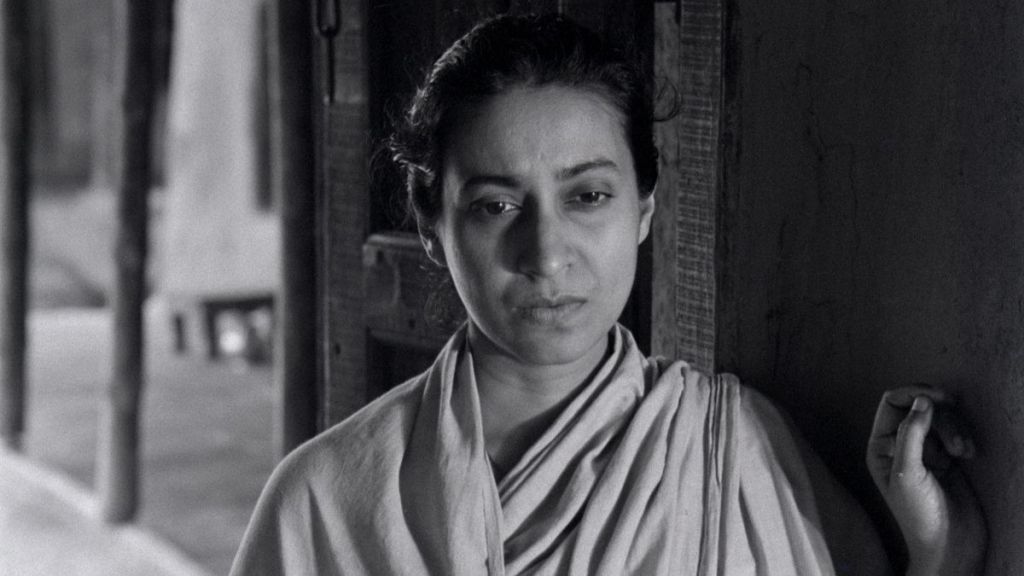
Ray’s film is superb at making us understand the impossible burdens Sarbajaya has taken on herself to raise her son. Ray constantly frames Sarbajaya in the act of waiting: in Varanasi we never see her outside of the courtyard of their shared tenement block, constantly preoccupied with household tasks. Ray frames Sarbajaya frequently in doorways, visually presenting her as someone constantly waiting on the outskirts, shadows cast across her – someone vital for ensuring order, but easy to forget on the outskirts of rooms. It also serves to make her look constantly trapped and overburdened with duty, shadows constantly cast across her.

These burdens magnify for Sarbajaya after the death of Harihar. Apu’s decent father is still a dreamer who lacks the dedication and drive to make something of himself. Do memories of his father’s desire to become a writer ending in a fever in a tenement block, subconsciously drive Apu later? Harihar collapses near the holy river, ill from the damp of the city that he trudges through barefoot night and day, hitting the ground in a shadow lit passageway – much like his wife, as if the city has crushed him with its burdens.

The city seems very different to the young Apu. Ray’s camerawork is gentle, full of leisurely sideways pans, which serve to make the city appear to us as it does to Apu: a never-ending stream of visual wonders. Pans across the riverbanks of the Ganges, full of beautiful temples and river vistas look as magical to us as they do to the young boy. Similarly, the Dickensian hustle and bustle of the city itself, full of streets and alleyways that Apu and his friends rundown with glee feel like treasure-troves of adventure, rather than the never-ending streets trudge they look like when we see them from Harihar’s perspective.

Ray’s camera frequently brings us back to the searching, questioning, fascinated eyes of young Apu, always expanding his horizons. Education and the wonders that books bring him, far beyond the horizons of his mother who can only think about how to bring about tomorrow, offer a similar excitement. Young Apu excels at school and delights in trying to share the wonders he has learned – about science, astronomy and geography – with his mother. Ray shows a mastery of simple montage as years fly by in minutes as we see each of Apu’s passions before a masterful transition with a slow zoom in and out on a lit candle carries across years from Apu as a child to an adolescent.

An adolescent who feels the pull of a world away from what he increasingly sees as the smothering pull of his mother. It is, of course, impossible to watch this without feeling how unfair – but also how natural – this is. Your heart breaks as Apu heads off to Calcutta with only a single cursory glance back to his devoted mother. The mother who still packs his bag, gives him her savings – and asks him to come home as often as he can. You can understand why a young man finds this constraining, even as you want to tell him how sharp his regrets will be as Sarbajaya’s health begins to fail (naturally, the boy falls asleep as his mother timidly confesses her fear of old age and sickness to him).

Apu loves his mother, there is no doubt about that. One vacation, arriving at the train station to return to Calcutta, he decides to turn back (claiming he missed the train) to spend one more day with his mother. He still relies on her wisdom and unreserved love and he thinks often of her in the city. But he’s a teenager and wants his freedom. Sarbajaya even understands this, just as her heart breaks for the loss of and loneliness his departure brings. Is there a sadder shot in the movies as Ray focuses on Sarbajaya slowly sinking down as Apu walks away to his future?

The impact is only increased by the gloriously moving, hollow-eyed performance of Karuna Banerjee, exhausted but untiring in her work to protect family and home. It’s a performance of quiet, bubbling grief and loss tightly packed under optimism and support for her son – a grief that only the audience sees. Smaran Ghosal is also very fine as the adolescent Apu, a boy we can never dislike for very naturally wanting to forge his own path, in a performance that feels extraordinarily real.

The humanity shines out again in Ray’s follow-up to his debut. Moving confidently from location to location, in a novelistic structure translated perfectly to the screen, Aparajito is rich, beautifully told and carries real, unbearable emotional punch for anyone who has ever been a parent or child. Another masterwork in a mighty trilogy.

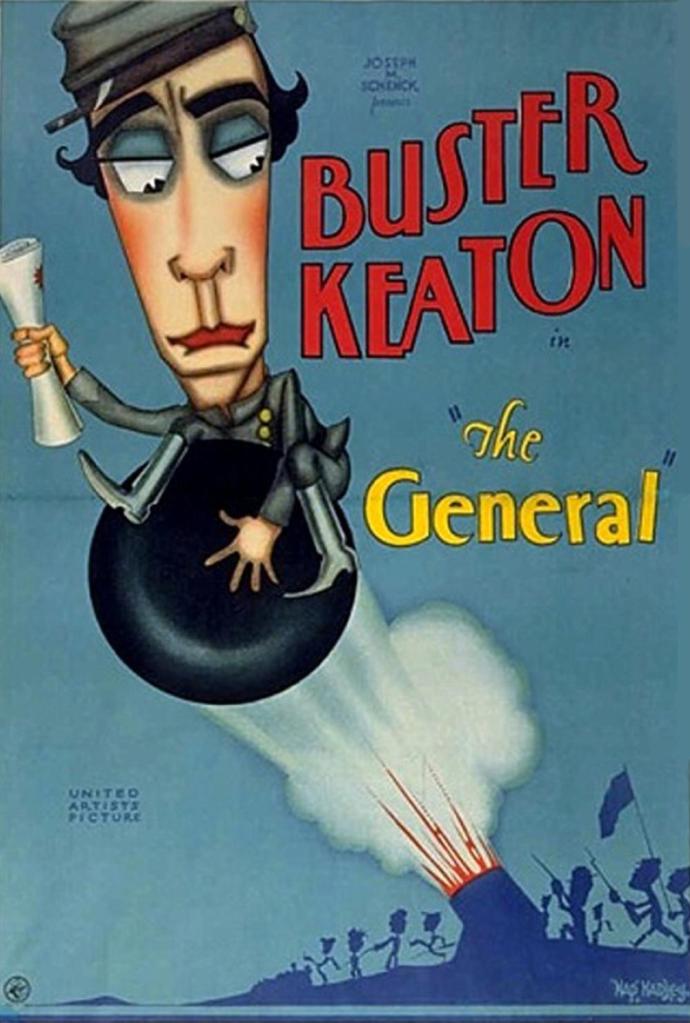
The General (1927)

The General (1927)

Keaton’s masterpiece, less of a comedy and more an inspiration for hundreds of action films

Director: Buster Keatson & Clyde Bruckman

Cast: Buster Keaton (Johnnie Gray), Marian Mack (Annabel Lee), Glen Cavander (Captain Anderson), Jim Farley (General Thatcher), Frederick Vroom (Southern General), Charles Smith (Mr Lee), Frank Barnes (Annabel’s brother), Joe Keaton (Union General)

The General frequently features in the lists of greatest comedies of all-time. It’s a bit of a misnomer: while The General has its fair share of jokes, it’s really a sort of action film. A Mad Max: Fury Road with gags, the greatest chase you’ll ever see and one of the most dynamic stunt spectaculars ever made. It’s Keaton’s apogee, one of the most influential and greatest films ever made. If you’ve ever seen a stunt-filled epic, you’ve seen something that takes inspiration from the tireless physical tricks Keaton pulled here and the stunning, cinematic grace he films it with. The General is a classic that is instantly, and constantly, rewarding.

Keaton plays Johnnie Gray, a respected engine driver of the South with two loves in his life: Annabel (Marian Mack) and his steam engine The General. He’s about to propose to Annabel when the Civil War breaks out. She wants him to enlist: he tries his best but is rejected, unbeknownst to him, because the army considers him more valuable as a train driver. Mistakenly seen as a coward by Annabel, she vows never to speak to him again. A year later The General is hi-jacked by Union soldiers as part of a surprise offensive. Johnnie gives chase in a second engine, The Texas, unaware Annabel is aboard the kidnapped General. The wild chase takes Johnnie North then South again to bring Annabel home and report to the Confederate army the approaching attack.

The General was the most expensive film Keaton’s company had ever made. No expense was spared in bringing two period-accurate engines to the screen, with everything shot in location (in Oregon, admittedly, due to the Tennessee not being keen on staging a Civil War Keaton comedy) and all executed in perfect period detail. The film contained the most expensive single shot ever mounted – costing a whopping $42,000, it would show a real bridge collapse and hurl a real engine into a real river (Keaton filmed in long shot, with real horses moving around near the bridge, to stress this was a real stunt not a model). Despite all this, the film was a box-office disappointment.

Why? Well frankly, I’m not sure the world was ready for something that promised itself as being a comedy set during what was still a raw scar in the American psyche. The marketing material also promised more laughs than you can shake a stick at – a misrepresentation of a film that is more a stunt-filled poem than a slapstick riot. For those expecting The Navigator, The General was a disappointment. For us today, it is one of the great American films, a piece of cinematic mastery.

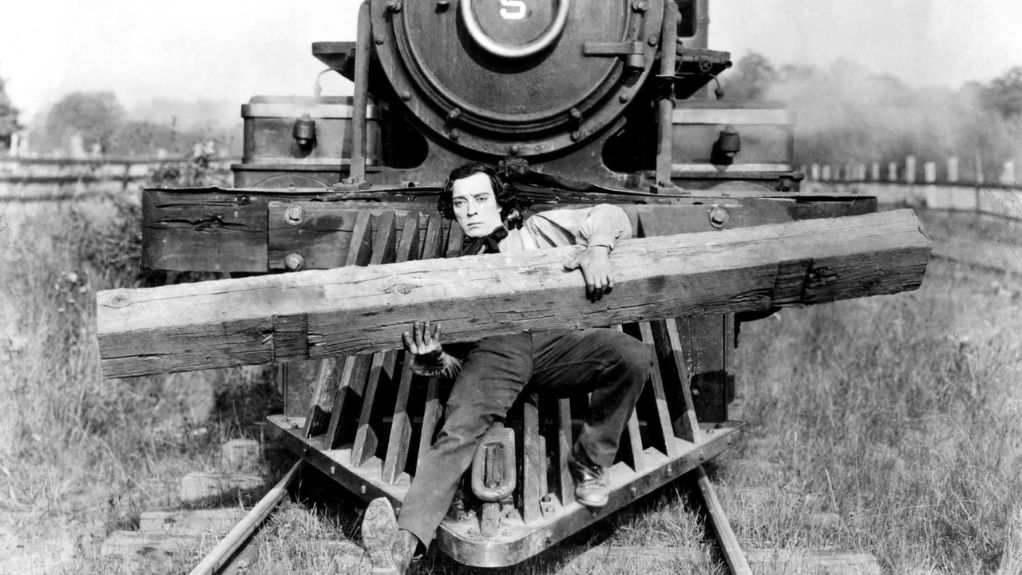
The General is for a large chunk of its run-time (almost 40 of its just under 80 minutes) a glorious chase, in which every sequence show-pieces invention at high-speed. The majority of the stunt filled tricks were executed by Keaton himself, surely at some considerable risk to life and limb. As you watch him bound over railway carriages, dive through port holes, sprint alongside steaming trains or sit atop the hurling railway sleepers to remove obstructions, you can only marvel at his physical dexterity and commitment.

Keaton’s character is also subtly, and impressively, different from his other roles. These were often defined by their haplessness – would-be detectives and empty-headed heirs. But within his professional sphere, Johnnie is a master. He knows the capabilities of engines and dynamics of the railroad better than anyone. He is relentless and endlessly inventive in overcoming myriad problems just as he can use his knowledge to place near-insurmountable barriers in the way of his pursuers.

The opening of the film stresses the respect people hold him in – he’s hero-worshipped by children, greeted warmly by all and has no doubts about asking Annabel to marry him. Sure Johnnie can get pre-occupied and miss the bigger picture – a few times, he is almost left behind by the steaming train while resolving problems on the line – and away from the train, especially when he joins the soldiers in the film’s finale, he suffers from the same clumsy, cluelessness as Keaton did fighting to defend his ship in The Navigator. But he’s also brave, indefatigable, ingenious and relentless. He’s more of a model for every action hero maverick since than you could imagine.

And those stunts! Keaton was a master film-maker, framing the action to accentuate its speed, scale and reality. The camera runs alongside the train, demonstrating its speed by showing objects move by. The action is frequently framed in medium and long shot to demonstrate its scale and the grandness. This goes for Keaton bounding across carriages and for simple gags, such as the famous shot of a forlorn, jilted Johnnie sitting on a drive rod of the moving train, lifted up and down as it shunts forward. The complexities of this chase are always made clear and camera angles are key to the various attempt each train makes to stop the other. This is placed above the standard comedic reaction close-ups audiences expected – but make for a richer, more rewarding film.

In fact, watching the film, you can grow to admire Johnnie so much you start to wonder what he sees in Annabel. Perhaps Keaton, to an extent, wondered the same. Annabel is kidnapped, tied up, caught in a bear trap, tossed around in a sack and doused in engine water. Is this woman being partially punished by the film? After all, it’s her demand that Johnnie turn his life upside down to fight in (what we know) will be a brutal war – and her kneejerk condemnation of him – that sets events in motion. Does she need this humbling to learn her lesson? It perhaps helps her and Johnnie become an ever more effective partnership on their flight back South, setting traps and keeping the engine going (with the odd comic misunderstanding, one of which sees Johnnie running down then back up a hill to reboard the train) that leads to their eventual reconciliation.

Interestingly, what’s less comfortable with The General today is its avoidance of the core issues of the civil war. Slavery never rears its head, and the film takes a largely sympathetic view of the romantic Southern gentlemen vs the nefarious Northerner, with their under-hand schemes. Peter Kramer, in an excellent BFI book, lays out a compelling argument that The General exposes, especially through its final battle sequence which sees real people die and a hapless Johnnie charging into heroics like a lost child, the dangerously blind embrace of violence in the South and a subtle criticism of a horrific war that led to so many needless deaths. While there might be beats of that under the surface here (especially if you are familiar with the shocking death toll of the war), it’s not enough to overcome the generally sympathetic view of the Confederacy and its leaders.

But politics is not at the heart of Keaton’s film. The appeal for him, just as for Johnnie, was that engine and, by extension, the glory of the chase. Only someone who loved trains as much as Keaton could have made such a guilty pleasure of plunging one thirty feet to its doom on camera. And in Johnnie Flynn he created a genuinely little-guy hero, a character who shared his dynamism and pluck and, above all, his love for all things mechanical.

The General isn’t a comedy really – there are few real belly laughs in it, and the film is played straight by all and sundry, devoid of reaction shots. Its laughs come in shock at its audacity, its epic scale and from how much it causes you to invest in the trials and tribulations of its lead character. It’s an action film that you embrace with fervent love, because it’s pure, unadulterated, cinematic beauty. It’s a masterpiece.

Asteroid City (2023)

Asteroid City (2023)

Anderson’s quirk filled film is a triumph of his own style but lacks the depth of his best work

Director: Wes Anderson

Cast: Jason Schwartzman (Augie Steenbeck/Jones Hall), Scarlett Johansson (Midge Campbell/Mercedes Ford), Tom Hanks (Stanley Zak), Jeffrey Wright (General Gibson), Tilda Swinton (Dr. Hickenlooper), Bryan Cranston (Host), Edward Norton (Conrad Earp), Adrien Brody (Schubert Green), Liev Schreiber (J.J. Kellogg), Hope Davis (Sandy Borden), Stephen Park (Roger Cho), Rupert Friend (Montana), Maya Hawke (June Douglas), Steve Carell (Motel manager), Matt Dillon (Mechanic), Hong Chau (Polly), Willem Dafoe (Saltzburg Keitel), Jake Ryan (Woodrow), Grace Edwards (Dinah), Aristou Meehan (Clifford), Sophia Lillis (Shelly), Ethan Josh Lee (Ricky)

Every time I go and see a Wes Anderson film, I hope I might fall in love again. Eventually, I’ll find something in Anderson’s overly distinctive, quirky style that I love as much as The Grand Budapest Hotel. Maybe the romantic in me is dying, because I think its never going to happen. Certainly it doesn’t with Asteroid City a film I sat watching thinking “I know some people will love this more than life itself, but for me sitting here it feels like waiting for the rapture”.

Asteroid City is another of Anderson’s films that’s an intricate puzzle box where the pieces shift like the brightly coloured squares on a Rubrik’s cube. It’s filtered through several layers of remove: we watch a 50s TV announcer (Bryan Cranston) introduce a stage performance of a playwright’s (Edward Norton) long-running play that is itself an entrée to a wide-screen, technicolour production of a host of eccentrics, including a recently widowed photographer (Jason Schwartzman), his grouchy father-in-law (Tom Hanks), a glamourous Hollywood star (Scarlett Johansson) and several others accompanying their kids to a remote town in the desert for a young stargazing and science competition co-sponsored by an army general (Jeffrey Wright), when the whole town is thrown into quarantine after a stop-motion alien drops in, looks around and flies off.

Somewhere in Asteroid City there is an interesting, slightly sad, meditation on grief, loss and ennui struggling to get out. The alien arrival makes everyone question the nature of the universe and their place in it. It’s easy to see the influence of Covid on a town flung into quarantine, and the resulting state of uncertainty throwing everyone off kilter. We are following a man who has recently lost his wife, being played in this film-within-a-play-within-a-TV-show by an actor who was (we discover) recently lost his own partner. At one point this actor asks the director if he is ‘doing it right’, if he is getting the emotion or the author’s intention: “just tell the story” the director (Adrien Brody) responds. I think that’s part of a message about just live and let the big questions take care of themselves, of trusting that we can do our loved ones proud. That’s an interesting, rewarding point.

But it’s lost in Anderson’s pitiless device, his never-ending quirk and the deliberately distancing, artificial nature of his world and the monotonous, arch delivery his script, camera work and editing imposes on a series of actors. What this film desperately misses is a leading player with the strength and independence of a Ralph Fiennes or a Gene Hackman: someone who can bring depth and a sense of reality to the stylised Anderson world, while still delivering something perfectly in keeping with his tone. To put it bluntly, Schwartzman is, to put it bluntly, not a sufficiently engaging or interesting actor to communicate his character’s inner turmoil under the surface which the film’s inner meaning requires. He too naturally, and trustingly, settles into the Anderson rhythm.

In this crucial role, he’s a misfire. With our leading player too much of an artificial character, someone we never believe is anything other than a construct of the film’s author, inhabited by a collaborator who doesn’t bring the independence or new vision the director needs, the more the deeper emotional layers of the film are drowned. Instead, the film becomes a crushing onslaught of style and trickery, devoid of any sense of reality at any point.

It eventually makes the film feel overly smug, too pleased with-itself, too taken with its intricate, tricksy construction. It is of course a triumph of art design and the photography is gorgeous, from the black-and-white of the TV studio and theatre, to the 60s tinged, artificial world of Asteroid City, crammed with its obviously fake skylines and vistas and technicolour inspired feel. That at least its impossible not to admire. But it’s also a mighty artificial trap that enfolds the entire film – and eventually the audience – in a world of weightless, arch, eyebrow-cocked commentary that promises a lot but winds up saying almost nothing of any interest.

There are performances to admire. Scarlett Johansson is very droll and finds some depths as an star actress struggling with a concealed depression. Tom Hanks looks most like the actor who feels like he can break out of the Anderson mould and discover some genuine emotion. Jeffrey Wright demonstrates few actors can do Anderson dialogue better than him, Bryan Cranston very droll and perfectly observed as Ed Murrow style TV man and Adrien Brody is loose, fun and inventive as the play’s director. But yet its everything inside this framework that feels somehow empty.

What I want from Anderson is someone to come in and shake him up, to point out that he is not betraying his aesthetics or style by injecting a small dose of reality and humanity into it. When he has done that in the past – moments in Rushmore, The Royal Tenenbaums and, above all, The Grand Budapest Hotel – he has delivered movies that are inventive, fun and playful but also carry real, lasting emotional impact. When he delivers in-jokes like Asteroid City, it feels like a party you have been invited to where everyone speaks in some made-up language they’ve not told you about in advance. And after not very long, all you want to do is to get up and leave.

Pather Panchali (1955)

Pather Panchali (1955)

Satyajit Ray’s first film in his glorious Apu trilogy is one of the finest neo-realist films about childhood ever made

Director: Satyajit Ray

Cast: Kanu Banerjee (Harihar), Karuna Banerjee (Sarbajaya), Subir Banerjeee (Apu), Uma Das Gupta (Durga), Chunibala Devi (“Auntie” Indir Thakrun), Shampa Banerjee (Young Durga), Reba Devi (Sejo Thakrun), Aparna Devi (Nilmoni’s wife), Tulsi Chakraborty (Schoolteacher), Binoy Mukherjee (Baidyanath Majumdar)

The filming of Panther Panchali is almost as famous as the film itself. Ray set up on the first day of shooting having never made a film before, working with a cinematographer who had never shot a roll of film before and two inexperienced child actors he had not auditioned. He shot the sequence of quiet, observant young Apu (Subir Banerjeee) and his rebellious older sister Durga (Uma Das Gupta) walk in awed wonder through a field to discover a train whooshing by. Ray later wrote he learned more that day “than from a hundred books”. You can tell: so majestical, magical and mesmerising is the sequence (admittedly the one we see in the film was a reshoot) you can’t believe it was made by a novice. It was the centre-piece of Ray scrapping together funding for the rest.

Pather Panchali was adapted from the novel Bibhutibhushan Bandyopadhyay – in a stunning act of loyalty, Bandyopadhyay’s widow turned down a large sum from a production company for the rights because she had promised them to Ray. Ray turned it into a masterful slice of life, that expressed everything he had worshipped from the neo-realism of Rossellini and De Sica (The Bicycle Thieves, which Ray adored, is surely Pather Panchali’s father) and the detailed, masterful camerawork of Jean Renior (who Ray and photographer Subrata Mitra had witnessed at work on The River). It became Ray’s calling card, and a pivotal moment in Indian cinema, a masterpiece that helped redefine the artistic boundaries of the country’s film industry as well as an award-winning international hit.

It’s a sedate, gentle, un-bombastic but quietly moving and engrossing drama focused on the nitty-gritty of life. Set in a small Indian village in the 1910s, we follow the lives of pre-teen Apu, a dreamer who takes after his Micawberish father Harihar (Kanu Banerjee) and his close relationship with his sister Durga, whose penchant for rebellion and stealing causes no end of strive with their harassed mother Sarbajaya (Karuna Banerjee). The family lives in poverty and Sarbajaya carries the burden, driven to quiet, repressed despair at the stress of constantly making ends meet and increasingly resentful of Harihar’s elderly relative “Auntie” Indir (Chunibala Devi) who she sees as taking but offering nothing. Despite, this we follow the childish delight Apu and Durga see in the world around them, a world in which darkness eventually (inevitably) intrudes.

Some have argued Ray’s film – and the subsequent films that followed in this landmark trilogy – had such international impact because it fit naturally into international perceptions of India as a rural, poverty-stricken nation. But that’s to do a disservice to the emotional humanism of Ray’s work and the universal themes of childhood, family and the fears of not being able to provide for it.

Pather Panchali, for all the lyrical beauty which Ray shoots it with, is cold-eyed and serious about poverty. There is nothing noble and sentimental about having no money to afford food. The strain of it is carving lines into the face of Sarbajaya, reduced to quietly pawning what possessions they have and frustratingly berating the dreaming Harihar who believes a career as a writer is just round the corner. The shame of poverty is a major theme: Sarbajaya cares nothing if Harihar’s employers are made aware of the family’s desperate need to for the money they owe him, but she will not countenance the shame of accepting charity from neighbours. Debts are repaid as a priority, at several points a relative’s offering of a few rupees is adamantly refused and Sarbajaya is appalled and shocked by Durga’s habit of stealing fruit from a local orchard owned by the village elders.

That orchard was once the property of Harihar – and its more than implied he was conned out of it by the villagers over imaginary debts. Its where we first encounter the young Durga, a delightful, playful and inquisitive child, running free and unashamedly stealing fruit and bringing it home for herself and “Auntie”. Its just another reason for Sarbajaya to resent the presence of this old woman in her household, as well as the close bond “Auntie” has with both her children, with Sarbajaya constantly playing the role of harsh authority figure.

The constant refrain of the train whistle at crucial points from the distant train tracks serves as a reminder of the possibility of change and escape. But it also means to the children a wider world of excitement and opportunity. Pather Panchali is about a child’s eye view of the world – we are literally introduced to the child Apu with a close-up shot of his eye has Durga wakes him for school. Ray’s film carefully follows their experiences and innocence, where every day presents the possibility of adventure and wonder. The struggles of the adults are unknown for them.

Pather Panchali is a great film about childhood. Apu and Durga run through fields, play and fight, share a deep and caring bond. They follow sweet sellers, wonder at the arrival of theatre troupes and brass bands, stare in awe at projected images of Indian landmarks. The entire village and its countryside is a wonderland to them, and the problems of life are something that they don’t need to concern themselves with. Ray shoots the film with a realism tinged with a pre-Tarvoksky love for the beauty of nature: lingering shots follow raindrops on lakes, the willowy blowing of plants in the fields and the movements of nature.

Through it all he draws superb performances from the children, frequently cutting to reaction shots that ground us in a children’s-eye-view of the world. It’s all there in the magic of that pursuit of the train. The freedom of the fields, the joy of running, the mystery of distant sounds and then the impactful glory of the train itself. Alongside this, there is a beautifully judged score by Ravi Shankar that captures both the mood of this humble village life, but also the exurberance of childhood.

It can’t last though. Mortality and tragedy intrude on this life. And just as Ray shot joy with a simplicity that carried a magical pull, so he calmly and unobtrusively observes pain and suffering in a way that will tear your heart out. The film’s episodic look at life becomes darker and more painful, rewarding the patient viewer (and you do need patience for Ray’s leisurely pace) with a powerful connection with the characters – and a final shot that leaves you longing to know what will happen to them.

Beautifully paced, atmospheric and immersed in a world that feels very real, Pather Panchali feels like the work of a master, not the plucky work of debutante. Perhaps that was a result of the nearly two years Ray took to make the film (he couldn’t believe his luck that the children did not noticeably age), allowed him the time few film-makers have to find every single moment of beauty in his story. Or perhaps he was simply that good to begin with. Either way, it became a landmark film – and led to a swiftly answered call for the story of Apu to be continued.

Go West (1925)

Go West (1925)

Keaton meets his finest leading lady – a cow – in this adorably charming comedy

Director: Buster Keaton

Cast: Buster Keaton (Friendless), Howard Truesdale (Ranch owner), Kathleen Myers (Ranch owner’s daughter), Ray Thompson (Ranch foreman)

Keaton had been unconvinced by Seven Chances, the theatrical farce he’d been asked to film that saw him chased left, right and centre by women. Perhaps his reaction to playing a somewhat cold man pursuing and pursued by ladies persuaded him to try something completely different. What if he could make a film where he removed the “romantic” girl from the equation altogether? Could Keaton make an affecting comedy where his character’s strongest bond is to a cow?

Go West is Keaton back to his best, a glorious Western spoof (a happy return to the grounds of Our Hospitality). Keaton is Friendless, a hard-working guy adrift in the cut-and-thrust of the world. So much so that, visiting New York, he is literally trampled by bustling crowds. He heads out West to try his luck, becoming a ranch hand on a farm. There he finally meets someone who sees him as a friend – ‘Blue Eyes’, a cow who like him is an outcast from the herd. For the first time both of them has a friend – but what will Friendless do when Blue Eyes is to be packed off to a Los Angeles slaughterhouse?

You would never think that a man and a cow could be as sweet as they are together in this film. Keaton spent almost a month with the cow who plays Blue Eyes, going everywhere with her, feeding her and spending weeks with her. By the time they came to filming, the cow followed him without the slightest hesitation and never once seemed anything less than completely comfortable in his presence. Keaton (half) joked he never had a better leading lady than Blue Eyes – and his earnest, gentle and sincere playing of this friendship between man and beast gives Go West its heart.

Taking a gentle pop at DW Griffith again – Friendless and Blue Eyes both share names with leading characters from the director’s Intolerance – Keaton creates a film that many have called his one excursion into pathos but, for me, is all about creating character and story and having it service comedy. The laughs come faster for me in Go West than a farce like The Navigator because Keaton invests real warmth into this unlikely screen partnership. You invest in their story – these two outsiders, lonely and illtreated on the ranch, who find themselves as unlikely soul mates – and once you have that investment, you laugh along with their exploits.

Keaton also creates a variation on his usual character. Friendless is stoic but unlike other Keaton characters, he’s not bumbling or naïve, instead he seems to have accepted that he has no place in the world of men. Unlike other Keaton characters, he’s got an impressive ability to teach himself new skills rather than relying heavily on imitating others and reading instruction manuals. Friendless, slowly, picks up the skills of a ranch hand himself. Sure, he bungles his first attempts – his hilariously poor saddling of a horse (the saddle almost on the horses’ rump) being a case in point – but give him time and he’ll get there.

He’ll even win odd moments of respect. He gets two bulls back into the pen through skilful, unfazed, use of a red handkerchief (two ranch hands look on in grudging respect). He improvises an elastic string for his tiny pistol which works surprisingly well. He spots a cheat in a card-game and then skilfully disarms him (by placing his finger in the way of the trigger). In the film’s closing act – where a herd of bulls walk wildly around Los Angeles – he’s able to herd them back together with a great deal of skill, cunning and improvisation. He’s he’s undeniably good at the things he does – and gets better.

Go West has several great jokes, many of them initially based around Friendless’ place as an outsider. Selling his remaining goods to a pawnbroker in the films opening, he forgets to remove his shaving kit and mother’s picture from a desk: of course, the pawnbroker immediately charges him for taking the goods (making his money back in moments). On the ranch, Friendless inevitably times his arrival at the daily meals with everyone else finishing up and leaving the table, forcing Friendless to leave as well (he doesn’t eat for days on this ranch). His clumsy attempts at ranch life leads to several pratfalls of inevitable high-standard.

But it all starts to change as he forms a friendship with Blue Eyes. He’ll bend over backwards to help her. He’ll stay up all night with a gun to protect her from wolves. He’ll strap antlers to her head to help her ward off bulls. He’ll shave a brand (thank goodness he grabbed that shaving kit) into her back to save her from the fire. And he’ll raise what money he can to try and buy her and, when that fails, he’ll jump on a train to travel with her to save her.

It leads into the film’s action packed third act. It starts with a classic Keaton piece of business. Trying to earn the money to buy Blue Eyes, he buys into a rigged poker game. Calling the dealer on cheating, the ranch hand pulls a gun and orders Keaton “When you say that – SMILE”. Will cinema’s most famous stony-faced comic finally crack a grin? It’s a lovely in-joke – and Keaton’s two fingered mouth push grin the perfect response, as his ingeniously shrewd solution to prevent violence. Jumping on a train from here (this is another classic train sequence from a Keaton film) he dodges bullets from an attack from outlaws and ends up the only man on board with an army of cows.

The final sequence – a series of sight gags as cows invade shops, Turkish baths and street stalls in Los Angeles before Keaton dons a red-devil suit to lead them back into a holding pens in a perverse twist on Seven Chances – is sometimes overlong, but offers plenty of delights. But none match the sweetness and innocence of that friendship between man and cow. Keaton’s chemistry with Blue Eyes – and his understanding that the beauty of silence makes animals as legitimate characters in many ways as humans – shines out. It gives the film a real heart and tenderness that grounds all the jokes in something real, as well as providing the film with real stakes (because, after all, Blue Eyes is in danger of being turned into one).

Go West is often overlooked in the Keaton CV but, despite being a fraction overlong, it’s a warm, tender and sweet story packed with excellent gags. This isn’t manipulative pathos – instead this is Keaton using humanity to deliver a unique sort of pure romance. This is possibly one of the finest films about friendship ever made – and Blue Eyes stands with Balthasar as one of the greatest animal actors on screen.

Agnes of God (1985)

Agnes of God (1985)

A chamber piece play is expanded into something less enigmatic or satisfying

Director: Norman Jewison

Cast: Jane Fonda (Dr Martha Livingston), Anne Bancroft (Mother Miriam Ruth), Meg Tilly (Sister Agnes Devereaux), Anne Pitoniak (Mrs Livingston), Winston Rekert (Detective Langevin), Guy Hoffman (Justice Joseph Leveau)

In a Montreal convent a naïve, other-worldly young novice, Sister Agnes Devereaux (Meg Tilly), has given bloody birth to a baby, that now lies strangled in a waste paper bin. The courts must decide if Sister Agnes is fit and capable of standing trial. That decision will be based on the recommendation of hard-smoking psychiatrist and atheist Dr Martha Livingston (Jane Fonda). Spending time with the devout young woman, Dr Livingston finds herself drawn to her and determined to discover why this girl who knows nothing of sex became pregnant. But she also butts heads with Mother Miriam (Anne Bancroft), the stern head of the convent, equally determined to protect Sister Agnes.

Jewison’s film – adapted by original playwright John Pielmeier – is a not entirely successful transfer of a three-hander chamber piece into cinema. The play, at its best as a series of monologues and duologues, deliberately left events open to interpretation: we have only their words and recollections to base conclusions on, all within an increasingly claustrophobic single-room set. Much of that pressure is lost in this film version, exposing instead the play’s flaws.

The “opening out” of the play focuses on introducing new characters and scenes. Unfortunately, these tend to stick out like sore thumbs. They invariably involve Dr Livingston talking to thinly sketched characters outside of the convent, who deliver stilted and dull dialogue that feels like clumsy padding. Members of the Canadian court take her on and off the case. A priest suggests she has an anti-Church bias. A brief visit to her Alzheimer’s suffering mother. A detective boyfriend passes her the odd file. All of these encounters feel exactly like what they are: scenes introduced solely so that we can see people other than the three principals.

They contrast greatly with the weightier and more engaging scenes between the three women, the meat of which is carried across from the stage play. Played with a high-pitched, breathless naivety by Meg Tilly (Oscar-nominated), Agnes is almost child-like in her interpretation of what the Lord demands of her and seems barely capable of understanding the adult world she finds herself in. She is enthralled by the ringing of bells and the sound of birds. She wants to make herself the perfect image of what she believes God wants.

It demands every inch of Dr Livingston’s professional expertise and ability to draw confidences and make psychological leaps to begin to understand this godly young woman’s psyche. Fonda is very good in a part that demands hard work with none of the flashy histrionics the other two roles have. Fonda makes Livingston a consummate professional, with a touch (not least in her constant parade of cigarettes) of the maverick to her, someone who never takes no for an answer and constantly drills deeper and deeper.

In many ways this makes her a kindred spirit for Anne Bancroft’s (also Oscar-nominated) Mother Miriam. Late to her calling, Bancroft brilliantly embraces a big, chewy part as a seemingly stern, slightly exasperated stereotypical head nun who reveals reservoirs of humanity and a strong sense of duty of care for her charges. It’s a standard twist on the grouchy older character who hides an affectionate smile, but Bancroft performs it with gusto and cements her clashes with Livingston in genuine resentment at the doctor’s initially glib assumptions about life in the convent.

The debates and confrontations between Miriam and Martha – and their attempts to both protect and draw truths from Sister Agnes – are the dramatic meat of the film and by far its most engaging moments. The problem is, the film’s attempt to expand these points with flashbacks and the grim reality of the camera undermines the suggestiveness of the original play,.

Like Equus – which demonstrated how real horses and a graphic horse-blinding scene can make a thoughtful play crude and clumsy on filmAgnes of God falls back into a POV flashback of choral singing, flying doves and undefined shadows to try and picture how Sister Agnes became pregnant. The implication seems clear that this was therefore something supernatural in this. (The film’s unsubtle love of stigmata blood smeared on various white clothes and walls hammer this home further.) What on earth does the film want us to take from that?

Especially as it ends with a confused up-beat ending, with an idyllic looking Sister Agnes (very different from the play’s bleak final monologue for Dr Livingston). If, as Sister Agnes (and maybe a part of Mother Miriam) believes, this child was conceived by God, what on earth does the film want us to make of Sister Agnes murdering (presumably) the second coming? When Sister Agnes, under hypnosis, rants and raves about her hatred for God, is she talking literally – or are we meant to think it is because the Lord has let a bad thing happen to her?

It ends up feeling incredibly unsatisfying, raising questions around faith and divinity, but pointedly running away from them and any implications they might raise. A braver film would have either kept the original’s inscrutability, or it would have dived into a truly critical look at religion and a world where God (at the very least) allows suffering. Agnes of God does neither. Despite good performances, it substitutes unsubtle bluntness for suggestion and insinuation.

Vampyr (1932)

Vampyr (1932)

Dreyer’s vampire movie is enigmatic, dream-like, surreal and disturbing

Director: Carl Theodore Dreyer

Cast: Julian West (Allan Gray), Maurice Schitz (The Chatlain), Rena Mandel (Gisèle), Sybille Schmitz (Léone), Jan Hiéronimko (Doctor), Henriette Gérard (Old woman), Albert Bras (Old servant)

It feels like some sort of bizarre joke. What did Carl Theodore Dreyer direct after The Passion of Joan of Arc? A vampire movie of course! Vampyr for decades was seen as a curious footnote on Dreyer’s CV, so out-of-step with the rest of his filmography that cinematic experts have suggested it was nothing more than a naked attempt to turn a few coins at the box office (something which, like almost all of Dreyer’s work, is spectacularly failed to do). But this is the work of a master visualist film-maker: Vampyr is a vampire movie almost unlike any other, something so dark, surreal and unsettling that will haunt your nightmares.

Inspired by the work of Sheridan Le Fanu, Vampyr (subtitled The Strange Adventures of Allan Gray) follows the arrival of Allan Gray (Julian West) in a strange, secluded village where almost everyone seems to be in a trance, and a series of strange, unexplained events occurs. In the grand house of the lord of the manor (Maurice Schitz), his daughter Léone (Sybille Schmitz) lies dying and her sister Gisèle (Rena Mandel) can’t work out why. When the lord of the manor dies suddenly, West stumbles across what might be the truth: the terrible power of the undead, a mysterious creature that rises from its coffin every night to consume the living and send their souls to damnation.

Vampyr unfolds like something between a dream or a trance. It has lashings of the surreal in almost every scene, and it scrupulously avoids clear or even rational explanations. Events frequently happen for seemingly no rhyme or reason, dreams come to life, shadows gain mysterious powers and everything is designed to unsettle, confuse or mystify us. Camera movements seem designed to disorientate and confuse us about the geography of the locations in the film. It’s shot in a hazy slight blur (a deliberate effect by Dreyer and photographer Rudolph Maté) which adds to the sense that we are halfway between sleep and awake. It adds up to something unsettling, unpredictable but also hauntingly off-kilter.

Vampyr was Dreyer presenting a film the antithesis in almost every way to The Passion of Joan of Arc. He set up his own production company to make it – gaining funding from a Baron Nicolas de Grunsberg (who required that he play the lead role, under the pseudonym Julian West). Joan of Arc was filmed on huge sets, in stark close-up and a static camera, that would bore into every emotion of its characters. Vampyr would be shot on location with a constantly moving camera, performed by actors encouraged to perform as if hypnotised. Where one was about realism, the other would be about occultish fantasy, one about truth the other about concealment.

It ends with Dreyer creating a strikingly originally, deeply surreal and fascinating film, a vampire film in its way as influential as Nosferatu. While Murnau’s film would be unsettling in its painterly composition and the twisted, jittery movements of its lead,Dreyer’s would have the quality of a nightmare. From the start, images to unsettle and disturb the viewer are marshalled brilliantly. Gray’s arrival at his accommodation – with an unsettling, disturbingly long wait for a door to open – is intercut with shots of a mysterious man carrying a huge scythe waiting for a ferry to take him across the river. From such details, Dreyer imposes a sense of twisted unpredictability.

When Gray enters the house he will stay in, the camera seems to whip around the building, making sharp but smooth turns, constantly leaving us slightly disoriented as to where we are. It only gets worse for us as Dreyer throws in the first of a series of sequences where it is almost impossible to tell if what we are watching is real, a dream or something in between. Gray explores a nearby mill, the camera tracking smoothly away from him past a white wall, where we see shadows of a bizarre waltz play out to music, stopped only by the cry of a distant old woman for ‘Quiet!’. In the mill, Gray discovers an array of coffins, strange objects and the sounds of children and dogs – sounds which no one else can seem to hear.

Dreyer continues this unpredictable mise-en-scene throughout the film. The camera constantly focuses on the strange movements of shadows on floors and walls – scenes constantly play out only in shadow. The actors – nearly all of them amateur (and, to be fair, nearly all of them not great) – walk about as if in a daze, robotically delivering lines and as hazy and transmutable as the shadows. Gray even has a literal out-of-body experience, his ghostly double projection reflection separating from his body, to witness a dream (or premonition) of his own funeral.

This sequence is another chilling display of horror, as the ghost Gray opens a coffin to find himself inside – rigid and unable to move – before he finds himself in the coffin, witnessing the lid being screwed in (something we also witness from his POV), but able to see outside through a window in the lid. From this prone, trapped position he witnesses the coffin carried to the church and buried before he awakes. It’s but one nightmareish entombment we see in the film, another character facing the horrific fate of being buried alive under a mountain of freshly sieved flour, his hands grasping hopelessly for freedom above him.

Through it all we see nothing graphic – there is only one brief drop of blood – but everything remains unexplained and terrifying. Doors open seemingly unaided. Discordant sounds are heard (the film’s primitive, intermittent sound actually becoming a benefit for its unsettling effect) and its as if the whole world is collapsing in on itself into a small, nightmareish stumble around a house or garden in unpredictable, hard-to-interpret haze where nothing is as it seems and where everyone seems to be acting under a dark influence.

Dreyer’s Vampyr is horror in its most unexplained, unsettling and ungraphic style. It’s the fear of being trapped in a bad dream you can’t wake from, unfolding in a nightmareish atmosphere of unpredictability and terror where nothing is ever what it seems. Imagery and mood is crucial and Dreyer’s precise but ever-moving camera seems to float unnaturally through all the action. With its touches of the surreal and unpredictable it’s deeply unsettling, haunting and surprisingly effective. Far from a footnote, it shows the depth and ambition of Dreyer’s skill and cinematic vision.

Rocco and His Brothers (1960)

Rocco and His Brothers (1960)

Visconti’s realistic family epic simmers with the dangers of split loyalties, but is mixed on gender politics

Director: Luchino Visconti

Cast: Alain Delon (Rocco Parondi), Annie Girardot (Nadia), Renato Salvatori (Simone Parondi), Katina Paxinou (Rosaria Parondi), Roger Hanin (Duilio Morini), Spiros Focas (Vincenzo Parondi), Claudia Cardinale (Ginetta), Paolo Stoppa (Tonino Cerri), Max Cartier (Ciro Parondi), Rocco Vidolazzi (Luca Parondi, Alessandro Panaro (Franca), Suzy Delair (Luisa), Claudia Mori (Raddaella)

Visconti was born into a noble Milanese family: perhaps this left him with a foot in two camps. He could understand the progress and achievement of northern Italy in the post-war years, those booming industry towns which placed a premium on hard work, opportunity and social improvement. But he also felt great affinity with more traditional Italian bonds: loyalty to family, the self-sacrificing interdependency of those links, and the idea that any outsider is always a secondary consideration, no matter what. It’s those split loyalties that power Rocco and His Brothers.

Rocco (Alain Delon) is one of five brothers, arriving in Milan from the foot of Italy looking for work with his mother Rosaria (Katina Paxinou). The hope of the family is second brother Simone (Renato Salvatori), a sparky pugilist destined for a career as a boxing great. But Simone can’t settle in Milan, too tempted by the opportunities he finds for larceny and alcohol. He falls in love with a prostitute, Nadia (Annie Girardot), until she rejects him and then he drifts ever downwards. Rocco, always putting family first, inherits his place first as a boxer than as Nadia’s lover. Problem is, Simone is not happy at being replaced, and the three head into a clash that will see Nadia become a victim in the twisted, oppressive, family-dominated loyalty between the two brothers.

Rocco and His Brothers is a further extension of Visconti’s love of realism – but mixed with the sort of classical themes and literary influences that dominated his later period pieces, themselves in their stunning detail a continuation of his obsession with in-camera realism. Filmed in the streets of Milan, where you can feel the dirt and grit of the roads as much as the sweat and testosterone in the gym, it’s set in a series of run-down, overcrowded apartment blocks and dreary boxing gyms that you could in no way call romantic.

This ties in nicely with Visconti’s theme. Rocco and His Brothers is about the grinding momentum of historical change – and how it leaves people behind. In this case, it’s left Rocco and Simone as men-out-of-time. Both are used to a hierarchical family life, where your own needs are sacrificed to the good of the family and every woman is always second best to Momma. While their brother Ciro knuckles down and gains a diploma so he can get a good job in a factory, Simone drifts and Rocco bends over backwards to clean up the mess his brother leaves behind. Naturally, Simone and Rocco are the flawless apples of their mother’s eye, Ciro an overlooked nobody.

The film focuses heavily on the drama of these two. And if Visconti seems split on how he feels about the terrible, destructive mistakes they make, there is no doubting the relish of the drama he sees in how it plays out. Rocco, by making every effort to make right each of the mistakes his brother makes, essentially facilitates Simone’s collapse into alcoholism, criminality and prostitution. Simone flunks a boxing contract? Rocco will strap on the gloves and fulfil the debt. Simone steals from a shop? Rocco will leave his personal guarantee. Simone steals from a John? Rocco will pay for the damage.

Caught in the middle is Nadia, a woman who starts the film drawn to the masculine Simone but falls for the romantic, calm, soulful Rocco. Wonderfully embodied by Annie Girardot, for me Nadia is the real tragic figure at the heart of this story. Whether that is the case for Visconti I am not sure – I suspect Visconti feels a certain sympathy (maybe too much) for the lost soul of Simone. But Nadia is a good-time girl who wants more from life. Settling down to a decent job with Rocco would be perfect and he talks to her and treats her like no man her before. Attentive, caring, polite. He might be everything she’s dreaming off, after the rough, sexually demanding Simone.

Problem is Nadia is only ever going to be an after-thought for Rocco, if his brother is in trouble. Alain Delon’s Rocco is intense, decent, romantic – and wrong about almost everything. He has the soul of a poet, but the self-sacrificing zeal of a martyr. He clings, in a way that increasingly feels a desperate, terrible mistake, to a code of conduct and honour that died years ago – and certainly never travelled north with them to the Big City. When Simone lashes out at Nadia with an appalling cruelty and violence, making Rocco watch as he assaults her with his thuggish friends, Rocco’s conclusion is simple: Simone is so hurt he must need Nadia more than Rocco does. And it doesn’t matter what Nadia wants: bros literally trump hoes.

Rocco does what he has done all his life. He wants to live in the south, but the family needs him in the north. He wants to be a poet, but his brother needs him to be a boxer. He loves Nadia but convinces himself she will stabilise his brother (resentful but trapped, she won’t even try, with tragic consequences). All of Rocco’s efforts to keep his brother on the straight-and-narrow fail with devastating results. Naturally, his mother blames all Simone’s failures on Nadia, the woman forced into trying to build a home with this self-destructive bully. Rocco’s loyalty – he sends every penny of his earnings on military service home to his mother – is in some ways admirable, but in so many others destructive, out-dated indulgence.

And it does nothing for Simone. Superbly played by Renato Salvatori, he’s a hulk of flesh, surly, bitter but also vulnerable and self-loathing, perfectly charming when he wants to be – but increasingly doesn’t want to. His behaviour gets worse as he knows his brother is there as a safety net. It culminates in an act of violence that breaks the family apart: not least because Simone crosses a line that Ciro (the actual decent son, who Visconti gives precious little interest to) for one cannot cross and reports him to the police.

That final crime is filmed with a shocking, chilling naturalism by Visconti, horrific in its simplicity and intensity. But I find it troubling that Visconti’s core loyalties still seem to be with the out-of-place man who perpetrates this crime and his brother who protects him, rather than female victim. Rocco and His Brothers could do and say more to point up the appalling treatment of Nadia, or at least make clearer the morally unforgiveable treatment she receives from both brothers (she’d have done better disappearing from Milan after Simone’s attack and never coming back, not playing along with Rocco’s offensive belief that Simone’s assault was a sort of twisted act of love).

Saying that, this is a film of its time – perhaps too much so, as it sometimes feels dated, so bubbling over is it with a semi-Marxist view of history as a destructive force. But it’s shot with huge vigour – the boxing scenes are marvellous and their influence can be felt in Raging Bull – and it ends on a note of optimism. The film may have disregarded Ciro, but there he is at the end – happy in his choices, settled, making a success of his life. Rocco and Visconti may see the drama as being exclusively with the old-fashioned brothers, making their counterpoint a paper tiger, but it ends with him – and (I hope) a reflection that Ciro’s path may be duller and safer, but also nobler and right.

Seven Chances (1925)

Seven Chances (1925)

Sub-par Keaton comedy, remembered only for its chase scene, but otherwise best forgotten

Director: Buster Keaton

Cast: Buster Keaton (James Shannon), T Roy Barnes (Billy Meekin), Snitz Edwards (Lawyer), Ruth Dwyer (Mary Jones), Frances Raymond (Mrs Jones), Erwin Connelly (Clergyman), Jules Cowles (Hired Hand), Jean Arthur (Receptionist)

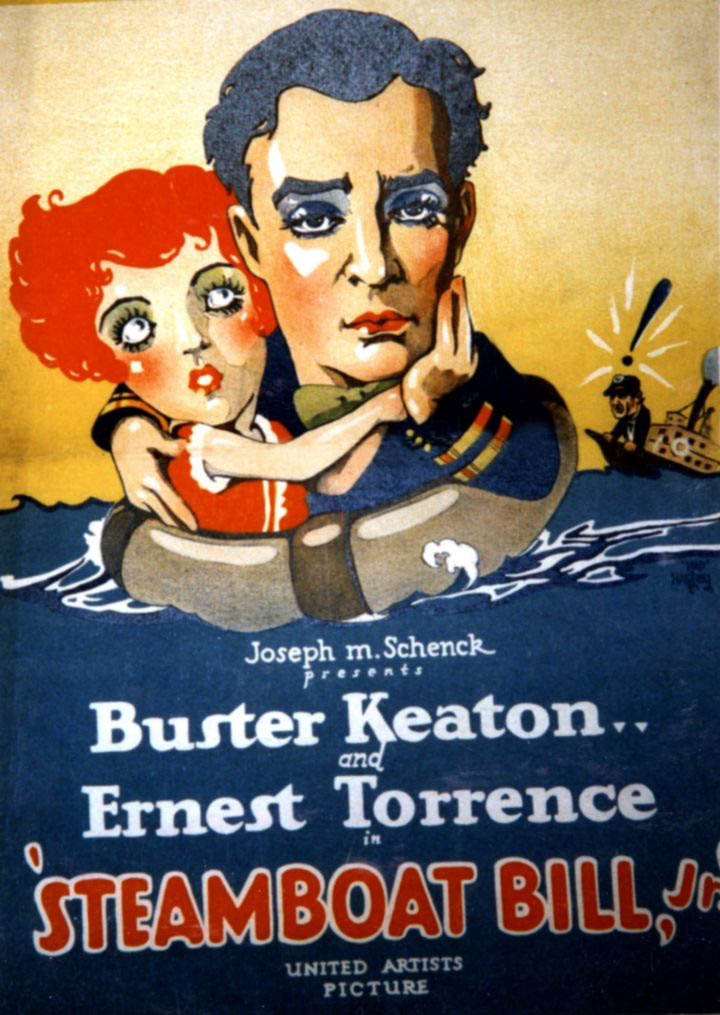
It’s the film Keaton didn’t care for – so much so he told a film restorer working on his films to essentially not bother with it. It was a play purchased for him by producer Joseph Schenck, rather than chosen by the physical-comedy gag-meister, who called it a “sappy farce”. Still, he did his best with it – and then some, since it became one of his biggest hits – and, if it’s far from a stand-out on his CV, that’s not Keaton’s fault. In fact, the only parts of the film anyone remembers are all due to Keaton alone.

The plot follows businessman James Shannon (Buster Keaton). He finds out from a lawyer (Snitz Edwards) that he is to inherit $7million – but only if he is married by 7pm on his 27th birthday. And naturally, today is his 27th birthday! Bungling his proposal to the girl he loves (but was always too shy to ask) Mary (Ruth Dwyer), he and his business partner (T Roy Barnes) head to a country club and ask every girl he can see to marry him. They all say no (guess how many he asks) until an advert in the paper revealing the fortune awaiting a willing bride, produces an army of ladies who will chase Shannon to the ends of the earth for marriage. Can he get back to Mary, reconcile and marry by 7pm?

You can see why Seven Chances is an awkward fit for Keaton. He was more comfortable in a role where the world was awash with obstacles. From natural elements to modern machinery, Keaton was the impassive little guy struggling against the odds. He was much less suited to the faintly unsympathetic Shannon, where coincidence, shyness and poor explanations were his problem. Keaton reworked the character to make him more sympathetic – it’s shyness rather than unwillingness that delays his proposal (in an opening technicolour sequence showing the passing of the seasons around Shannon’s ever-delayed proposal), but its still a role he lacks affinity for.

The film’s opening is too dialogue driven – it throws up more title cards than almost any Keaton film you can think of – and Keaton looks restrained by the role. It’s telling that the “Keaton” part for the first ten minutes goes to Snitz Edwards (very funny with his eternally put-upon face) who struggles to get anyone to listen to his news about a possible inheritance. The film rushes through much of the plays plot in its opening 40 minutes, recognising that it’s essentially the same gag – Keaton asks a woman to marry him, she says no – repeated over and over again.

Those seven chances whizz by in the country club, as a progression of women (including an unbilled, pre-fame Jean Arthur) turn him down with a mix of laughter, anger and contempt. To be honest its diminishing returns, even with some Keaton directorial flair (one proposal takes place walking up the stairs, without breaking step after rejection Keaton walks down the stairs with a second unwilling woman). There is nothing for Keaton to get his teeth stuck into.

It’s only in the second half, the play forgotten, that Keaton finds sure ground – and the films memorable moments. The advert produces an army of women – in some shots, it looks like hundreds if not more. As Keaton sleeps in a church pew, it slowly fills up around him. Eventually a clever cross fade (similar to an early cross fade that moves a cars location without it moving in frame from one house to the other – Keaton understood editing like few others) sees the church filled with women. Keaton awakes, is ambushed under a scrum of would-be brides and makes his escape.

What follows is a madcap chase through the streets – including several inspired tracking and crane shots stressing the speed and the size of the pursuing crowd. The chase passes through a police march, a football game (where the players are all crushed by the mob), an industrial plant and then into the countryside, Keaton running for all he is worth.

At one point Keaton intended to end the film like this. It wasn’t until a test audience failed to laugh that he realised it needed to change – and he cottoned onto the unexpectedly loud laugh from when he had thrown himself down a hill (a suicidal looking jump on screen) and dislodged some rocks, causing a small avalanche. Back out to location they went, accompanied by dozens of papier-mâché rocks of various sizes, and scaled up the gag to huge levels, Keaton running, leaping and climbing up trees to escape this onslaught of boulders. It also created a reason for the women to be blocked off – and allow Keaton to escape to propose to his girl and create the just-in-time happy ending.

It’s that chase people remember – and gives Seven Chances a fonder public image than it deserves. But its ten minutes of great material in over an hour of sub-par Keaton. It doesn’t help that this film, more than any other Keaton, has a parade of black-face gags (Jules Cowles in a head-in-hands performance today) revolving around Mary’s servant, who is (of course) stupid, slow and lazy. It’s compounded by a gag where Keaton rejects (in horror) the idea of proposing to a Black woman.

Seven Chances is fondly remembered for its chase – but if you want to watch a Keaton chase, there are many better options than this, a film meaner and less good-natured than his best work.