Category: Tim Burton

Sweeney Todd: The Demon Barber of Fleet Street (2007)

Sweeney Todd: The Demon Barber of Fleet Street (2007)

Blood, guts and gore in this horror-tinged, claret-dipped Burton adaptation of Sondheim’s musical

Director: Tim Burton

Cast: Johnny Depp (Sweeney Todd), Helena Bonham Carter (Mrs Lovett), Alan Rickman (Judge Turpin), Timothy Spall (Beadle Bamford), Jayne Wisener (Johanna Barker), Sacha Baron Cohen (Adolfo Pirelli), Laura Michelle Kelly (Lucy Barker/Beggar Woman), Jamie Campbell Bower (Anthony Hope), Ed Sanders (Toby Ragg)
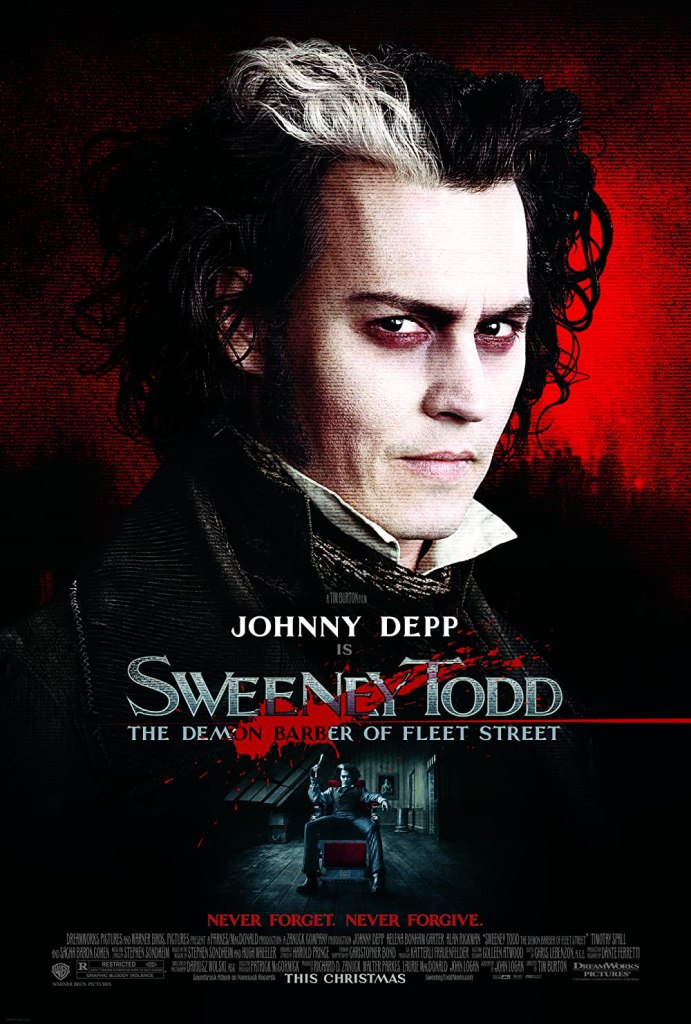
Sondheim’s blood-soaked musical about the infamous serial-killing barber, intent on revenge against the judge who transported him to Australia and stole his late wife, took years to make it to screen. His intensely theatrical, intricate musical masterpieces don’t always translate to film – they lack that crowd-pleasing oomph. What with Todd slashing throats with misanthropic glee, aided by besotted neighbour Mrs Lovett baking the bodies into pies, and no wonder Sweeney was a difficult pitch.

However, it’s practically tailor-made for the High Priest of Gothic Oddity, Tim Burton. A lifelong Hammer horror fan, it’s no surprise Burton had loved the musical since first seeing it in 1980. He’s a perfect match for this stuff, and his film is a bleak, heavily desaturated, oppressively grim and strikingly optimism-free descent into a subterranean hell, with almost every scene accompanied by a free-flowing deluge of Shining-style levels of blood.

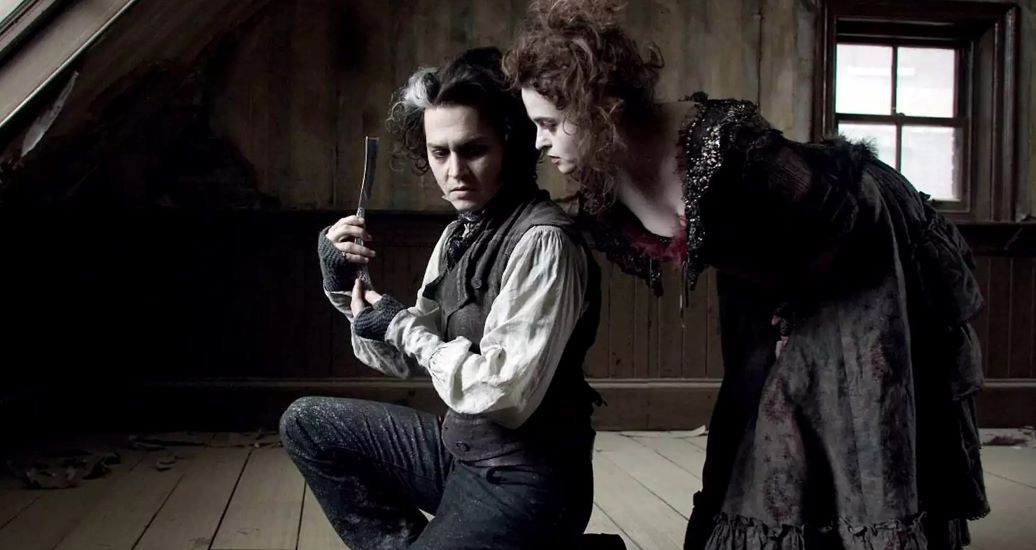
Sweeney Todd is a design triumph (Oscar-winning for its production design and nominated for its costumes). It’s London is like an Oliver! set run through a fevered nightmare slasher film. Everything is grandiose, filthy and above all cold, oppressive and unwelcoming. Most of the light comes from the reflection of moonlight on the blades of Todd’s razors, and the basement of his building is a gruesome horror show, with a pumping furnace and mangled body parts in a mincer.

The film shocked critics expecting a more traditional Broadway musical translation with the dark glee it embraces the gore. When throats are slashed – which occurs as regularly as clockwork – blood sprays over the actors, camera and virtually everything else. Sweeney’s chair drops his victims head-first into the cellar: each fall is seen in terrible detail, bodies landing with a sickening crunch, twisted out of shape and heads smashed open on the stone floor. There is little black comedy, the film embracing flat-out horror.

It also focuses on the black hate in Sweeney’s heart, his fixation on revenge at any costs and the lack of any trace of humanity within him. While Mrs Lovett longs to turn this “relationship” into something more intimate and loving – she even sings about it in By the Sea to the stony-faced indifference of Sweeney – to Sweeney she is little more than a convenient means to an end. Bravely, no real attempt is made to make us feel real sympathy for this brutal killer – and the visceral brutality of his killings only adds to this.

The film is dominated by its two leads, simplifying the musical down to something leaner, swifter and meaner. This is a dark revenge tragedy doubling as a character study of its two leads’ souls. These places a lot of pressure on Depp and Carter. Sweeney Todd was very much at the apex of a trend in musical film-making where stars were trained to sing, rather than casting skilled singers who can act. Sweeney Todd is an immensely complex musical, with deeply challenging lead parts. Even using the intimacy and immediacy of the camera to bring the scale down (they don’t need to hit the back row), it still must have been intimidating to sing with very little experience.

Depp and Carter however acquit themselves well. Working with a director they both trust implicitly, they give dark, twisted performances of unspoken longings. Depp, in one of his finest and most restrained performances (which says a lot about the irritating abandon of many of his other roles) that stresses Sweeney’s sociopathic coldness. He is a tortured man, turning his unhappiness and self-loathing into a weapon to slice open the world. Carter channels sociopathic eccentricity with a tenderness, vulnerability and desperation for love.

As singers however, they are competent rather than inspired. Depp goes for an earthy, Bowie-esque, Rex Harrison-paced growl that conveys the emotion but simplifies the songs and robs them of some of their impact. Carter’s more lively rendition carries more character, but in both cases you wonder what would have happened if the film had married its cinematic visuals with assured Broadway performers. The best singers by far are Jamie Campbell Bower (whose role as the would-be lover of Sweeney’s long-lost daughter is heavily cut) and Ed Sanders, who is excellent as the orphan taken under Mrs Lovett’s wing (West End-star Laura Michelle Kelly, perversely, barely sings a note).

The focus on Sweeney and Mrs Lovett leaves little room for the other actors. Rickman brings a subtle perversion to Judge Turpin – even though, bless him, he’s not the best singer – and Spall a creepy eccentricity to the Beadle. But this is the Sweeney show, a decision that robs the film of any trace of the more hopeful elements of the original, to zero in on the dark horrors.

The film pulls few punches, but never makes us care about Sweeney. For all the trims, it’s surprisingly poorly-paced (especially considering its short run-time). Such little importance is given to the supporting characters, time feels wasted when we are with them. The cuts also stress how little actual plot there is around Sweeney and Mrs Lovett (once they decide to embark on a life of crime, there is little that happens to sustain the film through its middle act).

The film is a Gothic slasher triumph, but it’s perhaps neither a great musical nor a truly engaging tragedy. A slice more humanity, in between the slashed throats, might have helped a great deal.

Batman (1989)

Batman (1989)

Comic book movies get a jump start in the very first attempt to take the genre really seriously on screen

Director: Tim Burton

Cast: Jack Nicholson (Jack Napier/The Joker), Michael Keaton (Bruce Wayne/Batman), Kim Basinger (Vicki Vale), Robert Wuhl (Alexander Knox), Pat Hingle (Commissioner Gordon), Billy Dee Williams (Harvey Dent), Michael Gough (Alfred Pennyworth), Jack Palance (Carl Grissom), Jerry Hall (Alicia Hunt), Tracey Walter (Bob), Lee Wallace (The Mayor), William Hootkins (Lt Max Eckhardt)

Strange to think, but there was a time when comic book movies were not Hollywood’s be-all and end-all. Instead, they were slightly embarrassing, campy messes, big-name actors were a little ashamed to appear in and studio executives were convinced no-one outside a comic-book shop would be remotely interested. So, you could say Batman is one of the most influential films of the last 30 years, a massive box-office smash that treated its source material fairly seriously. For the first time ever, it was suggested these films could be dark and adult, as well as fun. Sure, there is a lot more goofy humour in it than you might remember, but it changed how this genre was perceived.

It’s an origin story of sorts. Bruce Wayne (Michael Keaton) has just started his campaign as Batman, the masked vigilante terrifying criminals at night in crime-ridden Gotham city. A late-night scuffle at a factory stuffed with toxic waste (but of course) sees psychopathic gangster Jack Napier (Jack Nicholson) tumble into a vat of chemicals. Napier emerges, disfigured and insane, as The Joker and starts a campaign of terror across Gotham. A campaign only Batman can end.

Fans feared during its production that the film would follow in the footsteps of the campy 60s TV show. So many letters of complaint (at least 50,000 – imagine how many tweets that would translate into today) at the casting of ‘comic actor’ Keaton hit the officers of Warner Bros, the company’s share price even took a dip. Fans were only reassured when the film opened – and you know you’re in for something heavyweight, as soon as Elfman’s strikingly gothic yet bombastic score echoes out.

Gothic is the word here: Gotham is imagined as world where Art Deco meets Steampunk by way of German Expressionism – it’s like a Fritz Lang explosion in a graphic novel panel. The film was a brilliant twist on noir, with every street hosting a looming nightmare. This was a dark, sinister world where it was always night (fitting for the Dark Knight) and horrors lurked around every corner.

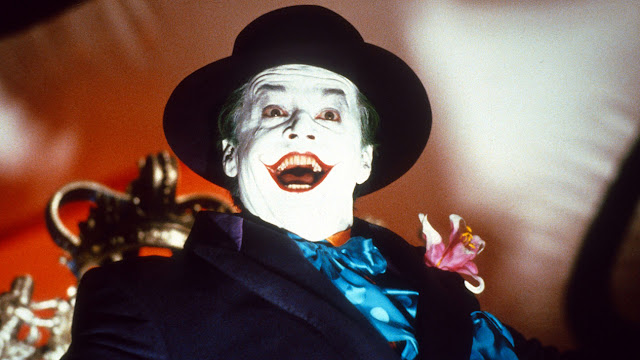
The nightmare at the heart of the film is of course the Joker. Nicholson was so uncertain about doing the film that he struck a deal giving him unprecedented control over the hours he worked, the length of the shoot, the billing and above all a huge back-end salary on box-office and merchandise (the deal was so good, he also made millions from Batman Returns, the sequel he didn’t even appear in). But it was worth it as the film benefits hugely from Nicholson’s cultural and artistic cache, but also his flamboyantly, unashamedly demonic performance, a grinning imp clearly having a whale of a time. Shrewdly, Burton recognised the Joker was such an outrageous character he could provide all the campy, OTT humour some viewers expected – and because it was in tune with the anarchy of the character, the fans wouldn’t mind. Which of course they didn’t, because it’s Jack.

Nicholson soaks up nearly all the energy of the film, leaving very little left for Keaton. Almost certainly very aware of the overwhelmingly negative reaction to his casting, Keaton plays the role absolutely dead-straight. So dead-straight in fact, that he all but forgets to bring any life to the character what-so-ever. Batman is a humourlessly sober hero (the rubber headset also meant Keaton couldn’t hear anything on set) while Wayne has a timid shyness that masks personal trauma. Keaton hits the notes very carefully and seemingly has decided to hide all the manic energy he had shown elsewhere. He effectively concedes the film to Nicholson – and it says a lot that he even looks overawed by Kim Basinger’s greater vibrancy as love-interest Viki Vale.

Watching Batman today, with our attitude to this sort of material changed completely (not least by Christopher Nolan), it’s striking how much more goofy this film seems. It actually says a lot that this was hailed as the darkest, most serious comic-book movie ever. It’s crammed with Burtonish pratfalls and visual humour, from tea trays blocking bullets to Basinger fainting when surprised by a jack-in-the-box. Classic Hollywood imagery is spoofed – at one point the batwing flies over the clouds, holds position dead-centre of the moon and then dives down while everyone in the film is dressed in a mix of pastiche 1930s style and 1980s clothing. In no way could you mistake anything here as happening in something approaching the real world (compare and contrast the few-degrees-to-the-left reality of Batman Begins).

Burton was in fact an odd-choice for director, with only two live-action films under his belt. He’s not been fond of Batman – he called it “mainly boring to me…more of a cultural phenomenon than a great movie” – and the film is an odd fusion of styles. Burtonish dark humour and surreal dashes, mixed with blockbuster action and Prince songs. The film itself has a drifting and unfocused plot (part of constant studio rewriting – shooting the climax Nicholson asked Burton “Why am I climbing up these stairs?” to which Burton responded “We’ll work it out when you get to the top”) which plays around with ideas of trauma motivating these characters but goes nowhere with it. The Joker has no scheme and the film gives him no real personality depth or manages to explore his anarchism in the way The Dark Knight did. Events sort of happen with a shady logic and an unconnected inconsistency, until the film decides to end with a parade climax and rooftop fight.

What’s also striking is how little the comic books are treated like Holy Text by the film-makers (a complete no-no today, where even the slightest deviation from the writ leads to an avalanche of on-line criticism). Batman offs criminals without a second thought, his backstory is radically altered, the continuity merrily distorted. He seems less like a highly-trained fighter and detective, and more a gamely-trying brawler dependent on gadgets. Every character outside Batman, Vale and, I guess, the Joker is a clueless old buffer. While the film is inspired by the look of some of the comic books, it basically has no interest at all in their mythology or deeper themes.

Batman is entertaining but manages to feel long – largely because its plot is vague and drifts, without a tightly controlling theme or plot arc. It’s at times rather inconsistently edited – watch the sequence in the art gallery that is rife with continuity errors – and the film is slightly in awe of Jack Nicholson’s exuberant performance that dominates the film and crushes the life out of any narrative. But it showed that comic books could take place in a world that was dark and imposing rather than primary coloured and that superheroes didn’t need to wear their underpants over their trousers to get the crowds in. For all its flaws, it’s the first stone in the road to the Marvel Cinematic Universe (and yes I know it’s a DC comic).

Sleepy Hollow (1999)


Rumours that Johnny Depp is tapping into his eccentric style are of course unfounded

Director: Tim Burton

Cast: Johnny Depp (Ichabod Crane), Christina Ricci (Katrina Van Tassel), Michael Gambon (Baltus Van Tassel), Miranda Richardson (Lady Van Tassel), Casper Van Dien (Brom Van Brunt), Jeffrey Jones (Reverend Steenwyck), Richard Griffiths (Magistrate Philipse), Ian McDiarmid (Dr. Thomas Lancaster), Michael Gough (Notary Hardenbrook), Christopher Lee (Burgomaster), Christopher Walken (The Headless Horseman), Claire Skinner (Beth Killian) 

Tim Burton’s films often take on a larger-than-life quality, an overblown fanciful journey into a world that is a few degrees off from our own. So a bizarre ghost story about a headless horseman lopping off bonces left, right and centre, in an isolated town that feels more like a construct from a series of other films than any sort of real place, probably suits him perfectly.

After a series of murders via decapitation in the small town of Sleepy Hollow, Iachobad Crane (Johnny Depp) is called from New York to investigate. An eccentric (what else, it’s Depp) moderniser, Crane believes in logic and forensic investigation and is having none of the fears of the townspeople that the murders are being committed by a headless ghost. However he soon changes his views…

This adaptation bears little or no resemblance whatsoever to the original source material, bar a few homages, one or two brief scenes and a few character names. Burton, indeed, seems to have no interest in it at all: what he is interested in doing is paying homage to high-blown Hammer horror films from the 60s and 70s. Whether you enjoy this largely depends on whether you were a fan of either Burton or this style of film-making going into it.

I found the film rather too arch throughout – from the stylised performances of the actors, through to the slight tongue-in-cheek tone. It’s not particularly scary at any point, despite the blood and gore – largely because nothing ever feels real, there’s no sense of dread or peril. Heads are lopped off with an almost comic athleticism, bouncing around floors or rotating on necks. Only one sequence – the murder of a family – carries any real sense of unease about it. The rest of the film is one not-particularly-witty black comedy, in which a lot of time and talent seems to be invested in something not particularly interesting.

Depp is of course perfectly suited to this, his “look at me” acting style springing to the fore as Crane. As usual he overloads the character with quirks and mannerisms, the sort of tricksy emptiness it’s easy to mistake for great acting. The rest of the cast go about their business with a trained professionalism. However, despite the array of British acting talent on display, in truth none of them make much of an impression, with the exception of a nice cameo from Alun Armstrong as a senior New York policeman, and Miranda Richardson who has fun with her role as a sinister housewife with hidden depths.

The awards attention for the film focused on its finest aspects – its look and design. The production design of the film is impressively constructed and the artificial look of the exterior sets actually fits in very nicely within the world of the film. Emmanuel Lubezki’s photography also looks fantastic, shooting the film with a slightly off colour, 70s style that adds a vibrant red to the large amount of blood on screen. Costumes and other technical aspects are also impressive. The film looks fantastically striking, like a brilliantly designed coffee table book – and has about as much plot as one. It’s my problem with Tim Burton – this whole “unique vision” of his, often seems to be an excuse for littering his films with in jokes, arch design and stylisation and leaving out the things we actually care about, like characters, emotion and drama.

In the end, it’s really not a lot more than a joke, a pastiche of a certain genre of film that seems much more like one for the fans than a joke that we can all take part in. I’m aware not liking it throws me open to accusations of not “getting it” or expecting more from it, but I basically didn’t really find the joke funny enough. Its arch style make it hard to relate to, and despite the clear enjoyment of all involved, not a lot of the wit behind the scenes is clear in the final product. With nothing to really invest in, a rather sudden ending and a mood throughout that is trying to be creepy rather than genuinely so. Don’t expect a retelling of its plot around a camp fire to awaken too many goosebumps.