Category: William Dieterle

A Midsummer Night’s Dream (1935)

A Midsummer Night’s Dream (1935)

Handsomely staged and quietly influential production, full of invention and good ideas

Director: Max Reinhardt, William Dieterle

Cast: James Cagney (Bottom), Joe E. Brown (Francis Flute), Dick Powell (Lysander), Jean Muir (Helena), Victor Jory (Oberon), Verree Teasdale (Hippolyta), Hugh Herbert (Snout), Anita Louise (Titania), Frank McHugh (Quince), Ross Alexander (Demetrius), Ian Hunter (Theseus), Mickey Rooney (Puck), Olivia de Havilland (Hermia), Dewey Robinson (Snug), Grant Mitchell (Egeus), Arthur Treacher (Epilogue)

It says something about Hollywood’s back-and-forth relationship with Shakespeare, that Reinhardt and Dieterle’s film can still make a case for being one of its finest Hollywood Shakespeare films. What’s fascinating about it is how much attitudes towards it have changed over time. Opening to a chorus of sniffs from the critics (“It should never have been filmed!”), horrified about the blasphemy of the Bard on celluloid, the things praised at the time now feel the stuffiest while the elements criticised feel fresh and dynamic. Personally, it’s crazy mix of genres, eras, comedic styles and dramatic tone feels like the sort of thing Shakespeare (a consummate showman who spoke in poetry) might have enjoyed.

It came about because Jack Warner wanted a bit of class. Max Reinhardt, internationally famous avant-garde theatre director, as part of Warner’s power thruple: direction by Reinhardt, music by Mendelssohn, words by Shakespeare! Reinhardt had directed a lavish production at the Hollywood Bowl (which also featured Rooney as Puck and de Havilland as Hermia), that would form the basis of his film, incorporating ballet and impressive visual effects. William Dieterle, was bought in to translate Reinhardt’s vision to film (since it quickly became clear Reinhardt didn’t know how to make a movie).

We get an MND that mixes farcical comedy with a dark, sensuous energy. Athen’s forest was transformed by Hal Mohr’s Oscar-winning photography into a glittering fantasy land, created with a mixture of superimposition and miles of cellophane wrapped around the perfectly-recreated trees to reflect the studio lights in a shimmering dance. But in this, is a fairy world of danger and chaos: Reinhardt’s pioneered the interpretation of Puck (played with malicious gusto by Mickey Rooney) as a fire-lighting child, revelling in the chaos his actions cause. Rooney (or rather his double, as Rooney broke a leg early in production) skips and sways, laughing maniacally, tormenting the lovers (possibly even controlling their words and actions), unleashing dark forces of the night.

The film is full of such dark forces – a surprise to critics who saw Dream as a gentle comedy. The ballet sequences, used by Reinhardt to visually demonstrate Oberon’s and Titania’s power to manipulate the environment around them, feature demonic dancers who wouldn’t look out of place in Faust, creepy music-playing goblins and a constant sense of unknowable power. Victor Jory – highly praised at the time, although his precise, poetic reading feels austere and lacking in feeling today – is a darkly imperious Oberon, with barely a trace of warmth to him. (Anita Louise’s Titania also takes a traditional line, speaking with a slightly irritating sing-song that should serve the poetry but instead drains it of life.)

You suspect, if he could have got away with it, Reinhardt might have allowed a trace of bestiality to enter into Titania’s romance with the transformed Bottom. As it is, he settles for Titania snatching a coronet from the Indian boy (nicely introduced early, to cement the split between the two fairy monarchs) who bursts into tears, increasing the feeling that the fairies are inconsistent, temporary creatures, perfectly willing to drop previously treasured people for whoever else captures their attention.

Lavish spectacle runs throughout a play that feels highly indebted to Raphael and the other Renaissance masters. Reinhardt has no problem switching styles: Theseus’ arrival is staged like an Ancient Roman pageant, before settling into a Renaissance style court while the Mechanicals could have stepped straight out of Brueghel. Again, it’s a playing around with style and location that looks very modern today but short-circuited reverentially literal critics at the time. Reinhardt even plays with the idea of Hippolyta being a less-than-willing partner for Theseus (she appears defiantly restrained in the opening scene), although this is largely benched for later scenes.

The lavish opening also shows the production’s ability to balance comedy and drama. Alongside the traditionalist grandiosity, we have low comedy from both the lovers and mechanicals. In a fast-cut, skilfully assembled array of moments (surely Dieterle’s work), the relationships between the four lovers are expertly displayed and mined for comic energy (particularly Lysander’s and Demetrius’ private competition to sing loudest) as are those between the mechanicals (from Bottom’s enthusiasm to Quince’s frustration at the terminal stupidity of Flute).

The mechanicals are one of the greatest divergence in critical opinion between then and now. To critics at the time it was a jaw-dropping mistake to cast Cagney and a host of film comedians in Shakespeare – surely these were roles for the likes of Gielgud? Everything from their delivery to the posture was lambasted for being crude and too damn American for a genre considered the exclusive preserve of the well-spoken likes of Jory and Hunter. However, the energy and naturalness of these actors – and the consummate comic timing they pull out of their roles – is one of the film’s greatest touches.

Cagney was never afraid to look beat-up or ridiculous, and he revels as an explosive ball of energy as Bottom. He flings himself, with the same energy as Bottom, into over-enunciated voices and grand displays of ‘bad acting’, parodying a host of styles from classical to pantomime to stage comedy. Cagney also makes him sweetly naïve and childishly literal, while his gentle, polite mystification about being treated like a king by the fairies seems rather sweet. The other mechanicals are also genuinely excellent, doing one of the hardest things: making Shakespearean comedy work on screen. Joe E Brown is hilarious as a supernaturally dim Flute, barely able to remember what gender he is playing; Hugh Herbert’s Snout has an infectious nervous giggle he can’t control, Frank McHugh’s Quince parodies directors like DeMille. Each of them contributes to a genuinely funny Pyramus and Thisbe that closes the film.

It’s more funny than the sometimes-forced banter between the lovers, not helped by a far too broad performance by Dick Powell (who later claimed he didn’t understand a word he was saying) that makes Lysander somewhere between a buffoon and an egotist. Olivia de Havilland (perhaps not surprisingly) emerges best here as a heartfelt Hermia, although the quarrel between the lovers is perhaps the least well staged sequence in the film (Reinhardt and Dieterle resort to all four of them at points speaking their lines at the same time, as if wanting to get the scene over and done with).

But MND is awash with other touches of cinematic and interpretative invention, it’s darkish vision of the Fairy world (with superimposition and ballet interjections giving it a darkly surreal touch) as influential as it’s haphazard approach to place and setting. Its comic performances come alive with real energy, devoid of the more stately approach from others. Above all, MND feels like an actual interpretation of its source material, rather than just a respectful staging – and its influence played out over decades of productions to come. Overlooked for too long, it’s a fine and daring piece of film Shakespeare, far better than it has a right to be.

All That Money Can Buy (1941)

All That Money Can Buy (1941)

The Devil sure knows how to tempt a man in this beautifully filmed morality tale

Director: William Dieterle

Cast: Walter Huston (Mr Scratch), Edward Arnold (Daniel Webster), James Craig (Jabez Stone), Anne Shirley (Mary Stone), Jane Darwell (Ma Stone), Simone Simon (Belle), Gene Lockhart (Squire Slossum), John Qualen (Miser Stevens), HB Warner (Judge Hawthorne)

Sometimes life can be a real struggle. With debts, failed crops and animals getting sick, what’s a guy to do? That’s the problem New Hampshire farmer Jabez Stone (James Craig) has in 1840. What he wouldn’t give to find a bundle of buried gold that could solve all his problems. Fortunately, charming old rogue Mr Scratch (Walter Huston) knows exactly where to find one – all he wants in return is for Jabez to sign away his soul seven years from now (signed in blood of course). Jabez gets fortune, prestige, the son he always wanted – but when ‘Mr Scratch’ comes to collect, can Jabez’s friend, famed orator, lawyer and congressmen Daniel Webster (Edward Arnold) save his soul?

All That Money Can Buy is a richly atmospheric piece of film-making from William Dieterle, adapted from Stephen Vincent Benet’s short story and full of gorgeously filmed light-and-shadow with a haunting score by Bernard Herrmann. (The story was originally titled The Devil and Daniel Webster, also the film’s original title before RKO changed it to avoid confusion with their more successful Jean Arthur comedy The Devil and Miss Jones.) It’s a neat morality tale, full of dark delight at the devilish ingenuity of Mr Scratch, with lots of dark enjoyment at seeing a weak-but-decent man corrupted into being exactly the type of greedy, cheating cad to whom he was deeply in debt to from the beginning.

It’s nominally about James Craig’s Jabez Stone, but Jabez is a shallow, easily manipulated passenger in his own life, pushed and pulled towards and away from sin depending on who he’s talking to. Stone’s fall is swift: moments after meeting Scratch, he’s digging hungrily into a meal while his wife and mother say grace, hugging his newfound bag of gold. As his wealth goes, he drifts from his pure wife (Anne Shirley, effective in a dull part) becoming easy prey for demonic (literally) temptress Belle (a wonderfully seductive Simone Simon). By the time the seven years are up, he’s skipping church for illicit card games and crushing the farms of his neighbours to fund his dreamhouse-on-a-hill.

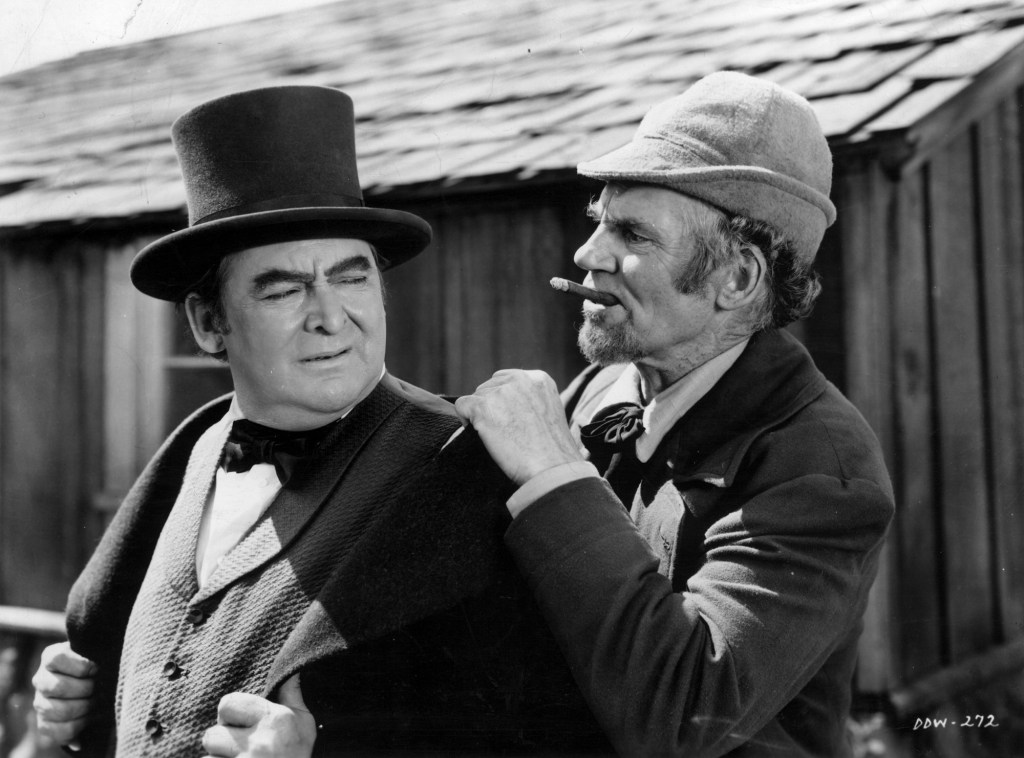
Stone is really the Macguffin here. The real focus is the big-name rivals: The Devil and Daniel Webster. It’s implied these two have fought a long-running battle for years: our introduction to Webster sees him scribbling literally in the shadow of Mr Scratch, who whispers to him tempting offers of high office. Later Webster is unflustered when Scratch suddenly appears to place a coat on his shoulders, treating him as familiar rival. You could argue Scratch is only prowling the streets of New Hampshire because he’s looking for a way to nail the soul of his real target, Daniel Webster.

As Mr Scratch, the film has a delightful (Oscar-nominated) performance from Walter Huston. With his scruffy clothes and twirling his cane, Scratch pops up everywhere with Huston’s devilish smile. It’s a masterclass in insinuating, playful malevolence, with Huston playing this larger-than-life character in a surprisingly low-key way that nevertheless sees him overflowing with delight at his own wickedness. Huston has the trick of making Scratch sound like someone trying to sound sincere, while never leaving us in doubt that everything he says is a trap or lie, only showing his arrogance and cruelty when victory is in his grasp. It’s a fabulous performance, charismatic and wicked.

Edward Arnold makes Daniel Webster both a grand man of principle and a consummate politician, proud of his reputation and all the more open to temptation for it. He also has the absolute assurance of a man used to getting his own way, and the arrogance of seeing himself as an equal to the Devil rather than a target. These two form the ends of a push-me-pull-me rivalry.

The rivalry culminates in its famous ‘courtroom’ scene, as Webster – a little the worse for drink –argues for Jabez’s soul in front of a ghostly court of American sinners from the bowels of hell (lead among them Benedict Arnold). Its shot in atmospheric smoke, with the double exposure creating a ghostly effect for jury and judge. It’s another excellent touch in a film full of inventive use of effects and camerawork, Dieterle at the height of his German influences. The artificial New Hampshire scenery is shot with a sun-kissed beauty that bears Murnau’s mark. Striking lighting and smoke-play abounds in Joseph H August’s camerawork, not least Belle’s introduction backlit with an extraordinarily bright fire. Early scenes of Stone’s misfortune interrupted by a brief frames of a photo-negative Scratch laughing, quite the chillingly surrealist effect.

Politically, All That Money Can Buy backs away from any overt criticism of Webster’s support for the Missouri Compromise (this key piece of slavery protection legislation is so key to Webster’s view of American strength he’s even named a horse after it). But it’s quite brave for 1941 in allowing the Devil legitimate criticism of America’s ‘original sins’ saying he was there driving on the seizing of the land from the Native Americans and up on deck on the first slave ship from the Congo. (Especially as Webster can’t defend these actions). It’s also interesting that the film praises collectivism for the farmers over rugged individualism, a conclusion it’s hard to imagine being praised a few years later.

All That Money Can Buy is also filled with impressive practical effects, not least Scatch’s impossible catching of an axe thrown towards him, bursting it into frame. Both Scratch and Bell reduce papers to flaming ashes with a flick of the wrist. Horribly woozy soft-focus camera work accompanies Jabez’s nightmare visions of the damned. It’s tightly and skilfully edited, superbly paced, with montages used effectively for transitions (a field of corn growing is particularly striking) and wildly unnerving sequences, like Scratch’s fast-paced barn-dance with its whirligig of movement and repeated shots. It’s all brilliantly scored by Herrmann, from the pastoral beats of New Hampshire to the discordant sounds (some created from telephone wires) that accompany Scratch.

All That Money Can Buy concludes with a stand-out speech from Webster that perhaps settles matters a little too easily – and brushes away any of the film’s mild criticism of America’s past with a relentlessly upbeat patriotic message. But the journey there – and the performances from a superb Huston and excellent Arnold – is masterfully assembled by a crack production team working under a director at the height of his powers. A flop at the time, few films deserve rediscovery more.

The Story of Louis Pasteur (1936)

The Story of Louis Pasteur (1936)

A visionary struggles against the blind in this genre-defining slightly cosy biopic

Director: William Dieterle

Cast: Paul Muni (Louis Pasteur), Josephine Hutchinson (Marie Pasteur), Anita Louise (Annette Pasteur), Donald Woods (Dr. Jean Martel), Fritz Leiber (Dr. Charbonnet), Henry O’Neill (Dr. Emile Roux), Porter Hall (Dr. Rossignol), Raymond Brown (Dr. Radisse), Akim Tamiroff (Dr. Zaranoff), Halliwell Hobbes (Dr. Joseph Lister), Frank Reicher (Dr. Pfeiffer)

Jack Warner was convinced no one would want to watch the life story of some crusty old scientist. But Paul Muni insisted they would – and he was a star – so with a threadbare budget and host of re-used costumes (many not from the correct period) and sets The Story of Louis Pasteur came to the screen – and much to Warner’s surprise was a hit. It can look like an oddly cliché-ridden affair today: until you realise many biopic tropes we’re used to were virtually coined here.

The Story of Louis Pasteur remixes huge portions of Pasteur’s life to make it more dramatic: the man who was the leading scientist in France for almost thirty years is repackaged as an outsider and laughing stock, constantly scorned by the medical establishment until (but of course!) he is triumphantly hailed as a genius by the same doctors who mocked him for years. Sound familiar? The film charts Pasteur’s efforts to discover vaccines, first for anthrax in sheep (leading to a famous test where 25 sheep were vaccinated and 25 were not, then all of them exposed to the disease, killing all the unvaccinated sheep) then rabies in dogs and treating those bitten by rabid dogs. Pasteur uses his unparalleled knowledge of microbes which (but of course!) every other doctor says cannot possibly have anything to do with infection.

There is a lot to enjoy in The Story of Louis Pasteur, an undeniably old-fashioned “Great Men” view of history that manages to turn bacteriology into effective entertainment. It recasts history into an easily digestible tale of visionaries and scoffers – but, crucially, no real baddies – crafting a series of small steps towards scientific discoveries into flashes of inspiration and triumphant revelations. Science is made simple, plain and understandable with Pasteur to talk us through a few shots of microbes under microscopes. At its centre we have a stubborn maverick determined that it is his way or the high-way and who won’t listen for a second to anyone questioning his theories.

There is something rather touching about the film’s admiration for science and celebration of an altruistic quest to make the world a better place. It carefully outlines the dangers of surgery and poor hygiene in medical practice – it opens with a doctor murdered for failing to save his killer’s wife, the reason for his failure pretty clear from the haphazard way he chucks medical equipment into a bag (dropping some of it on the floor en route). This lack of hygiene affects rich and poor (even Duchesses are not safe), in particular women in childbirth. Its truly the enemy of mankind, as a caption explaining the 1870 war stresses (European squabbles being a distant second). This is a problem that is truly noble to take on.

And it motivates Pasteur. Paul Muni is on Oscar-winning form as Pasteur, brilliantly precise and superbly conveying great intelligence mixed with an arrogant self-assurance. But Pasteur’s egotism comes not from vanity but from simply knowing more of which he speaks than anyone else. He’s also a man consumed by a sense of duty to the world: when his work can literally save lives (be they either animal or human) he will not let scorn stand in his way. Muni captures all this wonderfully, creating a prickly man with a playful streak determined to do the right thing the right way (Pasteur may disagree with his critics, but woe-betide their assistants disrespectfully doing the same).

Dieterle’s film crafts a series of excellent set-pieces to present Pasteur as a visionary ahead of his time. To make this really land, he’s therefore completely altered into being seen as a crank and pariah by everyone around him, rather than the influential scientific leader he actually was. This might be poor history, but it’s much better drama. From a furious encounter with Napoleon III (who won’t wear the idea his hand-picked doctors might be wrong about sterilization) to the Medical Academy publicly poo-poohing Pasteur’s outlandish ideas that vaccines might prevent anthrax. To give a face to this mocking of Pasteur (from an establishment we are told is totally wrong on every count) the film invents Dr Charbonnet (well played by Fritz Leiber), an honest but pig-headed critic who exists to be wrong (for noble reasons) on almost every single issue.

Noble as important: this film want to stress everyone acts for decent reasons, so that its final celebration of Pasteur is unblemished by deeply personal rivalry. Charbonnet and Pasteur are both framed as decent men and their relationship allows for plenty of fun melodrama, such as Charbonnet injecting himself with Pasteur’s (fortunately for him) weak rabies sample to ‘expose’ his ideas. When Pasteur’s daughter falls ill in childbirth, but of course Charbonnet is the only doctor available: he humours Pasteur’s sterilisation rules in exchange for a signed letter from Pasteur rubbishing his own theories (Muni’s shuffling flash of conflict that flows across his face at this moment is very well done). But of course, Charbonnet and Pasteur eventually reconcile in honour and decency.

This forms a fun thread throughout the movie, that’s never less than well-staged by Dieterle, with pace and energy. The anthrax test is very dynamic – all celebrating crowds and circus side-shows – and the dramatic appearance of a host of Russian peasants (led by Akim Tamiroff’s bombastic doctor) desperate for a cure for rabies-induced sickness is well-executed. Some beats work less well than others. Donald Woods gets dealt a rotten hand as the dull son-in-law of Pasteur. The women in Pasteur’s family get even worse, with most of Josephine Hutchinson’s lines being of the “stop trying to cure anthrax and come to bed Louis” variety. The costumes are bizarrely all-over-the-place (the women look more like Southern Belles) and there is a reassuring cosiness about everything.

But that’s also one of its most successful features. The Story of Louis Pasteur is a little twee – but it’s also effective. It’s why it laid down a template that worked for countless films that follow (A Beautiful Mind pretty much follows its model and won an Oscar for it 65 years later). That’s because there is also a feel-good factor to see someone who is, without doubt, in the right triumphing over the stubborn. With a great performance by Muni, it’s a rewardingly entertaining biopic.

The Life of Emile Zola (1937)

The Life of Emile Zola (1937)

Oscar-winning biopic that laid down many of the conventions we expect

Director: William Dieterle

Cast: Paul Muni (Emile Zola), Gloria Holden (Alexandrine Zola), Gale Sondergaard (Lucie Dreyfus), Joseph Schildkraut (Captain Alfred Dreyfus), Donald Crisp (Maitre Labori), Erin O’Brien-Moore (Nana), John Litel (Charpentier), Henry O’Neill (Colonel Picquart), Morris Carnovsky (Anatole France), Louis Calhern (Major Dort), Ralph Morgan (Commander of Paris), Harry Davenport (Chief of Staff), Vladimir Sokoloff (Paul Cezanne)

One of the lesser-known Best Picture winners, The Life of Emile Zola is a prime example of the 1930s trend for “Great Man” pictures, setting the template for a whole genre of biographical movies. A whistle-stop tour of how the Great Man came to be, before a tight focus on what made him great – ideally ending in either triumph or disaster (or, as is the case here, with both). It’s from a time when the viewing public didn’t expect a rigid adherence to the fact – and when films were very open with their flexibility with the truth (the film opens with an on-screen caption which happily states most of what happens in it is made up.) Actually, I think being told from the start you are watching a heavily fictionalised version of the truth covers a multitude of sins: and that The Life of Emile Zola is pretty entertaining when you get past that.

Emile Zole (Paul Muni) is of course one of the most famous French authors. But he was also at least as famous for his campaigning and presence as he was for his volumes and volumes of best sellers. The film follows Zola, for its first forty minutes or so, from poverty-stricken writer, struggling to make ends meet in the draughty hovel he shares with similar future-genius Cezanne, to success (although in real life by the time he wrote Nana, the book that makes him a sensation here, he was already hugely famous). Zola becomes increasingly aimless. What worlds are there left to be conquered? That all changes when Lucie (Gale Sondergaard) the wife of army officer Alfred Dreyfus (Joseph Schildkraut) asks for his help to save his life from unjust imprisonment and exile on Devil’s Island. Because the army are convinced Dreyfus is a spy – and won’t let inconvenient things like evidence that someone else did it get in the way.

The film is called The Life of Emile Zola but really it might as well have been called The Dreyfus Affair. This infamous miscarriage of justice drives the entire second half of the movie – with Zola himself disappearing from focus for stretches as the film covers the conspiracies that led to Dreyfuss spending the best part of a decade imprisoned for something he didn’t do. What seems strange today is that the film makes no mention of the most famous angle of the case: Dreyfus was almost solely suspected because he was Jewish, and the case became one of the most infamous antisemitic persecutions in history. But the studio heads – Jewish themselves and nervous of being accused of making a film that criticised Nazi Germany – removed all reference to Dreyfus’ Jewishness from the script. It’s a curious omission, but by and large doesn’t affect the film’s final impact.

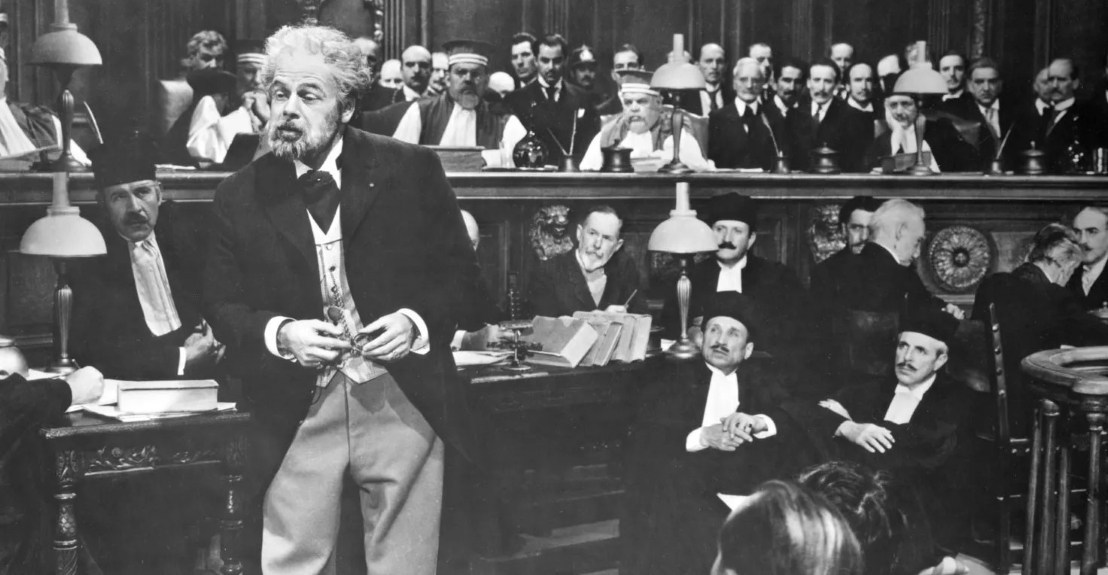
Dieterle’s movie is also one of the first courtroom dramas. A large chunk of the final third is given over to Zola’s trial for libel (after his famous J’Accuse article, denouncing the army’s persecution of Dreyfus). In a crowded courtroom, the film carefully follows the intricacies of the court case, from calling to witnesses to final speeches (all fairly accurate, even if Zola is given a larger role with a final speech). As in the trial itself, the blatant unfairness (witnesses shouted down, defence questions vetoed, evidence withheld and even invented) is hammered home with shocking regularity. Donald Crisp does fine work as the liberal lawyer, hamstrung by a crooked system.

The Dreyfus affair element is really what makes the film come to life. The French army officers are almost to a man a group of corrupt bullies, who have pre-decided the outcome of their investigation and are determined that every single element of it should support that decision. By contrast Joseph Schildkraut (winning an Oscar that feels more for Dreyfus than him, delivering an effective if rather one-note performance) is the soul of decency and nobility as a Dreyfus who is at first bewildered then fighting a manful struggle against despair. Even better is Gale Sondergaard, who gets an ahistorical impassioned speech to win Zola to the cause and carries a core of quiet anger under her shock.

The Dreyfus Affair was the struggle of Zola’s life, the crusade that would win him a place in history, perhaps even more than his books. It’s also the sort of campaigning material that gives rich rewards to actors. Paul Muni seizes the opportunity. The film was shot in reverse so Muni would need to spend less and less time in make-up as shooting went on: the old-age make-up and wigs are very effective, matched by Muni’s physicality and voice which subtly changes as the character ages.

Muni is an actor who seized any chance for a bit of grandstanding. The film gives him its best one with a five-minute monologue closing the trial, during which Zola argues with passionate but quiet reasonableness that Dreyfus is an innocent victim. It’s even more effective since Dieterle has kept Muni silently off-centre for much of the court case. Muni sometimes carries the whiff of stagey ham, but in several moments he brings both a charming cheek and strong morality to Zola. It’s a very strong performance from one of the leading actors of the 1930s.

The film itself is also a good mixture of the twee and the compelling. Most of the Dreyfuss material falls into the latter category. It’s the early days of Zola that falls into twee: Zola scrippling ideas, bantering with Cezanne on the purpose of art, playfully mining prostitute Nana for the material he will make into a hit book. There is a nice foreshadowing through the film with Zola’s obsession with blocking draughts – an obsession that will later cost him his life to a misfunctioning heater.

It’s a well directed film. Dieterle mixes in nice touches of humour (a husband and wife using subterfuge to disguise from each other that they are both buying Nana) and also effective details that speak of Dreyfus’ isolation (the letter that has been redacated into nothingness, the effective transition of several years at Devil’s Island that stresses how little has changed, Dreyfus’ giddy joy when finally allowed to walk unheeded in and out of his prison cell).

The Life of Emile Zola looks today like a surprising winner of Best Picture. But the patterns for both courtroom drama and many biographical dramas were laid down here. By the end, as the survivors pay tribute to Zola with high-blown speeches, the audience should be convinced that this was a man deserving of being honoured by a whole movie. It’s setting of a template copied many times over can make it look a little twee today, but its’ still well done, with some powerful flashes of effective film-making and great acting.

The Hunchback of Notre Dame (1939)

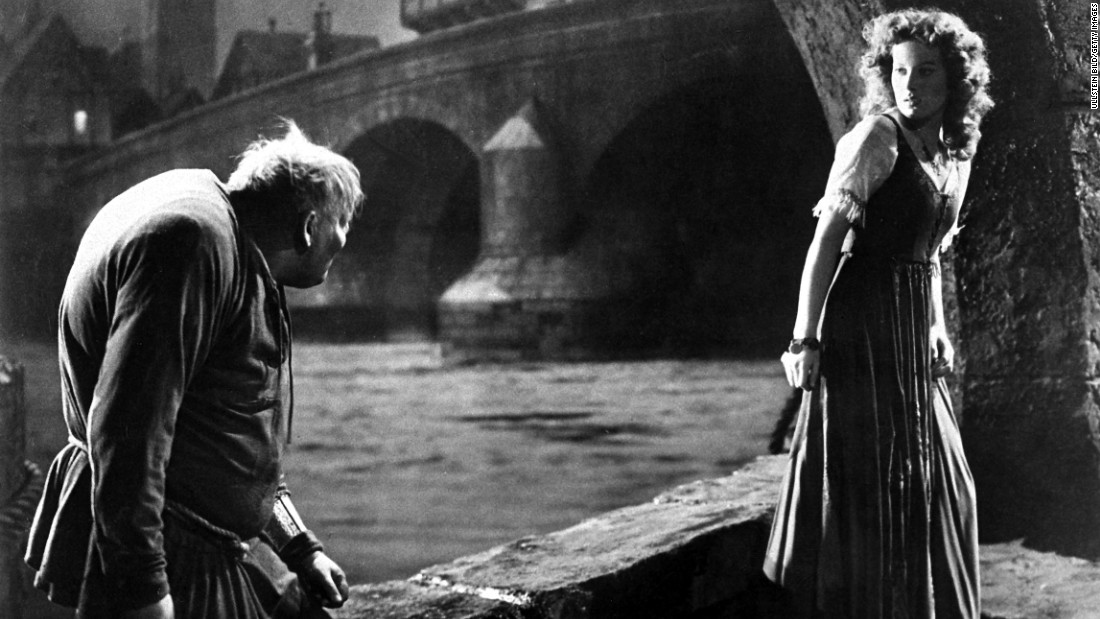
Charles Laughton looks on with longing as The Hunchback of Notre Dame

Director: William Dieterle

Cast: Charles Laughton (Quasimodo), Cedric Hardwicke (Jean Frollo), Thomas Mitchell (Clopin), Maureen O’Hara (Esmeralda), Edmond O’Brien (Pierre Gringoire), Alan Marshal (Captain Phoebus), Walter Hampden (Archbishop Claude Frollo), Harry Davenport (King Louis XI), Katherine Alexander (Madame de Lys), George Zucco (Procurator)

Victor Hugo’s gothic romance–slash-tragedy has been turned into a film so often, it’s a wonder anything that happens in it remains a surprise. But this 1939 version is perhaps the most influential, where Hollywood decided to throw money at the fable and try and make something as close as possible to the spirit of the book. But of course with a happyish ending on the end – because, you know, it’s still Hollywood!

In 1470s Paris, the city is caught between the pressures of religion and new developments such as the printing press. In the centre of the city is the Cathedral of Notre Dame – where the bells are operated by foundling Quasimodo (Charles Laughton), a deformed hunchback driven deaf by the constant ringing of the bells. His benefactor, Judge Jean Frollo (Cedric Hardwicke), is running a vicious campaign to cleanse the city of the gypsies and beggars that make up a large part of its underbelly – but he’s hit for six when he falls in love (or rather lust) with beautiful gypsy woman Esmeralda (Maureen O’Hara). But he’s not alone – equally smitten are naïve young poet Gringoire (Edmond O’Brien), arrogant Captain Phoebus (Alan Marshal), and Quasimodo himself. When Esmeralda rejects Frollo’s advances she soon finds herself in danger – and her only hope of safety comes from unexpected sources.

Dieterle’s background in German expressionism and silent cinema shines through in this visually striking and opulent studio production, with its superbly marshalled crowd scenes, brilliant use of near-impressionistic shadows and fabulous camera work that drifts over the impressive (and hugely expensive) set. Dieterle mixes this technical expertise with a real sense of emotion and character development, helped by some terrific performances from the cast. It’s a film that motors through the story of the novel, but skilfully repackages it as both a fascinating semi-romance and a sort of urban tragedy, as well as a subtle mediation on love and lust.

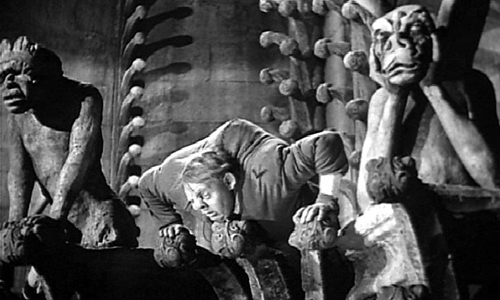
At the centre of it, you have Charles Laughton giving probably the definitive performance of the hunchback. Sweating under layers of make-up and an artificial hump, Laughton is nearly unrecognisable as the bell-ringer. His triumph is to make a gentle, tragic character emerge from make-up that suggests more Frankenstein’s monster than tragic hero. Nearly wordless for the first hour and a half of the film, Laughton does his magic with an expressiveness that speaks volumes of the loneliness in Quasimodo. Tenderly, he watches people knowing he can never be part of their lives – and look how excitedly he bursts out when he finally gets a chance to speak to Esmeralda one-on-one. Suffering punishment on the wheel, Laughton’s eyes convey the numb acceptance of pain as his natural state of affairs. But he also manages to bring out the gentle, childlike qualities of Quasimodo. It’s a wonderful, wordless, expressionistic performance – a triumph of physical acting and wonderfully judged emotional vulnerability.

The rest of the cast match Laughton stride-for-stride. Censor demands at the time required that Frollo be removed from his position (in the novel) as Archbishop, so the book-version of the character is split in two here. Archbishop Frollo is the sort of pious bore who can keep the Hayes committee happy. But Cedric Hardwicke gets to play the invented evil brother Judge Jean Frollo, the lecherous hypocrite from the novel. An authoritarian ascetic, Hardwicke’s Judge Frollo is lean, mean and utterly ruthless – and totally in denial about both his lustful feelings and hypocrisy. Hardwicke is virtually an archetype of the sinister authoritarian, but he manages to never chew the scenery. Incidentally, knowing the two characters are basically split from the original book, does allow moments of fun imaging the moral debates between the two as a sort of split personality discussion.

But there are plenty of other good performances as well – not least from Maureen O’Hara, who is charming and engaging enough to make you believe that the whole male cast is in love with her. Edmond O’Brian goes large at times with the passionate romance, but he does a very good job in the role. Thomas Mitchell is good value as the leader of the beggars, Clopin. There are strong performances across the whole film.

All these performances are framed within a fabulous design. The trouble and expense that has gone into the construction of the set is inspiring, the sweeping gothic arches and towers giving every shot something exquisite to look at. It also gives never-ending options for camera placement and impressionistic imagery for Dieterle. It works as well – the gloomy, imposing towers of Notre Dame are captured with real artistry, while the shadow it casts over the whole city of Paris serves as a constant reminder of the oppression the city lives in.

Dieterle also brilliantly films the crowd scenes, getting a superb sense of visceral emersion from these sequences. Whether the camera is in the mix, or flying above the crowds from the tops of Notre Dame, these scenes look equally fantastic. Dieterle handles the more action-related scenes with particular skill – Quasimodo’s rescue of Esmeralda from a death sentence is particularly well staged in its dynamism and graceful filming. 

Not every beat works. The portrayal of Louis IX as a sort of kindly old uncle seems off-piste from the very start. The early sequences sometimes get bogged down too quickly in set-up rather than getting into the action. Alan Marshal is rather wooden as Captain Phoebus, although the film goes surprisingly far in suggesting the dark desires and predatory sense of danger that comes from the character. Some of the beggar court sequences get similarly stuck in kitsch.

But these are minor beats. It’s a film that really understands emotions and makes the dramatic thrust work. It also has a dark sexual power, not least in Hardwicke’s Frollo: a seething mess of frustrated desires. It never loses sight of the sadness at the heart of its central character’s story, of his loneliness and isolation, and manages to communicate this brilliantly in every scene where the character appears – he is trapped by his muteness, his ugliness or his sadness at every turn. It’s a development that never fails to be engrossing and finally moving. It’s a film that is brilliantly assembled with real technical skill, very well acted and wonderfully directed.