
Tag: Ross Alexander

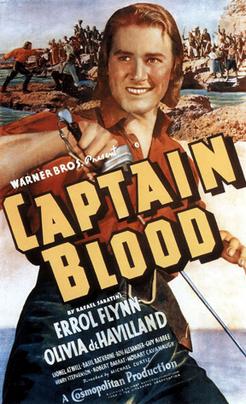
Captain Blood (1935)

Captain Blood (1935)

Errol Flynn buckles swashes in this stirring and exciting pirate adventure

Director: Michael Curtiz

Cast: Errol Flynn (Peter Blood), Olivia de Havilland (Arabella Bishop), Lionel Atwill (Colonel Bishop), Basil Rathbone (Lavasseur), Ross Alexander (Jeremy Pitt), Guy Kibbee (Hagthorpe), Henry Stephenson (Lord Willoughby), Robert Barrat (Wolverstone), Hobart Cavanagh (Dr Bronson), Donald Meek (Dr Whacker), Jessie Ralph (Mrs Barlow), Frank McGlynn Snr (Reverend Ogle), David Torrence (Andrew Baynes), J. Carrol Naish (Cabusac), George Hassell (Governor Steed), Halliwell Hobbes (Sunderland)
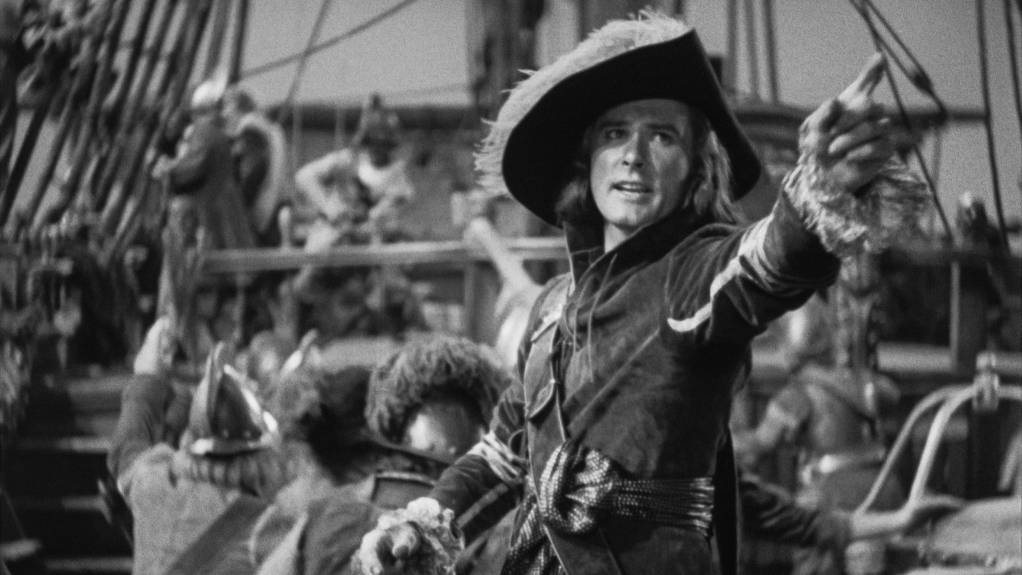
Dr Peter Blood (Errol Flynn) is having a bad day. Plucked from his bed to tend to a dying man by close friend Jeremy Pitt (Ross Alexander), he’s arrested. That’s because it’s 1685 and Jeremy and tat dying man are part of Monmouth’s ill-fated rebellion against James II. Blood, Pitt and many others are shipped to Jamaica and sold into slavery. Blood is purchased by the ambitious Colonel Bishop (Lionel Atwill), whose daughter Arabella (Olivia de Havilland) is strangely drawn to the proud slave. Blood struggles to find freedom for his friends, helped by his medical skills successfully treating the governor’s gout, until a fortunate Spanish attack gives them the chance to escape and set up a career as pirates – all while dreaming of one-day clearing their names.

It’s all gist to the swashbuckling mill, in this rip-roaringly entertaining adventure, the first collaboration of Curtiz, Flynn, de Havilland and Rathbone, that would eventually lead to the genre-defining brilliance of The Adventures of Robin Hood. Flynn was essentially plucked from nowhere, taking the part after an asthma-suffering Robert Donat turned it down, coached (or bullied) through the performance by the relentless task-master Curtiz, opposite a de Havilland with less than a handful of credits to her name. Everything pretty much comes together in a celebration of old-school matinee thrills, with a star oozing charisma at its heart.

Because, say what you like about Flynn, if there is star quality they guy had it in spades. Whether that’s swinging by rope from ship to ship, staunchly standing against injustice against Judge Jeffries (shooting off a few cutting one-liners on Jefferies ill-health along the way), defiantly stating he will never be broken when tied to a pole for a lashing or delicately navigating a spikey love-hate relationship with the haughtily playful Arabella, you can’t take your eyes off him. Captain Blood’s dialogue is frequently slightly heightened, but Flynn’s ease with it (which he learned the hard way – Curtiz reshot several earlier sequences later when he had relaxed and got better) lets it sing, as he stands tall and talks of equality and justice.

Captain Blood is in many ways the perfect Flynn vehicle, setting the template for the roles the star would later triumph in: an egalitarian man of nobility and principle, who fights when he must, with determination and never bitterness. Captain Blood uses this to maximum effect, surrounding Flynn with a cast of seasoned pros virtually none of whom were taller than his shoulders (just to make him look even more heroic as he towers above them). This was the guy Hollywood had been waiting for since Douglas Fairbanks, a hale-fellow well-met slice of masculine charm and energy.

He triumphs in a film which is often wordier and plot-heavier than you think. It’s a credit to the relentless energy Curtiz bring to it, that you almost don’t notice it takes nearly an hour before piracy enters this pirate movie, almost half its run time dedicated to Blood’s struggles in Jamaica. It works because the character dynamics are very well-drawn. George Hassell’s slightly pathetic governor, constantly whining about his gout is as entertaining as the two useless doctors (Hobart Cavanagh and Donald Meek) easily bested by Blood’s practical brilliance. Curtiz is also able to lay-on the grim injustice of indentured servitude on Jamaica, embodied by a gigantic mill wheel the prisoners turn round and round, to the constant soundtrack of lashing (it has to be said, Captain Blood does feel a bit awkward, especially today, in its near complete absence of Black slaves).

But you can don’t feel any drag when sequences like Blood’s defiant trial in England or the carefully measured flirtation between him and de Havilland (full of intelligence and allure) is so well done. And then of course, when you get to the piratical antics, it’s well worth the wait. Flynn, as noted, was made for making principled speeches in the nominal role of rebel (these pirates solemnly swear, among other things, never to mistreat a woman). The naval battles – brilliantly assembled from a mix of miniatures, old footage from silent films and studio-bound sets – are quite gripping, full of exploding ships, cannon fire, boardings and frantically energetic sword fights.

That’s almost nothing to the location-shot, shoreline duel among the rocks between Flynn and Rathbone. Basil Rathbone was surely only cast for his ability to fight duels like this – his character, a French pirate captain, is so unnecessary to the plot and turns on Blood for such trivial reasons, it’s hard not to feel it’s been shoe-horned in to give the actor something to do before the swords come out. The duel is full of deathly cut and thrust, with its final shot of Rathbone lying in the sand, the turf washing over his face (it’s no spoiler to say that Hollywood’s finest fencer again loses) beautifully done.

Captain Blood is full of visual style and flair, Curtiz the master-craftsman showing us all how it’s done. The Rembrandt-inspired locations of Stuart England are filled with angular lighting and giant-cast shadows. The camerawork through the mix of studio sets and location footing seamlessly ties locations together. His management of the film perfectly marries the scale of the adventure set-pieces with the elements of character stories that run throughout. It’s a film that manages to be exciting and witty, rollicking adventure and light comedy.

It also helps that it has a host of leading Hollywood character players doing fabulous work. Lionel Atwill is full of pomposity, self-importance and casual, unthinking cruelty as the ambitious Colonel Bishop. Ross Alexander – who tragically died only a year after the film was released – has a fair degree of earnest charisma. Guy Kibbee is hugely entertaining as grouchy Hagthorpe, a stand-out in a parade of crewmen (Frank McGlynn, David Torrance, Forrester Harvey and J Carrol Naish) who fully embrace their concisely written characters. And, of course, Olivia de Havilland is romantic allure itself, determined and independent and more than a match for Flynn.

As is the way with this era of Hollywood, there are several period details that are all over the place (a street light outside Blood’s London home?), with things like coaches and de Havilland’s dresses parachuted in from several decades later. But these little details are almost by-the-by in a film as full of energy, entertainment and excitement as this, a swashbuckler that continues to thrill and delight almost 90 years on.

A Midsummer Night’s Dream (1935)

A Midsummer Night’s Dream (1935)

Handsomely staged and quietly influential production, full of invention and good ideas

Director: Max Reinhardt, William Dieterle

Cast: James Cagney (Bottom), Joe E. Brown (Francis Flute), Dick Powell (Lysander), Jean Muir (Helena), Victor Jory (Oberon), Verree Teasdale (Hippolyta), Hugh Herbert (Snout), Anita Louise (Titania), Frank McHugh (Quince), Ross Alexander (Demetrius), Ian Hunter (Theseus), Mickey Rooney (Puck), Olivia de Havilland (Hermia), Dewey Robinson (Snug), Grant Mitchell (Egeus), Arthur Treacher (Epilogue)

It says something about Hollywood’s back-and-forth relationship with Shakespeare, that Reinhardt and Dieterle’s film can still make a case for being one of its finest Hollywood Shakespeare films. What’s fascinating about it is how much attitudes towards it have changed over time. Opening to a chorus of sniffs from the critics (“It should never have been filmed!”), horrified about the blasphemy of the Bard on celluloid, the things praised at the time now feel the stuffiest while the elements criticised feel fresh and dynamic. Personally, it’s crazy mix of genres, eras, comedic styles and dramatic tone feels like the sort of thing Shakespeare (a consummate showman who spoke in poetry) might have enjoyed.

It came about because Jack Warner wanted a bit of class. Max Reinhardt, internationally famous avant-garde theatre director, as part of Warner’s power thruple: direction by Reinhardt, music by Mendelssohn, words by Shakespeare! Reinhardt had directed a lavish production at the Hollywood Bowl (which also featured Rooney as Puck and de Havilland as Hermia), that would form the basis of his film, incorporating ballet and impressive visual effects. William Dieterle, was bought in to translate Reinhardt’s vision to film (since it quickly became clear Reinhardt didn’t know how to make a movie).

We get an MND that mixes farcical comedy with a dark, sensuous energy. Athen’s forest was transformed by Hal Mohr’s Oscar-winning photography into a glittering fantasy land, created with a mixture of superimposition and miles of cellophane wrapped around the perfectly-recreated trees to reflect the studio lights in a shimmering dance. But in this, is a fairy world of danger and chaos: Reinhardt’s pioneered the interpretation of Puck (played with malicious gusto by Mickey Rooney) as a fire-lighting child, revelling in the chaos his actions cause. Rooney (or rather his double, as Rooney broke a leg early in production) skips and sways, laughing maniacally, tormenting the lovers (possibly even controlling their words and actions), unleashing dark forces of the night.

The film is full of such dark forces – a surprise to critics who saw Dream as a gentle comedy. The ballet sequences, used by Reinhardt to visually demonstrate Oberon’s and Titania’s power to manipulate the environment around them, feature demonic dancers who wouldn’t look out of place in Faust, creepy music-playing goblins and a constant sense of unknowable power. Victor Jory – highly praised at the time, although his precise, poetic reading feels austere and lacking in feeling today – is a darkly imperious Oberon, with barely a trace of warmth to him. (Anita Louise’s Titania also takes a traditional line, speaking with a slightly irritating sing-song that should serve the poetry but instead drains it of life.)

You suspect, if he could have got away with it, Reinhardt might have allowed a trace of bestiality to enter into Titania’s romance with the transformed Bottom. As it is, he settles for Titania snatching a coronet from the Indian boy (nicely introduced early, to cement the split between the two fairy monarchs) who bursts into tears, increasing the feeling that the fairies are inconsistent, temporary creatures, perfectly willing to drop previously treasured people for whoever else captures their attention.

Lavish spectacle runs throughout a play that feels highly indebted to Raphael and the other Renaissance masters. Reinhardt has no problem switching styles: Theseus’ arrival is staged like an Ancient Roman pageant, before settling into a Renaissance style court while the Mechanicals could have stepped straight out of Brueghel. Again, it’s a playing around with style and location that looks very modern today but short-circuited reverentially literal critics at the time. Reinhardt even plays with the idea of Hippolyta being a less-than-willing partner for Theseus (she appears defiantly restrained in the opening scene), although this is largely benched for later scenes.

The lavish opening also shows the production’s ability to balance comedy and drama. Alongside the traditionalist grandiosity, we have low comedy from both the lovers and mechanicals. In a fast-cut, skilfully assembled array of moments (surely Dieterle’s work), the relationships between the four lovers are expertly displayed and mined for comic energy (particularly Lysander’s and Demetrius’ private competition to sing loudest) as are those between the mechanicals (from Bottom’s enthusiasm to Quince’s frustration at the terminal stupidity of Flute).

The mechanicals are one of the greatest divergence in critical opinion between then and now. To critics at the time it was a jaw-dropping mistake to cast Cagney and a host of film comedians in Shakespeare – surely these were roles for the likes of Gielgud? Everything from their delivery to the posture was lambasted for being crude and too damn American for a genre considered the exclusive preserve of the well-spoken likes of Jory and Hunter. However, the energy and naturalness of these actors – and the consummate comic timing they pull out of their roles – is one of the film’s greatest touches.

Cagney was never afraid to look beat-up or ridiculous, and he revels as an explosive ball of energy as Bottom. He flings himself, with the same energy as Bottom, into over-enunciated voices and grand displays of ‘bad acting’, parodying a host of styles from classical to pantomime to stage comedy. Cagney also makes him sweetly naïve and childishly literal, while his gentle, polite mystification about being treated like a king by the fairies seems rather sweet. The other mechanicals are also genuinely excellent, doing one of the hardest things: making Shakespearean comedy work on screen. Joe E Brown is hilarious as a supernaturally dim Flute, barely able to remember what gender he is playing; Hugh Herbert’s Snout has an infectious nervous giggle he can’t control, Frank McHugh’s Quince parodies directors like DeMille. Each of them contributes to a genuinely funny Pyramus and Thisbe that closes the film.

It’s more funny than the sometimes-forced banter between the lovers, not helped by a far too broad performance by Dick Powell (who later claimed he didn’t understand a word he was saying) that makes Lysander somewhere between a buffoon and an egotist. Olivia de Havilland (perhaps not surprisingly) emerges best here as a heartfelt Hermia, although the quarrel between the lovers is perhaps the least well staged sequence in the film (Reinhardt and Dieterle resort to all four of them at points speaking their lines at the same time, as if wanting to get the scene over and done with).

But MND is awash with other touches of cinematic and interpretative invention, it’s darkish vision of the Fairy world (with superimposition and ballet interjections giving it a darkly surreal touch) as influential as it’s haphazard approach to place and setting. Its comic performances come alive with real energy, devoid of the more stately approach from others. Above all, MND feels like an actual interpretation of its source material, rather than just a respectful staging – and its influence played out over decades of productions to come. Overlooked for too long, it’s a fine and daring piece of film Shakespeare, far better than it has a right to be.