Tag: Donald Meek

Captain Blood (1935)

Captain Blood (1935)

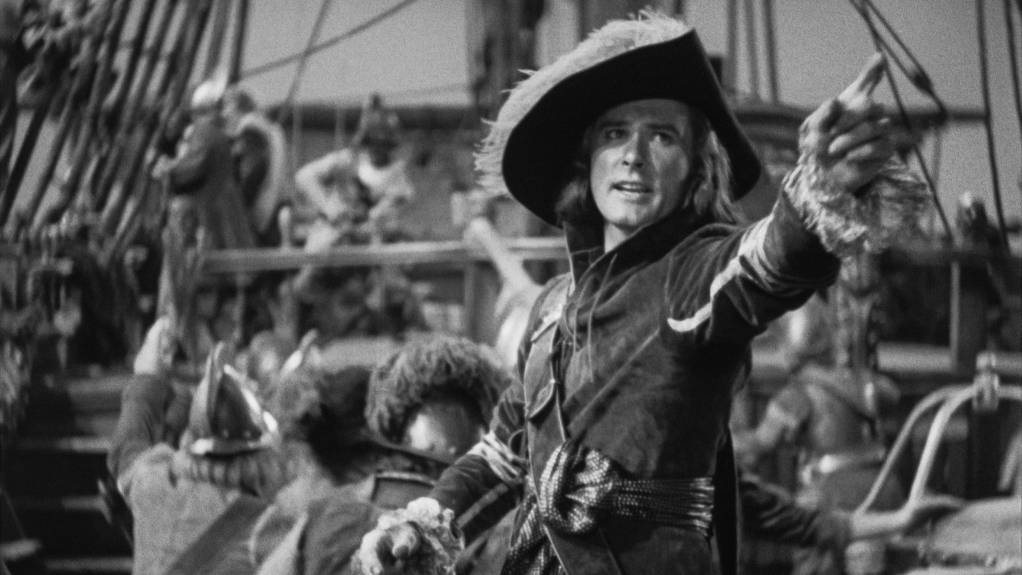
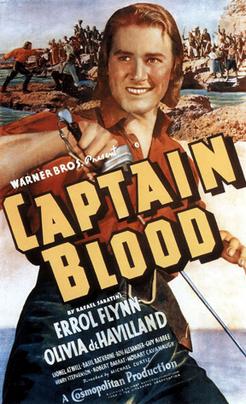
Errol Flynn buckles swashes in this stirring and exciting pirate adventure

Director: Michael Curtiz

Cast: Errol Flynn (Peter Blood), Olivia de Havilland (Arabella Bishop), Lionel Atwill (Colonel Bishop), Basil Rathbone (Lavasseur), Ross Alexander (Jeremy Pitt), Guy Kibbee (Hagthorpe), Henry Stephenson (Lord Willoughby), Robert Barrat (Wolverstone), Hobart Cavanagh (Dr Bronson), Donald Meek (Dr Whacker), Jessie Ralph (Mrs Barlow), Frank McGlynn Snr (Reverend Ogle), David Torrence (Andrew Baynes), J. Carrol Naish (Cabusac), George Hassell (Governor Steed), Halliwell Hobbes (Sunderland)

Dr Peter Blood (Errol Flynn) is having a bad day. Plucked from his bed to tend to a dying man by close friend Jeremy Pitt (Ross Alexander), he’s arrested. That’s because it’s 1685 and Jeremy and tat dying man are part of Monmouth’s ill-fated rebellion against James II. Blood, Pitt and many others are shipped to Jamaica and sold into slavery. Blood is purchased by the ambitious Colonel Bishop (Lionel Atwill), whose daughter Arabella (Olivia de Havilland) is strangely drawn to the proud slave. Blood struggles to find freedom for his friends, helped by his medical skills successfully treating the governor’s gout, until a fortunate Spanish attack gives them the chance to escape and set up a career as pirates – all while dreaming of one-day clearing their names.

It’s all gist to the swashbuckling mill, in this rip-roaringly entertaining adventure, the first collaboration of Curtiz, Flynn, de Havilland and Rathbone, that would eventually lead to the genre-defining brilliance of The Adventures of Robin Hood. Flynn was essentially plucked from nowhere, taking the part after an asthma-suffering Robert Donat turned it down, coached (or bullied) through the performance by the relentless task-master Curtiz, opposite a de Havilland with less than a handful of credits to her name. Everything pretty much comes together in a celebration of old-school matinee thrills, with a star oozing charisma at its heart.

Because, say what you like about Flynn, if there is star quality they guy had it in spades. Whether that’s swinging by rope from ship to ship, staunchly standing against injustice against Judge Jeffries (shooting off a few cutting one-liners on Jefferies ill-health along the way), defiantly stating he will never be broken when tied to a pole for a lashing or delicately navigating a spikey love-hate relationship with the haughtily playful Arabella, you can’t take your eyes off him. Captain Blood’s dialogue is frequently slightly heightened, but Flynn’s ease with it (which he learned the hard way – Curtiz reshot several earlier sequences later when he had relaxed and got better) lets it sing, as he stands tall and talks of equality and justice.

Captain Blood is in many ways the perfect Flynn vehicle, setting the template for the roles the star would later triumph in: an egalitarian man of nobility and principle, who fights when he must, with determination and never bitterness. Captain Blood uses this to maximum effect, surrounding Flynn with a cast of seasoned pros virtually none of whom were taller than his shoulders (just to make him look even more heroic as he towers above them). This was the guy Hollywood had been waiting for since Douglas Fairbanks, a hale-fellow well-met slice of masculine charm and energy.

He triumphs in a film which is often wordier and plot-heavier than you think. It’s a credit to the relentless energy Curtiz bring to it, that you almost don’t notice it takes nearly an hour before piracy enters this pirate movie, almost half its run time dedicated to Blood’s struggles in Jamaica. It works because the character dynamics are very well-drawn. George Hassell’s slightly pathetic governor, constantly whining about his gout is as entertaining as the two useless doctors (Hobart Cavanagh and Donald Meek) easily bested by Blood’s practical brilliance. Curtiz is also able to lay-on the grim injustice of indentured servitude on Jamaica, embodied by a gigantic mill wheel the prisoners turn round and round, to the constant soundtrack of lashing (it has to be said, Captain Blood does feel a bit awkward, especially today, in its near complete absence of Black slaves).

But you can don’t feel any drag when sequences like Blood’s defiant trial in England or the carefully measured flirtation between him and de Havilland (full of intelligence and allure) is so well done. And then of course, when you get to the piratical antics, it’s well worth the wait. Flynn, as noted, was made for making principled speeches in the nominal role of rebel (these pirates solemnly swear, among other things, never to mistreat a woman). The naval battles – brilliantly assembled from a mix of miniatures, old footage from silent films and studio-bound sets – are quite gripping, full of exploding ships, cannon fire, boardings and frantically energetic sword fights.

That’s almost nothing to the location-shot, shoreline duel among the rocks between Flynn and Rathbone. Basil Rathbone was surely only cast for his ability to fight duels like this – his character, a French pirate captain, is so unnecessary to the plot and turns on Blood for such trivial reasons, it’s hard not to feel it’s been shoe-horned in to give the actor something to do before the swords come out. The duel is full of deathly cut and thrust, with its final shot of Rathbone lying in the sand, the turf washing over his face (it’s no spoiler to say that Hollywood’s finest fencer again loses) beautifully done.

Captain Blood is full of visual style and flair, Curtiz the master-craftsman showing us all how it’s done. The Rembrandt-inspired locations of Stuart England are filled with angular lighting and giant-cast shadows. The camerawork through the mix of studio sets and location footing seamlessly ties locations together. His management of the film perfectly marries the scale of the adventure set-pieces with the elements of character stories that run throughout. It’s a film that manages to be exciting and witty, rollicking adventure and light comedy.

It also helps that it has a host of leading Hollywood character players doing fabulous work. Lionel Atwill is full of pomposity, self-importance and casual, unthinking cruelty as the ambitious Colonel Bishop. Ross Alexander – who tragically died only a year after the film was released – has a fair degree of earnest charisma. Guy Kibbee is hugely entertaining as grouchy Hagthorpe, a stand-out in a parade of crewmen (Frank McGlynn, David Torrance, Forrester Harvey and J Carrol Naish) who fully embrace their concisely written characters. And, of course, Olivia de Havilland is romantic allure itself, determined and independent and more than a match for Flynn.

As is the way with this era of Hollywood, there are several period details that are all over the place (a street light outside Blood’s London home?), with things like coaches and de Havilland’s dresses parachuted in from several decades later. But these little details are almost by-the-by in a film as full of energy, entertainment and excitement as this, a swashbuckler that continues to thrill and delight almost 90 years on.

Stagecoach (1939)

Stagecoach (1939)

Iconic action adventure, a very exciting chase film with a strong script and characters

Director: John Ford

Cast: Claire Trevor (Dallas), John Wayne (The Ringo Kid), Andy Devine (Buck Rickabaugh), John Carradine (Hatfield), Thomas Mitchell (Dr Josiah Boone), Louise Platt (Lucy Mallory), George Bancroft (Sheriff Curly Wilcox), Donald Meek (Samuel Peacock), Berton Churchill (Gatewood), Tim Holt (Lt Blanchard), Tom Tyler (Luke Plummer), Chris-Pin Martin (Chris), Francis Ford (Billy Pickett)

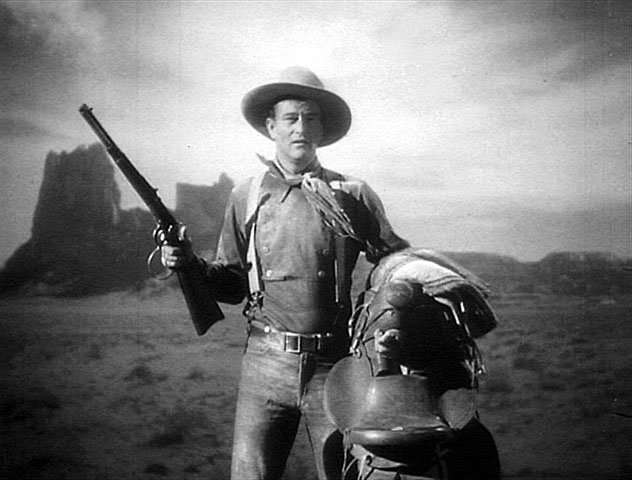
It might be the greatest star entrance of all time. Before Stagecoach, John Wayne was a minor leading man from a never-ending stream of oats-and-saddles B-movies. But, after one shot – a superb fast-paced zoom (so fast, the focus slips at one point) into the stoic face of Wayne, Winchester rifle twirling – that wasn’t going to be the case anymore. Stagecoach was Ford’s return to the Western – and he was bringing a friend along for the ride. After it, both director and star would become synonymous with the genre and Wayne would remain Hollywood’s Mayor-in-all-but-name.

Of course, that shot alone didn’t make Wayne a star (but, as you can imagine Andy Devine’s Buck wheezing “it sure helped, didn’t it”). What cemented the deal was what the hugely entertaining thrill ride Stagecoach is, a rollicking journey through Monument valley, crammed with just about anything you could want, from gun-battles and stunts to class commentary and arch dialogue. Like some sort of JB Priestley play, a regular smorgasbord of folks climb into a stagecoach to travel from Tonto to Lordsburg, facing a parade of dangers from Geronimo’s Apaches along the way – not to mention their own personality clashes and business to take care off in Lordsburg. All aboard!

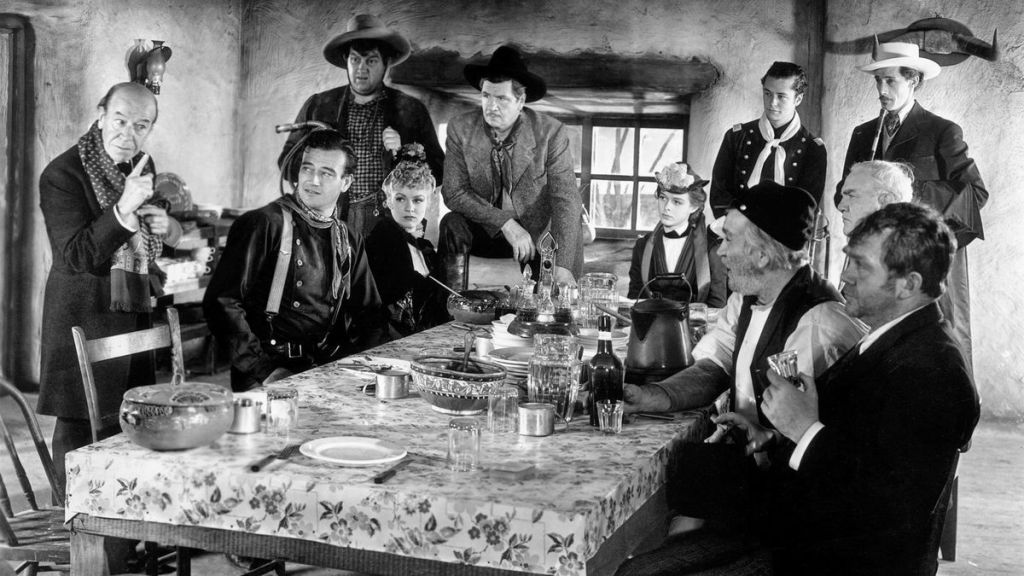
We’ve got prostitute Dallas (Claire Trevor), run out of town by ‘blessed civilisation’ – much like drunken surgeon Dr Boone (Thomas Mitchell) – hoping for a new life. Army wife Lucy Mallory (Lucy Platt) trying to find her missing husband, escorted by Southern gent turned gambler Hatfield (John Carradine); both are more than a little uncomfortable sharing a carriage with a lady of the night. They probably wish the carriage had more people like bank manager Gatewood (Benton Churchill), although they might change their mind if they knew he was an embezzler. Sheriff Curly Wilcox (George Bancroft) is trying to catch escaped prisoner The Ringo Kid (John Wayne), who is himself keen to get to Lordsburg to take down the Plummer gang who killed his father and brother.

All of these well-drawn characters – including the timid whisky salesman (whose name no-one can remember) Peacock (well played by the suitably named Donald Meek) – are bought vividly to life by a strong bunch of actors working with a well-constructed script by Dandy Nichols, crammed with sharp lines and wit. It’s packaged together by Ford into a film that’s lean, plays out at a whipper-cracker pace and juggles several plots, threats and character motivations all at once.

You can see Ford’s mastery of story-telling throughout Stagecoach. The opening fifteen minutes is a superbly efficient piece of lean scene-setting which, in a series of tightly-focused, engaging scenes, brilliantly introduces the principle characters, their motivations and the twin dangers of the Indians on the road and the Plummers in Lordsburg all in perfectly digestible chunks. In addition, Ford carefully introduces the class commentary that greases Stagecoach’s wheels: from the unconcealed loathing and disdain Dallas is treated with by the town’s worthies (including the appalled revulsion of Hatfield and the marginally less strident disdain shown by Lucy) to the unquestioned bluster of blowhard fat-cat Gatewood, whose blatantly transparent lies and increasing nervousness draws no where near the level of suspicion it should do.

But then most people are too worried about catching sin-by-touch from Dallas. Stagecoach never outright states her profession, but only the naïve Ringo Kid seems unaware she’s on-the-game. At the first stop on the journey, Ford orchestrates a perfectly constructed scene of micro-aggressions and class structure, where Ringo guiltily utterly misreads as snobbery about his own jailbird past. (Hatfield is so committed to keeping the distance between himself and Dallas, he won’t even let her borrow his water glass as he does Lucy, tossing Dallas the canteen to drink straight from instead). Similar disdain also meets Dr Boone, whose utter refusal to even slightly moderate his drinking (he spends the first day getting sozzled) disgusts the elite passengers, right up until his skills are needed during a medical emergency. (At this point Hatfield starts treating him as the fount of wisdom).

Ford’s sympathies are, like so often, with the tough little-guys out in the West, who judge people by who they are and what they do rather than where they come from. Claire Trevor is perfectly cast as Dallas, never a victim but always full of patient defiance, all-to-used to the snubs from others. But we respect Dallas because it’s clear – from the start – she’s kind, considerate and decent. When the chips are down for Laura, it’s Dallas and Boone (not self-appointed guardian Hatfield) who step-up to save her, and never once does it cross their mind to hold Lucy to account first.

Just the same is, of course, The Ringo Kid. Stagecoach was possibly the last time Wayne could plausibly be called ‘the Kid’ – he looks older than his 32 years already – and he fills the part with a sincere honesty, courtesy and straight-forwardness that would become integral to Ford’s films, while still making the Kid the rough-and-tumble hero you want to be. The Ringo Kid may be a jailbird, but treats people according to their personal merits, sticks to his word, unhesitatingly protects people (that iconic introduction is him warning the coach of danger ahead) and won’t do anything he isn’t unwilling to do himself. It’s people like that – and Thomas Mitchell’s Oscar winning (Mitchell had key roles in half the best picture nominees that year, so had to win for something!) Doc Boone who turns himself into a master surgeon by force-of-will alone – who form the backbone of Ford’s West.

This all sits alongside some truly sensational action-adventure. Most of Stagecoach is a long build-up to its two action sequences that end the film: the running attack across the wide-open desert sands from the Apache and Ringo’s fateful duel with the Plummers. The eight-and-a-half minute chase would be the highlight of any film, a dynamic, pulsating masterclass of tight editing and tracking shots that fills the screen with electric pace and energy. It also has some of the most iconic stunts of all time, executed by Yakima Canutt Wayne’s long-term stunt consultant. From Canutt-as-Ringo jumping from pair-of-horses to pair-of-horses in front of the coach galloping at full-speed, to Canutt-as-Apache leaping from horse, to coach horses to falling and bring dragged under the coach (a stunt homage by Raiders of the Lost Ark’s truck chase) their visceral thrill is made even more exciting by Ford’s camera speeds making them look like they took place at even faster pace than the 45-miles-an-hour the horses were galloping at.

Ringo’s final duel with the Plummers gets a different approach, a long, steadily paced build-up that culminates in a very low camera watching a ready-for-action Wayne move towards us like a striding mountain. Stagecoach is also a masterclass in visual imagery and camera-use – so much so Orson Welles literally used it as such in prep for Citizen Kane, screening it over 40 times. Not just in action and editing, but also the brilliance of placement. Stagecoach’s low-ceilinged sets and striking shadows are a clear influence on Kane. A superb shot of Dallas from down a corridor, framed in light strewn from an open doorway, is a wonderful piece of visual poetry and there are gorgeous visual flourishes throughout, from the black cat that crosses the Plummer’s path to the wonderful vistas from Ford’s first trip to Monument valley.

All of this comes together into a film that is a wonderfully entertaining character study, wrapped up with a series of knock-out set-pieces, with romance, comedy and social commentary thrown in on top. It’s perhaps one of the most purely ‘entertaining’ Westerns ever made and one of Ford’s finest fusions of artistic brilliance and popcorn chewing thrill-rides.

Young Mr Lincoln (1939)

Henry Fonda excels in the origins story as the Young Mr Lincoln

Director: John Ford

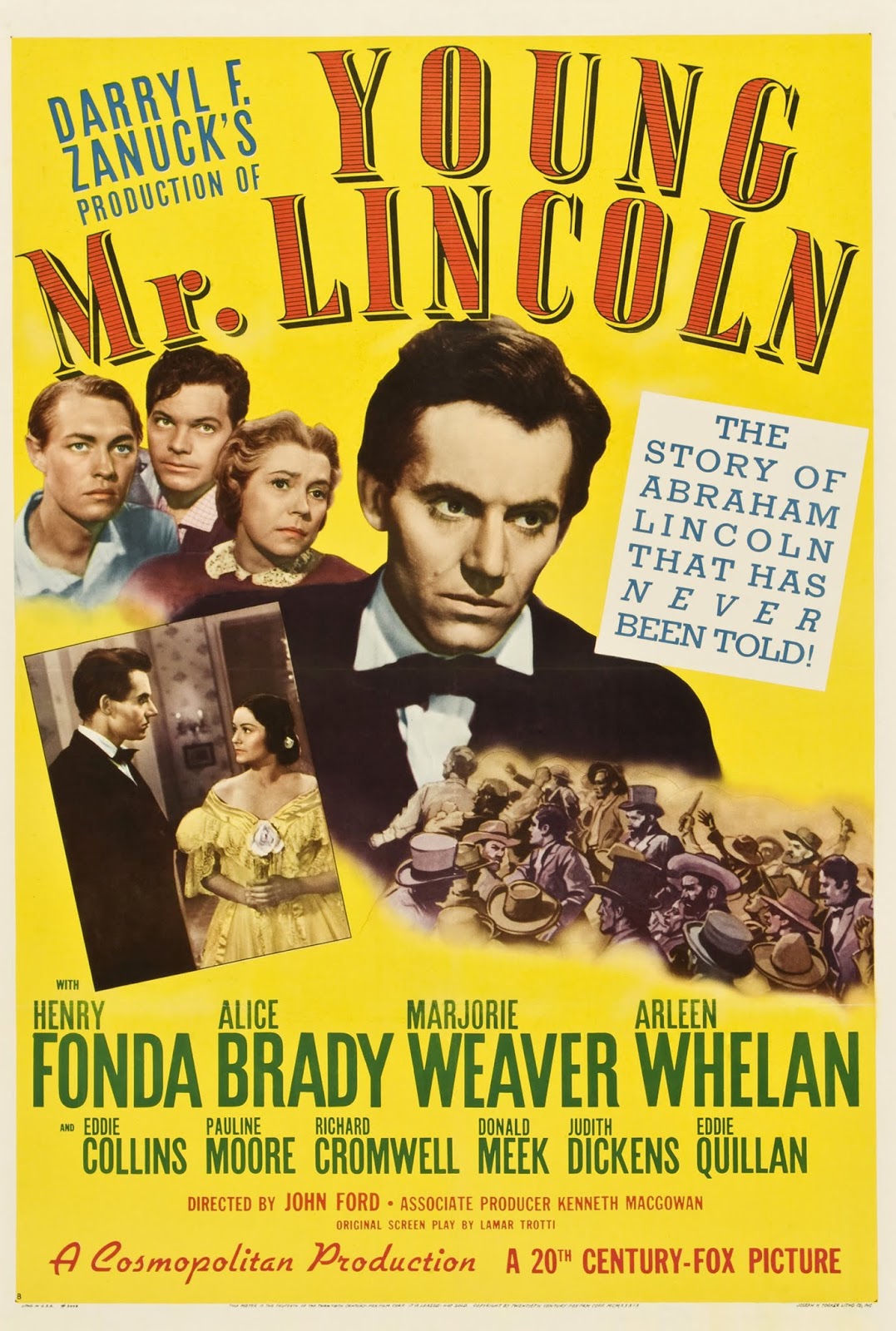
Cast: Henry Fonda (Abraham Lincoln), Alice Brady (Abigail Clay), Marjorie Weaver (Mary Todd), Arleen Weaver (Sarah Clay), Eddie Collins (Efe Turner), Pauline Moore (Ann Rutledge), Richard Cromwell (Matt Clay), Donald Meek (Prosecutor John Felder), Eddie Quillan (Adam Clay), Spencer Charters (Judge Herbert A Bell), Ward Bond (John Palmer Cass), Milburn Stone (Stephen A Douglas)

John Ford is often called the mythmaker of America, the director who perhaps contributed more than any other to building a romantic vision of America’s roots and past. As an explorer of the legends and mythology that underpinned his country, it’s perhaps no great surprise that he directed a film about the American revered more than any other since the Founding Fathers – Abraham Lincoln himself.

Playing out over 10 years, the film follows Young Honest Abe (Henry Fonda) from his days of autodidactism with a law book in Illinois, through his love for, and the death of, Ann Rutledge (Pauline Moore) and his arrival in Springfield to practice law (which he does with a shrewdness mixed with the wisdom of Solomon). The bulk of the film’s plot focuses in particular on him representing two brothers accused of murder in a courtroom trial, where Lincoln’s wit, wisdom and determination see justice done.

Okay reading that subplot, it’s pretty clear that this is a fairly rose-tinted view of The Great Emancipator. Henry Fonda had put off playing the role, as he felt it would be like hewing a performance out of marble. It’s hard for non-Americans to even begin to understand the reverence with which Lincoln is almost universally held in America, but it runs through this film like sugar through a stick of rock. Lincoln throughout the film is maybe an increasingly canny operator with a mastery of winning people over and playing crowds large and small, but he’s also always right, always does the right thing and always has a warm regard and love for genuine real people.

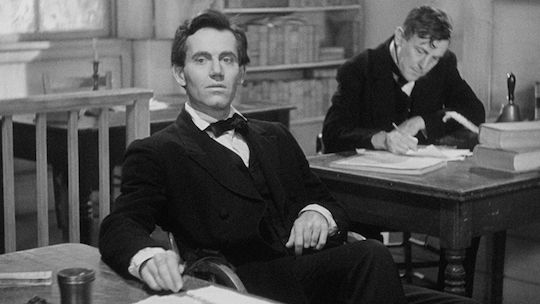
If you made the film today it would probably be called Abraham Lincoln: Origins, as Ford shows Lincoln building up all the weapons that would become central to his political artistry. Fonda starts the film gangly and physically awkward, finding it hard to know what to do with his height or long arms while giving speeches (Fonda wore platform shoes to increase his height). But even at the start his words are warm and genuine, even if his delivery is awkward. It’s something he masters to a far greater degree by the mid-way point of the film, when he skilfully diffuses a potential lynch mob with wit, gentleness, calm and a bit of righteous shaming. By the time he hits the courtroom, he’s overwhelmingly confident in his physicality and able to match it up with his oratorical brilliance and his skill at using seemingly rambling, inconsequential stories to suddenly hit home a sharp and painful truth.

Fonda’s impressive performance as Lincoln makes the film. Fonda gives Lincoln not just these positives but also hints at his sharpness of mind and his cunning. Negotiating a legal disagreement between two farmers (which he does with such skill that both end up paying him), he not only gives a fair sentence, but shows how he is not above manipulating men to achieve his ends (and, in biting one of the coins that he is given, that he may be honest himself but he’s not always trusting). He has a romantic regard for the mother of his clients (played very well by Alice Brady), but can still gently patronise her with his romantic ideal of her as an ideal American mother.

But when the push comes, Lincoln is a man of principle, wrapped in a skilful performance. The idea of mob justice is anathema to him, while Fonda makes clear he’s smart enough to not say that outright but to guide the crowd to agree with him. During the selection of the jury for the courtroom scene, he will accept men honest enough to say they favour hanging for the guilty, but turn down equivocators or those who believe they are better than the accused men. During the trial scene, he erupts in moral outage when the boys’ mother is pressured into naming one of her sons as the killer so as to save the other from the death penalty.

But he’s also a clever and brilliant player of the game, able to charm both the working classes and the rich, even if he’s not comfortable with either. During the trial scene, his quick wit and relaxation run rings around the government prosecutor (a good role of absolute convictions from Donald Meek) and he easily wins the crowd over with a series of gags and light touches that also carry with them a real, deep truth. Ford is also able to show his ambition – over the grave of Ann Rutledge he lets the fall of a stick decide whether he will continue his career or stay at home, and he all too clearly lets the stick lean over one way before letting it fall (he even acknowledges this himself).

Ford’s film is only very loosely based on actual true events – only the final coup Lincoln uses to win the case is really based on fact. The film is covered with smatterings of what look now like clumsy droppings in of key facts or persons from Lincoln’s life – from the cowpoke who plays “Dixie” (“Sounds like a song you could march to” is Lincoln’s comment) to Lincoln meeting future-wife Mary Todd, to his legal (and romantic) rival being none other than Stephen A Douglas his later rival for the presidency. There could have been a lot more, but afraid that it would make the film ridiculous, Ford kept these to a minimum by simply refusing to shoot them (such as a planned scene where Lincoln met John Wilkes Booth).

It all works because the audience knows who Lincoln will become, and it’s told with an earnestness and a certain amount of pace. Ford however really crafts a modern American myth and it even ends in a suitably epic scale: having won the case, Lincoln strikes off for a walk up a hill, trudging into the distance while a storm brews, heading onwards and upwards away from us and into his future. Sure it’s corn, but it works.