Tag: Lionel Atwill

Captain Blood (1935)

Captain Blood (1935)

Errol Flynn buckles swashes in this stirring and exciting pirate adventure

Director: Michael Curtiz

Cast: Errol Flynn (Peter Blood), Olivia de Havilland (Arabella Bishop), Lionel Atwill (Colonel Bishop), Basil Rathbone (Lavasseur), Ross Alexander (Jeremy Pitt), Guy Kibbee (Hagthorpe), Henry Stephenson (Lord Willoughby), Robert Barrat (Wolverstone), Hobart Cavanagh (Dr Bronson), Donald Meek (Dr Whacker), Jessie Ralph (Mrs Barlow), Frank McGlynn Snr (Reverend Ogle), David Torrence (Andrew Baynes), J. Carrol Naish (Cabusac), George Hassell (Governor Steed), Halliwell Hobbes (Sunderland)
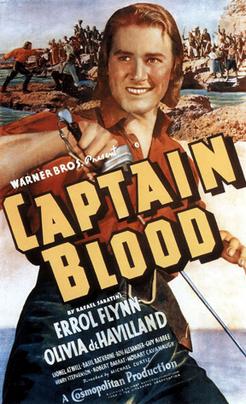
Dr Peter Blood (Errol Flynn) is having a bad day. Plucked from his bed to tend to a dying man by close friend Jeremy Pitt (Ross Alexander), he’s arrested. That’s because it’s 1685 and Jeremy and tat dying man are part of Monmouth’s ill-fated rebellion against James II. Blood, Pitt and many others are shipped to Jamaica and sold into slavery. Blood is purchased by the ambitious Colonel Bishop (Lionel Atwill), whose daughter Arabella (Olivia de Havilland) is strangely drawn to the proud slave. Blood struggles to find freedom for his friends, helped by his medical skills successfully treating the governor’s gout, until a fortunate Spanish attack gives them the chance to escape and set up a career as pirates – all while dreaming of one-day clearing their names.

It’s all gist to the swashbuckling mill, in this rip-roaringly entertaining adventure, the first collaboration of Curtiz, Flynn, de Havilland and Rathbone, that would eventually lead to the genre-defining brilliance of The Adventures of Robin Hood. Flynn was essentially plucked from nowhere, taking the part after an asthma-suffering Robert Donat turned it down, coached (or bullied) through the performance by the relentless task-master Curtiz, opposite a de Havilland with less than a handful of credits to her name. Everything pretty much comes together in a celebration of old-school matinee thrills, with a star oozing charisma at its heart.

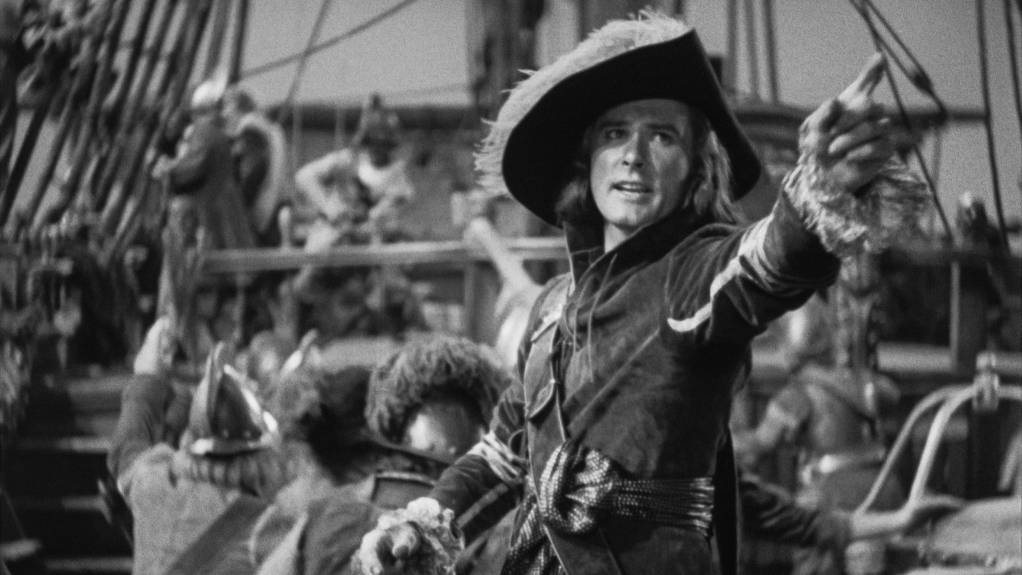
Because, say what you like about Flynn, if there is star quality they guy had it in spades. Whether that’s swinging by rope from ship to ship, staunchly standing against injustice against Judge Jeffries (shooting off a few cutting one-liners on Jefferies ill-health along the way), defiantly stating he will never be broken when tied to a pole for a lashing or delicately navigating a spikey love-hate relationship with the haughtily playful Arabella, you can’t take your eyes off him. Captain Blood’s dialogue is frequently slightly heightened, but Flynn’s ease with it (which he learned the hard way – Curtiz reshot several earlier sequences later when he had relaxed and got better) lets it sing, as he stands tall and talks of equality and justice.

Captain Blood is in many ways the perfect Flynn vehicle, setting the template for the roles the star would later triumph in: an egalitarian man of nobility and principle, who fights when he must, with determination and never bitterness. Captain Blood uses this to maximum effect, surrounding Flynn with a cast of seasoned pros virtually none of whom were taller than his shoulders (just to make him look even more heroic as he towers above them). This was the guy Hollywood had been waiting for since Douglas Fairbanks, a hale-fellow well-met slice of masculine charm and energy.

He triumphs in a film which is often wordier and plot-heavier than you think. It’s a credit to the relentless energy Curtiz bring to it, that you almost don’t notice it takes nearly an hour before piracy enters this pirate movie, almost half its run time dedicated to Blood’s struggles in Jamaica. It works because the character dynamics are very well-drawn. George Hassell’s slightly pathetic governor, constantly whining about his gout is as entertaining as the two useless doctors (Hobart Cavanagh and Donald Meek) easily bested by Blood’s practical brilliance. Curtiz is also able to lay-on the grim injustice of indentured servitude on Jamaica, embodied by a gigantic mill wheel the prisoners turn round and round, to the constant soundtrack of lashing (it has to be said, Captain Blood does feel a bit awkward, especially today, in its near complete absence of Black slaves).

But you can don’t feel any drag when sequences like Blood’s defiant trial in England or the carefully measured flirtation between him and de Havilland (full of intelligence and allure) is so well done. And then of course, when you get to the piratical antics, it’s well worth the wait. Flynn, as noted, was made for making principled speeches in the nominal role of rebel (these pirates solemnly swear, among other things, never to mistreat a woman). The naval battles – brilliantly assembled from a mix of miniatures, old footage from silent films and studio-bound sets – are quite gripping, full of exploding ships, cannon fire, boardings and frantically energetic sword fights.

That’s almost nothing to the location-shot, shoreline duel among the rocks between Flynn and Rathbone. Basil Rathbone was surely only cast for his ability to fight duels like this – his character, a French pirate captain, is so unnecessary to the plot and turns on Blood for such trivial reasons, it’s hard not to feel it’s been shoe-horned in to give the actor something to do before the swords come out. The duel is full of deathly cut and thrust, with its final shot of Rathbone lying in the sand, the turf washing over his face (it’s no spoiler to say that Hollywood’s finest fencer again loses) beautifully done.

Captain Blood is full of visual style and flair, Curtiz the master-craftsman showing us all how it’s done. The Rembrandt-inspired locations of Stuart England are filled with angular lighting and giant-cast shadows. The camerawork through the mix of studio sets and location footing seamlessly ties locations together. His management of the film perfectly marries the scale of the adventure set-pieces with the elements of character stories that run throughout. It’s a film that manages to be exciting and witty, rollicking adventure and light comedy.

It also helps that it has a host of leading Hollywood character players doing fabulous work. Lionel Atwill is full of pomposity, self-importance and casual, unthinking cruelty as the ambitious Colonel Bishop. Ross Alexander – who tragically died only a year after the film was released – has a fair degree of earnest charisma. Guy Kibbee is hugely entertaining as grouchy Hagthorpe, a stand-out in a parade of crewmen (Frank McGlynn, David Torrance, Forrester Harvey and J Carrol Naish) who fully embrace their concisely written characters. And, of course, Olivia de Havilland is romantic allure itself, determined and independent and more than a match for Flynn.

As is the way with this era of Hollywood, there are several period details that are all over the place (a street light outside Blood’s London home?), with things like coaches and de Havilland’s dresses parachuted in from several decades later. But these little details are almost by-the-by in a film as full of energy, entertainment and excitement as this, a swashbuckler that continues to thrill and delight almost 90 years on.

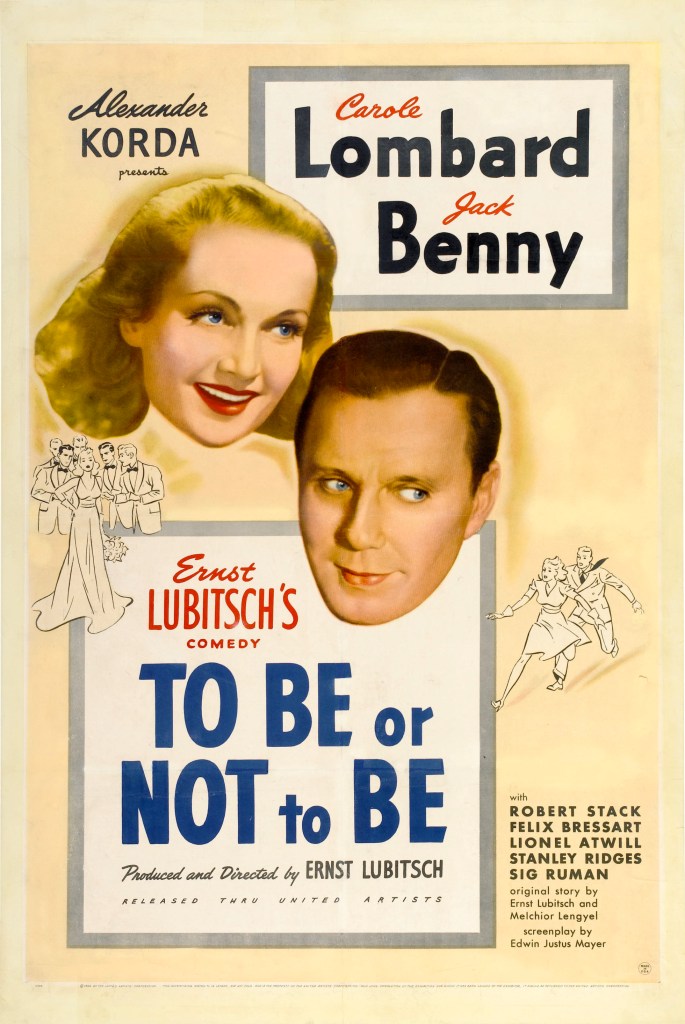
To Be or Not To Be (1942)

To Be or Not To Be (1942)

Hilarious Lubitsch comedy that walks a fine line between the dark horrors and absurdities of Fascism

Director: Ernst Lubitsch

Cast: Carole Lombard (Maria Tura), Jack Benny (Joseph Tura), Robert Stack (Lt Stanislav Sobinski), Felix Bressart (Greenberg), Lionel Atwill (Rawitch), Stanley Ridges (Professor Alexander Siletsky), Sig Rumann (Colonel Erhardt), Tom Dugan (Bronski), Charles Halton (Dobosh), George Lynn (Actor Schultz), Henry Victor (Captain Schultz)

Is there a setting less likely for the famous Lubitsch Touch than war-torn Warsaw? To Be or Not To Be is a farce set at the most serious of times, sharp-paced, smooth and very funny. But it’s also about how the sort of playful, civilised class of eccentric free-spirits that Lubitsch excelled at can win through, even at the most dreadful of times against barely-sane bullies. What To Be or Not To Be does best – as well as make you laugh – is give you hope there is some light at the end of the tunnel.

The Turas – husband and wife Joseph (Jack Benny) and Maria (Carole Lombard) – are the (self-proclaimed) most famous actors in Poland. But the season 1939 is tough: their latest play Gestapo (a piss-take of course) is canned because the government is worried it might upset Hitler. Joseph revives his Hamlet and Maria uses the start of his ‘To Be or Not To Be’ soliloquy as the perfect time to entertain her current lover Lt Sobinski (Robert Stack) in her dressing room. Flirtations like this get left behind after the Germans invade, Sobinski flees to join the RAF and the theatre is shuttered.

For most of that, To Be or Not To Be fits neatly into the Lubitsch Touch. The Tura’s – with their fast-talking wit and casual attitude to sexual fidelity – are not a million miles from Trouble in Paradise’s con artists. Joseph’s principal concern isn’t that his wife might be walking out with someone else, but that someone is walking out of his performance (the worst fate imaginable!). The company are a parade of theatrical hams (Lionel Atwill’s grandiose Rawich can never resist padding his role) or spear-carrying dreamers, like Felix Bressart’s Greenberg (dreaming of Shylock). These are all denizens of Lubitsch Land, and it’s all wonderfully funny, soaked in Lubitsch’s love for actors and theatre.

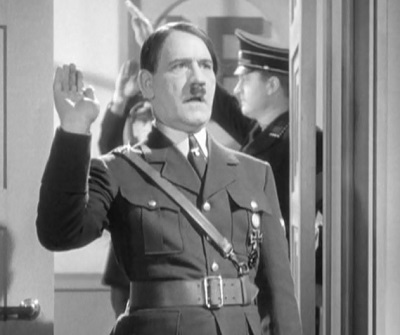
But the world they are about to step into is entirely different. Lubitsch opens the film with a hilarious misdirection: first it seems Hitler (Tom Dugan) himself is walking around Warsaw, before cutting to Jack Benny in Nazi uniform (a sight so shocking to Benny’s Jewish Polish Dad, he walked out and had to be coaxed by his son back in to finish watching it). But the conversation we hear – with its parade of nervous ‘Heil Hitlers’, ridiculous bribing of a small child with a toy tank – is slightly too absurd and, by the time Dugan’s Hitler enters with a proud ‘Heil myself!’ it becomes clear we’re watching rehearsals for Gestapo (at the end of which Dugan’s Bronski heads out into Warsaw to prove he can pass as Hitler).

It’s a fabulous lead into what we can expect for the rest of the film, which sees the actors swopping identities and character with desperate abandon as they get trapped into an espionage plot. In Britain Sobinski is rightly suspicious of Polish exile Professor Siletsky (Stanley Ridges), largely because he’s never heard of Maria Tura. With Siletsky carrying information to Warsaw that could shatter the resistance, Sobinski smuggles himself back into Poland and loops the actors –especially Joseph – into a complex, improvised deception scheme to get the deadly information back, save the resistance and dodge the real Gestapo under ruthless but desperate Colonel Erhadt (Sig Ruman).

To Be or Not To Be ups its gear into one of the wildest, riskiest and outrageous farces of all time. Jack Benny is front-and-centre as the vain-but-decent Tura, roped into impersonating first Erhardt to Siletsky, then Siletsky to Erhardt, with the help and hindrance of the company (many of whom, especially Rawitch, still instinctively take every chance to expand their roles). Benny’s comic timing throughout is exquisite, using every inch of his gift for comic vanity, brilliantly bouncing from assurance to barely concealed panic (usually when his pre-prepared lines run out). While working overtime to do the right thing, neither he – nor Carole Lombard’s beautifully performed Maria – step to far from the sort of flirtatious, catty banter that wouldn’t be amiss in a Noel Coward comedy.

Lubitsch’s film is in-love with actors, showing them as instinctively decent and brave, while also being squabbling, competitive misfits either pre-occupied with themselves (from Joseph unable to imagine anything worse than a bored audience, to a rehearsing Rawich not even noticing he has walked into a light backstage) or dreaming of glories to come. Sure, he has fun with their reliance on a script – Joseph runs out of lines so quickly as Erhadt he is hilariously reduced to simply saying over and over again “So they call me Concentration Camp Erhadt”, inevitable raising the suspicions of Siletsky – but at the same time in this crazy, dangerous world, the theatre is a bastion of civilisation.

Civilisation is of course in danger from the worst of the worst. Lubitsch is the comic director, par excellence but he is not afraid to dramatically shift tone and style throughout. The war action, as shells rain up towards Sobinski’s plane, would not look out of place in an action film. Sobinski’s attempt to contact the resistance could be dropped in from a Hitchcock thriller. When a Fritz Lang-inspired chase of Siletsky through a dark theatre is called for, Lubitsch goes entirely straight. The subtle threats behind Siletsky’s attempted seduction of Maria are quietly chilling if you stop to listen (Siletsky is the only character neither funny or on some level ridiculous, as if he has walked in from a serious thriller). There are moments in To Be or Not To Be that are surprisingly tense: when guns are pulled, we know having seen them used earlier that lives are at risk.

The most controversial element of To Be or Not To Be is whether Nazi occupied Poland is a suitable topic for comedy – and lines from Edwin Justus Mayer’s exceptional script like “What [Joseph] did to Shakespeare, we are now doing to Poland” feel close to the bone today. Lubitsch was of course not to know that plans were already being formed forthe Holocaust. But he had been the literal face of Hollywood Jewish corruption in the Nazi’s deplorable The Eternal Jew and the vileness of Nazism was familiar to him. He acknowledged it with Siletsky, the dogmatic, obsessed Nazi (who even dies with the word Heil on his lips). Erhardt brags about the powers of life and death he holds and casually talks of torture and executions. To Be or Not To Be couldn’t picture the evils of mechanised death, but Lubitsch knew the people he was dealing with.

He also knew nothing punctures evil like mockery – and, like most bullies, many Nazis were small, pathetic people. Erhadt – superbly played as a wide-eyed, panicked middle-manager and deadly dispenser of punishments by Sig Rumann – might be dangerous, but he’s also a twitchy, clueless idiot, blaming his subordinate for all his mistake (it’s part of the film’s joke that Joseph’s suave Erhardt feels more convincing than the bug-eyed ignoramus himself). The Nazis are small-minded bullies, with their continued parroting of Heil Hitler and kneejerk obedience to orders (up to jumping out of a plane). Lubitsch treats Nazism seriously while showing how ludicrously puffed-up and stupid it is.

It’s a fine tight rope walk, which echoesThe Great Dictator – but without Chaplin’s heartfelt, fourth-wall plea for peace and understanding. To Be or Not To Be manages to make identity switching farce a sort of commentary on how the Nazis are incapable of questioning the reality they are ordered to accept. Lubitsch shows Nazism as a cult diametrically opposite to the more libertine, bickering and free-minded actors. As such, it’s a valuable reminder in war time that we can prick the pomposity of tyrants by hitting them where it hurts them most: in their pride.

The Devil is a Woman (1935)

Devil is a woman header
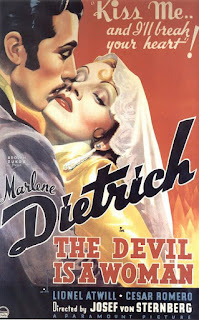
Lionel Atwill and of course Marlene Dietrich play out the final chapter of von Sternberg’s psycho-sexual fantasies in The Devil is a Woman

Director: Josef von Sternberg

Cast: Marlene Dietrich (Concha Perez), Lionel Atwill (Captain Don Pasqual Costelar), Edward Everett Horton (Governor Don Paquito), Cesar Romero (Antonio Galvan), Alison Skipworth (Senora Perez), Don Avarado (Morenito)

The Devil is a Woman has more than a whiff of being made after the Lord Mayor’s Show. It’s an impression not helped by the fact that it takes place in the aftermath of a town carnival, with Sternberg having apparently emptied the Paramount props cupboard of paper streamers. The Devil is a Woman is the final film made by Sternberg and Dietrich, a piece of contractual obligation for all concerned. Sternberg’s career deflated swiftly after it and the entire film has an autumnal sadness about it. No one seems particularly interested in what they are making, and it finds nothing new to say or do that Sternberg and Dietrich haven’t already done, other than set it in Spain (a decision that did not delight the Spanish government).

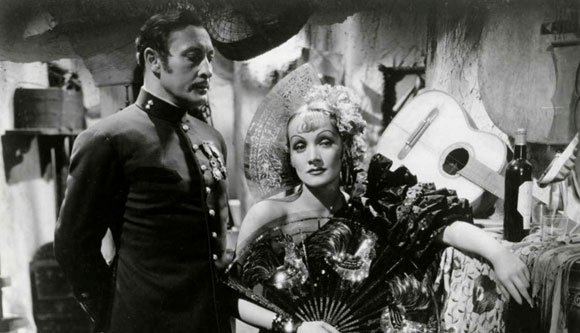
Dietrich is Concha Perez, a beyond ruthless, heartless, scheming, femme fatale who teases and uses men for her own ends with nary a second of guilt. Her web is starting to form around revolutionary Antonio Galvan (Cesar Romero). He’s warned off though by her former beau (victim?) Don Pasqual (Lionel Atwill), a middle-aged aristocrat who Concha effortlessly made dance to her tune and fund her many affairs, all while giving him just enough affection to keep him on board. Pasqual recounts his relationship with Concha in flashback – but will Antonio give a damn? Or is a duel on the cards between the two? Watch out Pasqual is an expert marksman…

For decades The Devil is a Woman was considered a lost film, until Sternberg provided one of the few copies of the film to the Venice Film Festival in 1959. This copy however did not contain the 17 minutes of footage cut from the film by Paramount (it’s a very short film, less than 80 minutes). Even found though, it’s a minor work, a little coda to seven collaborations between director and star, some of them iconic classics.

The film has all the foibles of Sternberg – and is a final indicator why this visual stylist found himself so hideously out of step in the era of the talkies. Dialogue and story are so secondary that you can’t help but notice their crudeness. When Sternberg has longer dialogue scenes, he shoots them with a cursory flatness that suggests he them over and done with as soon as possible. The passion of the film – what passion there is – goes into the visuals, whether it’s the streamer filled carnivals, the thundering rain that powers down on the duel or (of course) the sultry, painterly shots of Dietrich in luscious black-and-white.

The problem is that there isn’t really a truly striking visual in the film: perhaps Sternberg had used all his fire on The Scarlet Empress or maybe, after the disaster of that film, he was worried (or had been firmly told) that his final Paramount film had to have at least some semblance of the conventional to it. So, The Devil is a Woman is a conventional film with little flashes of imagination and visual skill – like the balloon that bursts to reveal Dietrich’s face (marksman to burst the balloon none other than Sternberg himself). It all adds to the end-of-an-era feeling that permeates the film.

The most interesting beat in the film is the feeling that we are watching yet-another on-screen playing out of Sternberg’s own psycho-sexual drama. Surely, he saw more than a bit of himself in Pasqual? The older, refined man, hopelessly infatuated with the beautiful, younger woman who drains him dry of money and prestige, but won’t commit herself to loving him? Pasqual the masochist who keeps coming back for more and more humiliation and sexual rejection? Hard not to think that there was more than a bit of Sternberg in Atwill’s performance – or that Concha’s late abandonment of Antonio to return to Pasqual was Sternberg’s own fantasy. Of course, it’s all Sternberg’s view, where he was very much the Henry Higgins. Dietrich would very well disagree.

The Devil is a Woman has its moments. Although often (despite being very short) rather slow – the long flashback-structure back story takes it time and then some – Sternberg can still find moments of beauty. Cesar Romero brings a lot more charisma and interest to the sort of handsome beefcake role John Lodge played in The Scarlett Empress. (In a bizarre advance in-joke Romero wears something very close to a Batman style mask at one point). Dietrich is given little to do other than be as cold as possible, but she manages to add depth and shade to her character. Atwill is rather good as the masochist Pasqual and the rain-soaked duel between him and Romero is worth the price of admission.

It can’t change the fact though that this is rather a sad coda to a great collaboration, an after-thought where it’s not clear that anyone was really interested in the content itself. It’s final shot is fitting: a chariot rides away into the sunset. It fits for this partnership – and effectively for Sternberg’s career which never achieved these heights again.