Category: Disaster film

The Poseidon Adventure (1972)

The Poseidon Adventure (1972)

Our heroes climb up an overturned cruise liner in the film that launched a thousand enjoyable disaster movie clichés

Director: Ronald Neame (Irwin Allen)

Cast: Gene Hackman (Reverend Frank Scott), Ernest Borgnine (Mike Rogo), Red Buttons (James Martin), Shelley Winters (Belle Rosen), Jack Albertson (Manny Rosen), Carol Lynley (Nonnie Parry), Roddy McDowell (Acres), Stella Stevens (Linda Rogo), Pamela Sue Martin (Susan Shelby), Arthur O’Connell (Chaplain John), Eric Shea (Robin Shelby), Leslie Nielsen (Captain Harrison)

New Year’s Eve on the biggest cruise liner in the world and the money men have ordered “Full steam ahead!” into a storm – after all, it would be terrible publicity to arrive late at harbour. Needless to say, it’s a terrible idea, as the Poseidon is hit by a tsunami and flipped upside down. Everyone at the top of the ship is killed, leaving only the party goers in the promenade room alive. Who is going to make it out from the one of the most famous disaster films of all time?

Produced by the Master of Disaster himself Irwin Allen – he personally staked half the budget and made a fortune – the ship’s passenger log is a host of Oscar-winning stars, each balancing soapy plotlines. Gene Hackman is the maverick priest, body pumping with muscular Christianity, who believes God helps those who help themselves. Ernest Borgnine is a grumpy police chief, on a long-delayed holiday with his ex-call girl wife Stella Stevens. Shelley Winters and Jack Albertson are a retired couple heading to Israel to see their grandson for the first time. Red Buttons is an unlucky-in-love fitness freak, Roddy McDowell a plucky steward. Pamela Sue Martin and Eric Shea are two (unbearable) kids travelling to join their parents while Carol Lynley is the ship’s terrified singer.

The Poseidon Adventure cemented the tropes you’d come to know and love in disaster films. The maverick leader, the grouchy contrarian, a plucky pensioner with a vital skill, adorably brave kids, a self-sacrificing nice guy… They’re all in here, the actors playing these cardboard cut-out characters with gusto as they climb up the endurance obstacle course set of an upside-down cruise liner.

Allen’s film takes a while to get going: a quarter of the run time is dedicated to setting up the various character dilemmas. Is a member of the crew a former client of Stevens’ Linda? Will Gene Hackman find new purpose in his faith? Will Red Buttons find love? Neame shoots these opening exchanges with the uninspired professionalism the exposition-filled dialogue demands (there are several variations on “What am I doing on this ship? Let me tell you…” lines). But what makes the best of these films work is when the soapy shallowness manages to make the characters endearing. It’s what happens here: the cast could do these scenes standing on their head, but gosh darn it we end up hoping the Rosens will live to see their grandson at the foot of Mount Sinai.

The film of course “starts” proper with that wave hitting. At which point, Allen (and Neame) knows exactly what works. He makes the stakes clear, the target simple (climb up, get out) and taps into common fears of falling, drowning etc. He knows how to make us thrill at the stunts – that tipping ballroom, with various stuntmen plunging downwards – and throw in the odd moment to remind us how tragic it all is (like Red Buttons sadly laying his jacket across some poor soul).

It also understands that we need to feel smarter than the crowd of extras caught up in the drama. When Gene Hackman earnestly tells everyone their only chance of survival is up, we want to feel that we’d be smart enough to go with him, rather than join the sheeple listening to the literally-out-of-his-depth purser (“What you’re suggesting is suicide!”). Allen knows we need to feel smarter so much he later throws in another group led by a confident-but-wrong authority figure (the ship’s doctor) blithely walking downhill to the flooded aft, ignoring Hackman’s cries that they are striding to a watery grave.

No, we’d definitely be with the plucky stars. After all Hackman can’t be wrong! (Gene Hackman’s priest, for all his bluster, is remarkably unpersuasive – he even only just holds onto authority in the group). The stunt work and production design as the battered stars climb up the overturned ship to the hull are remarkable – not for nothing did this scoop nine Oscar nominations – and while the film is undeniably slightly cheesy, it’s played with an absolute earnest seriousness by the cast (Hackman, to his eternal credit, acts as if his life depended on it – which considering it’s clearly a pay cheque role other actors would have coasted through is admirable).

The set pieces are superb. As the cast is whittled down, the deaths carry a certain weight – again conveyed by the honesty of the grief from those left behind. Shelley Winters bagged the best role – and the most iconic scene – as an overweight old lady with a Chekhov’s skill, performing (at great cost) an act of heroism no one else could manage. (She landed an Oscar nomination, largely for this stand-up-and-cheer moment with a sting). Most get a moment to shine – although Carol Lynley’s pathetic, panicking singer (she can’t swim or climb or hold her breath or run…) who spends her time shrieking tries your patience no end.

The film is so much about the experience of seeing this group of people overcome death-defying climbs, swims and flames that when the survivors stagger into the sunlight, the film abruptly ends. It’s all about the ride, with most of the plot points established earlier settled by someone dying on the way up. But it’s entertaining and lands just the right side of involving. The characters may be artificial, but we still care about them.

The Poseidon Adventure was a massive hit and still the best maritime disaster film made (certainly much better than its belated, lame, remake). Allen cements a formula where swiftly sketched characters, played by recognisable actors, go through endurance tests in front of us via terrifying set-ups and death-defying stunts. It’s grand, old-fashioned entertainment, perhaps taking itself a little too seriously, but giving us lots to gasp and cheer at.

WaterWorld (1995)

WaterWorld (1995)

As the waters rise, the world sinks down – and WaterWorld went down with it in the very average mega-budget sci-fi

Director: Kevin Reynolds

Cast: Kevin Costner (The Mariner), Dennis Hopper (The Deacon), Jeanne Tripplehorn (Helen), Tina Marjorino (Enola), Michael Jeter (Old Gregor), Gerard Murphy (The Nord), RD Call (Atoll Enforcer), Kim Coates (Drifter #2), John Fleck (Smoker Doctor), Robert Joy (Smoker Ledger), Jack Black (Smoker Pilot), Zakes Mokae (Priam)

In 1995 they called it “Kevin’s Gate”. Costner cashed all – and I pretty much mean all – his superstar chips to make Waterworld, a sort of water-logged Mad Max crossed with a Leone Western, starring himself as a nameless mutant with gills behind his ears. You needed to be the Biggest Box Office Star in the World to get that one up and running. But then Costner’s last “all-in” bet had been Dances with Wolves – and that won seven Oscars. What could do wrong?

Waterworld has been pretty much defined – then and now – as the (at the time) most expensive film ever made, which went on to be a damp squip, a box-office stinker. It’s not that: it’s a solid, entertaining-enough B-movie with some neat Dystopian ideas. In 2500, the world has been completely flooded after the polar ice caps melted. Mankind exists in rusted boats and small floating camps on the ocean. Dry land is a myth and actual soil is worth a fortune. Costner’s Mariner ends up protecting Helen (Jeanne Tripplehorn) and her adopted daughter Enola (Tina Marjorino), as Enola has (handily tattooed on her back) a map to the last piece of dryland left in the world. But Enola’s map is hunted by the Smokers, and their maniacal leader The Deacon (Dennis Hopper), who want to claim Dry Land for themselves.

Waterworld largely lives on as a hugely successful stunt show at Universal Studios (I’ve seen it and it is amazing – all the exciting bits of the film, done in about fifteen minutes) that has been running non-stop since 1995 (other shows, based on more successful movies, have long since disappeared). It focuses on all the stuff that’s good about the film. Kevin Reynolds’ can shoot the heck out of action scenes and professional stuntmen really know their business. The best sequences in Waterworld involve pounding action – jet ski chases, the Mariner’s transforming trimaran, jet skis flying over walls and diving under water, stunning boat chases – and they are great.

They also exploit, in their rusted crap-sack props, one of the film’s other triumphs, it’s detailed world-building design. Sure, it owes a heavy-debt to the cobbled-together semi-steam-punk of Mad Max, with rust that covers everything, adapted wet-suits and rags (augmented with various pieces of fishing equipment and light fabrics) that characters wear, the bashed out colours contrasted with the glorious blue of the water. But the film never looks anything less than an outre mad-house. Throw in James Newton Howard’s very effective score – romantic and mournful when required, but then pounding with heroic action beat – and you’ve got elements of a decent movie.

But decent is all it ever is. Because, aside from the novelty of being set on water (a hugely time- and money-consuming expense, that partly explained why the film went zillions of dollars over budget), there isn’t anything that new about the story. A gruff outsider is roped into grudgingly protecting a mother and a daughter, but then his heart-is-melted – just as the villains turn up to snatch the daughter away. The villains are cartoonish monsters (Dennis Hopper seems to be on a mission to counter the water-logged misery of most of the rest of the performers by acting as much as possible), who are either ingenious or incompetent depending on the requirements of the script. The quest for the land-of-plenty is so familiar, you could scribble it down on a postcard in advance.

The question is, why did Costner want to make this? It’s not even a part that showcases him very well. I’ve always found Costner’s mega-stardom a bit of a mystery: once he graduated from more young, naïve parts (such as in The Untouchables), action films more and more exposed his slightly blank sulkiness as an actor. Perhaps due to the pressure of Waterworld (he worked non-stop, six day weeks, mostly on or in the water, for six months), perhaps due to his inability to find any warmth in a role he clearly sees as an Eastwoodish man-with-no-name, he largely comes across as sullen and hard-to-engage with. This is double hard for a film set in a dystopian future, where we really need to understand and relate to the hero in order to get into the world.

The rest of the cast follow his lead – no one, apart from maybe Hopper, really looks like they want to be there and most of them give of a sense of suffering under the constant threat of accidentally drowning. Tripplehorn isn’t helped by playing a dull, functionary, by-the-numbers character although Marjorino does get to have a bit of spark as plucky Enola. None of the characters step out of the formulaic surroundings of the film they have been trapped in.

You can have a bit of fun with the film’s wonky science. The Mariner is introduced pissing into a bucket and converting the piss into drinking water: cool character establishing moment, but since the salt quota of piss is higher than sea water, why not just convert the sea water? (I’m staggered at the idea that, in 500 years, no one has discovered a way to make sea water drinkable). If the polar ice caps melted, they would not flood the world as much as this. Would an oil tanker and fleet of jet skis really have managed to eek out the 235k cubic metres of oil it carried for 500 years? (How do they even convert it into petrol?) Where are all the fish? Why is the Mariner the only one with deep sea diving equipment – especially when he has flipping gills and doesn’t need it?

But hey, it’s only a movie. Waterworld eventually became profitable: but not till after it had cemented itself in the public perception as an uber-stinker. Really, it’s not that different from Avatar in its functional story, it just made a worse job of selling its big-budget effects as must-see moments. Costner’s alleged megalomania on set didn’t help (re-writing scenes, ordering special effects cover his receding hairline, falling out with Reynolds during editing – so much so Reynolds walked out), but really Waterworld isn’t terrible, just a huge lump of soggy okay. But that Universal Stunt Show? It’s the bee’s knees.

12 Monkeys (1995)

12 Monkeys (1995)

A world-ending-virus can only be cured through the power of time-travel in Gilliam’s twisty, paradox time loop

Director: Terry Gilliam

Cast: Bruce Willis (James Cole), Madeleine Stowe (Dr Kathryn Railly), Brad Pitt (Jeffrey Goines), Christopher Plummer (Dr Leland Goines), David Morse (Dr Peters), Jon Seda (Jose), Christopher Meloni (Lt Halperin), Frank Gorshin (Dr Fletcher), Bob Adrian (Geologist), Simon Jones (Zoologist), Carol Florence (Astrophysicist), Bill Raymon (Microbiologist)

2035 and the world is a plastic-coated hell, where what remains of mankind huddle below the Earth in rudimentary, environmentally controlled, airtight refuges. The surface is a dream, now home to a deadly virus that wiped out 99% of the population. That virus was unleashed in Philadelphia in 1996: nothing can stop that. But time travel can help the scientists of 2035 gain a sample of the original pre-mutation virus. They believe it was unleashed by an organisation called “The 12 Monkeys”. Track the organisation in the past and find an original sample of the virus. Easy right?

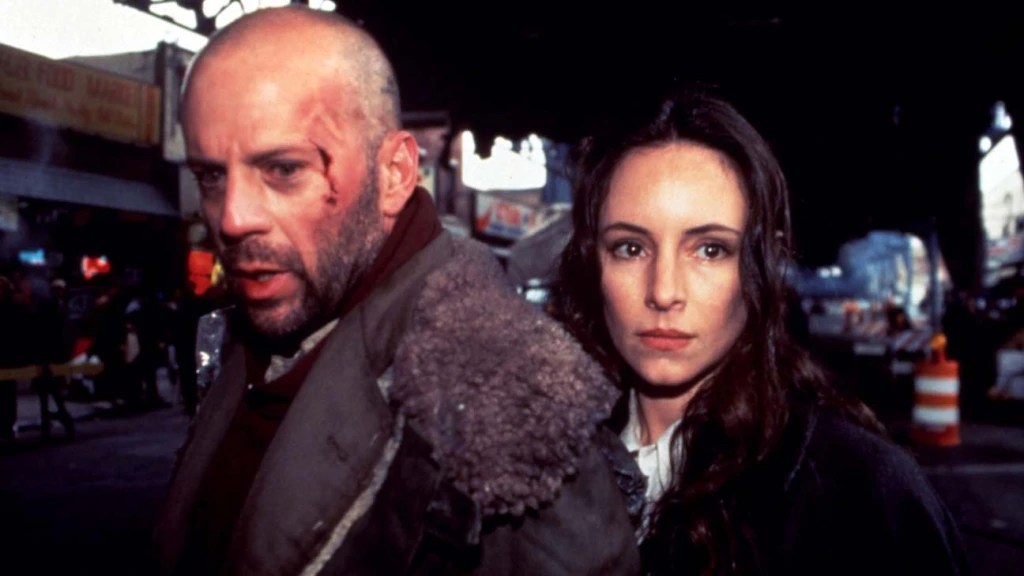
Wrong. Time travel messes with your mind, making it hard to tell what’s real and what’s not. The travellers are penal “volunteers”. James Cole (Bruce Willis) is selected as he has a photographic memory and a strong memory from 1996 of witnessing a Philadelphia airport shooting, that will help send him back. However, he’s flung back to 1990 and thrown into an asylum, treated by Dr Kathryn Railly (Madeleine Stowe) and sharing a room with environmentalist Jeffrey Goines (Brad Pitt). Rescued and correctly sent to 1996, can Cole convince Railly he’s telling the truth and track Goines who has become the leader of the 12 Monkeys?

12 Monkeys is one of the most intriguing time-travel films ever made – and its future, ripped apart with plague, seems chillingly closer today. It puts a vulnerable, scared person at its centre – and makes him a dangerous, inarticulate Cassandra who reacts with violence when no-one listens him (which they never do). It repeatedly tells us things cannot end well, but still gets us hoping they might anyway. It presents puzzles that provoke debate and stretch the imagination.

Gilliam’s most main-stream film is an eccentric, unsettling, tricksy film that juggles time travel and paradoxes, as well as mental health and the nature of reality. Shot with a Dutch-angle infused oddness – reflecting its hero’s mental unbalance – and scored with a French-inflected whirly-gig musical theme that is reminiscent of the demented street people that pepper the film (and may, or may not, be other unbalanced time travellers), it constantly puts you on edge and unsettles.

This extends to its casting, which takes two Hollywood superstars – Willis and Pitt – and deglamorises them to a shocking degree. As Cole, Willis is shambling, vulnerable, scared and struggling to distinguish between reality and fantasy. An 8-year-old boy when the virus destroyed the world, in a way he’s never grown up. He looks around the world of the past with a wide-eyed wonder (he adores the sun and the feel of the soil beneath his feet) but has the stroppy impulsiveness of a maladjusted teenager. He’s so twitchy and insecure, you start wondering if he is the mentally disturbed man who imagines he’s from the future, that his doctors think he is. It’s Willis’ least-Willis performance ever and one of his finest.

Similarly, Pitt pushes himself as the disturbed, aggressive Goines. Prone to obsessive rambling, that stretches Pitt’s languorous vocal register (he trained for months to improve his vocal range), Pitt’s performance is wide-eyed, unpredictable and unsettlingly dangerous. With a single eye swollen and askew, it’s a performance that plays with being OTT but manages to work because he mostly avoids actorly showing off. Madeline Stowe, by contrast, has the most difficult role as the ‘normal person’, a sceptical psychiatrist becoming more and more convinced Cole is telling the truth.

Of course, despite the film’s efforts to play with reality, the audience are always pretty certain he isn’t wrong about the future. But, with the sight of fellow deranged time travellers, not to mention Willis’ vulnerable performance, that Cole could still be crazy. Even if you are right, doesn’t mean you are sane.

Gilliam’s surrealist future helps with this. Every time Cole is pulled back to 2035, the world becomes ever more deranged. Is his grip on reality eroding, as he is feared it is. Design wise the future is a triumph – but it also seems eerily similar to the 1990 asylum Cole is in. Has the building, and the things in it, been repurposed in 2035? Or, as the scientists of 2035 become ever more surreal (including serenading Cole at one point in a Dennis-Potteresque fantasy), questioning Cole via a circular floating series of TV screens while he sits in a suspended chair, is Cole’s grip on reality gone?

It keeps the tension up in the ‘past’ plotline, even as the things Cole has seen in the future – strange messages on walls, photos, voicemail messages – accumulate. 12 Monkeys is a fascinating time-travel movie, that establishes from the very first moment it is impossible to change the past (something the audience, like the characters, get sucked into forgetting). After all, if the plague was stopped, then time travel would never be invented in the first place. All Cole, and the other travellers, can do is collect information.

But that doesn’t stop the future influencing the past. Goines decides to form the 12 Monkeys based on a conversation with Cole in 1990. Dr Railly becomes fascinated with apocalyptic predictions – writing a book that will influence the man planning viral annihilation in 1996 – only because she meets Cole. And, above all, 2035 Cole’s presence in 1996 leads to that strong childhood memory happening in the first placce. The final reveal of the meaning behind Cole’s recurring memory-dream is the perfect example of a time-loop closing (so much so the scientists in the future bend over backwards, giving Cole a doomed mission, to ensure it happens).

It also explains why he is drawn towards Stowe’s Railly, who resembles (with the exception of her lack of Hitchcock Blonde hair) the woman in his dream. The relationship between Cole and Railly develops into a slightly forced romance (it feels like a script requirement, for all Gilliam’s taking the characters to watch Vertigo to hammer home the obvious contrasts). But when it focuses on two people drawn together for reasons they can’t quite understand (and there are hints of predestination) it just about works. That and the commitment of both actors to the roles.

12 Monkeys is about 15 minutes too long (it’s 1990 section outstays its welcome), especially as the audience is never in doubt that the plague is real (after all this is a movie). But Gilliam keeps us on our toes with how confident we feel in Cole: we’re repeatedly shown he’s violent, inarticulate and impulsive. The final half of the film, where the origins behind events we have been shown or heard in the first half, is fascinating. The tragic turns of the film’s paradoxical temporal loop is brilliantly executed and haunting. Gilliam’s film is quirky, unsettling and a design triumph: but it also tells a fascinating story. It’s his most accessible and crowd-pleasing film.

Twister (1996)

Twister (1996)

Cardboard characters try not to get blown away in this extremely silly disaster movie

Director: Jan de Bont

Cast: Helen Hunt (Dr Jo Harding), Bill Paxton (Dr Bill Harding), Jami Gertz (Dr Melissa Reeves), Cary Elwes (Dr Jonas Miller), Lois Smith (Aung Meg Greene), Philip Seymour Hoffman (Dusty Davis), Alan Ruck (“Rabbit” Nurick), Sean Whalen (Allan Sanders), Todd Field (“Beltzer” Lewis), Wendle Josepher (Haynes), Jeremy Davies (Brian Laurence), Joey Slotnick (Joey), Zach Grenier (Eddie)

In 1996 Twister blew through cinema screens with a vengeance, becoming the second most biggest hit of the year. Yes, you read that right. Stop me if I am wrong, but has anyone thought about, even for a second, this bog-standard disaster film since? Staffed almost exclusively by characters so lightweight a puff of wind would blow them away, never mind a tornado, the whole thing is full of sound and fury and signifies absolutely nothing at all.

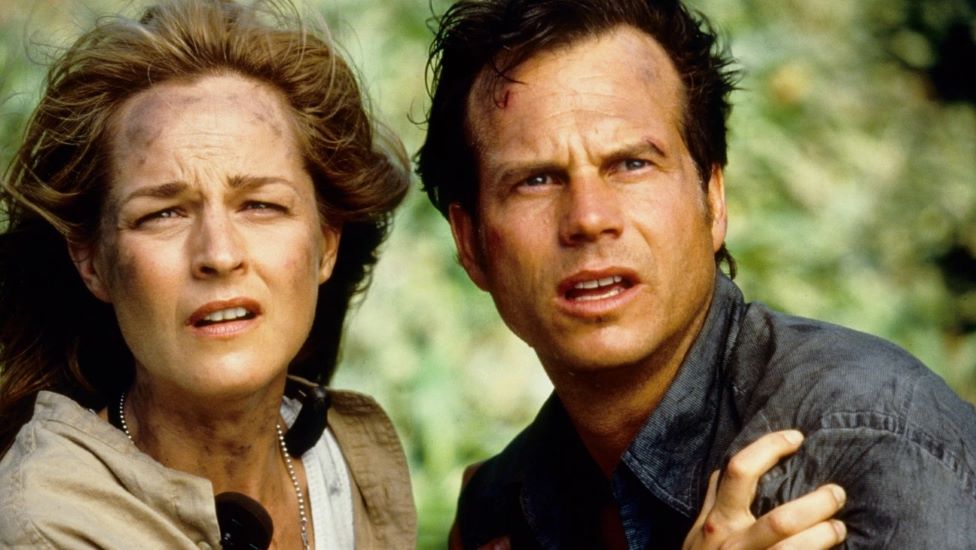
Drs Jo (Helen Hunt) and Bill Harding (Bill Paxton) are trying to get divorced. He’s finally had enough of risking his neck on their joint passion for storm-chasing, deciding to jack it in for a lucrative life on the media circuit and marriage to relationship therapist Dr Melissa Reeves (Jami Gertz). He arrives in Oklahoma to get Jo to sign the divorce papers – but doncha know it, he gets sucked in to “one more job”, to road-test the storm measurement doo-hickey device he and Jo dreamed of making but she’s actually built. And, handily, one of those pesky twisters is on the way.

The doo-hickey – I’m really not sure what it’s meant to do – is the sort of ludicrous scientific device that only exists in the movies. It’s basically a huge metal cauldron full of marbles that needs to be placed in the path of a twister. It’s also – in a terrible design flaw – hugely fragile and unstable, constantly falling over at the worst possible time. There are apparently three prototypes, of decreasing quality, each a back-up of the one before – you have one guess as to how many of these they burn through in the film.

In fact, you can pretty much one guess almost everything that might happen. Will Jo finally come-to-terms with the death of her father in a storm? (That’s right – she has a “I’m passionate and obsessed because a twister killed my dad” backstory!) Will Bill realise Jo is the one for him, not fish-out-of-water big-city-girl Mel? Will Cary Elwes’ lip-smacking, moustachio-curling copyright-stealing storm expert get his (fatal) comeuppance? Will sweet Aunt Meg (and her dog) survive her tussle with the storm? That “it’s almost never happened” super-storm they talk about at the start of the film – do you think it’s possible our heroes will find themselves in the middle of it before the end?

All of this is shuffled in a film with a hideously over-loaded deck. Jo’s team consists of around eight assistants, none of whom have so much as a character between them. They are a feeble collection of archetypes: the geek, the shy one, the techie, the religious one and the loud-mouthed one (a role of flamboyant indignity for Philip Seymour Hoffman, yet to be recognised as a great actor and instead relegated to feeble comic relief roles). But then it’s not like the leads are that interesting either: she’s committed, passionate but gosh-darn-it puts the storm before her personal life. He’s trying to move on but doncha-know-it he’s just lying to himself that he doesn’t love the storm.

In fact, as this rather smug ex-couple riffed on in-jokes, storm facts and their shared love for their doo-hickey made of marbles I felt rather sorry for Mel. Obviously, we are meant to scorn Mel, with her hand-wringing profession of counsellor (as opposed to the macho jobs of Bill and Jo) and her reluctance to run into a massive twister. Actually, I think she’s rather sensible. Bill and Jo are both clearly insane and take suicidal risks. She puts up with her fiancé flirting with his ex far longer than most of us would and she is hugely patient with the polite scorn she’s treated with by Jo’s rag-tag band of tedious risk-taking geeks playing at being alphas. She hangs around far longer than anyone else would do, before departing after maturely and sensibly telling Bill he should stick with his first two loves (Jo and storms – maybe not in that order).

People aren’t watching these films for the character or plot though – just as well as the film doesn’t really have either – but the special effects. These are impressive, I suppose, as the storm rips through sets, throws CGI buildings around and generally makes for loud and impressive noise. The film has a sort of goofy wit at times – at one point a CGI cow is blown through the sky in front of the Hardings, mooing rather sadly.

There are some decent set-pieces, even though they are basically all the same set-piece repeated over and over again at a different scale (first the storm blows over a car, then a building, then a village, then most of a town while our heroes duck and cover their heads). Lots of it was done with practical effects, shot with an alarming lack of regard for safety – Hunt got an infection from being flung into a drain and she and Paxton were temporarily blinded by a burst of artificial lightning.

De Bont directs all this with a personality-free competence. The film is at absolute best less than half as good as his first film, Speed – and de Bont’s subsequent film, The Haunting, would be half as good again in a career of ever-diminishing returns. Twister offers nothing new or even particularly interesting, other than some wind special effects that are of passing curiosity value but nothing else. It’s almost quaint that, in 1996, this was seen as something earth-shatteringly impressive. Now it’s as fearsome a burst of raw natural power as a fart.

In the Heart of the Sea (2015)

In the Heart of the Sea (2015)

Hunger, desperation, the sea and a very big whale in this Moby Dick origins story

Director: Ron Howard

Cast: Chris Hemsworth (Owen Chase), Benjamin Walker (Captain George Pollard), Cillian Murphy (Matthew Joy), Tom Holland (Thomas Nickerson), Brendan Gleeson (Old Thomas Nickerson), Ben Whishaw (Herman Melville), Michele Fairley (Mrs Nickerson), Gary Beadle (William Bond), Frank Dillane (Owen Coffin), Charlotte Riley (Peggy Chase), Donald Sumpter (Paul Mason), Paul Anderson (Caleb Chappel), Joseph Mawle (Benjamin Lawrence), Edward Ashley (Barzillai Roy)

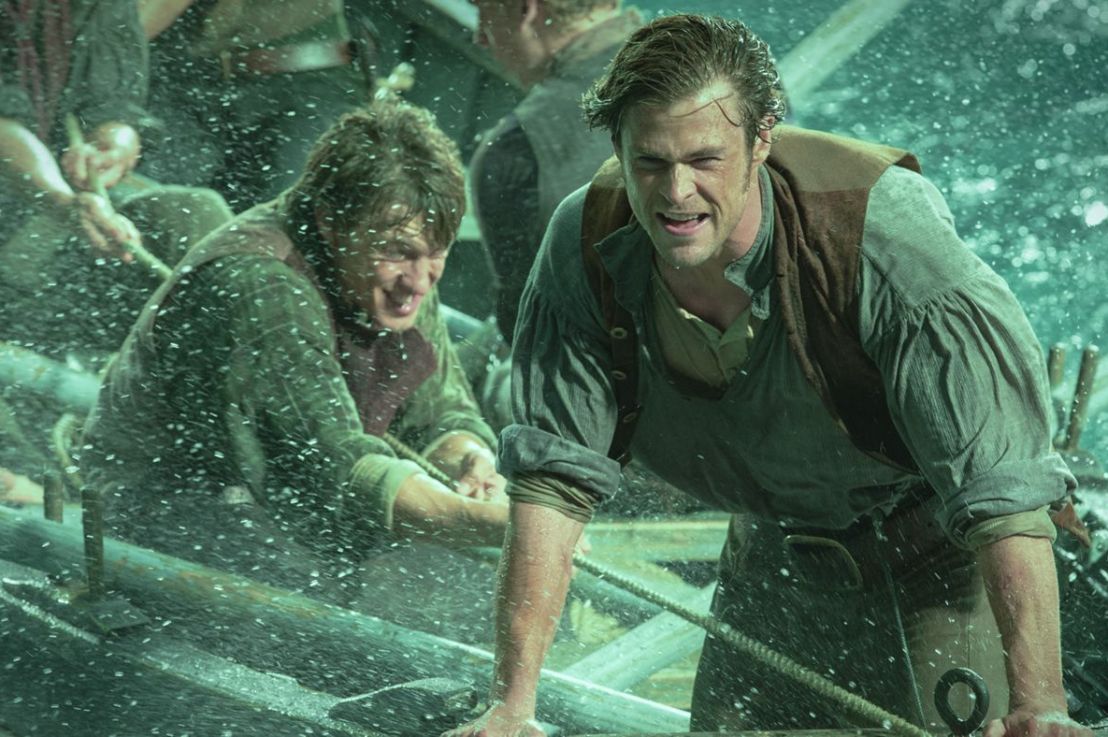
1820 and the world is run by oil. Not the sort you get out of the ground, but the sort you fish out of a whale’s corpse with a bucket. America is the leading exporter of whale oil and Nantucket is the centre of the industry. But it’s a dangerous business: as the crew of the Essex are about discover. Attacked by a whale, their ship sinks in the Pacific Ocean, thousands of miles from land. Passed-over first officer Owen Chase (Chris Hemsworth) and privileged captain George Pollard (Benjamin Walker) must set aside their differences to lead the survivors to safety. But starvation and desperation will lead those survivors to ever more desperate acts. All of this is told to Herman Melville (Ben Whishaw) by final living survivor Thomas Nickerson (Tom Holland and Brendan Gleeson), and it all sounds like a perfect inspiration for that Big Whaling Book Melville wants to write.

That Melville framing device is a good place to start when reviewing the many problems of In the Heart of the Sea, Ron Howard’s misfiring attempt at a survivalist epic. When we should be consumed by concern at whether these men survive, the film keeps trying to get us care as much about whether Melville will write a novel worthy of Hawthorne. The clunky prologue eats up a good sixth of the film, and we keep cutting back for Gleeson to tell us things the script isn’t deft enough to show us. Worse, it keeps ripping us way from the survivalist story that should be film’s heart.

Howard should know this: he directed one of the best survival-against-the-odds films ever in Apollo 13. Maybe the difference is that Apollo 13 is, at heart, a hopeful story. In the Heart of the Sea is about grimy sailors in a trade the film can’t find any sympathy for, eventually drawing lots in a long boat to see who is going to get killed and eaten by the others. It’s the sort of thing Werner Herzog would (pardon the metaphor) eat up for breakfast. For Howard, a fundamentally optimistic film-maker, its an ill fit. No wonder he wants to end the film with the triumph of Moby Dick.

In the Heart of the Sea is the rare instance of a film that is too short. The narration keeps skipping over time jumps in the first hour, that means we don’t get invested in the characters (most of whom are barely distinguished from each other, especially as beards and wasted bodies become the uniform). The sinking doesn’t take place until almost an hour in the film, meaning the time we spend with them lost in boats is a mere 40 minutes or so.

That is nowhere long enough for us to get a sense of either the monotonous time or the ravages hunger and desperation have made. Difficult as that stuff is to film – and I can appreciate its hard to make five men sitting, dying slowly, in a boat visually interesting – it means the film is asking us to make a big leap when it goes in five minutes from the men leaving a stop on an abandoned island to regretfully slicing one of their party up for dinner. We need to really understand how desperation has led to this point, but the film keeps jumping forward, as if its impatient to get to it.

Understanding is a general problem in the film. It can’t get past the fact that, today, we don’t see whaling (rightly so) as a sympathetic trade. But to these men, plunging a harpoon into a whale wasn’t an act of barbarous evil. It was more than even just making a living: it was a noble calling. Several times the film makes feeble attempts to push its characters towards moral epiphanies which seem jarringly out of chase (would Owen Chase, a hardy whaler with multiple kills, really hold his hand when confronted with a whale he thinks is trying to kill him?). Clumsy parallels are drawn between the heartless corporate oil industry of today, and the ‘suits’ back at Nantucket who only care about the bottom line.

Without accepting that, to these men, striving out into the ocean to bring back whale oil was as glorious a cause as landing on the moon, the film struggles to make most of the earlier part of the film interesting. Hard to sympathise with the characters, when the film is holding their profession at a sniffy distance. The film even radically changes the future career of its hero, Owen Chase, claiming he joined the merchant navy and never whaled again (not remotely true).

On top of this, Howard doesn’t manage to make the act of sailing feel as real or as compelling as, say, Peter Weir did in Master and Commander. Everything has a slightly unconvincing CGI sheen. Strange fish-eyed lenses keep popping up zooming in on specific features of pulleys and sails (is it meant to be like a whale’s eye view?). The film never manages to really communicate the tasks taking place or the risks they carry. There is a feeble personality clash between Pollard and Chase that fills much of the second act of the film, but is written and acted with a perfunctory predictability that never makes it interesting.

You can’t argue with the commitment of everyone involved. The cast noticeably wasted themselves down to portray these starving dying men. But it all adds up to not a lot. Chris Hemsworth gives a constrained performance as Chase – his chiselled Hollywood bulk looks hideously out of place – while Cillian Murphy makes the most impact among the rest as his luckless best friend. But the film’s main failure is Howard’s inability to make us really feel every moment of these men’s agonising suffering and to really understand the desperation that drove them to lengths no man should go to. Eventually that only makes it a surprisingly disengaging experience.

The Midnight Sky (2020)

The Midnight Sky (2020)

Dystopian end-of-the-world drama gets dull and dreary in this misfire

Director: George Clooney

Cast: George Clooney (Augustine Lofthouse), Felicity Jones (Dr “Sully” Sullivan), David Oyelowo (Commander Adewole), Kyle Chandler (Mitchell), Demián Bichir (Sanchez), Tiffany Boone (Maya), Caoilinn Springall (Iris), Ethan Peck (Augustine), Sophie Rundle (Jean)

The world has been evacuated after an unspecified radiological disaster, with the survivors bound for K-23, a newly discovered moon of Jupiter capable of supporting life. The only person left on Earth is Augustine Lofthouse (George Clooney), suffering from a terminal illness. He remains behind at an arctic base to warn returning space missions. The returning mission Aether – crewed by Jones, Oyelowo, Chandler, Bichir and Boone – are en route, but to make contact with them Lofthouse must travel across the arctic to a back-up transmitter, accompanied by a mysterious wordless child called Iris (Caoilinn Springall) who seems to have been left behind during the evacuation.

The Midnight Sky is the largest, most technically ambitious film Clooney has directed. Did the focus on the technical aspects mean he took his eye off other elements? Even the ones his previous films have been strong on: dialogue and character. The Midnight Sky looks great and has some impressive effects. But it is a dull film, lacking pace or energy, populated by paper-thin characters and often feeling like a Frankenstein-like stitching together of elements of other, much better, films.

It splits its focus between two story lines: one a survivalist two-hander between Clooney and child actress Caroilinn Springall; the other a “journey home against the odds” space mission. The first carries a little more interest, if only because Clooney manages to brilliantly convey loneliness, isolation, sadness and how terminal illness increases the effects of all of these. There is also emotional depth from his growing bond with Iris: the two of them playfully flicking peas at each other over dinner and his protecting her from the dangers outside. This is shot in some stunning Iceland vistas and shows a competent selection of various traditional survivalist set-ups during the struggle to complete the journey. It’s not exactly original, but at least it holds the interest.

That interest isn’t found in the space scenes – although the lack of originality is. How did Clooney fail to notice that he assembled a terrific cast of actors, but then failed to give them so much as a whisper of a character to play between them. This crew are terminally unengaging 2-D characters, whose dialogue echoes tropes of other films. Despite the dangers they encounter while navigating a course to Earth (that inevitably takes them through uncharted meteor storms), we are never really given a reason to really care about these characters (all the sad mooning over holograms of the families they left behind doesn’t actually make us feel like we know them).

The sense of nothing we are seeing here actually feeling new is key, and the main problem with the whole film. Countless other films have covered world-ending events. Clooney’s battle to cross the arctic and survive carries more than an echo of The Revenant by way of The Road. The struggles in space have lashings of Gravity with an Interstellarvibe. And those are just for starters. Even the final narrative twist (which you can probably see coming) echoes other film twists. For all the handsomeness of the film, it never feels fresh, always more of a tribute remix of other superior films that you should probably just consider rewatching instead.

That’s Clooney’s main failing here. As if he was so focused on getting the technical elements spot on, he never checked if the patient had a pulse. The Midnight Sky, knitted together from the offcuts of other films, has only the vaguest of heartbeats. Nothing is original and virtually no character in it ever feels either fully-formed or someone we care about. Others, all too obviously, serve as nothing but narrative devices. There are some wonderful shots and a lovely score from Alexandre Desplat. But narratively, the film often feels too cold, distant and emotionally dead. It ends up feeling far, far longer than its two-hour run time.

The Towering Inferno (1974)

Newman and McQueen tackle a huge blaze in The Towering Inferno

Director: John Guillermin, Irwin Allen

Cast: Steve McQueen (Fire Chief Michael O’Halloran), Paul Newman (Doug Roberts), William Holden (James Duncan), Faye Dunaway (Susan Franklin), Fred Astaire (Harlee Claiborne), Susan Blakely (Patty Duncan Simmons), Richard Chamberlain (Roger Simmons), Jennifer Jones (Lisolette Mueller), OJ Simpson (Harry Jernigan), Robert Vaughn (Senator Gary Parker), Robert Wagner (Dan Bigelow), Susan Flannery (Lorrie), Shelia Matthews Allen (Paula Ramsay), Jack Collins (Mayor Ramsay)

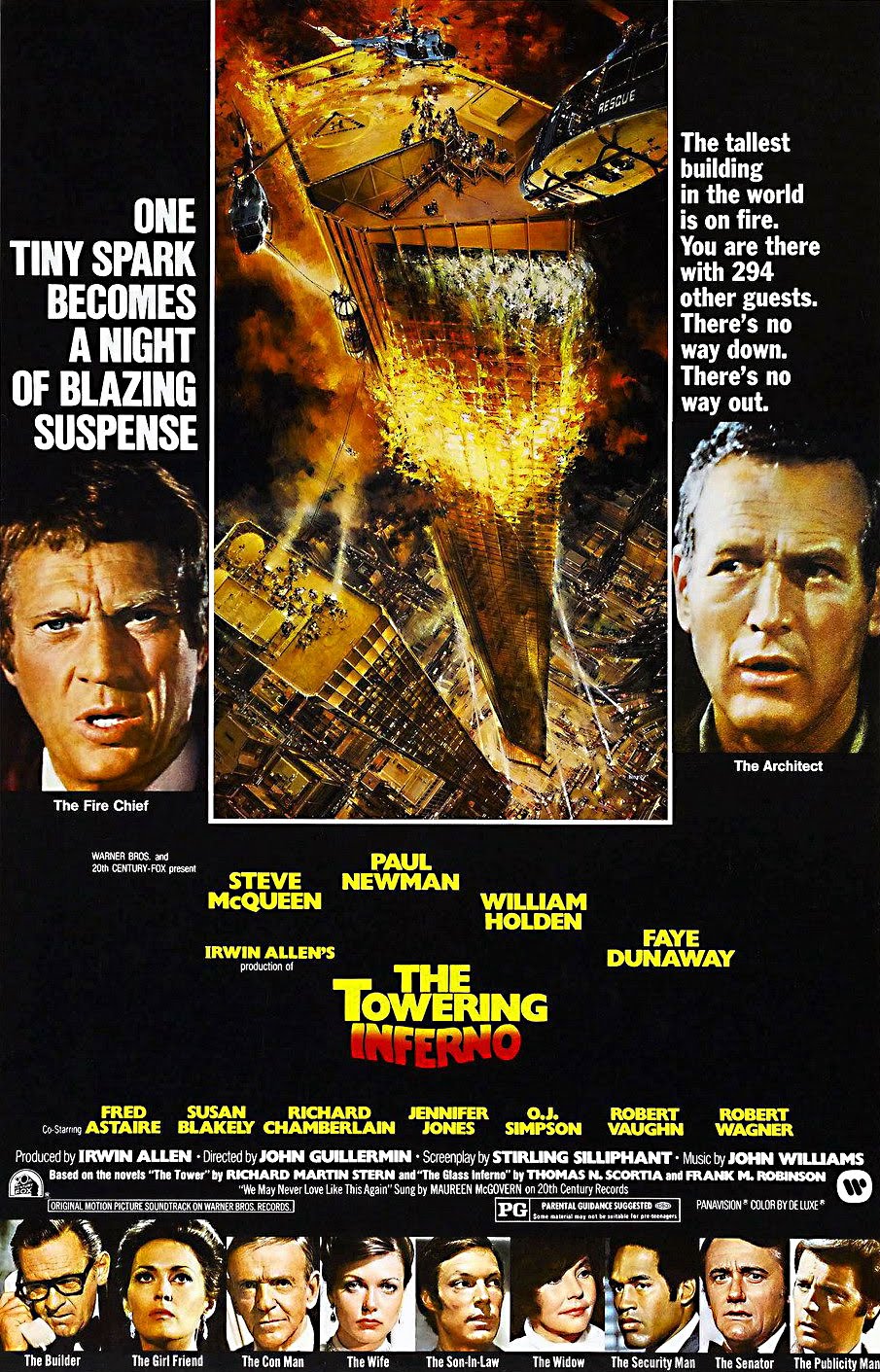
Architect Doug Roberts (Paul Newman) flies into San Francisco for the grand opening of The Glass Tower, the newly constructed tallest building in the world which he has designed for developer James Duncan (William Holden). A celebration with the rich and famous is planned – too bad Duncan’s rogueish son-in-law Roger Simmons (Richard Chamberlain, smarming like his life depends on it) has saved a few dollars by stuffing the building with sub-standard wiring. Surely the world’s largest building can’t catch fire? You bet it could – and only heroic Fire Chief Michael O’Halloran (Steve McQueen) has the expertise to put it out.

The Towering Inferno was the peak of the “all-star disaster” genre. It was bought to the screen by Producer (and “Master of Disaster”) Irwin Allen, and pretty much ticks all the boxes you expect from the genre. A star at every turn! A huge running time! Constant denials that anything could go wrong (of the “This building can’t burn down!” variety)! Kids in peril! Death-defying stunts! A brave pet! An elder statesman of Hollywood risking life and limb! A scoundrel we can boo! A tear-jerking death! The Towering Inferno pretty much has it all, and it plays every single beat with the sort of po-faced seriousness that was already starting to look a bit silly by 1974.

Films like this work because audiences – as we’ve seen time and time again – never lose their taste for watching things get trashed. In the 1970s every studio wanted its own mega-budget disaster film. The Towering Inferno’s real uniqueness is the story behind its making – two studios had competing “Skyscraper on Fire!” projects but, instead of competing, pooled their resources to make one mega hit. So, Warner Brothers The Tower and 20th Century Fox’s The Glass Inferno became this.

Irwin Allen was handed the keys – because no-one did it better – and each studio contributed a star. McQueen and Newman spent almost as much time negotiating equal terms as acting in the movie. Both were paid 10% of the gross and agreed they would have exactly the same number of lines (many of Newman’s final scenes sees him perform stunts wordlessly, as he burned through his allotted lines during the 40 minutes he spends on screen before McQueen turns up). The billing was negotiated carefully: their names would appear on screen together with Newman slightly higher, but McQueen’s name to the left (both could therefore claim they were “first billed”).

Their interest in the film pretty much ended there. Newman was famously disparaging of what he called “a piece of shit” and the only time he did something purely for the money. He coasts through on those blue eyes and twinkly grin. Eager that his character be absolved of responsibility (he has designed a tower that will claim 200 lives!) Newman’s architect is continuously absolved of any responsibility by the rest of the cast and leads on saving lives. McQueen grabbed the better role as the all-action fire-chief, riding in after 45 minutes (thus wisely missing out the tedious build-up of the soapy plot lines), takes charge and does nothing but manly action, but he also looks like someone going through the motions.

But then they know the things that will be remembered are the set-pieces. As flames stretch up the building, our star names dodging explosions, climbing up shattered staircases, dodging collapsing ceilings and taking on vertigo-inducing heights, it’s hard not to be excited. As in all disaster films, the disaster takes a strong moral stance. Of all the characters who die only one ‘doesn’t deserve it’. Aside from that, the actors playing philanderers, swindlers and bastards inevitably bite the dust, while the upstanding and noble pretty much see their way to the end.

The disaster sequences are impressive – and the fire-effects are really well done. Allen directed the ‘action sequences’ – aka the only bits of the film you really remember – while Guillermin handled ‘the acting’ (the dull, soapy, badly written bits you forget). The cardboard characters (no wonder they catch fire so easily!) could have had their personalities scribbled on the back of a stamp, and are pretty much dependent on the charms of the actors playing them. Fred Astaire’s gentle conman (the sweetest grifter you’ll ever meet) is a ludicrous character, but works because of Astaire’s twinkle-toed charm (Astaire grabbed a wave of affectionate awards nominations). Jennifer Jones plays off him rather well in the film’s ‘heroic elder statesman of Hollywood’ role, as a woman who puts herself at huge risk to save two kids (and their deaf mum) from immolation.

But pretty much all the character-based stuff in Towering Inferno is ludicrously silly, with some strikingly bored actors (Faye Dunaway looks like she wants to be anywhere else) but it hardly matters as we are there to watch the world burn. Which it does to spectacular effect, and the reassuringly, camp predictability of the film’s events is endearing – and raises a few good-natured laughs (you have to laugh at something like this, even though it wants to take itself so seriously). The Towering Infernowas the largest of all the disaster flicks of the 1970s. Allen shoehorns in a few points about fire safety in tall buildings for the ‘serious bits’, but his heart is in consigning most of the second tier of his all-star cast to dramatic, firey deaths. Overlong, very silly but rather sweet.

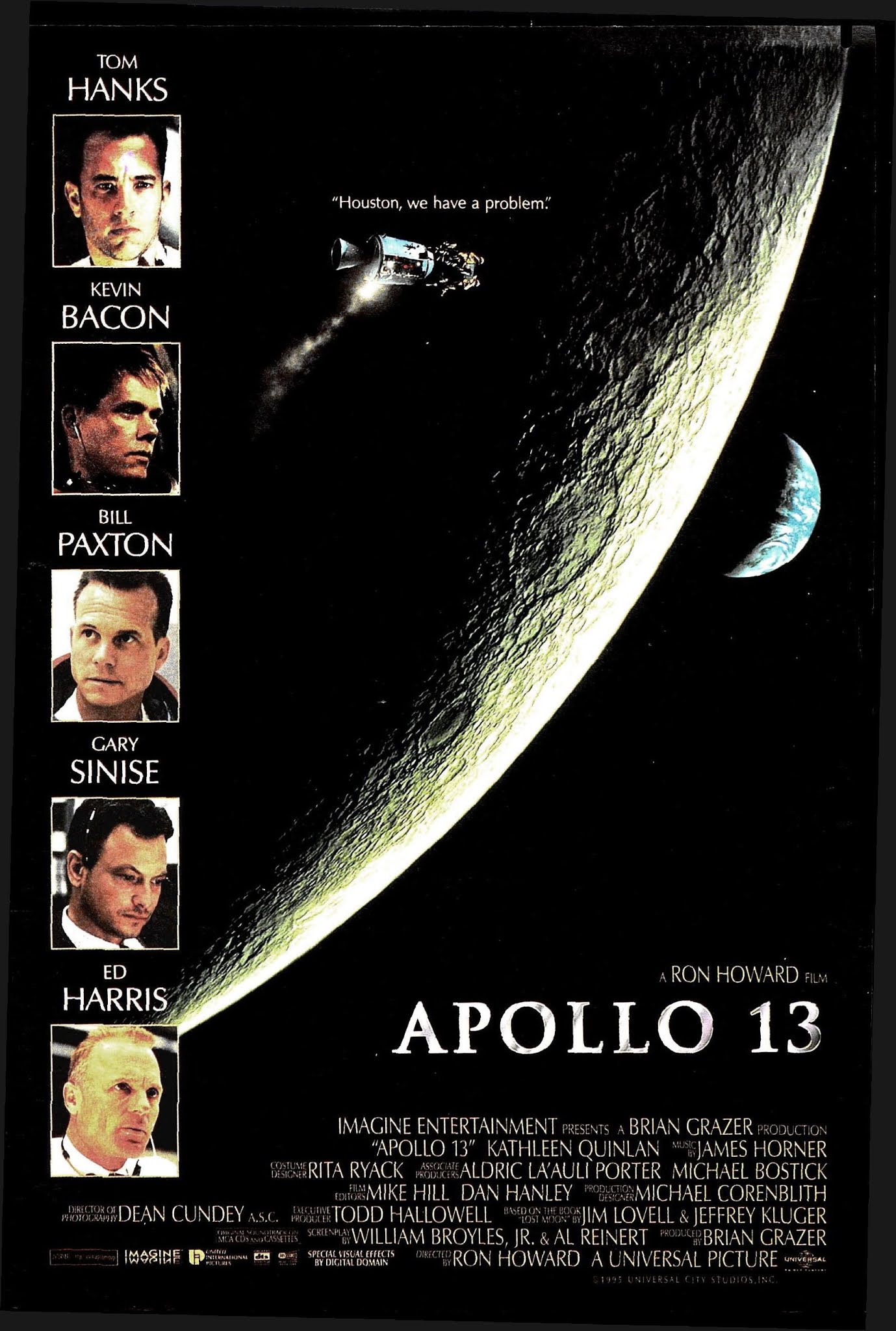
Apollo 13 (1995)

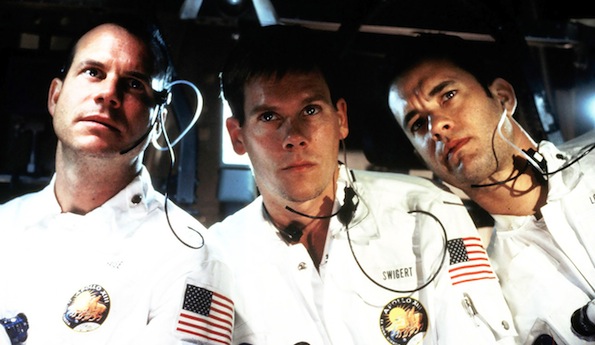
Bill Paxon, Kevin Bacon and Tom Hanks are stranded in space in Apollo 13

Director: Ron Howard

Cast: Tom Hanks (Jim Lovell), Kevin Bacon (Jack Swigert), Bill Paxton (Fred Haise), Gary Sinise (Ken Mattingly), Ed Harris (Gene Kranz), Kathleen Quinlan (Marilyn Lovell), Chris Ellis (Deke Slayton), Joe Spano (NASA Director) Xander Berkeley (Henry Hunt), Marc McClure (Glenn Lunney), Clint Howard (Sy Libergot), Ray McKinnon (Jerry Bostwick), David Andrews (Pete Conrad), Christian Clemenson (Dr Charles Berry), Brett Cullen (CAPCOM1)

“Houston we have a problem”. Those calmly spoken words coat an ocean of disaster in Ron Howard’s brilliant reconstruction of the disaster-that-very-nearly-was, Apollo 13. Without a shadow of a doubt Howard’s finest film, this is brilliantly tense and hugely engaging that builds an edge-of-the-seat tension around a true story. You can’t watch it without being filled with breathless admiration for the ingenuity of those in mission control and the courage of those in space as they worked together to bring the mission home. Truly “Failure is not an option”.

On a mission to the moon, Mission Commander Jim Lovell (Tom Hanks) and crew Fred Haize (Bill Paxton) and late replacement Jack Swigert (Kevin Bacon) are left desperately trying to salvage their ship after an accident strikes. Meanwhile back in Houston, Flight Director Gene Kranz (Ed Harris) and replaced crewman Ken Mattingley (Gary Sinise) lead a dedicated team juggling every inch of mathematical, scientific and practical knowledge they have to bring the ship home.

Apollo 13 is a masterpiece of reconstruction. Every inch of the NASA space programme is reassembled in perfect detail. Every nut and bolt, from procedures to the interplay between the astronauts and Ground Control. There isn’t a single false note, and every single element of the production, photography and editing is carefully placed to support this total immersion in period. Howard’s technical direction is brilliantly done, intercutting with a fabulous sense of pacing between the crew in space and Ground Control back here on Earth. It becomes one of the most engrossing and involving true-life stories you can imagine.

I love this film. I love every second of it. Every single time I see it – and I must have watched it at least once a year since 1996 – I get wrapped up in the tension and, perhaps even more than that, the inventiveness needed to solve problems in space. The film throws conundrums at us time and time again. The command module needs to be restarted to land the ship – but only has enough power to keep a coffee machine running for a few hours. A vital course correction, that a computer could calculate and perform, needs to be carried out by hand. The weight of moon rocks needs to be replicated in the landing module. And, most brilliant of all, the NASA boffins need to work out literallyhow to fit a round peg into a square hole in order to replace a CO2 filter – using nothing but the pile of equipment on the spaceship.

These problems all need to be solved by people low on sleep, high on stress and – in three obvious cases – stranded, cold and alone in space, and each one is carefully explained by the film’s very natural but highly detailed script and then relayed into nail-biting efforts to solve them. (James Horner’s score also works wonders here, communicating the awe of space and our vulnerability in that black void expertly.) In no other film can the tearing of a plastic bag have you gasping at the impact it could have on life or death.

Added to the impact of this, is the engrossing excitement of watching brilliantly trained professionals tackle the sort of situations that would reduce you or I to sweaty panic. Other than a brief moment of recrimination between Haise and Swigert (authoritatively quashed by Lovell’s “Gentlemen, we are not doing this”), everyone stays more cool, calm and collected than you could possibly expect. This also means that flashes of urgency or emotion carry huge impact in communicating stress: when Libergot stresses powering down the ship is the only way for the crew to survive or Lovell is caught on radio ranting he is “well aware of the Goddamn gimbels” while trying to pilot a ship leaking oxygen through a barrage of debris to a soundtrack of alarms, the pressures they are trying to cope with come thundering home to us.

The extraordinary work of the actors also goes a long way towards the film’s success. If any film cemented Tom Hanks’ everyman quality, it was this one. His Jim Lovell is calm, controlled and extremely grounded, a professional with a realistic outlet, a devoted family man and overwhelmingly ordinary for all the extraordinary things he’s done. Hanks brings the role a huge authority and acres of empathy and relatability. He seems both vulnerable, human and professionally assured. I’d trade both his Oscar-winning performances for this one.

The whole cast follows his lead. Bacon and Paxton are very good as the rest of the crew, juggling moments of fear, frustration and black humour. Ed Harris became a star character actor overnight with his brilliant performance as Kranz, another committed professional who refuses to countenance failure and guides the ground team through super-human efforts, while keeping his own emotions carefully under control. Kathleen Quinlan is impressive as Lovell’s wife, keeping the morale of those left behind as high as she can while barely controlling her own fear. Gary Sinise’s Ken Mattingley channels his resentment at being benched from the mission into a Herculean commitment to bringing them home.

It’s that commitment on the ground that Howard’s film so brilliantly understands. A lesser film would have focused overwhelmingly on the courage of the astronauts alone, and heightened their struggles to pilot the spacecraft and survive. Apollo 13 understands above all that this was a team effort – and the casting and scripting feeds brilliantly into this. No one is the “hero”, no one “saves the day”. Every character focuses on their own small piece of the puzzle and has to trust all the others worked out. The film gives huge amounts of time over to the boffins and geniuses of Mission Control – all brilliantly played by a host of character actors – and its respect for these unsung heroes is as great as it is for Lovell and his crew.

Howard also understands exactly when to up the music, editing and effects and when to slow the film down and let events quietly play out. Moments in space where the actors have to quietly reflect, or when we check in on the fears and concerns of the families back home, contrast perfectly (and carry even more impact) when they sit alongside the scenes of failures and rushes to save lives. As for that re-entry scene… is there any more tense scene in a true story film than that long, long wait to see if Apollo 13 will return from space? There are certainly fewer moments that will get those specks of dust irritating your eyes – I get a lump in my throat just thinking about it.

Everything in Apollo 13 is spot on. I would go further and say I’m not sure there is a single wrong beat in it. It’s Howard’s masterpiece – his infamous snubbing for an Oscar nomination is inexplicable, his direction here is vastly superior to winner Mel Gibson’s work on Braveheart. It turns a true-life story into an impossibly tense, deeply involving, hugely emotional story. The actors – some of whom shot for weeks in a “vomit comet” plane to replicate weightlessness, an effect that works superbly – are outstanding. Every single technical aspect of the film is spot on. Its emotional impact is as absolute as the admiration and respect you’ll feel for the real NASA crews that guided this mission home. Apollo 13 is a classic. I can’t imagine anyone not finding something in it to like – not many films you can say that about.

Armageddon (1998)

Bruce Willis leads a group of Big Damn Heroes in Michael Bay’s abysmal Armageddon

Director: Michael Bay

Cast: Bruce Willis (Harry Stamper), Billy Bob Thornton (Dan Truman), Ben Affleck (AJ Frost), Liv Tyler (Grace Stamper), Will Patton (Chick Chapple), Steve Buscemi (Rockhound), William Fichtner (Colonel Sharp), Owen Wilson (Oscar Choice), Michael Clarke Duncan (Bear), Peter Stormare (Lev Andropov)

In Michael Bay’s space, no-one can hear you scream. But that’s only because it’s so damn loud up there. It’s 1998’s other “asteroid is going to wipe out humanity” film, the one that came out after Deep Impact but grossed more. NASA recruits ace driller Harry Stamper (Bruce Willis) and his team (including Will Patton, Steve Buscemi, Michael Clarke Duncan and Owen Wilson) to fly up to an asteroid the size of Texas, drill a hole in it, drop a massive nuke in and blow it into two bits that will bypass the Earth. Will humanity be saved? And will the tensions ever be resolved between Harry, his protégé AJ (Ben Affleck), and Harry’s daughter Grace (Liv Tyler) who, much against her dad’s will, wants to marry AJ? Houston, we have a problem.

Armageddon is the ultimate expression of Michael Bay’s style. With the camera swooping and rotating wildly around characters on the move, the fast-editing, the assault on the ears, the green-yellow-blue hue, every shot and line of dialogue in Armageddon feels like it was made to be inserted into a trailer. It’s an overlong onslaught (nearly two and a half hours) which rarely goes ten minutes without a sequence that features explosions, furious shouting and frantic camera movements. Most of the action in Armageddon is incoherent and the film rather neatly replicates the experience of being actually hit by a meteor.

For many people this is a guilty pleasure. But there is very little pleasure to be had here. By trying so hard to top Deep Impact – a film he hadn’t even seen at this point – Bay dials everything beyond 11. So much so it becomes exhausting. Half the action sequences (of which there are many) are impossible to understand, such is the fast editing and the way all the dialogue is screamed by the actors at each other, all at once, drowned out by bangs and crashes. The only dialogue you can actually make out in the film is of the “The United States government asked us to save the world. Anybody wanna say no?” variety, built for slotting into a trailer before some more bangs.

In fact the whole film is basically a massive trailer for itself. It’s unrelenting and after a while not a lot of fun. I guess if you catch it in the right mood it might just work. Bay gives it everything he has in his arsenal. But even he can’t overcome performances from his actors that range from bored and unengaged (Willis and Buscemi both fall into this category) to over-played grasping at epic-status (Affleck and Tyler fall into this one). Billy Bob Thornton comes out best with a wry shrug, knowing the whole film is bonkers but going with the ride.

Anyway, it all charges about a great deal, even while it never knows when to stop. In every situation one crisis is never enough – it’s best to have three at once. Not only does someone need to stay behind, but the asteroid is breaking up and the shuttle won’t take off! What a to-do! The film is desperate to excite you, like a 7 year old who wants to share the BEST-THING-EVER with you and doesn’t draw breath while telling you every single detail.

Of course, scientifically the film is nonsense, but that hardly matters. How NASA can know the comet being blown in two will create two bits that will miss the Earth (rather than two impacts or a whole load of debris) is unclear. Timeline wise – particularly early on – the film makes no sense. But then who goes to Bay looking for a science lecture? It even opens with a ponderous Charlton Heston voiceover, all part of the straining for grandeur.

It’s not even the best Bay film (that would surely be the far more enjoyable but equally overblown The Rock closely followed by the first Transformers film, the only one that doesn’t make you feel soiled after watching it). Armageddon could be a guilty pleasure. But really it’s terrible. You should just feel guilty.

Jurassic Park (1993)

Jurassic Park header
Dinosaurs walk the Earth once more in Spielberg’s classic blockbuster Jurassic Park

Director: Steven Spielberg

Cast: Sam Neill (Dr Alan Grant), Laura Dern (Dr Ellie Satler), Jeff Goldblum (Dr Ian Malcolm), Richard Attenborough (John Hammond), Bob Peck (Robert Muldoon), Joseph Mazzello (Tim Murphy), Ariana Richards (Lex Murphy), Samuel L. Jackson (Ray Arnold), Wayne Knight (Dennis Nedry), Martin Ferrero (Donald Gernaro), BD Wong (Dr Henry Wu)

Can you imagine a more exciting film for a 12-year-old boy, than one with dinosaurs walking the Earth once more? And not the sort of rubbery dinosaurs, that we always knew were really models, in classic films. I was 12 when I first saw this film, and these animals really did look 65 million years in the making: they felt real, with roars that deafened the ears and footfalls that made the cinema shake. Dinosaurs are hugely exciting, awe-inspiring beasts. So much so you can forget many of them were also ruthless killers, with really sharp pointy teeth. It’s that mixture of awe and terror that Steven Spielberg understands so well in this exceptional blockbuster, like he mixed Close Encounters and Jaws together in a lab and then let it run loose.

Boffins have worked out a way to clone dinosaurs from frozen DNA, stuck inside prehistoric mosquitoes. Naturally, what else would you do with this discovery but use it to create the most exciting theme park ever seen. What could possibly go wrong? Avuncular billionaire John Hammond (Richard Attenborough) has built the park – and he wants scientists and archaeologists Alan Grant (Sam Neill), Ellie Satler (Laura Dern) and Ian Malcolm (Jeff Goldblum) to give it the thumbs up. Sadly however things are set for disaster during a long, low-staffed weekend when an act of industrial espionage by disgruntled employee Nedry (Wayne Knight) leads to all control over the par being lost and the dinosaurs turning on the guests.

The rights to Chrichton’s novel were sold before the book was published, and it’s classic Chrichton set-up of science trying to play God, and landing us all in a moral quagmire and massacre. But first though, let’s not forget how awe-inspiring dinosaurs actually. It’s a long wait until we see any more detail of one than a fearsome eye. But when we do, Jurassic Park knows that for that brief moment we are all children again. As John Williams’ triumphant theme thunders out, and the characters stagger with breathless, tearful excitement in its wake, a Brachiosaurus towers over the screen. Spielberg’s camera perfectly hammers home the sense of wonder at the size and beauty of this gentle giant. Sure science is arrogant, but then if it wasn’t we’d never reach the stars, right?

Spielberg’s film though isn’t just an awe-inspiring modern-day Planet Earth. Because the makers of this park also created plenty of fierce monsters, from the mighty T-Rex to the scarily smart and vicious velociraptors. And if the first half of the film is about the magic – that imperious brachiosaurus, a sleeping triceratops, a baby velociraptor emerging from its egg – the second half is about the horror of finding out what happens when man’s hubris comes back and (literally) bites him in the ass (and plenty of other places). Because when the Raptors get lose, suddenly this park isn’t magic, but a terrifying death-trap where the guests are the prey to out-of-control exhibits.

The second half of the film – from the moment the T-Rex bursts through its non-functioning electric fence to rip apart two jeeps (and of course eat a lawyer cringing on the toilet) – is a terrifying, giddy, exciting monster-chase, with a director who hasn’t delighted this much in the relentless horror of nature since Jaws. And Spielberg gets to play every game here. Huge dinosaurs stomping on cars. Velociraptors playing ruthless hide-and-seek in isolated power houses. Open spaces becoming terrifying hunting grounds and everyday ones like kitchens become terrible traps. What chance do human beings have when there are “clever girls” like the raptors running around?

Jurassic Park is singularly responsible for elevating the raptor, a previously largely unknown dinosaur, to the front rank of dinosaur fame. There is always a romantic appeal to the T-Rex. It’s the king after all, the biggest and the most famous – and its status in the public perhaps reflects the fact that the film sort of asks us to root for it. After all, it only eats the lawyer. And when the final act comes, it’s the T-Rex’s intervention that saves our heroes bacon. The real monsters are the raptors: supremely clever (they can open doors!), totally ruthless, they hunt in packs, they move super-fast and they look like a disturbing mix between bird, human and lizard. Spielberg makes them one of the most terrifying monsters in film, that more than live up to their extended build-up.

Spielberg directs the entire film with his usual devilish wit and fiendish mastery of the set-piece. The film draws some neat, if simple, story-lines for its human characters. Will Dr Grant overcome his aversion to children? Each of them gets a snippet like this. The actors are often (literally) in the shadow of the dinosaurs, but they are big part of communicating the sense of awe. Neill and Dern go through the motions with a certain charm. Goldblum steals most of his scenes as a rock ‘n’ roll physicist, riffing in the way only he can. Richard Attenborough reinvented himself from a career of creeps to cuddly grandad as a Hammond who shares nothing but his name with the book’s ruthless capitalist.

But the real stars are the dinosaurs. And even almost thirty years on, the special effects are really breath-taking here. These feel like real, living, breathing creatures, and Spielberg knows how to shoot them. Even today it still casts quite a spell. It’s telling that none of the sequels, except Jurassic World (which was made by the people who grew up on this film) gets near to matching the mix of magic and horror that this one hits. Sure, it’s a film so confident of success that it fills one scene with shots of the park merchandise (available in a shop near you now!), but then that’s because it’s got a master at the helm and the greatest attractions in 65 million years.

With its underlying plot of the dangers of mankind’s hubris – plus some rather witty criticism of how a park reliant on wild animals might have struggled to work anyway if the dinosaurs refused to emerge from the shadows of their huge paddocks for the tourists – Jurassic Park gives you something to think about, while still terrifying you with ruthless monsters. It’s a classic.]