Catnip to fans (like me) but honestly a tonal mess of a film with just enough fun to almost work
Director: Travis Knight
Cast: Nicholas Galitzine (Adam/He-Man), Camila Mendes (Teela), Idris Elba (Duncan/Man-At-Arms), Jared Leto (Skeletor), Alison Brie (Evil-Lyn), Kirstin Wiig (Roberto), James Purefoy (King Randor), Charlotte Riley (Queen Marlena), Morenca Baccarin (Sorceress), Jóhannes Haukur Jóhannesson (Fisto), Jon Xue Zhang (Ram-Man), Sam C. Wilson (Trap Jaw), Sasheer Zamata (Suzie), Christian Vunipoa (Huessein)
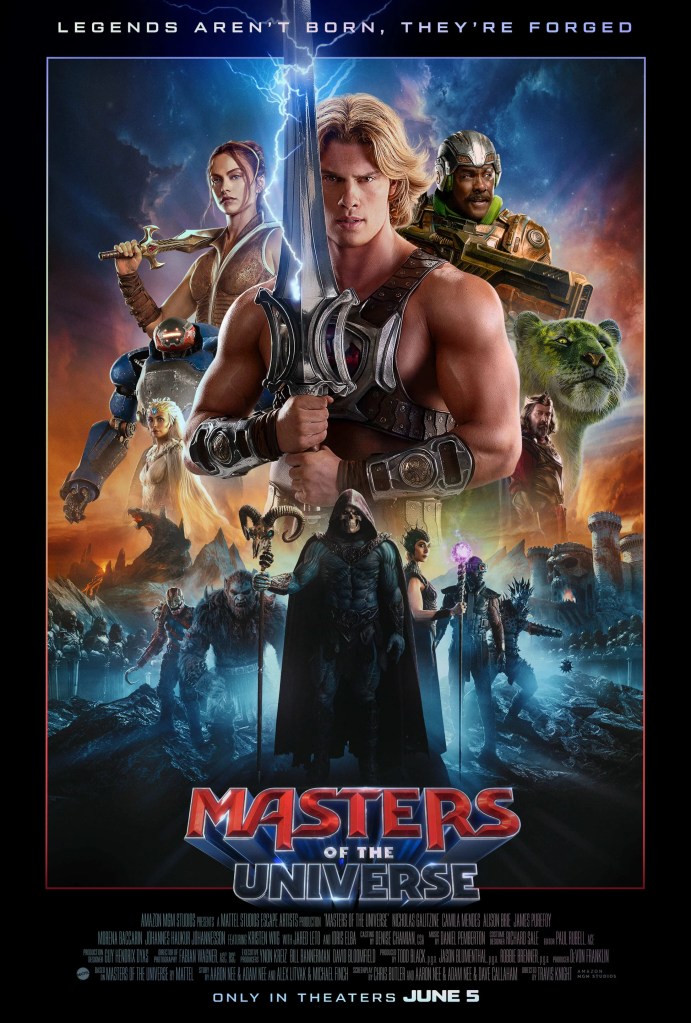
When I was very young I loved He-Man and the Masters of the Universe. I had almost every toy, watched every cartoon, seen the live-action movie – I even continued watching the Further Adventures which took He-Man into space. So, I think its fair to say I am the exact target market for Masters of the Universe: a middle-aged man who hasn’t really grown up, who wants to soak in childhood nostalgia. On several of those scores, I can’t be disappointed with Masters of the Universe, even while recognising this is a deeply flawed film, with far less to entertain the non-fan.
Anyway, Adam (growing up to be Nicholas Galitzine) is the Prince of Eternia, who fled via a sword-of-power wormhole, to Earth after his planet was conquered by the evil Skeletor (Jared Leto). After losing the sword and being stranded on our world for 15 years, earning a crust as a sensitive ear in HR, Adam tells anyone who will listen he is actually a Prince from a far-flung world. When he finds the sword, he is rescued by old friend Teela (Camila Mendes) and taken back to Eternia where he finds the remains of the Eternia’s mightiest heroes struggling in the resistance to Skeletor. But perhaps Adam is the chosen one, who by the power of (Castle) Greyskull will become the mighty hero to defeat Skeletor?
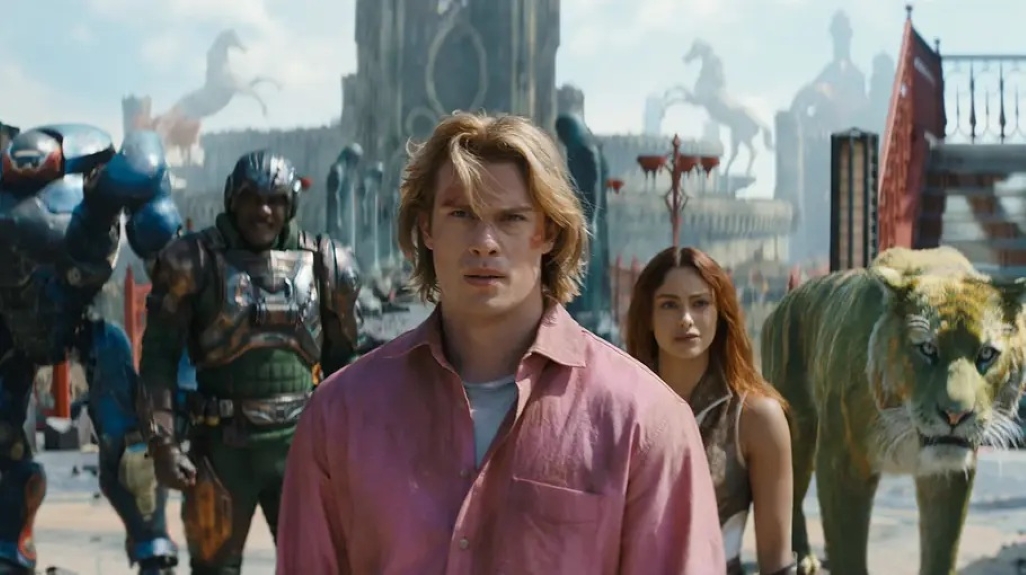
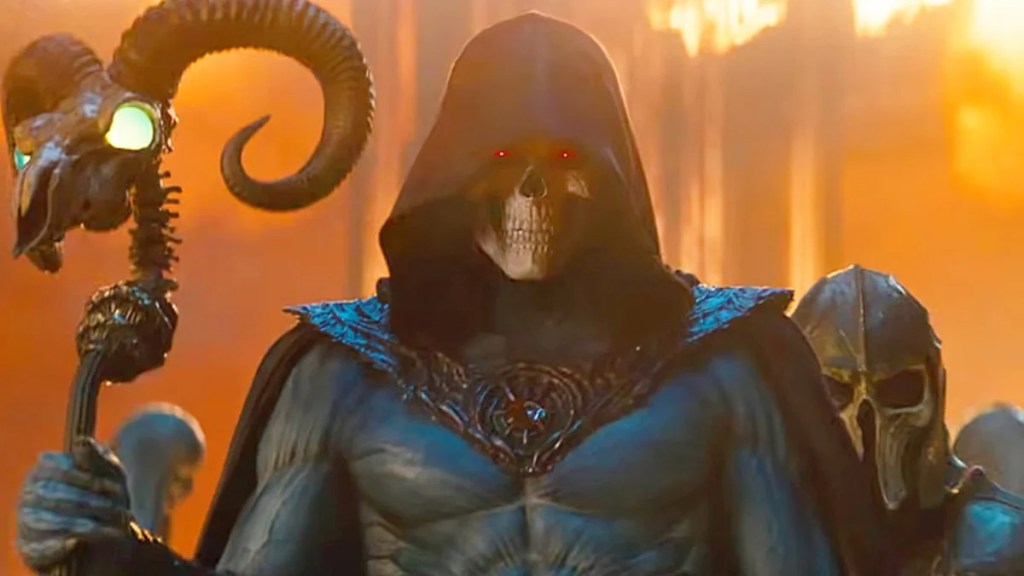
Spoilers: of course he is. I’ll repeat, for the fan, there is so much to like about Masters of the Universe. First and foremost, the loving detail the characters have been bought to life, in all the bright primary colours and demented designs of the original. Did I ever imagine a world where I would see a live action film with a blue skinned Trapjaw with a green face, pinkish helmet and jaw and a mechanical arm that can turn into a hook or canon? Heck no, but I’m all for it.
Every single character has been bought to the screen like they’ve literally been ripped from the pages of my old comics, and given a steroids boost (although Skeletor’s old toys were as ripped as this). Not only that, but the film brings us obscure heroes like Moss Man (exactly what you’d expect) and Mechaneck (whose weapon is an extending mechanical neck). My hat guys. You can’t deny the love clearly there: so many of the cast and crew have talked about their deep-rooted affection for it (if I was a famous actor, I’d have loved to be in this). It’s strangely heart-warming.
But with my more critical grown-up head on – the one that isn’t bashing the action figures – is Masters of the Universe a mess? Yes, 100%. A fun mess for sure. Some decent laughs. Nicholas Galitzine is charmingly endearing as the gentle Adam. Camila Mendes revels in playing the film’s real tough guy, the good at almost everything Teela. Jared Leto has never been more enjoyable than as Skeletor, walking a tight rope between making the character absurdly pathetic and deeply horrible. It bounds along with real pace. As it should, since you can see much of its visual design, use of rock music and strongly tongue-in-cheek affectionate mockery is ripped straight from Thor: Ragnorak (you feel like its desperately trying to be a remake).
But thematically, it’s all over the shop. You feel the push-me-pull-me of different writing crews during the film’s tortuous production. It wants to explore questions of toxic masculinity and true strength coming from within. But does so ham-fistedly. For starters, the idea that Adam’s true powers come from his HR trained empathy is rendered hard to take seriously since (a) the film rips the piss out of HR speak every chance it gets, (b) Adam sounds ridiculous and uncertain and fails every single time he tries to defuse a conflict and (c) all his problems are solved through super strength. Not a single dilemma is resolved through negotiation or compromise.
Toxic masculinity coverage is also all over the shop. James Purefoy is presented as the model appalling dad, eternally disappointed in his sensitive son… until the film judderingly changes gear and tries to present this as well-meaning tough-love. Idris Elba’s Duncan collapses into a decade of drunken self-pity after his cocky self-assurance is torn apart. Does he get out of this spiral by acceptance or humility? No, he gets over it by blasting the hell out of stuff. Adam’s flatmate’s hiding his love of romcoms should be perfect for this but is only ever a punchline. Even Fisto’s masculine dismissal of Adam gets no blow back (the suggestion he’s full of cowardly bluster is similarly dismissed by the finale reaffirming he’s tough and therefore a hero).
Which makes the film’s moral (just like the cartoon, it ends with one!) feel pretty empty. Adam doesn’t even learn from his first brutally ill-thought out, violent attack on Skeletor’s HQ, which only succeeds in hurting people he cares for, that anger and pride are dangerous. He also quickly gets over his endearing squeamishness about ripping arms off androids or gunning down goons. Struggling to get out here is an idea of He-Man as still being the same sensitive twelve-year old – but it’s constantly cancelled out by the film needing He-Man to flex his muscles and skewer goons to the wall. A better film would have given He-Man his powers much later or explicitly have him earn them through demonstrating the qualities the film is pretending its praising (communication, honesty, sensitivity) rather than in his willingness to give a punch a go.
I could probably go on. I enjoyed the film. I did. But it’s sort of observed the arcs of Thor and Thor: Ragnorak, mixed it with some of the charm of Travis Knight’s Bumblebee, but still ended up completely missing the points it’s claiming to be making. And no amount of nostalgia-bait character design or (I can’t believe I’m typing this, even before news leaked he might have the same attitude to women as his character) fun from Leto or charm from Galitzine really makes up the difference.