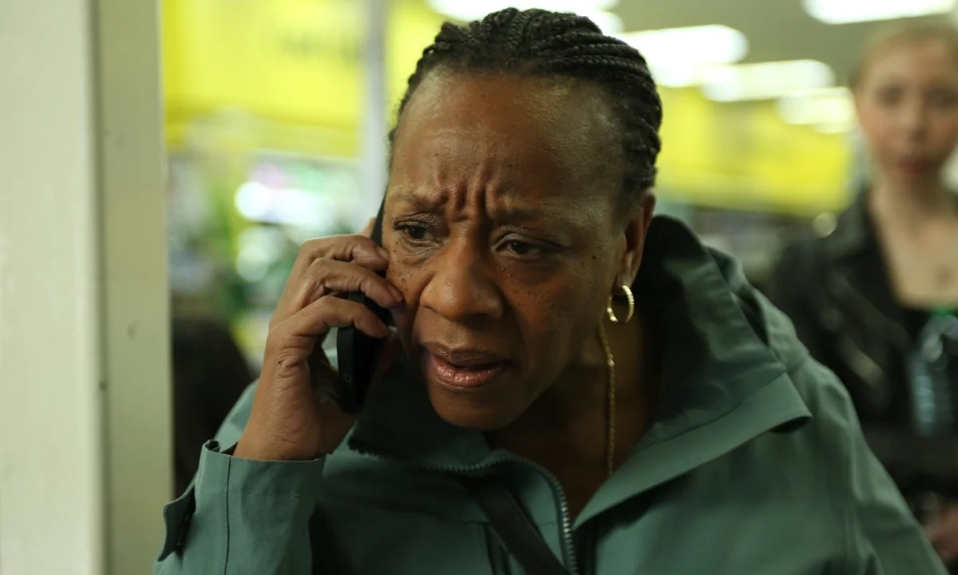
Category: Female led film

Hard Truths (2024)

Hard Truths (2024)

Leigh encourages us to take a deeper, more considered look at the people around us

Director: Mike Leigh

Cast: Marianne Jean-Baptiste (Pansy), Michele Austin (Chantelle), David Webber (Curtley), Tuwaine Barrett (Moses), Ani Nelson (Kayla), Sophia Brown (Aleisha), Jonathan Livingstone (Virgil)

Sometimes the world all gets too much for all of us. But it’s pretty much always too much for Pansy (Marianne Jean-Baptiste). A stay-at-home wife to plumber Curtley (David Webber), mother to shy, unambitious Moses (Tuwaine Barrett), pretty much everything enrages Pansy, who responds to virtually everything around her with unbridled rage and accusatory rants. She’s completely different to her sister Chantelle (Michele Austin), a motherly hairdresser with two ambitious daughters Kayla (Ani Nelson) and Aleisha (Sophia Brown) with whom she has a warm loving relationship. What made one sister easy-going and the other someone who could literally pick a fight in an empty room?

The sharpest part of Mike Leigh’s small-scale, but deeply engaging, family story is encouraging us to take a longer look at a person who, at first, is almost unbearable. To find in them vulnerabilities and fears that makes us understand and feel sorry for them. But, make no mistake, Pansy is a tough person to spend time with. Brought to life in an astonishing, visceral, deeply raw performance by Marianne Jean-Baptiste, most of the film’s opening half hour is spent establishing Pansy’s kneejerk aggression which she uses to deal with everything around her.

Jean-Baptiste launches into these furious rants with the sort of all-consuming energy that feels like you’ve been punched back in your seat, while her all-in commitment even raises a chuckle or two at the unadjusted fury of Pansy’s words. Every encounter ends in Pansy either letting rip or almost deliberately escalating everyday moments into confrontations. She tears a strip off a shop assistant in a furniture store, seemingly for no reason. She confronts a shopping till assistant and two other people in a supermarket queue. She begins a slanging match with another driver over a parking space. At dinner she barely gets a fork-full of food into her mouth, so intent is she on condemning the rest of the neighbourhood while her husband and son keep their heads down and silently eat the meal she prepared. Compared to Chantelle’s warm home life and bubbly, chatty interaction with her customers, our sympathies lie with those who have to deal with Pansy.

But the brilliant thing in here, and in Jean-Baptiste’s fragile desperation and terror just under the surface, is that Leigh’s film unpacks this to make clear it stems from an inability to deal with the world: a fear that has turned Pansy into someone who instinctively attacks first before when she feels threatened (which is all the time). Pansy clearly suffers from some sort of deep anxiety mixed with OCD. She’s terrified of germs, barely able to touch items she hasn’t personally cleaned. Her house is antiseptic, devoid of personal items. She seems totally at a loss with how to talk to people, interpreting every approach as an implicit threat and is deeply lonely under her aggression. This is the anger of someone who is scared literally all the time, who can’t deal with the pressures of the world and has retreated into a defensive cocoon to drive everyone away.

Jean-Baptiste’s performance grows, deepens and peels away layers of Pansy to become richer and richer as Leigh’s perfectly placed, deceptively slight film gently spreads itself out. Pansy is convinced the world is dangerous, certain that everyone hates her, only married her husband (who gives her no emotional support what-so-ever and silently expects meals when he gets home) because she was afraid of dying alone. She can’t sit in a room without cleaning it, can’t bring herself to put on dentist goggles someone else might have used and is nearly paralysed with fear at the thought of touching a bunch of shop wrapped flowers. To her the world is a continuing, never-ending, terrifying struggle and it has turned Pansy into a woman constantly desperate and scared. Worst of all, Pansy knows this isn’t ‘normal’, that things which incapacitate her with fear don’t even cause other people to bat an eye – and she doesn’t understand why she is like this. This emotion pours out of Jean-Baptiste in a riveting, hugely affecting second act, playing out like a deeply moving emotional breakdown.

The catalyst is the mother’s day commemoration she and Chantelle share for their mother, a woman Chantelle remembers with deep fondness and love: but whom Pansy remembers only as a woman who expected Pansy to sacrifice her own education and interests to look after Chantelle and bring money into the home. Pansy references a childhood love of mathematics that was never encouraged – the sort of natural skill you can imagine someone somewhere on a spectrum like Pansy is would have had a real passion for – which for her summarises how opportunities were never meant for.

Our sympathies slowly, but noticeably shift. Pansy can’t do what the rest of do, put aside or forget the things that upset us. Hard Truths suggests sometimes we do that too easily: Chantelle’s daughters experience tough, unpleasant days at work but come together for drinks to say how great their careers are. Others deal with painful encounters – like the bullying Moses endures – by retreating into silence. Pansy though is aware she cannot deal with situations, cannot understand herself or why she is the way that she is – and, it’s clear, doesn’t like herself either. More and more we agree with Chantelle, who can’t understand why she married the unsupportive, monosyllabic Curtley (who treats his eager apprentice with dismissive disinterest and barely acknowledges Chantelle’s family showing its not fear of Pansy that keeps him sullen and silent at home).

It’s a masterful part of this wonderful, small-scale but deeply heart felt film from Leigh. Jean-Baptiste’s performance is one of the ages, but Michele Austin gives a highly emotive performance with a charm that hides an inner steel. It’s a beautifully assembled, wonderfully acted, highly intelligent film from an accomplished director who encourages the viewers to look as closely at characters – their complexities and virtues as well as their flaws – with the same patience and regard as he has spent his career doing.

Emilia Perez (2024)

Emilia Perez (2024)

Controversial arthouse film which clumsily tries to do to many things, many of them not well

Director: Jacques Audiard

Cast: Zoe Saldaña (Rita Mora Castro), Karla Sofía Gascón (Emilia Pérez/Juan “Manitas” Del Monte), Selena Gomez (Jessi Del Monte), Adriana Paz (Epifanía Flores), Édgar Ramírez (Gustavo Brun), Mark Ivanir (Dr. Wasserman)

Sometimes a film comes along that manages to annoy everyone. Emilia Pérez seems to have achieved that unwanted goal. Jacques Audiard’s Cannes Jury Prize winner is a wild, audacious piece of film-making that misses as much as it hits. It’s also been bashed as a musical full of people who can’t really sing, denounced as transphobic, and savaged by Mexicans. Perhaps Emilia Pérez shows us the downside when an auteur French director works with Netflix who accidentally promote what would have otherwise been a little-seen arthouse film into the heart of a culture war. I don’t think Emilia Pérez intends to be racist or transphobic (but yeah most of the cast can’t sing), but it does deal with these issues at times very clumsily. It’s also a curious mish-mash that places a transitioning character in a traditional “hard-to-escape-your-past” plot.

That transitioning character is Emilia Pérez (Karla Sofía Gascón), formerly a notorious drug-lord. With the (initially coerced) aid of crusading lawyer Rita Mora Castro (Zoe Saldaña), Emilia succeeds in faking her death, moving her family to Switzerland to protect them, extricating a fortune from her criminal empire and flying to Israel for her operation. Four years later, Emilia finds she can’t live without her children and Rita is roped back into retrieve her wife Jessi (Selena Gomez) and kids and move them in with their “aunt” Emilia. Simultaneously Emilia, wanted to be cleansed of her criminal past, starts a foundation to “discover” the graves of those killed in Mexico’s drug wars. But returning to a world she left behind only makes it harder for Emilia to escape her criminal past.

Emilia Pérez: an Audiard crime story with songs! Audiard described it as an opera fantasia, and I feel it was his intention for nothing in it to be treated as traditionally “real”. The characters frequently burst into song or throw themselves into dream-like dance sequences to express complex feelings. Aside from the film’s explosive, guns-blaring conclusion, filmed on isolated, dusty, abandoned houses and roads, key scenes are tightly shot on sparse sets with very little back lighting, giving them a dreamy black-box effect. Emotions are as heightened as the (sometimes clumsy) lyrics and the film throws itself into every dialled-up event with a comic-book energy.

All of which means Emilia Pérez is an acquired taste and, like many ambitious films that zig when they should zag, fails as often as it hits the jackpot. Its finest scenes are the key song-and-dance numbers, all left in the hands of Zoe Saldaña (excellently torn between idealism, fear, cynicism and regret with complex feelings about her dubious employer). Saldaña is a dynamic and fearless dance performer, throwing herself into synchronised movements through a Mexican market in the film’s opening “El Alegato” and dominating the film’s central show-piece, an athletic, sensual dance around and over tables at a charity ball in “El Mal”.

But even Saldaña falls foul of the film’s largest musical failing: with the exception of Selena Gomez (who struggles with a Mexican accent so terrible, even non-Spanish speakers can tell it’s awful) no one in the cast can really sing. Criticism like that somehow feels shallow when you apply it to an arthouse film, but it’s legitimate. The cast largely go for fast-paced, Henry-Higgins-ish, rhythmic speaking, big on husky intensity but not exactly something you would sit and listen to. Gascón is a particularly poor singer, especially noticeable with the operatic high notes she is frequently given. Even the controversial AI-upgrade her voice was given in post-production can’t help her.

Throw into that the clumsiness of some of the lyrics. For a film dealing with as sensitive an issue as this, are lyrics like “Man to woman or woman to man? Man to woman. From penis to vagina” really a good idea? Is a song about Emilia’s son singing about how her smell reminds him of his Dad (body smell being a hot topic for this community) tasteful? Since this issue (the perception of bodily odours) is a key issue for the trans community, writing a whimsical song about it rather suggests Audiard and team didn’t really do enough to wrap their heads around controversial issues.

Perhaps that’s because Emilia Pérez is, at heart, a classic “just when I thought I was out…” movie that tries to spice up the formula by having its gangster character be a trans woman (the partial implication of a sex change being a type of disguise is another hot-topic issue the filmmakers should have got themselves familiar with). It does, I think, make for a fresh take to see even incredibly macho, hardened killers can have longings like Emilia – and Gascón’s performance is actually at its best showing the fear that lies below the aggression before Emilia’s transition, and when embracing her tearful joy at the success of her operation. But the point remains this is a film not looking to make a real statement on transgender issues, or even demonstrating any real interest in the experience of being trans. It is instead just using a trans identity as a new context for a familiar “starting a new life” storyline. With minimal changes, Emilia could have undergone extensive plastic surgery or gone into witness protection and it would have made few changes to plot or themes.

It is interesting to get a trans character who is not always completely sympathetic (although I get that the community find it a blow upon a bruise to finally get a film with a trans lead, and she’s as a morally questionable and unlikeable as this). Emilia’s desire to restart her life away from crime is fatally undermined by refusing to make the sacrifices needed. Slowly she drags her family back in (passing herself off, Mrs Doubtfire-like, as her own sister), reconnects with the criminal underworld (albeit for humanitarian reasons) and reverts to the threats and violence she used in her old life (when, let’s not forget, she had a plastic bag slammed over Rita’s head to motivate her).

Emilia Perez also never explores the outrageous moral stance of a murderer in a new life, using their knowledge to “help” their victims by “discovering” the graves of people she ordered put in the ground. In fact, the only person affected by Emilia’s past crimes whom the film shows her encountering is the widow of an abusive husband (who is actually grateful to the gangsters for saving her the trouble). It scrupulously avoids any contact with, say, a grieving relative of one of her past victims. Similarly, the film avoids engaging with Emilia’s appalling emotional manipulation of her family. Karla Sofía Gascón gives a committed performance, but she is not able to coalesce all these complicated feelings into a character that feels real and the film constantly veers awkwardly between giving her implied criticism and absolution.

Audiard offering not exactly the most flattering image of Mexico was the final nail in the film’s coffin, even if to be honest it’s his nationality as the face of a film about Mexico (Paz is the only Mexican involved) that has probably raised most hackles. Emilia Pérez has moments where Audiard’s impressive film-making stands out, a dance number captures your imagination or there is a flash of compelling acting. But then it will segue into the sort of scenes we’ve seen in hundreds of crime movies, or songs so out-there they raise the wrong sort of gasps. Emilia Pérez might not be intentionally trying to be racist or transphobic, but it certainly handles both themes with real clumsiness. Fundamentally, it’s a traditional plot told in an outlandish style, over-exposed into a world of criticism that Audiard (who has basically apologised if people don’t like the movie) and his collaborators just weren’t ready for. The film itself? Good moments, bad moments, but not worth all the fuss.

The Teacher’s Lounge (2023)

The Teacher’s Lounge (2023)

A series of minor thefts leads to a school spiralling out of control in this intense, small-scale drama

Director: Ilker Çatak

Cast: Leonie Benesch (Carla Nowak), Eva Löbau (Friederike Kuhn), Anne-Kathrin Gummich (Dr. Bettina Böhm), Rafael Stachowiak (Milosz Dudek), Michael Klammer (Thomas Liebenwerda), Kathrin Wehlisch (Lore Semnik), Leonard Stettnisch (Oskar Kuhn)

Schools can be like whole societies in microcosm, with attention grabbing events having earth-shattering consequences in these tiny worlds. New teacher Carla Nowak (Leonie Benesch) finds this out the hard way when she takes matters into her own hands to solve a spate of petty thefts in the staff room, before the blame is pinned on students. Setting a trap, to her surprise she captures on film evidence that the thief is the school’s popular administrator Mrs Kuhn (Eva Löbau), mother of Carla’s star-pupil Oskar (Leonard Stettnisch). Events quickly spiral out of control, as Mrs Kuhn denies the charges and Carla’s attempts to be even-handed and fair leave her isolated at the centre of a storm pitting teachers, students and parents against each other.

The Teachers Lounge is a gripping ‘everyday’ thriller, where events on a small scale capture wider conflicts that rock whole societies. The events themselves seem small – petty theft and arguments over invasions of privacy – but Çatak’s film demonstrates they have shattering impacts on those involved. Loss of reputation, of jobs, the damaging impact on a promising child’s education, the shattering of harmony in a small community – it all explodes due to a few spur-of-the-moment decisions, building on each other so delicately that you are suddenly surprised to find it’s a crisis.

What’s really painful about The Teacher’s Lounge is how scrupulously honest and moral everything Carla tries to do is. What she’s not prepared for, is other people not playing by the same rules. Privately confronting Mrs Kuhn (having caught her distinctive blouse going on camera) with an offer to stop stealing and she’ll say no more about it, she’s amazed and totally shaken by the complete unwillingness to admit any guilt. When the matter is raised with the headmaster, Carla is dumbfounded by Kuhn’s aggressive denial and furious counter-accusation of invasion of privacy. Her cause is passionately taken up by Oskar, accusing Carla of ruining his mother’s life for no reason.

At the film’s heart is a wonderful performance of repressed tension from Leonie Benesch. Carla is a good teacher, but also a slightly distant, perhaps little-too-professional person. She engages more comfortably with the children because the ‘rules’ are clearer. With her fellow teachers, she never seems relaxed. She isn’t willing, as they are, to support (or cover up) for colleagues regardless of the situation. She judges each situation on its own merits – and Benesch superbly shows through her tense frame and strained voice how stressful this is – and adjusts her views and opinions as the situation develops. To everyone else this isn’t a positive but a huge negative, her refusal to follow an agreed line a sign of her flaky lack of loyalty to the team. (Her controversial filming is entirely caused by her mistrust of her colleagues, after watching one of them shamelessly empty an honesty box).

Çatak’s film shows how fragile the rules holding society together can be under pressure. Carla’s compassionate, thoughtful teaching focuses on developing her young students’ empathy and morality. She respects their views and asks for honesty in return. When arguments arise in class, she encourages discussion and consensus building. A jolly welcoming clapping-and-singing routine she practices every morning is about bringing the class together as a group. All of this flies out of the window as events unfold, showing how fragile these precious democratic conventions are.

The control of the teachers in the school turns out to be unbelievably fragile. Carla’s students stop co-operating with her lessons, effectively forming a union. The school newspaper – older students full of idolism about being the next Woodward and Bernstein – trap Carla into a Gotcha interview and misrepresent her opinions, fuelling the crisis (and leading to a near mutiny over a ban of the school newspaper). Carla, naturally, is blamed by her colleagues for the interview.

These fragilities and small-scale repression is just one way Çatak uses the setting to illustrate larger issues. Just under the school’s surface, there is a strong ‘us-and-them’ atmosphere. Both teachers and students demand internal loyalty to their sides. The thefts have already motivated heavy-handed members of staff to pressure (in private meetings) students to inform on their classmates. Carla objects to this but lacks the strength to end it – just as she later objects but does not obstruct a forced search of the boy’s wallets for stolen cash. It becomes more and more clear that Carla’s more considerate, diplomatic way of proceeding simply hasn’t got a chance of getting heard.

There is an uncomfortable air of casual assumptions being swiftly made. The first student suspect is the son of Turkish immigrants (the father’s job as a taxi driver all but used as evidence that the boy is likely guilty). Some of the staff simply can’t believe a boy from his background could have ready cash on him. An unbearably uncomfortable meeting with his parents – who at one point are instructed to speak German – is rife with tension. No wonder Carla is so uncomfortable with her Polish roots being discussed, that she asks a colleague with a similar background to only speak to her in German. Of course that contributes even more to the untrusted sense of distance Carla accidentally gives off to her fellow teachers.

This makes it even more heartbreaking to see Carla’s world slowly collapse in on itself as her attempts to treat everyone’s view points and demands fairly and equally ends with her attacked by both her colleagues and students. With her ever tense, bewildered decency getting ever more crushed Leonie Benesch is excellent in Çatak’s wonderful small-scale morality tale about society today, where the loudest and most strident voices win out. If you were her, you’d be finding an excuse to scream in a classroom as well.

Queen Christina (1933)

Queen Christina (1933)

Garbo is at her best in this luscious, romantic, beautifully filmed historical epic

Director: Rouben Mamoulian

Cast: Greta Garbo (Queen Christina), John Gilbert (Antonio Pimental de Prado), Ian Keith (Count Magnus Gabriel De la Gardie), Lewis Stone (Axel Oxenstierna), Elizabeth Young (Countess Ebba Sparre), C. Aubrey Smith (Aage), Reginald Owen (Prince Charles Gustav), David Torrence (Archbishop), Gustav von Seyffertitz (General), Akim Tamiroff (Pedro)

What could be more perfect casting than Garbo as Queen of Sweden? In Queen Christina she plays the eponymous queen, daughter of legendary martial monarch Gustavus Adolphus, killed in the never-ending European bloodbath that was the Thirty Years War. Coming to the throne as a child of six, almost twenty years later she’s ready for peace in Europe. But, after a lifetime of duty, she’s also ready for something approaching a regular life. But her lords need her to do something about providing an heir, ideally by marrying her heroic cousin Charles Gustav (Reginald Owen) despite the fact she’s conducting her latest secret affair with ambitious Count Magnus (Ian Keith). One day Christina sneaks out of town, dressed as a man and meets (and spends several nights with – the disguise doesn’t last long) Spaniard Antonio de Pradro (John Gilbert) in a snowbound inn. Returning to court she has a difficult decision: love, duty or a bit of both?

Queen Christina is a luscious period romance with Garbo in peak-form. It’s a masterful showpiece for a magnetic screen presence and charismatic performer. Queen Christina gives Garbo almost everything she could wish: grand speeches, coquettish romance, Twelfth Night style romantic farce, domineering regal control and little-girl lost vulnerability. Garbo brings all this together into one coherent whole, and is a dynamite presence at the heart of Queen Christina. Garbo nails the show-stopping speeches with regal magnetic assurance, but will be delightfully girlish when giggling with lovers. Her nervousness that her femineity could be unmasked in any moment with Antonio in the inn is played with a charming lightness that’s deeply funny, while the romantic shyness and honesty she displays with him is pitched just right. Garbo also manages to make the queen never feel selfish even as she is torn between desire and duty.

She’s at the centre of a beautifully assembled film, gorgeously shot by William H Daniels, with dynamic camera movements, soaking up the impressive sets and snow-strewn locations. Rouben Mamoulian’s direction is sharp, visually acute and balances the film’s shifts between drama and comedy extremely well – it’s a remarkable tribute that considering it shifts tone and genre so often, Queen Christina never feels like a disjointed film or jars when it shifts from Garbo holding court in Stockholm, to nervously hiding under her hat in a snowbound inn to keep up the pretence she’s just one of the guys. (How anyone could be fooled for even a moment into thinking Garbo was a boy is a mystery).

It’s a relief to Antonio to find she isn’t one of the guys, since he’s more than aware of the chemistry between the two of them when he thinks she is one. There more than a little bit of sexual fluidity in Queen Christina, with Garbo’s Queen clearly bisexual, sharing a kiss with Elizabeth Young’s countess in ‘a friendship’ that feels like a lot more. Even before escaping court, Christina’s clothes frequently blur the line between male and female, as does the way she talks about herself. She is after all, very much a woman in a man’s world. Garbo brilliantly communicates this tension, her face a careful mask that only rarely slips to reveal the strain and uncertainty below the surface. You can see it all released when she stands, abashed, nervous (and unequivocally not a boy) in front of Antonio, as if showing her true self to someone for the first time.

Seizing not being the figurehead of state but her own, real, individual is at the heart of one of Queen Christina’s most memorable sequences. After several nights of passionate, romantic love making with Antonio, Christina walks around the inn room where, for a brief time, she didn’t have to play a role. With metronomic precision, Mamoulian follows Garbo as she gently caresses surfaces and objects in the room, using touch to graft the room onto her memory, so that it can be a place she can return to in her day-dreams when burdened by monarchy. It’s very simply done, but surprisingly effective and deeply melancholic: as far as Christina knows, the last few days have been nothing but in an interim in a life where she must always be what other people require her to be, never truly herself.

But then if she never saw Antonio again, there wouldn’t be a movie would there? He inevitably turns up at court, presenting a proposal from the Spanish king – which he hilariously breaks off from in shock when he clocks he is more familiar with the Queen than he expected. John Gilbert as Antonio gives a decent performance – he took over at short notice from Laurence Olivier, who testing revealed had no chemistry with Garbo – full of carefully studied nobility. He and Garbo – not surprising considering they long personal history – have excellent chemistry and spark off each other beautifully. He also generously allows Garbo the space to relax as Christina in a way she consciously never truly does at any other point in the film.

The rumours of this romance leads to affront in Sweden, from various lords and peasants horrified at the thought of losing their beloved Queen – and to a Spaniard at that! (Queen Christina makes no mention of the issue of Catholicism, which is what would have really got their goat up – an Archbishop shouts something about pagans at one point, but he might as well be talking about the Visigoths for all the context the film gives it). The shit is promptly stirred by Ian Keith’s preening Count Magnus, making a nice counterpart to Gilbert’s restrained Antonio. It also allows another showcase for Garbo, talking down rioting peasants with iron-willed reasonableness only to release a nervous breath after resolving the problem.

Queen Christina concludes in a way that mixes history with a Mills-and-Boon high romance (there is more than a touch of campy romance throughout). Mamoulian caps the film with a truly striking shot, the sort of image that passes into cinematic history. Having abdicated into a suddenly uncertain future, Christina walks to the prow of the ship carrying her away from Switzerland. Mamoulian holds the focus on Garbo and slowly zooms in, while Garbo stands having become (once again) a literal flesh-and-blood figurehead, her eyes gloriously, searchingly impassive leaving the viewer to wonder what is going on in her head? Is she traumatised, hopeful, scared, regretful, determined? It’s all left entirely to your own impression – and is a beautiful ending to the film.

Queen Christina was a big hit – bizarrely overlooked entirely at the Academy Awards, which makes no sense to me. It’s beautifully filmed by Mamoulian who finds new, unique angles for a host of scenes and at its heart has a truly iconic performance by Garbo. If you had any doubts about whether she was a great actress, watch Queen Christina and see how thoughts and deep emotions pass briefly across her face before being replaced by a mask of cool certainty. It’s a great performance from Garbo and a lusciously conceived historical epic.

Autumn Sonata (1978)

Autumn Sonata (1978)

The great Bergmans collaborate in a raw powerful film that does cover familiar Bergman ground

Director: Ingmar Bergman

Cast: Ingrid Bergman (Charlotte Andergast), Liv Ullmann (Eva), Lena Nyman (Helena), Halvar Björk (Viktor), Erland Josephson (Josef), Gunnar Björnstrand (Paul), Georg Løkkeberg (Leonardo)

In the history of Swedish cinema, there was one mighty collaboration the world was waiting for. The Bergmans (no relation) Ingmar and Ingrid, two generations of iconic Swedish filmmaking, to work together for the first time. It’s ironic that when it finally happened – and Autumn Sonata was the final time both Bergman’s worked on a project exclusively intended for cinema – it came during Ingmar’s self-imposed exile, meaning it was shot in Norway via a German company (and with a title originally in German) with British and American money. But one thing you couldn’t change: this would bring Ingrid back to the artistic Euro-film-making of her own Hollywood exile and that Ingmar wouldn’t flinch on his forensic, emotionally traumatic style for the legend.

Ingrid plays Charlotte, a famed classical pianist whose entire life has been her career, with brief stop-offs between concerts for marriages and kids. It’s meant she’s not seen her now-adult daughter Eva (Liv Ullmann) for over seven years. And that she’s also missed most of Eva’s affectionate-but-passionless marriage to Viktor (Halvar Björk) and the entire life (including birth and funeral) of her grandson Erik. Charlotte also has no idea Eva has moved her disabled younger sister Helena (Lena Nyman) from the nursing home Charlotte deposited her in years ago into her own home. A visit brings mother and daughter together again for an awkward reunion that turns into a cathartic emotional outpouring, as Eva unbottles decades of resentment, anger and pain.

Autumn Sonata revolves around this extended confrontation scene, which takes up a sizeable portion of Ingmar Bergman’s thoughtful, measured film where conversations are all too clearly ticking time bombs leading to revelations that might be best unsaid. It fixates powerfully on the damage parents can inflict on their children and the shattering pain children can cause their parents. It’s a film about the brutal, challenging complexities of family and the unspoken resentments they can cause on those within them, who see their own opportunities and freedoms eaten into by a never-ending stream of demands and expectations from ‘loved ones’.

It’s a feeling familiar to all three of the principles. Ingmar was all-too-aware of his difficult relationship with both his parents and his children, Ullmann wrote about her self-perceived failings as a mother while Ingrid’s elopement with Roberto Rossellini in the 40s led her to not seeing her own daughter for almost five years. And it plays into this incredibly raw film which, while it covers familiar Ingmar ground, is played with such powerful, visceral commitment from its leads (held grippingly in frame by Ingmar’s regular collaborator Sven Nykvist), that it’s still one of his tougher watches.

Ingrid is superb as Charlotte, a woman who arrives in the remote vicarage home of her daughter, bursting with glamour. Assured, certain and utterly confident of her position as the centre of any room, Charlotte has a tendency to narrate her own life, self-assuredly mapping out her actions (from what to wear to the decision to gift Eva a car) and basks in advance in the positive reactions she anticipates. Charlotte maps her life out in terms of concerts and recitals (constantly, when Eva asks about an event from her childhood, Charlotte will ground herself by referring to a performance from that time). She automatically assumes maestro status in the house, including listening to Eva’s piano playing, moving her aside to take over and lecturing her on how the piece should be played.

She’s also though a woman deeply uncomfortable with emotion and emotional commitment. It’s an insight into how distant and unconnected Eva’s childhood must have been (brief flashbacks show Charlotte’s politely affectionate utter lack of interest in the young Eva) that what’s motivated her to visit Eva is to distract herself from the unpleasant burden of dealing with her recent husband’s death. Not grief or the need for comfort mind: it’s the experience of dealing with the events connected to the death that’s unsettled her. Her refusal to engage with anything emotional continues, from avoiding the topic of Eva’s dead son entirely to reacting to something close to barely concealed irritation at discovering her disabled daughter Helena in the home: she didn’t come here to be reminded about this other difficult emotional bond she’d outsourced to a professional.

Charlotte’s emotional coldness and distance under her warm confidence is brilliantly embodied by Ingrid. She’s a woman so overwhelmingly focused on her career she probably should never have had children at all (and perhaps regrets doing do), wasn’t remotely interested in Eva and Helena’s father (a decent, bank-manager sort played silently by Erland Josephson in flashbacks) and wants nothing from this visit except to feel better about herself. The lacerating home truths unleashed on her, see Ingrid’s composure fracture in shock, guilt and regret, her eyes becoming wells of shamed emotion.

Equally brilliant is Liv Ullman, perhaps even more so. Ullmann appears at first mousey, dowdy, humble and deferential – her husband opens the film with a heartfelt monologue about her being convinced she is not worth loving and that he only regrets he has never been able to persuade her otherwise. The cause for this becomes clear as Eva releases years of pent-up fury and anger at her mother’s oscillating from ignoring her to bursts of obsessive attention focused on coaching Eva into becoming what Charlotte wants her to be (Ingrid is fantastic at establishing Charlotte’s dumb-founded amazement that these times she fondly remembers were in fact purgatory for her daughter). Ullman’s delivery of this is powerful, viciously resentful and overwhelmingly painful.

This confrontation is the centre of Autumn Sonata but Ingmar knows that, despite what happens in Hollywood, moments like this don’t cure festering boils. In fact, our great gift as humans is to forget, re-form and move on. The film’s coda sees both women doing this: Charlotte feels her shame, but in a one-sided conversation with her agent (a wordless cameo from Gunnar Björnstrand) has already begun the process of self-justifying self-mythologising of her past. Similarly, having released years of frustration, Eva returns to her compromising self, drafting letters of apology to her mother. Or perhaps these are springs of hope? Somehow in Bergman it’s hard to think so.

You can argue that all of this very familiar to Bergman watchers: and it is (the presence of Ingrid is probably what cements it as one of his best-known films). But this is also a thought-provoking work in its own right. Autumn Sonata suggests we may try to confront or deal with things that have caused us pain. But in reality, the long, continual work of doing so is too much or us: we revert instead to compromise, adjustment and familiar patterns. Flashpoints carry emotional and dramatic weight, but life is made up of forgetting. It’s a powerful closing idea in this viciously raw piece of film-making from Ingmar, that draws such heart-breaking and emotional performances from Ingrid and Ullman.

Wicked (2024)

Wicked (2024)

Hugely enjoyable and electrically filmed (sung and danced) adaptation of the classic stage musical

Director: John M. Chu

Cast: Cynthia Erivo (Elphaba Thropp), Ariana Grande (Galinda Upland), Jonathan Bailey (Fiyero Tigellar), Michelle Yeoh (Madame Morrible), Jeff Goldblum (Wizard of Oz), Ethan Slater (Boq Woodsman), Bowen Young (Pfannee), Marissa Bode (Nessarose Thropp), Peter Dinklage (Dr Dillamond), Bronwyn James (Shenshen), Andy Nyman (Governor Thropp)

I might be the only person who missed the phenomenon of Wicked, a smash-hit musical that filled in the back story of The Wizard of Oz. Set long before the arrival of Dorothy and her march down that yellow brick road, it covers the meeting and eventual friendship of Elphaba (Cynthia Erivo) future Wicked Witch of the West and Galinda (Ariana Grande) future Glinda the Good, at Shiz University (a sort of Ozian Hogwarts). Wicked is a grand, visual spectacular crammed with memorable tunes and show-stopping dance numbers and it’s bought to cinematic life in vibrant, dynamic and highly enjoyable style by John M. Chu.

At Shiz, Elphaba is snubbed by all and sundry who can’t see past her green skin. Despised by her father (Andy Nyman) – who we know isn’t her true father (I wonder who it could be?) – she’s lived a life of defensive self-sufficiency. Galinda, in contrast, is effortlessly popular and has never found herself in any situation where she can’t get what she wants. But Elphaba has something Galinda wants – a natural talent for magic that makes her the protégé of Madame Morrible (Michelle Yeoh) – and circumstances end up with the two of them sharing rooms. Surprisingly, a friendship forms when these two opposites find common ground. But will this be challenged when Elphaba is called to the Emerald City to meet with the Wonderful Wizard of Oz (Jeff Goldblum)?

Wicked Part One covers (in almost two and half hours!) only the first act of Wicked, meaning the film culminates with the musical’s most famous number ’Defying Gravity’. The producers proudly stated this was to not compromise on character development by rushing – the more cynical might say they were motivated by double-dipping into mountains of box-office moolah. Despite this, Wicked Part 1 (despite taking pretty much as long to cover Act 1 as it takes theatres to stage the entire musical) feels surprisingly well-paced and the film itself is so energetic, charming and fun you quickly forget the fundamental financial cynicism behind it.

Wicked is directed with real verve and energy by John M. Chu – it’s easily the most purely enjoyable Hollywood musical since West Side Story and one of the most entertaining Broadway adaptations of this century. Wicked is expertly shot and very well edited, its camerawork making the many dance sequences both high-tempo and also easy to follow (Wicked avoids many musicals’ high-cutting failures that make choreography almost impossible to see). And it looks fabulous, the design embracing the bold colours and steam-punk magic of Oz.

It also perfectly casts its two leads, both of whom are gifted performers bringing passion and commitment. Cynthia Erivo’s voice is spectacular, and she taps into Elphaba’s loneliness and pain under her defensive, defiant outer core. It’s a fabulously sad-eyed performance of weary pain and Erivo beautifully conveys Elphaba’s moral outrage at the lies that underpin Oz. Just as fantastic is Ariana Grande. Grande says she had dreamed about playing Galinda since she was a kid (yup, that’s how old this musical is) – and it shows. It’s an electric, hilarious performance that embraces Galinda’s studied sweet physicality, her little bobs and flicks and blithe unawareness of her aching privilege and self-entitlement, but what Grande does stunningly well is really make you like Galinda no matter how misguidedly self-centred she is.

And she really is. Part of Wicked’s appeal is mixing Oz with Mean Girls with more than a dash of racial prejudice. Elphaba is immediately snubbed because she literally doesn’t look right (anti-green prejudice is an unspoken constant) compared to Galinda’s pink-coated, blond-haired perfectness. Galinda is Shiz’s queen bee, followed everywhere by two sycophantic acolytes (delightfully slappable performances from Bowen Young and Bronwyn James) who cheer everything she does and push Galinda to maximise her subtle hazing of the green-skinned outsider. After all, they see popularity as a zero-sum game: the more Elphaba might have, the less there must be to go around for them.

It’s not really a surprise that Elphaba has had a tough time. Oz is dripping with prejudice, racist assumptions and strict hierarchies. From the film’s opening number – ‘No one mourns the wicked’, where Munchkins wildly celebrate Elphaba’s future death – we are left in little doubt there is a culture of blaming those who are different for misfortunes. This sits alongside a purge of unwanted citizens: namely talking animals. Goat professor Dr Dillamond (a lovely vocal performance from Peter Dinklage) is subtly belittled for his goat-accent then dragged in disgrace from the school. A new professor extols the virtues of keeping frightened animals in cages. The casting of Jeff Goldblum helps with creating this genial but cruel world, his improvisational mumbling suggesting a man of arrogant, sociopathic distance under initial aw-shucks charm.

These secrets will impact the friendship between our leads. The extended runtime means it already takes a very long time for the ice between them to thaw (and, for me, their ballroom reconciliation doesn’t land with the cathartic force it needed for the transition from hostility to friendship to completely work), but the exceptional chemistry between Erivo and Grande helps sell it. What Wicked does very well though is show the fault-lines in this relationship. Galinda’s answer to all Elphaba’s problems is for her to be more like her, while Elphaba has clearly never had a real friend in her life and wants one more than anything. There is true kindness and love between them, but Elphaba remains an outsider with cause to be angry against the system while Galinda is the ultimate insider for whom the system has always worked. Wicked Part 1 does a very good job of never letting these facts escape your notice, for all the charm of an unexpected friendship.

Wicked Part 1 though is also a monstrously entertaining film. The song and dance numbers are spectacular – the pin-point choreography of ‘What Is This Feeling’ is superb, while the power ballad intensity if ‘The Wizard and I’ is perfectly nailed by Erivo. Jonathan Bailey comes close to stealing the limelight with a show-stopping turn as the charming, likeable but slightly rogueish Fiyero, his ‘Dancing Through Life’ routine in particular being a stunning display of athletic dancing matched with perfect vocals. Every number is given its own carefully judged tone, with wonderfully complementary photography and editing, to create a film that leaves you eagerly wanting more.

I didn’t really know the musical coming into it, but after Jon M Chu’s excellent production, I’m excited to see what happens in Part (Act) 2.

Anora (2024)

Anora (2024)

Superb mix of tragedy, farce and social commentary laugh-out-loud-funny then suddenly deeply moving

Director: Sean Baker

Cast: Mikey Madison (Anora “Ani” Mikheeva), Mark Eydelshteyn (Ivan “Vanya” Zakharov), Yura Borisov (Igor), Karren Karagulian (Toros), Vache Tovmasyan (Garnick), Aleksei Serebryakov (Nikolai Zakharov), Darya Ekamasova (Galina Zakharova), Lindsey Normington (Diamond), Ivy Wolk (Crystal)

Who doesn’t love a Cinderella story? A plucky young woman comes from nothing to find a life of love and riches she never dreamed of is at the heart of dozens of fairy tales. And films for that matter: it’s impossible to not think about Pretty Woman when watching Anora. In fact, you could argue the at-times surprisingly charming, laugh-out-loud funny but cold-eyed realism of Anora is a Pretty Woman corrective, as if Richard Gere woke up a few days later, introduced Julia Roberts to his friends and family and immediately wondered what the hell he had done.

Not just that but Mikey Madison’s beautifully performed force-of-life Ani (real name Anora, but she doesn’t like it) feels far more like a high-end-stripper-and-occasional-sex-worker than Julia Roberts. She’s 24-years-old, living in Brighton Beach and working in a glossy Manhattan strip club. One night the manager asks her to entertain Ivan (Mark Eydelshteyn), the dissolute, immature son of an extraordinarily wealthy Russian oligarch, because she can speak Russian. Ivan is taken with Ani, paying her $15,000 for a week as his girlfriend that peaks (after a hedonistic stay in Las Vegas) in a marriage proposal. Eloping, Ani returns home believing her life has changed forever. That illusion is shattered when Ani’s godfather Toros (Karren Karagulian), and heavies Garnik (Vache Tovmasyan) and hired muscle Igor (Yura Borisov) turn up at their home (really, of course, Ivan’s parent’s home) under strict instructions that the marriage must come to end. Over a long 24 hours of exasperation, farce and slow realisations our Cinderella story collapses.

Anora is a brilliant film, superbly directed by Sean Baker. You’d expect a film of cold-eyed social realism – and there are elements of this in Anora – but it’s also a hugely loveable, charming, surprisingly hilarious and deeply felt film, perfectly paced as its story develops across a series of events that beautifully lead into each other. A lot of its success comes from Mikey Madison’s extraordinary performance, one of those star-making force-of-nature roles where you start off liking her and end up loving her. Madison is warm but prickly and spikey, vulnerable but determined, worldly but naïve, someone who fights her corner to the end but can’t see any change at forming her own future. Madison embodies all this perfectly, switching from wide-eyed naïve delight at her luck, to spitting, incandescent fury when defending her rights, to an increasingly desperate disillusionment mingled with self-disgust as her dreams collapse around her.

Similar to his previous films, Baker presents the world of sex work with understanding and compassion. There is nothing leering about the lens of Anora, even as it opens with a pan (sound tracked to a disco remix of Take That’s Greatest Day) along a row of dancer. Baker understands the professional drudgery of exotic dancing, the hard work and effort needed to give each client the best experience. Ani is a master of ‘put the client first’ patter, her sing-song Brooklyn accent filled with awe at their dull lives, helping her clients believe they are special. What’s striking about Anora is this a world Ani needs to be ‘saved’ from as such – she’s comfortable with her profession, is good at it and understands it’s limits – but it one where she has subconsciously learned her value as a person is directly related to her body and what she is willing to do with it, complex feelings that return at the film’s conclusion with shattering impact.

What she doesn’t truly understand perhaps is people in the long-term. So swept up and impressed with Ivan’s ostentatious wealth, she misses all the clues to his true character. Anyone who still moves around his apartment by letting his feet slide across the floor, who doesn’t know where the water in the house is kept, plays video games obsessively and hurls himself into sex with the rabbit-like intensity of a horny teenager is about a million miles away from the app developer she first imagines he is. Ivan – very well played by Mark Eydelshteyn – might be sweet, excitable and full of joie de vivre, but he’s also staggeringly immature, extremely selfish and barely thinks about anyone other than himself. Or maybe Ani does notice, but she’s so used to being part of a perverse service industry, she assumes this is normal. Ivan may profess to love Ani, but he is the grasping, self-obsession of a spoilt teenager who no-one has ever said no to.

Baker’s care and regard for his characters is beautifully done – in fact what’s striking about Anora is how characters who at first feel peripheral and marginal are organically grow, emerging over time as crucial figures. In fact, what’s striking about it is that it becomes very much a film about class: about the have and have-nots and how all of us – from put-upon fixer to stripper – have more in common with each other than with the super-rich, to whom everyone else are nothing but staff, there to meet their needs. There is only a small degree of difference between the cleaner Ivan teases while she cleans his floors and Ani who he teases while she allows him to get his end away in bed.

This become clear when the film enters it’s hilarious second act, as Ivan’s godfather Toros (a side-splitting performance by Karren Karagulian as man on the verge of a nervous breakdown) can barely hide his resentment at being Ivan’s dogsbody – while still terrified at how his super-powerful parents could ruin Toros’ life in seconds (and clearly wouldn’t think twice about it). Such is their power, Toros leaves his own child’s christening to clean up Ivan’s mess – and its clear he’s been doing this his whole life (his first appearance is easy to miss, ordering Ivan’s drunken friends to get off the sofa at the debauched New Year’s party he throws). Equally good is Vache Tovmasyan as the increasingly bemused Garvik, medicine addled and slowly losing his composure over one never-ending night.

What these characters have in common – along with Yuro Borisov’s Igor, hired muscle like Ani valued only for his physicality – is that to their employers they are less people and more items of furniture or household utensils. Ivan is no different from his tyrannical parents, who may deplore their son’s selfish wastefulness but have never done anything to stop it. Anora’s tragedy (among the comedy) is watching (and Mikey Madison does this beautiful in a series of micro reactions) Ani release only the thinnest slither of affection makes her any different from Ivan’s cleaner. To Ivan, she’s a status symbol – an attractive woman, great in bed who his hangers-on can be impressed by, a tool for rebellion, marrying her the ideal fuck an immature teenager can imagine for the parents he fears and resents.

Baker’s film unfolds all this with astonishing skill, but also an overwhelming energy and joy – and I have to stress again, that Anora’s middle section is hilariously funny, much more so than many conventional comedies – but also an empathy that eventually lands with a devastating and surprising force. Mikey Madison’s extraordinary performance deeply invests in Ani, understanding how her spiky exterior hides a vulnerable interior she rarely exposes. Every performance is outstanding – kudos also to Yuri Borisov who so subtly draws Igor’s quiet decency under his thuggish exterior, that his growing prominence in the film feels completely natural.

Anora is a film that deconstructs the reality of Cinderella stories. But it’s also a film that feels very much about the world today, where all of us have our lives directed and influenced by the super-wealthy in ways we have become so used to, we don’t even notice it anymore. It’s more obvious with strippers, cleaners, fixers and hired muscle. But if Ivan’s parents sank a business, how many families would be drowned in the waves? Under the heartfelt characters, the superbly paced drama, the farce and the emotional moments, Anora captures a universal truth about our modern age that all of us, like Ani, have tried to close our eyes against.

The Substance (2024)

The Substance (2024)

Twisted body horror isn’t quite the feminist statement it thinks it is, but still a unique film

Director: Coralie Fargeat

Cast: Demi Moore (Elizabeth Sparkle), Margaret Qualley (Sue), Dennis Quaid (Harvey), Edward Hamilton (Fred), Gore Abrams (Oliver), Oscar Lesage (Troy), Christian Erickson (Man at diner)

Getting old in Hollywood is not kind. Particularly for women. Elizabeth Sparkle (Demi Moore), a big star of the 90s, now eeks out a living as exercise queen for a daytime TV show. But TV exec Harvey (Dennis Quaid) decides people don’t want to watch a woman in her 50s and unceremoniously gives her the boot. Fearing a life of lonely irrelevance, miles from the limelight, Elizabeth accepts an invitation to try ‘The Substance’. This black-market drug creates a ‘younger, more beautiful, more perfect’ version of you – birthed from your spine. Taking the drug, Elizabeth spawns Sue (Margaret Qualley), a 20s version of herself who promptly lands her old job on the exercise show.

The two must swop places every week, one living their life (either in obscurity or vicariously enjoying much-lusted after career success) the other lying comatose on the bathroom floor. At first the balance works, but they soon grow to resent each other: Sue despises Elizabeth’s self-loathing bitterness while Elizabeth becomes consumed with envy at Sue’s hedonistic success. Quickly the balanced life between the two collapses, leading to inevitable disaster.

The Substance is one of those films you can pretty much guarantee people will remember about 2024. Pretty much everything in it is dialled up to eleven, a crazy mix of The Picture of Dorian Gray and Cronenberg-body horror (particularly The Fly) by way of David Lynch. Fargeat shoots it with a deliberate grindhouse intensity, revelling in the vast amounts of icky body horror, gallons of blood and guts, often filmed in a mix of dream-like drifting and trashy exploitation.

It’s a sharply directed, extremely intense film from Coralie Fargeat (who also scripts), punchy, vicious and darkly hilarious. It’s also been shot to be almost as uncomfortable to watch as possible. The camerawork is frequently disjointed, full of disconcerting jerky close-up. Nightmare Lynch-style dream horror images pop-up, along with haunting Mulholland Dr style floating heads and Kubrickian homages. Every moment of body horror is accompanied with revolting, squelching sound-effects. You’ve rarely seen anything as intensely, bizarrely OTT as this, the film carefully designed to get audiences either screaming “fucking hell!” or hiding their eyes behind their popcorn.

The film’s most successful moments are these moments of shocking body horror. Created from a host of ingenious practical effects (The Substance surely is destined for a make-up Oscar), the film superbly creates everything from green-fluid soaked birthing scenes to the grim disintegration of various body parts that slowly ages Demi Moore into a wizened babushka to the final hellish Elephant Man by way of the The Fly inspired ending. It’s superbly done, deeply unsettling, but blackly entertaining in its extremity. And The Substance is incredibly extreme, pulling absolutely no punches in this blood-soaked, Angela Carteresque fairy-tale horror.

Fargeat draws an extremely committed performances from Demi Moore, given the sort of acting challenge she never got when she was the biggest star in Hollywood, playing a woman so consumed with ingrained self-loathing and disgust (having so completely swallowed the ideology that your personal value is directly connected to your appearance) that she would rather live as a recluse in the shadow of another version of herself than build a new life. There is an extraordinary scene where a panic stricken Elizabeth prepares for a date with an old schoolfriend (possibly her last chance at a normal life) but is so consumed by self-loathing and doubt about her appearance (painfully ironic, since she of course looks great) that she goes through multiple attempts at make-up up in the movie, each time rubbing it off with such increasing fury that by the end she’s virtually sand-papering her face as if trying to erase herself from existence.

Just as fine is Margaret Qualley as the ‘perfect’ version of Elizabeth, but who has just the same self-loathing and insecurity as the original. It’s a similarly committed performance by Qualley, a carefully studied, surprisingly vulnerable performance while also being ruthlessly ambitious and self-indulgent, which embraces the hyper-sexualised expectations of young women in Hollywood. Dennis Quaid also throws in a fun cameo as a lasciviously camp, OTT executive full of ruthless, heartless bonhomie who sees women only as window-dressing for perverts. After all it’s an industry that forgets: from the opening montage of Elizabeth’s Hollywood star going from eagerly photographed to forgotten, through to the insultingly trivial gift stuffed in her hands as she is dismissed.

But The Substance’s satire is often rather forced and obvious (right down to Quaid’s exec being called Harvey). It feels like it misses a trick by having its only female character being a woman who has so swallowed the ageist views of Hollywood, she literally can’t imagine questioning it. So much so, her clone equally embraces life as a sex object. While The Substance invites us to understand the poison of this world independently, there is virtually no commentary on the unjust sexism within the film. In fact, The Substance so echoes the leering camera angles and pervy shots of the worst kinds of sexist cinema that sometimes it’s a bit hard to see it as satire and (as the camera stares at Qualley’s butt or down her top) more as just reality.

At no point do Elizabeth or Sue make any form of realisation about how they have been indoctrinated to only understand themselves as being worth something so long as they look like a pin-up. While The Picture of Dorian Gray understood the temptations of a selfish hedonism even when we know its wrong and The Fly was all about the damaging impact of ambition, for all its pointed smirking fun The Substance is at heart more of a pulpy gore-show revelling in extreme than a sort of social satire.

In fact the more you watch The Substance the more you think it’s real inspiration is Whatever Happened to Baby Jane and the ‘hag-horror’ of the 60s. A star name of yesteryear, takes on a role that riffs on their loss of youth and beauty, throwing them into an ever more twisted tale of obsession and revenge. You could argue The Substance trusts us to see for ourselves that all this rampant sexism is wrong: but you could also quite happily watch the film and assume it was Elizabeth’s vanity that caused all the problems, not the system that inoculated it in her.

There is another version of The Substance that could match its pulpy love of horror thrills with a bit more of an insightful commentary on gender politics. But the fact the film ends in an explosion of blood that makes The Shining look positively restrained (a sequence that goes on too long in an overlong film), you suspect its real heart is actually in creating shocking images rather than really exploring the issues it wants you to think it is addressing.

Lee (2024)

Lee (2024)

Kate Winslet plays with passion in an otherwise rather safe and traditional biopic

Director: Ellen Kuras

Cast: Kate Winslet (Lee Miller), Marion Cotillard (Solange d’Ayen), Andrea Riseborough (Audrey Withers), Andy Samberg (David Scherman), Noémie Merlant (Nusch Éluard), Josh O’Connor (Interviewer), Alexander Skarsgård (Roland Penrose), Arinzé Kene (Major Jonesy), Vincent Colombe (Paul Éluard), Patrick Mille (Jean D’Ayen), Samuel Barnett (Cecil Beaton), Zita Hanrot (Ady Fidelin)

“War? That’s no place for a woman!” That’s the message photographer Lee Miller (Kate Winslet) received when she applied to head to the Western Front for Vogue in World War Two. An experienced artist and photographer, with a strongly independent mindset, Miller wasn’t taking no for an answer: her stunning images of the horrors of war and the Holocaust would become a vital historical record.

That’s the key message of this well-meaning, rather earnest, slightly old-fashioned film, a callback to hagiographic biopics of yesteryear. It’s told through a framing device of an older Lee being interviewed in the 70s. The interviewer is played, in a thankless role, by Josh O’Connor (the character’s identity is a late act reveal that most viewers will probably guess early) and his dialogue is awash with either the sort of “and then you married and left France and moved back to London where you became the first woman photographer hired by Vogue” narration that links time-jumped scenes together, or blunt statements about Lee’s emotional state (“you must have been very frustrated”) that Winslet is definitely skilled enough to do with her face alone.

This was a passion project for Winslet, who spent a decade bringing it to the screen and which she bailed it out during a funding wobble, and she is the main reason to watch Lee. This strong-willed, take-no-nonsense bohemian turned hardened professional is a gift for Winslet, but she also gives Miller a strong streak of inner doubt and fear. Under her force-of-nature exterior, there is a strong streak of vulnerability in Miller, her life marked by past trauma. Winslet lets this rawness out at key moments, bringing great depth and shade to a character who could otherwise be blunt and difficult, and the film works best when it gives her free reign.

It’s unflinching but also tasteful in its depiction of war. Experienced cinematographer and first-time film director Ellen Kuras shoots its grimy, hand-held immediacy with an intensity that makes a lot of the film’s limited budget. Lee’s dirt and dust-sprayed combat scenes – with Miller dodging explosions and bullets to get into position to get the perfect shot – are tensely assembled and make a punchy impact. But Lee also knows when not to show us things, and its visual restraint when Miller and colleague David Scherman (Andy Samberg) photograph the horrific aftermath of Buchenwald and Dachau is admirable, the camera focusing on the characters’ stunned faces as they capture the terrible moments, with the horrific reality just out of focus.

There are some fine moments in Lee, which makes it more of a shame that so much of it feels safe, predictable and unchallenging. Lee focuses on Lee Miller as an artist and downplays her daring, unconventional life. Tellingly it’s adapted from a biographer by her son, titled The Lives of Lee Miller, which chronicles her life of constant reinvention. This is after all a woman who maintained a relationship with her Egyptian husband in the 30s, after meeting her second husband Roland who himself remained married for several years (they only married in 1947). She was a model, a surrealist artist, photographic pioneer, ahead of her time. That’s rinsed out to make her more conventional.

In the film, she and husband Penrose (a generously low-key performance from Alexander Skarsgård) have an uncomplicated meet-cute in a French villa owned by a friend (an extended cameo by Marion Cottillard) – admittedly it as at an outdoor picnic where Lee and others sunbathe topless – before settling into a life of middle-class suburbia (right down to Lee cooking meals for Roland when he returns from work). Hints that she has a consensual affair with Scherman linger, but the film seems prissily determined to reposition Lee as a far more conventional person than she really was. It’s a conservative attitude that comes from a good place – focusing on the work not the gossip – but it also makes her feel less unique or challenging than she was.

With the work as its focus, it’s surprising Lee doesn’t make more of the extensive collection of masterpiece photos Miller took. Although an inevitable credits montage shows how some of these were re-created for the film, actually including the images in the film itself might have carried more power and placed Miller’s work more prominently at its heart.

Lee also fumbles slightly with its final revelation of Miller’s past trauma. Shocking as this is, attempting to suggest what happened to Lee in her teens is on the same scale as the Holocaust or that she has a unique understanding of an act of ethnic genocide because she suffered in the past stinks. It’s especially notable since Lee does an excellent job of showing the quiet distress the Jewish Scherman feels as he realises only an accident of geography saved his life. Andy Samberg, in his first dramatic role, is extremely good in a role that clearly carries a very personal feeling for him.

Lee has things going for it, not least Winslet’s barn-stormingly committed and passionate performance. But in the end, it turns its lead character into someone who feels less provocative and revolutionary than she was. Its safely traditional structure and narrative approach turn her into a “role model” and make Lee the sort of middle-brow biopics Hollywood churned out in the 80s. It’s solid, interesting but essentially safe and forgettable.

Pan’s Labyrinth (2006)

Pan’s Labyrinth (2006)

Superb fantasy film, full of heart, visual imagination and beautiful story-telling, truly one from the heart

Director: Guillermo del Toro

Cast: Ivana Baquero (Ofelia), Sergi López (Captain Vidal), Maribel Verdú (Mercedes), Doug Jones (The Faun/The Pale Man), Ariadna Gil (Carmen), Álex Angulo (Doctor Ferreiro), Manolo Solo (Garcés), César Vea (Serrano), Roger Casamajor (Pedro), Pablo Adán (Narrator/Voice of the Faun)

What do you do when your world is terrible? Sometimes the only way to survive is to embrace your own world, even if that world has its own darkness and terrors. Guillermo del Toro’s masterful Gothic fairy tale mixes the terrors of Francoist Spain with one of untrustworthy magic and monstrous spirits and compellingly balances bleak horrors with the chance of hope. Visually stunning, thematically rich and heartbreakingly emotional, Pan’s Labyrinth is a Grimm’s fairy tale bought shockingly up-to-date, a uniquely heartfelt film from a distinctive director.

It’s 1944 in the woods of Spain and the Reds are still fighting their lonely crusade against Franco’s fascists. Captain Vidal (Sergi López) is here to stamp out these rebels and has summoned his heavily pregnant wife Carmen (Ariadna Gil) and twelve-year old step-daughter Ofelia (Ivana Baquero) to his distant command post so that he can be present at the imminent birth of his son. Ofelia hates the punctilious and coldly obsessive Vidal (rightly so – he’s capable of coldy indifferent but shocking acts of violence) and escapes more-and-more into her fairytale books. One night, she wanders into an old maze and encounters a Faun (Doug Jones), who tells her she is the long-lost princess of the fairy kingdom and must perform three tasks to return home. Ofelia now exists in two worlds: an increasingly Gothic fairy one of and a real one of violence, ruled by her monstrous father-in-law.

Pan’s Labyrinth is a beautifully balanced film of multiple interpretations. It’s never clearly stated whether Ofelia’s fairytale world is ‘real’ of a product of her imagination. It’s clearly a way a scared girl could process real world traumas – the death of her father, the appalling Vidal, the horrors of war around her – with many elements of the fairy world reflecting things happening around her. But on the other hand, the mandrake root the Faun gives her to help heal her sick mother by placing it under her bed has an immediate impact and Ofelia’s magic chalk and the labyrinth itself offer secret doorways that allow her to escape Vidal in the film’s final act (or perhaps a by then disoriented and drugged Vidal is just mistaken). Essentially, you are left to embrace the idea you prefer – much as it is implied Ofelia herself chooses the version of her life she wishes to embrace.

Choosing for yourself and not blindly following orders is one of the key lessons of Pan’s Labyrinth. The ‘real’ world of Franco’s Spain is full of regimented orders to be blindly obeyed without question. In this it has the collaboration of the Church – at Vidal’s dinner-party, a subservient priest self-satisfyingly fills his plate with food while shrugging off concerns of the starving poor – and Fascism echoes Church mantras (one of Vidal’s lieutenants repeats the same propaganda ‘prayer’ to Franco over-and-over again while he hands out the bread ration to the cowed villagers). Franco’s Spain is one of order and regimen, where individuality and choice is stamped out.

And there are echoes of this in Ofelia’s fantasy world. Played with a gentleness, vulnerability and strikingly earnest decency by Ivana Baquero, Ofelia refuses to accept the world must be the way it is (unlike her mother who has sadly accepted it must). But her fairy world, the Faun – expertly portrayed by Doug Jones’ lithe physicality – is a far from gentle guide. Creaking from the wood he is formed from, he’s sinister, mixes vague statements with subtly presented orders and constantly holds information back while presenting Ofelia with tight rules for her tasks. Just as Fascism takes choice away real world, the Faun presents Ofelia with a book that reveals the future (but only one page at a time) and her tasks increasingly demand complete obedience, under the threat of punishment.

This is not a comforting world. Ofelia – who at one-point wears costumes reminiscent of those other famous children in dark, surreal and dangerous fantasy-worlds Alice and Dorothy – confronts a vile toad and, most chillingly, an albino child-eater with eyes in his stigmata hands who lives in a room decorated with nightmare reflections of the real horrors of the 40s (most strikingly a Holocaust-reminiscent pile of children’s shoes). For all its fantastical, it’s also very much a nightmare version of a real-world that could have been dreamed up by a child processing horrors.

Pan’s Labyrinth celebrates individuality and choosing for yourself. Ofelia’s story is one of increasingly taking her own choices: from refusing to accept her mother’s new husband, to escaping into her fantasy world (twisted as it is), to finally outright refusing the increasingly dark instructions of the Faun. It’s in doing this that she can eventually prove herself a true hero, someone who does not accept the established order but can make her own decisions.

This makes her a contrast to Vidal. Truly he is one of cinema’s most loathsome monsters. In a superbly controlled performance by Sergi López, Vidal isn’t repulsive because he is a larger-than-life, sadistic monster but because he is a small, inadequate bully who has controls his small world in order to make himself feel important. Vidal is obsessed with order and detail – introduced tutting at the 15-minute-late arrival of his wife, his office is filled with the gears of the mill and he fetishistically cleans his pristine uniform, shaves himself and repairs his father’s watch. This watch – the only memoir he has of his hero father, who died when he was a baby – is the root of his obsessions, Vidal desperate to become his father and pass on his own toxic legacy of ancestor worship to his son. It’s striking that, as Vidal’s world collapses around him, his clothing and body becomes more and more scarred, bloody and disordered – his external appearance resembling the monster within.

In Vidal’s world everything fits neatly into place, governed by his Fascist ideology. Carmen – a fragile Ariadna Gil, struggling to accommodate to a world of harsh choices – is of interest to him only because of the baby she carries. He operates the mill as a tightly organised regime, in which the rebels are unwanted ghosts in the machine. He uses violence ruthlessly but as a tool, not with sadistic relish. He brutally beats a suspected rebel to death with a bottle with robotic indifference and tortures suspects with a practised patter. To him, everything is justified if it is obeying an order. So much so, that he literally cannot understand the refusal of Dr Ferreiro (in one of the film’s most moving moments) to blindly follow orders, no matter the consequences.

Dr Ferreiro (a beautifully judged performance by Álex Angulo) is one of two figures whose independent thought Vidal is unable to recognise, even when they are under his nose. His maid Mercedes (Maribel Verdú, one of the passionate hearts of the film) is fiercely independent, the sister of the rebel leader and working subtly against Vidal. She forms a bond with the gentle Ofelia while showing that refusing to be part of a blind system is a crucial part of humanity. She also provides possibly one of the most satisfying moments in cinema during a confrontation with Vidal.

Del Toro’s film beautifully balances these fascinating ideas of choice and independence within its brilliantly evocative design. It’s a beautifully shot film, in a gorgeous array of Velazquez-inspired tones, its moody darks and blues gorgeously captured by Guillermo Navarro while its design work is extraordinary in its texture and detail. But it’s a classic because del Toro’s superb creativity and quietly emotional direction. Pan’s Labyrinth makes us really care for this child just as it makes us despise the cruelty of her step-father. Combined with gorgeous design, del Toro’s film truly comes from the heart, a loving, very personal tribute to the power of stories and individual choices. The film is so powerful, you even forget that it opens as it ends, and that we know in our heart-of-hearts how this journey will finish. Nevertheless, Pan’s Labyrinth ends on a note of joy and acceptance so pure, it could only be from the fantasy world not the real one.