Category: Film about greed

Faust (1926)

Faust (1926)

Murnau’s gorgeous masterpiece is a technical wonder and a painterly visual treat

Director: FW Murnau

Cast: Gösta Ekman (Faust), Emil Jannings (Mephisto), Camilla Horn (Gretchen), Frida Richard (Gretchen’s mother), William Dieterle (Valentin), Yvette Guilbert (Marthe Schwerdtlein), Eric Barclay (Duke of Parma), Hanna Ralph (Duchess of Parma), Werner Fuetterer (Archangel)

It’s a story that has fascinated for generations: is any deal worth your soul? Murnau’s breath-taking Faust myth throws in an extra wager: can evil corrupt a man so absolutely that not a single trace of good can be left? That’s the opening deal Mephisto (Emil Jannings) makes with his Archangel (Werner Fuetterer) counterpart. Their battleground? Faust (Gösta Ekman), an elderly alchemist, who has lived a life of faith and good works.

Faust was (until Metropolis) the most expensive German film ever made. Like Metropolis it was designed to help Weimar challenge Hollywood as the centre of the filmic universe. Murnau had direct control and several versions were made for distribution to key markets around the world. Faust was filmed over a huge period, partly for the all the multiple re-takes needed for those different versions, but also due to Murnau’s quest for perfection. Throw in cutting-edge special effects and luscious sets and you had Murnau’s own Faustian pact for success.

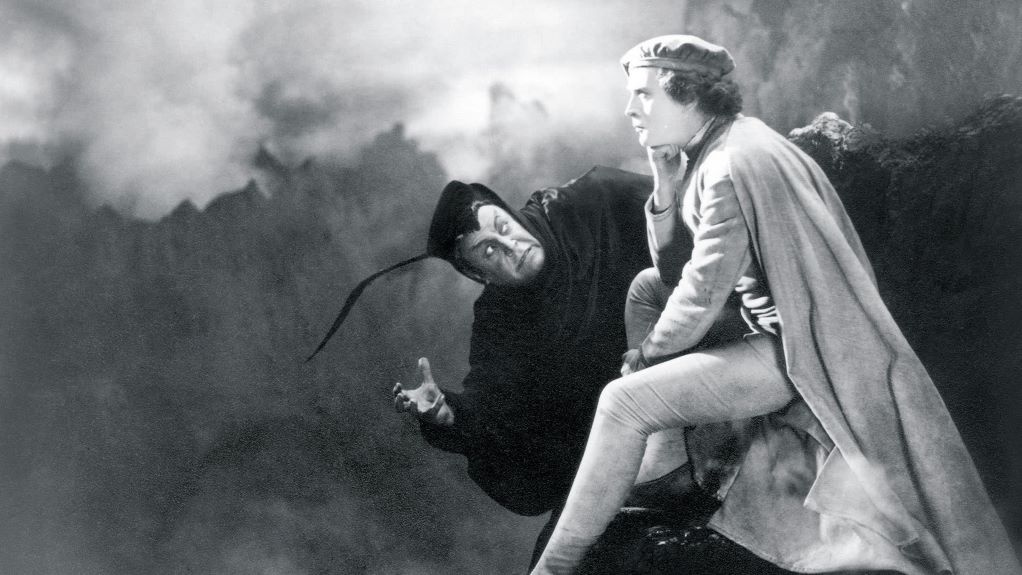
The film – as carefully restored today – that emerged is a work of expressionist genius jammed, particularly in its opening and closing acts, with a series of striking images balanced between fantasy and horror. Murnau used models, double exposure and transitional editing tricks to gorgeous, revelatory effect and crafted stunning images of supernatural horrors. Faust’s opening shot shows the horsemen of the Apocalypse riding through the clouds before a confrontation between a giant, satyr-like Jannings with huge wings and a similarly winged Archangel with flaming sword (the actors were strapped into stunning giant wings and Janning’s porcine like make-up is particularly demonic).

From there Murnau plays the first of his games of scale by showing Mephisto towering, mountainous, over Faust’s town, unleashing a black cloud of plague. Mephisto’s powers are demonstrated with a host of cinematic tricks: circular light then fire engulfs Faust when he summons him, Mephisto’s eyes are pinpricks of burning light (created by damaging the negative), he appears at every turn Faust makes and later shifts size, appearance and even duplicates himself while performing magic (always with gusts of terrible smoke).

The cinematic tricks continue as Faust is taken on a sort of magic carpet ride across Europe, Murnau’s camera dizzyingly flying over a series of highly realistic models of towns, forests, mountains and storming seas. The launch of this flying carpet is achieved by a miraculous double exposure shot that shows Mephisto and Faust flying out of a small window (standing upright on a cape) in one uninterrupted shot. The dizzying array of effects and visual imagination help us immediately understand why Faust is so tempted to harness the powers of this seemingly scruffy beggar (though Mephisto soon translates himself into a sharply dressed courtier).

It also ties in with extraordinary beauty of Murnau’s expert use of light and shadow. Faust is introduced as an old man, lecturing on astronomy to a room full of rapt students, lit by the glow of his astrolabe. Faust’s rooms are a light tunnel of instruments and books. His town turns from a thriving market, to a towering collection of shadowy buildings, holding a mass of swarming, panicked humanity, running in fear of the plague. Pools of light frame action: twice in the film, Murnau captures dying figures in perfectly composed outlines of light against a sea of black, the first (a priest) lying dead at his altar while smoke drifts up past the light he rests in.

Faust could almost be seen as a film about light. Murnau’s camera is continually artfully framed around painterly compositions with streaks of shadow and light. But it is also a thematic issue. Mephisto uses fog and smoke to power his magic, as if trying to obscure the light that represents the good. In Murnau’s world, light is frequently offers the possibility of hope – even the film’s closing fire offers a chance of redemption. Smoke becomes an obstruction, allowing evil to flourish.

Faust frames its hero initially as man using evil in desperation for the greater good against the plague. Faust is played Gösta Ekman, a Swedish actor in his thirties flawlessly made-up (the make-up is extraordinarily convincing) as the wizened alchemist before Mephisto restores his youth. Ekman is equally convincing in both roles, his angry rejection by the townspeople driving his descent into gred. Opposite him Jannings is a viciously cruel ball of scheming greed, under a surface of joviality.

Needless to say – after all this is a morality tale – it is the allure of sex that eventually brings Faust down. He surrenders his virtue for a night of passion with the beautiful Duchess of Parma. (The cruel Mephisto, having given Faust the sort of entrance to the court of Parma that inspired Disney’s Aladdin’s entry into Agahbar, maliciously murders the Duke after stealing his wife). Murnau’s Faust is all about the awful temptations of worldly pleasures over the hard graft of good works.

Faust also understands that temptation can come in reclaiming the moments we have lost. Faust longs for the sort of excitements he never had as a young man – too many books not enough bonks – but also for the simplicity of youth, where the possibilities of the future and happiness of home were everything. Faust’s middle section – and its weakest, an oddly farce-tinged dark-romantic-comedy – revolves around Faust’s courtship of Gretchen (Camilla Horn – in a part originally intended for Lillian Gish). Murnau raises the possibility that Gretchen’s feelings for Faust are controlled by Mephisto – via a magic necklace – but this idea is largely forgotten, possibly because Murnau’s film needed something uncorrupted by the Devil.

That incorruptible is what powers the final act of Faust as consequences – many caused by Mephisto, who cheats and abuses Faust’s trust and subtly works to destroy the lovers while bringing them together – come home to roost for its characters. Murnau’s film is very strong on the brutality of medieval justice – burnings and public executions are only moments away – but also on the spiritual strength from true love. Love is of course the answer, in Faust’s sentimental resolution, but there are worse answers to the question of what makes us human.

Faust returns to its heights in the torch-lit terror of its final section and the raw emotionalism of Ekman’s desperate, guilt-ridden performance, forcing his way through an enraged crowd hoping-against-hope that he can save the day. Faust is at its finest when centring Murnau’s extraordinary technique, a series of technical and visual marvels that makes you fall in love with cinema. At times it works best as a collection of extraordinary visuals and concepts – and I could do without some of that long middle act between Faust and Gretchen – and some of the acting is sometimes a little too broad. But it’s an extraordinary and unique piece of cinema – and a startling visual expression of the power and temptation of evil.

Metropolis (1927)

Metropolis (1927)

Lang’s sometimes flawed science fiction epic is one of the most influential films ever made

Director: Fritz Lang

Cast: Brigitte Helm (Maria/The Machine), Alfred Abel (Joh Frederson), Gustav Frölich (Freder), Rudolf Klein-Rogge (Rotwang), Fritz Rasp (The Thin Man), Theodor Loos (Josaphat), Heinrich George (Grot), Erwin Biswanger (11811/Geogry)

It’s 1927 and for too long Hollywood had held sway over the movies. But there were plans in Germany to change that. The booming Weimar film community, arguably the artistic hub of World Cinema, felt they had a shot at claiming the sort of global success Hollywood had made its own. No expense would be spared to bring Fritz Lang’s science-fiction spectacular, Metropolis to the screen. It was met with such a muted reaction, that the original epic cut was sliced to ribbons, parts of the film lost for all time, and for decades it lived only in a mutilated form. But it was visionary and extraordinary enough to inspire virtually every single science fiction film that followed it.

Metropolis is a sprawling future city state, run by Joh Frederson (Alfred Abel). In it the rich live a gilded life in mighty skyscrapers, with private gardens, luxurious apartments and raucous parties. Beneath them – literally so – are the workers, living a Morlock-like life of drudgery in the factories and power stations that keep the lights burning. But all that could change: below ground Maria (Brigitte Helm) preaches hope for change, above ground Frederson’s son Freder (Gustav Frölich) falls in love with Maria and rejects his father’s way for the life of a prole. Frederson has a scheme of his own: to use a robot (Helm again) built by old friend (and one time rival for the affection of his late wife) the one-handed scientist Rotwang (Rudolf Klein-Rogge) to replace Maria and sow discord among a potential worker’s rebellion. But does Rotwang and his creation have a game of their own?

Lang had a brief to create a film that would be a box-office hit in America. No stone was left unturned in creating his epic. Metropolis took a staggering 17 months to film, running almost three times over its initial budget. It’s extended shooting schedule was a godsend for many of its extras, struggling to make ends meet while the Weimar Republic thrashed through the after-effects of hyperinflation. It’s a magnificent monument to Lang’s superb visual styling, marrying shadow filled expressionism with sweeping epic magnificence.

Metropolis’ strengths all lie in its stunning, inventive and breath-taking design work. That has been so inspiring, it has permeated vast swathes of our culture. Filmic visions of imposing, neon-lit, skyscraper packed modern Babels (Frederer’s headquarters is an art-deco reimagining of Brueghel’s Tower of Babel) all find their roots here: from Burton’s Batman to Scott’s Blade Runner. Any robot in the movies can chase its lineage back to Rotwang’s man-machine, as any mad scientist ancestor is  Rotwang (from Dr Strangelove to Back to the Future’s Doc Brown). It’s the film that invented steam-punk, with its piston-filled machines, staffed by boiler-suited workers (it’s inspiration for a zillion music videos is not surprising). Everywhere you look in Metropolis it might feel like you are seeing something familiar, when in fact you are witnessing its original generation.

Metropolis is a cat’s cradle of differing moods and designs, woven masterfully into a whole. Frederson controls the city from a penthouse suite, while his immediate staff and family live in swish, very 1920s apartments. This contrasts sharply with the industrial-punk of the factories, cathedrals of technological movement, full of gears, levers and men performing tasks with a robotic, convey-belt repetition under a series of clocks. There are real cathedrals, legacies of an old world, where God has been left behind by the new Gods of work and efficiency. Under the ground, the workers live in personality free tenement blocks and chiselled out caves, which echo churches. Rotwang works in a laboratory part Frankenstein’s layer, part bizarre lecture theatre, all seemingly housed in a ramshackle house that wouldn’t look out of place in a Hans Christian Anderson fairy tale.

A fairy tale is perhaps what Metropolis is, underneath all the astonishing technical sheen and directorial mastery. We follow a hero who exiles himself to live among the poor, eventually becoming their champion, with a damsel-in-distress he must rescue from a crazed wizard. The wizard even produces a magic imposter, who threatens to bring disaster. Metropolis’ plot often proceeds with the illogical progression of a fairy tale, with characters frequently making veering changes in allegiance or unveiling dastardly schemes that appear from nowhere or make little sense.

It’s similar in Metropolis biggest weakness: it’s simplistic plot, wrapped up in a casually naïve politically theory that attempts to find a balance between left and right, but essentially boils down to “why can’t we all just get along”. It’s loud proclamation that “The Mediator Between the Head and the Hands Must Be the Heart” is so vague that it allowed the film to be embraced by the left as a proto-socialist film supporting worker’s rights and the right as a film that revealed the workers as a mob and the fate of the world best left in the hands of elites who know what they are doing.

It’s part of the simplistic view the film largely takes of character and story, which frequently feels like an after-thought behind the film’s sumptuous production values and Lang’s expressive camera work. It’s also not helped by some of the acting which, particularly in the case of Gustav Frölich’s hand-claspingly camp performance, mines the depths of silent-movie ostentatiousness. Saying that Brigitte Helm is chillingly, wickedly artificial and physically disjointed as the fake Maria (a far cry from her more simpering ‘good’ self) and Abel underplays effectively as Frederson. Klein-Rogge’s insane glare and conflicting lusts also make a strong impression.

But none so strong as Lang’s mastery of visual symbolism. Freder’s terrified vision of the ‘heart machine’ that sits at the centre of the city’s power, transformed into a terrible Moloch with workers literally fed into its gaping, firey maw. Those same workers from the film’s opening with Lang’s brilliant visual conceit of shuffling, shoulder-drooping figures lurching into a gigantic elevator that lowers them into the ground. Rotwang’s birth of the fake Maria is a masterclass in light and cross-cutting, as is the simmering eroticism of the fake Maria’s dance at an orgiastic night-club, the screen filling with the slathering faces of the man she has enchanted.

It mixes with the Gothic power Lang brings the film in its closing sequence, seemingly inspired by mystery plays with their deep-rooted sins bubbling to the surface to condemn those alive today. There are echoes back to this in Freder’s dreams of Metropolis as a modern Babylon (hammered home, once, by the lost scene of a monk preaching in the cathedral) and in Maria’s Joan of Arc like status among the working classes – a mantle taken to its logical conclusion by her metallic replacement who leads a doomed insurrection. Again, all these concepts and influences are effortlessly held together into one magnificent whole by Lang’s fluidic, beautifully paced direction.

Metropolis lives today as a monument to creative science fiction film-making – it is the most ambitious and most influential science-fiction film ever, except perhaps 2001 and (in a very different way) Star Wars. It may be politically simple and its story may veer in unplanned directions and strange cul-de-sacs, but as a piece of visionary cinema it is nearly unparalleled. Even its existence today as a reconstructed, corrupted version of itself (after hours of footage were considered lost for decades) doesn’t not dim or diminish its mastery.

The Grapes of Wrath (1940)

The Grapes of Wrath (1940)

Steinbeck’s masterpiece is transformed into a richly humanitarian and heartfelt film

Director: John Ford

Cast: Henry Fonda (Tom Joad), Jane Darwell (Ma Joad), John Carradine (Jim Casy), Charley Grapewin (Grandpa Joad), Dorris Bowdon (“Rosasharn” Joad), Russell Simpson (Pa Joad), OZ Whitehead (Al Joad), John Qualen (Muley Graves), Eddie Quillan (Connie Rivers), Zeffie Tilbury (Grandma Joad), Frank Sully (Noah Joad), Frank Darien (Uncle John), Darryl Hickman (Winfield Joad)

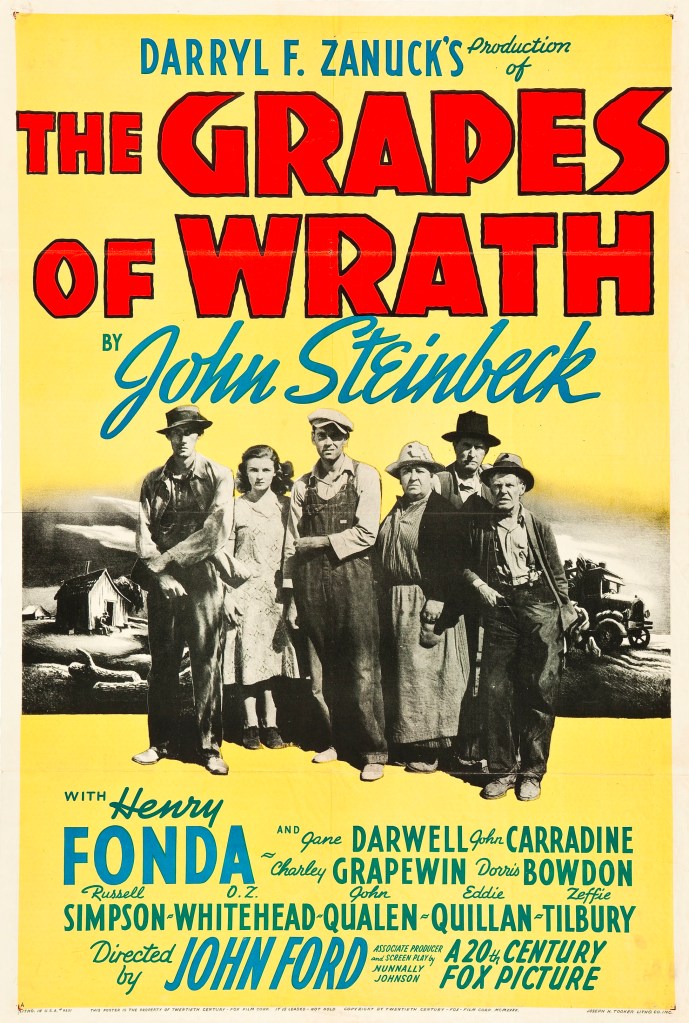
If you can be certain of one thing, it’s that times of economic hardship rise and fall like waves on the shore. John Steinbeck’s novel The Grapes of Wrath was a searing, powerful exploration of the impact of the Dust Bowl, the Great Depression and new farming technologies on Oklahoma tenant farmers. It was almost immediately cemented as a Great American Novel. Just as Ford’s moody, heartfelt, humanitarian film of it was immediately hailed as a Great American Film.

In Oklahoma, Tom Joad (Henry Fonda) is released from prison (after killing a man in a bar fight) to find his farming community has been devastated. The Depression has shattered the market and the landowners now farm their land with tractors rather than people. Tom and his family have no choice but to load up a beaten-up van and migrate to California where they have hopes of work picking fruit for meagre wages. What they find on the way, among small acts of kindness, is exploitation, brutal policing determined to crush any protest from migrants and migrant camps in terrible conditions. Misery, death and the endless grind of fading hopes seems to be all they have to look forward to.

The Grapes of Wrath moved to the screen faster than almost any other novel in history. Published in April 1939, in months Nunnally Johnson had completed a script and shooting began in October for release in 1940. The unprecedented speed spoke to the book’s enormous impact, which has remained eternally relevant in its depiction of the hostility faced by migrants. Producer Darryl F Zanuck, despite his passion for the novel, worried it would be seen as pro-Communist propaganda – thankfully basic research showed Steinbeck had, if anything, played down the labour conditions. Zanuck was convinced he could defend any accusation of anti-Americanism – perhaps, as well, he decided recruiting the film poet of romantic Americana, John Ford, as director would lay any change The Grapes of Wrath could be seen as an attack on the US to rest.

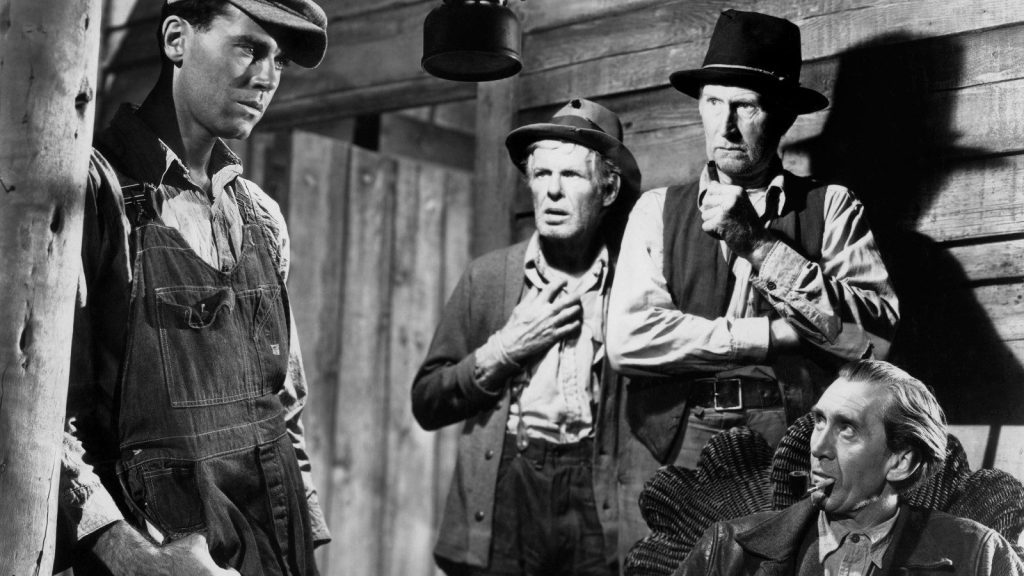
Ford was in fact a near perfect choice as director. A man who held his Irish migrant roots close to his heart, he felt a powerful bond with these victims of changed circumstances. As a man with a romantic view of America’s Golden Age, he was equally critical of sharp technology changes (he shoots the tractors who plough through the Oklahoma farmland as monstrous tanks, crushing hope below their ominous caterpillar tracks). Working closely with cinematographer Gregg Toland, he shot a film with one foot in realism, the other in low-lit, moody impressionistic shadow, a rich visual treat that marries both methods to enforce the appalling economic situation it depicts.

From its opening shot, which frames Tom Joad walking across Oklahoma desert land framed with telegraph poles, the idea of ordinary people left behind by technological change rings out. Tom’s farmstead Tom is derelict with one tenant recounting his eviction in a cramped room lit by a single candle. The Joad’s leave for California in a truck so beat up, it only just starts and appears to be partially made of wood. The California shanty town they are herded into is contrasted with the sleek automobile of the landowner offering work for a pittance. In the government run camp, we see running taps and modern bathrooms that seem space-age compared to the squalor we’ve seen.

The Grapes of Wrath doesn’t shirk in its anger at the ill-treatment of these sons of the soil. In California, the bosses are cruel, uncaring and greedy. The flyers the Joad family clutch hoping for work, is one of thousands recruiting for only hundreds of jobs. Salaries are constantly undercut – at their second camp, the Joads work exhaustingly for just about enough to feed them for the day. The sheriffs are little more than heavies for the bosses, breaking up protests at pay, arresting and beating ‘trouble makers’ and turning a blind eye to any threats or danger to the migrants.

The injustice of it is captured in a superb speech by John Carradine’s Jim Casy, a former preacher whose faith has been replaced by a burning passion to protect the rights of the little guy. Shot by Toland in a shadow-drenched, candle-lit tent, Carradine delivers with impassioned brilliance an inarticulate but moving speech on the need for the workers to stick together to combat exploitation. He follows in the footsteps of an earlier ‘rabble rouser’, whose denunciation of a fat-cat businessman is met with gunfire from a sheriff (a woman being near-fatally shot in the aimless fire).

It’s feelings that will inspire Henry Fonda’s Tom Joad. Fonda is marvellous as this plain-speaking man with a streak of self-destruction, who learns to focus his anger aware from his own needs to fighting for others. With his father – well-played by Russell Simpson – increasingly ineffective, Tom transforms himself slowly into a leader. His lolloping stance doesn’t detract from his everyman nobility. Fonda even manages to make some heavy-handed, speechifying really work as a profound statement of human rights.

He’s joined in this with the film’s third stand-out, the Oscar-winning Jane Darwell as the indefatigable “Ma”. Darwell becomes the family lodestone and an epitome of resilient spirit, her pained but patient face returned to again and again. Darwell as at the heart of many of the most moving moments, perhaps the most one of its simplest: Ma quietly, with sad smiles, burning old mementoes and holding up a pair of earrings to study her reflection in the flickering candlelight. Ma holds the family together, from cradling the dying Grandma on the floor of the truck to desperately hiding Tom from the vindictiveness of the police. Ford closes the film with a powerful speech of hope and resilience from Ma, again wonderfully delivered by Darwell in simple, unflashy close-up.

Despite that delivery though, the end film’s final act doesn’t ring true with what has gone before. The film reshuffles the novel’s plot. That culminated in a bleak miscarriage in a windswept hut. The well-built government-run migrant town is a stopping off point, a moment of hope, in a grim journey towards desolation. Here it is the final destination – and the community dances, organised by benevolent caretakers, feels like a cheat of reality. Perhaps Zanuck felt a relatively hopeful ending was needed to balance those fears of Anti-Americanism. Either way, it never feels like a ‘real’ ending: this economic catastrophe didn’t end like this for many, so it shouldn’t for our everymen.

It is perhaps, though, the only major flaw in Ford’s superb film. It’s a film sprinkled with as many small moments of peace and hope as it is injustice. The Joads enjoying a swim in the lake, or the kindly garage staff who let Pa buy bread and sweets for the kids at a price far below their value warms the heart. The shanty towns are given a real sense of community by Ford. It makes the stark cruelty of those in charge stand-out all the more.

The film doesn’t shirk on the grim surroundings. The detail of the squalor is magnificently delivered, while the foreboding, shadow filled lighting of Toland’s photography is exceptional. With a host of excellent performances, Grapes of Wrath is the finest statement of Ford’s overlooked humanitarianism. He was a director with a warm regard for the common man, who believed in their righteousness and right to just treatment. This streak runs strong throughout The Grapes of Wrath and makes a film that is never sentimental, but arouses huge sentiment in anyone who watches it.

Babel (2006)

Babel (2006)

Iñárritu’s grandiose film aims for a big statement about humanity, but settles for something simpler

Director: Alejandro González Iñárritu

Cast: Brad Pitt (Richard Jones), Cate Blanchett (Susan Jones), Gael Garcia Bernal (Santiago), Rinko Kikuchi (Chieko Wataya), Adriana Barraza (Amelia Hernandez), Kōji Yakusho (Yasujio Wataya), Boubker Ait El Caid (Yussef), Said Tarchani (Ahmed), Mustapha Rachidi (Abdullah), Elle Fanning (Debbie Jones), Nathan Gamble (Mike Jones), Clifton Collins Jnr (Border police officer), Peter Wight (Tom), Harriet Walter (Lily), Michael Maloney (James), Satoshi Nikaido (Detective Kenji Mamiya)

“Only connect” was the epigraph of Forster’s Howards End. It’s an idea Alejandro González Iñárritu attempts to bring to the screen in Babel. Across three countries, he shows how small events in one plotline have drastic impacts in others. It makes for an undeniably beautiful film-making experience – but also a film straining for import, that hectors and belabours obvious points and relies far more on random events occurring due to foolishness and stupidity than the vagaries of fate or humanity.

In Morocco, Abdullah (Mustapha Rachidi) buys a rifle from a neighbour to protect his goats. His young sons practice with it by taking pot-shots at a tourist bus. They hit Susan (Cate Blanchett), whose husband Richard (Brad Pitt) is left desperately trying to get her medical help in a remote Moroccan village. The incident means their nanny, Amelia (Adriana Barraza) with whom they have left with their children in the US, has to take them with her to Mexico for her son’s wedding, where events at the border spiral out of control. Meanwhile, in Tokyo, the original owner of the rifle Yasujio Wataya (Kōji Yakusho) struggles as a single father with his deaf teenage daughter Chieko (Rinko Kikuchi), who is dealing with grief and her burgeoning, frustrated sexuality.

I often find Iñárritu’s films a mixed bag. Babel is no different. There is a lot to admire here. There’s also just as much to be frustrated about. First the good. Iñárritu does an excellent job intercutting a film which moves from location to location and (it becomes clear) timeline to timeline, without ever confusing the audience or revealing plot details in one timeline until it becomes vital in another. We discover one entire storyline of the film takes place not in tandem but after the events of another plotline (which concludes where the other begins). The film is beautifully shot by Rodrigo Prieto, with Morocco unexpectantly filmed with a perfectly fitting dusty blue hue, Mexico in warmer tints that become oppressive and Tokyo with a sort of neon-noir.

The film’s first half does an excellent job of world and relationship building. Abdullah’s two young sons are head-strong, rash children entrusted with a weapon they lack the maturity to handle. The family’s desperation to hide their responsibility for the tragedy they have inflicted on Richard and Susan becomes terrifyingly engrossing – not least when we see the slap-and-trigger happy casual-brutality of the investigating forces. Similarly, Brad Pitt does a sterling job as a husband driven to ever-increasing desperation, impotent rage and grief as a husband powerless to help his dying wife in a remote village with poor communication and innumerable cultural barriers.

Iñárritu turns an intriguing eye on Mexico as a land met with looks of both wonder and terror by the Amelia two young charges. Young Mike is enthralled by the sights and sounds then sickened into tears when a game of ‘catch the chicken’ ends in a brutal decapitation. Amelia’s family is warm, friendly but also prone to thoughtless impulsiveness, made worse by a justifiable feeling of persecution from their wealthy neighbours across the border. The wedding though, for all the flashes of cultural confusion, is a vibrant and joyful event shot with a lyrical beauty.

The same poetic beauty extends to the Tokyo plotline, which is a sort of pilgrim’s progress for Chieko (excellently played in a superb mix of vulnerable and resentful by an Oscar-nominated Rinko Kikuchi) through a long few days in Tokyo. From feuding, aggressively, with referees at a volleyball, to clumsy attempts to seduce boys (alienated by her deafness) and, in one staggeringly awkward scene, a very much-older (and horrified) dentist, Iñárritu follow’s Chieko stumbling attempt to discover herself, leaving the revelation of the causes of her ennui for a final, near wordless sequence. Iñárritu experiments with sound, putting us into Chieko’s deaf isolation by draining sound in and out (noticeably in a late-night disco).

Communication and language are barriers for all the characters – hence the film’s grandiose title. Grandiose feels the word, as Babel makes a big swing making a relatively simplistic statement: the world would be a better place if we all listened to each other. Unfortunately, the script repeatedly falls back on tropes and narrative contrivances to make this message work. Two of the storylines – Mexico and the Moroccan family – hinge on aggressive, macho cops as disrupters. In a series of character developments I just don’t buy, Richard’s bleeding-out wife is treated as a tedious inconvenience by a busload of Brit tourists who essentially demand Richard leaves his wife to die so they can back to their hotel for dinner (I literally cannot imagine an entire busload of people behaving like this – god knows how the world responds to them when Susan’s bleeding out in a Moroccan village inexplicably becomes a major world news story).

There is also a half-hearted attempt to suggest guns are destructive forces. While it’s true a rifle purchase is the instigating factor – and Iñárritu makes a lot of one of the kids smashing up the rifle in a scene of heavy-handed import – it doesn’t really fly. Honestly, the main message I started to take out was that immature or stressed people make stupid, impulsive decisions in stressful situations. The kids shooting live ammunition at a tourist bus is an appalling act of immaturity. Santiago – a character set up as a time bomb from the start in an edgy performance by Gael Garcia Bernal – has a disastrous, impulsive meltdown bred out of booze and bravado at the Mexican border, that ruins the lives of everyone around him. Stranded in the desert, Amelia will make an equally disastrously poor decision with terrible consequences she can never turn back.

Eventually, Babel starts to feel like a film full of contrivances that mistakes ambitious range and variety of locations for actual depth. Essentially it has very little to say about the human condition other than looking for a little love or understanding. The four plot lines are fairly tenuously linked together, and impact each other only in the sense of each instigates the events of another. The film fails to create a tapestry of cause and effect and fails to weave its events back together for a conclusion. For all there are moments of effective tension and drama, and great deal of visual and visceral beauty, everything feels a little too forced, a little too on-the-nose.

That’s not to say there aren’t great performances or moments of great flair from Iñárritu. Adriana Barraza is fabulous as a proud mother and caring nanny, driven to her absolute limits. But it’s not as complex, revelatory or revealing as it thinks it is. It makes for a film that looks and feels like epic but carries only a simple and reassuring message.

Au Hasard Balthasar (1966)

Au Hasard Balthasar (1966)

Bresson uses an animal to make a powerful spiritual point in a simple but insightful movie

Director: Robert Bresson

Cast: Anne Wiazemsky (Marie), Walter Green (Jacques), François Lafarge (Gérard), Philippe Asselin (Marie’s father), Nathalie Joyaut (Marie’s mother), Jean-Claude Guilbert (Arnold), Pierre Klossowski (Miller), Jean-Joel Barbier (Priest), François Sullerot (Baker), Marie-Claire Fremont (Baker’s wife)

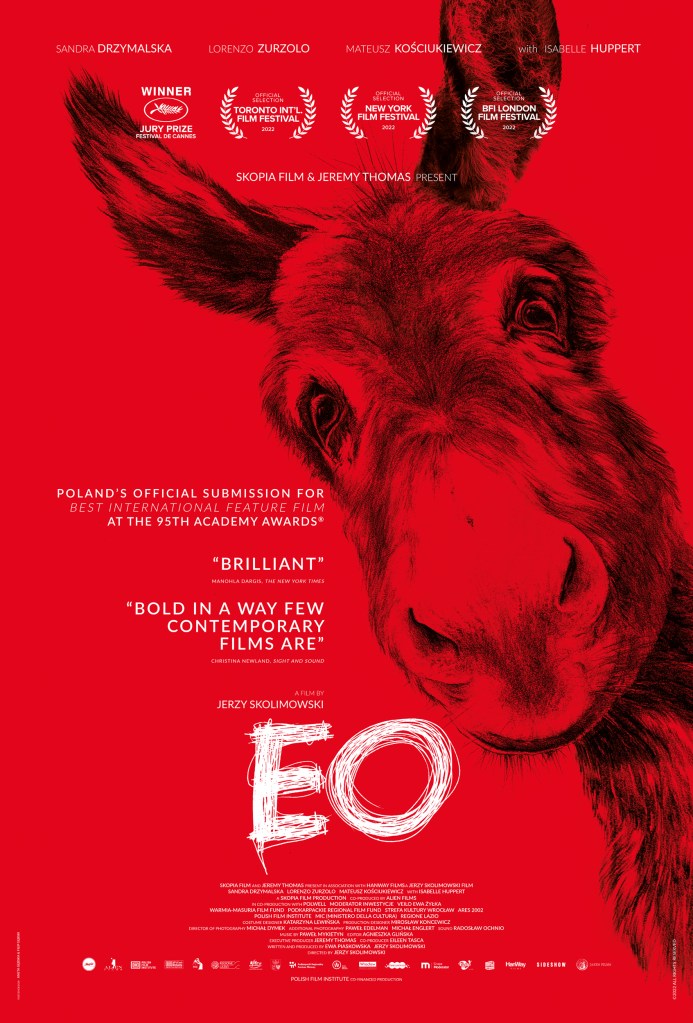
Robert Bresson valued naturalism in his actors above all things. So much so he would make them rehearse even the simplest actions hundreds of times, to drain all artificiality and performance from it and make it as ‘real’ and controlled as possible. He worked best with non-professional actors, whose lack of training meant there was one less barrier of artifice for him to break down. So, its perhaps not a surprise that one of his best collaborators, in one of his finest films, was such a non-professional he wasn’t even human. He was a donkey.

Au Hasard Balthasar (or Balthasar, at random) also throws in Bresson’s other great strength: a profound, but not overbearing, spirituality, a mark of Christian faith that turned simple stories told on an intimate scale into searching and intriguing metaphors for the human condition. He achieves something quite remarkable here, with a film that places a donkey near its centre but then becomes a meditation on the human condition and our capacity for cruelty and selfishness. And the donkey himself becomes a passive, Christ like figure, undergoing his very own passion on the way to his own Calvary where he will literally die because of – and maybe for – our sins.

Balthasar’s life is one of seemingly random, disconnected movements from one owner to another, all of whose lives loosely entwine. First, the kindly Marie (Anne Wiazemsky) who, as a child, adopts Balthasar and brings him into her home. This blissful life lasts a short time before the donkey is palmed off to farmhands then a baker whose delivery boy Gérard (François Lafarge) is a tearaway and criminal. Gérard treats the animal poorly – largely because he envies Marie’s love for it. They enter into an abusive relationship, while Balthasar is taken on by alcoholic Arnold (Jean-Claude Guilbert) who uses him to guide tourists up the Pyrenees. Balthasar works as a circus animal and a beast of exhausting labour for a miller, while in the background the threat of Gérard and his malign influence on Anne and his abuse of Balthasar lurk.

Perhaps the most striking thing about Au Hasard Balthasar is how readily Bresson embraces the nature of the donkey. Balthasar is never anything other than a dumb animal. He has no insight into what is happening around him. Instead, he stands passively chewing. He only rarely seems to recognise and respond to people. Events happen to and around him, but there is no attempt to show them having any impact on him. He is – and remains – simply a donkey, incapable of anything other than what a donkey can do. Bresson allows not a second of anthropomorphism. Babe this isn’t.

Instead, what happens to this donkey tells us more about the humans he encounters around him. This gives us a stunning insight into humanity and how we treat those below us. To most the donkey is not a person or even a creature, it is just a tool. As the miller says, it will be worked until it can work no more and then it will be euthanised. Gérard sees it as a petty scab to pick, a chance for a bit of casual sadistic fun, tying fire-crackers to its tail and watching its distress. The closest to a companion he has, outside of Marie, is Arnold – and even Arnold works him incessantly and drags him back to servitude from a brief release at the circus.

What Bresson does with this, is invest this donkey’s story with immense spiritual impact. The events that happen to Balthasar parallel the stages of the cross, moments of tenderness from strangers and friends mixed with labours dragging his own cross and the mockery of those who watch him. He’s met with indifference and disregard so many times, that his suffering eventually seems to be providing some sort of chance of retribution for the deeply flawed characters around him, that by treating him well the might save their own souls. Instead, Gérard will drag him over the border carrying smuggled goods and he will, uncomplainingly, suffer the punishment for him.

We can but hope that it is to give Gérard a second chance. But I doubt it. Bresson’s impact with his actors, beating the ‘acting’ out of them gives them a flat naturalness – but also allows us to layer our own feelings on top of them. Gérard is a choir boy with an angelic voice – but he’s also a selfish sadomasochist and a bully, charismatic but naturally cruel. Nevertheless, he has a demonic charm. The baker’s wife willingly covers him his theft and showers him with gifts.

And of course, Marie is drawn towards him with self-destructive yearning. She should love her childhood friend Jacques, but he’s a dull, uninspiring, sap. Gérard is rough, tough, wears a leather jacket and can sing like an angel and (you imagine) cuss like a demon. Their first encounter sees Marie torn between fear, fascination and attraction, as a roadside encounter leads to a sexual encounter in a car that has the whiff of lack of consent. Despite this, Marie returns again and again to Gérard, throwing away parts of her life and family to hang on his arm.

It’s only Balthasar it seems she can connect with. Perhaps because they are both sacrificial figures. Marie’s father loses his farm due to pride and stubbornness. She devotes herself to a bad man and rejects the one who idealises an idea of her. Marie’s motives defy logic to us – but maybe this is because she is closest to the donkey and, like him, content (condemned?) to lead a life where she is buffeted by events and people rather than controlling them.

Bresson plays this all out with a quiet, unfussy, contained camera, playing shots out in controlled takes and carefully selecting moments to cut to Balthasar. He avoids moral judgements but presents actions as they are. After all, shouldn’t a miller work a donkey hard? Shouldn’t a baker need him to walk miles? Don’t we go to the circus or zoo all the time and not think about the animals performing for us? Things are presented as they are and we are not pushed towards one view or another.

Except at the end as Balthasar makes his final sacrifice, lying down on his personal Calvary as Schubert plays on the soundtrack (the film’s only real sustained use of music). Quietly, life drains from this animal as sheep flock around him as if to pay tribute. It’s profoundly simple but somehow intensely moving – as if the pointless culmination of this life somehow sees the donkey transcend into something higher and more meaningful, and eternal symbol of virtue and sacrifice.

It’s what makes Au Hasard Balthasar linger in the memory. Bresson’s signature simpleness and restraint, his deliberate, observatory distance from characters and events leave it open to us to interpret what we will. Maybe it’s just a story about a dumb animal. Maybe it’s a story about all of us, about how we exploit things around us and how we treat each other with selfishness and greed. Eventually Bresson leaves it up to us to decide what we can take from it.

Jean de Florette & Manon des Sources (1986)

Jean de Florette & Manon des Sources (1986)

Luscious scenery and combines with fine acting to produce a sort of French Merchant Ivory

Director: Claude Berri

Cast: Yves Montard (César Soubeyrnan), Daniel Auteuil (Ugolin), Gérard Depardieu (Jean Cadoret), Emmanuelle Béart (Manon Cadoret), Elizabeth Depardieu (Aimée Cadoret), Ernestine Mazurowana (Young Manon), Hippolyte Girardot (Bernard Olivier), Margarita Lozano (Baptistine), Yvonne Gamy (Delphine)

At the time this double bill (which I’ll refer to as Jean de Florette unless specifically referring to the sequel only) were the most successful foreign language films ever released. Shot over seven months, they were also the most expensive French films ever made and garlanded with awards, including a BAFTA for best film. Jean de Florette turned Verdi into the soundtrack for France, while its photography transformed the rural idyll of Provence into a major tourist destination and the dream location for holiday homeowners. The films themselves remain rich, rural tragedies, gorgeous French heritage films, a sort of French Gone with the Wind replayed as Greek tragedy.

Told in two parts – although designed as one complete movie – they tell a story of how greed destroys lives in 1920s rural Provence. César (Yves Montard) is the childless landowner whose only hope of a legacy is his hard-working but dense nephew Ugolin (Daniel Auteuil). Ugolin dreams of growing carnations but the perfect land is frustratingly not for sale. When an argument with the owner leads to his accidental death, the land falls to Jean Cadoret (Gérard Depardieu) hunch-backed former tax collector from the city and son of Florette, the girl who broke César’s heart decades ago when she left the village while he impulsively served in the foreign legion.

César and Ugolin resent Jean – Jean of Florette as they call him – and hatch a plan to see his dream of a rabbit farm fail. They secretly block up the spring on Jean’s land and keep his connection to Florette a secret from the rest of the village, encouraging them to see him as an outsider and hunchbacked bad-luck charm. Ugolin befriends the decent, optimistic and hard-working Jean and watches the farm disintegrate. A decade later, in Manon des Sources, Jean’s daughter Manon (Emmanuele Béart) plots revenge for her father on Ugolin and César.

Jean de Florette and Manon des Sources were adapted from Marcel Pagnol’s novel – written, ironically, after Pagnol’s film Manon des Sources was butchered down by the studio in 1952 from four hours into an abbreviated two. It’s a richly filmed, luscious picture crammed with gorgeous locations, sweeping camerawork and marvellous score that riffs on Verdi. It’s an entertaining story of injustice and comeuppances. It’s first half (Jean de Florette) is an, at-times painful, unfolding of Jean’s inevitable failure. The second (Manon des Sources) sees all those chickens come home to roost as Manon’s suspicions about César and Ugolin’s duplicitousness are confirmed.

But what perhaps made Jean de Florette as successful as it was, is its mix of Merchant Ivory and BBC costume-drama. Many outside of France essentially took it as art because the characters spoke French. But Jean de Florette is a tasteful, classy, very well-made prestige package designed to be easily digestible. Claude Berri marshals events with the skill of a natural producer – he’s effectively a sort of French Richard Attenborough with a great deal of natural talent with actors, but without the true inspiration of the greats. You couldn’t mistake Jean de Florette as something made by Carné let alone Godard or Truffaut. It’s decidedly too carefully, tastefully made for that.

Which is not to say it isn’t in many ways a very fine film. Its construction is well-executed across its two parts. Berri makes clear that – for all the film showed a picture post-card view of France, encouraged to promote tourism and ‘traditional values’ by the government – the village our film is centred around is rife with prejudice and underlying hostility. It’s all too easy to for them to take against Jean: not only he is an outsider, he’s a tax-collector and a hunchback to boot. Prejudice naturally sets them against him (the villagers gleefully watch this “city man” destroy himself vainly trying to turn his dry land fertile). Manon des Sources makes clear the whole village at the very least suspected the spring had been deliberately dammed but effectively couldn’t be bothered to help.

It’s not a surprise as Jean’s techniques are totally alien to the traditionalists. Played by Depardieu with a wide-eyed enthusiasm, guileless honesty and trust, Jean takes on farming as if its another mathematical problem. He has books full of calculations and productivity rates he expects to hit, covering everything from rabbit breeding to the daily amount of soil and water needed for crops. He is prepared for anything except the cruelty of humans and the weather (Berri makes clear that, even with one arm tied around his back by the spring being blocked, he nearly manages to pull it off).

Instead, his super-human efforts come to naught. Forced to walk miles a day to carry gallons of water back to his farm to irrigate his land, he starts to resemble the weighted down donkey he drags with him. Rubicons are crossed one by one: even his wife’s necklace is eventually called on to be pawned, for all his promises that it would never come to that (fitting the Zolaish tragedy here, the necklace turns out to be worth sod all). Ugolin does everything he can to befriend and support Jean without helping him, even ploughing the land for him when Jean comes close to finding the hidden water supply. The events beat down Depardieu, here in one of his finest “man of the soil” peasant roles, until he is literally left shouting at the heavens, imploring God to give him a break.

This makes is all the easier to despise César and Ugolin, especially as Berri cuts frequently to these hypocrites giggling at their own deviousness and Jean’s suffering. It makes Manon des Sources – arguably the even more rewarding part – all the more satisfying as we watch the two of them slowly destroyed, events replaying themselves from the other direction. Manon des Sources features a performance of Artemis-like grace from Emmanuelle Béart as the older version of Jean’s daughter (the younger noticeably never trusted Ugolin), whose beauty enraptures Ugolin and who in turn dams the source of the village’s water to expose the crimes against her father.

It leads to a series of shattering reveals that break César and Ugolin from their satisfaction and complacency. These two villains are portrayed in masterful performances by Yves Montard and Daniel Auteuil. Under buck teeth and a foolish grin, Auteuil is sublime as a man who has it in him to be decent but is all too easily led by his forceful uncle. He regrets his actions, while never making an effort to reform and reverts all too easily into a love-struck Gollum, spying on Manon and literally sewing her lost ribbon into his skin. He’s a pathetic figure.

Montard has the juiciest part, which flowers into one of true tragic force in Manon des Sources. César is a man whose life of regret and loneliness has turned him into a bitter old man, grasping, greedy and hungry for a legacy. He treasures the few possessions he has of Florette – faded letters and a single hair comb – like relics and subconsciously can’t bring himself to actually meet her son. Suppressed sadness makes him every more tyrannical and foreboding. But Manon explodes this exterior, as events and revelations strip away all he holds dear. It culminates in a breath-taking sequence of raw grief from Montard – which depends on the magnetic power of his eyes – as his last delusions are stripped away and the true horror of his actions exposed to him.

It’s this emotional power that gives the two parts of Jean de Florette its force and impact and lift it the higher plain of its costume drama roots. It may be a very self-consciously prestige picture, designed to appeal to the masses, but Berri’s conservative style is matched with a great skill of drawing powerful performances from the actors. He does this in spades with his four leads and events eventually gain, through their performances, some of the force of a Provence Greek Tragedy. Jean de Florette manages to avoid melodrama and provides real dramatic meat and, while it is not high art, it’s certainly very high drama.

Atlantic City (1981)

Atlantic City (1981)

A never-was romances a dreamer in Malle’s low-key film, full of neat observations

Director: Louis Malle

Cast: Burt Lancaster (Lou), Susan Sarandon (Sally), Kate Reid (Grace), Michel Piccoli (Joseph), Hollis McLaren (Chrissie), Robert Joy (Dave), Al Waxman (Alfie), Moses Znaimer (Felix)

Lou trundles around Atlantic City taking a few cents for bets and wanting anyone who listens to know that back in the glory days of the Boardwalk Empire he was a big shot. Bugsy Siegel roomed with him in the slammer. Meyer Lansky asked his opinions on the latest scores. When he killed someone, he dove into the sea to wash the exhilaration from his body. Not his fault the glory days are gone, and his life has crumbled as much as the worn out city around him. He’s still a player.

Only of course he’s not. Played in a fine autumnal performance by Burt Lancaster, Lou has the front of an ageing star, but is a dyed-in-the-wool loser. He trades on a past that never happened, full of tall stories that only the dimmest and most impressionable would consider believing. He’s essentially a kept servant of Grace (Kate Reid), a former local beauty queen (third place) and spends his nights spying on his neighbour Sally (Susan Sarandon), while she washes away the stench of the hotel fish counter she works in.

When the chance comes to spin a fantasy that means Lou could actually impress and seduce this women, he jumps at it. That chance is Dave (Robert Joy), Sally’s pathetic dweeb of an ex-husband who believes Lou is the perfect to peddle his stolen cocaine around town. Dave winds up dead, Lou pockets the money, impresses the naïve but determined Sally (training to be a croupier) and very firmly considers letting her take the rap when the cocaine’s owners turn up looking for the money.

Both Lou and Sally are dreamers – or fantasists – at the opposite end of life’s scale. Lou dreams big about a past that never was. Sally is dreaming of an impossible future – one of French class, Monaco high-rollers and earning a future as a flash croupier. Really, we know both of their dreams are fantasies. After all it should be clear only losers wind up in Atlantic City. The casinos are dumps and even the criminals are pathetic, easily out-matched by Philadelphia hoods. Louis Malle’s film captures this perfectly in a crumpling city that looks like mouldy leftovers.

Malle’s film is a marvellously structured, low-key but highly effective character study, very well acted and shot with an intelligent, detailed eye. It’s a showcase for Malle’s subtle but intelligent camera work and composition. As Lou serves Grace early in the film, he is kept constantly in the centre of the frame, the camera jerking up and down to match his movements as he fetches and carries for the bed-bound Grace. Dave is frequently shot from above, looking even more pathetic and irrelevant with every shot. This is framing that speaks volume for status and character. The camera fluidly shifts across large spaces – the boardwalk, a casino – to show different interactions in different plains, characters either unaware of each other or using events elsewhere to escape notice.

Grimy and fabulously capturing the collapsing grandeur of a city fallen on very hard times, the setting is the perfect metaphor for the disaster of the character’s lives. None more so than Lou. You can argue Malle’s film may be too sympathetic to Lou – and, indeed, contemporary reviews discussed Lancaster’s inherent dignity mistaking it for the character. Lancaster however is smarter. Lou is a pathetic, sad figure. Look how he delights in puffing himself up as a big shot for the feeble Dave. Watch the childish excitement he takes in the notoriety he collects late in the film. Lancaster perfectly understands the desperate need to dress the part, longing to be something you are not: the grand, well-dressed sugar daddy who solves problems for his moll by unwrapping the elastic band from a roll of dollar bills.

Lancaster never allows this fantasy to be mistaken for reality. When danger comes, Lou almost always freezes or looks to keep himself safe. When he spins his stories of daring or classy confidence, Lancaster shows us a Lou who is replicating behaviours he has seen elsewhere. After completing his first cocaine deal, he has to wash his face in fear in a bathroom – then instantly condescends to an old friend who has been reduced to toilet attendant.

Sally is fooled for a while. But then we know she has a weakness for glamour. After all we’ve seen her indulge the pervy whims of casino trainer Joseph, a lecherous Michel Piccoli. In a clever performance by Sarandon, Sally is naïve enough to be sucked in but guileful enough to just about keep afloat. She tends to trust anyone who oozes confidence. She’s a little star-struck by the idea of Lou perving at her across the window (as if happy that she’s sexy enough to win the attentions of this seemingly classy old guy). But, turned, Sarandon makes clear she’s righteously furious when cheated and far more adept at confidence-tricksterism than the increasingly hapless Lou.

Because when crime comes Lou is out of his depth. But what would you expect from a man who is a live-in cook, dog-walker and sometime-stud for Grace, entombed in her kitsch-nightmare room. Kate Reid is very good as this clear-eyed bully who needs but also despises Lou, who knows all about what an unreliable and cowardly fellow he is deep-down but jealously guards his attentions.

Malle’s film plays out like a sort of noir short story, an adept study of its characters more focused on their damage and flaws than on the crimes at its nominal heart. This is about fantasy and the lies we tell ourselves. Just like Atlantic City kids itself it’s still a gambling mecca, so Lou and Sally believe they still have chances in life. It makes for an intriguing, engrossing film as they lie to themselves and each other, denying the truth until it hits them squarely and unavoidably in their face.

Atlantic City muses on familiar themes, but does so with freshness and intelligence. Perhaps Malle is a little too sympathetic to its characters (Lou in particular), but he is very clear-eyed about the Dennis Potterish fantasy world they are clinging onto and the shabby decline and disrepair that clutters their existence. It makes for a very fine, well-made and fascinating little film, full of sharp observations and wonderfully played beats.

Avatar: The Way of Water (2022)

Avatar: The Way of Water (2022)

Cameron’s film makes a huge splash despite its soggy plotted, flooded run-time

Director: James Cameron

Cast: Sam Worthington (Jake Sully), Zoe Saldaña (Neytiri), Sigourney Weaver (Kiri Sully), Stephen Lang (Colonel Miles Quaritch), Kate Winslet (Ronal), Cliff Curtis (Tonowari), Jamie Flatters (Neteyam Sully), Britain Dalton (Lo’ak Sully), Timothy Jo-Li Bliss (Tuk Sully), Jack Champion (Spider), Bailey Bass (Reya), Filip Geljo (Aonung), Duane Evans Jr (Rotxo), Edie Falco (General Frances Ardmore), Brendan Cowell (Captain Scoresby), Jermaine Clement (Dr Ian Garvin)

After thirteen years it finally arrived. The sequel to a film that seemed to leave no cultural impact, Avatar. People were convinced it would flop. But they say that about all Cameron films. And, if anyone should have learned anything from Terminator 2, Titanic and Avatar it was don’t bet against Cameron. If Avatar 2’s purpose was to make an awful lot of money, it has succeeded in every level. If its purpose was to make a strong and entertaining film… I’m not so sure.

About the same amount of time has passed on Pandora and Sully (Sam Worthington) and Neytiri (Zoe Saldaña) have raised a family of four children, including Kiri (Sigourney Weaver) born from the avatar of their friend Grace. They have also raised Quaritch’s son ‘Spider’ (Jack Champion) among them. Then the humans return… a bloody war begins, with Sully leading a guerrilla campaign. The company resurrects Colonel Quaritch (Stephen Lang) as a Na’vi super soldier to fight on their own terms. After Spider is captured, Sully and his family flee to live among the Metkayina, a sea-living tribe. But they can’t escape the war and its dangers.

As Avatar: The Way of Water is garlanded with praise and Oscars nominations, I feel like we are all part of a wide conspiracy of silence. So desperate are so many to keep viewers handing over their cash at the box office, that a film completely designed to be seen on the big screen (and this really is) is being praised to the skies by some as a masterpiece. It is not. It’s not even the best Avatar film. Instead, Avatar 2 is a visually impressive but hellishly long, predictable re-tread of the first film that stuffs the eyes with CGI wonders but leaves not a jot for the heart.

I was reminded part way through the overlong runtime that Cameron once made imaginative, thrilling sequels that completely reset the table. Aliens reinvented a haunted house horror movie as a pulsating action film. Terminator 2 turned a chase story into ramped up family story that mused on destiny. Avatar 2… basically tells exactly the same story, but with a familiar generational family conflict storyline and lots of water. It has the same environmental messages and anti-corporation vibe. When this lands, it works. A whale hunt is shot in terrifying detail, a giant mother whale creature brutally trapped and eviscerated for a small cannister of fluid extracted from its brain. This is also probably the most effective sequence and the one that moved me the most.

The effects do look impressive. There is no denying that, and the motion capture that turns the actors in blue giants is totally convincing. These Na’vi look and feel like flesh and blood beings. The visual imagination that creates this world, with its sweeping vistas and eclipse-kissed sky not to mention the myriad exotic creatures that populate it are stunning. If Avatar 2 deserves praise it’s for that. Pretty much every single frame looks like it cost a million dollars.

Unfortunately, it often also has a sheen of unreality. I became desperate for something real to appear on screen. But when only one character out of ten is not an effect, you don’t get much of that. On top of which the decision to film in slick, blur-free 48 frames per second means everything glides across the screen with the perfect-focused quality of a videogame. Don’t know what I mean? Try looking at things around you while moving your head at moderate speed. What do you see? Blur. Blur is real. The perfect focus of this world clues you up in every second that nothing in it is real.

The lack of reality eventually starts to remind you of The Phantom Menace. In fact, the only thing really separating this from that disaster is that James Cameron is a master director of epic, visual cinema. The film-making here, as a technical exercise , is beyond reproach. And few directors shoot action scenes with as much skill and raw excitement as Cameron. I can’t fault anything about that, even while I struggled to care as they dragged out over a huge chunk of time.

But Cameron’s weakness as always been the writing. He is a flat and unimaginative writer of dialogue – the Na’vi dialogue is awful flicking from ponderous (“We Sully’s stick together. That is our greatest weakness. And our greatest strength!”) to painfully bad (the number of “Bros” and “Dudes” from the Na’vi teenagers is fist-bitingly awkward, like your Dad trying to be down with the kids).

That’s not mentioning the fact that it’s so similar to the first film. The earth people return, war starts and eventually our heroes travel to a new part of Pandora where, just like Jake in the first film, they go through a training montage to learn the “way of the water”. This takes up most of the middle act. That’s not forgetting the huge number of themes and characters reshuffled and represented.  We build towards a clash very similar to the first film at the end. Nothing here feels fresh, everything feels like a retread. Our villain is resurrected as a Na’vi but, despite almost being defined by his racism in the first film, he doesn’t bat an eyelid at this.

There is a vague attempt to transfer Sully’s “torn between two cultures” storyline to Spider. But this character remains terminally under-developed and the film’s attempt to explore the father-son dynamic between him and Quaritch is so rushed, you wonder if Cameron was interested (odd since it’s crucial to the final act). Instead, we get a huge amount of generational clash in the Sully family, with Jake butting heads with his second son who struggles with being “the spare” (oddly appropriate right now), a hot head who gets everyone in trouble. These play out with a reassuring predictability, so much so that if I asked you to guess the fates of those involved you probably could.

There are bizarre logic gaps. Quaritch and his soldiers have been resurrected to destroy the Na’vi resistance – but instantly drop this for a personal vendetta against Sully (no one seems to care about the resistance after the first half an hour). When Spider is captured, Sully and gang don’t give a damn or even consider rescuing him. Sully doesn’t want to put the forest Na’vi in danger by staying – but doesn’t care about moving that danger to the water people.

Above all it’s frankly hellishly long, fully of trivial culture clash stuff and just the fact that the people in at are giant and blue or that it looks fabulous doesn’t make it good. Instead, Avatar 2 is a re-tread that feels like its treading water, spinning plates and repeating rather than reinventing. I’d rather watch the original again which, while it wasn’t inspiring, at least felt new.

Intolerance (1916)

Intolerance (1916)

Scale and sensation fill the screen in this ground-breaking epic that has to be seen to be believed

Director: DW Griffith

Cast: Mae Marsh (The Dear One), Robert Harron (The Boy), Constance Talmadge (The Mountain Girl), Alfred Paget (Prince Belshazzar), Bessie Love (The Bride of Cana), Walter Long (The Musketeer of the Slums), Howard Gaye (Jesus Christ), Lillian Langdon (The Virgin Mary), Frank Bennett (Charles IX), Josephine Crowell (Catherine de Medici), WE Lawrence (Hendi de Navarre), Lillian Gish (Woman Who Rocks the Cradle)

Even today I’m not sure there is anything like it. (Perhaps only the bizarrely OTT Cloud Atlas gets anywhere near it). DW Griffith’s follow-up to his (now infamous) smash-hit success The Birth of a Nation would not just be a melodrama with a social conscience (as he originally planned). Instead, it would be a sweeping epic that have as its theme humanity itself. Intolerance (captioned “Love’s Struggle Throughout the Ages”) would intercut four timelines simultaneously, each showing how prejudice, envy, and rage had shattered lives throughout the history of mankind.

Griffith wanted to make the biggest film ever. The sort of sweeping spectacle that would confine all other competitors to the dustbin of history and cement himself as the new media’s master visionary. Intolerance is certainly that, a film of dizzying technical and narrative scale. Never before had a film thematically intercut between four unlinked but complementary timelines. Nothing links these stories other than theme: all four play out in parallel, events in one reflected in another. Essentially, it’s like a massive book of fables where all the pages have been cut out, reorganised and handed back to you.

Intolerance started life as The Mother and the Law. This social-issue drama followed a young couple – the Dear One (Mae Marsh) and the Boy (Robert Harron) – forced to flee their factory community for the big city, after the brutal crushing of a strike. There, the Boy is sucked into the circle of a local gangster The Musketeer of the Slums (Walter Long). He renounces it all for love, before he is framed for theft and imprisoned. Then the couple are stripped of their baby and he is arrested again for the murder of the gangster (actually done by his moll). Will the sentence be revoked?

This is still the backbone – and takes up the most of the film’s runtime. But the one thing it didn’t really have is spectacle. A lot of it happens in rooms (bar a last-minute train and car chase). As well as expanding the film’s scope, Griffith also wanted to dial up the scale. Intercut with this are three grandiose historical narratives. In the largest, Griffith had the whole of Babylon rebuilt just so he could film its fall (after betrayal from the priests), despite the struggles of the Mountain Girl (Constance Talmadge) who is in-love-from-afar with Prince Belshazzar (Alfred Paget). We also get the St Bartholomew Day’s Massacre of 1572, as French Catholics butchered their Protestant neighbours. And finally, just to dial up the import, we get the last days of Jesus Christ.

The scale of it! The sets of Babylon have to be seen to be believed. Huge, towering structures so large they dwarf elephants and the thousands of extras thrown in for scale. The camera pans slowly up to stress their gigantism and zooms in slowly in tracking shots to pick out a specific face among thousands. The siege of Babylon plays out like a real military action: armies of extras play out a choreographed battle on multiple levels of the walls while elephants push siege engines into place. Some nifty special effects allow on-screen beheadings and for us to see swords, arrows and spears plunge into bodies. It’s genuinely exciting and influenced every siege you’ve seen on film since.

This scale isn’t just restricted to Babylon. The modern plotline brilliantly recreates strike action by the masses, including a brutal put-down by private and government forces. Questing for a late pardon for her husband (who is literally walking towards the gallows while they do), the Dear One and a kindly policeman hop into the fastest car they can find to chase down the Governor’s train. In 1572, the streets of Paris are skilfully recreated – as are the grand palaces – and the action of the massacre is shot with an intense, Bruegelesque immersion. Jesus is mocked by a large crowd as he drags his cross through the streets before being crucified on a bloody-sky kissed hill with flashes of terrifying red lightening.

The huge scale is also carried across in Griffith’s narrative. This was intended as important film-making with a capital I. Griffith’s film is in places surprisingly anti-authoritarian and firmly on the side of the little guy. The modern strike is caused by a factory wage cut. Why? Because more money is needed for the firm’s charity work and it needs to come from somewhere. The charity workers are, to a woman, shown as judgemental, smug and causing more harm than good from their arrogant assertion that they know best. Homes are broken up, jobs are sacrificed and mothers judged “not good enough” separated from their children. All in the name of a moral crusade that’s more focused on prohibition than protection.

In Babylon, the priests of Bel are weasily, bitter, power-hungry figures, furious at the arrival of the new female God Ishtar, selling the city out to the barbarian hordes to preserve the old religion. The French court are certain the only way to guarantee peace (but really their own positions against the Hugenout faction) is to kill them all. Jesus’ presence is met with stern-faced priests wondering what they can do to get shot of this trouble-maker. We are always invited to sympathise with humble, simple people who want to make their own choices: Brown Eyes (Margery Wilson), a Hugenout daughter hoping to marry, the boisterous Mountain Girl, the loving Dear One and the Boy.

To keep this feeling like a universal fable of hope, names are kept as non-specific as these. Small human moments abound. Brown Eyes is as giddy as schoolgirl on the day before her wedding. Henry IV weeps and nearly vomits after being brow-beaten into ordering the massacre. The Mountain Girl – dragged to a market fair for her obstinacy – decides the best way to put off husbands is to chow down on onions. The Dear One and the Boy go on a charming date, at the end of which she pleads for the strength of character to resist the temptation to let him into her flat before they are married. It’s these little beats of humanity that help sustain the scale.

Intolerance is connected together with a series of captions – frequently badly-written and pretentious (e.g. “The loom of fate wove death for the father”) – and via a recurring image of a woman rocking a cradle, which I think represents the circle of life. The editing between the storylines is masterful though and the film’s pace and structure is generally so well maintained that your understanding of when and where we are is never challenged for a moment.

There have been claims Griffith’s more human epic was a correction to his Birth of the Nation. But that’s to misunderstand the sort of era Griffith came from. In his Victorian background, it was in no-way a contradiction for a man to be both a white supremacist and a sentimental liberal. Griffith believed the South were victims of the Civil War and the ‘unjust’ Reconstruction and felt Intolerance was a logical continuation of that theme. A few of his prejudices are on show here anyway. The only black faces are sinister heavies among the ‘barbarians’ attacking Babylon. Henry of Navarre is a limp-wristed sissy. The female reformers are all ugly harridans (the caption even tells us “When women cease to attract men they often turn to reform as a second choice”). Intolerance is an interesting reminder that a director we now think of today as American cinema’s leading racist was that and a man who passionately believed in social justice. Contradiction is the most human quality we have.

There may be a little too much in Intolerance considering its crushing run-time (the Jesus scenes could be cut with no real loss at all), but generally it hits a balance between pomposity and entertainment. It has plenty of violence and naked ladies (the harem of Babylon is shown in detail – it’s pre-Code folks) to keep the punters entertained, along with charm (though you need to look past the pose-taking, broadness of the performances). Griffith has a way with little shots: there is a lovely track into the face of the Dear One as she silently mourns. The chase in the modern plotline is genuinely tense while the massacre of the innocents in 1572 actually horrifying.

Above all, Intolerance set the table for epic cinema in exactly the way Griffith intended. While it is full of big ideas – at times clumsily presented – it’s also full of breath-taking spectacle that has influenced generations to come. For that reason, if nothing else, anyone interested in film should see it.

The Heiress (1949)

The Heiress (1949)

Is it love or is it avarice? Wyler’s sumptuous costume drama is a brilliant translation of Henry James to the screen

Director: William Wyler

Cast: Olivia de Havilland (Catherine Sloper), Montgomery Clift (Morris Townsend), Ralph Richardson (Dr Austin Sloper), Miriam Hopkins (Lavinia Penniman), Vanessa Brown (Maria), Betty Linley (Mrs Montgomery), Ray Collins (Jefferson Almond), Mona Freeman (Marian Almond), Selena Royle (Elizabeth Almond), Paul Lees (Arthur Townsend)

Pity poor Catherine Sloper (Olivia de Havilland). She’s seems destined forever to be the spinster, the last person anyone glances at during a party. Her father Dr Sloper (Ralph Richardson) can’t so much as walk into a room without gently telling how infinitely inferior she is to her mother. And when a man finally seems keen to court her, her father tells her that of course handsome Morris Townsend (Montgomery Clift) will only be interested in her inheritance. After all, there is nothing a young man could love in a forgettable, dull, second-rate woman like Catherine. He’s cruel, but is he right – is Morris a mercenary?

The Heiress was adapted from a play itself a version of Henry James’ Washington Square. It’s bought magnificently to the screen in a lush, sensational costume drama that comes closer than anyone else at capturing those uniquely Jamesian qualities of ambiguity and contradictory motives among the New American elites. Magnificently directed by William Wyler, it brilliantly turns a theatrical character piece into something that feels intensely cinematic, without once resorting to clumsy ‘opening up the play’ techniques. And it marshals brilliant performances at its heart.

Sumptuously costumed by Edith Head, whose costumes subtly change and develop along with its central character’s emotional state throughout the story, it’s largely set in a magnificently detailed Upper New York household, shot in deep focus perfection by Leo Tover, which soaks up both the reaction of every character and the rich, detailed perfection of decoration which may just be motivating some of the characters. Not that we can be sure about that, since the motives of Morris Townsend and his pursuit of Catherine remain cunningly unreadable: just as you convince yourself he’s genuine, he’ll show a flash of avarice – then he’ll seem so genuinely warm and loving, you’ll be sure he must be telling the truth or be the world’s greatest liar.

Catherine certainly wants it to be true – and believes it with a passion. The project was also a passion piece for de Havilland, and this is an extraordinary, Oscar-winning performance that delves deeply into the psyche of someone who has been (inadvertently perhaps) humiliated and belittled all her life and eventually reacts in ways you could not predict. Catherine is clumsy, naïve and lacking in any finesse. With her light, breathless voice and inability to find the right words, she’s a doormat for anyone. She even offers to carry the fishmonger’s wares into the house for him. At social functions, her empty dance card is studiously checked and her only skill seems to be cross-stitch.

She is an eternal disappointment to her father, who meets her every action and utterance with a weary smile and a throwaway, unthinking comment that cuts her to the quick. Richardson, funnelling his eccentric energy into tight control and casual cruelty, is magnificent here. In some ways he might be one of the biggest monsters in the movies. This is a man who has grown so accustomed to weighing his daughter against his deceased wife (and finding her wanting) that the implications of the impact of this on his daughter never crosses his mind.

Catherine is never allowed to forget that she is a dumpy dullard and a complete inadequate compared to the perfection of her mother. Richardson’s eyes glaze over with undying devotion when remembering this perfection of a woman, and mementoes of her around the house or places she visited (even a Parisian café table later in the film) are treated as Holy Relics. In case we are in any doubts, his words when she tries on a dress for a cousin’s engagement party sum it up. It’s red, her mother’s colour, and looks rather good on her although he sighs “your mother was fair: she dominated the colour”. Like Rebecca this paragon can never be lived up to.

So, it’s a life-changing event when handsome Morris Townsend enters her life. There was criticism at the time that Clift may have been too nice and too handsome to play a (possible) scoundrel. Quite the opposite: Clift’s earnestness, handsomeness and charm are perfect for the role, while his relaxed modernism as an actor translates neatly in this period setting into what could-be arrogant self-entitlement. Nevertheless, his attention and flirtation with Catherine at a party is a blast from the blue for this woman, caught mumbling her words, dropping her bag and fiddling nervously with her dance card (pretending its fuller than of course it is).

Her father, who sees no value in her, assumes it is not his tedious child Morris has his eyes on, but the $30k a year she stands to inherit. And maybe he knows because these two men have tastes in common, Morris even commenting “we like the same things” while starring round a house he all too clearly can imagine himself living in – by implication, they also have dislikes in common. (And who does Sloper dislike more, in a way, than Catherine?) Morris protests his affections so vehemently (and Sloper lays out his case with such matter-of-fact bluntness) that we want to believe him, even while we think someone who makes himself so at home in Sloper’s absence (helping himself to brandy and cigars) can’t be as genuine as he wants us to think.

As does Catherine. Part of the brilliance of de Havilland’s performance is how her performance physically alters and her mentality changes as events buffet her. A woman who starts the film mousey and barely able to look at herself in the mirror, ends it firm-backed and cold-eyed, her voice changing from a light, embarrassed breathlessness into something hard, deep and sharp. De Havilland in fact swallows Richardson’s characteristics, Sloper’s precision and inflexibility becoming her core characteristics. The wide-eyed woman at the ball is a memory by the film’s conclusion, Catherine becoming tough but making her own choices. As she says to her father, she has lived all her life with a man who doesn’t love her. If she spends the rest of it with another, at least that will be her choice.

Wyler assembles this superbly, with careful camera placement helping to draw out some gorgeous performances from the three leads – not to forgetting Miriam Hopkins as a spinster aunt, who seems as infatuated with Morris as Catherine is. The film is shaped, at key moments, around the house’s dominant staircase. Catherine runs up it in glee at the film’s start with her new dress, later sits on it watching eagerly as Morris asks (disastrously) for her hand. Later again, she will trudge up it in defeated misery and will end the film ascending it with unreadable certainty.

The Heiress is a magnificent family drama, faultlessly acted by the cast under pitch-perfect direction, that captures something subtly unreadable. We can believe that motives change, grow and even alter over time – and maybe that someone can love somebody and their money at the same time (perhaps). But we also understand the trauma of constant emotional pain and the hardening a lifetime of disappointment can have. It’s the best James adaption you’ll ever see.