Category: Films about addiction

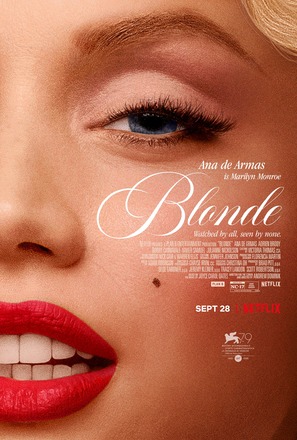
Blonde (2022)

Blonde (2022)

Exploitative biopic of Marilyn Monroe that doubles down on misery, discomfort and leaves you feeling rather like a Peeping Tom

Director: Andrew Dominik

Cast: Ana de Armas (Norma Jeane Mortenson/Marilyn Monroe), Adrien Brody (The Playwright), Bobby Cannavale (Ex-Athlete), Xavier Samuel (Cass Chaplin), Julianne Nicholson (Gladys Pearl Baker), Evan Williams (Edward G Robinson Jnr), Toby Huss (Whitey), David Warshofsky (Mr Z), Caspar Phillipson (Mr President), Dan Butler (IE Shinn), Sara Paxton (Miss Flynn)

Few icons had such cultural impact in the 20th century as Marilyn Monroe. Maybe Elvis – coincidentally also the subject of a 2022 biopic. Even people who have never seen a Monroe film can impersonate her or knows about that dress being blown up around her. It’s also pretty widely know she had a difficult life, troubled family and some disastrous marriages culminating in her tragically early death from an overdose. Blonde, based on a novel by Joyce Carol Oates, dives into a heavily fictionalised account of Monroe’s life, focusing overwhelmingly on anything that could be seen as miserable, shocking and traumatic to the exclusion of almost everything else.

In doing so it’s hard not to think that, for all its attempts to shine a light on the difficulties of Monroe’s life, it’s not also partly exploiting her as well, turning her into a sort of misery porn entertainment. Over the course of nearly three hours, we see her raped at least three times, beaten, fall victim to elaborate revenge plots, forced through two blood-soaked abortions, pumped full of drugs to get her through film shoots and constantly at the centre of slavering piles of male filmgoers who scream for her attention and call her a whore the second she walks past. To say Blonde is a miserable film that’s tough to watch is putting it lightly.

Why does Marilyn put herself through it? The film offers no real answers, beyond the simplest, crudest flashes of pop-psychology possible: Daddy issues. Growing up not knowing who her father is, Marilyn’s life is a quest to find either her father or an acceptable substitute. That could be the audience, the husbands she calls “Daddy” or the hope that the person claiming to be her father who sends her a letters, might one day meet her. This is about as far as the insight goes. How issues influenced her choices and decisions is left frustratingly untold.

The film skims over the creative control she gained over her movies, the production company she set up and her skill as comic actor (it focuses much more on her dramatic Actor’s Studio work). It never once tries to understand why she continues in a career she hates so much – she had plenty of chances, even in this film, to back out – or what lured her to the silver screen and a quest for superstardom in the first place. It’s as if acknowledging Monroe worked hard to get her career would undermine the victimhood the film is determined to define her with.

The film suggests “Marilyn Monroe” is a persona put on by Norma Jean. This is another crude piece of psychology. We completely skip the years Norma Jean must have spent creating this persona and we never learn what influences it or get an understanding of “who” this Marilyn is. I suppose it’s “Marilyn” who smiles at film premieres or appears on screen: but we get little sense of how Norma Jean might have used this alternative persona to get her through the day. For all the time we spend with her, we never understand her beyond someone desperate for love with severe Daddy issues.

The film is so clumsily mishandled, its makers were reduced to stating it was not intended as an anti-abortion movie. This despite both abortions being horrifying experiences (one with a drugged Marilyn begging that she’s changed her mind, the other a late blood-soaked possible-fantasy where Marilyn is kidnapped has an implied Kennedy baby removed). Worse than this, the film Marilyn hammers home Marilyn’s sense of guilt. During her first abortion she imagines herself in a house burning down around her and later imagines a conversation with a giant foetus, which asks “Mummy why did you kill me?” and begs her not to do the same for her future babies. Not exactly the sort of messaging you expect from a #metoo film.

On top of this, Blonde is a film almost unbearably pleased with itself. This is Art with a capital A, R and T. Dominik shifts from colour to black-and-white, changes film stock and constantly shifts and changes the aspect ratio from shot-to-shot. In almost three hours, only once could I see any logic in this: as Marilyn agrees to marry Joe DiMaggio, the frame closes in on her from 2.35:1 to 4:3, a neat visual metaphor for the constricting marriage she has signed up for. Other than that, there is no rhyme or reason for any of these visual changes in the film. It doesn’t comment on the action, reflect emotional beats, delineate between reality or fantasy… it just smacks of an overindulged director using all the flashy tools for the sake of it. It becomes intensely irritating.

There is a committed lead performance from Ana de Armas (even if her Cuban accent does sneak through), who captures beautifully Monroe’s physical and vocal traits and sells what emotional titbits she is given in the salacious, muck-raking framing of the film. Her traumatic relationship with her disturbed mother, a sex-filled thruple with Hollywood princes Cass Chaplin and Eddy Robinson Jnr, raped by Darryl F Zanuck and a surprisingly-vile John Kennedy (while a TV in the background shows missiles rising – boom boom), knocked about by a jealous Joe DiMaggio (in real life he remined close to her and organised her funeral, but hey ho)… it’s all meant to be shocking but it’s all dialled up with glee of a two-bit muck-rag, flogging the hot goss.

That’s standard for the whole film, a flashy, pleased-with-itself epic that focuses on misery and pain for its subject at the cost of everything else and ends up telling us very little about her or her inner life, instead leaving us feel slightly like peeping toms for watching.

Pickpocket (1959)

Pickpocket (1959)

Bresson’s fascinating message of hope, simply but superbly deconstructs the addiction of a life of crime

Director: Robert Bresson

Cast: Martin Lasalle (Michel), Marika Green (Jeanne), Jean Pelegri (Police Inspector), Dolly Scal (Michel’s mother), Pierre Leymarie (Jacques), Kassagi (First Accomplice), Pierre Etaix (Second Accomplice), Cesar Cattegno (Inspector)

A man watches with fixed eyes, breathless and tense, as another man’s hands artfully dodge out from beneath his newspaper to caress the lapels of his fellow train passenger, coming away with a wallet clasped between the folds of his paper. It has a clammy sense of the illicit, a tempting underbelly of the world, where the normal rules don’t apply and the special can take advantage of others because they deserve the world’s benefits more. It’s about being a pickpocket, but it could be about any shadowy world just under what society permits, where the attraction is being part of the club more than any of the actual awards from the act.

No wonder pickpocket Michel (Martin Lasalle) starts to believe his own pumped-up hype: he’s no ordinary man, but a superman, an uber-mensch who has a right to help himself to the gains of others. Getting caught? It will never happen: after all just fools and little people stumble into that trap. Instead, Michel walks through the streets of Paris with the fixed glare of the addict, who can’t wait for his next stealing fix. He’ll take from anyone (even his own mother), ignore the pleas of friends, taunt a police inspector and hoard his gains in a secret nook under his bed. Even the glances that come his way from the daughter of his mother’s landlord, Jeanne (Marika Green), can’t win him away from his longing for the buzz of crime.

Bresson’s perfectly formed novella of a film (it clocks in at a trim 74 minutes) turns this into a profound journey into one man’s soul, where he will constantly dance between temptation and redemption. Loosely inspired by Dostoyevsky’s Crime and Punishment (the criminal who thinks he is a better man, the police officer he engages in a battle of wits), Bresson uses this underlying idea to craft a profound, articulate and focused study of the emptiness behind indulging our worst instincts.

Because that’s what Michel is doing. He’s clearly smart enough to find a proper job, casting aside the offers of his friend Jacques to fix him up. But he can’t raise the passion for a normal life. Bresson, whose style embraced the rawness of unnatural performers, almost literally plucked Martin Lasalle from the streets. Carefully tutored by Bresson, all artificial effects were hammered out of him, leaving Lasalle a blank and exact performer. It works perfectly for Bresson’s concept of the criminal as a dysfunctional human, unable to relate to or understand others, unable to engage in the world, coming to life for his crimes and plodding through the rest of time with monotony and a striking lack of emotional engagement. (It admittedly works less well for those scenes where Lasalle must demonstrate emotion, which he plays with a mechanical dutifulness.)

Michel can’t bring himself to see his dying mother, dropping money off with Jeanne to pass over for him (money, it later transpires, he had stolen from her in any case). His friendship with Jacques sees him go blandly through the emotions. We constantly see him trudging up and down stairs, opening and closing his door, moving his few possessions around, all of it with clockwork regularity that seems relentless. He falls in with fellow pickpockets but doesn’t even learn their names. The most he ever seems engaged is during his sly exchanges with a police inspector (avuncular Jean Pelegri) who seems certain he’s a thief.

Perhaps Michel is so relatively animated in these exchanges because he’s desperate to be caught. Because how can you be a superman, if no one can really see what you are doing? The bitter irony is, your genius for theft can only be publicly acknowledged by being caught, the greatest failure of any thief. But Michel longs, in some part of himself, for recognition, praise and to stand-out. His life – in a grimy bedsit, wearing the same ill-fitting suit (which hangs about him, as if exaggerating his blankness) – is strikingly un-special. His best attribute as a pickpocket is that he’s a non-entity you wouldn’t look at twice. Is there a bigger slap in the face for the man who would be king, that his greatest strength is his ability to not be seen?

It must be particularly harsh, as Bresson makes clear Michel isn’t even a particularly adept pickpocket. He fluffs his first few attempts, his heart pounding so much that he can’t bring about the steady hands needed. His early crimes are clumsy and ineffective. At a race meet that opens the film, he filches cash from a lady’s handbag and only a lack of evidence saves him when he is immediately picked up. When he is finally found by his expert accomplice (played by real-life thief, and master of sleight-of-hand, Kassagi), his crude techniques are ruthlessly exposed.

This would-be superman never reaches the heights of Kassagi. Bresson’s shooting of the pickpocket’s crimes are edited like the greatest heist thrillers, tense moments of balletic beauty. We see hands carefully unbutton jackets from behind. Wallets knocked out of pockets and caught as they slide down a person’s body. Wrists are clasped and stroked as watches are removed. The pickpockets work in a team of three: one takes the wallet, passes it to a second who palms it instantly to a third who escapes. All this is caught by Bresson with all the grace of Gene Kelly. It’s exciting, dynamic – and also (you can’t escape it) sensual. You can see why Michel gets such a thrill out of it.

But he’s also the least of his team of three – and when the other two get nicked, he really should take the hint. He practises at length to make his fingers more supple, his ability to grasp watches and wallets more fluid. But his movements are never quite graceful enough, his face always a little too sweaty, his eyes flicking a little too much as if worried about being caught in an assignation. Later he travels to London but returns penniless, too inept to keep hold of his cash from card-sharps.

Bresson’s film reaches, gently but highly effectively, for a spiritual message. What joy or grace is there for Michel? Crime and the dreams of being someone special fill a void in his life. That void has no room for friends or family. Not even for God, who he’s touched by “for three minutes” at his mother’s funeral. Even the (to us) evident love of Jeanne can’t really touch him enough to change his ways. Or at least, perhaps not until he hits rock bottom where, like Paul on the road to Damascus, he will have a sudden vision, trapped behind bars, that life can be different.

To give that impact, Bresson has to show (and understand) the lurid temptation of a life beyond the rules and the norms. Pickpocketing was his tool – and it perfectly conveys the addictive glamour of feeling superior to others – but really it could have been the buzz of any addiction, the thieves hunting each other out with the knowing eyes of fellow addicts. These sensual delights are false though, engaging and absorbing as they are. Told without melodrama, it’s a stunning, hard-boiled thriller that ripens into a profound, subtle and intelligent parable, assembled with a cool, exact genius that makes filmmaking look simple.

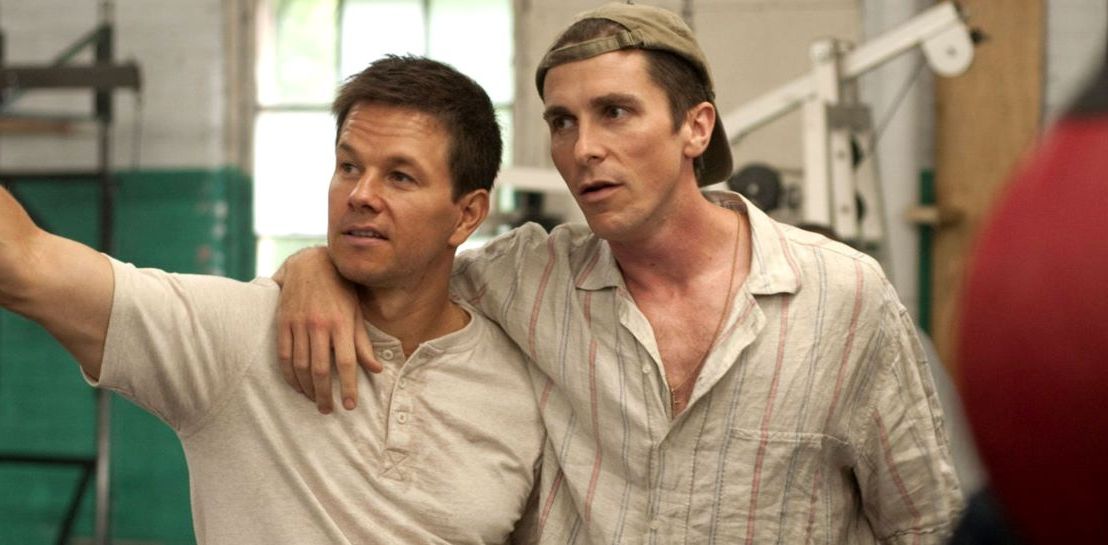
The Fighter (2010)

The Fighter (2010)

A fighter has a title shot, in a surprisingly heartwarming film about the importance of family, no matter how messed up it is

Director: David O Russell

Cast: Mark Wahlberg (Micky Ward), Christian Bale (Dicky Eklund), Amy Adams (Charlene Fleming), Melissa Leo (Alice Eklund-Ward), Jack McGee (George Ward), Frank Renzulli (Sal Lanano), Mickey O’Keefe (Himself)

Everyone loves Rocky. We all want to that local-hero-turned-good, the guy who went the distance. Lowell, Massachusetts had that in Dicky Eklund. Eklund, a minor pro-boxer, once went the distance against Sugar Ray Leonard in 1978 (he argues he knocked him down, although many are convinced Leonard slipped). “The Pride of Lowell” then became… a crack addict, tumbling from disaster to let-down, helping and hindering the career of his brother, fellow boxer Micky Ward.

The story of the two brothers – leading up to Ward’s eventual title shot in 1997 – comes to the screen in Russell’s affectionate, if traditional, boxing drama, long a passion project of Mark Wahlberg who plays Micky. Wahlberg kept himself in boxer-condition for years as he dreamed of making the film, recruiting director and cast and producing the film. The fine, sensitive film we’ve ended up with is a tribute to his commitment and producing skills, while the fact that Wahlberg casts himself in the least dynamic part is a nice sign of his generosity.

Because it’s only really on the surface a Micky Ward film. Sure, the film follows the vital events in his life. It opens with him bashed up in a mis-match, filling his role as a “stepping stone” fighter, someone the future champs flex their muscles against. We follow his struggles to escape from under the thumb of his large brash family – above all his bombastic, domineering mother Alice (Melissa Leo). He forms a relationship with ambitious-but-caring Charlene (Amy Adams), moves up the ranking, lands that title shot, fights the big bout. But it never quite feels like Micky is the star.

Because, really, this feels like it’s about Dicky Eklund working out the first act of his life is over, and trying to find if he has what it takes to start a second, more humble, one. The film opens with Dicky followed by an HBO crew for a fly-on-the-wall documentary. Dicky’s convinced himself it’s to chart his boxing come-back. It’s actually about the horrific impact of crack addiction. Dicky is a strung-out, unreliable junkie, living on past glories but screwing up everything he touches, being enabled by the fawning worship of his mother and sisters, who still worship him as the families main event (and continue to do so, even as Micky rises to title shot). The film’s heart is Eklund sinking to rock bottom and realising he has forced the compliant Micky into playing a subservient role in his own life.

Perhaps it feels like a film more focused on the remoulding of this charming but selfish figure because of the compelling performance of Christian Bale. Starving himself down to match Eklund’s wizened, strung-out physique (he’s still got the boxer moves, but his body has wasted away) is a day’s work for a transformative actor like Bale. But this isn’t just a physical performance, but a deep immersion into the personality of a person who almost doesn’t realise until it is too late how fundamentally flawed he is. Bale’s a ball of fizzling energy and electric wit coated in a lethargic drug-induced incoherence. His energy is frantic but uncontrolled, wild and mis-focused. It’s a superb, heartfelt performance of loveable but dangerous uselessness that nabbed Bale an Oscar.

But what makes The Fighter a surprisingly warm film is that, for all his many flaws, selfishness and self-obsession, Dicky genuinely cares for his brother. He wants the best for him, he believes in and loves him. Much of the power of Bale’s performance comes from the fact he never forgets this, even when Dicky is at his worst. In fact, Russell’s whole film works because that warmth and love everyone feels for Micky is never forgotten and never weaponised by Russell into helping us make moral judgements about the characters. Nor does it forget that Micky may sometimes hate his family, but he never stops loving and needing them.

A weaker film would have stressed the trailer-trash greed of Melissa Leo’s Alice. Leo (who also scored an Oscar and famously dropped the f-bomb on live TV, condemning the ceremony to a permanent time delayed broadcast ever since) is in many ways playing an awful character: controlling, nakedly favouring Eklund over his brother, quick to judge, rude and aggressive. She’s never truly likeable – but Russell’s film understands everything she does is motivated by love. She genuinely wants the best for Micky, even while she pushes him into bad fights and never listens to him. She tries to protect him, and expresses this in destructive selfishness.

In many ways she’s just like Micky’s girlfriend Charlene, who recognises early that Micky’s family (who have turned him into a timid hen-pecked type) can’t be trusted to run his whole career, but who also subtly pushes herself into Alice’s place as the leading decision-making influence in his life. Very well played by Amy Adams (who lost the Oscar to Leo), Charlene is smart, sexy, loving but just as determined that it’s her way or the highway.

What Micky needs to do, the film carefully (if rather safely) outlines, is take the best qualities of all his influences. It’s Eklund’s “job” to realise Micky needs everyone he loves singing from the same hymn-sheet. It needs compromise and putting other people first. It makes for a nice little paean to the importance of family relationships, founded on forgiveness and admitting when you are wrong. Micky forgives his mother and brother for their selfishness: they, in turn, acknowledge their mistakes. Eklund is crucial here: Bale is again superb as a man who suddenly realises pride has nearly ruined his life and embraces the junior role in the relationship with his brother.

Sure, none of this reinvents this wheel, but it still makes for engaging and rather sweet drama. Russell mixes it with some neat stylistic flourishes that don’t overwhelm the film. It’s shot with an edgy, handheld immediacy reflecting its street roots. The fights are shot with old TV cameras, so that invented footage can fuse with 90s HBO coverage. Russell of course gets great performances from his actors, as he always does.

The Fighter is in many ways predictable. But it wears its heart very much on its sleeve, and Wahlberg deserves credit for assembling it and for giving a quiet, generous performance at the centre of it. And the film’s commitment to the idea that, no matter the problems in our families, we can all find the courage to admit our mistakes and pull in the same direction remains heartwarming.

The Wolf of Wall Street (2013)

The Wolf of Wall Street (2013)

Greed is Good? Scorsese’s masterpiece is a heady deconstruction of the excess of white collar criminals

Director: Martin Scorsese

Cast: Leonardo DiCaprio (Jordon Belfort), Jonah Hill (Donnie Azoff), Margot Robbie (Naomi Lapaglia), Kyle Chandler (FBI Agent Patrick Denham), Rob Reiner (Max Belfort), Jon Bernthal (Brad Brodnick), Matthew McConaughey (Mark Hanna), Jon Favreau (Manny Riskin), Jean Dujardin (Jean-Jacques Saurel), Joanna Lumley (Aunt Emma), Cristin Milioti (Teresa Patrillo), Christine Eberle (Leah Belfort), Kenneth Choi (Chester Ming), Brian Sacca (Robbie Feinberg), Henry Zebrowski (Alden Kupferberg)

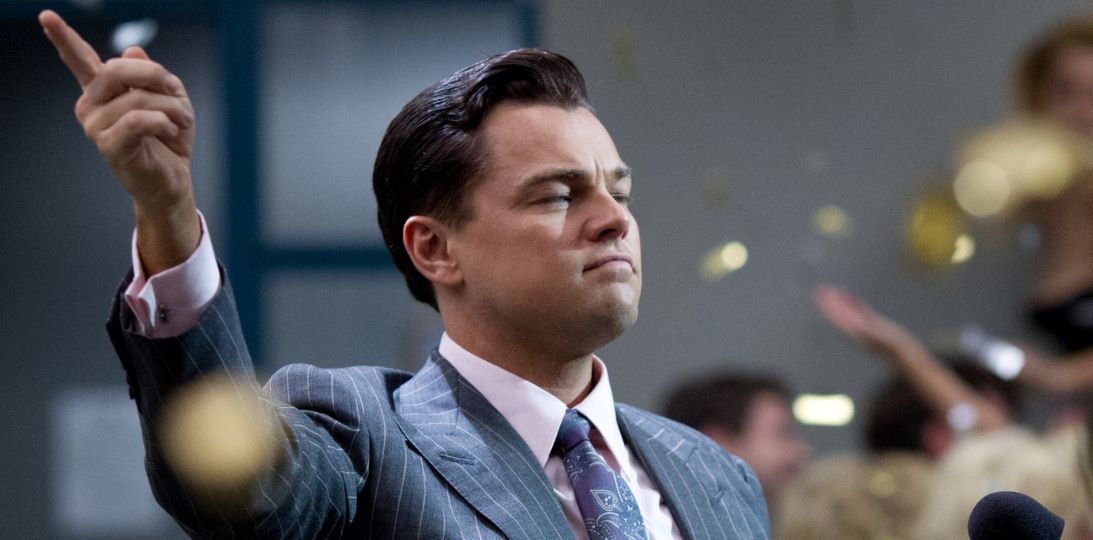
All The Wolf of Wall Street is really missing is an early freeze frame of a coke-fuelled banker slamming the phone down on a closed deal and a wistful voiceover from Jordan Belfort: “As far back as I can remember, I always wanted to be Wall Street trader”. If Goodfellas was Scorsese’s exploration of the attractions – and dangers – of a life in blue collar crime, then The Wolf of Wall Street is its white collar companion piece. The fact that so many viewers find the behaviour of Belfort morally outrageous in a way that no one ever objects about Henry Hill is, for me, an indication of how much we loath these masters-of-the-universe. For all their faults, we’d still rather see a violent criminal as one of us.

Based on Jordan Belfort’s (Leonardo DiCaprio) autobiography, The Wolf of Wall Street follows his time building a dodgy trading empire and a large fortune. Not that he can remember most of it, as he seems to be on a permanent intoxicated binge of drinks, hookers and every drug you can ever imagine (and some you can’t). The FBI catches up with him eventually, but Belfort learns precious little from his experiences. Other than, perhaps, that so long as you are rich and white in America, you can basically get away with anything.

That’s perhaps the key to Wolf of Wall Street. Scorsese may not shy away from the delicious dark comedy of Belfort’s life of excess, but it doesn’t blind him to the shallow awfulness of the man or his unthinking, instinctive greed and self-obsession. You would need to be a pretty shallow person to look at Belfort’s greed, moral emptiness and self-destructive binges and want to ape him. If you think watching DiCaprio literally paralytic on quaaludes is the life you want, frankly there is something wrong with you.

What perhaps made some feel Wolf of Wall Street was oddly in love with Belfort is its electric pace. The film is a brilliant reminder of Scorsese’s faultless understanding of pace. Or one who matches unparalleled cinematic skill with the rambunctious energy of a first-timer allowed to play with his movie toys for the first time. Brilliantly assembled, this is a superb collection of cinematic techniques, from jump cuts to fluid transitions that power through a series of increasingly bacchanalian parties and isn’t afraid to admit that, in the moment, this stuff can be fun (rather like getting the best table in Goodfellas) but ultimately self-destructive. (After all, few know the dangers of drugs like Scorsese.)

At the centre of this whirlwind is a stunning performance from Leonardo DiCaprio. With his still youthful, charismatic handsomeness, DiCaprio only needed to tweak his screen persona to provoke the sort of perverted idolatry Belfort receives from his co-workers. But he goes above and beyond in his transformation in this role. He makes Belfort simultaneously oddly childlike and revoltingly corrupted, someone whom we enjoy spending time with while finding repulsive. He rips through Belfort’s trademark, drug-fuelled motivational speeches, monologues of insanely eye-popping intensity, explosions of off-the-chain wildness. At other times he’ll sulk and whine like a spoilt child. DiCaprio struts across the screen with an unpredictable physicality – his embodying of the physical effects of mind-altering drugs is hilarious and horrifying –in possibly his finest ever performance.

DiCaprio is the raw energy source that helps power the rest of the film. Scorsese matches him blow-by-blow with this dynamic expose of white-collar corruption. Using Belfort as a narrator – which serves to further expose his shallowness, greed and utter inability to learn any sustained messages from the depths he plummets to – the entire film is all about how the flip side of the American Dream tacitly promotes and encourages this sort of behaviour.

Belfort is the rash the system has come out as. In a highly effective early cameo, McConaughey plays Belfort’s first mentor, a coke-fuelled hedonist hooked on the buzz of closing deals, who pushes Belfort towards a career of success (including introducing a brilliant breathing exercise – improvised by McConaughey based on his own warm-up exercises – that becomes a mantra in the film). DiCaprio’s eyes have already lit up at watching a deal closing. Drugs and sex are just an attempt for Belfort to replicate the buzz of the real addiction: money.

Scorsese recognises that we don’t need to know the details of Belfort’s illegal dealings. (In his voiceover Belfort literally tells us it doesn’t matter, all that does is the shitload of cash they were bringing in.) We learn enough about the huge mark-ups (50% of the deal’s value) he can make from selling penny stocks (trades of small public companies) and “pump and dump” tactics to know it’s wrong. I will admit the film does little to show the victims – but then Belfort never cares either, proudly stating at one point he has no guilt fleecing his clients out of cash, because he knows how to spend it, better than they do.

It all pours into a hedonistic, alpha-male environment where the air is as littered with fucks (the film held a record for most use of the word) as the floors and desks of Belfort’s offices are during his hooker-filled end-of-week parties. Wolf of Wall Street is also an expose of toxic alpha-maledom. Bullying, abuse and screaming are ripe, women are basically commodities traded as easily as shares. The only exceptions are those allowed into the boys’ club as either surrogate-male fellow traders or trophies to adorn the arm. Margot Robbie (superb in a star-making role) plays Belfort’s glamourous wife, who knows she needs to use her physical assets to make her way in this world.

The film rips along through a party-deal-party structure. Belfort goes from wowing his fellow penny stock traders by making $2k in two minutes to wrapping the trading floor of his fake-old-school Wall Street firm around his finger in excess filled speeches. He also goes from a charming party animal to an incoherent, rambling, deeply unpleasant and dangerous drunk and drug addict. But crucially, he learns nothing . There is no life-and-soul shattering payback like Henry Hill undergoes. Fault, guilt and consequences roll off his rich, spoilt back. He ends the film still winning the adulation of would-be millionaires, his conscience (if it exists) untroubled by any impact his actions have had on others.

Perhaps Scorsese could have allowed more space to victims – and to Kyle Chandler’s dutiful and dedicated FBI agent who brings him down (our final shot of this character stresses his humble, low-paid status – echoing back to his confession to at times regretting leaving a trading career for a law one). But that’s to criticise the film for not being obvious enough. Of course parties are fun. But each party becomes wilder, more orgiastic and uncomfortable as the film goes on. But if we didn’t understand the fun, we couldn’t understand how people get hooked on this adrenalin fuelled life.

Wolf of Wall Street though is a warning to the curious – if you are smart enough to look. Belfort’s soulless, horrible life is not one to aspire to, and his moral emptiness not one to wish to have. It’s a funny film, but it’s also a dark one. DiCaprio is brilliant beyond belief, Jonah Hill funny and pathetic as his best friend, Margot Robbie becomes a star and Scorsese rips through the film with the energy, passion and dynamism of a much younger director. An outstanding tentpole film in his CV.

Another Round (2020)

Another Round (2020)

Vinterberg’s film explores our complex relationship with alcohol with a surprising lack of judgement

Director: Thomas Vinterberg

Cast: Mads Mikkelsen (Martin), Thomas Bo Larsen (Tommy), Magnus Millang (Nikolaj), Lars Ranthe (Peter), Maria Bonnevie (Anika), Helene Reingaard Neumann (Amalie), Susse Wold (Principal)

Mankind’s most difficult relationship? Might just be with alcohol. Ever since Noah first toppled over pissed, we’ve struggled to balance that delightful buzz a touch of intoxication gives with the destructive impact way too much has. It’s a relationship explored in Thomas Vinterberg’s curious mix of warning and celebration, Another Round, which (slightly obliquely) looks at the positives and negatives of alcohol consumption.

In a gymnasium school in Copenhagen, history teacher Martin (Mads Mikkeslen) has lost all passion and interest in his students (so much so they try to have him removed) and his marriage is stuck in an increasingly distant rut. After a birthday meal, he and three friends – PE teacher Tommy (Thomas Bo Larsen), psychology teacher Nikolaj (Magnus Millang) and music teacher Peter (Lars Ranthe) – agree to a pact to combat their ennui. After reading a theory that mankind is born with 0.05% blood alcohol content deficiency (and topping it up makes you more creative and relaxed), they decide to experiment with maintaining a certain level of inebriation. At first it has a positive impact; but as they push the boundaries of the experiment, the negatives swiftly multiply.

Vinterberg’s film is notable for not taking an obvious (or firm) stance on alcohol consumption. It’s easy to imagine an American or British film dwelling on the negatives at the cost of everything, or demonstrating deep regret in the friends for ever starting on this journey in the first place. Another Round doesn’t do this. In fact, it rather bravely points out the positives we can feel from the happiness and relaxation alcohol can give. So much so that, at first, it actually improves people’s lives. After all, if it was always all bad – we wouldn’t drink it would we?

This is most notable in the case of Martin. He might stumble in the staffroom on the way to class, but (after a swig of vodka) his teaching becomes more inspiring, electric and engaging. He rediscovers a passion for working with students, dropping the disengaged drawling of semi-confused facts we see him use earlier (where he doesn’t even seem to be listening to himself, randomly drifting from the Industrial revolution to Churchill) and replacing it with insightful parallels, high-energy tempo and fun activities. Whether it’s psychological or something else, being able to relax clearly has a positive short-term impact on his ability to teach.

It’s matched in the others as well. Peter gets his students singing with an intensity and beauty he couldn’t begin to get them to reach earlier. Tommy, in his work with a primary school football team, brings out the skilled footballer in a shy, bespectacled student (although his uncomfortable blurring of the line between teacher and surrogate parent with this boy hints at Tommy’s lack of control, which the film will explore in more depth). Vinterberg echoes the giddy feeling of elation all four feel by subtle use of a free-moving handheld camera, compared to the more staid rigidity of the earlier stable shots.

Martin also dramatically improves his personal life. He starts to reconnect with his family and rebuild passions with his wife. Sure, there are negatives. Hidden alcohol stashes at the school are discovered. It becomes harder to hide their intoxication in the common room. But it still feels good, right? Problem is, Martin makes the mistake many of us have. If a small amount of this makes me feel this good – why don’t I take a large amount? Surely if I up the blood alcohol content even higher, the positives will be all the greater. Sadly, of course, it doesn’t work like that.

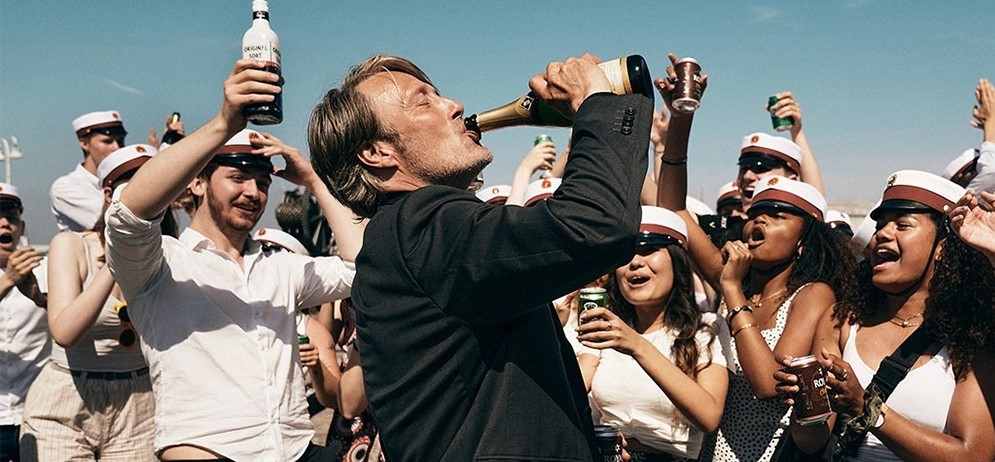
Vinterberg’s film is careful not to use labels like alcoholism. But, in the same way it isn’t afraid to show the world-beating confidence a stiff drink or two can give you, it doesn’t shy away from the impact of over-consumption. Deciding, “as an experiment”, to push their drinking to absurd levels for one night only, to get as intoxicated as possible, the four have a fab night. But the next morning? Peter loses all his clothes diving in the sea. Nikolaj wets the marriage bed in a confused stupor. Martin wakes up, face bleeding, on the pavement having tried (and failed) to use his keys on his neighbour’s house, and is carried home by his humiliated children.

This is as nothing compared to the terrible impact of alcohol on Tommy. While all four of the men no doubt become increasingly dependent, it’s Tommy who tips into full blown alcoholism. Beautifully played by Thomas Bo Larsen, its painful to watch this gruff-but-playful bachelor dip increasingly into confused, stumbling, permanent inebriation, living in a home made of finished bottles and unable to hide from colleagues or students his intoxication.

But, for all that much of the second half of the film focuses on these negatives, it doesn’t offer easy solutions. All four realise things have gone too far – but none of them can forswear (or even seem to consider doing so) alcohol. Martin’s marriage collapses and Nikolaj’s nearly goes the same way. But they still gather at the film’s end for a drink. It’s at this point that it can be a little unclear what Vinterberg’s thoughts are on the demon. But then perhaps that is the point: we all know it’s bad for us anyway, so a film that looks at how we balance that desire with a certain level of responsibility is always, perhaps, going to shy away from either easy answers or definitive statements.

It’s perhaps why the film ends with a surprisingly blissful, up-beat ending of hope for the future rather than despair, as Martin explodes into a riotous improvised dance routine. It’s easy to forget Mikkelsen is a trained dancer, and the fact he provides such a striking, memorable ending to the film is fitting as it’s a triumph for him. At first a shambling, sad-sack figure, Mikkelsen’s Martin finds a casualness and relaxation that seemed beyond him (the film is a physical triumph for Mikkelsen – his drunken move through a common room worthy of Gene Kelly or Buster Keaton). Mikkelsen’s work is extraordinary in its emotional complexity – bursts of pained sorrow, rage, guilt, self-loathing, despair and hope flash across his face and he holds the entire film together.

He’s ably supported by Larsen, Millang and Ranthe – all superb – and Vinterberg’s deceptively casual and unobtrusive direction helps craft a film that offers scenarios but not lectures. While I could have hoped for the film perhaps taking a bit more of a stance one way or the other – or give a more unflinching look at the impact on others of alcohol abuse – as a personal story Another Round is vibrant, honest and (strangely) hopeful, for all the terrible impacts it displays. It lingers with you like a hangover.

Wild (2014)

Wild (2014)

Reese Witherspoon finds herself in a film that is more than just Eat, Pray, Hike

Director: Jean-Marc Vallée

Cast: Reese Witherspoon (Cheryl Strayed), Laura Dern (“Bobbie” Grey), Thomas Sadoski (Paul), Michel Huisman (Jonathan), Gaby Hoffmann (Aimee), Kevin Rankin (Greg), W. Earl Brown (Frank), Mo McRae (Jimmy Carter), Keene McRae (Leif)

Ever thought tackling a 1,100 mile hike would be a fun adventure? The opening of Wild might change your mind. Gasp as Reese Witherspoon rips out a bleeding toe nail and then throws her ill-fitting hiking boots down a mountain, screaming abuse at them all the way! Want to grab that back-pack now?

In this adaptation of a memoir about loss and self-discovery, Witherspoon plays Cheryl Strayed who (fairly impulsively) decided to hike the Pacific Crest Trail in 1995 to try to find in herself the woman her late mother “Bobbie” (Laura Dern) believed she could be. After Bobbie’s early death from cancer at 45, Cheryl had collapsed – ruining her marriage to Paul (Thomas Sadoski) in an orgy of anonymous sex and heroin addiction. Now she wants to make a new start.

Adapted by Nick Hornby with a good deal of skill and emotional intelligence, Jean-Marc Vallée’s film is an interesting character study via the survivalist genre, mixed with a touching exploration of grief, loss and self-loathing. After throwing us into Day 26 with that bloodied toe-nail, the film rolls back to follow Cheryl’s walk: intercut with powerful memories of her relationship with her mother, each memory activated by different encounters along the way and bubbling into her mind along with a distinctive soundtrack (most especially Simon and Garfunkal’s El Condor Pasa) that reflects the music that reminds Cheryl of her mother.

It could have been a sentimental finding-yourself movie – Eat, Pray, Hike anyone? (I also rather like Reese Witherspoon Finds Herself in a Backpack) – and I won’t lie, there are elements of that. But maybe it caught me in the right mood, maybe because I’ve always fancied testing myself with an epic hike, but I actually found it intelligent, sensitive and just the right side of sentimental.

Wild carefully avoids simple points. It’s a film not about a long journey leading to revelation, but a journey that helps you accept all your past decisions, right or wrong. There is a pointed lack of emotional breakdowns, tearful confessions or flare ups of self-anger and revelation. Instead, it’s about the long grind of starting an internal journey towards contentment. Because trekking 1,100 miles is the long haul: there ain’t any easy ways out or short cuts on this trek.

The film’s principal asset is Reese Witherspoon. Also serving as producer, Witherspoon is in almost every single frame and delivers an under-played but very emotionally satisfying performance. She plays Cheryl as quietly determined, having already hit rock bottom and knowing every step she takes from now is upwards. She meets adversity – aside from the odd flash of frustration – with a stoic will and finds an increasing spiritual freedom in the wild that serves as an escape from the horrific wilderness of her self-destructive years. But she never lets us forget the pain that underpins this journey for Cheryl. It’s a very impressive performance.

The reminders of that pain are distributed through the film, which unflinchingly chronicles Cheryl’s escape from grief in the arms of a parade of sleazy men, anonymous hotel sex and (finally) shooting up heroin on the streets of San Francisco. It ends her marriage to Paul – but not their friendship, in the sort of adult emotional reaction you hardly ever see in a movie. Paul – played with warmth by Thomas Sadoski – may not be able to continue his marriage after discovering his wife’s parade of trust-breaking, but it doesn’t stop him from helping a person he loves who is in need.

All of this is nicely counterpointed by the hike itself. Naturally it’s all slightly episodic, as Cheryl moves from location to location, but Hornby’s script makes these vignettes really work. Vallée’s direction also does a fantastic job of intercutting between the long walk of 1995, and Cheryl’s memories of both her mother (played with a vibrancy that makes a huge impression from limited screen time by an Oscar-nominated Laura Dern) and her own emotional collapse after her death.

I also appreciated that Wild doesn’t shirk from showing the vulnerability of an attractive young woman hiking alone. Some potential predators are revealed to be the opposite: others are exactly what they appear to be. But not every encounter is one of potential danger: far from it.

Cheryl is met time and again by people who only appear to support, share their expertise and help her in her quest. At an early station, a man talks her through the huge amount of equipment she’s bought and advises what she can leave behind (Vallée opens the film with the strenuous effort, including rolling around on the floor, Cheryl has to go through just to put this backpack on). She finds a touch of romance with a handsome musician (a charming Michel Huisman). There’s also comedy, most of all with Cheryl’s encounter with a self-important journalist (Mo McRae), who won’t be convinced that she isn’t a female hobo.

This is all packaged together in a quiet, un-pretentious way that culminates in a thought-provoking monologue about the value of self-acceptance and putting aside regrets. Others would have layered on the sentiment, but here the balance is just right. With Witherspoon at the top of her game, Wild is a well-made and involving road trip that also makes you think.

French Connection II (1975)

French Connection II (1975)

Change of setting isn’t really enough to justify the existence of this half-hearted sequel

Director: John Frankenheimer

Cast: Gene Hackman (Detective Jimmy “Popeye” Doyle), Fernando Rey (Alain Charnier), Bernard Fresson (Inspector Henri Barthélémy), Philippe Léotard (Jacques), Ed Lauter (General Brian), Charles Millot (Miletto), Jean-Pierre Castali (Raoul Diron), Cathleen Nesbitt (Old Lady)

Did The French Connection really need a sequel? Friedkin’s original was a self-contained gem, based on a true story, that even ends with a series of “what happened next” captions. But there was enough of a foot in the door for a completely fictionalised resolution to fates left hanging. French Connection II has some similarities with the original, but it’s also a slight film caught even more obviously than the first between documentary realism and trigger-happy actioner.

The whole film feels like it has been assembled in a rush. The plot is incredibly slight. “Popeye” Doyle (Gene Hackman) arrives in Marseilles to help the police track drug kingpin Alain Charnier (Fernando Rey). Doyle doesn’t speak a word of French and charges around pissing everyone off and generally making a nuisance of himself. He’s grabbed off the streets by Charnier’s men. To get him to talk they spend weeks force-feeding him heroin until he’s hooked then cut off his supply. They then return him to the Marseilles police who lock him in a cell and help him go cold turkey. When he comes out if Popeye wasn’t mad before, he certainly is now.

That (long) sequence of heroin addiction and painful cold turkey is one of two things that really makes Frankenheimer’s sequel stand out. I think it must be what attracted Hackman to the film. Not only did the liberal Hackman (troubled by Doyle’s slight neo-fascism in the first film) probably enjoy the idea of seeing this guy hit rock bottom, it’s also an opportunity for an acting tour-de-force. Hackman is probably given more challenging material in this largely forgotten sequel than in his actual Oscar-winning role.

Weaned onto the drugs, Hackman’s body language shifts from defiant resistance to despondent, dope-strewn lethargy until he can’t be bothered to record the passing of days any more in his tally chart. He goes from being cuffed and dragged around, to blankly following his captors and rolling up his sleeve to accept another shot. But that’s nothing compared to the cold turkey scenes.

Locked up in a dingy cell under the police station (the French police worried about taking the blame and also feeling a brotherhood with this fellow cop), Doyle goes through withdrawal mourning – anger, bargaining and eventual grief – in a series of calmly shot, claustrophobic scenes that allows Hackman let rip. And he certainly does, deconstructing this proud man’s self-image until he’s a weeping mess, kicking doors, throwing food around and so full of self-loathing, he can barely face himself in the mirror. It’s hard to watch, and something truly unique – a twisted punishment for a drugs cop and a man who defines himself by his lack of reliance for anyone or anything else.

This long sequence takes up the centre of the film – and includes an equally difficult scene to watch, as Frankenheimer stages in (a single take) forensic detail the French police’s pumping of Doyle’s stomach to get a final (deadly) overdose out of his system. It’s quite unlike anything else I’ve seen before in a cops and robbers shoot-em-up (which is what most of the rest of the film, at heart, is) and you can guarantee it’s the one thing people will remember.

The other element that stands out is Frankenheimer’s – a long time Francophile – ability to shoot Marseilles not as a tourist destination, but a strikingly real urban environment. On top of this anti-picture-postcard environment, he stresses Doyle’s isolation. None of the French dialogue in the film is translated, leaving us as stranded as Doyle is in trying to understand what is going on and what people are saying. Doyle clumsily pantomimes for everything he wants, be that information from a suspect (he tries his toe-picking line to no effect what-so-ever) to a drink in a bar (a long exchange until he finally reaches an understanding with the barman on “whiskey”). Doyle, of course, has made no effort to learn any French and blunders about in a city he doesn’t understand, ruining operations and getting himself and others in trouble.

Aside from these moments though – and despite the film being well shot by Frankenheimer, with a nice continuation of the original’s drained out neo-realism – this is otherwise a conventional and unimaginative film that ticks a number of expected boxes. It has an action set-piece at a dry dock that feels unreal (and also copies the central idea of the car smuggling operation from the first film) and concludes in a chase and shoot-out that’s almost a copy of the original’s ending – with an ending even more sudden. For all Frankenheimer’s love of France, the film still has a suspicion for Europeans – be they smooth criminals or obstructive cops.

French Connection II tries a couple of different things, but never really makes a case for itself as a truly stand-alone film. It’s main rivalry between the hero and villain is dependent on having seen the first film and its slender plot veers into the sort of shoot-outs and set-pieces that don’t feel remotely like they are occurring in a ‘real’ world. It deserves credit for the bravery and honesty of its cold turkey sequence, but it’s a sequence caught in a film that otherwise offers little that’s truly unique.

Nightmare Alley (2021)

Nightmare Alley (2021)

A mysterious drifter gets more than he bargained for in del Toro’ flashy but unsatisfying film

Director: Guillermo del Toro

Cast: Bradley Cooper (Stanton Carlisle), Cate Blanchett (Lilith Ritter), Rooney Mara (Molly Cahill), Toni Collette (Zeena Krumbein), Willem Dafoe (Clem Hoatley), Richard Jenkins (Ezra Grindle), Ron Perlman (Bruno), David Strathairn (Pete Krumbein), Mark Povinelli (Major Mosquito), Mary Steenburgen (Felicia Kimball), Peter MacNeill (Judge Kimball), Paul Anderson (Geek), Clifton Collins Jnr (Funhouse Jack), Jim Beaver (Sheriff Jedediah Judd), Tim Blake Nelson (Carny Boss)

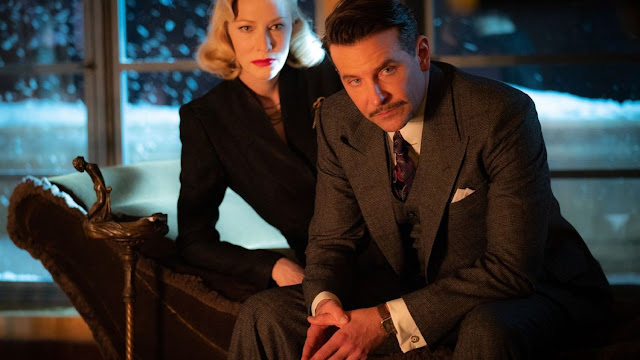
There isn’t any magic left in the world, it’s all show and tricks and no wonder. Nightmare Alley is del Toro’s follow-up to his Oscar-winning The Shape of Water and you can’t not admit it’s a triumph of style. It’s a glorious fusion of film noir and plush, gothic-tinged horror. There is something to admire in almost every frame. But it’s also all tricks and no wonder. There’s no heart to it, just a huge show that in the end makes nowhere near the impact you could expect.

In the late 1930s Stanton Carlisle (Bradley Cooper) is a drifter with a dark past, who is recruited as a labourer in a travelling carnival. Learning the ropes from freak show owner Clem (Willem Dafoe), he’s taken under the wing (in every sense) by mesmerist mind reader Zeena (Toni Collette) and taught the tricks of the art (observation and careful word codes using an assistant to guess names, objects and other facts) by Pete (David Strathairn). Eventually Stanton and his love, circus performer Molly (Rooney Mara), head to the big city where, after two years, Stanton reinvents himself as celebrity mind-reader and medium. There Stanton gets involved with psychiatrist Lilith Ritter (Cate Blanchett) in a long con where he will use the recordings of her sessions with patients to act as a medium to put them in touch with their lost ones. But is there a danger Stanton isn’t ready for in one of his clients, powerful businessman Ezra Grindle (Richard Jenkins)?

Nightmare Alley looks fabulous. But it’s hellishly overlong and curiously uninvolving. It’s like Del Toro fell in love with the whole project and forgot to search for the reason why somebody else would love it. It’s a strangely unshaped film, alternating between long, loving scenes glorying in the dark mood, baroque performances and design but then makes drastic, swift jumps in character psychology that constantly leaves you grasping at engaging with or understanding the personalities of its characters.

Its design is faultless though – it’s no surprise that its only Oscar nominations outside the Best Picture nod were all in technical categories. Dan Lautsen’s cinematography is inky black, with splashes of all-consuming colour. It’s a marvellous updating of film noir, with deep shadows spliced with angles reminiscent of Hammer-style horror. The production design is a labour of love, the carnival sets a hellish nightmare of unsettling shapes, forms and structure contrasting with the art deco grandness of the big city. The design is pretty much faultless, a real labour of love.

But the same effort didn’t go into pacing and story. This is a slow-moving, self-indulgent film, that frequently seems to be holding itself at arm’s length to make it all the easier for it to admire itself. It looks extraordinary, but it’s a frequently empty experience, more interested in mood and striking imagery than character and emotion.

Bradley Cooper gives a fine performance as Stanton. He has an air of cocksure charm, and Cooper skilfully shows this is largely a front of a man who, when push comes to shove, is capable of sudden and unflinching acts of violence. We get an early hint of this when he reacts to being struck by an escaping circus freak with unhesitating brutality. It recurs again and again in the film, and Stanton proudly states his avoidance of alcohol with all the assurance of a man who knows the bottle could unleash dark forces that he could never control. Cooper is vulnerable but selfish and above all becomes more and more arrogantly convinced of his own genius and bulletproof invulnerability, so much so that he drives himself further and further on into self-destruction.

There is some rich material here, so it’s a shame that for all that we never really seem to be given a moment to really understand who he is. Much has to be inferred from Cooper’s performance, since the film seems content to state motivational factors – troubled parental relationships, greed, ambition, a desire to make something of himself – without ever crafting them into a whole. Stanton remains someone defined by what he does.

And Stanton is the only character who gets any real oxygen to breathe, with the others largely ciphers or over-played caricatures. Rooney Mara as his gentle love interest is under-developed and disappears from the film for long stretches. Cate Blanchett gives a distractingly arch performance, somewhere between femme fatale and Hannibal Lector and is so blatantly untrustworthy it’s never clear why Stanton (an expert reader of people!) trusts her completely. Richard Jenkins is miscast as a ruthless businessman, lacking the sense of danger and capacity of violence the part demands.

Most of the rest of the cast are swallowed by the long carnival prologue, that consumes almost a third of the film but boils down to little more than mood-setting and a repeated hammering home of a series of statements that will lead into a final scene twist (and I will admit that is a good payoff). The carnival seems like a self-indulgent exploration of style, and several actors (Perlman, Povinelli and even Collette) play roles that add very little to the film other than ballooning its runtime.

The earlier section would have perhaps been better if it was tighter and more focused on Stanton and his mentor, well played by David Straithairn. I appreciate that would have been more conventional – but it would also have been less self-indulgent and helped the opening third be less of a stylish but empty and rather superfluous experience (since the film’s real plot doesn’t start until it finishes). Drive My Car demonstrated how a long prologue can deepen a whole film – Nightmare Alley just takes a long, handsome route to giving us some plot essential facts, without really telling us anything engaging about its lead character.

It makes for an unsatisfying whole, a cold and distant film packed with arch performances – although Cooper is good – and events that frequently jump with a dreamlike logic. It’s a marvel of design but way too much of a good thing, and constantly seems to stop to admire itself in the mirror and wonder at its own beauty. It becomes a cold and arch study of a film not a narrative that you can embrace. And you can’t the same about many of Del Toro’s other films – from Pan’s Labyrinth to Pacific Rim they’ve got heart. Nightmare Alley doesn’t really have that.

Boiling Point (2021)

Boiling Point (2021)

A chef struggles to hold it altogether under pressure in this intense one-take drama

Director: Philip Barantini

Cast: Stephen Graham (Andy Jones), Vinette Robinson (Carly), Alice Feetham (Beth), Hannah Walters (Emily), Malachi Kirby (Tony), Izuka Hoyle (Camille), Taz Skylar (Billy), Jason Flemyng (Alastair Skye), Ray Panthaki (Freeman), Lourdes Faberes (Sara Southworth)

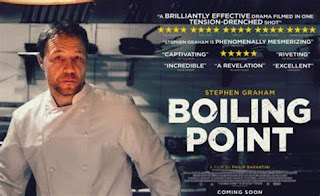
Who would want to run a restaurant? Blimey it can be stressful enough to cook for family and friends. Imagine having to prepare meals for hundreds of paying customers. Boiling Point follows – in real time – one single night of service in an over-booked restaurant a few days before Christmas. Chef Andy Jones (Stephen Graham) is feeling the pressure: his wife has left him, he’s let the paperwork slip so much over the past few months that the restaurant’s Food Hygiene Rating has slipped from five stars to three, little mistakes are slipping in and his former partner (and now celebrity chef) Alastair (Jason Flemyng) is sitting out front. It won’t be long before things hit the eponymous Boiling Point.

Expanded from a 22-minute short film made a few years previously, Philip Barantini’s film is shot in one 93-minute continuous take that starts with Andy’s (late) arrival at the restaurant and takes us through a night’s service. There are some films where this one-take device seems like a gimmick – but here it’s an essential part of the success of the film. Following all this in real time, with no single break or cut away, is like taking part in a giant panic attack. I can genuinely think of few films that were as tense as this one. There is a sweaty, edge-of-the-seat panic about the entire film that means you spend its entire runtime biting your fingernails, waiting for something to go wrong.

And there are so many potential disasters teed up. It’s a sign of the film’s intelligent, skilfully swift construction that all of these are established with minimum dialogue – and not all of them lead to disaster – but in short order we see not only the tensions among the staff (the disaffected junior chefs, the under-pressure waiting staff), but also a bullying Dad intent on making trouble on table 7, a drunken gaggle of ladies on a night out, a group of self-proclaimed social media influencers demanding off-the-menu treatment, a woman with a nut allergy that’s not correctly recorded on the ordering system, and that celebrity chef and the food critic he’s bought with him for dinner.

All this is of course bubbling up and hammering into an already deeply-under-pressure Andy, played with great skill by Stephen Graham, who has mastered these terminally weak alpha-males. Andy is the unknowing root cause of many of the problems. The restaurant’s health rating has dropped solely (as explained by a patronising but well-meaning health inspector, while Andy sits through the conversation like a sullen child who’s been caught cheating on his homework) because his lack of essential record keeping has made it impossible for it to be scored higher. Nevertheless, Andy lashes out at his junior chefs for the minor infractions also recorded, as if they were to blame.

Grasping a water bottle that he suspiciously swigs from almost non-stop, Andy has ceased leading in the kitchen: stock orders are not made, junior staff are either unsupported or allowed to shirk their duties (a kitchen hand is delivering the bare minimum, spending most of the shift on the phone or scoring drugs in the car park). Andy barely prepares any food and largely avoids any communication with his game-faced-but-deeply-out-of-her-depth restaurant manager Beth (an all-business Alice Feetham, trying to cover a rising sense of panic and a desperate need to be liked).

Kitchen command has effectively shifted to his deputy chef Carly, superbly played by Vinette Robinson. Calm, authoritative and supportive of the junior staff, Carly is just about holding the operation together by her fingertips, but even she has clearly had enough. There is a scintillating, hands-over-the-mouth dressing down she hands out to Beth – who she furiously points out doesn’t even realise all the things she doesn’t know – which feels like months of stress and frustration bursting out with carefully thought-out, inexorable, calm fury.

Just as pissed off is meat specialist Freeman (a brilliantly surly and resentful Ray Panthaki) who has had enough of cleaning up after Andy’s poor preparation and Beth’s greater interest in social media promotion rather than running a restaurant. The kitchen is full of careful character stories that swirl around the edges of the story, as the camera moves seamlessly from location to location. There is a beautifully done early scene between Hannah Walter’s motherly dessert chef and her young apprentice that literally brought tears to my eyes for its warmth and humanity.

Out front we wait for the inevitable cataclysm to take place. There to see it is Jason Flemyng’s smugly passive aggressive Alastair, mouthing platitudes about how he’s there to support Andy, while taking credit for his menu, mocking the set-up and pontificating about how he would improve every single dish. But even he is at breaking point, as later developments show.

All of this is built up by the single-take effect. Whenever the camera goes somewhere, we know that no second will be wasted and we are set to see something potentially dramatic. We begin to dread every time a young black teenage waitress heads back to table 7, where the customer doesn’t want her touching his glass and plates. Every return to the kitchen brings the sweat of wondering if a fatal mistake will take place. With the camera weaving around, following the action and moving seamlessly (but with obviously a huge amount of forethought) from place to place, this is brilliantly shot film where the one-take effect adds immeasurably to the pressure cooker effect.

Despite this, the final ending doesn’t quite land with the impact it should. But you can forgive it a great deal for the tense, gripping ride you follow to get there. The cast are all faultless – and often even more than that – and the direction is spot-on. This film is an unsung triumph – it should get a lot more recognition.

The Best Years of Our Lives (1946)

Harold Rusell, Dana Andrews and Fredric March find coming home can be as tough as war in The Best Years of Our Lives

Director: William Wyler

Cast: Myrna Loy (Milly Stephenson), Fredric March (Sgt Al Stephenson), Dana Andrews (Captain Fred Derry), Teresa Wright (Peggy Stephenson), Virginia Mayo (Marie Derry), Cathy O’Donnell (Wilma Cameron), Harold Russell (PO Homer Parish), Hoagy Carmichael (Butch Eagle), Gladys George (Hortense Derry), Roman Bohnen (Pat Derry), Ray Collins (Mr Milton)

Three men return from the Second World War. They’ve changed, but everything around them seems the same. How do they even begin to adjust when no one really understands what they’ve been through? The Best Years of Our Lives was a sensation when it was released, speaking to a whole country reeling from the shock of war. Many films focus on the gruelling experience of war, but few take on the struggle to find a place for veterans and help them reintegrate into normal life.

Our three veterans all meet at the airport, trying to home to the same small (fictional) city in the Midwest. Normally they would probably have never met: but war has given them a shared bond they will find hard to replicate back home. Al Stephenson (Fredric March) is a banker, who has developed something of a drinking problem to the surprise of his wife Milly (Myrna). Fred Derry (Dana Andrews) was a café worker who became an Air Force Captain – but finds that doesn’t interest employers back home. He also now has nothing in common with the flighty, flirty wife Marie (Virginia Mayo) he married before shipping out – and far more in common with Al’s thoughtful daughter Peggy (Teresa Wright). Homer Parish (Harold Russell) lost both his hands, replaced with mechanical hooks. Can he overcome the adjustments – and allow himself to be loved by Wilma (Cathy O’Donnell)?

What The Best Years of Our Lives explores brilliantly is how quick we are to praise heroes, but how slow we can be to offer them practical help and support. These problems aren’t just restricted to an unlucky one or two – the film goes out of its way to demonstrate the problem is universal. Our three leads are from different services, and radically different walks of life: an important businessman who served as a sergeant, a wash-out who found a purpose in the air force and an athletic sailor who returns without his hands. Rich or poor, it’s tough to find your place whoever you are.

Wyler shoots all this with a documentary realism, with extensive use of deep focus photography. It helps make this a frequently moving film. It sometimes feels like Wyler just captured real events. Flying home our heroes see “people playing golf like nothing happened”. They are all so nervous going home that both Al and Homer both suggest going for a drink rather than leave the cab they are sharing. Everyday problems about going to the office or looking for a job seem more affecting because we know they’ve come back from the war and don’t deserve knock-backs like this.

The heart of this film is Fred’s struggles to find some sort of purpose on civvie street. War offered more opportunities to him more than anyone else. He is a nobody who became a respected somebody. Now he can’t get a job in a department store. As a potential employer tells him, his CV is stuffed with irrelevant experience and his years out of the job market mean he’s fallen behind the rest. This is how a man with a chest full of medals, winds up serving ice cream and busting a gut trying to flog perfume to housewives who let their children run wild around his stand.

Dana Andrews is the heart of this film, giving a marvellous performance of great depth and sadness. Haunted by nightmares, Fred’s optimism drips away the longer he fails to find proper work. Perhaps most heart-breakingly of all, he increasingly makes himself the target of his dry wit. By the time he has surrounded to the indignity of taking back his old soda jerk job (and reporting to the spotty kid who used to be his assistant), Fred is disparagingly belittling his own wartime accomplishments.

If someone as matinee idol handsome, with a wonderful war record, as Fred can’t get ahead, what chance does anyone have? Fred’s wife (Virginia Mayo, marvellously smackable as this shallow girl) isn’t even interested in him, only the idea of him – begging him to wear his uniform (medals and all) for as long as possible so she can show him off like a new handbag. Fred is knocked back so many times, he comes to believe he deserves it. In a beautiful scene, late in the film, he walks through a field covered in old air force bombers. It’s a striking visual metaphor – one Fred is all too aware of – that he’s as much on the scrap heap as them.

The Best Years of Our Lives shows time and again how quick we are to forget. Al is hauled over the coals for offering a loan to a collateral-free GI who wants to start a farm. But Al feels a loyalty to men like this – and he recognises, unlike his superiors, there are qualities you just won’t find in a bank account. Homer is confronted at Fred’s workplace by an arrogant anti-Commie, who suggests the entire war was a waste of time, spent fighting the wrong foes. Calling Homer “a sucker” for losing his hands in the wrong war leads to a fight – and Fred losing his job for punching the guy out. Where is the sense of debt to these people?

Homer not only has to deal with disability – but also the metallic claws which get him all the wrong attention. The army trained him how to use the claws – but as Al observes, watching Homer’s awkward homecoming “couldn’t train him to put his arms round his girl”. They can solve the practical problem, but there is no support for actually coming to terms with the emotional impact.

Homer is played by real-life veteran paraplegic (and non-actor) Harold Russell, in a poignantly sincere, unstudied performance. It becomes even more heart-breaking, as his torment clearly rooted in Russell’s own experiences. When Homer demonstrates to Wilma how vulnerable he is without his hands –  if a door shuts, he’s trapped in a room, he can’t dress himself– it’s almost unbearably sad (O’Donnell is equally good in this scene). Russell’s simple, matter-of-factness is more moving than any histrionics.

The only plot that doesn’t get fully explored is Al’s implied drinking problem. He gets pissed the first night home (and his wife comments several times on his growing reliance). Everything to Al feels a little different – his kids are older, his bankwork seems stuffier. Today the film would dive more into Al’s probable survivor guilt. But Al makes a stand when others won’t to help his veterans – and March has a superb, low-key speech at a banquet in his honour where he vows to invest small loans into returning GIs. The film also gently probes – and in some ways leaves open – the ongoing problems he and Milly (warmly played by Myrna Loy) have had in their marriage, problems which Al’s absence and drinking have not helped solve.

Wyler pulls these threads together in a restrained style that largely avoids melodrama (though Hugo Freidhofer’s score is frequently overblown – Wyler apparently hated it). Instead, dilemmas are grounded in reality. Al might like Fred, but the last thing he wants is for Fred to get his daughter Peggy (Teresa Wright in a gentle, touching performance) caught up in a divorce. In a perfect example of Wyler’s restrained, documentary style, Al and Fred have a quiet man-to-man discussion, before Fred calls Peggy to see he can’t see her anymore. He does this in the back corner of the frame while the foreground shows Al listening to Homer and his uncle play the piano. It’s a perfect example of the way Wyler uses deep focus to give the film a fly-on-the-wall quality.

There is something extraordinarily modern about The Best Years of Our Lives. It feels calm and un-histrionic – and of course many veterans still struggle today. The camera feels observational and unobtrusive and the characters respond to situations in a very natural way. It’s also helped by the wonderfully natural acting. It all comes together in a film that is important without feeling like it’s trying to be important. An observant, sensitive exploration of the experience of veterans (made by a veteran), that never feels false and looks at our world with affection but realism.