Category: Films about mental health

One Flew Over the Cuckoo's Nest (1975)

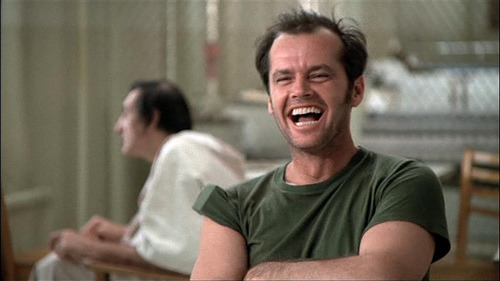
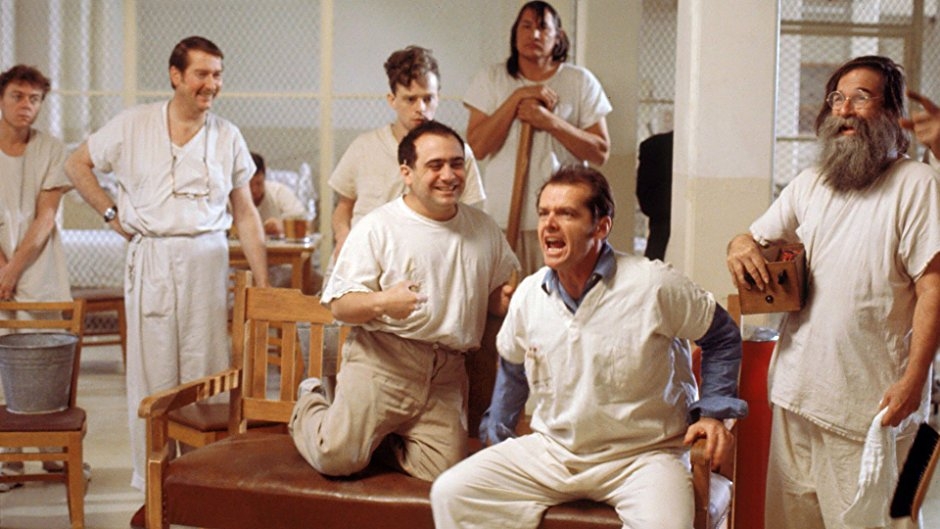
Jack Nicholson is superb as McMurphy in One Flew Over the Cuckoo’s Nest

Director: Milos Forman

Cast: Jack Nicholson (Randle P McMurphy), Louise Fletcher (Nurse Ratched), Will Sampson (“Chief” Bromden), William Redfield (Dale Harding), Brad Dourif (Billy Bibbit), Sydney Lassick (Charlie Cheswick), Christopher Lloyd (Max Taber), Danny DeVito (Martini), Vincent Schiavelli (Bruce Frederickson), Dean Brooks (Dr John Spivey), William Duell (Jim Sefelt), Scatman Crothers (Turkle)

One Flew Over the Cuckoo’s Nest is one of the landmark films of the 1970s, one of those films that’s on everyone’s list for great masterpieces. It lifted all five of the Big Oscars (Picture, Director, Actor, Actress and Screenplay), one of only three to do so. It’s widely loved for its celebration of rebelliousness and individualism, but there is more to the film than that. It’s as interesting for the things it doesn’t explore as much as the things it does.

Randle McMurphy (Jack Nicholson) has himself sent to a mental institution rather than a prison farm, under the belief that serving his time in the institution will be far easier than doing hard labour. However, he finds the ward he is locked into is under the authoritarian control of Nurse Ratched (Louise Fletcher), a passive-aggressive bully with a strict interest in the rules at the cost of all humanity. The inmates are cowed, but McMurphy encourages them to express themselves and seize their freedoms – little realising that his freedom is dependent on being signed off by the doctors, not the length of his original short sentence, and he has made no friends in the hospital authorities – or that Ratched is determined to break his influence over the other patients.

Forman was a perfect choice for directing a film that directly echoes his own iron-curtain upbringing. OFOTCN is a film that celebrates the freedom of the individual – but also recognises that authority and the state always wins out in the end. The hospital ward is cold, oppressive, a white-lined world where Ratched observes and quietly controls everything from her booth, softly issuing directives that carry a quiet menace. The film rotates around clashes between McMurphy wanting to do his own thing and Ratched stridently reinforcing a fixed hospital agenda. At one point Forman’s camera tracks from McMurphy on the basketball court, up to Ratched watching behind a full length window like an imposing Stasi officer. Forman totally understands the struggle of expression and free will in oppressive regimes, and it’s this that has given the film such a rich life – who doesn’t want to land on the side of freedom?

It helps as well that representing freedom we have possibly Jack Nicholson’s finest performance as McMurphy. A roaring, bubbling, manic, burst of nature, an impish anti-authority figure who rips through every scene with intense energy. It’s a marvellous, inspiring performance. And it makes McMurphy exactly the sort of rebel without a cause we would like to be, the guy who can inspire and lead through force of will alone, who refuses to be cowed or crushed. 

Nicholson’s performance however is a perfect mixture of larger-than-life drama and moments of reflection. The film splices in a few conversations between Nicholson and the doctors that, over the course of the film, change more and more from spry defiance and mockery towards a quieter, more despairing resignation as he slowly begins to realise how trapped he is. Not that he wants to show any of that to his fellow inmates, or to Ratched with whom he keenly engages in a battle of wills.

Ratched herself is exactly the sort of cold, rules-bound, inflexible authority figure we are naturally placed to hate. Louise Fletcher is wonderful, with her softly spoken iciness matched with certainty about her moral position. Is she even interested in curing the patients? Her focus seems to be completely on controlling and running the patients’ lives rather than changing the status quo. 

This battle of wills drives the film, but it’s interesting as well for what it tells us about McMurphy. He seems to have no understanding of the fact that, while his fellow inmates are cowed, they are all to some degree mentally ill and certainly all frightened and unpredictable. McMurphy sees them as people who need to be encouraged to seize their own destinies, but these are people who are incapable of really understanding what McMurphy is trying to do or have any interest in it. He shakes up their world, but has little real impact on them in the long term.

It’s not a film that engages in any great understanding of mental illness, but suggests that perhaps McMurphy and Ratched are in their own ways as insane as the people they are fighting over in the asylum. McMurphy is a self-destructive force who pushes for small things with huge passion, but then drifts through the major things. He acts without thinking and doesn’t try to understand the people around him. Ratched meanwhile is so obsessed with controlling her own small universe, she has defined her entire life around her governance of the ward.

The film has a slightly troubling relationship with women – which is not necessarily a criticism, but an observation since the film’s only prominent female character is Ratched and all the inmates are men. The things that Ratched stops the men from doing are the sort of typically “male” activities that McMurphy delights in – gambling, sports, girls – while McMurphy himself is (in what is the only truly dated moment in the film) in the slammer partly for having under-age sex with a girl, which he eagerly describes to his doctor. McMurphy pushes all the inmates to become more like the sort of man he understands men should be, and while it is a freedom of expression, it’s also one that has little place for women in it, other than as sex objects.

But that’s not the real aim of the film, so you can forgive it. McMurphy is not an intellectual or a man on a mission, he’s an unthinking burst of energy that burns up the world around him and demands the freedom to not be told what to do. That’s what gives the film its real emotional impact and why it spoke so much to Vietnam era America, and continues to speak to us today. And of course it’s linked to the fact that the film is a massive tragedy.

Because in the end the forces of oppression do win and McMurphy’s spirit is crushed. Sure McMurphy more than contributes to his own failures – he allows his own to drift away, and his pushing of his own agenda of what he feels men should want dooms poor Billy Babbit (a stuttering slice of timidity played by Brad Dourif). The film has a Pyrrhic victory in his inspiring the “Chief” (William Sampson), a giant native American flying under the radar by pretending to be deaf and dumb, into carrying out McMurphy’s dreams.

But for our hero it’s a bust. Forman’s film is a brilliant celebration of the energy and futility of lords of misrule like McMurphy, with a commanding performance from Jack Nicholson that’s one for the ages. A wonderful piece of ensemble playing in a set that becomes a metaphor for oppressive regimes, it’s remained remarkably undated and a force to be reckoned with on any top ten list.

Fat City (1972)

Stacy Keach and Jeff Bridges excel as boxers failing to live The Dream in Fat City

Director: John Huston

Cast: Stacy Keach (Billy Tully), Jeff Bridges (Ernie Munger), Susan Tyrell (Oma Lee Greer), Candy Clark (Faye), Nicholas Colasanto (Ruben), Art Aragon (Babe), Curtis Cokes (Earl)

The American Dream has an underbelly. For all those dreamers who find fame, fortune and glory in the Land of Free there are thousands who never made it. Thousands who stayed rooted at the bottom of the rung of the ladder and saw their dreams disappear and lives head into turnaround. Fat City – the good life, according to the slang of San Francisco, the crazy goal you’ll never achieve – is all about those left behind by their dreams.

Billy Tully (Stacy Keach) is a former boxer, now down on his luck and now possibly struggling with alcoholism. Ernie Munger (Jeff Bridges) is a young prospect who shows some promise in the ring. Both of them dream of getting into the limelight – but what hope do they have when it’s nearly impossible to turn your life around in smalltown America?

John Huston’s film is unflashily assembled, but carries a fundamental emotional power as it investigates with a simplicity and honesty the difficult dynamics of real life. It’s a film which has no pat answers, no simple solutions and doesn’t offer much in the way of hope. Which is not to say that it is a depressing vision of the world. Just a recognisable one. Because, sure, for most of us there isn’t any real chance of seeing our lives change. 

Huston’s film – brilliantly shot with a 1970’s muddy graininess mixed with flashes of revealing light by Conrad Hall – is wonderfully well observed and beautifully paced and keeps refreshingly loyal to its essentially downbeat vision of life. There is nothing forced in Huston’s well-paced touch and his embracing of the ordinariness of the drama and the lives of the characters. Because for both of them what we see in this film – and it ain’t much – is still clearly the high point of their life. Just getting into the ring and being beat (and only one fight in the film ends with one of our heroes winning – and even then he’s unaware of his win, he’s so punchdrunk) makes them something rather than nothing. These small moments are the best they can hope for.

Because both men have lives of nothingness in front of them. Keach’s Tully is a man whose best years are already behind them, but keeps up a touching air of hope and belief that maybe that could change, even while he drunkenly stumbles from one moment to the next. And maybe he did have something in the past – but he certainly doesn’t have something to come. Keach captures this superbly – like a reliable pro embracing what he feels might be the highlight of his career – investing Tully with a gentleness but also touch of fantasy, a man who can’t quite accept where his life is, but despite a lack of bitterness he’s still a man balancing fantasies. 

Jeff Bridges makes a perfect balance to this amiable failure of a man as Ernie, a young man who may well have more promise than Tully but lacks any sense of personal drive. He’s a friendly but empty shell. While Tully at least goes through spells of wanting success – even if he drifts and falls into alcoholic patches of non-achievement and becomes lost in recollections – Ernie has no desire. He’ll allow himself to be put forward but will do no work at all to push himself forward. He’s a young man with no hurry, a man who seems destined to never achieve anything because he has no desire to do so. It’s a great performance of amiable emptiness from Bridges.

But then you hope that Ernie won’t be heading to the alcoholism that consumes Tully and his romantic interest Orma. Played by an Oscar-nominated Susan Tyrell, Orma is the picture of a failed life, a semi-bloated, rambling alcoholic who oscillates between small insights and far more common drunken ramblings and bitter drunken whining but believes strongly in what she does. Huston’s film places her firmly as much of a drifter through life as Ernie in her way, taking up with Tully while her lover serves prison time – and moving easily and with little impact from one domestic set-up to another. Tyrell and Keach give outstandingly strong performances of drunkenness, never over-playing and totally convincing in their slurred speech, attempts to not appear as drunk as they are and emotional swings from calm to sudden and consuming fury.

But then what is there to look forward to in this life than the next drink? Certainly not the fights. For all the dreams of trainer Ruben (Nicolas Colosanto – very good) to find the next big thing, every fight we see is a tragic and painful affair mostly ending in defeat. Ruben drives carfuls of beaten, ring fodder from place to place, watches them get duffed up and then takes them home all the while dreaming of a title shot. It is dreams shared by Tully – even while we watch his slow, alcoholic fuelled body struggle to get through a few minutes of shadow boxing.

But then that’s the message of Fat City the anti-Rocky – and probably more realistic for it. Huston;s simple touch and pure vision help to make this one of his finest films, his unfussy and naturalistic camera encouraging truthful and powerful performances from his leads. And every small moment is full of it, including a marvellous wordless sequence that sees Tully’s Mexican opponent arrive in town (on a rundown bus), wordlessly check into a motel, piss blood and then head to the ring to be (only just) beaten – a moment of victory so fleeting and small it barely counts (and is only a hiatus on Tully’s return to shambling from bar to bar on the streets). The American Dream is a great thing – but for many people it’s just that: a dream.

The Lonely Passion of Judith Hearne (1987)

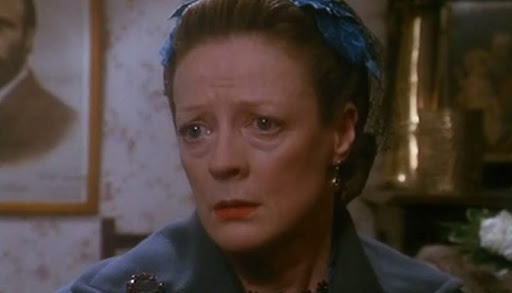
Maggie Smith excels in stately literary drama The Lonely Passion of Judith Hearne

Director: Jack Clayton

Cast: Maggie Smith (Judith Hearne), Bob Hoskins (James Madden), Wendy Hiller (Aunt D’Arcy), Marie Kean (Mrs Rice), Ian McNeice (Bernard Rice), Prunella Scales (Moira O’Neill), Alan Devlin (Father Quigley), Rudi Davies (Mary)

Judith Hearne (Maggie Smith) is a lonely, frustrated Irish spinster who never found her place in the world. Arriving at her new lodgings in Dublin, Judith leaves behind her a whiff of scandal and a slight air of being someone you don’t want in your home. However, while her superior manner may not fool everyone, it’s enough to spark the interest of chancer James Madden (Bob Hoskins) brother of Judith’s lodger Mrs Rice (Marie Kean) – who is not remotely fooled by Judith’s pretence at upper-class gentility. While Judith wonders if romantic love may, after all, finally be round the corner for her with Madden, Madden himself wonders if the starting investment for his next dream is in his grasp.

Jack Clayton’s adaptation of Brian Moore’s novel is a stately passion project. An adaptation that Clayton had worked for years to bring to screen, it’s a quiet and respectful picture that moves with a graceful serenity over its runtime, covering emotional territory but never quite sparking into life. Clayton’s adaptation of the book is precise and perfect in nearly every way, with the film very true to Moore’s style and his ability to capture the domestic tragedy of small-scale, disappointed lives. But it’s not quite a film that hums with inspiration.

What inspiration it has is bound up with Maggie Smith’s superb (BAFTA winning) performance in the lead role as Judith herself. This is surely some of Smith’s finest work on screen, perfectly capturing every beat of this character study. Judith Hearne is a woman who relies on her upper-class background – her airs and manners – to cover up the facts of her poverty and, even more importantly, her chronic alcoholism. Couple this with her self-loathing, her confused attitudes towards God and her (barely consciously aware) mixed feelings for her deceased aunt (Wendy Hiller in imperious form in flashbacks) and she is a woman reeking of disappointment, depression and oppression as much as she does the booze she knocks back.

Smith’s performance progresses throughout the film, from a veneer of assurance to an increasingly poignant and tough to watch collapse into starkly raw emotional disintegration. Desperate in ways she hardly understands for emotional (and physical) content for another, she’s almost touchingly over-enthusiastic when offered the olive branch of friendship of a man, and the self-loathing and loneliness that channel her collapse into brutal alcohol-driven meltdowns show Smith holding nothing back but never once heading over the top. Smith totally understands how to get the balance between quiet tragedy and emotional force, constantly balancing the two expertly. 

It’s her performance that is a triumph of small moments that build over time to carry emotional force, from her careful arrangement of a room to her confused slightly timid eagerness to please when in conversation with Madden. Smith’s superb in the role, never anything less than real her eyes little windows to the depths of sadness in her soul.

It’s a shame that the rest of the film doesn’t quite measure up to her and that, despite the force of her performance, the film never quite manages to capture the overall impact of domestic tragedy that the film needs in order to be something more than just a gracefully filmed package around a superb central performance.

Too many other plot directions end up in cul-de-sacs or never get explored. Madden’s frustrated sexual feelings – and his eventual assault on housemaid Mary (a decent performance by Rudi Davies) are simply never explored any further. Bob Hoskins gets short-changed with a character that doesn’t really go anywhere and whose darker side is demonstrated but then never referenced again. The film gives such force to the damage of Judith’s alcoholism and depression that her struggles with the church never quite gain the force they need. This is despite some sterling work from Alan Devlin as a bullying but empty churchman, not interested in hearing about problems that can’t be solved with doggerel and dogma.

The finest subplots feature Ian McNeice is superb as the bloated wastrel son of the landlady, a spoiled, lazy former student claiming to be working on the next great Irish poem (a work he estimates will take him at least another 5 years), but largely spends his time swanning around the house causing problem and sniping arrogantly at the residents. Marie Kean is also fine as the arch landlady who sees through all deceptions, other than her son’s.

It’s a shame that the film itself – for all the excellence of Clayton’s work – doesn’t quite come together into a really coherent package. What it kind of misses is perhaps the sort of sharp, knowing observation and dry wit that Alan Bennett bought to so many similar small-scale stories of wasted lives in Talking Heads. The film is on a grander scale than those, but somehow carries both less weight and less insight than an average Bennett monologue. Smith is superb – possibly a career best – but the film itself is more something to be admired than remembered.

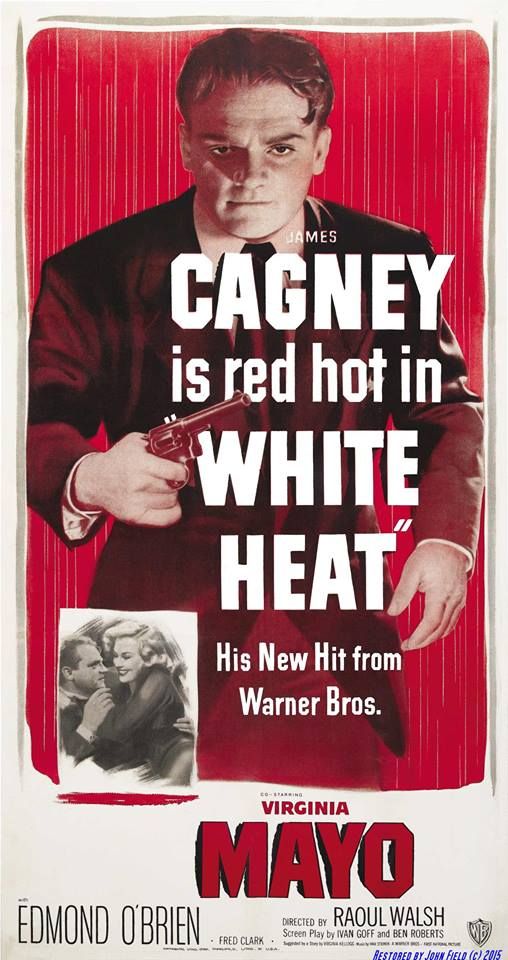
White Heat (1949)

Top of the World Ma! Cagney excels in his final and greatest Gangster role White Heat

Director: Raoul Walsh

Cast: James Cagney (Cody Jarrett), Virginia Mayo (Verna Jarrett), Edmond O’Brien (Hank Fallon/Vic Prado), Margaret Wycherly (Ma Jarrett), Steve Cochan (“Big Ed” Somers), John Archer (Philip Evans), Wally Cassell (“Cotton” Valletti), Fred Clark (Daniel “The Trader” Winston)

After winning an Oscar for Yankee Doodle Dandy, Cagney left Warner Brothers to form his own production company. When that folded, he swallowed his pride and re-entered the Warners’ fold. Money was driving the relationship: and it was the pay cheque that got Cagney to return one last time to the role of a psychotic gangster in White Heat. And if he had to go back, why not make that gangster the most psychotic of the lot? After all who else could make it to “the top of the world”?

Cody Jarrett (James Cagney) is the leader of a gang of criminals, to whom no act of larceny, violence or murder is taboo. A botched train hijack – during which Jarrett shoots two unarmed train drivers – attracts the full attention of the law, but Jarrett dodges justice by having himself sent down for a minor crime that happened at the same time as the train hijack. Not fooled, the Feds send an undercover operative, Hank (Edmond O’Brien), into the prison as Cody’s cellmate “Vic Prado”, tasked with getting the details of the train job and locating the mysterious fixer who set up the job. But such schemes didn’t take into account Jarrett’s psychological disturbance – powered above all by his obsessive, overwhelming love for his mother (Margaret Wycherly), the one dominant influence over his life.

Raoul Walsh’s film is a brutally efficient gangster flick which may be a little too long (the mechanisms of tracing and tracking a car are covered in far too great a depth…), but ticks all the boxes of the genre with exceptional skill and dexterity. It’s shoot-from-the-hip (literally) melodrama, and has all the internal logic of a schoolground game of cops and robbers, but Walsh’s direction is pin-point perfect, and the film is based around a series of stunning and effective set-pieces and crammed with a sort of deep (even disturbing) psychological insight that puts it miles ahead of many of films of the genre. Walsh also throws in some of the finest stylistic touches of film noir, with Virginia Mayo’s femme fatale, darkened frames, dubious morals among even our heroes (one of whom is a practised deceiver and liar) and a whirlwind monster at the centre.

But the film soars and flies because of Cagney, and the no-holds barred sharpness of Jarrett. The film revolves above all around the deep emotional emptiness and need in Jarrett, which sees him lean on O’Brien’s Falon (“like my kid brother!”) and, most famously, fixate like a toddler on his mother. Freud would have had a field day with Jarrett’s obsessive love for his mother, with Cagney turning him into the little boy lost. Consumed with headaches, he literally climbs into her lap so she can comfort him. The slightest criticism of her leads to instant reaction (not least knocking his wife off her chair – how can the poor woman compete with this beatified mother figure?)

This culminates in one of the film’s most famous sequences, as Jarrett digests in prison the news that his mother has died. Sitting in a crowded dining room, he passes word down to a new inmate for an update on his mother. Slowly the question is passed down the line of prisoners – and with trepidation the news of her death is passed back. And here is the Cagney magic. He seems too stunned at first to take it in then a series of low moans explodes into a titanic screaming fit, matched only by the violence he takes out on all who stand in his way. Walsh and Cagney kept the response secret from the entire room of 300 extras, all of whom seem as stunned as us by Jarrett’s total lack of control, his complete consumption in grief.

Cagney’s performance is just about perfect, a simmering mummy’s boy who is also a charismatic leader of men. A dangerous psycho who seems aware that he is not quite normal. A lonely man desperate for love. And Cagney has so many beautiful touches that could only be him – the quip as he plugs with bullets a car boot with a luckless gang member in it, the sly kick away at Virginia Mayo, that screaming sequence. It’s a performance of complete power and charisma, the gangster psychoanalysed and reduced to his bare essentials for a personality barely functional and obsessed with his mother.

Margaret Wycherly is similarly excellent as that mother, as sly and self-confident as her son and clearly as accomplished at leading a gang as him (I love the smug half smile she gives herself after evading the FBI tail she picks up). Edmond O’Brien does sterling work in the “straight man” role of the undercover cop, walking a line between judging and even perhaps sorta liking Jarrett a bit (even if he does get saddled with the mandatory “that’s the moral of the story” final line). Virginia Mayo is a wonderful mix of sex appeal and needling cheapness as Jarrett’s two-faced wife.

The film culminates in one of the most famous endings of all time – one you’ll know even if you haven’t seen the film – as the law catches up with Jarrett at last in a shoot-out at a gas plant. Finally driven mad by betrayal and abandonment – although lord Cagney’s performance makes clear that only a tenuous grip on sanity has been present in Jarrett from the start, fractured beyond repair by the loss of his mother – Jarrett insanely shoots at the police from atop a burning gas plant, before immolating himself (and most of the factory) with the cry “Made it Ma! Top of the world!”. As Jarrett heads down to a firey hell, so Cagney signed off on the gangster flick with perhaps the most dangerous, disturbed and also intriguing gangster on film. It’s such a mighty performance that the Hays-Code mandated final line of tutting disapproval at the criminal life from O’Brien feels even more forced and unnecessary than ever.

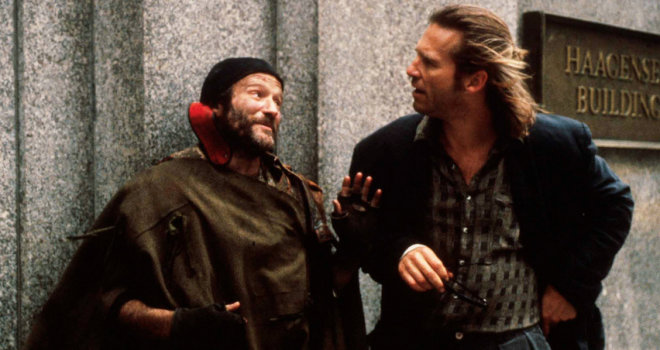
The Fisher King (1991)

Robin Williams and Jeff Bridges go on a quest in Terry Gilliam’s decent but overlong The Fisher King

Director: Terry Gilliam

Cast: Robin Williams (Parry), Jeff Bridges (Jack Lucas), Mercedes Ruehl (Anne Napolitano), Amanda Plummer (Lydia Sinclair), Michael Jeter (Homeless Cabaret Singer), David Hyde Pierce (Lou Rosen), Lara Harris (Sondra), Harry Shearer (Sitcom actor), John de Lancie (TV Executive), Tom Waits (Veteran)

In 1991 Terry Gilliam was seriously worried he might be unemployable. After the famous feud with his producers over the editing of Brazil, his follow-up The Adventures of Baron Munchausen had flown over budget and bombed at the box-office. For Hollywood Gilliam was the worst kind of maverick – trouble with no record of financial success to give him the licence to do what he wanted. So he was thrilled to be offered the chance to direct The Fisher King, his first ever “for hire” job, a sentimental but surreal romantic buddy movie. It’s financial and critical success almost certainly saved his career.

Jack Lucas (Jeff Bridges) is a New York radio shock jock, whose show accidentally provokes a lonely and confused man to massacre the customers at a late night bar. Three years later and Jack’s career is over and he is working as a co-owner of a video rental star (and live-in lover) with Anne Napolitano (Mercedes Ruehl). One day – drunken and suicidal – he is saved from a gang of young thugs by eccentric homeless man Parry (Robin Williams). Jack discovers three years ago that Parry was a respected professor of English literature, whose life fell apart after his wife was killed in the same bar massacre that ruined Jack’s career. The two men are drawn together – but can they save each other?

The film is based on the myth of the Fisher King, the king charged with finding the Holy Grail but could not find it for years – only for a fool to present it to the king full of water to drink, revealing it was there in the King’s possession the whole time. The fool helps because he is “purer” than those more worldly around him. The idea that Richard LaGravenese’s screenplay is leaning on is that these two characters – Jack and Parry – alternate between them the roles of Fisher King and Fool, both slowly doing things for each other that change their personalities and allow them to adjust back into the world and become comfortable with the people they are.

Reading that it should become clear that this is a sentimental film – and it certainly is. It’s also hellishly overlong for such a slight story of tragedy leading to overcoming personal crisis. We know watching the film from the start that Jack Lucas is a bad guy – and Gilliam shoots his opening scenes of Radio presenting with great skill, using high angles, extreme close-ups and shots that prevent us getting any real sight of Jack, making him as impersonal and contemptable as possible in his shallowness, pride and thoughtless cruelty. It’s not a mystery to expect that we are due to watch a triumph of the human spirit film, in which Jack becomes a better man. The film takes a very long time making this simplistic point.

The catalyst is Robin Williams, in a role tailor made for him as a hyper-active, manic personality mixed with tragedy and depression. To be honest Williams is frequently over indulged in the role – despite his Oscar nomination – heading over the top too often, and often over-egging the pudding both in Parry’s energetic enthusiasm and also in his moments of tragic depression. Parry is given a romantic sub plot with Amanda Plummer’s nervous office worker (a character who is little more than a collection of quirks than a personality, and it’s a shame it’s led to Plummer being typecast in such eccentric roles) that is almost insultingly slight and one-sided (he comes across a bit like a stalker) and lacks any of the charm needed for the story to work.

Parry is used to tie the film into further Arthurian flourishes with his obsessions with the legend. Parry visualises a sinister Red Knight – a mental expression of his grief and horror at his wife’s death, which takes the form of the appearance of his wife’s blood splattered face – which chases him through the city. Parry is also obsessed with the discovery of the Holy Grail, which he claims can be found in a millionaire’s faux medieval castle in the centre of Manhattan. This Arthurian stuff is often rather crow-barred in, but holds more interest than traditional plot-lines of people rediscovering their humanity and capability of bonding with others.

Jeff Bridges actually takes on the far harder role as Jack Lucas, a character who has to go on a firm development from start to finish. While Parry is a deliberately eccentric figure, Jack is the one who must journey from arrogance and pride to selflessness and humanity. Bridges does it very well, with a neat line in under playing and an ability to suggest the warmth, shame and self-disgust that Jack works hard to cover up. He’s also blessed to share scenes with Mercedes Ruehl who is outstanding (and Oscar winning) as his girlfriend, the most humane, engaging and real character in the film, a woman who seems at first blowsy and cheap (Jack clearly believes she is beneath him) but reveals more and more depths and capacity for honesty, love and generosity.

Gilliam has a sharp eye for the huge gap between wealth in poverty in 90’s New York, and how the two worlds are geographically only a width of a piece of paper, despite being worlds apart. His direction uses many of his flourishes with great effect. Fish eyed lens POV shots, low angles, stylistic dream sequences, a dream sequence where Grand Central station is full of dancing travellers like a mighty ballroom – many of the sort of things you see in his films are here. To be honest, I found some of the flourishes a bit overwhelming in a story that is so slight and so grounded in just four people’s interactions and quests for salvations. But it works, and Gilliam gets some moments of romantic and platonic love that really work. But it’s still a slight film that goes on far too long, and it eventually loses the viewer in its time-consuming journey towards expected heart-warming moments.

Joker (2019)

Joaquin Phoenix goes all out as Joker

Director: Todd Phillips

Cast: Joaquin Phoenix (Arthur Fleck), Robert DeNiro (Murray Franklin), Zazie Beetz (Sophie Dumond), Frances Conroy (Penny Fleck), Brett Cullen (Thomas Wayne), Glenn Fleshler (Randall), Leigh Gill (Gary), Bill Camp (Detective Garrity), Shea Whigham (Detective Burke), Douglas Hodge (Alfred Pennyworth), Marc Maron (Gene Uffland)

The mystic of Batman’s nemesis the Joker is his unpredictability, his other-worldly insanity laced with malicious viciousness and an anarchic sense of fun. There is a reason such an electric character has been the go-to for so many Batman related films – and why people are drawn time and time again to re-exploring him. With the DC Universe struggling, it makes sense that a stand-alone film around the most-popular, most-famous comic book villain of all time would be attractive. It’s been a massive success, but is it truly a good movie? I’m not so sure.

Arthur Fleck (Joaquin Phoenix) is a struggling professional clown in 1981 Gotham City, living with his invalid mother Penny Fleck (Frances Conroy). A run-down, dirty and no-good town with astronomical divides between the haves and the have nots, Fleck is a guy who can’t make the world work for him. Dreaming of a being a professional stand up and appearing on the popular nightly talk show hosted by Murray Franklin (Robert DeNiro), Fleck is actually a maladjusted, bitter outsider and fantasist who struggles to adjust to the real world. Will the idea of taking brutal vengeance on those around him, be eventually to tempting to resist? Hey: why so serious world?

Joker is a grim, trying and rather uninvolving film that even contained within a fairly tight two hours still feels like it drags on way too long. It perhaps feels like this because it signposts all its major narrative developments far too far in advance, meaning very little if anything surprises you. Fleck is essentially a time bomb waiting to go off, and everyone knows by the film’s final act he will do. The long wait to get there doesn’t really give us anything fresh or interesting to think about, other than presenting a comic book world mixed with the grimy atmosphere of classic Scorsese films. It’s a film made by people who love classic urban Hollywood films – but who seem unable to bring anything really fresh to a series of ideas better film makers have already had.

Instead it’s a film that relies heavily – in fact is completely dependent on – its inspirations, torn from comic books, other films and news bulletins. Your understanding of Fleck’s character arc is dependent on having some sort of visual image in your head for the Joker. Your appreciation of the film’s style and tone relies on you having seen Taxi Driver and King of Comedy. Your reaction to the sudden growth of flash-mob violence in Gotham depends on you knowing about these attitudes in the real world. The film largely fails to develop any of these ideas organically within itself or its own narrative, but instead throws them to the screen knowing that we will do the work of making them stick on our own with our past associations.

As the film doesn’t really try and build its own ideas, or really try to take ideas from anywhere else to really original places (apart from a few Joker developments which I’ll talk about later), for people who are familiar with its themes and inspirations, it just manages to make for a rather dull watch. The Joker character has been done better elsewhere, King of Comedy and Taxi Driver are films so full of depth and interest around maladjusted losers, stalkers and fantasists yearning for recognition, that this film’s showy coverage of the same ground come across as deep as puddle. Its political positions are so simple, basic and unchallenging that they might as well have come from a school essay. 

Both the film’s greatest strength, and its greatest weakness, is Phoenix’s lead performance. There is no question that this is a powerhouse performance, fully committed physically and emotionally. Phoenix has explored every inch of the psychological make-up of a misfit who believes the world owes him something and whose vulnerability eventually becomes twisted into a psychotic rage. As a portrait of the making of a school shooter (say) it’s a fascinatingly successful performance. But it’s also overwhelming. It’s so quirky, so twitchy, so detailed, so mannered it finally becomes too much. 

Finally, and this is perhaps intentional, it doesn’t feel like the Joker. When I think of that character, I think of one defined by joy. A twisted sense of joy, a psychotic killer’s joy, but joy nevertheless. Joy is something that never enters Phoenix’s interpretation for a second. This makes sense for the first three quarters of the film, but when the final push of the narrative takes us towards Joker territory, Phoenix’s character is still by-and-large the same tearful, desperate, tragic figure he was before. That doubling down on villainy, that “just let the world burn” anarchism is something completely missing from the performance. It makes the part something that is all impact but no real depth, no real development. It’s a showy performance of tricks and manners, impressive in its commitment but in the end empty and unaffecting.

It also means the film focuses almost completely on Fleck, meaning it has not time to develop its themes of urban clashes and rich vs poor narrative. Instead it just throws these ideas straight in to the film with no real introduction or context and trusts that we will do the work ourselves. It does the same with Fleck’s fantasies and obsessions. It’s no great surprise that all these dreams fail to pan out, and it’s no great surprise that killing ensues. All the victims of Fleck’s rage are completely predictable from the first few minutes, but Phillips film feels like it takes a very long time to get there. 

Joker does at least try to do something different, but Phillips film is more a scrap book of ideas and themes explored better elsewhere. Phoenix tries too hard and the film itself ends up telling a not very compelling story. In the end the character of the Joker is fascinating because the character is unknowable, unpredictable, a rootless force of nature. Giving him a back story weakens the character and makes him (and the film) less and less successful. And the general get-out-of-jail card the film holds (and plays) that all or some of this might just be happening in Fleck’s fractured mind isn’t clever, it’s just irritating.

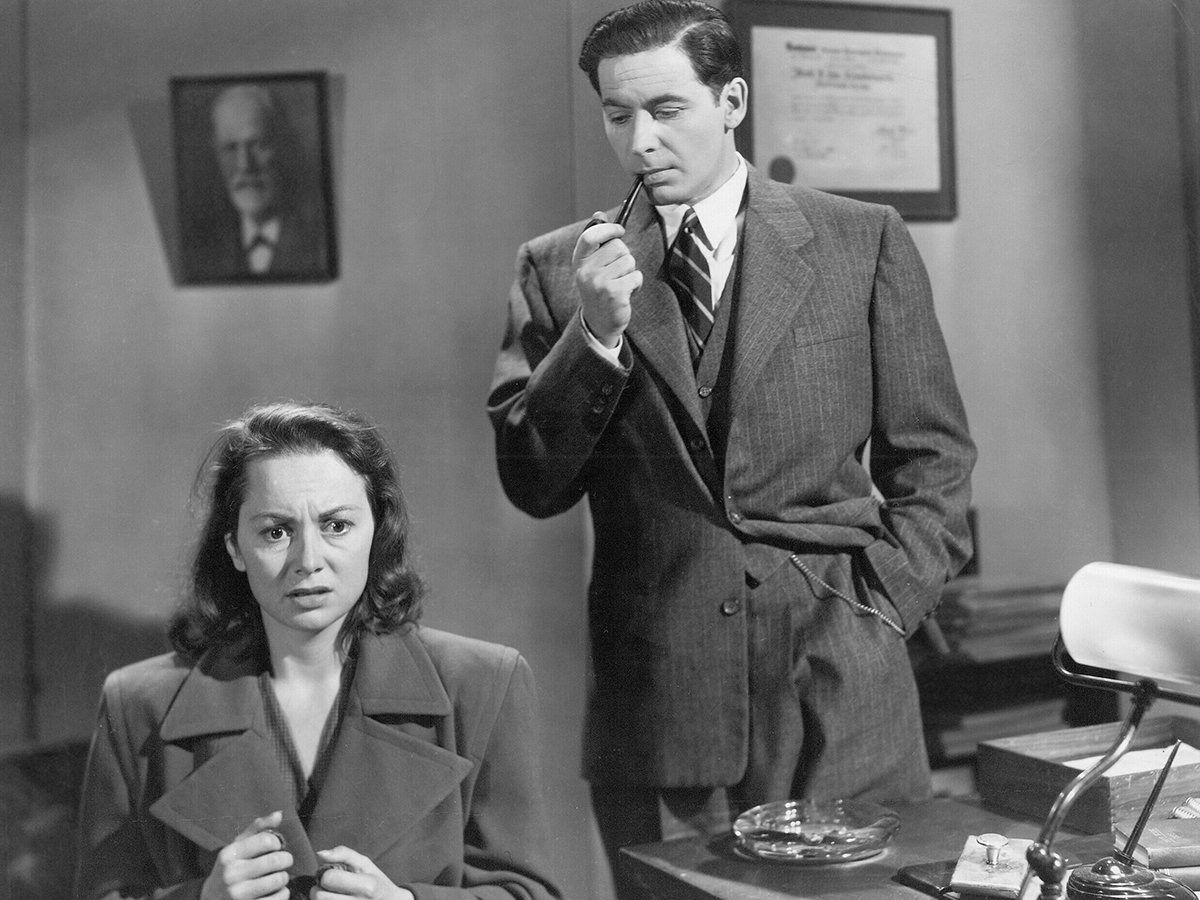
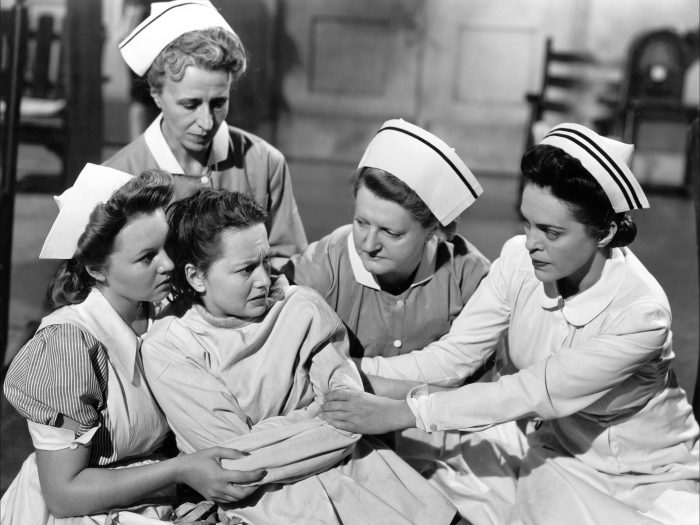
The Snake Pit (1948)

Olivia de Havilland struggles with her sanity in the engaging The Snake Pit

Director: Anatole Litvak

Cast: Olivia de Havilland (Virginia Stuart Cunningham), Mark Stevens (Robert Cunningham), Leo Genn (Dr Mark van Kensdelaerik “Dr. Kik”), Celeste Holm (Grace), Glenn Langan (Dr Terry), Helen Craig (Nurse Davis), Leif Erickson (Gordon), Beulah Bondi (Mrs Greer), Lee Patrick (Asylum inmate), Betsy Blair (Hester), Howard Freeman (Dr Curtis)

Virginia Stuart Cunningham (Olivia de Havilland) wakes up on a park bench with no idea where she is – and only the vaguest idea of who she is – and reckons she could be anywhere from a zoo to a prison. She’s actually in an asylum – or Juniper Hill State Hospital – and has been for some time, struggling with a schizophrenia and anxiety-related condition and with no idea of when – or if – she will ever leave. She is treated by the kindly, professorial “Dr Kik” (Leo Genn) and generally fails to recognise her husband Robert (Mark Stevens).

The Snake Pit is a very earnest but dramatically engaging and even quite moving story of one woman’s struggle to try and preserve her mental health, despite being stuck in a system that is a complete lottery with some patients lucky enough to be cared for and others dumped and forgotten. Litvak’s film is a passionate expose on the conditions that lack of funding and public interest had allowed to prosper in mental institutions in America, with parts of the facility little better than a Dickensian work-house, others like something out of Dante’s Inferno. It was a passion project for Anatole Litvak, who bought the rights to the book personally and pushed the studio to fund the creation of the film.

The story is centred around Virginia’s experiences of the asylum as she moves from ward to ward – low numbered wards being reserved for those considered likely to leave, with the ward number increasing as the prospect of the patient ever getting out of the asylum (or ever getting any focus from the doctors) decreasing. The staff are harassed, overworked, underpaid and frequently struggle with being heavily outnumbered by the patients, having only a few minutes a day for each one. They are also a mixed bag – there seems to be very little in the way of training – with some dedicated and caring, others seeing the patients as at best irritants and at worst little more than objects. Virginia’s real problems start when she gets on the wrong side of Ward 1 nurse Davis (Helen Craig), an officious, domineering bully who treats her patients like pupils in a finishing school and punishes ruthlessly any deviation from her rules.

Litvak’s film exposes the conditions here, but apart from the odd individual largely avoids attacks on the staff. Instead it seems to be the general air of indifference and disregard that society has for those who end up in these places that seems to be taking the brunt of the blame. Litvak’s direction is impeccable as he uses a combination of interesting angles, sympathetic close-ups and clever transitions and fades (which serve as a neat contrast for Virginia’s own struggles to understand where and when she is). In one particular tour-de-force moment, Litvak’s camera pulls up-and-away from Virginia in the middle of the hellish Ward 33 (the Snake Pit of the title), pulling away to make the ward indeed appear it is at the bottom of a pit with the patients a mass of figures within. 

Litvak’s film also benefits hugely from the simply superb performance by Olivia de Havilland. De Havilland brings the role such commitment and such emotional performance, that she is largely to thank for making the story (and not just the setting) as engrossing as it is. De Havilland is gentle, vulnerable, scared but mixes it with touches of determination and also carries with her a sensitivity that makes her as much a caring and gentle figure as it does a victim. She appears in almost every scene and dominates the film, handling the moments of quiet panic as well as she does the moments of immense distress. Her increasingly sorry state as she progresses down through the wards is heart-rendering, and her confusion and fear makes her someone we care for deeply, even while her concern and care for her fellow inmates – particularly a violent patient, played by Betsy Blair, who she takes under her wing and helps recover some of her equilibrium – makes her admirable and less of a victim.

Though lord knows she suffers enough, from claustrophobic locked-in baths (her screaming fit as she fears drowning being all-but-ignored by her dismissive nurses who have heard it all before) to being strapped into a straitjacket for god knows how long (after being provoked into an angry outburst by Nurse Davis). Around this she also undergoes bullying medical examinations from doctor’s unfamiliar with her case to watching her fellow inmates being mocked and laughed at my visitors. That’s not even to begin to mention the ECT treatment she undergoes at the start of the film (“to bring her back” from the edge of disappearing into a fantasy world), a series of detailed and observed procedures which are clinically sinister. 

Despite its many strengths, the film is dated in many ways. The original book avoided all reasons for Virginia’s illness. The film works overtime to give a “reason” for why she is, and of course this is rooted above all to issues related to Virginia’s failure to relax into the “proper” role for a woman in this man’s world. Her conditions are clumsily linked back to a troubled relationship with her mother and father, that led to a lack of development of maternal feelings. Guilt over a failed engagement has made her uncomfortable with marriage and nervous of men. Many of these revelations come out through a series of slightly clichéd therapy sessions that, for all the skill of Leo Genn’s performance as the doctor, carry the “and now we know all the answers” certainties of film psychiatry. 

Attitudes like this date The Snake Pit – so what if Virginia perhaps isn’t wild about marriage and isn’t sure if she wants children – and the film works overtime to suggest what will make her better above all is settling down into the sort of conventional life represented by her dull-as-ditch-water husband Robert, flatly played by Mark Stevens. While the film shows that healing like this takes time – and a lot of it – it also can’t imagine a world where a woman might find a life outside of the domestic norm healthier for them. But the film remains an emotional and moving one – moments like the one near the end where the patients listen enraptured, with enchanted faces, to a singer singing about home carry real emotional force – and it has a simply superb performance from de Havilland. Litvak’s film maybe slightly dated, but it’s still an impressive piece of work.

Silver Linings Playbook (2012)

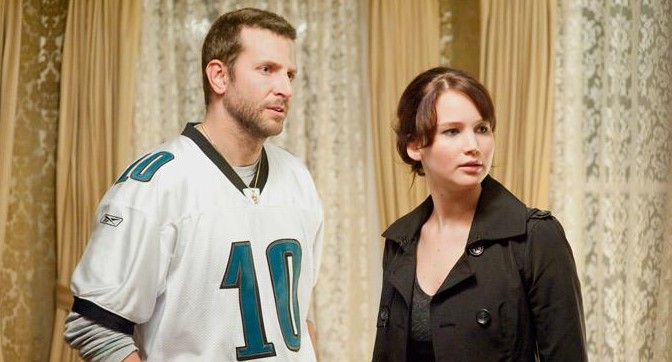
Bradley Cooper and Jennifer Lawrence in an unusual love story Silver Linings Playbook

Director: David O. Russell

Cast: Bradley Cooper (Pat Solitano Jnr), Jennifer Lawrence (Tiffany Maxwell), Robert De Niro (Pat Solitano Snr), Jacki Weaver (Dolores Solitano), Anupam Kher (Dr Cliff Patel), Chris Tucker (Danny McDaniels), Julia Stiles (Veronica), Shea Whigham (Jake Solitano), John Ortiz (Ronnie)

David O. Russell is a director it’s easier to admire than fall in love with. I can see why actors come back to work with him time and again – he’s clearly an actors’ director who crafts stories that give them chances to shine. But his films often have an archness about them, while I find too many of them settle for a sort of middle-of-the-road quirky cool. I’ve never really, truly, loved any of them – even if I have enjoyed them while watching them. The closest I think I’ve got is Silver Linings Playbook.

Pat Solitano (Bradley Cooper) is released from psychiatric hospital, after being confined for assaulting his ex-wife’s lover, into the care of his parents Pat Snr (Robert De Niro), unemployed now making a living as an underground bookmaker, and Dolores (Jacki Weaver). Suffering from a host of compulsions connected to his bipolar disorder, Pat is fixated on winning back his wife. To do so, he enlists the help of Tiffany (Jennifer Lawrence), the widow of a policeman who died in a road traffic accident, who has her own borderline personality disorder and has been dealing with her grief through a parade of casual sexual encounters. Together they enter a dance competition – Tiffany because she always wanted to, Pat because Tiffany has offered to take Pat’s letters to his wife if he says yes and because Pat wants to prove to his wife that he has changed. But is there more than mutual convenience between the two?

Silver Linings Playbook is an unusual romance, that also explores themes of mental health and compulsions and how thin the lines can be between what we consider healthy and not healthy. When does obsession tip over into something that should be treated? Pat is the sort of guy who wakes his parents up to furiously denounce the Hemingway book he has just finished reading in one sitting (a scene played exuberantly for laughs – including Pat smashing a window by throwing the book out of it) but it quickly tips into danger when in a similar mania he awakens the entire neighbourhood at 3am tearing the house apart for his wedding video, accidentally hits his mother, and ends in a tear filled scuffle with his dad. Similarly, Tiffany’s tendencies towards aggression and self-destruction frequently put her in situations both funny and dreadfully damaging.

But just as close to this, we have Pat Snr’s addiction not only to gambling, but also to a raft of superstitions designed to better his chances of winning (and which dominate large parts of his life). Dolores seems obsessed with maintaining peace and order in the family. Pat’s brother has an almost savant tendency to speak his mind, causing more harm than good. Every character in this seems to have their own psychological hang-ups, with resulting problems.

But the film marries this up with an actually quite sweet romantic story between two damaged souls, both very well played by Cooper and Lawrence. This was the film where Cooper repositioned himself as a major actor of note. His performance here is a perfect mixture of charm, pain, confusion, frustration, insight and self-destructive monomania. He’s both funny and deeply moving, sweet and also slappable, gentle but with a capacity for unpredictability. He’s a terrific performance, deeply affecting. It also helps he has fabulous chemistry with an Oscar-winning Jennifer Lawrence. Lawrence’s Tiffany is a vulnerable soul, desperate to appear as tough and impossible to harm as possible and not caring about any of the collateral damage. She’s as brittle as she seems rigid, and as desperate for affection as she pretends to be uncaring about it.

The film throws these two together with an obvious spark from the start, and brilliantly uses their preparation for a dancing contest to show them growing closer together physically and emotionally, as well as adding a purpose to their lives and giving them a common goal to work towards. There is a rather nice gentleness, amongst all the chaos of this film, that something as simple as taking up a new hobby can help to ground two people.

The film builds the romance gently, carefully showing it developing organically and leaving us to guess at what point the bond between these two enrichens and deepens from an instant connection to something more profound. It’s sure got a lot to overcome, with Pat’s obsessive focus on his wife and Tiffany’s compulsion for meaningless sex and her own desire to destroy promising relationships (she almost immediately alienates the surprisingly gentlemanly Pat with an offer of casual sex on their first meeting). With a gentle slow-burn, the film builds towards something that ends up being rather moving.

Russell’s adaptation of the original novel is well-structured and entertaining and his unfussy, stylish direction brilliantly creates an enjoyable mode. De Niro (in what many people called a joyous return to form) and Weaver are both very good as the parents (both were Oscar nominated – this is one of the few films to be nominated in each acting category) and there is hardly a weak beat in the cast. After several quirky, indie-cool, rather distant films, this is possibly the most fun and the most heart-warming Russell has ever been. It’s a career high. Heck even Chris Tucker is really good. And I’d never thought I’d say that.

Blue Jasmine (2013)

Cate Blanchett dominates the screen in Blue Jasmine

Director: Woody Allen

Cast: Cate Blanchett (Jasmine Francis), Sally Hawkins (Ginger), Alec Baldwin (Hal Francis), Peter Sarsgaard (Dwight Westlake), Louis CK (Al Munsinger), Andrew Dice Clay (Augie), Bobby Cannavale (Chili), Michael Stuhlbarg (Dr Flicker), Aldren Ehrenreich (Danny Francis)

Every so often an actor intersects with a director and, such is the actor’s brilliance, they seem to take the film by the scruff of the neck and almost carry the director along to success. Such is the case with Blue Jasmine, a film so seized upon, so wonderfully played and brilliantly observed by a truly phenomenal (she won every award going) Cate Blanchett, you feel Woody Allen just let the camera record her work and carefully built the film around her.

Allen’s film, easily one of his best of his troubled later years, is a modernised remix of Streetcar Named Desire. After a Ponzi scheme scandal leads to her husband Hal’s (Alec Baldwin) arrest and suicide, Jasmine (Cate Blanchett) finds herself landing in the poor end of San Francisco and sharing a house with her sister Ginger (Sally Hawkins). Ginger’s marriage to Augie (Andrew Dice Clay) collapsed after Hal’s dirty dealings destroyed their lottery win landfall. Jasmine, teetering on the edge of a nervous breakdown, living half in the present and half in an imagined version of her own past, soon clashes with Ginger’s new boyfriend Chili (Bobby Cannavale) and eventually finds hope for a second chance with diplomat Dwight (Peter Sarsgaard) who is oblivious to her background.

The parallels between Blue Jasmine and Streetcar should be pretty clear to anyone reading that summary, and Allen draws some neat modernisation parallels (and thankfully, and wisely, drops the rape plotline that ends that play) between the two. Placing Blanche/Jasmine as the trophy wife of a corrupt businessman, who has shut her eyes to his dealings and let her own intellect drain away in shallow frippery, works really well. Not least dramatizing very well the cultural shift from this extreme wealth (detailed in a series of cleverly interwoven flashbacks) to the relative poverty of normal life.

But the film really works from the super-intelligent, hyper-brilliant, eye-catching wonderfulness of Cate Blanchett in the lead role. This is one of those performances for the ages, a tour-de-force of fragility, self-pity, self-deception, hostility, undirected anger, desperation and pain that dominates and shapes the entire movie. Blanchett is particularly effective because she never, ever overplays the role, but let’s these complex, contradictory emotions play constantly behind her eyes and slowly seem to dribble out until they dominate her entire body. Several times, Allen plants the camera and allows us to simply watch Blanchett go through various stages of mental collapse in front of our very eyes, with this amazing actress able to seemingly fall apart in slow motion in front of us.

Jasmine is a complex and fascinating character, in some ways hugely unsympathetic. She’s a massive snob, she certainly feels the world owes her something (she flies into San Francisco first class complaining she has had to sell everything just to make ends meet, while dragging Louis Vuitton luggage behind her), she lies when she needs to and treats everyone around her with a slight air of condescension. But she’s also  incredibly vulnerable, and carrying a great deal of guilt and pain, as well as only barely able to deal not only with the loss of her privileged lifestyle, but also her growing (but denied) realisation that the price of the lifestyle wasn’t worth the having it. 

The film throws her into a series of contexts that show her at her best and worst, as victim and as fantasist. Getting a job at a dentist’s reception desk – a job she seems to only barely have the patience or aptitude for – she is forced to see off the unwelcome advances of her creepy boss (played with a passive aggressive sleaziness by Michael Stuhlbarg) with horror. Later though, she wilfully deceives Dwight (a fine performance of assured arrogance by Peter Sarsgaard) about her background and character. She is partly right in her assessment of her sister Ginger having a very low opinion of herself, so only pairing herself with men who treat her badly; but Chili is also right about her having no regard or time for her sister when she was wealthy.

The use of flashbacks throughout the film works very well to show us Jasmine before and after her economic crash. What’s fascinating is that her fragility is an ever-present, kept suppressed under a shower of gifts, but quickly coming to the fore when Hal’s (has there been a better role for Baldwin than this jovial, greedy cheat?) serial infidelity is bought to her attention. It also serves to remind us to keep Jasmine at a certain distance, her own evaluations of what her past life was like frequently not squaring with the version we see.

All of this hinges on Blanchett’s brilliant work, but she’s not alone in delivering a fine performance. As her blousy sister, moving like a weathervane from person to person, changing her opinions quickly depending on her recent experiences, Sally Hawkins is possibly at her best here as well. Andrew Dice Clay is excellent as an honest Joe who hovers over the film like an object of destiny. Bobby Cannavale does some very good work as a feckless but sort-of honest Stanley Kowalski.

Allen’s direction is calm and almost in awe of Blanchett, and that’s fair enough because whatever you look at, it comes back to her striking genius in the film. Blue Jasmine may remove some of the depth that Blanche has (with her life of pain and guilt in the play’s backstory) but it substitutes that with a gripping exploration of a long-running mental collapse that is so movingly and superbly brought to life by Blanchett you can’t help but be engrossed by it.

Lilith (1964)

Jean Seberg lures Warren Beatty and Peter Fonda into a psychologically dangerous web in Lilith

Director: Robert Rossen

Cast: Warren Beatty (Vincent Bruce), Jean Seberg (Lilith Arthur), Peter Fonda (Stephen Evshevsky), Kim Hunter (Dr Bea Brice), Anne Meacham (Mrs Meaghan), Jessica Walter (Laura), Gene Hackman (Norman), James Patterson (De Lavrier), Robert Reilly (Bob Clayfield)

Movies have long had a fascination with mental illness – in particular the impact of mental illness on women. Lilith is an intriguing, elliptical, somewhat cold but intriguing film that looks at the impact isolation, loneliness and seclusion can have on people and how these damaged psyches can sprawl out and cause further pain and suffering for others. However, it’s also a difficult, unclear and occasionally hard to like film, that deliberately clouds so many of its points in a veil of doubt and uncertainty that it’s difficult to really embrace it.

Returning from an undisclosed war (possibly Korea), Vincent Bruce (Warren Beatty), a lonely, slightly troubled young man, drifts into a job as a counsellor at a private mental hospital, under the supervision of Dr Brice (Kim Hunter). Bruce is empathetic and keen to understand and help the patients, but he finds himself slowly drawn towards Lilith Arthur (Jean Seberg), a sensual and seductive patient at the institute. Encouraged to spend more time with Lilith – as only Vincent seems able to draw her out of a fantasy world to engage with the real one – he increasingly finds himself infatuated with her, increasingly bending any personal or professional ethics to fuel his emotional and sexual need for her.

Just in case you are in any doubt from reading that, it’s pretty clear from early on in the film that the real person in need of help is Vincent. Played with a methody introspection and brooding insecurity by Beatty (he impassively and wordlessly drifts through several scenes or merely watches, and only rarely shows any emotional engagement), Vincent is frequently framed by Rossen alone, lost in the centre and sides of frames, or walking seemingly aimlessly forward. The camera often drifts towards him, if only to stress his lack of real engagement with the things he is seeing in front of him. His obsessive qualities are there from the very start, with his fixations switching between his mother, a former girlfriend (played with a flirtatious seductiveness by Jessica Walter) and finally settling, overwhelmingly, on Lilith whom he follows with the glazed eyes of a potential killer. Beatty struggled with the part – and I can see why, as our central character is such a distant cipher that he becomes someone very hard for the audience to invest any interest in.

Lilith herself is an intriguing if, it seems, unknowable character – almost impossible to tell if she is a truly destructive force or someone who simply behaves as she feels in the moment with no understanding of the impact her actions have. She is frequently callous and cruel, and then will revert to sadness, vulnerability and insecurity. She looks for love – or at least affection and loyalty – at every turn, but then also seems unable to understand any personal relationship except through the filter of sex. Starting the film placing an erotic spell around sensitive fellow patient Steve (Peter Fonda, vulnerable and rather sweet) she quickly switches all her efforts to wrapping Vincent in a web of enchantment (as the film rather clumsily stresses to us in a scene where a doctor explicitly compares her to a spider).

Lilith is increasingly seen as an unsettling, indiscriminate figure. No sooner does Vincent become her lover, than she begins flaunting a sexual relationship she is having with another female patient. (Lesbianism was quite radical for a film at the time). Even more surprisingly the patient is a staid, rather imperious middle-aged woman (played imposingly by Anne Meacham), and the relationship seems to be partly conducted to get a rise (of one sort or another) out of Vincent. Earlier, Lilith flirts disturbingly and erotically with a very young child (who seems disturbed) – although the viewer is perhaps even more disturbed by Vincent’s blank watching of the whole scene. At every point we are reminded of Lilith’s erotic allure – and the framing of the film, and its beautiful photography by Eugene Schufftan helps to create this mystic image. Lilith is often shown behind grills and bars earlier on, before she emerges into the outside world and one enchanting image sees her kissing her reflection in a lake, the very act reducing the reflection to shimmering ripples on the surface: can anyone know her?

The part leans on being borderline sexist, the idea of the enchanting, liberated woman as somehow being a dangerous (almost evil) threat to the safety and mental security of the men around her, deliberately endangering the decent world with her sexual openness. It largely manages to avoid this due to the performance of Jean Seberg, who gives Lilith a vulnerability and suggestions of deep psychological trauma that underpin her surface sexuality, flirtation and predatory nature. It’s no surprise that she is so completely able to overwhelm the repressed, inverted Vincent, or that he becomes such a willing slave to her whims and spur-of-the-moment suggestions.

Much of this disintegration of Vincent underpins the second half of the film, as he and Lilith engage in a dance that ends up having overwhelmingly negative consequences for each of them and for many of those around them. Intriguingly, Rossen’s vision of this mental institute as a more bohemian organisation suggests that the staff all seem aware of (and even tacitly encourage) the relationship – although whether this is part of a treatment or some sort of bizarre other motive is unclear. However, all this doesn’t help to make either character one we really care about, or make the story crystallise into something that carries real impact.

That captures the central problem of the film – Rossen deliberately builds the story with an elliptical sense of mystery in which the actions and motives of characters remain deliberately unclear, and the world they live in takes on elements of the dreamlike fantasy world that Lilith herself sometimes lives in (complete with her own language). Events seems to move with little sense of time. There are surreal interludes, not least an extended sequence where Vincent takes Lilith to a jousting competition (yes you read that right). It’s perhaps all a part of understanding how the personalities of the two lead characters slowly collapse over time into themselves, but it also serves to keep a distance between the film and the viewer. The final tragic outcomes are predictable from the very start of the film, but there is still a certain power to them. As a study of what slow mental disintegration may look like, Lilith is an intriguing little picture, but basically a little too hard to invest in emotionally to carry real impact.