
Comforting, nostalgia-tinged film, full of wit and comedy, but without a real sense of insight
Director: George Lucas
Cast: Richard Dreyfuss (Curt), Ron Howard (Steve), Paul Le Mat (John), Charles Martin Smith (Terry the Toad), Candy Clark (Debbie), Mackenzie Phillips (Carol), Cindy Williams (Laurie), Wolfman Jack (Himself), Bo Hopkins (Joe), Harrison Ford (Bob Falfa)
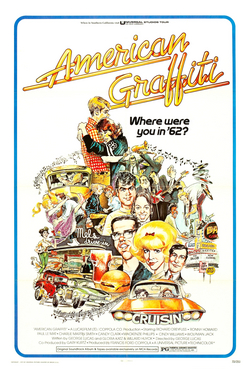
Years before he went a long time ago to a galaxy far, far away, George Lucas went not nearly so far back or away: Modesto, California 11 years earlier for a story seeped in nostalgia about the America he remembered growing up in. Much like Star Wars, studio execs thought this hardly sounded like a film people would pay money to see – only the support of a red-hot Francis Ford Coppola got it the green light. It then became one of the most profitable films ever made, repaying its tiny investment many, many times over – not to mention helping kick-start a nostalgic wave that would also (in a way) help Star Wars become a mega-hit.
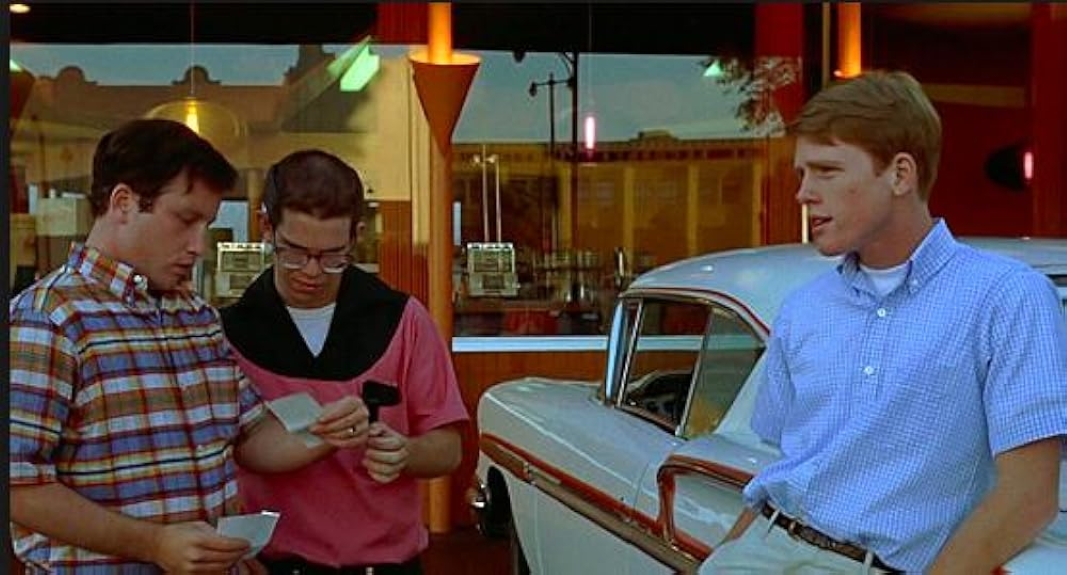
Told over the final night of the summer vacation, four late teenage friends go through various coming-of-age quests. Curt (Richard Dreyfuss), having second thoughts about leaving for college, spends the night in a Quixotic quest for a girl who mouthed ‘I love you’ to him from a passing car. Best friend Steve (Ron Howard) is more keen to depart, despite the pleas of his girlfriend (and Curt’s sister) Laurie (Cindy Williams). Their geeky friend Terry (Charles Martin Smith) desperately tries to impress Debbie (Candy Clark) with a borrowed car. And cool kid John (Paul Le Mat), is saddled with 12-year old Carol (Mackenzie Phillips) while fending off a challenge for his drag-racing crown from Bob Falfa (Harrison Ford).
There is an undeniable charm to American Graffiti so it’s not remotely a surprise it was a smash hit – or that, with its warm nostalgia for what felt a simpler, happier time, it helped inspire (among many other things) hit sitcom Happy Days. Lucas made the film after the disappointment of his debut, THX 1138, a chilling piece of dystopian sci-fi unlike anything else he ever made again. His segue into something fun, unchallenging and entertainingly crowd-pleasing as this marked a shift that stretched over the rest of his career: a desire to produce stuff the regular cinema-goer wanted to see.
American Graffiti is brilliantly assembled, cut together with a superb sense of pace by Marica Lucas and Verna Fields as it moves between what is effectively four short films. What’s particularly striking about its well-timed pace is that it never jars that, fundamentally, all four stories are thematically the same: horny young men learn lessons and reach surprising decisions in comic situations that place them out of their comfort zones. It’s further helped by its sharp dialogue – Lucas turned over his storyline to Gloria Katz and Wiliard Huyck to punch it up (as Stars Wars prequels viewers know only too well, dialogue was never Lucas’s strength).
It’s all then extremely well-executed by the cast. Best in show, not surprisingly, is Richard Dreyfuss who rode the wave from here to create one of the most impressive 1970s CVs. Dreyfuss – already nearly 25 when playing this teen – has just the right balance of naïve, dreamy decency and cheeky charm as a young man struggling to leave childhood behind to grow-up. He has a brilliant sense of comic timing for his smart-aleck one-liners, while totally convincing as the sort of romantic kid who wants to believe in love-at-first-sight. From awkwardly covering-up a dime-store theft, to impishly sabotaging a police car, or launching into a romantic plea for help in locating the woman who has stolen his heart with a glance, it’s a stand-out performance.
Ron Howard as the want-away Steve who begins to question his decisions, has less spark not helped that the interplay between him and Cindy Williams’ Laurie makes for the film’s dullest and most earnest pairing (both actors went onto play versions of these characters in Happy Days). Especially since they are contrasted with the comedy of mishaps (failed attempts to get alcohol, car jackings, bungled attempts to tackle thieves) of a very funny Charles Martin Smith (cementing a career of geeks) and Oscar-nominated Candy Clark, funny and very sweet as a cool girl who wants something meaningful from the boys fawning over her. The final pairing has some similarly sparky interplay between Paul Le Mat’s frustrated cool-kid, secretly worried his best days are already behind him and Mackenzie Phillips’ precocious pre-teen.
All this take place in a setting marinated in nostalgia and charm. It is a reassuring, unchallenging and romantic view of a particular era in American cultural history. One before the challenges of counterculture, Watergate and Vietnam. It harkened back to an era where kids had neatly cut-hair and wore plaid-shirts tucked into their trousers; where the most dangerous thing a teenager might do is thumb their nose at bossy cops or bum a bottle of booze. All four of the kids are the sort any girl could bring home to their parents without any concern about how they would be received, and even the film’s nominal bad boy is a stand-up guy with firm principles and loyalty.
In fact, what becomes clear is, unlike films from the likes of Fellini (which partly inspired Lucas) this is without any real introspection at all. Other films – take a look at Last Picture Show – would have looked at this setting and wondered if there are darker elements underpinning small town America. Prejudices, jealousies and the like – or the sort of dark foreshadowing of historical traumas like Vietnam and Nixon being just round the corner. There is none of that there – so little in fact that it’s a little jarring when the film’s on-screen “what happened in next” reveals two of its leads would suffer tragic early deaths, one in Vietnam (it’s also jarring – even at the time – that these on-screen captions tell us nothing at all about the futures of the female characters).
It’s a reminder that Lucas is an entertainer, not a director looking to challenge or explore deeper truths. And, to be fair to him, if he had really allowed American Graffiti more space to acknowledge the darkness to come, or some of the less seemly sides of small-town life, it certainly wouldn’t have become one of the most profitable films of all time. Instead, this is a film that served as a warm hug, a rose-tinted memory of what their childhoods might have been like, when everything was simpler, safer and more straight-forward and the biggest problem you could possibly face was finding the girl you liked and dealing with college. It’s undeniable entertaining, fun and heart-warmingly enjoyable, but it’s also a carefully reassuring view of a far more complex world.


