Category: Films about obsession

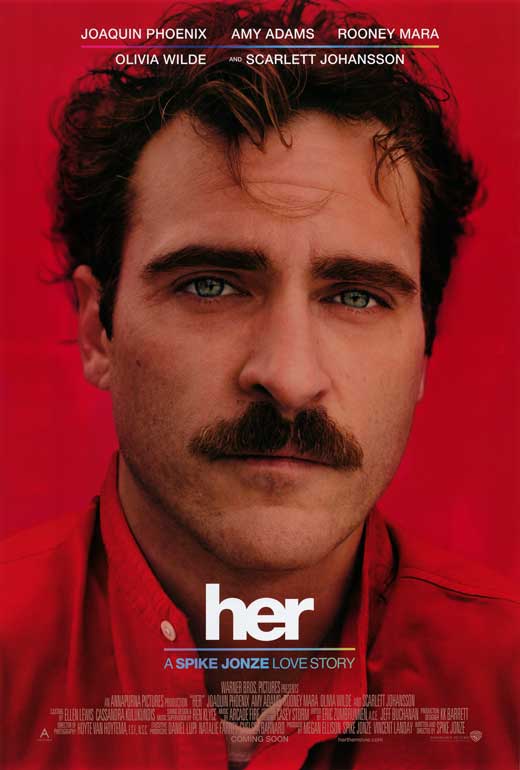
Her (2013)

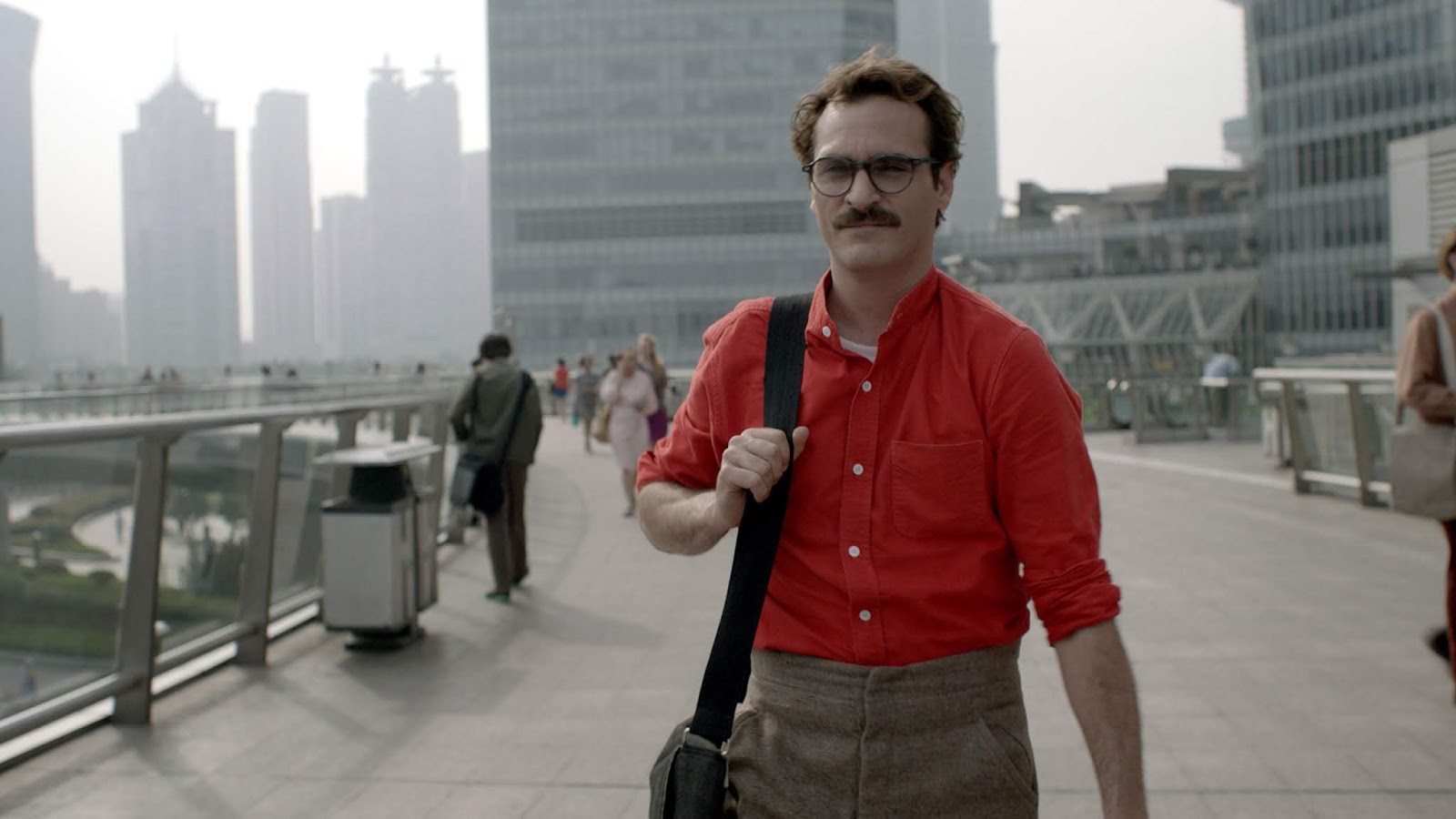
Joaquin Phoenix plays a complete prick in this unbearably pleased with itself satire Her

Director: Spike Jonze

Cast: Joaquin Phoenix (Theodore Twombly), Scarlett Johnasson (Samantha – voice), Amy Adams (Amy), Rooney Mara (Catherine Klausen), Olivia Wilde (Blind Date), Chris Pratt (Paul), Matt Letscher (Charles), Lukas Jones (Mark Lewman), Kristen Wiig (Sexy Kitten – voice), Brian Cox (Alan Watts – voice), Spike Jonze (Alien child – voice)

Every so often you start off engaged with a film and then, the longer it goes on, the less and less you like it. I couldn’t put my finger on the exact moment where I started to really take against Her, but I certainly had by the end of it. As someone once famously sort of said about Kriss Akubusi: “hard to dislike but well worth the effort”.

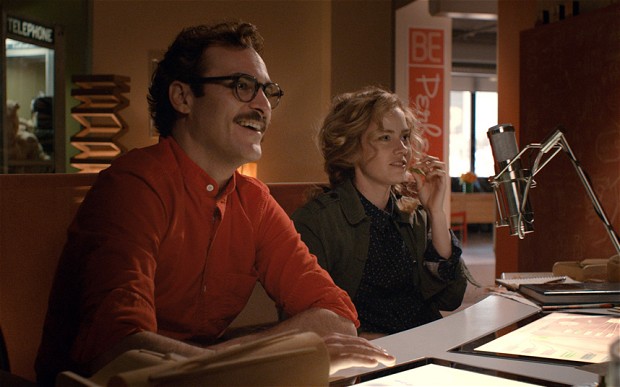
Anyway, Her is set in the near future. Theodore Twombly (Joaquin Phoenix) is a sensitive, insular man who writes personal romantic letters for other people who aren’t articulate enough (or bothered) to do it themselves. Getting divorced from his childhood sweetheart Catherine (Rooney Mara), Theodore downloads a new Artificial Intelligence Operating System for his computer. The system is designed to create a personality that appeals to the customer – and that is certainly the case here with this system, Samantha (voiced by Scarlett Johansson). Theodore, finding it hard to connect with the real world, is drawn to Samantha and, as she grows and develops, they start a relationship. But can the relationship survive the divide between realities and Samantha’s growing self-awareness and personality?

Okay. I’m going to swing hard for this film, so let’s start with what’s good shall we. Spike Jonze directs very well. It looks beautiful. There is some lovely music. The future world it shows is close enough to our own to still feel connected. Amy Adams is rather good as Theodore’s old college friend, and Rooney Mara turns in a very good performance as Theodore’s wife, a woman who doesn’t let Theodore get away with his excuses. Scarlett Johansson is perfect casting as the alluring and engaging voice of Samantha (much as I was primed to be annoyed by her post-production replacement of Samantha Morton, who had been on set with Phoenix). There are some sweet and even romantic moments.

Okay that’s it. This is a film overwhelmingly, unbearably, unbelievably pleased with the cleverness of its own concept and trite ideas (a man loves his computer – take that our modern consumerist world!). It then goes on to tell us almost nothing, bar the most basic statements about our struggles to interact with, and relate to, each other in this technology-filled world. Apparently it’s hard to create bonds with real people where we are viewing everything through our phones. Bet that has never occurred to anyone before right?

But my main problem with this film is the lead character. Now I will say that Joaquin Phoenix does a good job with this role, and his skilful acting brilliantly holds the story together. He does extremely well with a part that is almost exclusively reacting to someone not actually there. But my problem is with this characterisation of Theodore. To put it bluntly, he’s a prick.

In fact, he’s the sort of quirky nerd beloved of this genre, but take a long look and he’s basically a complete creep. And all his relationships with women seem to be based on him not wanting to engage with the problems of the other person. He requires the focus to be on his wants and needs, as if he is the only person in the world who can be sensitive or sad – no wonder he falls in love with a computer programme designed to reflect the behaviours he finds appealing.

“You want a wife without the challenges of dealing with something real” his wife accuses, eagerly pointing out his inability to deal with or even want to engage with human emotions. The film wants to give him a pass, because he is such a sensitive soul, but it’s bullshit. Theodore is a deeply selfish person, despite what the film wants, who has that geeky, arrogant, self-satisfied sensitivity that blindly says “if I struggle in the world, then it’s the fault of the world not me”.

Theodore is a constant happy victim, a whining, softly-spoken, guilt-tripping prick who only sees himself as a victim and makes no effort to change or understand his behaviour to other people. The film wants us to think that the world is a puzzle to his poetic soul, but it’s actually a maze he doesn’t want to find a way out of. He doesn’t want to engage with it and only feels justified and reinforced in these feelings by everything he does.

He is like the perfect ambassador for passive aggressive guys: “Oh I don’t get the girls because they don’t want to open themselves up to my sensitivity blah blah blah”. Theodore goes on a blind date early in the film: it goes well, they make out, sex is on the cards and then she asks “Before we do anything, will you see me again?”. Theodore can’t even bring himself to make even the smallest offer, meekly babbling about having a busy weekend. When she reacts angrily and leaves, the film wants us to side with Theodore’s timidity, rather than say “yeah it is a bit shitty to let a girl put her hand down your pants and then not even show the slightest interest in seeing her again, and then call her unpleasant”. Fuck you Theodore.

Theodore is basically a controlling arsehole and it’s where the romance of the film drains out. He clearly has no idea why his marriage ended, but while the film wants us to think he’s too sensitive for the rough and tumble, it seems clear he had no interest in, or comprehension of, his wife’s life. She is constantly subtly blamed for not having patience with Theodore – the film ends with him writing her a cathartic e-mail saying he will always love his memory of her and thanking her for being part of his life, forgiving her from leaving (again, screw you film). Instead she, like other people, doesn’t deserve Theodore because she doesn’t have the patience to delve into his life.

Theodore, though, has no depths. He’s a bland, faux-poetic guy with a nervy disposition and a disinterest in other people’s emotions, focused only on his own gratification. He wants his relationships to adjust to what he needs them to be. As Samantha grows and develops into a more fully rounded personality, his first reaction is hostility and jealousy at the thought of her talking to other people and operating systems. It’s not sweet and endearing – or Theodore again being taken advantage of, as the film wants us to think – it’s creepy, and Theodore is the sort of passive aggressive gentle guy who ends up stalking and murdering the girl who rejected him.

How can you engage with the points of this film, when the central character through whom everything is filtered is so awful? Distance in relationships in this modern world – and the lack of genuine interaction – is a point that hardly needs hammering home as it does here. The trite points about love and relationships the film makes are all wrong. The film is so on the nose about distance between people and the artificial nature of our interactions, the hero even writes other people’s love letters for them. It’s subtle as a sledgehammer.

Computers and phones are everywhere and everyone uses them, but there is less insight and heart in this story than an average episode of Black Mirror (which would have done the same thing in half the time). The film does its best to build a romance between the two, but it never quite lands or has the impact it should, because it never feels like an equal relationship: first Theo has the control, then Samantha grows beyond anything Theo is capable of but is still trapped by her initial programming of devotion to him. What point is this meant to be making about romance and commitment? Theo lives in a dream-world and does so until the end of the film. 

Her is the sort of film lots of people are going to love. It uses the conventions of romantic films very well. It has darker moments, such as a sequence where Theo and Samantha try to use a surrogate for sex (a scene where to be fair I could understand why Theo is creeped out and disturbed), but none of these ever comes together into a coherent point. And Theo remains, at all times, a block on the enjoyment of the film, an unpleasant figure hiding in plain sight that stops you from falling for the film. In love with itself, in love with its idea, in love with its cleverness, this is a film that tells you everything about the smugness of the geek and nothing about the subjects it actually wants to get you thinking about.

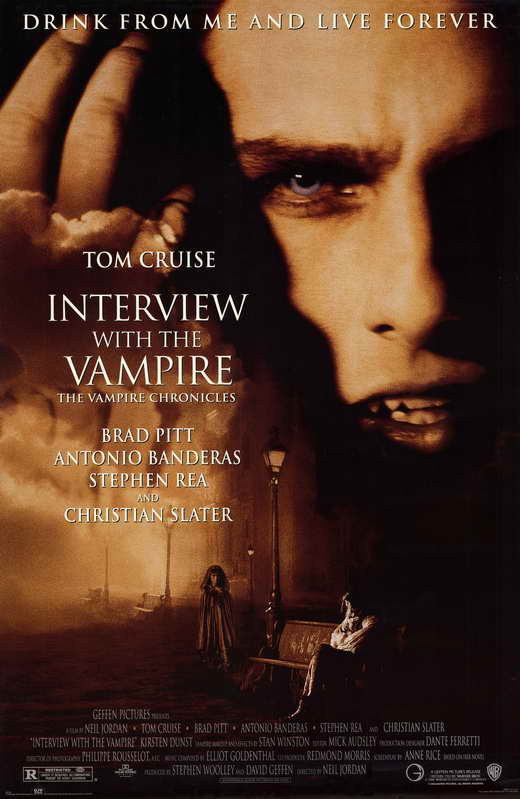
Interview with the Vampire (1994)

Tom Cruise and Brad Pitt bite and flirt in high-minded, but rather camp, Interview with the Vampire

Director: Neil Jordan

Cast: Tom Cruise (Lestat de Lioncourt), Brad Pitt (Louis de Pointe du Lac), Christian Slater (Daniel Molloy), Kirsten Dunst (Claudia), Antonio Banderas (Armand), Stephen Rea (Santiago), Domiziana Giordano (Madeleine), Thandie Newton (Yvette)

Why do vampires constantly keep rearing their ugly heads in films? What is it about them that we seem to find so addictive? Interview with the Vampire is a vampire film that takes a slightly different tone and tries to explore what it might actually be like to live the life of a vampire, the actual psychological impact it might have. It’s just a shame the film also can’t escape the temptation to fall back on the high camp the genre often gets trapped in.

Anyway, the film opens in modern day San Francisco, with young reporter Daniel Molloy (Christian Slater) interviewing a man named Louis (Brad Pitt) who claims to be an ageless vampire from the late 18th century. Louis tells his life story: turned to a vampire by the hedonistic Lestat (Tom Cruise) when he was consumed with grief at the loss of his wife and child. Louis struggles with the morality of taking life, unlike Lestat’s joy in killing. Later they turn a dying girl Claudia (Kirsten Dunst), who over the next 30 years matures psychologically but remains in the body of a 12-year-old. Louis and Claudia slowly begin to fear Lestat’s control and struggle to escape from his shadow.

Interview with the Vampire wants, desperately, to be an intellectual vampire film. A sort of Freudian exploration of the impact of suddenly becoming a creature that can never see daylight, sleeps in a coffin and has an insatiable hunger for human blood. Does it work? Well sort of, I guess. But the problem is most of the depression is carried by Brad Pitt’s Louis and, to put it frankly (as Lestat observes) he’s a whiner. His very human struggle with taking life and his sadness at the loss of his humanity should be engaging, but Louis is not an interesting character. He just mopes around. Rather than being sparked by his predicament, he’s just a boring and frustrating character.

Maybe this is partly Pitt’s performance as well – too withdrawn, too morose. Apparently Pitt hated making the movie (from the long hours of make-up, to the endless night shoots, to the boring character) and it shows in the movie. Pitt just can’t get engaged in the role, his matinee idol looks and rather dull speaking voice combining to make him look like a worse actor than he is. And then Louis keeps banging on and on about how depressed he is. In fact he bangs on so much you start to wonder why everyone – from Tom Cruise’s crazed Lestat, to Antonio Banderas’ ageless vampire – is so obsessed with him.

But then maybe it’s Louis’ looks eh? The film does wallow in the sensuality of sucking on people’s necks, and half the vampires in this seem to be campily metro-sexual. Cruise gives a surprisingly out-there performance of high camp hedonism and preening selfishness, so far out of his expected range that (while not brilliant) it reminds you he is a better actor than he gets credit for. Lestat clearly has a huge crush for Louis, and the orgasmic converting of Louis into a vampire leaves little to the imagination. Later Antonio Banderas as an effeminate, ethereal older vampire also seems to have a huge crush on Louis. The many vampire victims seem to succumb to erotic joy when they are bitten (at least until they die). Sex flows over the whole film, without the film itself ever actually being sexy, and the vampires are all pretty indiscriminate in their tastes.

Unfortunately this all too often tips into pure high camp. Stephen Rea, as a sort of vampire acrobat actor, gives a performance of superb silliness. Banderas lisps and wafts through the picture like a bizarre puff of perfume. Neil Jordan frequently explores the frame with ridiculous overblown action – no less than four times in the picture we watch scenes of operatic fire starting (often with vampires writhing in flamey pain) that suggest Jordan spent too long watching the fire sequence in Gone with the Wind before he made the picture. All the actors (aside from Pitt who barely shows up) dial it up to eleven with their performances, and the long-haired, long finger-nailed vampire representations here are like some sort of odd Halloween dressing up box.

Jordan’s film often trades dark, campy humour in favour of horror or thrills. There are no real jumps or scares in the picture, and the buckets of blood thrown around are more ridiculous than they are disgusting. In fact watching the film, I feel Jordan may have been torn between wanting to do something a little different (a sad vampire film about depression) and having to deliver the blood, guts and gore the genre fans wanted. Certainly, he fails to mine any real poetry from Anne Rice’s source material (although she loved the film, so what do I know) and for all the musings on the tragedies of living a life in the shadow you never really feel that moved by it.

There are however good things. Technically the film is very good. Cruise is surprisingly fun as the colourful Lestat. The film gets stolen by Kirsten Dunst as the physically young, mentally older Claudia, who struggles to find the balance between her teenage blood lust and her later disgust and fury at being trapped forever in the body of a child. But there isn’t enough good stuff among the tosh. Interview with the Vampire is an odd, actually rather bad film that is struggling to be a good one. It has a cast of 1990s heartthrobs who mostly enjoy dressing up and playing at their campy side. But it fails to really be engaging or make someone care about the story it is trying to tell.

The Count of Monte Cristo (2002)

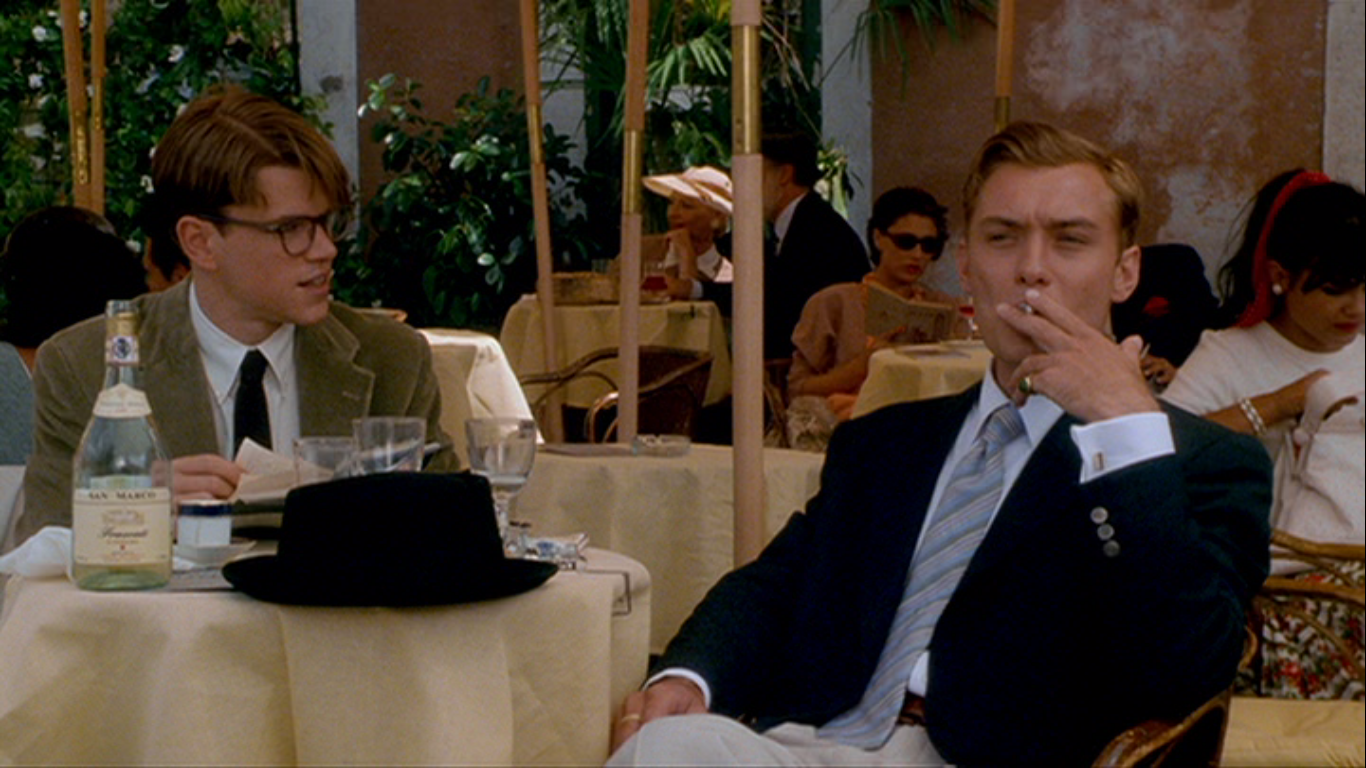
Guy Pearce and Jim Caviezel as friends turned foes in The Count of Monte Cristo

Director: Kevin Reynolds

Cast: Jim Caviezel (Edmond Dantès), Guy Pearce (Fernand Mondego), Dagmara Dominczyk (Mercedès Mondego), Luis Guzmán (Jacopo), Richard Harris (Abbè Faria), James Frain (JF Villefort), Michael Wincott (Armand Dorleac), Henry Cavill (Albert Mondego), Albie Woodington (Danglers), JB Blanc (Luigi Vampa), Alex Norton (Napoleon Bonaparte), Patrick Godfrey (Morrell), Freddie Jones (Colonel Villefort), Helen McCrory (Valentina Villefort)

Alexander Dumas’ novels are beasts. The Count of Monte Cristo is a real mountain of a book, a sprawling story of adventure and revenge. Kevin Reynolds’ film had a near impossible task to turn this into a film – most have gone down the route of adapting the book into a TV series – but triumphantly succeeds by locating in it a very clear, very filmic narrative.

In 1815, Edmond Dantès (Jim Caviezel) and Fernand Mondego (Guy Pearce) are young men serving on a merchant ship, who wash up on Elba where Napoleon (Alex Norton) is in exile. Tricked into taking a letter for Napoleon back to France, Dantès is betrayed by Mondego, who desires Dantès’ fiancée Mercedès (Dagmara Dominczyk) and resents his own envy for the far poorer Dantès. The corrupt magistrate Villefort (James Frain) colludes to protect his own family’s secrets, and Dantès is locked up in the dreaded Chateau d’If for 15 years, during which time he meets fellow prisoner Abbè Faria (Richard Harris) who teaches him politics, mathematics, philosophy and sword-fighting. Faria shares with Dantès the secret of the vast treasure he hid on the island of Monte Cristo – treasure Dantès dreams of using for his revenge.

This is actually a fairly nifty adaptation of a huge novel into something cinematic. Almost every change made to the original book ends up working extremely well – and adds an immediately understandable dramatic tension to it. I’d actually go so far as to say this might be a masterpiece of cinematic adaptation. The decision to make Dantès and Mondego childhood friends and rivals instantly adds a real frisson of betrayal to Mondego’s actions, as well as adding a very personal element to the revenge portion of the narrative. The simplification of the other “betrayers” also works extremely well, while the careful links throughout back to Dantès’ upbringing never let us forget the roots he has come from.

The script is also packed full of fun interjections. The idea of the chess piece, which Dantès and Mondego pass from one to the other, becomes laced with symbolism, while the changing of Jacopo into a sort of Brooklyn pirate works extremely well (Guizmán gets some of the best lines, but also gets to show a touching loyalty and concern for Dantès). On top of which, the pushing to the fore of the swashbuckling sword-fighting excitement sets us up for a cracking final sword fight between our two friends-turned-enemies. 

Reynolds also shoots the film extremely well with a host of interesting angles and framing devices showing how Dantès position and confidence change throughout the story. The film’s climactic sword fight is brilliantly staged and the film charges forward with a real momentum (there are of course no sword fights in the book!). 

Particularly well handled through is the sequence that is (in many ways) most faithful to the original book – Dantès’ time in the Chateau d’If. What I love in this sequence is that it’s a perfect combination of stuff from the book, Karate Kid style training, and some good old-fashioned warm character building. It’s also got two terrific performances from Michael Wincott as an almost comically dry sadistic guard and Richard Harris as the imprisoned Abbè Faria, the quintessential wise-old-mentor (the relationship between Faria and Dantès is beautifully judged).

The film perfectly balances its sense of fun and adventure with a very real-feeling story of a man who has to learn there is more to life than revenge. The plot that Dantès puts together probably isn’t the most complex piece of chicanery you are ever going to see, but it doesn’t really matter because the focus is the fun of the journey, and the thrill of someone being a few steps ahead of everyone else. 

Jim Caviezel is very good as Dantès, just the right blend of forthright moral strength and simmering resentment (few actors do stoic suffering better than Cavizel). There is a really nice questioning throughout the film of Dantès’ motives and whether revenge is really worth the candle, which adds a lovely depth to Cavizel’s performance.

But the film probably gets waltzed off by Guy Peace (who turned down the role of Dantès because he thought Mondego was more fun) who gets to campily simmer, sulk and fume at the edge of every scene. Mondego is brilliantly reinvented as a fearsomely proud, selfish, hedonistic aristocrat with a major inferiority complex, who takes everything from Dantès and still isn’t happy at the end of it. But Pearce has a whale of a time with his cruelty and resentment, and it’s a great reminder of how much he is (as an actor) in love with make-up, Mondego being scruffy, slightly pock-marked and increasingly bad of tooth.

He’s a villain you can scowl at and he’s a perfect counter-point for a hero whose emotional distance is designed to make him at times a difficult man to invest in. The film’s expansion of their personal relationship in its early section works really well, setting up the innate inequalities between them (wealth on one side, bravery and decency on the other) during the film’s cheeky and amusing opening sequence on Elba with Napoleon.

The Count of Monte Cristo is an extremely well structured, hugely entertaining adventure film. It’s very much like a 1930s swashbuckler, and every scene has some delightful moment that you’ll love. There are some very good performances in here as well, working with a very good conversion of this doorstop of a book into a film. Skilfully directed, interestingly shot, well acted – it’s a gem that’s far too overlooked.