
Category: Films about theatre

Black Swan (2010)


Natalie Portman in the intense world of ballet in Aronofsky’s crazy masterpiece Black Swan

Director:  Darren Aronofsky

Cast: Natalie Portman (Nina Sayers), Mila Kunis (Lily), Vincent Cassel (Thomas Leroy), Barbara Hershey (Erica Sayers), Winona Ryder (Beth MacIntyre), Benjamin Millepied (David Moreau), Ksenia Solo (Veronica), Kristina Anapau (Galina), Janet Montgomery (Madeline), Sebastian Stan (Andrew)

Something about ballet just makes people think of obsession. Many dancers criticised Black Swan for perpetuating myths about the dangerous psychology, the quest for perfection, the personal life imbalance connected with the all-consuming art ballet seems to be. It’s hard not to agree with them – but that doesn’t mean Black Swan isn’t unsettling, creepy and hypnotic film-making. 

Nina Sayers (Natalie Portman) is an obsessive member of the New York Ballet, focused on achieving perfection and lives a sheltered, barely adult life at home, dominated by her mother Erica (Barbara Hershey). With the forced retirement of company lead Beth McIntyre (Winona Ryder), Diagheliv-style director Thomas Leroy (Vincent Cassel) selects Nina to play the dual role lead of white and black swan in Swan Lake. Leroy feels she is perfect for the innocent white swan, but needs to work on the sensual black swan. Increasingly feeling the pressure of playing the role under the demanding Leroy – and growing increasingly preoccupied with her understudy Lily (Mila Kunis) – Nina’s fragile psyche begins to fracture.

Black Swan is a mesmerising mixture of psychological drama, melodrama, Cronenberg-style body horror, unreliable narration and immersion into a pressure-cooker world. It’s often difficult to watch, sometimes maddeningly over-blown, and overly tricksy in its intense visual style. But despite that, it’s actually compellingly watchable, an audacious tight-rope walk between style and substance that constantly feels like it’s going to get lost in its extremes but never does.

Aronofsky’s camera flies and whirls like the ballet dancers he is recording, and he creates a wonderfully dark spin on The Red Shoes. What I found particularly fascinating watching the film again after many years is how unreliable and imprecise so much of the story is. Told completely from the perspective of Nina – a woman subject to delusions, chronic social insecurity and an increasingly split psyche – it becomes clear that a lot of what we see may not be as clear-cut as we think. 

This most obviously affects our perception of Mila Kunis’ rival (or is she?) dancer Lily. How many of the interactions we see are actually happening, and how many are fantasies? With Lily becoming an alternative physical form for Nina’s projection of her own “black swan” persona (several times, Lily’s face morphs and shifts into Nina’s), we have to question virtually every appearance we see of her – and interpret her personality from the prejudiced, fearful view seen by Nina. Similarly, Barbara Hershey’s domineering mother (while undoubtedly controlling) is perhaps not the monster we see. She’s clearly 100% right in her fears for Nina’s sanity. How much of her behaviour is possessive jealousy and how much is it a protective parent who knows her daughter is a danger to herself?

Then of course we have Nina herself. Natalie Portman won every award going for her performance here, a tour de force of bravura dementedness mixed with vulnerability. Nina is a character who we only slowly realise as the film progresses is not the innocent, childlike waif she first appears, but has a much darker, more complex personality. Her “black swan” side – the darker, sexual side of her personality she is encouraged to explore – slowly expresses itself more and more as a physically. Portman clearly demonstrates the differences between the two sides of Nina’s personality. Her increasing desperation, isolation and insecurity are very effective – and the moments where she allows the “black swan” persona to control her actions are riveting.

Aronofsky explores Nina’s unbalanced mind with moments of pure body horror – although it’s grand guignol ickyness like this that probably pushed some people too far. It ties into most of the film being (quite possibly) a series of Nina’s vivid fantasies. Ballet wounds become increasingly magnified – from a broken toe nail early on, to Nina obsessively picking and scratching any wound. In one impossible to watch moment she obsessively picks off a long strip of skin from a finger wound (fortunately revealed immediately after to be fantasy). Beginning to believe she is growing wings, she obsessively scratches her back and has visions of swan flesh morphing over her body. At one point she fantasies her legs breaking into swan legs. In between this are bouts of sexual exploration – both solo and with partners – that seem increasingly unnerving. 

Aronofsky’s ballet world is one of meticulous work and back-stabbing brutality. An early sequence covers Nina’s almost ritualistic preparations of her ballet shoes. The troupe, far from supportive, seems to be ripe for bitchy debate and rivalry (although of course some of this may well be Nina’s unhinged perception). Winona Ryder has a neat cameo as a former star dancer, ruthlessly dumped for being too old. Vincent Cassel’s director is at best a domineering bully and at worst a position-abusing horndog, depending on how reliable Nina’s perspective is. It’s the setting of a melodrama, and Aronofsky has expertly mixed a Silence of the Lambs style psycho-drama and The Fly style horror.

Portman holds the film together brilliantly under Aronofsky’s distinctive direction. It’s not going to be for everyone – but Aronofsky understands ballet if nothing else, shoots it brilliantly, and when we finally see Nina fully transformed as the Black Swan dancing the final performance, the energy and controlling focus of her performance, and its beauty, really comes across (even to a ballet ignoramus like me).
Black Swan is such an off-the-wall mix of styles, and so out there in some of its visuals, story developments and characterisations, that it’s not going to please everyone. In fact, catch this on the wrong day and you’ll hate this film (and probably really, really, really hate it). But catch it at the right time and it will stick with you. But whatever your view of its gothic style and content, you’ll admire Portman’s performance, respect the craft with which it has been made, and enjoy several fine performances from Cassel, Hershey and Kunis among others. It’s weird. Very weird. But that’s not necessarily a bad thing.

Birdman (or The Unexpected Virtue of Ignorance) (2014)


Michael Keaton is haunted by his superhero alter-ego in Iñárritu’s well made but heavy handed theatre satire

Director: Alejandro González Iñárritu

Cast: Michael Keaton (Riggan Thomson), Zach Galifianakis (Jake), Edward Norton (Mike Shiner), Andrea Riseborough (Laura Aulburn), Amy Ryan (Sylvia Thomson), Emma Stone (Sam Thomson), Naomi Watts (Lesley Truman), Lindsay Duncan (Tabitha Dickinson), Merritt Wever (Annie)

Oscar voters seem to be invariably drawn towards stories about actors and acting. Put together a decent and ambitious movie about those subjects, ideally with a sprinkling of gentle satire that pokes fun at acting but basically says at the end it is a noble profession, and you got yourself a contender. So it was with Birdman.

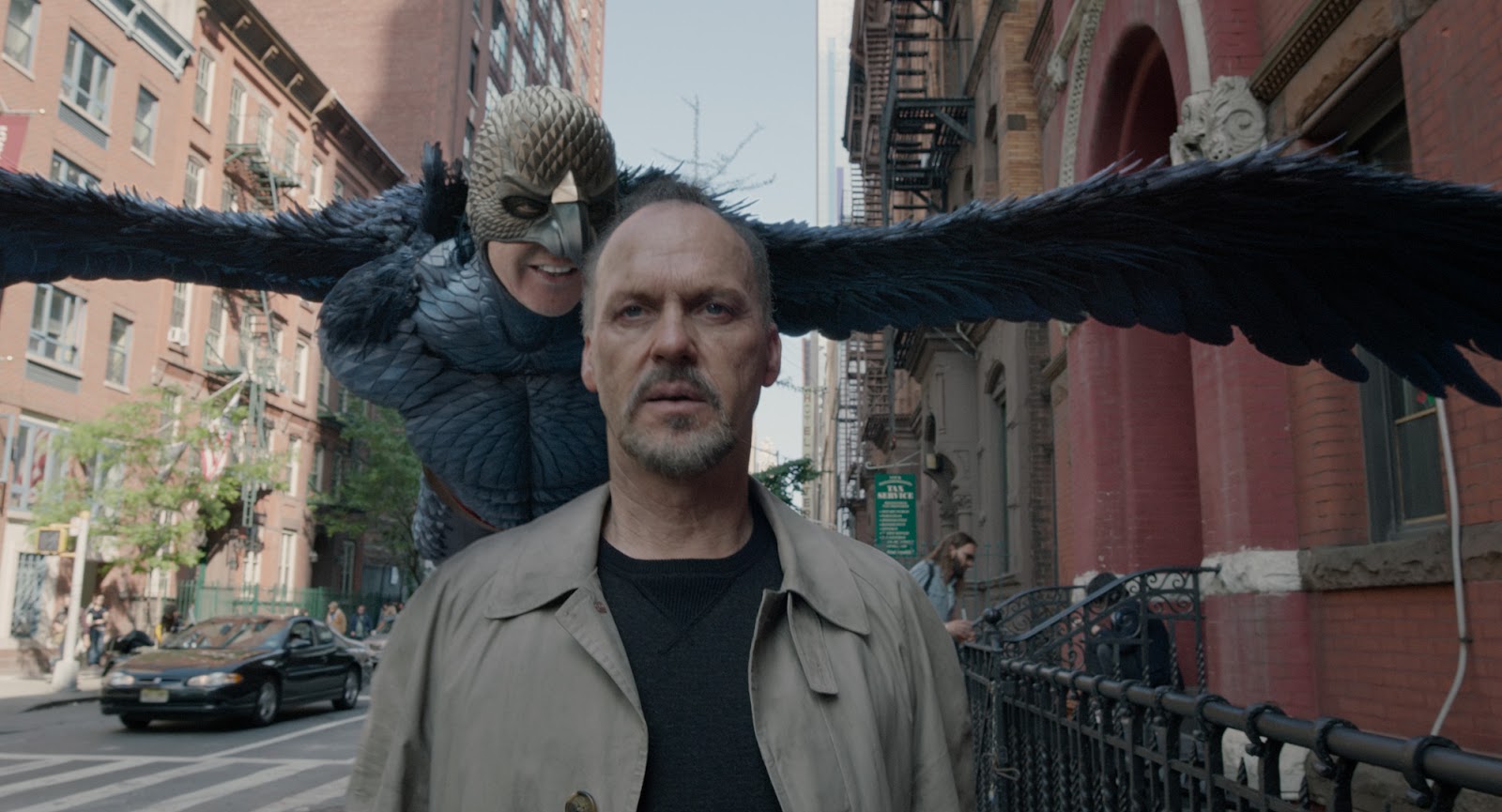
Riggan Thomson (a career revitalising role for Michael Keaton) is a faded movie star who hit celebrity 15 years ago with a series of films about a superhero, Birdman. Today he is trying to reclaim his artistic integrity by directing, adapting and starring in a Raymond Carver story on Broadway. At the same time he wants to rebuild a relationship with his daughter (Emma Stone), a recovering drug addict. The film covers the stumbling journey towards the opening night, with Thomson dealing with a demanding and difficult enfant terrible co-star (Ed Norton), a string of disasters and the haunting presence of his Birdman alter-ego, lambasting his choices and urging him to return to blockbusters.

I’m going to lay into this film a bit. It’s harsh, because it is really trying to do something different, for which it deserves credit. So I’ll start with the good stuff. The conceit of making the film look like it was done in one take is extraordinarily well done – the camera work is inventive and extraordinary. Emmanuel Lubezki is a visual genius and the technical accomplishment is astounding, a real tour-de-force. The acting is also very good. Michael Keaton embraces the best script he had in years, giving the part such commitment and emotion you overlook it’s a fairly simple part. Emma Stone is raw and tragic as his daughter. Ed Norton gives one of his finest performances as a dickish method actor (a neat self-parody) who in quieter conversations reveals real depth – and provides more insights into the passion for creativity than virtually anything else in the film.

Okay, that’s the really good stuff. It’s got some good lines as well, and its general style never stops being entertaining. But it’s also nowhere near as clever as it thinks it is. It wants to be a profound study of the nature of life and art, but it never really gets to grips with these ideas or drills down into them. For art, its contrasts are simplistic verging on hectoring. It never really gets to the heart of what acting is or means. For life it boils down into a straightforward “father wants to win back love of family” plot. The film presents all this as something deep and meaningful, and uses a lot of style and razamatazz – but the basic points remain simple or under-explored.

Part of my problem with the film is that is wears its pseudo-intelligence rather too heavily, and it ends up turning into smugness. Lubezki’s camera work is extraordinary but it also has a “look-at-me” quality that really begins to distract from the viewing of the film – even second time around the content of the film passes you by a bit. Tellingly, on the DVD Iñárritu talks about being drawn to the project because he wanted to make a film that felt like it was done in one take. Fine, but perhaps it would have been better if he had been a bit more interested in, say, the content of the film itself? Everything about the film-making demands you give it your attention, from the camerawork to the insistent drumming soundtrack. These elements are not bad in themselves – but it’s showing off rather than craft servicing the film.

The film’s themes themselves are, I think, also not as interesting or challenging as the film-makers believe them to be. The central idea of actors being shallow with chaotic home lives is so tired as to be a cliché: “Why don’t I have any self-respect?”/”You’re an actress, honey” summarises the sort of jokes you’ve seen before in other films.

I also felt the film’s attempts to analyse the nature of art and performance were formulaic and even rather empty. Lindsay Duncan plays a chilly theatre critic, determined to destroy the play, and Keaton delivers well Riggan’s rant to her on using labels and presenting opinions as facts. There isn’t any counterbalance to this offered, no exploration of, for example, criticism can service art or how opinion guides our reception of what we perceive as good art. A heavy handed fantasy sequence has his Birdman alter ego addressing the camera directly “Look at these people, at their eyes… they’re sparkling. They love this shit.” Yeah Alejandro we get it, we are shallow and deep down prefer action films than all this “ talky, depressing, philosophical bullshit” – hardly an original thought, and hardly framed originally though, is it? Do we really need to be whacked on the head with it? What point is this trying to make that we haven’t heard hundreds of times before?

But then is it any wonder that it wants to try and make points about cinema rather than theatre? For a film set exclusively in a theatre, I don’t really feel that its makers really understand the pressures or nature of theatre. Instead, it merely stands in here as a short hand for “cultural worthiness” – Riggan might as well be making an independent film or writing a novel, theatre is just a counterpoint used for blockbuster films (a genre Iñárritu clearly does understand and has opinions on). Nothing in the film really seems to capture a real sense of backstage in a theatre or what putting on a play is like, for example Peter Yates’ film of The Dresser. There is no sense of the collaborative nature of the medium or its immediacy as a performance art – it’s labelled as lazily as a vehicle for pretension and self loathing as criticism is for bitterness and failure.

The film also plays with the notion of Riggan’s (possibly) unhinged nature. Throughout the film we see him use superpowers – levitation, telekenesis, flight, control of fire. Along with his haunting by the Birdman character (done with a nice parody of the gravelly Christian Bale-Batman voice), it all ties into the possibility that Riggan is losing the ability to keep his real life and his career’s defining moment from merging into one another. The film’s ending builds on this, playfully suggesting some of what we have seen might have been real (though it also could be interpreted as a final dream sequence) – but I’m not sure what is gained by introducing these skills other than for visual flair. Riggan’s inner turmoil is never explored fully by the film and I don’t feel the film has the patience to explore his feelings or depression. As such, I find the open-ended ending doesn’t really add anything – it feels like it has been inserted to create debate, rather than acting as a culmination for your interpretation of the film, a la Inception say.

Phew. Birdman is by no means a bad film. It is a good one, but not a great one. It has much to admire, both on a technical and performance level, but (like Riggan) it is straining for an intellectual depth and thematic richness that simply isn’t there. It’s a showpiece, a brilliantly done one, really impressive to watch and it dazzles while it takes place – but there isn’t much to talk about afterwards. It is what it is. Compared to this year’s film-about-acting, La La Land, it’s both less charming and less profound, and has less to tell us about the compromises and struggles of real life. You can enjoy it, and it needs to be seen, but I can’t see it ageing well.