Category: Gangster film

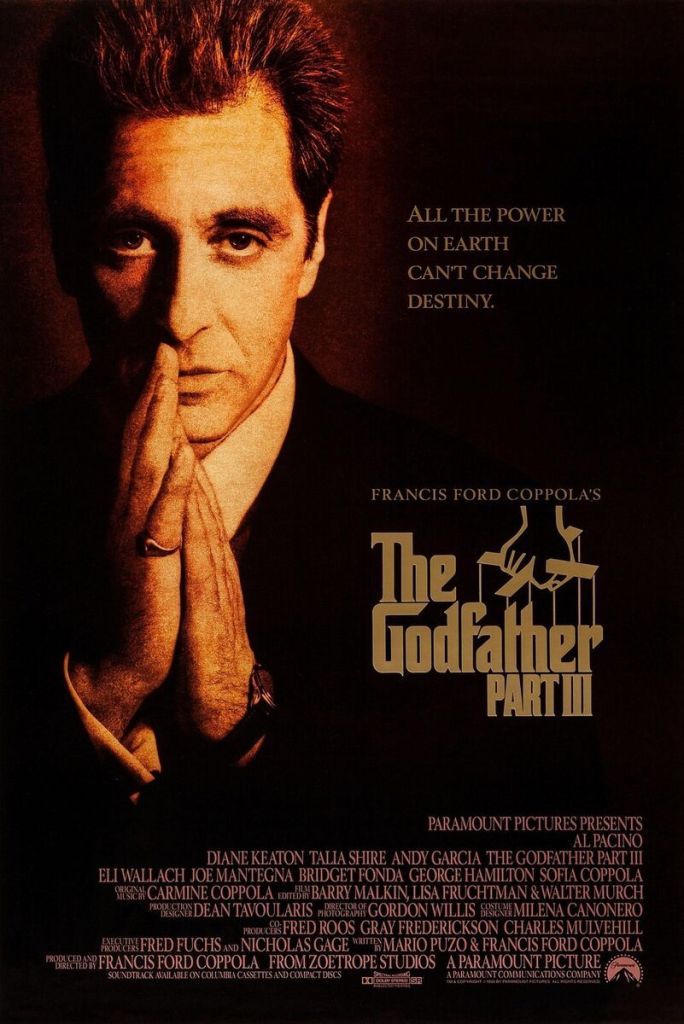
The Godfather Part III (1990)

The Godfather Part III (1990)

The third film in the series is a decent effort – but pales in comparison to the others

Director: Francis Ford Coppola

Cast: Al Pacino (Michael Corleone), Diane Keaton (Kay Adams-Corleone), Talia Shire (Connie Corleone), Andy Garcia (Vincent Corleone), Eli Wallach (Don Altobello), Joe Mantegna (Joey Zasa), George Hamilton (BJ Harrison), Bridget Fonda (Grace Hamilton), Sofia Coppola (Mary Corleone), Raf Vallone (Cardinal Lamberto), Franc D’Ambrosio (Anthony Corleone), Donal Donnelly (Archbishop Gilday), Richard Bright (Al Neri), Al Martino (Johnny Fontane), John Savage (Father Andrew Hagen), Helmut Berger (Frederick Keinszig), Don Novello (Dominic Abbandando), Franco Citti (Calo)

Coppola wanted to call it The Godfather Coda: The Death of Michael Corleone. He got his wish decades later with a belated re-edit release. But at the time, the studio wasn’t having it: this would be a full-blown Third Part to The Godfather. Problem is, those are some very big shoes to step into and The Godfather Part III wasn’t the genre-defining masterpiece its predecessors was. Instead, it’s a decent, melancholic gangster film with touches of King Lear. However, when you are following the sublime being “pretty good” winds up looking like “pretty awful”. The Godfather Part III became the infamous “fuhgeddaboutit” chapter in the saga, the one for completists and those who watch out of duty. On its own merits its fine, but perhaps it was a doomed venture from the start.

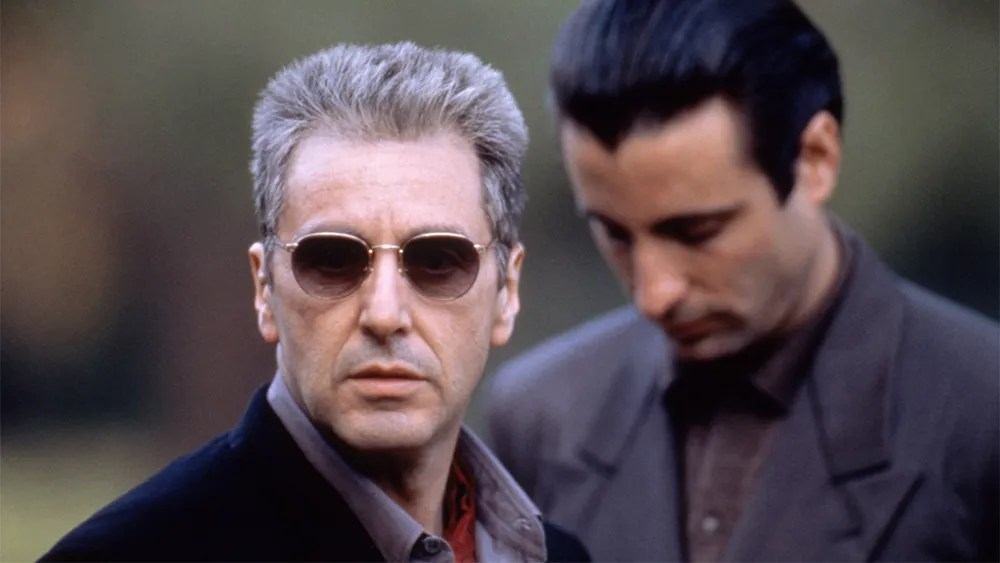
It’s 1979 and Michael Corleone (Al Pacino) has aged and mellowed. All his life he’s talked about getting out, and now it seems he finally has. He’s set up a charitable foundation, he’s been honoured by the Vatican and is rebuilding relationships with his children: daughter Mary (Sofia Coppola), now head of his foundation and son Anthony (Franc D’Ambrosio), an opera singer. Even Kay (Diane Keaton) is speaking to him again. Michael is grooming Vincent (Andy Garcia), illegitimate son of his brother Sonny, to take over the reins of the crime family. But then, they drag him back in. Bailing out the Vatican Bank, Michael finds is double-crossed by a collection of Euro-banking crooks, corrupt Church leaders and rival Mafiosi. Will he survive the dangers a return to Sicily will bring?

The unspoken secret of The Godfather is that everyone was always there for the money: they just also had something to prove the first two times and the fire in their bellies to turn gangster grist into cinematic beauty. Fast forward 15 years later, and there hangs an air of “give the studio what it wants” about Part III, coupled with a willingness to rest on laurels. Coppola agreed to do it because his last few films were bombs and he needed the money. Pacino demanded – and got – a massive sum. Keaton coined it. Robert Duvall asked for $1.5 million, didn’t get it and walked. Coppola agreed to turn the script around in lightening time to rush the film to the screen for the inevitable box-office and awards bonanza. No one involved really did the film for either love or passion.

Coppola’s script, written to a deadline, is torn awkwardly between two plots, neither completely satisfactory. His interest lies with the question of whether absolution (of any sort) for Michael is possible. This is the film Coppola wanted to make, but it keeps losing ground though to the other, a complex conspiracy thriller, riffing on real-life events in the Vatican. This conspiracy is frequently dense, difficult to follow and (frankly) not particularly interesting as it trudges through Papal politics and investment banking, seeming existing to provide faces for the inevitable violent montage of inventive hits.

A Part III that zeroed in on Michael himself, his guilts and shame, would have been both distinctive and unique. But The Godfather Part III fudges this. Crucially, the Michael we see here – for all he would have mellowed with age – feels very different from the cold, buttoned-down, calculating figure from the first two. Pacino – perhaps remembering the pressure of Part II that left him exhausted – invests it with more “hoo-hah”. This twinkly Michael, smiles to hide his regrets – when you feel, in reality, years of pressure would have turned him into even more of a murderous Scrooge. I also can’t believe he would be this close to his now adult children. Pacino embraces the moments of raw pain when they come, but this character just doesn’t quite mesh with his previous performances (and his hair looks just plain wrong).

The rushed production further fatally holed this personal plot below the water-line. Duvall was originally intended to serve as the film’s ‘antagonist’, the film planned as a very personal battle between the last two ‘brothers’. Duvall’s departure ripped the heart out of this script, his role redistributed between George Hamilton’s anonymous lawyer, Talia Shire’s Connie (now turned inexplicable consigliere) and Eli Wallach’s treacherous Don Altobello. None of these make any real impact. Rushed production also meant Winona Ryder dropped out of the crucial role of Michael’s daughter, Coppola taking the (disastrous) last-minute decision to cast his daughter Sofia instead.

Sofia Coppola has suffered more than enough from lacerating reviews of her performance (the level of vitriol poured on her is shocking to read today). Let’s just say, while a great director, she is no actor. But then, neither really is Franc D’Ambrosio playing her brother. Both children never become either interesting or dynamic presences. Since their relationship – and the flowering of it – with Michael is crucial to the film’s emotional impact, it’s a fatal flaw. No matter how hard Pacino works, these scenes just don’t ring true. There is no sense of decades of anger and resentment. The drama seeps out of the family scenes and Mary becomes such a flat and two-dimensional character that her impact on the other principle characters never engages.

Sofia Coppola similarly struggles in her romantic scenes with Andy Garcia, again despite his best efforts. Garcia is the best thing in the film, full of cocksure confidence and instinctive cunning, channelling the best elements of Sonny and Michael into a character we’d dearly like to see more of. His facing down of two murderous home-invading hoods is the film’s most memorable moment while Garcia also does excellent work charting Vincent’s slow acceptance of the tragic sacrifices – the killing of parts of your nature – that being ‘the Godfather’ demands. Diane Keaton is also excellent as a far more seasoned and stronger Kay than we’ve seen before.

The Godfather Part III has several fine moments, even if it never coalesces into anything more than a decent film. Coppola restages with assurance and poise versions of previous scenes from the saga – a Little Italy festival assassination, Sicilian countryside violence, an assassin surreptitiously moving through a quiet building, Kay closing a door by choice, the montage of killings – mixed with large scale moments (a helicopter attack on a crime boss meeting is the film’s most ‘action moment’). He works really hard to channel a sense of melancholy: Michael is crippled with diabetes, plagued with guilt for his brother’s death, running to stand still and do the right thing. Pacino’s strongest moments are these moments of rawer emotion: his cloister confession to the future Pope is a masterclass in letting simmering pain suddenly rush to the surface.

But The Godfather Part III always feels like a perfunctory re-heat of key moments, not quite mixed successfully with a redemption (or lack of) tale. This film needed to be a more sombre, focused story about an army of chickens coming home to roost. It needed a stronger sense of Michael desperately scrambling to bring back together the family he was so desperate to protect that he destroyed it. Instead, it’s torn between recapturing old glories and being hampered by fudged attempts to provide emotional depth, linked to a poor structure, unfortunate casting choices and lack of focus. It’s not a bad film – but it is not a great one. And for the third in the greatest series of all time, that wasn’t good enough.

The Testament of Dr Mabuse (1933)

The Testament of Dr Mabuse (1933)

Lang’s masterful mix of gangster thriller and supernatural psychological drama is superb

Director: Fritz Lang

Cast: Rudolf Klein-Rogge (Dr Mabuse), Otto Wernicke (Inspector Lohmann), Oskar Beregi Snr (Professor Baum), Gustav Diessl (Thomas Kent), Wera Liessem (Lilli), Karl Meixner (Hofmeister), AE Licho (Dr Hauser), Theo Lingen (Karetzky), Klaus Pohl (Muller), Theodor Loos (Dr Kraum)

Did Fritz Lang invent the concept of the cinematic universe? Or after completing M, did he just wonder what it would be like if his detective Lohmann (Otto Wernicke) took on the dastardly criminal mastermind Dr Mabuse (Rudolf Klein-Rogge) from his earlier epic crime drama. Either way, the hero and the villain from those two very different films face-off in The Testament of Dr Mabuse, a pacey crime melodrama spliced with a spooky ghost story, that rattles its way through a scintillating story tinged with the whiff of the dread of Nazism.

It’s eleven years after Mabuse’s reign of terror ended with him catatonic and under arrest. In a psychiatric hospital under Professor Baum (Oskar Beregi Snr), who sees him as a fascinating case study of deluded genius, Mabuse has not spoken in years instead filling his days with endlessly scribbling a series of blueprints and schemes for the criminal underworld, focused on destabilising the country and corrupting the currency. But, despite being under lock and key, a secret society of criminals is carrying out Mabuse’s scribbles, seemingly under the guidance of the man himself. Can death, when it comes, really take Mabuse? Or are Lohmann’s suspicions that the dread hand of the Great Unknown still controls events, even from beyond the grave, correct?

Lang’s gangster film throws together some of the best elements of all his German films. This is a pulpy gangster thriller, full of action, shoot-outs and explosions mixed with the unsettling double exposure appearance of ghosts and shady, unknown powers manipulating events. It’s Scarface meets A Christmas Carol, with Mabuse as a dreadful Marley’s Ghost causing devastation and chaos even after death. The Testament of Dr Mabuse sees realism meet thriller meet supernatural powers, but brilliantly combines all three up into a propulsive thriller.

And it’s a film, more than any of Lang’s others, about the malign influence of Fascism. For what is Mabuse’s dogmatic lust for chaos and destruction, but a terrible prophecy of the horrors Hitler would unleash. Mabuse, like the Fuhrer, is interested only in destruction wanting to pull the world down to rule over the ashes, to reforge the remains into his ideal vision of reality. His paranoid ramblings – and the spectral, transparent (brilliant use of double exposure at the technical possibilities of cinema, as always from Lang) presence he becomes parroting the same mantra of the nobility of destruction – are about leading the country into a morass of destruction. No wonder The Testament of Dr Mabuse was almost immediately spiked by Goebbels. Hitler’s magnetic powers of persuasion and control were surely the real-world apotheosis of Mabuse’s skills.

Mabuse’s powers are so great that even death can’t slow him down. Today it doesn’t take long to figure out exactly who the real mastermind – or after-death puppet of Mabuse’s – might be. As wardens in the hospital say, even in silence the fixed, controlling glare of Mabuse is enough to bend minds to his will. The rantings of his testament – Mabuse’s Mein Kampf – merely add to the force of his stare. Even the echo of Mabuse’s name will turn former police detective Hofmeister into a gibbering wreck. His power is absolute.

No wonder he appears after death, disfigured post-autopsy, his eyes bulging, to continue to direct his puppets, his ghostly form directing their actions. It’s a wonderful visual expression of the hypnotic control Mabuse had over his victims, that they continue to see his controlling, ranting form – across a desk or guiding them down corridors – even after they’ve gone. Mabuse’s ghostly form will literally emerge out of the body of his underling, crossing to sit opposite him and pour more instructions in his ear.

Ordering his underlings from behind a curtain that hides his true face, Mabuse’s commands are absolute and its threats always delivered. The gang, each a series of cells who work together only when instructed, are nearly all brain-washed fanatics, accepting orders without question. Much like Hitler, Mabuse’s followers cover a vast range, not just common criminals, or trigger-happy loons but also the middle-class and professional, in thrall to the words of a mad man promising a new dawn (sound familiar?) Much like in Mabuse’s hey-day, any deviation from absolute loyalty is met with swift, fatal punishment. What chance does Thomas Kent (Gustav Diessl – a spitting image for the young George Sanders) have when he decides the gang life is too risky for his girlfriend?

Up against this, Lang places his hero from M and his accustomed detailed fascination with the mechanics of investigation. The Testament of Dr Mabuse mixes this analysis of things like the forensic translation of scratches on a windowpane, with this outré pulpy set-up of Wizard of Oz-like criminal masterminds. The world of Lohmann is one of order and methodical investigation, grounded in realism and detail. It’s an adjustment for Lohmann who, in M, was more the jovial face of a failing institution – here he’s the last bastion of reasonable authority.

The Testament of Dr Mabuse is full of shrewd political observations – but it’s also a supremely entertaining film. Few directors were as good at crime drama set-ups than Lang. The film’s opening sequence, showing Hofmeister tracking the gang through a warehouse, is a masterclass of the tension of imminent discovery, then of explosive (literally) violence during a chase. A gorgeously inventive bomb sequence – where a flooded room is the best chance of safety – is another masterpiece of slow burn tension, while the insidious threat of Mabuse’s voice creates a miasma of terror.

That sequence plays beautifully into Lang’s increasing comfort with, and mastery of, sound. The film opens with a pounding heart-beat on the soundtrack as freelance investigator Hofmeister hides in the factory where Mabuse’s men assemble their latest schemes, capturing the fear as he constantly ducks and hides to (unsuccessfully) avoid detection. The sound of machinery grows to overwhelm the film and, as Hofmeister flees, his barracked by the sounds of engines and rolling oil-filled barrels that burst into flames. Sound skilfully stresses mood and bridges scenes, controlling mood and atmosphere and adding to the air of distrust and disturbance.

The technique shines out of several stunning set-pieces. A traffic light assassination – another masterpiece of sound – is a brilliant piece of gangster-ish business, the gangsters using a crescendo of car horns to cover a fatal shot. Watching its slow build-up and the carefully paced release of information to the audience (the presence of the killers, the gun, the tension of the wait) you can see why Lang often felt Hitchcock got a lot of credit for things he had invented.

Fast-paced and thrilling, it’s a perfect extension of both Lang’s previous films, a brilliantly unsettling and disturbing drama wrapped up in a gangster package. It’s supernatural touches are just the right side of psychological drama, a portrait of obsession and a fractured mind. A perfect expression of Lang’s mastery of mixing the high and low brow into an engaging, thought-provoking and thrilling package.

Atlantic City (1981)

Atlantic City (1981)

A never-was romances a dreamer in Malle’s low-key film, full of neat observations

Director: Louis Malle

Cast: Burt Lancaster (Lou), Susan Sarandon (Sally), Kate Reid (Grace), Michel Piccoli (Joseph), Hollis McLaren (Chrissie), Robert Joy (Dave), Al Waxman (Alfie), Moses Znaimer (Felix)

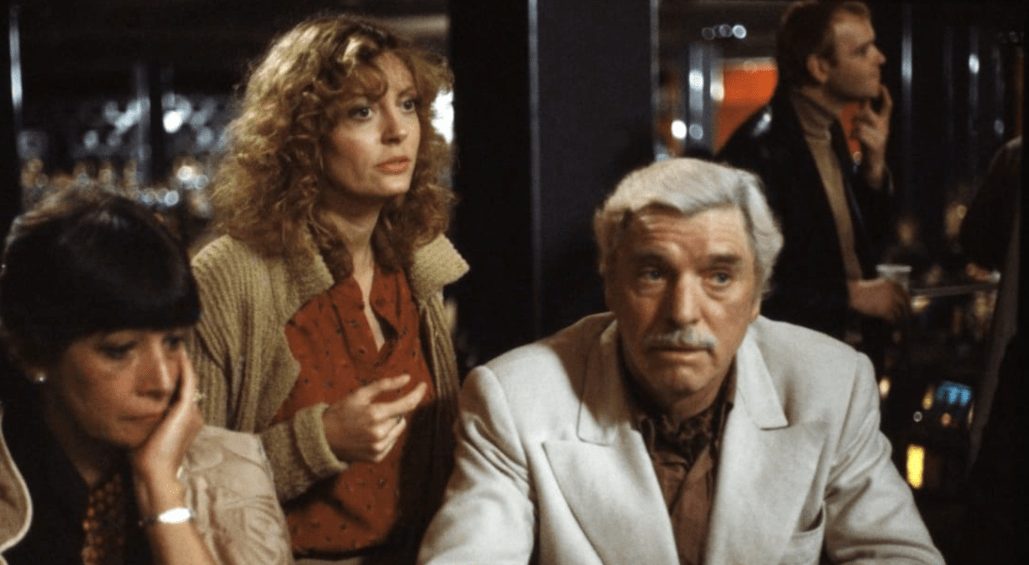
Lou trundles around Atlantic City taking a few cents for bets and wanting anyone who listens to know that back in the glory days of the Boardwalk Empire he was a big shot. Bugsy Siegel roomed with him in the slammer. Meyer Lansky asked his opinions on the latest scores. When he killed someone, he dove into the sea to wash the exhilaration from his body. Not his fault the glory days are gone, and his life has crumbled as much as the worn out city around him. He’s still a player.

Only of course he’s not. Played in a fine autumnal performance by Burt Lancaster, Lou has the front of an ageing star, but is a dyed-in-the-wool loser. He trades on a past that never happened, full of tall stories that only the dimmest and most impressionable would consider believing. He’s essentially a kept servant of Grace (Kate Reid), a former local beauty queen (third place) and spends his nights spying on his neighbour Sally (Susan Sarandon), while she washes away the stench of the hotel fish counter she works in.

When the chance comes to spin a fantasy that means Lou could actually impress and seduce this women, he jumps at it. That chance is Dave (Robert Joy), Sally’s pathetic dweeb of an ex-husband who believes Lou is the perfect to peddle his stolen cocaine around town. Dave winds up dead, Lou pockets the money, impresses the naïve but determined Sally (training to be a croupier) and very firmly considers letting her take the rap when the cocaine’s owners turn up looking for the money.

Both Lou and Sally are dreamers – or fantasists – at the opposite end of life’s scale. Lou dreams big about a past that never was. Sally is dreaming of an impossible future – one of French class, Monaco high-rollers and earning a future as a flash croupier. Really, we know both of their dreams are fantasies. After all it should be clear only losers wind up in Atlantic City. The casinos are dumps and even the criminals are pathetic, easily out-matched by Philadelphia hoods. Louis Malle’s film captures this perfectly in a crumpling city that looks like mouldy leftovers.

Malle’s film is a marvellously structured, low-key but highly effective character study, very well acted and shot with an intelligent, detailed eye. It’s a showcase for Malle’s subtle but intelligent camera work and composition. As Lou serves Grace early in the film, he is kept constantly in the centre of the frame, the camera jerking up and down to match his movements as he fetches and carries for the bed-bound Grace. Dave is frequently shot from above, looking even more pathetic and irrelevant with every shot. This is framing that speaks volume for status and character. The camera fluidly shifts across large spaces – the boardwalk, a casino – to show different interactions in different plains, characters either unaware of each other or using events elsewhere to escape notice.

Grimy and fabulously capturing the collapsing grandeur of a city fallen on very hard times, the setting is the perfect metaphor for the disaster of the character’s lives. None more so than Lou. You can argue Malle’s film may be too sympathetic to Lou – and, indeed, contemporary reviews discussed Lancaster’s inherent dignity mistaking it for the character. Lancaster however is smarter. Lou is a pathetic, sad figure. Look how he delights in puffing himself up as a big shot for the feeble Dave. Watch the childish excitement he takes in the notoriety he collects late in the film. Lancaster perfectly understands the desperate need to dress the part, longing to be something you are not: the grand, well-dressed sugar daddy who solves problems for his moll by unwrapping the elastic band from a roll of dollar bills.

Lancaster never allows this fantasy to be mistaken for reality. When danger comes, Lou almost always freezes or looks to keep himself safe. When he spins his stories of daring or classy confidence, Lancaster shows us a Lou who is replicating behaviours he has seen elsewhere. After completing his first cocaine deal, he has to wash his face in fear in a bathroom – then instantly condescends to an old friend who has been reduced to toilet attendant.

Sally is fooled for a while. But then we know she has a weakness for glamour. After all we’ve seen her indulge the pervy whims of casino trainer Joseph, a lecherous Michel Piccoli. In a clever performance by Sarandon, Sally is naïve enough to be sucked in but guileful enough to just about keep afloat. She tends to trust anyone who oozes confidence. She’s a little star-struck by the idea of Lou perving at her across the window (as if happy that she’s sexy enough to win the attentions of this seemingly classy old guy). But, turned, Sarandon makes clear she’s righteously furious when cheated and far more adept at confidence-tricksterism than the increasingly hapless Lou.

Because when crime comes Lou is out of his depth. But what would you expect from a man who is a live-in cook, dog-walker and sometime-stud for Grace, entombed in her kitsch-nightmare room. Kate Reid is very good as this clear-eyed bully who needs but also despises Lou, who knows all about what an unreliable and cowardly fellow he is deep-down but jealously guards his attentions.

Malle’s film plays out like a sort of noir short story, an adept study of its characters more focused on their damage and flaws than on the crimes at its nominal heart. This is about fantasy and the lies we tell ourselves. Just like Atlantic City kids itself it’s still a gambling mecca, so Lou and Sally believe they still have chances in life. It makes for an intriguing, engrossing film as they lie to themselves and each other, denying the truth until it hits them squarely and unavoidably in their face.

Atlantic City muses on familiar themes, but does so with freshness and intelligence. Perhaps Malle is a little too sympathetic to its characters (Lou in particular), but he is very clear-eyed about the Dennis Potterish fantasy world they are clinging onto and the shabby decline and disrepair that clutters their existence. It makes for a very fine, well-made and fascinating little film, full of sharp observations and wonderfully played beats.

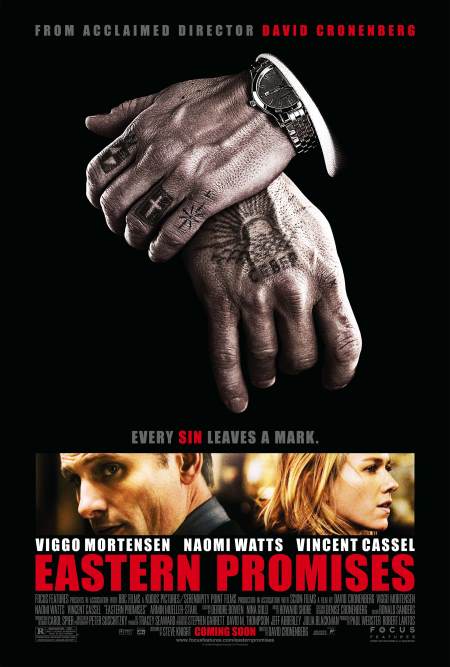
Eastern Promises (2007)

Eastern Promises (2007)

Brutal violence in London’s underbelly in Cronenberg’s formal and chilling dark fairytale

Director: David Cronenberg

Cast: Viggo Mortensen (Nikolai Luzhin), Naomi Watts (Anna Ivanova Khitrova), Armin Mueller-Stahl (Semyon), Vincent Cassel (Kirill Semyonovich), Sinead Cusack (Helen), Mina E Mina (Azim), Jerzy Skolimowski (Stepan Khitrov), Donald Sumpter (Inspector Yuri), Raza Jaffrey (Dr Aziz), Josef Altin (Ekrem), Tatiana Maslany (Tatiana’s voice)

Big promises shipped back to Russian villages, telling women about dreams they can make reality in the bright lights of London. Those are Eastern Promises – but the reality, of sexual slavery and abuse in Russian Mafia controlled houses is horrifyingly different. Set in an underbelly of London just under grand restaurants and red buses, Eastern Promises is a typically tough and bloody gangster fable from David Cronenberg, which plays out like a nightmare fairytale.

It’s the nightmare of midwife Anna Khitrova (Naomi Watts). When a pregnant Russian teenager dies giving birth, the only clue she has to who her daughter’s family might be is a Russian diary and a business card for a Russian restaurant. Anna – whose family are Russian immigrants – is offered help by grandfatherly restaurant owner Semyon (Armin Mueller-Stahl). Seymon is all pleasant insistence that he can help, even as asks after every detail of her life. Because Seymon is a ruthless Mafia kingpin, with a hapless son Kirill (Vincent Cassel) leaning on the emotional and practical support of his imposing, heavily tattooed driver Nikolai (Viggo Mortensen). As Anna is pulled further and further into Semyon’s deadly world of death, could she have a surprising saviour?

Cronenberg’s film, sharply scripted by Steven Knight, is shot with a traditional stillness and a palette of strong colours – all of which reassuring visual language is utterly at odds with the skin-slashing violence at its heart. Eastern Promises opens with a Russian gangster practically having his head sawn off with a switchblade, in the hands of a mentally-handicapped nephew of a minor Turkish gangster. There isn’t a single gun in Eastern Promises – after all that would be breaking British law! – instead violence is meted out with the violent intimacy of a knife across the throat.

The film’s formal structure and framing – angles and cutting are kept simple, almost static – works brilliantly. As we watch throats slashed, grim sexual encounters or moments of imposing menace, the matter-of-fact presentation of these become more-and-more chilling. Eastern Promises feels like a bogey-man fable. Seymon’s restaurant – all class and bright red walls – an ogre’s cavern that leads us into an ever-grimmer world of violence and mayhem.

It’s a world Anna is unprepared for. Determined and resilient, Naomi Watts’ Anna is also undone by her politeness. How can she refuse an offer to help from someone as polite as Seymon? Watts does extremely well with a slightly under-written role, a woman on a quest who slowly realises how terrible the world she is peeking into is, but stop from trying to force through what she believes is right. Her disbelief – and out-of-place semi-innocence and sense of moral duty – make her stand out all the more in this terrible underbelly world, full of ogres and secret codes.

At the centre of is a monster. Armin Mueller-Stahl looks like your favourite uncle, but he quietly exudes cold, remorseless villainy. He’s the sort of man who delights in cooking the finest borsch, playfully teases his granddaughter’s violin playing and doesn’t bat an eyelid about ordering a rival to be dismembered. Mueller-Stahl is terrifying as this man the audience instinctively knows is dangerous and will stop at no moral boundaries to get what he wants (watch the steely eyed kindness he asks Anna where she works, lives and who she knows during their first meeting).

The obvious moral void in Seymon makes the unreadable Nikolai even more intriguing. Played with an extraordinary physical and linguistic commitment by Mortensen, Nikolai’s body is a tattooed walking advert of his past and capacity for violence and he’s the sort of relaxed heavy who is as unfussed with stubbing a cigarette out on his tongue as he is with snipping fingers off a corpse. Mortensen’s skill here is to make us constantly unsure where the moral lines are for Nikolai. He is a confirmed killer, but he takes an interest in Anna. Is this sexual or protective? What does he make of his bosses’ brutality towards women? What does he think of his direct superior Kirill?

Kirill is played with a larger-than-life weakness by Vincent Cassel in a thrilling performance that constantly shifts expectations. At first, he seems like a drunken blow-hard with a capacity for thoughtless violence. But Cassel makes clear he is a weak man with some principles, bullied by his father (to whom he is a constant disappointment), desperate to prove he is more capable than he is. He has an emotional reliance on Nikolai laced with sexual fascination (he can barely keep his hands off him).

Nikolai seems to accept this. But we don’t seem to know why. His actions are constantly open to interpretation. Ordered to have sex with a prostitute, he almost apologises to her after – left alone with her after Kirill has watched their sexual encounter, he’s strangely tender. He urges Anna to keep her distance but follows orders with calm disinterest. How far will he go? What moral qualms does he have, if any? Mortensen’s carefully judged performance is a master-class in inscrutability in a film that plays its cards very close to its chest as to why he (and others) do the things they do.

Cronenberg’s entire film is structured like this. Is the dragon a dragon or a potential knight? Can Anna emerge from this semi-Lynchian nightmare world and return to normal life – or will everything connected to her be destroyed by this world. Cronenberg’s study of this shady, heartless world is masterful. The “rules” and code of this brutal Russian Mafia world are excellently explored. And the film’s formal style culminates in a stunningly violent but beautiful (if that’s the right word) fight between a nude Mortensen and two knife-wielding Checians in a Turkish bath that is a brutal model for how these things can be done.

Eastern Promises resolves itself, after twists and turns, into something more comforting and traditional than you might expect. But is it a fairy tale ending to a nightmare? Either way, Cronenberg’s mix of formality and unflinching gore is masterful and in Mortensen it has a performance both relaxed and full of tightly-wound violence. Tough but essential.

Get Carter (1971)

Get Carter (1971)

Brutal, dark and nihilistic British gangster film removes any chance that you might fancy trying a life of crime

Director: Mike Hodges

Cast: Michael Caine (Jack Carter), Ian Hendry (Eric), John Osborne (Kinnear), Britt Ekland (Anna), Brian Mosley (Cliff Brumby), George Sewell (Con McCarty), Tony Beckley (Peter the Dutchman), Glynn Edwards (Albert Swift), Alun Armstrong (Keith), Bernard Hepton (Thorpe), Petra Markham (Doreen), Geraldine Moffat (Glenda), Dorothy White (Margaret)

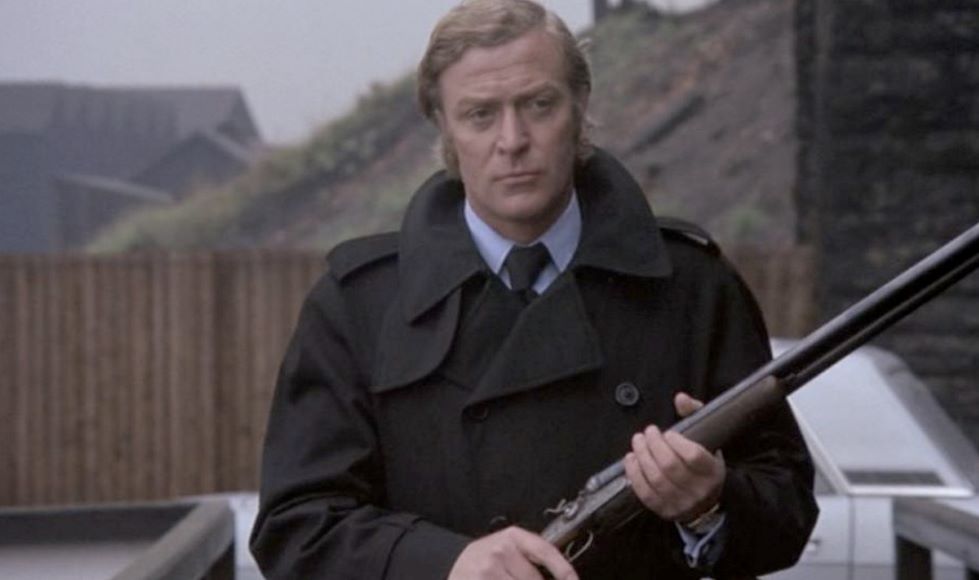
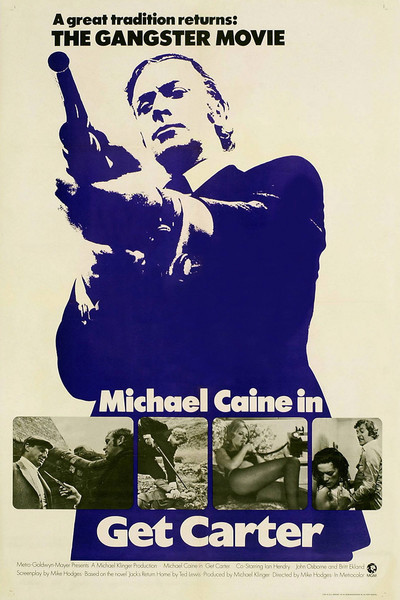
It’s probably the finest British gangster film ever made. Get Carter is a cold, dark, grimy film – a punch to the solar plexus, which completely rejects any sense of charm in its gangster characters. Michael Caine called Jack Carter a shadow Caine, the man he could have become if his life had broken out slightly differently. It’s set in an unremittingly bleak Newcastle, but it feels like it might be happening in an anti-chamber of hell, with its thoroughly amoral lead barely aware he’s spiralling towards destruction. It’s a sociopathic, Jacobean revenge tragedy set among the dirt filled suburbs of Newcastle.

Jack Carter (Michael Caine) is a professional fixer for London gangster brothers. He returns to his childhood home of Newcastle after the sudden death of his brother. But he’s not satisfied with the official explanation. Instead, he dives into an investigation, in which he cares not a jot about the collateral damage he causes or the likely reaction of the underworld powers that be as he rocks the boat to destruction, trashing the lives of everyone he meets, good and bad.

Powered by an extraordinary performance of blank nihilism and cold, unexpressed fury by Caine, nominally Jack is a man motivated by the harm done to his family. However, Hodges film is so cold-eyed and realistic about the mentality of gangsters, we know it’s just an excuse. Carter is never heart-broken, he’s annoyed. His brother may have been punished and his niece (it transpires) misused, but fundamentally what motivates Carter is the affront. By taking a pop at his family, he feels they really think they can take a pop at him. How dare they: he’s Jack Carter.

Any charm Carter has, solely comes from residual affection for Caine. By any measure, Carter is an awful man (even if he has a good turn of phrase). He is a sociopath with no concern for anyone. When friendly Keith (a young Alun Armstrong) is beaten black and blue for helping Carter, how does our hero respond? Tosses a few bank notes on his bed and tells him “buy some karate lessons”. Carter sees the world solely as made up of debts, which can be discharged by money, never mind the situation. His niece throws beer over a friend? He’ll pay for the dry-clean. Keith gets bashed up: take a roll of twenties, what’s your problem?

Carter directly kills four people (and is responsible for several other deaths), all with a blank-eyed lack of reaction. There isn’t any sadism to what he does – the deaths are mostly efficient and to his mind, justified, because by taking actions against his family they disrespected him. When he locks a woman in the boot of his car, and a pair of heavies push the car into the Tyne he doesn’t bat an eyelid at her inevitable death (never mind he slept with her hours before). People who find themselves close to Jack, or drawn into his circle, suffer terribly and he literally couldn’t care less.

Get Carter is the bleakest of all gangster films, shot with an imaginative kitchen-sink beauty by Mike Hodges, which actually carries a lot more visual glory than you might expect. Drained out colours abound – there are virtually no bright primary colours in this, with the whole of Newcastle a mix of muddy browns, soot-stained greys and filthy charcoals. Hodges’ film is also dynamic and fast-paced: he throws in striking aerial and crane shots (there is a beautiful shot that follows a car chase from a bird’s eye view), but also gets down and dirty in this grainy world.

It’s an urgent, lean and mean film constantly kicking you in the shins, but told with skill and artistry. Hodges pieces together a marvellous early scene, where Carter visits local heavy Kinnear (a suave, chillingly well-spoken John Osborne): simultaneously, in one single location, two scenes (both with vital information) play out at the same time – Carter chats to Kinnear’s moll Glenda (Geraldine Moffat), picking up vital information while on the same sofa Kinnear beats his guests at cards. Everything though is perfectly clear: masterful stuff. It’s also a film crammed with small details that reward careful viewing: Carter’s bed has a cross-stitch of “What would Jesus say?” above it (I dread to think) and on his train journey, look out for a fellow passenger with a distinctive ring.

So confidently is this put together, it’s amazing to think Hodges was a first-time director. This is a film dripping with menace, but also a horrifyingly immersive camera. We are frequently thrown into the midst of the action. Carter frequently looms over the camera or is filmed in violent motion moving towards his next goal. There is not a jot of romanticism around the film: neither about the gangsters or the bleak world they operate in. Newcastle is pre-Thatcherite hellhole, with precious little glamour. Even the gangster locales – the clubs and pubs – are bashed-up and unpleasant.

Across the board, the gangsters are exposed as cruel, heartless and vile. Touches of class are ruined by everyone’s fundamental lack of class. Cliff Brumby’s (Brian Mosley) planned classy restaurant sits atop a concrete multi-story car-park. Kinnear’s (John Osborne) fancy country house is the setting of the grimmest, most depressing orgy you’re likely to see. Carter is trying his best to dress classily, but his cruelty always punctures the illusion. He’s introduced watching a porn film with his bosses in London and the film revolves around the seamy underworld of homemade porn.

The women in the film are primarily used by the gangster as props for these films, and Get Carter doesn’t shy away from the exploitative fate for women in this world. However, you can’t disagree that it takes in a bit of exploitation itself. Britt Ekland has high billing for her single scene, where she lies mostly naked on a bed pantily having phone sex with Carter (who goes about this, as all things, with a functional efficiency, at least as interested in the excited reaction of his middle-aged landlady who is sitting in the room with him while he chats on the phone). It’s undeniably a moment for us to gawp but it still feels less cold and cruel than those awful porn films.

Carter discovers his niece has found her way into these. He even sheds a tear over this: but he doesn’t care because of what has happened to her. Again it’s all about him: Carter couldn’t care less about the morals and is perfectly happy for porn to soak up other women. He’s not really that interested in his niece: it’s all about the damage to him, that a “made man” like him should have a member of his family getting boffed like a slag for others entertainment. How bloody dare they?

Get Carter understands this is a dark and soulless world, and is a film bereft of hope. Its hero is a revenge obsessed sociopath, who only smiles in the film after he has burnt everything around him down. Gangsters destroy everything they touch and care about nothing other than themselves. All debts can be settled with money, all women are toys to be used and thrown away. Death means nothing and the world is a drained-out hell of shabby houses and dirty clubs. It’s the grimmest and finest British gangster film out there. Who would want to be gangster after seeing this?

Drive (2011)

Drive (2011)

Neon, darkness and shades of grey fills the screen in a film that’s practically the definition of cult

Director: Nicholas Winding Refn

Cast Ryan Gosling (Driver), Carey Mulligan (Irene Gabriel), Bryan Cranston (Shannon), Albert Brooks (Bernie Rose), Oscar Isaac (Standard Gabriel), Christina Hendricks (Blanche), Ron Perlman (Nino Paolozzi), Kaden Leos (Benicio Gabriel)

Impassive and supernaturally calm, the Driver (Ryan Gosling) sits with the car engine purring. In this five-minute window he is the get-away driver who will go to any length. Outside of that, criminals are on their own. Its one of the simple rules he lives by. He never compromises. Until, of course, he finds something worth compromising for. That would be his neighbour Irene (Carey Mulligan) and her young son Benicio (Kaden Leos), trying to make ends meet while her husband Standard (Oscar Isaac) is in prison. The Driver helps them – and feels compelled to go on helping them when newly released Standard (trying to go straight) does one more job to get out from under the thumb of his criminal friends. That last job is always the worst one isn’t it? Particularly when crime lords as ruthless as Bernie (Albert Brooks) and Nino (Ron Perlman) are involved.

Drive won Refn the best director award at Cannes (after a huge standing ovation). It’s not hard to see why. This film is so overflowing with style, uncompromising cool and unreadable enigma it was practically a cult classic before it was even released. Layered in a mix of 70s and 80s chic – with its electric pink titles, John Carpenter-ish Los Angeles visuals and counter-culture smarts – it echoes cutting-edge crime drama from the punk years of Hollywood (it’s practically a remake of The Driver for starters!), by way of touches of Melville crime drama and Spaghetti Western anti-hero. Scored to a mix of ambient beats and electronic rock, it’s the dictionary definition of style.

It keeps you on your toes from the start. Its opening not only explores the Driver’s incredible skills (speed, manoeuvring, ingenious evasions and knowing when to go slow, he can do it all) it also sets us up for the whole film. Shot largely alongside the Driver in the car, we zip through streets and understand the determination (and hints of danger) under his impassive surface. That prologue is the whole movie in capsule – a careful wait, a sense of a fuse being list, touches of humour to distract us (the Driver’s precision with his gloves) and brilliant misdirection when his focused  attention to listening to a football game on the radio pays off in spades when we see his plans revealed.

Much of the first 40 minutes carefully develops the Driver’s surprisingly contented life: his happy acquiescence in the racing dreams of his fixer and mechanic boss Shannon (an ingratiating Bryan Cranston), who the Driver likes so much he doesn’t care that Shannon regularly swindles him; a soft, unspoken half-romance with Irene (Carey Mulligan, truthful and with a strength beneath the vulnerability); and a big-brother bond with her son Benecio. In another world this could have been a film where a loner learns to make a connection and finds love.

But it ain’t that film. The troubles start with Standard’s release from prison. Skilfully played by Oscar Isaac as well-meaning but essentially hopeless, Standard’s problems become Irene and Benecio’s problems. That one last job goes south – as they always do – in an orgy of cross, double cross and increasingly graphic violence. And the burning propulsive energy that lies under Drive, just like that purring engine in the films opening, is let rip.

What we get in the second half is dark, nihilistic and violent. Oh, good Lord, is it violent. Bone crunchingly, skull shatteringly, blood spurtingly violent. Because when gangsters get pissed off, they play for real. And it turns out, when the Driver finds something to care about, he plays for real as well. Refn’s eye for violence is extremely well-judged. We see just enough for it to be horrifying, but the worst is done via sound and editing (the Driver’s almost unwatchable assault on a goon in a lift puts almost nothing on screen, but the squelches and crunches on the soundtrack leave nothing to the imagination).

Refn’s trick is to combine lashings of indie cool and ultra-violence with a deceptively simple story that allows plenty of scope for interpretation. Drive has a sort of mythic, Arthurian quest to it, with the Driver as a sort of knight errant, defending a damsel in distress. But it’s also a grim crime drama, with a man at its centre who brutally kills without a second thought. This all depends on the enigmatic Driver at its heart. No other actor alive can do unreadable impassivity like Ryan Gosling – this could almost be his signature role. He’s ice-cool and professional, but also rather child-like and gentle.

Is he a guy dragged down by his own worst impulses? His jacket has a large scorpion on its back, echoing the old fable of the frog and the scorpion. Rather than one or the other, the Driver feels like both in one. A frog who wants to carry everyone over the river, but whose poor instincts and capacity for violence acts as the scorpion that destroys him. Where does he come from? What is his past? The film ends with a series of enigmatic shots that, to my eyes, suggest a supernatural quality to him. I sometimes toy with the idea he’s a sort of fallen angel, constantly protecting the wrong people like he has a scorpion curse on him. Refn’s gift is to craft pulp with psychological intrigue.

Drive is a very cool film – and Carey Mulligan and Ryan Gosling’s careful playing gives it a lot of heart, just as Albert Brooks’ marvellously dangerous gangster gives it a sharp, unpredictable edge. It rips its eye through the screen, with pace, speed and iconic imagery, all splashed with a pop art cool. But it’s not just a celebration of style: it’s also a dark romance, a tragedy and an exploration of a character who may be his own devil or may not even be human at all. Either way, its intriguing and exciting. Can’t ask for much more than that.

Widows (2018)

Widows (2018)

Sexism, racism and corruption get mixed in with crime drama in McQueen’s electric heist film

Director: Steve McQueen

Cast: Viola Davis (Veronica Rawlings), Michelle Rodriguez (Linda), Elizabeth Debicki (Alice), Cynthia Erivo (Belle), Colin Farrell (Jack Mulligan), Brian Tyree Henry (Jamal Manning), Daniel Kaluuya (Jatemme Manning), Jacki Weaver (Agnieska), Carrie Coon (Amanda), Robert Duvall (Tom Mulligan), Liam Neeson (Harry Rawlings), Jon Bernthal (Florek), Garret Dillahunt (Bash), Lukas Haas (David)

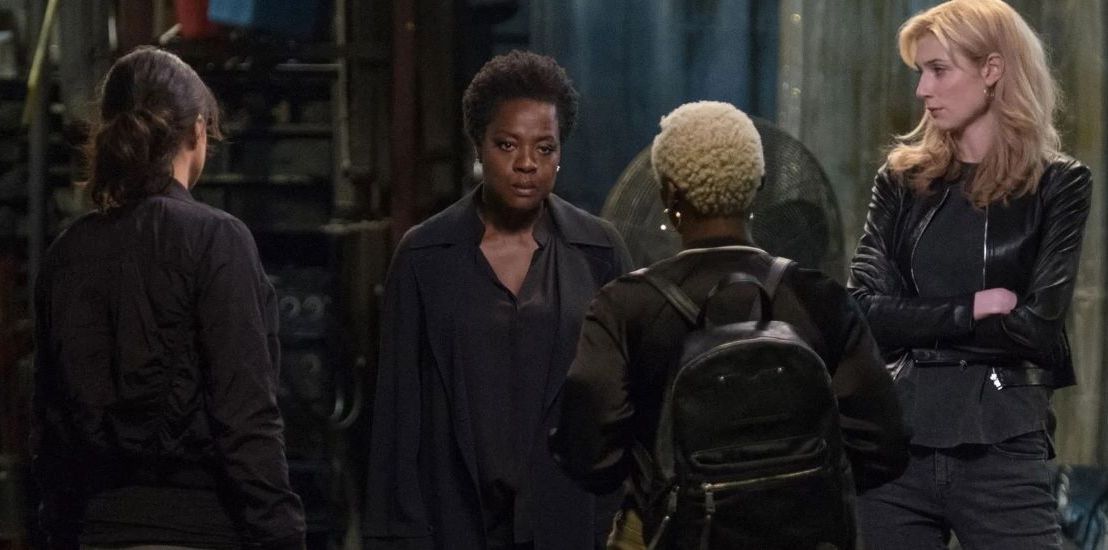
A getaway goes wrong and Harry Rawlings (Liam Neeson) and his criminal gang all wind-up dead and their loot burned up. Their last job was cleaning out the election fund of gangster-turned-electoral-candidate Jamal Manning (Brian Tyree Henry). Manning believes he’s owed a debt by Harry’s widow Veronica (Viola Davis). On the hock for millions, Veronica has no choice but to recruit the widows of Harry’s gang to help her pull off the next job Harry planned: cleaning out the campaign fund of Manning’s electoral rival Jack Mulligan (Colin Farrell).

Adapted from an 80s British TV mini-series, Widows has been run through Steve McQueen’s creative brain, emerging as a compelling, beautifully shot crime drama mixing social, racial and gender commentary with blistering action. It takes a traditionally masculine genre – the crime caper – and places at its heart a group of women motivated by desperation and survival rather than the lure of lucre.

What’s particularly interesting is that none of these women fit the bill of the sort of person you expect to arrange a daring heist. Viola Davis’ Veronica is a retired teachers’ union rep; Elizabeth Debicki an abuse victim, treated terribly by her husband and selfish mother; Michelle Rodriguez a shop owner desperately trying to give her kids a chance, despite her husband’s reckless gambling. Even the driver they hire, played by Cynthia Erivo, is a hairdresser and babysitter. These women are a world away from the ruthless criminals you’d expect to pull off this kind of operation.

It’s probably why they are routinely underestimated and patronised by men. Veronica is advised clear her debt by selling either everything she owns and disappear. As with the rest of the women, the world expects her to put up and shut up. These are women defined by their husbands and the expectation that their needs are subordinate to others’. Debicki’s Alice is all-but pushed into escort work by her demanding mother, while Rodriguez’s Linda is blamed by her mother-in-law for her husband’s death. But these women have a steely survival instinct that makes them determined and (eventually) ruthless enough to take this job on.

Davis is superb as a determined and morally righteous woman, whose principles are more flexible than she thinks. She efficiently (and increasingly sternly) applies her organisational skills to planning the heist, pushing her crew to adapt her own professionalism. Davis wonderfully underplays Veronica’s grief, not only at the loss of her husband but also the recent death of her son (shot by police officers while reaching to answer his phone behind the wheel of an expensive car – in front of a wall of Obama “Hope” posters, a truly striking visual image).

Her co-stars are equally impressive. Debicki has mastered the mix of vulnerability and strength behind characters like this (how many times has she played suffering, glamourous gangster molls?). Her Alice gains the self-belief to push back against those exploiting her. Rodriguez beautifully balances grief at the loss of her husband with fury at the financial hole he has left her in. Erivo gets the smallest role, but makes Bella dry, loyal and sharp. All four of them use the way men underestimate them – seeing them as widows, wives, weak or sex objects – to plan out their heist.

The reversal of gender expectations crosses over with the social political commentary McQueen wants to explore. This sometimes works a treat: the flashback to the shooting of Veronica’s son is shockingly effective. But the film’s dives into the Chicago political scene and the deep class divisions in the city don’t always have the impact they should. There is a marvellous shot – all in one take, mounted on the car bonnet – as Farrell’s Mulligan travels (in a few minutes) from a photo op in a slum back to his palatial family home, emphasising how closely extreme wealth and poverty sit side-by-side in America.

Both candidates are corrupted in different ways. Jamal Manning – a knife behind a smile from Brian Tyree Henry – is a thug talking the talk to line his pockets. Farrell’s Mulligan has more standards – and you wish for more with this fascinating put-upon son part on-the-take, part genuinely wanting to help. His domineering dad – an imperiously terrifying Robert Duvall, who wants to backseat drive his son in office – demeans his son, shouts racial slurs and bullies everyone around him. Politics: your choice is the latest off-spring of a semi-corrupt dynasty or a literal criminal.

But the film doesn’t quite find the room to explore these issues in quite as much detail as you feel it could: it’s a strong hinterland of inequality, but you want more. McQueen however, does have a gift for unique character details that speak volumes: the women’s operation is shadowed by an electric Daniel Kaluuya, as Manning’s calm yet psychotic brother, who listens to self-education podcasts on Black history and shoots people without a second thought. He, of course, underestimates the women as much as everyone else. That’s as much of a political statement as anything else: none of the men in this film seem to even begin to think that they could be in a world which is truly equal.

The film adds a late act reveal that doesn’t quite work – and the film as a whole is trying to do a little too much – but it’s a confirmation of what a gifted and superb film-maker Steve McQueen is. McQueen shoots even conventional scenes in unique and interesting ways – check out his brilliant use of mirrors throughout – uses editing superbly to set tone and is brilliant at drawing the best from talented actors. Widows is crammed full of terrifically staged scenes and gallops along with pace and excitement. It’s a fine example of a great director turning a genre film into something deeper.

Bugsy (1991)

Bugsy (1991)

Old school glamour is the order-of-the-day in this luscious but slightly empty gangster film

Director: Barry Levinson

Cast: Warren Beatty (Ben “Bugsy” Siegel), Annette Bening (Virginia Hill), Harvey Keitel (Mickey Cohen), Ben Kingsley (Meyer Lansky), Elliot Gould (Harry Greenberg), Joe Mantegna (George Raft), Bebe Neuwirth (Countess Dorothy de Frasso), Bill Graham (Charlie Luciano), Lewis van Bergen (Joe Adonis), Wendy Phillip (Esta Siegel), Richard C Sarafian (Jack Dragna)

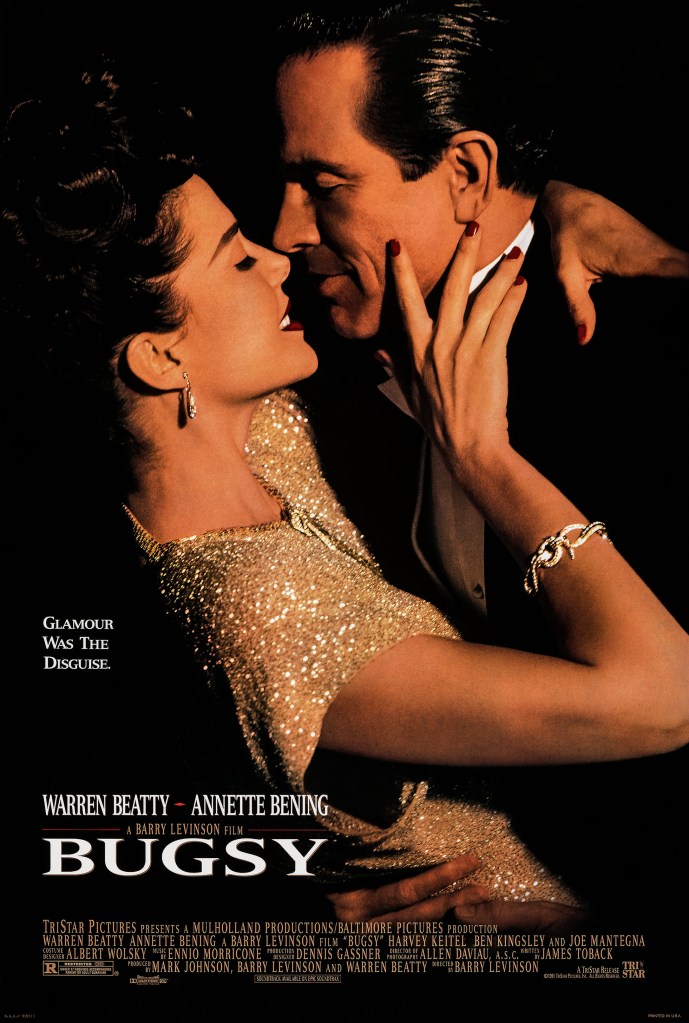
Las Vegas: the city of dreams for gangsters. As Ben (“Bugsy” – but don’t call him that) Siegel (Warren Beatty) tells a room full of gangsters when he’s pitching for their investment, like a hyper-violent Dragon’s Den: build the largest city in a state, you own the state, own the state and you own a slice of America. Imagine how the money can come rolling in then. It’s fair to say the mobsters aren’t so certain – and maybe Las Vegas would never have been a huge success if Bugsy had run it rather than being whacked – but God knows their investment paid out millions of times over.

The dream of building Las Vegas is at the centre of Beatty’s passion project (in this one he just played the lead and produced, dropping a couple of hyphens compared to Reds), a Golden-hued, romantic biopic of notorious gangster (and killer) “Bugsy” Siegel. Siegel sees what no-one else could see: how a city in a law-lax desert could become a mecca for gamblers, and crime could reap the profits. But the project goes millions over budget – not helped by girlfriend Virginia Hill (Annette Bening) creaming millions off the top. Trouble is Bugsy’s investors aren’t the sort of guys who shrug their shoulders at failed investments.

You can see what attracted Beatty to Bugsy. For all it’s about gangsters, I couldn’t escape the feeling Beatty sees Bugsy as something akin to a fast-talking movie producer. Bugsy spins elaborate stories for his backers of how their investment will pay-off, builds fantasies on a huge scale, won’t accept any compromise (a load-bearing wall should be knocked down if it’s blocking the view of the pool!), pouring his heart-and-soul into every detail of his vision. It doesn’t feel a world away from the same control-freak energy Beatty poured into Reds (Bugsy is basically financier, manager, backseat architect and marketing man for his dream).

Bugsy feeds a lot off the fascinating two-way admiration street between Hollywood and gangsters. Beatty’s Bugsy is enamoured with Hollywood, even shooting a (terrible) test reel to try and break into the movies. He’s thrilled to be hanging around with old pal George Raft (a muted Joe Mantegna), who seems equally jazzed to hook up with notorious criminals. Hollywood laps up the notoriety of criminals, both on-screen and off. For his Flamingo launch, Bugsy wants to stuff the place with stars (to his fury, bad weather prevents them arriving), and schmoozing celebrities is at least part of what is going to make the City of Sin such a fun place.

Levinson’s film is shot with a romantic lusciousness, a sepia-tinged nostalgia that wants you to soak up the glory of the costumes, sets and the cool of being a quick-witted gangster who gets all the best girls. It’s very different from the real Bugsy, a brutal killer with a huge capacity for violence. The film tries its best to match this, but can’t escape the fact that Beatty is way more suave and charming than Bugsy deserves. For all we’re introduced to him gunning down a cheating underling – and we see him brutally beat others for bad-mouthing Virginia or using his loathed nickname – he never feels like a brutal criminal, but more like a flawed, romantic dreamer with a temper.

It’s hard not to compare Bugsy with the best works of Scorsese from the same era. Goodfellas knew that, under the surface glamour, this was a dog-eat-dog world and that there was no romance at the end of a bullet. Casino (which followed a few years later, a sort of semi-sequel) sees the true vicious sadism and greed at the heart of this city-building operation, while Bugsy sees it more as a lavish dream and a tribute to a sort of visionary integrity. Even seeing Bugsy gunned down in his own home by a sniper, doesn’t carry  with it the sort of inevitability it needs. As Scorsese understands, this way of life is like playing Russian roulette forever – eventually the chamber is going to be full. For all Bugsy literally plays roulette, it never feels like he’s playing with fire, more that he’s reaching slightly beyond his grasp.

Perhaps Levinson doesn’t quite have the vision to make the film come to life or stamp a personality on it. It feels like a film that has been carefully produced and stage-managed to the screen – and Levinson deserves credit for marshalling such an array of commanding personalities together to create such a lavish picture. But it’s muddled in its message. Is Bugsy actually worth making a film about? What are we supposed to understand from this: was he a killer out of his depth, or an unlucky dreamer? Bugsy wants him to be both, but fails to make a compelling argument for either.

Beatty is impressive in his charisma though, for all he never quite seems to have the edgy capacity for instant violence the part needs. He does capture Bugsy’s desire for self-improvement, from the Hollywood dreams to the eternal elocution lessons he repeats over-and-over like a mantra. His desire for glory even manifests as a bizarre fantasy that he is destined to assassinate Mussolini. It also perhaps explains why he’s drawn to Virginia, a would-be starlet. Annette Bening gives arguably the most impressive performance (but, inexplicably, was practically the only major figure involved in the film not to pick up an Oscar nomination) as a woman who is an unreadable mix of devoted lover and selfish opportunist, leaving us guessing as to her real intentions and feelings.

There is good support from Keitel (hardly stretching himself as Bugsy’s number two Mickey Cohen), Kingsley (an ice-cool but loyal Meyer Lansky, unable to stop Bugsy destroying himself) and, above all, Elliott Gould as Bugsy’s hopeless, pathetic best friend. Bugsy though, for all it’s entertaining, feels like a mispackaged biopic that wants to turn its subject into a romantic figure, unlucky enough to be rubbed out before he could be proved spectacularly right. This soft-soap vision doesn’t ring true and misses the opportunity the film had to present a more complex and nuanced view of the era and its crimes.

Calm with Horses (2020)

Calm with Horses (2020)

Irish gangsters manipulate a violent but needy boxer in this well-made debut

Director: Nick Rowland

Cast: Cosmo Jarvis (Arm), Barry Keoghan (Dymphna), Niamh Algar (Ursula), Ned Dennehy (Paudi), Kiljan Moroney (Jack), David Wilmot (Hector), Anthony Welsh (Rob), Simone Kirby (Jules)

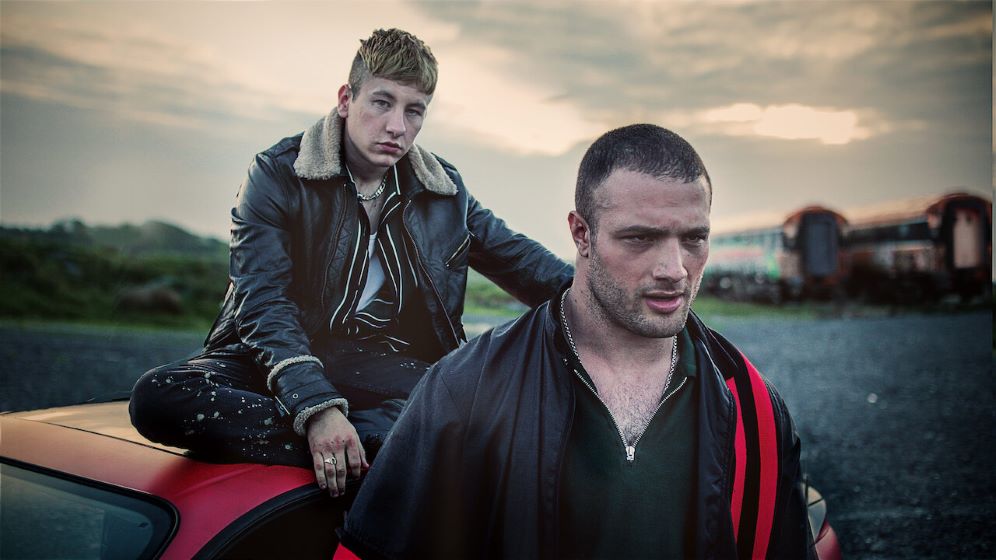
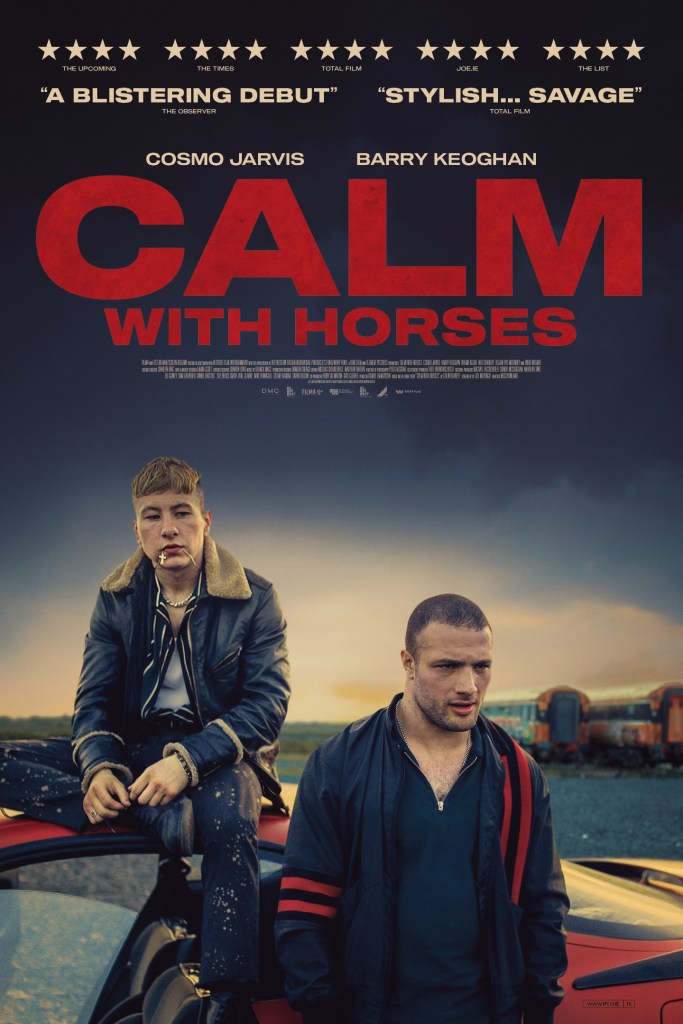
In rural Ireland a former boxer, Arm (Cosmo Jarvis), has found a new outlet for violence as an gang enforcer. But Arm is, at heart, a gentle soul, and his desire to belong and be part of a “family” is effectively exploited by the gang, especially his weaselly, bullying boss Dymphana (Barry Keoghan) who treats him like an affectionate pet-dog. His ex, Ursula (Niamh Algar), mother to his autistic son Jack, wants him to change his ways or stay out of their lives. But can Arm change?

Rowland’s film has a deliberately seedy quality to it, shot with a grimy intensity and crawling along on its belly among the mud and filth of Irish crime gangs. It’s a thrilling expose though of how crime takes and takes and is never satisfied. It’s turned Arm into a shell, throwing him the odd bone of inclusive comfort, then ordering him out like a rabid dog to hand out another beating to anyone who has crossed the family.

The main target is a man the heads of the family suspect of raping their teenage niece – although whether this was genuine sexual assault or simply a question of perverse family pride is left open. Arm opens the film by handing out a vicious beating – albeit one where he carefully lays out the ground rules with his victim before going about it with a punch-clock sense of duty. It’s what Arm is used for – a not that bright, piece of muscle who, despite his intimidating presence, will do (almost) anything for anyone who makes him feel wanted.

Even if the main person who does is as a dastardly as Dymphana. Keoghan is very good as a snide, insidious small-time crook, who openly calls Arm his dog and fills his head with prejudices and suspicions designed to keep him in his place. If he’s the dark angel, then Ursula is the good one: Algar equally brilliant as a decent, kind, supportive person who has come to the end of her tether with a man who she now feels is a danger to the fragile temperament of her autistic son.

It’s the fate of this son that will penetrate through the dead exterior shell that surrounds Arm, and make him start to question his own life. There is more than a hint that the fragile, timid, surly Arm – beautifully played, with a haunting gentleness under the violent exterior by Cosmo Jarvis – suffers from a similar condition to his son. Like him, he finds rage he can’t control bubbling up inside him (Arm is hopelessly ill prepared for helping his son during Jack’s emotional outbursts). He at times lacks an emotional intelligence to understand how people are treating him and why. It’s something Ursula knows and recognises – and why she gives him as many chances as she does.

Like his son, Arm finds himself calmed by engagement with animals (the title comes from Jack’s therapy sessions, horse riding). He also, buried somewhere in him, has a strong sense of right and wrong and eventually finds the courage to question his orders, as he begins to understand he really belongs not with them but with his ‘true’ family. His motivations shift from simply pleasing his masters to finding the money Ursula needs to move to Cork and place Jack in a special-needs-school, a need for his son that he slowly learns to place above his own wants and desires.

Eventually this explodes into scenes of retributive violence, shot by Rowland with an immersive intensity (there are some particularly uniquely filmed country-lane car-chase scenes, with the camera mounted on the car at an unusual angle). The violence that has lurked only just beneath the surface of the crime family, bubbles savagely to the top as it’s made clear that even the slightest deviation from what the family wants or expects from its enforcer will never be tolerated.

At times, Calm with Horses is a little too reminiscent of other crime dramas: for all its intelligent and skilful construction and playing, there isn’t a lot that feels really original here. Its influences are plain, but what it has is an intelligent empathy for its characters, and their situations, that constantly rewards you. At times, these characters surprise you with how far they will go: at others they disappoint you with their selfishness. But, thanks to the acting and direction, they always feel real.

Calm with Horses is an impressive debut, confident and exciting. Jarvis is superb as an inarticulate, unaware gentle-ish giant, with Keoghan and Algar outstanding in support (both were BAFTA nominated). It’s grimy, matching the dangerous world its set in, but it also has flashes of hope and understanding in it, little moments of calmness that pepper the darkness. It’s a fine crime drama.

The French Connection (1971)

The French Connection (1971)

A ruthless, obsessed (of course!) cop chases down a drug kingpin in this Best Picture winning crime drama

Director: William Friedkin

Cast: Gene Hackman (Detective Jimmy “Popeye” Doyle), Fernando Rey (Alain Charnier – “Frog One”), Roy Scheider (Detective Buddy “Cloudy” Russo), Tony Lo Bianco (Salvatore Boca), Marcel Bozzuffi (Pierre Nicoli – “Frog Two”), Frédéric de Pasquale (Henri Devereaux), Bill Hickman (FBI Agent Bill Mulderig), Ann Rebbot (Marie Charnier), Harold Gray (Joel Weinstock), Arlene Faber (Angie Boca), Eddie Egan (Captain Walt Simonson), Sonny Grosso (FBI Agent Clyde Klein)

Cops and criminals: do they have more in common than we’d like to think? In Friedkin’s Oscar-winning The French Connection, the lead cop and criminal are both obsessive, single-mindedly ruthless and locked into a cycle of actions that isn’t going to be change with one big bust. Look at them in isolation and its hard to tell at times which is which: the French drug dealer is a suave cosmopolitan type, unfailingly cultured and polite, but remorseless; the cop is a border-line racist and narcissist who doesn’t give two hoots about collateral damage, kills without remorse and whose life is one of tunnel-visioned obsession.

Based on a true-story – the model for Doyle, Eddie Egan, has a cameo playing his own boss – the film covers the arrival in New York of French heroin dealers, led by Alan Charnier (Fernando Rey) looking to make a killing with their prime product. Opposite them is narcotics officer Jimmy “Popeye” Doyle (Gene Hackman), who’s practically the dictionary definition of anti-hero. Doyle and Charnier engage in a battle of wits and force across New York during one blisteringly cold few days in Winter, and never mind who gets in the way.

The French Connection is about masculinity, and that no matter what many men don’t like to lose. Getting beat is certainly the main concern for Doyle, who I’m not sure has ever really thought twice about the impact of drugs (he’d be just as passionate chasing down coca-cola or stamps if you banned those). Neither has Charnier, with his reassured cool of old Colonial Europe, which just knows better than the nouveau Americans. (there is an underlying subversive fear of America being undermined by this suspiciously metropolitan Frenchman, the country’s best defence being a loud-mouthed, son of the streets).

Played superbly by Gene Hackman, Doyle is presented as a man we are invited to make up our own mind about. He’s obviously an effective detective and he doesn’t just go the extra mile: the job is a night-and-day obsession. He’ll spend hours pounding the streets, staking out a hotel on a rainy street, walk miles tailing a subject and barely spend a minute off-duty. He’ll also drive cars wildly though crowded streets, shoot a man in the back, rough-up suspects and treat others with an abrupt anger, xenophobia or both. As a model for the society he’s sworn to protect, he’s a disgrace – but is he the effective agent of crime-fighting we need?

Friedkin’s film largely aims to present Doyle as he is, within its documentary realism – although I’d argue the film repeatedly looks at his commitment and never-say-quit-energy with barely veiled admiration. The film is assembled with an on-the-streets immediacy reminiscent of The Battle of Algiers – added to by the casting of many non-actors in key roles. It’s shot with a drained-out series of muted colours (even more drained-out in Friedkin’s egotistical blu-ray remastering). All shot on location, it captures the slummy flavour of the rougher ends of New York. Right from the off, we see Doyle and Russo roughing up an informer in something between a slum and building site (including the famous “do you pick your toes in Poughkeepsie” exchange, a classic bit of psychological messing with criminals – incidentally check out Scheider trying not to corpse as Hackman roars through this.)

The investigation proceeds with a muted sense of grounded realism. There is a lot of time-consuming following, watching and taking notes. Word is picked up by informers. Careful surveillance work fills out the gang and its members. Doyle is constantly frustrated by bureaucratic demands, not to mention turf-war squabbles with the FBI (who, in addition, think he might be next door to a dirty cop which is pretty fair). Similarly, the criminals go through careful negotiations around timing, testing the purity of the goods and working out the best way of dodging the cops.

Friedkin’s film is so wrapped up in a perfect “slice of life” documentary realism shell, that it gets away with much of the second half being a piece of pure filmic flair. First and foremost is its famous car-chase. Narrowly surviving an assassination attempt from “Frog Two”, Doyle requisitions a car and hares through New York at 100mph trying to beat the elevated train “Frog Two” is escaping on, to the next station. In this superbly cut sequence, Friedkin pioneers the sort of low-angled front bumper shots that would be a staple of car chases for years to come. It’s pounding, gripping and brilliantly assembled, a raw slice of action that uses the film’s documentary style to trick you into thinking it’s something akin to the realism elsewhere.

But it’s a bit of filmic fantasy – and wouldn’t be out of place in Dirty Harry, the other 1971 film about a morally-complex cop. Doyle is certainly a less attractive person than Callahan – with no real moral feelings just a love of winning. Winning is what motivates him in this car chase: he has little interest in questioning the shooter (who has, to be fair, taken out several civilians, including a mother of a young baby) or preserving public safety and way more about getting revenge. He tears through the streets, sending civilians flying, scares Frog Two into killing two more people and finally caps it by shooting his unarmed would-be-killer in the back after a cursory warning. (Not the first time he’ll pull the trigger after only the most slender of warnings).

Winning is all that matters though. Charnier is just as bad. He ruthlessly exploits a patsy and has no concerns about bodies piling up. Fernando Rey’s impish smile and campily cool little wave to Doyle through the subway doors, after he has managed to shake him off in a marvellous sequence in a subway station, is all about enjoying a smug triumph. No wonder Doyle repeats the same gesture to him late in the film when the tables are turned.

It’s the way Friedkin’s film mostly doesn’t ask us to blindly root for Doyle that really makes it stand out. In many ways the film is less exciting – or even less intriguing a character study – than Dirty Harry. It uses its documentary realism heavily at times, to justify showing the sort of shocking, exploitative material (at one point, the camera lingers on the incidental victims at a car crash scene at distasteful length) that you would expect to find in Dirty Harry or Shaft. What Friedkin’s euro-inspired style – and Hackman’s committed playing – managed to do was make itself feel like it was making a higher artistic statement than those films, which played a much more conventional hand.

That and the sense that nothing has really changed. Early in the film Doyle and Russo charge into a bar – a bar by the way with an entirely black clientele, who Doyle delights in abusing – to seize whatever drugs people seem to have on them. It’s a basic clean-up and shakedown – but hours later you can be sure it will be look nothing happened there. Similarly, the film’s end credits reveal all involved basically dodged charges (except for the patsy for the smuggling of course), while the cops got transferred. We’ve got one small win at the cost of at least five lives.

I seem to change my mind on The French Connection every time I see it. Sometimes I think it’s not that different from a host of other police actioners released at the same time (add Bullit to that list). At others, I get gripped by its edgy mise-en-scene and Friedkin’s challenges to conventional morality. And I guess, a film that can make you switch your mind constantly, should be seen as some sort of classic.