Category: German films

Westfront 1918 (1930)

Westfront 1918 (1930)

Wonderfully filmed, but grim and slightly too allegorical war film, sitting in All Quiet’s shadow

Director: GW Pabst

Cast: Fritz Kampers (The Bavarian), Gustav Diessl (Karl), Hans-Joachim Moebis (The Student), Claus Clausen (The Lieutenant), Jackie Monnier (Yvette), Hanna Hoessrich (Karl’s wife), Else Helle (Karl’s mother), Carl Ballhaus (Butcher)

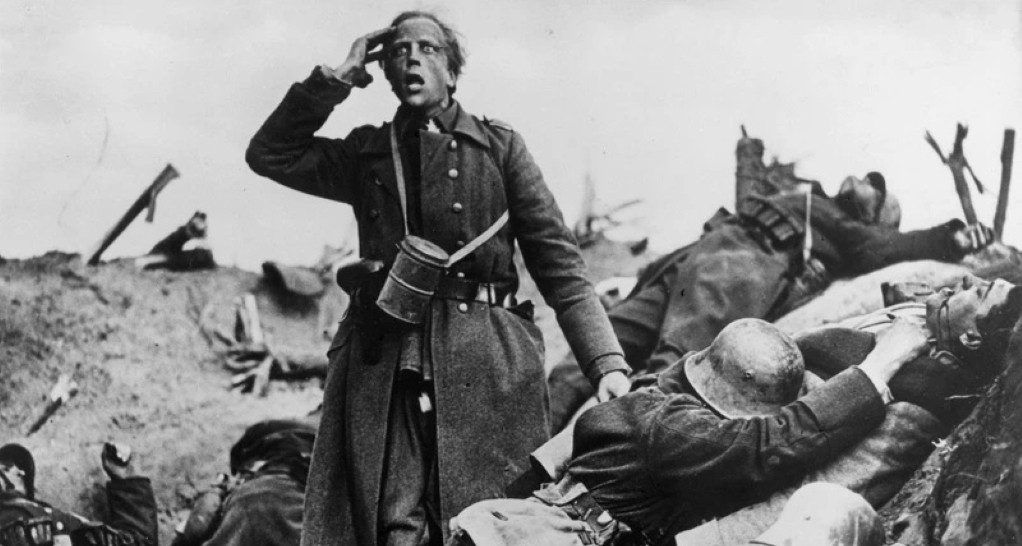
If there is one thing you definitely understand when watching Westfront 1918, it’s the impact of the First World War on ordinary Germans. Westfront 1918 is low on plot and is close to an experience film, following four regular soldiers ground down by the military campaign on the trenches, with horrific psychological and physical injuries which will leave most of them dead (or as good as). Our soldiers are Karl (Gustav Diessl), a husband who discovers his wife has found comfort at home in the arms of the local butcher, the young Student (Hans-Joachim Moebis) in love with Yvette (Jackie Monnier), a rotund Bavarian joker (Fritz Kampers) and the tightly-strung Lieutenant (Claus Clausen) under huge pressure.

The inescapable comparison Westfront 1918 lives with is to All Quiet on the Western Front (shot almost at the same-time). Unfortunately, the novel Westfront 1918 is based on is not as strong as Erich Remarque’s and the film goes for such an allegorical universality in its characters (most of whom don’t get names) that it doesn’t carry the same powerful emotional impact. All Quiet also shows its characters going from hope to disillusionment: what Pabst is going for, with unrelenting grimness, is to show disillusioned men stuck in a pointless slaughter, fighting a distant and faceless enemy.

All they is chaotic uncertainty and the suddenness of death. The story is topped and tailed with different types of incompetence and inadequacy. Our heroes, on a brief leave near the front, are forced to hit the basement after their occupied village is shelled by their own artillery (this fuck-up will be repeated again and again, to the exasperation of the Lieutenant as his men duck in the trenches from their own shells). The film climaxes in an over-crowded, shelled-out church acting as field hospital, with over-worked doctors and inadequate medical supplies struggling to save lives. Stressing how much this is a hell on earth, the camera pans past a shattered Christ statue in the rubble. This dance with death isn’t just pointless, it’s ineptly led.

The combat sequences are shot with a strikingly observant camera, soaking up the detail, the soundtrack (and the ground) constantly peppered with exploding shells. Pabst stages our arrival at the trenches in a striking tracking shot, stressing their narrowness and inhospitality and the flimsy protection they provide. The final battle that closes the film – a French tank advance against hopelessly outmatched Germans – includes brilliant stationary shots that hold a fixed view of the battlefield. In front of us march (and run) troops – but also, when troops are hit, their bodies slump and remain there in shot, sprayed with mud when shells explode. Slowly the frame fills with the detritus of war. It’s an extremely well-done capturing of the grimness of war.

Pabst’s film stresses the unfairness and dismissal of the ordinary soldier by the officers. Senior officers are based miles from the front, fighting a very different war: pushing troops around a map and enjoying fine rations, served by batmen. When the Student struggles into their presence with a message after a harrowing journey, they barely register his presence: he’s left slumped on the floor and only fed when the batman sneaks him some food. Everyone is not equal and the soldiers there is no point volunteering for things (the student has only taken on his hazardous mission in the hope he can steal away afterwards to see Yvette).

The homefront is equally troubled, crowds queuing for low rations and those left behind struggling with the loneliness and shame (as millions die a few miles away). Pabst’s film also treats those on the homefront as victims. When Karl’s wife is found in an adulterous twist with a butcher, Westfront 1918 gives as much sympathy to her loneliness and depression as much as it does Karl’s rage. In fact, if anything, Karl’s fury towards a woman he hasn’t seen in 18 months finding some comfort is held up as his character flaw, something he will spend time deeply regretting later. What does a passing moment like this matter when you could be killed at any time? Pabst’s argues we should stick together as Komarades, not turn on each other.

The film’s main weakness is the characters largely act as ciphers and universally representative figures. Westfront 1918 never quite manages to make them people we really care for in themselves, even as they fall. Which isn’t to say the tough moments don’t land: one character’s fate, drowned in a pool of mud, only his hand sticking limply out after death, is especially tough. The impact of death land (literally so in one shot which drains out the light to leave one character’s face literally looking like a skull) but, unlike All Quiet, we never quite feel like we fully know and understand these men.

This is perhaps why Pabst’s film is now most strongly remembered for its technical innovations. His first sound film, Pabst didn’t want his camera to be restricted into a stationary position so that a sound boom could pick up the sounds. He and cameraman Fritz Arno invented a sound-proof casing for the camera to allow them to move. In doing this, Pabst re-introduced much mobility to sound film-making.

Westfront 1918 is a film full of admirable film-making virtues and a strong streak of humanity. It doesn’t carry quite the same emotional impact as All Quiet – and it will always be remembered as that’s companion piece – but it has moments of haunting, virtuoso film-making. It’s view of war as a pointless grindstone inevitably led to it being banned by the Nazis. But it’s also sad to reflect that Pabst spent the next war (reluctantly) filming propaganda films for Joseph Goebbels. As Westfront 1918 tells us, life is cruel.

The Teacher’s Lounge (2023)

The Teacher’s Lounge (2023)

A series of minor thefts leads to a school spiralling out of control in this intense, small-scale drama

Director: Ilker Çatak

Cast: Leonie Benesch (Carla Nowak), Eva Löbau (Friederike Kuhn), Anne-Kathrin Gummich (Dr. Bettina Böhm), Rafael Stachowiak (Milosz Dudek), Michael Klammer (Thomas Liebenwerda), Kathrin Wehlisch (Lore Semnik), Leonard Stettnisch (Oskar Kuhn)

Schools can be like whole societies in microcosm, with attention grabbing events having earth-shattering consequences in these tiny worlds. New teacher Carla Nowak (Leonie Benesch) finds this out the hard way when she takes matters into her own hands to solve a spate of petty thefts in the staff room, before the blame is pinned on students. Setting a trap, to her surprise she captures on film evidence that the thief is the school’s popular administrator Mrs Kuhn (Eva Löbau), mother of Carla’s star-pupil Oskar (Leonard Stettnisch). Events quickly spiral out of control, as Mrs Kuhn denies the charges and Carla’s attempts to be even-handed and fair leave her isolated at the centre of a storm pitting teachers, students and parents against each other.

The Teachers Lounge is a gripping ‘everyday’ thriller, where events on a small scale capture wider conflicts that rock whole societies. The events themselves seem small – petty theft and arguments over invasions of privacy – but Çatak’s film demonstrates they have shattering impacts on those involved. Loss of reputation, of jobs, the damaging impact on a promising child’s education, the shattering of harmony in a small community – it all explodes due to a few spur-of-the-moment decisions, building on each other so delicately that you are suddenly surprised to find it’s a crisis.

What’s really painful about The Teacher’s Lounge is how scrupulously honest and moral everything Carla tries to do is. What she’s not prepared for, is other people not playing by the same rules. Privately confronting Mrs Kuhn (having caught her distinctive blouse going on camera) with an offer to stop stealing and she’ll say no more about it, she’s amazed and totally shaken by the complete unwillingness to admit any guilt. When the matter is raised with the headmaster, Carla is dumbfounded by Kuhn’s aggressive denial and furious counter-accusation of invasion of privacy. Her cause is passionately taken up by Oskar, accusing Carla of ruining his mother’s life for no reason.

At the film’s heart is a wonderful performance of repressed tension from Leonie Benesch. Carla is a good teacher, but also a slightly distant, perhaps little-too-professional person. She engages more comfortably with the children because the ‘rules’ are clearer. With her fellow teachers, she never seems relaxed. She isn’t willing, as they are, to support (or cover up) for colleagues regardless of the situation. She judges each situation on its own merits – and Benesch superbly shows through her tense frame and strained voice how stressful this is – and adjusts her views and opinions as the situation develops. To everyone else this isn’t a positive but a huge negative, her refusal to follow an agreed line a sign of her flaky lack of loyalty to the team. (Her controversial filming is entirely caused by her mistrust of her colleagues, after watching one of them shamelessly empty an honesty box).

Çatak’s film shows how fragile the rules holding society together can be under pressure. Carla’s compassionate, thoughtful teaching focuses on developing her young students’ empathy and morality. She respects their views and asks for honesty in return. When arguments arise in class, she encourages discussion and consensus building. A jolly welcoming clapping-and-singing routine she practices every morning is about bringing the class together as a group. All of this flies out of the window as events unfold, showing how fragile these precious democratic conventions are.

The control of the teachers in the school turns out to be unbelievably fragile. Carla’s students stop co-operating with her lessons, effectively forming a union. The school newspaper – older students full of idolism about being the next Woodward and Bernstein – trap Carla into a Gotcha interview and misrepresent her opinions, fuelling the crisis (and leading to a near mutiny over a ban of the school newspaper). Carla, naturally, is blamed by her colleagues for the interview.

These fragilities and small-scale repression is just one way Çatak uses the setting to illustrate larger issues. Just under the school’s surface, there is a strong ‘us-and-them’ atmosphere. Both teachers and students demand internal loyalty to their sides. The thefts have already motivated heavy-handed members of staff to pressure (in private meetings) students to inform on their classmates. Carla objects to this but lacks the strength to end it – just as she later objects but does not obstruct a forced search of the boy’s wallets for stolen cash. It becomes more and more clear that Carla’s more considerate, diplomatic way of proceeding simply hasn’t got a chance of getting heard.

There is an uncomfortable air of casual assumptions being swiftly made. The first student suspect is the son of Turkish immigrants (the father’s job as a taxi driver all but used as evidence that the boy is likely guilty). Some of the staff simply can’t believe a boy from his background could have ready cash on him. An unbearably uncomfortable meeting with his parents – who at one point are instructed to speak German – is rife with tension. No wonder Carla is so uncomfortable with her Polish roots being discussed, that she asks a colleague with a similar background to only speak to her in German. Of course that contributes even more to the untrusted sense of distance Carla accidentally gives off to her fellow teachers.

This makes it even more heartbreaking to see Carla’s world slowly collapse in on itself as her attempts to treat everyone’s view points and demands fairly and equally ends with her attacked by both her colleagues and students. With her ever tense, bewildered decency getting ever more crushed Leonie Benesch is excellent in Çatak’s wonderful small-scale morality tale about society today, where the loudest and most strident voices win out. If you were her, you’d be finding an excuse to scream in a classroom as well.

Das Boot (1982)

Das Boot (1982)

Perhaps the definitive submarine film, a terrifying masterpiece of claustrophobia and suspense

Director: Wolfgang Petersen

Cast: Jürgen Prochnow (Kapitänleutnant), Herbert Grönemeyer (Leutnant Werner), Klaus Wennemann (Chief engineer), Hubertus Bengsch (First watch officer), Martin Semmelrogge (Second watch officer), Bernd Tauber (Chief HelmsmanKriechbaum), Erwin Leder (Chief Mechanic Johann), Martin May (Ullmann), Heinz Hoenig (Hinrich), Uwe Ochsenknecht (Boatswain Lamprecht), Claude-Oliver Rudolph (Ario), Jan Fedder (Pilgrim), Ralf Richter (Frenssen)

In the annals of submarine movies, few have taken such a hold of the imagination than Das Boot. This is particularly remarkable since it follows the struggles not of Allied sailors but members of the German Kriegsmarine, the U-Boats who patrolled the Atlantic to sink as many merchant ships as they could, all in the service of aiding the Nazi war effort. But the sea knows no flags and holds no allegiances: to the watery deep, men are just men, and a small, rusty metal box is fragile at 280 metres no matter who sails in it. And the men sailing U-96 are just ordinary, regular men, with wives, girlfriends and regrets back home who above all just want to survive to see them again.

Wolfgang Petersen’s is a masterclass in immersing us in a claustrophobic world. The crew of U-96­ are led by the captain (Jürgen Prochnow), a hardened, cynical veteran is out here to do a job, not fight for radical cause he has little time for. Instead, his concern is to preserve the lives of his men, all younger (in most cases almost twenty years so) than him, during their time at sea where days (and even weeks) of bored inaction are interspersed with interludes of sheer terror as the submarine desperately runs from depth charges and dodges Allied destroyers.

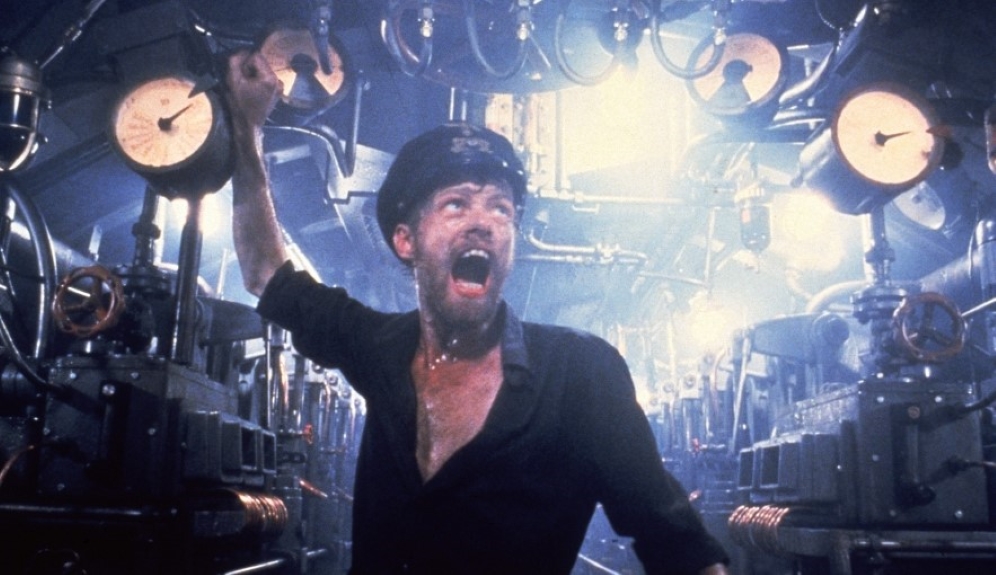
Das Boot was filmed over almost a year, in chronological order. The actors practically lived in their confined set (deafened by the sound of its mechanics), their hair growing out to match their characters and their skin taking on a pallor from not enough time in the sun. For hours at a time we never leave the confines of the submarine – if you don’t count the odd trip to the ship’s bridge, where those lucky enough to venture up-top are lashed with salty sea water from near constant Atlantic storms. Aside from that, they are in what is effectively a 60m metal corridor, a specially designed camera operated by cinematographer Jost Vacano, tracking swiftly behind the frenetic pace of the sailors as they dive through hatches and pound along dripping quarters.

It’s a film where you cannot escape the tight confines of this boat, the sound track filled with groans and shudders as the boat cracks under the weight of water or buckles from high-pressure depth charges. When under attack, bolts burst out of pipes like machine gun bullets and water (which is obviously freezing) gushes through opened valves. It mixes with the sweat in the characters tension-filled faces. There is no comfort and no privacy under the water, bunks positioned on the edges of the ship’s corridor. The only food is whatever was taken aboard last time the ship was at shore – and if that means cutting layers of green mould off weeks-old bread, so be it.

Petersen’s capturing of this sense of a tiny, pressure-filled world is superb and he succeeds masterfully in getting the audience to feel the character’ stress and fear. When the film opened in America, crowds cheered an opening caption which details the losses the Kriegsmarine suffered during the war: at the end, the same audiences were reported stunned into sympathetic silence. None of these men are detestable Nazis. One man writes never-ending letters to his French fiancée. Another is a devout Christian. The Chief Engineer clasps tight photos of a skiing holiday with the wife he has not seen in months. Another is frustrated at radio reports of his football team losing a key match. All of them are haggard, unshaven and scruffy. None of them feel safe for a moment.

Only the first watch officer utters anything approaching true believe in the Nazi regime (he is also the only man to try and maintain some semblance of military smartness – at an encounter with a German merchant ship, he is inevitably mistaken for the captain). But his belief comes from naïve optimism: he has no wider idea of the world around him and his statements of trust in the regime noticeably dry up over time. For the rest: who has the time for ideology when you could be crushed by a mountain of water at any time? Captain Thomson (Otto Sander) opens the film by making a drunken speech at the launch of U-96, lambasting Hitler – a speech that is met with shocked silence because its being said rather than because of the content.

The sea also builds subconscious bonds for those who share its dangers, even with enemies. After returning later at night to the scene of a sinking ship (their only successful operation throughout the whole film), the Captain and his officers are horrified to find the Allied ship has not had its crew evacuated – a fact they notice too late, having already sent two more torpedoes into the water to finish the ship off. Haunted, the Captain orders U-96 to back off: after all, he knows (as we do) it will be impossible to take any survivors aboard his tiny boat. Even this successful mission is tinged with horror: the rest of their encounters mostly feature desperate attempts to dodge British destroyers.

It’s relentless. Life under water is dull, but inescapable but could be broken at any moment by life-threatening terror, perhaps hours of shaking and leaking under depth charges explode around them. Even the most experienced can crack – Johann, the ship’s chief mechanic, at one-point breaking under the pressure, his wide-eyes desperately searching for some escape as he ignores orders. War correspondent Lt Werner (Herbert Grönemeyer) goes through the same experiences we do: his assumptions about brave soldiers and ice-cold professionals, breaking down as he and we realise these are ordinary people just trying to stay alive.

Their lives are the principle concern of the Captain, superbly played by a stoic Jürgen Prochnow, as a man who keeps his emotions on a tight leash because letting them slip may see them never getting under his control again. The Captain is a default father to his men, concerned above all with preserving their lives, over and above the war he is bitter and cynical about. Now of course, you can argue Petersen is stacking the deck by presenting a German crew with not a (determined) advocate for Nazism among them: but so superbly does the film bring-to-life the pressures, risks and terror of U-96, you fail to be surprised that they would come to focus overwhelmingly on their own survival rather than the gnomic ideology of the murderous dictator who started the whole thing.

By the time the film has send U-96 to the near bottom of the ocean, forcing the crew to battle against the odds to restore power and save it from sinking (it’s the golden rule of all submarine films, that the recommended depth should be exceeded and for the ship to sink like a stone), you will be rooting for these pressured-but-capable professionals to save themselves. The overall feeling you take from Das Boot is the futile, pointlessness of it all: months at sea almost for nothing, acts of extreme bravery rendered moot by flashes of ill luck and chance, the utter lack of having any to show for it when the boat returns to port. Das Boot understands the futile horror, the grim pressure and punishing impact of war, placing people into terrible situations for no real purpose. It’s that which helps make it one of the defining war films – and the great submarine film.

Die Nibelungen (1924)

Die Nibelungen (1924)

Wagnerian epic is crammed with gorgeous, dramatic imagery and relentless pace

Director: Fritz Lang

Cast: Paul Richter (King Siegfried of Xanten), Margarete Schön (Kriemhild of Burgund), Hans Adalbert Schlettow (Hagen of Tronje), Theodor Loos (King Gunther of Burgund), Hanna Ralph (Queen Brunhild of Isenland), Rudolf Klein-Rogge (King Attila), Bernhard Goetzke (Volker of Alzey), Rudolf Rittner (Margrave Rüdiger of Bechlarn), Georg John (Mime the Goldsmith/Alberich the Dwarf/Blaodel)

Fritz Lang wanted to create a film that would help a shell-shocked Weimar Germany start to feel proud of its heritage and culture. He would do this with a film of the legend of Siegfried. It’s not really Lang’s fault that this Aryan feel-good stuff, coupled with Lang’s flawless visual compositions dripping with power and authority, would turn into the wet dreams of the Nazi party Lang fled Germany to escape. Die Nibelungen has unfortunate associations, but it stands as a towering pinnacle of Lang’s visual artistry. An adaptation of the legend, not the Wagner operas, Lang created something both mystic but also subtly questioning the idealistic figures it celebrates.

He would do all this in two (epic of course) films, totalling almost five hours. In the first Siegfried, the hero (Paul Richter) overcomes dragons and murderous dwarves to gain powers of almost (that almost is key) total invulnerability, strength and invisibility. Powers he puts to the test to win the weak King Gunther of Burgundy (Theodor Loos) the hand of Brunhild (Hanna Ralph) by invisibly aiding Gunther best this Valkyrie at a series of challenges. He even takes on Gunther’s form to help lead Brunhild to the bridal bed. Brunhild however discovers the truth from the loose lips of Siegfried’s wife (and Gunther’s sister) Kriemhild (Margarete Schön). Brunhild’s tricks Gunther and his loyal heavy Hagen (Hans Adalbert Schlettow) to murder Siegfried via a spear in his one weak spot. In Kriemheld’s Rache, Kriemheld plots the destruction of everyone who conspired in the death of her husband, via a marriage with the warlord Attlia the Hun (Rudolf Klein-Rogge).

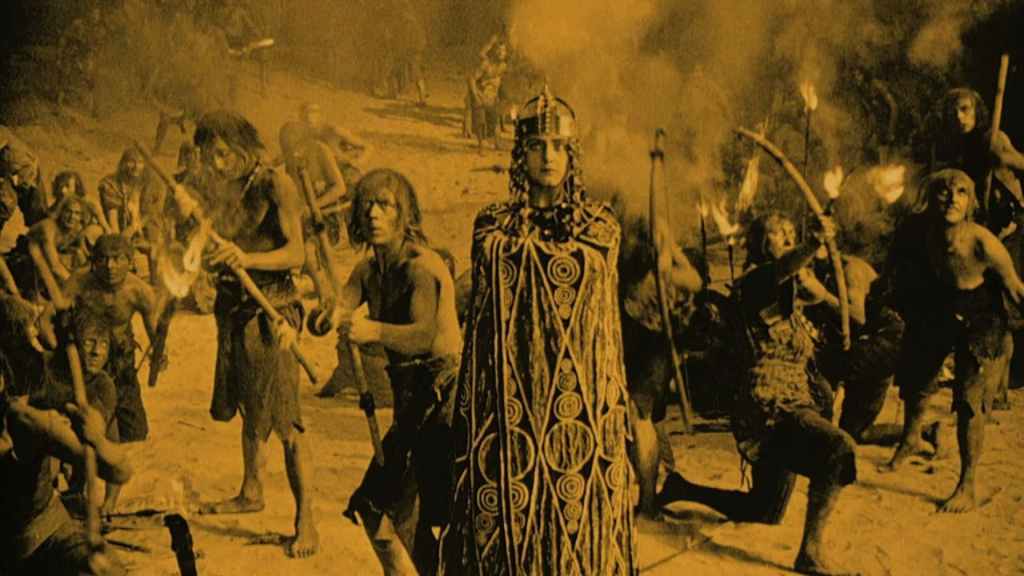
The first thing that strikes you about Die Nibelungen – aside from its surprisingly electric pace – is the powerful, undeniable beauty of nearly every single frame. Lang composed each image as if it was a painting, from Siegfried introduced in steaming smoke at the forge, to the formalist imperialism of the castle of Burgandy and the rigid order and symmetry of its soldiers. Locations, from grand castles to mystic forests, underground caverns full of scheming, wicked creatures are superbly bought to life. There is a martial power Lang’s composition of so many of these images, their perfect angles and symmetrical blocking: parts of Die Nibelungen are some of the greatest pageantry displays in movies.

There is a wonderful sense of overblown, geometric, artificiality in all this – Lang deliberately creates a world larger than life and full of the unworldly and impossible. Buildings tower over crowds, courts that hold thousands to view events of grand importance, sieges of burning halls that fill the frame, staircases up impossibly high buildings. The sort of world of medieval excess where Gunther and Kriemheld disembark from a boat by walking across a bridge of shields created by half-submerged knights. Power and magnificence come from every frame.

It’s matched with an impressive creation of the bizarre and magical. Of course Siegfried kills a giant, animatronic dragon (strangely it’s obvious – even then surely – fakeness works in a film where everything is a heightened, from the emotions to the buildings to the costumes). Siegfried trains in something not far off from Vulcan’s forge and the forest feels like a sort of fairy-tale wonderland. Lang pioneered cross-fades and double exposures to make extraordinary effects, as Siegfried disappears under a veil of invisibility and jumps impossible distances. There is an extraordinary shot where Brunhild, still in the midst of her Valkyrie-like super-powers, seems to jump straight into the camera lens at full force. A beautiful edit sees a tree seem to reform itself into a skill in front of the eyes of the grieving Krimhild.

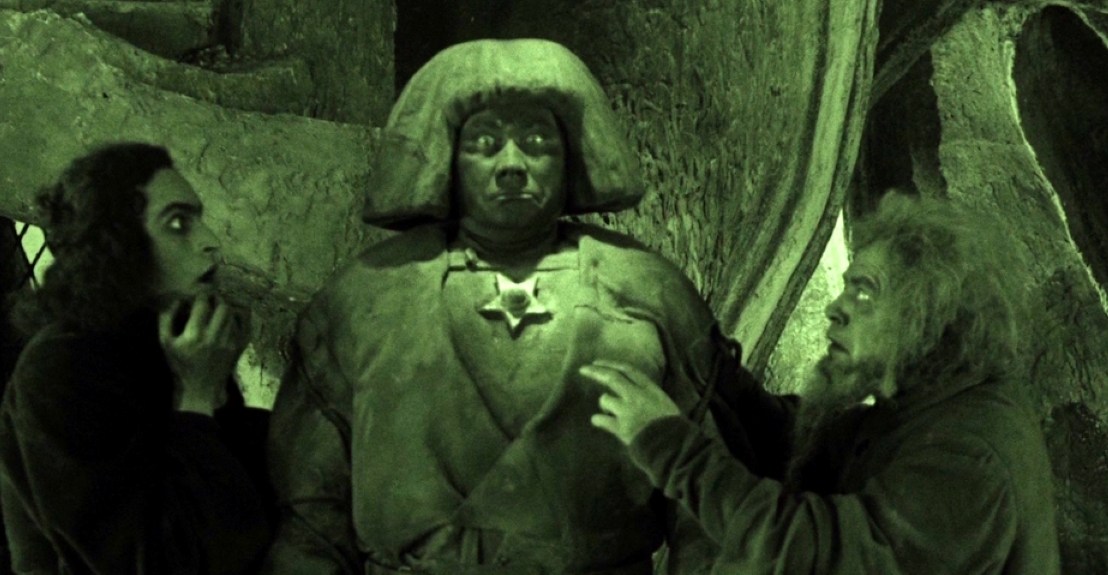
But Die Nibelungen places its world of power and magical forces in an increasingly costly human world of realpolitik and conspiracy, where its mystical but naïve and simple hero is out of step. Even before then, Siegfried’s status as a hero is subtly questioned. The dragon he kills seems a peaceful, inoffensive creature for all is scale, sitting placidly when Siegfried attacks and stabs it in the eye. Lang introduces a lovely touch where it’s dying tail flick will send the leaf that shields a crucial spot of Siegfried’s back from the torrent of invulnerability-granting dragon’s blood he bathes in. Siegfried is easily manipulated by the dwarf Albereich (a Gollum-like, uncomfortably antisemitic in appearance) before a large dose of luck allows him to defeat his opponent and gain the treasure of Nibelungen.

At the court of Burgundy, for all his courage and blunt honesty, Siegfried is at sea among the subtle power dynamics. The kingdom is ruled by chronically indecisive weakling Gunther (a snivelling Theodor Loos), easily manipulated by Wagnerian-costumed Hagen (an imposingly arrogant and faintly psychotic Hans Adalbert Schlettow). Siegfried’s main acts are to trick and then break the resistance of Brunhild (a dynamic Hanna Ralph) while impersonating the weakling – hardly acts to brag about, which doesn’t stop Siegfried doing exactly that to his wife who then blurts it out to Brunhild in a fit of pique. This isn’t a hero covering himself with glory, just as even the formally idealistic Brunhild (much to her later self-disgust) is reduced to scheming and plotting revenge, a far cry from the noble actionee she prided herself on being.

It’s not a surprise to find Part 2 heads into a Götterdämmerung as Kriemhild’s obsessive, destructive desire for revenge against Hagen (her husband’s murderer) meets with Gunther’s own stubborn-short-sighted protection of his controlling vassal. Nearly half of Part 2 is dedicated to the prolonged siege of the King and his followers by the massed armies of Kriemheld’s new husband Attila the Hun, her manipulations of him helped a great deal by Hagen’s arrogant, impulsive violence against Attila’s people. This extended battle sequence is astounding in its scale, violence and excitement – you can see the influence it had on The Two Tower’s Helm’s Deep – and is shot with the same visual mastery as the more stately first half, even as it seeks into bloody desperation.

It must be stated that Die Nibelungen does feature more than its share of clumsily presented racism. As mentioned, the hook-nosed, gold-obsessed, murderous dwarf Albereich is a painful antisemitic stereotype. Rudulf Klein-Rogge is caked under layers of make-up as the ugly, Slavic Attila while his Hun army resemble crouching Orc like figures, frequently ripe for the sword edge of the relentless German soldiers. It’s the uncomfortable flip side of the Aryanism idealism and romantic framing given to Siegfried, that these un-German figures are painted so monstrously.

But Die Nibelungen’s subtle criticism of the flaws in its German leads – it would go some to call them heroes – balances this out. From the flawed, empty-headed, foolishness of Siegfried to the increasingly sadistic, unrelenting cruelty of Kriemheld (Margarete Schön’s performance is excellent, going from sweetly retiring to unblinking fanaticism over the course of the film) the Germanic characters are compromised, weak and cruel: Hagen and Gunther are no one’s ideas of admirable figures. Compared to them, for all his clumsy racist appearance, Atilla feels like a reasonable figure, loving his family, caring for his people and refreshingly free of vindictiveness and cruelty.

It makes for an intriguing complex undercurrent in a film which, of course, the Nazis interpretated entirely on surface-appearance as a celebration of Aryan super-might. Or at least they did for Part 1 – even they couldn’t kid themselves that Part 2 didn’t quite fit that bill. Today Die Nibelungen provokes the same interesting thoughts. But above all it’s a visual marvel from a gifted film director, a truly painterly masterpiece that, for all its great length, never flags and offers a new marvel, camera trick or miraculous composition with every frame. This is silent cinema at its best.

The Testament of Dr Mabuse (1933)

The Testament of Dr Mabuse (1933)

Lang’s masterful mix of gangster thriller and supernatural psychological drama is superb

Director: Fritz Lang

Cast: Rudolf Klein-Rogge (Dr Mabuse), Otto Wernicke (Inspector Lohmann), Oskar Beregi Snr (Professor Baum), Gustav Diessl (Thomas Kent), Wera Liessem (Lilli), Karl Meixner (Hofmeister), AE Licho (Dr Hauser), Theo Lingen (Karetzky), Klaus Pohl (Muller), Theodor Loos (Dr Kraum)

Did Fritz Lang invent the concept of the cinematic universe? Or after completing M, did he just wonder what it would be like if his detective Lohmann (Otto Wernicke) took on the dastardly criminal mastermind Dr Mabuse (Rudolf Klein-Rogge) from his earlier epic crime drama. Either way, the hero and the villain from those two very different films face-off in The Testament of Dr Mabuse, a pacey crime melodrama spliced with a spooky ghost story, that rattles its way through a scintillating story tinged with the whiff of the dread of Nazism.

It’s eleven years after Mabuse’s reign of terror ended with him catatonic and under arrest. In a psychiatric hospital under Professor Baum (Oskar Beregi Snr), who sees him as a fascinating case study of deluded genius, Mabuse has not spoken in years instead filling his days with endlessly scribbling a series of blueprints and schemes for the criminal underworld, focused on destabilising the country and corrupting the currency. But, despite being under lock and key, a secret society of criminals is carrying out Mabuse’s scribbles, seemingly under the guidance of the man himself. Can death, when it comes, really take Mabuse? Or are Lohmann’s suspicions that the dread hand of the Great Unknown still controls events, even from beyond the grave, correct?

Lang’s gangster film throws together some of the best elements of all his German films. This is a pulpy gangster thriller, full of action, shoot-outs and explosions mixed with the unsettling double exposure appearance of ghosts and shady, unknown powers manipulating events. It’s Scarface meets A Christmas Carol, with Mabuse as a dreadful Marley’s Ghost causing devastation and chaos even after death. The Testament of Dr Mabuse sees realism meet thriller meet supernatural powers, but brilliantly combines all three up into a propulsive thriller.

And it’s a film, more than any of Lang’s others, about the malign influence of Fascism. For what is Mabuse’s dogmatic lust for chaos and destruction, but a terrible prophecy of the horrors Hitler would unleash. Mabuse, like the Fuhrer, is interested only in destruction wanting to pull the world down to rule over the ashes, to reforge the remains into his ideal vision of reality. His paranoid ramblings – and the spectral, transparent (brilliant use of double exposure at the technical possibilities of cinema, as always from Lang) presence he becomes parroting the same mantra of the nobility of destruction – are about leading the country into a morass of destruction. No wonder The Testament of Dr Mabuse was almost immediately spiked by Goebbels. Hitler’s magnetic powers of persuasion and control were surely the real-world apotheosis of Mabuse’s skills.

Mabuse’s powers are so great that even death can’t slow him down. Today it doesn’t take long to figure out exactly who the real mastermind – or after-death puppet of Mabuse’s – might be. As wardens in the hospital say, even in silence the fixed, controlling glare of Mabuse is enough to bend minds to his will. The rantings of his testament – Mabuse’s Mein Kampf – merely add to the force of his stare. Even the echo of Mabuse’s name will turn former police detective Hofmeister into a gibbering wreck. His power is absolute.

No wonder he appears after death, disfigured post-autopsy, his eyes bulging, to continue to direct his puppets, his ghostly form directing their actions. It’s a wonderful visual expression of the hypnotic control Mabuse had over his victims, that they continue to see his controlling, ranting form – across a desk or guiding them down corridors – even after they’ve gone. Mabuse’s ghostly form will literally emerge out of the body of his underling, crossing to sit opposite him and pour more instructions in his ear.

Ordering his underlings from behind a curtain that hides his true face, Mabuse’s commands are absolute and its threats always delivered. The gang, each a series of cells who work together only when instructed, are nearly all brain-washed fanatics, accepting orders without question. Much like Hitler, Mabuse’s followers cover a vast range, not just common criminals, or trigger-happy loons but also the middle-class and professional, in thrall to the words of a mad man promising a new dawn (sound familiar?) Much like in Mabuse’s hey-day, any deviation from absolute loyalty is met with swift, fatal punishment. What chance does Thomas Kent (Gustav Diessl – a spitting image for the young George Sanders) have when he decides the gang life is too risky for his girlfriend?

Up against this, Lang places his hero from M and his accustomed detailed fascination with the mechanics of investigation. The Testament of Dr Mabuse mixes this analysis of things like the forensic translation of scratches on a windowpane, with this outré pulpy set-up of Wizard of Oz-like criminal masterminds. The world of Lohmann is one of order and methodical investigation, grounded in realism and detail. It’s an adjustment for Lohmann who, in M, was more the jovial face of a failing institution – here he’s the last bastion of reasonable authority.

The Testament of Dr Mabuse is full of shrewd political observations – but it’s also a supremely entertaining film. Few directors were as good at crime drama set-ups than Lang. The film’s opening sequence, showing Hofmeister tracking the gang through a warehouse, is a masterclass of the tension of imminent discovery, then of explosive (literally) violence during a chase. A gorgeously inventive bomb sequence – where a flooded room is the best chance of safety – is another masterpiece of slow burn tension, while the insidious threat of Mabuse’s voice creates a miasma of terror.

That sequence plays beautifully into Lang’s increasing comfort with, and mastery of, sound. The film opens with a pounding heart-beat on the soundtrack as freelance investigator Hofmeister hides in the factory where Mabuse’s men assemble their latest schemes, capturing the fear as he constantly ducks and hides to (unsuccessfully) avoid detection. The sound of machinery grows to overwhelm the film and, as Hofmeister flees, his barracked by the sounds of engines and rolling oil-filled barrels that burst into flames. Sound skilfully stresses mood and bridges scenes, controlling mood and atmosphere and adding to the air of distrust and disturbance.

The technique shines out of several stunning set-pieces. A traffic light assassination – another masterpiece of sound – is a brilliant piece of gangster-ish business, the gangsters using a crescendo of car horns to cover a fatal shot. Watching its slow build-up and the carefully paced release of information to the audience (the presence of the killers, the gun, the tension of the wait) you can see why Lang often felt Hitchcock got a lot of credit for things he had invented.

Fast-paced and thrilling, it’s a perfect extension of both Lang’s previous films, a brilliantly unsettling and disturbing drama wrapped up in a gangster package. It’s supernatural touches are just the right side of psychological drama, a portrait of obsession and a fractured mind. A perfect expression of Lang’s mastery of mixing the high and low brow into an engaging, thought-provoking and thrilling package.

Dr Mabuse, der Spieler (1923)

Dr Mabuse, der Spieler (1923)

Lang’s crime drama is a sprawling silent mini-series, still gripping today

Director: Fritz Lang

Cast: Rudolf Klein-Rogge (Dr Mabuse), Bernhard Goetzke (State Prosecutor von Wenk), Aud Aged Nissen (Cara Carozza), Gertrude Welker (Countess Dusy Told), Alfred Abel (Count Told), Paul Richter (Edgar Hull), Robert Forster-Larringa (Spoebri), Hans Adalbert von Schlettow (Georg), Georg John (Pesch), Karl Huszar (Hawasch), Grete Berger (Fine)

In a world before television, there were only two places for long-form stories – and Fritz Lang wasn’t a novelist. His four-and-a-hour epic Dr Mabuse der Spieler is really a sort of gargantuan mini-series, a rollicking action-adventure about a conscience-free conman wiling to go to any lengths to get the things he wants. It’s pulled together as a pacey, episodic yarn – each reel is basically an individual act (or episode) and filmed with such visionary vividness that it remains compelling today. Whether you decide to settle in for the long haul or split its parts and acts over a series of nights (and why not, the film was released in two parts, months apart) it won’t fail to entertain.

It was based on Norbert Jacques novel, a publishing sensation (so much so this was rushed into production while Jacques novel was still being serialised). At its heart: Dr Mabuse (Rudolf Klein-Rogge), practically the dictionary definition of an omnipotent, amoral villain. Mabuse is a practiced liar, master-of-disguise, ruthless murderer, conman and has such demonic will power he is capable of extraordinary levels of hypnotic control, whose gang of acolytes switch between terror and outright worship of him. He can manipulate the rich into handing over their money as easily as he can the collapse of businesses on the stock exchange. No one knows who this malign spider is. But State Prosecutor von Wenk (Bernhard Goetzke) will make it his business to know.

Lang’s film is a gorgeous mix of the sort of urban realism he mastered in M and little touches of mystical realism more reminiscent of The Cabinet of Dr Caligari, wrapped up in the sort of action that inspired everything from The Sting to Mission: Impossible. It’s opening section is a brilliant example of both. Essentially a twenty-minute prologue to introduce Mabuse’s nefarious genius, it sees our anti-hero masterfully execute a plot mixing heist, disguise, manipulation and brazen self-confidence to make a fortune on the stock exchange. The theft of a secret commercial contract from a train involves the sort of disguises and split-second timing (to throw the contract from a train passing over a bridge into a car passing under it) which would make Ethan Hunt’s heart race.

It’s a perfect entrée to our villainous lead, Mabuse. First introduced rifling through photos of the many expert disguises he will effortlessly assume during the film – he becomes everything from banker to magician, psychologist to hypnotist, tramp to member of high society – Mabuse has no moral code what-so-ever other than the accumulation of things. That ranges from wealth, to an obsessive desire for ownership over attractive women (and his desire for Gertrude Welker’s Countess Told eventually contributes to his undoing) to simply the having power over the wills of weaker men. Rudolf Klein-Rogge is magnetic as this monster of the dark, ruthlessly calm but equally wild-eyed, unflappable but willing to go to any lengths.

Spieler is often translated as “gambler” – but it’s German meaning is richer than that and many have commented a better translation might well be “player”. Mabuse is certainly that. He is a master actor, who can be lose himself in different roles, undetectable to others. He weaves elaborate games around his victims, where only he knows the rules (and, often, only he knows a game is even being played). Other people are pawns to moved and gambled with. He’s a monster, but one born from disillusion of the end of the First World War, part of the hedonistic self-regard of dissolute Weimar. We can see touches of this environment throughout Lang’s film, in its hedonistic gambling dens and the casual thoughtlessness of the rich. Mabuse flourishes because he is the rash an age has come out in. (Retrospectively, you can detect the shadow of Hitler in this ruthlessly power-mad monster who hides in plain sight but demands absolute control).

Mabuse is “the Great Unknown” and the natural target of methodical if uncharismatic von Wenk, played with a stolidness by Bernhard Goetzke, balancing Klein-Rogge’s larger-than-life portrayal perfectly. The duel between these two moves from gambling rooms to elaborate houses, from the streets to the jails of the city, taking in chases, bombs, shootings, kidnappings and all sorts of attempted moves and counter-moves, culminating in a shoot-out that surely inspired countless Hollywood gangster movies.

Through it all Lang directs with astonishing freshness and invention. Dr Mabuse der Speiler throws a slice of cinematic visual inventiveness into almost every scene. Lang makes extensive use of superimpositions, cross-fading, location shooting, fast-paced editing and brilliantly evocative lighting to create a world both highly realistic and also dancing to the tune of its demonic lead. Some of this has become such a part of cinematic language that it’s unlikely to draw comment from modern viewers today – we are unlikely to be wowed by night-time footage of Wenk pursing Mabuse in a car, but to viewers at the time such scenes of photorealism taken in darkness were unheard of.

There is plenty that will continue to thrill audiences. Lang’s visual portrayal of Mabuse’s hypnotic powers is superb. In his first confrontation with von Wenk (both men are disguised at the time – this really is a game of move and counter-move), Mabuse attempts to implant a hypnotic suggestion in von Wenk. Lang demonstrates with an astonishing use of lighting which slowly concentrates the light into a small pool on Mabuse’s face before his face seems to grow to fill the frame (technical effects like this were a small miracle in 1923). On a second attempt, the hypnotically suggestive words are imposed on the screen as a set of animated letters which loom over von Wenk and later seem to be almost leading him (in his car) to the clifftop Mabuse has suggested he drive off. It’s a superb way of showing the power of Mabuse, building on the intimidating cross-fade from our stock-exchange opening that briefly shows Mabuse’s face super-imposed over the clutter-filed room.

Lang mixes this imaginative dynamism with some superbly done realist scenes that help make Dr Mabuse der Spieler a gripping crime thriller. That stock-exchange opening is followed by car chases and murders – one character is dispatched in the streets after dark with a brutal suddenness. Lang creates a series of locations, all perfectly detailed but instantly recognisable, from the distinctive look of each gambling den (from art deco lined walls to a strange rotating gambling pit filled with cards and erotic dangers) to the objet d’Art packed rooms of Mabuse’s mark Count Told (a gloriously ineffective Alfred Abel – unrecognisable from the world controller he would become in Metropolis) to the white-lined jails and careful detailed offices of von Wenk’s police headquarters.

Dr Mabuse der Spieler uses these real locations to constantly remind us that, underneath the Moriarty genius of its lead, this is also a tragedy of real people caught in the web of an uncaring spider. Mabuse cares nothing for his underlings, sacrificing them as readily as pawns. None more so than Cara Carozza, beautifully played by Aud Aged Nissen, a seducer in love with Mabuse who dedicates her life to him, at the cost of her own. She makes a dark mirror for Countess Told, drawn into Mabuse’s web but drawing strength from her admiration of Cara who is, in her own way, deeply principled. Mabuse’s victims are prodded, pushed and outright shoved into punishing and often self-destructive behaviours, their lives flourishing or ending according to his whims.

As a sort of epic mini-series, Dr Mabuse der Speiler is sublime entertainment. Each act follows its own clear arc and the culmination in a brutal shoot-out throws in a nightmare of surrealist imagery at its close as a crucial character tips, under pressure, into madness and delusion. (This series of horrors, the ghosts of fallen characters arising to torment him, is a masterclass in ghostly horror). It gripped audiences then and its surprisingly brisk pace and pulpy sensibility still do now.

M (1931)

M (1931)

Lang’s masterpiece, a thrilling and complex crime drama that explores the horrors of crime and mob justice

Director: Fritz Lang

Cast: Peter Lorre (Hans Breckett), Gustaf Gründgens (Safecracker), Otto Wernicke (Inspector Lohmann), Ellen Widmann (Mother Beckmann), Inge Landgut (Elsie Beckmann), Theodor Loos (Inspector Groeber), Friedrich Gnaß (Franz, the burglar), Fritz Odemar (Cheater), Paul Kemp (Pickpocket), Theo Lingen (Conman), Rudolf Blümner (Beckert’s defender)

A murderer prowls Berlin’s streets. For weeks children have been murdered and the citizens are at fever pitch. The police are desperately trying every weapon in their investigative arsenal. The heightened police presence on the streets hampers the lives of regular criminals: they too decide to take matters into their own hands, pooling their resources to catch the killer. And the killer himself? Not a mastermind, but a peculiar, timid man (Peter Lorre), a slave to uncontrollable impulses.

All this forms Fritz Lang’s masterpiece, his first sound film and one of the greatest German films of all time. A rich, psychologically detailed procedural thriller it is a stunning indictment of mob violence, a detailed look at the flawed assumptions of the official forces and an unflinching look at the horrific personal impact of crime. Lang’s film is extraordinary, a brilliant mix of impressionistic insight and documentary realism covered in an all-revealing social tapestry. It’s gripping and extraordinary.

Lang’s film was heavily inspired by real-life cases, most notably Peter Kürten (“the Vampire of Dusseldorf”) and the structure of the Weimar police department. Just like the real Berlin, his fictional one has a criminal underworld governed by a sort of German mafia, the Ringvereine, who a bizarre social set of rules among criminals. M tied into debates around the death penalty: was it right to take a life, even for unspeakable crimes? Is a life in a psychiatric prison fair for the murderer of several children? M is fascinating as it provides enough ambiguity to support either side (Goebbels claimed, when watching it, that it was a sure sign that Lang would become “one of us”).

This stems from Lang’s superbly detailed, anthropological filming style, which throws the viewer into the centre of a world that feels extremely real. Streets are lined with beggars and an array of adverts, posters and political messages. The camera prowls down streets and over tenement blocks, catching shadows and gets lost in cigarette smoke. It captures every detail of the Berlin police department: forensic labs that breakdown fingerprints, annotated maps, criminal psychologists pontificating on the intellectual make-up of the killer based on his handwritten notes to newspapers. Detective Lohmann (an increasingly harried Otto Wernicke) puffs cigars, pulls together facts and fails to make any real progress, looking increasingly buffeted by events rather than controlling them.

It’s one of the film’s subtle criticisms of the political situation at its time. The official forces have every resource going, but seem powerless. Instead, Lang contrasts them ever more closely with the criminal underworld or use brute, uncontrolled, unordered force to tackle the problem. Is it my imagination, or is there the stench of Nazism in this group? Their nameless leader (Gustaf Gründgens) strides, with a leather-clad firmness, emotionlessly forward, fixated on the end result – despite, with at least three murders on his score card, arguably not being that different from the man he’s chasing killer. He instructs the criminals to effectively throw a dictatorial cordon around the city, their solution being stamping out freedom and taking unilateral action.

Lang’s film is sharply critical of the kneejerk horrors of this mob justice. Crowds are whipped up by press coverage (which they excitedly read, the papers hitting the streets with a special edition after every murder) into a mob desperate to lash out, crowding around posters offering rewards for catching the killer. A man giving the time to a child in the street is nearly lynched, a raised camera angle reducing him to a tiny figure compared to his aggressor towering over him. A group of people playing cards in a bar descend into blows after one accuses the other of behaving suspiciously. The criminal put together a show trial (with a token, powerless defence counsel) where the killer is allowed a few brief words before his pre-ordained lynching (no legality with Nazism).

Again, it’s hard not to consider the growth of street violence in Germany in 1931, an atmosphere where justice was slowly dying as the Nazi party argued people had the right to take violent action against those who they see as enemies of the state. The criminal organisation here are worryingly efficient and organised. Lang brilliantly intercuts between two meetings, both in smoke-filled rooms, as the police and the criminals plan their operations. Sentences started in one location are finished in another. Complementary camera angles echo each other. In the police meeting there are also calls for unilateral action. Lang criticises the authorities who are active but ineffective (and some sympathetic to the criminal’s viewpoint), as much as the brutal mob justice of the criminals.

And the killer himself? Brilliantly played by Peter Lorre (who resembles a perpetually frightened paedophilic toad), Hans Breckett is weak, feeble, as scared of himself as he is of others, unable to understand or control his urges. He is driven by a whistling tune of In the Hall of the Mountain King for Grieg (a whistling that he sometimes produces, at others seems to hear around him) and consumes the things he desires – be they apples, drinks or children – with an impulsive immediacy. His letters to the papers suggest he is desperate to be seen. But when he is, chased by the crowds, he’s weak, terrified and utterly unimposing, trembling amongst the flotsam of a factory almost indistinguishable from the debris around him. At his trial he attempts to vindicate himself with a whining desperation. But, as Lang quietly suggests, do we have the right to kill him?

After all, Breckett is almost certainly a war veteran. He shares that with several other characters – as we are reminded by beggars with wooden limbs. Maybe his split personality – perhaps that’s why he stares with curiosity at his own face in the mirror, as if he doesn’t recognise himself – is a relic of a conflict where men were encouraged to kill, then returned back into society where expected to do the opposite. Perhaps the same feelings also lie behind the ease so many people have with mob justice – and also those in the criminal jury who show some sympathy for Breckett’s forbidden urges.

As well as balancing these complex ideas, Lang’s film is also a masterpiece of visual and aural technique. A child’s death is suggested by a newly orphaned ball rolling into frame. A gorgeous hand-held camera shot wanders through the beggar’s bar, where beggars gather used cigars, rescued sandwich fillings and sign up to be the criminal’s eyes on the street. Sound transitions between scenes are handled with an extraordinary confidence. The silence of armies of policeman walking through the streets turning into burst of noise as they move through raids. The Grieg leitmotif is used to brilliant effect.

Lang’s film though never forgets the victims. we start and end with the parents. The mother of the film’s first victim, Elsie Beckmann, waits with increasing panic in her apartment, each knock of the door promising her daughter’s return but disappointing (we’ve already seen Elsie disappear, hand-in-hand, with Breckett’s whistling shadow). It’s to her the film returns to her at the end, her tear-stained face telling us no sentence will bring back the dead. Appearing over a wordless scene of Beckett’s actual trial (the result of which we never discover), its Lang’s subtle reminder that mob justice brings only false satisfaction, that killing never heals the wounds of loss and our effort would be better directed to protection rather than revenge. It’s a message that feels particularly poignant in a German film made in the final years before Nazism would lead the country into devastation.

Filled with stunning film-making confidence, mixing documentary realism and brilliantly confident visual and audio mastery, Lang’s M could be argued to be one of the greatest film noir detective dramas ever made – and also a brilliantly insightful look at human and social nature. M is a masterpiece, as gripping and relevant today as it was Lang filmed it.

The Lives of Others (2006)

The Lives of Others (2006)

Breathtaking, heartfelt and in-the-end deeply moving film which leaves you with a profound sense of hope for humanity

Director: Florian Henckel von Donnersmarck

Cast: Ulrich Mühe (Hauptmann Gerd Wiesler), Sebastian Koch (Georg Dreyman), Martina Gedeck (Christa-Maria Sieland), Ulrich Tukur (Oberstleutnant Anton Grubitz), Thomas Thieme (Minister Bruno Hempf), Hans-Uwe Bauer (Paul Hauser), Volkmar Kleinert (Albert Jerska), Matthias Brenner (Karl Wallner), Herbert Knaup (Gregor Hessenstein), Charly Hübner (Udo Leveh)

For almost half the twentieth century, Germany was a country divided. West Germany was a world we might recognise today. East Germany was one George Orwell would have found eerily familiar, a surveillance state, where neighbour reported on neighbour, conversations and opinions were monitored and controlled, and the Stasi had ultimate power. Everything was designed to undermine personal loyalty, introduce mistrust into every relationship and keep in power apparatchiks who enjoyed privileges beyond the imagination of others. But what happens when humanity comes up against this system? Can the lives of others affect what the system’s agents think and feel?

1985, East Berlin. Gerd Wiesler (Ulrich Mühe) is the perfect cog in the Stasi machine. Emotion isn’t an issue when he interrogates dissidents for hours at a time, or sits overnight listening to every word spoken in a suspect’s bugged house. All that starts to change when Wiesler is ordered to carry out an operation against noted playwright Georg Dreyman (Sebastian Koch). Dreyman appears to be the perfect citizen, but is suspected of dissident sympathies. More dangerously for him, he’s having a relationship with famed actor Christa-Maria Sieland (Martina Gedeck) who has attracted the lascivious attentions of the corpulent and corrupt Minister Hempf (Thomas Thieme). As Wiesler listens to Dreyman and Sieland’s lives, he finds himself deeply affected by exposure to art he has never experienced and begin to question the certainties of his world-view.

The Lives of Others is a moving, humane debut from von Donnersmarck, offering a rich and chilling insight into the horror of living in a country where thoughts are not free and words are strictly monitored. It carries such emotional impact because it gives us hope that, no matter the strictures of the world around us, common humanity and decency can break through and change us – even the most mechanical servants of a regime. The Lives of Others does this with realism and a lack of sentiment, showing life and the after-effects of our decisions in non-romantic detail, while also giving us hope that goodness can shine through no matter the cost.

Shot in a series of cold colours reflecting the featureless surroundings of East Germany, The Lives of Others exposes the beige hopelessness of Soviet life. It opens with Weisler’s long interrogation of “Prisoner 227”, cutting between it and a lecture hall, where Weisler plays tapes of it to teach a class. He shows no emotion of any type in either setting for the distressed, exhausted prisoner he’s talking to, and matter-of-factly marks down the name of a student who questions the ethics of what he’s doing. Weisler’s life is one of quiet exactitude: his apartment is featureless, his meals are bland pasta with ketchup, he has no friends and barely seems able to smile.

He contrasts totally with Geog Dreymon. Played with an ebullient innocence by Sebastian Koch, Dreymon has accommodated himself with the regime’s requirements. Does he believe in socialism? It’s one of the film’s mysteries – Dreymon may have an intellectual romanticism but he’s averse to making pointless protests or stands that will only lead to him being silenced. He is willing to accept the shelving of his director friend, for his works to be pushed into a realist factory-setting by plodding directors. His charm sees him befriend the high and mighty (“it was a gift from Frau Honecker” he tells a Stasi officer who questions his possession of a Western book) and he has boyish innocence, like someone who has never known the Orwellian horrors he lives amidst.

His friends however have. His director friend Jerska (Volkmar Kleinert) is an ‘unperson’ whose presence is an embarrassment at parties. Another is a closet radical who feels he should take a stance. Above all, Christa-Marie (a marvellous Martina Gedeck) lives with the abuse of Minister Thieme. This corrupt man – who orders Stasi investigations against people he doesn’t like and is the only character who looks overfed and well-dressed – fondles Christa-Marie at parties and forces her into sexual encounters in his chauffeured car. Corrupt men run this state – similarly Wiesler’s Stasi superior Grubitz (a wonderfully smug Ulrich Tukur), is interested only in promotion.

The system is propped up by men like Wiesler. But all that changes as listening to Dreymon’s life pulls something out of Wiesler he has never thought about before. What pivots this? Perhaps Wiesler truly listening to the warmth and vibrancy of Dreymon’s home life? Perhaps exposure to art? Von Donnersmarck masterfully shows (with complimentary camera moves between two locations) Wiesler teary, spellbound listening to Dreymon’s playing of a piano sonata. It opens up a new world of artistic and cultural understanding to Wiesler, who is drawn to the books in Dreymon’s apartment and begins turning more than a blind eye to Dreymon’s flirtation with dissidents.

In fact, Wiesler morphs from Dreymon’s dark shadow to his protective guardian angel. He awakens in himself a care for people around him, from the son of a neighbour to Dreymon and Christa-Maria. He conceals Dreymon’s involvement in a scheme to smuggle someone across the border (tragically the plan is a fake, designed to test if Dreymon’s apartment is bugged). He does his best to reassure Christa-Maria, “bumping into her” anonymously to provide her a moment of solace with a stranger and subtle counselling on her relationship with Dreymon. As Dreymon carefully writes an article, to be smuggled to the West, critical of the regime, Wiesler fills his reports with imagined plot details and quotes for the Lenin play Dreymon claims to be writing.

Dreymon is actually writing an article about the suicide rate in East Germany. Suicide becomes a heart-wrenching central theme. An oppressive, domineering regime like East Germany offers only one real escape: death. A state designed to make its own people suspect and turn on each other is designed to grind you into a choice between blank conformism or taking your own life. And we see the effects of this on multiple characters, as people are separated from the things that give their life meaning, stripped of their own identity, or made to betray those they love. For some, this is more than they can bear.

In this world, just displaying humanity is the victory. Ulrich Mühe’s breath-taking performance slowly fills with growing doubts, longings and passions under the surface of an impassive, quiet man who suddenly realises the world is larger and more magical than he ever imagined. Like a butterfly emerging from a chrysalis, he starts burrowing in the bowels of Stasi HQ, his eyes fixed only on what is in front of him. The film’s victory is turning this man into one who makes huge, unrewarded, sacrifices to protect another, the very attitude he quietly deconstructed in the film’s opening. Mühe is superb, the film constantly exploring his face for unspoken depths.

von Donnersmarck’s film ends with an extended coda of life after reunification. Some things are not as triumphant as hoped: Wiesler lives in poverty, the streets are lined with graffiti and tramps, cockroaches like Thieme remain in authority. But it is also a place where hope and friendship are possible, where things can be spoken rather than suppressed. It culminates in the sort of free-publishing Dreymon could never dream of and a tribute that could never have been spoken before.

After the crushing misery and suicidal pressures of the East, a world of possibility and freedom is one where we all could change our stars like Wiesler, to find an inner contentment from doing the right thing for no reward. Brilliantly filmed and deeply moving, The Lives of Others is a masterpiece.

Faust (1926)

Faust (1926)

Murnau’s gorgeous masterpiece is a technical wonder and a painterly visual treat

Director: FW Murnau

Cast: Gösta Ekman (Faust), Emil Jannings (Mephisto), Camilla Horn (Gretchen), Frida Richard (Gretchen’s mother), William Dieterle (Valentin), Yvette Guilbert (Marthe Schwerdtlein), Eric Barclay (Duke of Parma), Hanna Ralph (Duchess of Parma), Werner Fuetterer (Archangel)

It’s a story that has fascinated for generations: is any deal worth your soul? Murnau’s breath-taking Faust myth throws in an extra wager: can evil corrupt a man so absolutely that not a single trace of good can be left? That’s the opening deal Mephisto (Emil Jannings) makes with his Archangel (Werner Fuetterer) counterpart. Their battleground? Faust (Gösta Ekman), an elderly alchemist, who has lived a life of faith and good works.

Faust was (until Metropolis) the most expensive German film ever made. Like Metropolis it was designed to help Weimar challenge Hollywood as the centre of the filmic universe. Murnau had direct control and several versions were made for distribution to key markets around the world. Faust was filmed over a huge period, partly for the all the multiple re-takes needed for those different versions, but also due to Murnau’s quest for perfection. Throw in cutting-edge special effects and luscious sets and you had Murnau’s own Faustian pact for success.

The film – as carefully restored today – that emerged is a work of expressionist genius jammed, particularly in its opening and closing acts, with a series of striking images balanced between fantasy and horror. Murnau used models, double exposure and transitional editing tricks to gorgeous, revelatory effect and crafted stunning images of supernatural horrors. Faust’s opening shot shows the horsemen of the Apocalypse riding through the clouds before a confrontation between a giant, satyr-like Jannings with huge wings and a similarly winged Archangel with flaming sword (the actors were strapped into stunning giant wings and Janning’s porcine like make-up is particularly demonic).

From there Murnau plays the first of his games of scale by showing Mephisto towering, mountainous, over Faust’s town, unleashing a black cloud of plague. Mephisto’s powers are demonstrated with a host of cinematic tricks: circular light then fire engulfs Faust when he summons him, Mephisto’s eyes are pinpricks of burning light (created by damaging the negative), he appears at every turn Faust makes and later shifts size, appearance and even duplicates himself while performing magic (always with gusts of terrible smoke).

The cinematic tricks continue as Faust is taken on a sort of magic carpet ride across Europe, Murnau’s camera dizzyingly flying over a series of highly realistic models of towns, forests, mountains and storming seas. The launch of this flying carpet is achieved by a miraculous double exposure shot that shows Mephisto and Faust flying out of a small window (standing upright on a cape) in one uninterrupted shot. The dizzying array of effects and visual imagination help us immediately understand why Faust is so tempted to harness the powers of this seemingly scruffy beggar (though Mephisto soon translates himself into a sharply dressed courtier).

It also ties in with extraordinary beauty of Murnau’s expert use of light and shadow. Faust is introduced as an old man, lecturing on astronomy to a room full of rapt students, lit by the glow of his astrolabe. Faust’s rooms are a light tunnel of instruments and books. His town turns from a thriving market, to a towering collection of shadowy buildings, holding a mass of swarming, panicked humanity, running in fear of the plague. Pools of light frame action: twice in the film, Murnau captures dying figures in perfectly composed outlines of light against a sea of black, the first (a priest) lying dead at his altar while smoke drifts up past the light he rests in.

Faust could almost be seen as a film about light. Murnau’s camera is continually artfully framed around painterly compositions with streaks of shadow and light. But it is also a thematic issue. Mephisto uses fog and smoke to power his magic, as if trying to obscure the light that represents the good. In Murnau’s world, light is frequently offers the possibility of hope – even the film’s closing fire offers a chance of redemption. Smoke becomes an obstruction, allowing evil to flourish.

Faust frames its hero initially as man using evil in desperation for the greater good against the plague. Faust is played Gösta Ekman, a Swedish actor in his thirties flawlessly made-up (the make-up is extraordinarily convincing) as the wizened alchemist before Mephisto restores his youth. Ekman is equally convincing in both roles, his angry rejection by the townspeople driving his descent into gred. Opposite him Jannings is a viciously cruel ball of scheming greed, under a surface of joviality.

Needless to say – after all this is a morality tale – it is the allure of sex that eventually brings Faust down. He surrenders his virtue for a night of passion with the beautiful Duchess of Parma. (The cruel Mephisto, having given Faust the sort of entrance to the court of Parma that inspired Disney’s Aladdin’s entry into Agahbar, maliciously murders the Duke after stealing his wife). Murnau’s Faust is all about the awful temptations of worldly pleasures over the hard graft of good works.

Faust also understands that temptation can come in reclaiming the moments we have lost. Faust longs for the sort of excitements he never had as a young man – too many books not enough bonks – but also for the simplicity of youth, where the possibilities of the future and happiness of home were everything. Faust’s middle section – and its weakest, an oddly farce-tinged dark-romantic-comedy – revolves around Faust’s courtship of Gretchen (Camilla Horn – in a part originally intended for Lillian Gish). Murnau raises the possibility that Gretchen’s feelings for Faust are controlled by Mephisto – via a magic necklace – but this idea is largely forgotten, possibly because Murnau’s film needed something uncorrupted by the Devil.

That incorruptible is what powers the final act of Faust as consequences – many caused by Mephisto, who cheats and abuses Faust’s trust and subtly works to destroy the lovers while bringing them together – come home to roost for its characters. Murnau’s film is very strong on the brutality of medieval justice – burnings and public executions are only moments away – but also on the spiritual strength from true love. Love is of course the answer, in Faust’s sentimental resolution, but there are worse answers to the question of what makes us human.

Faust returns to its heights in the torch-lit terror of its final section and the raw emotionalism of Ekman’s desperate, guilt-ridden performance, forcing his way through an enraged crowd hoping-against-hope that he can save the day. Faust is at its finest when centring Murnau’s extraordinary technique, a series of technical and visual marvels that makes you fall in love with cinema. At times it works best as a collection of extraordinary visuals and concepts – and I could do without some of that long middle act between Faust and Gretchen – and some of the acting is sometimes a little too broad. But it’s an extraordinary and unique piece of cinema – and a startling visual expression of the power and temptation of evil.

Metropolis (1927)

Metropolis (1927)

Lang’s sometimes flawed science fiction epic is one of the most influential films ever made

Director: Fritz Lang

Cast: Brigitte Helm (Maria/The Machine), Alfred Abel (Joh Frederson), Gustav Frölich (Freder), Rudolf Klein-Rogge (Rotwang), Fritz Rasp (The Thin Man), Theodor Loos (Josaphat), Heinrich George (Grot), Erwin Biswanger (11811/Geogry)

It’s 1927 and for too long Hollywood had held sway over the movies. But there were plans in Germany to change that. The booming Weimar film community, arguably the artistic hub of World Cinema, felt they had a shot at claiming the sort of global success Hollywood had made its own. No expense would be spared to bring Fritz Lang’s science-fiction spectacular, Metropolis to the screen. It was met with such a muted reaction, that the original epic cut was sliced to ribbons, parts of the film lost for all time, and for decades it lived only in a mutilated form. But it was visionary and extraordinary enough to inspire virtually every single science fiction film that followed it.

Metropolis is a sprawling future city state, run by Joh Frederson (Alfred Abel). In it the rich live a gilded life in mighty skyscrapers, with private gardens, luxurious apartments and raucous parties. Beneath them – literally so – are the workers, living a Morlock-like life of drudgery in the factories and power stations that keep the lights burning. But all that could change: below ground Maria (Brigitte Helm) preaches hope for change, above ground Frederson’s son Freder (Gustav Frölich) falls in love with Maria and rejects his father’s way for the life of a prole. Frederson has a scheme of his own: to use a robot (Helm again) built by old friend (and one time rival for the affection of his late wife) the one-handed scientist Rotwang (Rudolf Klein-Rogge) to replace Maria and sow discord among a potential worker’s rebellion. But does Rotwang and his creation have a game of their own?

Lang had a brief to create a film that would be a box-office hit in America. No stone was left unturned in creating his epic. Metropolis took a staggering 17 months to film, running almost three times over its initial budget. It’s extended shooting schedule was a godsend for many of its extras, struggling to make ends meet while the Weimar Republic thrashed through the after-effects of hyperinflation. It’s a magnificent monument to Lang’s superb visual styling, marrying shadow filled expressionism with sweeping epic magnificence.

Metropolis’ strengths all lie in its stunning, inventive and breath-taking design work. That has been so inspiring, it has permeated vast swathes of our culture. Filmic visions of imposing, neon-lit, skyscraper packed modern Babels (Frederer’s headquarters is an art-deco reimagining of Brueghel’s Tower of Babel) all find their roots here: from Burton’s Batman to Scott’s Blade Runner. Any robot in the movies can chase its lineage back to Rotwang’s man-machine, as any mad scientist ancestor is  Rotwang (from Dr Strangelove to Back to the Future’s Doc Brown). It’s the film that invented steam-punk, with its piston-filled machines, staffed by boiler-suited workers (it’s inspiration for a zillion music videos is not surprising). Everywhere you look in Metropolis it might feel like you are seeing something familiar, when in fact you are witnessing its original generation.

Metropolis is a cat’s cradle of differing moods and designs, woven masterfully into a whole. Frederson controls the city from a penthouse suite, while his immediate staff and family live in swish, very 1920s apartments. This contrasts sharply with the industrial-punk of the factories, cathedrals of technological movement, full of gears, levers and men performing tasks with a robotic, convey-belt repetition under a series of clocks. There are real cathedrals, legacies of an old world, where God has been left behind by the new Gods of work and efficiency. Under the ground, the workers live in personality free tenement blocks and chiselled out caves, which echo churches. Rotwang works in a laboratory part Frankenstein’s layer, part bizarre lecture theatre, all seemingly housed in a ramshackle house that wouldn’t look out of place in a Hans Christian Anderson fairy tale.

A fairy tale is perhaps what Metropolis is, underneath all the astonishing technical sheen and directorial mastery. We follow a hero who exiles himself to live among the poor, eventually becoming their champion, with a damsel-in-distress he must rescue from a crazed wizard. The wizard even produces a magic imposter, who threatens to bring disaster. Metropolis’ plot often proceeds with the illogical progression of a fairy tale, with characters frequently making veering changes in allegiance or unveiling dastardly schemes that appear from nowhere or make little sense.

It’s similar in Metropolis biggest weakness: it’s simplistic plot, wrapped up in a casually naïve politically theory that attempts to find a balance between left and right, but essentially boils down to “why can’t we all just get along”. It’s loud proclamation that “The Mediator Between the Head and the Hands Must Be the Heart” is so vague that it allowed the film to be embraced by the left as a proto-socialist film supporting worker’s rights and the right as a film that revealed the workers as a mob and the fate of the world best left in the hands of elites who know what they are doing.

It’s part of the simplistic view the film largely takes of character and story, which frequently feels like an after-thought behind the film’s sumptuous production values and Lang’s expressive camera work. It’s also not helped by some of the acting which, particularly in the case of Gustav Frölich’s hand-claspingly camp performance, mines the depths of silent-movie ostentatiousness. Saying that Brigitte Helm is chillingly, wickedly artificial and physically disjointed as the fake Maria (a far cry from her more simpering ‘good’ self) and Abel underplays effectively as Frederson. Klein-Rogge’s insane glare and conflicting lusts also make a strong impression.

But none so strong as Lang’s mastery of visual symbolism. Freder’s terrified vision of the ‘heart machine’ that sits at the centre of the city’s power, transformed into a terrible Moloch with workers literally fed into its gaping, firey maw. Those same workers from the film’s opening with Lang’s brilliant visual conceit of shuffling, shoulder-drooping figures lurching into a gigantic elevator that lowers them into the ground. Rotwang’s birth of the fake Maria is a masterclass in light and cross-cutting, as is the simmering eroticism of the fake Maria’s dance at an orgiastic night-club, the screen filling with the slathering faces of the man she has enchanted.

It mixes with the Gothic power Lang brings the film in its closing sequence, seemingly inspired by mystery plays with their deep-rooted sins bubbling to the surface to condemn those alive today. There are echoes back to this in Freder’s dreams of Metropolis as a modern Babylon (hammered home, once, by the lost scene of a monk preaching in the cathedral) and in Maria’s Joan of Arc like status among the working classes – a mantle taken to its logical conclusion by her metallic replacement who leads a doomed insurrection. Again, all these concepts and influences are effortlessly held together into one magnificent whole by Lang’s fluidic, beautifully paced direction.

Metropolis lives today as a monument to creative science fiction film-making – it is the most ambitious and most influential science-fiction film ever, except perhaps 2001 and (in a very different way) Star Wars. It may be politically simple and its story may veer in unplanned directions and strange cul-de-sacs, but as a piece of visionary cinema it is nearly unparalleled. Even its existence today as a reconstructed, corrupted version of itself (after hours of footage were considered lost for decades) doesn’t not dim or diminish its mastery.