Category: Horror film

Frankenstein (2025)

Frankenstein (2025)

Del Toro’s dream project makes it to the screen in a lavish gothic spectacular

Director: Guillermo del Toro

Cast: Oscar Isaac (Baron Victor Frankenstein), Jacob Elordi (The Creature), Mia Goth (Elizabeth Harlander), Felix Kammerer (William Frankenstein), Lars Mikkelsen (Captain Anderson), Christoph Waltz (Henrich Harlander), David Bradley (Blind Man), Charles Dance (Baron Leopold Frankenstein), Ralph Ineson (Professor Krempe)

When he was a kid del Toro fell in love with James Whale’s Frankenstein. It was his dream project to create his own version of Mary Shelley’s classic. Year of dreaming pay off in this visually gorgeous, and emotionally engaging film – even if it’s also a little overlong and overindulgent. Del Toro throws everything into Frankenstein, creating a grand Gothic epic whose sympathies firmly lie with the abused Creature.

You must be familiar with the plot: in eighteenth century Germany, Frankenstein (Oscar Isaac), driven by never-really-resolved anger over his mother’s death, dreams of conquering death. With the funding of arms dealer Harlander (Christoph Waltz), who is also uncle to the woman he loves: Elizabeth (Mia Goth) who happens to be fiancée to his younger brother William (Felix Kammerer). On a stormy night, he gives life to the Creature (Jacob Elordi) but quickly rejects him. The Creature tries to find a place in the world, only to discover the world is full of prejudice and violence towards him and the Creature’s resentment against his thoughtless creator grows.

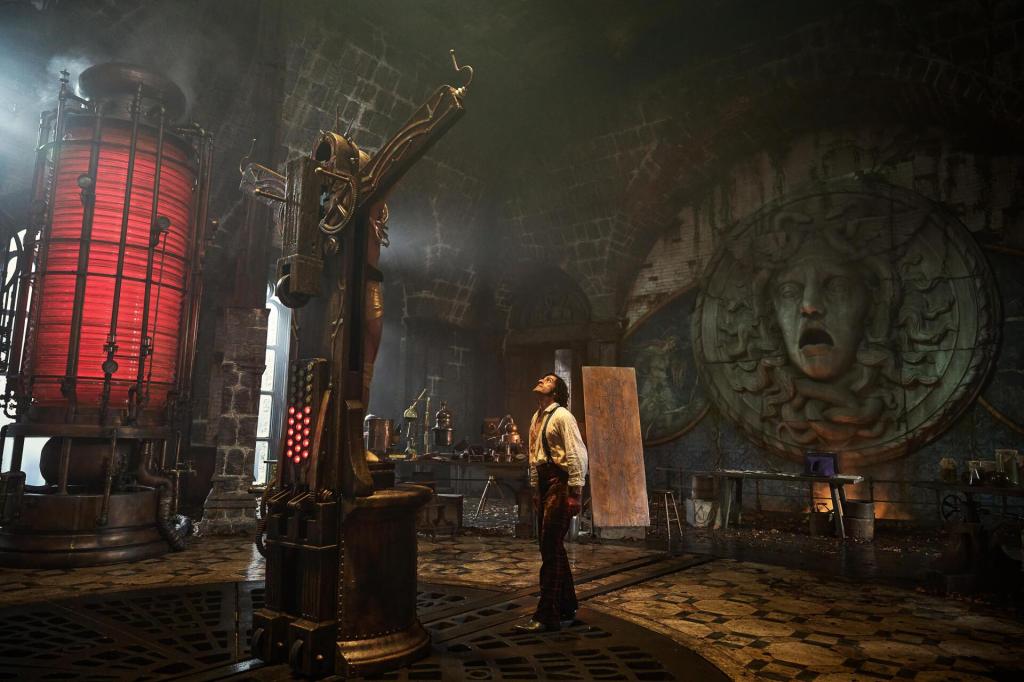
Del Toro’s film looks absolutely stunning, a sumptuously designed Gothic melodrama with extraordinary sets, grand costumes and beautiful cinematography (the Polar-set framing device is particularly striking, covered in lusciously contrasting blues and greens). There are striking echoes of the visual intensity of Pan’s Labyrinth, with Frankenstein’s lab turned into a mix of laboratory and classic temple, including a giant Medusa sculpture. The birthing sequence is a grandiose, operatically Gothic thing of beauty, a version of Whale’s film dialled gloriously up to eleven.

Del Toro’s film goes back to the novel in some ways (in themes and its Polar framing device), but in many ways it’s more of a complex, emotional reimagining of Whale’s film. Isaac’s Frankenstein, an egotist in need of an audience feels very similar to Colin Clive. Whale’s key motif, the Creature’s romantic yearning for the sun, becomes thematically central here. As there, Frankenstein conducts his experiments in a colossal Gothic tower, keeps the Creature chained and makes vague attempts to rear it and takes no responsibility for his actions or the deaths connected to it (in fact Isaacs’s Frankenstein lies and lies in a weasily attempt to protect his reputation). Waltz’s arms dealer funder of Frankenstein’s insanity feels like a version of Pretorious from Bride of Frankenstein, while del Toro goes even further than that film in deepening the bond between the Creature and the Blind Man.

Del Toro also doubles down on Whale’s implicit sympathy for the Creature. Here re-imagined as possessing near super-human strength and durability (his violent responses to being attacked being partially a result of his own strength being uncontrollably great), his child-like vulnerability is as dialled up as his actual physical invulnerability. The Creature feels, first and foremost, like a thought experiment by Frankenstein – and the fact this experiment has effectively rendered the Creature immortal and capable of a Wolverine-like cellular regeneration, condemned to walk the Earth forever alone only heightens the creator’s myopic selfishness.

One of del Toro’s key themes is terrible parenting. Much as he loathed his domineering, brutal father (Charles Dance, in a role perfectly crafted for his austere distance) who caned his face (his hands are too precious) when he flunked remembering anatomy facts, Frankenstein ends up echoing his father’s approach. When the creature constantly fails to say anything other than ‘Victor’, he too reaches for a cane to beat learning into him. Like his father, he resents the creature for being a bad reflection on him. He is, effectively, a dead-beat Dad, casually fathering a child which he has no idea how to treat, who falls back on cruelty.

There can be few Frankenstein’s on film less sympathetic than the version played here by an impressively egotistical Oscar Isaac. He’s full of preening self-importance and self-justification, obsessed with his task but giving no thought to its consequences. Twice he reanimates corpses then callously switches them off without a second thought. Giving birth to Frankenstein – just like in Whale’s film – after an initial interest (that is really self-congratulatory pride) his reaction is to chain him up in the basement and lose patience at him. With his constant milk-drinking there is a sense he’s a little boy who never grew up, and to him love is founded on possession: first of his mother, then his brother, then Elizabeth, all of whom at various points he wants to keep to himself – while his anger at the Creature is rooted in his failing to meet Victor’s expectations.

Frankenstein is at heart an angry mother’s boy, resenting his father for ‘taking’ his mother away from him (del Toro even has him wrapped in his mother’s distinctive red when he wakes to discover the Creature lives). There is more than an echo in that in his love for Elizabeth, the fiancée of his younger brother (who he also subconsciously resents for both ‘killing’ his mother in childbirth and for having the sort of relationship with his father Victor never had). These Freudian feelings are subtly enforced by Mia Goth playing both roles (it’s so subtly done I missed it first time round). Victor’s love for Elizabeth is just as possessive and selfish as that for his mother – and in the same ways his contempt for the Creature is for ‘failing’ him.

By contrast with this monster, the Creature is presented overwhelmingly sympathetically. Played with an outstanding physical and emotional commitment by Jacobi Elordi, he’s framed as a child stumbling towards a painful adolescence. Freshly born, he waddles like a toddler, stares in fascination at leaves floating on a stream and painfully forms the word ‘Victor’. Of course, it never occurs to his creator that this is the equivalent of “mama”. Only Elizabeth, who feels an immediate affinity with the sensitive soul, understands this. Only she tries to speak to him – or asks what his name is.

The poor Creature escapes into a world he quickly full of senseless, prejudiced violence. He bonds with a stag – only for the creature to be shot in front of him by hunters (who instantly turn their guns onto him). In conversation, Elordi presents a man who is sensitive, kind and gentle but capable of anger and fury. Del Toro crafts a tender relationship between the Creature and David Bradley’s Blind Man (the only person, other than Elizabeth, to look past his appearance). The film’s second act, focusing on the Creature’s emotionally painful interaction with the world is its strongest – not least because you feel throughout del Toro’s deep bond with him.

After all this, it’s surprising that Frankenstein ends on a note of hope. Del Toro’s film isn’t always quite nimble enough for this: some of its more optimistic moments can feel as if they have emerged a little thin air (or from the optimistic wishes of the director). In particular, Elizabeth’s bond with the Creature feels so swiftly sketched out it failed to completely convince (more time on this and less time on Waltz’ creepy arms dealer would have been welcome). But this feels like a passionate, committed and perhaps above all beautiful to-look-at piece of work with a real emotional heart. This easily lifts it into the upper echelons of Frankenstein adaptations.

28 Years Later (2025)

28 Years Later (2025)

Belated sequel successfully compliments gore with thoughtfulness and surprising sensitivity

Director: Danny Boyle

Cast: Alfie Williams (Spike), Jodie Comer (Isla), Aaron Taylor-Johnson (Jamie), Ralph Fiennes (Dr Kelson), Edvin Ryding (Erik), Chi Lewis-Parry (Samson), Christopher Fulford (Sam), Amy Cameron (Rose), Stella Gonet (Jenny), Jack O’Connell (Jimmy)

Following on not quite 28 years since the original (23 Years Later wouldn’t have had the same ring to it), 28 Years Later sees Danny Boyle return to the post-apocalyptic hell-scape that is a Britain over-run by rage-infected, super-fast, permanently-furious, adrenaline-filled humans (don’t call them zombies!). But those expecting a visceral, gut-punch of blood-soaked violence may be in for a surprise. 28 Years Later is a quieter, more thoughtful film, where the battlefield is for the sort of values to embrace in a world gone to hell.

After a viciously terrifying opening set on the day of the original outbreak – in which vicar’s son Jimmy flees, terrified, from his home after a gang of infected literally rip-apart or infect his family sand terrified telly-tubby-watching friends – we flash-forward decades. Britain is now quarantined and nature has reclaimed large chunks of the land. The few remaining survivors live in protected communities, like a group on Lindisfarne, protected by a causeway flooded at high tide. In the community, 12-year-old Spike (Alfie Williams), is taken to the mainland by his father Jamie (Aaron Taylor-Johnson) to claim his first infected kill, while his confused and ill mother Isla (Jodie Comer) sits at home. But Spike will learn things about himself and his father on the mainland – enough for him to decide to risk taking his mother to meet with the mysterious Dr Kelson (a magnetically eccentric and softly-spoken Ralph Fiennes, in a performance that defies all expectations), who lives in isolation and may just know how to cure her.

Boyle’s film is kinetic and vicious at points, but also has a magnetic beauty as his camera flows across a world in some-ways unchanged from 2002 and in others utterly alien. Scavenged supplies are full of technology from the earlier noughties. The remains of things like Happy Eater restaurants are everywhere, and (proving not everything is bad) the Sycamore Gap tree remains standing. Buildings and villages are overgrown with plant-life and trees. Colossal herds of deer – enough to shake the earth – roam the countryside. In many ways the future is once more the green and pleasant land, with the Lindisfarne community sharing supplies and relearning skills like farming and archery (echoing the days of Henry V, with Boyle calling back to this with a series of shots from OIivier’s film, it’s a compulsory skill as the safest way to kill infected).

There is no chance of salvation or change here. That’s made very clear to us, with the Act Two arrival of Edvin Ryding’s scared Swedish soldier who tells us plainly that being stranded on the island is a death sentence. The world has left Britian behind and they way Erik describes it, all iPhones and Amazon deliveries, is as familiar to us as it is utterly incomprehensible to young Spike. This is not a film about fixing, averting or liberating the island. It’s a film about existing in a permanent state where mankind is no longer the apex predator.

Boyle’s film, with an excellent and thoughtful script by Alex Garland, is therefore all about defying expectation. Spike’s journey with his father is less about a terrifying chase from hordes of infected (though there is plenty of that), or him hardening himself in a brutal world. Instead, it’s about Spike’s nagging doubts about his father being confirmed. Aaron Taylor-Johnson is a very good as a man who is brave and protective, but morally weak and desperate for approval. He’s the sort of man who harangues his son into executing restrained infected (even children) and takes every opportunity in between dutiful caring for his wife, to slip off to his girlfriend. A man who brags on their return as if his son was some sort of Hercules, when Spike knew he spent most of his time missing with his arrows and in a constant state of terror.

28 Years Later captures that sinking feeling children can have when they realise beyond doubt that their parents aren’t perfect. Alfie Williams is excellent as a caring boy, who doesn’t see sensitivity and humanity as weaknesses in the way you suspect his father does. Who sees through his father’s need to promote himself and is disgusted by it. And finds himself drawn closer to his sick mother (a carefully vulnerable performance from Jodie Comer) and finding he has more affinity for a world that still has a place in it for decency, where going back to help someone is not written off as foolishness.

It’s a film that raises fascinating questions about the infected themselves. While millions of infected passed away – their rage filled minds unable to carry out basic tasks like eating or drinking – the small percentage who survived, seemed to retain enough of themselves to maintain some sort of life. They move in herds – or, as some of the obese ground-crawlers do, in a bizarre family unit – and they even have leaders. ‘Alphas’ – those who the disease caused to grow to humongous proportions (in every organ) – direct their charges. And they have intelligence: our main Alpha ‘Samson’ enraged at the death of his comrades, holds back from an attack until the moment is right, mourns the loss of a female infected and maintains a relentless pursuit for reasons we’d recognise from thousands of movies.

28 Years Later uses this to force us to ask questions about ourselves and when human life ceases to matter. To Jamie, the infected have ceased to be human and killing them a duty. But Spike is forced to start to ask: what right do we have to decide there are less human than us, these people who were like us perhaps moments before? Beyond self-defence, is killing them as noble as all that? 28 Days and Weeks Later featured the instant slaughter of anyone with even a suspicion of infection. Years questions this like never before. Everyone on this island is a victim, and the infected deserve just as much memoralizing as victims as the uninfected.

It makes for a surprisingly quiet and meditative drama – even if it is punctuated by moments of shocking blood and gore, from heads and spinal cords being ripped out to a blood-spatted TellyTubbies screening in a vicarage – and one that demands you think almost more than it demands you be thrilled. With exceptional performances, especially from Alfie Williams, it’s a different but mature sequel that redefines aspects of the series. And, based on its jaw-droppingly bizarre ending, its sequel will only take this thinking further.

Sinners (2025)

Sinners (2025)

Coogler’s mix of political statement and horror flick is overlong but very effective

Director: Ryan Coogler

Cast: Michael B Jordan (Elijah “Smoke” Moore/Elias “Stack” Moore), Hailee Steinfeld (Mary), Miles Caton (Sammie “Preacher Boy” Moore), Jack O’Connell (Remmick), Wunmi Mosaku (Annie), Jayme Lawson (Pearline), Omar Miller (Cornbread), Delroy Lindo (Delta Slim), Li Jun Li (Grace Chow), Yao (Bo Chow), Buddy Guy (Old Samme)

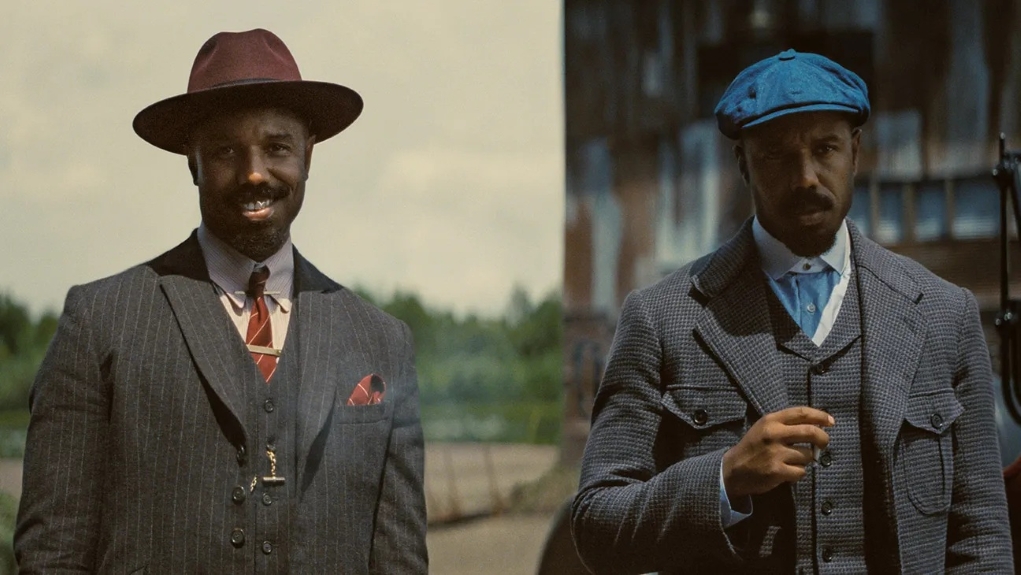
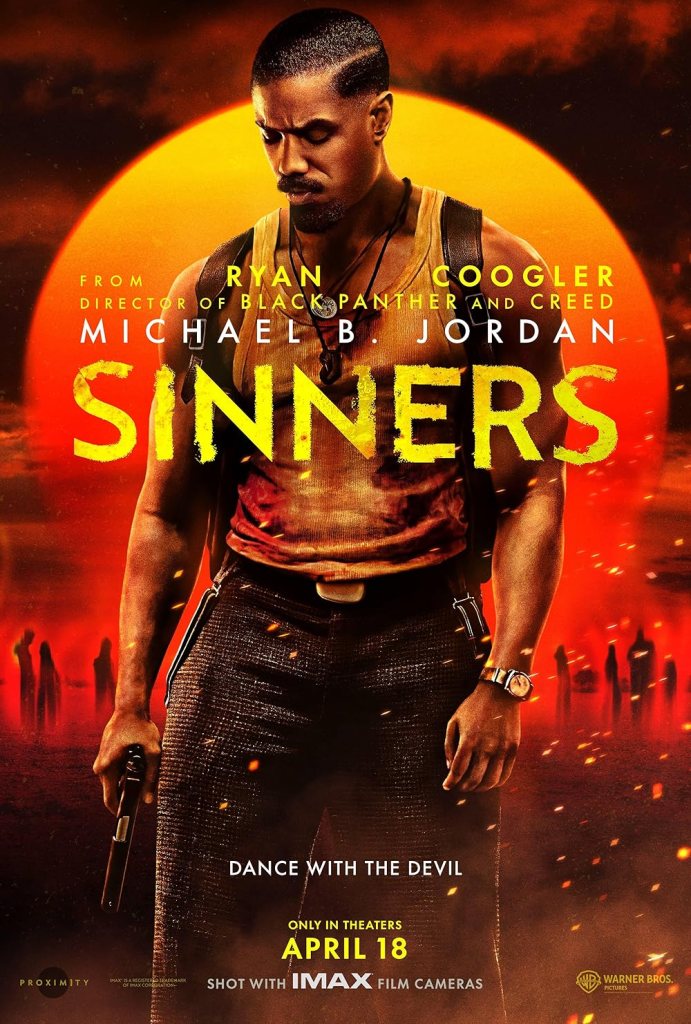
In 1932 twin brothers Smoke and Stack (Michael B Jordan, pulling double duty) return to the racist South of Mississippi after years of war service followed by time spent working for the gangs of Chicago. They dream of setting up a juke joint for the Black community, flying in the face the racism of local Mississippi. But the dangers of the KKK pale slightly, when their opening night coincides with the arrival of vampire Remmick (Jack O’Connell) who dreams of forming a new family of the dead – and wants to recruit Mississippi’s Black community, with promises of equality in his world they could never have in their own. Holed up in their juke joint, can the brothers and their families and friends survive a night long siege until dawn?

The basic set-up of Sinners is, to be honest, familiar. It delights in hueing close to Vampire mythology – garlic, wooden stakes, silver and sunlight are the key weapons here and the vampires are powerless to cross a threshold until they are invited – and the ‘base under siege’ that occupies the film’s final act is essentially taken direct from the sort of set-up John Carpenter excelled at in his heyday. What makes Sinners really stand-out is the richness of its character relationships and its social context.

That social context is, of course, the Jim Crow South. Sinners is a film steeped in the racial injustice of a particular time-and-place. In 1932, Black workers still pick cotton on plantations in exchange for wooden nickels. Families live in shanty towns and use different shops than the white folk (local goods dealers the Chow’s run two convenience stores, on opposite sides of the street, to serve their two clienteles). The danger of lynchings are everyday threats (Delroy Lindo has a haunting monologue, beautifully delivered, as Slim recounts the lynching of a former band partner, who unwisely produced his stuffed wallet at a train station). Virtually the only white people we see (other than Rennick) are KKK members.

In this world of radical injustice, it’s fascinating that Coogler suggests, in some ways, the afterlife of a Vampire is more just and fair than actual life. Rennick, himself the relic of a long-oppressed pagan Irish community, makes solid points about Smoke and Stack facing a losing battle trying to play by the white man’s game as entrepreneurs and would-be local businessmen. He even, genuinely, states he would be happy to kill the entire KKK just to wipe their hatred from the Earth. There is a certain truth in the fact that, in the legions of the undead, all are equal and race means nothing. That getting bit could be a doorway to a new world, free of racial oppression – even if it also seems to mean living in the sort of community Rennick alone crafts.

It becomes a fascinating idea, joined with the fact that Rennick also points out Christianity is a spirituality forced on the Black community. Unlike the blues music, that gifted young cousin to the brothers, Sammie (a lyrical performance in every sense from Miles Caton) plays so well it can cross the bounds of space and time joining Black souls together, the enslaved people didn’t bring Christianity with them across the water. It was forced on them, as much as the labour in the fields. Sinners isn’t quite brave enough to explicitly denounce the Church as just another wing of enslavement (even if Sammie’s preacher father uses trauma to hammer conversion on people, rather than offering comfort). But it does make clear that Sammie’s ‘coming-of-age’ is whether he will choose the culture of his ancestors or the culture of his oppressors.

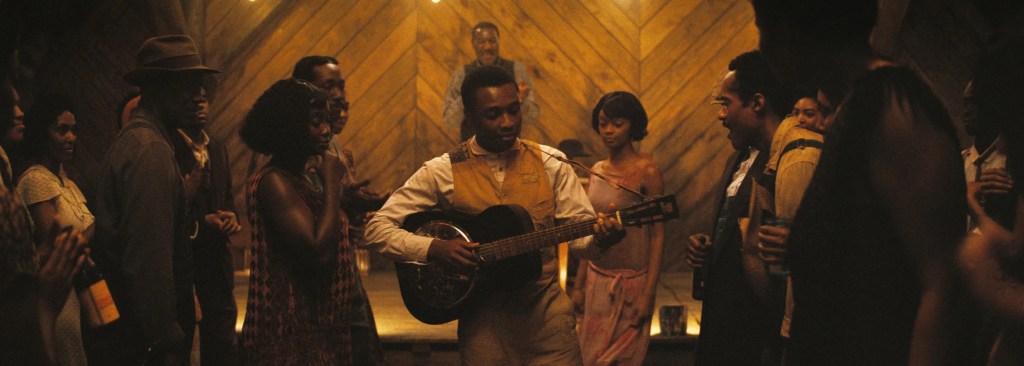
This is thought-provoking stuff – and Coogler does a superb job of threading it through the blood-spurting, neck-biting, stake-hammering action that fills up a large portion of the film’s conclusion. Sinners is dripping in Blues music, which artfully and beautifully wraps itself around the film to perfectly capture its tone and pitch. The sequence where Sammi’s music fills the juke joint, is transcendent in more ways than one, powerful and transporting in its musicality and passion (Ludwig Göransson’s score, created in partnership with several Blues artists and the actors is exceptional). Coogler matches it with one his trademark, virtuoso, one-take shots, the camera seamlessly weaving in and around the juke joint as our 1930s characters dance alongside modern club dancers and musicians as well as tribal African musicians of the distant past.

It also rewards more as Coogler takes his time throughout the film’s long opening act to really establish the characters and their relationships. You can argue that Sinners is over-indulgent in the sometimes overlong (well over an hour) long ‘recruitment’ sequence as Smoke and Stack assemble family and friends for their opening night. But this careful exploration of the closeness and warmth between these people – their loving sense of family, loyalty and sometimes painful shared history – pays off in spades when they begin one-by-one to turn to Rennick and then on each other. Coogler then makes these corruptions of the living into the hungry undead really sting, just as we feel the pain of those left among the living who must stake their nearest and dearest.

That carries further impact from the strength of the acting. Jordan, one of the most charismatic actors out there, gives a superb double-performance as the two twins, expertly sketching out their contrasting personalities and their deep love for each other. He makes Stack charismatic, gregarious and fun, and Smoke gruff, reserved but endlessly loyal and protective. They are too sharply humane turns, with Jordan so naturally playing off himself you forget both are played by the same actor.

Equally fine are the rest of the cast. Miles Caton is youthful idealism being shaken by traumatic events on the greatest night of his life. Wunmi Mosaku gives Smoke’s wife Annie a moral authority and deep sense of lingering grief. Hailee Steinfeld is vivacious but similarly burdened by disappointment and pain at chances lost as Stack’s one-time girlfriend that prejudice thwarted. Delroy Lindo’s soulful skill invests Slim with a real grace under the drunkenness. Even O’Connell, at times transformed into an Orlock-like nightmare, has a lonely humanity behind his ruthless, never-ending desire to build a new community (which he controls) around him.

There are powerful subtexts throughout here, even if parts of Sinners could at times benefit from a little tightening. Coogler effectively gives a rich hinterland to some familiar genre settings: and he surprises us with two codas, one rich in satisfying revenge violence the other with a rhapsodic melancholy which feel like natural ends for both their characters. Sinners mixes its Spike Lee influences with its John Carpenter ones with excellent effect, and is another firm reminder of the visual flair and piercing individualism of Coogler as director.

The Exterminating Angel (1962)

The Exterminating Angel (1962)

Buñuel’s unique party-gone-wrong is a fascinating mix of comedy, surrealism and satire

Director: Luis Buñuel

Cast: Silvia Pinal (Leticia, “The Valkyrie”), Jacqueline Andere (Alicia de Roc), José Baviera (Leandro Gomez), Augusto Benedico (Dr. Carlos Conde), Enrique Rambal (Edmundo Nóbile), Luis Beristáin (Cristián Ugalde), Antonio Bravo (Sergio Russell), Claudio Brook (Julio), César del Campo (Colonel Alvaro Aranda), Rosa Elena Durgel (Silvia), Lucy Gallardo (Lucía de Nóbile), Enrique García Álvarez (Alberto Roc)

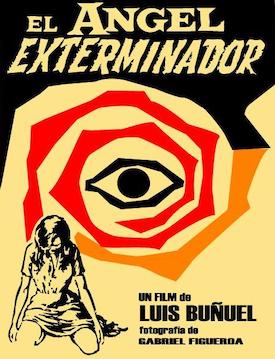
Imagine a party so good, you couldn’t bear to leave. Sounds great, right? Now imagine a party that wasn’t even that good, but you couldn’t leave anyway. A dinner party with the hoi polloi that locks you into a seemingly never-ending parade of days (or weeks) where you and everyone else were physically incapable of stepping over the threshold of the room you’re in. All of you forced to live in a tiny space, on top of each other, none of you having a clue why you can’t leave or why this is all happening. Imagine that, and you’ve got Buñuel’s The Exterminating Angel, a surrealist-tinged, open-ended mystery of a film that presents its situation and leaves you to make of it what you will.

Returning to Mexico after comprehensively incinerating his nascent re-alignment with Spanish cinema with Viridiana (a film made in Catholic Fascist Spain that mocked both the fascists and the Church), Buñuel creates a haunting elliptical masterpiece by harnessing an idea so compelling it’s been recycled, reframed and reexplored by countless films after.  It’s an idea that has soaked into horror, of being trapped by some unknown force in a single place, unable to break free. It’s also sparked satire with its depiction of the thin veil of smug self-satisfaction over the bourgeoisie that collapses under the strain of covering primitive, violent instincts.

The Exterminating Angel tips us off from the start that we won’t be settling down to watch any old dinner party. As the guests assemble, the staff at the grand town house are practically falling over themselves to flee, as if subconsciously aware there is something wrong in the house. Buñuel throws the viewer off from the start by deliberately repeating scenes – a repetition so on-the-nose, that when watching I actually doubted myself about whether I had just seen what I thought I saw. We see the guests arrive – and make a forlorn call for their coats to be taken – twice in quick succession. It’s so blatant, even Buñuel’s editor gave him a panicked phone call about the ‘error’ just before the film’s opening!

Later the micro-repetitions of scenes, interactions and lines will pile up (it’s a film that rewards constant reviewing) making the whole set-up even more disconcerting. Two characters introduce themselves to each other three times, each time with a different emotional mood (from friendly to outright hostile). The same dinner toast will be greeted with rapture then complete indifference. Two couples will echo the same conversation. Oblique points about freemasonry and current affairs will be made over and over. Is Buñuel suggesting the whole whirligig of the social situation is just a slightly pointless merry-go-round where the same old bullshit happens over-and-over again and essentially means nothing? Sure, the characters notice they are literally trapped in the same room, but really aren’t they just metaphorically trapped in the same old rooms all the time?

Nevertheless, as the dinner party winds down, everyone is far too polite (or far too concerned with appearances) to openly say they feel like its physically impossible for them to cross the threshold and leave. Instead, the hosts quietly grumble that no-one seems to know when to go as the clock ticks into the wee small hours and the middle-class types here settle down in armchairs, on sofas or even on the floor to sleep. Come the next morning, polite embarrassment prevents anyone from saying exactly why they are still here. In fact, everyone promptly makes politely meaningless excuses about why they aren’t quite ready to leave yet: they’ve not had breakfast, nanny will look after their children, they don’t need to be anywhere quite yet.

In fact, I’m not sure anyone openly says they ever feel trapped. It’s like social faux pas everyone is horrified of pointing out. Not a surprise really as everyone here is from the height of professional society: doctors, conductors, army officers, businessmen, society grande dames. None of them wants to stand out like some panicked rube thrown by odd sensations. Instead, everyone slowly settles down into working around this bizarre situation no one wants to talk about. A cupboard is tacitly turned into a toilet. The food is carefully rationed. A water pipe is tapped into so everyone can drink. Sleeping areas are claimed. No one tries to solve the problem, because even acknowledging the problem feels like a cheeky liberty.

It leads into an increasingly fascinating blend of horror, dark satire and surrealist black comedy that Buñuel skilfully builds. A few shots show us the threshold of the room from the next room (a lush ballroom), and there are cuts to a crowd of rubber-neckers outside the house) who also cant enter. But otherwise, it’s all in this one room and as time – and the guests lose all track of that – drags on, the bonds of society both loosen under the polite instincts. Tempers fray, but there remains a formality even as the ravenous guests rip apart (off camera) and cook a sheep that wanders into the room. Some guests take advantage of the proximity to indulge in voyeuristic perversions, but when arguments erupt they are resolved with a Victorian duel mind-set. Only towards the end, as the world really fragments, does the danger of real violence (a suggested lynching of those judged responsible) flare up.

Buñuel would criticise himself later for not going far enough (if you want an idea of relatively tame he later thought it was, he argued cannibalism was one of the things he should have explored). But the fact that much of the behaviour remains grounded, recognisably stuck in a rut of upper-class restraint makes the film more effective. (Or as restrained as a party, where the cancelled ’entertainment’ at the original dinner was an unspecified event involving a tame-ish bear and three sheep, can be). Somehow, if the guests had regressed into the most animalistic behaviour possible, the film might have lost some of its enigmatic quality. As it happens, the fact the guests can never quite escape the trappings of their social rules makes it even more unsettling. It means that threats – such as the ferocity behind the ‘I’ll kill you’ response to a joke about someone being pushed out of the room – carries even more of a shock.

Buñuel throws in the odd surrealistic touch – after all he always claimed a dream sequence was in there when he had run out of ideas. We get two, one revolving about a nightmare of a disembodied hand moving freely around the house (it must be some sort of joke from Buñuel that the hand itself is the least convincing rubbery affair you can imagine) and later a sequence of disconnected images superimposed over a cloud filled sky. The film’s conclusion suggests a deadly, ever-expanding loop, based around the fact the characters suffer but learn nothing from it.

You can argue that The Discreet Charms of the Bourgeoisie, by allowing more physical freedom to its characters, allowed even more surreal, fascinating and intriguing exploration of the repressions, lies and hypocrisies of bourgeoisie life. But The Exterminating Angel has a claustrophobic horror to it, and the pressure cooker bubbling just below the surface of these trapped characters exposes class tensions in superbly unnerving ways. It makes for an expertly executed, shrewdly vicious social satire that lifts a lid on the many petty behaviours that govern so much of our lives. And it’s a mark of genius that you cannot imagine anyone other than Buñuel making it.

Nosferatu (2024)

Nosferatu (2024)

Eggers’ wonderfully atmospheric remake is creepy, haunting and quite extraordinary

Director: Robert Eggers

Cast: Bill Skarsgård (Count Orlock), Lily-Rose Depp (Ellen Hutter), Nicholas Hoult (Thomas Hutter), Aaron Taylor-Johnson (Friedrich Harding), Willem Dafoe (Professor Albin Eberhart von Franz), Emma Corrin (Anna Harding), Ralph Ineson (Dr Wilhelm Sievers), Simon McBurney (Herr Knock)

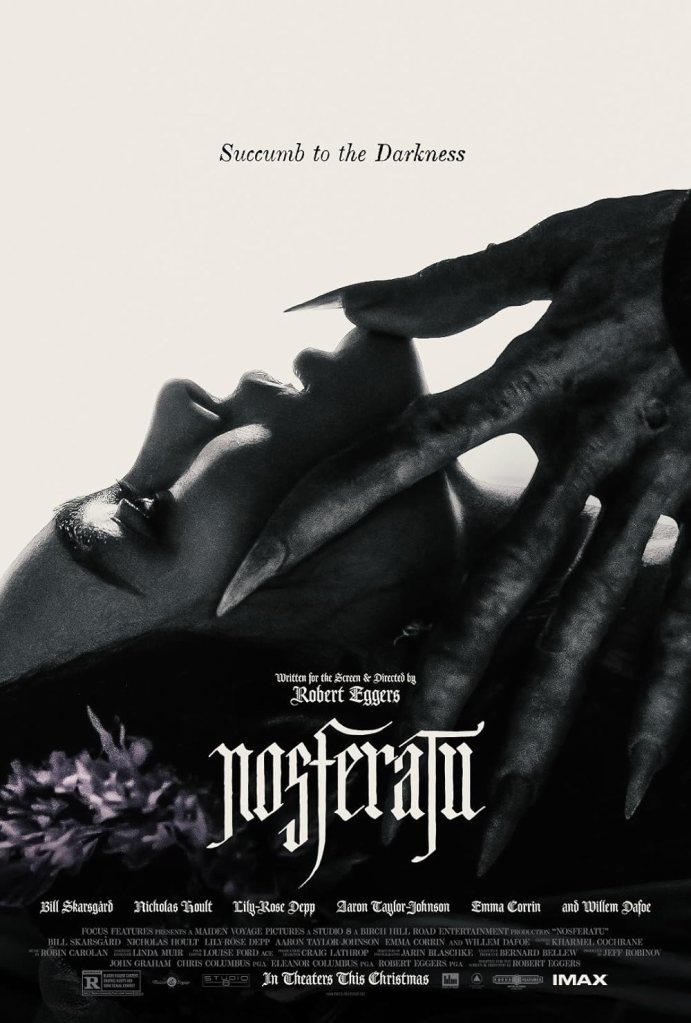
Robert Eggers dreamed so long of his own version of FW Murnau’s seminal vampire film (and Bram Stoker copyright infringement) Nosferatu, it was originally announced as his second film. We had to wait a bit longer, but it was well worth it. Eggers’ experience helped him create a film infinitely richer than I suspect he would have made ten years earlier. Nosferatu is an astonishing, darkly gothic, richly rewarding film, glorious to look at and a fiercely sharp exploration of the subtexts of both sources. It can never match the original’s seminal impact, but celebrates and elaborates it.

The story hasn’t changed dramatically from the one Murnau ripped off from Stoker. In Wisborg, junior solicitor Thomas Hutter (Nicholas Hoult) leaves his beloved wife Ellen (Lily-Rose Depp) for Transylvania and a lucrative land deal with the mysterious Orlock (Bill Skarsgård) that could lead to a comfortable life for him and his new wife. Unfortunately, there are three things he doesn’t know: firstly, the Orlock is a ravenously cruel vampire, with extraordinary supernatural powers; second his employer Knock (Simon McBurney) is an occultist worshiper of Orlock; thirdly, Orlock has used his mental powers for years to terrorise and groom Ellen from afar and Hutter’s presence is the final step in his scheme to control her. It won’t be long until a deadly curse plagues Wisborg.

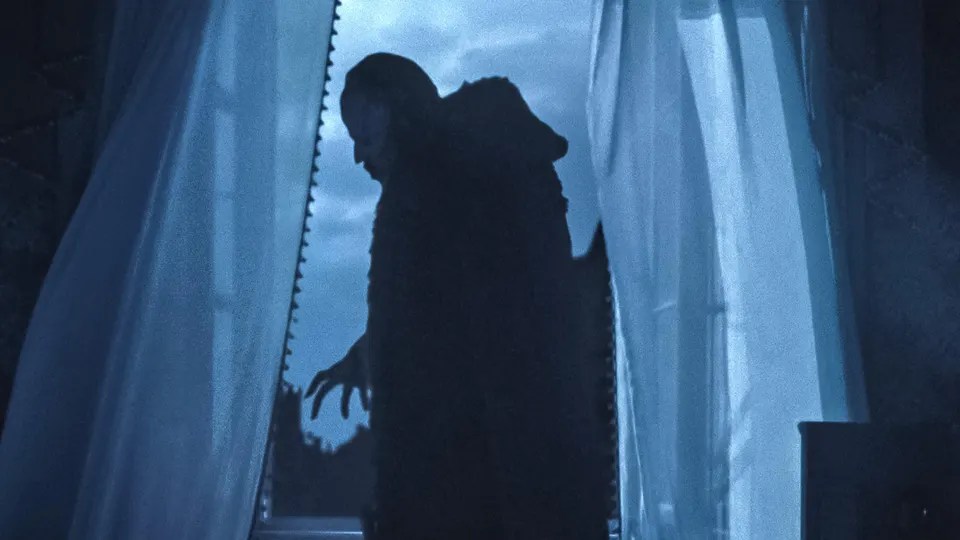
Egger’s dark (but extremely beautiful) gothic film drips with atmosphere, gloomy shadows rolling over its elaborate sets, the drained out night-time shots reminiscent of the tinted black-and-white beauty of the original. The entire film is soaked in love for silent-era horror, with homages to Murnau, Dreyer, Sjöström and so many others I couldn’t begin to spot them all – though I loved Orlock’s gigantic shadowy hand creeping Murnau’s Faustus-like over Wisborg. The film drowns in folk horror, from its snow-capped Transylvanian countryside dripping in unspeakable hidden evils to the unreadable motives of a mysterious Transylvanian village.

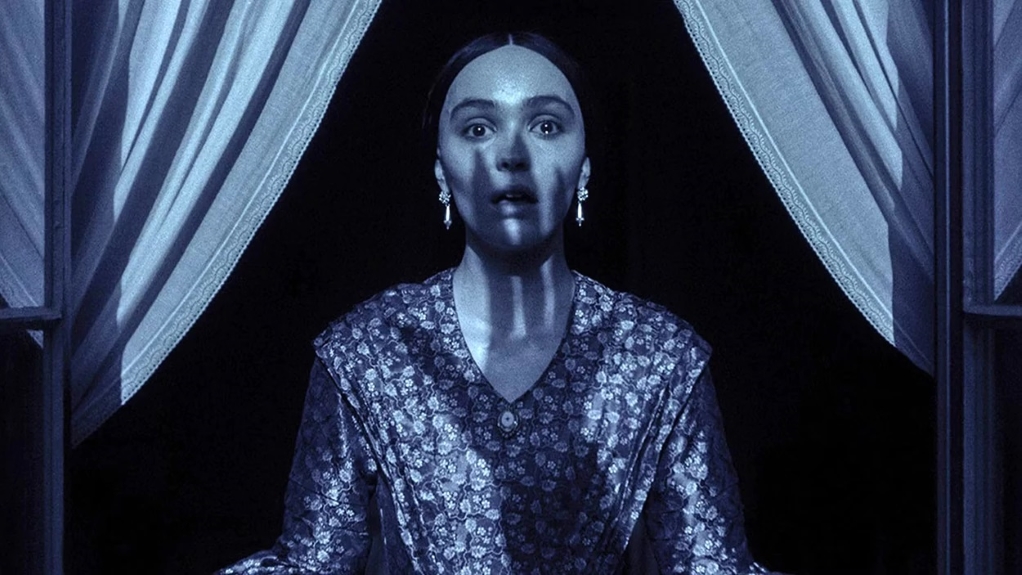
At its heart is an exploration of the sexual undertones of the vampire legend. Orlock’s assaults leave his victims are overwhelmingly sexual, with Orlock’s body thrusting forward while he drains the blood of his groaning victims. That’s not to mention Orlock’s revolting sexual manipulation of Ellen. Nosferatu leans heavily into Stoker’s dark sexual awakening subtext. Orlock’s psychological manipulation has left Ellen traumatised, torn between dark sexual desires and romance with Hutter. Nosferatu opens with a dark (dream?) sequence, as Ellen rises with sensual sighs from sleep, drawn towards Orlock’s seductive shadow in sheet curtains, before joining him outside for something that looks an awful lot like sex before Eggers cuts with a jump scare shot, our first glimpse of Orlock.

This is an Orlock radically different from Max Schreck’s original. While he shares his long nails and angular posture, here he is no-more-or-less than a decayed, rotting corpse. His body is covered in sores of decayed skin, with everything (including his penis) halfway to the compost heap, his bony legs and hips positively skeletal. There are homages to his Vlad the Impaler roots, from his fur-lined uniform coat (that like the rest of him has seen better days) to his surprisingly well-groomed moustache. But there isn’t a trace of the handsomeness of so many Draculas – this Orlock is possibly even more repulsive to look at than the rat-faced monstrosity of the original.

Skarsgård’s make Orlock a truly ruthless figure, delighting in his natural cruelty. With Hutter his looming, shadowy menace offers not a jot of home comforts, working to terrify a man who he sees as a perverse romantic rival. (His hallucinatory blood-sucking assault on Hutter is filmed in a manner reminiscent of rape). Throughout, he treats almost everyone he encounters with contempt and lofty disgust and takes a sadistic delight in torturing Ellen’s friend Emma Harding’s family, culminating in a truly shocking scene of grizzly horror. While the original Orlock was almost feral, like his rats, this one is a monstrous decayed sorcerer with a never-ending hunger and sadistic desire to play with his food.

He also has something the original never had: a voice. Skarsgård spent weeks in training to develop this (digitally unaltered) vocal range, a rolling bass-rumble which wraps itself around a raft of Dacian dialogue. Eggers’ gives him immense supernatural skills, in a film dripping with occult magic. Simon McBurney’s Knock (a remarkable performance) is a lunatic drowning in it: covered with dark markings, biting the heads of pigeons and communicating with Orlock by sitting naked in a Pentecostal star. His brain has been flushed out by Orlock’s mental power (who treats him like dirt) and the vampire’s hypnotic voice overwhelms the senses: just a few sentences drains Hutter of willpower (Nicholas Hoult’s fear is so palpable here you could almost touch it). Orlock’s malign influence can twist people or make them suddenly ‘wake’ with no idea of where they’ve been.

The power of his influence twists and distorts emotionally and physically. Lily-Rose Depp captures all this in a remarkable physical and vocal performance, as Ellen falls victim to Orlock’s mental manipulations. Depp throws herself into the most violent fits since Linda Blair: her body spasming, her voice distorted into an Orlock-mirroring gurgle, her eyes rolling back, her inhibitions falling away and blood weeping from deeply disgusting places, especially her eyes. Depp’s performance is extraordinarily committed, her fear and self-disgust at her manipulated sexuality (eekily from childhood) by the Count as tender as he hatred of him is sharp and all-consuming.

It’s never clear how far the vampire wants to screw Ellen, and how far he wants to consume her (Eggers even suggests, towards the end, that Orlock may even welcome his own destruction – perhaps the rapacious hunger is too much?). What is different from the original is Orlock and the plague he brings with him are different. While the original was a destructive force of dark nature, this Orlock is focused exclusively on punishing Ellen, with a literal plague striking down Wisborg.

In the face of this beast, the powers of science and reason are powerless (as Aaron Taylor-Johnson’s delicately performed Harding discovers, refusing to believe until its far too late). Like Murnau’s original, the powers of science and reason (such a key weapon against the vampire in Stoker) are useless. Even rationalist Dr Sievers (a fine performance by Ralph Ineson, channeling Peter Cushing and Michael Hordern) – a man so calm even the insanity of Knock can’t flap him – chucks in the towel and calls in Willem Dafoe’s barnstorming Professor von Franz (here considerably more effective than his counterpart), a scientist turned alchemist with deep occult knowledge.

But it can’t change the fact this is not a war between two sides, but a deeply personal struggle between Orlock and Ellen, with Hutter torn between them. Eggers’ focus on this personal story at the heart of a dark twisted legend adds a genuine freshness – and makes a superb counter-balance to the lashings of gothic horror the film soaks in. It makes for a superb remake that contrasts and comments on the original while telling its own story of dark, corrupted manipulation. Eggers’ direction is faultless in its atmospheric unease and there are superb performances from Skarsgård, Depp, Hoult and the rest. It’s a powerful work, overflowing with silent horror atmosphere while also feeling very modern that has the potential to haunt our nightmares as much as the original.

Don’t Look Now (1973)

Don’t Look Now (1973)

Atmospheric, heart-rendering and beautifully constructed supernatural film, an emotional look at grief

Director: Nicolas Roeg

Cast: Julie Christie (Laura Baxter), Donald Sutherland (John Baxter), Hilary Mason (Heather), Clelia Matania (Wendy), Massimo Serato (Bishop Barbarrigo), Renato Scarpa (Inspector Longhi), Leopoldo Trestini (Hotel manager), Giorgio Trestini (Woekman)

We tend to trust our senses, don’t we? We like to see the world as something solid and factual, that we can process and understand with rational thought. What we don’t have time for is the idea of a sixth sense about the world beyond us. We can’t measure that, so we prefer to ignore those feelings. Don’t Look Now is partially about the terrible consequences of ignoring gut-instincts about the unexplainable, as well as the terrible, all-consuming horror of grief. On top of that it’s a horrifying quasi-ghost story, a moving portrait of marriage and a terrifyingly beautiful image of Venice that’s quite unlike anything else on film.

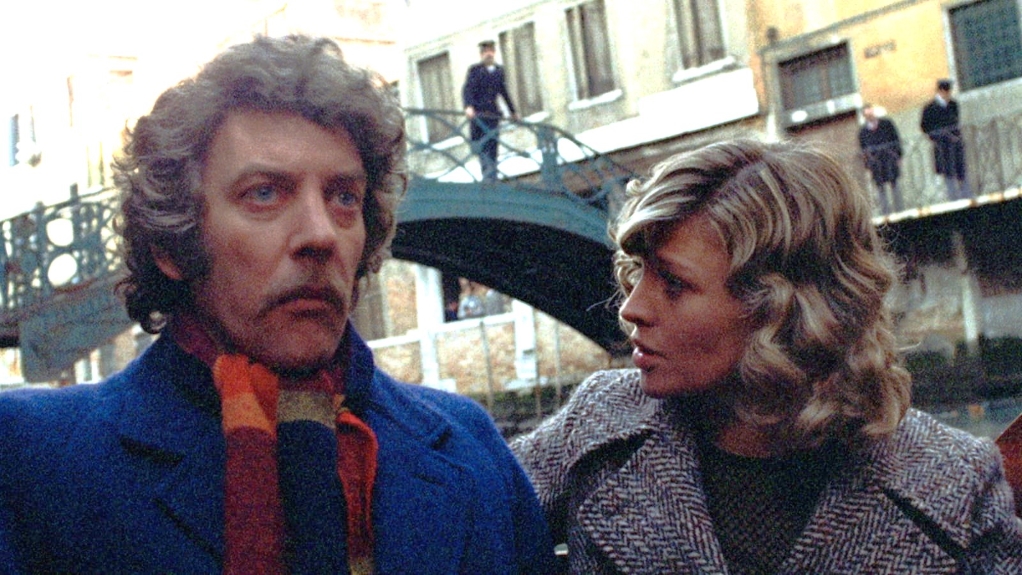
John (Donald Sutherland) and Laura Baxter (Julie Christie) are in Venice, a few months after the death of their daughter in a tragic drowning accident. John is busying himself at work restoring a church, Laura is looking for distraction from grief. Chance leads to a meeting between Laura and two mysterious sisters (Hilary Mason and Clelia Matania), one of whom claims to have second sight and to be able to ‘hear’ messages from the Baxter’s late daughter. Laura is desperate to believe, but John is resolutely unconvinced. But it’s John who starts seeing visions of a child in a red coat – a red coat just like the one their daughter was wearing when she drowned – and becomes increasingly troubled by strange coincidences and feelings.

Roeg’s stunning film is a masterpiece of atmosphere. Shot in vivid colours in a coldly intimidating Venice – which Roeg manages to make feel both beautiful and deeply, disturbingly unknowable and dreadfully intimidating. Don’t Look Now constantly unsettles and disorientates you, a gorgeous city hosting an insidious gothic mystery. It’s a masterfully edited film, that uses our ‘knowledge’ of the language of cinema to disorientate us, forcing us to form associations between images by juxtaposing them together (for instance, Roeg cuts from John casting doubts on the motives of the sisters to them laughing joyfully something that context makes us see as sinister).

The clue in Don’t Look Now is in the title – once we are told to look at something, we’ve got an overwhelming desire to stare straight at it. John’s mind is mind sending a plethora of subconscious warnings: but the more his mind says ‘don’t look’, the longer he stares. He should be picking up on the visual signals from Roeg’s extraordinary design: Don’t Look Now is awash in red. In almost every scene, splashes of striking crimson abound – from coats, to bags, to signs, to everyday objects, to blood – as if the film itself is trying to warn him (at one crucial moment, he even turns away from a street of green fronted shops and cafes, to charge down a street lined with red ones). Don’t Look Now is the tragedy of a man with great powers of intuition who comprehensively ignores them because it’s the rational, sensible thing.

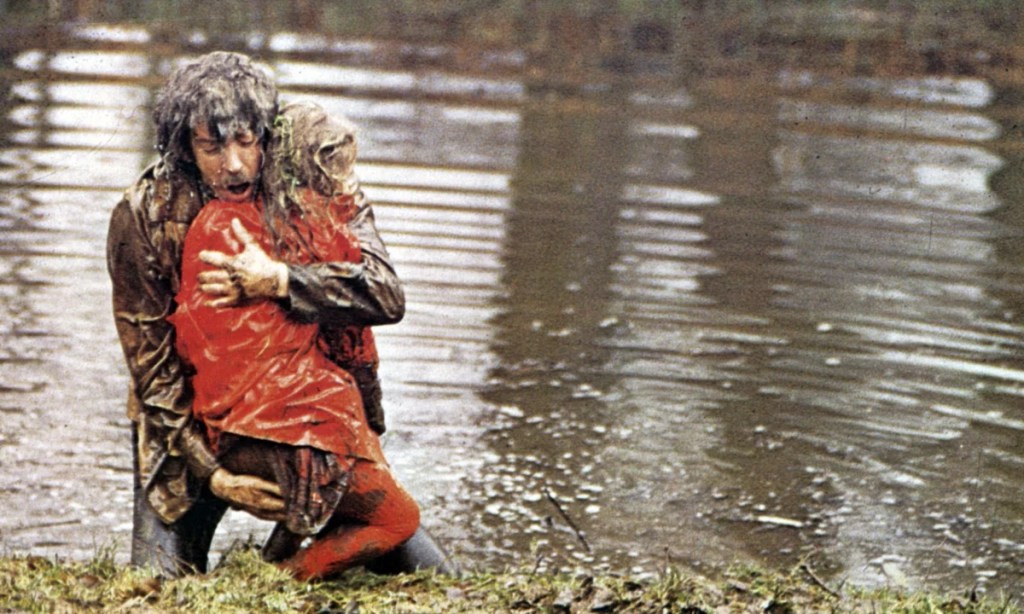
Already he has been warned of the dangers of ignoring his instincts. Roeg opens the film with the drowning of the Baxter’s daughter, while her parents rest indoors after a large Sunday meal. It’s a sequence of ominous, intense anxiety and terrifying, gut-wrenching impact as we cut back and forth between the daughter playing outside (with broken glass and lost balls floating on ponds), to John and Laura continuing casually talking while a slide frame of the Venetian church John is working on soaks in spilled water and the red of a girl’s coat in the image bleeds across the it (as much a prescient warning of John’s danger, as it is of his daughter’s). A distracted John is finally unable to resist the of danger he is feeling – racing instinctively to the pond, but too late to prevent tragedy.

The heart-rendering, raw pain as John fishes his daughter from the pond – the elemental roar from Donald Sutherland being almost unwatchable – caps a deeply affecting sequence in Don’t Look Now’s profound and tender study of grief and the strain it places on a loving relationship. Sutherland and Christie give beautifully judged, profoundly humane and sympathetic performances as shell-shocked people, barely able to process tragedy and looking for anything to distract them from the crushing grief that is hollowing them out. Grief in this wintery city is practically a third wheel in the relationship, an unspoken mix of regrets (and recriminations, Laura at one point blaming John’s lax rules for their daughter’s death) and barely expressed pain.

This doesn’t detract from the deep love they still feel from each other. Don’t Look Now’s (in)famous sex scene carries the erotic charge it does, because it genuinely feels like a long-married couple reconnecting physically, intimately familiar with each other’s bodies. Brilliantly, this sense is actually increased by Roeg intercutting from their love-making to their post-coital dressing, somehow the act of them half-watching each other put their clothes on being as loving as what they did before. Both have a deep desire to protect the other: John is distracting himself from his grief by ‘looking after’ Laura, while she re-focuses on an intense desire to protect her remaining family.

Laura at first feels the more vulnerable of the two: her emotions rawer (she collapses in distress after her first encounter with the sisters), her need for spiritual connection – either lighting candles in the Church, or desperately trying to believe she can communicate with their late daughter – much greater. It’s only when they are separated (after she rushes home to see their son after an injury at school) that the depths of John’s vulnerability and fragility become clear. Without her to distract him, he quickly seems to fall apart: becoming paranoid, increasingly fixated on possible disasters, ever-more obsessed with his glancing images of that girl in the red coat.

Roeg presents much of the world exactly as John sees it, and his masterful framing and editing of key moments and sequences both leave us in as much doubt about what is real as John is, suckering us into making the same mistakes he does. Again, our trust of how visual images are presented works against us, just as John misinterprets and misunderstands premonitions as events literally happening at that moment. It’s what lies behind his obsessive hunt for his ‘kidnapped’ wife, after seeing her on a boat on the canal hours after she flew back to England. Later events will demonstrate how disastrously he has misinterpreted these warnings.

John is drawn into an ever-more Kafkaesque nightmare (there is a lovely touch that, the more distressed John becomes, the more his Italian evaporates – in his element at the church, rebuilding frescoes, he’s fluent – at other times he can barely string a sentence together). A sinister police inspector – Roeg deliberately not correcting Renato Scarpa’s phonetic delivery of his English dialogue, making it unsettingly ‘wrong’ – seems sympathetic, but has John watched. The off-season city empties out (even the Baxter’s hotel closes), becoming a ghost town of echoey, identical streets which John hurtles down. The dark mystery of a serial killer haunting Venice becomes more prominent, concluding in the film’s horrifying reveal of what lies under that red coat, John realising all too late the skills of intuitive understanding that make him a skilled restorer of fragmented mosaics, was the same ignored intuition warning him of the dangers first to his daughter then himself.

Don’t Look Now is not only a masterpiece of atmosphere and superb editing and structure, it’s also Roeg’s most humane and tender work. It’s a deeply affecting portrait of a loving marriage struggling with grief – with extraordinary performances from Christie and Sutherland – and the way our longings combat with our rational mind to confound us. Set in a Venice that is eerily, ghostly and unsettling, it’s a haunting, powerful and superb piece of film-making.

Bride of Frankenstein (1935)

Bride of Frankenstein (1935)

Whale’s sequel is a masterclass in how more can sometimes be more, a delightful black-comedy

Director: James Whale

Cast: Boris Karloff (Frankenstein’s monster), Colin Clive (Baron Henry Frankenstein), Valerie Hobson (Elizabeth Frankenstein), Ernest Thesiger (Dr Pretorius), Elsa Lanchester (Mary Shelley/The Bride), OP Heggie (Hermit), Gavin Gordon (Lord Bryon), Douglas Walton (Percy Shelley), Una O’Connor (Minnie), EE Clive (The Burgomaster), Dwight Frye (Karl), Ted Billings (Ludwig), Reginald Barlow (Hans)

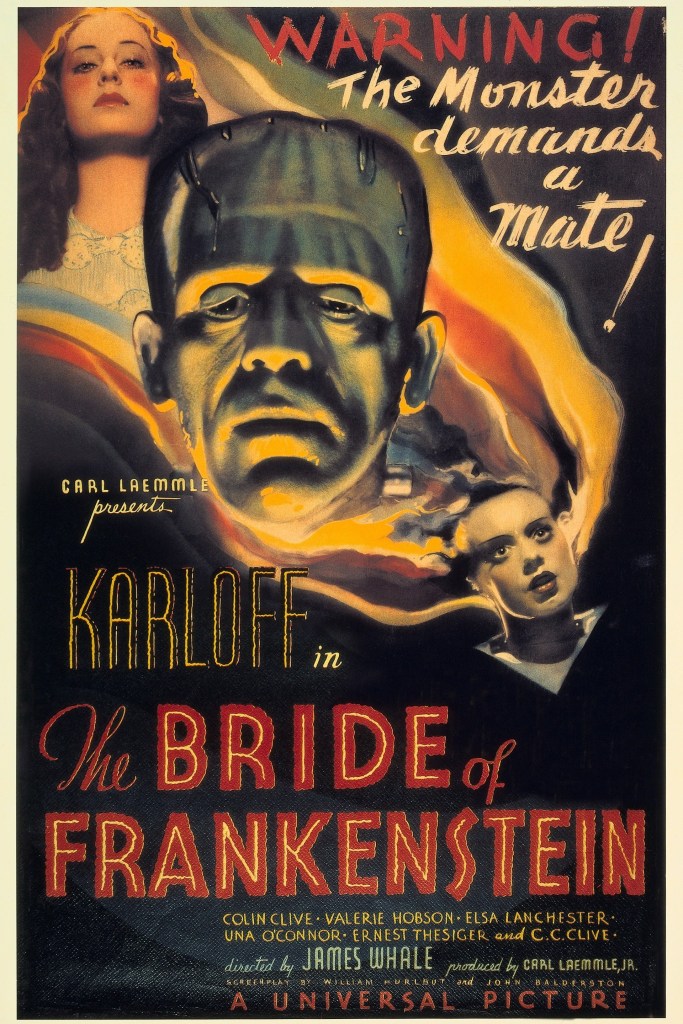
What does every studio want after a mega hit? A sequel of course! Directors are never more powerful then when studios will let them do pretty much whatever they want so long as they get another shot at capturing body-sparking lightening in a bottle one more time. James Whale and gang came back for Bride of Frankenstein and produced a classic, more entertaining than the first film, a barmy, balls-to-the-wall piece of nonsense where logic is thrown out, sly jokes abound and the meter is dialled well up to camp. Bride of Frankenstein is exactly the “memorable hoot” Whale wanted to make, and proof that perhaps he had not “drained the well” after all.

Bride of Frankenstein kicks off pretty much where Frankenstein left off – requiring some fast thinking since the creature (Boris Karloff) ended that film incinerated in a burning windmill. Turns out he actually hid in the water-logged basement, emerging to stumble into violence from villagers terrified at this bolt-necked giant’s existence. Meanwhile, a chastened Henry Frankenstein (Colin Clive) swears he’s out of the reanimation game… only to be dragged back in by his old mentor (presumably a different one to the first film’s Waldmann) the creepy Dr Pretorius (Ernest Thesiger). Pretorius has been experimenting with creating life, and he wants a whole race of these people – so he’ll need a bride for the creature, to get that ball rolling. While the creature fights and flies, Pretorius and Frankenstein fire up the generator and get ready to stitch.

There is more than a little bit of black humour to Bride of Frankenstein, a film Whale clearly never intended to be taken seriously. It’s combined with more than a touch of camp and sprinklings of the absurd with general utter indifference to any rules of time, setting or location. Whale’s gothic world is whatever and whenever he needs it to be at any point. If that means the creature is chucked in a medieval cell one minute and Dr Pretorius is using a telephone to call his underlings the next, that’s fine. Logic is already all over the place, since it opens with Mary Shelley, her husband Percy and Bryon in full period costume recapping the first movie, despite that film being littered with no-end of what would be to them unimaginable technical possibilities.

Whale buttresses his fantasia on Frankenstein by pruning out, probably, the last couple of elements of the book he liked but hadn’t used: the creature’s ability to speak, it’s time out at the secluded hut of a blind man and (of course) the concept of a bride being resurrected. But then Whale also pours all his love into Ernest Thesiger’s sinister and delightfully eccentric Dr Pretorius, the sort of larger-than-life character who leaves all reality behind. Thesiger has a whale of the time, sucking on the sarcastic dialogue like a lemon and delighting in playing the sort of amoral mad man (he even makes Frankenstein look sane) who brings a picnic to a grave-robbing and uses a tomb as a table.

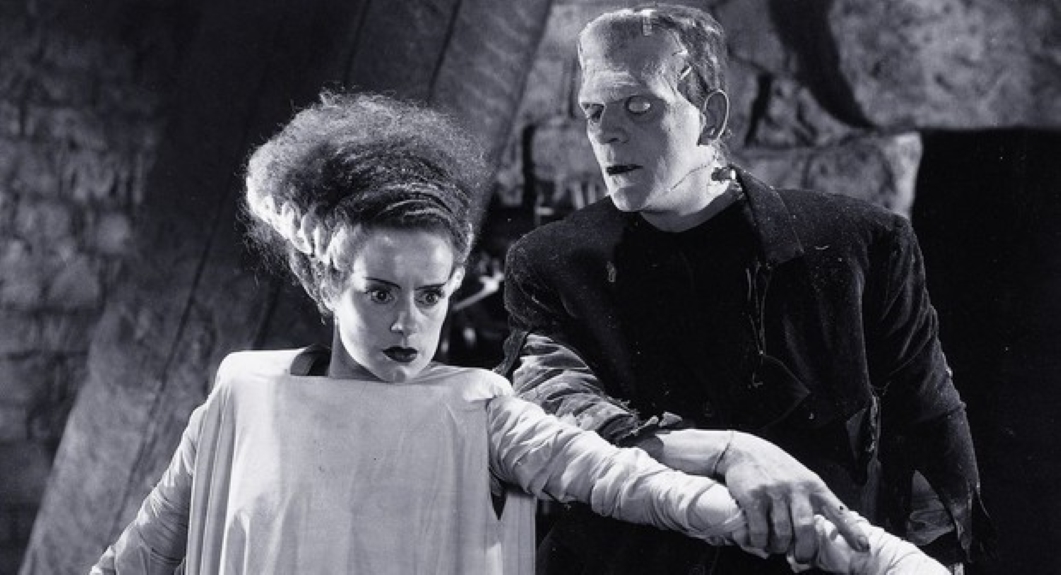
Pretorius’ swiftly brow-beats Frankenstein into saddling back up. Colin Clive – who broke his leg shortly before filming, requiring him to do nearly all his scenes sitting down – is surprisingly restrained, with the old madness only coming to the fore in the Bride’s birthing scene. That birthing scene is a brilliant expansion of the first film, Whale using the increased budget to expert effect to take us up onto the roof of the laboratory, expanding the detail shown of the mechanics of the experiment (Whale uses Dutch angles to dial up the general air of creepy weirdness and clearly was inspired by Metropolis) and launching a creation even odder than the original. As before the design work is exquisite: the Bride – wonderfully played with a ear-piercing screech (based on the swans near her London home) by Elsa Lanchester, her white high-lit hair a masterpiece of memorable, blackly-comic imagery. The Bride makes such a lasting impression, it’s a shock to realise she’s in it for less than five minutes.

Did Whale intend anything to be taken seriously? He tips the wink with Una O’Connor’s opinion-dividing performance of shrieking, Oirish panic as the villager who discovers the surviving creature. Pretorius is introduced showcasing his collection of miniature living people in jars (a bishop, a devil, a mermaid, a queen and a randy Charles Laughton-channelling Henry VIII) the sort of head-turningly bizarre scene that leaves you both delighted and shaking your head in amazement. There is something hilariously odd about the creature being introduced to those human vices, smoking and drinking. Whale was surely chortling to himself at the thought of the creature contentedly blowing smoke circles with the blind hermit or eagerly knocking back a glass with Pretorius.

It’s remarkable that despite this strong leaning into comedy, Bride of Frankenstein still manages to find the humanity in the persecution of the monster. Chased down (once again) by a wild, the creature is tied down to a pole and lifted up, his body unmistakenly in a crucifixion pose. The film’s emotional centrepiece is his sojourn with the blind hermit. It’s impossible not to see more than a touch of Whale’s experience of persecution for his homosexuality in the tender staging of these scenes, two men living contentedly together only to have their partnership condemned the moment the real world intrudes. The gentleness of these scenes becomes very affecting, not least since this is the first (and last) time the creature is treated like a person rather than a monster.

Karloff is, as before, excellent in the lead role – despite his worries about the creature’s mystery being sacrificed on the altar of his fumbling, toddler-like speech. He makes the creature, even more than before, someone reaching out for warmth and connection, disgusted at his own monstrous nature and whose delight at the idea of a bride is strangely touching. (Bride of Frankenstein – a title even name checked at one point by Pretorius – cemented the popular confusion about whether the creature or his creator is ‘Frankenstein’). It’s the monster who also emerges at the film’s conclusion as the closest thing we have to a moral force.

Really Bride of Frankenstein shouldn’t work as half as well as it does. It’s part horror, part black comedy, part farce with scenes that shift from tragedy to knock-about satire. But it’s superbly assembled by Whale – at the top of his game here – and barrels along at such speed (sustained by superb performances, in particular from Karloff, Lanchester and Thesiger creating a portrait of monstrously soft-spoken camp for the ages) and with such full-blooded commitment at every moment that the film never once sinks. It is such a gloriously entertaining, wildly committed piece of pulpy film-making that it’s hard to imagine it could have been done better. And it certainly was the last word in what to do with the monster on-screen, that saw him embrace fear, love, comedy and tragedy all in one go. He probably should have stayed with the dead.

Frankenstein (1931)

Frankenstein (1931)

Iconic monster film, dark expressionist nightmare that totally reinvented the novel’s public image

Director: James Whale

Cast: Colin Clive (Henry Frankenstein), Mae Clarke (Elizabeth Lavenza), John Boles (Victor Moritz), Boris Karloff (The Monster), Edward van Sloan (Dr Waldman), Frederick Kerr (Baron Frankenstein), Dwight Frye (Fritz), Lionel Belmore (The Burgomaster), Marilyn Harris (Maria)

Has any film shaped the popular idea of a book more than Frankenstein? Ask anyone to describe the monster or the book itself, and you’ll not have to wait too long until you start to hear about bolts in the neck, thunder-struck gothic castles, hunchbacked assistants and labs stuffed with bizarre electrical equipment. Of course, none of that is actually in Mary Shelley’s The Post Modern Prometheus. But it is a key part of James Whale’s creative vision in this Hollywood hit. In fact, so much of a hit that it and its army of sequels led to whole generations convinced Frankenstein was the name of the monster, not his creator.

Frankenstein in fact bears almost no similarity to the original novel at all, checking off a few plot points and duplicating some character names. Other than that, it’s very much its own thing, a big expressionistic nightmare, with everything dialled up as high as those lightening-catching electrical machines can cope with. Henry Frankenstein (Colin Clive) – you’ll note the film even changes his name to the more relatable Henry, with Victor given to his dull-as-dish-water pal Moritz (John Boles) – won’t settle down and marry fiancée Elizabeth (Mae Clarke). Instead, he dreams of creating life, to become like God! And to follow that dream, he’ll dig up bodies, steal laboratory brain specimens from his mentor Dr Waldmann (Edward van Sloan) and stitch them together into a creature (Boris Karloff). But then misunderstandings and ill treatment leads to a series of terrible events.

James Whale’s film is a triumph of atmosphere; its images and visual creativity so haunting it’s not a surprise it effectively overwhelmed the novel. Inspired by German expressionist cinema – you can see the fingerprints of Cabinet of Dr Caligari and Fritz Lang all over it – Whale sets this monster tale in a world of towering, angular buildings, looming shadows and vast steampunk (long before it came into fashion) labs in damp-lined medieval castles. There is a strange timeless quality to Frankenstein: it opens with a shadow-laden graveyard dug up by Henry and his assistant Fritz (Dwight Frye), but the village feels like it is set in almost any time from the late nineteenth to early twentieth century (the costumes in particular are a real hodgepodge). Perhaps this was part of Whale’s intention, to create a timeless metaphor for man’s reach exceeding what’s sensible, to disastrous consequences?

It’s also interesting that, for all the warning of the terrors to come the film opens with from Edward van Sloan (who also portrays Waldmann), we actually end up siding with the creature. A lot of this is due to Boris Karloff’s excellent performance. Without a word of dialogue, Karloff makes this lumbering result of stitched together bits and pieces, into something vulnerable, frightened and child-like, whose violent acts only emerge from tragic misunderstandings or gross provocations. Karloff’s physicality is frequently gentle and timid, the few strangled sounds he makes sound almost scared, and his awkward stumbling resembles a deadly, confused toddler. He needs parenting, not chasing down by a mob.

The film’s key moment is Frankenstein introducing the creature to the daylight – the camera following those towering vertical lines of the set up to into a skylight, with the enchanted creature reaching his arms up to try and touch this magic ball of light. Then Frankenstein smugly slaps it shut and Fritz shoves a torch into the poor creature’s face. The monster may be introduced with all the elements of dread – Whale’s classic introduction a series of striking cuts that pull us closer and closer to the reveal of his restitched head – but it doesn’t take long before you feel really sorry for it. Even if it does have a ‘criminal mind’ stitched into it (a development so out of tone with the treatment of the monster, it feels like a fig leaf to reassure the producers it must be the baddie).

Not least because Frankenstein himself is hardly that sympathetic. Colin Clive – a long-term collaborator with Whale – grabs this larger-than-life part and runs with it, oscillating from scenery-chewing self-aggrandizement (his celebratory screaming has rightly passed into cinematic legend) to self-pitying excuses. It’s telling he never takes a jot of responsibility for either creating the monster, or for his inattention and poor treatment of it directly causing the tragedy it unleashes. Unlike his book counterpart, his arrogance requires witnesses – Elizabeth, Victor and Waldmann – to his experiments, entirely due to his arrogant fury at Waldmann’s questioning his sanity. His first solution, as soon as the creature becomes challenging, is to euthanise it and he never confesses to the lynch mob that take on the creature in the film’s final act that he is its creator.

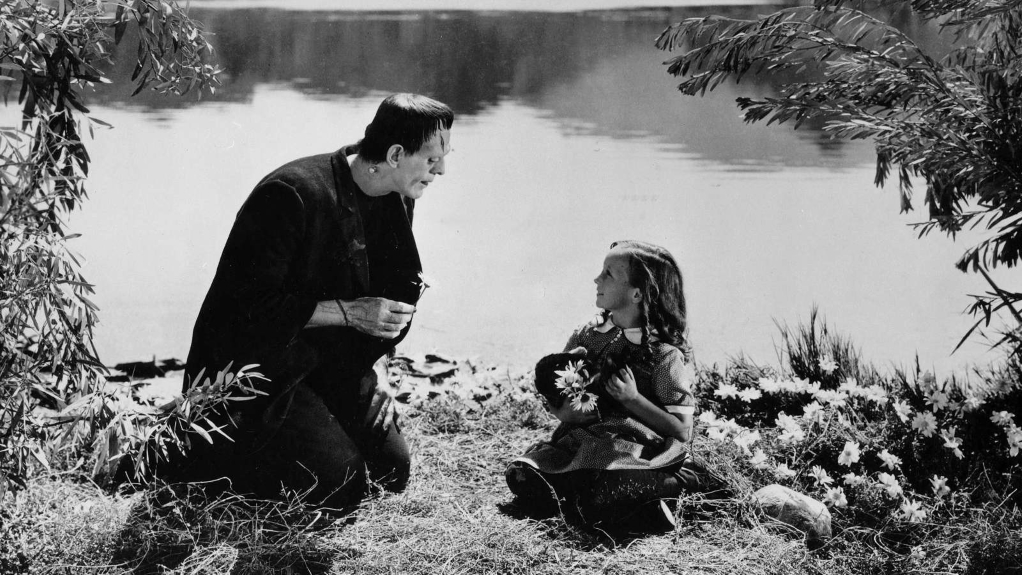
The lynch mob is responding to the creature’s accidental drowning of a small girl. Again, this killing stems from a misunderstanding. Young Marie – the only person in the film who doesn’t react with horror when she sees the creature, suggesting she instead sees a kindred spirit – invites the delighted creature to join her in a game, tossing flowers into the river. Clapping his hands in delight, the creature joins in for a scene directed with bucolic beauty by Whale – right up until the flowers run out and the creature tosses Marie in instead, only to find she doesn’t float artistically.

As the creature flees in confused panic, Whale cuts to the raucous wedding celebrations in the Frankenstein village, which comes to a crashing close as Marie’s father walks with her body through the crowd, that turns from joy to shock around him. It’s one of several striking moments of fluidic camera work in Frankenstein, Whale employing a tracking shot that follows and partially rotates around the father, while keeping him tightly central in the frame as he walks through the crowds. There are similar moments of dynamic camerawork throughout the film, Whale using every opportunity to make this gothic nightmare world as immersive as possible.

The hyper reality of Frankenstein means it doesn’t really matter that much of the skylines are all too clearly cloth (I like to think Whale deliberately kept the multiple points where the cloth has bunched up in shot to stress the artificiality), since everything about this is dialled up to eleven, from performances, to setting to the grandly staged windmill-finale, hugely impressive in its flame-licked excitement. In fact, it’s all so overblown and gothic, in its set design, shooting and performance that the most grounded, human thing in it is Karloff’s beautifully played creature himself. That feels like no accident and makes Frankenstein a surprisingly subversive film. And also perhaps, even though it strips the creature of much that makes him a character in the novel, made him a modern icon.

The Substance (2024)

The Substance (2024)

Twisted body horror isn’t quite the feminist statement it thinks it is, but still a unique film

Director: Coralie Fargeat

Cast: Demi Moore (Elizabeth Sparkle), Margaret Qualley (Sue), Dennis Quaid (Harvey), Edward Hamilton (Fred), Gore Abrams (Oliver), Oscar Lesage (Troy), Christian Erickson (Man at diner)

Getting old in Hollywood is not kind. Particularly for women. Elizabeth Sparkle (Demi Moore), a big star of the 90s, now eeks out a living as exercise queen for a daytime TV show. But TV exec Harvey (Dennis Quaid) decides people don’t want to watch a woman in her 50s and unceremoniously gives her the boot. Fearing a life of lonely irrelevance, miles from the limelight, Elizabeth accepts an invitation to try ‘The Substance’. This black-market drug creates a ‘younger, more beautiful, more perfect’ version of you – birthed from your spine. Taking the drug, Elizabeth spawns Sue (Margaret Qualley), a 20s version of herself who promptly lands her old job on the exercise show.

The two must swop places every week, one living their life (either in obscurity or vicariously enjoying much-lusted after career success) the other lying comatose on the bathroom floor. At first the balance works, but they soon grow to resent each other: Sue despises Elizabeth’s self-loathing bitterness while Elizabeth becomes consumed with envy at Sue’s hedonistic success. Quickly the balanced life between the two collapses, leading to inevitable disaster.

The Substance is one of those films you can pretty much guarantee people will remember about 2024. Pretty much everything in it is dialled up to eleven, a crazy mix of The Picture of Dorian Gray and Cronenberg-body horror (particularly The Fly) by way of David Lynch. Fargeat shoots it with a deliberate grindhouse intensity, revelling in the vast amounts of icky body horror, gallons of blood and guts, often filmed in a mix of dream-like drifting and trashy exploitation.

It’s a sharply directed, extremely intense film from Coralie Fargeat (who also scripts), punchy, vicious and darkly hilarious. It’s also been shot to be almost as uncomfortable to watch as possible. The camerawork is frequently disjointed, full of disconcerting jerky close-up. Nightmare Lynch-style dream horror images pop-up, along with haunting Mulholland Dr style floating heads and Kubrickian homages. Every moment of body horror is accompanied with revolting, squelching sound-effects. You’ve rarely seen anything as intensely, bizarrely OTT as this, the film carefully designed to get audiences either screaming “fucking hell!” or hiding their eyes behind their popcorn.

The film’s most successful moments are these moments of shocking body horror. Created from a host of ingenious practical effects (The Substance surely is destined for a make-up Oscar), the film superbly creates everything from green-fluid soaked birthing scenes to the grim disintegration of various body parts that slowly ages Demi Moore into a wizened babushka to the final hellish Elephant Man by way of the The Fly inspired ending. It’s superbly done, deeply unsettling, but blackly entertaining in its extremity. And The Substance is incredibly extreme, pulling absolutely no punches in this blood-soaked, Angela Carteresque fairy-tale horror.

Fargeat draws an extremely committed performances from Demi Moore, given the sort of acting challenge she never got when she was the biggest star in Hollywood, playing a woman so consumed with ingrained self-loathing and disgust (having so completely swallowed the ideology that your personal value is directly connected to your appearance) that she would rather live as a recluse in the shadow of another version of herself than build a new life. There is an extraordinary scene where a panic stricken Elizabeth prepares for a date with an old schoolfriend (possibly her last chance at a normal life) but is so consumed by self-loathing and doubt about her appearance (painfully ironic, since she of course looks great) that she goes through multiple attempts at make-up up in the movie, each time rubbing it off with such increasing fury that by the end she’s virtually sand-papering her face as if trying to erase herself from existence.

Just as fine is Margaret Qualley as the ‘perfect’ version of Elizabeth, but who has just the same self-loathing and insecurity as the original. It’s a similarly committed performance by Qualley, a carefully studied, surprisingly vulnerable performance while also being ruthlessly ambitious and self-indulgent, which embraces the hyper-sexualised expectations of young women in Hollywood. Dennis Quaid also throws in a fun cameo as a lasciviously camp, OTT executive full of ruthless, heartless bonhomie who sees women only as window-dressing for perverts. After all it’s an industry that forgets: from the opening montage of Elizabeth’s Hollywood star going from eagerly photographed to forgotten, through to the insultingly trivial gift stuffed in her hands as she is dismissed.

But The Substance’s satire is often rather forced and obvious (right down to Quaid’s exec being called Harvey). It feels like it misses a trick by having its only female character being a woman who has so swallowed the ageist views of Hollywood, she literally can’t imagine questioning it. So much so, her clone equally embraces life as a sex object. While The Substance invites us to understand the poison of this world independently, there is virtually no commentary on the unjust sexism within the film. In fact, The Substance so echoes the leering camera angles and pervy shots of the worst kinds of sexist cinema that sometimes it’s a bit hard to see it as satire and (as the camera stares at Qualley’s butt or down her top) more as just reality.

At no point do Elizabeth or Sue make any form of realisation about how they have been indoctrinated to only understand themselves as being worth something so long as they look like a pin-up. While The Picture of Dorian Gray understood the temptations of a selfish hedonism even when we know its wrong and The Fly was all about the damaging impact of ambition, for all its pointed smirking fun The Substance is at heart more of a pulpy gore-show revelling in extreme than a sort of social satire.

In fact the more you watch The Substance the more you think it’s real inspiration is Whatever Happened to Baby Jane and the ‘hag-horror’ of the 60s. A star name of yesteryear, takes on a role that riffs on their loss of youth and beauty, throwing them into an ever more twisted tale of obsession and revenge. You could argue The Substance trusts us to see for ourselves that all this rampant sexism is wrong: but you could also quite happily watch the film and assume it was Elizabeth’s vanity that caused all the problems, not the system that inoculated it in her.

There is another version of The Substance that could match its pulpy love of horror thrills with a bit more of an insightful commentary on gender politics. But the fact the film ends in an explosion of blood that makes The Shining look positively restrained (a sequence that goes on too long in an overlong film), you suspect its real heart is actually in creating shocking images rather than really exploring the issues it wants you to think it is addressing.

Alien: Romulus (2024)

Alien: Romulus (2024)

Starting as a cleverly structured homage, it becomes increasingly more nostalgia driven as it goes on

Director: Fede Álvarez

Cast: Cailee Spaeny (Rain), David Jonsson (Andy), Archie Renaux (Tyler), Isabela Merced (Kay), Spike Fearn (Bjorn), Aileen Wu (Navarro), Daniel Betts / Ian Holm (Rook)

It’s always a surprise how many Alien films there actually are (at least nine if you count all the Alien vs Predators). Perhaps we forget because so many of them have been less than great. So, saying Alien: Romulus is the third best Alien film isn’t exactly high praise. After all, beyond Alien and Aliens the bar is pretty low. Alien: Romulus has a lot going for it, not least the fact it’s clearly been made with love by a director who adores the series. It makes it all the sadder that, the longer it goes on, the more it becomes a fan-boy remix of a elements from the other films. It ends up as much of a nostalgia obsessed, easter-egg piece of fan bait as any recent Marvel film, but at least entertaining.

Set some time after Alien – it opens with a mysterious Weyland-Yutani ship plucking the original Xenomorph (wrapped in a protective cocoon) from the Nostromo’s wreckage– ourhero is Rain (Cailee Spaeny), a young worker in a grim mining facility planet. Working for credits for passage home – a target the company constantly changes – she lives with her adoptive ‘brother’ Andy (David Jonsson), a gentle, glitchy synthetic reprogrammed by her late father. They have a chance for freedom when her ex-boyfriend Tyler (Archie Renaux) and his crew asks her and Andy’s help to plunder cryostasis chambers from an abandoned ship so they can survive the nine-year journey to another world. But the ship (Romulus and Remus) is, of course, the one we saw earlier – and on board are a host of facehugger experiments, leading inevitably to Xenomorph slaughter.

Alien: Romulus starts very strongly, carefully reconstructing the stylistic look and feel of the original (right down to the spot-on sound design of all those 70’s future computers blinking into life, chuntering old fax machines). The crapsack colony feels perfectly in-tune with Aliens, as a mix of Western frontier town and industrial hellscape. Álvarez’s film brings the franchise back to its roots, after the mystique-shattering of Ridley Scott’s prequels. Romulus is a haunted house in space, a psychopathic alien lucking around every corner. As the tension slowly builds – helped by the fact we, obviously, know a lot more about what those odd spidery-things suspended in animation are – Alien: Romulus feels like a return to the factors that made the series work in the first place.

Álvarez dials up the sexualised body horror of this revolting creature and its unstoppable relentless cunning. Alien: Romulus is full of the revolting invasiveness of these animals, the icky body horror of creatures hatching inside you, with the nightmare-fuel monstrosities getting worse as the film goes on. Playing out in a poorly lit ship, the creatures scuttle from the corners of the screen to impregnate or dissect their victims. He also has some neat original ideas, including deducing the face-huggers detect body heat and movement (having no eyes) so the only way to evade them is to raise the room temperature and move slowly (such a good idea, you wish he made more of it).

It’s also a film that looks at the all-round weapon nature of these creatures, specifically their acid blood. The team can’t shoot the things – they’ll melt through the decks and cause instant decompression – and when one does die, its blood floats through zero-gravity as an almost impossible to evade thread. One character dies not from the jaws of the xenomorph, but from sticking a cattle prod into its cocoon, acid spilling out into his eyes, hands and chest (not pretty).

It’s opening act also offers an intriguing relationship between its two leads, one a potential proto-Ripley with a strong moral compass, the other a very different type of synthetic. Andy, well-played by David Jonsson, is gentle, clumsy and naïve, a vulnerable people-pleaser who loves cringy Dad jokes, prone to the android equivalent of epileptic fits under pressure. By establishing the closeness between these two characters, Alien: Romulus explores a new angle of the series study of the relationship between humans and their creations: are these synthetics people or property?

Rain clearly loves Andy: she may resent the bullying he receives from some of the anti-synthetic crew, but also willingly reprograms him when needed and plans to leave him behind so as not to fall foul of anti-synthetic laws back home. Reprogramming Andy drastically alters his personality – David Jonsson does a great job switching his body language, demeanour and accent (back to his native British) – as Andy becomes a more familiar Alien electric reflexes and ‘needs-of-the-many’ andriod. What’s intriguing here is its implied part of this is due to Andy’s own suppressed resentment at his treatment by the humans as somewhere between a child and a screwdriver.

The complex relationship between these two is the heart of Alien: Romulus and its most original element. It’s a shame the film loses focus on this the longer it goes on. As Romulus hits it’s second half, Álvarez succumbs to fanboy temptation until finally he can’t go more than thirty seconds without referencing an line or scene from an earlier Alien film. Slowly the parade of painfully recognisable features (even an utterly out-of-character reprise of ‘Get away from her you bitch’) begins to depress you as Alien: Romulus gives up the idea of being something fresh and settles for being a passionate piece of fan-fiction, unable to imagine anything beyond the scenarios it’s already seen play out somewhere else.

Alien: Romulus becomes as much a nostalgia trip as anything else Hollywood makes these days. Right down to recreating a digital version of the late Ian Holm as ‘Rook’, Romulus and Remus’ version of Nostromo’s Ash, for a prominent role. The recreation is pretty good, Rook is an interesting character – sympathetic to the heroes at first, but increasingly reverting to form – but there is something uncomfortable about it. This is, after all, a recreation for nostalgia of a dead actor, without his consent (though with his families) not as a visual cameo but as a crucial character. How long before we get more and more of this?

It’s a slightly unsettling note, even if I ended up enjoying Alien: Romulus more than a should have. Part of me liked seeing Ian Holm again. Hypocritically I don’t mind quite so much riffs on films I like –hypocritical since I was annoyed by the same thing in Deadpool & Wolverine. But I wish Alien: Romulus had settled for subtle recreation of details while striking out somewhere unique. What it actually ends up doing is suggesting that, once you strip it down to its roots, there isn’t much to Alien beyond slasher-in-space. Which makes you think, for all its flaws, perhaps Prometheus was a braver movie for trying to do something that wasn’t that.

But then I’ll also definitely watch it again. So maybe that makes me part of the problem.