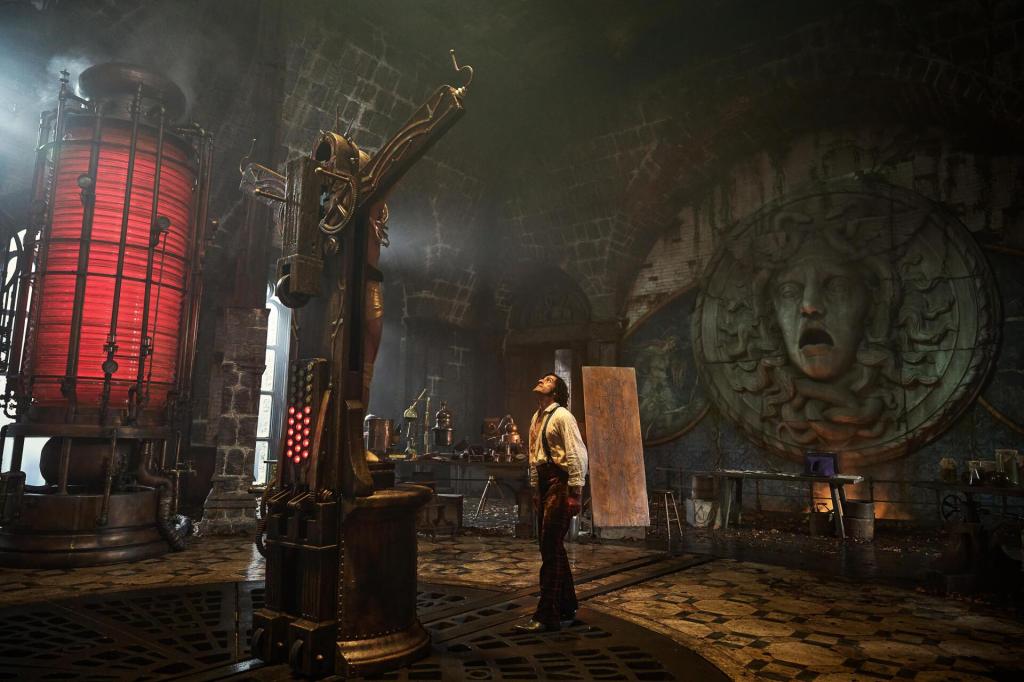
Nolan’s epic takes deep, thoughtful bites out of Homer, looks amazing but maybe tries to do too much
Director: Christopher Nolan
Cast: Matt Damon (Odysseus), Tom Holland (Telemachus), Anne Hathaway (Penelope), Robert Pattinson (Antinous), Lupita Nyong’o (Helen of Troy/Clytemnestra), Samantha Morton (Circe), John Leguizamo (Eumaeus), Zendaya (Athena), Charlize Theron (Calypso), John Bernthal (Menelaus), Himesh Patel (Eurylochus), Bill Irwin (Polyphemus), Elliot Page (Sinon), Benny Safdie (Agamemnon), Mia Goth (Melantho), Corey Hawkins (Polybus), Logan Marshall-Green (Melanthius)
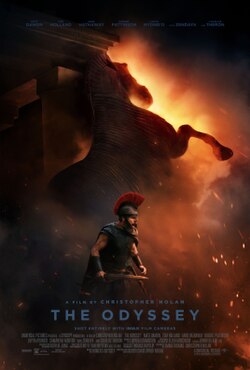
I think pretty much everyone knows the story: Odysseus (Matt Damon), after ten years fighting the Trojan War, has the longest, most hellish commute ever. Will he see his Kingdom of Ithaca again, or wife Penelope (Anne Hathaway) and now-grown son Telemachus (Tom Holland) again? And, even if he does, what will he do about the fact his home is awash with hostile suitors, led by the bullying Antinous (Robert Pattinson) who want to take his throne and wife for themselves?
Nolan’s adaptation of Homer is epic as few other films are. Shot it seems with the whole Mediterranean (and Iceland for good measure) as a soundstage, its visual imagery is almost impossible to beat, shot with immense skill for IMAX without letting the scale flood the story. It’s a surprisingly faithful retelling of the legend, with Homer’s non-linear style catnip for an architect storyteller like Nolan, who promptly opens the film in the final year of the timeline and spools backwards and forwards from there.
The film is set in “a time of apparent magic”, an oblique idea in a world of Cyclopes and trips to Hades (a stunningly, bleakly unsettling vast black landmass, with bodies crawling forward to sip goats blood and share terrible prophecies), but where the presence of the Gods is open to interpretation. Zeus cracks thunder and Poseidon rolls waves, but maybe it’s just superstition. Is Odysseus right to be a sceptic? The only God present is Athena, played with warm distance by Zendaya, who may or may not be a figment of Odysseus guilty conscience.
Despite its length, it frequently zips along, with a marvellously staged sequence from Homer cropping up every few minutes. Sequences like the Fitzcarraldo-like laborious dragging of a wooden horse (half buried in the sand) that looks like a grim bronze statue of a bucking horse, over many miles by the luckless Trojans are brilliantly done. It’s hard to fault almost anything about its production. But it’s not perfect.
Perhaps the major thing missing from Nolan’s film is a sense of personal hubris (as opposed to the imperial hubris of Agamemnon). Nolan has a very interesting interpretative idea of the fall of Troy being effectively the fall of man, the deception and brutality being a Bronze age Hiroshima. But a more interesting film would have seen Odysseus initially proud of his role in this orgy of war-ending killing, only to realise during the disastrous journey home he is in fact the villain. That he broke his own sacred code, of twanging the bow to warn the prey. Instead, Odysseus is plainly aware of his crimes from the start, and his shame perversely gives the character little room to develop, beyond Nolan’s implication his journey is self-inflicted.
Strangely then, it’s hard to get a sense of the journey changing Odysseus. Nolan is far more successful as seeing the whole film as a self-inflicted punishment. Odysseus doesn’t believe he deserves to go home. Instead, as the destroyer of peace and order, part of him embraces his journey (he even leaves Troy on a self-imposed longer route, over his crew’s protests). While his long exile with Calypso is largely pushed into montage, the film implies Odysseus willingly eats the lotus to forget his guilt.
Nolan attempts to fill the gap by having Odysseus strain to save his crew’s lives. But, while Odysseus is weighed down with guilt, his crew emphatically isn’t; this borderline mutinous bunch merrily ransacking and burning a farming village. When Circe denounces this bunch as rapists in waiting, neither the film (or Odysseus) can really argue otherwise. The Odyssey can never quite decide what it feels about these characters, and their resentment at Odysseus for their numbers being whittled down tends to get outweighed by the film’s empathy for Odysseus’ guilt and shame.
There are similarly confused emotional lines in Odysseus relationship with young warrior Sinon. The Odyssey wants to establish Odysseus’ double betrayal of this man – first allowing Antonius to bully him into taking his place in the army, then using him as a pawn to get the Trojans to drag the horse into the city – as a foundational crime. But there isn’t time to establish a surrogate father-son bond between them, meaning Odysseus betrayal of Sinon feels muddily motivated. Again, the film wants to keep Odysseus sympathetic so avoids stating the conclusion he must have made: Sinon’s life is an acceptable sacrifice to end the war. The Odyssey leans heavily on Elliot Page’s sensitive, traumatised performance to make us fill in this blank.
This is a sign of Nolan’s film covering a lot of complex meat, without always finding room to digest it fully. Alongside this, he wants a more conventional, crowd-pleasing tale of a hero coming home to a loving wife. As part of this, many of the female characters of The Odyssey are stripped of some of their richness. Most egregiously, Charlize Theron’s Calypso and Zendaya’s Athena are little more than sounding boards for Odysseus. But even Penelope, despite an emotionally intense performance from Anne Hathaway, is more of a traditional faithful wife. Nolan is trying to show the vulnerability of her position in a masculine world – but you long for more sign of the shrewd resentful figure of either The Return or Margaret Atwood’s The Penelopiad.
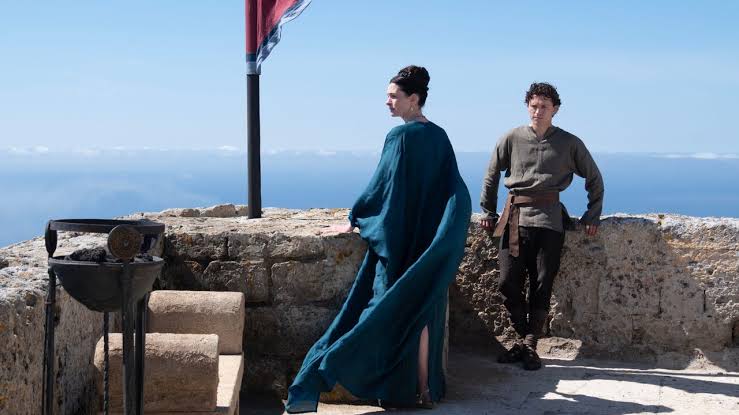
Perhaps because this is because Nolan is grimly realistic in suggesting women are often trapped in victim roles in this male world. Lupita Nyong’o’s Helen of Troy may be critical of the Greeks but is also an abused wife (her face disfigured by Jon Bernthal’s brutish Menelaus), plagued with shame about how her name was used to justify so much death. Even Circe, the most complex and engaging female role, dreads becoming a victim. That doesn’t take away from the barn-storming cameo of resentment and paranoia by Samantha Morton. The creepy Cronenbergesque body-horror of Circe using her hands to craft the sailor’s faces into pigs – including shoving her hand down one man’s throat – is perhaps the film’s most unsettling moment.
What a lot of this comes back to is Nolan’s admittedly fascinating idea that Odysseus has opened a Pandora’s Box that unleashed destruction on the world. His burning of Troy, broke Zeus’s Law of treating guests as you yourself would wish to be treated. In echoes of Oppenheimer, Odysseus believes he has laid the groundwork for the end of the world, by creating one where hospitality can be betrayed and people’s word is no longer their bond (exactly the world the suitors are exploiting in Ithica).
This keys into Nolan’s most interesting concept. Throughout this subtly fracturing world – where the Gods may be falling silent and the world is shorn of rules – there are reports of ‘men of the sea’ roaming the coasts taking anything they want. Is this another cause for the Greeks to fight? Perhaps not: like nuclear weapons, violence become self-perpetuating. The actions of Odysseus crew should clue us in that these men are in fact the Greeks themselves, their humanity gone, continuing a cycle of destruction and death started by Odysseus who has “become death, destroyer of worlds”.
There are many, many good ideas in The Odyssey, which I’ve mulled over for several weeks after seeing the film. Fundamentally, I feel some of it doesn’t always land from the casting of Odysseus. Would Matt Damon have been my choice? Probably not: there is a boyish decency about Damon, not a tortured cunning. He’s probably not helped by recent memories of Ralph Fiennes (almost born to play the role), but Damon can’t bring out the depths of conflict, guilt, regret and misplaced pride in the way (say) Cillian Murphy did in Oppenheimer. Damon is a little too similar to the optimistic, earnest energy Tom Holland very successfully gives Telemachus. The Odyssey tries to follow The Return in making Odysseus keen to ensure Telemachus does follow him into a life of violence – but can’t resist giving Holland one last sword fight to flex his muscles.
I feel conflicted about The Odyssey and I need to see it again. It is so close to everything I wanted. Its practical effects and epic scenes with Polyphemus, the sirens and Sicilia and Charybdis have a wonderful Jason and the Argonauts feel to them that I loved. But it also feels quite damning that the sack of Troy is less shocking here than it was in Troy (especially as the brutality is at the heart of what the film is trying to do) and its final third covers similar ground to The Return, but (for me) with less clear-eyed honesty, awkwardly balancing action set-pieces and its thematically ‘happy’ ending.
But there are so many delights to appreciate, not least Ludwig Göransson’s imposing score, the stunning imagery and costume design (Ellen Mironijck’s imaginative use of a range of inspirations reaches an apotheosis in Agamemnon reimagined as a mix of Darth Vader and Batman). There are wonderful performances in smaller roles, not least Morton, Bernthal, Himesh Patel and most of all John Leguizamo as the loyal Eumaeus and Robert Pattinson as the despicable. But while it tackles an array of brilliant idea, it can’t always balance these all successfully. It’s almost the first Nolan film where his reach overextends his grasp – but when you have a reach like this, does it matter?