Category: Italian cinema

The Decameron (1971)

The Decameron (1971)

Pasolini’s naughty-boy Boccaccio adaptation, aims for political but in loves with cheek

Director: Pier Paolo Pasolini

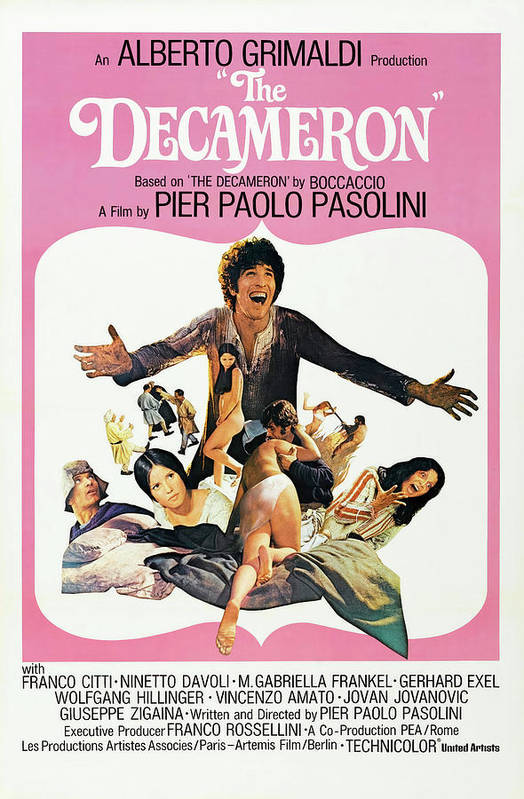
Cast: Franco Citti (Ciappelletto of Prato), Ninetto Davoli (Andreuccio), Vincenzo Amato (Masetto), Maria Gabriella Maione (Madonna Fiordaliso), Angela Luce (Peronella), Giuseppe Zigaina (German Monk), Pier Paolo Pasolini (Giotto’s Pupil), Giacomo Rizzo (Friend of Giotto’s Pupil), Guido Alberti (Musciatto), Elisabetta Genovese (Caterina), Giorgio Iovine (Lizio)

The Decameron is a collection of a hundred tales written by Boccaccio in the 14th century, which offers a rich mosaic of Italian life from the tragic to the comic. But it also has a reputation for a lot of bawdy naughtiness – and perhaps part of that comes from Pasolini’s cheeky, sex-filled adaptation, with its playful lingering on some of the most rumpy-pumpy filled yarns. Scholars of Boccaccio were appalled in 1971; it’s a gag that I think Boccaccio might have appreciated that today Pasolini’s film is required viewing on Boccaccio courses.

Much like with The Gospel According to Matthew, Pasolini shifted the location to fit his themes. Here most of the tales take place in Southern Italy – Neapolitan accents and dialect abound – and the new underlying theme explore the exploitations of simple, honest peasants by cannier, ruthless people from the richer north. Roughly linking the tales together is a pupil of Giotto – played by Pasolini himself – preparing a fresco in a monastery, inspired (it becomes clear) by the stories which may in turn be inspired by ordinary people he sees on the streets. The Decameron is aiming to be a playful musing on the chicken-and-egg nature of artistic inspiration and the way different artists in different genres can inspire and motivate each other to ever greater heights.

Or at least those themes are there. But they can be hard-to-spot beneath the surface, since The Decameron mostly delights in its array of sexual goings-on, which pretty much tick-offs every taste and inclination you can imagine from masturbation to orgies, as well as darker content like rape and paedophilia. To be honest, for all that Pasolini is an artist thinking earnestly about the classics, he’s also a very naughty boy eager to get a few erect penises into mainstream film-making (and The Decameron was a huge hit in Italy and played in arthouse cinemas the world over). The Decameron, for all its pretentions about art, is also a bit of end-of-pier soft-porn – or a hard-core Carry On.

There is something deliberately amateurish about The Decameron in its scatological humour and the bumpy, rushed nature of its film-making. In common with many Euro films at the time, it makes no effort (either in its Italian or English dubs) to match the words we hear with the movement of the actors’ mouths, with most of the sound having a muffled post-recording session feel to it. The camerawork and editing are frequently jolted and rushed, adding to the bawdy sense of things being thrown together, Pasolini using sped-up film and punch-line jumpcuts to keep up the improvisational energy. It makes the film feel at times like a student revue.

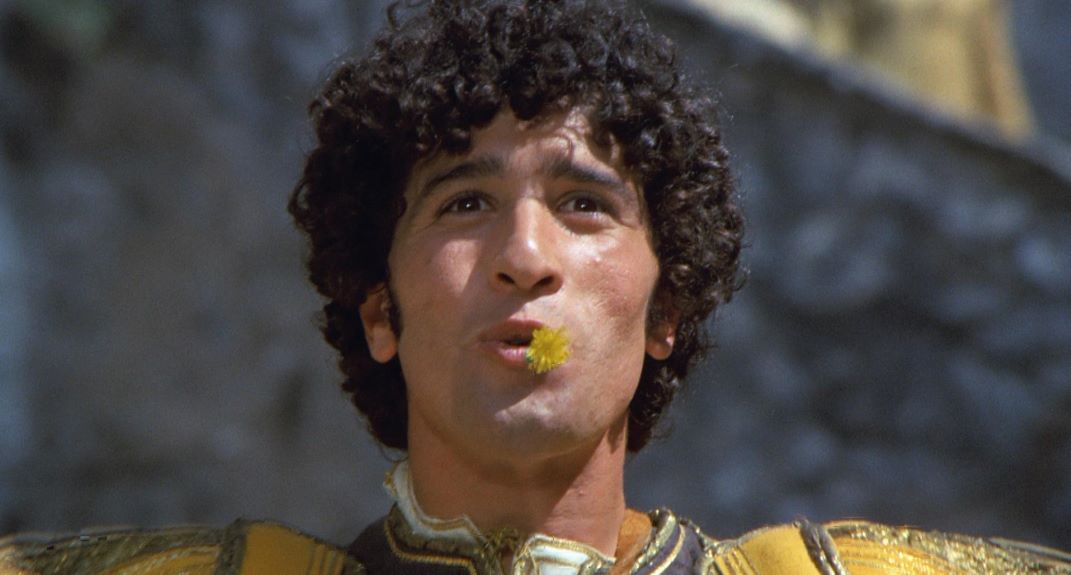
Pasolini shot the film entirely on location, with a cast of actors who were mostly unprofessional. As with many of his films, much of the casting seems to be based on people’s appearances more than anything else. The Decameron has a superfluity of striking faces. Toothy grins or missing teeth, hooded eyes, vacant grins, these faces look like they could have stumbled in from a Brueghel painting. Everyone looks distinctive and this parade of striking faces adds to the film’s wild energy.

It also makes everyone in this Boccaccio cheek and smut stand out. Pasolini’s trick was to argue that the medieval era, in many ways, wasn’t that different from today. He didn’t present it as a high-blown time of men in tights speaking poetry, but one where people were obsessed with money and sex (usually the latter) and showed no shame in chasing it. An era where the medieval world looked dirty, shabby and slightly sordid, rather than what the poets would have us believe.

This informed his choice of stories. When you start with a naïve young man nearly drowned in a pool of shit, you can tell that this isn’t exactly going to be Hollywood medieval epic. Pasolini’s chosen tales involve: a well-endowed gardener pretending to be mute so he can shag a convent full of nuns, a woman boffing her lover while her husband inspects the insides of a large pot, a dying sinner (who we’ve already seen proposition a child for sex) claiming to be a saint, a girl and her lover shagging naked on a rooftop, a monk tricking a man into allowing him to have sex with the man’s wife, and concludes with a man receiving a visit from the ghost of a dead friend telling him that sex is no sin and the angels of heaven say he should certainly give his girlfriend a good pre-marriage seeing to.

Throughout, Pasolini aims to show a world where simple pleasures mix with the exploitation by the rich and powerful of the simple, poor and naïve. It’s a not a theme that comes out all that much, especially since few people are going to remember the political message when we are all much more inclined to focus on the constant in-and-out. The Decameron might want to think it is a grand statement, but its really a great big joke, told by a director who is sort of laughing at us while he does it. It’s a rather juvenile piece of titillation, passing itself off as political statement.

Perhaps that’s why Pasolini felt a bit embarrassed about it all later. After a parade of knock-offs, he effectively disowned the film, claiming low-quality imitators that dialled up the sex even more had missed the point and buried the anti-capitalist message of his own film. Since I can imagine several people watching The Decameron and completely missing the point in the first place, I can’t help but feel he has only himself to blame.

The Gospel According to Matthew (1964)

The Gospel According to Matthew (1964)

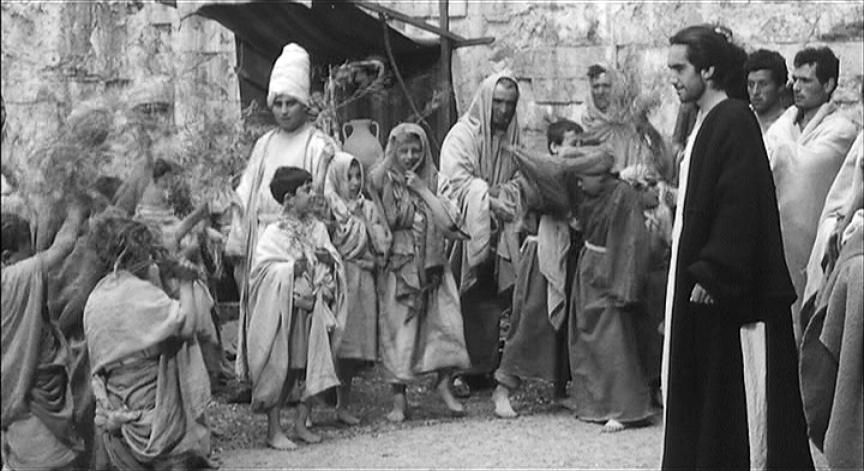
Pasolini’s neo-realist Biblical epic is quite unlike any other retelling ever made

Director: Pier Paolo Pasolini

Cast: Enrique Irazoqui (Jesus Christ), Margherita Caruso (Mary), Susanna Pasolini (Older Mary), Marcello Morante (Joseph), Mario Socrate (John the Baptist), Settimio Di Porto (Peter), Alfonso Gatto (Andrew), Luigi Barbini (James), Giacomo Morante (John), Rosario Migale (Thomas), Ferruccio Nuzzo (Matthew), Otello Sestili (Judas), Rodolfo Wilcock (Caiaphas), Rossana Di Rocco (Angel)

Pasoloni seems a strange choice for a film about Jesus. A Marxist-atheist intellectual? Pasolini had even been jailed briefly for blasphemy after featuring Jesus in his short film La ricotta. But he was fascinated by questions of faith and was a passionate admirer of the classics, from the Greeks to Boccaccio via the New Testament. Pope John XXIII made it one of his missions to reach out to non-Catholic artists (the film is dedicated to him) and Pasolini’s interaction with the Church made him interested in bringing the life of Jesus to the screen.

But on his own terms. Pasolini didn’t want a reverential epic, but something real and human amonf the divine. After scouting the Holy Land and concluding it no longer matched the ideal look required, he would set the film in South Italy. In this he followed in the footsteps of the classic artists, who had frequently transposed events from the Bible to the homelands of their patrons. (And, after all, as Pasolini surely reasoned, not all of the great Renaissance artists could have been passionate believers themselves).

Pasolini also chose his source carefully. Unlike other Bible stories, he would not use all the gospels. Instead he would exclusively dramatise St Matthew’s. Going even further, he would remove the “St” from the title. This was to be one man’s personal view of the story of Christ, featuring only events he reported where the only dialogue spoken would be the words he wrote down. There would be no clumsy modern dialogue, suggested motivations, omnipotent narrator or small talk. The film would play out often in silence, jump from event-to-event and the dialogue would faithfully reproduce the Gospel. There hadn’t been a Biblical epic like it.

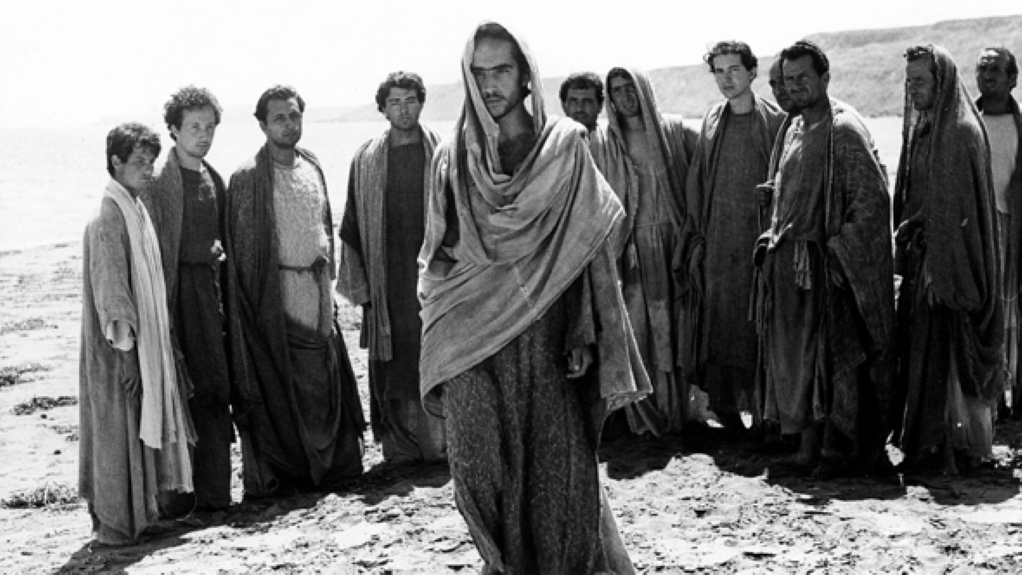
It would also serve as a commentary of sorts on generations of artistic interpretations of the Gospels. The costumes and many of the compositions would reflect different eras of artwork, from Fra Angelina and El Greco onwards. The Romans and Herod’s guards would be dressed in a faux-medieval garb, the Apostles in more Byzantine robes. The execution of John the Baptist looks straight from Caravaggio, the massacre of the innocents like something from Brughel. The sprawling crowd scenes of the great artists would be reflected as much as the smaller intimate moments. The score would be a sea of different religious music, from Bach to Odetta (especially Sometimes I feel like a Motherless Child) via African gospel choir and Blind Willie Johnson.

Pasolini was presenting a reporting of Jesus’ life, that also subtly commented on and absorbed thousands of years of artistic discussion on the same subject. It used visual and aural analogy to convey its story and any question of the “truth” or not was put to one side. It was not a chronicle, but an artistic exploration, where the subjective view removed any theological clashes and implied many more versions were available of the same story.

Pasolini was drawn to Matthew’s gospel as he engaged more with its energy and passion. It carries across here with a Jesus full of contradictions. He can be warm but also angry and passionate. He marches across plains, by turns preaching at and berating his followers, shouting homilies at bewildered farmers. He has the magnetism of a born leader. Fascinatingly, the Sermon on the Mount is filmed in extreme, lonely close-up (with Jesus framed in a Raphael-style pool of light) but his more energetic words against the priests or calling for something near revolution are shown to attract vast crowds (Pasolini’s version of Matthew’s Jesus is perhaps a revolutionary).

The Gospel According to Matthew dug deep into neo-realist Italian film-making traditions. As well as being shot on location, Pasolini recruited a cast of non-professional actors. Jesus would be played by a philosophy student. The rest of the cast would be made up of a sea of professions, from peasants to intellectuals. Unlike Bresson, who drilled his amateur casts mercilessly, they were encouraged to express the wonders their characters witnessed on their faces. Faces of course being Pasolini’s interest – few directors could recruit such a striking range of visages as he could.

Pasolini’s camera-work and film-making style also evolved. The film starts with a series of shot-reverse-shots as a pregnant Mary confronts Joseph. Much of the Nativity plays out in close-up, before the frantic burst of violent energy that is the massacre of the innocents. But as the film progresses, Pasolini mixes his style considerably. Jesus march through the plains is full of something approaching whip-pans. When Jesus preaches, the camera searches for the apostle’s faces with the odd roving mis-turn as if it was searching for them as well.

Shot-reverse-shot is used for the miracles (the element Pasoloini was most uncomfortable about – and embarrassed to bring to the screen), but as the film progresses a more mobile, immersive camera is used. From the Garden of Gethsemane on, the camera becomes almost a face-in-the-crowd, witnessing Jesus’ trial by the priests and Pilate through a sea of crowded heads and moving alongside Jesus through the streets. It follows Judas in a helter-skelter sprint through the plains to his suicide and avoids aerial shots for throwing us in amongst the action. While tipping the hat to art of the past, it is also a hand-held, edgy piece of cinema, putting us in the dirt.

There is much to admire in The Gospel According to Matthew but, it has to be said, the film is also rather slow (the section covering Jesus’ mission and preaching, including the performance of the miracles, in particular drags). The decision to use only the text of the Gospel frequently means the film lacks the sort of drive that spoken dialogue and character can bring. It would almost be superior as a wordless film that made use of captions since much of the dialogue scenes are rigid and the visually least-interesting moments. It’s a film that’s easier to admire than perhaps really love.

But it’s also a very true, fair and intriguing vision of the Gospels, that presents the ‘facts’ as they are and works hard to avoid prejudice and interpretation. Difficult as it may be, at times, to watch it is also challenging and thought-provoking. A melange of interesting filming styles and creative decisions, it has its flaws but many virtues too.

1900 (1976)

1900 (1976)

Bertolucci’s bloated, self-indulgent and simplistic film is a complete mess

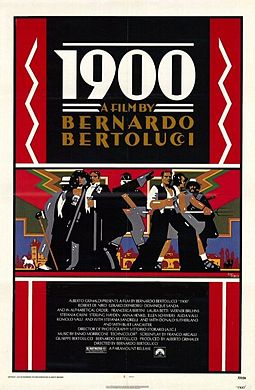
Director: Bernardo Bertolucci

Cast: Robert De Niro (Alfredo Berlinghieri), Gerard Depardieu (Olmo Dalco), Dominique Sanda (Ada Fiastri Paulhan), Donald Sutherland (Attila Mellanchini), Laura Betti (Regina), Burt Lancaster (Alfredo Berlinghieri the Elder), Stefania Sandrelli (Anita Foschi), Werner Bruhns (Ottavio Berlinghieri), Stefania Casini (Neve), Sterling Hayden (Leo Dalco), Francesca Bertini (Sister Desolato), Anna Henkel (Anita the Younger), Ellen Schwiers (Amelia), Alida Valli (Signora Pappi)

After The Conformist and Last Tango in Paradise, Bertolucci could do anything he wanted. Unfortunately, he did. Perhaps the saddest thing about 1900 is that you could watch The Conformist twice with a decent break in-between during the time it would take you to watch it– and get a much richer handle on everything 1900 tries to do. Bertolucci went through a struggle to get his 315-minute cut released: perhaps the best thing that could have happened would have been if he had lost. Not only would the film be shorter, but it would be remembered as a lost masterpiece ruined by producers, rather than the interminable, self-indulgent mess we ended up with.

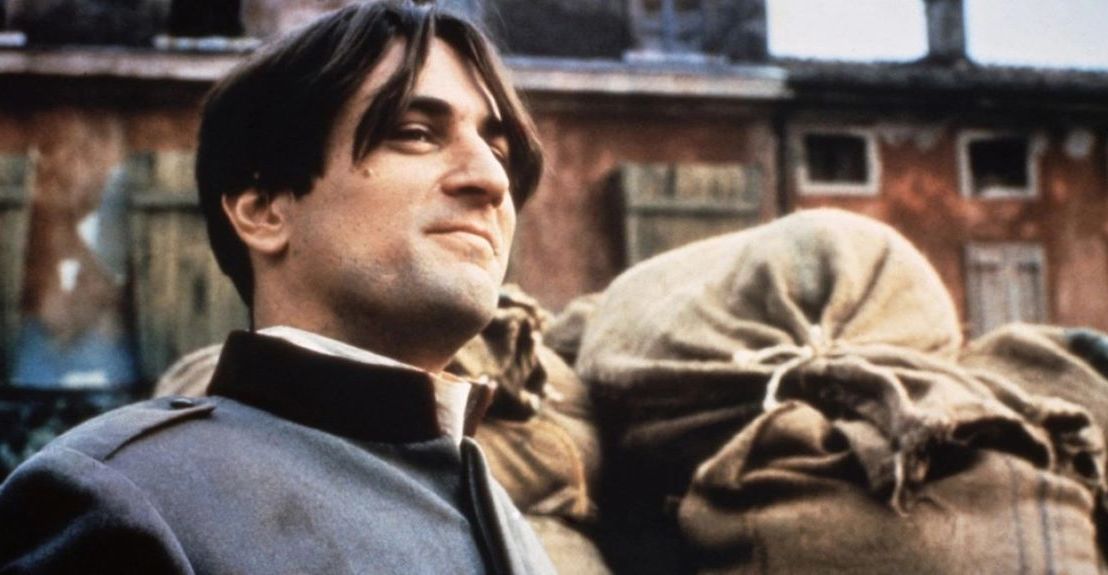
1900 – or Twentieth Century to literally translate its title Novecento – follows the lives of two very different men. Born minutes apart in 1901, Alfredo (Robert De Niro) is the grandson of the lord of the manor (Burt Lancaster), while Olmo (Gerard Depardieu) is the grandson of Leo (Sterling Hayden), scion of a sprawling dynasty of peasants. They grow up as friends, Olmo becomes a socialist and Alfredo an indolent landlord and absent-minded collaborator with the fascists, embodied by his psychopathic land agent Attila (Donald Sutherland). Their small community becomes a symbol of the wider battle between left and right in Italy.

In many ways 1900 is an epic only because it is extremely long and beautifully shot in the Bologna countryside by Vittorio Storaro. In almost every sense it fails. It offers nominal scale in its timeline, but its attempt to become a sweeping metaphor for Italy in the twentieth century falls flat and it focuses on a small community of simple characters, many of whom are ciphers rather than people. All of Bertolocci’s communist sympathies come rushing to the fore in a film striking for its political simplicity. It never convinces in its attempt to capture in microcosm the forces that divided Italy between the two world wars, nor invests any of its characters with an epic sense of universality.

Instead Bertolucci presents a world of obvious questions and easy answers. Every worker is an honest, noble salt-of-the-earth type, working together in perfect harmony to fight for rights. Every single upper-class character is an arrogant, selfish layabout, caring only about their back-pockets and the easy life. Bertolucci suggests fascism only arose in Italy as a means for the rich to control the poor, and never allows for one moment the possibility that any working-class person was ever tempted to take their side. It never rings true. (Bertolucci skips a huge chunk of the fascist 30s and 40s, possibly because this fantasy would be impossible to sustain if he actually focused on the history of that era.)

Bertolucci uses his two protagonists to make painfully on-the-nose comparisons between working class and rich with De Niro’s weak-willed Alfredo always found wanting compared to Depardieu’s Olmo. Even as children, Olmo is braver, stronger and smarter. Olmo has the guts to lie under the moving trains (Alfredo runs), Olmo stands up for what he believes in (Alfredo looks away), Olmo puts others first Alfredo whines about his own needs. Hell, Olmo even has a bigger cock than Alfredo (something they discover comparing penises as children and re-enforced when as young men they share an epileptic prostitute and she ‘tests’ them both).

The upper classes hold all the power but can do nothing without the working class. During the 1910s, a strike by the workers on the Berlinghieri leaves the clueless rich unable to even milk their moaning cows (they buy milk instead). Sterling Hayden’s peasant patriarch is a manly inspiration to all, while Lancaster’s increasingly shambling noble is literally and metaphorically impotent (Lancaster’s role is like a crude commentary on his subtle work in The Leopard). At one point he even pads around barefoot in horseshit to hammer home his corruption. (Incidentally this is the only film where you’ll ever see a horse’s anus being massaged on camera to produce fresh shit to be thrown at a fascist.)

For the rich, fascism is the answer. Continuing to shoot fish in a barrel, Bertolucci scores more easy hits by presenting our prominent fascist as an out-and-out psychopath. Played with a scary relish by Sutherland – in the film’s most compelling performance – no act of degradation is too far for Attila. Along with his demonic partner-in-crime Regina (a terrifyingly loathsome Laura Betti), he routinely carries out acts of violence, horrific murder and child-abuse, even literally headbutting a cat to death while ranting about the evils of socialism.

The poor meanwhile are all good socialists. Olmo, decently played by Depardieu, and his wife Anita (an affecting Stefania Sandrelli) rally the workers to stand against charging cavalry and protect their rights. Bertolucci even has Depardieu flat-out break the fourth wall for a closing speech, spouting simplistic platitudes direct to camera about the inherent wickedness of the landowner. Depardieu at least seems more comfortable than De Niro among this Euro-pudding (every actor comes from a different country and the soundtrack is a mismatch of accents and dubbing, not least Depardieu himself). Rarely has De Niro looked more uncomfortable than as the empty Alfredo, a role he fails to find any interest in, like the rest of the actors never making him feel like more than a device.

Bertolucci, stretching the run-time out, also embraces numerous tiresome excesses. Rarely does more than 20 minutes go by without a sex scene or a sight of someone’s breasts or sexual organs. From children comparing penises, to Depardieu performing oral sex on Sandrelli (just outside a socialist meeting), to De Niro and Depardieu getting hand-jobs from a prostitute, to Sanda dancing naked and high on cocaine or the revolting exploits of Attila and Regina, nothing is left to the imagination. As each goes on and on Bertolucci ends up feeling more like a naughty boy than an artist, so praised for his sexual licence in Last Tango that he feels more is always more. The excess doesn’t stop with sex either: at one point a worker silently cuts his ear off in front of a landowner to make a point about his stoic nobility.

1900 eventually feels like you’ve stumbled into a student debating club, where a privileged student drones on at great length about the evils of the rich, while quaffing another glass of champagne. It has moments of cinematic skill – some of its time jump transitions, in particular a train passing through a tunnel in one time and emerging at another, are masterful – but it’s all crushed under its self-indulgence. From its length to its sexual and violence excess, to its crude and simplistic politics delivered like a tedious lecture, everything is crushed by its never-ending self-importance.

Rocco and His Brothers (1960)

Rocco and His Brothers (1960)

Visconti’s realistic family epic simmers with the dangers of split loyalties, but is mixed on gender politics

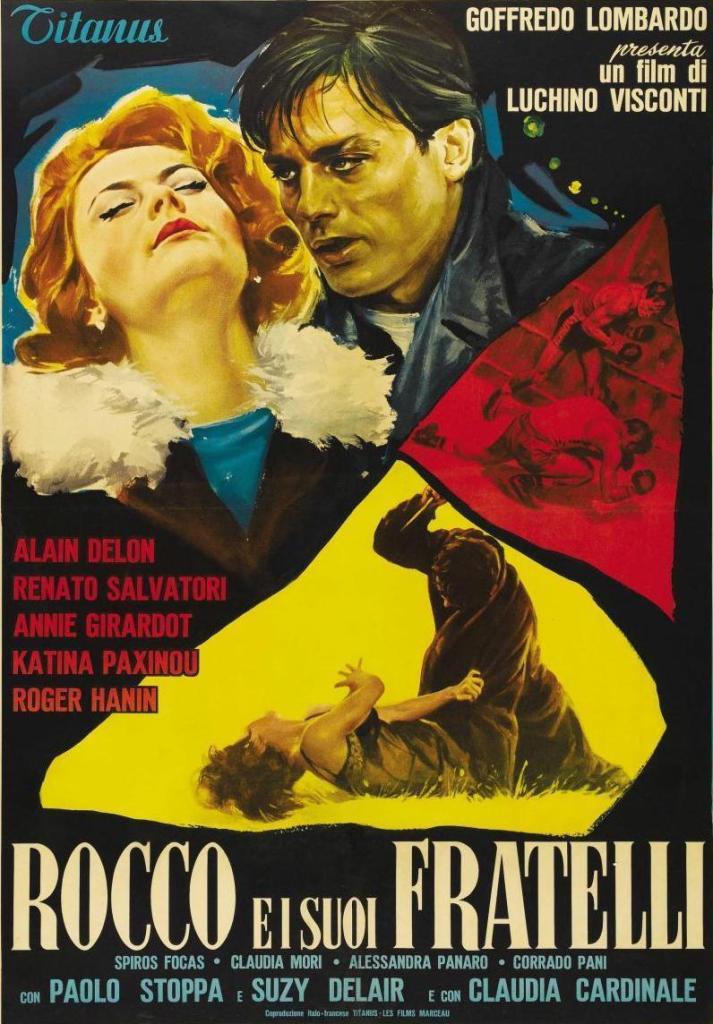
Director: Luchino Visconti

Cast: Alain Delon (Rocco Parondi), Annie Girardot (Nadia), Renato Salvatori (Simone Parondi), Katina Paxinou (Rosaria Parondi), Roger Hanin (Duilio Morini), Spiros Focas (Vincenzo Parondi), Claudia Cardinale (Ginetta), Paolo Stoppa (Tonino Cerri), Max Cartier (Ciro Parondi), Rocco Vidolazzi (Luca Parondi, Alessandro Panaro (Franca), Suzy Delair (Luisa), Claudia Mori (Raddaella)

Visconti was born into a noble Milanese family: perhaps this left him with a foot in two camps. He could understand the progress and achievement of northern Italy in the post-war years, those booming industry towns which placed a premium on hard work, opportunity and social improvement. But he also felt great affinity with more traditional Italian bonds: loyalty to family, the self-sacrificing interdependency of those links, and the idea that any outsider is always a secondary consideration, no matter what. It’s those split loyalties that power Rocco and His Brothers.

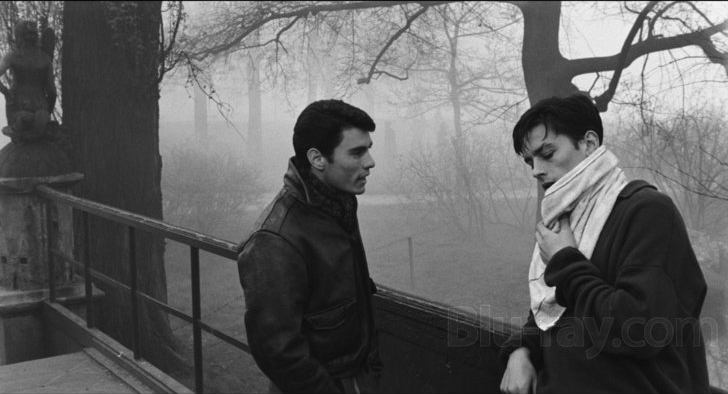
Rocco (Alain Delon) is one of five brothers, arriving in Milan from the foot of Italy looking for work with his mother Rosaria (Katina Paxinou). The hope of the family is second brother Simone (Renato Salvatori), a sparky pugilist destined for a career as a boxing great. But Simone can’t settle in Milan, too tempted by the opportunities he finds for larceny and alcohol. He falls in love with a prostitute, Nadia (Annie Girardot), until she rejects him and then he drifts ever downwards. Rocco, always putting family first, inherits his place first as a boxer than as Nadia’s lover. Problem is, Simone is not happy at being replaced, and the three head into a clash that will see Nadia become a victim in the twisted, oppressive, family-dominated loyalty between the two brothers.

Rocco and His Brothers is a further extension of Visconti’s love of realism – but mixed with the sort of classical themes and literary influences that dominated his later period pieces, themselves in their stunning detail a continuation of his obsession with in-camera realism. Filmed in the streets of Milan, where you can feel the dirt and grit of the roads as much as the sweat and testosterone in the gym, it’s set in a series of run-down, overcrowded apartment blocks and dreary boxing gyms that you could in no way call romantic.

This ties in nicely with Visconti’s theme. Rocco and His Brothers is about the grinding momentum of historical change – and how it leaves people behind. In this case, it’s left Rocco and Simone as men-out-of-time. Both are used to a hierarchical family life, where your own needs are sacrificed to the good of the family and every woman is always second best to Momma. While their brother Ciro knuckles down and gains a diploma so he can get a good job in a factory, Simone drifts and Rocco bends over backwards to clean up the mess his brother leaves behind. Naturally, Simone and Rocco are the flawless apples of their mother’s eye, Ciro an overlooked nobody.

The film focuses heavily on the drama of these two. And if Visconti seems split on how he feels about the terrible, destructive mistakes they make, there is no doubting the relish of the drama he sees in how it plays out. Rocco, by making every effort to make right each of the mistakes his brother makes, essentially facilitates Simone’s collapse into alcoholism, criminality and prostitution. Simone flunks a boxing contract? Rocco will strap on the gloves and fulfil the debt. Simone steals from a shop? Rocco will leave his personal guarantee. Simone steals from a John? Rocco will pay for the damage.

Caught in the middle is Nadia, a woman who starts the film drawn to the masculine Simone but falls for the romantic, calm, soulful Rocco. Wonderfully embodied by Annie Girardot, for me Nadia is the real tragic figure at the heart of this story. Whether that is the case for Visconti I am not sure – I suspect Visconti feels a certain sympathy (maybe too much) for the lost soul of Simone. But Nadia is a good-time girl who wants more from life. Settling down to a decent job with Rocco would be perfect and he talks to her and treats her like no man her before. Attentive, caring, polite. He might be everything she’s dreaming off, after the rough, sexually demanding Simone.

Problem is Nadia is only ever going to be an after-thought for Rocco, if his brother is in trouble. Alain Delon’s Rocco is intense, decent, romantic – and wrong about almost everything. He has the soul of a poet, but the self-sacrificing zeal of a martyr. He clings, in a way that increasingly feels a desperate, terrible mistake, to a code of conduct and honour that died years ago – and certainly never travelled north with them to the Big City. When Simone lashes out at Nadia with an appalling cruelty and violence, making Rocco watch as he assaults her with his thuggish friends, Rocco’s conclusion is simple: Simone is so hurt he must need Nadia more than Rocco does. And it doesn’t matter what Nadia wants: bros literally trump hoes.

Rocco does what he has done all his life. He wants to live in the south, but the family needs him in the north. He wants to be a poet, but his brother needs him to be a boxer. He loves Nadia but convinces himself she will stabilise his brother (resentful but trapped, she won’t even try, with tragic consequences). All of Rocco’s efforts to keep his brother on the straight-and-narrow fail with devastating results. Naturally, his mother blames all Simone’s failures on Nadia, the woman forced into trying to build a home with this self-destructive bully. Rocco’s loyalty – he sends every penny of his earnings on military service home to his mother – is in some ways admirable, but in so many others destructive, out-dated indulgence.

And it does nothing for Simone. Superbly played by Renato Salvatori, he’s a hulk of flesh, surly, bitter but also vulnerable and self-loathing, perfectly charming when he wants to be – but increasingly doesn’t want to. His behaviour gets worse as he knows his brother is there as a safety net. It culminates in an act of violence that breaks the family apart: not least because Simone crosses a line that Ciro (the actual decent son, who Visconti gives precious little interest to) for one cannot cross and reports him to the police.

That final crime is filmed with a shocking, chilling naturalism by Visconti, horrific in its simplicity and intensity. But I find it troubling that Visconti’s core loyalties still seem to be with the out-of-place man who perpetrates this crime and his brother who protects him, rather than female victim. Rocco and His Brothers could do and say more to point up the appalling treatment of Nadia, or at least make clearer the morally unforgiveable treatment she receives from both brothers (she’d have done better disappearing from Milan after Simone’s attack and never coming back, not playing along with Rocco’s offensive belief that Simone’s assault was a sort of twisted act of love).

Saying that, this is a film of its time – perhaps too much so, as it sometimes feels dated, so bubbling over is it with a semi-Marxist view of history as a destructive force. But it’s shot with huge vigour – the boxing scenes are marvellous and their influence can be felt in Raging Bull – and it ends on a note of optimism. The film may have disregarded Ciro, but there he is at the end – happy in his choices, settled, making a success of his life. Rocco and Visconti may see the drama as being exclusively with the old-fashioned brothers, making their counterpoint a paper tiger, but it ends with him – and (I hope) a reflection that Ciro’s path may be duller and safer, but also nobler and right.

The Leopard (1963)

The Leopard (1963)

Possibly the most luscious film ever-made, Visconti’s epic is a beautiful film of rage against the dying of the light

Director: Luchino Visconti

Cast: Burt Lancaster (Don Fabrizio Corbera), Alain Delon (Prince Tancredi Falconeri), Claudia Cardinale (Angelica Sedara), Paolo Stoppa (Don Calogero Sedara), Rina Morelli (Princess Maria Stella of Salina), Romolo Valli (Father Pirrone), Terence Hill (Count Cavriaghi), Serge Reggiani (Don “Ciccio” Tumeo), Leslie French (Cavalier Chevalley), Pierre Clémenti (Francesco Paolo Corbera), Lucilla Morlacchi (Concetta Corbera), Ida Galli (Carolina Corbera), Ottavia Piccolo Caterina Corbera)

There might not be a more visually ravishing film than Visconti’s The Leopard. Every detail of costume and set design is perfect in this gloriously stately, carefully crafted adaptation of Giuseppe Tomasi di Lampedusa’s only novel. It’s a perfect match for the autumnal melancholy of Visconti’s elaborate work, as an ageing prince in the Risorgimento rages quietly against the dying of the light. The Leopard is a delicate and carefully-paced film that carries a sweeping romanticism.

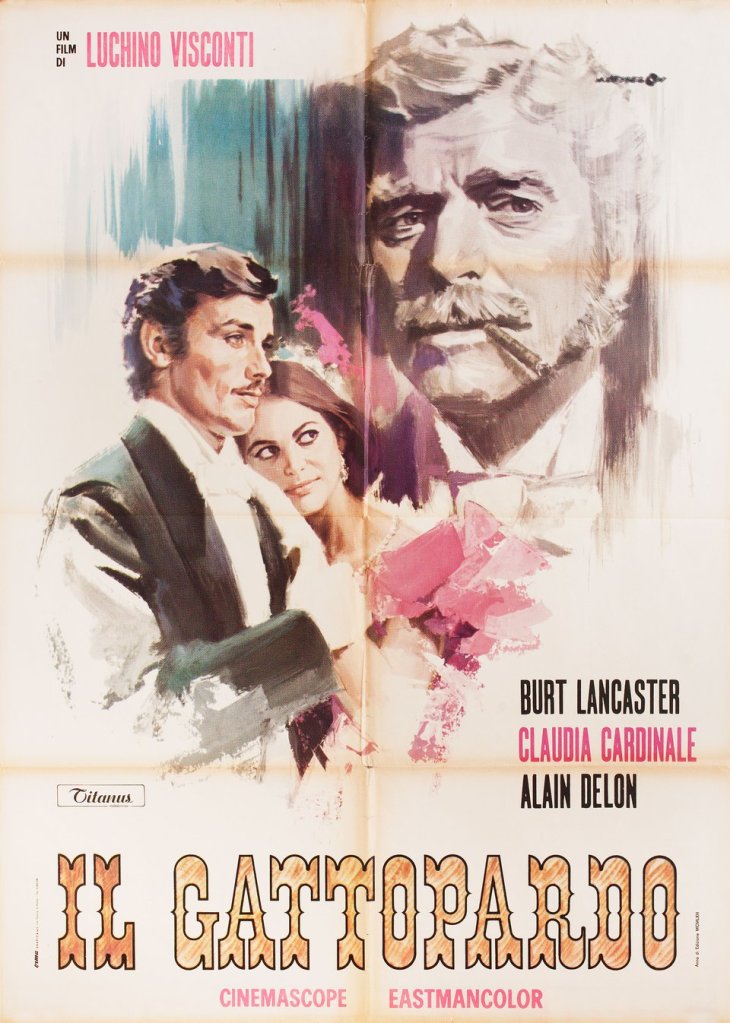
It’s 1860 and if the Sicilian aristocracy “want things to stay as they are, things will have to change”. Italy is forming itself into a nation and Sicily is in a state of civil war. On one side, the forces of the revolutionary republican Garibaldi – on the other, the old-guard of Francis II of the Two Sicilies, clinging to keep Sicily part of the Bourbon empire. Watching all this, Don Fabrizio Corbera, Prince of Salina (Burt Lancaster), scion of a noble family, watching the inevitability of change but clinging to tradition. His nephew Tancredi (Alain Delon) embraces first the fervour of Garibaldi, then Angelica (Claudia Cardinale) the radiant daughter of nouveau riche Don Sedara (Paolo Stoppa). But is there a place for the prince in this new world of democracy and the power of the middle classes?

The Leopard hails from the same wistful remembrance of things past that powers Brideshead Revisited in the English language. In Visconti, son of Milanese nobility, it found its perfect director. Visconti didn’t just know the world behind the declining place for the nobility: he’d lived it. He brings every inch of that to the luscious beauty of The Leopard, a mournful final hurrah of a generation and way of living that has no place in the present and is only an echo of the past.

The Leopard is crammed with simply stunning period detail. Visconti shoots this with a calm, controlled, observant camera, that moves and pans slowly through sets, carefully following its players. It’s set in a world of elaborate drawing rooms and stunning vistas. Costumes are intricate in their period detail. Dinners are grand celebrations of the opulence of this bygone era. Every detail in the set is perfect to the minutest detail – you feel a drawer could be pulled open and only period-appropriate props would be contained inside.

Visconti though never makes the film a slave to its period trappings. The careful details of the prince’s life serve to stress how bygone and dying these days are. It’s a film full of moments of small but telling undercutting that stress how this world is crumbling. In church, wind blows dust across the gathered Corbera family, coating them in dirt. They mock the newly empowered Don Sedara – and the pompous chap’s ineffectiveness is hammered home when a band keeps interrupting his attempt to declare the results of a rigged unification plebiscite – but Fabrizio is desperate to secure a marriage alliance with him and it’s clear Sedara is very much in the political ascendancy.

Could Fabrizio have done more to preserve his way of life if he wasn’t so clearly entering the twilight of his years? He’s virile enough, dashing from the family home (priest in tow) to spend a night in town with his mistress. He can climb the hills and hunt with the best of them. He half considers that it’s not outside the realm of possibility for him to have a crack at Angelica himself. But this is truly the Lion in Winter. He’s powerless to defend the traditional position that guarantees his influence and lacks the drive and youth Tancredi has to fashion himself a new one. For all his wry wit and handsome features, he becomes a sweaty, mournful figure at a celebration ball watching the young people dance all night and musing on where his own vitality went.

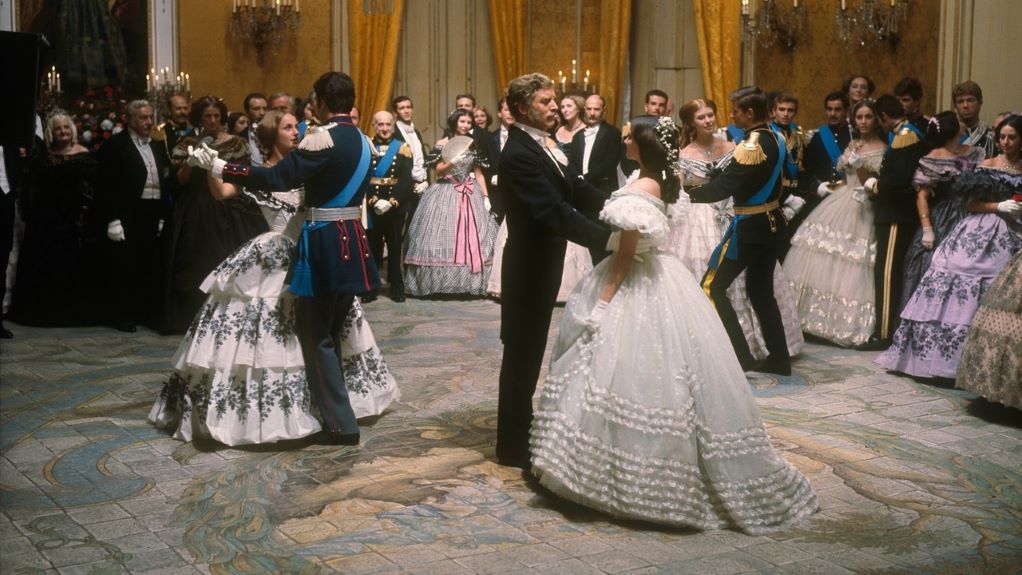
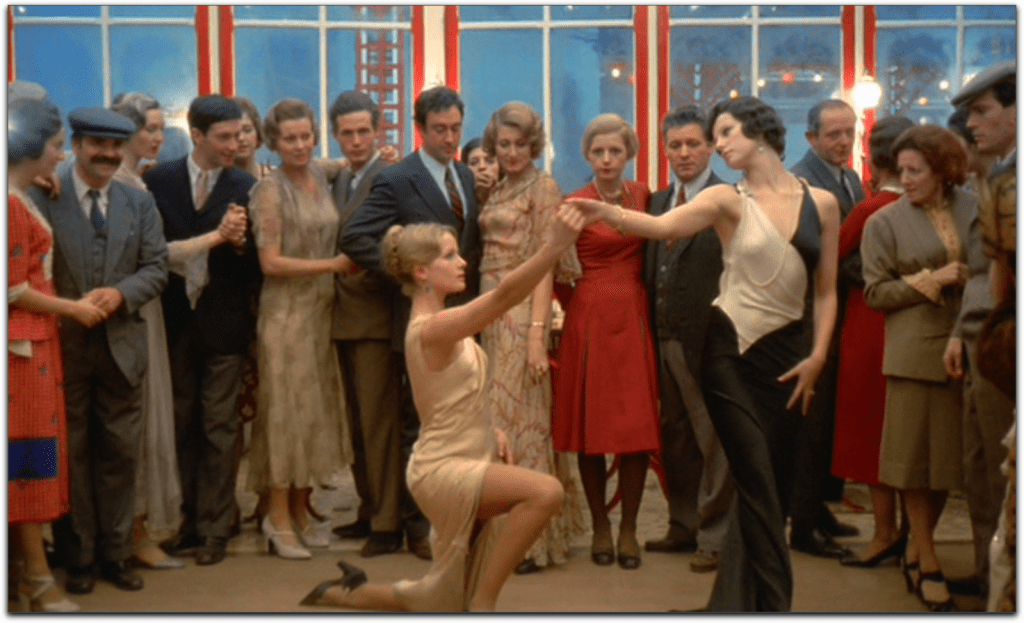
That long ballroom sequence – a near 45-minute extended scene that ends the film – is one of the triumphant tour-de-forces of cinema. A gorgeous culmination of the beauty of the entire piece, Visconti also manages to present it as a final hurrah of a whole way of life. This celebration is crammed with military figures who call the shots and filled as much with older people struggling to keep the pace as it is young ones with an eye on something far more modern than the pleasures that thrilled their parents. At the heart of this, Visconti’s camera carefully follows the prince as he moves from room to room, a quiet, lonely observer, tears in his eyes at moments, reflecting on his mortality and rousing his youthful fire only for a single dance with Angelica.

As this rusting monument to the old ways, Visconti was gifted with a Hollywood star. To be honest, at first he was far from happy when he received Burt Lancaster. But – once you get over the oddness of Lancaster being dubbed by a plummy Italian accent – it’s a near perfect marriage of actor and role. Always a graceful and elegant actor, Lancaster becomes Italian – there is more than a foreshadow of the Godfather to him – and his genteel, noble face is perfect for this bastion, just as his expressive eyes are perfect for the part’s delicacy and sadness. It should be a bizarre miscasting, but it lands perfectly and much of the success of the final ball sequence is his ability to communicate so much from such small moments.

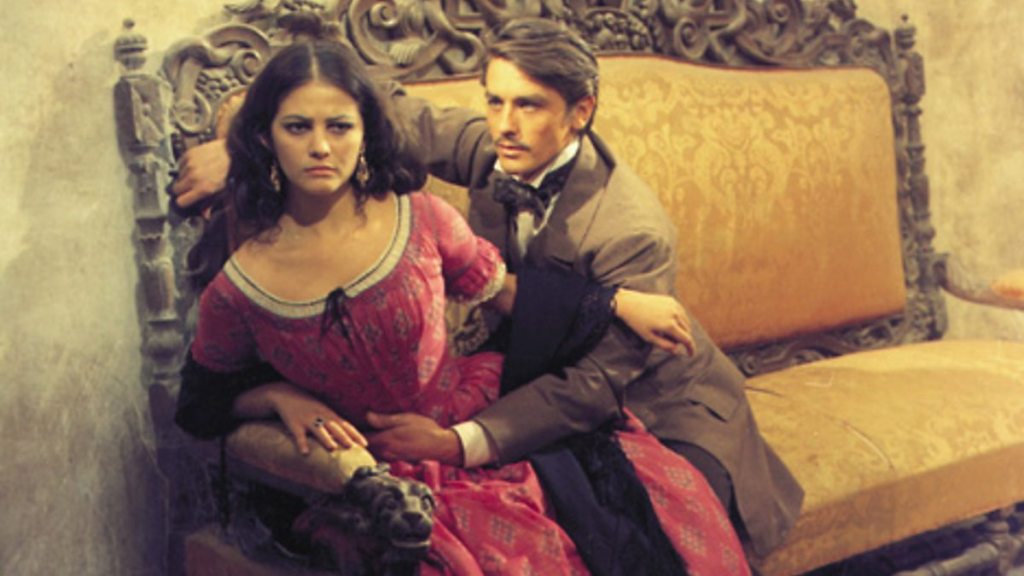
Visconti places him at the heart of this languid, precise film and contrasts the prince’s gentle moving out-of-step with the future with the dynamism and openness to compromise of his nephew. Tancredi – a youthful and passionate Alain Delon – is energetic and with a casual ease switches passions personal and political. Starting the film as a red-shirted revolutionary, he ends it as a uniform-clad member of the elite. Professing his love for the prince’s daughter, he ditches her on a sixpence for Angelica. Not that anyone can blame him: Claudia Cardinale is gorgeous but also shows the elemental charisma that Leone was to use to such great effect in Once Upon a Time in the West. Cardinale also feels like someone between two eras: attracted to the casual and flexible Tancredi but perhaps more drawn to the elegant grandeur of the prince.

The Leopard works as extraordinarily well as it does because it is so well paced. This is a film that requires an inordinate length, lingering shots and scenes, and for action to be happening elsewhere. Our single burst of action is to see Garibaldi’s forces fight in the streets of Palermo: other than this, momentous events happen elsewhere off-screen. The camera moves instead to study the scenery or the passing of normal people on the streets. We are always given the sense of this family and its world being cut off and left behind by real events. Tancredi starts the film explaining his conversion to Garibaldi in detail: later he will barely mention why he’s changed uniforms or feel the need to say why he is accepting positions the revolutionaries reject.

It’s not a surprise that a cut-down version of The Leopard was a major bomb when released in America. The three-hour run time is needed to truly understand the drift and ennui Visconti’s film is exploring. It does it in a film dripping with gorgeous period detail and full of scenes awash with interest, but the point is this is a film of slow, deceptive but finally overwhelming impact. The quiet, controlled, predictable life that generations of the prince’s family has known, dies with the same polite, grand silence as it largely lived. The Leopard is a stunning tribute to the passing of an era.

The Conformist (1970)

The Conformist (1970)

Freud mixes with politics in Bertolucci’s stunning political-psychological thriller, one of the greatest films ever made

Director: Bernardo Bertolucci

Cast: Jean-Louis Trintignant (Marcello Clerici), Stefania Sandrelli (Guilia), Dominique Sanda (Anna Quadri/Minister’s Lover/Prostitute), Gastone Moschin (Manganiello), Enzo Tarascio (Professor Luca Quadri), Fosco Giachetti (Colonel), José Quaglio (Italo Montanari), Pierre Clémenti (Lino Semirama), Yvonne Sanson (Guila’s mother), Milly (Marcello’s mother)

At age 29, Bertolucci made one of the greatest films of the 20th century. The Conformist is a film of uncertain illusions, half-seen shadows dancing on the wall of a cave. Each viewing unfolds new perspectives and interpretations. But each is rewarding, such is the magisterial grace the story is told with, and the radiant beauty of the film itself (a clear, massive, visible influence on Coppola’s Godfather films).

In 1938, a young Fascist Marcello Clerici (Jean-Louis Trintignant) is commissioned by Mussolini’s government to arrange the assassination of his former philosophy professor, dissident intellectual Luca Quadri (Enzo Tarascio) in Paris. Marcello longs for a “normal life”, obsessed with the fear that personal flaws, rooted in childhood trauma, will expose him. He marries the unexpected woman – the garrulous and ingenuous Guilia (a superb, guileless Stefania Sandrelli) – and joins the Fascists. But he is shaken by his fascination with Quadri’s wife Anna (Dominique Sanda).

Bertolucci’s film is nominally a political thriller. It exposes the brutality of fascism, but its alleged heroes are ineffective, bourgeoise left-wing dissidents. But really this is a Freudian deep dive into the character of Marcello and how he has sought to “conform” his whole life.

The Conformist is like sitting in on a prolonged psychotherapy session, Marcello’s past, present and future stripped down to their components, with the viewer invited to theorise how they assembled in the way they have. The film’s non-linear structure is crucial for this – and Bertolucci was vocal on the vital wisdom of editor Franco Arcalli. The narrative was reconstructed around the day of the assassination and Marcello’s car journey to it – with flashbacks inspired by events along the way.

The film is a revue of Marcello remembering his recruitment, the days before his marriage and the childhood trauma of sexual awakening and murder that haunts his inner fears. Most of all we see unspool the events that directly brought him to sitting in this car, on this day, driving towards the site of an assassination. These component parts shift and rearrange themselves to form new patterns about how we understand Marcello and the choices he makes.

The film’s theological pivot is Marcello and Quadri’s discussion of Plato’s cave (read about it here), where men chained in a cave understand the world only from the shadows of objects outside which they watch on its walls. But there are no easy conclusions. Are the fascists the chained men? Or has Marcello chained himself away and only interprets the world through shadows? Is Marcello so disjointed he can only interpret emotions based on his understanding of shadows of them?

Or is this pushing us to consider we are watching a film: a thing made of light and shadows. Imagery constantly reminds us of this fact. Light streams through trees, pillars and windows like light from a projector. Views outside of train windows resemble back projection. Marcello watches a radio performance from a recording booth, the window of which literally resembles a cinema screen. Constructed realities are the language of this medium – and Marcello is perhaps applying the same phraseology to his life. He builds a narrative, just as we all do, making himself bland and forgettable.

Marcello dreads the discovery not only of his crime, as a 13-year-old, of shooting and killing a seductive chauffer (played by Pierre Clémenti), but also the sexual longing it awakened in him. This horror of homosexual yearnings – and fear at being caught for murder – has, perhaps, led to a reflexive desire to hide in the crowd: to conform. Understanding this leads to us seeing Marcello, for all his coldness, as a strangely tragic, repressed figure, hiding from himself and others. His face is often obscured, or seen behind glass and mirrors. He’s always slightly distant from us.

This void is beautifully captured in Trintignant’s compelling performance. He bottles genuine emotions within himself, that at rare moments are released like small explosions. He clings to a hat that hides his face and seems barely aware of his desires. Sensuality and nakedness fascinate and alarm him. Fascism is a large, empty illusion he clings to. In the film’s only touch of heavy-handedness Italo, who recruits him, is blind. You feel something for Marcello, but are also repelled by his studied artificiality. His whole life is a carefully framed pose, like those he strikes when handed a gun before stroking his hair (a repeated gesture) and running off to find his hat.

The one thing that seems to affect him is the fascination – attraction seems too strong a word – he feels for Anna Quadri. Laying the groundwork for the sudden impact she has on Marcello, Dominique Sanda appears twice earlier as unconnected characters (both prostitutes). Anna, smart, bisexual, knowing herself and others far more than anyone else, sees straight through Marcello. How much is her seduction of Guilia an attempt to titillate and neutralise Marcello? At one point, she seductively touches the laughing Guilia, while staring at the door where Marcello (and the camera) stand in the shadows, knowing he is watching. Does Marcello long for her sexually, spiritually or because it feels like he should do? Answers are myriad.

These are expanded by the constructed beauty of Storaro’s photography. Bertolucci’s mastery of camera movements is clear (there are tracking shots of breathtaking grace, including a long drift along wind-blown leaves that Coppola outright pinched) and he knows when to use angles that unsettle (including a Dutch angle that suddenly, stunningly rights itself) or feel voyeuristic. Storaro’s shoots with ravishing beauty that subtly colour codes emotions, moods and locations and stresses the constructed nature of film narratives.

Italy is a land of imperious, grandiose Fascist architecture: towering modernist rooms, cold marble and neo-classicism, shot with whites and striking starkness. Paris is awash in softer – but also cold and damaging – blues that feel more natural but unsettling. Moments where Marcello touches on his longings (or at least persuades himself he does) drip with yellows. It looks gorgeous, but also fits with themes of invented kaleidoscopes, being re-shaken to construct a world.

The film builds towards a scene of genuine horror. The assassination is a bleak nightmare in the snow. You can never forget the image of Sanda – her face contorted with panic, desperation and hate – clawing and screaming at the window of Marcello’s car while he just sits. Is he torn between indecision and fear, or does he feel nothing? Your ideas will change, but your horror at Anna’s desperate, hand-held-shot, futile flight through the woods like a deer pursued by hounds never will.

The film’s final coda re-opens mysteries. Marcello discovers things that make him question if his life of conformity (and the price he has paid for it) was even necessary. The final shot sees him sitting, a flame behind him, starring at a wall (of course!) before turning to – well to look at us? Or is he looking, at last, at the world he has only studied from it shadows? It’s unclear. Deliberately so.

What’s clear is that The Conformist is crammed with truly extraordinary images (from that haunting assassination to a beautiful Brueghelesque late-night dance between Anna and Guilia, everything sticks with you) and challenging ideas that carry no easy answers. Bertolucci’s film invites deep examination and analysis and presents possible suggestions, but no answers. It’s what makes it an extraordinary classic, a fascinating study of psychology and humanity.

Il Postino (1995)

Il Postino (1995)

A friendship (of a sort) across the divide in this sentimental, overtly charming romantic comedy drama

Director: Michael Radford

Cast: Massimo Troisi (Mario Ruoppolo), Philippe Noiret (Pablo Neruda), Maria Grazia Cucinotta (Beatrice Russo), Renata Scarpa (The Telegrapher), Linda Moretti (Donna Rosa), Mariano Rigillo (Di Cosimo), Anna Bonaiuto (Matilde Urrutia)

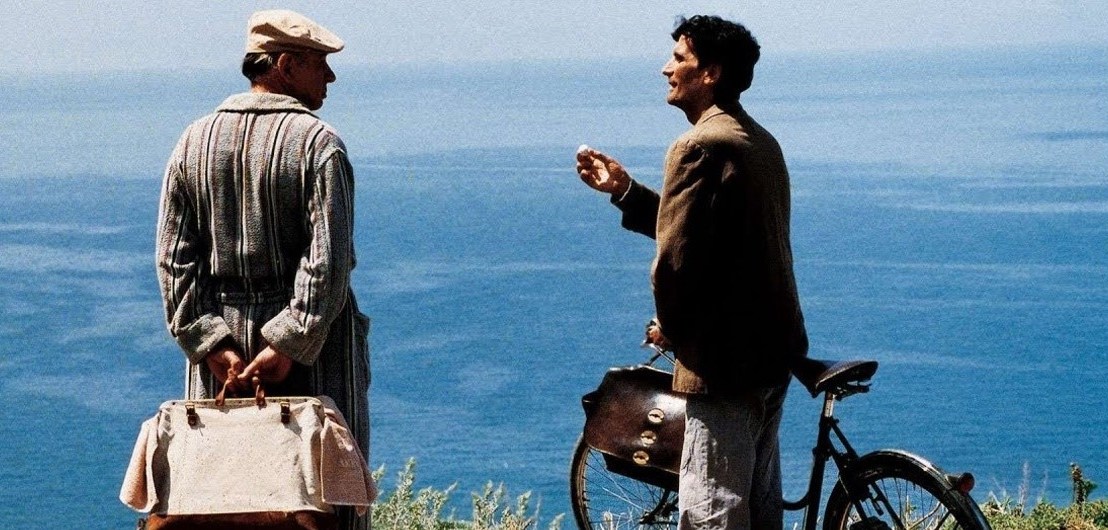
Pablo Neruda (Philippe Noiret) arrives on an Italian island in 1950, exiled from his home in Chile. He brings celebrity to the small community: but also transforms the life of local Mario Ruoppolo (Massimo Troisi). Mario, a quiet and slightly lost man who doesn’t want to follow in his father’s fishing footsteps, takes a job delivering Neruda’s mail. He becomes fascinated by poetry and idolises Neruda with whom he forms a friendship, after he enlists him to help woo Beatrice (Maria Grazia Cucinotta), daughter of the local café worker. Mario becomes more and more influenced by Neruda’s communism and love of language. How will he cope when Neruda’s exile ends?

A massive box office success – one of the biggest foreign language hits in the USA – Il Postino is a film born from tragedy. Troisi had long wanted to adapt the novel by Antonio Skarmeta. So much so, he delayed urgent heart surgery to make the film. With filming due to start, Troisi was so ill he could work little more than an hour a day. Many of his scenes were done in a single take. Radford re-worked scenes to allow Troisi to sit as much as possible, while a body double did all long shots, medium shots and any close-up where Troisi’s face didn’t need to be seen. Troisi recorded all his dialogue before filming – and tragically died the day after shooting completed.

It’s a moving story: and it’s hard to separate your reaction to it from your reaction to the film. Perhaps influenced by Troisi’s illness, Radford turns Il Postino into a quiet, gentle and mediative piece, crammed with restrained camerawork and thoughtful pacing. There is a gentle, easily digestible warmness to Il Postino, with relatable themes around love, friendship and the power of poetry. But you can’t help but feel subtitles made some feel they were watching something arty, rather than something that is essentially a bit of popular fiction turned into a film.

Don’t get me wrong, there are plenty of positives. Radford perfectly captures the warmth and eye-opening wonder of a man discovering intellectual horizons he never imagined. Mario at first seems not particularly bright – but we discover he is simply a man who has grown up without intellectual stimulation of any sort. No one ever leaves his island and the only ambition anyone has is to become a fisherman. Watching a newsreel of Neruda’s arrival in Italy, the villagers seem as stunned by seeing these magic moving pictures as they do the famous poet’s arrival.

Into this tiny world drops a magic figure: someone who makes Mario discover that the functional words that only ever dropped hesitantly from his mouth, can actually be crafted into gorgeously elaborate sentences, full of power and beauty. Poetry at first just seems like a great way to get girls – Mario is stunned by the amount of mail from ladies Neruda receives – but then becomes an end in itself. Slowly Mario appreciates things around him – the moon, the lapping of waves on the shore, the sound of the wind in the hills – in a way he never even thought about before. Similarly, he begins to question the quiet acquiescence the village shows to all-too-obviously corrupt local politician Di Cassimo.

This largely works due to a quiet, unforced and gentle performance from Troisi. Shyly muttering his lines and rarely raising his head up to look directly at the person he is talking to, Troisi’s performance has an unaffected naturalness to it. He’s quiet, abashed and shy, also childlike, worshipping Neruda with a puppy-dog intensity (that never wilts, even after Neruda leaves the island) and reacts to things around him with an awe-filled wonder.

Opposite him, Noiret soaks himself in artistic confidence as Neruda, a man very aware he’s a huge fish in a small pond. Perhaps because he’s lonely, perhaps because he finds Mario’s childlike openness endearing, he indulges and encourages Mario’s attempts to befriend him. But, despite appearances, I’m not sure Il Postino wants to commit to the fact that this is not a friendship of equals. Neruda is fond of Mario – but he never, truly, sees him as an equal. Mario is, at heart, a distraction Neruda is fond of. He indulges Neruda’s clumsy attempts to win his attention, and there is a slight quiet background air of fatherly condescension in his treatment of him.

It means people overlook the more interesting parts of Il Postino. Because, despite the way it’s presented, this isn’t a story of a friendship over a divide. The final act is in fact more interesting in showing, after Neruda leaves, that a relationship that changed Mario’s life forever was just a brief, fond distraction to Neruda. Neruda remains the most important person in Mario’s life – but he wouldn’t even make the top hundred in Neruda’s life. Neruda makes little effort to keep in touch, gets a secretary to write a functional letter to Mario and takes years to even consider a visit.

The real point of interest here is how Mario flew, Icarus like, close to the sun – but found he could only get so close. He will only ever be a footnote in Neruda’s life, while Neruda is his life. Even when faced with evidence of Neruda’s affectionate disregard, he will still insist on naming his child after him. Similarly, poetry is something he can love but never quite master himself. This is interesting stuff. Il Postino avoids it.

Instead, it’s a film that settles on sentiment. You can’t argue with the skill Radford directs the film, or the quiet power of a late sequence when Mario records the sounds of the island for Neruda. Radford’s unobtrusive direction – partly influenced by working around Troisi’s illness – works to wring the maximum emotion from it. But it’s still a sentimental package: a package skilfully presented to Academy voters by Miramax (Luis Bacalov’s Oscar win for score was surely connected to Weinstein mailing a recording to every member of the Academy) and presents a pleasant fantasy story for the masses, that veers away from its more complex parts to present something far more reassuring and gentle.

La Dolce Vita (1960)

La Dolce Vita (1960)

Ennui, emptiness and envy in Fellini’s coolly satirical portrait of a hedonistic Rome

Director: Federico Fellini

Cast: Marcello Mastroianni (Marcello Rubini), Anita Ekberg (Sylvia Rank), Anouk Aimée (Maddalena), Yvonne Furneaux (Emma), Walter Santesso (Paparazzo), Lex Barker (Robert), Magali Noël (as Fanny), Alain Cuny (Steiner), Nadia Gray (Nadia), Jacques Sernas (Divo), Laura Betti (Laura), Valeria Ciangottini (Paola)

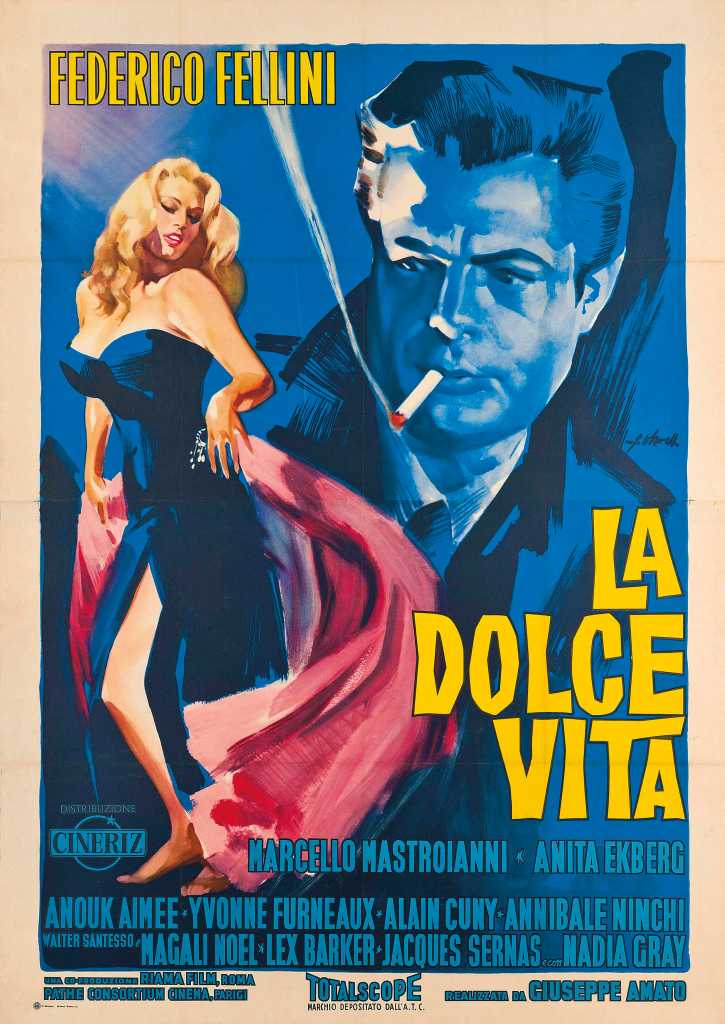
It’s one of those films as much about everything as it is nothing. Fellini’s omnibus of interconnected shaggy-dog short stories follows Marcello (Marcello Mastroianni), a would-be novelist writing a gossip column, as he mixes with the great and the good in Rome. Casual affairs, Hollywood stars, nightclubs, drunken parties and would-be orgies – Rome is a whirligig of the shallow and meaningless, all wrapped up in a classic façade. La Dolce Vita was gloriously popular and hugely influential – it seemed to be casting a cynical eye over the 60s, even as they were kicking off – and remains possibly Fellini’s best-known and most popular film.

At its heart is Marcello. Gloriously played with a shallow suaveness smothering deep self-loathing by Mastroianni, Marcello has enough insight to understand the world he occupies is an empty and meaningless one – but not enough drive, discipline or determination to do anything about it. For all his dreams of becoming a novelist and artist, he’s all too easily seduced by the glamour and the hedonistic pleasures of Roman high society. When presented with choices, he invariably takes the easier one. He has enough soul to wish he had more of one.

Fellini lays out his journey through Roman night-life with a painterly skill – the frame is often full of fresco like images, taking in multiple characters at once, all preoccupied and busy with their own needs and wants. Fellini uses a superb mix of shifting POV shots to constantly place us in and then immediately out of Marcello’s shoes. Characters stare direct at the camera – are they looking at us or Marcello? Marcello arrives at Steiner’s house in a POV shot – but then Marcello walks into the shot and suddenly we are witnesses again. It’s a film where we are always reminded we are on the outside, like participants in a dream.

La Dolce Vita is long, but also spry. This is a city of people universally keeping ennui at bay, by a never-ending parade of parties and sex. While we might see and hear life-changing statements – declarations of love, resolutions to build a better life, the severing of personal relationships – these lead to nothing. Fundamental relationships and patterns of living remain unchanged across the (unspecified) period of time the film covers. Words come and go as easily as parties.

La Dolce Vita is constructed from seven short stories, each exploring a different aspect of Marcello’s empty, hedonistic existence. They cover: a sexual encounter with society heiress Maddalena (Anouk Aimée) in the water-logged flat of a prostitute; a night Marcelo spends trailing Hollywood star Sylvia (Anita Ekberg) across Rome; Marcello and other reporters reporting on a ‘miracle’ just outside Rome; a visit from Marcello’s estranged father; a party at an aristocrat’ faded palazzo with a failed encounter with Maddelena; finally a beach-house party where a jaded Marcello fails to initiate an orgy and collapses into something akin to a mini-breakdown, which he shrugs off. Intercut with this is Marcello’s friendship with Steiner (Alain Cury), the intellectual family-man Marcello aspires to be, who transpires to be as depressed and trapped as Marcello – with disastrous consequences.

These encounters are open to multiple interpretations: and part of the film’s strength is Fellini’s lightness in telling the story. Interpretation and significance isn’t forced upon the film: it’s long because it is stressing the repetition of its cycles. Each ‘short story’ is told with a pace and skill, frequently shifting in tone. Fellini will make you hoot with laughter or swoon with sensuality in one scene – and then shift uncomfortably in your chair the next.

Part of La Dolca Vita’s aim is to move Rome on from the tourist-centred attractiveness it had been given by a host of films from Roman Holiday on. It’s essentially marrying films like that with Rome Open City and Bicycle Thieves. It’s Fellini’s attempt to compare (and perhaps question) Rome’s classical cultural background with the hedonistic casualness of today’s world. It opens with a statue of Jesus being helicoptered across the outskirts of Rome towards St Peter’s. The statue is a glorious reminder of the power of Rome’s religious significance: but what follows it? A second helicopter, flown by Marcello and Paparazzo (his photographer), smirking and trying to pick up the numbers of the sun-bathing women waving up at them. New and old Rome intermixed, and not favourably.

The film is full of moments like this. The party at the aristocrat’s palazzo takes place in gorgeous grounds and rooms lined with busts of Roman emperors. At first it feels like a comparison between class and classlessness. But then you remember that ancient Rome was a hub of orgies and violence, and everything at this party would probably look pretty tame to the emperors watching.

The false miracle suggests affectations of Christianity are stage-managed and willingly performed at the dictates of the media. A priest may denounce the whole thing, but it doesn’t stop an army of people desperate to grab a piece of the action – from the media to ostentatious worshippers – descending on a small field, all of them willingly playing their expected parts. It only takes a downpour of rain to turn this devotional crowd into a panicked mass of people, blindly charging from shelter to shelter – with tragic results for one pilgrim. TV journalists stage-manage the crowd, give lines to members it and turn the whole place into a film-set.

As the film progresses, elements of classical Roman architecture slowly drift out, replaced by the harsher modernist buildings and blocks of flat (we’re subtly reminded, particularly with the arrival of Marcello’s father, mysteriously ‘absent’ for much of Marcello’s childhood, that a lot of these buildings were fascist in origin). Ironically the most famous sequence buries itself in classical architecture: Marcello’s night vainly following Sylvia (an alluringly playful Anita Ekberg, channelling Marilyn Monroe) in the hope of a sexual encounter (she remains wilfully oblivious of this). It culminates in Ekberg’s famous Trevi fountain dance – inspiring millions of would-be imitators.

Marcello’s life takes place in nightclubs and drunken parties, where social and sexual morals are modern and casual. Marcello’s most significant relationships are with Maddalena (Aimée is wonderfully archly cold), who toys with a profession of love only to instantly sleep with another man, and fiancée Emma (a clingy and desperate Yvonne Furnaux), who Marcello dutifully maintains a relationship with. Marcello wishes to see himself as a glamourous playboy, but he’s frequently on the backhand – picked up when wanted by Maddalena, played with by Anita and oppressed by Emma. We see him as often ignored and rejected as we do conquering.

Who Marcello really wants to be is the intellectual Steiner, who seems to have it all: fame, respect, and a loving family. It’s after meeting Steiner that we see Marcello doing the only novel writing in the film. Sitting in a beach café, he chats with a young waitress, Paola, who he compares to an angel in Umbrian paintings. Paola is also the last face we see in the film: waving to Marcello from a distance after his depressingly bitter failed orgy, as the guests gather around a leviathan washed up on a beach. She seems to be trying to ask him how the writing is going: he fails to understand and walks away. Paola feels like a moment of hope – a representative of a more fulfilled life of creativity and meaning – rejected by Marcello in favour of wallowing in pleasure. Fellini ends the film with Paola staring directly at the camera: is she making the offer of meaning to us instead?

It’s open to interpretation – as is the whole film. A big part of Fellini’s skill is not to hammer his points home, but let events speak for themselves, leaving the film open to interpretation. I see it as a sort of Dantesque parallel. Nearly every story is framed with characters moving up and down stairs – like the circular descent of Dante through Hell. Its structure seems to be broken into Cantos. And each step sees Marcello descend a little bit further – culminating in Mastroianni impotently ripping up pillows and spraying feathers over a laughing woman.

Is modern Rome hell? That might be a little bit too far. But it’s definitely a soulless purgatory. Paparazzo doesn’t care who he hurts to get the photo – a dead child or a grieving mother are all game. Marcello’s uses what talents he has for empty and cynical purposes and to seduce women. Everyone thinks only about their next hedonistic encounter. It’s a wonder that Fellini makes this as strangely enjoyable as it is: but then he is a master. And La Dolce Vita remains his most popular and most recognised work.

Death in Venice (1971)

Dirk Bogarde falls victim to obsession in Death in Venice

Director: Luchino Visconti

Cast: Dirk Bogarde (Gustav von Aschenbach), Mark Burns (Alfred), Marisa Berenson (Frau von Aschenbach), Björn Andrésen (Tadzio), Silvana Mangano (Tadzio’s mother), Romoloa Valli (Hotel manager), Nora Ricci (Governess), Franco Fabrizi (Barber), Carole André (Esmeralda)

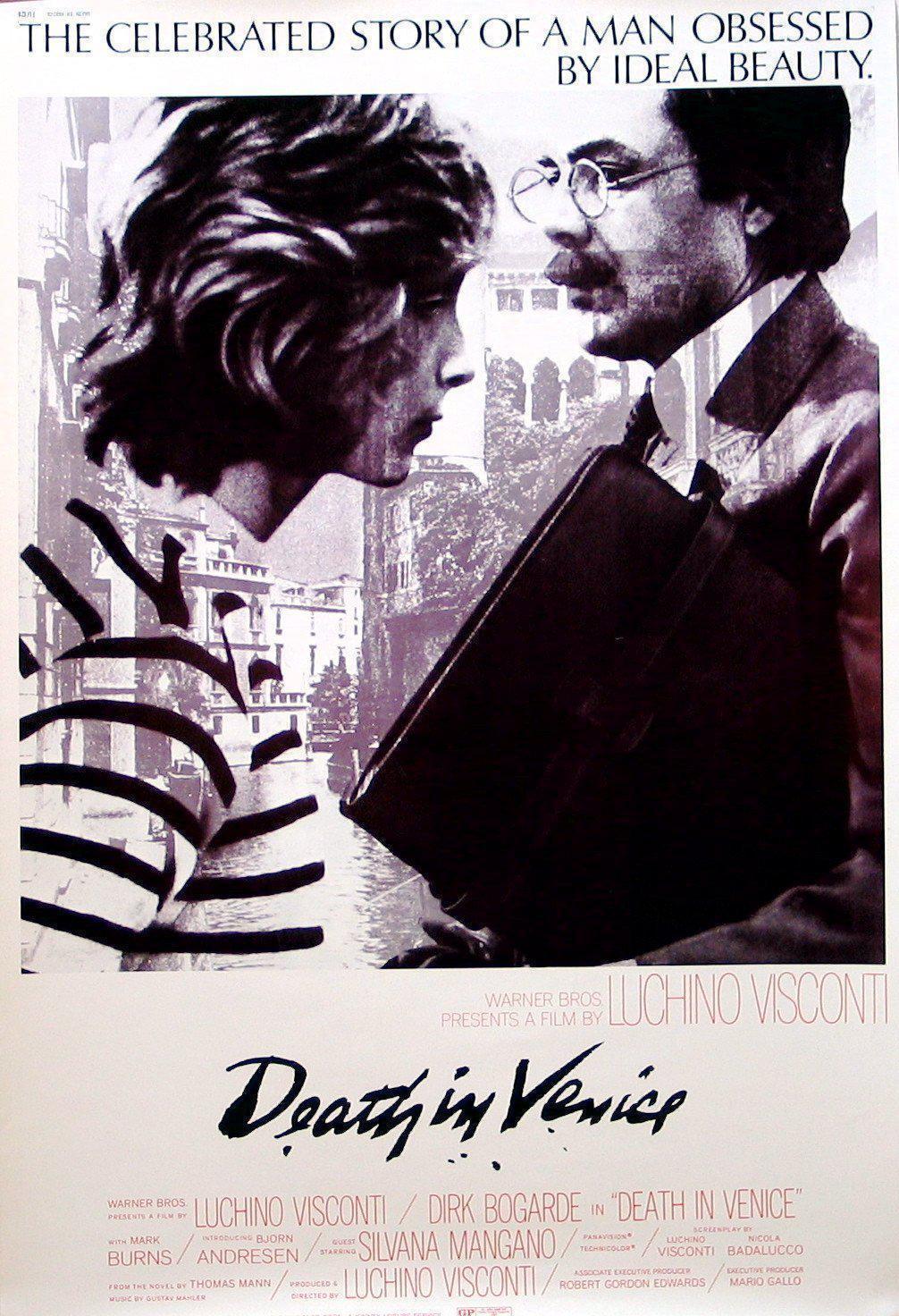
In the early 1900s a famed German composer, Gustav von Aschebach (Dirk Bogarde), travels to Venice for his health. A repressed artist who believes beauty is found not in the sensual but the spiritual, his world is turned upside down when he becomes fascinated/infatuated with a divinely beautiful teenage boy (Björn Andrésen) staying at his hotel. Gustav lingers in the city, never speaking to the boy, but reduced to watching him at the beach and following him and his family puppy-like through the city. A city that is on the verge of falling into a serious cholera pandemic. With Gustav’s health rapidly deteriorating, the title alone tells you where this all going.

That opening paragraph will probably also tell you all you need to know about whether this is the film for you or not. Increasingly, the idea of a famed artist starring with a longing, breathless admiration at a (very young looking) teenage boy (who is also at times shot with a coquettish flirtatiousness, increasingly aware that he is being looked at) has more than a whiff of Operation Yewtree to it. Take a moment though: Visconti’s extremely delicate and deliberate film largely manages to walk a tightrope between sexual interest and a deeply closeted admiration for physical beauty in the style of classical statues or paintings.

The film is not a leering pederast’s fantasy, but a melancholic meditation where this young man as much represents the loss of youth amidst a life of regret and closeted repression as it does sexual interest. Don’t get me wrong, sex bubbles under there. Gustav – even if he is struggling to process his own feelings – has a giddy schoolboy like love for this unattainable boy, something he seems aware he can (and will) never act on. Gustav becomes a rather tragic even pathetic figure. By the time the film ends and he has caked his face in the same “young” make-up that disgusts him when he sees it on the face of another ageing roue on his arrival in Venice, it’s hard not to feel he has lost his way. He seems aware death is knocking and that it is simply a matter of opening the door.

Visconti’s film is perhaps the ultimate arthouse classic. Long, slow, with lashings of Gustav Mahler playing while the camera slowly pans across incredibly detailed sets (rumour has it, even the unopened drawers were filled with period specific props) and lavish costumes. It’s got more than a puff of self-importance, taking as its subjects art, love and beauty. It’s the sort of film where nothing much really happens (there is no real dialogue for the first ten or last ten minutes), but what little happens is laced with an overwhelming spiritual and poetical importance.

The film is however outstandingly beautiful. Venice has never looked so striking – or so original. It’s not a picture postcard: the sky is frequently doom-laden pinks and reds, the streets are lined with litter, antiseptic wash and later small fires to burn away the bad air. But everything is presented with a painterly, if doom-laden, beauty. As mentioned, the period detail is exquisite and faultless. There are more than a few comparisons with Barry Lyndon in its obsession with detail, the pictorial and period over such trivial matters as storyline and humanity. Like that film it also has a languid self-importance, that has helped make it ripe for parody throughout the years.

And yet, it engages at some level slightly more than Barry Lyndon perhaps because Dirk Bogarde is a far more skilled actor than Ryan O’Neal. Bogarde is a master of the small detail. A huge portion of the film is basically Bogarde starring at Tadzio and letting a range of emotions play across his face: fascination, shame, fondness, intrigue, self-disgust, longing. Visconti frequently lets the camera just study Bogarde’s face as the actor thinks, capturing moments of almost youthful excitement that tip as swiftly into an old-man’s shame. It’s a compellingly cinematic performance from Bogarde, an actor who never quite gets the credit he deserves.

Of course, it’s also an important land-mark in gay cinema. It’s one of the few films where we have a man express a confused yearning and admiration for a beautiful teenage boy (films – such as American Beauty – which cover similar ground with men and teenage girls are far more common). Despite this, the film never tips into feeling too icky, largely because Gustav himself is a rather sexless figure. Flashbacks show his failed fumblings with (female) prostitutes and traces of a marriage with a wife (a silent Marisa Berenson – another Barry Lyndon link), with whom he shares grief at the loss of a daughter, but seemingly little else. The implication is that Gustav has carefully suppressed all his emotions in to raise himself to a higher artistic plain. Tadzio perhaps shows him there is also beauty in youth and life, rather than just intellect.

Or you might think that’s just hogwash, and an excuse for a man in his fifties to leer at a pretty young boy. There are times when Visconti makes Tadzio too coquetteish, at times casting him in the role of distant seducer (although there are hints at least some of these glances and poses are in the imagination of the infatuated Gustav). Björn Andrésen has spoken about his discomfort in making the film (where Visconti and others allegedly tended to treat him with an icky fascination) and dealing with its legacy. Often the film plays more awkwardly today and while Visconti is partly aiming for the sort of admiration of beauty we see in classic Renaissance art – like Rubens co-directed the film – he’s still at times also positioning a young teenage boy as something close to a sex object. The film is not as simple as that, and its far from being crude while Aschenbach never feels predatory or dangerous only deluded – but touches of it are there.

Death in Venice has faced years of parody. It’s an easy film to snigger about, with its self-consciously arty look and feel. Visconti wants you to know this is an important film, and like Tarkovsky often hammers this home by making it slow and ponderous. But it’s also a beautiful and strangely engrossing film. A slow-paced two hours – pace that could have been helped if the heavy-handed flashback discussions about art between Gustav and piano player (lover?) Alfred had been trimmed out. Visconti directs it with a poetic mesmerism.

It’s got the feel of a classic painting. But it’s a film: and parts of that make it troubling at times. It never questions the appropriateness or not of this semi-sexual fascination of Gustav (for all that it stresses his increasingly pathetic delusion). However, it just about works because of the overwhelming air of tragedy and regret that hangs over it – and Bogarde’s delicately judged performance. Visconti indulges himself terribly here – but produces something that feels very much his own. Death in Venice is intriguing because its simultaneously bloated and self-important, but also mesmerising and beautiful.

8½ (1963)

Marcello Mastroianni plays a version of the director in Fellini’s inspiring

Director: Federico Fellini

Cast: Marcello Mastroianni (Guido Anselmi), Anouk Aimée (Luisa Anselmi), Rossella Falk (Rossella), Sandro Milo (Carla), Claudia Cardinale (Herself), Guido Alberti (Pace – Producer), Jean Rougeul (Carini Daumier), Mario Pisu (Mario Messabotta), Barbara Steele (Gloria Morin), Madeline Lebeau (Herself), Eddra Gale (La Saraghina), Ian Dallas (Maurice, clairvoyant’s assistant)

If there is a single director associated with self-reflecting films its Federico Fellini. Frequently recognised as one of the greatest and most influential directors of all time, many of his films use baroque imagery and a masterful interplay of reality and fantasy to delve deep into both its director’s own subconscious and the swirling pressures and internal conflicts that make us the people we are. is, perhaps, the greatest expression of this style of film-making, a giddy sensory delight that demands investment and wisdom to unpeel its layers and give you a chance of finding its meaning.

Frequent Fellini collaborator Marcello Mastroianni plays Guido, a thinly veiled portrait of Fellini himself. Like Fellini, Guido is a successful and visionary director, facing pressure to come up with his ‘next masterpiece’ after the glorious success of his previous film (in Fellini’s case La Dolce Vita). Like Fellini, Guido is struggling to work out exactly what statement he wants to make next, instead allowing himself to become distracted by personal issues and day-dreaming flights of fancy (literally so in the film’s opening, where Guido imagines himself flying through the sky before being tethered and pulled to earth by his producer). Most of all these distractions revolve around women, from his wife Luisa (Anouk Aimée), his mistress Carla (Sandro Milo) and recurring daydreams of Claudia Cardinale (playing herself) who could just be the muse he is looking for. 

To me one of the things that can make a film great, is when the ideas in it are not obvious and tired, but when they defy obvious characterisation but throw themselves open to further thought and different interpretation depending on your mood. definitely meets this criteria, combined with the fact that it’s beautifully made and very entertaining.

Fellini’s deep dive into his own subconscious is deeply involving and intriguing. The film dances from beat to beat between reality, memory and fantasy – often leaving the lines blurred about which of these we are watching at any one time. That’s part of Fellini’s idea, that our minds are complex enough to exist on all three plains at the same time, to juggle within ourselves what’s real, what we remember, what we imagined or wished could happen and how we create our own versions of all these. 

In the build-up to the film, Fellini famously struggled to identify what he wished to make and what it should be about. But while you could say that Fellini turned this creative block into a film – that, when unsure about what to make a film about, he made a film about a director who didn’t know what to make a film about – that’s to suggest a vagueness in its execution that isn’t the case. Fellini knows exactly what he’s doing here: every scene serves its purpose to explore the ennui and feelings of entrapment that an artist feels, both in his life and his craft. Far from being ambling, the film is carefully constructed and brilliantly focused.

Guido is hounded at every corner by people wanting something from him. Be it producers demanding progress, extras looking for roles in his film, actors demanding insight for their characters to his mistress looking for his attention or his wife demanding more focus from him on their marriage. The film is Guido attempting to identity among all these demands what he needs and wants from his own life – and how to build on that. It’s telling that most of Guido’s fantasies that litter the film revolve around his demands for other people to service him – be that romantically, literally or spiritually. Is part of the point of the film that we are all selfish to some extent? 

It’s the film’s exploration of day-dreaming fantasy that gives it some of its most extraordinary work, coupled with Fellini’s superb and striking visuals. The opening sequences of Guido imaging literally flying out of a traffic jam (and away from the stares of the other drivers) into the freedom of the sky – before being literally pulled back down to Earth – shows how these flights of fancy give us windows into our own desires. Guido’s a confused man looking for focus and something to believe in – his constant fantasies of Claudia Cardinale seem in part longing for her to solve his creative problems, part sexual, part almost motherly, as if she can take some decisions away from him.

Other fantasies – such as an imagined conversation with a priest for spiritual guidance – lean on finding the sort of structure his life seems to be missing. (And also, in a fantasy confession of his ennui to the same priest, perhaps a need again to be told what to do.) Most of his fantasies though revolve around romance. He imagines his wife and mistress sharing anecdotes before dancing away arm-in-arm. Most famously, an extended sequence shows Guido imagining a harem containing all the woman in his life, where he is the centre of attention – and women who age beyond his interest are politely banished upstairs “to be well looked after”. The women range from long-standing crushes and mistresses, to half-glimpsed dancers and an air hostess with a sexy voice. 

There is a striking honesty about Fellini putting something like this on film – and then use the fantasy he is displaying to both comment on and criticise his own internal fantasies. In the fantasy, unlike real life, his wife is an almost maternal figure (Guido has already jumped at one point in his reverie earlier in his film, to remember his mother only for her to turn into his wife), the women address Guido with harsh truths about everything from his character to his sexual performance, a revolt breaks out in the fantasy harem at Guido’s banishing of early crushes as they age (one which Guido stamps out). The harem is further set within his childhood home, adding a whole other layer of odd sexuality to it, as part of the women’s duties are to bath and wash him exactly as his grandmother did as a boy. It’s a sequence that lays itself open to multiple interpretations, but never feels exploitative or sleazy.

Large chunks of the rest of the film take place in a hard-to-define space between dream, memory and reality. Frequently scenes shift in nature half way through – Guido is followed throughout the film by a critic-turned-screenwriter, full of criticism of the intellectual shallowness of his work who, mid-rant, he imagines taken away for execution by some toughs. Gentle tracking shots around the retreat Guido is staying at – scored with a mixture of classical music and Nina Rota’s wonderful score – trip a line between real and imaginary in the sights we see. Conversations are intercut with imagined moments or might simply be happening in a pretence rather than a reality.

If it sounds like a difficult view, it’s not. Because for all the intelligent analysis of the ennui that can come from a creative block and the internalised struggle to find a balance between all the impulses that pull on us, it’s also a hugely entertaining film. Funny, wise and superbly acted. Mastroianni is brilliant as Guido, in turns giddy and world-weary, confused and resigned then ambitious and dreamlike. The rest of the cast are also excellent, with Anouk Aimée delightful as his long-suffering wife and Sandro Milo hugely entertaining as a needy but largely ignored mistress.

Fellini’s dives into memory also add both a richness and an emotional heft to the film. There are some beautifully nostalgic sequences that head back into the past. Guido’s childhood is explored with a series of wonderful vignettes. From his childhood in a wine distillery with his grandmother and aunts, full of playful energy, to the first stirring of a sexual awakening watching a prostitute dance on the beach (a quite extraordinary scene of playful flirtation, but still rather oddly innocent in its way). These scenes have captured the imagination of directors across the globe, with their power and ability to capture both the nostalgia of recollection, but also a distant magic of memory and the impact these still have on us in the present. But no body does this better than Fellini.

The best thing that can be said about is that I can imagine watching it hundreds of times, and each time seeing something fresh and new about it. And it works because its ideas are profound without being pretentious and easy enough to engage with, while never shallow. It brings depth and richness to complex internal struggles and repackages these into a rich experience that enlightens both memory and creativity. A great movie.