Category: Literary adaptation

The Great Gatsby (2013)

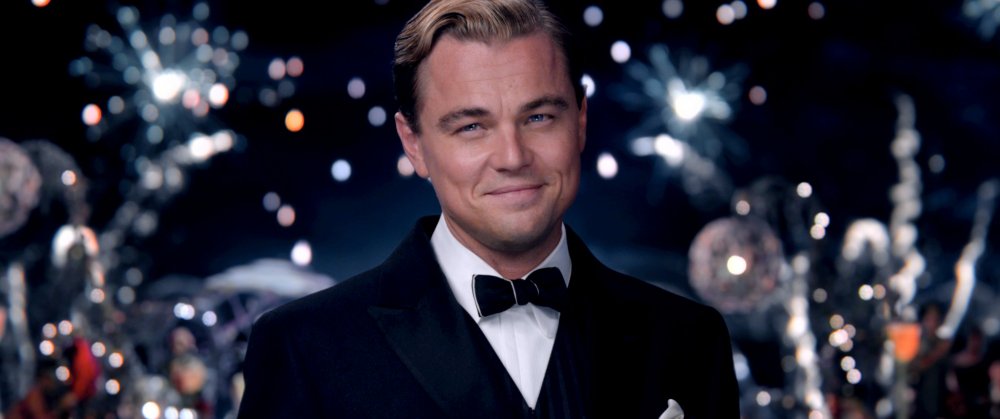
“Hello old sport”: Leonardo DiCaprio is The Great Gatsby

Director: Baz Luhrmann

Cast: Leonardo DiCaprio (Jay Gatsby), Tobey Maguire (Nick Carraway), Carey Mulligan (Daisy Buchanan), Joel Edgerton (Tom Buchanan), Elizabeth Debicki (Jordan Baker), Isla Fisher (Myrtle Wilson), Jason Clarke (George Wilson), Amitabh Bachchan (Meyer Wolfsheim), Jack Thompson (Dr Walter Perkins), Adelaide Clemens (Catherine)

The Great Gatsby is possibly the great American novel. I’ve only read it once, but I certainly admired its beautiful prose, capturing of an era of American life and understanding of the fragility behind America’s love of success. Baz Luhrmann is clearly a fan, as he spent years putting together this passion project, presenting the biggest, brashest version of Fitzgerald you are ever going to see.

Nick Carraway (Tobey Maguire) is a young writer turned bonds salesman in 1920s New York. He lives across the bay from his cousin, Daisy (Carey Mulligan) and her husband Tom Buchanan (Joel Edgerton), a brash old-money man carrying on an affair with Myrtle (Isla Fisher), the wife of his garage mechanic. Carroway’s next-door neighbour is the sumptuously wealthy, but mysterious, Jay Gatsby (Leonardo DiCaprio) whose parties and generosity are legendary. As Carraway gets to know Gatsby (as much as anyone can), he discovers that Gatsby has a deep, near obsessive, love for Daisy.

Luhrmann’s film is a technicolour explosion that uses many of the techniques you’ll be familiar with from any of director’s other films. The camera is a whirligig of motion. The colours are bright and primary. The whole tone of the film (certainly for its first hour) is larger than life. The narrative has been tweaked to take on the tone of a Greek Tragedy, with the loud noise, fast camera moves and speedy pace all inverted in the latter half to invoke sadness and tragedy. And of course, the music is deliberately anachronistic, mixing modern genre music with 1920s sounds.

Sometimes this high-budget technicolour brilliance does feel like it is partly getting in the way of the deeper themes that lie within the original. But that might be partly because the novel’s themes are so reliant on internalised feelings, unsaid or guessed emotions, and deeply purple prose, that these are ideas which are very hard to translate to the screen.
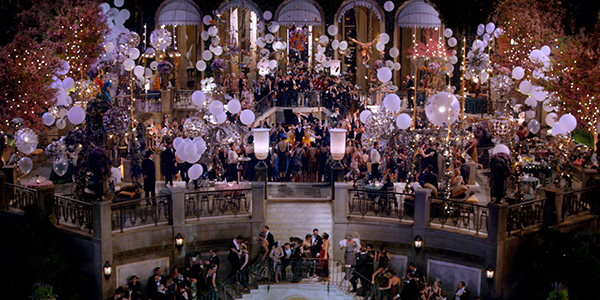
There is something to be said for Luhrmann turning one of the pillars of 20th-century American culture into a spiritual sequel to Moulin Rouge!. And Moulin Rouge! is what the film strongly resembles, not only in design, but its romantic structure, poetic retelling, high drama, sense of impending doom and danger behind the bright lights, assault on class and the way it stands in the way of true love, and the lack of freedom in our lives. Both even have sad, reflective authors book-ending events.

So your enjoyment of the film is probably going to depend on how you feel about Luhrmann’s OTT style. Love Moulin Rouge! and Romeo + Julietand you will probably find something to enjoy here (and you’ll also notice his love of tragic love stories). Saying that, of those three, Gatsby is the one the carries the least depth to it, which is intriguing as it probably mines the most psychologically rich source material. While Luhrmann understands that the book is about the real emotions masked by explosive parties and opulence – the film often feels as choked by these things as the characters do.

This is partly because I feel both Maguire’s and Mulligan’s performances don’t quite work. Maguire is so stripped back, quiet and passive he almost disappears – you don’t get a sense of Carraway as either a shrewd observer or someone wrapped up in events: instead he’s a passenger, like the plot contrivance Gatsby sometimes treats him as. Similarly, Mulligan is slightly overwhelmed by the movie, not giving a strong enough performance for her to break through. The film powers forward with such momentum and brashness, it squashes her.

It’s probably why the most successful lead performance by far comes from DiCaprio. He’s perfectly cast as Gatsby: so good in fact you wish he was in a more thoughtful, relaxed film that would give him a more of a chance to breathe. DiCaprio perfectly encapsulates the desperation just beneath Gatsby’s surface, the fear and uncertainty that lies under his suave urbanity. He completely gets the character, understands he is a showman presenting a front to the world because that’s what he thinks the world wants, but who is, in his own way, as empty and lost as the world of bright lights he is offering people. It’s an excellent performance.

Luhrmann’s work with DiCaprio is what gives the film it’s centre and, for all the colour, noise and joy of the first 40 minutes or so, it finds its heart in the moments of acting and character interplay as the Gatsby-Daisy-Tom love triangle comes to a head. This scene, with its bubbling emotions, high stakes and tension is like an oasis of calm in the high-faluting scenery that surrounds it. But then this is a film where the smaller moments actually come across as richer than the larger ones – partly helped by the fact that Joel Edgerton and Elizabeth Debicki both give excellent performances as the key supporting characters. 

The Great Gatsby captures the feel of Fitzgerald rather well, but for all the dialogue of the book placed over the film in voiceover, it never quite manages to capture the spirit of the book in the same way. It looks wonderful, and its dynamic filming is certainly enjoyably impressive, but it doesn’t quite become a film that deals in emotions and depth. It flashes and fizzles but it never lets us really soak in its ideas and themes. It’s all too much at times, and the tragic sadness at the heart of the story, of this lost boy trying to live the life of a man, never comes out as it should. An interesting and entertaining film, but not one that will last.
Sherlock Holmes (2009)

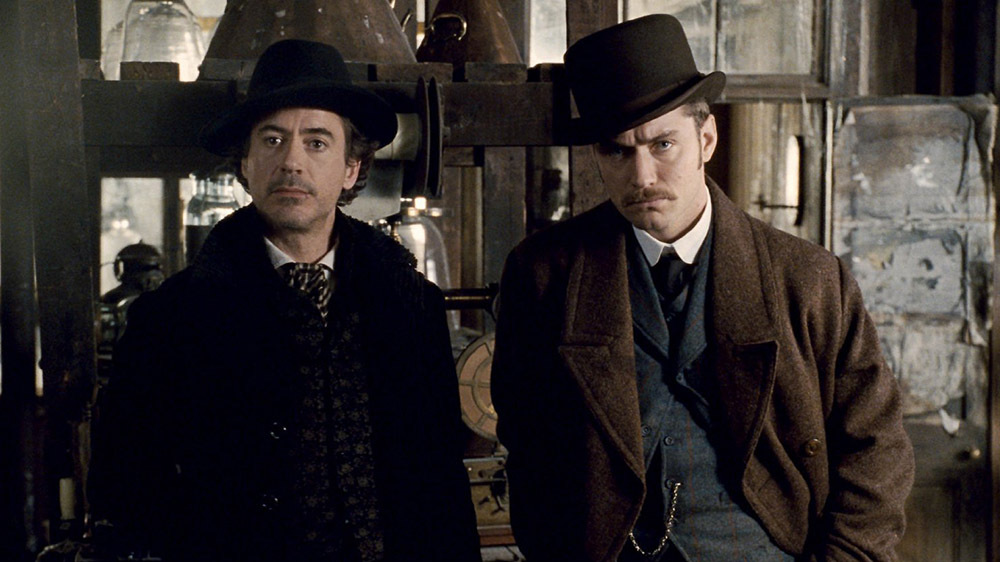
Robert Downey Jnr and Jude Law made a great odd couple in Sherlock Holmes

Director: Guy Richie

Cast: Robert Downey Jnr (Sherlock Holmes), Jude Law (Dr John Watson), Rachel McAdams (Irene Adler), Mark Strong (Lord Henry Blackwood), Kelly Reilly (Mary Morstan), Eddie Marsan (Inspector Lestrade), Hans Matherson (Lord Coward), James Fox (Sir Thomas Rotheram), Geraldine James (Mrs Hudson), William Houston (Constable Clark), William Hope (Ambassador Standish)

I don’t think there has been a single character brought to the screen more often than Sherlock Holmes. Sure there are certain tent-pole performances (Rathbone, Brett, Cumberbatch) that people automatically think of when you say “Sherlock Holmes”, but there are hundreds of others. It’s a character that survives constant re-imagination. In fact, you could argue it’s pretty much vital to bring something of your own to the table when putting together a Sherlock Holmes dramatisation. It’s what made Sherlock so successful. And it’s something that works very well here.

Sherlock Holmes (Robert Downey Jnr) is part Bohemian artist, part mad scientist, part kickboxer. The sort of guy who can think so far ahead he can plan out an entire fight in his mind before it even begins. He’s partnered up with determined, smart, handy-with-a-sword Dr Watson (Jude Law). With Watson preparing to move out of 221B to marry Mary Morstan (Kelly Reilly), they take on their last case: defeating creepy Dracula-lite Lord Blackwood (Mark Strong), who claims to have returned from the dead and wants to take over the British Empire. Along the way they are helped (or hindered) by the mysterious Irene Adler (Rachel McAdams) an old flame of Holmes’.

Guy Ritchie’s rollicking adventure is actually a huge amount of fun that, underneath the crashes and bangs, actually has a really strong respect for the original stories (the film is littered with references and quotes from the originals, none of which feel shoe-horned in except maybe Rachel McAdams’ Irene Adler, perhaps because the producers felt Holmes needed a love interest to stop any worries that he might be a bit too much in love with Watson). Ritchie has crafted a Holmes-Watson relationship that repositions them as a sort of odd-couple surrogate brothers, a marriage of equals (and make no mistake, a marriage is basically what this Holmes and Watson have). It’s big and silly, but then so were the original stories (The Creeping Man anyone?). 

Ritchie is a film-maker it’s easy to find faintly annoying, with his faux-geezer attitudes, his bizarre philosophical views and his love of the poor-taste gag. But on this film he’s basically a director-for-hire rather than putting his own story together and, you know what, putting this director into a studio strait-jacket is actually pretty good. It smacks some disciple on him, makes him drop his indulgent and poor-taste jokes and instead brings his strengths as a director – his sense of pace, his eye for a witty image, his rollicking sense of fun – to the fore. That’s probably why this is his most enjoyable and best film. 

It’s a film that mainly works because Downey Jnr and Law make a terrific pairing as Holmes and Watson. They have great chemistry, they spark off each other extremely well as performers and they really give the sense of two life-long devoted friends. Both actors are very good here. The film hits these notes of male friendship extremely well – a mixture of mocking and abuse, mixed with devotion and loyalty. The film gets the balance of these things exactly right: from debates to fights, you really get a sense that these two are honorary brothers, almost a bickering old married couple. 

In fact, the whole film revolves quietly around this relationship coming under threat (as Holmes sees it) of Watson leaving Holmes to get married – although, nicely, the film makes clear his fears of Mary are completely unfounded. Part of the dual engine of the film is Holmes continuing to tempt Watson into getting more and more involved with his cases, because he doesn’t want to lose his friend. It’s actually quite sweet. As are the protective feelings both have for the other: Watson knows Holmes puts himself at ridiculous risks, in turn Holmes shows a gentle worry for Watson’s gambling addiction (a popular Sherlockian society interpolation from references in the story).

All this warm, brotherly stuff from two excellent performers is built into a dramatic, thrillingly shot, series of action and detection scenes. The film’s big gimmick is Holmes’ ability to use his analytical abilities to accurately predict the outcome of fights (which the film communicates with slow motion and forensic narration by Downey Jnr, before staging the entire fight again at real time). It’s actually a fairly neat way of turning his deductive abilities into a visual language. Alongside this, plenty of this great fun – exciting or, as in Holmes’ battle with a 7ft giant, funny. All hugely entertaining.

Placing the focus on this relationship and the action does mean that the mystery elements of the plot get a bit short-changed. The story is a rather silly series of near-Dracula style high-Gothic mysteries that may or may not be real (all these occult references more than echo The Young Sherlock Holmes!). There isn’t much in the way of the small intricate puzzles of the early stories here – but then plenty of the later ones became increasingly hyper-real Gothic stories, so I guess that is fine. Mark Strong does a decent job as the villainous Blackwood, using his sinister looks and imperious voice extremely well. 

It also looks wonderful – the photography and set design is marvellous – and the score by Hans Zimmer must be one of his best ever, a sprightly mix of Irish music, Westerns and Music Hall. Ritchie directs it with a wonderfully, tongue-in-cheek, entertaining sprightliness, like Sherlock Holmes meets Indiana Jones. Holmes more than survives his re-imagination as an action superhero – and in fact he brings across a lot of the tone and character of the original book along with him. A terrific entertainment and a more than worthy entry to the Holmes movie cannon.

Apocalypse Now (1979)

Martin Sheen heads into insanity in Coppola’s epic pretentious masterpiece Apocalypse Now

Director: Francis Ford Coppola

Cast: Martin Sheen (Captain Willard), Marlon Brando (Colonel Kurtz), Robert Duvall (Lt Col Kilgore), Frederic Forrest (Chef), Albert Hall (Chief), Sam Bottoms (Lance), Laurence Fishburne (Mr Clean), Dennis Hopper (Photojournalist), GD Spradlin (Lt General Corman), Harrison Ford (Colonel Lucas), Scott Glenn (Captain Colby), Christian Marquand (Hubert de Marais), Aurore Clément (Roxanna Sarrault), Jerry Ziesmer (Mysterious Man)

During the 1970s, the director was king in Hollywood. Get a reputation as a visionary director, and Tinseltown fell at your feet. You could spare no expense to put together ambitious, thought-provoking, epic films. If you wanted to shoot on location at huge cost, or reconstruct elaborate sets for single shots, for a huge runtime that catered as much to your ideas of being an artist as it did to crowd-pleasing narrative, then Hollywood would give you keys. It didn’t last: several massive bombs (combined with the huge box office take of Star Wars) shattered the mystique of the director as an ego-mad, flawless genius who had to be indulged, and persuaded Hollywood the future was in big-budget, mass-produced action films (welcome to the 1980s, Hollywood’s nadir).

Apocalypse Now wasn’t one of those flops, like (most infamously) Heaven’s Gate. But, by golly gosh, it really could have been. In fact, in many ways it should have been. It has all the hallmarks: a huge runtime, filmed over a colossal period of time in a difficult location, a plot that mixes action, war and thrills with impenetrably pretentious musings on mankind’s dark soul. A maverick director throwing his own very personal vision at the screen, and damn the consequences. It’s a miracle Apocalypse Now wasn’t a career apocalypse for everyone. It escaped because, despite everything, it more or less gets the balance right between plot and character and pretention and faux-philosophy.

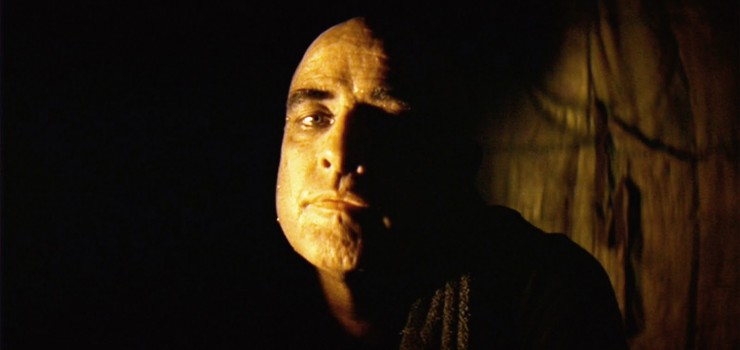
The film is famously a transposing of Joseph Conrad’s Heart of Darkness into Vietnam. Captain Willard (Martin Sheen) is ordered to head down the river to “terminate with extreme prejudice” rogue Special Forces Colonel Kurtz (Marlon Brando), who is conducting his own vigilante war. On the boat trip down the river, Willard encounters a host of increasingly bizarre and surreal scenes, from war-mad Colonel Kilgore (Robert Duvall) to a seemingly leaderless battle over a bridge, a playboy bunny show and a compound of ex-French colonials. And that’s before he even arrives at Kurtz’s compound and things get really strange.

Apocalypse Now is almost impossible to separate from the bizarre, tortuous route it took to get to the screen. Originally scheduled for a few months, the film took over a year to complete. A typhoon destroyed all the sets in the first two months. Original star Harvey Keitel was dismissed after a week (as his performance wasn’t right): his replacement, Martin Sheen, had a near-fatal heart-attack partway through filming. Marlon Brando not only turned up the size of a buffalo but refused to learn (or even speak) his lines. A year into production, the film had no ending. Coppola put his entire fortune up as collateral to complete the film. It was a nightmare.

But yet somehow what emerged has a sort of force-of-nature quality to it. Even though parts are basically pretentious rubbish, despite the fact I have twice fallen asleep in this film, despite the fact it is far from being a film that trades in complex ideas and offers profound insights, it still has a hypnotic quality about it. It’s done with a real force of commitment, a genuine labour of love, a film that doesn’t leave anything in the locker room but throws it all at the screen. The quality of what lands may sometimes be questionable, but the commitment with which it is thrown is beyond doubt.

And in a world of cookie-cutter films, it’s hard to have anything but respect and regard for a film that is so defiantly its own animal, that tells its story in its unique way. It’s perhaps one of the first “experience” films: no film could of course communicate what it was like to serve in Vietnam, but this film perhaps gets close to the surreal, drug-fuelled madness in that conflict.

Because Apocalypse Now is a very surreal film. Its plot is extremely thin, and each section of its (mammoth) runtime is all about experiencing another element of the American experience. In the commentary, Coppola talks about the river trip being partly a journey from the present into the past, a journey back not only into the history of the conflict (and its different stages) but also the regressing of mankind itself into a more primitive, malleable, basic state. It’s a big lump for a film to bite off – and I’m not sure if the idea really comes across without you knowing it. The real impression you get is of rules of society being left further and further behind.

The arrival at Kurtz’s compound is the fufillment of this increasingly unnerving story. We’ve seen the madness on the journey, the pointlessness, and the bemused, carefree confusion of the crew. But at the camp we get the overblown, decadent lunacy of Kurtz. Brando dominates the final 30 minutes of the film, although his monologues are meaningless drivel, the sort of intellectual point-scoring you could hear in a sixth form debating society. To be honest, iconic as Brando’s appearance is, his performance of mumbling battiness is actually a little awful (like one big practical joke from the actor) and the film’s momentum grinds to a halt while he babbles on. 

In fact, so self-indulgent is Brando that in a way it’s a sort of tribute to Coppola’s mastery of cinema that he makes this pompous character make any sense at all – or that he makes this sort of nonsense even remotely watchable. But again it’s the hypnotic pull of the film: Coppola builds towards a chilling, haunting final sequence of Willard and Kurtz’s final confrontation intercut with The Doors’ The End and the real-life slaughtering of an ox by a crowd of real-life villagers (they were going to kill the animal anyway but offered to do it for the camera). Coppola somehow turns all this into iconic cinema, even though, viewed objectively, it’s overblown, indulgent, pretentious rubbish.

The whole film is a testament to hewing compelling filmmaking out of breathtaking insanity. After the film departs in the boat, most of reason, sense and conventional story-telling depart with it. Information only gets conveyed through rambling monologues from Willard. The crew of the boat get into scraps that reflect heightened versions of the American experience in Vietnam – from a war crime as the crew shoot-up what turns out to be an innocent boat, to an attack from unseen tribesmen with spears from the mists of the shore. Sam Bottoms, as surfer-turned-GI Lance, is our guide of a sort here – as he gets more stoned, so narrative logic departs with his senses. 

What keeps the film going throughout is the masterful film-making. Coppola shoots the bizarreness with brilliant, visionary imagination. As a social theorist he’s pretty basic – man is, by the way, a savage animal and the Americans didn’t know what they were getting themselves into in ‘Nam – but as a film-maker he’s one of the best. Who else could have made three hours of episodic boat journeys so strangely compelling? The film is crammed full of great scenes and moments which rarely feel like they tie together – in fact, they could almost be watched in any order – and there is barely a character in there, but the film feels like its throwing you into the madness of Vietnam. 

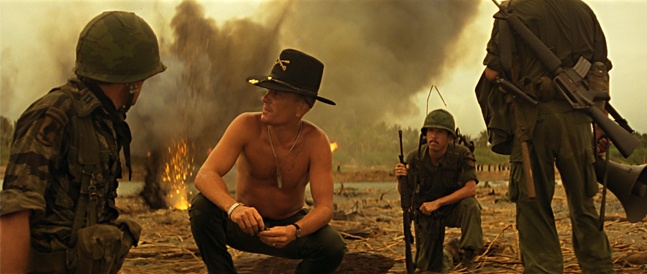
Even the sequence with a bit more narrative is still laced with absurdity. Kilgore’s helicopter assault on a village – and its use of Wagner blaring from helicopters to scare the Vietcong – is justly famous. This is a bravura film-making – and as much a tribute to the astoundingly amazing editing and sound work of Walter Murch as it is the photography of Coppola. Like most of the rest of the film it is visually outstanding, but it also has the film’s best writing (in the quotable but also strangely subtle characterisation of Kilgore) and also the film’s most iconic performance in Robert Duvall. Duvall is terrific as the war-loving, but strangely childish Kilgore, obsessed with surfing and with an ability to live totally in the moment. 

This sequence doesn’t hesitate in showing both the brutality of war – and also the insanity of our commanders. Kilgore is genuinely dreading the end of the war, and you can see why he would since he is clearly having a whale of a time bombing places. Kilgore is a lovable, quotable badass doing what needs to be done – but the film doesn’t forgot that he is also an insane soldier with no off-switch. And Apocalypse Now never really glamourises war, for all the excitement and beauty of watching those helicopters come over the horizon.

It’s the artistry in its film-making, and the genuine effort and work that helps make it a demented classic. Walter Murch’s sound design and editing is possibly flawless – this might be the best edited and sound designed movie ever – from the opening moment when the helicopter blade sounds transform into a hotel room fan you know you are seeing something special. Scenes such as Willard’s hotel-room breakdown hum with intensity as they feel genuinely real – that scene in particular feels like Martin Sheen exposing part of his tortured psyche at the time. Sheen is by the way perfect as Willard, a slightly unknowable killer with dead eyes and a dead soul, still aware of the vileness of his world.

Apocalypse Now is a sprawling batty film – and in many ways an intellectually empty one straining at a depth that ain’t there. But somehow, for all that, it still is a masterpiece. Which is in itself a bit of a miracle as it really should be a disaster. It’s pretentious. It’s overlong. It’s very full of its own importance as a work of art (the re-insertion of the long-winded political discussion at the French Plantation into the Redux version doesn’t help). Some of its performances are plain ridiculous, verging in Brando’s case on outright bad. But yet, it’s delivered with such force of conviction, it’s so wonderfully assembled, so hauntingly shot and edited, that it hammers itself into your brain. You literally can’t forget it, for all its many, many flaws. Despite yourself, you find yourself forgiving it an awful lot – a lot more than you might expect. A mess, but also a classic.

Greystoke: The Legend of Tarzan, Lord of the Apes (1984)

Christopher Lambert is the lord of the apes in dull Tarzan epic Greystoke

Director: Hugh Hudson

Cast: Christopher Lambert (John Clayton), Ralph Richardson (Earl of Greystroke), Ian Holm (Capitaine Fyllieppe d’Arnot), James Fox (Lord Charles Esker), Andie MacDowell (Jane Porter), Cheryl Campbell (Lady Clayton), Ian Charleson (Jeffson Brown), Nigel Davenport (Major Jack Downing), Nicholas Farrell (Sir Hugh Belcher), Paul Geoffrey (John Clayton Snr), Richard Griffiths (Captain Billings), Hilton McRae (Willy), David Suchet (Buller), John Wells (Sir Evelyn Blount)

For his follow-up to Chariots of Fire, Hugh Hudson settled on this curious mess: part heavy-handed exploration of class and the brutality of man, part picturesque jungle picture with people in ape costumes. If anyone remembers Greystroke today, it’s for an interesting bit of trivia: original director and writer Robert Towne was so annoyed at being removed from the project, he used his dog’s name as his screenwriting credit. When the Oscar nominations were announced, this pooch became the first four-legged Oscar nominee. Strangely fitting for a film about the nobility of animals.

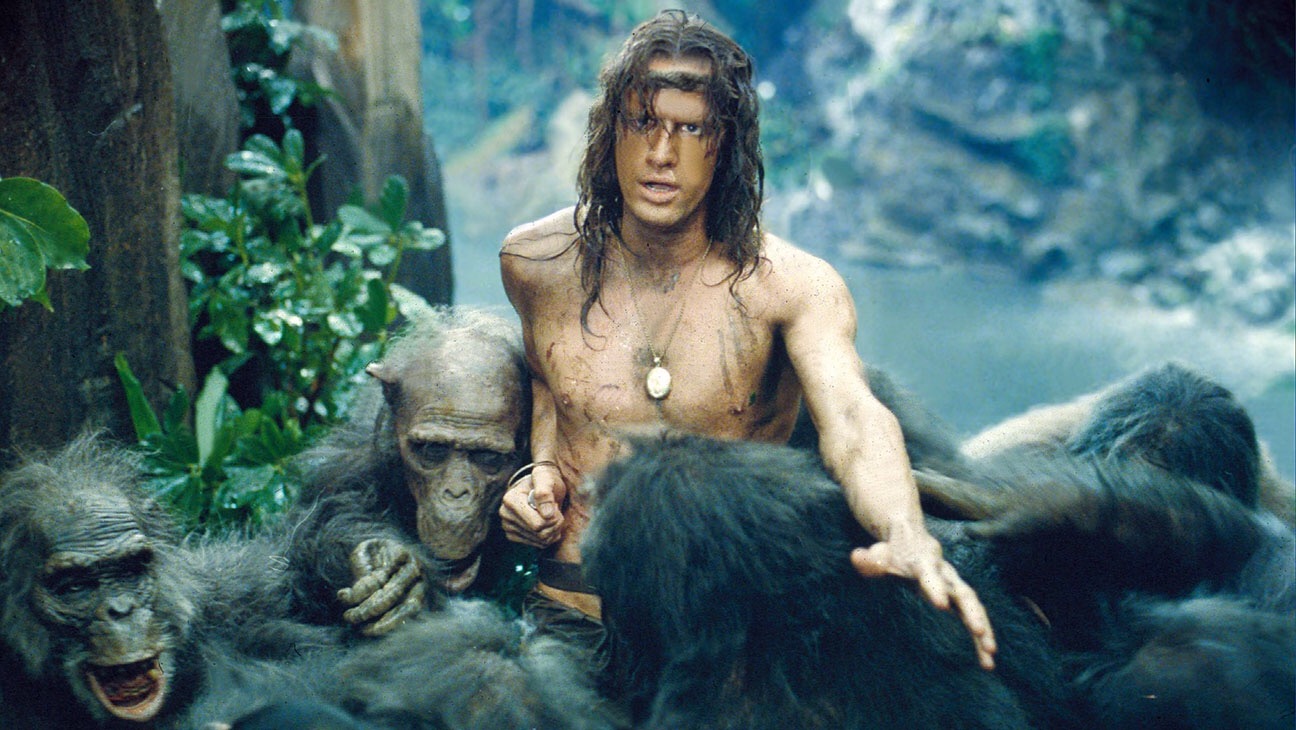
The film is a “real life” version of the Tarzan story. What this basically means is that it is dry and boring with a ponderous self-important message about how the real animal is in man (or something like that). It also of course means that the word “Tarzan” isn’t used except in the title (presumably so that audiences could be lured into the cinema). Anyway, after his parents are shipwrecked off the jungle coast, and die after young John Clayton’s (Christopher Lambert) birth, he is raised by gorillas and becomes one of the leaders of the pack. When a troupe of gung-ho explorers are slaughtered by natives, the only survivor is Belgian Fyllieppe d’Arnot (Ian Holm). Rescued by John, d’Arnot teaches him language and takes him home to the estate of his grandfather the Earl of Greystoke (Ralph Richardson), who is desperate for an heir. But can John adjust to the jungle of the modern world?

So Greystoke is well filmed, looks good and has a couple of decent performances in it. But it’s a dull mess as a film. Watching it you suspect a lot of the runtime ended up on the cutting room floor. There are sudden time jumps. Characters appear and disappear, many serving no real purpose. The film drifts towards a conclusion that neither seems enlightening nor serves any real cathartic summation of what the film might be about. There are many, many lovely shots of the jungle and Scottish countryside, but we never really end up caring about any of the characters within it.

The film is thematically a mess from start to finish. It seems to be making a point about John being totally unsuited, by his upbringing, to adjusting to the world of man. But it never really gives a proper voice to John himself. Of course he’s only just learning language, but even without that you never really feel like you begin to understand him, or get a sense of half-remembered human traits emerging from his ape upbringing. Basically you don’t get a sense of conflict within him as to whether he should stay or go. Without that conflict, there isn’t really much interest in watching him work out the answer.

This is despite the fact the Christopher Lambert is actually pretty good as John Clayton. The role plays to his strengths: it’s highly physical (not just in the acts of athleticism but also in its half-man, half-ape physicality). Lambert also has this rather fine other-worldly quality that constantly leaves him looking a bit lost and vulnerable. The part may be underwritten but he is certainly doing his very best here, and he really does a brilliant job of playing an ape trapped in man’s body.

It’s a shame that the film takes so long to get going that he doesn’t really appear for the first half an hour or so. Instead we get a lot of ape-based action in the forest – and probably too much of his parents. Later in the film, the camera makes a point of returning two or three times to a large painting of Cheryl Campbell as John’s mother – but the film never suggests any link at all between these two characters. A lot of time is wasted setting up the parents’ voyage, while at the same time no time is spent on establishing any emotional link between the Claytons and their son.

Far more time is spent on the apes – which I suppose is the point of a film that wants to celebrate the purity of the world of animals over the corruption of man. Rick Baker’s ape make-up is pretty impressive for the time – and works really well in longshot – but in close-up is all too obviously a series of performers in masks. There is a sense of their natures, but not of them as dangerous or wild animals. In fact the film goes overboard in humanising them – even to the extent of giving them their own language of grunts and groans.

The ape stuff goes on too long – and then means the return to civilisation seems rushed and unclear. Ian Holm is excellent as d’Arnot, the bridge between the two worlds, and his fatherly love for John works extremely well. But the film makes no attempt to tackle the questions it raises of John dealing with his split animal-human relationship. Instead the film loads the decks by making almost every human character – epitomised by James Fox’s flat performance as Jane’s toff fiancée – a heartless uncaring moron.

Ah yes Jane. Played with an openness by Andie MacDowell, she’s dubbed in a painfully obvious way by an uncredited Glenn Close. This is another underwhelming relationship that seems skimmed over – one moment they have just met, the next they seem on the verge of a great love. It’s as rushed and slapdash as the introduction of a mentally handicapped servant – of course, with his childish outlook, he is closer to John than anyone could be – who literally appears out of nowhere.

The film was also Ralph Richardson’s final role – he died shortly after completing it – and his barmy Earl of Greystroke (part lonely old man, part semi-senile eccentric) does lift the film with a certain energy (he was posthumously Oscar nominated). But it’s an easy role for Richardson – and in fact his eccentric, hard-to-define energy kind of sums up the whole messy film pretty well. His character’s death is the final nail in its interest, his eccentric energy sorely missed.

The most damaging thing about Greystoke is it is dull and obvious. Pretty scenery and decent performances can only cover so much when the plot is empty and predictable. The film feels cut down absurdly – half the cast of Chariots appear in roles so tiny you wonder why they bothered – and by the time the film drifts towards its conclusion you’ll probably have stopped caring about what it was all about in the first place. It tries to ask questions about man’s nature, but it doesn’t even seem to notice it never answers them. A poor film.

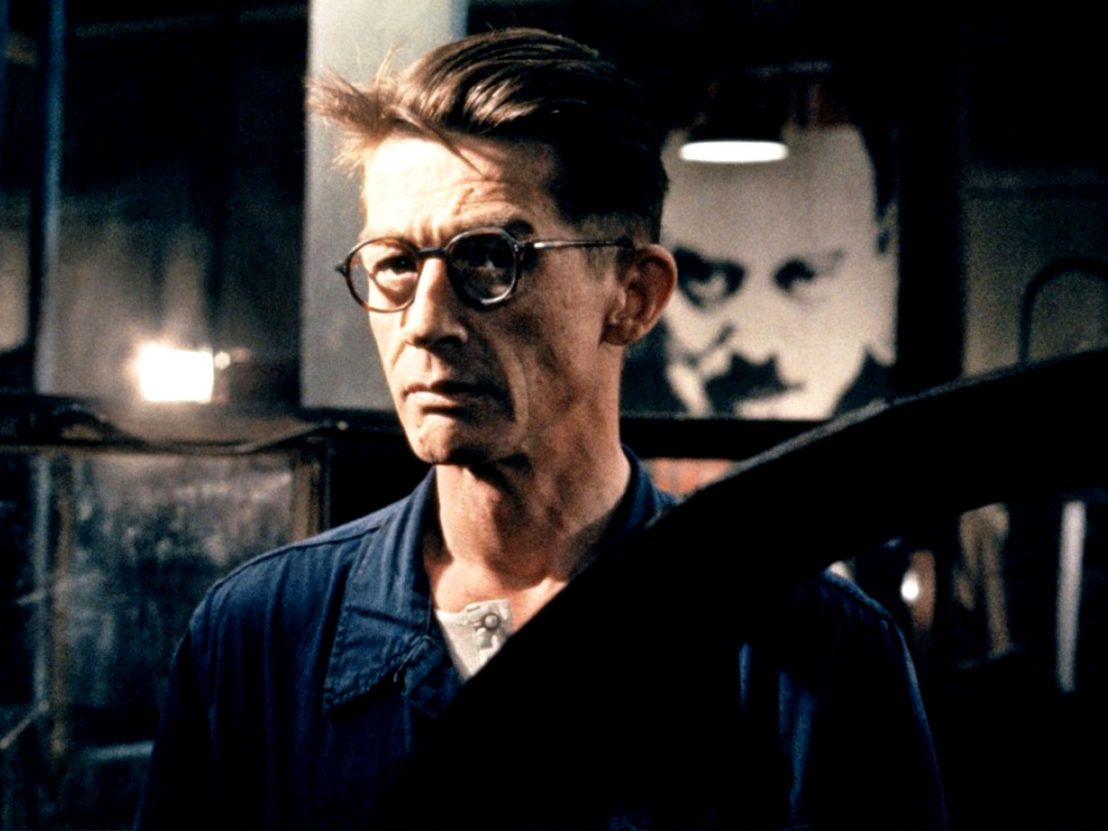
1984 (1984)


John Hurt is simply perfect as Winston Smith, in Michael Radford’s faithful Orwell adaptation 1984

Director: Michael Radford

Cast: John Hurt (Winston Smith), Richard Burton (O’Brien), Suzanna Hamilton (Julia), Cyril Cusack (Mr Charrington), Gregor Fisher (Parsons), James Walker (Syme), Andrew Wilde (Tillotson), Phyllis Logan (Announcer)

Few novels of the 20th century have had such a far-ranging impact as George Orwell’s 1984. Its concepts and ideas have dominated the popular language around topics from politics to reality television. Orwell’s idea of a dystopia, ruled by a controlling government, has inspired virtually every other story in a similar setting since. Hell, Orwellian is now an actual word.

Michael Radford had dreamed for years of bringing a film version of Orwell’s last masterpiece to the screen. This film is the end-result, shot (as it proudly announces at the end) in the exact times and locations the original novel was set in. Radford has created a hugely faithful adaptation that strains at the leash to cover all the complex political, philosophical and personal questions Orwell’s novel explores. From the opening sequence, expertly recreating the books “Two-minute-hate”, it’s immediately clear that Radford knows (and loves) this book.

Winston Smith (John Hurt) is a party worker in Oceania (a sort of super country consisting of North America, Britain and Ireland), whose role is to edit and adjust the historical records to ensure that everything the ruling Party has ever said was always accurate and correct. Unpeople are removed from old newspaper cuttings, economic targets are edited to match the final results. In his heart he has sincere doubts about the system and yearns for freedom – but it is not until a chance meeting with Julia (Suzanna Hamilton) that he finds a way to express his individuality through their love affair. But what does Inner Party member O’Brien (Richard Burton) have planned for him?

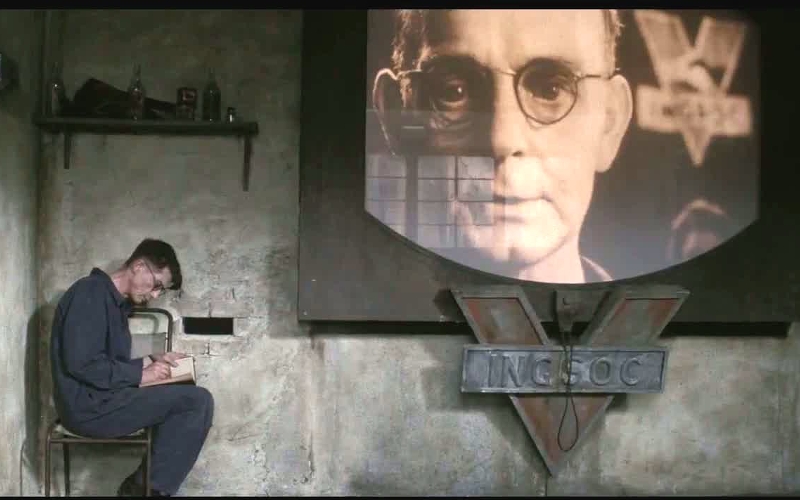
Radford’s film is a marvel of design. Its look and feel could have been ripped from the pages of Orwell. Today we’d call it almost steam-punk – every piece of technology is made of antiquated and repurposed pieces of equipment (such as phone dials or computer screens) that have a rusty, poorly maintained feeling that immediately communicates the run-down crapsack world the film is set in. Every building seems to be crumbling, collapsing, poorly made, unpleasant, dirty – every street is littered with wreckage. Who on earth would want to live anywhere like this?

The oppression of the design – all dark blues, greys, blacks and crumbling stone and rusty metal – is contrasted at key points. The (relative) opulence of O’Brien’s apartment – with actual comfortable chairs, plastered and painted walls and decent furniture – really stands out (as does Burton’s well-tailored boiler suit compared to the uncomfortable rags of the others). Roger Deakin’s photography also really mixes up the grime of London with the sweeping vistas of the countryside, the only place we see greens or brighter blues. 

Radford’s adaptation of the novel manages to hit every beat from the original. I’m not sure if it is quite accessible to someone who hasn’t read the novel: there is a lot of information only briefly communicated here, and the film makes no real effort to set up or establish the situation in Oceania. Some moments work a lot better if you know the book – the nature of Winston’s job most especially. However, Radford really captures the spirit of the original – and he really understands the contrasts in the book between its gloom and oppression and the free spirit of Julia, and what their love affair represents to Winston. 

The film contains a lot of nudity in these scenes (Suzanna Hamilton does full frontal several times –John Hurt’s bottom similarly appears a fair bit) – but it’s kind of vital. The characters are literally (and figuratively) laying themselves bare. It’s a clear visual sign of how they are rejecting the rules, systems and crushing control of the state itself. Alone they can shed the burden of being controlled and truly be themselves. It’s one of the few films where extensive nudity actually feels completely essential to the plot – and vital to communicating the character’s desire for openness.

Radford also draws some neat (inferred) visual parallels from the material of the book, most notably around Winston’s fear of rats. In the book, this visceral fear is never fully explored, but here in the film Radford has Winston plagued with dreams and flashbacks of stealing chocolate as a child from his starving mother – and returning to an empty room full of rats. Rats are linked in Winston’s mind with betrayal and inhumanity, the very qualities he most fears in the real world – and the impact of these animals psychologically on Winston seems all the more clear.

The film is further helped by the casting of John Hurt as Winston Smith. If ever an actor was born to play this role, it was John Hurt. Not only does Hunt’s gaunt face, emaciated frame and pale cragginess fit perfectly (he also looks a lot like Orwell), but Hurt’s gift as an actor was his empathy for suffering. His finest parts were people who undergo great loss and torment, so Winston Smith was perfect. He gives the role a great deal of damaged humanity, a naïve dream-like yearning, a desire for something he can barely understand. There’s a real gentleness to him, a vulnerability – and it makes Winston Smith hugely moving.

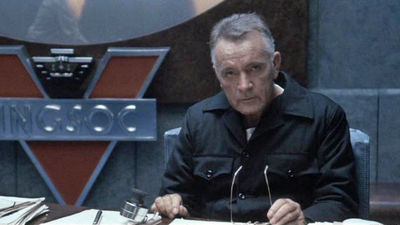
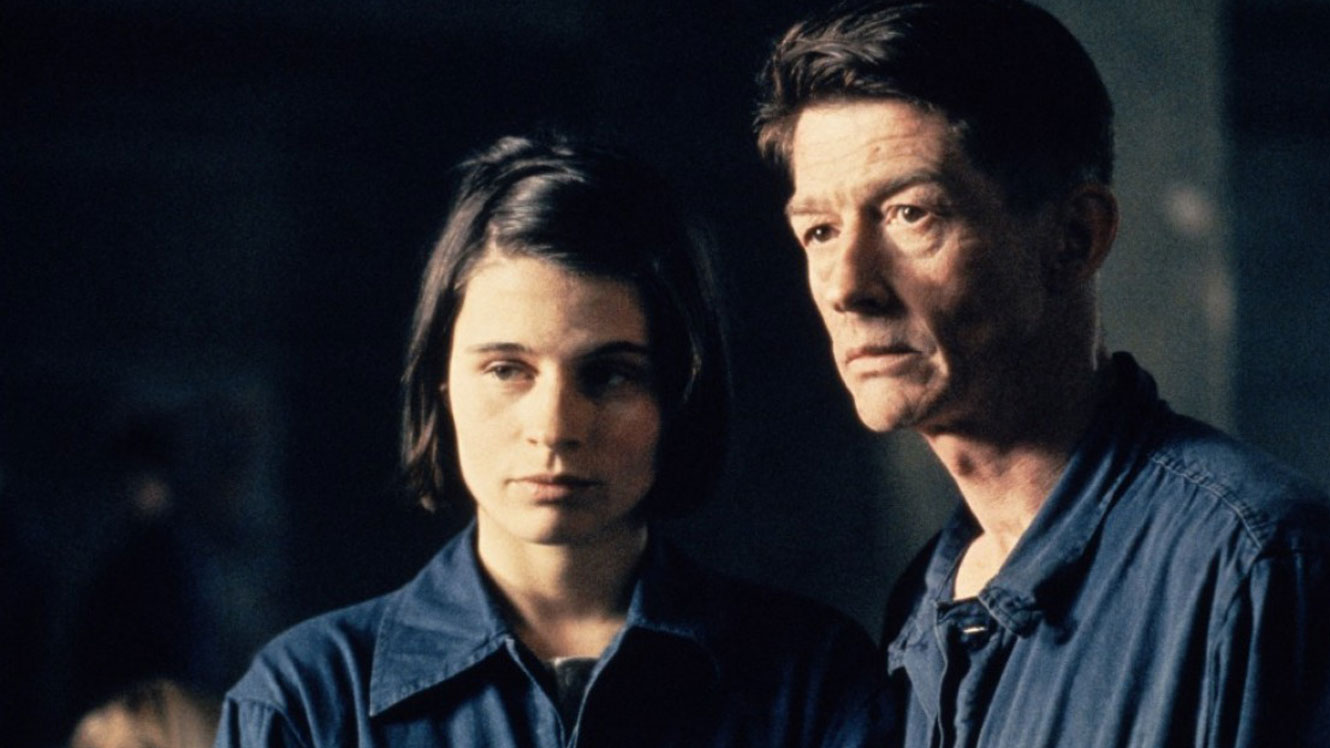
Suzanna Hamilton (in a break-out role) is a great contrast, as a confident, controlled, brave Julia – again there is something tomboyish about her that really works for the part. She’s both certain about what she is doing, but also unwise and naïve. It’s a shame her performance often gets overlooked behind Hurt and Richard Burton. This was Burton’s final film – and while he clearly looks frail, he gives O’Brien all the imposing authority of the melodious voice: you could believe Burton as both a secret rebel and as the face of the state. He’s really good here, hugely menacing and sinister.

1984 is perhaps one of the most faithful and lovingly assembled tributes to its source material you can imagine. In fact that’s the root of its two biggest flaws. Radford had an electronic score by the Eurythmics imposed upon the film (the band was unaware that Dominic Muldowney had spent almost a year working on a score rejected by the producers). This electronic, slightly popish soundtrack feels completely out of whack with the tone and style of the rest of the film. It’s very 1980s electronic tone doesn’t match the novel and it looks even worse today. That’s the danger when your passion project can only get finance from a record company!

The other problem is the film is very much an adaptation: wonderfully done, brilliantly designed and acted, but it exists best as a companion piece. In fact the full enjoyment of the film pretty much relies on having read the book – and it has virtually no appeal to someone who didn’t already know the book (even the 2-minute hate that opens the film isn’t explained). Historically I think the film is very easy to overlook as it came out at a very similar time to Terry Gilliam’s Brazil. Brazil doesn’t adapt the plot of Orwell’s book – but in all other senses it’s an adaptation of the heart of that novel, told with greater artistry and imagination than here. It’s a thematic adaptation that is its own beast not just a page-to-screen version. That’s what 1984 is and, however well done, it will always be in the shadow of the original.

Radford’s labour of love is still a very good film. Somehow what was pretty bleak on the page is even more traumatising on screen. A lot of this is due to Radford’s balance between oppression and freedom, and the film’s perfect adaptation of the book’s themes. But a lot of it is due to Hurt’s heartfelt, sympathetic and perfect performance in the lead role. Literally no-one else could have played this role: and from the opening shots of him at a party rally, through scenes of love, torture and traumatised aftermath, he’s simply wonderful. Read the book: but once you do enjoy (if you can!) the film.

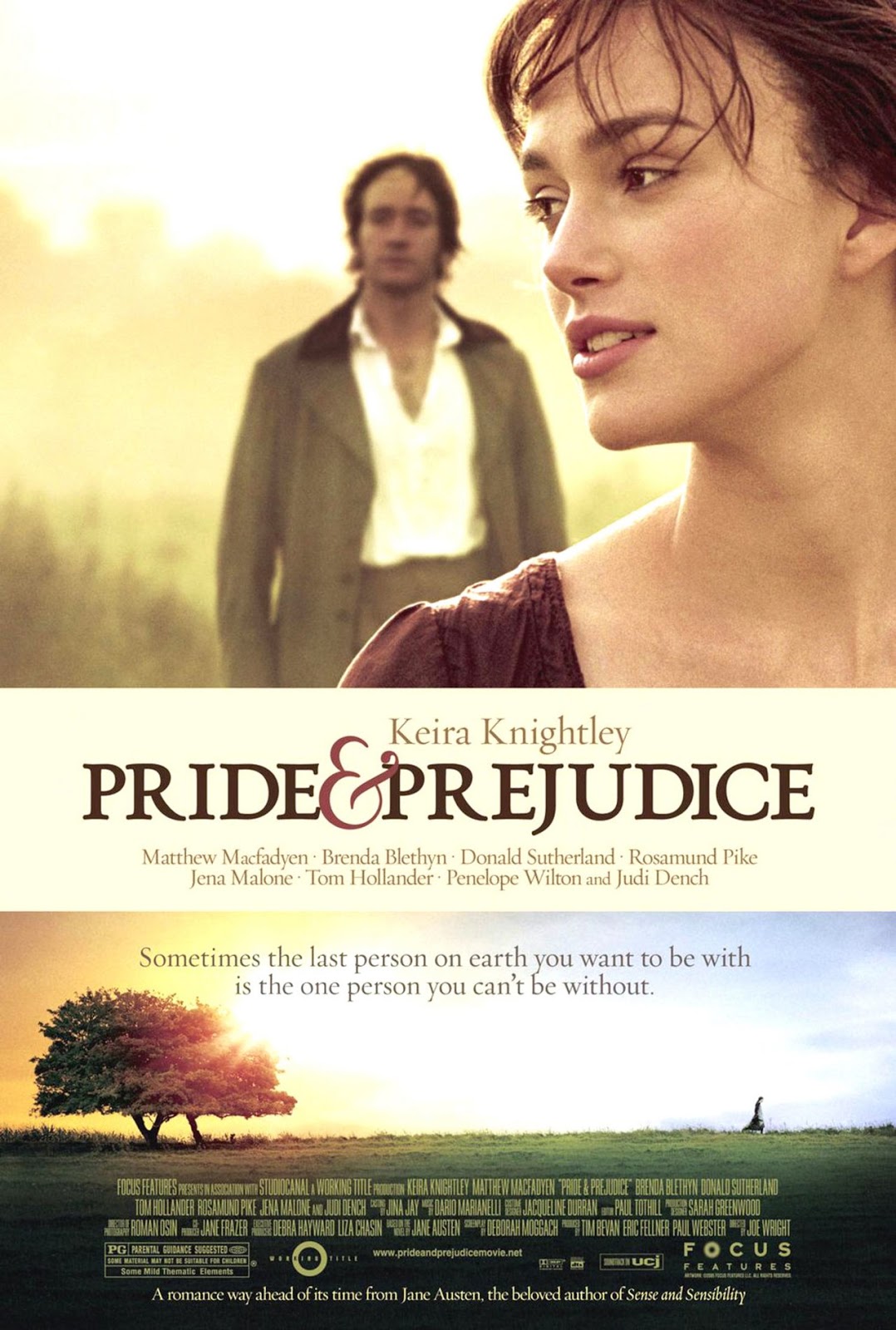
Pride and Prejudice (2005)


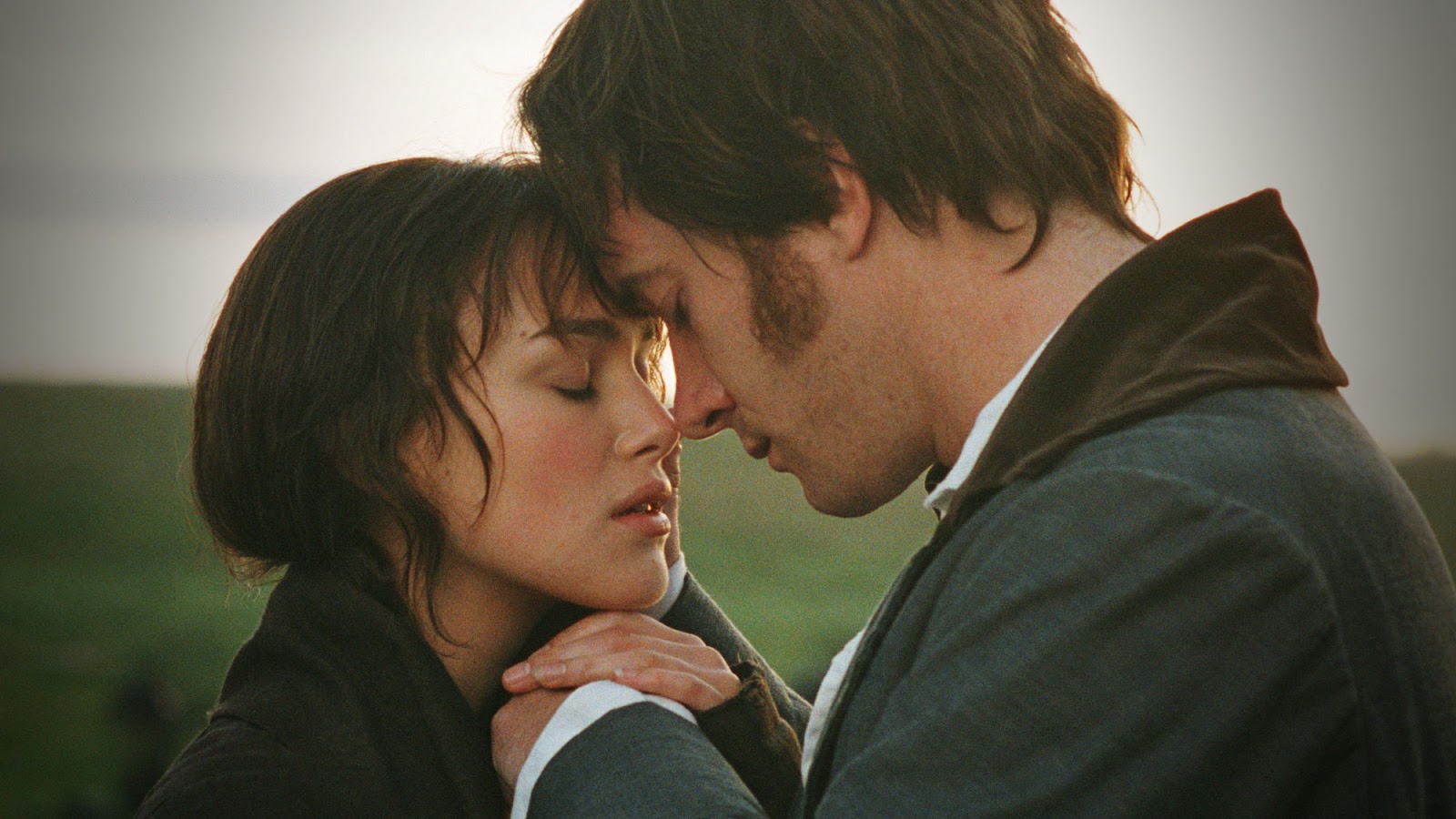
Keira Knightley and Matthew Macfadyen are drowned in the shadow of the BBC adaptation of Pride and Prejudice

Director: Joe Wright

Cast: Keira Knightley (Elizabeth Bennet), Matthew Macfadyen (Mr Darcy), Brenda Blethyn (Mrs Bennet), Donald Sutherland (Mr Bennet), Tom Hollander (Mr Collins), Rosamund Pike (Jane Bennet), Carey Mulligan (Kitty Bennet), Jena Malone (Lydia Bennet), Talulah Riley (Mary Bennet), Judi Dench (Lady Catherine de Bourgh), Simon Woods (Mr Bingley), Tamzin Merchant (Georgiana Darcy), Claudie Blakely (Charlotte Lucas), Kelly Reilly (Caroline Bingley), Rupert Friend (Mr Wickham), Penelope Wilton (Mrs Gardner), Peter Wight (Mr Gardiner)

I’ve written before about certain books having been adapted so successfully there feels very little point rolling out another. If ever an adaptation set this principle, it’s the 1995 BBC adaptation of Pride and Prejudice. Not only did it perfectly capture the spirit and style of the book, with perfect scripting and direction, but the two lead actors – Jennifer Ehle and especially Colin Firth – were simply perfect (for all his achievements, the first line of Firth’s obituary will forever be “Darcy Dies”.)

So Joe Wright and his team were already climbing a mountain when they announced plans to make a new adaptation of Jane Austen’s most beloved novel. What they’ve produced in the end is a well-made, handsomely mounted film full of visual invention – that has been pretty much rejected by nearly everyone I know who loves Austen. It’s a film that, in attempting to plough its own furlough, has ended up not really pleasing anyone: for the casual viewer it’s an entertaining but forgettable watch. For the Austen fan it’s just plain not right.

Structurally the film places Elizabeth’s relationship with Darcy slap bang at the centre, and has little to no interest in anything else. This leads to major themes and relationships being neglected or outright abandoned in some bizarre cut choices. The film wants to front-and-centre Lizzy’s increasing isolation – so Jane is dispatched from the film for almost over an hour. Even more oddly, Wickham is cut down to a few spare scenes – which makes her passionate sympathy for him and anger against Darcy make very little sense. All this isolation also means we never really understand the social implications and importance of marriage – in fact the whole thing is basically turned into a Cinderella romance: Rich Man Meets Poor Girl (And No One Else Matters). 

Which means a lot of the focus for the film lands on Keira Knightley. Is there a more controversial actor in film than Knightley? Oscar-nominated for the role, among my Austen-loving friends I have found only revulsion against her performance. She plays it with spirit but too much of a modern sensibility. She’s fine, but she’s just not convincing: she doesn’t look like her, she doesn’t have her warmth and wit and seems more like she’s wandered in from some sort of “flirty girls” comedy. Nothing really communicates the character’s intelligence and wit – and Knightley probably looks a little too modern for the whole thing to work. 

On top of that the film doesn’t want her to be too unsympathetic at any point, so dials down her judgemental nature, and also reduces any possibility of us judging her partiality for Wickham by mostly removing him from the film. However, this also removes many of the obstacles from the plot that stand in the way of romance.

Matthew MacFadyen does a decent job as “Nice Guy In A Period Drama”, but the character is just wrong for Darcy. Like Lizzy’s tendency to rush to judgement, Darcy’s apparent coldness and snobbery have been watered down to almost invisibility. His first announcement of love is so genuine, so gentle, so loving that you are amazed that Elizabeth dismisses him out of hand. It’s no surprise this Darcy turns out to be a decent bloke, the edges of the character have been completely shaved off. This puts a big old dent in the plot, reduces his character development, and ruins the impact of sweet later moments like Darcy’s uncertainty when the two meet at Pemberley. 

There are some good performances though. Tom Hollander is very funny as a social-climbing Mr Collins. Donald Sutherland gets so much warmth and twinkly good humour out of Mr Bennet that Wright even ends the film on him (another odd choice, but never mind). Judi Dench could play Lady Catherine standing on her head. Rosamund Pike is rather good as Jane – she totally feels right for the period. Brenda Blethyn largely manages to avoid turning Mrs Bennet into a complete stereotype. Saying that, Simon Woods portrays a version of Bingley so bumbling, tittering and awkward you are amazed either Jane or Darcy could be interested in him, let alone bear to spend time with him.

But then large chunks of the film feel odd. The screenplay works overtime to turn the film into a straight-forward star-crossed lovers story: so it’s Darcy and Elizabeth all the way, and the film is desperate to make them both likeable from the off. And if that means that, in a film called Pride and Prejudice, both the pride and the prejudice have to be junked to make sure even the stupidest audience member will like the hero and heroine, well that’s apparently a price worth paying. Lowering the Bennets’ social status as far as the film does, also turns the story into a full-on Cinderella territory. Darcy and Bingley are so posh an entire room falls silent when they walk in – in comparison the Bennets are so poor they share their house with pigs.

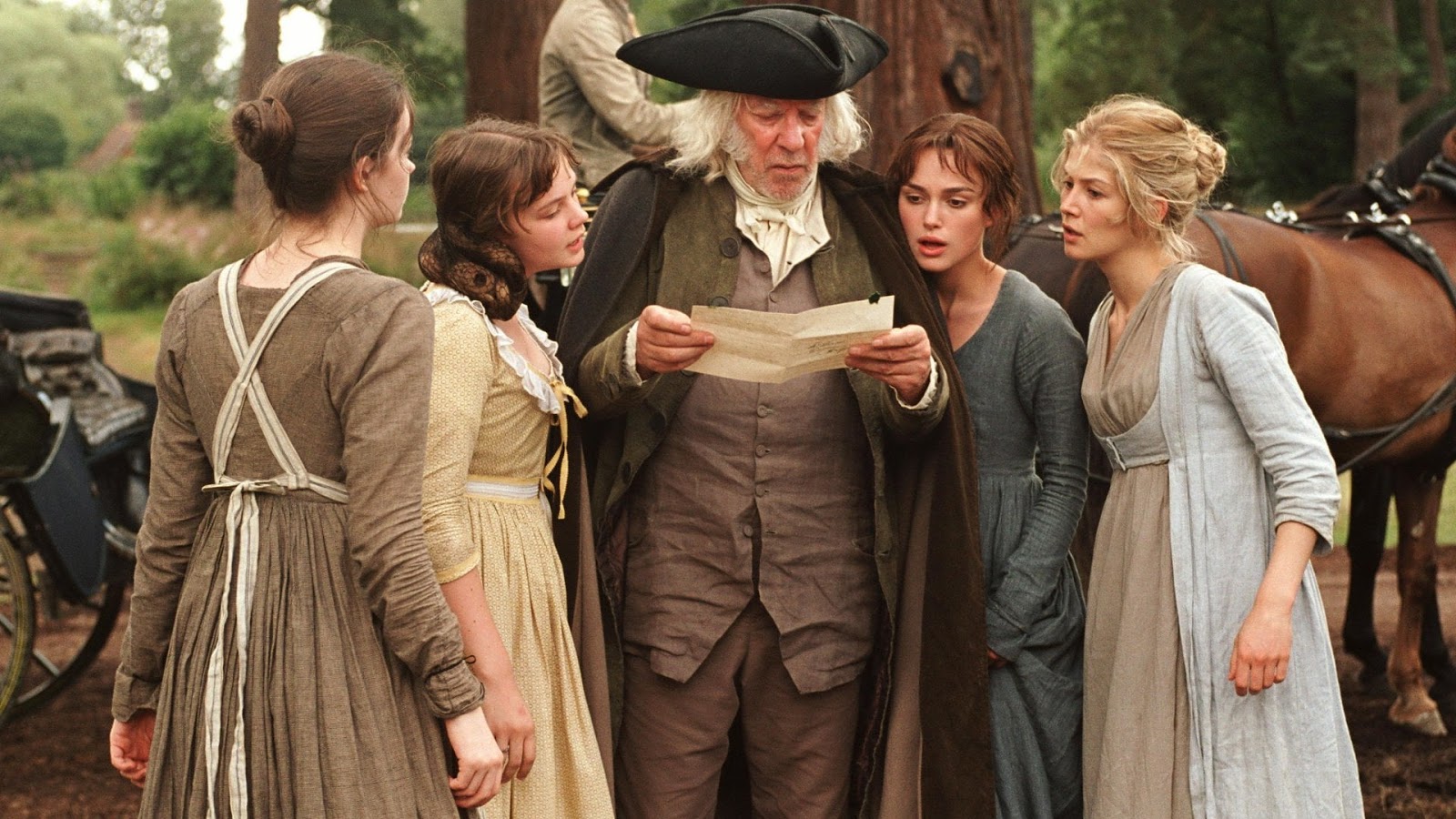
Ah yes the pigs. Why? The Bennets aren’t paupers. If they were, why would Collins want the place? Why would they be invited to the ball? Why would Bingley and Darcy even consider them as partners? Why would a family so aware of impressions have a home that is literallyfull of shit all the time? Why is Mr Bennet scruffy and unshaven – and why doesn’t anyone care? Who designed this? If the Bennets are so fixated on getting good marriages why do they literally live in a pig sty? It’s a visual idea that undermines the whole story.

I’m not joking. Here is a pig walking through the Bennet house.

It’s full of things like this that don’t feel right. The film junks most of the language of the original book, which makes it sound jarring (it even re-works Darcy’s first proposal: “in vain I have struggled, it will not do…” – large numbers of Austen lovers I know can recite those lines verbatim. This film apparently thought it could create a better version. It couldn’t). Large chunks of the film happen in the rain like some sort of version of Wuthering Heights. Why is that? Is it because professions of love in the rain are romantic in a Mills and Boonish sort of way? Or is it an echo back to Firth’s wet shirt?

Emma Thompson’s sublime adaptation of Sense and Sensibility demonstrated that it is completely possible to adapt an Austen novel into a two-hour film and still preserve the characters, relationships, major events and themes of the book, while also making a story that stands on its own two feet for non-Austen-ites. This film bungles its attempt to do the same. 

But there are things Wright gets right. The camera work and transitions are lovely. A long tracking shot that weaves in and around the ball early in the film, taking in every single character is not only a technical marvel but really gets across a feeling of what these hectic and bustling social events are like. There is a beautiful time transition at Longbourn, as Elizabeth rotates on a screen and the camera takes on a POV shot, showing the seasons changing each time the camera revolves around through 180 degrees. The cinematography is luscious and Wright – his first film – shows he was more than ready for the step-up from TV.

It’s just a shame that the film they made doesn’t quite work. It doesn’t capture the sense of the book. It doesn’t capture the sense of the characters. It makes bizarre and just plain wrong choices. It’s a decent film, but it is not a good adaptation of the novel. And that’s a major problem, because if you are going to adapt something as widely loved and revered as this, you better bloody well understand the novel – and I don’t think enough people here did. It’s told with a sweeping romantic style – but they are adapting the perception of Pride and Prejudice rather than the actual story. The chemistry and romance aren’t there: the film even ends with an odd sequence of Sutherland and Knightley, probably because there was better chemistry between these two than the two leads. It’s a film that basically doesn’t work at all.

Excalibur (1981)


Nigel Terry gets a special gift in John Boorman’s crazily OTT Arthurian epic Excalibur

Director: John Boorman

Cast: Nigel Terry (King Arthur), Nicol Williamson (Merlin), Helen Mirren (Morgana Le Fay), Nicholas Clay (Sir Lancelot), Cherie Lunghi (Guenevere), Paul Geoffrey (Sir Perceval), Gabriel Byrne (King Uther Pendragon), Corin Redgrave (Duke of Cornwall), Patrick Stewart (King Leondegrance), Keith Buckley (Sir Uryens), Clive Swift (Sir Ector), Liam Neeson (Sir Gawain), Robert Addie (Mordred), Niall O’Brien (Sir Kay), Ciarán Hinds (King Lot), Charley Boorman (Young Mordred), Katrine Boorman (Igrayne)

John Boorman had wanted to make a film about King Arthur for over a decade, but it only came into being after his plans for an adaptation of The Lord of the Rings fell through (the suits were convinced the film couldn’t be a hit – good call). So, with a lot of prep work for Tolkien in place, Boorman moved a lot of his ideas for LOTR over to Excalibur. In doing so he created something probably truly unique – a bonkers version of the Arthurian legend, so consistently Wagnerian (often literally), high-falutin’ and overblown that it has a strange integrity in its operatic silliness.

The film begins with Arthur’s conception, a result of King Uther’s (Gabriel Byrne) lust for his ally’s wife, Igrayne (the director’s daughter Katrine). Merlin (Nicol Williamson) agrees to magically disguise Uther as Igrayne’s husband for one night, and in return spirits away the resulting child to be reared ignorant of his heritage. Years later, with a leaderless kingdom in chaos, Arthur (Nigel Terry) draws the magical sword Excalibur from the stone, and proves himself as king. He marries Guenevere (Cherie Lunghi) and brings Sir Lancelot (Nicholas Clay) to Camelot – oblivious of their love for each other. Slowly this love destroys the peace of the land – encouraged by the schemes of Arthur’s vengeful half-sister Morgana (Helen Mirren).

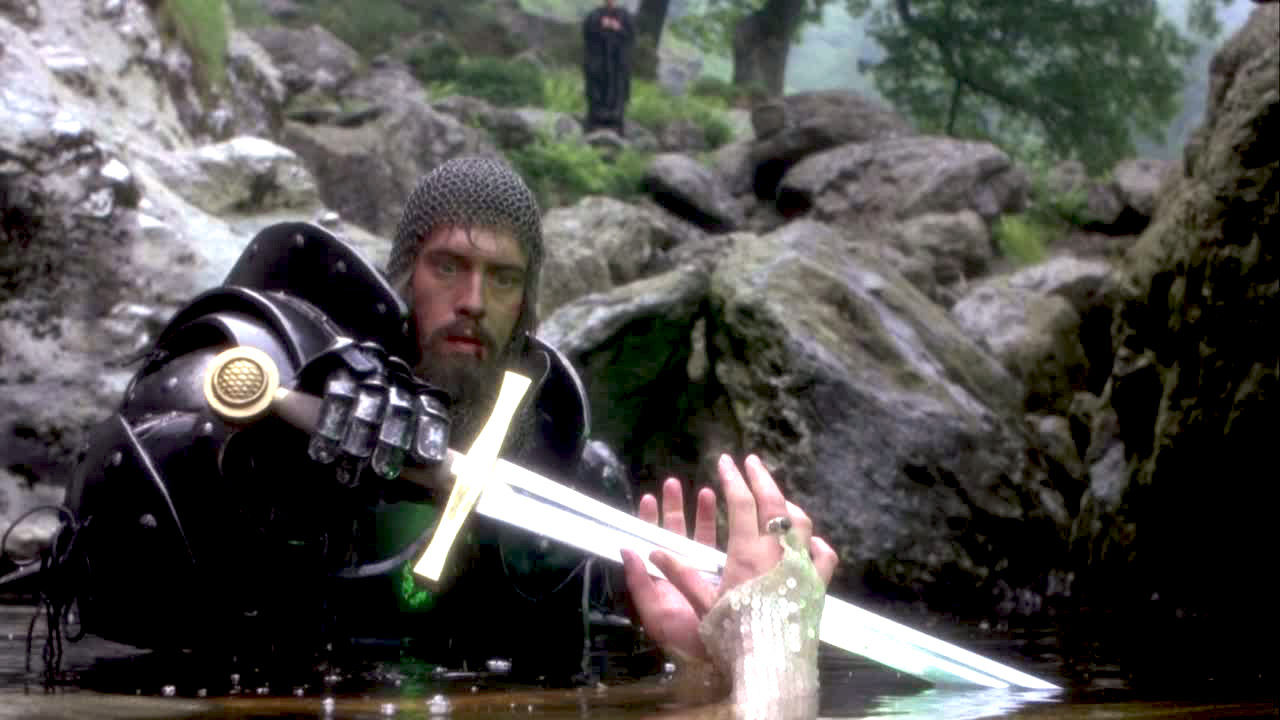
Excalibur is a film set in a completely heightened middle-ages dreamworld, as if it’s a series of drawings from an illustrated edition of King Arthur brought to life. The design of the film is dialled up to eleven: the armour the characters wear is ridiculously elaborate, shiny and eye catching. The characters never seem to take it off: Uther even has sex wearing it (poor Igrayne is completely naked – that can’t have been comfortable for her). Full armour is worn at meals, wedding, social events, everything: at the same time it’s brilliantly ineffective, punctured with ease by axes and spears.

The rest of the design of the film is equally overblown. Camelot seems to have been literally made from silver and gold. Lancelot kips in the forest and sleeps in the nude. Battle scenes are filmed on moody, misty nights, with horses and knights riding with insane riskiness at each other. Excalibur itself is almost impossibly shiny and unblemished and occasionally glows green. Everything has a high-artistic feel to it, like a Romantic painting. Nothing looks real – it uses a “rule of cool” aesthetic, anything that looks good from anything approaching medievalism is used.

The acting itself follows this operatic style. Half the dialogue is delivered shouting: Patrick Stewart in particular must have lost his voice while filming this one. Filmed in Ireland (it practically kickstarted the Irish film industry), many Irish actors got their first film break here, not least Gabriel Byrne (a furiously lusty Uther), Liam Neeson (a drunken oafish Gawain) and Ciarán Hinds (growling in the background). Each roars through their dialogue, perhaps none more so than Corin Redgrave who screams his with such flemmy passion it’s often hard to work out what exactly he’s saying. 

There are quieter moments from the three leads, even if all three of them don’t really have the charisma to impose themselves on sketchily drawn characters. Cherie Lunghi adopts an odd, part-time Irish accent as a bland Guenevere. Nicholas Clay is an upright Lancelot who simmers with guilt but is just a wee bit dull. Nigel Terry’s performance as Arthur (from young yokel to tortured king) gets better the more times I see it, but it lacks a certain star quality. But then in Boorman’s design, these three characters are just tools of fate rather than real characters – and the film has so much story to cover it often has very little time for character development.

The real stars of this film are Nicol Williamson and Helen Mirren. The two actors had a long-standing animosity – Boorman deliberately cast them to get an extra spark out of their scenes. But both actors seize their colourful characters – and have the time to add some depth to their bombastic, larger-than-life moments. Mirren gets to express bitterness and fury under simmering sexuality, as well as a genuine love for her son. Williamson is fantastic: playful, half nutty professor, half vengeful force of mystic power, he turns Merlin into an eccentric but somehow sinister old man. Williamson finds bizarro and unique line readings of even the simplest lines, stretching the material in the way only a really great actor can. He’s such an electric and interesting character, that he makes a performance that’s basically well over the top, hugely enjoyable and also even rather sweet.

As such, Williamson is perfect for Boorman’s overblown, crazy film. The score uses Wagner and Carmina Burana to great effect, and the closing moments are shot before a giant blood red sky. Boorman’s shiny, colourful world effectively melts down in the second half of the film into musty, moody greys: his concept of Arthur losing his way and the kingdom disintegrating works extremely well, and means we get a real sense of things falling apart. The Grail Quest is like a creepy fever dream – with knights we have known dying in gruesome ways, freezing in chapels or hanging in a tree with their corpses picked clean by crows (of course one crow eats an eye!). 

In many ways Excalibur is a very silly film: it’s hard to believe it was made six years after Monty Python and the Holy Grail, as much of its design and action is more than a little reminiscent of that film (it’s probably the only parody you could argue was made before the film it best sends-up). You probably need to see it at a certain age or enter into it with the right mindset for something that walks a difficult line between fairy tale and earthy campness. But I still love it.

Because Boorman really goes for it here. You know from the early sequence of Uther and Igrayne having sex against a background of actual fire, in full plate armour, intercut with a lingering death of Cornwall impaled on a series of spears in Uther’s camp (his death and Uther’s climax are of course cut together) what sort of film you are going to get. Everything is OTT. The drama leaves nothing behind, and Boorman wisely removes any sense of restraint from this telling of the legend. It looks gorgeous – even if dated moments like the Lady of the Lake are more likely to raise sniggers than not – and it really, really goes for it. Not many other films could get away with something so over-the-top and bizarre: but this sort of does.

The Private Life of Sherlock Holmes (1970)


Robert Stephens and Colin Blakely explore the mysteries of the Private Life of Sherlock Holmes

Director: Billy Wilder

Cast: Robert Stephens (Sherlock Holmes), Colin Blakely (Dr John Watson), Geneviève Page (Gabrielle Valladon), Christopher Lee (Mycroft Holmes), Irene Handl (Mrs Hudson), Clive Revill (Rogozhin), Tamara Toumanova (Madame Petrova), Stanley Holloway (Gravedigger), Mollie Maureen (Queen Victoria), Catherine Lacey (Old Woman)

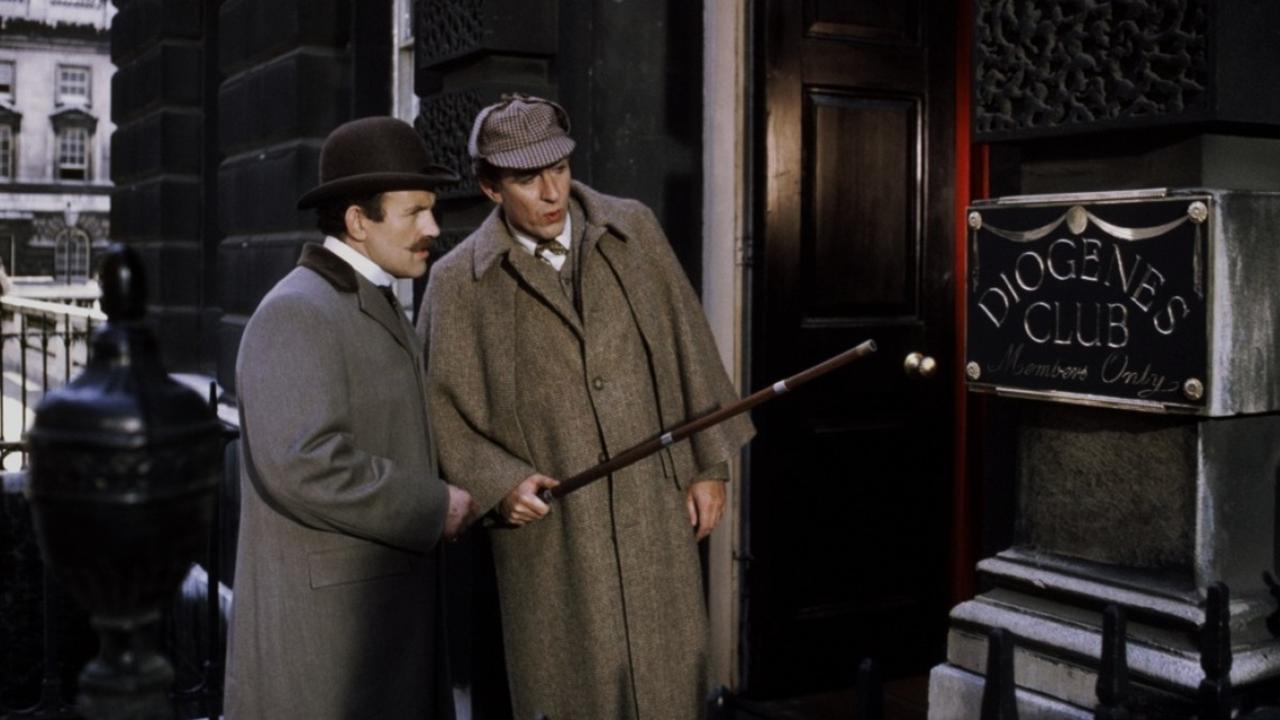
The Private Life of Sherlock Holmes may just be the best Sherlock Holmes film you’ll see. It’s certainly one of the most original. Wilder’s semi-pastiche, described by Mark Gatiss as “both reverent and irreverent”, was a major box-office disaster at the time, but it’s a film that has grown richer and more enjoyable with age – particularly as we’ve caught up with its “fan fiction” style, its placing of the great detective in unusual emotional and social situations. 

Wilder’s film follows two “buried” cases of Sherlock Holmes, both suppressed by Watson. In the first (taking up the first quarter of the film), Sherlock Holmes (Robert Stephens) and Dr Watson (Colin Blakely) are invited to a production of Swan Lakeby the Russian Royal Ballet, where a curious and unusual case is proposed to Holmes. In the second story, a mysterious woman suffering from amnesia (Geneviève Page) winds up on the doorstep of 221B Baker Street. Investigating who and what has brought her there leads into a case that covers continents, the upper echelons of the British government, and (possibly) the deeply hidden depths of Holmes’ own heart.

First off, it’s impossible to talk about Private Life without noting we only really have half the film. Not only did audiences not get it, nor did the studio. Both were expecting a traditional Holmes adaptation. Getting an amusing and wry exploration of Holmes’ psychology, built into a film where the great detective makes several errors, was categorically not that. So half the film was cut and chucked in the bin (including two whole cases). The footage no longer survives (there is an excellent recreation of what is left on Eureka’s new blu-ray) – but it’s a film that might have been.

It’s also a film that was apparently hell to make. Wilder had always been demanding – he demanded a completely faithful interpretation of his text, and often gave scrupulous line readings. It went to extremes here: epic rehearsals before every shot, with every line and movement dictated. For Stephens – a fragile alcoholic going through a divorce – it was too much, and part way through filming he attempted suicide. Shooting was delayed while he recovered, though Stephens’ pale, wan face needed to be overly made-up to compensate (in the opening scenes he genuinely looks like a drag act).

So you can’t forget the turmoil that brought it to the screen. But the end result (what remains) is largely a delight, even if it isn’t perfect. But it really is decades ahead of its time. Just like Sherlock (and it’s certainly the parent of that show), its main interest is not the case but the detective, his foibles and his emotional hinterland. Motored throughout by the wonderful chemistry between Stephens and Blakely (the two actors were good friends), it’s a wonderfully written film, full of wry humour and banter, mixed with moments of genuine heart and emotion. 

The film asks: who is Sherlock Holmes? Is he the cold fish he appears to be? While it doesn’t want to answer the enigma, it enjoys trying to unpeel those layers. Stephens’ Holmes is wry, witty, slightly fey, playful but also distant. He stands off from genuine intimacy and emotion – and why is that? As he spends time with Gabrielle Valadon, how much does he warm towards her – when he ruminates on his fears about trusting people, particularly women (in a marvellous late night conversation in an overnight train bunkbed), the film asks us to think: how damaged can this man who lives to investigate crimes but seems to have only one friend, be? It’s everything Sherlock took further: in fact the relationship between Holmes and Vardon has more than a few echoes in A Scandal in Belgravia.

The film’s real genius though is its opening short story, revolving around Holmes, a ballet company and a serious of unusual requests. This pastiche is very funny, very clever, beautifully played and crammed with invention and wit. The dialogue is beautiful, while both actors are perfect: Blakely is hilarious as a Watson full of joie de’vivre while Stephens’ drily amused Holmes works hard to never let surprise penetrate his raised eyebrow. The story goes down some mysterious alleyways – not least some curious questions around Holmes’ sexuality and experience with women. But it’s just about a perfect half hour of Holmesian pastiche: probably the best of its kind ever made.

The larger story doesn’t quite live up to it, but there are some beautiful moments in there, not least the growing bond between Holmes and Vardon in which nothing is ever said or done – and much is left open to interpretation – but where Holmes shows more of his humanity than he has perhaps ever done. The case itself is half humour, half expansion of Conan Doyle. By the end we are left asking ourselves how much on the back foot Holmes was for most of the case: and the case’s resolution eventually sniffs of satire. But the film itself ends on a bittersweet resolution, with Holmes facing the impact of emotions in a way he perhaps never has before.

Wilder’s film is sharp, witty and crammed with great scenes and jokes. It’s very well acted, particularly by Blakely as a hilarious Watson, full of good humour and bombast but with a sharp sense of cunning. He may not be as bright as Holmes, but he’s certainly bright enough to get the most out of life. Stephens is a little uncomfortable as Holmes (this film sparked a career nosedive that it took nearly 20 years for him to emerge from) but at certain moments he gives the part a really unique lightness masking an unknowable emotional hinterland.

It’s a film that’s easy to mistake for straight comedy, but it really isn’t. It’s a fascinating, entertaining and rewarding exploration of the leading character’s psyche, by writers who clearly know of what they speak. It throws in a case framework that smacks of the high-blown, Giant Rat of Sumatra-style cases Watson makes passing reference to in the stories. It’s a film that focuses on character and relationship – that captures a sense of friendship between Holmes and Watson that few other films have managed – and that spoofs the cannon while still feeling very true to it. 

It’s not perfect: it’s overlong and sometimes the pace drags or the sparkle fades. But Wilder and Diamond’s script has plenty of jokes and cannon knowledge (this was the first pastiche to explore Holmes’ cocaine use – and the psychological reasons for it) and has some terrific performances. Christopher Lee makes a wonderful urbane, whipper-thin Mycroft while Irene Handl is a wonderfully bumptious Mrs Hudson. Not only did it inspire Sherlock – it must also keep inspiring all fans of the great detective.

Little Women (1994)


Gillian Armstrong’s beautifully cast and played adaptation of Little Women is a classic

Director: Gillian Armstrong

Cast: Winona Ryder (Jo March), Gabriel Byrne (Friedrich Bhaer), Trini Alvarado (Meg March), Kirsten Dunst (Young Amy March), Samantha Mathis (Amy March), Claire Danes (Beth March), Susan Sarandon (Marmee March), Christian Bale (Theodore Laurence), Eric Stoltz (John Brooke), John Neville (Mr Laurence), Mary Wickes (Aunt March)

There are certain adaptations that simply set the standard. I’m thinking of the BBC Pride and Prejudice or Emma Thompson’s Sense and Sensibility. For productions like this, it almost seems superfluous to create another version: why would you want to when you can already watch the whole thing done perfectly? Gillian Armstrong’s superlative production of Little Women is such a film: so perfectly cast, immaculately acted and brilliantly assembled that I simply can’t imagine another production bettering it.

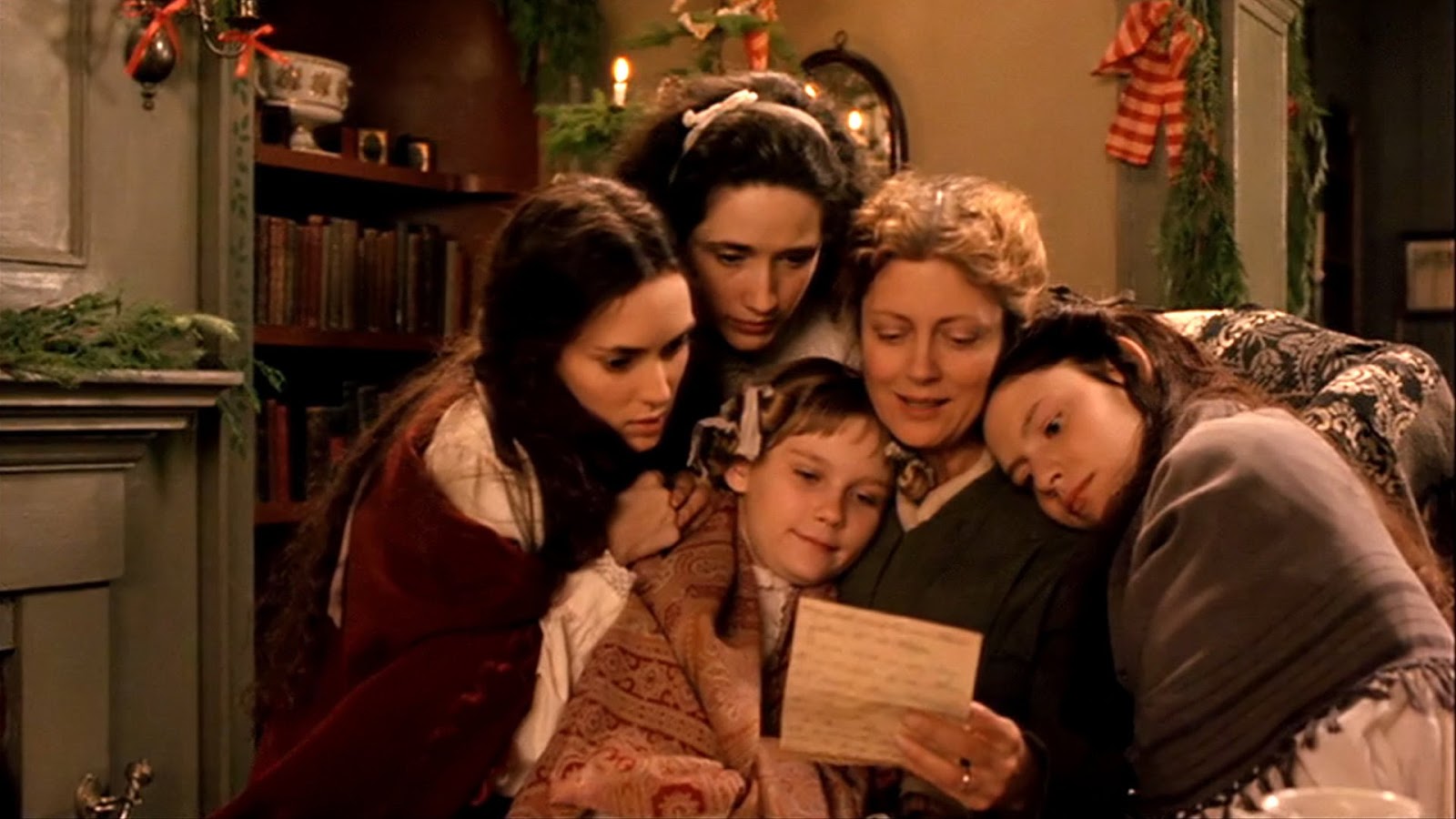
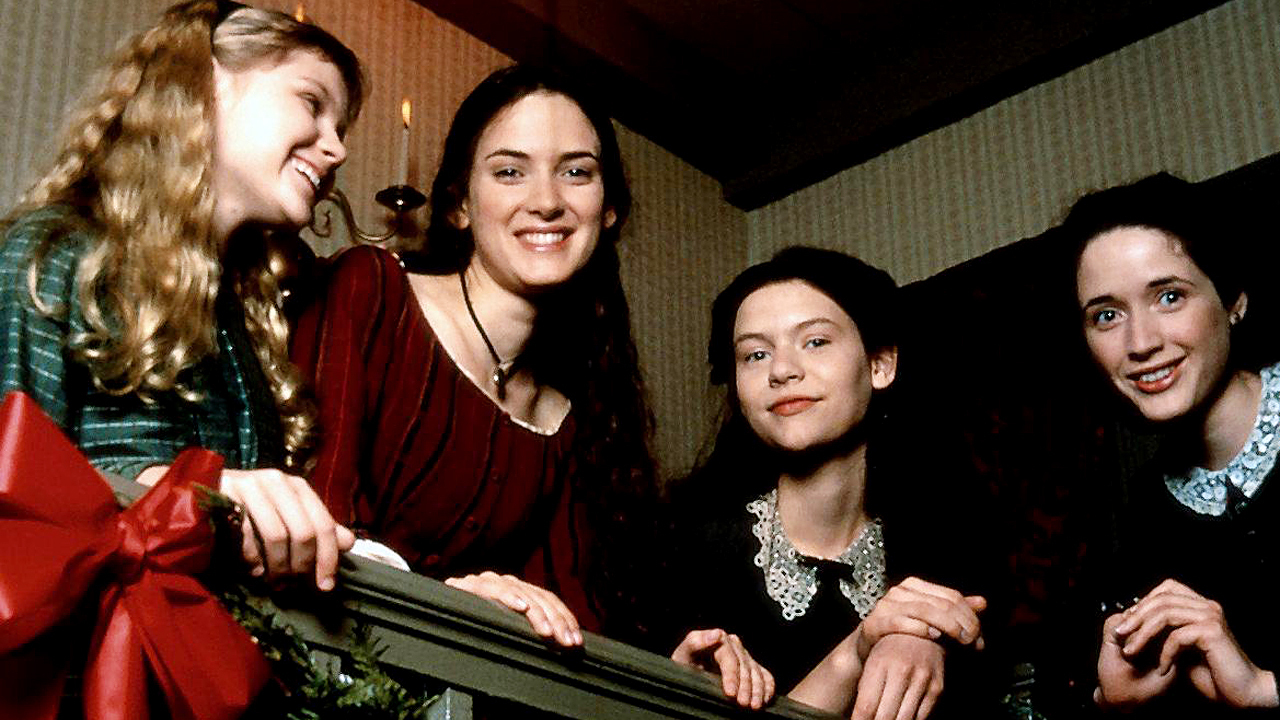
In Massachusetts during the American Civil War, the March sisters live with their mother (Susan Sarandon): sensible Meg (Trini Alvarado), tomboyish Jo (Winona Ryder), gentle Beth (Claire Danes) and temperamental Amy (Kirsten Dunst). While their father is away fighting, the girls grow up and experience the highs and lows of life and love, while never losing sight of the strong bond that holds them together.

Not only is it impossible to imagine another production besting this, I can’t imagine another creating so many “something in my eye” moments as this film manages. Gillian Armstrong’s tender direction gets a guaranteed emotional response from the audience every time, largely because she keeps the film simple, focused and doesn’t overegg the emotion. She recognises the story itself carries delicious highs and heartbreaking lows – and lets these moments speak for themselves. From its opening moments, establishing the girls’ love of theatricals and their own private “Pickwick club”, you know you are in the safe hands of people who fully understand the novel.

It’s a film which plays it very, very simple and lets the beauty of the moments speak for themselves. Many work perfectly: no less than three times I felt myself welling up, from the presentation of Mr Laurence’s piano to Beth, to Beth’s tragic death, to the final scenes between Jo and Professor Bhaer. Each of these moments is quite simply perfectly played and carry a major emotional wallop. It’s because Armstrong sets out a film that is totally straight, and a completely loving and respectful adaptation of Alcott’s novel. Armstrong, and adapter Robin Swicord, also build a profound, focused story of growing up and learning to adjust to loss and the changes life brings us. Focusing on this creates a very clear journey in the movie – as well as a story anyone who has had any life experiences is going to respond to.

Part of the reason why the film is such a complete success is the superb playing from a cast without a weak link among it. The four March sisters genuinely feel like people who have grown up together, so strong are the bonds of chemistry between them. I’d also hugely commend Armstrong and Swicord for so skilfully establishing the different personalities of the sisters – within the opening few minutes you’ll feel like you know all their personalities exactly (a task utterly failed by a recent three-part BBC adaptation).

In the lead role, it’s scintillating to watch Winona Ryder and remember what a superb, heartfelt and gloriously expressive actress she is. Vulnerable but also tomboyish, boisterous and also tender, she brilliantly captures Jo and her semi-bohemian, semi-homespun yearnings, and her passionate love for a life different from the traditional. Ryder also has such wonderful skill with conveying emotion – at several key moments, waves of emotion seem to pass over her face in careful micro-expressions. Several moments carry the weight that they do, because Ryder sells them so well. 

Her three sisters are equally well-cast. If she has a rival for skill of expression and conveying depth of emotion it’s Claire Danes, who is astonishingly good as the gentle Beth (hard to believe she was only 15 at the time!). Danes’ simple joy and her gentle, unassuming love for those around her really hit home. Danes’ joyful warmth makes Beth’s acceptance of the piano from Mr Laurence a beautiful moment, while her tender humanity makes her death incredibly moving. Kirstin Dunst is superb as the young Amy – part brattish pre-teen, part excitable child. Her sudden horror when she realises the gravity of burning Jo’s book again helps this moment work so well. Trini Alvarado has the less interesting part, but her grounded, calm, proper and gentle performance as Meg balances the work of the sisters really well, and Alvarado demonstrates she has real empathy for the role.

The rest of the cast are equally good. Samantha Mathis (taking over the older Amy) delivers an excellent portrayal of a woman keen to head into the world. Susan Sarandon is perfect as a wonderfully loving, all-knowing mother. Christian Bale is perfect as the playboyish Teddy, full of playful fire. John Neville sells a few crucial scenes as a humane Mr Laurence. Gabriel Byrne is certainly far more handsome than his literary counterpart, but he’s so wonderfully gentle, caring and kind that it hardly matters: the relationship between him and Jo is beautifully judged.

Beautifully judged basically sums up the whole thing: there is not a bum note in this whole film. Armstrong and Swicord nail every single decision. Armstrong’s direction is outstanding: a brilliant example is the gently, unbearably sad sequence of sprinkling roses in Beth’s room after her death – it’s so simply done but incredibly moving. The film is crammed with moments like this, beautifully scored by Thomas Newman. Swicord’s script is marvellous, and it successfully draws out the feminist message of the book, without hammering the points: it gently flags up the lack of opportunities often available for women at the time, but also celebrates the contribution they can make. 

Little Women is a simply superb piece of adaptation, and a deeply affecting and heart-warming film. Only a film that lets you invest in the characters as much as this, could move you as much as it does. When Ryder smiles, you feel your whole world light up. When Danes cries with joy you feel your heart sing. When tragedy comes you feel like you’ve had a loss yourself. The story is superbly streamlined, each character is perfectly established, the relationships between them all are so wonderfully done – you can’t help but fall in love with it. If it had been a film about men it would have been littered with Oscar nominations. As it is, despite the sexism of the Academy, it’s a film you’ll treasure and return to again and again.

The Hobbit: An Unexpected Journey (2012)


Martin Freeman goes on An Unexpected Journey in the first of Peter Jackson’s deeply flawed trilogy

Director: Peter Jackson

Cast: Martin Freeman (Bilbo Baggins), Ian McKellen (Gandalf), Richard Armitage (Thorin Oakensheild), Ken Stott (Balin), Graham McTavish (Dwalin), Aidan Turner (Kili), Dean O’Gorman (Fili), James Nesbitt (Bofur), Cate Blanchett (Galadriel), Hugo Weaving (Elrond), Christopher Lee (Saruman), Ian Holm (Old Bilbo), Elijah Wood (Frodo Baggins), Sylvester McCoy (Radagast), Andy Serkis (Gollum), Manu Bennett (Azog the Defiler), Lee Pace (Thranduil), Benedict Cumberbatch (Necromancer)

The little-loved Hobbit films are finished now. This may be a controversial statement, but looking back at the three films now, An Unexpected Journey is clearly the best of an average bunch, the only one that feels like it has some sort of story arc, where the padding isn’t too overbearing and we get some character moments. Despite all that, it’s (bless) a bit of a mess. A tragic missed opportunity, which are like bloated windy farts that follow through.

So. It’s three films. We all know it shouldn’t be. We all know it’s a slight kids’ book. So let’s take it as read that even this, the best of the bunch, is an over-extended three hour expansion of six chapters (six bloody chapters!) of the original kids’ fable. Never, at any point, does this feel like it needs to be a long film. Where is the depth and passion in this film? It’s a slow, slow, quick, quick, slow paced splat, which takes ages and ages and ages to get going and then runs through as many set-piece action scenes as possible. 

Why did Peter Jackson make these films? Honestly, watching it you feel he had a gun to his head. He can’t bring any love or depth of feeling to huge chunks of the film. The action scenes feel put together by a choreographer and designed to be as loud and broad as possible, rather than because they are being put together by a storyteller. 

Thirteen dwarves? This is one of the main reasons Jackson was worried about making this film. How could he make these characters distinctive? How could he build plot arcs and storylines for each one? The answer was he couldn’t. So he didn’t even bother. Now I know the Tolkien fans would have hit the roof, but for goodness’ sake would it not have been better for the good of the film to cut the number of dwarves down? So we could get to know them a bit? Because large numbers of these dwarves are indistinguishable from the other. Throughout the course of this film, as a stand-alone viewing experience, only Thorin and Balin stand out in any way as immediately recognisable. They are the only two who you can always identify. The rest? They just all mash into one. They don’t even really have distinctive moments. They are just a mass.

So you watch the overblown, overextended and yawn-worthy action and chase scenes and you just can’t get wrapped up in them. Because all we are doing is watching huge, time-consuming sequences with a mass of characters we can’t tell about, and even when we do, we don’t have any emotional connection to them. The dwarves are all sort of refugees I guess, which gives us some sort of link to them, but it’s the same back story for each one. It’s indistinctive and unclear. If Jackson had gone with his gut and cut some of these out, then the extended running time could have been used to build establishing character moments, to give pay-offs and plot arcs for them. Instead, he kept them all – and never develops any of them.

Those action scenes do go on forever. I know they all come from the book, I get it, but there is no tension in any of them. Dwarves bounce, twirl and fly all over the place. Never at any point do they really feel like they are in danger. A run over the field from some wolves – yawn. The chase sequence through the Goblin kingdom in a mine – double yawn. The second is particularly bad as it brings back strong memories of the LOTR sequence in the Mines of Moria, which had a hundred times the excitement and thrills of this. 

In fact that reminiscence is a big problem for a large chunk of the film. The Hobbit is a kids’ book, but The Lord of the Rings is an adult fantasy novel. The attempt to tie these two different tones and genres of novel is a constant hiccup. So we get the dwarves pratting around and bouncing about, in moments that seem childish and cheap. And then we get doom-laden conversations, and dark over-blown musings about the stakes of the world – stakes that don’t tie in, in any way, with the content of the action, adventure story we are seeing in the film. Then there are blatant, clumsy references back to the original – did anyone else groan when Elijah Wood wandered onto the screen? Appearances from Blanchett, Weaving and Lee are all shoe-horned in. At least Ian Holm gets to do some lovely narration. But all these moments simply remind you that you could be watching a better film trilogy than this.

But despite all this, An Unexpected Journey isn’t all bad. Yes it hares about so quickly, with no depth at all, at great over blown length, but it has its moments and it is just about entertaining enough. Jackson can still do some of these moments well – the flashback that opens the film to Smaug’s attack on the mountain is very well done; in fact it has more inspired film-making and tension than nearly anything else that follows. Yes the arrival of the dwarves takes a lot longer to get going than the film needs – but at least it’s pretty charming, and Jackson’s whimsical love of Hobbiton is pretty clear. Shame I don’t think he brought any more invention or sense of charm to much of the rest.
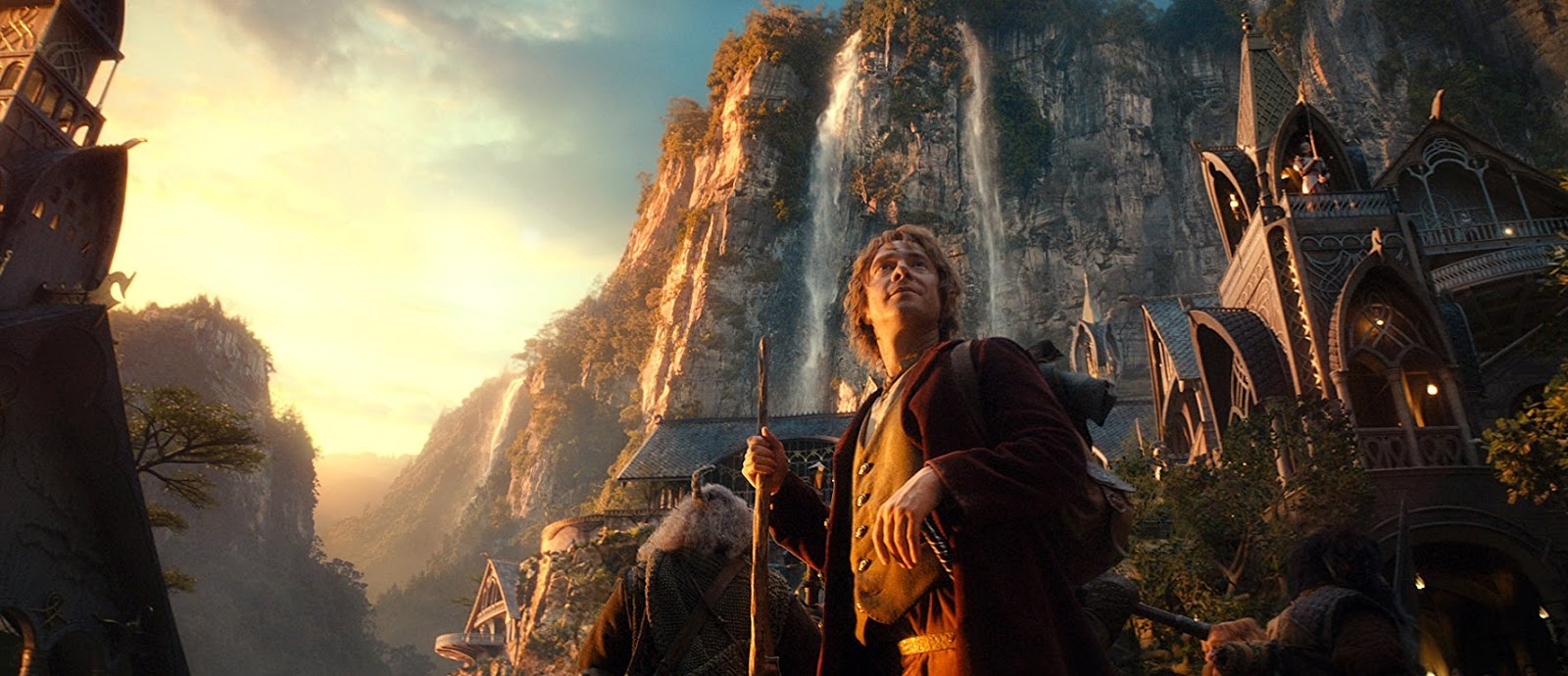
It’s also helped by the fact there are some damn fine performances in there. Martin Freeman is just about perfect casting as Bilbo; he’s charming, vulnerable, slightly-out-of-his depth, brave, very English – he’s great. Ian McKellen practically is Gandalf by now, and he hasn’t lost his understanding of the character’s slightly grubby, grandfatherly charm. Richard Armitage as Thorin is brilliant, mixing a gruff, maverick quality alongside his pride and resolution – and his intense sense of loyalty. Of the rest of the cast, not many get a look-in, being either cameos or underdeveloped, but Ken Stott stands out as the kindly, wise Balin.

The film is also possibly the only one of the three that truly stands alone in some way. It has some form of plot arc behind it in the relationship between Thorin and Bilbo, and the lack of trust Thorin has for Bilbo, his unwillingness to accept him into the group. Similarly, Bilbo has to learn to embrace his role with the dwarves and his place in the company. This is actually a pretty touching and carefully done dynamic, that culminates not only in the film’s most involving (and tellingly low-key) action sequence, but also a tender moment of acceptance from the previously stand-offish Thorin (brilliantly sold by Armitage). 

This is a great plot arc. It also has a negative impact on the next two films – because this is the emotional climax in many ways of the trilogy – and it came in the first film of three! With this major emotional plot line between two of our core characters resolved by the end of the first third of the sequence, what is there to do with the rest of it? It’s a major loss for the rest of the trilogy. 

But for this stand-alone film it works well. Because it reminds you there is some heart in this film – heart missing from the next two films – because it is founded on an understandable emotional bond. The rest of the company may be indistinguishable, but at least Thorin and Bilbo move us. The best moments in these films are founded on feeling and character investment. Andy Serkis makes a great return as Gollum in an entertaining exchange with Freeman. The clash between Thorin and Azog is the most engrossing in the film because it has a genuine history to it established in the film, that a zillion clashes with the Goblin King, or a pack of wolves or faceless goblins never do. 

The Hobbit: An Unexpected Journey is a decent movie. It has flashes of excellence in it. It’s got some good performances. Peter Jackson is still able to shoot a decent scene, even if you don’t really feel his heart is completely in it. The performances are uniformly good, and some are excellent. But the whole thing feels like an overblown missed opportunity. There was a chance to do something magic here with this Hobbit series. But this wasn’t it. You can’t cast the same trick twice.