Category: Medieval film

Kingdom of Heaven (2005)

Kingdom of Heaven (2005)

Scott’s crusader epic is a much better, more thoughtful film than you’ve been led to believe

Director: Ridley Scott

Cast: Orlando Bloom (Balian of Ibelin), Eva Green (Sibylla of Jerusalem), Jeremy Irons (Lord Tiberias), David Thewlis (Hospitaller), Liam Neeson (Godfrey of Ibelin), Brendan Gleeson (Raynald of Chatillon), Marton Csokas (Guy de Lusignan), Edward Norton (King Baldwin IV), Ghassan Massoud (Saladin), Michael Sheen (Priest), Velibor Topić (Almaric), Alexander Siddig (Imad ad-Din al-Isfahani), Kevin McKidd (Sergeant), Jon Finch (Patriarch Heraclius), Ulrich Thomsen (Gerard de Ridefort), Nikolaj Coster-Waldau (Godfrey’s nephew), Iain Glen (Richard I)

Version control: This review cover the Director’s cut of Kingdom of Heaven, a three-hour film that is much better than the original theatrical version.

For hundreds of years the Middle East has been the site of wars over land and religion: the more things change, the more they stay the same. Ridley Scott’s Kingdom of Heaven is a grand, melancholic epic about the crusades, a period of history that seems to become even more divisive and controversial if every passing year. During the First Crusade (1096-99), a European Christian army had bloodily seized control of Jerusalem (massacring its Muslim population). The Crusaders built a state that lived through fragile truces, in a constant state of cold war with the Muslim states that opposed their conquest. Scott’s film picks up the final years of that ‘kingdom of Heaven’.

He does so through fictionalised version of the events. Balian (Orlando Bloom), a former military engineer, is now a widowed blacksmith in Northern France – until Godfrey of Ibelin (Liam Neeson), a crusader lord, returns to claim him as his illegitimate son. Fleeing his home after murdering his bullying priest brother (Michael Sheen), Balian arrives in the Holy Land as the new Lord of Ibelin. But he not a paradise, but a kingdom full of ambitious lords and zealots, surrounded by the armies of Saladin (Ghassan Massoud) with the whole thing only just held together by the wise leper king Baldwin IV (Edward Norton). There is already a power struggle for who will control Baldwin’s heir, the child of his sister Sibylla (Eva Green). Will it be the moderates led by Tiberias (Jeremy Irons) or the zealot Templars led by Sibylla’s husband Guy de Lusignan (Marton Csorkas)?

I’ve always been interested in this period of history, and I’m a sucker for a grand historical epics. So I’m pretty much the target for this ambitious, luscious, flawed but engaging film. It helps when it’s assembled by a director as full of visual flair as Ridley Scott. Kingdom of Heaven is an extraordinarily beautiful film – one of those where you really could snip out every frame and hang it up on your wall. Gorgeously lensed by John Mathieson, it moves from a chilly, blue-filtered North France (a land of artistic snow fall and permafreeze) to a David Leanesque desert land, of rolling sand dunes and skies tinged with deepest blue. It’s a film of breathtaking scale, as medieval armies converge, legions of siege weapons roll up to never-ending city walls and the desert stretches as far as the eye can see.

It makes a fantastic backdrop for a film that’s tries really, really hard to take a measured, reasonable view on human nature and religion. It’s fair to say that this makes Kingdom of Heaven a very serious film (there is barely a few minutes of humour in its entire three hour runtime – a joke about Neeson once fighting three days with an arrow in his testicle is about all you’re gonna get), but it’s also nice to have a film celebrating compromise and moderation. Really, Kingdom of Heaven isn’t a true representation of the Crusader period at all – the real Balian and Baldwin would scarcely recognise the humanist liberals they become here – but as a sort of fantasia on balancing conflicting demands in a place that seems to make men mad, it’s hard not to be respect that it’s trying as hard as it is.

To achieve it’s aims, Kingdom of Heaven divides both sides of the argument into goodies and baddies. For the goodies, Baldwin and Saladin are reasonable, just men willing to strive for a world where all can worship freely. Edward Norton – unbilled under a silver mask and English accent – brings a great deal of strength and wisdom to Baldwin, matched by Ghassan Massoud’s superbly patient Saladin. On the other side, we have the “God wills it!” brigade. Admittedly on the Muslim side, they are embodied by one of Saladin’s advisors, whereas the crusaders are awash in angry, Holy War bloodlust types who believe any killing is justified if it’s in God’s name.

Kingdom of Heaven has a respect for faith, particularly when filtered through the words of characters who don’t believe painting a cross on their chest allows them to kill anyone who disagrees with them. Several times, Balian argues doing sensible, reasonable things technically against the word of the Biblewill be understood by God (if he’s worthy of the name). It playfully suggests David Thewlis’ (in an excellent performance) reasonable Hospitaler might actually be an angel, with his power to appear undetected and prodding of Balian towards doing the right thing (Thewlis even disappears into a burning bush at one point).

But, if I’m honest, much of the rest makes its points rather forcefully, showing a world where fine words are corrupted by ambition and anger. Many of those preaching faith are really motivated by a constant hunger for more –power, land, you name it. The closer a character is to the Church, the more likely they are to be either a pantomime, mustachio-twirling villain (like Marton Csorkas imperious Guy or Brendan Gleeson’s playfully-psychotic Raynald) or snivelling hypocrites like Jon Finch’s Patriach (who counsels converting to Islam and repenting later when the shit hits the fan).

Kingdom of Heaven lays out this earnest, well-meaning political viewpoint of how moderation should trump fanaticism, while filling its wonderful visuals with gorgeous costumes, stupendous sets, a brilliant score and some stunning battle sequences. But there is always a fascinating lack of hope in Kingdom of Heaven. When Balian troops up Gethsemane on his arrival in Jerusalem, he only hears the wind not the word of God. When offered the chance to save the kingdom from itself, it comes with such a morally compromised price-tag a straight-shooter like Balian is always going to say no. While his father (one of Neeson’s patented performances of weary, maverick nobility) clings to ideals, the film is perhaps best summed up by Jeremy Irons’ wonderfully world-weary performance as the cynical Tiberias: mournful, depressed and wondering what the hell it’s all been for.

It’s no wonder it’s such a savage world. Kingdom of Heaven doesn’t shirk on the medieval violence. Bodies are hacked to pieces with fountains of blood. It opens by introducing us to a regular Dirty Dozen of toughened Crusader veterans – only to slaughter nearly all of them in the first act. Death is only seconds away in this dangerous world: even sailing to the Holy Land is to risk near certain shipwreck. It’s fascinating that the film’s amazing reconstruction of the Siege of Jerusalem sees Balian fighting to make the siege so difficult that Saladin will be forced to offer terms rather than slaughter the city’s population as the First Crusaders did hundreds of years ago.

Sadly, the film’s main weakness is Orlando Bloom. Surfing the peak of his post LOTR popularity, Bloom’s limitations are ruthlessly exposed by carrying this historical epic. His delivery lacks shade and depth, he doesn’t have the charisma for the big speeches and he never convinces as either a man consumed with grief or a battle-hardened veteran (he doesn’t even remotely look like Michael Sheen’s older brother). It’s a part that needs a role of commanding presence, but Bloom doesn’t have it. It’s unlucky he also has to play off Eva Green giving a complex, well-judged performance as a Queen who learns humility the hard way (the director’s cut restores an entire plot-line for her, which adds hugely to the film’s quiet air of inevitable tragedy).

Kingdom of Heaven has a lot going for it: it looks amazing, it’s crammed with stunning scenes on a truly epic scale and gives excellent opportunities to a host of great actors. It’s an interesting, surprisingly glum exploration of the struggle to find peace. Sure, it’s view of the Crusades has very little link to do with the actual crusades and it’s a little one-sided in its views. But it’s also a thoughtful film that’s really trying to say something that’s worth hearing about moderation, all with some truly breath-taking epic film-making. It’s not a lost masterpiece, but it’s a much more impressive film than its reputation suggests.

Monty Python and the Holy Grail (1975)

Monty Python and the Holy Grail (1975)

The Python’s finest hour is a hit-a-minute medieval comedy that I never fail to laugh at

Director: Terry Gilliam, Terry Jones

Cast: Graham Chapman (King Arthur), John Cleese (Sir Lancelot/The Black Knight/French Taunter/Tim the Enchanter), Terry Gilliam (Patsy/ Soothsaying Bridgekeeper/The Green Knight/Sir Bors), Eric Idle (Sir Robin the-not-quite-so-brave-as-Sir-Lancelot/Concorde, Dead collector/Roger the Shrubber/Brother Maynard), Terry Jones (Sir Bedevere the Wise/Prince Herbert/Dennis’ mother), Michael Palin (Sir Galahad the Pure/Leader of the Knights Who Say Ni/Lord of Swamp Castle/Dennis), Connie Booth (Miss Islington), Carol Cleveland (Zoot/Dingo)

I’ve sometimes found the surreal, satirical and sometimes plain silly humour of the Monty Python troupe hit-and-miss. But when it lands, it really lands and Monty Python and the Holy Grail may well just be their finest hour. Essentially a series of sketches loosely worked together into a sort-of-plot, but never taking itself too seriously, it’s an often-inspired collection of highly influential gags delivered by a troupe of performers at the top-of-their-game (it’s hard to believe that they have all said shooting the film was a tough, punishing and exhausting process).

What Python got right here is how easy – and hilarious – it is to poke fun at something so very po-faced and serious as medievalism had a tendency to take itself back then. In fact, it’s perhaps a lasting tribute to the film that no-one has ever been able to take it quite as seriously since. Monty Python and the Holy Grail also lines up shots at the arthouse high-brow seriousness of films like Andrei Rublev and, most famously, The Seventh Seal (those hilarious, moose-obsessed, opening credits are a flawless take-down of Bergman’s portentous opening) but also a dismantling of the likes of Bresson’s Lancelot du Lac (no-one can watch that film’s opening now without picturing the Black Knight protesting ‘It’s a only a flesh wound!’ as crimson spray flows freely).

I love Holy Grail. It’s practically designed for undergraduates to sit around and watch, while getting slowly pissed and then spend ages quoting at each other. Many of its jokes lean into bizarre surrealism and funny sounding words – “shrubbery!” just sounds funny, even more so when it’s squeaked out by a giant Michael Palin in a ridiculous helmet affecting a rhotacism. And the Pythons knew how to turn problems into genre-defining gags: thank God they couldn’t afford horses, so instead came up with the frankly genius idea to just mime the knights riding horses to the sound of two coconut halves being visibly tapped together by their squires.

And then to have the comic presence of mind to riff on enforced ideas like this so much (just how did coconuts turn up in medieval Britain?) that for generations, fans will ram their tongues earnestly into their cheeks debating the migratory habits and air speeds of laden and unladen swallows. It’s all part of a superbly written script, which get just the right balance between Thomas Mallory-esque medieval rhythms laced with nonsese ( “The swallow may fly south with the sun or the house martin or the plover may seek warmer climes in winter, yet these are not strangers to our land”) and a mix of anachronistic casualism and simmering middle-class frustration. All the time in Monty Python and the Holy Grail there are traces of the sort of serious, played-dead-straight, medieval film this could be, making the constant punctuation of surreal, fourth-wall leaning, silliness all the more hilarious.

A lot of this also comes down the highly skilled comic playing of the troupe. Graham Chapman, in particular, has the seemingly dull job of playing the straight-man. But his ability to play, even the most ridiculous encounters, with complete earnestness is crucial to the film’s success. Arthur is, really, a ludicrous figure, but Chapman knows he can never acknowledge this for the joke to work. Hilariously, the legendary king here becomes a sort of put-upon middle-manager, constantly frustrated while going about his day job, dumb enough to be unaware of how absurd he is, but smart enough to get frustrated at the increasingly dim antics of his followers.

It also allows the rest of the troupe to let rip with broader comic performances, all of whom have a whale of a time. John Cleese’s pompous bossiness and control-freak mania is perfect for the psychotic Sir Lancelot while his latent comic cruelty, combined with a passion for silly accents and walking, is perfect for the famed French taunter (the funniest Frenchman on screen). Palin’s goodie-two-shoes decency is great for the tempted Sir Galahad while his brilliant capacity for deluded self-importance nails the Lord of Swamp Castle – and who else could have taken such an impish delight in the Trotskyist mantras of the socialist peasant Dennis? For the rest of the troupe, Eric Idle’s mix of cheek, dressed-up poshness and wimpy weakness is expertly used while Terry Jones mocks academia as Sir Bedevere and whines brilliantly as Herbert. And no-one does dirty better than Terry Gilliam.

Gilliam and Jones also directed, allegedly not always harmoniously neither quite agreeing if this was a film or whether it was a comic show. But the presence of Gilliam behind the camera probably accounts for why this is the most visually striking Monty Python film, with mists rolling over the hills and the Scottish locations given a mythic power which makes the silly jokes that happen all around them even funnier – while Jones’ medievalist background surely helped define the film’s surprisingly authentic (and therefore even funnier) feel. Holy Grail also very successfully disguises that it was effectively all shot in one or two locations (Doune Castle is shot from so many angles it becomes about a dozen different locations).

But what really makes Holy Grail work is the quality of the jokes. And it opens with a run of gags of such consistent quality they are perhaps unparalleled in Python’s work. The Swallow debate. Bring Out Your Dead. Peasants nailing the ‘self-perpetuating autocracy’. The flesh wounds of the Black Knight. The witch trial. The French Taunter (“Your mother was a hamster and your father smelled of elderberries!”). The Trojan Rabbit. Camelot being a silly place. The opening half of the film is one piece of solid comic gold and if the second half doesn’t have quite the same hit rate, it’s still more than funny enough.

And funny is what it is all about. You can say ‘it doesn’t have as good a plot as Life of Brian’. You can say it just ends, as if the troupe ran out of ideas. You can say it loses a steam. But it doesn’t matter when you laugh and laugh time and time again at its best bits. And you really do. And people who encounter it at the right age, will go on laughing at it for the rest of their lives., for decades to come.

Die Nibelungen (1924)

Die Nibelungen (1924)

Wagnerian epic is crammed with gorgeous, dramatic imagery and relentless pace

Director: Fritz Lang

Cast: Paul Richter (King Siegfried of Xanten), Margarete Schön (Kriemhild of Burgund), Hans Adalbert Schlettow (Hagen of Tronje), Theodor Loos (King Gunther of Burgund), Hanna Ralph (Queen Brunhild of Isenland), Rudolf Klein-Rogge (King Attila), Bernhard Goetzke (Volker of Alzey), Rudolf Rittner (Margrave Rüdiger of Bechlarn), Georg John (Mime the Goldsmith/Alberich the Dwarf/Blaodel)

Fritz Lang wanted to create a film that would help a shell-shocked Weimar Germany start to feel proud of its heritage and culture. He would do this with a film of the legend of Siegfried. It’s not really Lang’s fault that this Aryan feel-good stuff, coupled with Lang’s flawless visual compositions dripping with power and authority, would turn into the wet dreams of the Nazi party Lang fled Germany to escape. Die Nibelungen has unfortunate associations, but it stands as a towering pinnacle of Lang’s visual artistry. An adaptation of the legend, not the Wagner operas, Lang created something both mystic but also subtly questioning the idealistic figures it celebrates.

He would do all this in two (epic of course) films, totalling almost five hours. In the first Siegfried, the hero (Paul Richter) overcomes dragons and murderous dwarves to gain powers of almost (that almost is key) total invulnerability, strength and invisibility. Powers he puts to the test to win the weak King Gunther of Burgundy (Theodor Loos) the hand of Brunhild (Hanna Ralph) by invisibly aiding Gunther best this Valkyrie at a series of challenges. He even takes on Gunther’s form to help lead Brunhild to the bridal bed. Brunhild however discovers the truth from the loose lips of Siegfried’s wife (and Gunther’s sister) Kriemhild (Margarete Schön). Brunhild’s tricks Gunther and his loyal heavy Hagen (Hans Adalbert Schlettow) to murder Siegfried via a spear in his one weak spot. In Kriemheld’s Rache, Kriemheld plots the destruction of everyone who conspired in the death of her husband, via a marriage with the warlord Attlia the Hun (Rudolf Klein-Rogge).

The first thing that strikes you about Die Nibelungen – aside from its surprisingly electric pace – is the powerful, undeniable beauty of nearly every single frame. Lang composed each image as if it was a painting, from Siegfried introduced in steaming smoke at the forge, to the formalist imperialism of the castle of Burgandy and the rigid order and symmetry of its soldiers. Locations, from grand castles to mystic forests, underground caverns full of scheming, wicked creatures are superbly bought to life. There is a martial power Lang’s composition of so many of these images, their perfect angles and symmetrical blocking: parts of Die Nibelungen are some of the greatest pageantry displays in movies.

There is a wonderful sense of overblown, geometric, artificiality in all this – Lang deliberately creates a world larger than life and full of the unworldly and impossible. Buildings tower over crowds, courts that hold thousands to view events of grand importance, sieges of burning halls that fill the frame, staircases up impossibly high buildings. The sort of world of medieval excess where Gunther and Kriemheld disembark from a boat by walking across a bridge of shields created by half-submerged knights. Power and magnificence come from every frame.

It’s matched with an impressive creation of the bizarre and magical. Of course Siegfried kills a giant, animatronic dragon (strangely it’s obvious – even then surely – fakeness works in a film where everything is a heightened, from the emotions to the buildings to the costumes). Siegfried trains in something not far off from Vulcan’s forge and the forest feels like a sort of fairy-tale wonderland. Lang pioneered cross-fades and double exposures to make extraordinary effects, as Siegfried disappears under a veil of invisibility and jumps impossible distances. There is an extraordinary shot where Brunhild, still in the midst of her Valkyrie-like super-powers, seems to jump straight into the camera lens at full force. A beautiful edit sees a tree seem to reform itself into a skill in front of the eyes of the grieving Krimhild.

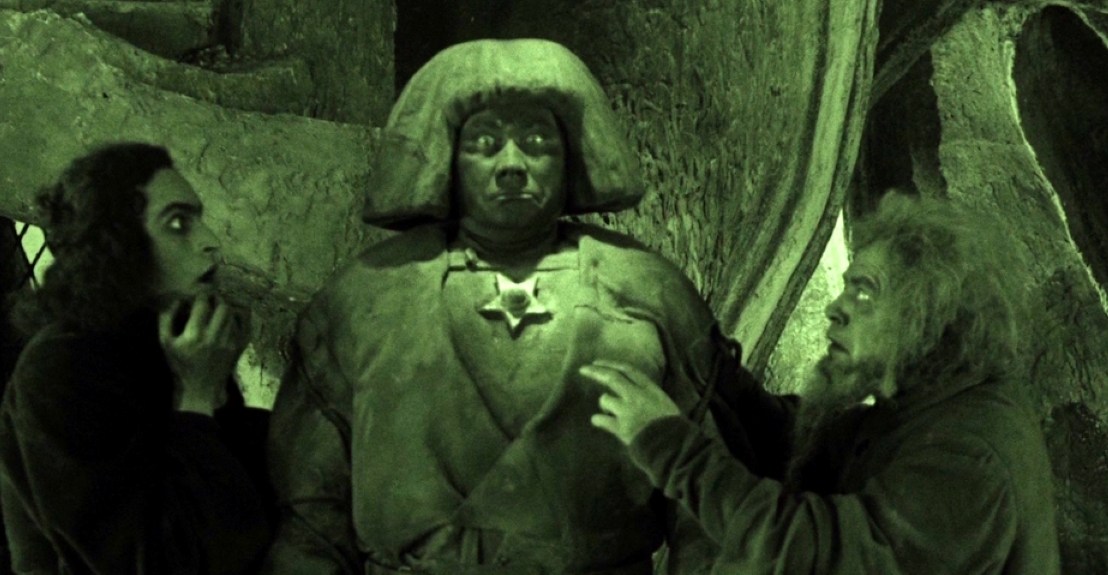
But Die Nibelungen places its world of power and magical forces in an increasingly costly human world of realpolitik and conspiracy, where its mystical but naïve and simple hero is out of step. Even before then, Siegfried’s status as a hero is subtly questioned. The dragon he kills seems a peaceful, inoffensive creature for all is scale, sitting placidly when Siegfried attacks and stabs it in the eye. Lang introduces a lovely touch where it’s dying tail flick will send the leaf that shields a crucial spot of Siegfried’s back from the torrent of invulnerability-granting dragon’s blood he bathes in. Siegfried is easily manipulated by the dwarf Albereich (a Gollum-like, uncomfortably antisemitic in appearance) before a large dose of luck allows him to defeat his opponent and gain the treasure of Nibelungen.

At the court of Burgundy, for all his courage and blunt honesty, Siegfried is at sea among the subtle power dynamics. The kingdom is ruled by chronically indecisive weakling Gunther (a snivelling Theodor Loos), easily manipulated by Wagnerian-costumed Hagen (an imposingly arrogant and faintly psychotic Hans Adalbert Schlettow). Siegfried’s main acts are to trick and then break the resistance of Brunhild (a dynamic Hanna Ralph) while impersonating the weakling – hardly acts to brag about, which doesn’t stop Siegfried doing exactly that to his wife who then blurts it out to Brunhild in a fit of pique. This isn’t a hero covering himself with glory, just as even the formally idealistic Brunhild (much to her later self-disgust) is reduced to scheming and plotting revenge, a far cry from the noble actionee she prided herself on being.

It’s not a surprise to find Part 2 heads into a Götterdämmerung as Kriemhild’s obsessive, destructive desire for revenge against Hagen (her husband’s murderer) meets with Gunther’s own stubborn-short-sighted protection of his controlling vassal. Nearly half of Part 2 is dedicated to the prolonged siege of the King and his followers by the massed armies of Kriemheld’s new husband Attila the Hun, her manipulations of him helped a great deal by Hagen’s arrogant, impulsive violence against Attila’s people. This extended battle sequence is astounding in its scale, violence and excitement – you can see the influence it had on The Two Tower’s Helm’s Deep – and is shot with the same visual mastery as the more stately first half, even as it seeks into bloody desperation.

It must be stated that Die Nibelungen does feature more than its share of clumsily presented racism. As mentioned, the hook-nosed, gold-obsessed, murderous dwarf Albereich is a painful antisemitic stereotype. Rudulf Klein-Rogge is caked under layers of make-up as the ugly, Slavic Attila while his Hun army resemble crouching Orc like figures, frequently ripe for the sword edge of the relentless German soldiers. It’s the uncomfortable flip side of the Aryanism idealism and romantic framing given to Siegfried, that these un-German figures are painted so monstrously.

But Die Nibelungen’s subtle criticism of the flaws in its German leads – it would go some to call them heroes – balances this out. From the flawed, empty-headed, foolishness of Siegfried to the increasingly sadistic, unrelenting cruelty of Kriemheld (Margarete Schön’s performance is excellent, going from sweetly retiring to unblinking fanaticism over the course of the film) the Germanic characters are compromised, weak and cruel: Hagen and Gunther are no one’s ideas of admirable figures. Compared to them, for all his clumsy racist appearance, Atilla feels like a reasonable figure, loving his family, caring for his people and refreshingly free of vindictiveness and cruelty.

It makes for an intriguing complex undercurrent in a film which, of course, the Nazis interpretated entirely on surface-appearance as a celebration of Aryan super-might. Or at least they did for Part 1 – even they couldn’t kid themselves that Part 2 didn’t quite fit that bill. Today Die Nibelungen provokes the same interesting thoughts. But above all it’s a visual marvel from a gifted film director, a truly painterly masterpiece that, for all its great length, never flags and offers a new marvel, camera trick or miraculous composition with every frame. This is silent cinema at its best.

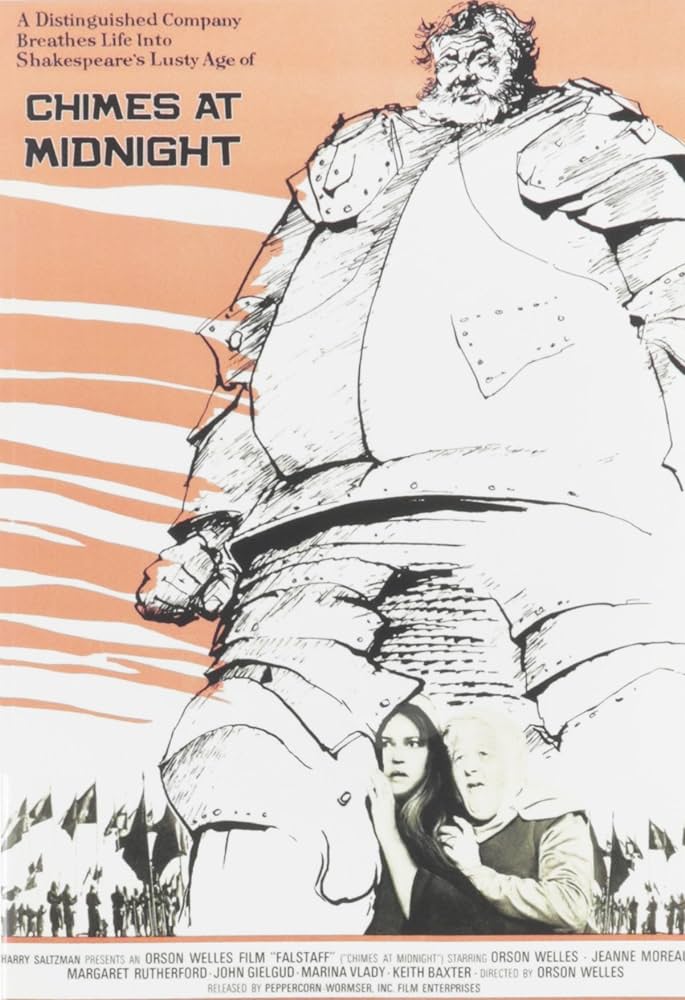
Chimes at Midnight (1965)

Chimes at Midnight (1965)

Welles reimagines Shakespeare’s Henry IV as a melancholic tribute to lost glories

Director: Orson Welles

Cast: Orson Welles (Sir John Falstaff), Keith Baxter (Prince Hal), John Gielgud (King Henry IV), Margaret Rutherford (Mistress Quickly), Jeanne Moreau (Doll Tearsheet), Alan Webb (Justice Shallow), Norman Rodway (Henry Percy “Hotspur”), Walter Chiari (Justice Silence), Michael Aldridge (Pistol), Tony Beckley (Poins), Charles Farrell (Bardolph), Patrick Bedford (Nym), José Nieto (Northumberland), Fernando Rey (Worcester), Keith Pyott (Lord Chief Justice), Andrew Faulds (Westmoreland), Mariana Vlady (Lady Percy), Ralph Richardson (Narrator)

For decades Sir John Falstaff was the part Welles couldn’t get out of his head. He’d already made two attempts at re-working the first Henried for the stage, with Age of Kings in the 30s (where Welles played Falstaff in his twenties) and Chimes at Midnight in 60’s Dublin with Welles again as Falstaff and Keith Baxter as Hal in what would be Welles final stage performance. Welles was fascinated with the roistering knight so when he was offered a film of Treasure Island by a Spanish producer, he agreed on condition he could make Chimes at Midnight at the same time with the same cast. Naturally, this being Welles, not a frame of Treasure Island was made, but with Chimes at Midnight he created possibly his most influential Shakespearean work.

Surely, it’s no coincidence the two literary characters Welles felt the closest affinity to was the windmill-tilting wandering fantasist Don Quixote and the mountain of rogueish humour and memories of Golden Years long-gone, Sir John Falstaff. Welles arguably altered the interpretation of the Fat Knight for generations. Before Welles, he was a “Hail Fellow, Well Met” comic, the exuberant force-of-nature Prince Hal must sadly cast aside for the throne. But Welles knew, like few others, what a wasteland missed opportunities, lost glories and achievements-that-never-were lay behind the raconteur. His Falstaff might be cheeky and sometimes jolly, but he’s also a mountain of melancholy, a playboy with no achievements, his glory days long gone. Even without the rejection, there is no future for Falstaff, only hazy memories of a past long gone.

Chimes at Midnight brilliantly repackages, recuts and recombines several Shakespeare plays (not just Henry IV Parts 1 and 2 but also Merry Wives of Windsor, Henry V and touches of Richard II) to reframe this story around Prince Hal and Falstaff and away from both Henry IV and the politics of rebellion (not embodied by Norman Rodway’s bombastic Hotspur). Structure is imaginatively reworked, with Part 2’s recruiting scenes appearing before Part 1’s Battle of Shrewsbury and ingenious touches such as Henry V’s decision to “enlarge that man who railed against our person” retroactively applied to Falstaff rather than a nameless offender.

Welles makes Falstaff a mix of terrible influence and proud parent – no coincidence that a half-smile of pride crosses his face when Hal finally dismisses him. They banter and bounce off each other, but there is a world-weariness. Baxter’s Hal is beginning to focus his mind on the responsibilities that come with the throne. Falstaff alternates between awareness and denial that their salad days are on borrowed time. Strikingly, both of their most prominent soliloquies are overheard by the other. Hal’s secret plans to reform as King is delivered with steely regret by Baxter, while Falstaff stands a short distance behind him; later Falstaff’s mocking of honour in the aftermath of Shrewsbury is impatiently half-listened to by a Hal already starring towards the future. These are two characters who know each other, their flaws and their ruthlessness, more than they might like.

Chimes at Midnight is Welles’ lament not just for Falstaff but for the whole idea of a Merrie England. The film is a set in a wintery land, covered in cold snow and deeply unwelcoming. Mistress Quickly’s inn is a run-down building in farmland, Henry IV’s breath can be seen in his chilly castle, Silence and Falstaff huddle around a flickering fire after a wintery walk. There is a tiredness around the antics of Falstaff’s gang. Falstaff responds to Doll Tearsheet’s attentions with an impossibly weary “I am old Doll, I am old”. We are living in the winter of a whole way of life, which Hal will comprehensively kill off in favour of realpolitik. The days of dreamers like Welles-Falstaff are numbered.

Welles stresses these differences by shooting events in various locations in strikingly different ways. The Boar’s Head Tavern uses more fluidic camera-work, with events frequently happening in multiple plains – characters appear above others on balconies or at the head of stairs – with the action filled with raucous, swiftly choreographed interplay. This contrasts with the Cathedral-like classicism of Henry IV’s court. Where the Boar’s Head is confined and intimate, Henry IV’s medieval palace has towering stone walls, beams of light flowing down from large windows, courtiers still and quiet while Henry effectively speaks to himself, the exact opposite of the boisterous egalitarianism of The Boar’s Head. Justice Shallow’s ramshackle home of bittersweet memories sits somewhere between the two, where the melancholy Falstaff is closest to Henry’s regrets.

Chimes at Midnight is filled with this sort of superb visual language. The film’s centrepiece is a truly impressive set-piece of cinematic flourish, the Battle of Shrewsbury. A masterclass in fast editing, quick cuts and brilliant framing (that makes 200 extras look like a thousand) this scene captures in microcosm the film’s theme of the death of old-fashioned principles. It starts with a knightly charge and degenerates into mud-strewn, brutal hand-to-hand combat with death agonising and swift. You can see the roots here of Saving Private Ryan, with Welles not using cutting, adjusted film stock and montage to create something really visceral and even shocking, as bodies are forced into the mud or cry out in agony – and our fat ‘hero’ trembles and hides to avoid the barbarity.

This is certainly Welles’ finest acting performance in his Shakespeare films. While always a more limited actor than remembered (a combination of laziness and stage fight), Welles was born for this role. His Falstaff builds off an element of self-portrait: a man still capable of lighting up a room with humour (as seen in his delightful ‘mock trial’ of Hal) but who knows he has achieved only a fraction of what might have been (never before have references to Falstaff’s past glories felt more sad) and that only the march towards death awaits. No wonder Keith Baxter’s excellent Hal, clinging to the last chance to let his hair down, is torn somewhere between love, pity and good-natured contempt for this man. The interplay between the two is perfectly pitched.

Chimes at Midnight is filled with rich performances. It may also be Gielgud’s finest Shakespeare performance on film, his rich, fruity tones turning monologues into musings on self-doubt and regret, distancing the coldly austere king even more from the boisterous knight. (That voice is also a gift for the other actors: Welles, Baxter and Rodway all showcase impersonations of Gielgud’s distinctive voice.) This Henry is so full of doubt, bordering on contempt, for his son he may even believe Falstaff’s claims to be the true killer of Hotspur. Rutherford is wonderful as Quickly, earthy and caring; Rodway, from charging across the battle to impulsively springing out of his bath to meet a messenger clutching only a towel makes a superb contrast with Baxter’s calculating prince. Webb’s disappointed Shallow and Moreau’s kindly Doll also make an impact.

Chimes at Midnight’s main impact though is to reimagine these plays in a highly influential way – just look at the BBC’s more recent The Hollow Crown where the Henry IV productions are so indebted to Chimes it might as well be a remake, while Branagh’s Henry V is virtually a tonal sequel. Rarely again would these be plays seen as near-comedies with a sad-but-necessary final act. Instead, they became sadness-tinged meditations of lost chances and missed opportunities, with productions set not in Olivier-style pageantry, but Wellesian chill.

It’s a film tinged with melancholy, so it’s also fitting that as well as a swansong for a lost time, a “Merrie England” past where everything was possible and the future was golden, it’s also the last narrative film completed by Welles (all others would be either documentaries or filmed lectures). When Falstaff, thanked but coldly dispatched, exits clinging to the fantasy of a glorious return but heading towards death, it’s hard not to see Welles himself shuffling away, never again to persuade a young prince (or film producer) to give him a chance again. It’s a moving metatextual ending to a film that reinvents Shakespeare and expertly exploits the tools of cinema.

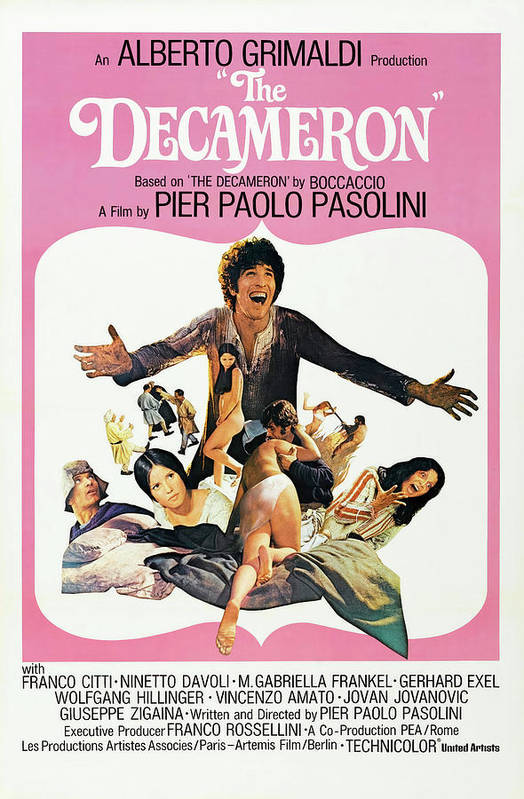
The Decameron (1971)

The Decameron (1971)

Pasolini’s naughty-boy Boccaccio adaptation, aims for political but in loves with cheek

Director: Pier Paolo Pasolini

Cast: Franco Citti (Ciappelletto of Prato), Ninetto Davoli (Andreuccio), Vincenzo Amato (Masetto), Maria Gabriella Maione (Madonna Fiordaliso), Angela Luce (Peronella), Giuseppe Zigaina (German Monk), Pier Paolo Pasolini (Giotto’s Pupil), Giacomo Rizzo (Friend of Giotto’s Pupil), Guido Alberti (Musciatto), Elisabetta Genovese (Caterina), Giorgio Iovine (Lizio)

The Decameron is a collection of a hundred tales written by Boccaccio in the 14th century, which offers a rich mosaic of Italian life from the tragic to the comic. But it also has a reputation for a lot of bawdy naughtiness – and perhaps part of that comes from Pasolini’s cheeky, sex-filled adaptation, with its playful lingering on some of the most rumpy-pumpy filled yarns. Scholars of Boccaccio were appalled in 1971; it’s a gag that I think Boccaccio might have appreciated that today Pasolini’s film is required viewing on Boccaccio courses.

Much like with The Gospel According to Matthew, Pasolini shifted the location to fit his themes. Here most of the tales take place in Southern Italy – Neapolitan accents and dialect abound – and the new underlying theme explore the exploitations of simple, honest peasants by cannier, ruthless people from the richer north. Roughly linking the tales together is a pupil of Giotto – played by Pasolini himself – preparing a fresco in a monastery, inspired (it becomes clear) by the stories which may in turn be inspired by ordinary people he sees on the streets. The Decameron is aiming to be a playful musing on the chicken-and-egg nature of artistic inspiration and the way different artists in different genres can inspire and motivate each other to ever greater heights.

Or at least those themes are there. But they can be hard-to-spot beneath the surface, since The Decameron mostly delights in its array of sexual goings-on, which pretty much tick-offs every taste and inclination you can imagine from masturbation to orgies, as well as darker content like rape and paedophilia. To be honest, for all that Pasolini is an artist thinking earnestly about the classics, he’s also a very naughty boy eager to get a few erect penises into mainstream film-making (and The Decameron was a huge hit in Italy and played in arthouse cinemas the world over). The Decameron, for all its pretentions about art, is also a bit of end-of-pier soft-porn – or a hard-core Carry On.

There is something deliberately amateurish about The Decameron in its scatological humour and the bumpy, rushed nature of its film-making. In common with many Euro films at the time, it makes no effort (either in its Italian or English dubs) to match the words we hear with the movement of the actors’ mouths, with most of the sound having a muffled post-recording session feel to it. The camerawork and editing are frequently jolted and rushed, adding to the bawdy sense of things being thrown together, Pasolini using sped-up film and punch-line jumpcuts to keep up the improvisational energy. It makes the film feel at times like a student revue.

Pasolini shot the film entirely on location, with a cast of actors who were mostly unprofessional. As with many of his films, much of the casting seems to be based on people’s appearances more than anything else. The Decameron has a superfluity of striking faces. Toothy grins or missing teeth, hooded eyes, vacant grins, these faces look like they could have stumbled in from a Brueghel painting. Everyone looks distinctive and this parade of striking faces adds to the film’s wild energy.

It also makes everyone in this Boccaccio cheek and smut stand out. Pasolini’s trick was to argue that the medieval era, in many ways, wasn’t that different from today. He didn’t present it as a high-blown time of men in tights speaking poetry, but one where people were obsessed with money and sex (usually the latter) and showed no shame in chasing it. An era where the medieval world looked dirty, shabby and slightly sordid, rather than what the poets would have us believe.

This informed his choice of stories. When you start with a naïve young man nearly drowned in a pool of shit, you can tell that this isn’t exactly going to be Hollywood medieval epic. Pasolini’s chosen tales involve: a well-endowed gardener pretending to be mute so he can shag a convent full of nuns, a woman boffing her lover while her husband inspects the insides of a large pot, a dying sinner (who we’ve already seen proposition a child for sex) claiming to be a saint, a girl and her lover shagging naked on a rooftop, a monk tricking a man into allowing him to have sex with the man’s wife, and concludes with a man receiving a visit from the ghost of a dead friend telling him that sex is no sin and the angels of heaven say he should certainly give his girlfriend a good pre-marriage seeing to.

Throughout, Pasolini aims to show a world where simple pleasures mix with the exploitation by the rich and powerful of the simple, poor and naïve. It’s a not a theme that comes out all that much, especially since few people are going to remember the political message when we are all much more inclined to focus on the constant in-and-out. The Decameron might want to think it is a grand statement, but its really a great big joke, told by a director who is sort of laughing at us while he does it. It’s a rather juvenile piece of titillation, passing itself off as political statement.

Perhaps that’s why Pasolini felt a bit embarrassed about it all later. After a parade of knock-offs, he effectively disowned the film, claiming low-quality imitators that dialled up the sex even more had missed the point and buried the anti-capitalist message of his own film. Since I can imagine several people watching The Decameron and completely missing the point in the first place, I can’t help but feel he has only himself to blame.

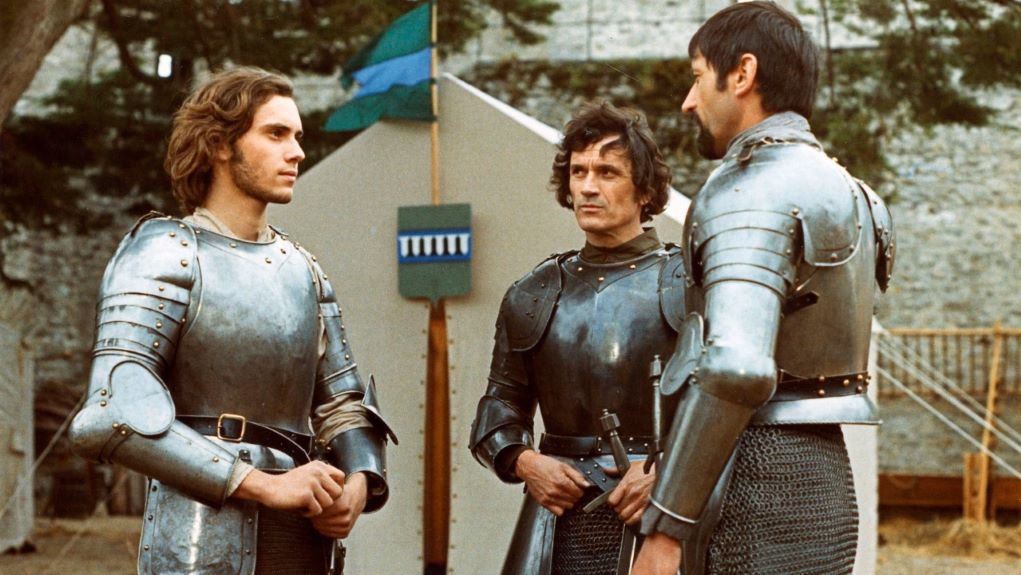
Lancelot du Lac (1974)

Lancelot du Lac (1974)

Bresson’s bleak film is the least romantic, most depressing Arthurian film out there

Director: Robert Bresson

Cast: Luc Simon (Lancelot du Lac), Laura Duke Condominas (Queen Guinevere), Humbert Balsan (Gawain), Vladimir Antolek-Oresek (King Arthur), Patrick Bernhard (Mordred), Arthur De Montalembert (Lionel)

Only Bresson could have made a King Arthur film like this. Lancelot du Lac takes Bresson’s spare, thoughtful style and applies it to that most unlikely of genres, the historical epic. What we end up with (for better or worse) is something perhaps bleaker and more difficult than any other King Arthur film out there. Bresson repackages Camelot not as the dreaming spires of hope, but a spare, vaguely mechanical world where Arthur and his knights are going through the motions of duty and honour, while stumbling towards inevitable death. However much the characters want to believe in a higher purpose, they can’t escape the cynical truths of the world, or their own lusts and desires.

Lancelot du Lac opens with the return of the knights from a disastrous Grail Quest. The best of them, Percival, never came back. Neither did most of the rest, all dead in some distant land. Arthur (Vladimir Antolek-Oresek) is a worn-out man who doesn’t seem to know what to do next. He’s delighted to see Lancelot (Luc Simon) return. Just as pleased is his queen Guinevere (Laura Duke Condominas), whose historical affair with Lancelot is an increasingly open secret in Camelot. Lancelot talks about letting it lie in the past, but temptation inevitably fractures the kingdom as Mordred (Patrick Bernhard) plots a coup.

Bresson doesn’t compromise on any of his distinctive style. Scenes mix between carefully structured longer takes, that frequently feature on obscure parts on the body (in particular legs, whose motion frequently fills the frame) and simple cutting between the faces of two people in conversation. He casts non-professional actors and, as before, ruthlessly drills them until they deliver every line with a flat, defiantly non-actorly, monotone. Nearly every event of note happens off screen. Every human is a choiceless cog in a much larger machine, unable to impact or effect the actions around them.

There is no romance whatsoever in Lancelot du Lac. The film is bookended with what passes (in Bresson) for moments of action. A clash between knights at the start ends (after a very short and perfunctory swinging of swords) with a blood spurting decapitation and another blood spurting disembowelment. (The blood spurting style was effectively piss-taked within a year by Monty Python and the Holy Grail.) It ends with a deliberately underwhelming Battle of Camelan, in which we see no fighting only faceless knights dead in a woody clearing, as archers rain arrows down. There is no glamour here, no glory or honour in combat – just pointless, mechanical sacrifice.

It’s the same with the jousting tournament which takes up a surprisingly large portion of the film’s runtime. Bresson shoots this almost with an almost irritatingly cheeky lack of spectacle. As horses charge at each other, the camera lingers on: the arms of a bagpipe player, the legs of horses, the ends of spears and the impassive faces of Arthur and Gawain in the crowd. Occasionally flags go up to denote new jousts and helmets crash down over faces. But any sense of what’s going on, or the point of it, is secondary to the sense of the knights as nothing more than humble parts of a great, pointless machine, churning out martial events by rote.

That sense of a machine is behind all of Bresson’s vision of Camelot. The actors all wear armour, all the time, clunking around the set like clumsy automatons, every flinch accompanied by the clank of armour. (John Boorman’s Excalibur would present the Wagnerian contrast of this same aesthetic choice.) Towards the end, Bresson repeats four of five times in sequence near identical shots of knights slamming helmets over their faces making them look like even more like robots.

It’s here where the actors deliberately lifeless performances work, and actually create a sort of hypnotic power. Bresson’s style makes them all feel like tired, exhausted figures at the end of their tethers, scarcely knowing the point anymore. Lancelot looks like a middle-aged bank manager sticking to the letter of a code because it’s all he’s got. Arthur is so disengaged from any sense of the ‘dream of Camelot’, he practically allows a civil war to break out due to apathy. Gawain is so constrained by his idea of duty that he allows himself to be killed, seeking revenge for the death of a brother he couldn’t stand. Mordred is the only guy who really feels aware of the world he lives in, a middle-manager who stirs up trouble and then gets others to deliver for him.

No wonder Guinevere constantly questions the whole set-up and the point of anything anyone is doing. Why shouldn’t she and Lancelot try and cling to something real, even if it will destroy everything else? After all it’s not the original sin: Camelot was already long since corrupted, way before they hooked up. There is no sense in Bresson’s work that medieval honour really means much to anyone, and the only people who really talk about it (Gawain and Lancelot) respectively die for no reason and betrays everyone after convincing himself his betrayal was an act of honour.

There is a fatalistic, hypnotic quality to this after a while as we watch characters square their actions against abstract ideals irrelevant to the situation they are in. So, Lancelot steals Arthur’s wife and then rides to a pointless death for the man he betrayed. Arthur allows men to die on crusades, allowing his kingdom to become fatally weakened in pursuit of purity. Everyone talks about honour all the time, but no one does anything to turn the situation into something actually honourable. Instead, their lives are ones of empty, unknowing fatalism leading to inevitable ends. It makes for a powerfully bleak Bresson tale – and faith and Christianity is notable by its absence in this world. Without it, it seems the knights have nothing to cling to.

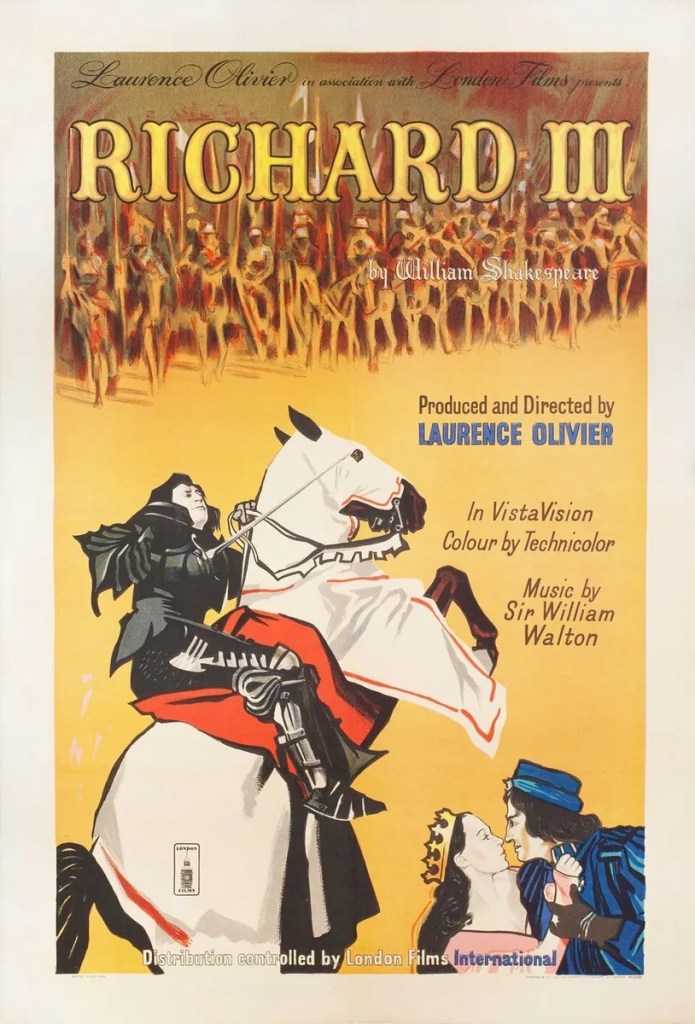
Richard III (1955)

Richard III (1955)

Olivier stamps his claim to Shakespeare’s greatest villain in this gorgeous theatrical epic

Director: Laurence Olivier

Cast: Laurence Olivier (Richard III), Cedric Hardwicke (Edward IV), John Gielgud (Clarence), Ralph Richardson (Buckingham), Claire Bloom (Lady Anne), Helen Haye (Duchess of York), Pamela Brown (Mistress Shore), Alec Clunes (Lord Hastings), Laurence Naismith (Lord Stanley), Norman Wooland (Catesby), Clive Morton (Lord Rivers), Douglas Wilmer (Dorset), Stanley Baker (Richmond), Mary Kerridge (Queen Elizabeth), Esmond Knight (Ratcliffe), John Laurie (Lovell), Patrick Troughton (Sir James Tyrell), Michael Gough (Murderer)

Olivier had played the greatest Shakespeare hero in Henry V and made Hamlet the most romantic princes of film. Having scaled those heights, did he also want to set the benchmark for Shakespearean villainy? Perhaps, with his vaulting ambition and competitiveness, he knew his clipped, precise tones and physical suppleness was perhaps best suited to playing the villain. What better role to prove it than the “poisonous, bunch-backed toad” himself, Richard III. Olivier bought to the screen a performance that would be as influential as his Hamlet (perhaps even more so), an embodiment of the role that all future Richards would be compared to.

I like to think of Richard IIII as a twisted inversion of Henry V. Like that film, the action is shot in lusciously beautiful technicolour, with beautiful costumes and a marvellously stirring, magnetic score by William Walton. It has courtly intrigues, a charismatic lead, the seduction of a young princess, many of the same actors and caps itself in a bravura battle shot on location. The only difference being that, instead of “the mirror of all Christian kings”, our lead is a twisted, remorseless killer who acts as his own Chorus to bring us on-side with his Machiavellian schemes. (There is a fun little opening message, stressing that this is a legend not the truth, that almost feels like an apology in advance to the Ricardian societies of today).

Olivier’s performance is the heart and soul of this film, and it’s possibly his finest cinematic (and certainly his finest screen Shakespeare) role. This Richard is openly – almost proudly – cruel and hypocritical, sociopathic in his amoral ease with the death and slaughter of his nearest and dearest (including his beloved wife, brother and nephews to whom he is sweetness and charm), overwhelmingly impressed with his own cunning and eagerly inviting us to share in his villainy. Olivier practically caresses the camera in his readiness to get close to us, forever turning towards it with a smile, quick aside or delighted breakdown of schemes to come. Olivier inverts his matinee idol looks into a stooped smugness (his costume, with its dangling sleeves, frequently makes him look like a spider) and his clipped vocal precision is dialled up to stress his heartless self-confidence.

Stare into Richard’s eyes and all we see is an uncaring blankness, the chill of a man who cares for nobody except himself. His sigil maybe a boar, but he resembles a wolf, devouring the Lords around him. Much of the first two thirds sees him keep a steady illusion of outward good fellowship. He comforts Gielgud’s Clarence with genuine care, greets Hastings like an old friend, is mortified and hurt by the suspicions cast on him by the Queen and her family, smiles with affection at his cousins. It means the moments where Olivier lets the mask slip even more shocking: the matter-of-fact abruptness he urges murderers not to take pity on Clarence, the whipped glare of pure loathing he shoots at the princes after an ill-advised joke about his hunched back or the imperious hand he shoots at Buckingham to kiss after being acclaimed by the crowds, harshly establishing the hierarchical nature of their ‘friendship’.

While the charisma of course is natural to a performer as magnetically assuring as Olivier – and this Richard is truly, outrageously, wicked in his charm – he also nails the moments of weakness. Having achieved the crown, Olivier allows not a moment of enjoyment of his feat, but his brow furrows into barely suppressed concern and anxiety that he may be removed by schemes exactly like his own. The threat of armies marching on him sees him first lose his temper publicly and then leap to cradle the throne in his arms like a possessive child. The morning of Bosworth, he even seems quietly shocked at the very idea that he could feel fear.

Richard III, despite its length, makes substantial cuts to the original play, including throwing in elements from Henry VI. Several characters – most notably Queen Margaret, whose major confrontation scene with Richard is lost altogether – are cut or removed all together. Olivier reshuffles the order of events, most notably shifting the arrest of Clarence to split up the seduction of Lady Anne. Richard’s late speech of remorse before the battle of Bosworth hits the cutting-room floor (Olivier’s Richard never seems like a man even remotely capable of being sorry for his deeds). Several small additions from the 18th century by Colley Cibber and David Garrick are kept in (most noticeably his whisper to his horse on the eve of battle that “Richard’s himself again”).

The film is deliberately shot with a sense of theatrical realism to it, Olivier favouring long takes so as to showcase the Shakespearean ease of the cast (much was made of the cast containing all four of the Great Theatrical Knights of the time in Olivier, Richardson, Gielgud and Hardwicke). The camera frequently roams and moves, most strikingly during the film’s first monologue from Olivier, where it flows from the coronation retinue outside the throne room, through a door, to find Richard himself waiting for us in the hall. It’s set is similarly theatrical, a sprawling interconnected building (with some very obvious painted backdrops) where the Palace of Westminster, the Tower of London and Westminster Abbey seem to be one massively interconnected building.

The film makes superb use of shadows, the camera frequently panning from our characters (especially Richard) to see their shadows stretch across floors and up walls. The claustrophobia of the interconnected set also helps here, making events seem incredibly telescoped (it feels like the film takes place in just a few days at most). It makes the court feel like a nightmare world completely under the control of Richard, who knows every corner to turn and can seemingly be in several different places at once. In that sense, filming Bosworth outside on location in Spain seems like a neat metaphor for Richard’s lack of control of events: suddenly he’s in a sprawling open field, where it’s possible to get lost and it takes genuine time to get from A to B.

Olivier may dominate the film with a performance of stunningly charismatic vileness, but he has assembled a superb cast. Ralph Richardson is superb as a supple, sly Buckingham, a medieval spin doctor whose ambitious amorality only goes so far. While I find Gielgud’s delivery of Clarence’s dream speech a little too poetic, there are strong performances from reliable players like Laurence Naismith’s uncomfortable Stanley and Norman Wooland’s arrogant Catesby while Stanley Baker makes a highly effective debut as a matinee idol Richmond. Claire Bloom superbly plays both Lady Anne’s fragility but also a dark sexual attraction she barely understands for this monster. Perhaps most striking though is Pamela Brown’s wordless performance as Mistress Shore (mistress first to Edward IV then Hastings), a character referred to in the play but here turned into a sultry, seductive figure who moves as easily (and untraceably) around the locations as Richard does.

Fittingly for a film obsessed with the quest for power, we return again and again to the image of the crown. It fills the first real shot of the film, bookmarking its beginning and end and frequently returns to fill the frame at key moments. With the films gorgeous cinematography, it’s a tour-de-force for its director-star and a strikingly influential landmark in ‘traditional’ Shakespeare film-making.

Hamlet (1964)

Hamlet (1964)

Kozintsev’s masterful version of Hamlet is one of the greatest Shakespeare films ever made

Director: Grigori Kozintsev

Cast: Innokenty Smoktunovsky (Hamlet), Mikhail Nazvanov (Claudius), Elza Radziņa (Gertrude), Yuri Tolubeyev (Polonius), Stepan Oleksenko (Laertes), Anastasiya Vertinskaya (Ophelia), Vladimir Erenberg (Horatio), Igor Dmitriev (Rosencrantz), Vadim Medvedev (Guildenstern), Aadu Krevald (Fortinbras)

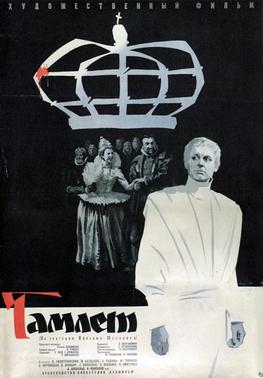
One of the main reasons Shakespeare remains timeless is that he can be shifted and adjusted through any society or perception and new riches will be discovered in his work. That’s why the, perhaps, greatest film version of Hamlet doesn’t even have an actual word of Shakespeare in it: Grigori Kozintsev’s epic, paranoia-tinged Hamlet with the dialogue translated into robust, poetic Russian by Boris Pasternak, takes huge liberties with the text but creates a richer, commanding and, above all, cinematic version of Elsinore than almost any other version yet made.

Kozintsev was a leading Russian theatre director who had written extensively on Shakespeare. He bought to his film both a brilliantly cinematic eye but also a comprehensive understanding of the play. Kozintsev’s Hamlet is filtered through Stalinist Russia. Where other Hamlets of the era focused on Freudian themes and the poet Prince, his Hamlet would be starkly, strikingly political.

Here Elisinore is a place devoid of privacy, where every word is overheard and every action watched. It’s controlled by Claudius as an eminence grise turned king, a smooth and assured political player who understands the machinations of power and the importance of appearance. Koznitsev’s rearranges Claudius opening speech into three discrete chunks. The first sees a herald reading out Claudius’ announcement of his wedding and the new regime to a crowded courtyard of peasants. We then cut to crowded room of Ambassadors of various European powers roaming, where we hear snippets of conversation each delivering a separate line from Claudius’ oration. Finally, the conclusion of the speech, and his plans for Fortinbras, is delivered by the king himself to a room of nodding courtiers. That’s imaginative cinematic translation of Shakespeare right there.

This is a Hamlet that lives and breathes the fear of living in an oppressive regime, under the thumb of a smiling autocrat. Mikhail Nazvanov’s Claudius charms but has a resolute, ruthless coldness behind his eyes. The court is drenched in paintings of the great leader – including one grand armoured horseback painting that looks like a Claudius head has been swiftly painted over his brother’s. Claudius controls all privacy in the castle: Koznitsev fills the film with shots of closing doors, lowered portcullises and a constant stream of background observers for every conversation. Only Claudius can gain solitude – tellingly he is the only character who speaks his soliloquy out loud, because he is the only character who knows for sure his words are for his ears alone.

This Elsinore is a castle where knowing too much is dangerous and the threat of being wrapped up in the wrong side of a purge is a very real one. Laertes’ aborted rebellion may see him forgiven – but the citizens who follow him to charge into the castle are escorted way, hands bound, never to be seen again. Claudius’ soldiers are increasingly visible presence in every doorway and corridor. When Hamlet unsettles the King with the Player’s performance, the courtiers practically fly away from the would-be dissident, as if worried that even the faintest contact could infect them with the same danger of exile and death that Hamlet is flirting with.

In this authoritarian production, our Hamlet is not the poet prince that so many Western productions at the time presented him as. Instead, portrayed with a chilling intensity by Innokenty Smoktunovsky, Hamlet is a dangerous man, filled to the brim with suspicion and resentment, who trusts nothing and confides to no-one. Rarely alone in this crowded Elsinore, he strikes a lonely figure, who finds isolation only on the cliffs staring out to the sea. His soliloquies are all internal voiceover monologues – less due to their internalised nature, and more that you feel he cannot risk speaking his feelings out loud (an impression created by his voiceover of his “Too, too solid flesh” speech delivered while Smoktunovsky moves through a crowd of courtiers).

Hamlet’s destructive bitterness is sparked by the Ghost. Cutting the first scene, Koznitsev introduces Hamlet and us to the Ghost at the same time. Unlike the smooth, ornately collared Claudius, the Ghost is an armour-clad rigid behemoth, his face almost completely obscured by his helmet. (There is a brief shot of his eyes which I would have removed – better that it had been kept completely distant from us). The camerawork stresses both its deliberation and size while Dmitri Shostakovich masterful score helps to build its sense of power and might (so effectively, that only a reprise of its theme is enough to suggest its reappearance to Hamlet later). It is a terrifying, other-wordly figure.

Smoktunovsky’s Hamlet barely ever raises his voice but has the intense determination of a man of natural action. Koznitsev has removed virtually every line that dabbles in doubt, uncertainty or hints even vaguely at delay. Smoktunovsky is merely biding his time for his chance at taking a hit at Claudius – a chance that will rarely come, in a court crowded with military protection for the King. He never forgives and even the slightest delay rouses him to anger rather than self-analysis. Koznitsev has trimmed out most of his lines with Horatio, who becomes an almost silent, scholarly observer and makes Smoktunovsky even more of a distant figure, liable to break out into dangerous violence at any moment, with no regard for the consequences.

The most visible of those consequences is Ophelia, who Smoktunovsky’s Hamlet uses coldly as a tool for probing the weaknesses of his enemies. Portrayed with a touching vulnerability by Anastasiya Vertinskaya, Ophelia is likewise never alone, unable to escape a crowd of duennas, who train her in dancing like a clockwork toy. Polonius (here an arch and scruple free political fixer, played by Yuri Tolubeyev) shows almost no interest in her at all, bluntly dismissing her and her distress when his need for her is done. After his death, she is literally locked into a metallic corset by her maids and covered by a gauzy funeral dress – even her clothes are cages. Her madness scene inevitably takes place in a room full of soldiers: even at the end she cannot escape the eyes of strangers.

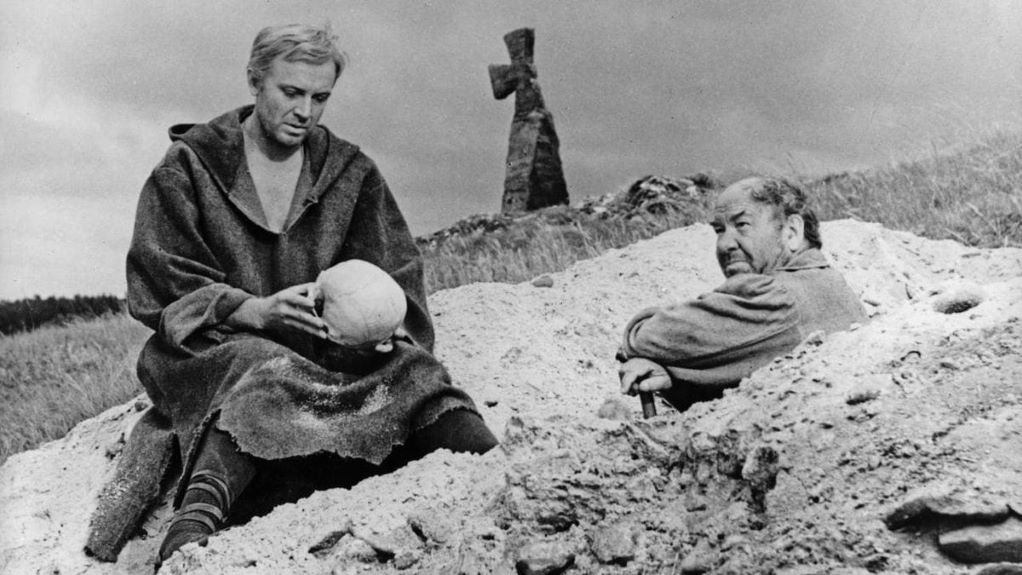
In the cold, Bergmanesque quality of Koznitsev’s film (the players, in particular, look like they have rolled in from The Virgin Spring), the stoney castle on the cliff (despite its renaissance, wood-lined interiors) is an imposing, terrible place. After the death of Polonius, Hamlet is dragged into (essentially) a show-trial (including a stenographer) before being dispatched to England. Rosencranzt and Guildernstern are empty-headed, ambitious minor officials who Hamlet displays not a moment’s hesitation in dispatching to their deaths. The only moment of reflection Smoktunovsky affords Hamlet is over Yorick’s skull – and even then, the cut suggests his focus is on the lost opportunities of great men. Certainly, Smoktunovsky’s grief over Ophelia is as much motivated by Laertes’ ostentatious show of public grief as sadness (and certainly not guilt, which he lacks entirely).

Koznitsev’s supremely visual film, beautifully designed and shot, reorders and reworks the text to maximum effect to continuously stress Hamlet’s highly political nature. It does mean characters like Gertrude fade into the background, but it repositions Elsinore highly effectively as a dangerous, ruthless place where life can be cheap. Like Stalinist Russia, the wrong word can condemn you and even our hero is as much a potential dictator as our villain. Hamlet is the most imaginative, revelatory and intelligently distinctive reading of the play on film, a production that interprets the play rather than just presenting it. It is a masterclass in adapting the Bard for the screen.

Watch the film here!

Alexander Nevsky (1938)

Alexander Nevsky (1938)

Eisenstein offers one of the great battle scenes in an epic that abandons his earlier style

Director: Sergei Eisenstein

Cast: Nikolay Cherkasov (Alexander Nevsky), Nikolay Okhlopkov (Vasili), Andrei Abrikosov (Gavrilo), Dmitry Orlov (Ignat), Vasili Novikov (Pavsha), Nikolai Arsky (Domash), Valentina Ivashova (Olga), Aleksandra Danilova (Vasilisa), Vladimir Yershov (Hermann von Balk), Sergei Blinnikov (Tverdilo)

And we think directors are under pressure in modern Hollywood. Eisenstein hadn’t made a film in ten years after an ill-fated tour in America, that largely left him under suspicion back home in the USSR. He’s patented montage directing style had been denounced as ideologically unsound. His last film had ended in over-budget disaster, in the aftermath of which the head of Mosfilms had been arrested, tried and executed for treason. Eisenstein was in the last chance saloon and told he could make one film. Imagine having Stalin breathing down your neck.

He picked, from a bundle of possible projects, Alexander Nevsky. A medieval Russian hero, Alexander Nevsky led Russia to historic military victories over the Germans and the Swedes. (He also had the freedom of history knowing almost nothing about Alexander beyond that). Alexander Nevsky would zero in on his victory over the invading Teutonic knights in the “Battle of the Ice” and present Nevsky (Nikolay Cherkasov) as a Russian Henry V, a legend who knew only victory, leading a unified Russia against a barbaric and cruel (German) foe. What better subject when Hitler was on the door?

Eisenstein was given a team of Stalinists to work with (to ensure he never strayed into his “formalist” style) as well as trusted cinematographer Eduard Tisse and legendary Soviet composer Sergei Prokofiev. The film would essentially be the build-up to the central battle, a propagandist celebration of the strength and unity of the Russian spirit against wicked invaders. (It’s easy to forget that Eisenstein was one of the greatest propagandaists ever.) Nevsky – seven-foot, shot often from below so he towered over the frame and played by Stalin’s favourite actor, the charismatic Nikolay Cherkasov – would be a clear stand-in for the USSR’s leader.

Alexander Nevsky is strikingly different from Eisenstein’s earlier films. Obeying strict instructions, it is shot in a more formal, almost operatic, style with longer takes and a greater dependency on camera set-ups than Potemkin or October’s use of editing and montage. This translates into the battle that makes vivid use of speed, motion and immediacy in front of a camera, with carefully timed-cuts rather than fast-editing ala Potemkin. It doesn’t prevent this being one of the most influential battles ever placed on screen. It serves as a clear structural inspiration for Olivier’s Henry V (right down to Nevsky and the knight’s leader taking part in a mano-a-mano fight in the middle of the battle) and its DNA runs through countless films that followed, right up to Jackson’s Lord of the Rings.

This is an all-out brawl, a mass of bodies and weapons piling into each other with the camera (and the viewer) in the middle. The soundtrack is drowned out in a barrage of clashing swords, and we frequently see our Russian heroes framed centrally and slightly from below in mid-shot, hewing away on all sides with swords, axes and spears. At times Eisenstein employs faster film – particularly for the movement of troops – but it’s striking how clear and lack in impressionism the editing is. There are no cuts to suggestive details or the sort of flexing hands on straining horse’s reins you might expect from his other work. Instead, narrative clarity and masculine patriotism is to the fore.

None of this stops the battle from being compelling. A furious back and forth on the ice which culminates (inevitably) in the ice breaking and many German foes sinking to the bottom of the river in their heavy armour. Eisenstein, the master propagandist, makes no attempt to humanise the Germans. The Teutonic knights are nearly to a man, steel-bucket-headed stormtroopers, impersonal robots who cruelly follow any orders. At the sack of Pskov, they toss children and babies into bonfires without a backward glance and think nothing of slaughtering the helpless. Their leader is an arrogant sadist, who faces capture with a whimper. He serves alongside hypocritical churchmen who bless the slaughter of innocents and conspire with turncoat Russian monks to subvert Novograd.

On the flip side, the Russians are united in nobility and determination. They are led from the front by Nevsky who places weapons in the hands of the peasants and motivates all around him with his wisdom, humility and courage. Cherkasov is hugely charismatic as this idealised leader – even if little is called of him as an actor other than inspired speeches and standing hands-on-hips in manly determination. He forms a bond with a brave-but-Falstaffian blacksmith (Dmitry Orlov) standing in for the ordinary Russians, who jokes about but (unlike Falstaff) fights like a tiger.

As do all the Russians. All disagreements are put to one side. Two nobles feuding over their love for the same woman form a bond of brotherly mutual respect on the battlefield. The bereaved daughter of a Pskov noble, straps on chainmail and fights in the frontline. Peasant and noble hold the line together. The most despised character is Russian traitor Tverdilo (a snivelling Sergei Blinnikov) who betrays Pskov, wheedles for advantage and (literally) stabs people in the back.

The battle – and the rest of the action – plays out to a stunning score from Prokofiev. At turns martial, terrifying, tension-filled and triumphant, Eisenstein cut portions of the film to directly match Prokofiev’s rhythms. He’s equally well-served by Tisse, who shoots the film with a mix of epic stateliness and visceral immediacy. Interestingly it’s in the editing that the film looks most primitive today. At one point in the battle the Germans move from right-to-left charge to left-to-right (a strangely disconcerting switch) while the clash between Nevsky and the Teutonic leader is disjointedly cut with obvious, jarring, jumps.

But then Eisenstein didn’t want to be accused to succumbing to this formalist style. Stalin was showed the film and loved it. Allegedly apart from one reel which was promptly utterly destroyed (or it was destroyed before he saw it, his acolytes anticipating his dislike – the story varies). The film was a huge hit – until Stalin signed a pact with Germany in 1939, at which point it was banned. When the Germans broke the pact in 1941, it was back with a vengeance, a stirring example to all Russians of the glory of fighting back against the aggressor, with it’s “don’t tread on me” message (which Eisenstein throws up in text on the screen) a rallying cry in a new patriotic war.

There isn’t much to Alexander Nevsky outside of the battle – it’s all build-up, battle and then tiring up of loose ends. There isn’t much in the way of characters – never a major interest to Eisenstein. But he did creep some things under the wire, not least an effecting end-of-battle sequence that sees the dead and dying Russians on the field whisper or call out the names of their loved ones quietly before they expire. But in a film as triumphant as this one about the indomitable might of the Russian people, Stalin could let that slide. Alexander Nevsky might be a simpler, less striking film than Eisenstein’s earlier work – but it’s still an influential piece of cinema.

Watch Alexander Nevsky here (why this video has a full colour image fronting it I have no idea…)

Further reading

As a quick note… A new feature I’m trying out here. Probably more for classic films than recent releases.

The Virgin Spring (1960)

The Virgin Spring (1960)

Revenge, violence but also a touch of hope abound in Bergman’s haunting Oscar winning classic

Director: Ingmar Bergman

Cast: Max von Sydow (Töre), Birgitta Valberg (Märeta), Gunnel Lindblom (Ingeri), Birgitta Pettersson (Karin), Axel Düberg (Thin Herdsman), Tor Isedal (Mute Herdsman), Axel Slangus (Bridge-keeper), Allan Edwall (Beggar), Ove Porath (Boy)

Spoilers: If you can spoil a Bergman classic, the full content of the film is discussed below

If a film cemented Bergman as the master of misery, it was his Oscar-winning The Virgin Spring. On the surface, a grim fable of rape revenge shot in wintery horror, it’s hard to imagine most people nerving themselves to watch it based on a synopsis. But they would be missing out. The Virgin Spring is, for all its hard-hitting violence and cruelty, a surprisingly hopeful film. Like the best of Bergman, it’s profoundly challenging, searching and operates on multiple levels – but rewards the viewer with splashes of strange optimism that feel a world away when it opens. It’s one of his truly great films.

Set in medieval Sweden, Töre (Max von Sydow, magnificently, chillingly grief-stricken) is a prosperous and devotional Christian farmer, in a cooling marriage to Märeta (Birgitta Valberg). The light of his life is his daughter, the beautiful Karin (Birgitta Pettersson). One day, Töre tasks Karin to travel to the Church (half a day’s ride) to deliver some candles. She travels with Ingeri (Gunnel Lindblom – bitter, damaged and brilliant), a pagan servant girl, heavily pregnant and resentful. Along the way they two are separated and Karin meets with three peasant brothers in the forest, who share her meal with her before the two adult brothers (Axel Düberg, Tor Isedal) rape and murder her. The brothers walk on and take shelter that night in Töre’s hall. When he discovers their deed, he murders them all (even the innocent youngest brother, a boy) then, horrified, pleads to God for forgiveness. At which point a spring, bursts forth where Karin was killed.

Not exactly a bundle of laughs. But this is powerful, compelling film-making from Bergman. His influence on horror has been overlooked, but The Virgin Spring show how much he inspired everything from shlock to The Exorcist. This is a tense, unbearably so, film which twice draws out the long build-up to shocking violence in a way that would make Sergio Leone proud. Played out in a beautifully moody, bleakly cold and wintery visual style from Sven Nykvist (his first collaboration with Bergman) and often in an atmospheric mix of silence and natural sound, you can feel your stomach knot as the inevitable transgressive act looms ever closer.

The film pulls no punches, while never being exploitative. The rape and murder of Karin (excellently played with just the right mix of innocence and spoilt certainty by Birgitta Pettersson) unfolds with a cold matter-of-factness, as she slowly realises these men are far more dangerous than she imagined. The event is hard-to-watch for its simplicity rather than its graphicness, and for the cold indifference of its perpetrators who act on a whim. It takes place almost in silence and the killing (mercifully off-camera) is more because they don’t know what to do next. Mix that in with the terrified stares of Ingeri from afar, and the shell-shock of the younger brother (who vainly tries to bury Karin with dirt before running away), makes a scene devoid of sensationalism but terrible to watch.

It’s reflected in the film’s later act of violence. The brothers having tried to pass off Karin’s blood-stained dress as their (imaginary) sister’s, sell it to Märeta (who instantly recognises a garment she stitched herself, even as she’s asked to admire the handiwork), are locked in the hall while they sleep. Töre’s slaying of them, however, never feels triumphant. Instead, the Christian Töre abandons his faith to embrace pagan revenge. Like a priest before a blood sacrifice he dresses himself in butchery gear, discards a sword for a smaller knife, carefully prepares the room for the brothers to wake and then sits, idol-like, in his chair waiting. This is a damning ritualistic insight into how our faith – the faith Töre was so proud of – can drop away to reveal our vengeful simplicity below.

The fight that ensues feels like something from the nether-regions of hell. One brother is skewered, arms wide, to Töre’s chair. Another is stabbed under Töre’s body weight – shot in a way reminiscent of Karin’s rape, with the flames of the fire dancing between them and the camera – his body left to burn in the fire. Their brother – a child – runs to Märeta for protection, yet Töre hurls him against the wall breaking his neck. There is no triumph. Töre speaks not a word – the brothers die having no idea who he is. Töre is left starring at his trembling hands in shock, as if waking from a dream not recognising the man he has become who turned his back on every article of faith he held dear.

It’s a film that shows the impact of grief and trauma. From the terrified face of the youngest brother – shovelling dirt on a dead body with tear-stained eyes – to Töre’s shell-shocked realisation his daughter is dead. Deep down, people blames themselves. Märeta believes she is being punished for envying Karin’s closeness to her father. Ingeri believes she has cursed Karin to suffer the same shame as her. Töre, perhaps, feels guilt at his own semi-incestuous closeness with his daughter. Why else does he struggle to bring down with his bare hands a new-planted birch tree (in beautifully haunting medium shot), cutting branches from it to flay himself in a sauna before he takes his revenge? It’s both punishment for past and future sins.

This is also a film that challenges us to decide whether brutal revenge is justified. The build-up to the murder of the brothers is very similar to the murder of Karin. A long meal, shared, even with similar food – so similar that the innocent younger brother vomits at the memories it brings back. This young boy is the death of innocence in this world. Betrayed into crime by his vile elders then forced to pay a terrible price for a deed he was powerless to stop and left him deeply distressed. How can we really triumph in Töre’s killing, when we see it performed so violently at such a price?

Bergman tests throughout how far faith goes, and questions what power God has. The film opens with two pleas, to two very different Gods. Ingeri pleads to Odin to punish the virtuous Karin, who in Ingeri’s eyes is a working rebuke for her wedlock-free pregnancy. Töre prays to a Dürer style carved cross for God to keep their household safe. Only one deity delivers: and rightly Töre will plead at the film’s end “You see it God, you see it…you allowed it. I don’t understand you.” Töre has even mirrored the rapists, in murdering an innocent. He repents later, but is a heathen in the moment.

Paganism is strong in The Virgin Spring. But it is not good. Ingeri separates from Karin when she meets a half-blind bridge-keeper, in a house full of ravens, in the wood. The man ticks every box for representing Odin and conveys dark promises of powers beyond mankind. But he is a vile, Devilish figure who takes an impish delight in cruelty and mischief. Ingeri’s departure from him coincides with Karin’s encounter with her killers – as if these demonic sprites had been conjured up by Odin to punish Ingeri by providing her with exactly what she asked for.

Why then is a film so grim, so cold, so difficult and challenging also feel strangely hopeful? Odin has won and Töre has turned his back on Christian faith to embrace cold, merciless, pagan violence. But as Töre pleads for forgiveness a spring bursts forth from below the point where Karin’s head lay. Suddenly, water pours out of the ground. Light bathes the clearing from above. Ingeri washes her face and hands, cleaning symbolically the parts of her that made those pagan pleas. Suddenly, from nowhere, the film presents an intense moment of spiritual hope that I found surprisingly moving. Rarely has something so grim, felt so cleansing at its close. Perhaps viewers need the simple, honest refreshing splash of water to help themselves after. That’s what helps makes The Virgin Spring difficult, uncomfortable but essential.