Category: Political drama

Ivan the Terrible Parts 1 & 2 (1944/46)

Ivan the Terrible Parts 1 & 2 (1944/46)

Eisenstein’s final film sees him bravely turn Stalin’s dream project into a criticism of his whole regime

Director: Sergei Eisenstein

Cast: Nikolay Cherkasov (Ivan Vasilyevich ‘the terrible’), Serafima Birman (Efrosinia of Staritsa), Pavel Kadochnikov (Vladimir of Staritsa), Mikhail Zharov (Malyuta Skuratov), Amvrosy Buchma (Alexei Basmanov), Mikhail Kuznetsov (Fyodor Basmanov), Lyudmila Tselikovskaya (Tsarina Anastasia), Mikhail Nazvanov (Prince Andrew Kurbsky); Andrei Abrikosov (Philip, Metropolitan of Moscow)

The Soviet Union is at war, but Sergei Eisenstein is riding high. Fully restored to favour with the powers-that-be in the USSR with his flashy-but-traditional propaganda pic Alexander Nevsky, the master-of-the-montage was personally selected by Stalin to direct a three-part epic on the dictator’s hero, Ivan the Terrible. (You might wonder what attracted the paranoid, bloodthirsty dictator to a strong man Tsar best known for ruthless purges…) Stalin wanted an epic painting Ivan as a hero, who sometimes did bad things for the right reasons, all wrapped up in a neatly accessible package.

And he almost got it. Part 1 was met with acclaim and the Stalin Prize. Presenting Ivan as a successful politician and soldier, a true strong man binding the nation together and winning the admiration of his people, outfoxing his enemies at court (even though they successfully secretly murder his wife Anastasia), who retreats into Cincinnatus-like retirement only to be dragged back to save the country. It was the General Secretary’s wish-fulfilment wet-dream. Then came Part 2.

Part 2 was was immediately locked away in the vaults and all work on Part 3 ended instantly (every frame of footage shot was burned). If Part 1 was the dictator’s ideal Ivan-as-Stalin, then Part 2 was Ivan-as-Stalin that he definitely didn’t want to see. Now Ivan was ‘the Terrible’ doubling down on his nickname. Even worse, he did this while appearing unhinged, paranoid or (worst of all) manipulated by his poisonous advisors, none more so than jovial Beria-like Malyuta Skuratov (Mikhail Zharov). This Ivan rubbed out opponents, used terror as tool and focused all his anger and vengeance on those around him. Not something Stalin wanted to see, or was going to let anyone else see. Part 2 only emerged in 1958 ten years after Eisenstein’s death and 5 years after Stalin’s.

What the world ended up with, after they were allowed to see it, is a strange and hard-to-categorise film which has divided opinion for decades. To some it’s an artistic masterpiece, a triumph of symbolism and suggestion, with every shot crammed with intelligent and informed call-backs to artistic, psychological or sociological thinking. To others, it’s a somewhat turgid, hard-to-follow mess that serves as final expression of Eisenstein’s lack of interest in plot and character, not helped by his directions to the cast to echo Japanese theatre Kabuki style acting full of striking poses.

But you can’t deny the courage it must have taken Eisenstein to make this film. To have the guts to present something that deviated away from what history’s most ruthless dictator wanted and try and locate in it an unavoidable (if soft-pedalled) criticism of Stalinism. And can you blame Eisenstein if he tried to hide some of this behind art references and psychological games? Ivan the Terrible isn’t exactly easy – or fun – watching, but sometimes you just need to tip the hat to someone who has the guts to do things like this.

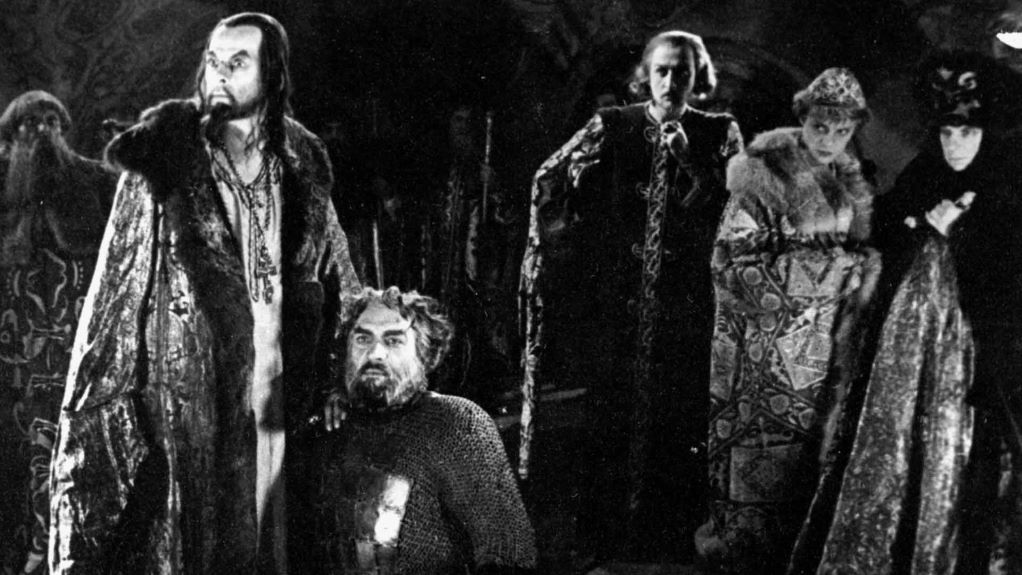
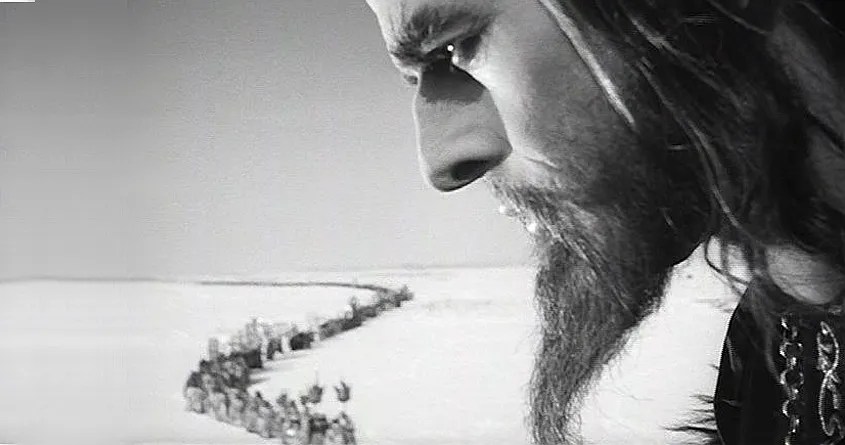
And there is plenty to admire in it. Eisenstein isn’t always recognised for his ability with the composition of shots – after all he’s the fast-cutting director’s dream – but Ivan the Terrible plays right back to his roots as a painter and designer. There are gorgeous shots here, my favourite being a looming close-up of Ivan’s face while behind him a never-ending procession of Russians slog through a white-out landscape to beg him to take back the throne. Ivan’s palace is a subterranean series of mole-like caverns, lavished with truly striking (and highly symbolic) devotional art. Firey angels are plastered across the walls above Ivan while plotting Boyars are shot huddled under mighty frescos of Death. The shadow work is extraordinary: light casts imposing, monstrous, giant black curtains. Astrolabe shadows dominate walls and advancing figures cast mighty shady pools in front of them.

Eisenstein takes his montage and arty suggestiveness of his editing work in Battleship Potemkin and October and translates it into images. The images do the work his banned formulist leanings had. Every image is rigidly thought-through and designed to make a specific implication or inference. It turns Ivan the Terrible into something ripe for analysis and exploration, the sort of film you could happily spend hours deconstructing.

It’s a film crammed with symbolism – some of it, if I’m honest, a little too clever-for-its-own-good. There are references to the work of Holbein, Botticelli, Rublev and a host of mythological figures. Sexual imagery is thrown in with blasting cannons at the siege of Kazan. It uses mirroring and contrasts throughout. Ivan’s coronation that opens in Part 1 will be echoed in a mock coronation of his would-be successor Vladimir (a fine performance of child-like simplicity and sweetness from Pavel Kadochnikov) in Part 2. As a child, Ivan will witness the death of his mother caught in the light of the doorway, very similar to the light in the doorway Vladimir will walk through to his death.

Characters are constantly positioned in framing that suggests (or hammers home) their personalities, motivations and desires. Vladimir will be cradled in his arms in a confessional Freudian clinch with first his mother and then (in an identical shot) with Ivan. The mock jovial Malyuta is given the physicality of the faithful dog he claims to be, while the villainous Efrosinia (a pantomimic, hissable Serafima Birman) rises from the ground like the serpent she feels like in almost every scene. Most of these characters are drawn in the broadest, most unsubtle strokes. It makes for some laughably unsubtle moments, but also a sort of primitive energy.

Unfortunately, it is also a film that dumps traditional narrative and characterisation for something highly stylised and impressionistic. Nowhere is this clearer than in Nikolay Cherkasov’s performance as Ivan. Constructed of a series of wild-eyed poses that would not look out of place in a silent movie, this is an over-the-top performance of hyperbolic mannerisms that probably has to be seen to be believed. There is nothing natural about this at all. It is all deployed to create a series of artistic poses and effects: what it is not designed to do is create a character we can relate to or understand.

Maybe this is how Eisenstein hoped to get away with implicit criticism of Stalinism? Ivan endorses the purges that happen, but we don’t seem him organising and initiating them. Was that, to Stalin, the worst crime of all – after all a strong man leads, even if his leadership is cruel. It’s also why, perhaps, he turned Malyuta into a jovial fixer (nevertheless Mikhail Zharov gives the film’s finest performance) rather than the ruthlessly ambitious killer he was. Part 2 shows an Ivan who allows executions not just out of ruthless paranoia but also a weakness of personality. Of all things, Stalin couldn’t take that.

Ivan the Terrible rockets along with very little sense of time, narrative or coherent, logical sense. Between the first and second scenes not only do years go by, but Cherkasov’s appearance changes so much it will take the viewer a few minutes to work out who he is. Characters sometimes go several scenes without being named. There is a Shakespearean pace to the narrative, even if it frequently flies over events, motivations, timescales and locations so quickly it’s hard to follow. It’s highly stylistic acting styles frequently make it hard for modern audiences not to raise a snigger.

Eisenstein was perhaps a little too keen to be seen as an artist, and Ivan the Terrible is at times – a bit like October – watching an overly enthusiastic art student showing you just how clever they can be. But, for all that, it’s intriguing and even if it’s not exactly entertaining, it offers many opportunities for intriguing analysis. And the very fact he dared to make a film that criticised Stalinism and then show it to Stalin is always going to be worth something.

The Leopard (1963)

The Leopard (1963)

Possibly the most luscious film ever-made, Visconti’s epic is a beautiful film of rage against the dying of the light

Director: Luchino Visconti

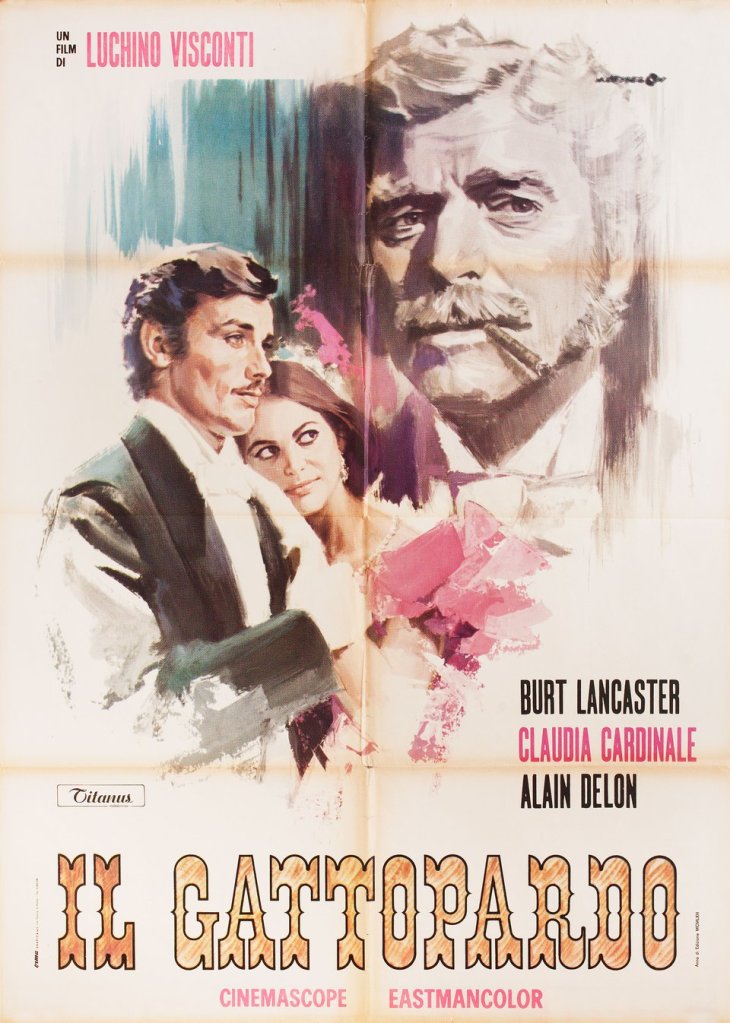
Cast: Burt Lancaster (Don Fabrizio Corbera), Alain Delon (Prince Tancredi Falconeri), Claudia Cardinale (Angelica Sedara), Paolo Stoppa (Don Calogero Sedara), Rina Morelli (Princess Maria Stella of Salina), Romolo Valli (Father Pirrone), Terence Hill (Count Cavriaghi), Serge Reggiani (Don “Ciccio” Tumeo), Leslie French (Cavalier Chevalley), Pierre Clémenti (Francesco Paolo Corbera), Lucilla Morlacchi (Concetta Corbera), Ida Galli (Carolina Corbera), Ottavia Piccolo Caterina Corbera)

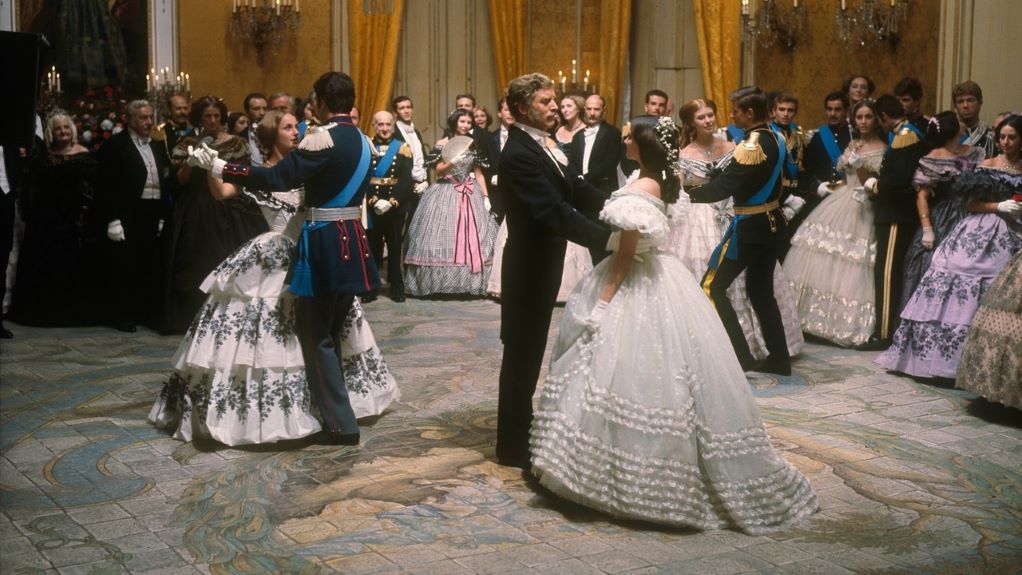
There might not be a more visually ravishing film than Visconti’s The Leopard. Every detail of costume and set design is perfect in this gloriously stately, carefully crafted adaptation of Giuseppe Tomasi di Lampedusa’s only novel. It’s a perfect match for the autumnal melancholy of Visconti’s elaborate work, as an ageing prince in the Risorgimento rages quietly against the dying of the light. The Leopard is a delicate and carefully-paced film that carries a sweeping romanticism.

It’s 1860 and if the Sicilian aristocracy “want things to stay as they are, things will have to change”. Italy is forming itself into a nation and Sicily is in a state of civil war. On one side, the forces of the revolutionary republican Garibaldi – on the other, the old-guard of Francis II of the Two Sicilies, clinging to keep Sicily part of the Bourbon empire. Watching all this, Don Fabrizio Corbera, Prince of Salina (Burt Lancaster), scion of a noble family, watching the inevitability of change but clinging to tradition. His nephew Tancredi (Alain Delon) embraces first the fervour of Garibaldi, then Angelica (Claudia Cardinale) the radiant daughter of nouveau riche Don Sedara (Paolo Stoppa). But is there a place for the prince in this new world of democracy and the power of the middle classes?

The Leopard hails from the same wistful remembrance of things past that powers Brideshead Revisited in the English language. In Visconti, son of Milanese nobility, it found its perfect director. Visconti didn’t just know the world behind the declining place for the nobility: he’d lived it. He brings every inch of that to the luscious beauty of The Leopard, a mournful final hurrah of a generation and way of living that has no place in the present and is only an echo of the past.

The Leopard is crammed with simply stunning period detail. Visconti shoots this with a calm, controlled, observant camera, that moves and pans slowly through sets, carefully following its players. It’s set in a world of elaborate drawing rooms and stunning vistas. Costumes are intricate in their period detail. Dinners are grand celebrations of the opulence of this bygone era. Every detail in the set is perfect to the minutest detail – you feel a drawer could be pulled open and only period-appropriate props would be contained inside.

Visconti though never makes the film a slave to its period trappings. The careful details of the prince’s life serve to stress how bygone and dying these days are. It’s a film full of moments of small but telling undercutting that stress how this world is crumbling. In church, wind blows dust across the gathered Corbera family, coating them in dirt. They mock the newly empowered Don Sedara – and the pompous chap’s ineffectiveness is hammered home when a band keeps interrupting his attempt to declare the results of a rigged unification plebiscite – but Fabrizio is desperate to secure a marriage alliance with him and it’s clear Sedara is very much in the political ascendancy.

Could Fabrizio have done more to preserve his way of life if he wasn’t so clearly entering the twilight of his years? He’s virile enough, dashing from the family home (priest in tow) to spend a night in town with his mistress. He can climb the hills and hunt with the best of them. He half considers that it’s not outside the realm of possibility for him to have a crack at Angelica himself. But this is truly the Lion in Winter. He’s powerless to defend the traditional position that guarantees his influence and lacks the drive and youth Tancredi has to fashion himself a new one. For all his wry wit and handsome features, he becomes a sweaty, mournful figure at a celebration ball watching the young people dance all night and musing on where his own vitality went.

That long ballroom sequence – a near 45-minute extended scene that ends the film – is one of the triumphant tour-de-forces of cinema. A gorgeous culmination of the beauty of the entire piece, Visconti also manages to present it as a final hurrah of a whole way of life. This celebration is crammed with military figures who call the shots and filled as much with older people struggling to keep the pace as it is young ones with an eye on something far more modern than the pleasures that thrilled their parents. At the heart of this, Visconti’s camera carefully follows the prince as he moves from room to room, a quiet, lonely observer, tears in his eyes at moments, reflecting on his mortality and rousing his youthful fire only for a single dance with Angelica.

As this rusting monument to the old ways, Visconti was gifted with a Hollywood star. To be honest, at first he was far from happy when he received Burt Lancaster. But – once you get over the oddness of Lancaster being dubbed by a plummy Italian accent – it’s a near perfect marriage of actor and role. Always a graceful and elegant actor, Lancaster becomes Italian – there is more than a foreshadow of the Godfather to him – and his genteel, noble face is perfect for this bastion, just as his expressive eyes are perfect for the part’s delicacy and sadness. It should be a bizarre miscasting, but it lands perfectly and much of the success of the final ball sequence is his ability to communicate so much from such small moments.

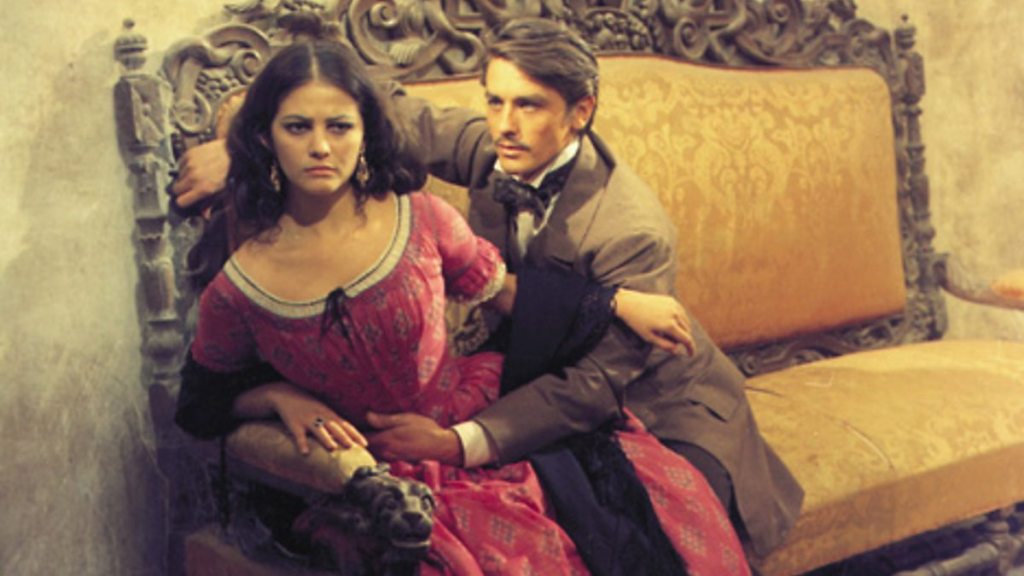
Visconti places him at the heart of this languid, precise film and contrasts the prince’s gentle moving out-of-step with the future with the dynamism and openness to compromise of his nephew. Tancredi – a youthful and passionate Alain Delon – is energetic and with a casual ease switches passions personal and political. Starting the film as a red-shirted revolutionary, he ends it as a uniform-clad member of the elite. Professing his love for the prince’s daughter, he ditches her on a sixpence for Angelica. Not that anyone can blame him: Claudia Cardinale is gorgeous but also shows the elemental charisma that Leone was to use to such great effect in Once Upon a Time in the West. Cardinale also feels like someone between two eras: attracted to the casual and flexible Tancredi but perhaps more drawn to the elegant grandeur of the prince.

The Leopard works as extraordinarily well as it does because it is so well paced. This is a film that requires an inordinate length, lingering shots and scenes, and for action to be happening elsewhere. Our single burst of action is to see Garibaldi’s forces fight in the streets of Palermo: other than this, momentous events happen elsewhere off-screen. The camera moves instead to study the scenery or the passing of normal people on the streets. We are always given the sense of this family and its world being cut off and left behind by real events. Tancredi starts the film explaining his conversion to Garibaldi in detail: later he will barely mention why he’s changed uniforms or feel the need to say why he is accepting positions the revolutionaries reject.

It’s not a surprise that a cut-down version of The Leopard was a major bomb when released in America. The three-hour run time is needed to truly understand the drift and ennui Visconti’s film is exploring. It does it in a film dripping with gorgeous period detail and full of scenes awash with interest, but the point is this is a film of slow, deceptive but finally overwhelming impact. The quiet, controlled, predictable life that generations of the prince’s family has known, dies with the same polite, grand silence as it largely lived. The Leopard is a stunning tribute to the passing of an era.

Women Talking (2022)

Women Talking (2022)

A worthy attempt but a misfire, that frustratingly fails to grapple with deeper feminist issues, settling for a safer, less challenging consensus

Director: Sarah Polley

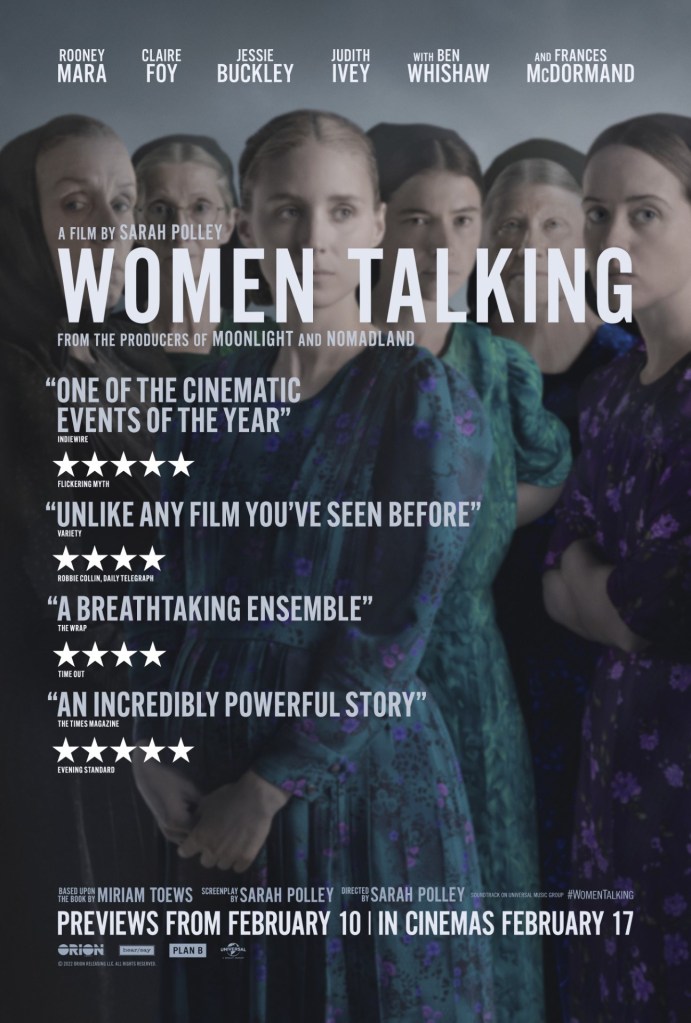
Cast: Rooney Mara (Ona), Claire Foy (Salome), Jessie Buckley (Mariche), Judith Ivey (Agata), Ben Whishaw (August), Frances McDormand (Scarface Janz), Shelie McCarthy (Greta), Micelle McLeod Mejal), Kate Hallett (Autje), Liv McNeil (Nietje), Emily Mitchell (Miep), Kira Guloien (Anna)

In 2010, the women of an isolated Mennonite community discover they have been victims of a policy of systemic drugged rape by the men, every night for decades. All this remains unknown until a man is caught in the act and the attackers arrested. The other men go to the city to bail them out, informing the women they will be expected to forgive on their return. The women hold a vote about what to do: do nothing, stay and fight or leave. When the vote is tied between the latter two options, the women decide the final choice will be in the hands of a small group of their number, who will debate in the community’s hay loft.

All of this happens, in voiceover, in the film’s opening few minutes. It all sounds more engaging, challenging and dynamic than what actually happens in the film. I saw Women Talking with my wife, who is passionate about the issues this film wants to deal with. We were both united in our view of the film: Women Talking is full of talking, but no one really says anything. It’s a missed opportunity that fails to convert its undeniably powerful premise – or the committed and passionate performances of its cast – into something that really successfully grapples with, and comments on, the issues, with a cast of characters who feel more like devices than fully-rounded people discovering their voices and freedom.

It’s a film that should have the urgency of a time-bound debate and the passion of a group of women discovering that they have the power to make decisions themselves. But the film feels slow (much longer than its two hours), flat and theoretical where it should be filled with debate and different ideas. It has moments of power and speeches of tragedy, but it doesn’t manage to make this something truly revolutionary.

The film would have been more interesting if it had been about everything covered in that opening monologue. In this community the women are kept illiterate, have never been allowed to be part of any decision-making and are so oppressed they don’t even have language to understand what sexual assault is. There was a fascinating film waiting to be made about these women working out exactly what had happened to them – imagine the heart-rending conversations that must have involved – and discovering they were just as capable of reaching decisions in their own right as men. Of finding their voice and freedom.

Now that is a film about feminism I want to see! I wanted to see these women who have never even considered ideas about independence and self-determination discovering they could do that. Just having a vote in a community like this one is an astonishing revolutionary act – it shouldn’t be so blandly passed over as this film does. How did these women even realise that they could decide for themselves what they to do with their lives?

Instead, we get a film where actual debate is surprisingly neutered. Frances McDormand’s character is the voice of conservatism, but walks out of the debate after five minutes and never comes back. With her gone, no counter-arguments are raised, no voice given to help understand why people (and many of them have done so) would choose to stay in relationships even after they know the truth. McDormand’s character is almost certainly wrong – the women should get out of this awful place – but we should at least hear her say why she wants to stay and the film should trust us to understand that listening to her viewpoint isn’t the same as agreeing with it.

In fact, it would have been fascinating to hear why so many women in the community heard about the systemic rape and yet voted to stay. The hay-loft debates should hum with the exchange of ideas. We should hear different viewpoints. Many people voted to stay and do nothing: why? Let’s hear what makes these women accept what’s happened to them. Are they institutionalised, love their husbands despite their faults or can’t imagine leaving their homes no matter the cost? We don’t know. It’s like the film makers were worried that a debate which actually included all potential viewpoints would have been seen as reducing the horror. In reality, however, it’s essential.

There is also a fascinating discussion to engage with about justice and forgiveness – particularly given the film’s setting in a religious community that preaches forgiveness. The men have demanded the women forgive. Ona (Rooney Mara) declares early on that forced forgiveness cannot be real. But instead of engaging with this, that throwaway is all we get. It’s a deep question which we often grapple with in the wake of terrible crimes. Whole books have been devoted to people who can or cannot forgive those who’ve committed terrible crimes against them or their loved ones. There’s so much this film could have delved into with its cast of women who’ve been told all their lives they must forgive – but it had no interest.

Instead, the film wants to make things easy. It completely shirks any debate of religion. This is a community of women whose entire understanding of the world is founded on the Bible and religious instruction. But yet God, faith and Christian ideas barely come up. It’s briefly mentioned that leaving the community means exile from heaven – but that is benched and never raised again. It should be at the heart of their considerations. There isn’t even a debate about whether their community’s teachings are legitimate (since they are partly based on systemic rape, we can guess not).

In the end rather than really tackling themes, we get conversations which do little but make the same point over and over again. Some of these speeches are undeniably powerful, and the performances of Foy and Buckley in particular are strong, but they are weakened by the lack of depth to the characters.

Women Talking is full of words but never says as much as you are desperate for it to do. The actors do a fine job with the passionate speeches and bring a lot of power to this chamber piece. But it’s frustrating that we feel robbed of seeing these women realise they have the power to choose and instead circles a highly emotive but ultimately slightly unrevealing discussion intercut with on-the-nose shots of fields, playing children and empty kitchen tables. It manages to avoid focusing on anything potentially interesting or engaging and feels like a worthy missed opportunity.

Do the Right Thing (1989)

Do the Right Thing (1989)

Spike Lee’s masterpiece is still frighteningly relevant today – and stunning film-making

Director: Spike Lee

Cast: Spike Lee (Mookie), Danny Aiello (Sal), Ossie Davis (Da Mayor), Ruby Dee (Mother Sister), Giancarlo Esposito (Buggin’ Out), Bill Nunn (Radio Raheem), John Turturro (Pino), Richard Edson (Vito), Roger Guenveur Smith (Smiley), Rosie Perez (Tina), Joie Lee (Jade), Steve White (Ahmad), Martin Lawrence (Cee), Leonard L. Thomas (Punchy), Christa Rivers (Ella), Robin Harris (Sweet Dick Willie), Paul Benjamin (ML), Frankie Faison (Coconut Sid), Samuel L. Jackson (Mr Señor Love Daddy)

When it was released in 1989 it was like a punch in the solar plexus. Spike Lee’s third joint was a powerful, dynamic and deeply thought-provoking and challenging piece of cinema. This demanded you sat up, took notice and understood that underneath the happy lies America tells itself, the country was deeply divided and a tinderbox waiting for a spark. Perhaps the most painful – and shocking – thing about Do the Right Thing is how little has changed. You could make the same points today and the film’s tragic ending in police brutality, violence and uneasy truce could be repeated in the headlines as readily tomorrow as it was in 1989.

Set on one swelteringly hot day in New York City, Lee’s film is a kaleidoscope of diverse lives in the predominately Black neighbourhood of Bedford–Stuyvesant in Brooklyn. Just about the only people here not Black are Pizzeria owner Sal (Danny Aiello) and his sons Pino (John Turturro) and Vito (Richard Edson). Working for Sal is Mookie (Spike Lee), drifting through life but determined to get paid, who has a son with Tina (Rosie Perez). In this neighbourhood anything could be a spark. Perhaps it will be Buggin’ Out’s (Giancarlo Esposito) objection to Sal’s pizza parlour ‘wall of fame’ being exclusively Italian? Perhaps the bored kids schlepping around the street? Maybe imposing Radio Raheem’s (Bill Nunn) ghetto blaster constantly pumping out ‘Fight the Power’? Or will it because of the Korean convenience store owners, or the police officers who ride into the neighbourhood like it’s a war zone?

What’s really striking about Spike Lee’s film is it is neither polemic nor hand-wringing exercise. Perhaps what really outraged people in 1989 when it was released – let’s not forget it’s the year the vaguely similarly themed but deeply reassuring Driving Miss Daisy won Best Picture – was that it offered no answers. Instead, it holds a mirror up to America for a long, uncomfortable, look. While other films presented racism as a journey towards peace, Do the Right Thing shows it as a systemic problem with no easy solutions. Any reconcilement is tentative or grudging at best, few lessons are learned and there is very little sign that this won’t all happen again.

Lee’s film is an electrically confident piece of film-making. It’s also amazing what a glorious mish-mash of styles Do the Right Thing is. You get everything from music video to action set-piece, kitchen-sink drama to comic book dutch angles, soft porn to comedy, odd-couple romance… Almost every scene as it moves around its smorgasbord of characters takes an influence from a different genre, held loosely together by Samuel L Jackson’s 24/7 DJ Mr Señor Love Daddy. But never once does one scene jar up against another or does the general impact of the film feel blunted.

Perhaps it works because the entire film is awash in the messy unpredictability of life and the simmering resentments hidden below the surface. Sal and his sons are awkward fits in the neighbourhood, legacies of a bygone age – a whole other generation of usurped immigrants – keeping an uneasy truce with their customers. Not that there are obvious lines drawn here: John Turturro (in an excellent performance of great depth) plays a racially aggressive man, fascinated with Black culture. Sal, superbly played by Danny Aiello, balances genuine affection for some customers with baseball-grabbing antagonism for others.

It’s sometimes hard to tell what they might face, as the Black community is widely disparate in its feelings. (Spike Lee has written critically of the tendency by some to lump “Black people” together into a homogenous lump). There are stark generational. Da Mayor – a superb Ossie Davis, stumbling, well-spoken and ineffective – and Mother Sister (a sensational Ruby Dee), the neighbourhood matriarch, belong to an older era of Civil Rights, Malcolm X and MLK. The younger generations – those kids bombing loudly around the neighbourhood, including a young Martin Lawrence – don’t give a toss about their legacies and are barely interested in the world around them. Others, like Buggin’ Out (a firecracker Esposito), speak a semi-coherent collection of political phrases, mixed in with righteous but largely pointless anger about trivial events, that most people ignore.

In the middle of all of this, Lee himself plays Mookie, an everyman character for Black America, young, drifting, uncertain about where he is going. Mookie shirks fatherly duties – Tina literally has to order a pizza from Sal to get him to visit – and often does little more than punch-clock. But he also offers a fine, level-headed understanding of the various personal and community clashes around him. He’s an effective sounding board for every character, listening carefully and constantly torn about what doing the right thing might mean.

There is a sort of brilliantly brave ambiguity around Do the Right Thing. There are no heroes, only people, warts and all. Casual fights are picked but not seen through – like Buggin’ Out confronting John Savage’s well-to-do commuter for scuffing his trainers. The kids demean Da Mayor as a drunk wash-out who never made anything of his life (perhaps, subconsciously, worried his present is their future). Racial prejudice works every way – in one of Lee’s many flourishes, several characters (Mookie, Pino, a Hispanic man, a police officer and Sonny the Korean shop-owner) break the foruth wall to speak a flurry of racial insults to Italians, Blacks, Hispanics, Asians and white Americans, giving vent to private feelings, but also showing how close these are to the surface.

Do the Right Thing is made up of a series of brilliantly sketched vignettes as its many characters mix and mingle over the long day, some sharing insights, some butting heads. The film zigs as much as it zags – Mookie confronts Pino’s racism not with anger but calm, reasoned discussion. Our three breeze-shooting old timers are as irritated at the loud and brash kids as they resent the cops. Heavy-set Radio Raheem (a stoic Bill Nunn) puts aside his ghetto-blaster to talk about love beating hate. That ghetto blaster will exact a heavy toll.

It’s at the heart of the explosion of violence that caps the film. It’s tragic that the police violence which ends the film – and the resulting riot – is still no stranger today. A troublemaker meets a death far exceeding their crime by being effectively lynched by the police in a choke hold (Lee cuts to his feet twitching in the air, as he is lifted by a truncheon around the neck). This police murder (and the police flee the scene, taking the body – and the evidence – with them) slams the political message home. People are flawed, tensions are high – but no one does anything even vaguely approaching deserving death, and the fact the authorities ‘resolve’ problems through brutal force is everything that’s wrong with America.

But Lee is not one to excuse all violence. The mob – and it becomes a mob, with Lee not afraid to show cash tills being looted as well as furious, righteous anger – nearly turns on the Korean shop next, seemingly for no other offence than being foreign. People we would never expect, scream passionately for the world to burn. But then, Lee also makes the key point: when the world is as unjust and dangerous as this, isn’t the right thing sometimes to let out a primal scream. After all, what is a building when weighed against a man’s life?

What is the right thing to do? It’s a complex message the film grapples with. Mookie arguably starts the riot – or at least directs its anger – with a window smash. But by doing so, he also side with his community. In many ways it is the right thing to do. After all, Sal started the spiral by responding to intense, loud baiting with a flurry of racism. Mookie is, in some ways, a fixed labourer – Sal, for all his affection for Mookie, can’t imagine a world where Mookie won’t be working in his pizza parlour – and siding with the crowd is a defiant assertion of his independence and identity.

It’s just a flavour of the complex and challenging ideas in a film that avoids easy answers. As Sal and Mookie, the next day, stand in the ashes neither of them willing to forgive and forget, but also neither of them wanting to return to violence, they stand like representatives of America, struggling to process its race-related history. It’s a million miles away from the easy messages and gentle fixes of liberal Hollywood. Tension here settles for coexistence – but acknowledges that explosions of rage and anger are an inevitable part of that. That’s not a message America wanted to hear in 1989 – hell its barely one it wants to hear today – but it’s a powerful part of this landmark masterpiece.

Battleship Potemkin (1925)

Battleship Potemkin (1925)

Revolutionary in more ways than one, this masterpiece still carries a real punch today

Director: Sergei Eisenstein

Cast: Aleksandr Antonov (Grigory Vakulinchuk), Vladimir Barsky (Commander Golikov), Grigori Aleksandrov (Chief Officer Giliarovsky), I. Bobrov (Young sleeping sailor), Mikhail Gomorov (Militant sailor), Aleksandr Levshin (Petty Officer), N. Poltavseva (Pince-nez woman), Lyrkean Makeon (Masked Man), Konstantin Feldman (Student agitator), Beatrice Vitoldi (Woman with baby)

If you have any doubt whether you have ever seen a film influenced by Battleship Potemkin I’d direct your attention to just one sequence. No, not the Odessa Steps. Instead: we’re on the deck of the Potemkin. The tyrannical captain has reacted to a complaint about the mouldy meat by demanding everyone refusing to eat it is shot. In a series of swift edits, mixing shots of the soon-to-be-victims, the marines who will do the shooting, different angles of the ship, we keep cutting back to Sailor Vakulinchuk’s face. What will he do? Will he protest? If you have ever seen a film build a violent crescendo with repeated cuts to a hero torn on taking action, you’ve seen something inspired by Battleship Potemkin.

It was made to celebrate the 20th anniversary of Russia’s first go-round for revolution, the series of uprisings that nearly overthrew the Tsar in 1905 (and led to him caving and allowing a degree of political representation anathema to him). Sergei Eisenstein, with the highly praised film Strike under his belt, was selected to direct. Eisenstein was offered a script full of events, but just one really spoke to him. That revolt of the sailors of the Potemkin, off the coast of Odessa. This was something he thought he could make a movie about! Eisenstein ditched nearly the whole of the script to focus on the class struggle between the sailors and workers and the faceless Tsarist system.

Battleship Potemkin would be a showcase for Eisenstein to expand the possibilities of editing images, cross-cutting to suggest inferences between events and characters. It’s no accident we cut so swiftly, and so often, from the maggot-filled meat the sailors are given and the stubbly, smug faces of the officers who insist the meat is edible. It’s pretty clear those maggots aren’t the only parasites aboard ship. The guns of the Potemkin are returned to time and again, dominating and dividing the frame or serving constantly as a reminder, first of the oppressive Tsarist regime, then of the heroic defiance of the sailors when faced with the Tsarist fleet sailing towards them.

Eisenstein’s mise-en-scene would become unimaginably influential. Not least because Battleship Potemkin is the most effective propaganda film ever made. It is impossible not to feel complete kindred with the sailors – all humble, honest, stoic Russian types, roused only to action by repeated provocation – and to despise the officer class, puffed up, dripping in elaborate uniforms, sneering at everyone, twirling moustaches over stubbly faces.

The film is shot time and again to present the sailors and the crowds in Odessa as a single, unified force. It’s rare where one of them appears alone – only reaction shots which capture their individual resolve (and, later, horror) – and they are mostly presented as united in purpose. In particular, Eisenstein shoots the citizens of Odessa as a near never-ending flow: they pour down the streets and steps (in a disciplined, respectful, mass) and fill the pier leading to Vakulinchuk’s makeshift grave. They work together and collaborate on tasks. On the other hand, the officers are frequently shot alone, either in close-up to stress their monstrous features or to capture their spittle-filled rants.

The sole exception is that meat-grinder of sabres and bullets that chews through the crowds at the Odessa Steps sequence. Here these soldiers – the brothers who don’t rise up but carry out the cruel, sadistic orders of their superiors – are barely human at all. There is no trace of personality or individuality in them. The features Eisenstein cuts to most are their marching feet, striding inexorably forward over bodies like a machine, and the bayonet tip of the rifles that relentlessly pour bullets into the crowd. If Bolshevism is a mass of individuals working as a coherent whole, then Tsarism is a brutality where the only faces are scornful and cruel officers.

The eventual coup of the sailors is masterfully cut together, fast-paced and overwhelmingly modern. It’s another indicator of the huge influence Battleship Potemkin has had on the grammar of modern filmmaking. As we watch Vakulinchuk and his fellows fight the officers, chasing them across the deck, scrabbling for weapons and the final duel between Vakulinchuk and Commander Golikov, its only the silence and black-and-white imagery that really distinguishes it from a similar end sequence in Avatar: The Way of Water. Battleship Potemkin can lay claim to being the most influential action film ever made, it’s use of fast-cutting to build tension, empathy and the imposing terror of seemingly insurmountable odds in a hostile environment second to none.

Editing and montage was central of Eisenstein’s technique – and you can argue that camerawork, character and (sometimes) narrative were secondary. Battleship Potemkin works as well as it does because it is an experience film. Its characters are ciphers, all of them Marxist tools towards an end effect. Eisenstein’s film is one of cuts designed to bring pace and rhythm, to project and create a visceral emotive reaction. He is very different from other silent directors who used the camera as a viewing tool, mobile and flowing. His movement comes from fast edits and quick cuts. Battleship Potemkin is modern in the sense that its finest sequences are a dizzying array of cuts and quick shots, that continue to influence action films today.

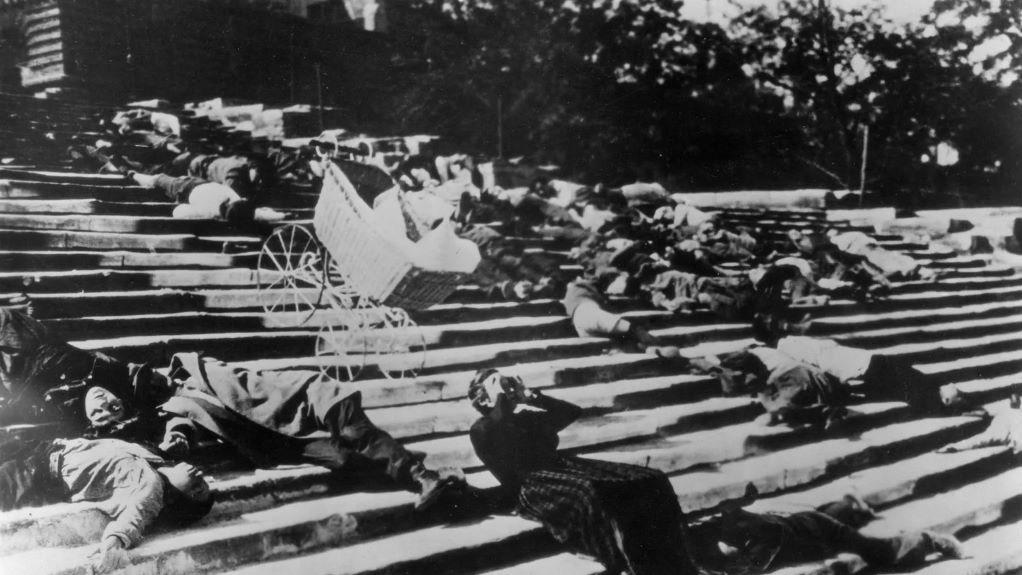
Which brings us, of course, to the Odessa Steps. Does it matter that this never happened in real life? Eisenstein essentially takes the 1905 Bloody Sunday massacre at the gates of the Imperial Palace in St Petersburg and transposes it to Odessa. It captures the mood of the time. Edits build in intensity – and swiftness – to highlight the growing tension and then explosive terror when the guns start firing. People flee in terror – one of the few tracking shots in the film follows the descent first of people, that that famous pram – down the steps. Reaction shots show a horrified mother, an older woman pleading for peace and a furious student radical.

And the furious intensity of the montage helps communicate the rampage. Careful cutting highlights the horror of a boy shot, trampled and then carried up to the soldiers by his distraught mother only to be gunned down. This is montage at its finest, and it even transforms time. People are shot and start to fall, we cut to reactions, soldiers marching, the stairs and then back to that person still falling. Is it reality? No. Is it drama? Yes. It’s a magisterial triumph of Eisenstein’s style, everything servant to the editing machine.

Battleship Potemkin is in the end all about editing. Eisenstein loves the impressions it can build. From maggots to officers. The sadistic priest’s face which constantly cuts back to his crucifix which thuds into his hand like a mace. The three lion statues – one lying down, one sitting, one standing up – cut swiftly together in sequence to give the impression the statue is reacting to events. Where Potemkin avoids camera inventiveness it more than makes up for it with the power of its montage.

And Eisenstein would argue that’s what cinema (ultimately) is and what differs it from theatre. It certainly works to make Battleship Potemkin thrillingly impactful. It’s no wonder that almost every country in the world – including the USSR – seems to have banned it at some point. It carries such visceral impact, it’s practically a weapon in the class war. Eisenstein’s influence continues to felt today, and while other pioneering directors would introduce more effective camerawork and story-telling techniques, none would harness the potential of the editing suite as effectively as Eisenstein.

Not seen it? Watch it now

Salvador (1986)

Salvador (1986)

Oliver Stone’s passionate denunciation of American policy, highly politicised but electrically made

Director: Oliver Stone

Cast: James Woods (Richard Boyle), Jim Belushi (Doctor Rock), Michael Murphy (Ambassador Thomas Kelly), John Savage (John Cassady), Elpida Carrillo (Maria), Cindy Gibb (Cathy Moore), Tony Plana (Major Maximiliano Casanova), José Carlos Ruiz (Archbishop Oscar Romero)

To many countries the Cold War was very hot. The USA and USSR may not have crossed swords personally, but they were happy to funnel money and arms to governments and resistance groups in other countries to fight for them. The Salvadoran Civil War became another proxy battleground for East vs West – or rather Capitalism vs Communism. The US backed the military dictatorship, the USSR the left-wing revolutionaries. Caught in the middle? The people of El Salvador and their shattered human rights.

It’s not surprising this attracted the attention of Oliver Stone. Released in the same year as Platoon, Salvador is the second half of a one-two punch against the failures of American intervention. It was considerably less palatable to the masses though: Salvador is a furious, spittle-mouthed denunciation of American policy. Unlike Platoon where the victim is basically the innocence of a whole generation of Americans (an American tragedy), here you can’t fail to notice America is one of the bad guys. To Stone, El Salvador (as Richard Boyle points out in the film) was America’s chance to fight Vietnam again, only this time “right”: win it while sacrificing the lives of another country instead. It’s a considerably less easy to digest message.

Salvador is based on a fictionalised version of gonzo-journalist Richard Boyle (played with mesmeric intensity by an Oscar-nominated James Woods) who escapes from the mess of his life in San Francisco to cover the war first hand in El Salvador. There he finds himself growing increasingly sympathetic to the left-wing rebels, as the US-backed government forces commit atrocity after atrocity: mountains of corpses, assassinations and out-of-control death squads. And no-one in the embassy wants to admit to it, not when they are more concerned about keeping El Salvador from going Red. To stop that, any price is worth paying.

It makes for a passionate, angry but not subtle film. But then is Oliver Stone known for anything else? It hectors, it bellows, it hammers its points home. Stone’s writing is often a touch simplistic. There are traces of the unpleasant racism of Stone’s scripted Midnight Express in the scruffy, lecherous vileness of many of the government troops while death squad leader Major Max (Tony Plana) struts around like a mix of Tony Montana and Henry II, all but saying “who will rid me of this turbulent priest?” as he plots the murder of leading protestor Archbishop Oscar Romero.

It’s a film that lands punches that would have been better pulled. I could have done without the all-too-detailed recreation of the rape and murder of four American missionaries by a government death squad. Changing the names, doesn’t change the fact that these are fundamentally real people whose final moments are staged with a little too much queasy detail (or close-ups of their mistreated, bullet ridden bodies). But then, Stone is equally unafraid – and perhaps rightly so – to show us mountains of dead Salvadoran bodies, including children, so maybe it’s hypocritical of me to argue restraint for American victims.

Stone shoots the film with a real urgency and immediacy. Boyle frequently makes his way to the heat of the action and the camera follows him right in there. It ducks and sways among panicked mobs of people. It sees charges of horse-backed revolutionaries head towards it. It follows Boyle through devastated streets and scenes of despicable human carnage. It doesn’t flinch from executions and murders and when Boyle is thrown to the ground by explosions and gunfire, it goes down with him. Stone allows bombastic excess into the film, twinned with a score that adds a little too much classical self-importance, but at least his reasoning behind making this an overwhelming film makes sense. The whole ghastly civil war is overwhelming.

And so is America’s part in it. Aside from the ambassador – a Carter-ish hangover, played with ineffectual decency by Michael Murphy – the figures we see from government are heartless, cold warriors, interested only in the ends and caring nothing for the means. They pour money into death squads, provide air support and tanks for rebels to be strafed on the ground and are totally indifferent to morality. The media largely backs them all the way, parroting the government line and painting the revolutionaries as terrorists. They even suggest those dead missionaries were either foolish or mixed up with the rebels – either way fundamentally responsible for their deaths.

The government contrasts with the “ordinary” Americans we see. Missionaries down here to do good. And, of course, the cryptic figure of Richard Boyle. Boyle is, in many ways, a deeply unsympathetic character. Woods makes him selfish, sleazy and self-interested, constantly letting people down and taking what he can get from friendships and situations. But the things he sees in El Salvador reawakens his sense of right and wrong. He’s vile but he’s kind of brave. He will call out what he sees as wrong. He will protect others, instinctively covering those he loves when bullets fly.

And, finally, he tries to do something right, smuggling his girlfriend Maria (sweetly played by Elpidia Carrillo) and her young son back to America (needless to say, the authorities do not react well). Part of Salvador’s success is in seeing Woods perfectly craft a character arc that takes a man interested only in himself through to putting himself at risk for innocents. It’s a long road from the gonzo washout who drives down to the country stoned with drinking buddy Dr Rock (Jim Belushi, rather good as grungy stoner, sweeter than he appears, who grows to love the country and its people).

He’s a complex hero though, superbly bought to life by Woods in a performance that’s like a raw wound in a complex film. While Platoon could be seen, for all its loss of innocence, as a film where America was the victim, Salvador casts the country as the villain sharing morally responsibility for the piles of corpses Boyle picks his way through. Stone acknowledges the crimes of the revolutionaries – Boyle furiously denounces them for their shooting of unarmed soldiers pleading for the lives – but his real anger in this passionate, vibrant polemic is America itself. It’s delivered with verve, commitment and drama and helps make Salvador one of his best and most overlooked films.

Under Fire (1983)

Under Fire (1983)

Well-filmed but politically naive Nicaraguan revolution film that pulls its punches and settles for melodrama

Director: Roger Spottiswoode

Cast: Nick Nolte (Russell Price), Gene Hackman (Alex Grazier), Joanna Cassidy (Claire Stryder), Ed Harris (Oates), Jean-Louis Trintignant (Marcel Jazy), Richard Masur (Hub Kittle), René Enríquez (President Anastasio Somoza Debayle), Hamilton Camp (Regis)

In 1979 Nicaragua was torn apart by revolution as the regime of right-wing President Somaza was challenged – and eventually overthrown – by the Sandinata National Liberation Front (FSLN), a coalition of left-wing revolutionaries. The US largely threw in its lot with the Somaza government until its appalling human rights record – and the outrage at the murder of journalist Bill Stewart, which was caught on camera – led to it withdrawing aid and the collapse of the regime. Not that it led to peace in the country, as Raegan’s government promptly began supporting the right-wing Contra rebels (but that’s another story).

A version of this is bought to the screen in Roger Spottiswoode’s earnest but slightly naïve film which tries to walk the walk but largely pulls its punches. Here Bill Stewart is translated into Alex Grazier (Gene Hackman) whose journalist ex-wife Claire Stryder (Joanna Cassidy) is in love with his best friend war photographer Russell Price (Nick Nolte). Price and Stryder are embedded in Nicaragua and find their sympathies growing for the left-wing revolutionaries – and their hackles rising at some of the actions of their country.

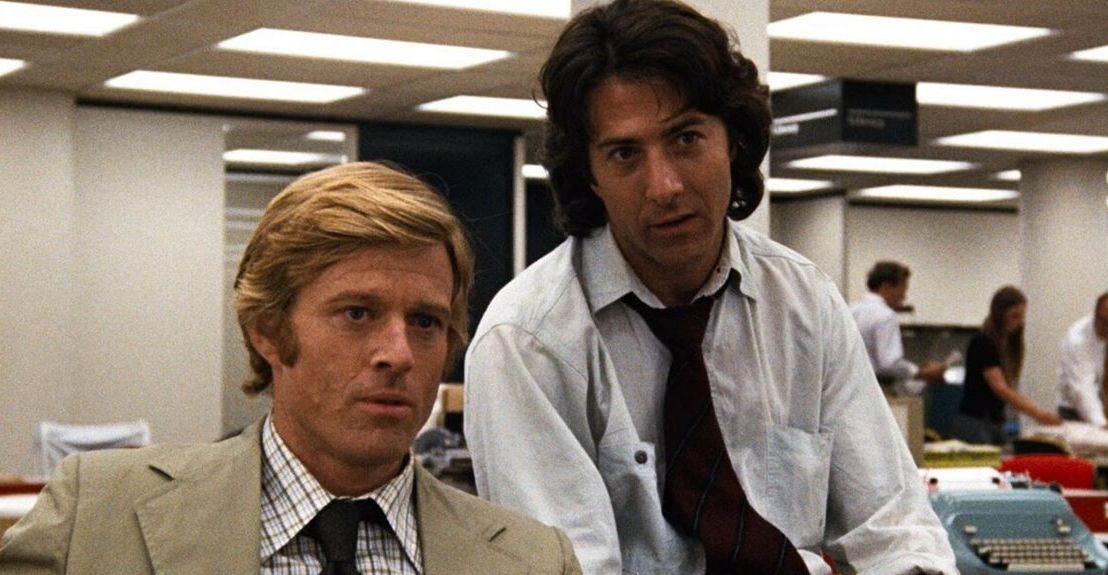
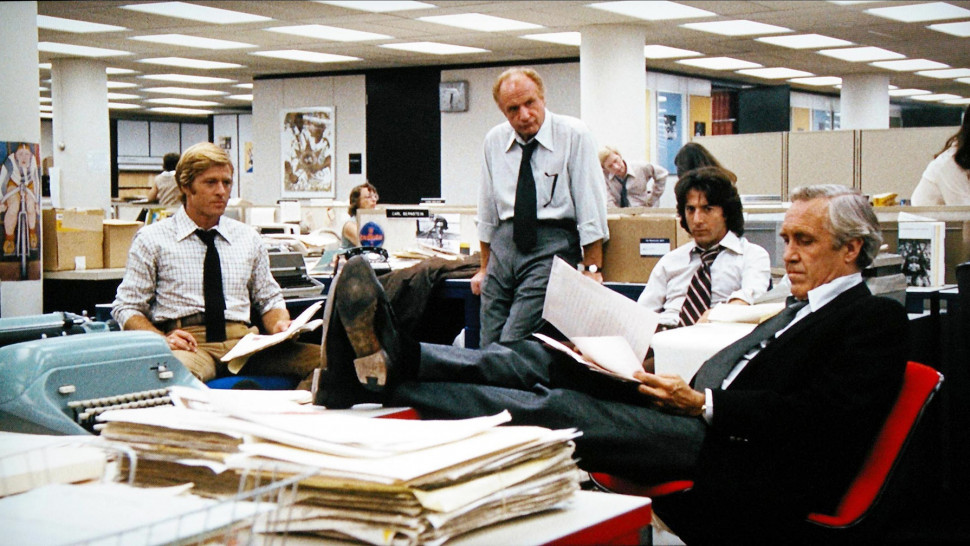
That “some” is the key here. For all Under Fire would like to be a firebrand political film – a sort of Battle of Algiers by way of All the President’s Men – it’s a film that continually pulls its punches. When compared to the brutal honesty Missing (a year earlier) looked at America’s bungled, self-serving and short-sighted foreign policy in Latin America, bashing any communist leaning revolutionary, even if meant propping up blood-soaked dictators, Under Fire looks very tame indeed.

Only the barest information and context is given to American policy. The only two villainous representatives of American policy we see are carefully distanced from the government. Oates, played with empathy-free gusto by Ed Harris, is a mercenary as happy driving trucks as he is executing POWs. The CIA’s man-on-the-ground is not even American – instead he’s a supercilious, lecherous Frenchman played with awkwardness by Jean-Louis Trintignant. Trintignant gets the closest anyone gets to a political speech, pointing out today’s sympathetic left-wing revolutionaries are tomorrow’s Stalinist purgers. But he’s always a degree separate from official American policy.

Instead, America remains the innocent here. The implication is the true decision makers don’t realise what’s going on, on the ground. It’s only the murder of Alex – and the smuggling out of Russell’s photos showing his execution – that leads to America having its eyes opened and withdrawing its support. This neatly lets everyone off the hook. Neither does the film dare suggest the hypocrisy of a country pouring money and arms into the bloody Somaza regime for years, only stirring when one innocent American journalist is killed. Not once does the film challenge the unpleasant truths that lie behind a statement made by a Nicaraguan: “if we had killed an American journalist years ago perhaps you might have done something”.

Instead, the film settles for a slightly naïve romance of the largely decent, young and sympathetic rebels vs brutish Government soldiers. The rebels are all plucky kids – like the young man and would-be baseball player Russell and Claire follow through a street battle in Leon (naturally, he’s shot by Oates, in the back of all places). Either that or decent, wise figures who would never consider sullying their hands the way the government forces do. It all feels a long way from the mutual brutalities of Pontecorvo’s Battle of Algiers or the (admittedly spittle-mouthed) fury of Oliver Stone’s Salvador.

After a while you start to feel Nicaragua is really a backdrop for a half-hearted romance between two journalists who re-discover their idealism under fire. The sense that the film could be set anywhere really is backed up by it’s opening in the Chad civil war, which is explored in fifteen minutes in the same cursory depth as the Nicaragua revolution. It’s all exotic backdrop for a drama about whether Russell and Claire can get over the guilt of sort-of betraying Alex (although Claire and Alex are already separated by the time they get it-on) and convert their affair into something more meaningful.

Truth be told all three journalists are thin characters, invested with more depth than they deserve by three very strong actors. Nolte is at his gravelly best, scruffy but impassioned, righteous anger bubbling not far under the surface. Cassidy turns a character that could have easily been “the woman” into a dedicated, intelligent and inspiring professional. Hackman finds beats of self-doubt and sadness in an anchorman worried he’s left what he’s loved (personally and professionally) behind.

Spottiswoode films with sweep and energy – helped by a very good score by Jerry Goldsmith and some impressive recreations (sanitised as they are) of street clashes in Nicaragua. But the story never takes flight and its political edge gets far too blunted. Even the murder of Alex is turned into melodrama, the focus quickly shifting to a wild chase for Russell to smuggle his film out of the country to end the Somaza government claims that the killers were the rebels not his soldiers.

It’s where the film goes wrong, settling for melodrama and romance where it should be angry. In the end it’s a romantic film, where American policy is misguided for the right reason and good triumphs. The cheering crowds that end the film ring especially hollow considering the continued violence that plagued the country throughout most of the 80s. It’s a solid thriller, but a flawed film.

Breaker Morant (1980)

Breaker Morant (1980)

Complex moral issues are brilliantly explored in this superbly made attack on war and its consequences

Director: Bruce Beresford

Cast: Edward Woodward (Lt Harry “Breaker” Morant), Bryan Brown (Lt Peter Handcock), Lewis Fitz-Gerald (Lt George Ramsdale Witton), Jack Thompson (Major James Francis Thomas), John Waters (Captain Alfred Taylor), Rod Mullinar (Major Charles Bolton), Charles ‘Bud’ Tingwell (Lt Colonel Denny), Alan Cassell (Lord Kitchener), Vincent Ball (Colonel Hamilton)

To some the case is still a cause celebre. In 1902, near the end of the Boer War, three Australian officers were put on trial (effectively, but the term didn’t exist) for war crimes – the murders of two German missionaries and the execution of six Boer. Two of them – Captain Harry “Breaker” Morant (Edward Woodward) and Lt Peter Handcock (Bryan Brown) were shot – the third, Lt George Witton (Lewis Fitz-Gerald) was sentenced to life (later commuted). But were they guilty or scapegoats? Fighting in a guerrilla unit, ordered to use the same tactics as their Boer opponents, were the men simply taking their blame for decisions made by their (British) superiors?

Beresford’s superb film is far more complex and challenging than a simple polemic. These men are sympathetic, but no martyrs. A defence of “just following orders” sounds queasy in a post-Nuremberg world. The film makes abundantly clear that all three are guilty of the crimes they have been accused off. Ironically, the one charge they are acquitted of (the underhand, unordered murder of a German missionary) is the one Handcock (the trigger man) and Morant (who ordered it) are most deserving of being shot for. But these are still junior officers, taking the fatal blame, while policy makers tut-tut and distance themselves from the consequences of their actions.

What Breaker Morant does, in an intelligent and impassioned way, is attack imperialism, arrogance and the way war twists ordinary men into carrying out deeds they would never have thought themselves capable of. War turns a poet and lover of horses like Morant into an angry, impulsive murderer; a happy-go-lucky chancer like Handcock into an assassin; a decent, naïve man like Witton into a triggerman. This, Beresford’s film argues, is the consequence of military aggression and imperial overreach. It’s impossible not to think of Vietnam, Afghanistan or other wars, where initial intentions are lost in a sea of hit-and-run attacks, mutual brutality and a comfort with the dea that any deed is excused if carried out in service of the conflict.

Breaker Morant manages to pull off a difficult trick. It’s a film about an unfair trial, rigged from the start to product a verdict of guilty, which never whitewashes the accused but always reminds us through flashbacks that they are definitively guilty (but not solely responsible for) the crimes they have been accused of. It asks a challenging question: who should we punish more, the soldier on the ground who commits the crime, or the general miles away who decided on the order of combat that allowed it? It’s a film that argues both are guilty, both corrupted by war. Kitchener (played with a surprising dignity by Alan Cassell) isn’t presented as a monster, but a man who feels sacrificing these men to a firing squad to bring the Boers to the negotiating table is as valid (if regretful) a military tactic as ordering them to charge a machine gun emplacement would have been.

The trial takes up the bulk of the film and is a display of inventive camera-work and editing to present a small location in a constantly dynamic and interesting way. Beresford uses a rich combination of close-up, deep-focus, reaction cutting and fluid cameras to alternately expand and contract the space according to the pressures of the scene. A senior officer gives his oath in extreme close-up, the court blurred behind him, his tense face giving a visual image that defines the fact we know he’s come to lie. Later the opposing counsels conduct an angry exchange with the tribunal in perfect deep focus behind them, never letting us forget who really makes the decisions.

The trial has been set up for the Australians to lose. Their defence counsel, an under-prepared solicitor turned army major with limited trial experience, clutches his notes in the first few minutes of the trial. Major Thomas’ main experience is with wills (“Should come in handy” Handcock drily comments). Nevertheless, Thomas emerges as a brilliant, passionate advocate. It’s a superb performance from Jack Thompson, full of courtroom fireworks but underpinned by both moral outrage but also a suppressed certainty that everything he is doing is in vain. His defence skewers the army’s case in several key places (it certainly swings some of the tribunal, two of whom vote to acquit) but he’s pushing boulders up slippery hills.

Every witness statement is underpinned by flashbacks showing the actions play out more or less as stated. Sure, witnesses lie, absolve themselves and colour the narrative, but on the essentials its true. The accused – apart from the assassination of the missionary – don’t deny their crimes. They also show not a shred of remorse. After all they were just holding up the British way. As the pieces of imperial memorabilia – paintings of Victoria, British flags (including one towering over the men in the field as they eat) and the constant refrain of a military band playing outside during the trial – remind us, while their decisions are their own they are very much part of a wider system (“We’re the scapegoats for Empire” Morant says before he’s shot).

If there is a case for anger, it’s there. These men remain so dedicated to the army, they even volunteer to come out of their prisons to help defend against a Boer attack. Their decisions were their own but the expectations on them were clear. If the Nuremberg Trial had focused on corporals and platoon commanders, while Field Marshals and Ministers were treated as negotiating partners, would that have been justice? The film also makes clear colonial arrogance makes the Australian officers easy sacrifices – a witness at the trial even tries to paint Australians as naturally inclined to violence and indiscipline (before he is dismantled by Thomas).

The film (despite how its remembered by some) makes very little case for them as martyrs. The final sequence of the execution is the only point the film leans into an “epic martyr” angle. Morant and Handcock are shot on a red-sun kissed hill, holding each other’s hands as they march to their final resting place, refusing a blindfold with Morant defiantly shouting at the squad “Don’t make a mess of it!” before being squashed into ill-fitted coffins (in another sign of the film’s dark wit, Handcock comments they haven’t even been measured for these coffins “I shouldn’t think they’ve had any complaints” Morant replies dryily).

It’s that closing sequence that has probably led some to see this as making a case for the men. Far from it. This is a sensational, gripping and intelligent trial drama that manages to both represent injustice and also about make the guilt clear. It’s superbly acted. Woodward is quietly, authoritatively marvellous as a difficult, socially awkward, would-be-marionet with a poetic soul. Brown is charismatic in the film’s flashiest part, Fitz-Gerald quietly disbelieving at what fate has bought him. Breaker Morant bubbles with anger and sadness but makes its target far wider and more challenging. Its target is war and the mentality that leads us to applaud soldiers for what we ask them to do until we are told what they have done. One of the greatest films of the 1980s.

The Front (1976)

The Front (1976)

The Blacklist is skewered in this heartfelt comedy that turns tragedy

Director: Martin Ritt

Cast: Woody Allen (Howard Prince), Zero Mostel (Hecky Brown), Herschel Bernardi (Phil Sussman), Michael Murphy (Alfred Miller), Andrea Marcovicci (Florence Barrett), Remak Ramsey (Francis X Hennessey), Lloyd Gough (Herbert Delaney), David Marguiles (William Phelps), Danny Aiello (Danny LaGattuta), Josef Summer (Committee chairman)

The first Hollywood drama about the “the Blacklist”, the shamefully unconstitutional banning of left-leaning Hollywood figures from working as a result of the House of Un-American Activities Committee’s investigation into alleged communist subversion. If there was any doubt how personal the film was to its makers, the credits scroll with the Blacklisting dates of many of its makers including Ritt, screenwriter Walter Bernstein, Mostel, Bernardi, Gough and Delaney. The Front is a tragedy told with a wry comic grin. Perhaps the makers knew that if they didn’t laugh they’d cry.

When screenwriter Alfred Miller (Michael Murphy) is blacklisted he asks an old friend, small-time bookie and cashier Howard Prince (Woody Allen) to attach his name to Miller’s scripts and submit them. In return Prince will keep 10% of all payments. The scheme is so successful Prince becomes “the Front” for two other writers and the quality and volume of Howard’s ‘output’ wins him a lucrative job as lead writer on a successful TV show, while his ‘genius’ wins the love of idealistic script editor Florence (Andrea Marcovicci). But, as the Blacklist takes hold – driving out of work actors with tenuous links to Communism like the show’s star Hecky Brown (Zero Mostel) – will Howard take any sort of moral stand about what’s happening in America?

The Front took a bit of flak at the time for not being more overtly angry about the Blacklist – as if the only response possible was spittle-flecked fury. However, today, its mix of comedy and real, visceral tragedy looks like the perfect response. The Front embraces the Kafkaesque ridiculousness the Blacklist created. Howard locked in an office at his studio to do an emergency re-write, calling Miller who taxies round replacement pages. Howard’s general ignorance of writing in general and his desperate mugging up on Eugene O’Neill and Dostoyevsky to pass them off as ‘influences’. The fact the list hasn’t done anything to stop these writers’ work from getting out there.

It’s also strong on the sense of underground community that grew among the banished writers. As veterans themselves, Ritt and Bernstein could be nostalgic about the sense of ‘all being in it together’ that the unemployed scribblers had.That vibe comes across well form Miller, Delaney and Phelps meeting in restaurants, libraries and hospital rooms to knock ideas around. There is the espionage-tinged excitement of watching script pages being palmed across to Howard like dead-drops. The film never forgets the gut-wrenching difficulty, stress and pain of not being able to work openly. But it also remembers the family feeling of a support network, giving people the courage to keep going.

But then the Kafkaesque comedy slowly drains away, as the punishing injustice creeps to the fore. Studio fixer – and vetting officer – Hennessy (played with self-satisfied relish by Remak Ramsey) calmly pressures creatives to turn on each other. Sure, there is comedy in him telling a victim of mistaken identity that there is nothing he can do to help him as the guy has nothing to confess to – that’s Kafka – but Ritt doesn’t miss the desperation and fear in the victim’s eyes. To Hennessy everyone is guilty, innocence is something that needs to be proved – and it’s a lot less funny when he strips people of their livelihoods because their personal views don’t fit.

The film’s true tragedy is actor Hecky Brown. Beautifully played by Zero Mostel, in a performance of a jovial front placed over ever-growing bitterness, anger, self-loathing and despair, Hecky can’t work quietly behind a front. As an actor, once he’s under suspicion, he’s unemployable. Despite his jokey pleas that he only marched on May Day and subscribed to the Socialist Worker (six years ago, when as he points out the USSR were our allies) to impress a girl, he’s goes from star to begging for work at the Catskills. There the manager is all smiles and pays him $250 for a gig worth thousands (based on a real life incident that happened to Mostel – and the pain and anger of it is still in his eyes).

Mostel’s performance is the heart-and-soul of the film which follows his increasingly bleak tip into despair. He scuffles with that Catskills manager over his hypocritical sorrow. Staying in Howard’s apartment, he despises himself as he searches through Howard’s desk for incriminating evidence. In a striking scene, he berates “Henry Brownstein” (Hecky’s real name) for stopping him turning state’s evidence. It’s a sad, moving picture of the real human cost of this injustice that helps moves the film past comedy and into dark drama.

And to get an even better of how serious this human cost, what could be better than placing a self-interested, politically disengaged chancer at its heart and seeing how he responds. The casting of Woody Allen – in one of the few films he appeared in and didn’t write – is perfect. There is no-one more politically disengaged and full of pinickity obsession that Allen. Howard Prince is a decent guy but his main interests are money (his eyes light up at earning 10% for nothing), his fancy apartment, seducing Florence and the adulation from fawning producers.

What better way to show the impact of the Blacklist injustice, than to see how Howard slowly shifts from a man so disinterested he doesn’t even know what the Fifth Amendment is, to someone who feels compelled to make a stand. Slowly he finds he can’t ignore the injustice – there is a beautiful moment when Howard embarrassedly drinks and stares at a poster on the office wall at the back of the frame while Hecky begs for $500 from that Catskill’s manager. He gradually realises a fun ride for him is a dystopian nightmare for others – his self-satisfied shrugs turning into real principle.

Because, he will learn, HUAC doesn’t care for names – they care about breaking people. Being as ignorant and disinterested in politics as Howard won’t save you. That’s what Ritt and Bernstein have been driving to: this wasn’t Kafka, it was Orwell, it wasn’t about the obstructive indifference of bureaucracy but Big Brother’s ruthless rooting out of thought crime. So, when Allen tells them – in the final lines of the film – to go fuck themselves, and the film freezes so he can walk out of it, you really understand why this is a glorious cry of wish fulfilment straight from the heart of the film-makers.

Things to Come (1936)

Things to Come (1936)

HG Wells ultra-serious view of the future is stilted but also visionary

Director: William Cameron Menzies

Cast: Raymond Massey (John Cabal/Oswald Cabal), Edward Chapman (‘Pippa’ Passworthy/Raymond Passworthy), Ralph Richardson (The Boss), Margaretta Scott (Roxana Black), Cedric Hardwicke (Theotocopulos), Maurice Braddell (Dr Edward Harding), Sophie Stewart (Mrs Cabal), Derrick De Marney (Richard Gordon), Ann Todd (Mary Gordon), John Clements (Enemy pilot)

Alexander Korda was thrilled. He’d secured the rights to the legendary HG Well’s new novel. Even better the Great Man would work, hand-in-glove, with Korda’s team to bring The Shape of Things to Come to the screen. It would be a grand science-fiction hit, that would echo the success of American films based on Wells’ work (films, to be fair, Wells pretty much hated apart from The Invisible Man). It became a continual struggle before the final flawed-but-fascinating film arrived in cinemas.

Things to Come opens in the (then) near future in 1940 as war tears “Everytown” on Christmas Day and flies 100 years into the future. Bombing destroys the city and hurtles the world into over twenty years of never-ending war that leaves civilisation wrecked by carnage, advanced weapons and poisonous gases. A legacy of the war, “the wandering sickness” devastates the survivors, killing half the remaining population. In the ruins of Everytown in the 1960s, the Boss (Ralph Richardson) rises to take power, one of many warlords across the world being challenged by the “World Communications” alliance of engineers and scientists in Basra, Iraq. When they reshape the world, decades of progress lead to a new civilisation in 2036 aiming at the stars.

HG Wells saw Things to Come as a polemic, an ambitious and optimistic look at how mankind should progress, leaving behind war and politics to embrace rational thought and the quest for knowledge. Written at a time when tensions were high in Europe, it would show the world torn apart, devastated and reborn greater than it ever was before. Never-the-less at every point, the unambitious, myopic and power-hungry gather to hold back progress. What he didn’t really see it as was a conventional “drama” or those involved as “characters” more devices, ciphers and mouthpieces for his viewpoints.

Which helps explain the curious project that made it to the screen. Wells was guaranteed approval over the dialogue, which remains flat and heavy handed. Actors felt constrained within the sonorous phasing and over-written prose. It wasn’t helped by director William Cameron Menzies’ discomfort with dialogue scenes. Whenever two people stand around (which sums up the blocking) and chat, the film is frequently a little dull, settling for a semi-disguised lecture on humanity, science and progress. Korda correctly identified the dialogue problems and cut as much of it as possible.

In doing so, he snipped away much of the narrative framework of the film. In a film that flies forward through time and world-changing events, we frequently get confused about the exact details of who goes why and where and what makes characters do the things they do. Characters disappear and reappear, fly across the world in seconds, form and break alliances and argue and drop cases all on a sixpence. Raymond Massey later talked about how hard he found his character (a man and his grandson, bridging all timelines) to bring to life with dialogue largely devoid of emotion. Much of Things to Come can be dry-as-a-bone.

But yet… Away from the weaknesses of the script, much of Things to Come is quite awe-inspiring. While the characters might be a little flat, the energy of the film’s first two acts (in 1936 and 1966) offers a host of striking scenes and images. Things to Come remains powerful and horrifying when it looks at the darkness and damage of war. The 1936 bombing attack on Everytown still shocks with its superbly assembled shots of buildings exploding, crowds panicking, dead bodies slumped in cars, terrified faces and dead children in the rubble. Imagine watching this with the Blitz just a few years away. Menzies may not direct acting or dialogue with much inspiration, but his skill with visuals and editing is clear. The montage carrying the world over the next thirty years is a masterful mix of fake news-footage and technological innovation as ever more advanced tanks and airplanes roll past the screen. The film’s use of design and visuals is frequently haunting and impressive.

It carries across to the bombed-out design of Everytown in the 1960s. A shell of a city, where wrecks of cars are pulled by horses. Those suffering from “the Wandering Sickness” move like zombies through the city. Homes and buildings are gutted remains. Newspaper headlines – of newspapers that become ever more basic in printing and more expensive in price – had previously helped communicate the passage of events. Now the news is chalked up onto a board outside the home of the Mussolini-like Boss (the film’s finest performance of charismatic swagger and delusional power-mad greed by Ralph Richardson). Clothing is basic and functional, pulled together from scraps leftover from the war, in a world largely devoid of all technology.

This wasteland makes the futuristic designs even more striking. The “Wings Over the World” organisation – growing from the cradle of civilisation in Iraq – is sleek, metallic and efficient in its construction. When John Cabal (Raymond Massey) lands back in the 60s ruin of Everytown, he looks like a spaceman. He might as well be. His fleet of unimaginably vast airplanes have inspired visions of futuristic flight right up to the mighty airbases the Avengers operate in the MCU.

While you can snigger a little at the utopiaish version of the future – very Star Trek in its flowing robes and shoulder pads – it’s vision of subterranean cities full of everything from wrist communicators to widescreen TVs feels quite prescient. Everything is clear, polished and perfect – much of it doesn’t look a million miles away from an Apple store. While the villains of the future (a band of luddites led by Cedric Hardwicke) may be little more than paper tigers, given only the vaguest motivations, the grand engineering accomplishments of the future and their glances at the stars feel inspired in their detail and ambition.

It’s where Things to Come triumphs. It might not often have much to listen to, but every single scene carries a slice of design or visual interest. Its frequently assembled into effective – and even terrifying – montages. And its design of the future – based on Wells vision and bought to life by Menzies and his technical team – is a perfect mix of striking and prescient. Things to Come isn’t always the best drama, but as a forward-looking piece of design it’s truly memorable.