Category: Relationship film

Tootsie (1982)

Dustin Hoffman plays somewhat against type in the marvellous Tootsie

Director: Sydney Pollack

Cast: Dustin Hoffman (Michael Dorsey/Dorothy Michaels), Jessica Lange (Julie Nichols), Teri Garr (Sandy Lester), Dabney Coleman (Ron Carlisle), Doris Belack (Rita Marshall), Charles Durning (Les Nichols), Bill Murray (Jeff Slater), Sydney Pollack (George Fields), George Gaynes (John van Horn), Geena Davis (April Page)
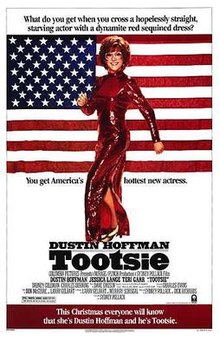
It sounds like a movie idea from hell: “We’ll get Dustin Hoffman to play a struggling actor who can only get a job when he dresses as a middle-aged woman and auditions for a daytime soap. Hilarious misunderstandings will follow…” But you’d be wrong: Tootsie is an absolute delight: not only a wonderful comedy, but a touching love story and an acute commentary on sexism and the compromises women are forced to make to get the same opportunities as men. It’s a wonderful, smart, thought-provoking film.

In a role that draws on more than a little self-parody, Dustin Hoffman plays Michael Dorsey, a dedicated, demanding, difficult actor who has alienated so many people across Broadway and Hollywood with his unwillingness to compromise that he can’t land a job. When his friend Sandy (Teri Garr) flunks an audition on a General Hospital-style daytime soap, Michael thinks “what the hell” and puts himself forward for the role under the disguise of the middle-aged “Dorothy Michaels”. Surprisingly he finds he lands the job: and realises that women’s lot on the masculine film-set is not a happy one, evading sexual approaches, treated like idiots and generally encouraged to not pipe up. Intelligent, clever fellow-cast member Julie Nichols (Jessica Lange) hides her light under a bushel. At first Michael enjoys the respect he wins, but as Dorothy increasingly becomes a feminist icon he’s plagued with guilt at the lies and deceptions he’s practising.

It’s the sort of idea that should be either patronising today (a man learns about feminism by walking in a woman’s shoes!) or inadvertently toe-curling. The fact that it isn’t (and I’ve watched this film with women who have enjoyed it a great deal, so I’m not completely guessing here!) is a tribute to the film’s lightness of touch, combined with a neat sense of the ridiculous, along with the emotional truth and genuineness that the film is handled with. It neither preaches nor mocks but simply focuses on telling the story and allowing us to draw our own conclusions. It also has a script packed through with some absolutely cracking jokes, all of which are delivered straight.

Central to its success is Dustin Hoffman, who plays the entire role completely straight. His Michael is a neat self-parody in his abrasive difficulty – but he’s also shown to be a concerned and genuine friend to Teri Garr’s delightfully ditzy Sandy, urging her to have more confidence (little realising how difficult it is for women to impress male casting directors if they behave with the confidence of men). Sure he’s not above clumsy passes to women at parties, but he’s no dinosaur or sexist. And becoming Dorothy Michaels is an opportunist moment of eagerness to show he has range and can get work if severed from his terrible reputation, rather than having any cruel or mocking motivations.
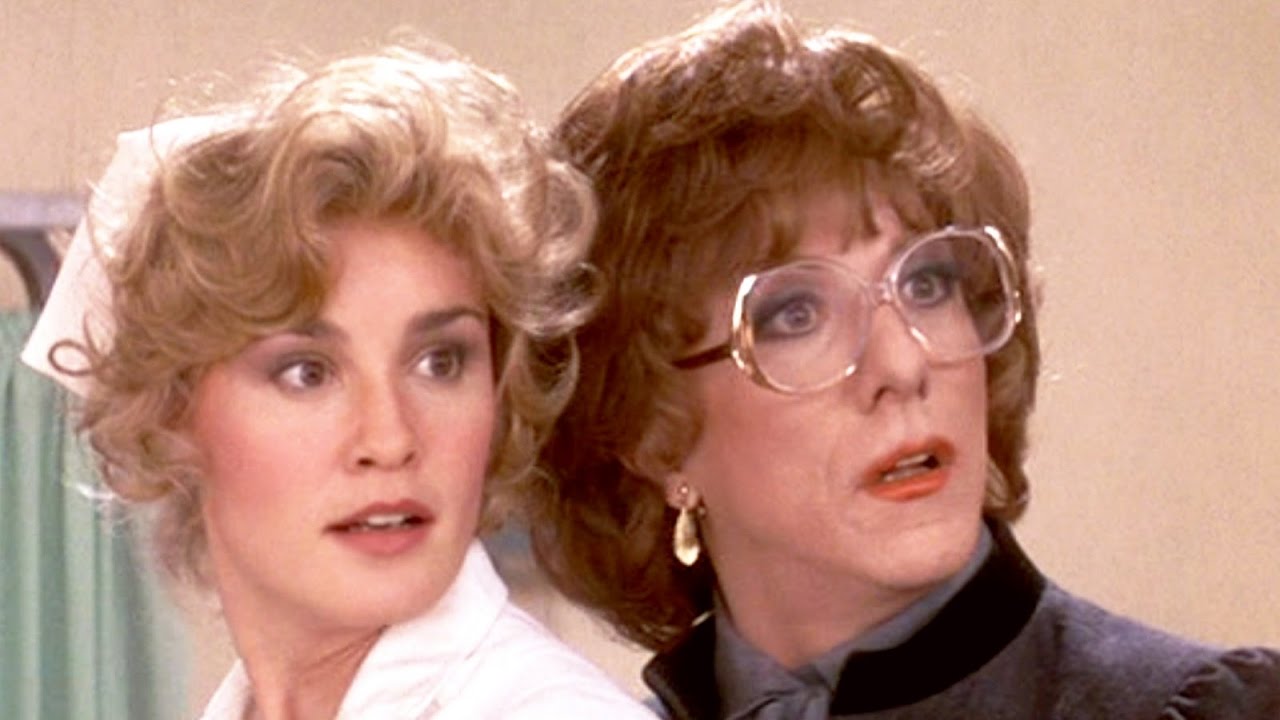
And what Hoffman does so well here is that Dorothy becomes her own personality. And that Michael immediately recognises that Dorothy, with her assurance, her kindness, her unwillingness to take nonsense, but her serene confidence, is a much better person than he is. She refuses to be trapped into either of the two roles the director intends for her (love interest or shrew) but insists her role in the hospital soap be treated like a dedicated professional, not defined by her sex – which makes her exactly the sort of role-model women around her (and eventually across America) have yearned for. Somehow as well, the film gets us to invest in what a great person Dorothy is, even as we know it’s really Michael in disguise – and Hoffman never, ever plays the part for laughs.

The casting allows the film to get a number of hilarious shots at the fast-paced, poorly-written, cheaply sexist nonsense that goes into daytime soaps. The director of the show is a roving lothario (played with all the smarm at his command by Dabney Coleman), who opposes Dorothy’s casting because she is not attractive enough, talks over the women in the cast and expects affairs as part of his salary. The show’s leading man is an aged actor (played with an oblivious sweetness by George Gaynes) who expects to kiss every woman in the show and is totally unable to learn lines. The plots of the soap are a joke, and the actresses are frequently placed into demeaning situations that real nurses and administrators (the only roles of course women can play in a hospital!) would never do.

Becoming horrified by this, Dorothy/Michael encourages the other women in the cast to break out from this – not least Julie Nichols, beautifully played by Jessica Lange as an intelligent, sensitive woman forced into pretending to be an airhead so as not to disturb the men around her. Lange is superb in this role, and so radiant that of course Dorothy/Michael finds himself falling in love with her – a complexity that constantly intrudes on the sisterly bond that Julie increasingly feels for Dorothy…

And that’s another source of guilt for Michael, who is (despite it all) a good guy, and slowly works out that there is no way of extracting himself from all this without hurting people’s feelings (not least when Julie’s sweetly charming widowed dad – played wonderfully by Charles Durning – starts to have feelings for Dorothy). Michael doesn’t want to hurt anyone – not even Sandy, with whom he finds himself stumbling into a one-night stand that he can’t work out how to reverse out of because he’s so desperate not to damage their friendship (something that he of course ends up damaging anyway). It’s a film that brilliantly balances these personal struggles with wider pictures.
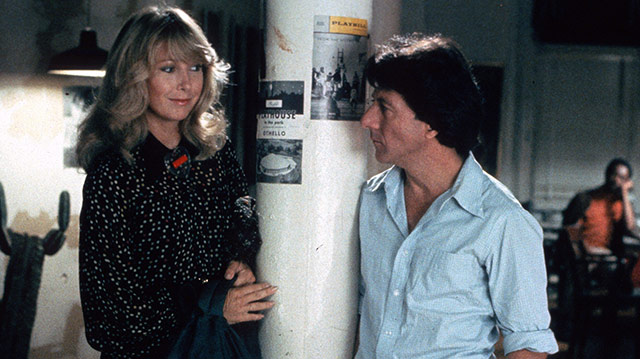
Because, as Michael is aware, he’s himself guilty of using women by stealing the cause of feminism by pretending to be a woman. He’s perpetrating a con on the whole of America, and can’t work out a way to back out. The solution he does finally find is a comic tour-de-force – while finding time to still focus later on the real, emotional impact on those who have come closest to Dorothy – and gently indicates how lives can move on.

Sydney Pollack has probably never directed a film as smart, touching and wise as this one (he also puts in a hilarious cameo as Michael’s frustrated agent). It’s a film that could have been just a comedy about a man in drag, but in fact ends up raising profound issues about sexism, feminism and relationships that still feel relevant today. It’s almost certainly Hoffman’s greatest performance – honestly, he’s sublime here, it’s a once in a lifetime performance – and there is barely a wrong beat in it. The cast fall on the great script with relish – Garr was never better and Bill Murray has a superb unbilled supporting role as Michael’s acerbic, playwright housemate. You’ll laugh, you’ll cry, you’ll think and you’ll want to watch it again. Can’t say better than that.

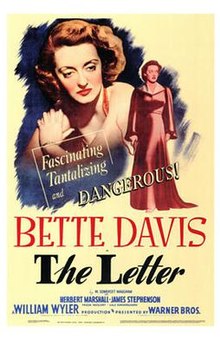
The Letter (1940)

Bette Davis plots doom and death in The Letter. Can she be caught?

Director: William Wyler

Cast: Bette Davis (Leslie Crosbie), Herbert Marshall (Robert Crosbie), James Stephenson (Howard Joyce), Frieda Inescort (Dorothy Joyce), Gale Sondergaard (Mrs Hammond), Bruce Lester (John Withers), Elizabeth Earl (Adele Ainsworth), Cecil Kellaway (Prescott), Sen Yung (Ong Chi Seng)

The “woman’s picture” was a popular genre of the 1940s, a catch-all for stories that centred around women dealing with domestic issues in the home or in relationships, with the lady herself the driving force of the narrative. There were several stars who excelled in this wide-ranging genre, but the best was perhaps Bette Davis. This melodrama is a superb example of exactly this sort of female-led narrative, focusing in on its heroine making catastrophic decisions that lead to terrible consequences.

On a plantation in Malaya, in the late 1930s, Leslie Crosbie (Bette Davis) the wife of gentle plantation owner Robert (Herbert Marshall) guns down a man, Geoff Hammond, who comes to visit her in her home alone. She insists to her husband, and their lawyer Howard Joyce (James Stephenson), that she was defending her honour. The trial for murder feels like a formality – until Joyce’s clerk Ong Chi Seng (Sen Yung) informs him that Hammond had a Eurasian wife (Gale Sondergaard) who has a letter from Leslie to the dead man which casts a very different light on the affair. Because “affair” is the right word: the letter implies Leslie invited the man to visit her while her husband was out. Mrs Hammond will hand the letters over to the authority – unless Leslie and Joyce cough up a huge sum of money to stop her.

The Letter is a film with two marvellous book-end scenes. The first is a beautifully shot and assembled murder sequence, where Wyler’s camera moodily pans through the sleeping native workers on the plantation – dappled by moonlight – until it finds itself drawn towards the steps of the plantation house by the sounds of gunfire. It’s a superbly marshalled sequence that mixes stillness and quiet from the start with a sudden explosion of noise, reflected in the shift in editing from slow camera movements to fast cuts. Nothing else in the film quite matches it until we reach the final sequence that mirrors it with Bette Davis heading back outside into the moonlight, where a terrible and violent surprise awaits her.

And you can enjoy that because no-one did these brutal, arrogant, high-society queens as well as Bette Davis. Davis is superb here, bringing just the right touch of melodrama to balance the intensity of Leslie’s selfish desperation to get away with what we immediately know is an act of murder. Leslie Crosbie is entitled, arch and a natural liar who carefully builds a series of alternative stories (each of them less believable than the one before) which she spins carefully with a mix of vulnerability and a dash of feminine weakness, to try and get away with murder. It’s a domineeringly strong performance that powers the entire film and Wyler draws a wonderful arch cruelty from her, just below the surface of her acceptable female hobbies of knitting and dinner planning. 

Wyler balances this with the two men around her, both of whom are under her spell to different degrees. Herbert Marshall is very good as her husband, a generous, loving, naïve soul who believes his wife without question until he later realises he shouldn’t. Marshall does an excellent job with making this hen-pecked weakling intriguing, not least in his later passive-aggressive response when discovering most of his fortune has been blown to save his wife from a certain death sentence.

The other man is her lawyer Howard Joyce, played with a patrician reserve by James Stephenson. Oscar-nominated for the role, Stephenson’s Joyce doubts everything he is told from the very start, but somehow allows himself to be dragged along with the cover-up that slowly develops. Whether this is out of pride, or whether this is because he is himself somehow under some sort of erotic spell that she emits is left open to question. Either way, Stephenson puts a wonderful growing aghast horror behind the role as his professional and moral scruples are challenged more and more.

The chicanery of Davis’ character in the film is of course helped by her being white and rich, and prejudices against Hammond (not to mention the reception his Eurasian wife expects to gets if she comes forward) are most of the mainstay of the case in her defence. Joyce basically speaks platitudes about professional integrity, while all but knowingly defending a murderer (he in fact goes out of his way to give himself plausible denial and avoids questions). The film manages to present the native workers on the plantation – and Joyce’s clerk – as something a bit more than this, as perhaps the only people in the film with actual integrity.

But of course Davis gets away with it, because she can pay to do so, but the film finds other ways to punish her (as these women’s pictures usually do for adultery). The film’s final sequences see Davis’ character slowly collapse from arrogant certainty into moral and mental torture, before almost willingly marching towards certain danger. Wyler’s film is a great vehicle for her, but it’s also superbly made and shot and captures the sweaty lack of justice in the British Empire with perfection.

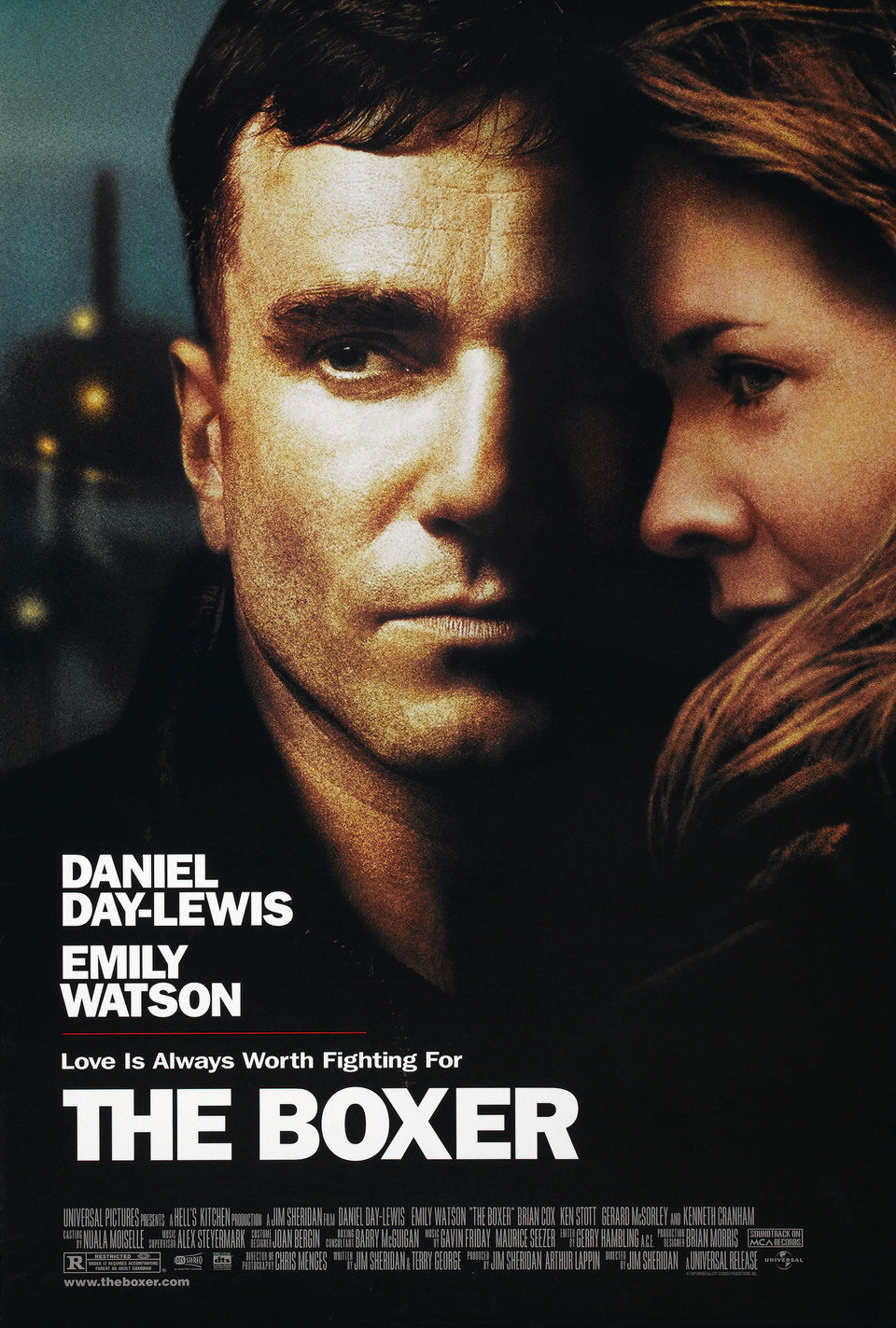
The Boxer (1997)

Daniel Day-Lewis returns from 14 years in prison in this passionate but obvious film about the Troubles in Ireland, The Boxer

Director: Jim Sheridan

Cast: Daniel Day-Lewis (Danny Flynn), Emily Watson (Maggie), Brian Cox (Joe Hamill), Ken Stott (Ike Weir), Gerard McSorley (Harry), David Hayman (Hamill’s aide), Ciaran Fitzgerald (Liam)

Daniel Day-Lewis and Jim Sheridan collaborated before this on the stirring, passionate and angry In the Name of the Father, a film that acutely analysed the impact of the Troubles on ordinary people. That film was about a miscarriage of justice that ruined lives. This film tries to cover similar ground, but somehow the force of the narrative never really comes together as much as it should.

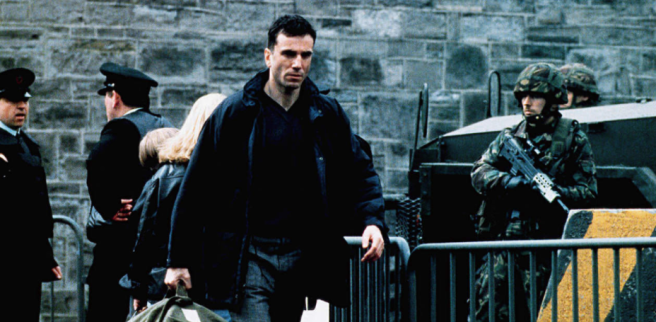
The Boxer himself Danny Flynn (Daniel Day-Lewis) is released from prison after 14 years, due to his peripheral involvement with the IRA. He’s guilty for sure, but has played the game inside and refused to name names. He comes out still in love with Maggie (Emily Watson) – but she is married to another man currently in prison (putting her out of bounds by the code pushed by the IRA). Making things more complex, her father Joe (Brian Cox) is a leading IRA man currently part of negotiations with the British government. Danny and his former trainer Ike (Ken Stott), now a struggling alcoholic, decide to reopen the local boxing gym, making it a denomination free facility for all the community. But their efforts to try and build bridges are not welcomed by all – not least local IRA enforcer Harry (Gerard McSorley) who makes it his mission to destroy Danny.

Why does The Boxer not work as well it should do? It’s got nothing to do with the commitment of the cast, all of whom offer excellent performances. Day-Lewis, inevitably, spent almost three years in preparation learning to be a boxer. It’s just a shame that the script doesn’t really give anyone here something interesting to play with. Instead it makes fairly familiar points about the dangers when we let hatred govern our lives, and carefully sorts and packages most of its characters into goodies and baddies, while making sure in every single scene we are always told exactly what we should be thinking and feeling.

It’s a flaw that I’ve often found in other of Sheridan’s films. He’s a passionate but rather blunt director, full of righteous anger and a determination to make films that carry a social message. But he often makes these points without subtlety or imagination. Here we get an Ireland shot almost completely in a washed-out blue, with the tensions of a community increasingly simplified down into rotten apples playing on the fears and resentments of different groups to continue the spiral of hate.

In the middle of this, Sheridan places a love story between Day-Lewis and Watson’s character that both of them play with a tender commitment and an emotional vulnerability, but which never really invests the audience. It always feels too heavily built on cinematic contrivance – with its long separation, new relationships and social obstacles put in the way. Much as Day-Lewis and Watson give it their all, they never manage to make it feel anything other than it is – a rather tired “movie” love story, that moves it characters through familiar beats.

More interesting than this by far are the real tensions in a community that is tired of violence and wants to move on, but keeps on getting dragged back into old ways because there is simply too much history to overcome. The most interesting character by far is Brian Cox’s IRA bigwig, a man carrying a burden of blood from the past but has an actual desire to see the country change. A film about a man like this, trying to walk a tightrope between negotiations with the British and keeping his own furious foot-soldiers in line (when all they want to do is to bomb something) would have carried real impact. Sadly, it’s too often relegated to the margins of the story while the film follows the immediate social impact of Danny trying to find a third way between war and surrender.

Peaceful co-operation is what Danny wants, and the gym for all people in the Belfast community is how he intends to go about it. Boxing itself is peripheral to the film – what really matters is that idea of bringing people together, of giving them something they can all own and feel some pride in. It’s an idea that Ike believes in above all things, and the prospect of recreating it with Danny’s release from prison gives his life real meaning (Ken Stott is very good as a character who is something of a cliché but still carries a real emotional wallop). Ike and Danny’s vision offers the community a possibility of moving on – something some are not ready to take on.

Not least Harry, played by a quietly fuming Gerard McSorley, prowling scenes like a man who can’t wait to hit someone. The film does at time suggest that there are “good” IRA and “bad” IRA chaps (with Harry firmly in the bad), but it does at least show that these extremists are a danger to everyone, not least the people they claim to protect. Harry’s prejudice towards Danny is motivated above all by his fear of Ireland’s way of life changing, and in that way it forms a decent expression of the film’s core message about the difficulty – but essentialness – of moving on.

Sheridan’s film is a cry for hope and opportunity at a difficult time – and its alarming watching it now to remember what a ghastly place Northern Ireland was at this time, when it’s so well known today as the Game of Thrones backlot. It’s just a shame that the story feels like such a – well – story. The film feels like a slightly over-cooked melodrama, and as the character clashes you expect and the twists you can see coming start to work their way into the narrative, it feels like the central story of a man wanting to make a better life for himself and his neighbourhood gets lost in the mix.

And it does. That’s the basic weakness of The Boxer in the end. For all of Day-Lewis’ skill and Watson’s emotional truth, their story just ends up feeling not that important, you feel that the more interesting things are happening on the margins: Cox’s IRA man feels more worthy of a film, while Stott gets some of the most electric moments of emoting. Sheridan’s film has fire in it, but it ends up burning up his main narrative, while the story relies too heavily on melodrama and cliché. Eventually it fizzles out and you end up not feeling as outraged as you should. Where the true story of In the Name of the Father helped control Sheridan’s spoon-feeding tendencies, here the fictional story allows full reign for the sort of narrative twists that end up feeling a little too tired and obvious.

Lilith (1964)

Jean Seberg lures Warren Beatty and Peter Fonda into a psychologically dangerous web in Lilith

Director: Robert Rossen

Cast: Warren Beatty (Vincent Bruce), Jean Seberg (Lilith Arthur), Peter Fonda (Stephen Evshevsky), Kim Hunter (Dr Bea Brice), Anne Meacham (Mrs Meaghan), Jessica Walter (Laura), Gene Hackman (Norman), James Patterson (De Lavrier), Robert Reilly (Bob Clayfield)

Movies have long had a fascination with mental illness – in particular the impact of mental illness on women. Lilith is an intriguing, elliptical, somewhat cold but intriguing film that looks at the impact isolation, loneliness and seclusion can have on people and how these damaged psyches can sprawl out and cause further pain and suffering for others. However, it’s also a difficult, unclear and occasionally hard to like film, that deliberately clouds so many of its points in a veil of doubt and uncertainty that it’s difficult to really embrace it.

Returning from an undisclosed war (possibly Korea), Vincent Bruce (Warren Beatty), a lonely, slightly troubled young man, drifts into a job as a counsellor at a private mental hospital, under the supervision of Dr Brice (Kim Hunter). Bruce is empathetic and keen to understand and help the patients, but he finds himself slowly drawn towards Lilith Arthur (Jean Seberg), a sensual and seductive patient at the institute. Encouraged to spend more time with Lilith – as only Vincent seems able to draw her out of a fantasy world to engage with the real one – he increasingly finds himself infatuated with her, increasingly bending any personal or professional ethics to fuel his emotional and sexual need for her.

Just in case you are in any doubt from reading that, it’s pretty clear from early on in the film that the real person in need of help is Vincent. Played with a methody introspection and brooding insecurity by Beatty (he impassively and wordlessly drifts through several scenes or merely watches, and only rarely shows any emotional engagement), Vincent is frequently framed by Rossen alone, lost in the centre and sides of frames, or walking seemingly aimlessly forward. The camera often drifts towards him, if only to stress his lack of real engagement with the things he is seeing in front of him. His obsessive qualities are there from the very start, with his fixations switching between his mother, a former girlfriend (played with a flirtatious seductiveness by Jessica Walter) and finally settling, overwhelmingly, on Lilith whom he follows with the glazed eyes of a potential killer. Beatty struggled with the part – and I can see why, as our central character is such a distant cipher that he becomes someone very hard for the audience to invest any interest in.

Lilith herself is an intriguing if, it seems, unknowable character – almost impossible to tell if she is a truly destructive force or someone who simply behaves as she feels in the moment with no understanding of the impact her actions have. She is frequently callous and cruel, and then will revert to sadness, vulnerability and insecurity. She looks for love – or at least affection and loyalty – at every turn, but then also seems unable to understand any personal relationship except through the filter of sex. Starting the film placing an erotic spell around sensitive fellow patient Steve (Peter Fonda, vulnerable and rather sweet) she quickly switches all her efforts to wrapping Vincent in a web of enchantment (as the film rather clumsily stresses to us in a scene where a doctor explicitly compares her to a spider).

Lilith is increasingly seen as an unsettling, indiscriminate figure. No sooner does Vincent become her lover, than she begins flaunting a sexual relationship she is having with another female patient. (Lesbianism was quite radical for a film at the time). Even more surprisingly the patient is a staid, rather imperious middle-aged woman (played imposingly by Anne Meacham), and the relationship seems to be partly conducted to get a rise (of one sort or another) out of Vincent. Earlier, Lilith flirts disturbingly and erotically with a very young child (who seems disturbed) – although the viewer is perhaps even more disturbed by Vincent’s blank watching of the whole scene. At every point we are reminded of Lilith’s erotic allure – and the framing of the film, and its beautiful photography by Eugene Schufftan helps to create this mystic image. Lilith is often shown behind grills and bars earlier on, before she emerges into the outside world and one enchanting image sees her kissing her reflection in a lake, the very act reducing the reflection to shimmering ripples on the surface: can anyone know her?

The part leans on being borderline sexist, the idea of the enchanting, liberated woman as somehow being a dangerous (almost evil) threat to the safety and mental security of the men around her, deliberately endangering the decent world with her sexual openness. It largely manages to avoid this due to the performance of Jean Seberg, who gives Lilith a vulnerability and suggestions of deep psychological trauma that underpin her surface sexuality, flirtation and predatory nature. It’s no surprise that she is so completely able to overwhelm the repressed, inverted Vincent, or that he becomes such a willing slave to her whims and spur-of-the-moment suggestions.

Much of this disintegration of Vincent underpins the second half of the film, as he and Lilith engage in a dance that ends up having overwhelmingly negative consequences for each of them and for many of those around them. Intriguingly, Rossen’s vision of this mental institute as a more bohemian organisation suggests that the staff all seem aware of (and even tacitly encourage) the relationship – although whether this is part of a treatment or some sort of bizarre other motive is unclear. However, all this doesn’t help to make either character one we really care about, or make the story crystallise into something that carries real impact.

That captures the central problem of the film – Rossen deliberately builds the story with an elliptical sense of mystery in which the actions and motives of characters remain deliberately unclear, and the world they live in takes on elements of the dreamlike fantasy world that Lilith herself sometimes lives in (complete with her own language). Events seems to move with little sense of time. There are surreal interludes, not least an extended sequence where Vincent takes Lilith to a jousting competition (yes you read that right). It’s perhaps all a part of understanding how the personalities of the two lead characters slowly collapse over time into themselves, but it also serves to keep a distance between the film and the viewer. The final tragic outcomes are predictable from the very start of the film, but there is still a certain power to them. As a study of what slow mental disintegration may look like, Lilith is an intriguing little picture, but basically a little too hard to invest in emotionally to carry real impact.

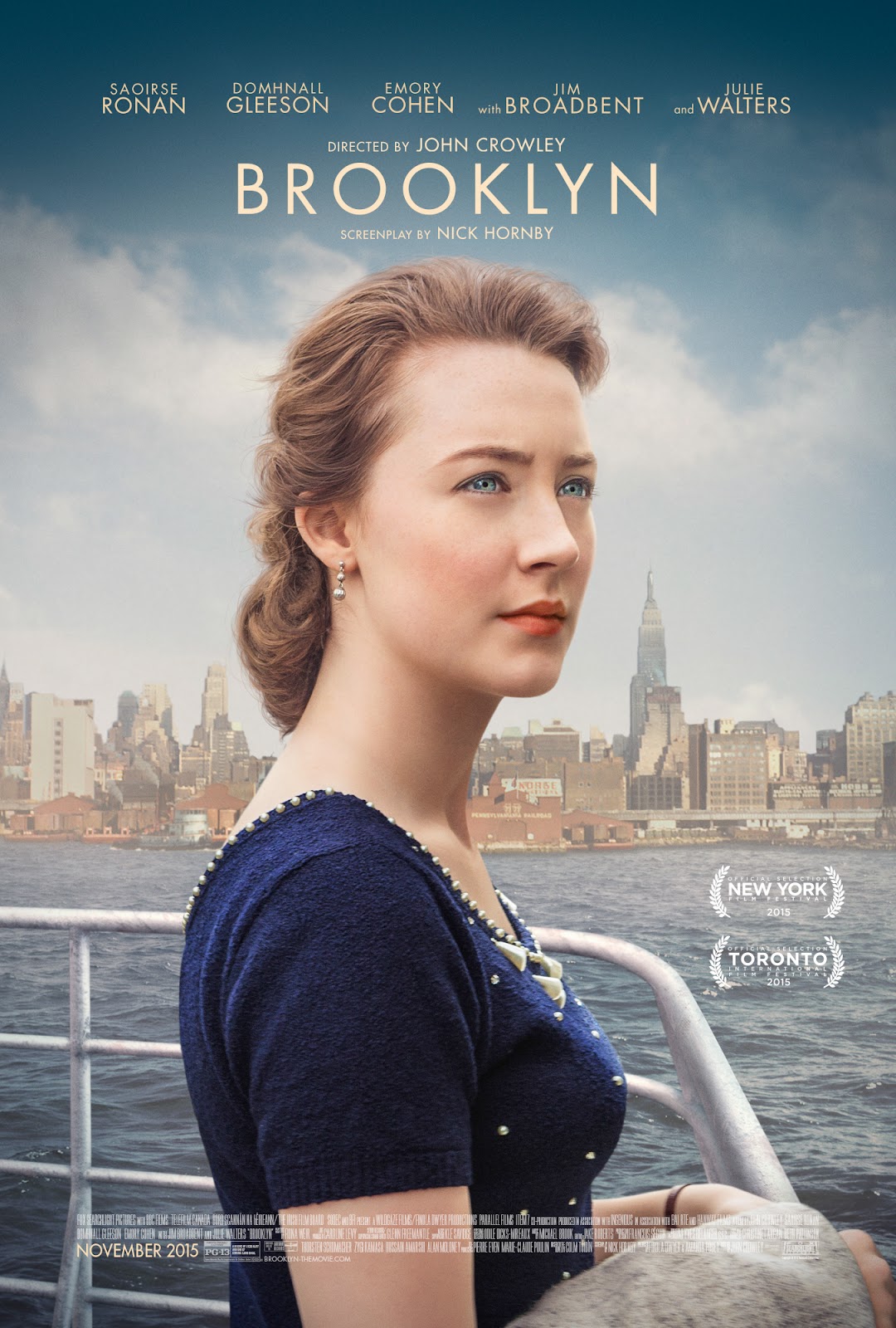
Brooklyn (2015)

Saoirse Ronan excels as an Irish immigrant in the USA, torn between two loves

Director: John Crowley

Cast: Saoirse Ronan (Ellis Lacey), Emory Cohen (Tony Fiorello), Domhnall Gleeson (Jim Farrell), Jim Broadbent (Father Flood), Julie Walters (Mrs Kehoe), Brid Brennan (Miss Kelly), Eva Birthistle (Georgina), Fiona Glascott (Rose Lacey), Jane Brennan (Mrs Lacey), Jessica Paré (Miss Fortini), Emily Bett Rickards (Patty), Nora-Jane Noone (Shelia), Eve Macklin (Diana), Jenn Murray (Dolores), Eileen O’Higgins (Nancy)

In the 1950s, Irish immigrants flocked to Brooklyn to build themselves a new life. Those who made the move often found themselves torn between two worlds – the lure of the new life they were building across the water, and the pull of the land of their fathers. Brooklyn, based on a successful novel by Colm Tóibín, places this conundrum in an intensely dramatic context by making the conflicting calls on its central character as much romantic as they are emotional.

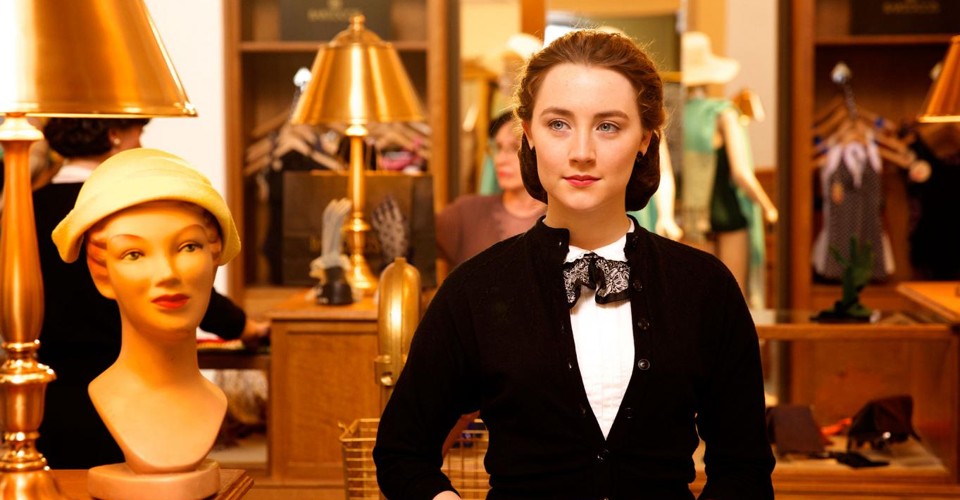
Ellis Lacey (Saoirse Ronan) is our homesick young woman, eager to build a new life in America. Sponsored by kindly priest Father Flood (Jim Broadbent, with more than a passing resemblance to Tóibín) and living in the boarding house of kindly-but-no-nonsense Mrs Kehoe (Julie Walters, in a role surely written for her) she finds work in a department store and trains at night as book keeper. She meets and falls in love with a sweet Italian American plumber Tony (Emory Cohen), but when tragedy occurs back in Ireland, on her return there she is strongly drawn to her homeland and to kindly, handsome Jim Farrell (Domhnall Gleeson). Which life will Ellis choose?

You can see why Brooklyn was so popular with Oscar voters, and why it struck such a chord with so many people. It’s reassuringly, warmly, old-fashioned, a big-hearted, brightly filmed, gorgeously mounted “woman’s picture”, the sort of story that Hollywood studios churned out in the 1940s and 1950s (you know, those sort of “who will she choose!” films). Crowley pulls the material together however with real emotional force, married with an interestingly different (if gently touched upon) theme of the immigrant experience.

Helped by a very good script by Nick Hornby, Brooklyn is not only emotionally moving but also much funnier than you might expect. Part of this is deliberate choice, expanding parts of the novel (particularly the dry humour of Mrs Kehoe, seized upon with relish by Julie Walters) that bring the funny, but also from the warmth, regard and humanity it invests its characters in. Ellis is a character so well drawn, whose feelings are so real, that we end up feeling deeply invested in her, and all the more ready to respond to her quick intelligence and dry (but gentle) wit. 

It’s a gift of a part for Saoirse Ronan, who is quite simply outstanding as a quiet, sheltered woman who grows, changes and decides to create her own destiny before our very eyes. (Helped by Hornby’s script again, which uses the Ireland-USA-Ireland structure to pinpoint many dramatic bookends and contrasts that Crowley subtly, and not forcefully, brings to the screen.) Ronan’s intelligence and her conflicting desires are clear in every scene, while her eyes seem able to communicate reserves of emotional depth. In two cultures where it isn’t easy for a woman to define her own destiny, Ronan brilliantly shows the difficulties many woman had in understanding or expressing what they want, in a world where they haven’t been set-up to think like that.

The film also doesn’t make it easier for her by making her two suitors – while radically different men – both such charming, lovely guys. Cohen’s Tony is a boyish enthusiast, full of hopes and dreams, who seems to represent everything that America has to offer Ellis. Domhnall Gleeson’s Jim is decent, honourable, kind, old-fashioned man who represents everything that she realises her Irish culture has for her – tradition, decency and a sense of self. It also speaks to how well drawn Ellis is by the film, and how deeply well-though out Ronan’s performance is, that it makes perfect sense that these two very different men would be drawn to her, and that both bring out different parts of her personality, which never feel contradictory.

It works as well because we’ve lived through everything Ellis has. She is present in nearly every scene in the film, and we see her change from a shy, scared, frightened woman on the boat from Ireland who needs to be cared for by an experienced emigrant fellow passenger (a very good cameo from Eva Birthistle) to a woman who flourishes in her new surroundings and the opportunities she is given. We need to feel that connection with her, since some of her behaviour (if it came from a man) would probably be seen as quite shabby indeed. But because we have such an understanding of her inner life – and because Ronan has such an empathetic and expressive face – we understand the reasons for her conundrum.

It’s that conundrum that lies at the centre of the film, and to be honest what dominates it. It works because it is done with such emotional truth (aided by Michael Brook’s excellent, heart-string tugging score that mixes American sounds with Irish folk to glorious affect), but the film is primarily a nostalgia romance. While it’s very setting makes you think about the immigrant life, it has very little to say really about either the cultural phenomenon or the impact it has on either the USA or Ireland (a charity Christmas meal for former Irish railway workers now all homeless is as close as it gets to talking about long-term integration). It doesn’t really matter, because the central story sweeps you up so much, but it does make the film more of a romance than the grander claims made for it by some as some sort of commentary on Irish immigration.

But there’s nothing wrong with such a handsome, romantic, emotional drama, or one that feels so reassuringly old-fashioned, even as it is made with touches of wit and confidence. Making some welcome comments on feminism, and led by Saoirse Ronan at her finest, it’s still a triumph of old-style, romantic, women’s pictures that you’d have to be pretty cold not to feel some sort of warming in your cockles by the end of it.

Tess (1979)

Nastassja Kinski is Thomas Hardy’s tragic heroine in Polanski’s Tess

Director: Roman Polanski

Cast: Nastassja Kinski (Tess Durbeyfield), Peter Firth (Angel Clare), Leigh Lawson (Alec Stokes-d’Urberville), John Collin (John Durbeyfield), Rosemary Martin (Mrs Durbeyfield), Carolyn Pickles (Marian), Richard Pearson (Vicar of Marlott), David Markham (Reverend Clare), Pascale de Boysson (Mrs Clare), Suzanna Hamilton (Izzy Huett), Tony Church (Parson Tringham)

At first sight it looks like a rather odd project for Roman Polanski: a faithful adaptation of a Thomas Hardy novel, shot in sumptuous period detail. But look a little closer and you’ll see it’s a neat fit for the director’s interests. A human interest story that revolves around the man’s capability for misusing, abusing and disregarding his fellows. With isolation, despair and depression thrown into the mix (what do you expect, it’s Thomas Hardy?!) and a depressing conclusion (again, it’s Hardy…) it feels less and less like an anomaly in its director’s CV. On top of this, it’s the film Polanski planned to make starring his murdered wife Sharon Tate (the film is dedicated to her memory).

Tess (Nastassja Kinski) is a young girl growing up in 1870s “Wessex” (Hardy surely the first major writer to create his own universe of interlocking stories in a fictional location). Her life is thrown into chaos when her father (John Collin) learns his family descends from the ancient lineage of d’Urbervilles. Tess is sent to find work and, maybe, fortune with her “cousin” Alec Stokes-d’Urberville (Leigh Lawson). But instead of a place at the family table, she finds herself charmed and then seduced (and perhaps raped) by Alec, leaving the house disgraced and pregnant. A few years later, she meets would-be-farmer and idealistic parson’s son Angel Clare (Peter Firth) – but their marriage cannot survive revelations of her past. As Tess’ life unravels, she is thrown into ever more desperate situations that entangle both men in her life with fatal consequences.

Polanski’s film is shot with a wonderful eye for period and makes extensive use of the “magic hour” (just after sunrise or just before sunset) to place some truly gorgeous images on the screen. Despite this, the film never compromises on the grinding lack of glamour in poverty, and few period dramas have had such an eye for mud, uncleanliness and shabby huts and bedding arrangements than this one. Polanski spent years making the film in several carefully selected locations, designed to make France look as much like Dorset as possible (for obvious legal reasons, Polanski had to rule out filming on location in England).

In this, Polanski creates a heartfelt drama of human suffering, with Tess repackaged as a sort of “every-woman” sufferer, whose entire life is shattered by a passing comment made to her father by a distant clergyman (a man whom we never see again). It’s part of Polanski’s theme of how events that we have little or no control over can shatter our lives and change the entire path of our existence. Tess frequently finds her life changed or altered by the actions of third parties (from the parson who speaks to her father, to the parish do-gooders who find the working boots she has quietly taken off to make a good impression for people she never meets and take them to a poor house – the sort of stunning moment of bleak “blow-upon-a-bruise” that the film does so well) and has no real power over what happens to her.

When she does finally take decisive actions with the two men in her life, both events rebound with tragic consequences on her – first with her rejection by Angel and then by her final escape from the influence of Alec. In between, we see her drifting gloomily from location to location, never able to find the energy, will or strength to make her life her own. Polanski’s film seizes on Hardy’s themes that we become trapped in our own fates, events spiralling constantly to leave us ever more at the mercy of factors over which we have no control. Tess is an isolated character, with few friends and confidantes, and whom society has left behind. It’s a film that follows an individual in a monolithic society with its own rules and structures, that makes no room for personal circumstances when rushing to its judgements.

Making Tess an innocent victim meant Polanski needed to cast someone who would not bring too much overt “actor” presence. Kinski, only 16 when filming started, brings a very natural innocence and gentleness to the role. She is certainly completely believable as a young woman who cannot truly understand what all these men who take such an interest in her really want, and feels unable to impose herself (just as Kinski struggles to impose herself on the film) on her life. That Kinski is not the strongest actor in the world, and that her accent erratically drifts between Dorset and Dutch, is counterbalanced by this gentle, unprocessed innocence. It matches perfectly Polanski’s idea of Tess as a victim, trapped in a perfectly constructed world.

It also allows the two men in her life a bit more scope for some domineering acting. Peter Firth does a very good job as the idealistic Angel who turns out to be nowhere near as liberal or understanding as he would like to think he is, until it is way too late. Firth walks a very neat line between sanctimonious, naïve and pompous. He also makes a great contrast with Leigh Lawson’s corrupt creepiness as the pervy Alec, all moustachio-twirling charm and caddish manner, but hiding a desire beneath to be the decent, better man.

Polanski positions Tess as the constant victim pulled between these two men, from the beautifully filmed misty forest glade where Alec forces his attentions on her, to the eccentrically furnished would-be family home (complete with lascivious elderly maid, giggling about the possibilities of the couple’s wedding night) where her marriage to Angel falls apart. It’s a film where Polanski throws in many lovely touches that ground the film in a particular time and place, from that giggling maid to the ominous sound of hedge-clippers when Angel arrives at seaside hotel in search of Tess. Every moment of the film feels realistically placed in Hardy’s Wessex, and it’s crammed with small sequences and moments that stick in the mind.

It’s a film with a masterful understanding of time and place (it rightly won Oscars for cinematography, costumes and production design) but uses that to build a story of a woman made an internal victim in a society that thinks it cares, but really doesn’t. Tess is a woman whose life is buffeted and changed by the actions of others, and who cannot escape from the dark shadows of being trapped in her own destiny. You can see why these themes appealed to Polanski – and perhaps this helps explain why the film feels like such a darkly personal one, right up to its near final image of Tess as a sacrificial victim laid out at Stonehenge.

Call Me By Your Name (2017)

Timothée Chalamet and Armie Hammer are lovers drawn together in Call Me By Your Name

Director: Luca Guadagnino

Cast: Timothée Chalamet (Elio Perlman), Armie Hammer (Oliver), Michael Stuhlbarg (Professor Perlman), Amira Casar (Annella Perlman), Esther Garrell (Marzia), Victoire Du Bois (Chiara)

First love is a story everyone can relate to. Call Me By Your Name unfolds an engrossing early romance, where precocious 17-year old Elio (Timothée Chalamat) discovers his bisexuality through his deep attraction to his professor father’s (Michael Stuhlbarg) summer research assistant, 24-year old Oliver (Armie Hammer). An attraction which, over a long hot summer in Northern Italy in 1983, finally leads to a deep romantic and sexual bond forming between the two.

Refreshingly, Guadagnino’s film is relentlessly positive and devoid of tension or disapproval. You’d expect a romance such as this – especially a gay one – to lead to an eventual outburst of furious disapproval from someone or tear-filled remonstrations that what the couple have isn’t wrong. These are avoided completely, for something that feels intensely real and convincingly grounded, especially as it follows Elio’s stumbling attempts to identify his own sexuality and understand how his feelings affect him. 

This is also a showcase for acting, a film like this living or dying on the chemistry between the two lead actors, and Chalamet and Hammer have this in spades, suggesting from the very start a deep bond, that grows in emotional intensity. The relationship is a slow dance, with both of them blowing hot and cold at different times. Oliver’s first tentative approach is resoundingly rebuffed by Elio, only for Elio’s fascination with Oliver to grow into a deep unexpressed longing, which Oliver is nervous about responding to for a host of factors, from the age difference to his residence in Elio’s parents’ house. Even after the two come together, Elio’s confusion about his own feelings leads him to turn colder before the two finally find an equilibrium that works. 

It’s also a classic coming of age story, as Elio moves out of adolescence and into adulthood. Elio never feels like a traditional teenager in the first place, a musical prodigy and talented autodidact who seems to have read nearly everything (“Is there anything you don’t know?” Oliver jokingly says at one point after Elio explains the detailed history of a war memorial). But in other ways he is the same as any other teen: sex-obsessed and confused, spending a lot of time with two female friends who he seems to be unsure of his feelings are towards, indulging in explorative sexual fantasies and fumbled exploration of his own and others’ bodies, working out what he likes and what he doesn’t.

It leads to a superb performance from Chalamet (youngest ever nominee for Best Actor at the Oscars), who perfectly captures both the intelligence of Elio, and his confused lack of understanding of who or what he is. Chalamet’s body language – a mixture of awkward teen and assured adult, is a perfect physical expression of his part-adult, part-child psyche. Like any teenager, he’s at times selfish, greedy or plain annoying. But at many others he’s sensitive, delicate, vulnerable and desperate to express his love. Chalamet juggles all these competing emotions and hormonal drives brilliantly, and his face is a true instrument of expression, a sliding kaleidoscope of confused urges that compels your attention.

It’s a perfect match-up with Hammer, who is superb as just the sort of boisterous, confident, exciting and sexy presence you can imagine being drawn towards. But Hammer also laces Oliver with a tenderness, a concern and a gentleness beneath his joie de vive that really expands the character’s soul and makes him not just a force of vibrancy but also a genuinely lovely man. Hammer is very careful (as is the film) to avoid the possibility of Oliver being seen as a seducer, and it does this by giving him a touching restraint as well as manipulation-free openness, an honesty and an emotional freeness that helps make him more often the pursued rather than the pursuer.

Guadagnino lets this gentle love story unfold over a luscious, gorgeous Italian summer, with his camera drifting contentedly around the two lovers and their environment, as much a part of the dance of their initial attraction. The film is resolutely “in the moment” and has no flashbacks, flash forwards or any real reference to any narrative events outside of what we see on screen. It unfolds gracefully and naturally, with the camera work largely taking an unflashy but still warm view on everything we see.

Guadagnino deliberately treats much of the central romance element with reserve, avoiding too much nudity and panning discretely away from sexual encounters between the two. (I will say though, that he has no such reserve with Elio’s heterosexual encounters, where female nudity and sex are shown in full.) It does successfully preserve a sense of innocence and purity in the relationship – and keeps the focus on the fact that this love between the two is about them becoming better people, who understand themselves better, through the relationship. 

This positive message is reinforced by the acceptance of Elio and Oliver from all in the film, including Elio’s parents. Michael Stuhlbarg in particular has a scene near the end of the film of wonderful power – cementing his status from this film as a dream dad – with a speech to his son so full of acceptance, encouragement and love that you’ll feel your heart melt. Both Elio’s parents are very aware of the relationship and tacitly encourage it: according to this film at least, if you’re young and gay, growing up in a Bohemian, academic household does make your life easier! (Even Oliver comments that Elio has no idea how lucky he is.)

This film is also refreshing for its lack of casualties. Sure the two girls Elio and Oliver flirt with are disregarded swiftly, and the film gives only a little time to their rather shabby treatment, but generally it’s a film about learning who you are by spending time with someone else. And if that includes a few moments of teen awkward sexual exploration that are almost unbearable to watch (a scene with a curious Elio and a peach is a case in point, replete with queasy sound effects) then so be it.

Call Me By Your Name is a terrific coming-of-age tale, emotionally honest, true and mature and directed with a graceful ease and unshowy skill that is a testament to the deep confidence and grace of its director. With two superb performances and some excellent support work, it’s a glorious summer movie of love that will speak to you regardless of sexuality.

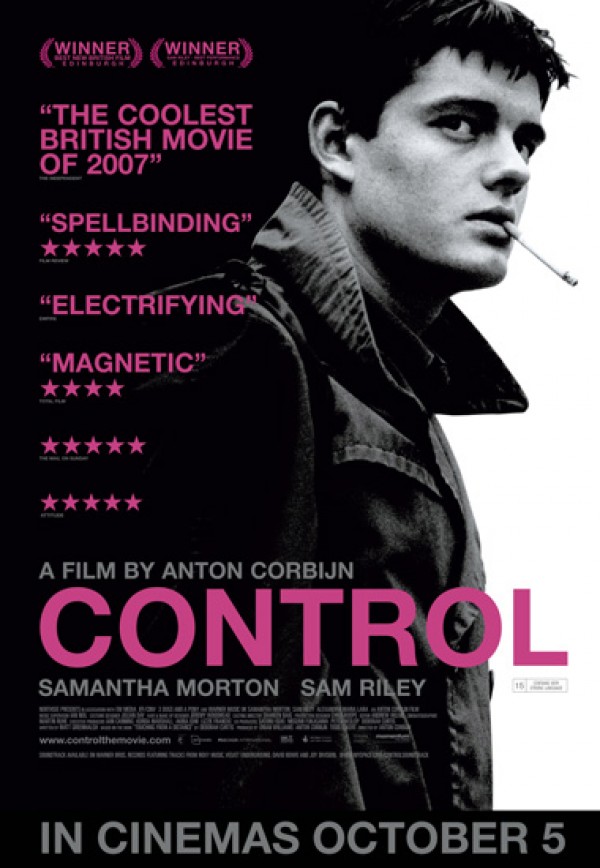
Control (2007)

Sam Riley excels in this heartbreak life story of Ian Curtis

Director: Anton Corbijn

Cast: Sam Riley (Ian Curtis), Samantha Morton (Deborah Curtis), Alexandra Maria Lara (Annik Honoré), Joe Anderson (Peter Hook), Toby Kebbell (Rob Gretton), Craig Parkinson (Tony Wilson), James Anthony Pearson (Bernard Sumner), Harry Treadaway (Stephen Morris), Andrew Sheridan (Terry Mason), Matthew McNulty (Nick Jackson)

Depression is no respecter of fame or success. You can have everything many people would give their right arm for, and still find the prospect of life overwhelming. Control is a heartfelt, deeply affecting film about Joy Division lead singer Ian Curtis, who committed suicide shortly before a career-changing tour of America. Anton Corbijn knew Curtis and the band personally, and his deep connection with this story is obvious in every frame of this beautifully shot film.

In 1975, fresh out of school, Ian Curtis (Sam Riley) marries Deborah Woodruff (Samantha Morton). Curtis is a would-be poet, but finds his interest piqued when he attends a gig by the Sex Pistols and quickly forms a band – Joy Division – with a group of friends. Powered by Curtis’ imaginative lyrics, the group starts to make a name for itself, taking on a manager Rob Gretton (Toby Kebbell) and winning the attention of the influential Tony Wilson (Craig Parkinson). However, all is not well with Curtis: beginning to suffer increasingly from epilepsy, Curtis is also falling in love with a young Belgian journalist Annik Honoré (Alexandra Maria Lara) while still in love with – although increasingly lacking in mutual understanding with – Deborah. These pressures slowly build up on Curtis.

Control is a film about a person’s longing to have security and a sense of mastery over their own life, but finding they lack both this and the emotional strength to deal with the consequences. Curtis is a man buffeted by competing pressures and desires, as well as a paralysing fear that epilepsy will eventually claim his life. He is frequently unable to relax, and tries his utmost to divorce himself from the reality of his situation by living as much as he can in the moment, ignoring until it is impossible the burdens of making choices about his life and relationships.

Living in the moment is what, for Curtis, makes it all possible. You can see it in reflection in his performances of Joy Division songs – the intense focus, mixed with the channelling of his own epileptic fits into a series of mesmeric on-stage dances, filled with wild and jerky movements. The entire film suggests much of Curtis’ output could be retrospectively seen as a cry for help, many of his lyrics about concerns that would eventually lead to him taking his own life. At one point, Curtis sings heartbreakingly of his isolation in a recording studio booth – with Corbijn cutting straight to the rest of the band and studio technicians talking and going about their business in the studio, oblivious to the underlying desperation that runs through it.

Because the film makes clear no one knew how to help Curtis or even how to identify his problem. To his manager and the band, its all part of the rough and tumble of rock ‘n’ roll. To his studio, it’s the artistic personality. Doctors seem to barely understand how to treat his epilepsy and miss all the signs of the personal stress it places on him. Neither his wife nor girlfriend can imagine that his guilt and self-loathing run as deep as they do. 

Corbijn’s beautifully evocative black and white photography adds hugely to this sense of dream-like non-reality around Curtis’ life, against the backdrop of some beautifully rendered Macclesfield locations. It helps wonderfully capture the sense of Curtis’ life somehow never coming fully into colour, as well as adding a deeply affecting air of melancholy over every frame. It’s also perfect for capturing the atmosphere of the 1970s clubs and bars that the band experienced.

The photography gives the film a feeling of the classic kitchen-sink dramas of the 1960s, and that is no bad thing, adding a certain depth to the tragedy of a working-class lad swept up by success and largely unable to cope with the burdens of expectation. Curtis is shown to be constantly overwhelmed by the pressure of live performance and the expectations of fans and viewers, yet also desperate to continue to have this channel to express himself.

Corbijn doesn’t give him a free pass though, and shows how he deliberately distanced himself from Deborah and their child. Often silent and disengaged, with a glazed look of a man who would rather be anywhere else than having to support a wife and child before he was 20, Curtis and Deborah’s marriage is one of affection but no shared interests of outlook. Deborah clearly provides Curtis with no kindred-spirit feeling, but he uses her as an emotional prop. Simultaneously he uses Annik for the same, while conducting an affair that clearly gives him a deep sense of shame, but finds impossible to resist. It’s living in the moment again: clearly, at every point, he would rather forget the other woman altogether, and is incapable of making the final life-altering decision needed.

This balance works so well because Sam Riley is astonishingly good as Curtis – real, pained, gentle, tender, selfish, with eyes that seem to have the life and will to go on drain out of them as the film goes on. Riley’s performance is pitch-perfect, and his empathetic brilliance for this man who did not know how to express his own feelings clearly is deeply moving. Over the film you see a sensitive man slowly fall apart in self-loathing, feeling trapped in his own life and unable to break free.

The film is stuffed with excellent performances, with Samantha Morton very good as Curtis’ deeply caring wife who unwittingly smothers him with demands – demands that are more than fair considering she is left frequently to hold the baby while her husband disappears for days on end. Alexandra Maria Lara has less to work with, but does a lot with Annik. Toby Kebbell provides some much needed lightness as Joy Divison’s manager, a blistering, foul-mouthed force of nature who can’t even begin to entertain the idea that his lead singer might consider ending his life.

The final sequence of the film, as Curtis (off camera) decides to follow-through on committing suicide (his second attempt to do so, another clear sign of those around him being totally unable to respond to the signals) is unbearably sad, ending with a beautifully evocative, tear-inducing shot of the crematorium releasing its ash – the last vestige of this lost life – into the sky to drift and disperse freely in a way Curtis never could. Control is a modern classic of British realism and possibly one of the finest music biopics ever made. Corbijn has the soul and eye of an artist, and brings all this to bear on a deeply heartfelt and moving film.

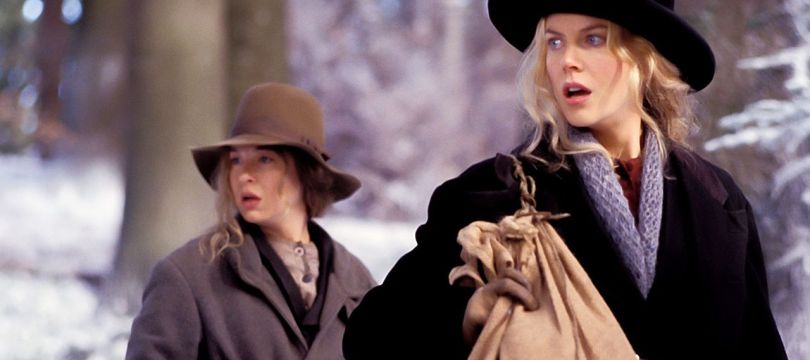
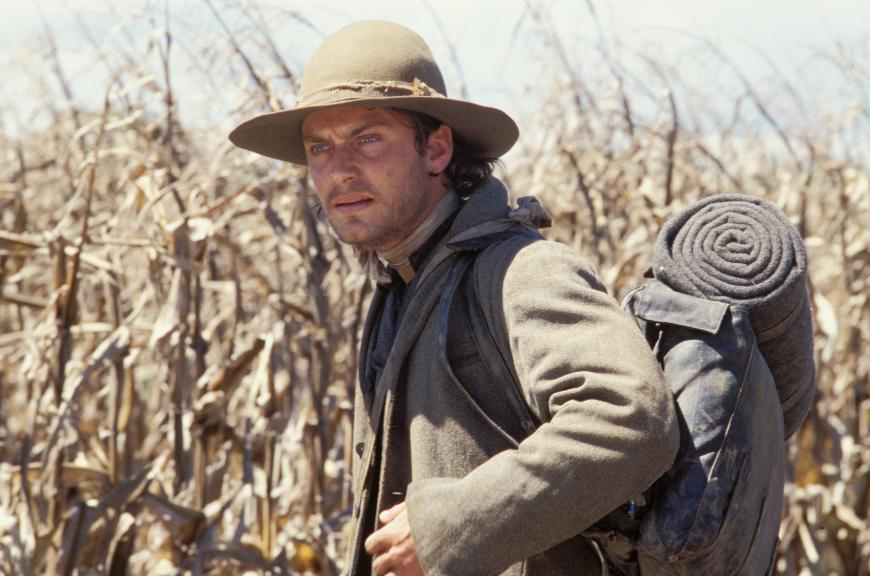
Cold Mountain (2003)

Nicole Kidman and Jude Law are souls in love separated by war in Cold Mountain

Director: Anthony Minghella

Cast: Jude Law (WP Inman), Nicole Kidman (Ada Monroe), Renée Zellweger (Ruby Thewes), Eileen Atkins (Maddy), Kathy Baker (Sally Swanger), James Gammon (Esco Swanger), Brendan Gleeson (Stobrod Thewes), Philip Seymour Hoffman (Reverend Veasey), Natalie Portman (Sara), Giovanni Ribisi (Junior), Lucas Black (Oakley), Donald Sutherland (Reverend Monroe), Cillian Murphy (Bardolph), Jack White (Georgia), Ray Winstone (Teague), Melora Walters (Lila), Charlie Hunnam (Bosie)

There was no difficult novel Anthony Minghella couldn’t adapt for the big screen. Cold Mountain is as beautiful and handsome a film as any he made, and his masterful scripting of a complex story is testament to his skill. So why is Cold Mountain not more loved? Is it because it’s almost too well made, too handsomely mounted, too literary and intelligent? Is it, actually, trying a little too hard? Is it a Cold Mountain itself, a giant structure of beauty but with an icy heart?

Based on Charles Frazier’s novel, set in the final days of the American Civil War, confederate soldier Inman (Jude Law), knowing the war is lost, deserts to return to the woman he loves, Ada Monroe (Nicole Kidman). The two of them have only spoken a few times but they feel a deep personal bond. During the years of war, poverty has hit preacher’s daughter Ada, although she has crafted a life-changing friendship with 18th century trailer trash Ruby Thewes (Renée Zellweger) which has helped her survive. As Inman’s odyssey home leads to him encountering a number of different vignettes that show the despair Civil War has brought to America, Ada struggles to survive and avoid the sinister attentions of home guard enforcer Teague (Ray Winstone).

There is so much to admire in Cold Mountain I want to start there. The photography is beautiful, and the film is assembled with a striking grace and skill. Walter Murch’s editing and sound design is perfect, with each shot of the film being fabulously composed and each carrying a specific message and purpose that contributes to the overall impact. The use of music – a collaboration between T Bone Burnett and Gabriel Yared – is perfect, a series of wonderful period compositions and impactful orchestral pieces. 

Everything about how Minghella captures the feel of the time, the mood of the South heading into war, and the disintegration of social conventions as the war takes hold and lays waste to the land, rings completely true. From the celebrations of the young men at the film’s start, to the increasingly haunted, tragic look of Jude Law’s Inman as he discovers new horrors at every point in his journey, you know war is hell. Minghella ironically opens the film with a catastrophic defeat for the North – but the slaughter disgusts Inman, and his burial under mounds of rubble during an explosion leads to a spiritual rebirths with Inman deciding senseless killing isn’t worth the candle any more. In a war of willing volunteers, how do we respond when these volunteers don’t want to keep fighting?

And why should they, as each of the various vignettes Inman walks through is a wasteland of moral collapse? From a sex-obsessed preacher (an amusing performance by Philip Seymour Hoffman) who has lost his morals to a tragic widow desperately trying to feed her baby (Natalie Portman, effectively stealing the whole show with an intense performance of utter desolation), everything Inman sees shows that nothing is worth all this. The film gets a very good sense of the drive that pushes Inman forward: constantly moving, he’s rarely seen sitting or resting. Each of the Odyssey-inspired stories gives him something to reflect on, or another opportunity for moral and emotional torment , from dragging bodies in a chain gang to avoiding the lustful advances of a group of hillbilly sirens who trap deserters for money.

Meanwhile, things ain’t much better on the homefront, where corrupt bullies like Teague (a slightly too obvious Ray Winstone) are enforcing their own law at the expense of justice. Poverty is also the impact of war, and poor Ada suffers hugely from this, as supplies run low and eventually out. Minghella’s swift and skilful establishment of character shows from the start how Ada is a stranger in a strange land, a middle-class town girl who is completely unsuited for country life and utterly unready to fend for herself when the chips are down without support. 

Is it any wonder in this world, that Inman and Ada cling to memories? Part of the film’s effect depends on how you respond to the romantic bond between these two clinging to a few brief moments (a few exchanges and one immensely passionate kiss on the day of Inman’s departure). It’s an old-fashioned, sweeping, love story and it depends on you relating to that old-fashioned mythic love story. I’m not sure that the film quite sells this as effectively as it could do. Somehow, perhaps because Inman is so insular and Ada a little too difficult to relate to, the passion between them can’t quite carry the sweep that the film demands, even as Minghella skilfully intercuts between them.

Nicole Kidman in particular feels miscast as Ada. Kidman is too intelligent, too determined and strong a performer to convince as a woman who is unable to look after herself and nearly succumbs to fear – she’s just not an actress I can picture cowering in fear in front of an angry rooster. Kidman does her best, but the character never really wins the sympathy that we need for the performance to work. Jude Law has much more to work with as Inman, brilliantly communication a whole world of feeling with very little dialogue. 

What works less well with Law is that his plotline just doesn’t quite grip enough. The vignettes are often entertaining, but feel like episodic sketches, and the sense of a building picture of the despair of the South doesn’t quite come into shape as much in practice as it does in theory. Frankly, after a while, you are ready for Inman’s journey to come to an end and for him to intersect with Ada’s plotline back at Cold Mountain (which is built around a consistent group of characters who engage our interest).

In the home front storyline you’ll be relieved with the entrance (almost an hour into the film) of Renée Zellweger’s blowsy Ruby, a loud-mouthed, trailer-trash woman with a heart of gold and a mastery of farming who effectively saves Ada’s life. It’s a loud, big, Oscar-winning performance from Zellweger that plays with being a little broad, but is skilfully balanced by the slow reveal that this personality is a cover that Ruby uses to hide her own pain. Added to this depth, her heart-warming presence carries such simple pleasure and colour compared to the more muted performances from the leads that you welcome it. 

Because Inman and Ada don’t quite work as a romantic couple. There is something slightly cold about them, slightly hard to relate to. And for all the intense and brilliant construction and filming of the film – and the mastery of Minghella’s writing and direction – it never makes them into the sort of classic romantic couple you care for. You want to connect with it more than you ever really do, and whether that is down to miscasting or the lack of intense chemistry between them I’m not sure, but it means Cold Mountain never becomes the great romantic tragedy it should be. You want a film this good to be as good as it feels – and it never quite is.

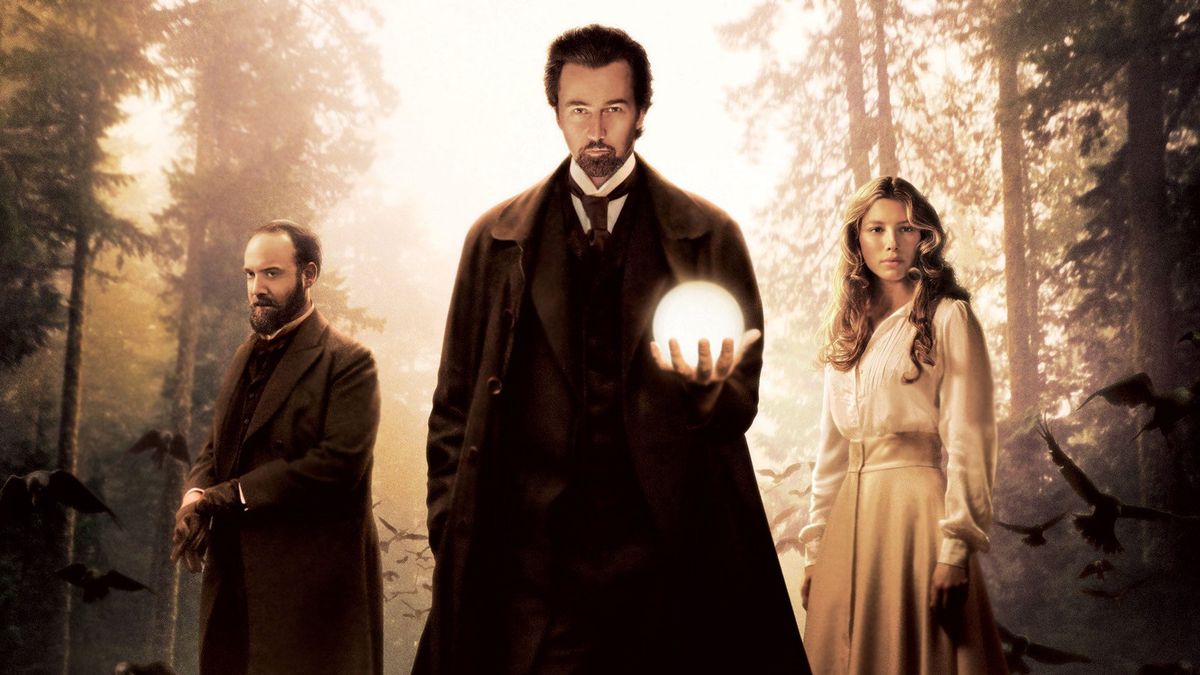
The Illusionist (2006)

Ed Norton, Paul Giamatti and Jessica Biel are wrapped up in the tricks of The Illusionist

Director: Neil Burger

Cast: Edward Norton (Eisenheim), Jessica Biel (Sophie), Paul Giamatti (Inspector Uhl), Rufus Sewell (Crown Prince Leopold), Eddie Marsan (Josef Fischer), Jake Wood (Jurka), Tom Fisher (Willigut), Aaron Taylor-Johnson (Young Eisenheim), Eleanor Tomlinson (Young Sophie), Karl Johnson (Doctor)

In 2006, The Illusionist was the other film about nineteenth-century magicians that wasn’t Christopher Nolan’s The Prestige. As such it got rather overlooked, which is unfair as this is a handsomely made, intriguing little puzzle which doesn’t reinvent the wheel but does what it does with a fair amount of invention and beauty.

In turn-of-the-century Vienna, the illusionist Eisenheim (Edward Norton) is a revelation – a mystery character whose past is investigated by Police Inspector Uhl (Paul Giamatti) under the orders of Crown Prince Leopold (Rufus Sewell). The Crown Prince feels Eisenheim’s illusions – which suggest at times dark truths in the Prince’s own personal life – are a serious risk to his position. On top of which, there is a secret past romance between Eisenheim and the Prince’s intended wife Countess Sophie (Jessica Biel), and the Prince is not a man to be crossed. So begins a cat-and-mouse game of trick and illusions between Uhl and Eisenheim.

The greatest thing about Neil Burger’s period piece is the grace and beauty with which it has been filmed. Dick Pope’s mixture of sepia tones and candlelit blacks makes for a series of gorgeous images, contrasted perfectly with Philip Glass’ beautiful score. Both contribute hugely to creating an atmosphere of mystical unknowingness around the Vienna locations, and give the film something in every scene to delight the senses.

What works less well is the slightly routine scripting and filmmaking that pulls the film together. For all the beauty with which it is presented, there isn’t quite enough of the original or – for want of a better word – the magical about what we see on the screen. The story is just ever so slightly too familiar, the points it intends to made – be it about the nature of power, or magic, or love, or hope – never quite coalesce into a coherent and clear message that really feels like you are being told something or shown something you haven’t seen in several movies before. 

Instead we see that behind the eyes of even the most obscure and unreadable conjurer there is deep and abiding love – love that will push them to do wild, even morally questionable, things. For others like the Crown Prince, that love is tied in altogether with possession and power and that there is no place for truth. Illusion is in all things: from Eisenheim’s entire life to the Prince’s front as a man of the modern world and his desire to become a dictator. Maybe that might be as close as the film gets to a deeper meaning – that illusion hides and protects our truths. 

As Eisenheim’s tricks get closer and closer to mesmerism and séance, the film suggests that it is a human need to want to see the truth behind tricks. The crowds who see Eisenheim raise the dead in flickering images want to believe it, that they could talk to their own deceased loved ones. Even in his early magic tricks, the less poetic characters of the film see value in the tricks only when they feel they have worked out the illusion behind it. Both are looking for a form of truth in the illusion, but the truth behind the trick is often deeper and more complex than the mechanical process by which it is done.

It’s a shame the film doesn’t tackle these ideas more, and settles for a more traditional “love across the divide” romance, but perhaps it doesn’t quite engage because Eisenheim and Sophie aren’t really interesting enough characters. Edward Norton plays Eisenheim with grace and intelligence, and draws a lot of depth and emotion from scenes that often require him to wordlessly stare. But juggling a character who deliberately conceals the truth and his intentions at every single turn seems slightly to have straitjacketed Norton, an elliptical actor at the best of times. There is something unknowable about him in this film which, while perfect for the character, makes him one you can’t really invest in. Similarly, Jessica Biel (a last minute replacement for Liv Tyler after filming had started) certainly looks the part, and gives Sophie a warmth, but she never really makes an impression as a character. Rooting for these two star-crossed lovers is difficult because we never get a sense of who they are.

Instead the film is dominated by hard-nosed rationalist Inspector Uhl, a man with a curiosity for conjuring, an appetite for power, a determination to get things done, but finally more than a bit of humanity. Paul Giamatti is excellent in the part, playing a role that emerges as the audience surrogate, trying as hard as we are to work out what is real and what is illusion. He doesn’t put a foot wrong with Uhl’s affable professionalism nor his ability to switch to business-like harshness. He’s also adept at playing a man who is the third smartest character in the film, but believes himself to be the smartest. You could also the same for Rufus Sewell’s (also great and clearly having a ball) Crown Prince, a bully who thinks he is an enlightened man.

It’s Uhl whom the film finally bonds with the most, and it’s his attempts to piece together what’s going on that becomes the most engaging thing in the second half of the film. For all the beauty of its making, and the skill that has gone into creating the optical illusions (some of Norton’s sleight of hand tricks in this movie are extraordinary), it’s a film that doesn’t quite satisfy. When the final reveal occurs in the film’s closing moments, you won’t quite be as satisfied as you would expect, perhaps because you won’t really care about Eisenheim or Sophie. Burger has made a handsomely mounted but strangely cold film.