Category: Relationship film

All That Jazz (1979)

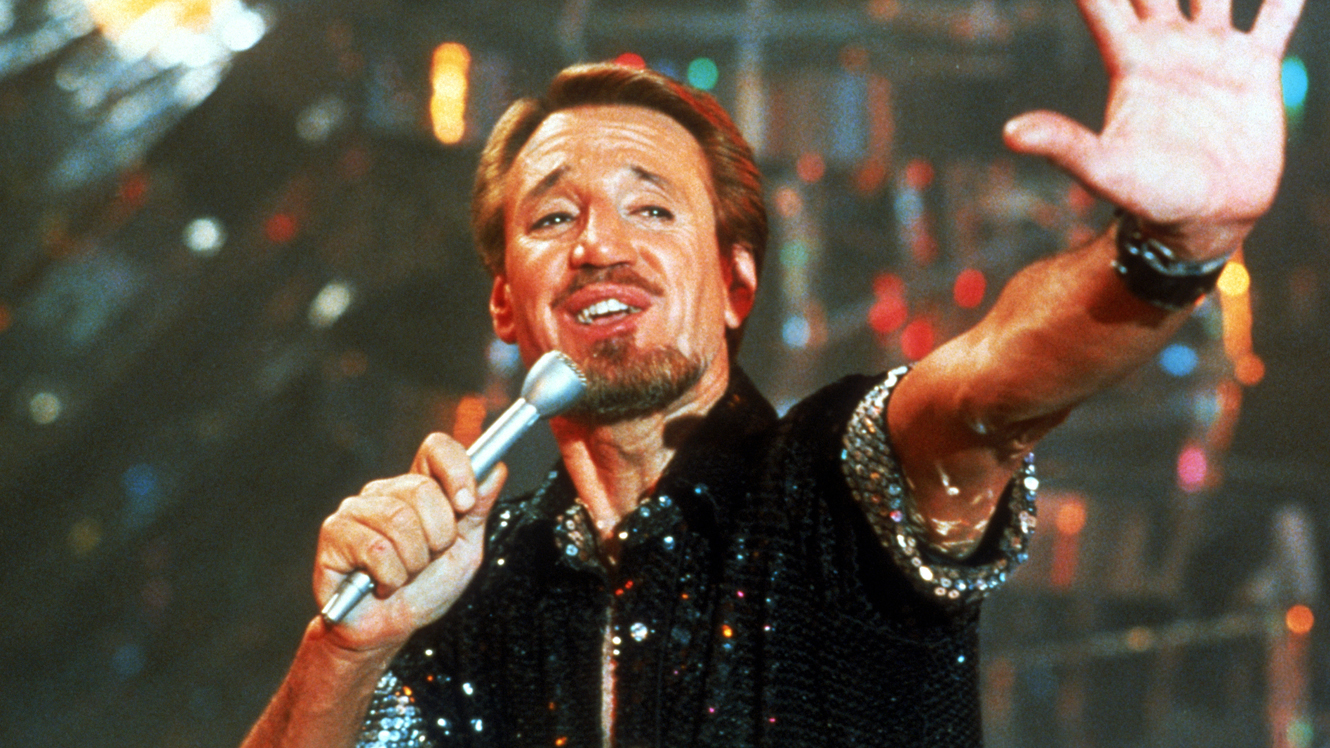
Roy Scheider plays the director Bob Fosse in a barely-veiled-at-all autobiographical film All That Jazz

Director: Bob Fosse

Cast: Roy Scheider (Joe Gideon), Jessica Lange (Angelique), Leland Palmer (Audrey Paris), Ann Reinking (Katie Jagger), Cliff Gorman (Davis Newman), Ben Vereen (O’Connor Flood), Erzsebet Foldi (Michelle Gideon), David Marguiles (Larry Goldie), Michael Tolan (Dr Ballinger), Max Wright (Joshua Penn), William LeMassena (Jonesy Hecht), Deborah Geffner (Victoria Porter), John Lithgow (Lucas Sergeant)

It’s revealing when a director makes an autobiographical film. There are insights to be found about the sort of person they are – and the sort of person they want to present themselves as to the world. And All That Jazz is possibly the most striking autobiographical film ever made. You have to have a towering amount of ego to make a film showing yourself as a deliriously talented polymath, generally liked by everyone. And then you have to have a giddy self-awareness to give your semi-fictional doppelganger all your titanic faults, selfishness, cruelty and flaws. Let’s not even get into the psychology of turning your own death into a musical number, eight years before it happened.

Just like Bob Fosse, Joe Gideon (Roy Scheider) is a hugely influential choreographer and director who has changed the face of Broadway musicals before going on to become the Oscar-winning director of a string of critically acclaimed films. He is also a workaholic, addicted to a string of prescription drugs, a never-ending smoker, with a strong of failed marriages and affairs behind him. Just like Bob Fosse, in 1975 Gideon is staging his ground-breaking original production of a musical (Fosse was directing Chicago which clearly inspired the unnamed musical here), starring his ex-wife (and mother of his daughter) Audrey Paris (Leland Palmer, a frequent Fosse collaborator), living with his girlfriend Kate Jagger (played by Ann Reinking, who was Fosse’s real life girlfriend at the time). At nights and weekends he is editing The Stand-Up (a version of Fosse’s film about stand-up Lenny Bruce titled Lenny starring Dustin Hoffman). When he has a near fatal heart attack part way through this, Gideon starts to sink. Fosse on the other hand used the experience to write this movie. 

All That Jazz is an electric piece of film-making, full of Fosse’s dynamism. It’s not only crammed with fabulous song and dance numbers (some of the best Fosse work you’ll see) but it’s beautifully edited and paced. Fosse holds it all together so brilliantly you never feel the thing teeter on the tightrope like Gideon does (the first image of the film is appropriately Gideon walking a tightrope). It perfectly captures the high intensity, killer pressure of maintaining this constant state of activity, and suggests how much Fosse (clearly) believed his own life was a performance, every moment constructed and staged for maximum impact. 

And that’s what you wonder about the film. Does Fosse hate himself, love himself or some combination of both? It’s something the film just teases, with Gideon indulged in a series of fantasy-tinged cryptic conversations with Jessica Lange (another Fosse conquest allegedly) as some sort of angel dressed in white. Here Gideon of course flirts and charms as only he can, while answering with ambiguous amounts of truthfulness a series of questions about love, his background, his wishes and dreams. But even when he says these things, there is the half smile that suggests it’s only part of the story. Or maybe Gideon himself doesn’t even know where life ends and the story begins.

Fosse’s film is just about perfectly structured. Repeatedly we see Gideon going through the same daily ritual when he wakes up: Vivaldi, shower, cocktail of prescription drugs, eye drops, slap hands, “It’s a show time!” (with an ever increasing struggle to keep the energy up). As the tempo of this repeated introduction changes through the film, you get a perfect idea of the state of Gideon’s mind and mood – and his relentless attempt to turn his own life into a perfect performance.

In among all this, perhaps no film has ever showed a better understanding of the pressures of creating a Broadway musical. The opening sequence follows a series of exhausting auditions from literally hundreds of dancers desperate for a role in Gideon’s show, slowly being whittled down to the chosen few. The rehearsals are a punishing series of deconstructions as the dancers strive to match Gideon’s perfectionism. Rehearsal rooms are crammed, sweaty and uncomfortable. The money men hover over every scene, with an eye on protecting their investment. And then, we see the results suddenly of Gideon’s work with a Chicago-ish dance routine so sexually charged it is positively indecent. It’s genius on at least three levels.

The film revolves around Gideon, and the amount of time squeezed out of his personal life by his never-ending, passionate work commitments. Leland Palmer is excellent as his loving but deeply frustrated wife, supportive but all too aware of Gideon’s selfishness. The bond between them feels strong, real and above conventional marriage. Ann Reinking is equally marvellous as his lover, protégé, partner and you name it. Between these three characters there is a hugely warm performance from Erzsebet Foldi as Gideon’s shrewd but loving daughter. Fosse isn’t afraid to sprinkle real moments of family warmth in, as if trying to show Gideon all the things he is missing out on – one particularly outstanding moment is a song-and-dance routine Reinking and Foldi perform for Gideon after the premiere of his film The Stand-Up, as entertaining as it is charming.

But the film’s secondary motor, after Fosse’s directing brilliance (seriously, there are few Hollywood directors so undervalued, the man is a genius) is Roy Scheider as Gideon. I can’t really imagine a more bizarre sounding bit of casting: Jaws Chief Brody as a song-and-dance man, the world’s greatest (even slightly camp) choreographer. But Scheider is simply sublime in this role. It’s a towering, landmark performance of total commitment. He’s achingly human, supremely sad but also overflowing with warmth, humanity and humour while also being repeatedly selfish, difficult and demanding. It’s a performance of total absorption.

By time of the finale number (a truly bizarre version of Bye Bye Love, renamed Bye Bye Life, in which Gideon lives his final moments in a fantasy world, singing and dancing his way towards death in front of an audience of faces from past and present) the whole thing is so wonderfully overblown it doesn’t really matter. The film’s passage into the surreal and fantasy as Gideon gets increasingly ill (while showing less and less regard for his own health) will be a bit much for some, but I was honestly so into it that I didn’t care. 

Because the film is about this acute piece of self-analysis from the director, a Fellini-inspired sort of musical , in which the understanding (or lack thereof) we get of Gideon, and which he gains about himself, is most important. His conversations with Lange’s angel of death are intriguing and as informative about the man he really is as the man he wants to be. 

Fosse’s film is simply supremely well directed (Kubrick called it one of the best films he ever saw). Fosse’s editor (playing himself in the film as the editor of The Stand-Up) said if Fosse had actually died during the making of the film, he would have made sure his death was filmed and edited into the movie. I can believe it. The only musical you’ll ever see which doubles as a confession and a condemnation, which turns death and surgical procedures into wham bam musical numbers, and which never becomes maudlin or sentimental about the self-inflicted disaster the director is putting on himself – it’s brilliant.

Her (2013)

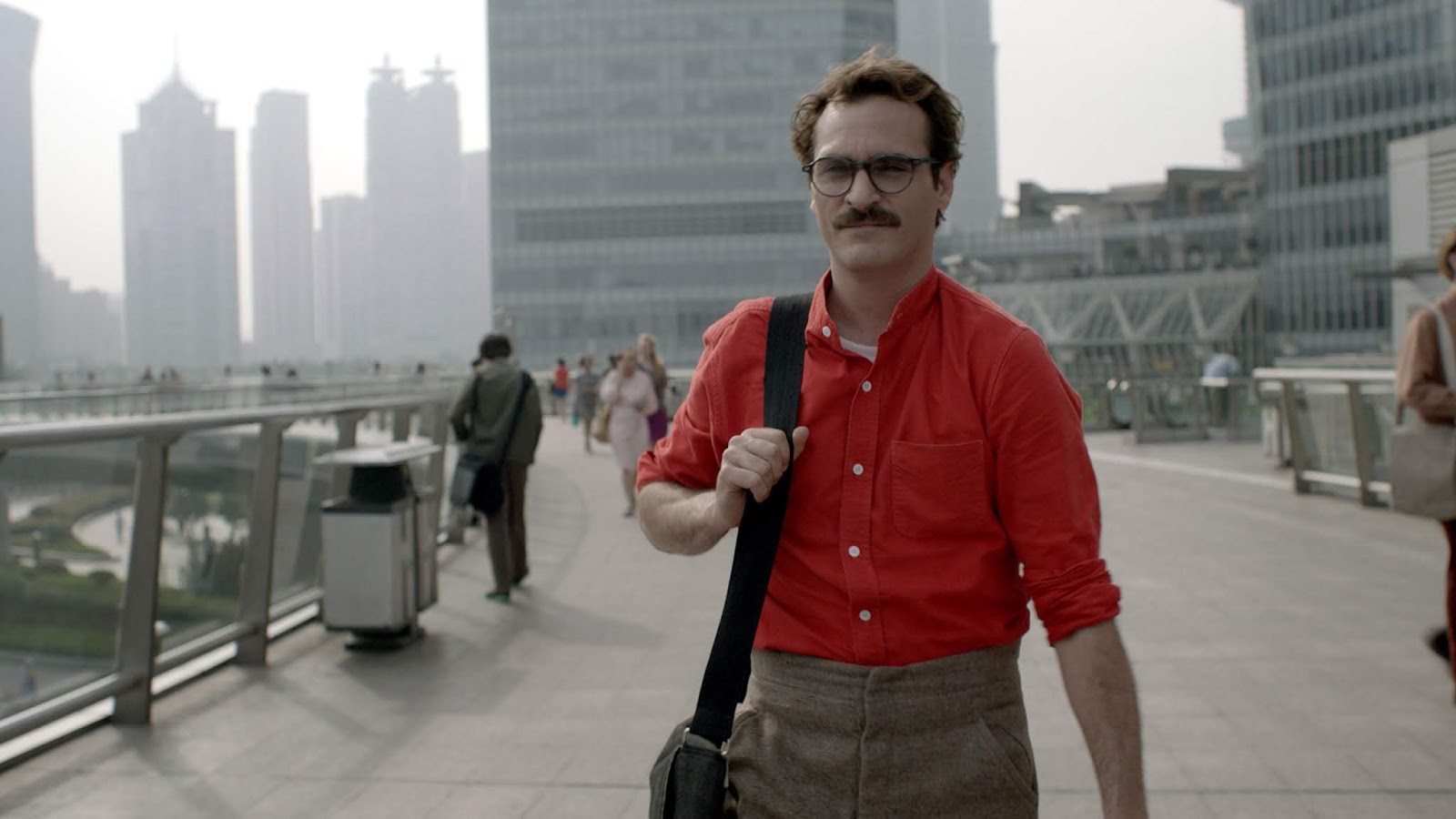
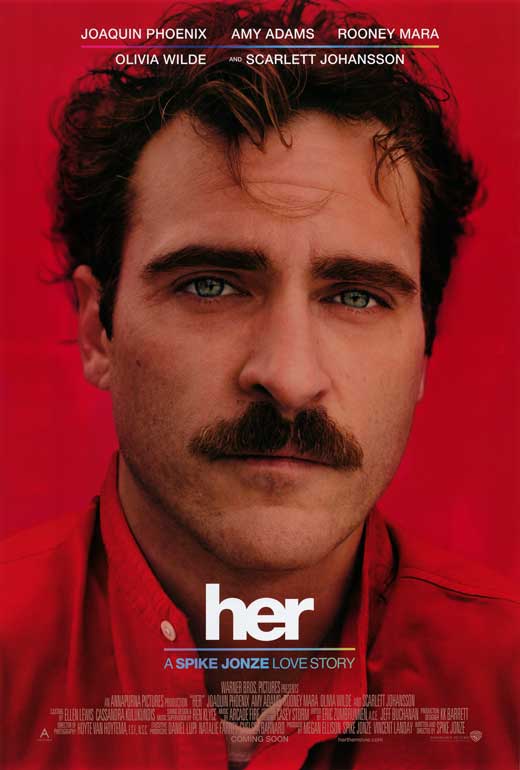
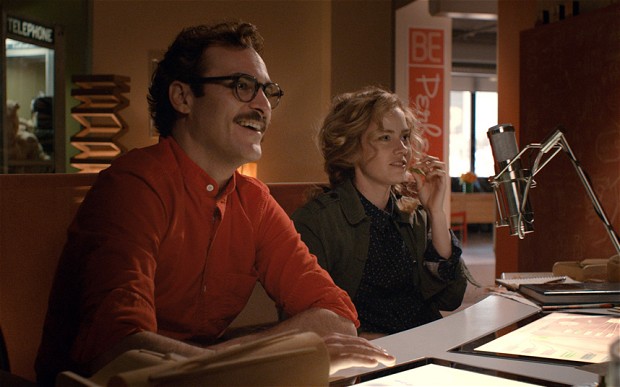
Joaquin Phoenix plays a complete prick in this unbearably pleased with itself satire Her

Director: Spike Jonze

Cast: Joaquin Phoenix (Theodore Twombly), Scarlett Johnasson (Samantha – voice), Amy Adams (Amy), Rooney Mara (Catherine Klausen), Olivia Wilde (Blind Date), Chris Pratt (Paul), Matt Letscher (Charles), Lukas Jones (Mark Lewman), Kristen Wiig (Sexy Kitten – voice), Brian Cox (Alan Watts – voice), Spike Jonze (Alien child – voice)

Every so often you start off engaged with a film and then, the longer it goes on, the less and less you like it. I couldn’t put my finger on the exact moment where I started to really take against Her, but I certainly had by the end of it. As someone once famously sort of said about Kriss Akubusi: “hard to dislike but well worth the effort”.

Anyway, Her is set in the near future. Theodore Twombly (Joaquin Phoenix) is a sensitive, insular man who writes personal romantic letters for other people who aren’t articulate enough (or bothered) to do it themselves. Getting divorced from his childhood sweetheart Catherine (Rooney Mara), Theodore downloads a new Artificial Intelligence Operating System for his computer. The system is designed to create a personality that appeals to the customer – and that is certainly the case here with this system, Samantha (voiced by Scarlett Johansson). Theodore, finding it hard to connect with the real world, is drawn to Samantha and, as she grows and develops, they start a relationship. But can the relationship survive the divide between realities and Samantha’s growing self-awareness and personality?

Okay. I’m going to swing hard for this film, so let’s start with what’s good shall we. Spike Jonze directs very well. It looks beautiful. There is some lovely music. The future world it shows is close enough to our own to still feel connected. Amy Adams is rather good as Theodore’s old college friend, and Rooney Mara turns in a very good performance as Theodore’s wife, a woman who doesn’t let Theodore get away with his excuses. Scarlett Johansson is perfect casting as the alluring and engaging voice of Samantha (much as I was primed to be annoyed by her post-production replacement of Samantha Morton, who had been on set with Phoenix). There are some sweet and even romantic moments.

Okay that’s it. This is a film overwhelmingly, unbearably, unbelievably pleased with the cleverness of its own concept and trite ideas (a man loves his computer – take that our modern consumerist world!). It then goes on to tell us almost nothing, bar the most basic statements about our struggles to interact with, and relate to, each other in this technology-filled world. Apparently it’s hard to create bonds with real people where we are viewing everything through our phones. Bet that has never occurred to anyone before right?

But my main problem with this film is the lead character. Now I will say that Joaquin Phoenix does a good job with this role, and his skilful acting brilliantly holds the story together. He does extremely well with a part that is almost exclusively reacting to someone not actually there. But my problem is with this characterisation of Theodore. To put it bluntly, he’s a prick.

In fact, he’s the sort of quirky nerd beloved of this genre, but take a long look and he’s basically a complete creep. And all his relationships with women seem to be based on him not wanting to engage with the problems of the other person. He requires the focus to be on his wants and needs, as if he is the only person in the world who can be sensitive or sad – no wonder he falls in love with a computer programme designed to reflect the behaviours he finds appealing.

“You want a wife without the challenges of dealing with something real” his wife accuses, eagerly pointing out his inability to deal with or even want to engage with human emotions. The film wants to give him a pass, because he is such a sensitive soul, but it’s bullshit. Theodore is a deeply selfish person, despite what the film wants, who has that geeky, arrogant, self-satisfied sensitivity that blindly says “if I struggle in the world, then it’s the fault of the world not me”.

Theodore is a constant happy victim, a whining, softly-spoken, guilt-tripping prick who only sees himself as a victim and makes no effort to change or understand his behaviour to other people. The film wants us to think that the world is a puzzle to his poetic soul, but it’s actually a maze he doesn’t want to find a way out of. He doesn’t want to engage with it and only feels justified and reinforced in these feelings by everything he does.

He is like the perfect ambassador for passive aggressive guys: “Oh I don’t get the girls because they don’t want to open themselves up to my sensitivity blah blah blah”. Theodore goes on a blind date early in the film: it goes well, they make out, sex is on the cards and then she asks “Before we do anything, will you see me again?”. Theodore can’t even bring himself to make even the smallest offer, meekly babbling about having a busy weekend. When she reacts angrily and leaves, the film wants us to side with Theodore’s timidity, rather than say “yeah it is a bit shitty to let a girl put her hand down your pants and then not even show the slightest interest in seeing her again, and then call her unpleasant”. Fuck you Theodore.

Theodore is basically a controlling arsehole and it’s where the romance of the film drains out. He clearly has no idea why his marriage ended, but while the film wants us to think he’s too sensitive for the rough and tumble, it seems clear he had no interest in, or comprehension of, his wife’s life. She is constantly subtly blamed for not having patience with Theodore – the film ends with him writing her a cathartic e-mail saying he will always love his memory of her and thanking her for being part of his life, forgiving her from leaving (again, screw you film). Instead she, like other people, doesn’t deserve Theodore because she doesn’t have the patience to delve into his life.

Theodore, though, has no depths. He’s a bland, faux-poetic guy with a nervy disposition and a disinterest in other people’s emotions, focused only on his own gratification. He wants his relationships to adjust to what he needs them to be. As Samantha grows and develops into a more fully rounded personality, his first reaction is hostility and jealousy at the thought of her talking to other people and operating systems. It’s not sweet and endearing – or Theodore again being taken advantage of, as the film wants us to think – it’s creepy, and Theodore is the sort of passive aggressive gentle guy who ends up stalking and murdering the girl who rejected him.

How can you engage with the points of this film, when the central character through whom everything is filtered is so awful? Distance in relationships in this modern world – and the lack of genuine interaction – is a point that hardly needs hammering home as it does here. The trite points about love and relationships the film makes are all wrong. The film is so on the nose about distance between people and the artificial nature of our interactions, the hero even writes other people’s love letters for them. It’s subtle as a sledgehammer.

Computers and phones are everywhere and everyone uses them, but there is less insight and heart in this story than an average episode of Black Mirror (which would have done the same thing in half the time). The film does its best to build a romance between the two, but it never quite lands or has the impact it should, because it never feels like an equal relationship: first Theo has the control, then Samantha grows beyond anything Theo is capable of but is still trapped by her initial programming of devotion to him. What point is this meant to be making about romance and commitment? Theo lives in a dream-world and does so until the end of the film. 

Her is the sort of film lots of people are going to love. It uses the conventions of romantic films very well. It has darker moments, such as a sequence where Theo and Samantha try to use a surrogate for sex (a scene where to be fair I could understand why Theo is creeped out and disturbed), but none of these ever comes together into a coherent point. And Theo remains, at all times, a block on the enjoyment of the film, an unpleasant figure hiding in plain sight that stops you from falling for the film. In love with itself, in love with its idea, in love with its cleverness, this is a film that tells you everything about the smugness of the geek and nothing about the subjects it actually wants to get you thinking about.

Gone Girl (2014)

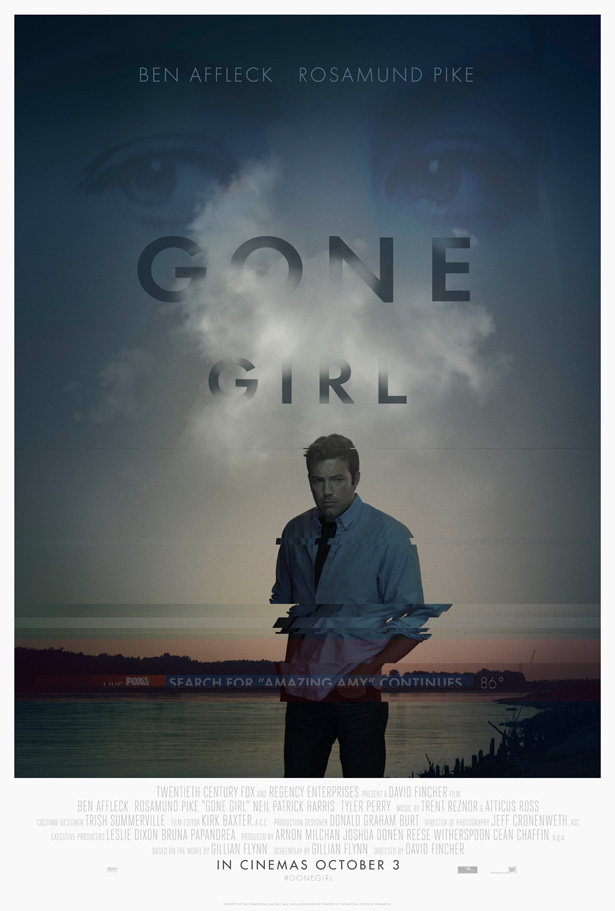
Rosamund Pike is the Gone Girl leaving husband Ben Affleck in a difficult mess

Director: David Fincher

Cast: Ben Affleck (Nick Dunne), Rosamund Pike (Amy Elliott Dunne), Neil Patrick Harris (Desi Collings), Tyler Perry (Tanner Bolt), Carrie Coon (Margo Dunne), Kim Dickens (Detective Rhonda Boney), Patrick Fugit (Officer James Gilpin), Missi Pyle (Ellen Abbott), Emily Ratajkowski (Andie Fitzgerald), Casey Wilson (Noelle Hawthorne), Lola Kirke (Greta), Boyd Holbrook (Jeff), Sela Ward (Sharon Schieber), Lisa Banes (Marybeth Elliott), David Clennon (Rand Elliott)

In our modern media age, we’ve got massive expectations for how people are meant to behave. With so much of our perception of life filtered through the internet and films we’ve seen, we are reassured when we see behaviours we expect to see, and disconcerted when we see those we haven’t been trained to see. Not distraught enough at your wife going missing? Well you must have done it then!

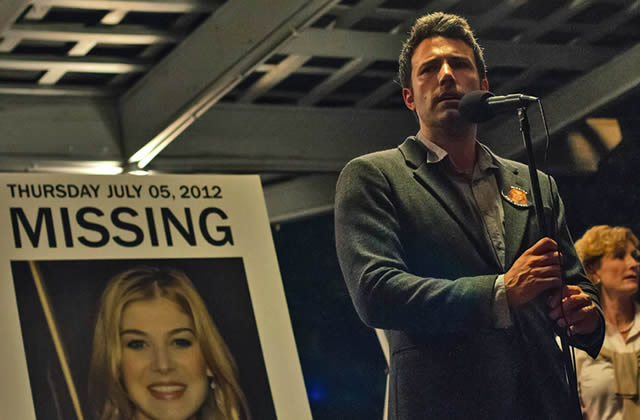
That’s the problem that faces Nick Dunne (Ben Affleck) in this chilling, intricate adaptation of Gillian Flynn’s best-selling book. Nick’s wife Amy (Rosamund Pike) goes missing in mysterious circumstances, possibly a kidnap, possibly a kidnapping gone wrong. The case becomes a media sensation, but the problem is Nick just isn’t expressive enough, won’t play the role of weeping husband. Instead he’s calm, distant and polite. So naturally rumour swirls that he did it – particularly after more and more manufactured evidence rears up to suggest he might have done. But does Amy have darker secrets than anyone might even suspect? Well to say any more would be a spoiler.

Fincher’s film is a tour-de-force of deliberately cold, polished looking perfection – which is designed to reflect back the surface perfection of the Dunnes’ deeply flawed marriage. Fincher’s film is in many ways a jet black social satire, using its almost outlandish shocks and twists to involve the audience in that “oh-no-they-didn’t!” way, in the same way that the Dunne media story fascinates the people in the movie.

“What have we done to each other?” Nick asks in voiceover early in the film, and it’s the question the film tackles obliquely: how much of the flashbacks to the relationship we see between Amy and Nick is real and how much springs from unreliable narration from Amy’s diary? Two handsome people living the American dream, but how much of it is an invented or projected narrative? Is their whole life a performance they are living for themselves and for others? Poor old Amy is even already semi-fictionalised person, a parents using her life as inspiration for a beloved children’s book character Amazing Amy.

So when Amy goes missing, the strain on Nick is very different from what you might expect. Rather than being consumed with grief, he feels wearied and dutiful about continuing a performance of a marriage which has long since ended. Nick’s actually too honest for this world – he won’t put on a show of how he is supposed to feel, he can only try not to make too much of a show of what he really feels. The mystery that builds around his and Amy’s marriage is born in this blunt honesty, of someone who won’t be what people want him to be. Of course that doesn’t stop Nick from being selfish or even a whiner.

Fincher mixes this intelligent commentary on society with, to be honest, the sort of bizarre extremism and bunny-boiling antics that make you unsurprised to hear he was inspired by Paul Verhoeven while making the film. It’s a film that shifts gears notably in the second half to become an increasingly gothic horror-thriller. A lot of this is powered also by Rosamund Pike’s excellent performance as Amy, a woman who seems almost completely cryptically unknowable, whose whole life has been a performance, and for whom taking on a series of roles and personalities is clearly not a challenge. Needless to say the person she turns out to be, and what she is capable of, is completely different from what the film leads you to expect.

It’s no surprise that a relationship featuring a person like Amy could go as south as the Dunnes’ has, but then Nick is hardly a saint either. Ben Affleck is just about perfect casting as a sort of All-American charmer gone to seed, a prickly fellow who wants privacy but also partly grows to enjoy the drama that surrounds him, once he works out the game he is playing. Fincher’s deliberately distant, smoothly clean-surfaced film frames modern day aesthetic perfection all round this seemingly dream couple.

The whole film is a nightmare vision of a love match gone wrong, of the after-effects of a beautiful story that has spiralled out into disappointment and everyday mundane life. And that struggle to keep the romance going in the familiar is at least something many of us can understand right? So it’s enjoyable to see that matched up with the freaky, semi-gothic blood and guts the film serves up in the second half, and the almost surreal Grand Guignol plot developments that power that half of the film (shot and scripted by Fincher and Flynn with a brilliant mixture of tension, horror and black comic delight at its extremity).

Like many Fincher films, there are several delightful performances. Pike is a revelation in a gift of a role, Affleck very good channelling his life lived in the spotlight. Carrie Coon is a stand-out as Nick’s exasperated, down-to-earth and loving twin sister. Kim Dickens is authorative and questioning as the police detective investigating the case, and Tyler Perry assured and cool as a hot-shot lawyer. Playing way against type, Neil Patrick Harris is pretty unforgettable as a slightly self-satisfied rich kid still holding a candle for Amy after all these years.

But the main success of the film is the whipper-sharp coldness of its execution, the cool tension Fincher ekes out of every moment, and the violent, Vertigo-ish obsession he gets out of every moment. Gone Girl works because it’s at first a chilling what-if story of a man in a media storm, which becomes a sort of black comedy so extreme that it pulls a delighted audience in to gasp at audacious characters getting away with outrageous things. As a black comic thriller it’s delightful.rela

This Sporting Life (1963)

Rachel Roberts and Richard Harris excel in brutal kitchen-sink drama This Sporting Life

Director: Lindsay Anderson

Cast: Richard Harris (Frank Machin), Rachel Roberts (Margaret Hammond), Alan Badel (Weaver), William Hartnell (“Dad” Johnson), Colin Blakely (Maurice Braithwaite), Arthur Lowe (Slomer), Vanda Godsell (Mrs Weaver), Jack Watson (Lennox), Harry Markham (Wade), George Sewell (Jeff), Leonard Rossiter (Phillips), Anne Cunningham (Judith)

The British New Wave of the early 1960s embraced working-class stories. They centred on chippy, confident, crowd-pleasing working-class young men (it was always men) from regional towns, doing blue collar work, thumbing their nose at the establishment and fighting to find their own way. This Sporting Life takes a similar route – but its central character, Frank Machin, is a furious, resentful and selfish man, who seems hellbent on destroying everything he touches. Unlike Arthur Seaton or Billy Fisher, he’s hard to like – and the film hits as hard as scrum of rugby players. 

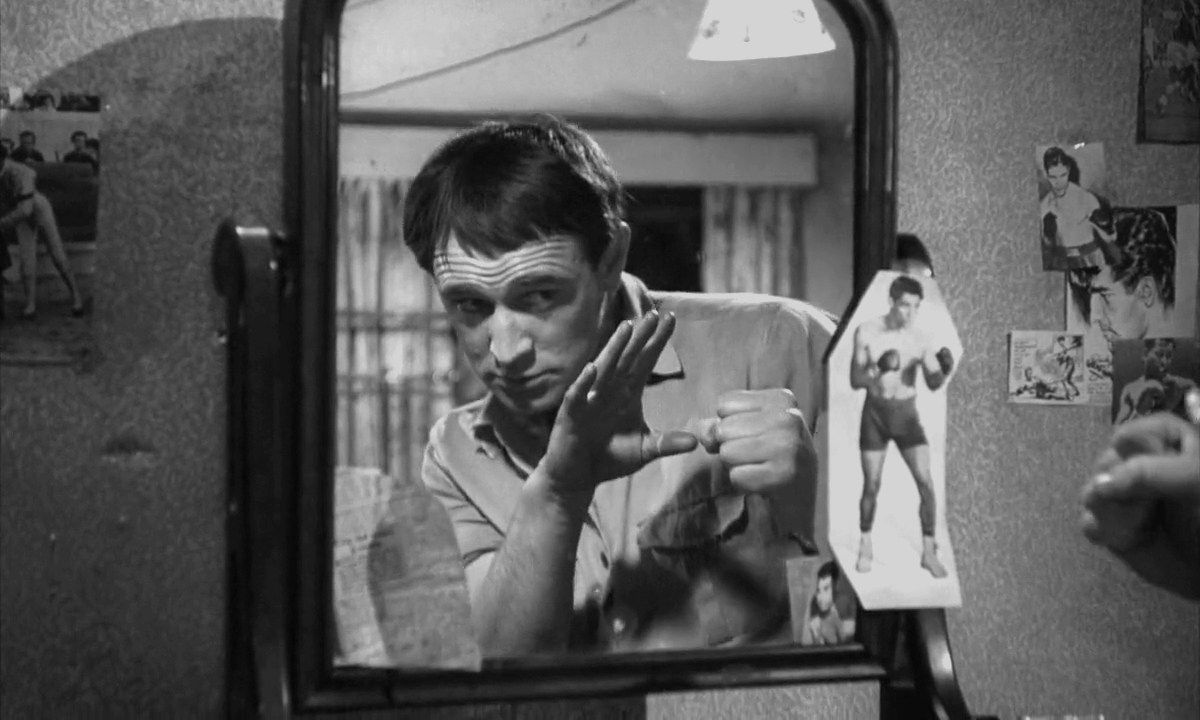
Frank Machin (Richard Harris) is a miner turned professional rugby player – not that he has any love for the game (“I only enjoy it if I get paid for it!” he contemptuously states). Machin is an articulate brute of a man, a pugilistic whirligig of resentments, barely expressed or understood desires, and a deep-rooted and chronic insecurity that cries out for love while pushing it away. He’s in love with his landlady, widowed mother of two young children Margaret Hammond (Rachael Roberts). They begin an affair of sorts – but it can barely survive her trauma and Machlin’s self-destructive rage.

Lindsay Anderson’s films are notable for their anger and bitter satire, so it’s no surprise he directed the least crowd-pleasing, angriest angry-young-man film of all – or that This Sporting Life killed the genre. The film is a series of hits, aimed far and wide, from the deference of the players to the owners who treat the clubs like playthings (the “amateur fair play” British attitudes to sport from the patronising owners gets a kicking), to the hypocritical judgemental attitudes of the working class. Even its romantic story features two characters so unable to engage with or understand their feelings that they only really seem able to communicate fully when raging at each other. 

Anderson’s new-wave, kitchen sink aesthetic creates a film that feels like a series of battles. From Machlin moving in local clubs to visiting the home of creepy closeted club owner Weaver (a smooth and unsettlingly cruel Alan Badel), whether rebuffing the advances of Weaver’s wife or at a Christmas party, he always seems ready for violence. The rugby matches are filmed like mud covered fights, with players piling into each other like sledgehammers. Even the “romantic” (and I use that word advisedly) scenes between Roberts and Harris feel like conflicts (they frequently tip into nerve-shreddingly raw emotional outbursts). 

Anderson’s film takes everything you expect from the Saturday Night and Sunday Morning expectations and amps up the danger, anger and tension. Machlin barrels through scenes, conversations and relationships in the same way he charges through the rugby pitch. The whole film is a sharp warning of the danger of unrestrained masculinity, pushing all softer emotions to one side. Machlin wants so desperately to be a man that everything must be a battle, at all times displaying his most manly qualities. The tragedy is that you can tell there is a far more sensitive and intriguing personality below the surface.

All this comes together in Richard Harris’ searing performance in the lead role. His career break – he won the Best Actor award at Cannes and was nominated for an Oscar – Harris was possibly never better. He’s a brooding force of nature in this film, utterly convincing as a man who bottles up his feelings until it is way too late. He hits out at everything, but you feel he is really running scared from the vulnerability in his own personality. With children, Machlin is tender and gentle, but with adults he is unable to express his feelings. His emotions for Margaret are based around suggestions of a need for a mother figure, sexual desire – and a desire for an answer to the emptiness he feels in himself. Harris is like an Irish Brando here, a marvellous, emotional, dangerous, brutal figure.

Rachel Roberts (also Oscar-nominated) is just as good, giving another extraordinary performance (to match the similarish role she played in Saturday Night and Sunday Morning) as Margaret. Grieving her husband, terrified of commitment, aware of her own position, as incapable in her own way of expressing her emotions and feelings as Machlin is, Margaret is as much a damaged and combative character. Roberts’ performance suggests years of disappointment and struggle behind the eyes, and she has a rawness and humane anguish in her scenes with Harris that sear the eyeballs. The scenes between these two are difficult to watch but engrossing.

The film is stuffed with excellent performances. William Hartnell is heartbreakingly tragic as the closeted talent scout who spots Machlin, only to be dropped by the new star. Colin Blakely is excellent as Machlin’s more grounded and engaging teammate. Vanda Godsell is the face of female corruption as Weaver’s sexually possessive wife. Arthur Lowe (who went on to work with Anderson several times) is very good as a stuffy but shrewd board member. All of this is beautifully filmed in black and white, with an urgency mixed with flashes of impressionistic grimness.

Anderson’s film, though, is primarily a working-class tragedy, about a man unable (until far too late) to really understand what he wants. Why is this? Because of failings in himself, but also failings in his upbringing, where qualities of self-understanding and expression are not encouraged, where pressure is placed on men to be men, where class and stuffy attitudes look to stamp out any real sense of self-knowledge. It’s an angry young man film that is truly, really angry. No wonder it flopped at the box office. But no wonder it lasts in many ways better than other films from this genre. It feels like a film that wants to say something, that has an urgent message. And it has at two extraordinary performances.

Farewell My Concubine (1993)

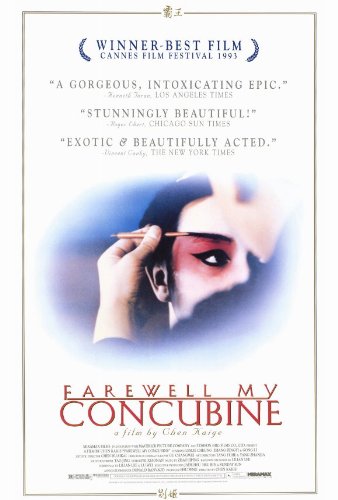
Leslie Cheung and Fengyi Zhang are the still centre for decades of Chinese history in Farewell My Concubine

Director: Chen Kaige

Cast: Leslie Cheung (Cheng Dieyi), Fengyi Zhang (Duan Xialou), Gong Li (Juxian), Ge You (Yuan Shquig), Lu Qi (Master Guan), Ying Da (Na Kun), Yidi (Eunuch Zhang), Zhi Yitong (Saburo Aoki), Lei Han (Xiaosi)

Chinese cinema isn’t well-known in the West. Maybe it comes from China so long being behind its own Red Curtain. Farewell My Concubine was pivotal to introducing Chinese cinematic culture to the West, winning a Palme d’Or and nominated for an Oscar. It’s surprising in a way, as Farewell My Concubine is a film that you almost need an intimate knowledge of Chinese history to truly appreciate (which I’m not sure I do!). But not surprising in another, as it is a glorious made, brilliantly acted and directed paean to the warmth of the human spirit.

Told over 52 years, from 1925 to 1977, the film follows two actors in the Peking Opera – Cheng Dieyi (Leslie Cheung) and Duan Xiaolou (Fengyi Zhang). Brought up in a brutally tough actor training school, the two become famous for their performances in the opera, Farewell My Concubine, about the suicide of a king’s concubine. Dieyi plays the concubine, while Xialou plays the king. The two actors are held together with a strong, almost unbreakable bond of brotherhood. But Dieyi also has a romantic longing for Xiaolou. Their relationship is made more complex after Xiaolou’s marriage to former courtesan Juxian (Gong Li) – but the three quickly find a relationship of tolerance, support and understanding that is tense but works. Around them China undergoes the Second World War, Japanese occupation, Mao’s seizure of power and the Cultural Revolution.

Kaige’s film is an epic that places an intimate and personal story at its centre and introduces global and national events which we largely understand from the perspective of our characters. This is a brilliant way of showing the seismic changes in China over this period – from the 1920s, which are so simple and Dickensian in their set-up that they might as well be the fifteenth century, to the increasingly brutal oppression of Mao’s regime. At the centre of all this is the relationship between the three core characters.

This relationship is almost impossible to define, so richly complex and human does it feel. It all rings immediately true – three people who are held very closely together by bonds of family, shared past and mutual dependency, but whose relationships are also rife with jealousies and regrets. Deiyi oscillates between vulnerability and guarded resentment against everyone around him. Xiaolou (brilliantly played by Fengyi Zhang, all warm-hearted charisma but easily led by others) is both annoyed and frustrated by Deiyi, but also goes to extraordinary lengths to protect him. Juxian (an enigmatic intelligent performance from Gong Li) at first seems to be a manipulative presence who wants to split the two of them apart, but comes to an unspoken accommodation with Deiyi that recognises they have a lot of shared interests and love.

All of this is simply beautifully done, subtle, un-obvious and brilliantly restrained, wonderfully acted by the three leads. Deiyi is a fascinating character, struggling with his sense of identity, trained from an early age to look and behave as much like a woman as possible. Is it any wonder that it has had an impact on his sexual identity? (The film’s openness about homosexuality – with Deiyi frequently being used for sex by his patrons – is one of many reasons it was nearly banned in China). Deiyi feels unable to express the feelings he clearly has, frequently falling back on imperiousness and pride. Leslie Cheung is just about perfect in this role: fragile, brittle but also harsh and unforgiving.

Kaige films all this beautifully in this visually striking film, using a host of brilliant images and wonderful lighting. The film’s opening hour covers the characters’ childhoods in the harsh training regime of the opera school, where beatings are common. Every character, by the way, accepts this as totally normal – in a striking later scene, the two adults meet their mentor again and immediately revert back to mutely accepting physical punishment for perceived wasting of their talent. One of the film’s striking commentaries on China in fact is the difference between their deference and the defiance of up-and-comer Xiaosi, who flat out refuses to take part in the harsh regime Deiyi tries to introduce and later becomes a leading light in the Cultural Revolution. It’s one of many ways the film uses the characters to demonstrate the changes in China.

The section covering the childhood of the characters is wonderfully done, a truly Dickensian series of events that will go on to define the lives and impressions of the two characters, skilfully built around the fate of a third friend – a more defiant joker who struggles far more to cope with the discipline of the camp compared to Deiyi’s stoic acceptance and Xiaolou’s matey deference. I truly loved this sequence and would happily have watched it for ever, every moment is so well observed, the child actors are marvellous and the claustrophobic world of the training school is immaculately observed (the outside world is so absent that the appearance of a car is actually a huge surprise as it makes you realise we are in the 20thcentury). 

But then this is a film that is set in a small interior world, which shifts and changes subtly as the wider Chinese world moves around it. The Japanese occupation seems to come from nowhere, a sudden interruption of a world where the two actors struggle to please patrons. The continued re-staging of the opera Farewell My Concubine is striking for how little it changes, a still centre of artistic conventionality (and it is conventional – every moment is handed down from previous generations, with Xiaolou constantly criticised for using five steps at one point where tradition demands seven). The imperious patrons rise and fall around the actors, victims to a China which is shifting quicker than they keep up. 

Kaige’s film also sharply criticises the excesses of the Cultural Revolution, that threaten this relationship and pressure the actors to denounce both themselves and each other. The Chinese government of Mao changes constantly in its views and demands, faster than many can keep up – and what is acceptable one year becomes a capital crime the next year. Deiyi is ordered to perform for the Japanese, and later nearly faces death for this. A patron pivotal in saving him is later a man condemned for having that kind of power. Welcome to China.

Farewell My Concubine works because it puts the sprawling history in the background of this personal story of the relationship between three characters who need each other in ways they can hardly understand, increasingly drawn together as fixed points in a changing world. When the rules of yesterday are the crimes of tomorrow, is it any wonder you cling closer to the few people around you who understand and remember what you were like and where you are from?

Deiyi, Xiaolou and Juxian are characters held together by bonds that seem unshakeable, which allow them to frequently anger and attack each other but constantly draw them back to each other to support and save each other. Kaige’s understanding of this – and his brilliant discipline in refusing to add moments of definition to the feelings between these characters, but allowing us to interpret and form our own opinions of how their relationship works – is brilliant, and Farewell My Concubine is a brilliantly made, fascinating and infinitely rewarding film.

Interview with the Vampire (1994)

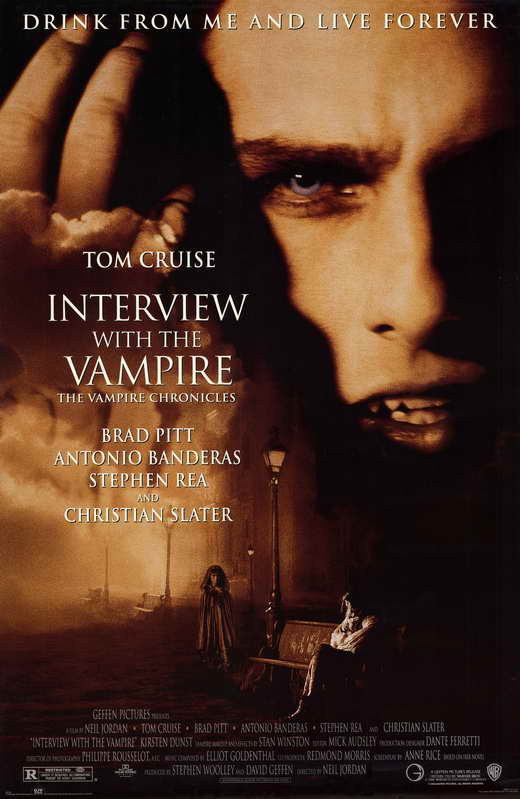
Tom Cruise and Brad Pitt bite and flirt in high-minded, but rather camp, Interview with the Vampire

Director: Neil Jordan

Cast: Tom Cruise (Lestat de Lioncourt), Brad Pitt (Louis de Pointe du Lac), Christian Slater (Daniel Molloy), Kirsten Dunst (Claudia), Antonio Banderas (Armand), Stephen Rea (Santiago), Domiziana Giordano (Madeleine), Thandie Newton (Yvette)

Why do vampires constantly keep rearing their ugly heads in films? What is it about them that we seem to find so addictive? Interview with the Vampire is a vampire film that takes a slightly different tone and tries to explore what it might actually be like to live the life of a vampire, the actual psychological impact it might have. It’s just a shame the film also can’t escape the temptation to fall back on the high camp the genre often gets trapped in.

Anyway, the film opens in modern day San Francisco, with young reporter Daniel Molloy (Christian Slater) interviewing a man named Louis (Brad Pitt) who claims to be an ageless vampire from the late 18th century. Louis tells his life story: turned to a vampire by the hedonistic Lestat (Tom Cruise) when he was consumed with grief at the loss of his wife and child. Louis struggles with the morality of taking life, unlike Lestat’s joy in killing. Later they turn a dying girl Claudia (Kirsten Dunst), who over the next 30 years matures psychologically but remains in the body of a 12-year-old. Louis and Claudia slowly begin to fear Lestat’s control and struggle to escape from his shadow.

Interview with the Vampire wants, desperately, to be an intellectual vampire film. A sort of Freudian exploration of the impact of suddenly becoming a creature that can never see daylight, sleeps in a coffin and has an insatiable hunger for human blood. Does it work? Well sort of, I guess. But the problem is most of the depression is carried by Brad Pitt’s Louis and, to put it frankly (as Lestat observes) he’s a whiner. His very human struggle with taking life and his sadness at the loss of his humanity should be engaging, but Louis is not an interesting character. He just mopes around. Rather than being sparked by his predicament, he’s just a boring and frustrating character.

Maybe this is partly Pitt’s performance as well – too withdrawn, too morose. Apparently Pitt hated making the movie (from the long hours of make-up, to the endless night shoots, to the boring character) and it shows in the movie. Pitt just can’t get engaged in the role, his matinee idol looks and rather dull speaking voice combining to make him look like a worse actor than he is. And then Louis keeps banging on and on about how depressed he is. In fact he bangs on so much you start to wonder why everyone – from Tom Cruise’s crazed Lestat, to Antonio Banderas’ ageless vampire – is so obsessed with him.

But then maybe it’s Louis’ looks eh? The film does wallow in the sensuality of sucking on people’s necks, and half the vampires in this seem to be campily metro-sexual. Cruise gives a surprisingly out-there performance of high camp hedonism and preening selfishness, so far out of his expected range that (while not brilliant) it reminds you he is a better actor than he gets credit for. Lestat clearly has a huge crush for Louis, and the orgasmic converting of Louis into a vampire leaves little to the imagination. Later Antonio Banderas as an effeminate, ethereal older vampire also seems to have a huge crush on Louis. The many vampire victims seem to succumb to erotic joy when they are bitten (at least until they die). Sex flows over the whole film, without the film itself ever actually being sexy, and the vampires are all pretty indiscriminate in their tastes.

Unfortunately this all too often tips into pure high camp. Stephen Rea, as a sort of vampire acrobat actor, gives a performance of superb silliness. Banderas lisps and wafts through the picture like a bizarre puff of perfume. Neil Jordan frequently explores the frame with ridiculous overblown action – no less than four times in the picture we watch scenes of operatic fire starting (often with vampires writhing in flamey pain) that suggest Jordan spent too long watching the fire sequence in Gone with the Wind before he made the picture. All the actors (aside from Pitt who barely shows up) dial it up to eleven with their performances, and the long-haired, long finger-nailed vampire representations here are like some sort of odd Halloween dressing up box.

Jordan’s film often trades dark, campy humour in favour of horror or thrills. There are no real jumps or scares in the picture, and the buckets of blood thrown around are more ridiculous than they are disgusting. In fact watching the film, I feel Jordan may have been torn between wanting to do something a little different (a sad vampire film about depression) and having to deliver the blood, guts and gore the genre fans wanted. Certainly, he fails to mine any real poetry from Anne Rice’s source material (although she loved the film, so what do I know) and for all the musings on the tragedies of living a life in the shadow you never really feel that moved by it.

There are however good things. Technically the film is very good. Cruise is surprisingly fun as the colourful Lestat. The film gets stolen by Kirsten Dunst as the physically young, mentally older Claudia, who struggles to find the balance between her teenage blood lust and her later disgust and fury at being trapped forever in the body of a child. But there isn’t enough good stuff among the tosh. Interview with the Vampire is an odd, actually rather bad film that is struggling to be a good one. It has a cast of 1990s heartthrobs who mostly enjoy dressing up and playing at their campy side. But it fails to really be engaging or make someone care about the story it is trying to tell.

Women in Love (1969)

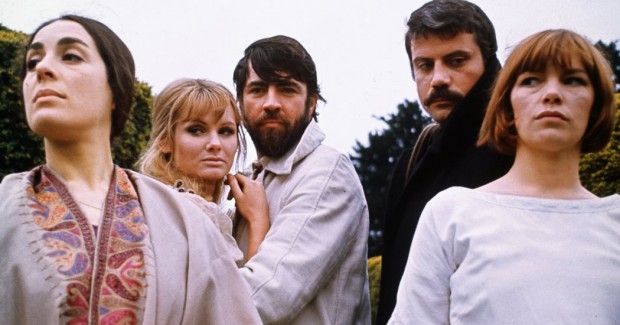
The stars of Women in Love: this publicity still gives only a hint of the simmering (and slightly strange) heightened passions you find therein

Director: Ken Russell

Cast: Alan Bates (Rupert Birkin), Oliver Reed (Gerald Crich), Glenda Jackson (Gudrun Brangwen), Jennie Linden (Ursula Brangwen), Eleanor Bron (Hermione Roddice), Alan Webb (Thomas Crich), Vladek Sheybal (Loerke), Catherine Wilmer (Christina Crich), Phoebe Nicholls (Winifred Crich), Sharon Gurney (Laura Crich), Christopher Gable (Tibby), Michael Gough (Tom Brangwen), Norma Shebbeare (Mrs Brangwen)

DH Lawrence is an acquired taste. While his writing is undoubtedly brilliant, reading his novels today it’s hard to shake off their sometimes histrionic melodrama – their revelling in all that (at the time) shockingly frank discussion of sex and all that Freudian analysis of fractured personalities against an alien industrial world. So perhaps there is a reason why one of the best interpreters of his work for the screen has been someone as melodramatic and envelope-pushing as Ken Russell.

Women in Love is Russell and Lawrence to the max. In a 1920s mining town, two sisters, Gudrun (an Oscar-winning Glenda Jackson) and Ursula (Jennie Linden) want to make their own way in the world. Local school inspector Robert Birkin (Alan Bates) wants to find perfect love and fulfilment. Alpha-male son-of-the-local-mine-owner Gerald Crich (Oliver Reed) isn’t quite sure what he wants, other than to reinvigorate his father’s business. Naturally all four of these characters come together in romantic, intellectual and sexual tangles that lead to a lot more misery than happiness.

Wow this is a difficult picture to write about. How so? Because it is about two-thirds masterpiece to one-third pretentious, hyperbolical nonsense. That’s quite some tight-rope. Russell walks it pretty well, but his problem has always been he loves being a sort of enfant terrible of British cinema too much. Too often he succumbs to temptation and pushes things a little further, to go for the demented camera or editing trick, or to push the sexual content a little bit further. The whole film has a hint of a cocky teenager, jumping up and down to look cool and catch your attention. 

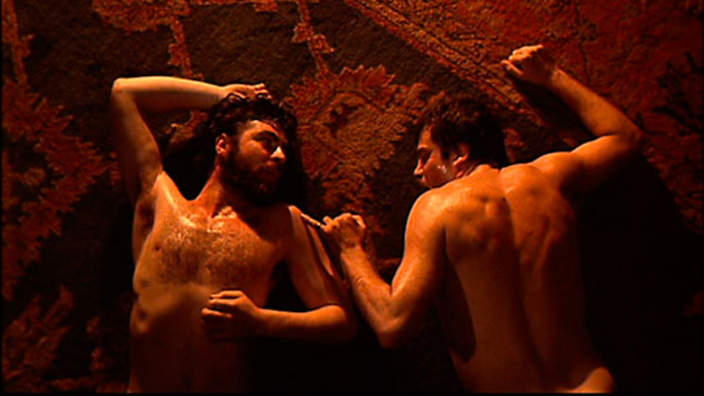
But then on the flipside, sometimes this excess really works (or if you like, sometimes more really is more). Nowhere is this clearer than in the famous naked wrestling scene between Oliver Reed and Alan Bates. It’s a high-blown, tightly edited, single-camera, increasingly artistic sequence that leaves little to the imagination as we wonder how far this nude, willy-waggling, sweaty wrestling turned intimate clinch will go (the final shot sees the characters roll off each other and lie exhausted on a carpet, breathless, in front of a roaring fire). But it works so well because the amped up shooting and content really tells us something about these two characters, their relationship, feelings, viewpoints on life, sexuality – everything. It’s a great scene and it’s a sign of how good this film can be.

And then you get other moments where you sigh and roll your eyes and almost want to say “yeah Ken we get it…”.  As Robert and Ursula roll off each other after an intense sexual encounter in the woods, we cut immediately to two bodies found drowned in a lake, their bodies locked together in exactly the same position. Yup sex ‘n’ death. Gerald and Gudrun have sex, intercut with shots of Gerald’s mother. Other moments ape up stuff that was already pretty ridiculous in the book to the max: Birkin, after a bash on the head, runs naked into the countryside and smears himself with grass and mud and rolls in the dirt. For about three minutes.

But then this is the sort of film where Glenda Jackson tames some bulls by performing a bizarre dance. Why does she do this? Who knows (certainly not the characters). But then the film is full of moments like this. But what kind of makes it work, even when it is so ridiculously over-the-top and dated in its filming, is that there is a smartness in it. It is a film that does, underneath it all, have some profound thoughts about love and relationships.

It manages to bring together the themes that intrigued Lawrence with a bit of coherence. What do we want from life? It focuses overwhelmingly on the men of the story, and in particular Alan Bates (excellent) as Birkin. Made up to look like Lawrence, Birkin also carries a lot of the prose of the novel debating what makes us happy, whether we need equally strong bonds in our life with men and women, and what constitutes our completeness as human beings. 

The film does this to a certain extent with the female characters as well – although we see them almost completely from the perspective of the men (which is interesting – maybe they were worried about making a film called Men in Love…). That’s possibly why Gudrun’s confused desires for Gerald never quite come into focus. Marvellous as Glenda Jackson is – surely an actress born to play this sort of part, marvellously passionate but strangely unknowable, vulnerable but harsh and even a little cruel – it’s hard to understand how Gudrun’s feelings change for Gerald. Maybe she doesn’t know herself. 

Gerald and Gudrun seem to be characters who don’t understand what they want (Gerald even expressly says it). That’s part of the point of the film (and Lawrence’s book) – a yearning, like both these characters have, for freedom and something different from previous generations, but unable to really put their finger on what this is. Gudrun wants a strong, dynamic man – but she also wants freedom and artistic fulfilment, and can’t find this with Gerald.

The film juggles these themes, of people struggling to reach an expression of (or to understand) their desires. Russell understands this – and for all the highblown eccentricity of some of the shooting, he sticks with a brilliant understanding of these personalities and themes. It remains a very caring movie that understands and relates to its characters. It has a lot of heart under the madness of Russell’s shooting.

And it’s superbly acted. Bates and Jackson are both marvellous, as is Jennie Linden in a (to be honest) rather thankless part as the second sister. But it’s a revelation of what a fine actor Oliver Reed could have been, if he had not decided to become a professional drunk. Reed drips charisma and intensity and he gives Gerald a real frustrated, sensual depth – a confused sexual fear mixed with a determined machismo. It’s a brilliant performance. The rest of the cast are also good, even if Eleanor Bron is (partly deliberately) overdone as Birkin’s first lover.

Women in Love is very dated in its style, but still a fascinating and intelligent piece of filmmaking that engages with and juggles with ideas. Despite all its overblown Russell excess, I actually really liked it, it stuck with me and I’ve been thinking about it since it finished. I’d actually like to see it again and see if it unlocks even more for me – and blimey it even makes me want to read Lawrence again, which after The Rainbow I never thought I’d say…

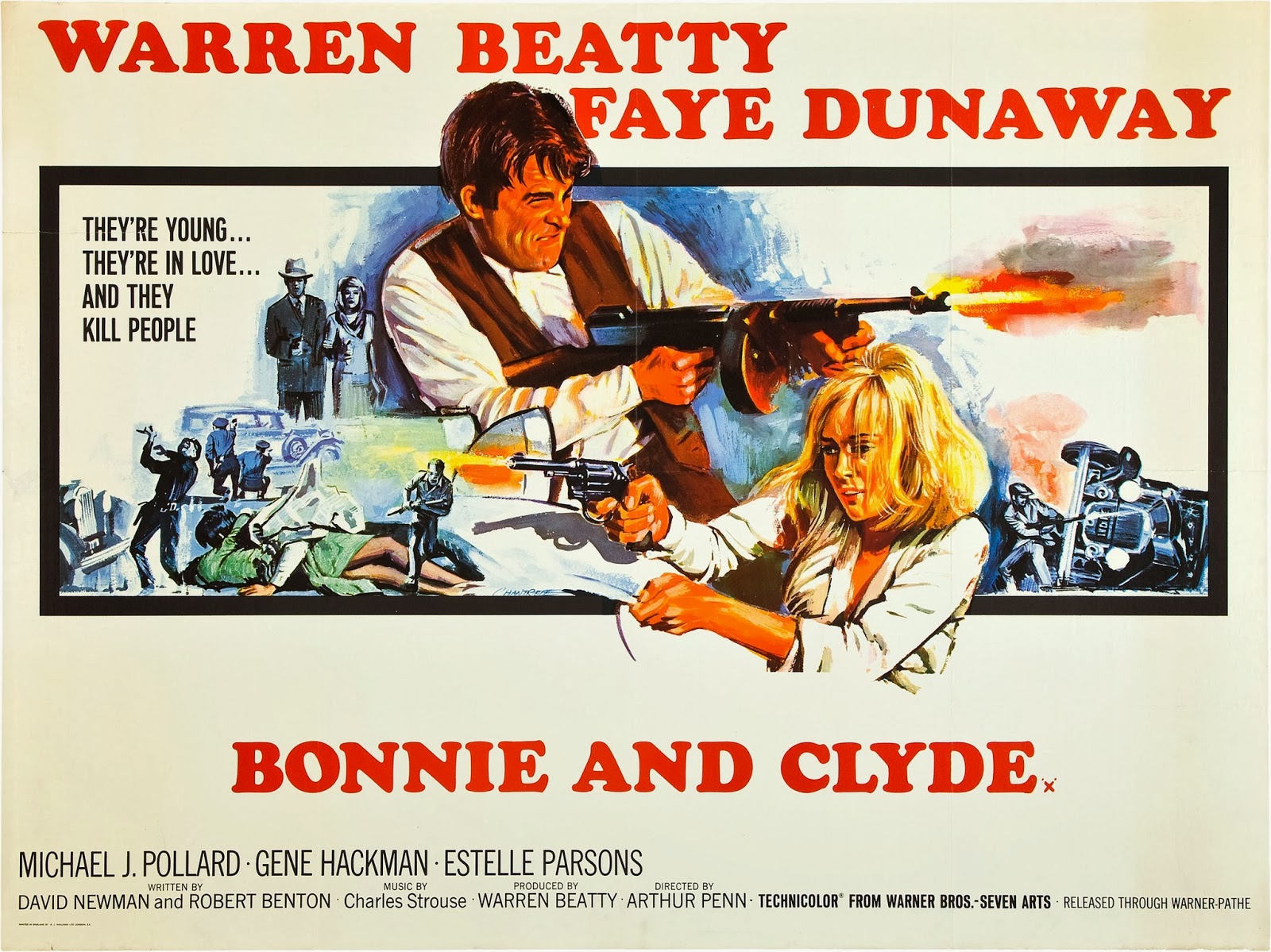
Bonnie and Clyde (1967)

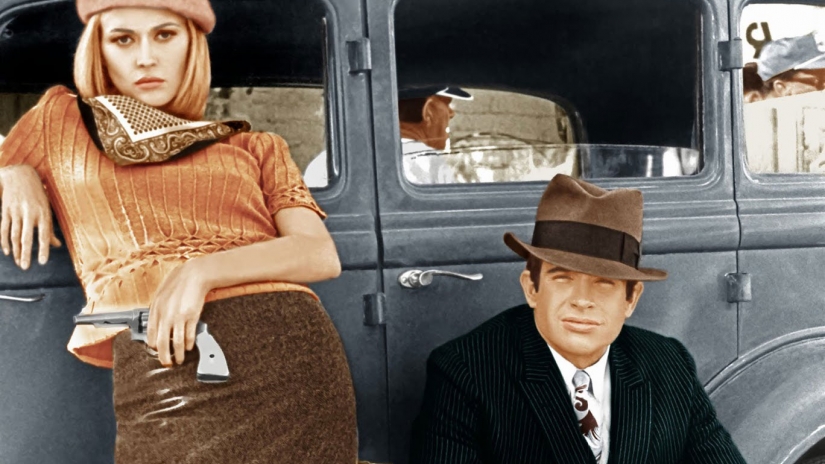
Faye Dunaway and Warren Beatty are the shallow, violent romantics Bonnie and Clyde

Director: Arthur Penn

Cast: Warren Beatty (Clyde Barrow), Faye Dunaway (Bonnie Parker), Michael J Pollard (CW Moss), Gene Hackman (Buck Barrow), Estelle Parsons (Blanche Barrow), Denver Pyle (Marshal Frank Hamer), Dub Taylor (Ivan Moss), Gene Wilder (Eugene Grizzard), Evans Evans (Velma Davis)

Bonnie and Clyde can lay claim to being one of the most influential American films ever made. It came out of a seismic cultural change in America, as old style Hollywood royalty faded out and a new generation stormed the barricades to make films that felt rougher, rawer and told complex stories in shades of grey. 

Clyde Barrow (Warren Beatty) and Bonnie Parker (Faye Dunaway): drifting youngsters, not interested in accepting a conventional life. They want to go where they please and take what they please. And if some people get hurt – well they can justify that to themselves. As the poster famously said: “They’re young. They’re in love. And they kill people”. In a deliberately disjointed narrative, where time is unclear, the two meet, head out together, commit crimes, stay on the run and are eventually killed by law enforcement. The story is simple – it’s the telling of it that matters.

Bonnie and Clyde latches on to a counter-culture vibe that was growing in strength at the time. But what the film does so brilliantly is subvert this. It invites us to identify to with the romantic, Byronic yearnings of its heroes, who see themselves as free spirits, living a life of idealistic, unconstrained excitement. But the film also has a clear eye on the trail of violence they leave behind them, their lack of regard for this and the impact on the victims. Because make no mistake, these dreamy killers get more and more violent as they go on.

The film turns these two killers into would-be celebrities – guys who want to project a certain image of themselves to the world (down to mailing the papers photos and poems about themselves). They enjoy the notoriety and their self-proclaimed mythology. Clyde walks into banks and gleefully announces he’s with the “Barrow gang”, as if half expecting someone to ask for his autograph. Later in the film, as Clyde reads their press coverage out loud, with CW Moss like a star-struck groupie, the film never forgets the two of them were basically nobodies, who wanted to feel like somebodies.

And it lets you enjoy the romance of this. There is something fairy-tale like in the film about Clyde picking up Bonnie from outside of her home, taking her into town for flirting and robbery. The whole film continues this dreamy logic, with time jumps and scenes that don’t necessarily link up directly with each other. 

But then the violence takes over. Wow is Bonnie and Clyde a film that lets you know about the impact of bullets. Gun shots don’t just maim or wing, they rip bodies apart. The japey feeling of their bank robberies gets dispelled about half an hour into the film when Clyde shoots a bank teller in the head from point blank range (“him or me”, he later tells his brother). The gang are so incompetent, that the film is frequently punctured by shoot-outs in which no mercy is shown to anyone. 

This is of course hard for the gang to reconcile with their self-image as Robin Hoods, so they mostly forget about it. Clyde won’t steal money from ordinary people (though he’ll happily steal cars, or beat a grocery store clerk into a coma). They playfully tease and taunt a captive US Marshal – until he spits in Bonnie’s face at which point violence ensues. Only at points do the gang seem to have the slightest idea of the dangers: after kidnapping Gene Wilder’s nervy car-owner and his fiancé, a happy-go-lucky Evan Evans (both excellent), merry conversations in the car with the gang are suddenly halted when Wilder admits he’s an undertaker – Bonnie immediately demands they are thrown out and the next shot is her weeping in a field. She doesn’t seem to understand the connection, but we can.

The film is superbly put together. Warren Beatty produced the movie practically from its inception. Robert Benton and David Newman’s script was intended as a French New Wave film – evident in its looseness, its lack of old-school values, its violence, its focus on naïve dreamers who choose the easy way out – but Beatty took the script, re-crafted it with Robert Towne (billed as special advisor) and decided the film needed an American director, not a Truffaut or Godard. He brought on board Arthur Penn, and the two worked together (fought together) closely to bring this radical, edgy, jittery, electric film to the screen. 

Penn and Beatty pushed themselves to some of their best work. Beatty is terrific as the vainglorious Clyde – whose determination in crime is matched by his impotence in the sack (the film wisely doesn’t overplay Clyde’s impotence as an ironic theme, but lets the audience draw its own conclusions). He also produced the film expertly. Penn’s direction is sublime, marrying the finest elements of French New Wave cinema with old-style Westerns.

The film is restless and energetic, and intermixes moments of fun and frivolity among the gang with ominous danger and violence. The camera jitters and shakes, while throwing us into the action – the film is masterfully edited – while at other points sailing on like a neutral observer. The film has a neat satiric edge, and Penn uses banjo music masterfully to ironically contrast with much of the action we see on the screen. The characters – all of them – seem to spend so much time talking about their press coverage because they have so little to say to each other. Even the lovers only really seem to find a moment of quiet devotion shortly before their death. It give you violence as entertainment, but also tells you effectively and quietly how appalling and dangerous violence is.

The acting is similarly extraordinary. Beatty is wonderful, as is Dunaway as an impossibly young, romantic Bonnie who adapts with alarming swiftness to killing and robbing. Michael J Pollard is excellent as the slightly simple, eager young car mechanic who hero-worships the couple. Hackman and Parsons are both excellent as Barrow’s older-but-not-wiser brother, and his wife who seesaws between resentment, fear and an imperious delight in her new-found infamy.

Penn’s brilliant film deconstructs the mythology of criminals to show the emptiness underneath, their shallow self-regard and lack of insight. It does this while still managing somehow to remain affectionate towards these two murderous dreamers. Bonnie and Clyde is a sublime modern Western, a commentary on fame, a dissection of violence and a great black comedy. Shot with youthful energy and an influential lack of traditionalism, it’s a film that always feels modern and necessary.

Suite Française (2015)

Matthias Schoenaerts and Michelle Williams love across the divide in this disappointing French Occupation epic

Director: Saul Dibb

Cast: Michelle Williams (Lucile Angellier), Kristin Scott Thomas (Madame Angellier), Matthias Schoenaerts (Oberleutnant Bruno van Falk), Sam Riley (Benoit), Ruth Wilson (Madeleine), Margot Robbie (Celine), Lambert Wilson (Viscount de Montmort), Harriet Walter (Viscountess de Montmort), Clare Holman (Marthe), Alexandra Maria Lara (Leah), Tom Schilling (Oberleutnant Kurt Bonnet), Eric Godon (Monsieur Joseph), Deborah Findlay (Madame Joseph)

The story behind the writing of Suite Française is compelling. Living in Nazi-occupied France, Irène Némirovsky began work on a five-novel series, Suite Française, which she intended to depict life in her homeland under German rule. She had only written two of the five books when she was arrested by the Gestapo as a Jew, and tragically died in Auschwitz. The books were written in a small notebook and kept by Némirovsky’s daughter while she moved from hiding place to hiding place evading the Nazis. Sixty years later, donating her mother’s papers to an archive, she deciphered the notebook and discovered the novels. They were published as a single volume to great success in 2004, regarded as an accomplished piece of literary fiction and a remarkable work of contemporary witness. 

The short summary of the novel’s richness and complexity provided by this film can’t really compete. Based on the second of the two novels, the story takes place in a small French village in 1940. Following the arrival of the Germans, officers are billeted in people’s homes: Lucile Angellier (Michelle Williams) and her mother-in-law (Kristin Scott-Thomas) are assigned sensitive musician Bruno van Falk (Matthias Schoenaerts), while their neighbours, farmers Benoit and Madeleine (Sam Riley and Ruth Wilson), are forced to accommodate bullying officer Kurt Bonnet (Tom Schilling). As hostilities between the French residents and the German occupiers grow, so does the attraction between Lucile and Bruno, but Bonnet’s pursuit of Madeleine threatens to ignite the simmering tensions in the community.

Suite Française manages to turn its promising material into a conventional, chocolate box wartime romance – you can’t help but think that it does a great deal of disservice to the original novel. It’s filmed in an unremarkable style (there are at best 1-2 imaginatively done shots and sequences) and poorly paced. With its short runtime (barely more than an hour and a half), it constantly feels rushed. Quite simply it’s a story about simmering tensions in a confined environment – it needed more time for us to get a sense of the drama building, of the resentments between the Germans and the French growing. Because the film is so short we don’t get that at all.

Most notably, in a film about a romance between a French woman and a German officer, there is no sense at all of the risks that French women who started relationships with German officers were running. Besides a few small throw away lines, there is no sense of the physical danger and the social stigma that would be applied to these women. Instead, the tension of Lucile falling for Bruno seems to be based more on whether her mother-in-law will discover that she’s considering cheating on her (absent, unfaithful) husband. Even Celine the promiscuous farmgirl (a wasted Margot Robbie in a terrible wig) doesn’t seem to be running any risks of reprisals from the villagers when she’s banging a German officer in the woods.

This, however, is where the film’s rushing undermines it. If it had allowed us to develop a sense of the resentment, shame and loathing the occupied French felt for their German oppressors, a feeling of the whole town being willing to close doors on anyone they perceive as being too close to the  Germans, we could have felt a real danger for Lucile in flirting with a dalliance with Bruno. As well as giving the situation a bit of stakes, it would have made it a lot more emotionally engaging too. We could have witnessed her inner conflict at considering a romance with the enemy, and the emerging feelings between them would have had the conflict of a forbidden love. Instead the film rushes us as quickly as it can towards getting Bruno and Lucile into a passionate clinch, at times taking giant unsupported leaps forward in their relationship, so when it arrives it packs no punch.

This passionate clinch undermines the film. If it wasn’t going to take the time to really build the relationship through lingering glances and brief moments, convincingly charting the journey from hostility and suspicion to a forbidden attraction, it should have cut the relationship down to being something that tempts them both but which they cannot express. Have these two recognise a deep bond between them, a bond that in another time would have brought them together but cannot in the time of war. It’s a film where the only physical contact between them should feel like a window on what might have been – not a passionate locking of lips and sexy fondle or two. Think how much more affecting that might have been.

It would also have fit the structure of the film far better. As Lucile finally finds herself having to choose a side – deciding whether to help a renegade hunted by the Germans or not – her decision to sacrifice her chance of love with Bruno might have worked much better. Similarly, Bruno having to revert to the soldier taking responsibility for the growing persecution of the villagers would have been more affecting. (It further doesn’t help that the film doesn’t give time for Williams and Schoenaerts to build up an effective chemistry.) By chucking them into a clinch as soon as it can, the film undermines its message and also manages to make itself feel more like “Mills and Boon in Occupied France” than the serious tragedy it could have been.

When the film finally focuses on the battles between the French and Germans in its final third, it’s much more interesting than the slightly tired romance. Here we get tensions, stakes, drama – and finally a sense of the danger that being in this situation could have. After the rather soft focus romance that comes before, it really seizes the attention.

Williams does a decent job as Lucile, Scott Thomas could play her austere mother-in-law with hidden depths standing on her head (the film fumbles the unexpected alliance between these characters late on). Schoenaerts is a bit wasted in an underwritten role but does good work. The best performances largely come from the second tier: Lambert Wilson is excellent as the local Viscount who wants to try and work with the Germans but quickly finds himself out of his depth. Harriet Walter is similarly strong as his wife, as is Ruth Wilson.

But Suite Française could have been so much better than the movie that it actually becomes. A film that focused on the dangers of occupation and the tensions of a small community would have been great. A film that rushes through a Romeo and Juliet style romance, without building the sense of forbidden love, is a film that just doesn’t work.

The Great Gatsby (2013)

“Hello old sport”: Leonardo DiCaprio is The Great Gatsby

Director: Baz Luhrmann

Cast: Leonardo DiCaprio (Jay Gatsby), Tobey Maguire (Nick Carraway), Carey Mulligan (Daisy Buchanan), Joel Edgerton (Tom Buchanan), Elizabeth Debicki (Jordan Baker), Isla Fisher (Myrtle Wilson), Jason Clarke (George Wilson), Amitabh Bachchan (Meyer Wolfsheim), Jack Thompson (Dr Walter Perkins), Adelaide Clemens (Catherine)

The Great Gatsby is possibly the great American novel. I’ve only read it once, but I certainly admired its beautiful prose, capturing of an era of American life and understanding of the fragility behind America’s love of success. Baz Luhrmann is clearly a fan, as he spent years putting together this passion project, presenting the biggest, brashest version of Fitzgerald you are ever going to see.

Nick Carraway (Tobey Maguire) is a young writer turned bonds salesman in 1920s New York. He lives across the bay from his cousin, Daisy (Carey Mulligan) and her husband Tom Buchanan (Joel Edgerton), a brash old-money man carrying on an affair with Myrtle (Isla Fisher), the wife of his garage mechanic. Carroway’s next-door neighbour is the sumptuously wealthy, but mysterious, Jay Gatsby (Leonardo DiCaprio) whose parties and generosity are legendary. As Carraway gets to know Gatsby (as much as anyone can), he discovers that Gatsby has a deep, near obsessive, love for Daisy.

Luhrmann’s film is a technicolour explosion that uses many of the techniques you’ll be familiar with from any of director’s other films. The camera is a whirligig of motion. The colours are bright and primary. The whole tone of the film (certainly for its first hour) is larger than life. The narrative has been tweaked to take on the tone of a Greek Tragedy, with the loud noise, fast camera moves and speedy pace all inverted in the latter half to invoke sadness and tragedy. And of course, the music is deliberately anachronistic, mixing modern genre music with 1920s sounds.

Sometimes this high-budget technicolour brilliance does feel like it is partly getting in the way of the deeper themes that lie within the original. But that might be partly because the novel’s themes are so reliant on internalised feelings, unsaid or guessed emotions, and deeply purple prose, that these are ideas which are very hard to translate to the screen.

There is something to be said for Luhrmann turning one of the pillars of 20th-century American culture into a spiritual sequel to Moulin Rouge!. And Moulin Rouge! is what the film strongly resembles, not only in design, but its romantic structure, poetic retelling, high drama, sense of impending doom and danger behind the bright lights, assault on class and the way it stands in the way of true love, and the lack of freedom in our lives. Both even have sad, reflective authors book-ending events.

So your enjoyment of the film is probably going to depend on how you feel about Luhrmann’s OTT style. Love Moulin Rouge! and Romeo + Julietand you will probably find something to enjoy here (and you’ll also notice his love of tragic love stories). Saying that, of those three, Gatsby is the one the carries the least depth to it, which is intriguing as it probably mines the most psychologically rich source material. While Luhrmann understands that the book is about the real emotions masked by explosive parties and opulence – the film often feels as choked by these things as the characters do.

This is partly because I feel both Maguire’s and Mulligan’s performances don’t quite work. Maguire is so stripped back, quiet and passive he almost disappears – you don’t get a sense of Carraway as either a shrewd observer or someone wrapped up in events: instead he’s a passenger, like the plot contrivance Gatsby sometimes treats him as. Similarly, Mulligan is slightly overwhelmed by the movie, not giving a strong enough performance for her to break through. The film powers forward with such momentum and brashness, it squashes her.

It’s probably why the most successful lead performance by far comes from DiCaprio. He’s perfectly cast as Gatsby: so good in fact you wish he was in a more thoughtful, relaxed film that would give him a more of a chance to breathe. DiCaprio perfectly encapsulates the desperation just beneath Gatsby’s surface, the fear and uncertainty that lies under his suave urbanity. He completely gets the character, understands he is a showman presenting a front to the world because that’s what he thinks the world wants, but who is, in his own way, as empty and lost as the world of bright lights he is offering people. It’s an excellent performance.

Luhrmann’s work with DiCaprio is what gives the film it’s centre and, for all the colour, noise and joy of the first 40 minutes or so, it finds its heart in the moments of acting and character interplay as the Gatsby-Daisy-Tom love triangle comes to a head. This scene, with its bubbling emotions, high stakes and tension is like an oasis of calm in the high-faluting scenery that surrounds it. But then this is a film where the smaller moments actually come across as richer than the larger ones – partly helped by the fact that Joel Edgerton and Elizabeth Debicki both give excellent performances as the key supporting characters. 

The Great Gatsby captures the feel of Fitzgerald rather well, but for all the dialogue of the book placed over the film in voiceover, it never quite manages to capture the spirit of the book in the same way. It looks wonderful, and its dynamic filming is certainly enjoyably impressive, but it doesn’t quite become a film that deals in emotions and depth. It flashes and fizzles but it never lets us really soak in its ideas and themes. It’s all too much at times, and the tragic sadness at the heart of the story, of this lost boy trying to live the life of a man, never comes out as it should. An interesting and entertaining film, but not one that will last.