Category: Relationship film

Women in Love (1969)

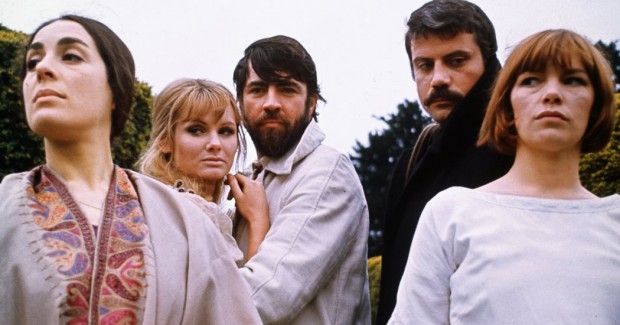
The stars of Women in Love: this publicity still gives only a hint of the simmering (and slightly strange) heightened passions you find therein

Director: Ken Russell

Cast: Alan Bates (Rupert Birkin), Oliver Reed (Gerald Crich), Glenda Jackson (Gudrun Brangwen), Jennie Linden (Ursula Brangwen), Eleanor Bron (Hermione Roddice), Alan Webb (Thomas Crich), Vladek Sheybal (Loerke), Catherine Wilmer (Christina Crich), Phoebe Nicholls (Winifred Crich), Sharon Gurney (Laura Crich), Christopher Gable (Tibby), Michael Gough (Tom Brangwen), Norma Shebbeare (Mrs Brangwen)

DH Lawrence is an acquired taste. While his writing is undoubtedly brilliant, reading his novels today it’s hard to shake off their sometimes histrionic melodrama – their revelling in all that (at the time) shockingly frank discussion of sex and all that Freudian analysis of fractured personalities against an alien industrial world. So perhaps there is a reason why one of the best interpreters of his work for the screen has been someone as melodramatic and envelope-pushing as Ken Russell.

Women in Love is Russell and Lawrence to the max. In a 1920s mining town, two sisters, Gudrun (an Oscar-winning Glenda Jackson) and Ursula (Jennie Linden) want to make their own way in the world. Local school inspector Robert Birkin (Alan Bates) wants to find perfect love and fulfilment. Alpha-male son-of-the-local-mine-owner Gerald Crich (Oliver Reed) isn’t quite sure what he wants, other than to reinvigorate his father’s business. Naturally all four of these characters come together in romantic, intellectual and sexual tangles that lead to a lot more misery than happiness.

Wow this is a difficult picture to write about. How so? Because it is about two-thirds masterpiece to one-third pretentious, hyperbolical nonsense. That’s quite some tight-rope. Russell walks it pretty well, but his problem has always been he loves being a sort of enfant terrible of British cinema too much. Too often he succumbs to temptation and pushes things a little further, to go for the demented camera or editing trick, or to push the sexual content a little bit further. The whole film has a hint of a cocky teenager, jumping up and down to look cool and catch your attention. 

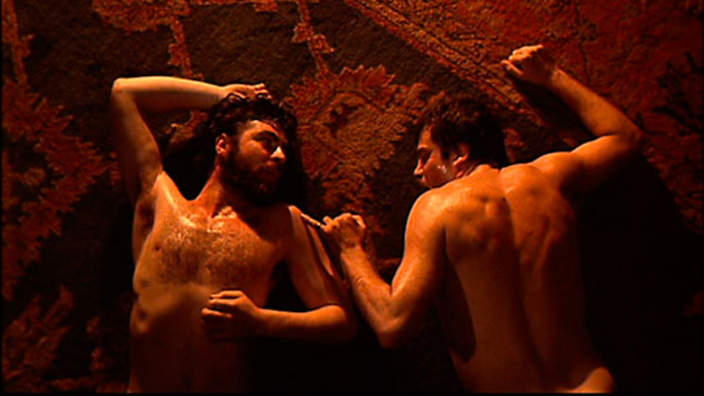
But then on the flipside, sometimes this excess really works (or if you like, sometimes more really is more). Nowhere is this clearer than in the famous naked wrestling scene between Oliver Reed and Alan Bates. It’s a high-blown, tightly edited, single-camera, increasingly artistic sequence that leaves little to the imagination as we wonder how far this nude, willy-waggling, sweaty wrestling turned intimate clinch will go (the final shot sees the characters roll off each other and lie exhausted on a carpet, breathless, in front of a roaring fire). But it works so well because the amped up shooting and content really tells us something about these two characters, their relationship, feelings, viewpoints on life, sexuality – everything. It’s a great scene and it’s a sign of how good this film can be.

And then you get other moments where you sigh and roll your eyes and almost want to say “yeah Ken we get it…”.  As Robert and Ursula roll off each other after an intense sexual encounter in the woods, we cut immediately to two bodies found drowned in a lake, their bodies locked together in exactly the same position. Yup sex ‘n’ death. Gerald and Gudrun have sex, intercut with shots of Gerald’s mother. Other moments ape up stuff that was already pretty ridiculous in the book to the max: Birkin, after a bash on the head, runs naked into the countryside and smears himself with grass and mud and rolls in the dirt. For about three minutes.

But then this is the sort of film where Glenda Jackson tames some bulls by performing a bizarre dance. Why does she do this? Who knows (certainly not the characters). But then the film is full of moments like this. But what kind of makes it work, even when it is so ridiculously over-the-top and dated in its filming, is that there is a smartness in it. It is a film that does, underneath it all, have some profound thoughts about love and relationships.

It manages to bring together the themes that intrigued Lawrence with a bit of coherence. What do we want from life? It focuses overwhelmingly on the men of the story, and in particular Alan Bates (excellent) as Birkin. Made up to look like Lawrence, Birkin also carries a lot of the prose of the novel debating what makes us happy, whether we need equally strong bonds in our life with men and women, and what constitutes our completeness as human beings. 

The film does this to a certain extent with the female characters as well – although we see them almost completely from the perspective of the men (which is interesting – maybe they were worried about making a film called Men in Love…). That’s possibly why Gudrun’s confused desires for Gerald never quite come into focus. Marvellous as Glenda Jackson is – surely an actress born to play this sort of part, marvellously passionate but strangely unknowable, vulnerable but harsh and even a little cruel – it’s hard to understand how Gudrun’s feelings change for Gerald. Maybe she doesn’t know herself. 

Gerald and Gudrun seem to be characters who don’t understand what they want (Gerald even expressly says it). That’s part of the point of the film (and Lawrence’s book) – a yearning, like both these characters have, for freedom and something different from previous generations, but unable to really put their finger on what this is. Gudrun wants a strong, dynamic man – but she also wants freedom and artistic fulfilment, and can’t find this with Gerald.

The film juggles these themes, of people struggling to reach an expression of (or to understand) their desires. Russell understands this – and for all the highblown eccentricity of some of the shooting, he sticks with a brilliant understanding of these personalities and themes. It remains a very caring movie that understands and relates to its characters. It has a lot of heart under the madness of Russell’s shooting.

And it’s superbly acted. Bates and Jackson are both marvellous, as is Jennie Linden in a (to be honest) rather thankless part as the second sister. But it’s a revelation of what a fine actor Oliver Reed could have been, if he had not decided to become a professional drunk. Reed drips charisma and intensity and he gives Gerald a real frustrated, sensual depth – a confused sexual fear mixed with a determined machismo. It’s a brilliant performance. The rest of the cast are also good, even if Eleanor Bron is (partly deliberately) overdone as Birkin’s first lover.

Women in Love is very dated in its style, but still a fascinating and intelligent piece of filmmaking that engages with and juggles with ideas. Despite all its overblown Russell excess, I actually really liked it, it stuck with me and I’ve been thinking about it since it finished. I’d actually like to see it again and see if it unlocks even more for me – and blimey it even makes me want to read Lawrence again, which after The Rainbow I never thought I’d say…

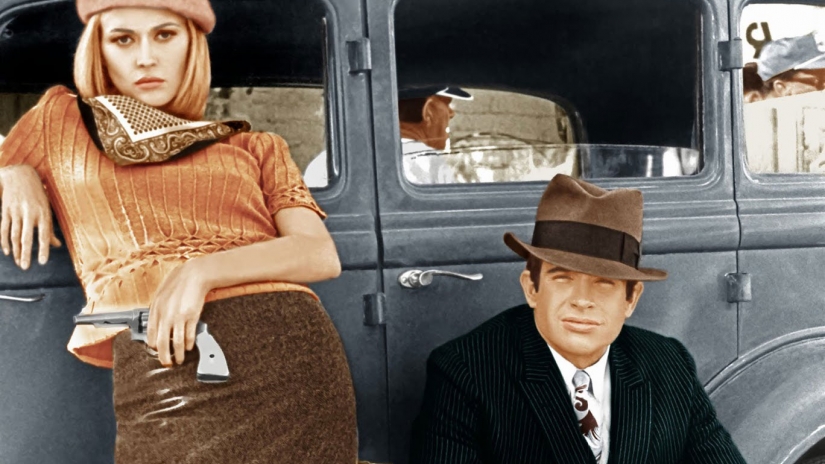
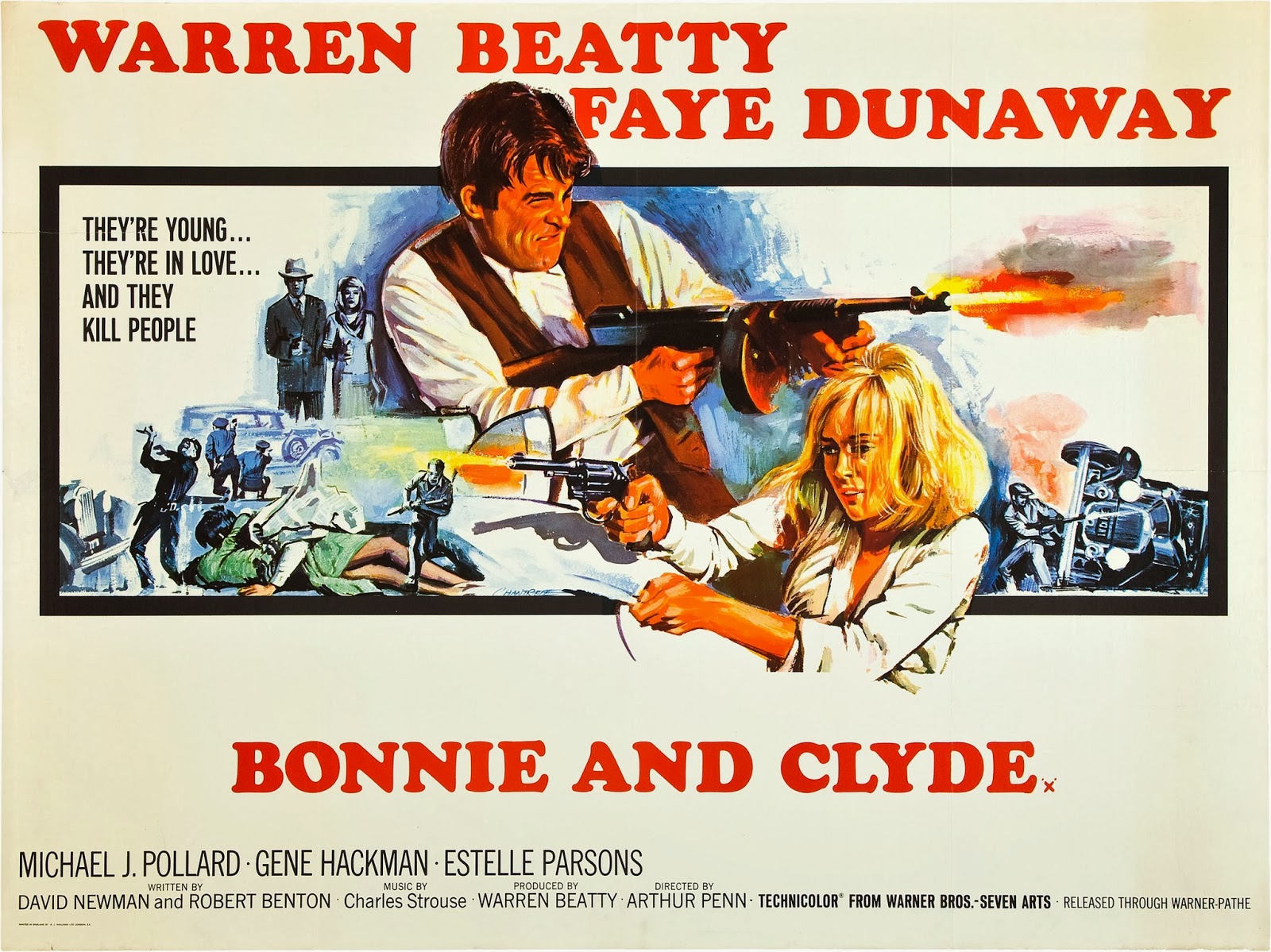
Bonnie and Clyde (1967)

Faye Dunaway and Warren Beatty are the shallow, violent romantics Bonnie and Clyde

Director: Arthur Penn

Cast: Warren Beatty (Clyde Barrow), Faye Dunaway (Bonnie Parker), Michael J Pollard (CW Moss), Gene Hackman (Buck Barrow), Estelle Parsons (Blanche Barrow), Denver Pyle (Marshal Frank Hamer), Dub Taylor (Ivan Moss), Gene Wilder (Eugene Grizzard), Evans Evans (Velma Davis)

Bonnie and Clyde can lay claim to being one of the most influential American films ever made. It came out of a seismic cultural change in America, as old style Hollywood royalty faded out and a new generation stormed the barricades to make films that felt rougher, rawer and told complex stories in shades of grey. 

Clyde Barrow (Warren Beatty) and Bonnie Parker (Faye Dunaway): drifting youngsters, not interested in accepting a conventional life. They want to go where they please and take what they please. And if some people get hurt – well they can justify that to themselves. As the poster famously said: “They’re young. They’re in love. And they kill people”. In a deliberately disjointed narrative, where time is unclear, the two meet, head out together, commit crimes, stay on the run and are eventually killed by law enforcement. The story is simple – it’s the telling of it that matters.

Bonnie and Clyde latches on to a counter-culture vibe that was growing in strength at the time. But what the film does so brilliantly is subvert this. It invites us to identify to with the romantic, Byronic yearnings of its heroes, who see themselves as free spirits, living a life of idealistic, unconstrained excitement. But the film also has a clear eye on the trail of violence they leave behind them, their lack of regard for this and the impact on the victims. Because make no mistake, these dreamy killers get more and more violent as they go on.

The film turns these two killers into would-be celebrities – guys who want to project a certain image of themselves to the world (down to mailing the papers photos and poems about themselves). They enjoy the notoriety and their self-proclaimed mythology. Clyde walks into banks and gleefully announces he’s with the “Barrow gang”, as if half expecting someone to ask for his autograph. Later in the film, as Clyde reads their press coverage out loud, with CW Moss like a star-struck groupie, the film never forgets the two of them were basically nobodies, who wanted to feel like somebodies.

And it lets you enjoy the romance of this. There is something fairy-tale like in the film about Clyde picking up Bonnie from outside of her home, taking her into town for flirting and robbery. The whole film continues this dreamy logic, with time jumps and scenes that don’t necessarily link up directly with each other. 

But then the violence takes over. Wow is Bonnie and Clyde a film that lets you know about the impact of bullets. Gun shots don’t just maim or wing, they rip bodies apart. The japey feeling of their bank robberies gets dispelled about half an hour into the film when Clyde shoots a bank teller in the head from point blank range (“him or me”, he later tells his brother). The gang are so incompetent, that the film is frequently punctured by shoot-outs in which no mercy is shown to anyone. 

This is of course hard for the gang to reconcile with their self-image as Robin Hoods, so they mostly forget about it. Clyde won’t steal money from ordinary people (though he’ll happily steal cars, or beat a grocery store clerk into a coma). They playfully tease and taunt a captive US Marshal – until he spits in Bonnie’s face at which point violence ensues. Only at points do the gang seem to have the slightest idea of the dangers: after kidnapping Gene Wilder’s nervy car-owner and his fiancé, a happy-go-lucky Evan Evans (both excellent), merry conversations in the car with the gang are suddenly halted when Wilder admits he’s an undertaker – Bonnie immediately demands they are thrown out and the next shot is her weeping in a field. She doesn’t seem to understand the connection, but we can.

The film is superbly put together. Warren Beatty produced the movie practically from its inception. Robert Benton and David Newman’s script was intended as a French New Wave film – evident in its looseness, its lack of old-school values, its violence, its focus on naïve dreamers who choose the easy way out – but Beatty took the script, re-crafted it with Robert Towne (billed as special advisor) and decided the film needed an American director, not a Truffaut or Godard. He brought on board Arthur Penn, and the two worked together (fought together) closely to bring this radical, edgy, jittery, electric film to the screen. 

Penn and Beatty pushed themselves to some of their best work. Beatty is terrific as the vainglorious Clyde – whose determination in crime is matched by his impotence in the sack (the film wisely doesn’t overplay Clyde’s impotence as an ironic theme, but lets the audience draw its own conclusions). He also produced the film expertly. Penn’s direction is sublime, marrying the finest elements of French New Wave cinema with old-style Westerns.

The film is restless and energetic, and intermixes moments of fun and frivolity among the gang with ominous danger and violence. The camera jitters and shakes, while throwing us into the action – the film is masterfully edited – while at other points sailing on like a neutral observer. The film has a neat satiric edge, and Penn uses banjo music masterfully to ironically contrast with much of the action we see on the screen. The characters – all of them – seem to spend so much time talking about their press coverage because they have so little to say to each other. Even the lovers only really seem to find a moment of quiet devotion shortly before their death. It give you violence as entertainment, but also tells you effectively and quietly how appalling and dangerous violence is.

The acting is similarly extraordinary. Beatty is wonderful, as is Dunaway as an impossibly young, romantic Bonnie who adapts with alarming swiftness to killing and robbing. Michael J Pollard is excellent as the slightly simple, eager young car mechanic who hero-worships the couple. Hackman and Parsons are both excellent as Barrow’s older-but-not-wiser brother, and his wife who seesaws between resentment, fear and an imperious delight in her new-found infamy.

Penn’s brilliant film deconstructs the mythology of criminals to show the emptiness underneath, their shallow self-regard and lack of insight. It does this while still managing somehow to remain affectionate towards these two murderous dreamers. Bonnie and Clyde is a sublime modern Western, a commentary on fame, a dissection of violence and a great black comedy. Shot with youthful energy and an influential lack of traditionalism, it’s a film that always feels modern and necessary.

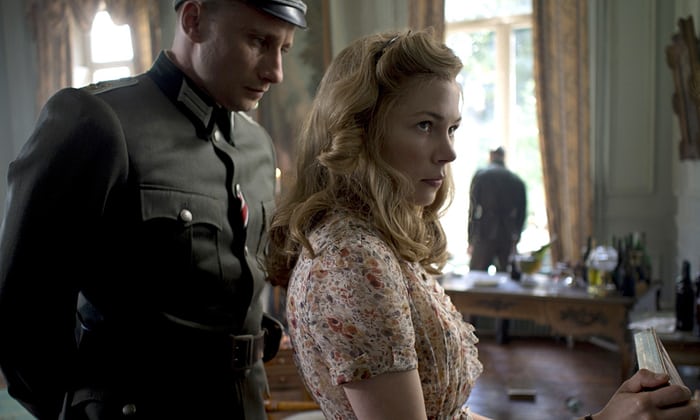
Suite Française (2015)

Matthias Schoenaerts and Michelle Williams love across the divide in this disappointing French Occupation epic

Director: Saul Dibb

Cast: Michelle Williams (Lucile Angellier), Kristin Scott Thomas (Madame Angellier), Matthias Schoenaerts (Oberleutnant Bruno van Falk), Sam Riley (Benoit), Ruth Wilson (Madeleine), Margot Robbie (Celine), Lambert Wilson (Viscount de Montmort), Harriet Walter (Viscountess de Montmort), Clare Holman (Marthe), Alexandra Maria Lara (Leah), Tom Schilling (Oberleutnant Kurt Bonnet), Eric Godon (Monsieur Joseph), Deborah Findlay (Madame Joseph)

The story behind the writing of Suite Française is compelling. Living in Nazi-occupied France, Irène Némirovsky began work on a five-novel series, Suite Française, which she intended to depict life in her homeland under German rule. She had only written two of the five books when she was arrested by the Gestapo as a Jew, and tragically died in Auschwitz. The books were written in a small notebook and kept by Némirovsky’s daughter while she moved from hiding place to hiding place evading the Nazis. Sixty years later, donating her mother’s papers to an archive, she deciphered the notebook and discovered the novels. They were published as a single volume to great success in 2004, regarded as an accomplished piece of literary fiction and a remarkable work of contemporary witness. 

The short summary of the novel’s richness and complexity provided by this film can’t really compete. Based on the second of the two novels, the story takes place in a small French village in 1940. Following the arrival of the Germans, officers are billeted in people’s homes: Lucile Angellier (Michelle Williams) and her mother-in-law (Kristin Scott-Thomas) are assigned sensitive musician Bruno van Falk (Matthias Schoenaerts), while their neighbours, farmers Benoit and Madeleine (Sam Riley and Ruth Wilson), are forced to accommodate bullying officer Kurt Bonnet (Tom Schilling). As hostilities between the French residents and the German occupiers grow, so does the attraction between Lucile and Bruno, but Bonnet’s pursuit of Madeleine threatens to ignite the simmering tensions in the community.

Suite Française manages to turn its promising material into a conventional, chocolate box wartime romance – you can’t help but think that it does a great deal of disservice to the original novel. It’s filmed in an unremarkable style (there are at best 1-2 imaginatively done shots and sequences) and poorly paced. With its short runtime (barely more than an hour and a half), it constantly feels rushed. Quite simply it’s a story about simmering tensions in a confined environment – it needed more time for us to get a sense of the drama building, of the resentments between the Germans and the French growing. Because the film is so short we don’t get that at all.

Most notably, in a film about a romance between a French woman and a German officer, there is no sense at all of the risks that French women who started relationships with German officers were running. Besides a few small throw away lines, there is no sense of the physical danger and the social stigma that would be applied to these women. Instead, the tension of Lucile falling for Bruno seems to be based more on whether her mother-in-law will discover that she’s considering cheating on her (absent, unfaithful) husband. Even Celine the promiscuous farmgirl (a wasted Margot Robbie in a terrible wig) doesn’t seem to be running any risks of reprisals from the villagers when she’s banging a German officer in the woods.

This, however, is where the film’s rushing undermines it. If it had allowed us to develop a sense of the resentment, shame and loathing the occupied French felt for their German oppressors, a feeling of the whole town being willing to close doors on anyone they perceive as being too close to the  Germans, we could have felt a real danger for Lucile in flirting with a dalliance with Bruno. As well as giving the situation a bit of stakes, it would have made it a lot more emotionally engaging too. We could have witnessed her inner conflict at considering a romance with the enemy, and the emerging feelings between them would have had the conflict of a forbidden love. Instead the film rushes us as quickly as it can towards getting Bruno and Lucile into a passionate clinch, at times taking giant unsupported leaps forward in their relationship, so when it arrives it packs no punch.

This passionate clinch undermines the film. If it wasn’t going to take the time to really build the relationship through lingering glances and brief moments, convincingly charting the journey from hostility and suspicion to a forbidden attraction, it should have cut the relationship down to being something that tempts them both but which they cannot express. Have these two recognise a deep bond between them, a bond that in another time would have brought them together but cannot in the time of war. It’s a film where the only physical contact between them should feel like a window on what might have been – not a passionate locking of lips and sexy fondle or two. Think how much more affecting that might have been.

It would also have fit the structure of the film far better. As Lucile finally finds herself having to choose a side – deciding whether to help a renegade hunted by the Germans or not – her decision to sacrifice her chance of love with Bruno might have worked much better. Similarly, Bruno having to revert to the soldier taking responsibility for the growing persecution of the villagers would have been more affecting. (It further doesn’t help that the film doesn’t give time for Williams and Schoenaerts to build up an effective chemistry.) By chucking them into a clinch as soon as it can, the film undermines its message and also manages to make itself feel more like “Mills and Boon in Occupied France” than the serious tragedy it could have been.

When the film finally focuses on the battles between the French and Germans in its final third, it’s much more interesting than the slightly tired romance. Here we get tensions, stakes, drama – and finally a sense of the danger that being in this situation could have. After the rather soft focus romance that comes before, it really seizes the attention.

Williams does a decent job as Lucile, Scott Thomas could play her austere mother-in-law with hidden depths standing on her head (the film fumbles the unexpected alliance between these characters late on). Schoenaerts is a bit wasted in an underwritten role but does good work. The best performances largely come from the second tier: Lambert Wilson is excellent as the local Viscount who wants to try and work with the Germans but quickly finds himself out of his depth. Harriet Walter is similarly strong as his wife, as is Ruth Wilson.

But Suite Française could have been so much better than the movie that it actually becomes. A film that focused on the dangers of occupation and the tensions of a small community would have been great. A film that rushes through a Romeo and Juliet style romance, without building the sense of forbidden love, is a film that just doesn’t work.

The Great Gatsby (2013)

“Hello old sport”: Leonardo DiCaprio is The Great Gatsby

Director: Baz Luhrmann

Cast: Leonardo DiCaprio (Jay Gatsby), Tobey Maguire (Nick Carraway), Carey Mulligan (Daisy Buchanan), Joel Edgerton (Tom Buchanan), Elizabeth Debicki (Jordan Baker), Isla Fisher (Myrtle Wilson), Jason Clarke (George Wilson), Amitabh Bachchan (Meyer Wolfsheim), Jack Thompson (Dr Walter Perkins), Adelaide Clemens (Catherine)

The Great Gatsby is possibly the great American novel. I’ve only read it once, but I certainly admired its beautiful prose, capturing of an era of American life and understanding of the fragility behind America’s love of success. Baz Luhrmann is clearly a fan, as he spent years putting together this passion project, presenting the biggest, brashest version of Fitzgerald you are ever going to see.

Nick Carraway (Tobey Maguire) is a young writer turned bonds salesman in 1920s New York. He lives across the bay from his cousin, Daisy (Carey Mulligan) and her husband Tom Buchanan (Joel Edgerton), a brash old-money man carrying on an affair with Myrtle (Isla Fisher), the wife of his garage mechanic. Carroway’s next-door neighbour is the sumptuously wealthy, but mysterious, Jay Gatsby (Leonardo DiCaprio) whose parties and generosity are legendary. As Carraway gets to know Gatsby (as much as anyone can), he discovers that Gatsby has a deep, near obsessive, love for Daisy.

Luhrmann’s film is a technicolour explosion that uses many of the techniques you’ll be familiar with from any of director’s other films. The camera is a whirligig of motion. The colours are bright and primary. The whole tone of the film (certainly for its first hour) is larger than life. The narrative has been tweaked to take on the tone of a Greek Tragedy, with the loud noise, fast camera moves and speedy pace all inverted in the latter half to invoke sadness and tragedy. And of course, the music is deliberately anachronistic, mixing modern genre music with 1920s sounds.

Sometimes this high-budget technicolour brilliance does feel like it is partly getting in the way of the deeper themes that lie within the original. But that might be partly because the novel’s themes are so reliant on internalised feelings, unsaid or guessed emotions, and deeply purple prose, that these are ideas which are very hard to translate to the screen.

There is something to be said for Luhrmann turning one of the pillars of 20th-century American culture into a spiritual sequel to Moulin Rouge!. And Moulin Rouge! is what the film strongly resembles, not only in design, but its romantic structure, poetic retelling, high drama, sense of impending doom and danger behind the bright lights, assault on class and the way it stands in the way of true love, and the lack of freedom in our lives. Both even have sad, reflective authors book-ending events.

So your enjoyment of the film is probably going to depend on how you feel about Luhrmann’s OTT style. Love Moulin Rouge! and Romeo + Julietand you will probably find something to enjoy here (and you’ll also notice his love of tragic love stories). Saying that, of those three, Gatsby is the one the carries the least depth to it, which is intriguing as it probably mines the most psychologically rich source material. While Luhrmann understands that the book is about the real emotions masked by explosive parties and opulence – the film often feels as choked by these things as the characters do.

This is partly because I feel both Maguire’s and Mulligan’s performances don’t quite work. Maguire is so stripped back, quiet and passive he almost disappears – you don’t get a sense of Carraway as either a shrewd observer or someone wrapped up in events: instead he’s a passenger, like the plot contrivance Gatsby sometimes treats him as. Similarly, Mulligan is slightly overwhelmed by the movie, not giving a strong enough performance for her to break through. The film powers forward with such momentum and brashness, it squashes her.

It’s probably why the most successful lead performance by far comes from DiCaprio. He’s perfectly cast as Gatsby: so good in fact you wish he was in a more thoughtful, relaxed film that would give him a more of a chance to breathe. DiCaprio perfectly encapsulates the desperation just beneath Gatsby’s surface, the fear and uncertainty that lies under his suave urbanity. He completely gets the character, understands he is a showman presenting a front to the world because that’s what he thinks the world wants, but who is, in his own way, as empty and lost as the world of bright lights he is offering people. It’s an excellent performance.

Luhrmann’s work with DiCaprio is what gives the film it’s centre and, for all the colour, noise and joy of the first 40 minutes or so, it finds its heart in the moments of acting and character interplay as the Gatsby-Daisy-Tom love triangle comes to a head. This scene, with its bubbling emotions, high stakes and tension is like an oasis of calm in the high-faluting scenery that surrounds it. But then this is a film where the smaller moments actually come across as richer than the larger ones – partly helped by the fact that Joel Edgerton and Elizabeth Debicki both give excellent performances as the key supporting characters. 

The Great Gatsby captures the feel of Fitzgerald rather well, but for all the dialogue of the book placed over the film in voiceover, it never quite manages to capture the spirit of the book in the same way. It looks wonderful, and its dynamic filming is certainly enjoyably impressive, but it doesn’t quite become a film that deals in emotions and depth. It flashes and fizzles but it never lets us really soak in its ideas and themes. It’s all too much at times, and the tragic sadness at the heart of the story, of this lost boy trying to live the life of a man, never comes out as it should. An interesting and entertaining film, but not one that will last.

Three Colours: Red (1994)

Irène Jacob gives a soulful performance in Kieślowski’s crowning achievement Three Colours: Red

Director: Krzysztof Kieślowski

Cast: Irène Jacob (Valentine Dussault), Jean-Louis Trintignant (Joseph Kern), Jean-Pierre Lorit (Auguste Bruner), Frederique Feder (Karin), Samuel LeBihan (Photographer), Marion Stalens (Vet), Teco Celio (Barman)

Spoiler warnings: I wouldn’t usually do this for a film that was made over 20 years ago, but discussing this film is almost impossible without covering the entire plot so – be warned! This is a rich viewing experience you should discover for yourself.

Kieślowski’s great trilogy wraps up with Three Colours: Red, a fascinating, moving, intriguing puzzle of a film that opens itself up to countless interpretations. It’s a film that seems to be about a great many things, but wears its intelligence and insight very lightly, never hammering points home or getting too wrapped up in its own smartness. It’s primarily a story and never forgets that. It also pulls together threads and themes from the entire trilogy hugely effectively. It’s a great movie.

Valentine (Irène Jacob) is a student in Geneva, funding her time at university through part-time modelling. After accidentally hitting (but not killing!) a dog with her car, she meets the dog’s owner, retired judge Joseph Kern (Jean-Louis Trintignant). Joseph is spending his time in isolation from the world, listening to his neighbours’ phone calls, more out of a judge’s habit of finding out secrets than any truly malicious intent. Valentine challenges this blatant disregard of privacy, and she and Joseph begin to form an increasingly strong bond. 

Red is a beautiful film, wonderfully made and rewards constant analysis. Kieślowski described this as the hardest film of the trilogy to write, and you can see why. Dealing with themes of fraternity, it ties this in closely with love (romantic and otherwise). The entire film shows the strengths of people coming together, specifically Valentine and Joseph who develop a bond that enriches their lives. This is contrasted throughout with Valentine’s domineering boyfriend on the other end of the phone-line, and modern communication in general that builds distance between people. Joseph, a man distanced himself from all others, finds his humanity once he opens himself to considering other people as people.

Kieślowski’s film also plays interesting games with narrative and time. A seemingly minor character, Auguste, a lawyer training to become a judge, is slowly shown to share a huge number of life events with Joseph’s youth. The question that bubbles over the film is, is this a coincidence or are Auguste and Joseph somehow linked? Is Auguste in some way the same person as Joseph – some sort of reincarnation? Is this fate or chance or mere coincidence? Is Joseph, living like some lonely old-testament God in complete isolation, somehow trying to move events to correct errors in the past – to try and find some contentment for Auguste (whose conversations with his girlfriend he has been listening to) so that he avoids the life Joseph has led?

I like this idea. It appeals a lot to me, not least as I started to feel that Joseph was almost some sort of Prospero, using phone taps as his own private Ariel to know everything happening around him and then (more benignly perhaps than Prospero) using this to improve the lives of those close to him. Perhaps. There is even a seemingly magic storm at the end of the film that brings several characters together, not least the leading couples from the previous two films in the trilogy. It’s also a storm that, it is suggested, will bring Valentine and Auguste together.

It’s a romantic flourish at the end of the film that speaks of the possibilities for the future (though typically of this intriguing series, it’s a flourish that comes out of a ferry accident that kills over a thousand people – you can’t get something for nothing in this world, and no romantic story is straight forward). It’s also a natural development of the strong romantic link between Joseph and Valentine. If Joseph and Auguste are (essentially) versions of the same person, it’s a further suggestion that (in another life) Joseph and Valentine would certainly have fallen in love (to match the platonic love that develops between them). This interpretation of love joining people together is seen as well in the lead couples from Blue and White also surviving the accident.

Or is this all coincidence? Kieślowski plays the mystery and depth so lightly – lets these points float out or be lightly stated without tub-thumbing – that it leaves it all gently to the viewer’s imagination. You can make of it what you will: the story works just as effectively if you ignore all the things I just discussed. Joseph as the isolated, austere man who finds a warmth in himself awakened by the generosity and compassion of Valentine. All this stuff could just be the working of chance.

But either way, the film is about fraternity: people coming together, and communication and compassion making us human. Irène Jacob is wonderful as the endearing, romantic and empathetic Valentine, her brightness and humanity shining through. Jean-Louis Trintignant is superb as the judge, whose careful veneer of distance and coldness is punctured throughout the film. The scenes these two share are beautifully done: conversations that throb with emotion under the surface. Kieślowski again directs these scenes with a masterful minimalism, using differing heights and levels (they are very rarely on the same level, usually one sits or stands above the other) to show the dynamics subtly change between the two. These height differentials – with Valentine often kneeling at Joseph’s feet – also suggest a growing intimacy between the two characters. 

Technically the film is a marvel. It is lusciously filmed by Piotr Sobociński. The presence of red throughout is very well done and adds a poetic brilliance to the images. Kieślowski in particular shoots sunrises and sunsets with an astounding beauty, and uses light to add a huge emotional depth and beauty to private conversations. Zbigniew Preisner’s score is marvellous, a lyrical, beautiful series of compositions that rewards constant re-listening.

Red is a marvellous, thought-provoking and humane film crammed with wonderful and involving ideas, and brilliantly gives you loads to think about both narratively and thematically. It’s a warm and moving story, with darker elements that make those parts seem richer. With two marvellous performances at its centre, it’s brilliantly directed by Kieślowski (who tragically died shortly after the film’s release), with grace, poetry and passion. It looks wonderful, it sounds marvellous and it always make you think. It’s a masterpiece.

Three Colours: Blue (1993)

Juliette Binoche seeks liberty from grief in Krzysztof Kieślowski’s masterpiece Three Colours: Blue

Director: Krzysztof Kieślowski

Cast: Juliette Binoche (Julie de Courcy/Vignon), Benoît Régent (Olivier Benôit), Emmanuelle Riva (Madame Vignon), Florence Pernel (Sandrine), Guillaume de Tonquédec (Serge), Charlotte Véry (Lucille), Yann Trégouët (Antoine), Hélène Vincent (La journaliste), Zbigniew Zamachowski (Karol Karol), Julie Delpy (Dominique)

There are few foreign language films that have cemented themselves in film’s cultural history more than Kieślowski’s Three Colours Trilogy. These three inter-linked films – made with French and Polish money – looked (individually) at themes of Liberty, Equality and Fraternity, while using a colour palate and design that reflected one colour of the French flag each. The first film in this interlinking trilogy is Blue, a sombre, intriguing, intimate drama that perhaps wears its intelligence a little heavily on its sleeve.

Julie de Courcy (Juliette Binoche) is the only survivor of a car crash that kills her husband, a famous composer, and her daughter. Lost in grief, Julie decides that she will separate herself from the world and live entirely independently. She rents out her home, distances herself from friends, takes back her maiden name and destroys what she believes to be the only copy of her husband’s final composition – a concert for the unification of Europe. But Julie finds that liberating herself from all worldly connections is not as easy as she hoped.

Blue is a heartfelt, gentle film that throbs with emotional intensity, much of it coming from Binoche’s searing performance of a woman consumed with a mixture of grief and survivor guilt, who sees complete isolation and “liberty” from all connections as the only chance for sanity. Kieślowski’s direction is masterful – patient, stable, quiet and with a brilliant eye for small details. The film is crammed with small moments that speak of peace and quiet reflection – from watching a lump of sugar being soaked in tea, to lingering studies of everything from rooms to streets. 

The opening sequences of the film convey this masterful confidence from Kieślowski. The camera is a still observer, alternating between subtle POV shots and gentle, perfectly placed observation of Julie. Every moment of the shocking discovery of Julie’s loss is wonderfully assembled – from the stumbling news from the doctor, to the crackling mini-TV on which she watches her family’s funeral being broadcast. Quietly we see Julie return to her own home – and Binoche bottles up emotion with a resolve that suggests as much her determination not to engage with the pain as it does self-control. No wonder her housekeeper bursts into tears at the fact that Julie isn’t crying.

This all ties in very interestingly with the film’s theme of liberty. Conventionally, we would have had Julie escaping from something to find her own life. Kieślowski’s film more interestingly explores the positive and negative of liberty. Julie chooses freedom from all of life’s connections – but this is shown constantly to be not only impossible, but also less than healthy. Her surface liberty is instead crushing her under the pressure of isolation.

At the same time, the film is partly about Julie learning to free herself from her survivor guilt. Cutting herself off from the world denies her a genuine emotional connection with her husband’s friend Olivier (a puppy doggish Benoît Régent). In the first months of her guilt she sleeps with Olivier, hoping it will get her a bit of peace (it doesn’t). Inevitably, as Julie finds out more about her husband’s life – and as we find out that his music output was heavily reliant on Julie’s secret collaboration – the film becomes a question of whether Julie will allow herself the liberty from her past to continue living.

Because in a way this is an anti-tragedy: it starts with a trauma and is about the survivor learning to continue her life. Kieślowski peppers the film with moments of falling, from items to bungee jumpers on the TV. Slowly, these images of falling progress to include being caught, or shots of the bungee cords snapping the person back from oblivion. It’s a neat, subtle continual reference to Julie’s unconscious search for support.

Particularly as it’s made clear that Julie’s entire personality is all about giving, about loving and supporting people. From her silent collaboration with her husband, to her patient caring for her mother suffering from increasing dementia (another perverse form of liberty), to her forming a reluctant friendship with an exotic dancer in her block of flats (who the rest of the tenants are trying to drive out), it’s clear that Julie’s attempt to distance herself is never going to truly work. A character late on even tells her that her husband had always described her as kind and forgiving – qualities Julie learns to re-embrace. 

The wider world that Julie is trying to escape is represented brilliantly throughout by the score of her husband’s (her?) music for Europe. This score – a richly exuberant piece of music by Zbigniew Priesner – constantly intrudes into the action, accompanied by moments where Kieślowski seems to suggest time has stopped as Julie becomes lost in her reflections. Kieślowski uses colour changes and slow zooms to suggest throughout these beats where Julie temporarily becomes lost in the past and memories. The continual presence of the music is perfectly done.

The one element I was less keen on was the over use of blue. From filters on the camera, to backlighting, to objects present in every frame, there is a lot of blue in this movie – every shot has something blue in it. Although this is clever, and clearly thematically intentional for the whole trilogy – I’ve got to be honest spotting this stuff probably took me out of the film at moments. I imagine on a second viewing this will be dramatically reduced – but it’s one of those curses of a trilogy of films that have been so hyped up on the arts circuit, that you are aware of some of its subtle tricks so much that they cease to be subtle.

But Three Colours: Blue is still a masterful, quiet study of grief, loss and yearning, that avoids the obvious and explores different types of liberty and freedom. Binoche is brilliant in the lead role, and Kieślowski sears the brains with images (I still wince remembering a sequence where Julie deliberately scrapes her knuckles over a wall she walks past) and his direction is impeccably sensitive and unshowy, letting the film speak for itself. I can’t wait to watch the other two films in the trilogy – and see how this might affect my views on this first one.

The Young Victoria (2009)

Emily Blunt and Rupert Friend play the royal couple in the cozy The Young Victoria

Director: Jean-Marc Vallée

Cast: Emily Blunt (Queen Victoria), Rupert Friend (Prince Albert), Paul Bettany (Lord Melbourne), Miranda Richardson (Duchess of Kent), Mark Strong (Sir John Conroy), Jim Broadbent (King William IV), Harriet Walter (Queen Adelaide), Thomas Kretschmann (King Leopold), Jesper Christensen (Baron Stockmar), Jeanette Hain (Baroness Lehzen), Julian Glover (Lord Wellington), Michael Maloney (Sir Robert Peel), Michel Huisman (Prince Ernest), Rachael Stirling (Duchess of Sutherland)

Now ITV’s Victoria exists, it’s a bit strange to go back and watch The Young Victoria. With the love today of long-form drama, and the time it can invest in things, it’s funny to see what the drama took almost 8 hours to do being crammed into an hour and a half here. But saying that, The Young Victoria is still an entertaining, luscious viewing experience which, while it has some strange ideas about certain events, is the sort of relaxing Sunday afternoon viewing that will take you out of yourself.

After the death of William IV (a slightly overripe Jim Broadbent), Victoria (Emily Blunt) is elevated to the throne. Finally able to shed the control of her mother’s (Miranda Richardson) domineering secretary Sir John Conway (Mark Strong), Victoria is determined to steer her own course. But she is surrounded by competing influences, not least from the charming arch-politician Lord Melbourne (Paul Bettany). King Leopold of Belgium (Thomas Kretschmann) dispatches his nephew Prince Albert (Rupert Friend) to England with the express interest of marrying Victoria and controlling her – but Albert and Victoria find themselves as kindred spirits, supporting each other to rule.

The Young Victoria is the epitome of prestige costume dramas. It looks fantastic, the cinematography is ravishing, the production and costume design exquisite. It’s pretty clear what the producers thought would sell the picture abroad. The royal regalia is pushed very much to the fore, and we get some wonderfully sweeping scenes, not least an impressively large-scale coronation. The soundtrack brilliantly riffs on Handel, and Julian Fellowes’ script mixes period regal style with a sweeping feeling of romance between Victoria and Albert.

The film actually does a very good job of repositioning Victoria as a young woman, and gives her a strong quality of self-determination and a desire to be herself in a man’s world. It’s really helped in this by the combination of imperial strength, girlish wilfulness and sharp intelligence Emily Blunt brings to the role. Blunt and the film also aren’t afraid to show that, however much Victoria had guts and determination, she was also quite a headstrong woman not above making emotionally led mistaken decisions. In fact, much of the drama spins out of Victoria learning to try and put these youthful crushes and prejudices aside.

Having said that, it’s interesting that the successful conclusion of the film centres on Victoria accepting that she needs the help of Albert to run the kingdom, and that she needs to remove competing influences for her affection – Melbourne and Lehzen – to focus her affection and loyalty on him. The film frames this as a winning romance and a successful partnership (which it was) – but it’s also vaguely creepy if you think about it. Mind you, since all the affectionate influences on Victoria are implied by the script to be at least partly motivated by self-interest, with the possible exception (eventually) of Albert, it manages to suggest this was for the best.

Albert’s background gets some interesting exploration here. He’s very much presented at first as the tool of Leopold as a means of controlling British politics. But he is far too independent, smart and noble to ever be the means of manipulation. Friend is very good here – his performance is quiet, authoritative but also heartfelt. Fellowes guilds the lily a bit to show his devotion by having Albert shot by a would-be assassin late-on in the film. Historically the assassin’s pistol wasn’t loaded, and Albert didn’t get shot (though Fellowes protests Albert didput himself in front of Victoria and that this intent is what’s important, not whether he was shot or not) but the moment does work – it gives the drama a boost and it’s undeniably moving.

While Albert is presented overwhelmingly sympathetically, interestingly Lord Melbourne gets quite a kicking. Paul Bettany is presented far more as a rival love interest than the sort of father-figure Melbourne was in real life (Bettany is probably 20 years younger than the real Prime Minister). Melbourne is shown as cynical, controlling, manipulative and overwhelmingly motivated by self-interest (a few more pushes and he would virtually become the film’s villain). He’s constantly contrasted negatively with Michael Maloney’s upright, honest Sir Robert Peel (one of my favourite statesmen of the 19th century so at least I’m pleased) – and his relationship with Victoria is one of self-promotion, which seems odd seeing as historically the two of them were so close. 

The film introduces other villains for us to hiss at. Kretschmann and Christensen do a good job as arch political schemers. Our real villain though is Mark Strong, who does a great job of scowling, controlling nastiness as the failed-bully Sir John Conroy. Strong’s performance works so well because he makes it clear that Conroy feels that his “Kensington System” (an attempt to manipulate and cow Princess Victoria into being a submissive puppet) is genuinely in her best interest, and that he genuinely cares for her. His partnership with Miranda Richardson as Victoria’s near-love-struck mother works very well.

The Young Victoriathrows in enough interesting character beats like this for it to really work as an enjoyable afternoon period-drama. With some great performances – Emily Blunt carries the movie brilliantly – and while some of the historical characterisation is a bit off, and other moments feel a little too chocolate box it’s a very entertaining, undemanding view., it’s great fun. The hardcore Victorian costume-drama fans will probably prefer Victoriafor the same story in more depth – but this film does it with great sweep (and doesn’t cram in Victoria’s stupid below-stairs plotlines!).

Ordinary People (1980)


Mary Taylor Moore, Timothy Hutton and Donald Sutherland pose for an awkward picture in family troubles drama Ordinary People

Director: Robert Redford

Cast: Donald Sutherland (Calvin Jarrett), Mary Taylor Moore (Beth Jarrett), Timothy Hutton (Conrad Jarrett), Judd Hirsch (Dr Tyrone Berger), Elizabeth McGovern (Jeannine Pratt), M. Emmet Walsh (Coash Salan), Dinah Manoff (Karen Aldrich), Fredric Lehne (Joe Lazenby), James B Sikking (Roy Hanley)

In 1980, Robert Redford became the first big Hollywood stars to parlay acting success into producing and directing small scale, independent films that otherwise might never have been made. Ordinary People was the first of these – with Redford focusing on staying behind the camera – and it was a big success. It even won four Oscars – best picture, screenplay, supporting actor for Timothy Hutton (despite the fact Hutton is really the lead) and best director for Redford himself (beating out David Lynch for The Elephant Man and Martin Scorsese for Raging Bull). It was a great story for 1980 – the matinee idol turned artist. But is Ordinary People that great a film?

The film covers the emotional collapse of a wealthy middle-class American family after the eldest son Bucky is killed in a boating accident. Younger son Conrad (Timothy Hutton) has had trouble coming to terms with the accident, which he survived, and has only just left an institution after a suicide attempt. His father Calvin (Donald Sutherland) is desperate to try and relate to his son again, while his mother Beth (Mary Taylor Moore) remains emotionally distant attempting to put the accident behind them. Conrad starts seeing psychiatrist Dr Berger (Judd Hirsch), to adjust – but the after effects of Bucky’s death continue to tear the family apart.

Nobody really talks about Ordinary People any more do they? Out of all the 1980s Best Picture winners it’s perhaps the most easy to overlook (except maybe for Terms of Endearment). Why is this? Well truth be told it’s just a pretty ordinary picture. There really isn’t much to it. The story it tells of a wealthy family (only a millionaire like Redford could consider these loaded people ordinary) suffering emotional trauma and psychiatry finding the answer has been told so many times before, and since, that there isn’t anything particularly unique or interesting about it. 

In fact Ordinary People is exactly the sort of small-scale, quiet, middle-brow independent film that awards ceremonies slather over and a few years later (never mind over 30!) people struggle to see what the fuss was about. Redford directs the film with a quiet professionalism – the sort of competent craftsmanship and skill with actors that dozens of other directors could have done just as well. His Oscar for best director is especially galling when you consider the artistry and imagination of Scorsese’s direction of Raging Bull, or the unbearable sadness and tragedy Lynch gave The Elephant Man. It’s the sort of direction a non-famous director wouldn’t even have been nominated for.

This film uses shot-reverse-shot like it’s going out of fashion, most of the scenes are conversations across tables that are weighted down so heavily with meaning you start to lose interest in them. The score uses Pachelbel’s music in such an overwhelming style, it makes that sound as anodyne as much of the rest of the movie. Maybe it’s just because this is such well-trodden ground, but the revelations towards the end of the movie are so blindingly obvious you wonder why it takes so long to get to them (the son blames himself, the mother blames the son and doesn’t love him as much as the dead son, the father wants the two to kiss and make-up). 

This rotates around a series of psychiatrist scenes which at least have the feeling of actual sessions, even if Judd Hirsch (good as he is here) basically plays the sort of revelation inspiring psychiatrist that only appears in movies. The film has a touching faith in the power of analysis being able to solve all problems, and spends so long luxuriating in scenes like this it virtually forgets to put actual living, breathing characters in the middle of them. With the possible exception of the father, none of these characters feel particularly real – they are just mouthpieces for the plot.

Not that it’s badly acted at all. Timothy Hutton made his film debut here and he brings a real fire and passion to the role, as well as a moving emotional vulnerability and anger directed only at himself. The supporting actor Oscar feels a bit of a cheat, as he’s clearly the lead, but he’s very good here as Conrad, struggling to express himself, bottling up his feelings and lashing out at those around him. It’s a part that feels drawn together from bits and pieces of plot requirement, but Hutton plays it to the hilt – it just doesn’t feel like a really real person, more a collection of sad traits.

Mary Taylor Moore is in a similar situation as a mother so cold and distant from her son, so repressed and controlling her distance starts damaging the entire family. She’s unable to process what has happened so almost wants to pretend nothing has (and blames her son for not doing that same), that it again feels like something from a psychiatric case-study rather than real person. Moore gained particular attention at the time as she was best known for comedy (much like Judd Hirsch, famous for the sitcom Taxi) – so the performance at the time might have looked stronger than it actually was.

The best performance might well come from Donald Sutherland in the least flashy role as the father trying to puzzle out what is going on – and trying to work out his own feelings. It’s the only character that feels less like a construct and more a genuine person, whose answers aren’t easily worked out by a bit of psychology study. Sutherland is low-key, tender, gentle and carries all his emotion on the inside – it’s a subtle and excellent performance, overlooked way too much. 

Redford essentially directed an actor’s film here (it’s all about the big moments of acting) so it’s not a surprise that it seized the attention of the Academy (largely made-up of actors) but really it’s not that far away from a well-made “movie of the week”,  with its obvious beats and not particularly surprising revelations. Perhaps it’s the point that the family’s problems seem a lot more apparent to the viewer than they do to the characters – and there is some interesting development of perceptions, not least from Sutherland’s father who starts to come to profound realisations about his wife and son. 

But Ordinary Peopleis an uninspiring and even rather tame drama, that today looks even more low-key and insubstantial. While it tries to break free from the confines of “social drama” it actually wants to tie everything up with a neat bow psychologically – and despite the fact it has an ending that suggests not everything is perfect, it really concludes with a safe full stop. There is a reason why it’s surely one of the best pictures which has been most forgotten about.

Alfie (1966)


Michael Caine excels as amoral cockney moralist lothario Alfie

Director: Lewis Gilbert

Cast: Michael Caine (Alfie), Shelley Winters (Ruby), Millicent Martin (Siddie), Julia Foster (Gilda), Jane Asher (Annie), Shirley Anne Field (Carla), Vivien Merchant (Lily), Eleanor Bron (Doctor), Denholm Elliott (Abortionist), Alfie Bass (Harry), Murray Melvin (Nat)

Is there a more “swinging Sixties” film than Alfie – the story of a cockney wideboy interested only in “birds” and having a good time? On the surface it captures the attitude of the 1960s, with free love, thumbing your nose at authority, and having the sort of fun the wartime generation frowned on. But it’s a more interesting film than this, which criticises the emptiness of the 1960s by showing us Alfie’s selfishness and loneliness. Sure he has a good time now and again – but would anyone really want to live like this forever?

Alfie (Michael Caine) is a handsome chauffeur with a never-ending stream of affairs, commitment constantly avoided. The film follows these entanglements, starting with his needy girlfriend Gilda (Julia Foster), the mother of his child, whom he constantly cheats on. When Gilda finally leaves him – and Alfie loses touch with the son he has become fond of – a medical condition ends up with him in a convalescent home, where his affairs include the wife of a fellow patient, Lily (Vivien Merchant). Later relationships with a young hitchhiker (Jane Asher) and a rich American woman (Shelley Winters) similarly lead to disappointment.

The main thing that makes Alfie last (possibly the only thing) is Michael Caine’s sublime performance. Caine is on screen the whole time, and the film is spotted throughout with his casual direct-to-camera addresses. Caine’s charm and likeability work perfectly for this device, winning the audience over. But Caine never falls for Alfie – even if many audience members clearly did. Caine’s constantly demonstrates Alfie’s hypocrisy, shallowness, meanness and selfishness. Sure he recounts his actions with wit, but most of these actions are extremely shitty. But right from the start there is a charismatic, lothario swagger to him – and a cheeky charm – that makes you like him.

But his general shittiness is more obvious today than back in the 1960s. Then the amount of sex probably shocked viewers the most. Today it’s Alfie’s inability in to refer to women as anything but “it”, like some smooth Richard Keys. His attitude to women is appalling – he describes Jane Asher’s hitchhiker like some sort of floor-cleaning, bed-sharing car. Alfie avoids any sort of emotional connection at all with his conquests, and the film makes clear that this has left him empty and lonely, feelings he buries deep down.

In fact, the film is most telling at the moments when Alfie doesn’t turn to us with that confident grin and place a self-serving spin on what just happened. Seeing his son being warmly embraced by Gilda’s new husband (at the christening of their new child), Alfie can only skulk quietly at the back of the church – as scared to meet our eyes as he is those of this family he could have had. His love for his son is something Alfie refuses to accept himself – but his feelings are all too clear at his physical collapse on losing access to his child, and his later tear-stained reaction to Lily’s abortion.

Ah yes the abortion scene. Probably the highlight of the film – if only because its intense seriousness is so different from the rest of the film, and Alfie’s wheedling weakness and whiny self-justification become all the clearer. His complete lack of principle in sleeping with his only friend’s wife (“Well what harm can it do?”) of course results in her pregnancy. And Alfie is all at sea, firstly with Vivien Merchant’s expert portrayal of distress, pain, shame and guilt as Lily – and with Denholm Elliot’s perfect cameo of grimy, resentful disillusionment as a struck-off doctor turned back-street abortionist. Just to bang the nail on the head, Alfie leaves Lily alone after the operation (telling the audience that there’s nothing he can do anyway, right?). He may be horrified later at what he has done, and may feel moments of empathy – but has he really learned anything?

The film is full of these moments where we are invited to understand that Alfie is not leading a life for us to aspire to, but one we need to avoid. It’s left Alfie alone, miserable and abandoned. For all the jaunty 1960s vibe, and Alfie’s charming cheek, he’s not a happy man but a desperately shallow one. And he’s even got a shelf life for this way of life: “He’s younger than you are” one of his lovers tells him late in the film, as she leaves him. Because what has Alfie got in his life? When he runs through a checklist in the film’s closing monologue (“a bob or two, some decent clothes, a car. I’ve got my health back and I ain’t attached. But I ain’t got my peace of mind”) the emptiness of his life is all too clear.

Caine’s brilliance is to make this tragic, empty, selfish man seem attractive and exciting – while also never losing sight of what a complete shit he is. It’s a great performance and he dominates the entire film. He plugs perfectly into the hip, light touch that Lewis Gilbert directs the film with, and the entire film has a layer of cool on it that works rather well. What makes the film last today though is its shrewd analysis of the empty, soulless, coldness that underpins living your life like this – and how the sort of shallow, no consequences, no emotional investment bouncing around Alfie has just leaves you alone and growing old.

“What’s it all about?” You can argue the answers are buried in this film – but Alfie never spots them.

Phantom Thread (2017)


Vicky Krieps and Daniel Day-Lewis play dangerous games in Paul Thomas Anderson’s fascinating film about control, Phantom Thread

Director: Paul Thomas Anderson

Cast: Daniel Day-Lewis (Reynolds Woodcock), Vicky Krieps (Alma Elson), Lelsey Manville (Cyril Woodcock), Camilla Rutherford (Johanna), Gina McKee (Countess Henrietta Harding), Brian Gleeson (Dr Robert Hardy), Harriet Sansom Harris (Barbara Rose), Lujza Richter (Princess Mona Braganza), Judy Davis (Lady Balitmore), Philip Franks (Peter Martin)

The last time Paul Thomas Anderson and Daniel Day-Lewis worked together, we got a true masterpiece in There Will Be Blood. Phantom Thread couldn’t be much more different. In place of rolling plains, oil, and Day-Lewis as a monstrously larger-than-life alpha male, we get confined rooms, handsome dresses and Day-Lewis as a pernickety, obsessive, creepy dressmaker. But Phantom Thread may also be just as intriguing, thought-provoking and memorable in its way as There Will Be Blood.

Reynolds Woodcock (Daniel Day-Lewis) is a leading couturier in 1950s London, whose fashions are highly sought after by the rich and famous. He lives and works with his sister Cyril (Lesley Manville), who dominates his life – and dispatches his various muses as their use comes to an end. On a break near the coast, Reynolds meets Alma (Vicky Krieps), a hotel waitress whom he takes back to London as his latest muse. At first Alma seems to be merely the tool of this fashion Svengali – but Alma has her own desires that quickly spark conflict in the House of Woodcock.

Paul Thomas Anderson’s film has lashings of Daphne du Maurier, Powell and Pressburger (it’s more than a little reminiscent of The Red Shoes) and a slickly inverted Pygmalion. It’s a film that slowly emerges as being about control and the way power relationships can shift and transform. Reynolds at first seems a twisted Henry Higgins: his muses come and go (and, it’s implied, fail to live up to his mother) – he becomes tired of them, and his sister, business partner, factotum and part-time mother-figure Cyril dismisses them when they have served their purpose. 

Reynolds and Alma’s first meeting is one of creepy control. He asks her to memorise his order, wipes her lipstick away so he can “see her” and, in a late night “living mannequin” sequence, dresses her in a series of fabrics and clothes, and offers dispassionate comment about her body. What’s interesting in this sequence though, is that Alma only becomes uncomfortable when Cyril arrives and joins Reynolds in the process. It’s a hint of the developments that will emerge over the course of the film: Alma doesn’t want to share Reynolds.

That’s the tension the film explores from thereon: Reynolds seems to have all the power, but Alma pushes against this to forge her own position as something more than a muse. The film has an acute understanding of the psychology of power in human relationships, which is more than reminiscent of Rebecca: the exact motivations of the characters remain unclear (sometimes even to themselves) until late in the film. The film veers into My Cousin Rachel territory – while giving us a totally unexpected series of emotional developments that spin out of this, which shock but make perfect sense.

That’s because Paul Thomas Anderson has made a sharply observant film about human fallibility and our desire to understand our place in the hierarchies around us, and the unusual paths to contentment that we can find. Like The Red Shoes, it also feels like a film that really understands the psychology of Svengali figures, and adds a Freudian bent to it. Reynolds is looking for a mother to take the place of his own and he is drawn to muses who remind him of her, but who constantly fail to replace her. It’s in the weakness that Reynolds’ perfectionism drives him away from, that he is capable of finding love and happiness.

So the film becomes a series of wonderfully low-key power shifts, many of them revolving around meals. It’s established early that Reynolds demands very precise conditions for his breakfasts – most importantly silence; in every breakfast scene that follows, everything from the loudness of the crunching to the amount of scrapping of jam on toast tells you who is in control. 

Because just as Reynolds wants to craft Alma to take on the perfect muse position for his dressmaking – so Alma wants to craft Reynolds into the perfect combination of high-achieving genius whose success she can vicariously enjoy, and a man who needs her emotionally. Anderson’s brilliant, bitter and waspy screenplay shows the different steps both characters dance through to achieve this. Alma’s solution, and its psychological impact, is brilliantly du Maurier; it’s out there, but makes perfect sense.

Visually the film is beautifully crafted. Anderson shoots a lot of the film with a combination of slow prowling shots, and cameras held at close-up or medium shots that regularly place the actors close to the camera. It means that we always feel like we are right in the middle of the action – looking over the shoulders of actors, or seeing their faces loom into the camera. It obviously creates a claustrophobic feeling, but also one of real intimacy – it’s like the camera is dressing the characters, the same way Reynolds does. But Anderson’s choices pull you closer into the action, and get you really thinking about the psychology of the characters you are watching.

And Anderson wants you to get into the psychology here, because he has cast three actors at the top of their game in this tight-character study. Day-Lewis is of course superb, as a character unnervingly precise and cool – his voice is a perfect combination of icy preciseness, and trembling emotional confusion. Reynolds is in many ways a child – his every whim must be followed, he explodes in foul-mouthed (hilarious) fury at any deviation from his procedures. But he’s also an emotionally stunted man who has never got over the loss of his mother, capable of strong sexual feelings and a yearning for closeness. It’s a subtle, controlled, low-key performance.

But Day-Lewis’ retirement has stolen a lot of the attention from Vicky Krieps, who is sensational as Alma. In many ways, she is the real protagonist of the story. Alma is at first our entry into the story – but we quickly learn we know or understand very little about her. She comes from somewhere in Europe, she may well be Jewish, but Krieps makes her hard to define. Unusual and impossible to understand, Krieps makes her a fascinating character. She emerges as a determined, strong-willed, manipulative figure, looking to have a firm place in her partner’s life – she’s both a toy that bites back, and a woman who will settle for no compromise in what she wants. It’s a fascinating performance. 

Lesley Manville rounds out the cast as the waspish Cyril, deliciously spitting out some cruel lines. Manville is terrific, and Cyril sits in an unusual place in the Woodcock house, partly catering to Reynolds’ demands, partly controlling and positioning him. This makes a perfect foil both for Reynolds’ demanding requirements for a mother, and for Alma’s desire to bring Reynolds under her own influence.

Anderson’s film is a beautiful, fantastically scored, wonderfully acted, intriguing character study, and an insightful exploration of emotional and sexual control and the traps we built for ourselves and for others. It’s a film where every scene is open to interpretation, where both the past and the future seem to haunt events and every resolution leaves questions. It’s a brilliant psychological study that rewards endless thinking, analysis – and I’m sure repeat viewings. I think this one could run and run.