Category: Romance

The Hunchback of Notre Dame (1939)

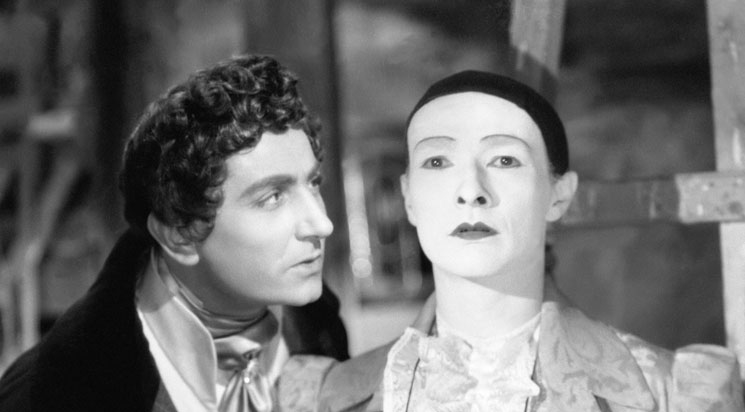
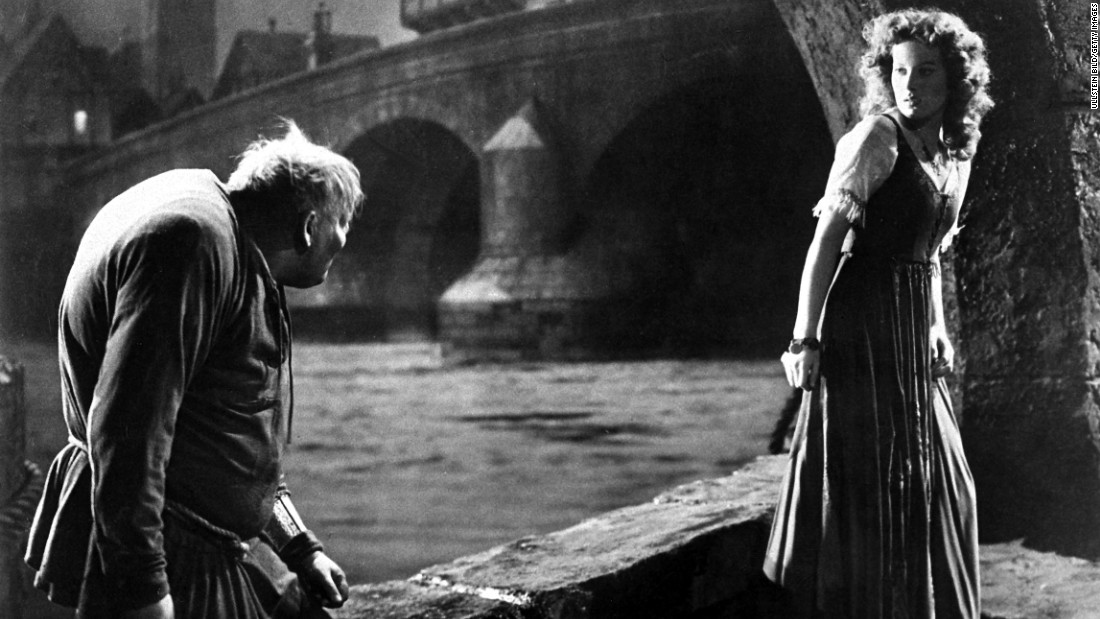
Charles Laughton looks on with longing as The Hunchback of Notre Dame

Director: William Dieterle

Cast: Charles Laughton (Quasimodo), Cedric Hardwicke (Jean Frollo), Thomas Mitchell (Clopin), Maureen O’Hara (Esmeralda), Edmond O’Brien (Pierre Gringoire), Alan Marshal (Captain Phoebus), Walter Hampden (Archbishop Claude Frollo), Harry Davenport (King Louis XI), Katherine Alexander (Madame de Lys), George Zucco (Procurator)

Victor Hugo’s gothic romance–slash-tragedy has been turned into a film so often, it’s a wonder anything that happens in it remains a surprise. But this 1939 version is perhaps the most influential, where Hollywood decided to throw money at the fable and try and make something as close as possible to the spirit of the book. But of course with a happyish ending on the end – because, you know, it’s still Hollywood!

In 1470s Paris, the city is caught between the pressures of religion and new developments such as the printing press. In the centre of the city is the Cathedral of Notre Dame – where the bells are operated by foundling Quasimodo (Charles Laughton), a deformed hunchback driven deaf by the constant ringing of the bells. His benefactor, Judge Jean Frollo (Cedric Hardwicke), is running a vicious campaign to cleanse the city of the gypsies and beggars that make up a large part of its underbelly – but he’s hit for six when he falls in love (or rather lust) with beautiful gypsy woman Esmeralda (Maureen O’Hara). But he’s not alone – equally smitten are naïve young poet Gringoire (Edmond O’Brien), arrogant Captain Phoebus (Alan Marshal), and Quasimodo himself. When Esmeralda rejects Frollo’s advances she soon finds herself in danger – and her only hope of safety comes from unexpected sources.

Dieterle’s background in German expressionism and silent cinema shines through in this visually striking and opulent studio production, with its superbly marshalled crowd scenes, brilliant use of near-impressionistic shadows and fabulous camera work that drifts over the impressive (and hugely expensive) set. Dieterle mixes this technical expertise with a real sense of emotion and character development, helped by some terrific performances from the cast. It’s a film that motors through the story of the novel, but skilfully repackages it as both a fascinating semi-romance and a sort of urban tragedy, as well as a subtle mediation on love and lust.

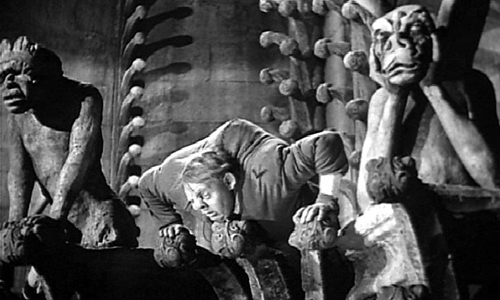
At the centre of it, you have Charles Laughton giving probably the definitive performance of the hunchback. Sweating under layers of make-up and an artificial hump, Laughton is nearly unrecognisable as the bell-ringer. His triumph is to make a gentle, tragic character emerge from make-up that suggests more Frankenstein’s monster than tragic hero. Nearly wordless for the first hour and a half of the film, Laughton does his magic with an expressiveness that speaks volumes of the loneliness in Quasimodo. Tenderly, he watches people knowing he can never be part of their lives – and look how excitedly he bursts out when he finally gets a chance to speak to Esmeralda one-on-one. Suffering punishment on the wheel, Laughton’s eyes convey the numb acceptance of pain as his natural state of affairs. But he also manages to bring out the gentle, childlike qualities of Quasimodo. It’s a wonderful, wordless, expressionistic performance – a triumph of physical acting and wonderfully judged emotional vulnerability.

The rest of the cast match Laughton stride-for-stride. Censor demands at the time required that Frollo be removed from his position (in the novel) as Archbishop, so the book-version of the character is split in two here. Archbishop Frollo is the sort of pious bore who can keep the Hayes committee happy. But Cedric Hardwicke gets to play the invented evil brother Judge Jean Frollo, the lecherous hypocrite from the novel. An authoritarian ascetic, Hardwicke’s Judge Frollo is lean, mean and utterly ruthless – and totally in denial about both his lustful feelings and hypocrisy. Hardwicke is virtually an archetype of the sinister authoritarian, but he manages to never chew the scenery. Incidentally, knowing the two characters are basically split from the original book, does allow moments of fun imaging the moral debates between the two as a sort of split personality discussion.

But there are plenty of other good performances as well – not least from Maureen O’Hara, who is charming and engaging enough to make you believe that the whole male cast is in love with her. Edmond O’Brian goes large at times with the passionate romance, but he does a very good job in the role. Thomas Mitchell is good value as the leader of the beggars, Clopin. There are strong performances across the whole film.

All these performances are framed within a fabulous design. The trouble and expense that has gone into the construction of the set is inspiring, the sweeping gothic arches and towers giving every shot something exquisite to look at. It also gives never-ending options for camera placement and impressionistic imagery for Dieterle. It works as well – the gloomy, imposing towers of Notre Dame are captured with real artistry, while the shadow it casts over the whole city of Paris serves as a constant reminder of the oppression the city lives in.

Dieterle also brilliantly films the crowd scenes, getting a superb sense of visceral emersion from these sequences. Whether the camera is in the mix, or flying above the crowds from the tops of Notre Dame, these scenes look equally fantastic. Dieterle handles the more action-related scenes with particular skill – Quasimodo’s rescue of Esmeralda from a death sentence is particularly well staged in its dynamism and graceful filming. 

Not every beat works. The portrayal of Louis IX as a sort of kindly old uncle seems off-piste from the very start. The early sequences sometimes get bogged down too quickly in set-up rather than getting into the action. Alan Marshal is rather wooden as Captain Phoebus, although the film goes surprisingly far in suggesting the dark desires and predatory sense of danger that comes from the character. Some of the beggar court sequences get similarly stuck in kitsch.

But these are minor beats. It’s a film that really understands emotions and makes the dramatic thrust work. It also has a dark sexual power, not least in Hardwicke’s Frollo: a seething mess of frustrated desires. It never loses sight of the sadness at the heart of its central character’s story, of his loneliness and isolation, and manages to communicate this brilliantly in every scene where the character appears – he is trapped by his muteness, his ugliness or his sadness at every turn. It’s a development that never fails to be engrossing and finally moving. It’s a film that is brilliantly assembled with real technical skill, very well acted and wonderfully directed.

The Guernsey Literary and Potato Peel Pie Society (2018)

Will Lily James and Michiel Huisman find true love in The Guernsey Literary and Potato Peel Pie Society? You have one guess.

Director: Mike Newell

Cast: Lily James (Juliet Ashton), Michiel Huisman (Dawsey Adams), Glen Powell (Mark Reynolds), Jessica Brown Findlay (Elizabeth McKenna), Katherine Parkinson (Isola Pribby), Matthew Goode (Sidney Stark), Tom Courtenay (Eben Ramsey), Penelope Wilton (Amelia Maugery)

Every so often I get challenged to write a really short review. The Guernsey Literary and Potato Peel Pie Society is the sort of film where I could almost write a review that was shorter than the film’s title. Look at the poster – everything you are now expecting from this movie, it completely delivers. It’s as warm, unthreatening, comfortable and familiar as Sunday dinner at your Gran’s.

In 1948, novelist Juliet Ashton (Lily James – so winning you overlook the fact that she’s clearly too young for the part) receives a chance letter from Dawsey Adams (Michiel Huisman), a farmer in Guernsey. Adams tells her about the book club that sprang up between himself and other islanders during Guernsey’s occupation by the Nazis, where reading books gave them a chance to escape the horrors of the occupation. Leaving her slightly put-out American fiancée (Mark Reynolds) in London (one guess as to what romantic pairing we’ll end the film with, by the way) she heads to Guernsey to meet the group and write an article about them – and finds herself swept up in a mystery around missing member of the club Elizabeth McKenna (Jessica Brown Findley). 

It’s a film that virtually writes itself, the sort of predictable Sunday-afternoon, British film where the 1940s look impossibly glamourous and everything turns out wonderfully happily in the end. You won’t be challenged by anything in it, you can simply sit back and enjoy it. Everyone involved in the film does clearly understand what they are making here though: it’s light, fluffy and unchallenging but it’s professionally made and everyone gives it their all.

Perhaps it’s a sign of how much the film is pitching for the Downton Abbey audience that it has no fewer than four actors from that show in key roles. Lily James is radiant and charismatic as Juliet – sweetly earnest and also with a determination to wrestle out a truth once she senses a story. It doesn’t take a genius to guess that she is going to be won away from her dull Yankee pilot (Glen Powell in a totally thankless role of blandness) by the earthy, romantic, caring and intellectually stimulating charm of Game of Thrones’ Dario Naaheris, Michiel Huisman (the sort of role an actor can play standing on his head but he’s still very good).

Penelope Wilton does some good work as a widow clinging to happier memories that she can’t bear to see affected by harsher truths. Jessica Brown Findley has little to do, but to be honest it’s not a problem as the part is such a straight re-tread of her Lady Sybil role from Downton she could probably do it in her sleep. The last Downton alumnus, Matthew Goode, is rather funny as Juliet’s sweet but good-naturedly exasperated publisher. For the rest of the cast, Katherine Parkinson oscillates between comic timidity and soulful sensitivity and Tom Courtenay gives a playful old man performance which can’t have stretched him.

Not being stretched is what the film is all about. Even the mystery at the film’s centre isn’t particularly gripping or – even when the truth is revealed – something that really has much impact on anything. And it’s hardly the focus anyway. It’s really a film that wants you to enjoy the photography and landscapes, and to root for the two leads to fall in love with each other. It wants you to feel little else, and carefully avoids getting you to invest your emotions in other aspects of the story so you can’t get upset. It’s the sort of film that you could call “lovely”, that passes an hour or two perfectly well, and at the end of it you’ll tell people it was fine. Then you’ll never think about it again. Ever.

Singin' in the Rain (1952)

Singin' in the Rain (1952)

The most beloved of all musicals gives you a burst of pure enjoyment no matter when it plays

Director: Stanley Donen, Gene Kelly

Cast: Gene Kelly (Don Lockwood), Debbie Reynolds (Kathy Selden), Donald O’Connor (Cosmo Brown), Jean Hagen (Lina Lamont), Millard Mitchell (RF Simpson), Cyd Charisse (Woman in the green dress), Douglas Fawley (Roscoe Dexter), Rita Moreno (Zelda Zanders)

Is there a more loved musical than Singin’ in the Rain? Is there a more famous musical from Hollywood’s golden age? That second point is particularly interesting, as this was possibly the last of the big Hollywood song-and-dance films – most of the rest that followed were film versions of Broadway hits. Singin’ in the Rain also has that “late discovery” quality: inexplicably not nominated for Best Picture (or hardly any other Oscars), it was for many years considered a second tier musical behind works like An American in Paris. Now it stands tall over the lot of them.

Singin’ is a film assembled from a collection of songs MGM held the rights to. The songs were given to Kelly, Donen and the screenwriters with the instruction to “come up with a movie”. What they came up with was this delightful film-about-films. Don Lockwood (Gene Kelly) and Lina Lamont (Jean Hagen) are the biggest stars of the silent screen in Hollywood, whose careers are in trouble overnight when sound is introduced. He can’t really act and she has a voice like nails on a blackboard. But Lockwood can sing and dance – so why not make their latest film a musical? Especially since the talented Kathy Selden (Debbie Reynolds), who Lockwood has fallen in love with, can sing and act and can dub Lina’s voice. What could go wrong?

There are few more purely enjoyable films than Singin’ in the Rain. Nearly every scene has a moment designed to make you burst out in a smile, be it a cracking line of dialogue, a piece of prodigious dancing skill or the simple warmth and joy of the leading actors. Every second something delightful seems to happen. The entire film is an explosion of gleeful joy in the sheer exuberance of singing and dancing. Kelly’s choreography brilliantly uses everyday props and pieces of furniture to give the numbers an exciting everyday charm. It gives the songs an immediate “gotta dance” energy. How could you not like it?

Threading these songs around a structure of Hollywood taking on sound for the first time was a brilliant idea. The recreation of the acting styles and technology of Hollywood is brilliant. Lockwood is a hopelessly stagy actor, hideously artificial in his gestures, while poor old Lina Lamont is horrendously wooden with an awful voice, and a complete lack of any talent. Jean Hagen as Lina Lamont is in many ways the butt – but she’s so demanding, bullying and selfish we don’t mind that most of the jokes are on her.

The shift towards sound in Hollywood is actually interesting as well as hilarious. Where do we place the mikes? How should the actors get used to speaking into a mike? How do we cancel out the background sound? What do we do with loud props? One of the highlights is the screening of this film-within-a-film to an audience for the first time. All the terribleness Lockwood and Lamont gets revealed. In a particularly genius moment, the sound of the picture gets out sync with the picture, with the voices seeming to come out of the young actors’ mouths to hilarious effect.

Alongside this we get some of the finest song-and-dance routines in the history of the movies. Donald O’Connor is electric as Cosmo and his dance routine for “Make ‘em Laugh” is an astounding early pace-setter in the film: how does he do what he does here? O’Connor goes bouncing off walls, swirling in circles on the floor, springing from place to place without a single pause for breath. Most of this number (like many of the others) is done in one take with electric pace. And that’s the film just warming up.

Debbie Reynolds famously described doing Singin’ as being (along with childbirth) one of the hardest things she’d ever done in her life. You can see that in ‘Good Morning’, another electric three-way number with herself, Kelly and O’Connor – she is pounding the floor to keep up with these two masters (and does a brilliant job). She was pushed to the extremes by Kelly who privately considered her a not quite strong enough dancer. Kelly dropped her from Broadway Ballet Medley, a complex ballet-heavy (as per all Kelly films from On the Town onwards – a sequence that I must confess I find a little dull). She’s still excellent – charming, sprightly, light, glorious fun – but it did mean Kelly re-worked the main number to showcase just himself.

Ah yes. ‘Singin’ in the Rain’. This sequence of the film is probably wedged in everyone’s mind. Even if they’ve never seen the film, people are familiar with Gene Kelly, soaked to the skin, dancing through puddles and swinging around lampposts. Kelly is of course marvellous in this sequence (hard to believe he was apparently suffering from the flu at the time) and the number has complete charm to it – that carefree vibrancy of realising you are falling in love. Especially as Lockwood’s ego is finally being put to one side in order to celebrate feelings he’s having for another person. But the whole scene is just sheer cinematic magic. And for something so famous, you never get tired of it. 

But then Kelly has pure star-quality here. Lockwood is a charming, handsome and smooth film star – but the film is happy to puncture his pomposity, or demonstrate in its opening sequence the self-aggrandising version of his early career (“Always dignity!”) with the reality of faintly embarrassing and dignity-free stage and stuntman work. Kelly is so charming you don’t mind that the film gives him an easy ride, considering Lockwood is actually quite selfish.

Singin’ in the Rain is pretty close to perfect. Even though I find some of the ballet stuff a little boring myself, it’s still filmed and shot with skill. It’s a pet discussion between film experts to ask how much of the film was directed by Kelly and how much of it was done by Donen. I guess it doesn’t really matter except to cinephiles, as the film is just beautifully directed: light, frothy, fun and with real technical expertise – the slow crane shot at the end of the famous number is justly famous. The pace is spot on, and the film is hilarious. Its understanding of filmmaking really pays off in the sequences that chronicle early film making.

So why did this film not get recognised at the time? Well to be honest, there were probably too many movies like this out at the time. It was a lot easier to miss in the crush of mega-MGM movies. It followed on the coat-tails of An American in Paris which had worn a huge number of Oscars (and was pushed back into cinemas in place of Singin’ in the Rain). Singin’ was still a big hit – but it perhaps needed film-fans to embrace it because it so perfectly married a love of Hollywood with the technicolour delight of 1950s musicals. Either way, Singin’ in the Rain is a delightful masterpiece which is guaranteed to pop a smile on your face. No matter the weather.

The Shape of Water (2017)


Sally Hawkins and Octavia Spencer work together to save a misunderstood creature in The Shape of Water

Director: Guillermo del Toro

Cast: Sally Hawkins (Elisa Esposito), Michael Shannon (Colonel Richard Strickland), Richard Jenkins (Giles), Doug Jones (The Creature), Michael Stuhlbarg (Dr Robert Hoffstetler), Octavia Spencer (Zelda Delilah Fuller), Nick Searcy (General Frank Hoyt), David Hewlett (Fleming), Lauren Lee Smith (Elaine Strickland)

Guillermo del Toro: part arthouse director, part thumping action director, who else could have made both Pan’s Labyrinth and Pacific Rim? The Shape of Water falls firmly into the former category, and continues the director’s long-standing interest in fairy-tales and fables, creating adult bedtime stories filled with romance and wonder, but laced with violence and human horror (and it’s always the humans who are the monsters). The Shape of Water has been garlanded with huge praise – but yet I’m not quite sure about it. Just not quite sure.

In 1962 in Baltimore, Elisa Esposito (Sally Hawkins) is a mute cleaner working in a government facility with her colleague, friend and effective translator Zelda (Octavia Spencer). Her only other friend is her neighbour, a gay out-of-work advert artist Giles (Richard Jenkins). The research facility takes delivery of a strange amphibious creature (Doug Jones), captured in the wild by sinister CIA man Richard Strickland (Michael Shannon). While Strickland and lead scientist Dr Hoffstetler (Michael Stuhlbarg) conduct tests on the creature, Elisa befriends it – the two of them drawn together by their isolation and inability to communicate verbally. When the decision comes from above to dissect the creature, Elisa decides to help it escape. 

The Shape of Wateris an adult fairy-tale that uses the structure, rules and heightened reality of the bedtime story. So we have Elisa as “the Princess without a voice”, the government facility as the evil castle, the creature as a mixture of damsel in distress and knight errant, and Michael Shannon’s vile government spook as a sort of perverted evil Queen. While the film is set in 1962, it’s aiming for a fantasy world feeling: Elisa and Giles even live above an old-school movie cinema, while the facility itself is a dank, subterranean concrete prison, part medieval dungeon, part industrial complex, dressed in a retro-1950s style. There’s no denying the film looks fantastically impressive.

The plot hinges on the growing bond between Elisa and the creature, which flourishes first into a mutual friendship, then semi-romance and finally into a full-blown relationship. If there is one part of the movie which I felt didn’t quite work, it was the build between friendship and love. While del Toro does some excellent work showing these two bonding over a common lack of language – she teaches him some basic sign language, they both share a love of music – I felt the jump between friendship and sexual attraction seemed a little big.

Del Toro films it all beautifully – and his empathy for both characters is very moving. But the film wants us to feel this deep connection for (and between) the two characters – and I’m just not sure I did. I’m not sure the film gives the time it needs for this development. Great as Michael Stuhlbarg’s (and excellent as his conflicted performance is) character is, could the film have removed his sub-plot and invested more time in the relationship? Yes it could – and I think this could have made a stronger movie. This is of course a personal reaction – I’m sure plenty of people will be bowled over by the romance of the film – but I didn’t quite buy it. For all the soulfulness of the film, I just didn’t find myself investing in this relationship as it built as much as I should.

This is despite Sally Hawkins’ expressive acting as Elisa. I find Hawkins a bit of an acquired taste: she is a little too twee, something about her eyes and vulnerable smile is a little too head-girlish. Of course that sprightly gentleness works perfectly here, but the character is more interesting when del Toro explores her depths, her desire and well-concealed resentfulness under a cheery exterior (practically the first thing we see her do is masturbate in the bath – a daily ritual timed to the second via egg timer, functionally getting these feelings out of the way before the day ahead). Hawkins mixes this gentle exterior and passionate interior extremely well throughout the film.

The principal supports are also excellent. It’s no coincidence that del Toro makes our heroes all outsiders: a mute, a black servant and an ageing gay man. As well as showing why these characters might be drawn together, it’s also a neat parallel commentary on attitudes of the time – Octavia Spencer in particular makes a huge amount out of a character that is effectively a voice for Elisa half the time, investing the part with a huge sisterly warmth.

Richard Jenkins is both very funny and rather sweet as a man scared of being alone and frightened about doing the right thing. Most of the film’s laughs come from him – but so does a large degree of its heart. Jenkins gets some fantastic material – from hints that he has been fired for social and sexual misdemeanors from his Mad Men-ish former job, to his growing realisation that his hand-drawn art is being left behind in a world embracing photography (“I think it’s my best work” has never sounded like a sadder mantra), and above all his hopelessly sad infatuation with the friendly barman at a local diner (the sort of hopeless crush you feel he must realise isn’t going to go anywhere good – but still manages to be endearing before it gets there).

Del Toro’s dreamy fable has plenty of potential monsters and obstacles in it – from government suits to Russian heavies – but the main antagonist is Shannon’s Strickland. Great as Shannon is in this role as a menacing heavy with a hinterland of insecurities and self-doubt, it’s a character that feels a little obvious. He’s the monster, you see! It’s a heavy-handedness the film sometimes uses – not least in its occasional references to the race politics of the era – that weights the deck, and tries to do a little too much of the work for the audience. Again, a film with one fewer sub-plot might have allowed this character greater depth. As it is, his vileness is established from the first second, which means the metaphor of his hand with its increasingly rotten, gangrenous fingers seems a little to on-the-nose.

But The Shape of Water is a labour of love, and a testament to love – and del Toro reminds us all what a luscious and romantic filmmaker he can be. The later romantic moments between Elisa and the Creature have a beauty to them – not least the moments when they immerse themselves together in water. Other moments are too obvious: an imagined song-and-dance routine is so signposted in advance that it carries little emotional impact. In fact, the film’s main fault may be it is too predictable: most of its plot developments I worked out within the first few minutes – but it sort of still works. After all, fairy-tales are predictable aren’t they?

Del Toro has made one from the heart here. It’s not a perfect film – it’s not a masterpiece, and I think it’s a less complex and affecting work than the brilliant Pan’s Labyrinth – but it’s made with a lot of love and a lot of lyrical romanticism. It looks absolutely astounding. It’s actually surprisingly funny and wonderfully acted: Richard Jenkins probably stands out, and my respect for Octavia Spencer continues to grow. Del Toro is gifted filmmaker, and he is working overtime here to make a romantic, sweeping, monster movie cum adult fairy-tale. All the ingredients are there: but somehow I didn’t fall in love. Did I miss it? Maybe I did. And I can’t think of much higher praise than I’m more than willing to go back and look again and see if I get more of a bond with it next time. But, for all its moments of genius, I found the delight was on the margins rather than the centre.

Slumdog Millionaire (2008)


Dev Patel is the Chaiwala living the dream in Slumdog Millionaire

Director: Danny Boyle

Cast: Dev Patel (Jamal Malik), Freida Pinto (Latika), Madhur Mittal (Salim), Anil Kapoor (Prem Kumar), Irrfan Khan (Inspector), Ayush Mahesh Khedehar (Jamal [Child]), Tanay Chheda (Jamal [Teenager]), Azharuddin Mohammed Ismail (Salim [Child]), Ashutosh Lobo Gajiwala (Salim [Teenager]), Runbina Ali (Latika [Child]), Tanvi Ganesh Lonkar (Latika [Teenager]), Saurabh Shukla (Constable Srinivsas), Mahesh Manjrekar (Javred), Ankur Vikal (Maman)

Re-watching Slumdog Millionaire, it’s surprising to think that back in 2008 this film was so garlanded with awards (EIGHT Oscars!) and heralded so quickly as a classic. While it’s a well-made and at times rather sweet (with a hard-edge) fable, it’s also seems slightly less unique and genre-defying than first appeared. Never mind a list of the greatest Best Picture winners, I’m not even sure it’s the greatest Danny Boyle movie. But saying this, it’s still a fine movie – and one I arguably enjoyed more re-watching it almost ten years on then when I saw it in the cinema.

Jamal Malik (Dev Patel) is an eighteen year-old Muslim, a chaiwala working in a Mumbai call centre. He enters the Indian Who Wants to be a Millionaire?, hosted by egotistical Prem Kumar (Anil Kapoor), and to the astonishment of everyone is one question away from the ultimate prize of 20 million rubles. Arrested by the police and questioned before his final show, he explains via flashbacks how his experiences allowed him to answer each question. His life-story is one of danger and conflict in the slums and criminal underworld of India, tied closely to his brother Salim (Madhur Mittal) and their childhood friend Latika (Frieda Pinto), whom Jamal has loved his whole life.

Part social-realist tale, romance, family drama and fairy-tale, Slumdog’s main triumph is probably its ability to juggle half a dozen tones and genres so successfully. This is most strikingly demonstrated by fact that so many came out of a film that opens with its lead character being waterboarded and tortured by policemen, saying it was a brilliant feel-good movie! In fact, Boyle’s film is far more complex, touching on themes ranging from child exploitation and prostitution to gangland politics to social corruption, via murder, betrayal and mutilation. How does this a film crammed with this sort of material make you feel rather positive at the end?

Boyle’s, and screenwriter Simon Beaufoy’s, trick is to follow in the footsteps of that other great juggler of urban social comment and larger-than-life characters – Charles Dickens. Dickensian is perhaps the best word to describe Slumdog – it throws the viewer into the slums of Mumbai, glancing at this world with all the keen social commentary Dickens used to bring to Victorian London. As young children, Jamal and Salim are thrown in with a Fagin-like gang boss, while Latika develops an (admittedly much more gentle) Estelle-like connection with them both. Like David Copperfield, our hero moves from place to place (or frying pan to fire!), with an episodic charm, each event adding to the spectrum of his life. It works really well as it taps into a reassuringly familiar story structure that makes us feel narratively safe, no matter how much peril our heroes undergo.

What’s fascinating is placing this familiar material into (for us) a more exotic location. I suspect many American viewers watching were even less familiar with India as such a mixture of extreme wealth and poverty sit side-by-side so naturally (and again how Dickensian does that sound?). Anthony Dod Mantle’s cinematography is astounding for its energetic immersion in the streets of Mumbai –it’s like an explosion of Boyle’s high-octane, camera-shaking style seen in so many of his other films. It not only makes the film feel fresh and vital, it also manages to present India as something very different for those only familiar with the country as a Taj Mahal postcard.

The most compelling parts of the film are those in the first half that throw us into the Mumbai of Jamal and Salim’s childhood. Helped immensely by six terrific performances from the child and teenager versions of our three leads, these sequences (just over the first half of the movie) immediately involve the viewer in the fates and feelings of these characters. Perhaps because the film is shot in such an immersive style, you feel as if you have experienced the dangers (and occasional joys) alongside them, and developed a close bond with them. 

Despite the romantic plot of the movie, the true story is the jagged relationship, with its loyalties and betrayals, between the innocent, gentle dreamer Jamal and the more ruthless, realist Salim. The film charts the lengths they will go to protect and help each other – or sometimes in Salim’s case not. Salim is a fascinating character – easily the deepest, most conflicted of the three – who even as a child has a moral flexibility, happy to gain the benefits of a ruthless criminal lifestyle, while still having enough conscience to know what he has done with his life is wrong.

In contrast, the relationship between Latika and Jamal is far less complex. Frieda Pinto doesn’t actually appear until almost two thirds of the way into the movie – and she and Patel have only really one dialogue scene together to establish a romantic link. The romance between them is in fact the standard fairy-tale – two young friends as children who become unknowing sweethearts. The film relies on us being invested in their fates as children to want to be together, rather than building a link between two grown adults. This is the structure of a Prince Charming and a Princess in distress rather than grown-up storytelling – but it clearly works because it taps into our own fundamental first experiences of how stories work.

Dev Patel is a very sweet and highly engaging lead – and how could we not be immediately on the side of a pleasant, gentle young man whom we first see hanging from a ceiling with electrodes on his feet? Patel has a low-key decency about him that becomes more engaging the more you watch the film. Since most of his narrative function is to offer linking scenes to the far more dynamic and exciting flashbacks – and since the character of Jamal has very little real depth to him beyond “he’s a good guy” (again like a fairytale his innocence is untouched by events) – it’s quite a testament to his performance that you end up feeling as close to him as you do.

But it’s clear to me second time around the framing device of the Who Wants to be a Millionaire contest is the most disposable, and least interesting part of the movie. It does have the film’s most outright enjoyable adult performance, a swaggering, ego-filled turn from Amil Kapoor, but it’s still all much more predictable, obvious and functional than the adventures we see as our characters grow up. We know Jamal is going to keep getting things right (and thank goodness each question he answers, he learned the answers consecutively through his life! What a mess that might have been otherwise narratively!), so the fact that Boyle keeps what is essentially the same scene each time seeming interesting is quite something.


The gameshow however is the “quest” of this romantic fairy-tale. And fairy-tale is really what the film is: Jamal is there to try and find and save Latika. So in the end it doesn’t really matter that Latika hardly feels like a character, or that we’ve been given no real reason to think she and Jamal are in love other than the film telling us that they are, or that the plot of the film is really as flimsy as tissue paper. The film is a dream, a romantic fable. The genius of Boyle is to use a whole load of familiar, Dickenisan-style tropes to place this into a social-realist travelogue, a dynamite dance of flamboyant film-making techniques. So perhaps that is the point about Slumdog: on repeated viewings, like fairy-tales, its plot tricks and narrative sleight-of-hand become more obvious. But you get more of a respect for the confidence with which the trick is played.

My Cousin Rachel (2017)


Rachel Weisz and Sam Claflin in a dance of romance and suspicion in My Cousin Rachel

Director: Roger Michell

Cast: Rachel Weisz (Rachel Ashley), Sam Claflin (Philip Ashley), Iain Glen (Nick Kendall), Holliday Grainger (Louise Kendall), Simon Russell Beale (Court), Pierfrancesca Favino (Enrico Rainaldi), Andrew Havill (Parson Pascoe), Andrew Knott (Joshua)

Did she? Didn’t she? That’s the key phrase this deliberately ambiguous film returns to again and again. Is Cousin Rachel a serial schemer, seductress and possible murderer? Or is she just – well I guess just really unlucky? It’s a difficult line to tread –ambiguity is extremely challenging to bring to film, as it’s a medium that’s pretty decisive in what it shows us first-hand. But My Cousin Rachel pulls this off with a creepy aplomb.

At some point in the 1830s, Philip Ashley (Sam Claflin) receives a letter from his cousin and guardian Ambrose, who has recently passed away in Italy. The letter obliquely accuses Ambrose’s wife, his cousin Rachel (Rachel Weisz), whom Philip has never met, of poisoning Ambrose. As Ambrose died before he could prepare a new will, Philip inherits his estate – but still harbours a rage against Rachel, suspecting her of murder. However, when Rachel comes to stay with him, Philip finds himself increasingly drawn towards, and besotted with, her.

Roger Michell gracefully directs and writes this intriguing little mood piece, a fine chamber-piece thriller. With an unsettlingly lyrical score and shot with a beautiful eye for the Cornish countryside, My Cousin Rachel not only grips, but rings true with anyone who has either (a) fallen blindly in love, (b) suffered from romantic obsession or (c) been paralysed with jealousy. Which is probably just about everyone.

The film relies for its success largely on Rachel Weisz’s exceptionally intelligent and thoughtful performance as Rachel. She looks perfect for the role – she’s both the sort of woman men would fall wildly in love with, and old enough to settle into an unsettling, semi-incestuous flirtation with Philip. Her performance works because Weisz plays the part with exceptional skill, never tipping the wink to the audience, but skilfully modulating and adjusting her performance with every scene so that you remain as uncertain about her actions and motives as anyone else.

Apparently Weisz made her own mind up on Rachel’s guilt and innocence, but never told Michell or Claflin. Intriguing to think that while they shot scenes of domesticity or passion, that only one of those involved really knows what’s happening – a mood that totally carries across to the viewer. Weisz plays the part with complete strength of conviction and straightness – every scene is played as if the feelings in it were completely true and bereft of manipulation. She makes it unreadable, while having a face overflowing with emotion and feeling. Does she understand Philips feelings early and manipulate him? Or does she genuinely not expect his romantic intentions?

Michell skilfully shows how Rachel wins over people with ease. Even the dogs immediately gravitate towards her. Parson Parscoe and his family flock around her. Philip’s servants smarten themselves up and make every effort to make a good impression on her. His godfather Nick seems to oscillate continually in his judgement of her, but even he seems powerless in her presence. The camera carefully hovers and focuses in on Rachel, with many shots focusing on her face alone – seducing us as much as the rest of the characters. We almost never see her except in scenes with Philip – so we have the same information as he does for making our minds up.

Sam Claflin is equally key to the film as Philip. In many ways Philip is quite the whiny teenager – you could easily dismiss him as a romantic young idiot, an obsessive would-be Romeo, who makes a series of terrible decisions through listening to his penis rather than his head. But despite that –/ perhaps because his errors and mistakes seem so universal – it’s easy to sympathise with him. Rather than want to slap him anger, you want to do so in frustration – “don’t do that, you idiot!” Michell and Claflin play his increasing disintegration brilliantly. Is it poison? Or is it his increasing jealousy and obsession unhinging him? Who hasn’t been involved in an unequal romantic obsession?

It’s not a perfect film. Philip’s obsession with Rachel is alarmingly sudden – perhaps too sudden. Towards the end, Michell becomes slightly too enamoured with mystery – a final, lingering shot introduces an element of uncertainty about a character we have never had cause to suspect, which feels like a little too much. At times the lingering camera seems to be trying to suggest more in the performance than Weisz seems willing to give away.

But these are quibbles. The film is well-directed and filmed, and terrifically acted – Glen and Grainger are very good in key supporting roles – but it’s a triumph for Rachel Weisz. Weisz seems like an actor it’s easy to overlook, maybe because she has never quite got the star vehicles her talent matches – but this film is a clear reminder that, at her best, she is an extremely gifted performer.

I Know Where I'm Going! (1945)


Roger Livesey and Wendy Hiller prove opposites can attract in Powell and Pressburger’s marvellous I Know Where I’m Going!

Director: Michael Powell, Emeric Pressburger

Cast: Wendy Hiller (Joan Webster), Roger Livesey (Torquil MacNeil), Pamela Brown (Catriona), Finlay Currie (Ruairidh Mhor), George Craney (Mr Webster), Nancy Price (Mrs Crozier), Catherine Lacey (Mrs Robinson), Jean Cadall (Postmistress), John Laurie (John Campbell), Valentine Dyall (Mr Robinson)

Joan Webster (Wendy Hiller) is a young middle-class woman with ambitious aims who has worked to secure a marriage to a wealthy, much older, industrialist. En route to the wedding in Scotland, she gets stranded on the Isle of Mull by a storm. There, she finds a world of very different values and principles than her own. She also finds herself thrown together with naval officer Torquil MacNeil (Roger Livesey) a man trying to return home for leave. Trapped on the island for days, Joan and Torquil find themselves romantically drawn together – however much Joan tries to avoid it.

Powell and Pressburger’s films all have a sense of filmic magic to them. They are the sort of films it’s very easy to fall in love with, and swear by. I Know Where I’m Going falls into that model extremely well – a dreamy romance in a stunning looking Scottish island, full of engaging characters and beautifully filmed. It’s a seemingly simple romance story, but it feels like a deep and engaging fable – it’s a film that shows how throwing a little uncertainty into a life can be a good thing.

Because Joan Webster categorically knows where she is going. The film’s entire build-up centres around her ambition and overwhelming focus. She literally dreams about marrying the engineering firm (yup that’s right, the firm itself not the man). She pushes her father into putting together a detailed itinerary for her entire journey. She seems to have no self-doubt whatsoever. So the magic of the film is that, deep down, it’s a about a woman realising that the place she has spent her whole life going, isn’t in fact where she wants to go. And the audience can see right away that she wants something else – much quicker than her!

This works because Powell and Pressburger get the romantic feeling of the island and its people so spot on. It’s very easy to get this Monarch of the Glen style Scottish idyll stuff feeling wearing and tedious. But somehow, it just sort of clicks. We don’t get the islanders’ charm and love of the simple life rammed down our throats, we just see how they behave and their simple contentment – and of course we have it compared all the time with Joan’s ruthless ambition. This combines really well with Powell and Pressburger’s lyrical style, their semi-magical romantic camera shots making the island seem hugely attractive (even when it is lashed with wind and rain).

By contrast our brief impression of the world outside Scotland seems cold and mechanical. It’s all offices, impersonal train booths, and besuited chaps giving stiff-collared responses. In a neat piece of cross cutting, one businessman even appears as if he has train steam puffing out of his top hat, like some human train. But we have hints that Joan has more romance under her skin than she would like to admit: as the train moves into Scotland (the film makes no real attempt at realism for its train shots) Joan dreams of the landscape they move through like some sort of tartan vision, with hills made of patchwork quilts. It’s one lovely image.

Then we have the arrival on the island – it’s got a charming, breezy openness about it. Out first introduction to Pamela Brown’s radiant Catriona is on a rainy hill with a pair of wolf hounds, before she bursts into a room (low angle cameras make her look even more romantic). Could the contrast with the mechanism of the rest of the world be more precisely made? There is a charming lack of interest in worldly affairs – the people are “not poor, they just haven’t got any money” – and what could be tiresome scenes set in ceilidhs and the like actually carry a lot of charm with them. Compare the vibrancy the islanders greet life with with the distant coldness of the wedding guests staying there – which group looks like the people you would like to spend time with?

The other thing that really works is the romantic relationship between Joan and Torquil doesn’t feel forced, or jump through too many clichéd hoops and feels organic and natural. The actors have fantastic chemistry, and the film playfully places them in a number of situations that drives this unspoken interest. It’s got more than a touch of screwball comedy about it – two people trapped together, one of them with mounting frustration – despite not really, as such, having a plot. 

Wendy Hiller is superb as Joan Webster – she brings a Katherine Hepburnish quality to the role: a determined, modern woman, a control freak in a situation where she has no power at all and hating every minute of it. What really works though is her own lack of self-knowledge. It’s clear to the viewer (and most of the characters) she is developing a deep attraction to Torquil, but Hiller makes it clear that Joan is completely unaware consciously of this. It’s a marvellous performance, totally relatable and hugely endearing, despite Joan’s ruthless certainty, because it’s always subtly puncturing that certainty with doubt.

Roger Livesey makes a perfect countpoint as Torquil. It’s a perfect role for him – a twinkly people-person, old-fashioned but not a stiff-upper lip cold-fish, who has dedicated his life to service, but can still enjoy himself. He also, in a way that many men in films of the time don’t, wears his feelings close to the surface. It’s clear he is in love with Joan from an early point, and every beat of his body language indicates this. At the ceilidh he can barely take his eyes from her – while his body language subtly (but not possessively) indicates his interest. He has an old-fashioned, casual, scruffy charm to him that never gets wearing. He’s also superb.

You’ve got a beautiful romance at the centre, with two characters it’s very difficult not to end up caring a great deal for. Beautifully acted – Pamela Brown is marvellous and Finlay Currie suitably gruff – it’s a film that feels distinctive, that makes charm and playfulness never feel wearing. Not much happens, but it’s beautiful, very sweet and extremely charming. You warm to these characters, and Powell and Pressburger create a world that feels incredibly attractive. There is some fine film-making here – from imaginative dream sequences, to intelligent visual choices that quietly influenced anyone making a film about the romance of the simple life. A little known treat.

First Knight (1995)


Casting choices only Hollywood producers could make #473: Richard Gere IS Lancelot du Lac

Director: Jerry Zucker

Cast: Sean Connery (King Arthur), Richard Gere (Lancelot), Julia Ormond (Guinevere), Ben Cross (Prince Malagant), John Gielgud (oswald), Liam Cunningham (Sir Agravaine), Christopher Villiers (Sir Kay), Valentine Pelka (Sir Patrise), Colin McCormack (Sir Mador), Alexis Denisof (Sir Gaheris), Ralph Ineson (Ralf), Stuart Bunce (Peter)

First Knight continues a proud tradition of Hollywood adaptations of British legends, with full-blown action and romance mixed with an anachronistic modern-ish vibe which clashes completely with the design of the rest of the film. Think anything from Ivanhoe to Robin Hood: Prince of Thieves. At heart these films are ridiculous, but to be a success they need to embrace this and create something with a bit of heart. First Knight is almost wholly absurd from start to finish – but it’s still remarkably good fun. Even when you laugh at the bizarre sequences that pepper the film, it’s still somehow entertaining. It doesn’t take itself seriously – so I feel people who lambast it are missing the point.

Anyway, it retreads the story of King Arthur (Sean Connery) with a modern mix. Here Arthur is an old man, marrying Guinevere (Julia Ormond) to seal a truce between Camelot and Guinevere’s home of Lyonesse. While being escorted to Camelot, an attempt is made by the villainous Malagant (Ben Cross) to kidnap Guinevere, but she is saved by charismatic chancer and expert swordsman Lancelot (Richard Gere). Returning to Camelot, she marries Arthur while Lancelot finds himself inducted into the Knights of Camelot. But their adventure together has led to a deep romantic bond between Lancelot and Guinevere – one that threatens to tear apart the harmony of Camelot.

Something stupid or horrendously anachronistic happens in every scene of First Knight. Many of these moments are thanks to Richard Gere. Gere is at his most smirky here as Lancelot, an American Gigolo in King Arthur’s Court. There are few more modern actors than Gere – so seeing him in armour and cod-medieval garb jumps straight out as completely incongruous. Rather like Costner in Robin Hood, he makes no concessions to period whatsoever, and behaves more or less as he does in Pretty Woman. Every event in the film is met with his trademarked smirk-cum-grin and a twinkle in his eye. And while he clearly spent a lot of time on his sword work for this film, you literally never forget you are watching Julia Robert’s sugar daddy pretend to be a knight.

But then why should be really have made an effort to adjust his manner, accent or style for this film? After all this is a film where Lancelot takes part in a Total Wipeout competition – and on the basis of his performance in it is basically offered a spot at the round table. As a travelling entertainer, Lancelot woos the crowd with the sort of patter not out of place on a New York street corner. Later, the baddies hook up a boat with a pulley system that turns it into a super-fast speedboat. The baddies are all armed with pistol sized cross bows. It’s the sort of film where the lead villain rides into Camelot and shouts “Nobody move! Or Arthur DIES!”. Anyone watching this expecting a faithful exploration of Thomas Mallory seriously needs to change the channel.

So instead embrace the film for what it is. And enjoy the production values! The music score is swellingly impressive (now hugely familiar to any fans of Sky’s Ryder Cup coverage). The Camelot location looks brilliant. The costumes are wonderful – even if the knight’s armour (basically little more than a shield on the shoulder) looks horrendously inefficient. There is a very effective night-time battle excitingly filmed. The photography looks luscious. It’s shot with an old school, chocolate box, romance that makes everything look like a grand renaissance painting. The final battle between Malagrant and Lancelot is terrific.

I’ve also got to say that it offers an actually fairly interesting role to Sean Connery as Arthur. Considering that four years after this film he made Entrapment, a film in which he boffed Catherine Zeta-Jones, in a way it’s fairly daring for him to make a film that puts so much prominence on his age making him an unsuitable lover for Guinevere. His age is prominent in every scene (especially when counter poised with the modern vibrance of Gere). Half the time he’s with Guinevere he reminds her that he knew her as a child (yuck). He takes no part in any of the action – it’s Lancelot who (twice) rescue Guinevere, while Arthur commands from the rear. His relationship with Guinevere is almost devoid of sex and passion (they share only one remotely passionate snog). He even plays the poor cuckold, the man unable to excite his wife. Has Connery ever played such an unflattering part?


Julia Ormond – an actress who achieved a certain run of prominent roles in the 1990s – plays Guinevere. Despite the fact she seems to frequently find herself in distress, Ormond does manage to make Guinevere not feel like a damsel in distress. She’s proactive, she saves others, she’s defiant and (by and large) she knows what she wants and tries to get it. She also is an effective leader of her people. Ormond is also a fine, generous actress – she manages to convey a lot of chemistry with both Gere and Connery, two actors very different in style.

The film remains charged through with silliness. Ben Cross’ snarling villain has big speeches about how he wishes to escape from “the tyranny of Arthur’s Law”. The LAW is a major theme throughout the film – the characters bang on about it with an earnest insistence. Arthur falls back on it to make sense of his life. Lancelot struggles to understand and embrace the values it brings. Guinevere is determined to match law and duty together. Sure there are some silly grandstanding speeches about it – and the film runs with gleeful pride of Camelot as some sort of Socialist Utopia – but I suppose there’s a kernel of an idea at the centre here about justice and its importance in the world. It might mean we get a scene where Camelot is left totally undefended while everyone gathers for an open trial of Guinevere (guess what happens!), but at least it’s got an idea.

Of course that doesn’t get in the way of the silliness, the high blown acting, the silly events and the overblown dialogue. The heroes are all clean cut, and chiselled of jaw with perfect teeth, the villains all dressed in black, forever scowling and rugged of shave. It never for one minute feels remotely like it is happening in a truly medieval world. Richard Gere is, frankly, completely wrong as a medieval knight. But he’s strangely completely right for a film that is a chocolate box entertainment, a soufflé of a romance with swords and passion, that provides a few stirring moments and an interestingly different part for Connery. Gere is a perfect measure for the film – it’s a silly entertainment for those with an affection for Mills and Boon not Henry V. And there’s nothing wrong with that – it knows what it is, and knows what it wants to be taken as. Enjoy it. After all Camelot Lives!

Stardust (2007)

Claire Danes plays a star and Charlie Cox a village boy in charming adventure fairy-tale Stardust

Director: Matthew Vaughn

Cast: Claire Danes (Yvaine), Charlie Cox (Tristan), Michelle Pfeiffer (Lamia), Mark Strong (Prince Septimus), Robert De Niro (Captain Shakespeare), Sienna Miller (Victoria Forester), Jason Flemyng (Prince Primus), Rupert Everett (Prince Secundus), Kate Magowan (Una), Ricky Gervais (Ferdy), Peter O’Toole (King of Stormhold), Joanna Scanlan (Mormo), Sarah Alexander (Empusa), Nathaniel Parker (Dunstan Thorn), Henry Cavill (Humphrey), Dexter Fletcher (Skinny Pirate), Ian McKellen (Narrator)

Stardust is loosely adapted from Neil Gaiman’s novel of the same name, an adult fairy tale refashioned into a crowd pleasing family film: a warm and genuine adventure story, stuffed with romance, excitement and drama.

Tristan (Charlie Cox) is a dreamy young man in the village of Wall, which neighbours the mystical and forbidden world of Stormhold. In love with the selfish Victoria (Sienna Miller), Tristan vows to travel to Stormhold and bring her back a fallen star. However, the star has landed in the form of a beautiful young woman, Yvaine (Claire Danes), and the two of them find themselves on a difficult journey to return to Wall. Along the way they must dodge the witch Lamia (Michelle Pfeiffer) who wishes to sacrifice Yvaine to regain her beauty, and the surviving sons of the late king of Stormhold, particularly the ruthless Septimus (Mark Strong), who need Yvaine’s necklace to claim the throne.

What works about Stardust is that it has an air of whimsy about it, without ever feeling whimsical or corny. It’s a grown-up fairy tale, in the sense that it has some black humour and acknowledgement of sex, but really it’s more of a charming adventure story in a fantasy setting, which manages to keep its tongue in its cheek and not take itself too seriously. Matthew Vaughn’s direction has a very light touch and never allows this soufflé of a film to either puff itself up too much, or to deflate. Instead it rolls along with a giddy charm, with a delightful odd-couple love story at the centre. It’s a film that totally gets its tone spot-on, helped by confident direction and a wonderful score.

Charlie Cox plays romantic lead Tristan with a great deal of charm and really captures the romance at his centre. He also manages that extremely difficult task of being likeable – you can’t help but warm to him despite the fact that his self-awareness is completely off for a large chunk of the film. Claire Danes is equally good as the prickly Yvaine, hiding a great capacity for emotion and longing under a defensive exterior. Their romance is of course highly traditional – they bicker because they love each other! – but both actors carry it off with a great deal of style. You can’t help but want them to get over their problems and get together.

The romantic plotline is also never overwhelmed by the faintly Pythonesque comedy that surrounds it, particularly from the ghostly chorus of deceased Princes of Stormhold. Vaughn produces a great cast of comic actors for this group, while entrusting Mark Strong with the lion’s share of the screentime as the dashing decoy antagonist. In fact, the construction of the film’s narrative is rather neatly done, as this plotline of the inheritance of Stormhold is largely kept separate narratively from the romantic Tristan/Yvaine storyline, with the intersections only occurring at key points.

The real antagonist of the film however is Michelle Pfeiffer’s witch Lamia, Pfeiffer offering a neat portrait of vanity intermixed with cruelty. It’s a very decent inversion of a “movie star” glamour performance, and Pfeiffer’s heartless ruthlessness is a very nice contrast with Tristan’s altruistic openness. In fact Pfeiffer is very good in this film: she gets the balance so right that Lamia constantly keeps you on your toes as to how villainous or not she may be. I’m not quite sure that the film quite manages to completely bring the two characters plot lines together to provide a really effective narrative drive to the film, but she certainly works as an effective antagonist.

The film’s structure is a combination shaggy dog story and classic quest structure, which allows each sequence to take on its tone and structure, from thriller to comedy, depending on the characters involved. What threads this together is the growing (and very sweetly structured) love story between Tristan and Yvain which keeps the momentum up as the film moves from location to location, with cameo roles sprinkled throughout, without the film losing momentum (though it is probably 15 minutes too long). The film’s comfort with letting it sequences expand is clear with Robert De Niro’s Captain Shakespeare, a feared cloud pirate whose secret desires are not so secret as he might think. The film delights in essentially extended jokes like this – but it gets away with it because these jokes manage to be quite funny (De Niro in particular turns in a very good comic performance).

It’s a film that manages to remain distinctive and original, while appealing to a wide audience, which is quite some trick to pull off. It also manages to do this without losing its distinctive rhythm, which is both endearing and enjoyable. The “rules” of its world are clearly established, and while many of the actors are slightly tongue in cheek, they never laugh at their characters but only gently tip the wink at the audience. This freedom largely comes from the conviction and honesty Danes and Cox endow the central characters with, to ground the film. It alsohas a great sense of emotional intelligence to it, and brings a lot of depth to the characters. It also helps that it’s brilliantly designed, looks ravishing and is full of several delightful performances.

There’s lots of terrific stuff in this film, with a very sweet story at its centre. In fact this sweetness is probably the secret of its success: it never takes itself very seriously, it dances lightly from scene to scene and never allows itself to become too overblown. It’s got a terrific cast and is well directed, with a snappy bounce. At moments it does feel a little long, and some sequences overstay their welcome a bit too much – but the central characters are so winningly played that you don’t really mind. Sure this is not a masterpiece, but it has a sort of magic about it, the charm, excitement, adventure and romance, all mixed together with such confidence that it’s a pleasure to watch.

Rust and Bone (2012)


Matthias Schoenaerts and Marion Cotillard in an unusual romantic drama

Director: Jacques Audiad

Cast: Marion Cotillard (Stéph), Matthias Schoenaerts (Ali), Armand Verdure (Sam), Corinne Masiero (Anna), Céline Sallette (Louise), Bouli Lanners (Martial)

Audiad’s films combine cinematic artistry with profound, sometimes elliptical, character studies that provoke great work from talented actors. Rust and Bone is no exception.

It’s the plot of a melodrama, staged like social-realism. Written down it sounds like the purest Hollywood schlock: crippled killer whale trainer Stéph (Cotillard) enters into a friendship that grows deeper with would-be kickboxer Ali (Schoenarts), who has a troubled relationship with his 5-year-old son. But the realistic portrayal of the pain of losing your limbs (in a scene of raw intensity from Cotillard) and Ali’s troubled homelife, penchant for casual sex and occasional resorting to violence when frustrated, pegs the film style farcloser to a hard-edged Bicycle Thieves. The film also has a lyrical poetry about it, as their relationship gently develops from friends with benefits to genuine feeling, which stops it from feeling gritty or hard-edged.

The film’s main strength is the brilliance of its two leads. Cotillard is outstanding as a passionate free-spirit whose entire world ends overnight. Her expressive face carries a host of confused feelings which shift and reform across her like a human kaleidoscope. Stéph’s vulnerability is married with a great strength of character, but Cotillard avoids many of the clichés of movie paraplegics by making her a woman who adapts without anger to her new condition. Instead, after overcoming depression, Stéph is looking actively (and with a curiosity) for something new to fill her life with.

Cotillard is so wonderful in the role, it’s very easy to overlook Schoenaerts’ skilful underplaying and Brandoish physical mastery. Ali is, I’ve got to be honest, a hard character to like – selfish, childish, in many ways thoughtless, blunt and fixated on himself. He’s also a terrible dad. Not malicious or cruel, just easily bored and frustrated with his kid. This frustration appears with anyone who doesn’t react the way he wants – “You’re so annoying!” he whines at both Stéph and Sam. Despite this, Schoenaerts’ is the heart of the movie. The film is his story, and he makes a difficult character engaging enough to carry the audience with him.

Rust and Bone is a film constructed around brilliant scenes and striking moments. In a wonderful sequence, Stéph repeats the arm signals she used to train the whales: at first she seems sad, then a warmth of enjoyment crosses her face. It’s the prompt for her to revisit the zoo, but the visit seems bittersweet: we see hugs with her friends, but Audiad cuts out the dialogue, adding to Cotillard’s own confused feelings about her return. Later she visits the whale that crippled her. Her mood here (with the camera to her back) is hard to read – is she forgiving the whale? Is she saying goodbye to this part of her life? Moments like this work so well because of the brilliance and humanity of the performances of both leads and Audiad’s patience and control as a filmmaker.

Audiad packs this beautiful film with moments like this. I particularly liked the bookend images he uses for each act. Each sets up the act thematically, from a bloodied tooth spinning on a pavement to the cover of a transit van flapping in motion. Audiad bathes the film in a series of cool blue colours, interspersed with flashes of light at moments of suggested revelation. He also has the discipline not to belabour the points of scenes or hammer home the feelings of characters (sometimes leaving you wanting more definition for the emotions they experience).

For a film immersed (to a certain degree) in a social realist world, there are odd gaps in logic: after throwing Ali out of her home (at gun point!) over his serial disregard for Sam, his indirect responsibility for her losing her job and his stroppy temper, would Anna really happily allow Sam to visit him a few months later? The disappearance of Stéph for much of the final reel of the film also pulls the focus from the central relationship and makes the final ending both rather sudden and slightly pat, out of step with the rest of the movie.

Audiad does bring a degree of engaging ambiguity to the story. The relationship between Ali and Stéph is intriguingly hard to define. She seems drawn to him for his lack of guile and his treatment of her disability with a matter-of-factness free of pity or embarrassment (qualities that linger around many of her other interactions). However, shifts in her character over the course of the film are deliberately kept low-key and open-ended, allowing moments where she surprises herself and the audience with the strength of her feeling. Similarly, the lack of depth in Ali’s personality makes his emotional development halting and discordant – he is attracted to her physically, but which qualities in her cause those feelings to deepen? It’s not immediately clear watching it – and I suspect many viewers would have different opinions from watching this curiously inscrutable film.

It’s a thoughtful film, but somehow never quite as moving as you expect. I think a lot of your connection with it depends on how much you feel Ali deserves redemption, or if you can forgive the constant stream of selfish and thoughtless things he does. I’m not quite sure I did. Similarly Stéph remains, for all the expressive humanity Cotillard brings to her, strangely unknowable.

That’s partly the problem with the film. Despite its beauty, it’s a little too enigmatic to be completely engaging. Wonderfully shot, and strangely haunting as it is, I think this is one every viewer will have a personal reaction to. I can imagine many would be deeply moved by its blue-tinted mystery and fragile dissection of damaged souls. For me it didn’t quite have the impact I think the film needs, and I didn’t feel this love story quite coalesced into a something truly profound in itself. It’s a beautifully made and intelligent film but not one I fell in love with – though I can imagine many people have.